A Commodity Trusted Computing Module
byVictor Marius Costan
Submitted to the Department of Electrical Engineering and Computer Science
in partial fulfillment of the requirements for the degree of Master of Engineering in Computer Science and Engineering
at the
MASSACHUSETTS INSTITUTE OF TECHNOLOGY May 2008
@
Massachusetts Institute of Technology 2008. All rights reserved.Author ...
Department of Electrical Engineering and Computer Science
Nay 23 2008
Certified by.
Certified by...
Srinivas Devadas
Associate Department Head, Professor
Thesis Supervisor
... ..
... ...
....
Luis F. G. Sarmenta 2 /' /' Accepted byResearch Scientist
,LahOesis-.
-upervisor
/CArthur C. Smith
Professor of Electrical Engineering Chairman, Department Committee on Graduate StudentsMASSACHUSETTS INSTITUTE
OF TECHNOLOG1Y
LIBRARIES
ARCHINV
MASSACHUSETTS INSTITUTEOF TECHNO
lOGY
NOV
13
2008
LIBRARIES
CC~---A Commodity Trusted Computing Module
by
Victor Marius Costan
Submitted to the Department of Electrical Engineering and Computer Science on May 23, 2008, in partial fulfillment of the
requirements for the degree of
Master of Engineering in Computer Science and Engineering
Abstract
The Trusted Execution Module (TEM) is a high-level specification for a commodity chip that can execute user-supplied procedures in a trusted environment. The TEM draws inspiration from the Trusted Platform Module (TPM), the first security-related hardware that has gained massive adoption in the PC market. However, the TEM is capable of securely executing procedures expressing arbitrary computation, orig-inating from a potentially untrusted party, whereas the TPM is limited to a set of cryptographic functions that is fixed at design-time. Despite its greater flexibility, the TEM design was implemented on the same inexpensive off-the-shelf hardware as the TPM, and it does not require any export-restricted technology. Furthermore, the TEM removes the expensive requirement of a secure binding to it host com-puter. This makes TEM a great candidate for the next-generation TPM. However, the TEM's guarantees of secure execution enable exciting applications that were far beyond the reach of TPM-powered systems. The applications include but are not lim-ited to mobile agents, peer-to-peer multiplayer online games, and anonymous offline payments.
Thesis Supervisor: Srinivas Devadas
Title: Associate Department Head, Professor Thesis Co-supervisor: Luis F. G. Sarmenta Title: Research Scientist
Acknowledgments
I would like to dedicate this work to my advisor, Prof. Srinivas Devadas. Words can-not express my gratitude for all the trust and learning oportunities he has provided. My design would have been significantly less elegant had I not encountered Ruby on Rails. To that end, I must thank Yukihiro Matsumoto (a.k.a. Matz) for creating Ruby, as well as David Heinemeier Hansson for enabling the language to reach the public spotlight by building Rails.
I owe the thoroughness of my design to Luis Sarmenta. The TEM architecture would have had a lot more rough edges had it not been for his endless willingness to listen to my ideas, ask clarifying questions, and give feedback.
Marten van Dijk's words pushed me to come up with a design that is both elegant and flexible, so that mobile agents can be easily implemented on the TEM. Marten also had the patience to review my thesis, and his advice on real life issues was invaluable.
I owe special thanks to Richard Kilmer, Jim Weirich, Chad Fowler, and Eric Hodel. Their packaging system, rubygems, saved me countless hours. Also, the rubyforge.org website, maintained by them, provided me with a very easy way to provide my code to those I collaborated with.
The OpenSSL integration in my TEM implementation is owed to Jacob Strauss, who wrote the custom OpenSSL cryptographic engine, as well as provided me with
guidance and testing.
I gained significant design skills and exposure to systems research thanks to Pro-fessors Robert Morris and Franz Kaashoek and their wonderfully inspiring courses Operating Systems Engineering (MIT course number 6.828) and Distributed Sys-tems. (MIT course number 6.824)
The names Yue and Mi were inspired by the movie "Rush Hour 3", as well as by my two students with strikingly similar names, Yue Yang (Cherrie) and Yueyang Li (Alice). Special acknowledgements go to Chengxi Huang (Cathy). I wouldn't have even noticed the students' names if she wouldn't have given me teh y3110w 43v3r.
Contents
1 Introduction 17
1.1 Thesis Outline ... ... .. 19
1.2 Motivation: the Need for Trusted Computing . ... 20
1.3 Landscape: Related Trusted Computing Work . ... 22
1.3.1 Trusted Modules ... ... 22
1.3.2 Smart Cards . . . . ... ... .. ... .. 22
1.3.3 Secure Processors ... ... 23
1.3.4 The Trusted Platform Module (TPM) . ... 23
1.3.5 The Need for a TEM ... .... 25
1.4 TEM Features ... ... .. 27
2 TEM Concepts 29 2.1 Expressing Computation with Closures . ... 31
2.1.1 Compiled Closures ... ... 32
2.2 Trusted Execution ... ... . 36
2.2.1 Trusting Other People's Computers . ... 37
2.2.2 Integrity and Confidentiality . ... 37
2.3 A Chain of Trust for the TEM ... ... 40
2.3.1 Anonymizing the TEM ... ... ... 42
2.4 Security-Enhanced Closures ... .... 44
2.4.1 Security Guarantee Classes ... . 44
2.4.2 Implementing the Security Guarantee Classes . ... 45
(No) Considerations for Authorizations . ... Minimality of the Persistent Store Design . ... Read-Only Access to Mutable Variables ...
3 Architecture
3.1 Cryptographic Engine . ... 3.1.1 Random Number Generator ... 3.1.2 Cryptographic Hashes ...
3.1.3 Asymmetric Key Cryptography . ... 3.1.4 Symmetric Key Cryptography . ... 3.1.5 Secure Key Store . . ... 3.2 Persistent Store . . . ...
3.2.1 Persistent Store Operations ... 3.2.2 Persistent Store Values . ...
3.2.3 Persistent Store Address Allocation . . . .. 3.2.4 Guaranteeing the Freshness in the Persistent Store 3.2.5 Secure External Memory: The World in a Nutshell 3.3 Execution Engine . . . ...
3.3.1 The TEM Virtual Machine . ... 3.3.2 Design Philosophy . . ... 3.3.3 The SECpack Loader . . ... 3.3.4 The TEM Instruction Set ... 3.4 Communication Interface . . ... 3.5 TEM Host Driver . . . . ... 4 Prototype Implementation
4.1 JavaCard Firmware . . . ... 4.1.1 Overall Design .. ...
4.1.2 Memory Management: the Buffer Pool . . . . 4.1.3 Communication Interface: the Applet .. ... 4.1.4 Virtual Machine Interpreter ...
57 . . . . 60 . . . . 60 . . . . 60 . . . . 61 . . . . 62 . . . . 63 . . . . 66 . . . . 66 . . . . 67 . . . . 68 . . . . 69 . . . . 72 . . . . 76 . . . . 76 . . . . 78 . . . . 81 . . . . 82 . . . . 88 . . . . 89 91 . . . . 92 . . . . 92 . . . . 92 . . . . 93 . . . . 93 2.5.1 2.5.2 2.5.3
4.1.5 SECpack Execution . . . . 4.1.6 Development Support . . . . . 4.1.7 Performance Considerations . 4.2 Smartcard Access Extension to Ruby 4.3 Driver Software for the TEM Host .
4.3.1 Domain Specific Languages 4.3.2 Developer Support . . . . 4.4 Demonstration Software . . . . .. . . . 95 .. . . . . . 95 .. . . . . . . . . 97 . . . . . . . . . . 98 . . . . . . . . . . 99 .. . . . . . . . . 99 .. . . . 102 .. . . . . 104 A Acronyms 105
List of Figures
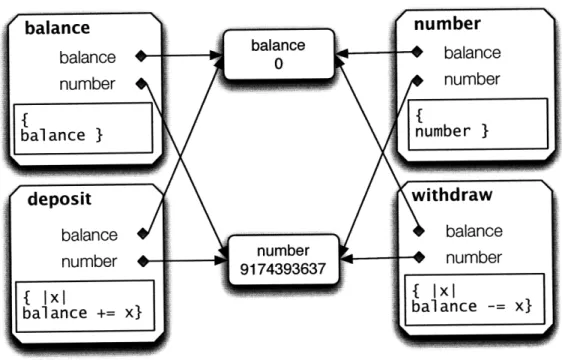
2-1 Structure of Bank Account closures . ... 33
2-2 Optimized structure of Bank Account closures . ... 34
2-3 The Chain of Trust Used by Yu to Trust the TEM . ... 40
2-4 Securing the Information in a Closure . ... 47
2-5 Closure with Mutable Variable Referencing the Persistent Store . . . 50
3-1 High-Level TEM Block Diagram ... .. 58
3-2 Snapshot of a TEM's Key Store ... ... .. 63
List of Listings
Closures in Scheme . . ... Closures in Ruby . . ... Closures in Java - Draft JSR [21] ...
Bank Account object implemented with closures . . . . VM Interpretor Code for Conditional Jumps . . . ... TEM Buffer Allocation Implementation in the Ruby Driver . TEM Primitive Data Types Expressed using the DSL . . . . Memory Block Instructions Expressed using the DSL . . . . Assembly Code for Key-Generating SECpack . . . ... Debugging Information for a SEC Execution Exception . . .
. . . . 31 . . . . 31 . . . . 32 . . . . 33 . . . . 94 . . . . 99 ... . 100 . . . . 100 ... . 101 . . . . 103 2.1 2.2 2.3 2.4 4.1 4.2 4.3 4.4 4.5 4.6
Chapter 1
Introduction
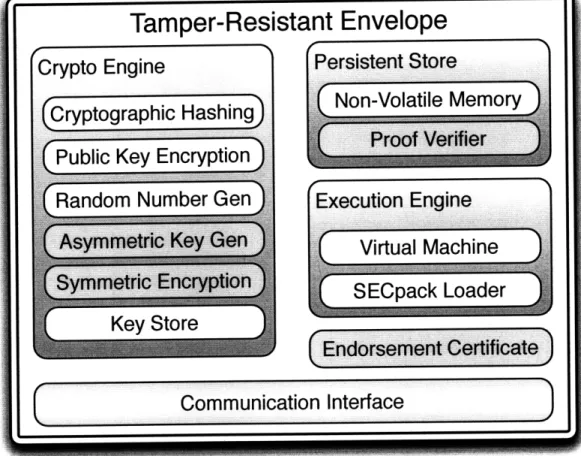
The Trusted Execution Module (TEM) is a Trusted Computing Base (TCB) designed for the low-resource environments of inexpensive commercially-available secure chips. The TEM can execute small computations expressed as compiled closures. The TEM guarantees the confidentiality and integrity of both the computation process, and the information it consumes and produces. The TEM's guarantees hold if the compiled closure author and the TEM owner don't trust each other. That is, the TEM will protect the closure's integrity and confidentiality against its owner's attacks, and will protect itself (and the other compiled closures of the TEM owner) against attacks from a malicious closure author.
The TEM executes compiled closures in sequential order, in a tamper-resistant environment. The execution environment offered by the TEM consists of a virtual machine interpreter with a stack based instruction set, and a single flat memory space that contains executable instructions and temporary variables. The environ-ment is augenviron-mented with a cryptographic engine providing standard primitives and secure key storage, and with a persistent store designed to guarantee the integrity and confidentiality of the variables whose values must persist across closure executions. The persistent store is designed to use external untrusted memory, so its capacity is not limited by the small amounts of trusted memory available on inexpensive secure hardware.
de-veloper (the closure author). The instruction set is small and consistent, the memory model is easy to understand, and the persistent store has the minimal interface of an associative memory.
The TEM was implemented on a JavaCard smart card that uses the same family of secure chips that are employed by Trusted Platform Module (TPM) implementations. The TEM's prototype implementation is a living proof that the design is practical and economical. The research code implements a full stack of TEM software: firmware for the smart card, a Ruby extension for accessing PC/SC smart card readers, a TEM driver, and demo software that leverages the driver. The protoype implementation leverages the advanced features of the Ruby language to provide a state of the art assembler which makes writing compiled closuers for the TEM very convenient.
The Trusted Execution Module has a lot of potential to enable new applications, by combining the flexibility of a virtual machine guaranteeing trusted execution with the pervasiveness of inexpensive secure chips. For example, the TEM can bring solutions to the previously unsolved problems of secure mobile agents, secure peer-to-peer multiplayer online games, and secure anonymous offline payments.
1.1
Thesis Outline
The rest of this thesis is structured as follows.
This chapter presented the context required to understand the Trusted Execution Module, and makes an argument for the value provided by the TEM. The facts here are not required for understanding the TEM, but it will greatly enhance the reader's understanding of the motivation behind the design decisions.
Chapter 2 defines the concepts that form the basis of the TEM architecture. Ambiguous or obscure notions are refined into clear definitions, which are used to explain the big ideas behind the TEM.
Chapter 3 covers the architecture of the TEM. The chapter visits each component in a TEM, providing a thorough presentation of the structures and processes involved at that component, interwoven with an analysis that sheds light on the reasoning behind the design decisions.
Chapter 4 presents a prototype implementation of the TEM architecture proposed in chapter 3. The implementation consists of a full stack, starting from firmware for a commodity secure chip, and going all the way to demonstration software that uses the TEM.
1.2
Motivation: the Need for Trusted Computing
Research on secure systems under the standard assumptions (no computer in the system can be trusted) is hitting a hard ceiling: there is only so much we can do without a trusted party in the system. The following cases illustrate this point:
1. The SUNDR paper [39] arguments that fork consistency is the best guarantee a secure system can provide in the absence of an on-line trusted party. Fork consistency means that users are protected from an un-trusted server returning arbitrary data instead of their files, but they are not protected from a server that will return old versions of their files.
2. In [6], Castro and Liskov argue that a replicated state machine (the standard architecture for implementing fault-tolerant services) needs 3N+1 replicas to survive N byzantine failures. Having trusted parties assist the consensus agree-ment protocol would reduce the number of replicas to 2N+1 (since replicas need to vote on the correct answer). This would greatly reduce both message size and the number of messages needed to achieve N-fault tolerance.
3. Peer-to-peer systems like Bittorrent [7] and Chord [53] eliminate the single-point of failure and scalability concerns of central servers. However, the absence of trusted hosts renders peer to peer architectures unusable for general applica-tions. The most notable example is MMO (Massive Multiplayer Online) games, which would benefit greatly from this technology, but need to withstand sophis-ticated attacks from players that want to gain unfair advantages.
4. Mobile payment systems are gaining traction in the UK [29], and are well-established methods of payment in South Korea and Japan [4]. However, since phones are un-trusted computers, transactions need to happen online, which raises anonymity concerns, and dooms mobile payments to a huge barrier to adoption experienced by any application that needs cooperation from cell-phone service providers.
The situations presented above are all real problems whose resolution can dra-matically impact tomorrows technology landscape.
1.3
Landscape: Related Trusted Computing Work
1.3.1
Trusted Modules
Secure platforms have been in demand since the advent of computers, especially by government intelligence agencies and by the financial industry.
Early solutions for secure platforms were supplied, most notably by IBM, as tamper-resistant assemblies that can operate either autonomously or as coproces-sors for high-end systems. The latest incarnation of these systems is the IBM 4764 co-processor [2], which is only available for IBM servers under custom contracts, which is pretty suggestive of the price range for the system.
The TPM (and its successor, the TEM) will not be in a position to replace cryp-tographic processors anytime soon, as they focus on providing a trusted platform at a low cost, which comes at a detriment to performance.
1.3.2
Smart Cards
Smart cards [27] are secure platforms embedded in thumb-sized chips. For handling convenience, the chips are usually embedded in plastic sheets that have the same dimensions as credit cards. The same chips, without the plastic sheets, are used as Subscriber Identity Modules (SIMs) in GSM cellphones. Smart cards have become pervasive, by offering a secure platform at a low cost.
The ISO 7816 standard regulates the low-level aspects of smart cards [31], namely the physical shape and disposition of contact points, voltages accepted by the contact points, and the link-layer and network-layer communication protocols between the smart card and its host device.
Platforms such as MultOS [41] and JavaCard [55] provide a common infrastructure for speeding up application development, and allow multiple applications from differ-ent vendors to coexist securely. However, both of these platforms build monolithic applications that are contained and executed completely on the smartcard. Given the limited resources available in a smart card chip, the approach above places a very
low ceiling on the complexity of the applications that can be developed.
1.3.3
Secure Processors
Secure processors represent a different approach to trusted platforms. A secure pro-cessor costs less than a trusted module because the secure envelope only contains the logic found inside CPUs. The AEGIS [54] design provides a cost-effective method for implementing a secure processor.
Secure processors are much more powerful than the chips found inside smart cards, and would be able to power applications that are significantly more complex.
1.3.4
The Trusted Platform Module (TPM)
The TPM is the first security-related computer component that has gained mass adoption, and is now included in laptop computers from major manufacturers such as Apple and IBM. The important lessons learned from the TPM's strategy are:
* The module specification should focus on the operations it must perform, and on the security requirements for the platform, without dabbling in actual chip design. This allows a variety of implementations coming from different vendors.
* The hardware required to build the module must be so cheap that its price is insignificant relative to the price of the untrusted platform it is attached to. Lack of high financial risk encourages manufacturers to adopt the technology.
* The specification should not use algorithms or concepts covered by export con-trol or technology patents. This way, vendors can design, produce and sell modules anywhere in the world. Furthermore, since algorithms that are not covered by export control can be incorporated into a universal specification, this makes the platform more attractive for application writers.
Limitations
While having the merits of removing a lot of obstacles corresponding to political and business practices in the computer manufacturing industry, the solution proposed by the Trusted Computing Group is lacking from a technical point of view. The TPM is a fixed-function unit, which means it defines a limited set of entities (such as shielded locations holding a cryptographic key or hash), as well as a closed set of operations that can be performed with the primitives (such as using a key to unwrap another key or to sign a piece of data). The TCG followed this avenue because it entailed simpler correctness proofs and promised to allow really cheap implementations. However, the fixed-function approach proved to be a poor match for the use cases envisioned by the TCG, which lead to an explosion in the complexity of the TPM specification. In response to a complex specification, vendors chose to use reasonably sophisticated secure chips borrowed from the smart-card industry.
Furthermore, the vision for the TPM states that that its main goal is to attest that the computer it is bound to is running a TCB (trusted computing base, as defined in [35] and [34]). The TCB notion encompasses all software that, once successfully attacked, may impact the correctness of computations executed by a program on the computer. The TPM design includes the software in the TCB, so a trusted platform needs to run a secure boot loader, operating system, and drivers. This is impossible to achieve in practice for the following two reasons:
1. The operating systems used in production (Windows, Linux, Mac OSX) have huge amounts of code running with administrative privileges, for performance reasons. It is impractical to analyze and certify such a large codebase, especially given the frequent stream of updates these operating systems expect. As a representative example, the Common Criteria Security Evaluation of Windows 2000 [10], [49] was completed in October 2002, which was more than one year after the following operating system version was released.
2. System drivers are a part of the TCB, even on systems that run driver software in user mode, like MINIX 3 [28]. This is because a driver communicates with
a hardware device which is connected to the system bus, and therefore has full read/write access to main memory via DMA transfers. This means that a security certification (e.g., the Common Criteria mentioned above) necessarily includes a hardware platform specification. Most systems are not willing to sacrifice agility for security, so large TCBs have proven impractical.
Last but not least, the Achilles' foot of the TPM architecture is the bond be-tween the secure chip that is TPM and its host computer. The nature of the bond implementation ultimately determines the security of the entire system, because an attacker that compromises the bond can break the attestation system. A perfectly secure bond ultimately amounts to enclosing everything connected to the main bus in a secure envelope, which yields the expensive systems described in section 1.3.1. The specification of the TPM for PC systems claims that using the LPC (low pin-count) bus [9] as the bond is a good compromise between security and cost. However, version 1.1 of the TPM specification has been broken by a trivial one-wire attack [36] on the LPC bus, and version 1.2 still leaves room for a relatively simple attack [37].
The TPM is still useful in the absence of trusted software, as shown by works like [46]. However, the lack of general-purpose computation places very narrow bounds on the applications of the TPM. In practice, the chip is most often used to implement a secure key store to be used in multifactor authentication, as illustrated by [58].
1.3.5
The Need for a TEM
The Trusted Computing research group at MIT, led by Professor Srinivas Devadas, has researched the applications afforded by the TPM, and understood its limitations. The group submitted and received funds for a NSF grant proposal containing the idea of a Trusted Execution Module that would be similar to the TPM, but provide execution capabilites.
The proposal of adding execution capabilities to the TPM mentioned above was the seed for this work. My thesis provides the result of exploring the idea mentioned above. In the process of turning the idea into a concrete implementation, the
unnec-essarily complex aspects of the TPM's design have been discarded, and replaced with new mechanisms that support an elegant execution model.
1.4
TEM Features
The Trusted Execution Module (TEM) was inspired by the Trusted Platform Module, and it follows the principles (described in Section 1.3.4) that led to its widespread adoption.
The breakthrough provided by the TEM is the capability to execute user-provided procedures in a trusted environment, for the low price of a commodity chip. This makes the TEM capable of revolutionizing consumer software security in the same way that the graphical quality of consumer software user interfaces was revolutionzed by the switch from fixed-pipeline to programmable GPUs.
Most importantly, the TEM does not require any trusted software outside the secured chip. The TPM can make a trusted statement of whether its host computer is running trusted software or not. However, the TPM is nearly useless if its host is not running trusted software, whereas the TEM considers this state to be the normal operation mode.
Since the TEM does not assume trusted software on its host, it does not need to certify the host software. Therefore, the TEM hardware does not need to be securely bound to its host. This means that a TEM can cost less than a TPM, and that existing computers can be enhanced with TEMs via standard extension buses, like the USB.
Switching from fixed-function to a programmable architecture provides simpler alternatives to the TPM's complex mechanisms. This lowers the barrier to designing and producing software that leverages the secure module. The best example of the simplifications achieved is replacing the TPM's hierarchical storage scheme with a conceptually simple associative memory. Furthermore, key migration is removed from the core architecture, as it can be achieved completely by user procedures.
The TEM does not trust the authors of the programs it runs. A malicious TEM program cannot negatively impact the module it runs on, and it cannot interfere with the result of running programs written by other authors. This feature implies there is no need for a program certification system, like the authentication schemes used on
gaming consoles. So the barriers for TEM program developers are as low as possible. Last but not least, the TEM can be used as a drop-in replacement for the TPM, in the applications that don't assume trusted software on the host computer. Indeed, it is possible to implement the TPM's functionality as user-supplied TEM programs, while maintaining the security guarantees provided by TPM chips. This can ease the transition from TEMs to TPMs. Note that realistic TPM applications cannot assume trusted software on the TPM host, because there is no trusted software stack for PC computers.
Chapter 2
TEM Concepts
This chapter introduces the concepts used in the Trusted Execution Module. It defines ambiguous or obscure terms, and explains the big-picture ideas behind the TEM.
The TEM is a very small TCB (Trusted Computing Base) which can be enclosed in a tamper-resilient envelope at commodity prices. The platform provides the guar-antees associated with trusted execution, even if the user requiring trusted execution is not the TEM's owner.
The TEM's execution primitive is the closure. Section 2.1 explains the benefits and research behind the decision.
The TEM provides the possibility of trusted execution on computers outside one's ownership. Section 2.2 analyzes the definition of trusted execution and explains the family of situations in which the TEM can add value.
The root of trust in the TEM is an Endorsement Certificate produced by a TEM's manufacturer, asserting that a public key (the Public Endorsement Key) corresponds to a private key that is only known to unique TEM. Section 2.3 explains the chain of trust that leads to this assertion.
Closures are transmitted to the TEM in a binary format that is convenient for the TEM to process. Section 2.4 begins with by classifying the pieces of information inside a closure according to the required guarantees. The bulk of the section is dedicated to introducing a cryptography-based process that guarantees the confidentiality and integrity of a closure's contents, as it is transmitted via unsafe channels to the TEM.
Closures can use non-local mutable variables, whose values must persist across clo-sure executions. The TEM stores all these values in an associative memory. Addresses are the same size as encryption keys, so the knowledge of a variable's address serves as proof of authorization to access the variable's value. This rather unconventional design is covered in section 2.5, where I argue for its robustness and minimality.
2.1
Expressing Computation with Closures
The closure is the execution primitive of the TEM. This allows the use of virtually any programming paradigm with the TEM. Compiled closures (described below) can be implemented in an execution engine that is just a bit more complex than an engine designed for procedural execution. This translates into a small' execution engine that is suitable for implementation on embedded platforms.
The term closure was defined in [56] to mean "a function that captures the bind-ings of free variables in its lexical context." Essentially, a closure is a fragment of executable code, together with the bindings of the variables that were in scope when the closure was defined.
The listings below demonstrate the sytanx for closures in Scheme (Listing 2.1), Ruby (Listing 2.2), and Java (Listing 2.3). adder is a closure that captures the value of term, which is a local variable in the enclosing function.
(define (adder term)
2 (lambda (x) (+ x term))) 3 (define increment (adder 1)) 4 (define six (increment 5))
Listing 2.1: Closures in Scheme
def adder (term)
lambda { Ixl x + term } end
increment = adder (1) six = increment . call (5)
Listing 2.2: Closures in Ruby
As shown in [24] and [26], closures are extremely powerful and expressive. They can be used to implement most primitive structures in modern programming lan-gauges. To provide immediate assurance to readers, we will show the use of closures to build objects (in the sense intended by Object-Oriented Programming [11]) featur-ing encapsulation. We use the same idea employed by ECMAscript [19] (best known
today as JavaScript). Listing 2.4 demonstrates the use of closures to implement a bank account object. The code is in Ruby for brevity's sake, but does not use Ruby's built-in features for Object-Oriented Programming.
The closures created by executing listing 2.4 are illustrated in figure 2-1. This drives home the point that a closure is code together with a set of variable bindings. A closure contains a, sequence of executable code, and a binding table that associates variable names with pointers to memory cells storing the variables' values. In order to implement mutable state, it is essential that the memory cells are shared between closures, and the changes made by one closure are immediately visible to all the other closures that reference the same memory cell.
2.1.1
Compiled Closures
The TEM is intended to provide trusted execution at commodity prices. Therefore, the design will be implemented in embedded chips, where persistent variables are expensive2. The following optimization, inspired from [25] is helps reduce the amount of shared memory cells used by a closure. Some of the variable bindings are de-facto immutable (constant). That is, the values of the bindings will never be modified throughout the lifetime of a closure. This means that, instead of storing the binding's value in a shared memory location, the constant value can be stored directly in each closure's binding table. This eliminates most uses of shared memory locations. [25] uses this mechanism to decide whether frames will be allocated on the stack or in the
2
Variables' values may change, therefore they would have to be stored in EEPROM. EEPROM is the slowest and most expensive type of on-chip memory.
1 class Closures
{
2 public static {int => int} adder(int term) {
3 return
{
int x => term + x };4
5 public static {int => int} increment = adder (1);
6 public static int six = increment. invoke (5);
7Listing 2.3: Closures in Java
aex oanK_accoUIt \accoUI _n1umIeI ) balance = 0
account = Hash.new
account [:balance] = lambda { balance }
account [:number] = lambda { account_number }
account [: deposit = lambda I lamount
I
balance += amount}
7 account
[:
withdraw] = lambda{
I amount I balance -= amount}
8 end
Listing 2.4: Bank Account object implemented with closures
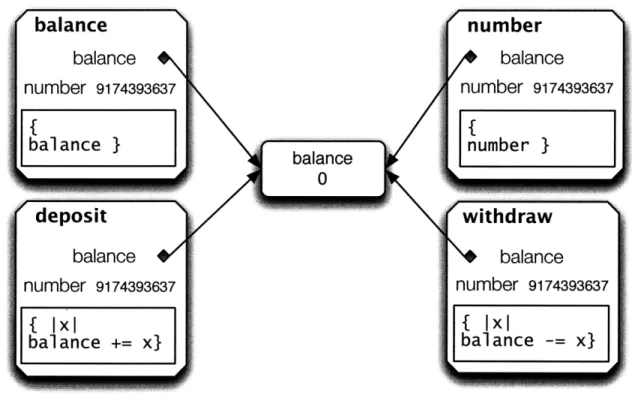
Figure 2-2: Optimized structure of Bank Account closures
heap.
For example, knowing that all the languages used in this section (Scheme, Ruby, Java) pass primitive types by value (as opposed to passing by reference) allows us to assert that term in listings 2.1, 2.3, and 2.2 are de-facto immutable. The proof is quick and straight-forward: term is a function parameter, therefore it is local to the adder function. fact is not on the left-hand side of any assignment in adder, therefore it is de-facto immutable.
By a similar argument, it is easy to prove that number in listing 2-1 is de-facto immutable, and balance isn't. So the closures' binding tables can be optimized to use one shared memory location instead of two, as illustrated in figure 2-1.
The result in figure 2-2 is further amenable to well-known optimizations, such as removing the unreferenced entries in the closures' binding tables. For instance, the variable number is not used at all in the closures balance, deposit, and withdraw, so it can be removed from their binding tables.
A compiled closure is a closure that has been fully optimized for the computer that is intended to execute it. A compiled closure consists of the following:
* the computation to be performed, expressed as executable instructions that can be interpreted by the target computer,
* a binding table that contains all the non-local variables,
* values for the non-local variables that are de-facto immutable, and
* addresses (references to shared memory locations) for mutable non-local vari-ables.
As a note, the approach used in Erlang [5] deserves interest. The language has no mutable state, so closures do not need shared memory locations. This is essential for concurrent programming. Upon further inspection, I decided that the ideas used to implement mutable state in Erlang (e.g., Mnesia [42]) would prove less efficient than allowing shared memory cells and using the optimizations described above.
2.2
Trusted Execution
This section argues that trusted execution is equivalent to being able to guarantee the integrity and confidentiality of a computation.
Starting out from an intuitive level, I claim that Yu3 trusts a computer if she has confidence that the computer is doing what she expects it to be doing.
For instance, software developers trust their computers to faithfully execute their code, and not share it with the outside world. When an issue occurs, the cause is assumed to be a bug in the program undergoing development, and the average developer never wonders if the CPU did execute the code it was given, or if the low-level instructions produced by the compiler or interpreter match the source code. On the other hand, if the same software developer plays a game over the Internet and is pwned4, the first thought that will come to her mind will be "did they use hackss?!"
Like most other people, Yu naturally trust computers she owns, and she trusts the communication between her and a computer in her physical vicinity. However, when using a system that is not in the same room (for instance, over the Internet), or a system that belongs to someone else, Yu's trust disappears as she is concerned that the computer's owner may tamper with the executable instructions or the program's
data.
The example above highlights two factors that can make Yu distrust the output produced by a system:
* physical vicinity; Unless the computer is close to her, Yu doesn't trust the communication channel. This problem has been solved, and the standardized solutions are SSL [20] and TLS [15].
* ownership; Yu does not trust computers owned by others. Commodity com-puters were fundamentally designed to run arbitrary code, and all attempts at building systems that restrict the access of owners to their computers have 3
Yes, Yu is intentionally spelled so that it reads just as you.
4
loses dramatically
5
modifications to a game's executable code which help a player perform better by revealing secret information or improving their commands
failed. (and met with huge amounts of protest)
2.2.1 Trusting Other People's Computers
The hard (and therefore interesting) scenario is that Yu needs to perform a compu-tation on Mii6's machine, and needs the guarantees of trusted execution. From this we can infer the following:
1. The computation is part of an interaction between Yu and Mii. could have run the code on her own computer that she trusts. 2. Mii has an incentive to complete the interaction between Yu and
not the case, then Mii has no incentive to run Yu's code on his alone provide trusted execution guarantees.
Otherwise Yu
Mii. If that is computer, let
So the process will be carried out as follows:
1. Yu will package the instructions to carry out the computation she needs in a format suitable for consumption by Mii's TEM.
2. Yu will transmit the package to Mii.
3. Mii will instruct a TEM attached to his computer to execute the package. 4. If Yu needs to know the result of the computation, Mii will transmit this result
to Yu.
The scenario presented above will be referred to as the use model of the TEM, because it reflects the way I intend users to interact with the platform.
2.2.2
Integrity and Confidentiality
We start out by defining integrity and confidentiality. Note that the definitions assume the context of the use model introduced in section 2.2.1.
6
You are right, Mii was intended to read like me. The name was invented by Nintendo, and is
Definition. Integrity is the guarantee that the computation being carried out on Mii's computer is the one specified or intended by Yu.
Practically speaking, integrity means that Mii should not be able to change the computation performed by his computer. Using the bank account example in section 2.1 (listing 2.4), Yu would be the online banking provider, and Mii would be an account holder in Yu's bank. Integrity implies, for instance, that Mii cannot modify the computation in withdraw so that balance remains unchanged (and thus gain an infinite amount of money).
Definition. Confidentiality is the guarantee that Mii will not learn any information that is not explicitly disclosed by Yu, as a result of performing the computation. In other words, Yu's secrets will be shielded from Mii.
As an initial motivation for confidentiality, note that computer systems are used in a competitive society, so it is unavoidable that computations will involve information that should be shielded from some parties.
The rest of this section relies on the intuition and the use model developed so far to prove that trusted execution is equivalent to the guarantees of integrity and confidentiality. First, I prove that integrity is required by trusted computing, then I prove that integrity requires confidentiality. The proofs also show how that trust in execution can be asserted based on given integrity and confidentiality.
Theorem. Trusted execution requires the guarantee of integrity.
Proof. The use model described in section 2.2.1 is assumed. All scenarios where the
TEM use model holds can be classified into of the following categories:
1. the computation contains one of Yu's secrets, so integrity is required, to ensure that the computation isn't transformed in a way that would make the result give Mii information about Yu's secrets (e.g., replace the entire execution with
"return secret").
2. the computation does not act on any of Yu's secrets, so it must be the case that Mii will contribute some information to the computation, and that Yu
needs to trust the final result. If Mii has no contribution, then Yu can execute the computation on her own computer which she trusts. If Yu does not need to trust the final result, it follows that Mii is the only one using the result, therefore Mii can obtain Yu's information (which contains no secrets, according to the hypothesis for this category) and execute it on a computer that Mii alone trusts. This contradicts the hypothesis that trusted execution (as defined in at the beginning of the section) is needed.
Theorem. The integrity guarantee of trusted execution requires confidentiality.
Proof. Assume that the computation to be performed does not require any secret
that Mii does not posess. Otherwise, confidentiality is trivially required, because the computation's specification includes the requirement of not disclosing the secrets.
The Church-Turing thesis (explained in [32]) holds for today's computers. This has the implication that a very simple computer (a Turing machine) can emulate any commodity computer that has been built to date. Since all computers can essentially perform the same calculations, it follows that it is impossible for Yu to formulate her computation in such a way that carrying out the computation on different computers would yield different results. Thus, Yu cannot distinguish between the case where Mii would show her the genuine result of her computation, and the case where Mii would show her maliciously contrived data.
We conclude that if the computation doesn't depend on information that is secret from Mii, no proof of integrity can be built. Conversely, proving integrity requires information that is secret from Mii, so confidentiality is required to ensure that the
2.3
A Chain of Trust for the TEM
Section 2.2.2 shows that trusted execution requires that a secret be established be-tween Yu and Mii's computer that Yu trusts. This section describes a chain of trust that allows Yu to assert that a public key corresponds to a private key that can only be found inside a computer Yu trusts. The chain of trust was derived by removing the unnecessary parts from the chain of trust used for platform attestation in the TPM [1].
Protects
Publishes
Already Trusts
PubCA
Manufacturer
Mii
-,- hnwc VIi
I, CA, hereby
to a TE'M
Figure 2-3: The Chain of Trust Used by Yu to Trust the TEM Owns Yu Endorses Mii's TEM Shows Mii Prrltw'c ns Verif
" Afi. & k-~laA 1
i-The public and private keys in this section can use any public-key encryption system, such as RSA [45] or ECC [33]. Figure 2-3 illustrates the chain of trust.
The root of trust is a hardware manufacturer (such as Infineon or Atmel), which acts as a Certificate Authority in a public key infrastructure as defined in [30]. The manufacturer has an asymmetric key named the Certificate Authority key. This key consists of protects the private key (PrivCA), while the public key (PubMK) is assumed to be well known.
At TEM manufacturing time, an asymmetric key, called an Endorsement Key, is generated for each TEM. The Private Endorsement Key (PrivEK) is securely em-bedded into the TEM. Then the manufacturer's private key (PrivCA) is used to sign an Endorsement Certificate (ECert) containing the TEM's Public Endorsement Key (PubEK), and stating that the Endorsement Key has been embedded in a hardware device that provides the security guarantees required by a TEM.
The TEM's Public Endorsement Key can be used to encrypt a secret generated by Yu, which becomes the shared secret between Yu and Mii's TEM needed to satisfy the requirement in 2.2.2. Once Mii presents Yu with his TEM's Endorsement Certificate, she is assured that any secrets encrypted with PubEK can only be decrypted by Mii's TEM, as it is the only computer that knows PrivEK. This method allows for secret information to flow securely from Yu to Mii's TEM. If there is a need for secret information to flow the other way, Yu can send Mii's TEM a symmetric7 or asymmetric encryption key, which is protected as described above, and allows for secure communication of secrets in both directions.
As stated towards the beginning of this section, the chain of trust is rooted at the hardware manufacturer who emits the Endorsement Certificate. Readers troubled by the need to trust big manufacturers should note that they have probably entrusted their information to small stores and credit unions, as well as to people working for various institutions.
7Building symmetric encryption features into the TEM requires careful consideration, because
2.3.1
Anonymizing the TEM
The chain of trust above has a potential issue: the proof that a TEM can be trusted requires the Public Endorsement Key. Since a TEM has exactly one PubEK, the PubEK can be used to identify and track the TEM, and thus its owner. This may be unacceptable in some circumstances, as it leaks information about the users' identity, just like the Intel Processor Serial Number (PSN) [23], which has generated great public uproar. Fortunately, the chain of trust described above can be amended in a way that makes the TEM untraceable.
The threat to anonymity stems from the fact that a TEM has a single Public Endorsement Key, which acts as a shared secret between the TEM and Yu, so Yu sees the same PubEK every time she interacts with Mii's TEM. This can be improved by adding an extra layer of keys, as follows.
In the modified design, when Mii needs to interact with Yu, he instructs his TEM to create a new asymmetric User Key, which is handled similarly to the Endorsement Key. The Private User Key (PrivUK) is never disclosed by the TEM, and the Public User Key (PubUK) is included in a User Certificate (UCert) signed by the TEM's Private Endorsement Key (PrivEK). The User Certificate states that the User Key was generated by the TEM, and the appropriate security guarantees hold.
Mii sends the User Certificate, together with the Endorsement Certificate, to a trusted server maintained by the TEM's manufacturer. The server verifies the two certificates to make sure that the Public User Key was indeed generated by a TEM emitted by the manufacturer, then the server gives Mii a User Endorsement Certificate (UECert) signed by the manufacturer's private CA key (PrivCA), and stating that the User Key provides all the security guarantees of a TEM User Key.
At the end of the process Mii can use the User Endorsement certificate to prove that the User Key can be trusted just as much as an Endorsement Key. However, UECert does not contain any information identifying the particular TEM used to generate the User Key. So this mechanism makes the TEM untraceable.
mecha-nism in the TEM. The steps above can be implemented in the TEM as programs on top of the architecture presented in chapter 3, which was designed without regard to this section. Therefore, the information here does not pertain to the TEM's design. Rather, it is included as to pacify any anonymity concerns that a reader may have.
2.4
Security-Enhanced Closures
Section 2.1 states that the closure is the execution primitive of the TEM, and illus-trates the structure of a closure. It follows that the TEM's mission is to provide trusted execution for closures. According to section 2.2.2, this is equivalent to guar-anteeing integrity and confidentiality.
Section 2.4.1 classifies the information inside a closure as private, shared, or open, according to the guarantees needed. A Security-Enhanced Closure (SEC) is a closure with all the information classified as described above.
Before they can be executed by the TEM, SECs must be compiled and encoded in a format that is easy to process, so that the logic to be implemented inside the TEM is minimized. The rest of this work uses the term SECpack to refer to compiled and encoded SECs.
SECpacks are suitable to be executed by the TEM, but the information inside them is unprotected. Section 2.4.2 describes a process that uses a TEM's Public Encryption Key (PubEK) to produce a bound SECpack. The bound SECpack contains the same information as the original SECpack, but it enforces the confiden-tiality and integrity of the information it contains. Thefore, Yu can safely give Mii a SECpack that was bound to Mii's TEM. The term bound is justified by the fact that a bound SECpack can only be used by the TEM whose PubEK was used to produce the bound SECpack.
2.4.1
Security Guarantee Classes
Section 2.2.2 shows that trusted execution is equivalent to providing integrity and confidentiality guarantees. However, both guarantees are not needed by all the infor-mation expressing a computation. Therefore it makes sense to classify the informa-tion, according to the guarantees needed:
* private: this is information that requires the confidentiality guarantee. Exam-ples of secret information are Yu's social security number, or one of her private encryption keys.
* shared: this is information that only requires an integrity guarantee. In the back account example in section 2.1, if the code for withdraw can be changed to the code for deposit, that would have dramatic consequences on the bank. * open: this information is not covered by any guarantee. This has to be informa-tion that Mii supplies to the computainforma-tion. As described in secinforma-tion 2.2.1, Mii is the TEM's owner, and therefore he is the only one who would trust the platform automatically, without requiring any proof of integrity or confidentiality. Private information must automatically receive an integrity guarantee, in order to ensure no secret is leaked. For example, secrets are usually encryption or signing keys. If Mii can replace one of Yu's key with his own, Yu's key will still be confidential, but Mii can access any information encrypted by Yu's key.
Section 2.2.2 proves that all the executable code in a closure requires an integrity guarantee. It follows that for trusted execution, all the executable code in a SEC is either private or shared.
For reasons of simplicity, it seems appealing to remove the shared class of infor-mation, and specify that all the information originating from Yu is private. However, if all the executable code is made private, then it is impossible for Yu to prove Mii anything about the nature of the computation expressed in the closure. The shared class is motivated by my conviction that known information should not be encrypted, and by applications where Mii must verify that the closure expresses a certain com-putation.
The next section describes a method for implementing the security guarantee classes presented here, thus demonstrating that the idea is practical.
2.4.2
Implementing the Security Guarantee Classes
The TEM's use model (section 2.2.1) states that the information describing Yu's com-putation will pass through at least one intermediary (Mii) before reaching the TEM. Therefore, it is reasonable to assume that the information can be altered arbitrarily in the passage from Yu to Mii's TEM.
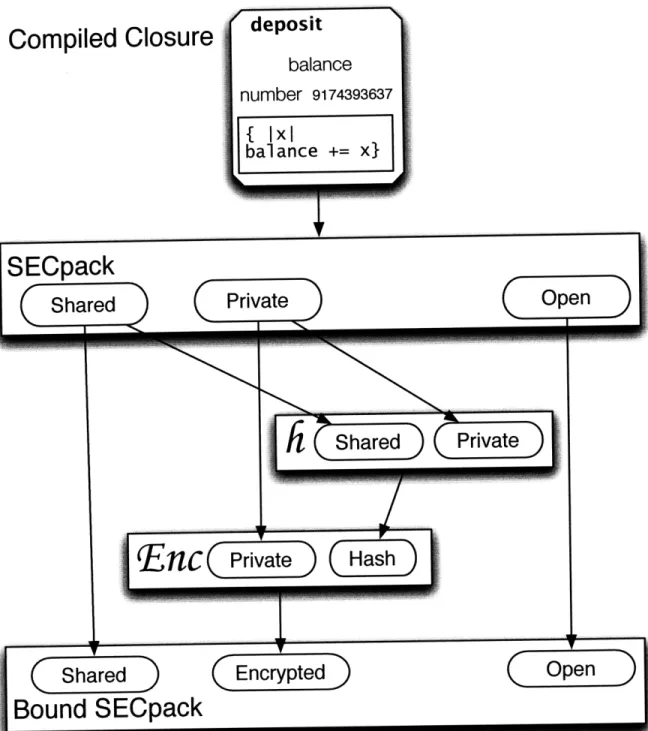
Fortunately, Yu can be assumed to know the TEM's Public Endorsement Key (PubEK), and she can use it to communicate secrets securely to the TEM, accord-ing to section 2.3. The followaccord-ing process, illustrated in figure 2-4, uses the Public Endorsement Key to convert a SECpack into a form that provides the appropriate guarantees (section 2.4.1) for the information inside the SECpack, despite the fact that the information has to pass through Mii's hands.
1. Let P be the private information, S be the shared information, and O be the open information.
2. Use a cryptographic hashing function h (such as SHA1 [16] or MD5 [44]) to compute a message digest of the private and the shared information.
H = h(PI S)
Note:
II
denotes concatenation.3. Use the TEM's Public Endorsement Key to encrypt the private information together with the message digest.
E = EncPubEK(P I 7-)
4. The secured closure consists of the encryption result 8, together with the shared information S, and the open information O.
Secured Closure = (S IISI0)
Yu will follow the process above to secure her closure before transmitting it to Mii. When Mii's TEM will receive the closure, it will use its Private Endorsement Key (PrivEK) to decrypt E and obtain P and N. In order to guarantee integrity and privacy, the TEM will refuse the input if 7 doesn't match the hash of PllS. This is sufficient to provide the security guarantees for private and shared data, as proven by the following:
Compiled Closure
Shared
Private
Figure 2-4: Securing the Information in a Closure balance
Theorem. The scheme described above guarantees the confidentiality of the private
information P and the integrity of the shared information S and the private informa-tion P.
Proof. By strong induction over NE, the number of execution attempts of the secured
closure on Mii's TEM. Note that an execution attempt can fail, if Mii attempts to change P and/or S in the closure (the fact follows immediately from this theorem).
Base case. the guarantees are provided on the secured closure's first execution attempt.
P cannot be directly derived from 8, assuming the encryption algorithm associated
with PubEK is resistant to Mii's attacks8, and that h is inverse-resistant9. As a special case, note that P will never be empty, because the trusted execution assumption implies the existence of confidential information, as proven in section 2.2.2.
Assuiming P's confidentiality (proven above), it follows that, in order for Mii to mutate S to S', Mii must break h as well as EncPubEK in order to produce the correct values of R' and S' without knowing P.
The process is resistant to modifications of P as well, as long as the entire value of P is not replaced. Assume the mutation transforms P = (P
IIPol
PQ) into P' = (PjIlPlPj).
The argument in the previous paragraph can be used to show that Mii must break h and EncPubEK, since he does not know Pq and/or P (at most one of them may be empty).Therefore, Mii cannot determine his TEM to execute the secured closure with modifications to P or S without replacing P completely. But once P is replaced with a value known by Mii, the closure does not contain any of Yu's secrets. There-fore, the notion of trusted computation isn't applicable to the resulting closure - the computation in it can be specified by Mii alone, and executed on any platform.
Induction step. assuming the guarantees are provided on the secured closure's first NE execution attempts, I will prove that the guarantees will be provided on the
(NE + l)th attempt.
8
This is believed to be true, at least for RSA [45] and ECC [33].
9It is impossible to compute PI S from H. This is true for any good cryptographic hash function, and it is believed to be true for SHA1 [16] and MD5 [44].
P's integrity is guaranteed for attempts 1... NE, so the TEM cannot be used to execute closures containing arbitrary mutations of P. Therefore, no information about P is leaked in the first 1 ... NE attempts. Hence, recovering P on the (NE+ 1)th attempt is just as difficult as recovering it directly from S. Therefore, the assumptions of the base case still hold, and the same argument can be used for the induction
2.5
Persistent Storage for Mutable Variables
Section 2.1 explains the process of obtaining compiled closures. The instructions and the constant variable bindings in a compiled closure are contained in the SECpack given to the TEM when the closure must be executed. The overhead of decoding the same instructions and constants is much smaller than the cost of persistent state. On the other hand, the values of the mutable variables must persist in the TEM across closure executions. To prevent integrity attacks that use stale data, the TEM owner cannot be trusted with the values of mutable variables, even if the values are encrypted and signed.
, , ... ... ... ... ... .. ... ... ... ... ... .... ... .. ..-.. ... . ... ... .. ... .. .... .... ... ... ... ... .. ... .... .. ... ..
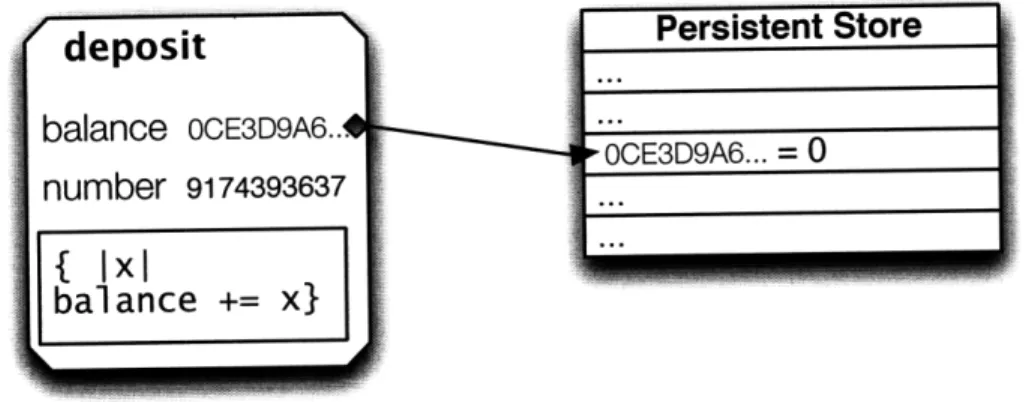
deposit
balance OCE3D9A6..4 number 9174393637{ Ixl
balance += x}Figure 2-5: Closure with Mutable Variable Referencing the Persistent Store The values of mutable variables are stored inside a secured global persistent store (Figure 2-5), indexed by addresses which are guaranteed to be at least as large as a cryptographic hash. An address identifies a value and is also proof that a closure is authorized to access that value. The information in the persistent store is stored in a way that prevents any accesses that bypass the associative memory abstraction. The implications of the requirement above are discussed in section 3.2. The following theorem proofs the security of this design.
Theorem. Gaining unauthorized access to the value of a mutable variable is as hard
as directly breaking chain of trust.
Proof. Gaining access to a variable is equivalent to obtaining the variable's address,
because the associative memory abstraction cannot be bypassed. Assume that the
-r I a o n a 1 1 B E a a Persistent Store
---OCE3D9A6... = 0 !.o.variable's address is stored in P in the secured version of the TEM. This holds for any well-designed secure closure. The analysis in section 2.4.2 shows that information in
P is not leaked by repeated attempts to execute a closure, so the only possibility of obtaining the variable's address is by guessing it.
If Mii has an oracle10 that can produce enough bits to allow Mii to guess a vari-able's address, then he can use the oracle to build a false Endorsement Certificate, as follows. Mii can generate an asymmetric key, and build a certificate for it by copying all the other fields from the Endorsement Certificate of his TEM. Then Mii can use the oracle to guess a value v that can be assigned to one of the inessential certificate fields (serial number, subject name, an optional field), so that the certificate's cryp-tographic hash matches the new data. The essential fact here is that an address has at least as many bits as a cryptographic hash, so v would be long enough to impact all the bits in the certificate's hash.
Once Mii has an Endorsement Certificate for his personal key, he can convince Yu to encrypt her secrets with his public key, thus the chain of trust is broken. Therefore, the effort needed to gain access to the value of a mutable variable is sufficient to break
the TEM chain of trust directly. O
Section 2.5.1 shows that the use of addresses as authorization values is robust and does not raise any issues when the closure is put together. The persistent store design presented here is minimal, as demonstrated in section 2.5.2. Chapter 3 demonstrates the practicality of these concepts, by presenting an architecture built on top of them.
2.5.1
(No) Considerations for Authorizations
The use of value addresses as authorization values may concern software developers, because intuition dictates that, under this design, closures should not use too many variables, to minimize the surface area for a guessing attack. The result below dissi-pates this concern, by showing that closures using a high number of variables are as safe as closures using one variable. The theorem presented here can also be used to
1 0
conclude that it is safe for a closure to use consecutive persistent store addresses. Lemma. Compromising a closure using N mutable variables is equally hard if the
authorization secrets are randomly distributed or consecutive numbers. Furthermore, either closure is insignificantly easier to compromise than a closure with a single mutable variable.
Proof. Let b be the size of the authorization secrets, in bits. Then A = 2b is the size
of the universe of authorization secrets. Section 2.4.2 shows that no information on authorization secrets is leaked as long as they are correctly classified as private (in
P), so the only attack on mutable variables is guessing values directly.
It follows that attacks on mutable variables are (educated) guesses of their autho-rization values. Assuming an attacker makes perfect use of his knowledge of address distribution, and stops upon a successful guess, the guesses can be considered inde-pendent probes. So the probability of success after g guesses is pg = 1 - (1 - p1)9,
where pi is the probability that a single guess will be successful.
The probability that a random guess matches one of the N authorization secrets is
U, regardless of the distribution of the N variables. An attacker with full information
on the distribution of the secrets can improve his chances of success to pl = N, in the best case (e.g., if the secrets are consecutive, the attacker would probe one out of every N addresses).
The number of guesses g(a, N) required to compromise one of the N variables with probability g(a, N) is given by the equation:
N2
1 - (1 - )9(,N) = a
which solves to:
g(za,N) log(1 - a) log(1 - N2)
For the lack of a better definition, assert that the number of variables N has no impact on security if it causes the loss of less than one bit of security. In other words, the number of bits that the attacker needs to guess is reduced by one. This is