Publisher’s version / Version de l'éditeur:
Journal of American Oil Chemist's Society, 81, January 1, pp. 91-96, 2004-01-01
READ THESE TERMS AND CONDITIONS CAREFULLY BEFORE USING THIS WEBSITE. https://nrc-publications.canada.ca/eng/copyright
Vous avez des questions? Nous pouvons vous aider. Pour communiquer directement avec un auteur, consultez la première page de la revue dans laquelle son article a été publié afin de trouver ses coordonnées. Si vous n’arrivez pas à les repérer, communiquez avec nous à [email protected].
Questions? Contact the NRC Publications Archive team at
[email protected]. If you wish to email the authors directly, please see the first page of the publication for their contact information.
NRC Publications Archive
Archives des publications du CNRC
This publication could be one of several versions: author’s original, accepted manuscript or the publisher’s version. / La version de cette publication peut être l’une des suivantes : la version prépublication de l’auteur, la version acceptée du manuscrit ou la version de l’éditeur.
For the publisher’s version, please access the DOI link below./ Pour consulter la version de l’éditeur, utilisez le lien DOI ci-dessous.
https://doi.org/10.1007/s11746-004-0862-2
Access and use of this website and the material on it are subject to the Terms and Conditions set forth at
A laboratory study for developing an aqueous process to make
skimmed soymilk
Xu, Lei; Kumar, Ashwani; Lamb, Karen
https://publications-cnrc.canada.ca/fra/droits
L’accès à ce site Web et l’utilisation de son contenu sont assujettis aux conditions présentées dans le site LISEZ CES CONDITIONS ATTENTIVEMENT AVANT D’UTILISER CE SITE WEB.
NRC Publications Record / Notice d'Archives des publications de CNRC:
https://nrc-publications.canada.ca/eng/view/object/?id=59dbe3ba-6c01-4977-a56d-06f79d4a4495 https://publications-cnrc.canada.ca/fra/voir/objet/?id=59dbe3ba-6c01-4977-a56d-06f79d4a4495ABSTRACT: Soymilk was extracted from soybeans at room
temperature, using water-to-bean ratios of 10:1 and 30:1 to ob-tain two different protein concentrations. Defatting of soymilk by centrifugation was studied with a focus on the effect of pro-tein concentration. A kinetic model, with a rate constant k and a fat-protein binding constant K, was established by linear re-gression to describe the defatting process in both cases. A high water ratio resulting in a low protein concentration was favor-able to defatting. Based on these results, an aqueous process was developed for the production of skimmed soymilk, consist-ing of grindconsist-ing, extraction, cookconsist-ing, centrifugation, and ultrafil-tration. The product obtained had about 3 wt% protein and 0.3 wt% fat and thus qualified as skimmed soymilk.
Paper no. J10632 in JAOCS 81, 91–96 (January 2004).
KEY WORDS: Aqueous processing, centrifugation, defatting,
kinetic model, soymilk, ultrafiltration.
Originally from the Orient, soymilk is becoming popular worldwide as the nutritional value of soy proteins is increas-ingly recognized. As an alternative source of supplementary proteins, it is particularly recommended to people experienc-ing intolerance to lactose present in cow’s milk. The tradi-tional way of making soymilk involves blending presoaked soybeans with water, cooking the ground mass, and straining it through filter cloth (1). Soymilk thus processed contains 2–3 wt% protein and 1–2 wt% fat. Although the protein makes the drink nutritious, the fat is viewed as a drawback by consumers because of the negative effects of fat such as weight gain. Therefore, there is a growing demand for skimmed soymilk.
Fat-free soymilk available in the market is made from vent-defatted soy flour or meal. Defatting with organic sol-vents such as hexane is currently the standard practice in the soy industry. However, hexane defatting requires sophisti-cated extraction and recovery equipment, and the solvents pose health, safety, and environmental hazards. Therefore, al-ternative methods that do not use organic solvents for defat-ting are being sought in an effort to produce high-quality oil and protein products from oilseeds. Aqueous processing, which has received much attention due to its potential advan-tages, uses mainly water to extract oil and protein and hence is simple, safe, and environmentally benign. The key steps in
aqueous processing include milling, extraction, solids separa-tion, defatting, and protein recovery. In solvent extraction the oil is dissolved in miscible solvents, whereas in aqueous pro-cessing defatting is achieved by breaking emulsions through various mechanisms such as creaming, sedimentation, phase inversion, ripening, and coalescence (2). Centrifugation, one of most commonly used methods to break an emulsion, is based on creaming and coalescence, and both heating and freezing can destabilize emulsions by promoting coalescence. As a component of an aqueous process, the recovery of pro-tein is usually accomplished by isoelectric precipitation or ul-trafiltration before drying.
Several studies have reported aqueous processing of oilseeds, including peanut (3–6), cotton (3), soybean (7,8), sunflower (9), and mustard (10). Hagenmaier et al. (11,12) readily extracted and separated clear oil from coconut using aqueous processing. For soybean processing, the results of Lawhon et al. (8) were of particular interest, because one of their aqueous processes gave a concentrate with nearly 80 wt% protein but less than 2 wt% fat. This was the lowest fat level in the protein products yet reported for an aqueous process. The method was, however, not very effective with seeds having high oil contents (such as rapeseed and mus-tard), and it tended to produce protein products with appre-ciable oil contents in the end. Sometimes proteolytic enzymes were used to aid oil separation from proteins since the hydroly-sis of the oil-binding proteins would favor the coalescence of oil droplets (2). Most of these proteins are located in the membranes of oil bodies in the seeds and are relatively hy-drophobic. The use of enzymes would, of course, increase the cost of products and is therefore fit for only high-value prod-ucts in commercial production. For commodity items such as soymilk, where cost is still a major concern, simple and inex-pensive processes are favored. Therefore, enzyme use may not be justifiable.
In an attempt to develop an aqueous process to produce skimmed soymilk, we combined and rearranged the typical operations used in soymilk production and aqueous process-ing of oilseeds, namely, grindprocess-ing, extraction, cookprocess-ing, filtra-tion, centrifugafiltra-tion, and ultrafiltration. The present study re-ports defatting kinetics of soy extraction including the effect on defatting of various process conditions such as water-to-soybean ratio, centrifuge speed, and residence time in the cen-trifuge. Based on the kinetic study, a process for making skimmed soymilk was proposed and tested in the laboratory. *To whom correspondence should be addressed.
E-mail: [email protected]
A Laboratory Study for Developing an Aqueous Process
to Make Skimmed Soymilk
Lei Xu, Ashwani Kumar*, and Karen Lamb
Institute for Chemical Process and Environmental Technology, National Research Council, Montreal Road Campus, Ottawa, Ontario, Canada K1A 0R6
EXPERIMENTAL PROCEDURES
Blending and extraction. Dry soybeans were purchased from a local grocery store. In each batch, 100 g of beans were first presoaked overnight in water, and then ground with 500 g water in a Waring blender (Waring Commercial, Torrington, CT) for 1 min at the full-speed setting. The ground mass was transferred to a 4-L beaker, where additional water was added to make up a water-to-dry bean ratio of 10:1 or 30:1, and stirred on a magnetic stirrer at the maximum speed for 30 min at room temperature. For experiments where a water-to-dry bean ratio of 10:1 was used, four batches were combined for extraction after grinding to generate enough milk for centrifu-gation. The milk was then strained through Tyler No. 18 and No. 400 sieves. In some experiments, the milk was boiled for 15 min after straining. All samples were analyzed for total fat and protein content.
Centrifugation.The milk obtained as described above was centrifuged in an Armfield disc bowl centrifuge FT-15 (Arm-field Limited, Hampshire, England) at speed settings of mini-mum, medium, and maximum. Owing to the small size of the unit, multiple (usually five) passes of the milk through the centrifuge were made to achieve extended residence times. In each pass the flow rate of milk was adjusted by turning the tap inside the receiving vessel to vary the residence time. The fat-enriched phase was discharged in between passes through the light-phase spout. For the calculation of mean residence time, the internal volume of the centrifuge was estimated by filling the rotor with water and weighing the difference. The G force generated by the centrifuge at a certain speed was es-timated by the following equation:
2πω2h[(R 2 3− R 1 3)/3] G–= –––––––––––––––– [1] V
where G–is the mean G force exerted on the liquid inside the rotor, ω the angular velocity, h the height of the liquid, R1the inner radius of each disc, R2the outer radius, and V the inter-nal volume of the rotor. In this case, h, R1, and R2were mea-sured to be 0.040, 0.015, and 0.045 m, respectively, and V was estimated to be 187 mL.
Skimmed milk preparation. Each run was started with 100 g dry beans presoaked in water overnight. The soaked beans were wet-ground at a water-to-dry bean ratio of 5:1, as above, diluted to a ratio of 30:1, and extracted for 30 min while being
stirred. After straining, the dilute milk was boiled for 15 min and cooled before being centrifuged at 5300 × g. Again, mul-tiple passes were made during centrifugation to ensure a total mean residence time in excess of 10 min. The defatted, dilute milk was then concentrated 3.5 to 4 times by ultrafiltration in a high-output stirred cell (Millipore Ltd., Etobicoke, Ontario, Canada) using a regenerated cellulose membrane with a M.W. cutoff (MWCO) of 30,000 (Nadir Filtration GmbH, Wies-baden, Germany). A trans-membrane pressure of ~350 kPa was maintained by compressed N2gas.
Analyses.A GC-based method was used for fat content de-termination (13). The equipment includes a Büchi B-815 ex-traction unit and a Büchi B-820 fat determinator (Betatek Inc., Toronto, Ontario, Canada). Protein content (N × 6.25) was determined by using the Kjeldahl method, including a Büchi K-424 digester and a Büchi K-314 distillation unit (Brinkmann Instruments, Mississauga, Ontario, Canada). Mi-crosoft (Redmond, WA) Excel 97 was used for the regression of kinetic models and statistical analyses.
RESULTS AND DISCUSSION
Extraction. After the beans were ground, soymilk was ex-tracted at room temperature and natural pH. The protein and fat data shown in Table 1 are from triplicate runs at water-to-bean ratios of 10:1 or 30:1, respectively. Student’s t-test con-firms that neither protein nor fat extractability was varied sig-nificantly by the change in water ratio. Nearly 70% of the pro-tein in the beans was extracted in water. This high propro-tein extractability was likely due to the fact that untreated beans were used as the starting material for extraction, where the proteins existed in the natural form and were not denatured. According to Wolf (14), although the major fractions of soy-bean protein are globulins, these fractions can be extracted with water with no pH adjustment or salt addition. In the nat-ural pH range of soybean extract, usually between 6.4 and 6.6, up to 85% of the protein is extracted from the beans. Ex-traction at elevated pH values and temperatures may increase protein extractability to some extent, but it also can cause problems for further processing and possibly even damage the protein. Therefore, these extraction conditions were not tried. As a result of the high protein extractability and fat–pro-tein binding, most of the fat in the beans also ended up in the extract, making up more than 1 wt% of the total mass of the
92 L. XU ET AL.
JAOCS, Vol. 81, no. 1 (2004)
TABLE 1
Protein and Fat Extractability in Soymilk Extraction
Protein Fat Protein Fat
Extraction concentrationa concentrationa extractabilityb extractabilityb
ratio (wt%) (wt%) (%) (%)
10:1 2.40 1.08 68.4 75.8
30:1 0.81 0.38 69.5 79.0
aNumbers are all means of triplicates, and the two numbers in the same column are significantly
dif-ferent (P < 0.05).
bExtractability is the percentage of the amount extracted compared to the total amount in the beans.
The values shown are means of triplicate runs, and the two numbers under this heading are not sig-nificantly different (P < 0.05).
liquid, a level almost half the protein content. This fat content may be considered high for a supplementary protein drink; therefore, it is desirable to reduce the fat content of this liquid considerably.
Defatting by centrifugation. In an attempt to defat soymilk, the extract obtained was centrifuged. Figure 1 shows the de-fatting curves obtained for the milk at a water-to-bean ratio of 10:1 at two different centrifuge speeds. The medium and the maximum speed gave a mean G force of about 5,300 × g and 10,000 × g, respectively. In both cases the limitation of centrifugal defatting was observed. With a mean G force of 10,000 × g the entire centrifugation can be divided into three stages: the first two passes make the initial stage; the third and fourth passes, the second stage; and the fifth pass, the final stage. The fat concentration dropped rapidly in the initial stage of centrifugation within 100 s of mean residence time, and in the second stage between 100 and 350 s the defatting process continued but slowed. Then centrifugal force seemed to reach its limit of defatting in the final stage around 400 s, as the curves began to level off. At this stage the milk still had a fat concentration almost half the initial level. Since heating is known to facilitate the coalescence of oil droplets in an emulsion, the soymilk was boiled for 15 min (cooked) in one experiment. But as shown in Figure 1, cooking did not im-prove the results. The poor defatting was likely caused by a protein concentration in excess of 2 wt% in the milk. Soy pro-tein is an excellent emulsifying agent and can strongly bind fat and water, thus preventing the separation of fat from the milk. This high protein concentration was able to keep a sub-stantial amount of fat in the milk even when a G force as high as 10,000 × g was applied for centrifugation.
In their work on aqueous processing of soy protein, Lawhon et al. (8) developed a process to make low-fat soy protein products, where soy protein was extracted from the full-fat beans at a water-to-bean ratio of 30:1. The extract was centrifuged to defat, concentrated by ultrafiltration, and
spray-dried. The final product had a protein content of nearly 80 wt% and a fat content of less than 2 wt%. Although this amount of fat might be considered appreciable using solvent-defatted starting material, it was actually very low for an aqueous process starting with full-fat beans. The high water ratio employed greatly reduced the protein concentration in the extract, which in turn put up less resistance in the subse-quent fat removal by centrifugation. As a result, much more fat was removed than with a low water ratio, leading to a low fat content in the product.
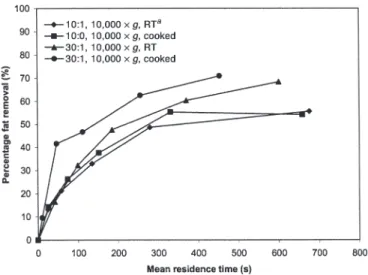
Consequently, we adopted this high water ratio for the de-fatting of soymilk. Naturally, the immediate effect of adding more water was the dilution of protein in the milk, while the amount of protein extracted remained much the same, as shown in Table 1. The centrifugation tests, done at three speeds, indicated a two-stage defatting process instead of the three stages as observed in the experiments with a 10:1 ratio (Fig. 2). The first three passes were the first stage, and the last two passes the second. The defatting rate was essentially the same despite different G forces in the first stage within a mean residence time of 100 s. The difference began to show at about 200 s when the defatting slowed. All three runs ap-peared to approach the limit of 0.1 wt% fat in the milk, but it took different times for these centrifugal speeds to reach this limit. The maximal speed featuring a mean G force of 10,000 × g needed only 600 s, whereas the minimal speed providing 3,400 × g required about 850 s. The advantages of a water-to-bean ratio of 30:1 over 10:1 are demonstrated in Figure 3, where fat removal is expressed as a percentage of the amount of extracted fat. It may be clearly seen that the higher water ratio resulted in a greater and faster fat removal, particularly when the milk was cooked. In the case of a ratio of 30:1, more than 40% of the milk fat was removed within the first 50 s of mean residence time, and nearly 70% was removed in a total mean residence time of 450 s, as compared to only about 50% total fat removal in almost 700 s using a ratio of 10:1.
FIG. 1. Centrifugal defatting of soymilk extracted at a water-to-bean
ratio of 10:1. aWater-to-bean ratio, G force, temperature. RT, room
tem-perature; cooked, at boiling temperature.
FIG. 2. Centrifugal defatting of soymilk extracted at a water-to-bean
The pseudo-hyperbolic shape of these curves suggested that the defatting rate was a function of fat concentration, and as the fat concentration decreased, the defatting rate slowed. Based on this observation, the defatting process was treated as a “reaction,” and a simple kinetic model was proposed as follows:
dC kC
v= –––– = –––––– [2]
dt K − C
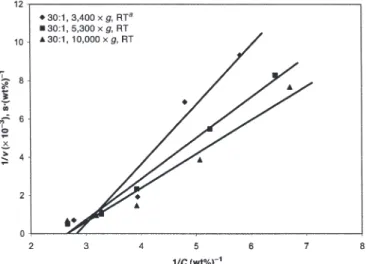
where v is the defatting rate, C the fat concentration, t the time, k the rate constant, and K the fat–protein binding con-stant. Whereas k depends on the centrifugal speed, K is related to the protein concentration in the milk. These two pa-rameters are important papa-rameters to know in size the pro-duction-scale centrifuges. The estimation of these constants was accomplished by linear regression after rearranging Equation 2. By inverting both sides, the following is obtained:
1 K 1 1
–– = –– · ––− –– [3]
v k C k
In grouping 1/v and 1/C as new variables, we turned Equation 3 into a linear equation in the form of y = A + Bx, where y = 1/v, A = 1/k, B = K/k, and x = 1/C. The defatting rate v could be represented by the average rate of each pass ∆C/∆ t. Since the milk was passed through the centrifuge five times in each test, five data points of 1/v and 1/C were generated from each run except for the experiment with a water ratio of 10:1, a G force of 10,000 × g and cooking, where the defatting curve completely leveled off at residence times greater than 300 s (Fig. 1). Therefore, the regression for this run was performed without the highest residence time data so as to avoid large errors. By a linear regression of these data, both coefficients
Aand B were determined, from which constants k and K were further calculated.
The results of all linear regressions are summarized in Table 2. The statistical analyses showed that in all cases both coefficients A and B and correlation coefficient R were statis-tically significant at a confidence level of 95%, thus allowing the conclusion that the model was valid. However, coeffi-cients A and B had errors ranging from 1 to 30%, which af-fected the accuracy of the models. These errors were a result of a number of factors. First, the error for those samples ob-tained at the end of defatting period, when their fat content was near the detection limit of the analytical instrument (~0.1%), were relatively high. Second, since soymilk resi-dence time in the centrifuge was varied only by adjusting the openings of the tap, which could not be precisely controlled, the data from each run could not be collected under precise conditions, and the regression was based only on single mea-surements, making the model susceptible to errors associated with fat analyses. Last, another source of errors could be the use of the average defatting rate ∆C/∆ t of each pass as a data point for the curve fitting simply because the more accurate instantaneous rate dC/dt was not possible to obtain. Although these factors affected all runs, the extent of the errors intro-duced into each model was different. Apparently data were better fitted with smaller errors, which led to more accurate models with higher R2values. Unfortunately, as there was only limited error control due to the limitation of equipment, it was not possible to ensure consistently small sizes of errors and high R2values for all runs. Nevertheless, statistical
analy-94 L. XU ET AL.
JAOCS, Vol. 81, no. 1 (2004)
FIG. 3. Comparison of percentage fat removal for two different water
ratios. aWater-to-bean ratio, G force, temperature. For abbreviations see Figure 1.
TABLE 2
Estimation of Parameters of Model of Defatting Kinetics
Processing conditions Coefficient Aa(× 10−3) Coefficient Ba(× 10−3) R2 b k (× 104, wt%·s−1) K (wt%)
10:1, 5,300 × g, RT −6.10 ± 1.70 6.14 ± 1.34 0.87 1.6 1.01 10:1, 10,000 × g, RT −6.19 ± 1.89 5.82 ± 1.39 0.85 1.6 0.94 10:1, 5,300 × g, cooked −3.26 ± 0.76 3.75 ± 0.67 0.91 3.1 1.15 10:1, 10,000 × g, cooked −1.16 ± 0.01 1.38 ± 0.01 0.99 8.6 1.19 30:1, 3,400 × g, RT −8.76 ± 1.94 3.10 ± 0.46 0.94 1.1 0.35 30:1, 5,300 × g, RT −5.65 ± 0.61 2.13 ± 0.13 0.99 1.8 0.38 30:1, 10,000 × g, RT −4.69 ± 0.98 1.77 ± 0.22 0.96 2.1 0.38 30:1, 3,400 × g, cooked −4.91 ± 0.80 1.72 ± 0.16 0.97 2.0 0.35 30:1, 5,300 × g, cooked −5.07 ± 0.93 1.70 ± 0.18 0.97 2.0 0.34 30:1, 10,000 × g, cooked −3.91 ± 0.99 1.35 ± 0.19 0.95 2.6 0.35
aBoth coefficients A and B are statistically significant in all cases (P < 0.05).
ses showed the significance of all the models in this study, in-cluding those with relatively low R2values.
As mentioned earlier, the two parameters k and K in Table 2 characterized the defatting process in two aspects. The val-ues of k indicated the defatting efficiencies in different cases, whereas those of K showed the strength of fat–protein bind-ing, thus determining the ultimate defatting limits. The effects of protein concentration, centrifuge speed, and cooking on both constants can be seen in Table 2. For a water-to-bean ratio of 30:1, both centrifuge speed and cooking had an impact on k in the low range of G forces. As the G force was changed from 3,400 to 5,300 × g, the k value increased from 1.1 to 1.8 × 10⁻⁴(wt%)·s−1. This seems consistent with what the curves in Figure 2 show. Furthermore, cooking alone almost doubled the k value at a G force of 3,400 × g. The effect of centrifuge speed and cooking on k values became less significant above a G force of 5,300 × g. When soymilk was cooked, the k value only changed from 2.0 to 2.6 × 10⁻⁴(wt%)·s−1as the G force increased to 10,000 × g. At a G force of 10,000 × g, cooking resulted in a similar rise in the k value over the room temper-ature treatment from 2.1 to 2.6 × 10⁻⁴(wt%)·s−1. When a low water ratio of 10:1 was used, varying the centrifuge speed alone from a G force of 5,300 to 10,000 × g without cooking did not change k substantially, but cooking increased the k value from 1.6 to 3.1 and 8.6 × 10⁻⁴(wt%)·s−1, respectively (Table 2), suggesting that cooking may have a much greater impact on defatting than increasing G force. However, this hypothesis is not reflected in the curves in Figure 1, which showed that centrifuge speed actually affected the defatting rate more than cooking. This lack of fit of the models is likely a result of overextrapolation in linear regression for the two experiments with a water-to-bean ratio of 10 and without cooking, where all six data points on each curve were used. But as mentioned earlier, defatting reached its limit around 400 s of residence time, and the curve was nearly level after 400 s in both cases (Fig. 1). Therefore, by including the last data point in the model large errors (up to 30%) were intro-duced during the curve fitting, leading to a significant under-estimation of k with a relatively low R2. This was confirmed by re-modeling these two treatments without the last data point, as was done in the experiment with a water ratio of 10:1, a G force of 10,000 × g, and cooking, which resulted in higher k values of 3.2 and 7.9 × 10⁻⁴(wt%)·s−1for G forces of 5,300 and 10,000 × g, respectively, with smaller errors (~15%) and regression coefficients well above 0.90. By com-paring these corrected k values, one can see that they are in agreement with the trends of the curves in Figure 1.
The fat–protein binding constant K, on the other hand, seemed to be affected by protein concentration only, and the ratio of 10:1 resulted in a much higher K than that of 30:1, mainly owing to a higher protein concentration in the former. Neither centrifuge speed nor cooking, however, had a signifi-cant effect on K. In all cases, K values pointed to the initial fat concentrations, where the straight lines in Figure 4 ap-peared to converge, suggesting that the K value actually re-flected the emulsification capacity of the protein. The
defini-tion of protein funcdefini-tionality specifies that emulsificadefini-tion ca-pacity is the amount of fat a protein at a certain concentration binds in an emulsion.
Since it has been shown that a high K value gives rise to a high defatting limit, a high protein concentration should be avoided as it leads to an increased K value. A high water-to-bean ratio is therefore desirable for defatting by centrifuga-tion, but necessitates subsequent concentration to meet the requirement for product quality. Use of excessive water in-creases the load for downstream processing and wastewater treatment. A ratio of 30:1 seems to be a compromise between desirable defatting and reasonable protein concentration.
Ultrafiltration. The concentration of protein was achieved in this study by ultrafiltration. Soy protein is composed of two major fractions, glycinin, with a sedimentation coefficient of 11S, and β-conglycinin, also known as the 7S fraction (14). Their M.W. are approximately 350,000 and 180,000, respec-tively. A membrane with a MWCO between 10,000 and 100,000 is able to concentrate the proteins. Also, since both of these proteins are globulins, a hydrophilic membrane should be used to avoid fouling. Based on these requirements, a regenerated cellulose membrane with a MWCO of 30,000 was chosen for the concentration of soymilk. It was expected to strike a balance between a reasonable flux and a reduced loss of protein. The milk extracted at a water-to-bean ratio of 30:1 had a protein concentration of about 0.80 wt% (Table 1). Therefore, to reach 3 wt% protein this extract was concen-trated by a factor of 3.5 to 4. An average permeate flux of about 15.5 L/m2·h was obtained in these ultrafiltration exper-iments.
Preparation of skimmed soymilk. Centrifugal defatting and ultrafiltration were incorporated into an aqueous process to make skimmed soymilk with a water-to-bean ratio of 30:1. The results are tabulated in Table 3. A protein concentration of 3 wt% and a low fat content of 0.3 wt% qualified the main product of this process to be skimmed soymilk. As seen in Table 3, almost half of the total amount of protein in the beans
FIG. 4. Linear regression to correlate fat removal rate and fat
concentra-tion in runs with a water-to-bean ratio of 30:1. aWater-to-bean ratio, G force, room temperature. C, fat concentration, v, defatting rate.
was recovered in the milk, and very little was lost to perme-ate. The effectiveness of defatting by centrifugation was demonstrated by the observation that more than 40% of the total amount of fat in the beans or 80% in the initial extract was removed from the milk into fat-enriched phase. The dried spent bean residue had a protein and a fat content similar to those of soybeans, thus making it a valuable by-product. As the bean residue and the fat-enriched phase combined to re-tain about 80% of the total fat amount, the mixture could still be used for oil extraction after drying. A mass balance calcu-lation showed a “loss” of 15%, which was actually a line-loss due mostly to liquid entrapment by the containers in a batch process, and thus could be essentially eliminated on a contin-uous basis. Permeate in ultrafiltration accounted for more than half of the processed water. Reverse osmosis could be used to recycle this water, thus reducing water consumption and the impact of this process on the environment.
ACKNOWLEDGMENTS
The authors wish to express their deep gratitude to Linda Layton for her technical support throughout the project. The valuable advice of Oleh Kutowy is also greatly appreciated. This paper is National Re-search Council of Canada no. 46450.
REFERENCES
1. Snyder, H.E., and T.W. Kwon, Soybean Utilization, Van Nos-trand Reinhold, New York, 1987, pp. 225–228.
2. Rosenthal, A., D.L. Pyle, and K. Niranjan, Aqueous and Enzy-matic Processes for Edible Oil Extraction, Enzyme Microb. Technol. 19:402–420 (1996).
3. Sugarman, N., Process for Simultaneously Extracting Oil and Pro-tein from Oleaginous Materials, U.S. Patent No. 2,762,820 (1956).
4. Subrahmanyam, V., D.S. Bhatia, S.S. Kalbag, and N. Subraman-ian, Integrated Processing of Peanut for the Separation of the Major Constituents, J. Am. Oil Chem. Soc. 36:66–70 (1959). 5. Rhee, K.C., C.M. Cater, and K.F. Mattil, Simultaneous
Recov-ery of Protein and Oil from Raw Peanuts in an Aqueous System, J. Food Sci. 37:90–93 (1972).
6. Rhee, K.C., C.M. Cater, and K.F. Mattil, Aqueous Process for Pilot Plant-Scale Production of Peanut Protein Concentrate, Ibid. 38:126–128 (1973).
7. Omosaiye, O., and M. Cheryan, Low-Phytate, Full-Fat Soy Pro-tein Product by Ultrafiltration of Aqueous Extracts of Whole Soybeans, Cereal Chem. 56:58–62 (1979).
8. Lawhon, J.T., L.J. Manak, K.C. Rhee, K.S. Rhee, and E.W. Lusas, Combining Aqueous Extraction and Membrane Isolation Techniques to Recover Protein and Oil from Soybeans, J. Food Sci. 46:912–919 (1981).
9. Dominguez, H., M.J. Nuñez, and J.M. Lema, Aqueous Process-ing of Sunflower Kernels with Enzymatic Technology, Food Chem. 53:427–434 (1995).
10. Dendukuri, D., and L.L. Diosady, Oil-Free Protein Isolates from Full-Fat, Dehulled Mustard Flour by Microfiltration, J. Am. Oil Chem. Soc. 80:287–294 (2003).
11. Hagenmaier, R., C.M. Cater, and K.F. Mattil, Critical Unit Op-erations of the Aqueous Processing of Fresh Coconuts, Ibid. 49:178–181 (1972).
12. Hagenmaier, R., C.M. Cater, and K.F. Mattil, Aqueous Process-ing of Fresh Coconuts for the Recovery of Oil and Coconut Skim Milk, J. Food Sci. 38:516–518 (1973).
13. Pendl, R., M. Bauer, R. Caviezel, and P. Schulthess, Determina-tion of Total Fat in Foods and Feeds by the Caviezel Method, Based on a Gas Chromatographic Technique, J. AOAC Int. 81:907–917 (1998).
14. Wolf, W.J., Purification and Properties of the Proteins, in Soy-beans: Chemistry and Technology, 2nd edn., edited by A.K. Smith and S.J. Circle, AVI, Westport, CT, 1978, Vol. 1, pp. 93–143.
[Received May 1, 2003; accepted September 24, 2003]
96 L. XU ET AL.
JAOCS, Vol. 81, no. 1 (2004)
TABLE 3
Protein and Fat Concentrations and Distribution in Main Streams of Skimmed Soymilk Preparation
Mass Protein Protein Protein Fat Fat Fat
Mass balance concentration amount balance concentration amount balance
Material (g) (%) (wt%) (g) (%) (wt%) (g) (%)
Soybeansa 100
100b 35.1 35.1 100 14.3 14.3 100
Water 3000
Concentrated 550 17.7 2.94 16.2 46.1 0.30 1.65 11.5
skimmed soy milk
Bean residuec 402 13.0 35.5 12.2 34.7 15.3 5.25 36.7
Fat-enriched phase 173 5.6 1.03 1.8 5.1 3.54 6.12 42.8
Permeate 1507 48.6 0.04 0.6 1.7 NDd ND ND
Loss 468 15.1 NAe 4.4 12.4 NA 1.28 8.9
aBoth protein and fat data are reported “as is,” with a moisture content of 7.6 wt%. bSoybeans and water.
cMass data are on a wet basis; protein and fat data are on the basis of 40.0 g of dry bean residue. dNot determined.