Building Competencies in Sensor Harness Manufacturing through Prototyping
byStacy Bergman
Bachelor of Science in Electrical Engineering, Oklahoma State University, 1995 Submitted to the Department of Electrical Engineering and Computer Science and the Sloan School of Management in partial fulfillment of the requirements for the degrees of
Master of Science in Electrical Engineering and
Master of Science in Management
In conjunction with the Leaders For Manufacturing program at the Massachusetts Institute of Technology
June 2001
© 2001 Massachusetts Institute of Technology. All rights reserved.
Signature of Auth
Certified by
Certified by
Accepted by
or
De tment of ectric n5 eering and Computer Science Sloan School of Management May 11, 2001
I Ar
-Ali A. Yassine Research Scientist, Center for Technology, Policy an Industrial Development Thesis Advisor
Thomas Roemer Assistant Professor, Sloan School of Management Thesis Advisor
Margaret Andrews
Dir ters PrgramSThan Schol of Management
Accepted by
N1 Arthur C. Smith
Chairman, Committee on Graduate Studies Department of Electrical Engineering and Computer Science
MASSACHUSETTS INSTITUTE OF TECHNOLOGY
JUL 11 2001
LIBRARIES
BARKER
I - .Building Competencies in Sensor Harness
Manufacturing through Prototyping
By
Stacy Bergman
Submitted to the Department of Electrical Engineering and Computer Science and the Sloan School of Management on May 11, 2001
in partial fulfillment of the requirements for the degrees of
Master of Science in Electrical Engineering and Master of Science in Management
Abstract
Organizational knowledge is information about products, processes and customers that is held by
the personnel in the organization. Institutionalization of the best practices contained within this knowledge is essential in creating competencies. Unfortunately, organizations do not utilize this knowledge effectively. This thesis introduces a framework that shows how establishing a prototype system to enhance product and process understanding can start to build organizational knowledge in the short-term. Along with external benchmarking, this internal knowledge can be used to form best practices based competencies. This framework will be illustrated through the use of a case study.
The case study was conducted at the Delphi Automotive Systems Mexico Technical Center. The
case study project was undertaken to improve the Energy and Chassis Systems division's
competencies in sensor wire harness products. In order to support this competency development, the author worked with Delphi Automotive Systems personnel to develop best practices based competencies employing the competency development framework introduced in this thesis. Installation of a working prototyping system was achieved in the six-month project period. Through the production and delivery of these harnesses, internal best practices were developed. These were used along with benchmarking of other harness manufacturers to develop a baseline
best practices based competencies repository for the division.
Effective use of the best practices based competencies developed during the case study project should foster improvement in competitive metrics, particularly speed-to-market and product development costs. Extension of best practices based competencies development to other products
will allow human and monetary capital to be released from re-engineering tasks. These resources can then be refocused on product advancement to exceed customer expectations in the automotive
market. It will also allow the organization to focus resources on development of strategic non-automotive markets in order to diversify the business to protect against future downturn in the automotive market.
Thesis advisors:
Ali A. Yassine - Research Scientist, Center for Technology, Policy, and Industrial Development
Thomas Roemer - Assistant Professor, Sloan School of Management
Delphi Automotive Systems advisors:
Al Webster - Chief Manufacturing Engineering
David Lehrschall - Manufacturing Engineering Staff Engineer
Acknowed ements
This author wishes to acknowledge the following people and organizations for their assistance in the accomplishment of this work.
e[phi Automotive Systems
e
Delphi Automotive Systems for sponsoring the author's studies at the Massachusetts Institute of Technology and offering all the support needed to study at such a prestigious institution.* Al Webster and Dave Lehrschall at Delphi Automotive Systems who were instrumental in developing the project and assuring the necessary resources were available.
* Luis Rodriguez and Jesus Carrillo at Delphi Automotive Systems - Mexico Technical Center who provided technical insights and language interpretation.
* Dan Afseth at Delphi Automotive Systems - Mexico Technical Center deserves special thanks for serving as a professional and personal mentor during the author's time at the border.
e
Kassy Bever at Delphi Automotive Systems - Wichita Falls Operations deserves special thanks for her invaluable advice and perspective not only during the project period but also during the author's entire time at Delphi Automotive Systems.Massachusetts Institute of'Technoagy
* The Leaders For Manufacturing Program for the support and resources made available to the author throughout the two years of study at the Massachusetts Institute of Technology.
* The Leaders For Manufacturing Class of 2001 for the opportunity to learn from their experiences and for the motivation to continue to personally improve.
9 Thomas Roemer and Ali Yassine, the author's thesis advisors, for their input and guidance throughout the thesis project process.
'Persona[
* The sincerest thanks go to the author's family. David Bergman, Karen Bergman, Mindy Bergman, Dana Bergman, Mitch Metzger and Hutch Laxton deserve the sincerest gratitude for loving and supporting the author through all endeavors.
Bergman 4
Dedication
The author wishes to dedicate this work to the memory of Dr. Leonard Stone. He was a sensible businessman, practical engineer and loving grandfather. He is deeply missed.
B~iographicaq9ote
The author, Stacy Bergman, is a Leaders For Manufacturing Fellow at Massachusetts Institute of Technology. Her fellowship is sponsored by Delphi Automotive Systems. Ms. Bergman is a June 2001 candidate for dual Master of Science degrees in Electrical Engineering and Management. Her previous education is a Bachelor of Science in Electrical Engineering from Oklahoma State University in December 1995.
Prior to entering the Leaders For Manufacturing Program, Ms. Bergman worked as a
Manufacturing Engineer with Delphi Automotive Systems in Wichita Falls, Texas. Her principal responsibility was the improvement of manufacturing processes used in the production of exhaust oxygen sensors.
Bergman 5
Tabfe of Contents
Title Page 1 Abstract 3 Acknowledgements 4 Dedication 5 Biographical Note 5 Table of Contents 7 Table of Figures 9Chapter 1: Strategic Knowledge and Competency Management
1.1 Organizational Knowledge 11
1.2 Knowledge Management 11
1.3 Best Practices Repositories Rationale 12
1.4 Thesis Organization 13
1.5 Chapter Summary 14
Chapter 2: Best Practices Based Competencies
2.1 Competencies Development Rationale 15
2.2 Competencies Development Frameworks 16
2.3 Preferred Development Framework 17
2.4 Chapter Summary 18
Chapter 3: Competency Development Framework
3.1 Proposed Competency Development Framework 19
3.2 Determination of Baseline Requirements Rationale 20
3.3 Experiment or Production Rationale 21
3.4 Benchmarking Rationale 21
3.5 Best Practices Repositories 22
3.6 Chapter Summary 24
Chapter 4: Case Study Project Background
4.1 The Changing Sensor Harness Business Environment 25
4.2 Internal Competencies Justification 26
4.3 A Project to Meet the Sensor Harness Competency Need 27
4.4 The Project Plan 27
4.5 Exhaust Oxygen Sensor Rationale 29
4.6 Product Family Portfolio 30
4.7 Chapter Summary 31
Chapter 5: Case Study Project Utilization of Competency Development Framework
5.1 The Case Study Plan and the Proposed Framework 33
5.2 Product and Process Requirements 33
5.3 Prototyping System 37
5.4 Benchmarking Study 41
5.5 Best Practices Development 45
5.6 Chapter Summary 46
Chapter 6: Conclusions and Recommendations
6.1 Project Outcomes 47
6.2 Case Study Project Specific Competency Development Framework Extensions 47 6.3 Competency Development Framework Extensions to Other Product Lines 48
6.4 Recommendations for Long-Term Strategy 49
6.5 Chapter Summary 52
Appendices
A The Prototyping System 53
B The Benchmarking Study 69
C Bill of Process 77
D Bill of Design 101
Annotated Bibliography 107
Bergman 8
Table of fF ures
Figure 1 Competency Development Framework 19
Figure 2 Iterative and Interconnected Best Practices Development 24
Figure 3 Energy and Chassis Systems Division Product 25
Figure 4 Packard Electric Systems Division Product 25
Figure 5 The Project Plan 28
Figure 6 Current Generation of Exhaust Oxygen Sensor 30
Figure 7 Next Generation of Exhaust Oxygen Sensor 30
Figure 8 Harness Basic Sub-Blocks 33
Figure 9 Exhaust Oxygen Sensor in the Vehicle 34
Figure 10 Exhaust Oxygen Sensor Harness 36
Figure 11 Typical Harness Process Flow 37
Figure 12 Exhaust Oxygen Sensor Harness Process Conceptualization 38
Figure 13 Implemented Prototype System 40
Figure 14 Benchmarking Study Methodology 42
Figure 15 Competency Development Strategy 51
Chapter 1
Strategic Knowledge and Competency Management
1.1 Organizational Knowledge
Organizational knowledge is the information that personnel possess about products, processes and customers. This knowledge is rooted in the experiences, successes, failures, contexts and
interpretations of the personnel within the organization. Regardless of size, product, industry or location, every organization contains a quantity of this valuable knowledge.'
Unfortunately, organizations often are not aware of the vastness or the value of the knowledge that is resident in a subset of the personnel. This lack of awareness, and subsequent limited
utilization, is often due to the nature of the knowledge. When the knowledge is inferred, it is often difficult to articulate for use across the organization. However, even when the knowledge can be captured in a format that makes it usable, organizations often fail to exploit their knowledge assets.
1.2 Knowledge Management
Knowledge management enables control of the organization's informational assets. Effectively institutionalizing the best practices contained within the knowledge is an important step in creating organizational competencies.3 At the center of knowledge management is the systematic creation, detection, collection, perception, adaptation, distribution and utilization of information.
Knowledge is developed through interactions with internal sources. These sources include the documentation that is utilized and the communications that are made in day to day business. Knowledge is also developed through interactions with external sources. External knowledge can be gained through processes such as benchmarking, competitive intelligence and reverse
engineering. It can also be gained through information sharing with the customers and suppliers of an organization.
At the source of the internal and external knowledge are individuals. Individuals create the knowledge. Knowledge developing organizations give each individual the vision based context with which to frame knowledge development, the personal flexibility with which to build mental models and the organizational flux with which to motivate new knowledge. These organizations also establish systems that allow for experimentation to prove new knowledge concepts with clear criteria for knowledge verification.
There are two forms of knowledge within individuals. These types are codifiable and tacit. Codifiable knowledge can be articulated. However, for an individual, codifiable knowledge is
Grayson, Randall. "Excuse me, isn't that your library on fire?" Camping Magazine. September/October 1998. <http://www.findarticles.com/cf_0/mi249/n5_v71/21186894/print.jhtml>.
2 Davenport, Thomas H, David W. DeLong and Micheal C. Beers. "Successful knowledge management projects." Sloan Management Review. 39.2 (Winter 1998): 55-58.
3 McEvily, Susan K., Shoba Das and Kevin McCabe. "Avoiding Competence Substitution Through
Knowledge Sharing." Academy of Management Review. 43.2 (April 2000). <http://www.findarticles.com/cf_0/m4025/2_25/62197041/print.jhtml>.
11
interconnected with the tacit knowledge that is routed in personal mental models. In order to manage this knowledge so that all the individuals within the organization can utilize it, systems for
sharing mental models and basic knowledge must be utilized.
Individual knowledge can become organizational knowledge through knowledge sharing and transferring. The most valuable knowledge shared will gain momentum that will allow it to be
institutionalized as an organizational competency. However, knowledge sharing across an
organization is not simple. Systems to share knowledge must include means of making four types of knowledge transfers. These transfers are tacit knowledge to tacit knowledge, codifiable
knowledge to codifiable knowledge, tacit knowledge to codifiable knowledge and codifiable knowledge to tacit knowledge.
Transfer of tacit knowledge to tacit knowledge is accomplished through socialization. Socialization is verbally and physically sharing similar experiences. Transfer of codifiable knowledge to codifiable knowledge is completed through combination. Combination is
assembling the articulated knowledge into a centralized and usable framework such as a
repository. Transfer of tacit knowledge to codifiable knowledge is done through externalization. Externalization is sharing personal metal models through the use of metaphors and analogies so that others can make mental model comparisons. Transfer of codifiable knowledge to tacit knowledge is fulfilled through internalization. Internalization is simply individual learning. Organizations that possess systems that facilitate socialization, combination, externalization and internalization are able to institutionalize individuals' knowledge into organizational knowledge.4 Knowledge management does not end at institutionalization. Knowledge creation and
institutionalization is a never-ending process. In order to facilitate knowledge utilization, continued dedication of resources is required to assure that the information is in assessable
formats. These resources are also required to enable continuous improvement to guarantee that the knowledge of the organization reflects the best information available.
1.3 Best Practices Repositories Rationale
There is a tremendous amount of knowledge within organizations that is not applied in product or production process design. Since the personnel who should be utilizing the knowledge are not aware that it exists, exploitation of the knowledge does not occur. Centralized best practices repositories are created to methodically maintain the knowledge in order to solve this problem. These repositories attempt to increase knowledge exploitation by providing accessible information for the entire organization.
Best practices repositories provide additional benefits. An organization's knowledge is centrally captured instead of residing with specific personnel who can leave the organization at any time. Providing accessibility to the organization's knowledge forces decisions to be less dependent on the responsible individual's depth of experience. Instead, the collective knowledge of the entire organization is utilized to make decisions. There is less dependence on costly repetitive creation of physical samples and more dependence on cost-effective centralized information. The best practices repositories provide a framework for product and production processes standardization
4 Nonaka, Ikujiro. "A Dynamic Theory of Organizational knowledge Creation." Organization Science. 5.1
(February 1994): 19.
when appropriate. Similarly, the repositories standardize the channel to communicate organizational knowledge.
Properly managed best practices repositories are comprehensive representations of organizational competencies. When guarded internally and used strategically, the knowledge within these repositories can offer an organization a competitive advantage.5 The best practices can be utilized to simplify design, source and manufacture decisions. The goal of this simplification is to release human and monetary capital from re-engineering tasks. Then, these resources can be utilized on product advancement to exceed customer expectations and to improve the bottom line.
Continuous repetition of this cycle enables an organization to consistently beat the competition to market in supplying products the customer wants at a superior price structure.
1.4 Thesis Organization
This thesis introduces a framework that shows how establishing a prototype system to enhance product and process understanding can start to build organizational knowledge in the short-term. Along with external benchmarking, this internal knowledge can be used to form best practices based competencies. This framework will be illustrated through the use of a case study.
Chapter
I
has introduced the general organizational environment that serves as a rationale for knowledge management to improve the competitive position of an organization in the market. Chapter 2 discusses best practices based competencies. The rationale for developing competencies and general development frameworks is introduced. The chapter details the preferred components of a competency development framework.Chapter 3 introduces the proposed competency development framework. This framework incorporates internal knowledge institutionalization and external knowledge detection. This framework also includes experimenting or producing as a practice to enhance product and process understanding. The ultimate goal of the framework is to form best practices based competencies that can allow an organization to gain competitive advantage.
Chapter 4 provides an introduction to the case study project. It includes basic information pertaining to the business background, the project requirements and the project plan. Included in this chapter is a section on the rationale for choosing a specific product family as the project focus. This chapter concludes with details pertaining to the product family.
Chapter 5 presents the case study project utilization of the proposed competency development framework. The chapter details the four steps of the development framework utilizing project specifics. The chapter discusses a baseline set of product and process requirements, a prototyping system and a benchmarking study. The chapter concludes with a discussion of the best practices developed through employing the competency development framework.
Chapter 6 details the results and conclusions based on the work completed during the project period. It closes with recommendations for further competency development framework extensions through an integrative best practices strategy.
- Lado, Augustine A. and M. Zhang. "Expert Systems, Knowledge Development and Utilization, and Sustained Competitive Advantage: A Resource-Based Model." Journal of Management. 24.4 (July/August 1998): 489-509.
Four case study project appendices complete the thesis. In Appendix A, specifics of the case study project prttyingsytem are etad. Appndx B describes the case studv henchmar1ing
efforts and presents the conclusions of the information collected through the study. In Appendix C, process best practices developed during the case study project are presented. Appendix D details several potential design best practices developed during the case study project.
1.5 Chapter Summary
This chapter has developed the rationale for developing best practices repositories as organizational knowledge centers. The need to manage organizational knowledge due to its potential competitive advantage was presented. Utilization of the knowledge included in best practices repositories to gain speed-to-market and cost structure competitive advantages was detailed. This chapter concluded with an explanation of the organization of the remainder of the thesis.
Chapter 2
Best Practices Based Competencies
2.1 Competencies Development Rationale
When guarded internally and used strategically, best practices based competencies can offer an organization a competitive advantage. However, developing competencies in every realm of an organization can be cost prohibitive. Similarly, improper management of best practices and organizational competencies can create a competitive disadvantage.
In order to avoid the negative cost structure associated with creating competencies in all functional areas, each organization must determine where there are potential synergies. Best practices based competencies should be developed that enable exploitation of these synergies. When
competencies are developed across multiple product lines, development costs can be counterbalanced by product volume.
Best practices based competencies that are developed to mirror product synergies should be utilized to make business decisions in order to provide profitable value to customers.6 In the areas of the organization where there are limited synergies, suppliers in the market should be engaged to create competencies. Developing the competencies that provide a competitive advantage internally while taking advantage of the best practices of suppliers in other domains will allow an
organization to maintain a competitive advantage in products delivered and cost structure.7
Ineffective knowledge management can cause potential organizational competencies to become a competitive disadvantage. If the best practices repository is inflexible or inaccessible the contents will not be utilized to gain a competitive advantage. Similarly, if the repository is not amendable, the competencies contained within will only be a competitive advantage for a moment in time. Organizations must continue to acquire new competencies from internal and external knowledge
sources to meet the changing market needs and to remain competitive in an industry. In the extreme, a best practices repository that is not continuously improved contains outdated competencies that can become competitive disadvantages.8
Even with proficient utilization of supplier competencies and competent management of organizational knowledge, there is another potential risk in the development of competencies. This risk is the introduction of disruptive9 technologies into the market. When new technologies enter that do not sustain current product and process practices, there is the possibility for
6 Lafrance, Martin and J&r6me Doutriaux. "Sustained success through the management of core competencies: An Empirical Analysis." Technology Management: The New International Language. Institute of Electrical and Electronics Engineers, Inc., 1991: 141-144.
7 Gordon, James C. and Aidan C. Gordon. "Outsourcing: Focusing on Core Competencies by Leveraging Resources." Managing Virtual Enterprises: A Convergence of Communications, Computing, and Energy Technologies - Proceedings of International Conference on Engineering and Technology Management. August 10-20, 1996. Institute of Electrical and Electronics Engineers, Inc., 1997: 163-167.
8 Qingrui, Xu, et al. "Putting Core Competencies into Market: Core Competence-Based Platform
Approach." Proceedings of 2000 IEEE Engineering Management Society: EMS-2000. Institute of Electrical and Electronics Engineers, Inc., 2000: 173-178.
9 Christensen, Clayton M. The Innovator's Dilemma. Boston, Massachusetts: Harvard Business School Press, 1997.
destruction of the current market." If a large quantity of resources were expended in the
development of the current competencies, a disruptive technology can have a disastrous financial effect on an organization. This effect can be intensified if customers demand an immediate
technological shift.
While the risk of disruptive technologies can never be completely adverted, organizations that have expertise in knowledge management and that maintain well structured best practices repositories can position themselves to meet the change in the market. Knowledge management will allow an organization to anticipate industry trends. This will enable the organization to develop competencies where there are new synergies across product lines.
Best practices based competencies can offer an organization a performance advantage over competitors. However, this can only occur when the competencies are accessible to personnel, limited in mobility and updated with frequency. These strategic resources can create a competitive advantage when developed for technologies that have a long-term profitable life and when created with flexibility to be updated with the advent of disruptive technologies.
Increased speed in the market fosters an environment where competitive advantage is driven by the ability of an organization to rapidly learn new competencies when novel technologies appear." Successful organizations will develop best practices based competencies using a framework that enables differentiation from the competition to gain competitive advantage. These competencies will be developed utilizing the best knowledge from inside and outside the organization at any moment in time.
2.2 Competencies Development Frameworks
Institutionalization of organizational knowledge and development of best practices based competencies are not novel approaches to creating a competitive advantage in the market. Organizations typically initiate a strategy that utilizes the available resources to fulfill current or long-term knowledge requirements.
Some organizations develop best practices through the utilization of an external benchmarking framework. This practice ignores internal organizational knowledge based on the belief that best practices are found outside the organization.'2
This is a farsighted view that can cause the institutionalization of practices that are worse than the baseline operation of the organization. Other organizations utilize frameworks that are too nearsighted. These organizations solely consider internal knowledge and create structures that enable competencies to be continuously reused allowing for speed-to-market." However, these competencies often do not reflect the best
10 Walsh, Steve and Bruce Kirchoff. "Disruptive Technologies: Innovators' Problem and Entrepreneurs'
Opportunity." Proceedings of 2000 IEEE Engineering Management Society: EMS-2000. Institute of Electrical and Electronics Engineers, Inc., 2000: 319-324.
" O'Dell, Carla and C. Jackson Grayson. "Identifying and Transferring Internal Best Practices." American Productivity & Quality Center White Paper. Houston, Texas: American Productivity & Quality Center, 2000.
1 Cross, Rob and Lloyd Baird. "Technology is Not Enough: Improving Performance by Building
Organizational Memory." Sloan Management Review. 41.3 (Spring 2000): 69-78.
13 Powers, Vicki J. "Xerox Creates a Knowledge-Sharing Culture Through Grassroots Efforts." Knowledge Management in Practice. 1.18 (Fourth Quarter 1999): 1-4.
Bergman1
practices in the industry, which can be incorporated through external knowledge detection. This can cause the knowledge institutionalized to become obsolete, leaving the organization speeding to market with inferior products and processes.
Some organizations utilize internal organizational knowledge and customer input when creating best practices based competencies.1 4 The inclusion of external knowledge in the form of customer requirements and preferences will enable created competencies to be utilized to better serve the end users. However, this competency development strategy does not take advantage of the best practices in the industry through external knowledge detection.
Other organizations attempt to incorporate all available information. These organizations institutionalize internal organizational knowledge, incorporate external industry knowledge and integrate customer-supplied product knowledge. However, the full advantage of the acquired information is seldom achieved. Instead of reducing the information to practice, these
organizations use simulation and modeling to verify that the knowledge is valid.'5 While this framework is better than the nearsighted internal knowledge institutionalization and farsighted external knowledge detection, it does not utilize experimentation to gain the learning that is essential to developing competencies.
2.3 Preferred Development Framework
There are three general categories of organizational knowledge. The first type, specific
knowledge, is information that is restricted to a particular technology or discipline. The second type, integrative knowledge, is comprised of integrated specific information. The third type, deployment knowledge, is obtained through the utilization of specific and integrative knowledge.'6 Specific, integrative and deployment knowledge are all required for competencies development. Specific and integrative knowledge will be realized when internal information is institutionalized. However, to obtain deployment knowledge the specific and integrative knowledge must be put into practice through experimentation or production.'7
Beyond internal organizational knowledge, external knowledge must also be institutionalized for the competencies to be effective. The best of the internal organizational knowledge and the external industry knowledge must be put into practice for the organization to obtain the competitive advantage that is sought.
In order to gain competitive advantage, institutionalization of best practices based competencies is required. Additionally, to assure that the established competencies reflect best practices, internal
1 Elliot, Susan. "Brsderbund Builds Strong 'Case' for Internal, External Knowledge Sharing." Knowledge Management in Practice. 1.14 (Fourth Quarter 1998): 1-8.
15 Harrison, Tracy Lynn. " Building Core Competencies in Auto Body Panel Stamping Through Computer Simulation." Master of Science Thesis. Cambridge, Massachusetts: Massachusetts Institute of Technology,
1992.
1 Parrup Nielsen, Anders. "Outsourcing and the Development of Competencies." PICMET '99: Portland
International Conference on Management of Engineering and Technology. Institute of Electrical and Electronics Engineers, Inc., 1999: Volume 1 59.
17 Linton, Jonathan D. and Steven T. Walsh. "How Do Firms Perform Effective Competency Development." PICMET '99: Portland International Conference on Management of Engineering and Technology. Institute of Electrical and Electronics Engineers, Inc., 1999: Volume 2 42-46.
17
knowledge capture, external knowledge detection and developed practice experimentation is essential.
2.4 Chapter Summary
This chapter has developed the rationale for institutionalizing organizational competencies through a discussion of potential risks and benefits of such an effort. The frameworks generally used to develop best practices based competencies were introduced. The limitations of these frameworks
were also detailed. The chapter concluded with a brief discussion of the preferred components of a framework for developing competencies.
Bergman 18
Ciapter3
Competency Development Framework
3.1 Proposed Competency Development Framework
Developing best practices based competencies within an organization requires a framework that fosters incorporation of the best knowledge and experimentation for organizational learning. A proposed framework that encompasses these requirements is visually represented in Figure 1.
Determine
Baseline
Product
Requirements
-Product Specifications -Customer Inputi -Supplier Input[Potential Failure Modes
Determine Baseline Process Requirements -Process Constraints -Underutilized Capacity ,Process Flow Plans
-Control Plans -Operator Instructions
Experiment
Develop
or
Best
Production
Practices
-Bill of Process
-Bill of Materials -Bill of Design BenchmarkExternal
SourcesO
-Competitive Products
Competitive Processes -Industry TrendsFigure 1. Competency Development Framework
Internal specific and integrative knowledge is included in the best practices based competencies development through the first process step, determine baseline process and product requirements. This framework step also assures that information from the supplier end to the customer end of the supply chain is incorporated. The second process step of the framework achieves assimilation of deployment knowledge through experimentation or production. In the third process step of the framework, external knowledge is detected through benchmarking. The final step of the framework process integrates all of the acquired information to develop best practices based competencies for the organization. Persistently replicating the framework to continuously improve the best practices based competencies will assure that the repository contains the capabilities required to maintain a competitive advantage.
3.2
Determination of Baseline Requirements Rationale
In the first step of the framework, information from the entire supply chain is discovered. This includes supplier-provided technology knowledge, internal organizational knowledge and customer-provided product knowledge. This information represents the baseline knowledge resident within the organization's supply chain.
Suppliers are engaged to create capabilities where organizations have limited synergies in support of best practices based competencies development. Utilization of supplier competencies allows an organization to maintain a competitive advantage in products delivered and cost structure.
However, this arrangement causes a strong organizational dependency on suppliers.
Suppliers' technological competencies are essential to the fulfillment of customer requirements. Therefore, suppliers should be instrumental in baseline requirement determination to assure that the corresponding capabilities are acknowledged and possessed.'8 Concurrence on baseline requirements will assure that best practices based competencies can be used in conjunction with
supplier capabilities to satisfy customer requirements.
Organizations have internal organizational knowledge that can aid in excelling in the market by fulfilling customers' expectations. However, organizations often confront an imposing challenge in classifying, storing and standardizing the information so that it can be utilized to gain a competitive advantage. Effective management of information promotes sharing and creating knowledge. It also enables the revelation of codifiable and tacit knowledge that can lead to best practices based competencies development.
Capturing best practices in a methodically structured manner through analytical or experimental means initiates institutional learning. This will foster support for further knowledge capture and momentum for competency development throughout the organization.9 At a minimum, internal knowledge discovered can be employed to represent a baseline of the current operations of the organization. Additionally, comprehending the advantages and disadvantages of internal organizational knowledge can prevent institutionalization of practices that are worse than the baseline operation of the organization.
The adage of meeting the customers' expectations has shifted to exceeding the customers' expectations. Speed in the market requires organizations to adapt to rapidly changing market demands. This competitive market also requires organizations to effectively predict and address customer needs. Maintaining a competitive advantage entails building superior processes, advancing product performance, improving product quality and maximizing organizational
effectiveness. 2
In order to achieve this competitive advantage, organizations must concentrate on understanding and documenting knowledge about their customers. This knowledge should be utilized in the development of best practices based competencies to assure that the capabilities of the
18 Nellore, Rajesh et al. "Specifications-Do We Really Understand What They Mean?" Business Horizons. 42.6 (November/December 1999): 63-69.
19 Miller, D. "A Preliminary Typology of Organizational Learning: Synthesizing the Literature." Journal of Management. 22.3 (May/June 1996): 485-505.
2 Haeckel, Stephen H. Adaptive Enterprise: Creating and Leading Sense-and-Respond Organizations.
Boston, Massachusetts: Harvard Business School Press, 1999.
organization are aligned to support customer needs. Incorporation of customer-supplied information in competency development signals that there is a clear understanding in the organization of the expectations of the customers.
3.3 Experiment or Production Rationale
Knowledge management is an important component of competency development. This component allows for the best information in the organization to be acquired and controlled. However, without verifying the organization's ability to put best practices based competencies into practice, there is little likelihood that the capabilities will lead to a competitive advantage.
In the second step of the framework, potential competencies are verified through experimentation or production. This step allows for the confirmation of an organization's ability to exploit the best practices. If confirmation does not occur, the outcomes of the experimentation offer information
regarding the adaptation required in order to create legitimate best practices based competencies. Experimentation or production alone is a poor basis for learning best practices and
institutionalizing competencies. Experimentation without baseline requirements attains limited organizational learning. Unforeseen dynamics and misperception of results will confound
unstructured experimentation or production." Concentrated experimentation rooted in determined baseline requirements enables an organization to verify that there are appropriate best practices. These practices can then be transferred across an organization and utilized in the development of competitive advantage competencies.
Validating abilities through experimentation or production should be completed internally by the organization, externally by suppliers and jointly by both the organization and suppliers. The direct result of these efforts will be novel and creative solutions for developing products and processes. Individual and joint experimentation will also shorten the learning curve allowing an organization to introduce improved products in the market faster in order to gain a sustainable competitive advantage.
3.4 Benchmarking Rationale
Achieving and maintaining a competitive position in the global market requires an awareness of the competition and their capabilities. To remain competitive, an organization must be able to continuously improve to become and remain one of the industry leaders. Benchmarking is a means to compare the capabilities of the organization against those of other industry participants.2 There are diverse sets of metrics that can be used to compare industry participants during
benchmarking studies. Typical metrics fit into several broad categories including financial performance, organizational performance, quality performance and product performance.
21 Lomi, A., E. Larsen and A. Ginsberg. "Adaptive Learning in Organizations: A System Dynamics-Based
Exploration." Journal of Management. 23.4 (July/August 1997): 561-582.
22 Compton, W. Dale. "Benchmarking." Manufacturing Systems: Foundations of World-Class Practice.
Washington, D.C.: National Academy Press, 1992: 100-106.
Financial performance is evaluated through measuring and comparing typical financial indicators of the industry competitors. These indicators include return on investment, unit cost and unit
nrofit.
Assessing organizational efficiency statistics across an industry's organizations fosters
organizational performance comparisons. These statistics include production per hour of labor, machine utilization and work-in-progress.
Evaluating customer satisfaction and internal throughput information in an industry allows quality performance comparisons to be made. This information includes data on customer returns, percent on time deliveries and first time quality.
Product performance is evaluated through comparing features and functionality of products offered by businesses within an industry. Product features comparisons include identifying part counts and material types. Product functionality comparisons include determining field
serviceability and operational repeatability.
Often, accurate information is not readily available for competitors' financial performance, organizational efficiency and customer satisfaction. Therefore, it is easier to focus on product performance metrics in benchmarking studies when idea generation is the goal rather than financial and operational comparisons.
In the competency development framework, the benchmarking study is used to gain knowledge to incorporate into best practices based competencies development. Financial performance and organizational efficiency information regarding the competition would be powerful. Since this knowledge is difficult to acquire, the benchmarking study should emphasize product performance. The end goal of the study would be generation of best-in-class product features and functionality
23 that can then be used to determine design and process best practices based competencies.
3.5 Best Practices Repositories
Centralized best practices attempt to increase knowledge exploitation by providing accessible information for the entire organization. This allows the collective knowledge of the entire organization to be utilized in product and process decisions. There are several repository
structures that can be utilized by corporations attempting to implement a best practices repository. Three of the most common structures are bill of materials, bill of process and bill of design.
I. Bill of Materials
- A list of parts required when producing a product. 2. Bill of Process
- A list of proven manufacturing processes and process sequences required to systematically produce a product.
3. Bill of Design
- A list of specifications required for the design of a product utilizing proven design fundamentals.
2 Ma, Hao. "Of Competitive Advantage: Kinetic and Positional." Business Horizons. 43.1 (January/February 2000): 53-64.
The bills of materials typically exist within an organization. These lists are required to complete standard operating functions. The financial and logistics branches of organizations use these lists to track component cost and delivery. These lists are utilized to assure that products are produced
to specifications by the production and quality sections of organizations.
The bill of process is developed to identify and to document the best manufacturing processes and process sequences for each product family. The goal is to determine the best manufacturing systems that can be standardized globally to provide a competitive advantage. Product specific bills of process will be the baseline common manufacturing plan for a specific product.
In some organizations, the bill of process best practices framework is used to gain competitive advantage through shared innovation, consolidated activities and reduced costs. General Motors developed a global bill of process in the corporation's stamping operations.25 Process
standardization through bill of process achieved the corporation's goal of doing more with less to become more competitive in the global market. General Motors has since incorporated the bill of process best practices framework into other sectors of the organization's business with similar success.26 Appropriately implemented bills of process in other organizations should allow them to
acquire similar benefits.
Bill of design factors in the customer-determined requirements and industry trends that effect products and production processes. Design for manufacturing, design for assembly, design for serviceability and design for environment tools are utilized in best practices creation in order to meet the expectations of the product and process stakeholders. These stakeholders include organization personnel, product customers, local governments and interest groups.
The bill of materials, bill of process and bill of design are interconnected. Best practices developed for one framework must be supplied into the development of the others in order to achieve overall best practices. Other information from inside and outside an organization should also be incorporated to create the broadest data set available. This creates an iterative and interconnected development for the three bills as illustrated in Figure 2.
24 Delphi Automotive Systems. Bill of Process Reference Guide.
2"d ed. Kokomo, Indiana: Delphi Automotive Systems, 1999.
25 Hallof, Gordon A. "Global Bill of Process - Dies." University of Michigan World Class Manufacturing
Seminar Session IV: Factories/Processes Most Likely to Succeed Into the 2' Century Presentation.
5 August 1997.
26 Cowger, Gary L. Automotive News World Congress Presentation. 16 January 2001.
Supplier Input Benchmarking Studies Lessons Operator Input
Operator Process Flow
Instructions Plans
Bill of Process
Bill of Design Bill of Materials
Control Plans Customer Input
Potential Failure Modes and Effects Analysis
Figure 2. Iterative and Interconnected Best Practices Development
3.6 Chapter Summary
This chapter has introduced a proposed four-step framework for developing best practices based competencies. The steps include determination of baseline product and process requirements, experimentation or production, external benchmarking and best practices based competencies development. The rationales behind the first three steps were presented after the framework introduction. The rationale for the fourth step or framework goal, was previously discussed in chapter one. The chapter concluded with a discussion of the interconnected best practices structures that are the goal of the framework.
Chapter 4
Case Study Project Background
4.1 The Changing Sensor Harness Business Environment
At the Mexico Technical Center, Delphi Automotive System's Energy and Chassis Systems division designs, prototypes and launches sensors and actuators. The majority of these sensor products require a wire harness to deliver electrical power to the sensor and to exchange electrical signals between the sensor and the on board computer in vehicle applications. Typically, these are
basic harnesses comprised of a vehicle connector, wires and a sensor connector. Figure 3 shows a typical Energy and Chassis Systems division sensor product.
Figure 3. Energy and Chassis System
Division Product
Figure 4. Packard Electric Systems
Division Product
Historically, the Energy and Chassis Systems division has designed the sensing assembly and procured the wire harness assembly from the Packard Electric Systems division of the organization. As the automotive market's demand has shifted toward electronically enhanced products, the Packard
Electric Systems division has redeployed resources to compete in these higher margin markets. Typically, these products utilize technologies that are more complex than the standard wiring used in sensor harnesses. In particular, a transition toward fiber s optic and wireless technologies has been made.
Figure 4 shows a typical Packard Electric Systems division fiber optics based product.
Timing of this resource rearrangement corresponded to the launch of several new sensor products. The Energy and Chassis Systems division had an immediate need to develop and prototype the analogous harnesses for these sensors. With the division's source concentrating on other electronic products, the Energy and Chassis Systems division was left searching for a new strategy.
Attempts were made to outsource the sensor harnesses to another manufacturer. This failed to find a willing or capable source. Potential vendors contacted were not interested in discussing the sourcing opportunity because they thought the Energy and Chassis Systems division was 27 Gaut, Steve, and John Pekarek. "Delphi to Accelerate Business Model Shift in 2001." Delphi
Automotive Systems Home Page. 12 December 2000. Delphi Automotive Systems. 15 December 2000. <http://www.delphiauto.com/index.cfm?location=2409>.
benchmarking the market for use in internal pricing negotiations. They believed that any good faith efforts on their part would be in vain and that the business would simply return to the internal supplier.
The division's initial solution was to start prototyping harnesses at the same facilities that were developing the sensing assemblies. While this strategy was convenient for the product
development teams, the decision was not in the division's long-term best interests. Design and process
learnings
were not being exploited between the sites. Different locations were using different processes and materials. These differences were being chosen to meet project timelines, to save project money and to utilize team knowledge. However, in the long-term, thesedifferences could increase divisional costs by eliminating the ability to standardize materials, to utilize capacity and to develop best practices.
4.2 Internal Competencies Justification
The timing of the Packard Electric Systems division's resource rearrangement corresponded to the launch of several new sensor products. The Energy and Chassis Systems division had an
immediate need to develop and prototype the harnesses for these sensors. With the division's source concentrating on other products, there was at least a temporary need for capacity, capability and technology from another source. This appeared to be a good opportunity to outsource.
However, when the division attempted to outsource, there was no willing and capable supplier. While a lack of willing suppliers made the harness prototyping internalization decision for the
division, it was strategically the best conclusion. The division's past dependence on the Packard Electric Systems division to supply sensor harnesses made it possible for the division to have
limited harness competencies. The division had limited abilities to write complete harness specifications and to identify capable harness suppliers.
In general, the division was not in a good outsourcing situation since it did not fully understand the product. The imperfect competencies in harness specification reduced the division's ability to determine if a supplier had delivered harnesses to specification. This inability could cause costly quality spills if supplier introduced defects were inadvertently passed on to the customer.
Similarly, given the timing of the resource redeployment, there was not adequate time to develop a new capable supplier. Even if there was time, the limited competencies of the division could cause a garbage-in-garbage-out phenomenon in supplier development, which could cause defects to be passed on to the customer.
Further strengthening the need to develop internal competencies was the long-term outlook of the automotive components market. In sensor products, the customer-determined customization is done in the harness through differences in harness length or vehicle connector geometries. As automotive systems become more electronically enhanced and automotive electrical architectures allow for more electronic customization, customers will want to customize using electronics. Embedding printed circuit boards inside the harness connectors is an anticipated method of
creating 'smart' sensors customized to meet customer-determined requirements.29 In order to meet
28 Fine, Charles H., and Daniel E, Whitney. "Is the Make-Buy Decision Process a Core Competence?." Cambridge, Massachusetts: Massachusetts Institute of Technology Center for Technology, Policy, and Industrial Development, 1996: 21.
29 Ward, Daniel K., and Harold L. Fields. "A Vision of the Future of Automotive Electronics." Detroit, Michigan: Society of Automotive Engineers, Inc., 2000: 1-3.
this latent market need in the future, thorough understanding of the design specifications and the manufacturing processes for the harness should be developed within the organization.
4.3 A Project to Meet the Sensor Harness Competency Need
The Energy and Chassis Systems division's internal competencies for wire harnesses needed enhancement in order to meet the needs of new sensor programs. A project was started to build these competencies through the development of a prototyping system and a best practices repository.
The prototyping system and the best practices repository would be housed at the Mexico Technical Center. This site was chosen for two reasons. First, the labor rate in Mexico allows products with high manual assembly content, such as harnesses, to be made cost effectively. Second, the Mexico Technical Center had been chosen by Delphi Automotive Systems to be the center for sensors and actuators in the corporation's global plans. Therefore, for the long-term global strategy, the prototyping system and best practices repository belong at the technical center.
Since there are a large number of different sensors and sensor families produced by the division, the decision was made to start with one family of sensor products to limit the magnitude of the project. This decision would give the project more focus enabling the realization of
accomplishments in the short project period. It was also a sound decision from the perspective of long-term initiative success since best practices learned from one family of harnesses could be transferred to other families without having to repeat all analyses.
4.4 The Project Plan
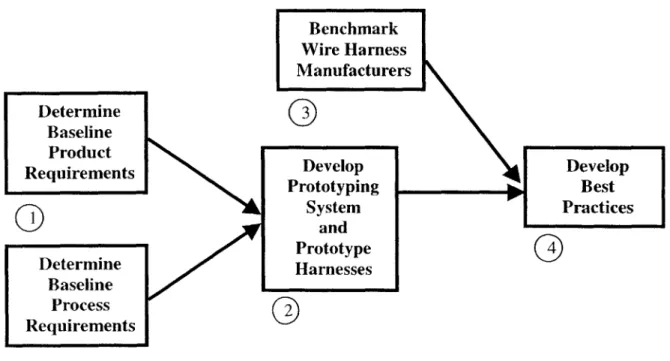
Developing a repository of best practices based competencies and creating a source of prototype harnesses were the general goals of the case study project. Through utilizing the proposed best practices based competencies development framework, both of these goals could be achieved. The project would start by acquiring the baseline product and process requirements. These requirements would be obtained from the internal documentation of the division with some guidance from the Packard Electric Systems division. Additional information would be solicited from the customers. These customers include the internal customer where the prototypes would be delivered and the potential original equipment manufacturer customers where the final productive products would be distributed. Supplier information would also be requested. This input
regarding components and equipment is essential to creating the prototype system requirements. Utilizing the acquired knowledge, the prototype system would be equipped to produce a variety of harnesses utilizing the best practices within the organization. These harnesses would be delivered to internal customer locations. This prototype capability would be integrated into the system for prototyping already established at the Mexico Technical Center without disrupting delivery of other product samples.
The prototype system's processes, equipment and infrastructure would be created through the utilization of Delphi Manufacturing System methods. These methods include value stream
mapping, lean equipment design, people focused practices and lifecycle cost analysis. These tools would be used to develop a prototype build system with the flexibility to be utilized for multiple
harness prototyping applications and with the efficiency to be considered the low-cost method for producing limited quantities of harnesses.
Quality statistics from the production at the technical center and assembly information from harness utilization at the internal customers would then be employed to develop lessons learned.
Internal best practices for material selections, design guidelines and process decisions would be developed from this information. Benchmarking of the Packard Electric Systems division and other wire product manufacturers would also be used to determine baseline best practices for the division. In Figure 5, a flow chart of the project plan is presented.
Determine
Baseline
Product
Requirements
Determine
Baseline
Process
Requirements
Benchmark
Wire Harness
Manufacturers
Develop
Develop
Prototyping
Best
System
Practices
and
Prototype
Harnesses
0
Figure 5. The Project Plan
The project had three major deliverables to be furnished. The first deliverable included all documentation required for the prototype build system. The second deliverable was delivery of built-to-specification sensor harnesses as required by the internal customers. The third project deliverable was the best practices repository.
After project completion, the best practices repository will be used in the development of future harnesses in the product family, and where appropriate, in the development of harnesses in other sensor product families. It will also be used as a template for the creation of other harness product best practices.
Bergman 28
4.5
Exhaust Oxygen Sensor Rationale
In order to provide focus in the short project period, the decision was made to concentrate on one family of sensor harness products. This decision would allow the project to accomplish early small wins in the best practices initiative. This decision would also allow the project deliverables to be used as a template for other families of sensor harnesses.
With focus on only one product, it was imperative to choose the most suitable product family. There were harness products that had an immediate need for a prototype source due to the Packard Electric Systems division's decision not to be a source of sensor harnesses. With the time
constraints, the project would be most effective if focus was put on a harness that needed a prototype source and that had well-developed requirements. Additionally, if this product's
requirements were similar to other product families, it would foster cross product family learning. The critical sensor family chosen was the exhaust oxygen sensor family of harnesses. This decision was made for several reasons.
1.
The author's previous work at Delphi Automotive Systems provided a background in exhaust oxygen sensors that would allow for the immediate commencement of work on the project requirements.2. Harnesses for these sensors are made of robust materials that can survive the extreme exhaust environment of a vehicle. This would allow technical insights to be transferred to other harness families with similarly strict requirements.
3. There was an urgent need to develop prototyping capabilities for this family of harnesses. There were three new exhaust oxygen sensor products in development. One of these products needed a harness prototyping source immediately.
4. The Clean Air Act of 1970 and subsequent amendments require cars to meet specific
exhaust emission standards.30 The exhaust oxygen sensor is part of the sophisticated
emission system that allows vehicles to meet these standards. As the governments of the United States and other countries further restrict emissions, these systems will continue to be needed. These regulations provide the product with a positive future outlook.
5. Research shows that future products based on current architectures of the exhaust oxygen sensor will be capable of meeting next generation customer requirements and government regulations.3' This further emphasizes the long-term positive outlook of the current product architecture, including the harness architecture.
30 "Milestones in Auto Emissions Control." United States Environmental Protection Agency Online.
EPA 400-F-92-014 Fact Sheet OMS-12. August 1994. United States Environmental Protection Agency. II November 2000. <http://www.epa.gov/otaq/12-miles.htm>.
31 Yoo, Joon-Ho, et al. "A Study of a Fast Light-Off Planar Oxygen Sensor Application for Exhaust
Emissions Reduction." Warrendale, Pennsylvania: Society of Automotive Engineers, Inc., 2000: 1.
4.6 Product Family Portfolio
The exhaust oxygen sensor family produced by Delphi Automotive Systems has one product generation in-the-market and three next generation product varieties in the development pipeline. The in-the-market generation's volumes are decreasing as it is nearing the end of its profitable lifecycle and is no longer considered for new vehicle model contracts. As current vehicle models' contracts expire, it will only be produced as an aftermarket product. Once the replacement parts market no longer demands this product generation, it will be phased out of production.
A customer driven volume mix of the three development pipeline products will replace the in-the-market product, as they are introduced into production in the next vehicle model years. The exhaust oxygen sensor shown in Figure 6 is the variety currently in-the-market.
A product variety from the next generation is shown in Figure 7.
Each variation of the exhaust oxygen sensor product utilizes a different sensing technology and has a different sensing scheme.
Differences within a product variation account for up to six additional sensor variation subtypes. There are up to ninety part numbers within a sensor variation. Up to forty of these part numbers are within a sensor variation subtype.
This large number of part numbers is the result of customer dictated customization in the harness. However, these part numbers do not reflect fundamental differences in harness design. Rather, the part numbers correlate to different vehicle connector geometries and different harness lengths. Generally, the harnesses across the product family have the
same structure.
The similarity in harness structure across the product family is an added benefit to best practices development. The diversity of harness lengths and vehicle connectors
produced will allow more basic variables to be considered during best practices learning. This will make the project deliverables more powerful when utilized in future best practices development. Focus will be maintained, however, since no fundamental difference in product requirements will have to be
addressed during the time constrained project perio<
Figure 6. Current Generation of
Exhaust Oxygen Sensor
Figure 7. Next Generation of
Exhaust Oxygen Sensor
Bergman 30
Bergman 30
NI,
4.7 Chapter Summary
This chapter has explained the background of the case study project. Included in this background was a discussion of the business environment in which the organization is situated. The
justification for developing internal rather than external competencies within this organizational environment was also discussed. The case study project plan and deliverables were introduced. This project plan was a project specific replication of the framework proposed for developing and
institutionalizing best practices based competencies in an organization. The chapter concluded with an introduction of the exhaust oxygen sensor product family and the rationalization for choosing the exhaust oxygen sensor harness as the project focus.