HAL Id: hal-01500348
https://hal.archives-ouvertes.fr/hal-01500348
Submitted on 3 Apr 2017
HAL is a multi-disciplinary open access
archive for the deposit and dissemination of
sci-entific research documents, whether they are
pub-lished or not. The documents may come from
teaching and research institutions in France or
abroad, or from public or private research centers.
L’archive ouverte pluridisciplinaire HAL, est
destinée au dépôt et à la diffusion de documents
scientifiques de niveau recherche, publiés ou non,
émanant des établissements d’enseignement et de
recherche français ou étrangers, des laboratoires
publics ou privés.
Time Weight Content-Based Extensions of Temporal
Graphs for Personalized Recommendation
Armel Jacques Nzekon Nzeko’O, Maurice Tchuente, Matthieu Latapy
To cite this version:
Armel Jacques Nzekon Nzeko’O, Maurice Tchuente, Matthieu Latapy. Time Weight Content-Based
Extensions of Temporal Graphs for Personalized Recommendation. WEBIST 2017 - 13th International
Conference on Web Information Systems and Technologies, INSTICC, Apr 2017, Porto, Portugal.
�10.5220/0006288202680275�. �hal-01500348�
Time Weight Content-Based Extensions of Temporal Graphs
for Personalized Recommendation
Armel Jacques Nzekon Nzeko’o
1,2,3, Maurice Tchuente
1,2and Matthieu Latapy
3 1Sorbonne Universités, UPMC Université Paris 06, IRD, UMI 209 UMMISCO, F-93143, Bondy, France
2
Université de Yaoundé I, CETIC, LIRIMA, Equipe IDASCO, BP 812, Yaoundé, Cameroun
2
Sorbonne Universités, UPMC Université Paris 06, CNRS, UMR 7606, LIP6, F-75005, Paris, France {armel.nzekon, maurice.tchuente}@uy1.uninet.cm, [email protected]
Keywords: Temporal recommendation; Long- and short-term preferences; Session-based temporal graph; Time weight content-based graph; Time-averaged hit ratio; pagerank; Injected preference fusion.
Abstract: Recommender systems are an answer to information overload on the web. They filter and present to customer, a small subset of items that he is most likely to be interested in. Since user’s interests may change over time, accurately capturing these dynamics is important, though challenging. The Session-based Temporal Graph (STG) has been proposed by Xiang et al. to provide temporal recommendations by combining long- and short-term preferences. Later, Yu et al. have introduced an extension called Topic-STG, which takes into account topics extracted from tweets’ textual information. Recently, we pushed the idea further and proposed Content-based STG. However, in all these frameworks, the importance of links does not depend on their arrival time, which is a strong limitation: at any given time, purchases made last week should have a greater influence than purchases made a year ago. In this paper, we address this problem by proposing Time Weight Content-based STG, in which we assign a time-decreasing weight to edges. Using Time-Averaged Hit Ratio, we show that this approach outperforms all previous ones in real-world situations.
1 INTRODUCTION
The amount of information in web sites like Amazon, Netflix and Last.fm is considerable, and still growing. For users, browsing and searching in such data as becomes very difficult. To address the problem, recommender systems solve this issue by filtering and presenting to users small subsets of items that they are likely to be interested in.
Early recommender systems did not take into account temporal information (Adomavicius & Alexander, 2005). However, user’s interests evolve with time, and may be affected by events such as weddings. Modern recommender systems aim at capturing such effects. Sugiyama et al. (Sugiyama, Hatano, & Yoshikawa, 2004) proposed to adapt results according to time-evolving user profiles, based for instance on browsing history. Similarly, Ding et al. (Ding & Li, 2005) proposed to weight user interests according to their age. Some
recommender systems focus on short-term
preferences (Lathia, Hailes, & Capra, 2009). Some
authors capture both long- and short-term
preferences and combine them for recommendations (Billsus & Pazzani, 2000; Li, Yang, Wang, & Kitsuregawa, 2007).
Interest in such recommender systems increased considerably since the Koren victory at the 2009 Netflix grand prize (Koren, 2009). However, it was based on a dataset with items rated by users, which are rarely available in practice. Instead, data often contains the history of user in term of their interactions with proposed items. For instance, Last.fm offers datasets in which each line indicated the fact that user u listened to song i at time t.
In this line of research, Xiang et al. (Xiang, et al., 2010) propose Session-based Temporal Graphs
(STG), which model long- and short-term
preferences separately. However, they ignore features of items, and so they miss for instance the fact that interest in a piece of music is related to its author. In order to improve this, Yu et al. (Yu, Shen, & Yang, 2014) extend the STG into Topic-STG for personalized tweet recommendation. They add topic
These recommender graphs process edges regardless of their age. This fails to capture the fact that recent transactions are the most likely to reflect user preferences in the near future (Ding & Li, 2005). To take this into account, we propose here to weight edges according to their age, so that older edges have lower influence. We propose the Time Weight Content-based STG, in which edges are labelled with their last occurrence time, and we use an exponential decay function proposed by Ding et al. (Ding & Li, 2005) to weight edges accordingly.
Section 2 shortly presents Session-based
Temporal Graph and the two recommendation algorithms on which our work is built. Section 3 introduces our Time Weight Content-based STG model. Section 4 is devoted to experiments and results. We discuss related work in Section 5, and we summarize our findings in Section 6.
2 BACKGROUND
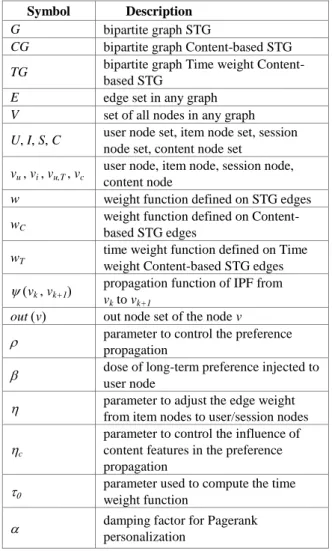
We use the notations and definitions proposed by Xiang et al. (Xiang, et al., 2010), together with some additional concepts related to content and time, summarized in Table 1.
2.1 Session-based Temporal Graph
We consider data under the form of a link stream, i.e. a set of triples (t, u, i) representing the fact that user u has selected item i at time t. For each user u (resp. each item i), we define user node vu (resp. item
node vi). We denote by T the time span of the
dataset and we divide T into time slices of equal duration. For each of these slices T, we define session node vu,T
A session-based temporal graph G(U, S, I, E, w) is a directed bipartite graph with three types of nodes: U is the set of user nodes, S the set of session nodes and I the set of item nodes. The function
w: E R is a non-negative weight function for
edges. The set of edges, E, is obtained as follows. For each triplet (t, u, i), let us consider T the time slice to which t belongs. Then, E contains edges (vu , vi) and (vi , vu), which represent long-term
preference between user u and item i; and E contains (vu,T , vi) and (vi , vu,T), which represent short-term
preferences.
The weight function is defined as:
𝑤 𝑣, 𝑣′ =
1 𝑣 ϵ 𝑈 ∪ 𝑆, 𝑣′ϵ 𝐼 ɳ𝑢 𝑣 ϵ 𝐼, 𝑣′ϵ 𝑈 ɳ𝑠 𝑣 ϵ 𝐼, 𝑣′ϵ 𝑆
(1)
Table 1: Notations and definitions.
In (1), u models the influence of long-term
preferences and s models the influence of
short-term preferences. To simplify the model, we can use
u ̸ s for u and 1 for s
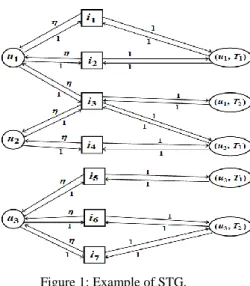
Fig. 1 is an example of STG with 3 user nodes, 5 session nodes, 7 item nodes and 2 time slices. It shows that user u1 has selected items i1, i2, user u2
has selected items i3, i4 and user u3 has selected item
i5 during the first time slice T1. During the second
time slice T2, user u1 has selected i3 and user u3 has
selected i6 and i7.
2.2 Temporal Personalized Random
Walk
The Temporal Personalized Random Walk (TPRW) (Xiang, et al., 2010) is a personalization of the Pagerank algorithm defined by Page et al. (Page, Brin, Motwani, & Winograd, 1999) for nodes ranking in graphs. It was defined to tackle temporal
Symbol Description
G bipartite graph STG
CG bipartite graph Content-based STG
TG bipartite graph Time weight
Content-based STG
E edge set in any graph
V set of all nodes in any graph
U, I, S, C user node set, item node set, session
node set, content node set
vu , vi , vu,T , vc
user node, item node, session node, content node
w weight function defined on STG edges
wC
weight function defined on Content-based STG edges
wT
time weight function defined on Time weight Content-based STG edges
vk , vk+1
propagation function of IPF from
vk to vk+1
out v out node set of the node v
parameter to control the preference
propagation
dose of long-term preference injected to
user node
parameter to adjust the edge weight
from item nodes to user/session nodes
c
parameter to control the influence of content features in the preference propagation
parameter used to compute the time weight function
damping factor for Pagerank
Figure 1: Example of STG.
recommendation using the idea of Haveliwala (Haveliwala, 2002). It corresponds to the following formula:
PR = M PR (1 ) d (2) where is the damping factor, M is a transition matrix and vector d is a user-specific personalized vector indicating which nodes the random walker will jump to after a restart.
When making recommendations for user u, vector d favors user node vu and the most recent
session node vu,T as follows:
𝑑 𝑣 =
𝑣 = 𝑣𝑢 1 − 𝑣 = 𝑣𝑢 ,𝑇 0 𝑜𝑡ℎ𝑒𝑟𝑤𝑖𝑠𝑒
(3) In other words, long-term preferences are injected to user node vu and short-term preferences are injected
to session node vu,T through vector d.
When we implement the Pagerank with iterative power law method, we stop when the difference of two consecutives rank vectors is of norm less than or equal to a threshold . To circumvent the cases where the convergence is very slow we stop after a maximum number of one hundred iterations.
2.3 Injected Preference Fusion
The IPF algorithm is an extension of the random walk with injection of preferences and customization of preference propagation. To recommend items to a user u, the algorithm proceeds in 3 steps:
Injection of long-term preferences on the user node vu and injection of short-term
preferences (1 ) on the most recent session node vu,T of user u.
Propagation of preferences by random walk of length 3 on the graph according to the formula. 𝜓(𝑣𝑘, 𝑣𝑘 +1) = ( 𝑤 (𝑣𝑘, 𝑣𝑘+1) 𝑤 (𝑣𝑘, 𝑣′) 𝑣′ ϵ 𝑜𝑢𝑡 (𝑣𝑘) ) (4) where out(vk) denotes the set of
out-neighbors of node vk, is a parameter used
to tune the propagation process, w(vk, vk+1)
is the weight of arc (vk, vk+1) and (vk, vk+1)
is the proportion of preference of vk that is
propagated to vk+1.
Recommendation of Top-N items that have received the greatest preference values and that user u has not yet selected.
The IPF random walk length is limited to 3 following experimental result (Xiang, et al., 2010).
3 TIME WEIGHT
CONTENT-BASED EXTENSIONS OF STG
In this section, we first illustrate how to construct Content-based STG (CSTG) which is similar to Topic-STG (Yu, Shen, & Yang, 2014). We end by showing how to construct Time Weight Content-based STG (TCSTG).
3.1 Content-based Session-based
Temporal Graph
The basic STG model neglects item properties which can contain significant information for the prediction of user’s behavior. This motivated Phuong et al. (Phuong, Thang, & Phuong, 2008) to add to the user-item bipartite graph, new nodes corresponding to content. The same idea is applied here to obtain Content-based STG.
To construct the Content-based STG, we need to have item properties in our data, so we don’t use a set of triples like in the construction of STG. We rather use a set of quadruples (t, u, i, c) where t, u and i have the same meaning as in STG, and c is a content feature of i.
Content-based STG CG(U, S, I, C, E, wC) is a
directed graph obtained from the STG G(U, S, I, E,
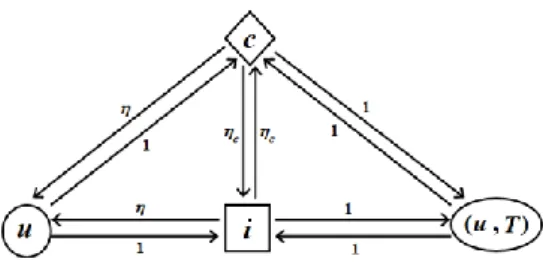
w) by adding for any link (t, u, i, c), the six
additional arcs (vu , vc), (vc , vu), (vu,T , vc), (vc , vu,T),
(vi , vc) and (vc , vi). With respective weights 1, , 1,
Figure 2: Edge weights in content-based STG.
3.2 Time weight Content-based
Session-based Temporal Graph
The Content-based STG neglects the ages of edges when assigning weights. So, it cannot capture the evolution of users’ interest which we assume to be sensitive to time as suggested by Ding et al. (Ding & Li, 2005). The recommendation model presented here assigns a greater weight to recent edges and lower weight to older edges. More precisely, the weight of the arc (v, v’) is defined by:
𝑤𝑇 𝑣, 𝑣′ = 𝑓 𝑡 𝑤(𝑣, 𝑣′) (5) where w(v, v’) is the weight in the graph without time weight, t is the most recent time at which edge (v, v’) appears and f(t) is a time-dependent decay function as in (Ding & Li, 2005). Here we take
𝑓 𝑡 = 𝑒− (𝑡𝑟 − 𝑡) (6)
where is the decay rate and (tr – t) is the difference
in second between time tr at which we are making
recommendations and t.
The parameter can also be defined as 0
where 0 is the delay after which the weight of an
edge reduces by 1/2. 0 is also called half life
parameter.
4 EXPERIMENTS
We have conducted a set of experiments to examine the performance of Time weight Content-based STG. For each model, we consider various values of parameters and we retain the best performance. We also implemented the classic bipartite user-item graph (BIP) to show the effects of taking into account long- and short-term preferences in graph models.
The experiment environment is as follow: the executions of our programs are done using a computer with 64Go of RAM and 16 processors Intel of 2.93GHz and 4MB of cache. For implementation, we have used the Python 2.7
language and the Networkx 1.11 module for graph manipulation. Note that we have changed the Networkx Pagerank in order to stop when convergence is not reached after 100 iterations. We used SQLite 3 as DBMS and Matplotlib 1.4.0 to produce graphics.
4.1 Data description
Following the example of Xiang et al, our goal is to make recommendations based on implicit data from various real world domains. To this effect, we used three sets of implicit data: two on citations and social bookmarking namely CiteUlike and Delicious (Cantador, Brusilovsky, & Kuflik, 2011); the third taken from Last.fm (Celma, 2010) is a web site where users can listen to songs.
We model our data as link streams {(t, u, i, c)}, where any quadruple has different interpretation depending on domains. In the case of CiteUlike and Delicious, each quadruplet means that user u has bookmarked page i at time t with tag c. And for the Last.fm data, this means that user u has listened to song i at time t and c is the author of i.
Before modeling our data as link streams, we performed a filtering by ignoring items and users that did not appear a number of times higher than a given threshold . Table 2 provides details on our data: date of the first link, date of the last link, total duration of link streams, threshold used, number of users, number of items, number of content features and number of links.
link, date of the last link, total duration of link streams, threshold used, number of users, number of items, number of content features and number of links.
Table 2: Data statistics.
Start date End date Duration
CiteUlike 2010-01-01 2010-07-02 183 days 10
Delicious 2010-05-11 2010-11-09 183 days 7
Last.fm 2005-02-14 2005-08-16 183 days 8
Users Items Content Links
CiteUlike 1318 424 4216 16885
Delicious 894 298 2789 13825
Last.fm 135 1054 225 41604
4.2 Experiment and evaluation
Before starting experiments, we have to divide the link streams into time windows of a fixed length ; it can be one hour, one day, one week or one month.
We fix to 15 days. To simplify the
length of session when constructing STG. Here after,
N denotes the number of time slices.
For each time window Wk, for k=1,..,N-1, we
proceed as follows:
Construct the graphs corresponding to data of W1, W2, .. ,Wk..
Compute the Top-N recommendations for users who have selected at least one “new item” during the time window Wk+1.
Evaluate the algorithm by computing the ratio of users for which at least one of these Top-N items recommends has been selected during Wk+1. This proportion is also call Hit
Ratio (Karypis, 2001).
After determining the Hit Ratio for each window, compute the overall Time Averaged Hit Ratio that is a weighted combination of the N-1 values obtained above for the Hit Ratio. In this combination, the weight of a Hit Ratio is the number of corresponding users.
4.2 Exploration of the range of the
parameters
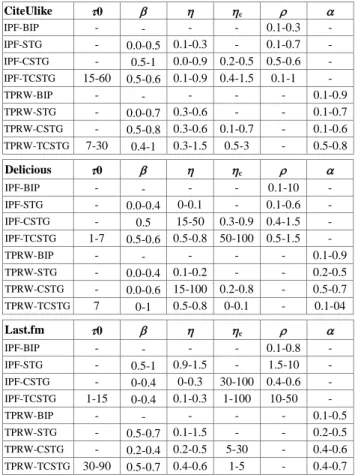
Let us see how the parameters are obtained in Table 3. We proceed as in (Xiang, et al., 2010). The parameters correspond to the vector [0, , , c, , ], whose components are numbered 1, 2, 3, 4, 5, 6 from left to right. This vector is initialized to [0, 0.5, 0.5, 0.5, 0.5, 0.5]. Then, we consider the values of 0 shown in the second row of Table 3, while maintaining the other parameters at their initial value 0.5. We perform ten experiments and take for 0 the value corresponding to the best performance. For instance we obtain for 0 the interval [15, 60] for IPF-TCSTG and [7, 30] for TPRW-TCSTG in CiteUlike dataset as shown in Table 4. Given this optimal value for 0 we then give to the eleven successive values shown in the third row of Table 3, while maintaining the other parameters at their initial value. We obtain for the interval [0.5, 0.6] for IPF-TCSTG and [0.4, 1] for TPRW-TCSTG in CiteUlike dataset as shown in Table 4. This process is repeated for the remaining parameters.
Figure 3 shows all the variations of Time-Averaged Hit Ratio with parameter values in the case of CiteUlike. The complete set of parameters explored is shown in Table 3 and the best values obtained with this procedure are shown in Table 4.
Table 3: Parameters values. Parameters Initial
value Set of values
0 (in days) 0 0, 1, 7, 15, 30, 45, 60, 90, 180, 365 0.5 0.1 × i for i = 0..10 0.5 0, 0.1, 0.2, 0.3, 0.4, 0.5, 0.6, 0.7, 0.8, 0.9, 1, 1.5, 3, 5, 10, 15, 20, 30, 50, 100 c 0.5 0, 0.1, 0.2, 0.3, 0.4, 0.5, 0.6, 0.7, 0.8, 0.9, 1, 1.5, 3, 5, 10, 15, 20, 30, 50, 100 0.5 0.1 × i for i = 0..10 0.5 0.1 × i for i = 0..10
Table 4: Parameters best values. z CiteUlike 0 c IPF-BIP - - - - 0.1-0.3 - IPF-STG - 0.0-0.5 0.1-0.3 - 0.1-0.7 - IPF-CSTG - 0.5-1 0.0-0.9 0.2-0.5 0.5-0.6 - IPF-TCSTG 15-60 0.5-0.6 0.1-0.9 0.4-1.5 0.1-1 - TPRW-BIP - - - 0.1-0.9 TPRW-STG - 0.0-0.7 0.3-0.6 - - 0.1-0.7 TPRW-CSTG - 0.5-0.8 0.3-0.6 0.1-0.7 - 0.1-0.6 TPRW-TCSTG 7-30 0.4-1 0.3-1.5 0.5-3 - 0.5-0.8 Delicious 0 c IPF-BIP - - - - 0.1-10 - IPF-STG - 0.0-0.4 0-0.1 - 0.1-0.6 - IPF-CSTG - 0.5 15-50 0.3-0.9 0.4-1.5 - IPF-TCSTG 1-7 0.5-0.6 0.5-0.8 50-100 0.5-1.5 - TPRW-BIP - - - 0.1-0.9 TPRW-STG - 0.0-0.4 0.1-0.2 - - 0.2-0.5 TPRW-CSTG - 0.0-0.6 15-100 0.2-0.8 - 0.5-0.7 TPRW-TCSTG 7 0-1 0.5-0.8 0-0.1 - 0.1-04 Last.fm 0 c IPF-BIP - - - - 0.1-0.8 - IPF-STG - 0.5-1 0.9-1.5 - 1.5-10 - IPF-CSTG - 0-0.4 0-0.3 30-100 0.4-0.6 - IPF-TCSTG 1-15 0-0.4 0.1-0.3 1-100 10-50 - TPRW-BIP - - - 0.1-0.5 TPRW-STG - 0.5-0.7 0.1-1.5 - - 0.2-0.5 TPRW-CSTG - 0.2-0.4 0.2-0.5 5-30 - 0.4-0.6 TPRW-TCSTG 30-90 0.5-0.7 0.4-0.6 1-5 - 0.4-0.7
5 RELATED WORK
In this section, we present some work on time aware recommender systems followed by recommender systems that use item properties. Finally, we present some graph-based recommender systems.
5.1 Time aware recommender systems
Ding et al. (Ding & Li, 2005) propose the use of an exponential decay function to assign greater weights to latest ratings when computing similarities in collaborative filtering. Subsequently, Liu et al. (Liu, Zhao, Xiang, & Yang, 2010) have proposed an incremental collaborative filtering where two decay functions are used: one to compute similarities and the other for prediction. Recently, Karahodža et al. (Karahodža, Donko, & Šupić, 2015) assumed that the importance of ratings (resp. interest granted to an item category) decrease in a similar manner for similar users. These hypotheses make it possible to improve user-based collaborative filtering.
Some recommender systems which use sliding time window are based on the assumption that importance of information is ephemeral. Thus, Lathia et al. (Lathia, Hailes, & Capra, 2009) set a time window size, then, any information is used during one time slice and ignored at the next time window. During each time window, collaborative filtering prediction errors are computed for different values of the parameter k of the of the k-nearest neighbors approach. The value which minimizes the prediction error is used for the next time window. Such recommender systems only capture short-term preferences.
Some works are not based only on short-term preferences but also considers that importance of certain information persists over time. Those works take long-term preferences into account and propose mechanisms to combine both preference types (Li, Yang, Wang, & Kitsuregawa, 2007; Kang & Choi, 2011). The STG (Xiang, et al., 2010) that we extend
in this work is a part of those works but it has the particularity that it is a graph and was designed with goal of improving Top-N recommendations on implicit data. However, this model ignores item properties.
5.2 Content-based recommender
systems
The content-based recommender systems seek to recommend similar items to the one the user already like. As Lops et al. (Lops, De Gemmis, & Semeraro, 2011) argue, the basic idea is to match features associated to users’ preferences and items so as to recommend new items that address their needs. This approach is used in various domains ranging from recommending books on Amazon website based on their description (Mooney & Roy, 2000), to recommending authors and papers on a research field based on tags assigned by users (Diederich & Iofciu, 2006) and recommending web pages (Pazzani, Muramatsu, & Billsus, 1996). Pazzani et al. (Pazzani & Billsus, 2007) illustrate the common treats of most recommender systems based on this approach.
Although content-based recommender systems can propose items that have not already been purchased in the past, it is also useful to use user similarities by combining this approach with collaborative filtering techniques. The result is a
hybrid system. Indeed, Balabanovic et al.
(Balabanović & Shoham, 1997) show that the combination of collaborative filtering and content-based filtering may result in a recommender system that eliminates the weaknesses of both approaches. This is confirmed by Basu et al. (Basu, Hirsh, & Cohen, 1998) for recommendation of videos by
taking into accounts not only ratings and user relationships for collaborative filtering, but also adds information related to videos. In this paper, we have used a graph model to realize this combination.
5.3 Graph based recommender systems
The simplest graph-based recommender systems only use user-item links that are available at a given time to build a bipartite graph in which there are user nodes and item nodes. A bidirectional edge is created between a user node and an item node if the user has purchased the concerned item. Finally, an item is recommended to a user if the user has not yet purchased that item and if there is a path from the user to that item. The most used recommender algorithms on the graphs are based on the random walk (Gori & Pucci, 2006; Baluja, et al., 2008), like Pagerank and IPF which are used in this paper.
The use of graph paths to recommend new items to each user reflects the logic of collaborative filtering logic as recommended items are those similar users have already purchased. However, such recommender graphs do not take into consideration information linked to item properties. To remedy this limitation, Phuong et al. (Phuong, Thang, & Phuong, 2008) have constructed a recommender graph in which they have added a third node type: the type “content”. This type of node represents any property of the item to recommend for example author and genre of songs. The obtained recommender system is actually a combined collaborative filtering and content-based filtering.
Although the graph of Phuong et al. (Phuong, Thang, & Phuong, 2008) takes item properties into account, this model ignores the temporal aspect of data and therefore cannot accurately capture short- and long-term preferences of users. Thus, Yu et al. (Yu, Shen, & Yang, 2014) propose the Topic-STG which combines those two preference types using the STG advantages, then made an extension by inserting topics to which tweets belong. This allows them to have better performance than STG. However, the Topic-STG (Yu, Shen, & Yang, 2014) handles edges regardless of age. This is not in accordance with the hypothesis of concept drift which suggests that recent data should have more consideration than older. For this purpose, we propose a new extension of STG according to works of Li et al. (Li & Tang, 2008) where they decrease the weight of older edges using a decay function. Edges weights are update in constant frequencies.
5 CONCLUSION
This paper proposes time weight content-based extensions of the temporal graph model introduced by Liang Xiang et al. We represent content by nodes, similarly to Jianjun Yu et al., but we penalize older interactions. Using the temporal personalized pagerank algorithm, we show that this improves obtained recommendations. This gives evidence of the fact that the age of interactions is a relevant feature for recommender systems, and our approach is able to take benefit from it. This open promising perspectives regarding the best ways to model interaction ages, and to which extent this may improve recommendation algorithms.
ACKNOWLEDGEMENTS
This work is funded in part by the African Center of Excellence in Information and Communication Technologies (CETIC), with the support of the World Bank, by the European Commission H2020 FETPROACT 2016-2017 program under grant 732942 (ODYCCEUS), by the ANR (French National Agency of Research) under grants ANR-15-CE38-0001 (AlgoDiv) and ANR-13-CORD-0017-01 (CODDDE), by the French program "PIA - Usages, services et contenus innovants" under grant O18062-44430 (REQUEST), and by the Ile-de-France program FUI21 under grant 16010629 (iTRAC).
REFERENCES
Adomavicius, G., & Alexander, T. (2005). Toward the next generation of recommender systems: A survey of the state-of-the-art and possible extensions.
Knowledge and Data Engineering, IEEE Transactions , 17 (6), 734-749.
Balabanović, M., & Shoham, Y. (1997). Fab:
content-based, collaborative recommendation.
Communications of the ACM , 40 (3 ), 66-72.
Baluja, S., Seth, R., Sivakumar, D., Jing, Y., Yagnik, J., Kumar, S., et al. (2008, April). Video suggestion and discovery for youtube: taking random walks through the view graph. In Proceedings of the 17th
international conference on World Wide Web. ACM ,
895-904.
Basu, C., Hirsh, H., & Cohen, W. (1998, July). Recommendation as classification: Using social and content-based information in recommendation. In
on Artificial intelligence/Innovative applications of artificial intelligence , 714-720.
Billsus, D., & Pazzani, M. J. (2000). User modeling for adaptive news access. User modeling and
user-adapted interaction , 10 (2-3), 147-180.
Cantador, I., Brusilovsky, P., & Kuflik, T. (2011). 2nd Workshop on Information Heterogeneity and Fusion in Recommender Systems (HetRec 2011). In
Proceedings of the 5th ACM conference on Recommender systems .
Celma, Ò. (2010). Music Recommendation and Discovery
in the Long Tail. Springer.
Diederich, J., & Iofciu, T. (2006, October). Finding Communities of Practice from User Profiles Based On Folksonomies. In Innovative Approaches for Learning
and Knowledge Sharing, EC-TEL Workshop Proc. ,
288-297.
Ding, Y., & Li, X. (2005, October). Time Weight Collaborative Filtering. In Proceedings of the 14th
ACM international conference on Information and knowledge management, ACM , 485-492.
Gori, M., & Pucci, A. (2006). Research Paper Recommender Systems: A Random-Walk Based Approach. In International Conference on Web
Intelligence, IEEE/WIC/ACM , 778-781.
Haveliwala, T. H. (2002, May). Topic-sensitive pagerank.
In Proceedings of the 11th international conference on World Wide Web , 517-526.
Kang, J., & Choi, J. (2011, April). An Ontology-Based Recommendation System Using Long-Term and Short-Term Preferences. In International Conference
on Information Science and Applications (ICISA),IEEE , 1-8.
Karahodža, B., Donko, D., & Šupić, H. (2015, May). Temporal Dynamics of Changes in Group Users Preferences in Recommender Systems. In 38th
International Convention on Information and Communication Technology, Electronics and Microelectronics, IEEE , 1262-1266.
Karypis, G. (2001, October). Evaluation of Item-Based Top-N Recommendation Algorithms. In Proceedings
of the tenth international conference on Information and knowledge management , 247-254.
Koren, Y. (2009). The bellkor solution to the netflix grand prize. Netflix prize documentation , 81.
Lathia, N., Hailes, S., & Capra, L. (2009, July). Temporal Collaborative Filtering With Adaptive Neighbourhoods. In Proceedings of the 32nd
international ACM SIGIR conference on Research and development in information retrieval, ACM , 796-797.
Li, L., Yang, Z., Wang, B., & Kitsuregawa, M. (2007). Dynamic adaptation strategies for long-term and short-term user profile to personalize search. In Advances in
Data and Web Management , 228-240.
Li, Y., & Tang, J. (2008). Expertise Search in a Time-varying Social Network. In The Ninth International
Conference on Web-Age Information Management, IEEE , 293-300.
Liu, N. N., Zhao, M., Xiang, E., & Yang, Q. (2010). Online Evolutionary Collaborative Filtering. In
Proceedings of the fourth ACM conference on Recommender systems. ACM , 95-102.
Lops, P., De Gemmis, M., & Semeraro, G. (2011). Content-based recommender systems: State of the art and trends. In Recommender systems handbook.
Springer US , 73-105.
Mooney, R. J., & Roy, L. (2000, June). Content-based book recommending using learning for text categorization. In Proceedings of the fifth ACM
conference on Digital libraries , 195-204.
Page, L., Brin, S., Motwani, R., & Winograd, T. (1999, November). The PageRank citation ranking: bringing order to the web. Technical Report, Stanford InfoLab . Pazzani, M. J., & Billsus, D. (2007). Content-Based
Recommendation Systems. In The adaptive web.
Springer Berlin Heidelberg , 325-341.
Pazzani, M., Muramatsu, J., & Billsus, D. (1996). Syskill & Webert: Identifying interesting web sites. In
Proceedings of the thirteenth American Association for Artificial Intelligence AAAI/IAAI , 1, 54-61.
Phuong, N. D., Thang, L. Q., & Phuong, T. M. (2008). A Graph-Based Method for Combining Collaborative and Content-Based Filtering . In Trends in Artificial
Intelligence. Springer Berlin Heidelberg , 859-869.
Sugiyama, K., Hatano, K., & Yoshikawa, M. (2004, May). Adaptive web search based on user profile constructed without any effort from users. In Proceedings of the
13th international conference on World Wide Web, ACM , 675-684.
Xiang, L., Yuan, Q., Zhao, S., Chen, L., Zhang, X., Yang, Q., et al. (2010). Temporal recommendation on graphs via long-and short-term preference fusion. In :
Proceedings of the 16th ACM SIGKDD international conference on Knowledge discovery and data mining. ACM , 723-732.
Yu, J., Shen, Y., & Yang, Z. (2014). Topic-STG : Extending the Session-based Temporal Graph Approach for Personalized Tweet Recommendation.
In Proceedings of the companion publication of the 23rd international conference on World wide web companion. International World Wide Web Conferences Steering Committee , 413-414.