Original Article
Bioefficacy of a mono-component protease in the diets of pigs and poultry:
a meta-analysis of effect on ileal amino acid digestibility
Aaron J. Cowieson and Franz F. Roos
DSM Nutritional Products, Kaiseraugst, Switzerland
Summary
A meta-analysis of the effect of a mono-component bacterial protease (RONOZYME®ProAct) on the apparent ileal digest-ibility of amino acids in poultry and swine diets was conducted to examine functional patterns, mean effects and variability of response. A total of 25 independently-conducted experiments were included comprising a total of 804 datapoints. The mean response to protease was +3.74% (SE 1.1%, P < 0.001) and this ranged from +5.6% for Thr (SE 1.2%, P < 0.001) to +2.7% for Glu (SE 1.2%, P < 0.05). For the most economically critical amino acids (Lys, Cys, Met and Thr) the mean response was 4.5%. The effect of protease was independent of geography, animal species and diet composition (P > 0.05). However, the inherent digestibility of amino acids in the control diet as a single explanatory term explained around 47% of the variance (P < 0.001) in effect. When the inherent digestibility of amino acids in the control diet was less than 70% protease addition improved amino acid digestibility in 90% of cases with a mean improvement of around 10%. When the inherent digestibility of amino acids in the control diet was more than 90% there was a protease-mediated improvement in digestibility in only 60% of cases with a mean improvement of around 2%. It can be concluded that the inherent digestibility of amino acids in the diet without protease supplementation is the primary explanatory term for the efficacy of this exogenous protease, demonstrating that it is highly effective in improving the digestibility of amino acids across a wide range of feed ingredients. Benchmarking diets or feed ingredients as to their relative nutritional value would enhance the ability of nutritionists to determine the likely return on investment on use of bacterial proteases in their operation.
Keywords:protease: poultry: pigs: amino acid: nutrition
(Received 5 March 2014– Accepted 11 May 2014)
Introduction
It has previously been established that the inherent digestibility of nutrients in the diet prior to enzyme inter-vention is a key explanatory term that predicts likely enzyme effect (Cowieson & Bedford, 2009; Cowieson,
2010). Though starch, and in most cases fat, are generally well recovered by the distal small intestine of pigs and poultry the apparent ileal digestibility of amino acids can be as low as 65–70%, particularly in diets that contain a substantial concentration of by-products (Ravindran et al., 2005) or where anti-nutrients such asfibre or phy-tate are present at high levels (Angkanaporn et al., 1994; Cowieson et al.,2004). However, though on a macro-level
there may be potential for more improvement in amino acid digestibility than is the case for starch, the opportun-ities are highly amino acid dependent. For example, the apparent ileal digestibility of Met is typically high (90-95%; Ravindran et al.,2005; Cowieson,2010) whereas the apparent ileal digestibility of Thr and Cys are often rather low (around 75–85%; Ravindran et al., 2005; Cowieson, 2010). Thus, intuitively there is more oppor-tunity for enzymes to mediate a beneficial effect for the digestibility of amino acids such as Cys, Thr, Ser, Gly, Pro and Asp than would be the case for Met, Glu, Arg or indeed Lys due to the ranking of inherent digestibility. It is likely, at least at an ‘apparent’ level, that the reason
Corresponding author:[email protected]
© Cambridge University Press and Journal of Applied Animal Nutrition Ltd. 2014
Journal
of
Applied
Animal
that amino acid digestibility follows a moderately predict-able pattern in terms of ranking of inherent digestibility is due to the amino acid profile of endogenous proteins such as mucoprotein, sloughed epithelial cells and digest-ive enzymes. Both basal and specific endogenous loss contribute to the apparent digestibility values reported in the literature and so though notionally the digestibility of Thr is almost always lower than Met the ‘true’ dietary digestibility of Thr and Met may not differ substantially, especially when transamination and synthetic amino acid use is considered. Nevertheless it is likely that protease will enhance the digestibility of Thr and Cys more consist-ently than Met or Arg and this has been demonstrated to be the case for carbohydrases and phytases (Cowieson,
2010). This dependency of enzymes on the quality of the diet to which they are added may explain some of the equivocal responses reported in the literature for the effect of protease on both digestibility and performance. Thus, it was the purpose of the work presented herein to explore the relationship between inherent ileal digest-ibility of amino acids in the notional ‘control’ diet and the magnitude of the response to bacterial protease. Furthermore, functional patterns of response can give mechanistic insight where, for example, relationships exist between amino acid effect and the amino acid pro-file of endogenous proteins. These correlations have been shown previously for the amino acid effects of phy-tases and the relationship with the amino acid profile of pepsin and mucin (Cowieson et al., 2008). Finally, an overview of the effect of protease on ileal digestibility of amino acids is useful to aid in least cost formulation and for consideration of alignment to the ideal protein concept.
Materials and Methods
The focal enzyme for the present meta-analysis was RONOZYME® ProAct (DSM Nutritional Products, Kaiseraugst, Switzerland), a random acting serine endo-peptidase from Nocardiopsis prasina and expressed in Bacillus licheniformis. A total of 25 independent experimen-tal datasets were included in the meta-analysis. These experiments included published works (Iwaniuk et al. (2011); Angel et al. (2011); Viera et al. (2009); Messias et al., (2010a) and (2010b); Carvalho et al. (2009); Bertechini et al. (2009a); Bertechini et al. (2009b); Guggenbuhl et al. (2011)) and internal research reports (DSM Nutritional Products, Kaiseraugst, Switzerland). The internal reports were generated during product
development and registration trials as well as for regional marketing and research purposes and were mainly conducted in University experimental facilities. No experiments were systematically excluded from the ana-lysis unless there was no appropriate control diet with which to contrast the protease treatment or where prote-ase had been added only in concert with other enzyme activities. For the purposes of the present analysis only experiments where the digestibility of amino acids was reported were included i.e. performance effects etc were excluded. In most instances digestibility was reported as apparent ileal digestibility though in several experiments a N-free diet was also fed to correct appar-ent values to a standardised value. In order to keep the data as similar as possible apparent values were used in the analysis (as standardised values were not universally available).
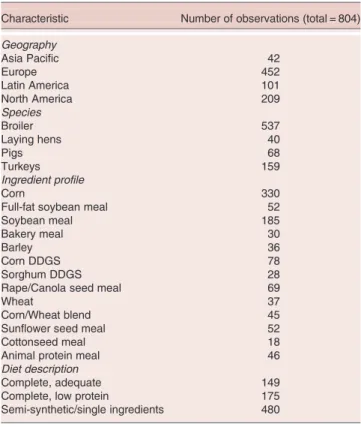
Descriptive information on the scope of the database is presented inTable 1. Of the 25 datasets that were included in the analysis the vast majority (>70%) were obtained from work in broiler chickens and turkeys with the remaining 30% being fairly equally divided between pigs and laying hens. In most experiments more than one con-trol diet was fed and as the digestibility of several amino acids are reported for each experiment a total of 804
Table 1. Database characteristics
Characteristic Number of observations (total = 804)
Geography Asia Pacific 42 Europe 452 Latin America 101 North America 209 Species Broiler 537 Laying hens 40 Pigs 68 Turkeys 159 Ingredient profile Corn 330
Full-fat soybean meal 52
Soybean meal 185
Bakery meal 30
Barley 36
Corn DDGS 78
Sorghum DDGS 28
Rape/Canola seed meal 69
Wheat 37
Corn/Wheat blend 45
Sunflower seed meal 52
Cottonseed meal 18
Animal protein meal 46
Diet description
Complete, adequate 149
Complete, low protein 175
Semi-synthetic/single ingredients 480
Journal
of
Applied
Animal
Nutrition
datapoints were used in the analysis. Diet characteristics varied from study to study and in many cases ‘semi-synthetic’ diets were fed which contained a starch, fat and mineral source as well as the test article e.g. soybean meal or bakery meal (Table 1). However, corn was the dominant cereal in the vast majority of studies and wheat was the focal cereal for only 37 out of 804 oberva-tions (Table 1). Soybean meal was the dominant protein source in most cases, although distillers dried grains with solubles, meat and bone meal, rapeseed meal and canola were used in around 200 out of the 804 observations. Geographically 42 of the 804 datapoints were from trials run in Asia Pacific, 452 from Europe, 101 from Latin America and 209 from North America.
The data were analysed using the statistical software R, version 2.15.2 (R Core Team,2012). A mixed model was applied using the function lme( ) in the library nlme (Pinheiro et al.,2012). To estimate the benefit of protease
overall and by individual amino acids, random intercepts were included for each of the 25 studies nested in 4 world regions. The same model was applied to estimate the control digestibilities per se. To model the response of protease as a function of digestibility in the control group, the digestibility of the control group and the square of the digestibility of the control group were used asfixed effects. The random effects included a ran-dom intercept for each of the 25 studies nested in 4 world regions, and random slopes of control digestibility. An approximated r2for the mixed model was calculated based on Xu (2003). Point estimates and the correspond-ing 95% confidence intervals were calculated and plotted for the entire range of observed control digestibilities.
In all cases the response to protease is expressed as a relative change compared with the appropriate control datapoint. Absolute percentage changes were also consid-ered and though there is an obvious scaling effect the conclusions were unchanged (data not shown).
Results
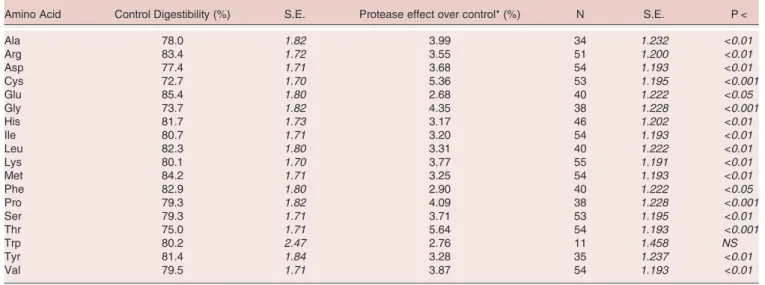
The mean digestibility of amino acids in the control diets across all 25 experiments was 79.7 ± 1.5 % (Table 2). This ranged from 72.7% for Cys to 85.4% for Glu. Amino acids that had relatively high digestibility (>82%) included Glu, Met, Arg, Phe and Leu, and those that had low digestibility (<75%) included Cys, Gly and Thr.
The mean improvement in amino acid digestibility with protease was 3.74% with a standard error of 1.10 (Table 2). This ranged from 5.6% for Thr (P < 0.001) to 2.7% for Glu (P < 0.05). The effect of protease was greater than the mean for Thr, Cys, Gly, Pro, Ala and Val and below the mean effect for Arg, Asp, Glu, His, Ile, Leu, Lys, Met, Phe, Ser, Trp and Tyr. The digestibility of all amino acids was significantly improved relative to the control diet with the exception of Trp where the number of observations was low which contributed to this effect.
Variance in protease effect on amino acid digestibility was not explained by geography, diet ingredient mix or species (P > 0.05). However, as noted earlier, the data-base is heavily biased in favour of broilers, which makes separation of genuine species effects difficult. It is possible that were more data available for other species different effects would be observed. The digestibility of
Table 2. Inherent ileal amino acid digestibility and the effect of exogenous protease in poultry and pigs
Amino Acid Control Digestibility (%) S.E. Protease effect over control* (%) N S.E. P <
Ala 78.0 1.82 3.99 34 1.232 <0.01 Arg 83.4 1.72 3.55 51 1.200 <0.01 Asp 77.4 1.71 3.68 54 1.193 <0.01 Cys 72.7 1.70 5.36 53 1.195 <0.001 Glu 85.4 1.80 2.68 40 1.222 <0.05 Gly 73.7 1.82 4.35 38 1.228 <0.001 His 81.7 1.73 3.17 46 1.202 <0.01 Ile 80.7 1.71 3.20 54 1.193 <0.01 Leu 82.3 1.80 3.31 40 1.222 <0.01 Lys 80.1 1.70 3.77 55 1.191 <0.01 Met 84.2 1.71 3.25 54 1.193 <0.01 Phe 82.9 1.80 2.90 40 1.222 <0.05 Pro 79.3 1.82 4.09 38 1.228 <0.001 Ser 79.3 1.71 3.71 53 1.195 <0.01 Thr 75.0 1.71 5.64 54 1.193 <0.001 Trp 80.2 2.47 2.76 11 1.458 NS Tyr 81.4 1.84 3.28 35 1.237 <0.01 Val 79.5 1.71 3.87 54 1.193 <0.01
*effect expressed as relative, not absolute, percentage change
Journal
of
Applied
Animal
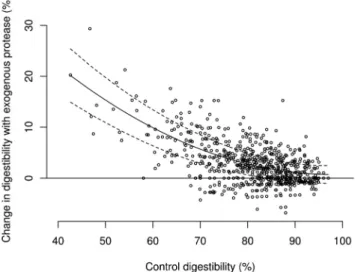
amino acids in the control diet was found to be a highly significant explanatory variable for the effect of protease on amino acid digestibility (approximated r2= 0.472; P < 0.001, Xu (2003)). The following quadratic model cap-tures this relationship:
Protease effect (% change over control )
= 61.318 + C∗(−1.23448) + C2∗0.00629 where, C is the digestibility of amino acids in the control diet in percent. This quadratic model explained around 47% of the variance in the effect of protease in amino acid digestibility where an increase of around 5.5%, on average, is predicted when control digestibility is 70% and an increase of around 1.3%, on average, when con-trol digestibility is 90%. Thus, the magnitude of protease effect decreases rapidly as control digestibility increases from 70 to 80% and more moderately from 80 to 90%. A graphical representation of this model is described in Fig. 1 and a more complete representation is illustrated in Fig. 2.
The effect of protease on amino acid digestibility indexed against Lys (100%) is presented in Fig. 3 in order to allow contrast to be made with the ideal protein concept (discussed later). The amino acids that diverge from Lys the most substantially include Thr (index 150), Cys (index 142) and Glu (index 71).
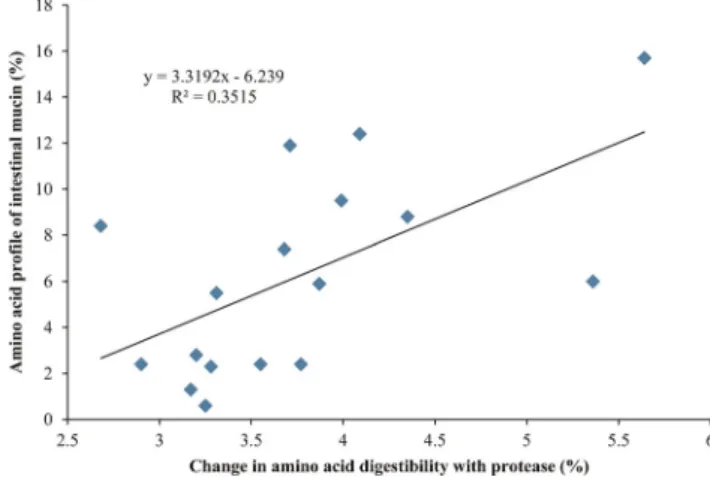
Finally, a correlation between the amino acid profile of intestinal mucin and the percentage change in amino acid digestibility with protease addition is presented in Fig. 4
(P = 0.012; r2= 0.35). Correlations between protease effect and the amino acid profile of amylase, trypsin, pep-sin, maltase, lipase, isomaltase and a wide range of acute
phase proteins proved entirely non-significant with r2 values between 0 and 0.1.
Discussion
The importance of the inherent digestibility of focal nutrients in the control diet as a predictor of enzyme effect has been reported previously (Cowieson & Bedford, 2009; Cowieson, 2010). However, these previ-ous reports have focused almost exclusively on phytase and carbohydrase (largely xylanase, glucanase and amylase). To the authors knowledge, the data reported herein are thefirst that have been reported for a mono-component protease that shows that the relationships previously observed for other enzyme classes also hold for protease. Though this is of significance for
Figure 1. Simple graphical representation of the best fit model for the effect of protease addition based on the relative digestibility of amino acids in the control diet (r2= 0.47; P < 0.001).
Figure 2. Correlation between inherent amino acid digestibility in the control diet (%) and the effect of exogenous protease (% change relative to control diet). Solid quadratic line indicates the best fit model. Dotted lines are 95% con-fidence intervals. Solid horizontal line indicates zero effect of protease.
Figure 3. Effect of protease on ileal amino acid digestibility in pigs and poultry index Lys 100.
Journal
of
Applied
Animal
Nutrition
optimisation of use of protease at an end user level and to help explain equivocal responses to protease it is of substantial importance at a macro-level for understanding enzyme responses per se and also how enzymes may be used simultaneously to best effect.
There has been interest in supplementation of poultry and swine diets with exogenous proteases for several dec-ades in order to augment endogenous peptidase produc-tion that may be insufficient in the neonate. Krogdahl and Sell (1989) reported that intestinal and pancreatic protease production increased throughout the first 21d of rearing of turkey poults suggesting that endogenous production of digestive enzymes may be inadequate in the initial post-hatch period. There are a handful of rela-tively early publications that showed promising responses to exogenous protease (Simbaya et al.,1996; Rooke et al.,
1998; Ghazi et al., 2002; Ghazi et al., 2003) and these responses have been confirmed more recently (Angel et al., 2011; Freitas et al., 2011; Fru-Nji et al., 2011). Furthermore, in a recent study where dose response of protease was investigated, a quadratic improvement in FCR was observed which is supportive of the data pre-sented herein (Freitas et al.,2011;Figs. 1 &2).
The major conclusion of the data reported in the pre-sent paper is that proteases are more effective in situa-tions where the digestibility of amino acids in the diet is low. Indeed, for every 10% decrease in ileal amino acid digestibility the efficacy of protease doubles (Fig. 1). Though this relationship explains only around 50% of the variance in the effect of protease, it is of con-siderable significance as a single explanatory. Thus, whilst the efficacy of protease at an end user level is likely to be influenced by a range of interacting terms, an
appreciation for the ‘starting point’ is critical as is an understanding of other management, nutrition, health and husbandry factors that may influence the digestibility of amino acids with a concomitant effect on protease value. Such factors may include animal species, age, diet or ingredient quality, nutrient balance, use of com-petitive micro-ingredients, environment, disease status, whole grain feeding and feed processing conditions.
Huang et al., (2005) report the effect of broiler age (d14 vs. d42) on apparent ileal amino acid digestibility of a range of common feed ingredients. Though it may be intuitively expected that amino acid digestibility would increase with age (for reasons suggested above), in fact for wheat specifically, and to some extent also for canola meal and meat and bone meal, amino acid digestibility declines from d14 to d42. Based on data presented by Huang et al. (2005), a theoretical blend of 50% wheat and 50% canola meal would have a mean amino acid digestibility on d14 of 78.7% and on d42 of 75.8%, representing an age-dependent decrease in AA digestibil-ity of−2.7%. However, a similar blend of maize and soy-bean meal would have a mean amino acid digestibility on d14 of 81.6% and on d42 of 85.5% representing an age-dependent increase in AA digestibility of +4.7%. This is of significance per se but particularly in the context of the likely responsiveness to exogenous protease as the inher-ent digestibility is such a pivotal explanatory of effect (Fig. 1). Indeed, based on the meta-analysis presented herein and the results of Huang et al. (2005) the predicted response to protease for a wheat/canola-based diet would increase from around 3% on d14 to 4% on d42 whereas for a corn/soy-based diet the effect of pro-tease would decrease from 2.2% on d14 to 1.8% on d42. These age x diet base interactions may explain why there have been equivocal reports in the literature (Wallis & Balnave, 1984; Ten Doeschate et al., 1993; Huang et al.,
2005) on the effect of animal age on amino acid digest-ibility and also explain some of the age-related changes in protease effect.
In addition to growth stage, there are a variety of other factors that modulate the digestibility of amino acids in the diets of pigs and poultry and so will invariably influ-ence protease efficacy. These factors include dietary fat concentration (Li & Sauer, 1994; Cowieson et al., 2010), xylanase and phytase (Hew et al., 1998; Cowieson & Bedford, 2009), dietary calcium or limestone inclusion concentration (Wilkinson et al., 2013), supplemental amino acids and amino acid density (Fan et al., 1994; Selle et al., 2007), ingredient type and quality (Lemme
Figure 4. Correlation between the amino acid profile of intestinal mucin and the effect of protease on ileal amino acid digestibility (P = 0.012).
Journal
of
Applied
Animal
et al.,2004; Liu et al.,2013a), anti-nutrients (Angkanaporn et al., 1994; Mosenthin et al.,1994; Cowieson et al.,2004; Clarke & Wiseman,2005) and hydrothermal conditioning (Liu et al., 2013b). It is beyond the scope of the present paper to detail these various effects (which will almost certainly overlap in the way they influence nutritional value) but it is consistent with the results presented in
Fig. 1 to suggest that the efficacy of exogenous protease
will be influenced by factors that leverage the inherent digestibility of amino acids in the diet.
As presented in Table 2 the improvement in ileal amino acid digestibility with protease was not the same for all amino acids examined. Responses ranged from >5% for Thr and Cys to <3% for Trp and Glu. It is interesting that the pattern of response to protease is similar to that of xylanase (Cowieson & Bedford, 2009) and phytase (Selle & Ravindran, 2007). In fact, there is a highly significant correlation between the effect of pro-tease and the effect of xylanase (P < 0.001; r2= 0.46) and phytase (P < 0.001; r2= 0.36) on ileal amino acid digest-ibility (data not shown). This is indicative of a shared reli-ance on the inherent digestibility of amino acids in the diet prior to enzyme intervention. However, though ‘room for improvement’ is an explanatory of effect for various feed enzymes, the substrates that these enzymes target are clearly very different and there is unlikely to be substantial overlap in effect. Furthermore the effect of phytase on amino acid digestibility is equivocal, having been determined clearly in only around 50% of studies (Selle & Ravindran, 2007) so though pattern of effect between phytase and protease may be similar in some instances, the consistency of effect is not.
As noted in Fig. 4 there is a significant correlation between the amino acid profile of intestinal mucin and the effect of exogenous protease on amino acid digestibil-ity. This relationship has been previously determined for both xylanase and phytase (Cowieson et al., 2008; Cowieson,2010). It is possible then that part of the bene-ficial effect of exogenous protease is mediated via a reduction in the loss of mucoprotein from the intestine. This may be associated with a reduction in mucin secre-tion or an increase in the autolytic recovery of mucin, or both. The mechanism by which this may occur is not clear but it is possible that exogenous protease reduces the secretion of HCl and pepsin in the gastric phase of digestion, reducing the need for mucin as a protective agent in the intestine. A similar mechanism has been pro-posed for the effect of phytase on protein solubility and digestion (Cowieson et al., 2009). An alternative
hypothesis is that exogenous protease influences the rate of recovery of amino acids in the intestine. Liu et al., (2013c) observed a significant increase in the rate
of amino acid recovery in the small intestine of broilers fed a sorghum-based diet when the diet was supplemen-ted with bacterial protease. Kalmendal & Tauson (2012) show that supplementation of a wheat-based diet with protease reduced the relative length of the ileum in broil-er chickens and that this was associated with improved FCR. These effects are indicative of protease-mediated changes in the dynamics of nutrient recovery and these may be of more importance than ileal digestibility changes per se. If protease increases the rate of recovery of amino acids and in doing so mediates a shortening of the small intestine then these effects would be detected only in FCR or other ‘net’ metrics and not necessarily in ileal digestibility coefficients. The effect of exogenous protease on endogenous secretion, particu-larly mucin, and on gut health and morphology, warrants further attention.
Afinal consideration for the appropriate use of exogen-ous protease is maintenance of amino acid balance. Baker & Han (1994) suggested that amino acids should be pro-vided to broiler chicks in particular ratios to Lys and this so-called ‘ideal amino acid’ or ‘ideal protein’ concept is relatively well accepted by nutritionists and has been more recently expanded to include Val, Ile and Arg (Lemme et al., 2003). Broadly, with Lys indexed at 100, the chicks’ requirement for Met, SAA, Ile, Thr, Trp, Val and Arg are indexed at 44, 75, 70, 65, 16, 80 and 105 respectively. Therefore though some interventions (such as those detailed above) may increase amino acid digestibility coefficients it is possible that the pattern of such a response will deviate from the ideal protein con-cept. Thus, ‘ideally’ for every 1 unit of digestible Lys yield from an exogenous protease there should be 0.75 units of digestible SAA and 0.70 units of digestible Ile (for example). The effect of protease on amino acid digestibility indexed against Lys is presented in Fig. 3. In some instances the non-Lys amino acid yield by prote-ase is well balanced relative to the yield for Lys. For instance, protease yields around 0.8 units of Ile for every 1 unit of Lys (against an ideal protein index of 0.7 to 1). However, in other instances, such as Thr, the yield relative to Lys is around 140 against an ideal protein concept of only 65, possibly resulting in an amino acid imbalance unless formulation strategies can overcome this risk. Relative to Lys the amino acids where protease addition may cause nutritional excess include SAA, Thr
Journal
of
Applied
Animal
and Val whereas Arg may be undersupplied by protease relative to Lys. These qualitative effects will depend on the health status of the bird or pig, growth stage and also the interaction with quantitative amino acid supply.
It can be concluded that exogenous protease has potential to increase the amino acid digestibility of the diets of pigs and poultry. Equivocal responses in the lit-erature may be partially explained by the leveraging effect of control diet digestibility. Prior to application of exogenous protease at an end user level consideration should be given to the inherent digestibility of amino acids in the diet and to the balance of amino acids relative to Lys. Protease may have considerable potential to improve gut health via sparing effects on mucoprotein and intestinal maintenance and further work is required on the interaction between exogenous protease and intes-tinal health, mucin integrity and enteric disease.
References
Angel R.A., Saylor W., Vieira S.L. and Ward N.(2011) Effects of a monocomponent protease on performance and protein utilization in 7- to 22-day-old broiler chickens. Poultry Science, 90: 2281–2286. Angkanaporn K., Choct M., Bryden W.L., Annison E.F. and
Annison G. (1994) Effects of wheat pentosans on endogenous amino acid losses in chickens. Journal of the Science of Food and Agriculture, 66: 399–404.
Baker D.H. and Han Y.(1994) Ideal amino acid profile for chicks dur-ing thefirst three weeks post-hatching. Poultry Science, 73: 1441–1447. Bertechini R.L., Carvalho J.C.C., Mesquita F.R., Castro S.F., Meneghetti C. and Sorbara J.O.B.(2009a) Use of a protease to enhance the utilization of full fat soybean amino acids by broilers. Poultry Science, 88(1), 70.
Bertechini R.L., Carvalho J.C.C., Mesquita F.R., Castro S.F., Remolina D.F. and Sorbara J.O.B.(2009b) Use of a protease to enhance the utilization of soybean amino acids by broilers. Poultry Science, 88(1), 69.
Carvalho J.C.C., Bertechini A.G., Rios R.L., Mesquita F.R., Lima E. M.C. and Sorbara J.O.B.(2009) Use of a protease to enhance the utilization of corn amino acids by broilers. Poultry Science, 88(1), 69–70. Cowieson A.J., Acamovic T. and Bedford M.R.(2004) The effects of phytase and phytate on the loss of endogenous amino acids and minerals from broiler chickens. British Poultry Science, 45: 101–108. Cowieson A.J., Ravindran V. and Selle P.H.(2008) Influence of
diet-ary phytic acid and source of microbial phytase on ileal endogenous amino acidflows in broiler chickens. Poultry Science, 87: 2287–2299. Cowieson A.J., Bedford M.R., Selle P.H. and Ravindran V. (2009)
Phytate and microbial phytase: implications for endogenous nitrogen losses and nutrient availability. Worlds Poultry Science Journal, 65: 401–418. Cowieson A.J. and Bedford M.R.(2009) The effect of phytase and car-bohydrase on ileal amino acid digestibility in monogastric diets: com-plementary mode of action? Worlds Poultry Science Journal, 65: 609–624. Cowieson A.J.(2010) Strategic selection of exogenous enzymes for corn/
soy-based poultry diets. The Journal of Poultry Science, 47: 1–7. Cowieson A.J., Bedford M.R. and Ravindran V.(2010) Interactions
between xylanase and glucanase in maize-soy-based diets for broilers. British Poultry Science, 51: 246–257.
Clarke E. and Wiseman J.(2005) Effects of variability in trypsin inhibi-tor content of soya bean meals on true and apparent ileal digestibility
of amino acids and pancreas size in broiler chicks. Animal Feed Science and Technology, 121: 125–138.
Fan M.Z., Sauer W.C., Hardin R.T. and Lien K.A. (1994) Determination of apparent ileal amino acid digestibility in pigs: effect of dietary amino acid level. Journal of Animal Science, 72: 2851– 2859.
Freitas D.M., Vieira S.L., Angel C.R., Favero A. and Maiorka A. (2011) Performance and nutrient utilization of broiler fed diets supple-mented with a novel mono-component protease. Journal of Applied Poultry Research, 20: 322–334.
Fru-Nji F., Kluenter A.M., Fischer M. and Pontoppidan K.(2011) A feed serine protease improves broiler performance and increases pro-tein and energy digestibility. Journal of Poultry Science, 48: 239–246. Ghazi S., Rooke J.A., Galbraith H. and Bedford M.R.(2002) The
potential for the improvement of the nutritive value of soya-bean meal by different proteases in broiler chicks and broiler cockerels. British Poultry Science, 43: 70–77.
Ghazi S., Rooke J.A. and Galbraith H.(2003) Improvement of the nutritive value of soybean meal by protease and a-galactosidase treat-ment in broiler cockerels and broiler chicks. British Poultry Science, 44: 410–418.
Guggenbuhl P., Wache Y. and Wilson J.W.(2011) Effects of dietary supplementation with a protease on the apparent ileal digestibility of the weaned piglet. Poultry Science (Abs).
Hew L.I., Ravindran V., Mollah Y. and Bryden W.L.(1998) Influence of exogenous xylanase supplementation on apparent metabolisable energy and amino acid digestibility in wheat for broiler chickens. Animal Feed Science and Technology, 75: 83–92.
Huang K.H., Ravindran V., Li X. and Bryden W.L.(2005) Influence of age on the apparent ileal amino acid digestibility of feed ingredients for broiler chickens. British Poultry Science, 46: 236–245.
Iwaniuk M., Angel R., Vieira S. and Ward N.E. (2011) True ileal amino acid digestibility of ingredients in broilers in the presence or absence of a mono-component protease. Poultry Science Abstract 504. Kalmendal R. and Tauson R.(2012) Effects of xylanase and protease,
individually or in combination, and an ionophore coccidiostat on per-formance, nutrient utilization, and intestinal morphology in broiler chickens fed a wheat-soybean meal-based diet. Poultry Science, 91: 1387–1393.
Krogdahl A. and Sell J.L.(1989) Influence of age on lipase, amylase, and protease activities in the pancreatic tissue and intestinal contents of young turkeys. Poultry Science, 68: 1561–1568.
Lemme A., Ravindran V. and Bryden W.L.(2004) Ileal digestibility of amino acids in feed ingredients for broilers. Worlds Poultry Science Journal, 60: 423–438.
Li S. and Sauer W.C. (1994) The effect of dietary fat content on amino acid digestibility in young pigs. Journal of Animal Science, 72: 1737–1743.
Liu S.Y., Selle P.H. and Cowieson A.J.(2013a) Influence of white- and red-sorghum varieties and hydrothermal component of steam pelleting on digestibility coefficients of amino acids and kinetics of amino acids, nitrogen and starch digestion in diets for broiler chickens. Animal Feed Science and Technology, In press.
Liu S.Y., Selle P.H. and Cowieson A.J.(2013b) Influence of condition-ing temperatures on amino acid digestibility at four small intestinal sites and their dynamics with starch and nitrogen digestion in sorghum-based broiler diets. Animal Feed Science and Technology, 185: 85–93.
Liu S.Y., Selle P.H., Court S.G. and Cowieson A.J.(2013c) Protease supplementation of sorghum-based broiler diets enhances amino acid digestibility coefficients in four intestinal sites and accelerates their rates of digestion. Animal Feed Science and Technology, 183: 175–183. Messias R.K.G., Albino L.F.T., Sorbara J.O.B. and Rostagno H.S.
(2010a) Effect of a mono-component protease on true amino acid digestibility of a corn and soybean meal diet for chicks. Poultry Science, 89(1), 86.
Journal
of
Applied
Animal
Nutrition
Messias R.K.G., Albino L.F.T., Sorbara J.O.B. and Rostagno H.S. (2010b) Effect of a mono-component protease on true amino acid digestibility of full fat soy for broiler chickens using different methods. Poultry Science, 89(1), 209.
Mosenthin R., Sauer W.C. and Ahrens F.(1994) Dietary pectins effect on ileal and fecal amino acid digestibility and exocrine pancreatic secre-tions in growing pigs. Journal of Nutrition, 124: 1222–1229.
Pinheiro J., Bates D., DebRoy S., Sarkar D. and R Development Core Team (2012) In: nlme: Linear and Nonlinear Mixed Models. R Package Version 3.1–105.
R Core Team(2012) In: R: A language and environment for statistical computing. R Foundation for Statistical Computing, Vienna, Austria. Ravindran V., Hew L.I., Ravindran G. and Bryden W.L. (2005)
Apparent ileal digestibility of amino acids in dietary ingredients for broiler chickens. Animal Science, 81: 85–97.
Rooke J.A., Slessor M., Fraser H. and Thomson J.R.(1998) Growth performance and gut function of piglets weaned at four weeks of age and fed protease-treated soya-bean meal. Animal Feed Science and Technology, 70: 175–190.
Selle P.H. and Ravindran V.(2007) Microbial phytase in poultry nutri-tion. Animal Feed Science and Technology, 135: 1–41.
Selle P.H., Ravindran V., Ravindran G. and Bryden W.L. (2007) Effects of dietary lysine and microbial phytase on growth performance
and nutrient utilization of broiler chickens. Asian-Australian Journal of Animal Science, 20: 1100–1107.
Simbaya J., Slominski B.A., Guenter W., Morgan A. and Campbell L.D.(1996) The effects of protease and carbohydrase supplementa-tion on the nutritive value of canola meal for poultry: In vitro and in vivo studies. Animal Feed Science and Technology, 61: 219–234. Ten Doeschate R.A.H.M., Scheele C.W., Schreurs V.V.A.M. and
Van Der Klis J.D. (1993) Digestibility studies in broiler chickens: influence of genotype, age, sex and method of determination. British Poultry Science, 34: 131–146.
Vieira S.L., Freitas D.M., Pena J.E.M., Barros R., Xavier P.S., Vian A.C. and Sorbara J.O.B.(2009) Performance and amino acid utiliza-tion by broilers supplemented with a novel exogenous protease. Poultry Science, 88(1): 37.
Wallis I.R. and Balnave D.(1984) The influence of environmental tem-perature, age and sex on the digestibility of amino acids in growing broiler chickens. British Poultry Science, 25: 401–407.
Wilkinson S.J., Selle P.H., Bedford M.R. and Cowieson A.J.(2013) Separate feeding of calcium improves performance and ileal nutrient digestibility in broiler chicks. Animal Production Science, doi.10.1071/ AN12432.
Xu R.(2003) Measuring explained variation in linear mixed effects mod-els. Statistics in Medicine, doi.10.1002/sim.1572.