HAL Id: hal-01761180
https://hal.archives-ouvertes.fr/hal-01761180
Submitted on 7 Apr 2018
HAL is a multi-disciplinary open access
archive for the deposit and dissemination of
sci-entific research documents, whether they are
pub-lished or not. The documents may come from
teaching and research institutions in France or
abroad, or from public or private research centers.
L’archive ouverte pluridisciplinaire HAL, est
destinée au dépôt et à la diffusion de documents
scientifiques de niveau recherche, publiés ou non,
émanant des établissements d’enseignement et de
recherche français ou étrangers, des laboratoires
publics ou privés.
Compositional Abstraction-based Synthesis for Cascade
Discrete-Time Control Systems
Adnane Saoud, Pushpak Jagtap, Majid Zamani, Antoine Girard
To cite this version:
Adnane Saoud, Pushpak Jagtap, Majid Zamani, Antoine Girard. Compositional Abstraction-based
Synthesis for Cascade Discrete-Time Control Systems. 6th IFAC Conference on Analysis and Design
of Hybrid System, ADHS 2018, 2018, Oxford, United Kingdom. �10.1016/j.ifacol.2018.08.003�.
�hal-01761180�
Compositional Abstraction-based Synthesis
for Cascade Discrete-Time Control
Systems ?
.
Adnane Saoud∗,∗∗, Pushpak Jagtap∗∗∗, Majid Zamani∗∗∗, Antoine Girard∗
∗Laboratoire des Signaux et Systemes (L2S) - CNRS, 91192 Gif sur Yvette, France. (e-mail: {adnane.saoud,
antoine.girard}@l2s.centralesupelec.fr)
∗∗Laboratoire Sp´ecification et V´erification - CNRS, ENS Paris-Saclay, 94235 Cachan Cedex, France.
∗∗∗Technical University of Munich, Munich, 80333 Germany (e-mail: {pushpak.jagtap, zamani}@tum.de).
Abstract: Abstraction-based synthesis techniques are limited to systems with moderate size. Thus to contribute towards scalability of these techniques, in this paper we propose a compositional abstraction-based synthesis for cascade interconnected discrete-time control systems. Given a cascade interconnection of several components, we provide results on the compositional construction of finite abstractions based on the notion of approximate cascade composition. Then, we provide a compositional controller synthesis for cascade interconnection. Finally, we demonstrate the applicability and effectiveness of the results using a numerical example and compare it with different abstraction and controller synthesis schemes.
Keywords: Symbolic control, Compositional abstraction, Compositional controller synthesis, Cascade composition, Discrete-time control system.
1. INTRODUCTION
Control and verification of dynamical systems using dis-crete abstractions and formal methods have been an on-going research area in recent years (see Tabuada (2009) and the references therein). In such approaches, a discrete abstraction (i.e. a dynamical system with finite number of states) is constructed from the original system. When the concrete and abstract systems are related by some behavioral relation such as simulation, alternating sim-ulation or their approximate versions, the discrete con-troller synthesized for the abstraction can be refined into a hybrid controller for the original system. The use of discrete abstractions principally enables the use of tech-niques developed in the areas of supervisory control of discrete event systems (Cassandras and Lafortune (2009)) and algorithmic game theory (Bloem et al. (2012)). The construction of the discrete abstraction (a.k.a. sym-bolic model) is often based on a discretization of the state space. As a result, symbolic control techniques suffer severely from the curse of dimensionality (the computa-tional complexity for synthesizing abstractions and
con-? The first two authors contributed equally to this work. This work was supported in part by the German Research Foundation (DFG) through the grant ZA 873/1-1, the TUM International Graduate School of Science and Engineering (IGSSE), and Labex DigiCosme (project ANR-11-LABEX-0045-DIGICOSME) operated by ANR as part of the program ”Investissement d’Avenir” Idex Paris Saclay (ANR-11-IDEX-0003-02).
trollers grows exponentially with the state space dimen-sion).
To tackle this problem, several compositional approaches were recently proposed. The authors in (Tazaki and Imura (2009)) proposed a compositional approach for finite state abstractions of a network of control systems based on the notion of interconnection-compatible approximate bisim-ulation. The results in (Pola et al. (2016)) provide com-positional constructions of approximately bisimilar finite abstractions for networks of discrete-time control systems under some incremental stability property. In (Mallik et al. (2016)), the notion of (approximate) disturbance simula-tion was used for composisimula-tional synthesis of continuous-time systems, where the states of the neighboring compo-nents were modeled as disturbance signals. The authors in (Dallal and Tabuada (2015), Kim et al. (2017), and Meyer et al. (2015)) use contract based design and assume-guarantee reasoning to provide compositional construction of controllers.
In spirit, our work is motivated by the recent work in (Hussien et al. (2017)) where a compositional abstraction was proposed for the class of partially feedback linearizable systems. However, this work is limited to the type of abstractions proposed in (Zamani et al. (2012)). In our work, we propose a compositional abstraction framework for cascade interconnected discrete-time control systems. Our framework allows the use of different types of abstrac-tions for individual components in the cascade composition
such as abstractions based on state-space quantization (Tabuada (2009)), partition (Meyer et al. (2015)), covering (Reissig (2011)), or without any state space discretization (Girard (2014)). Moreover, we provide results on the com-positional controller synthesis as well.
In this paper, we provide a compositional abstraction-based controller synthesis framework for a cascade com-position of N discrete-time control systems. The main contributions of the work are divided into three parts. First, we introduce the notion of approximate cascade composition, which enables cascade composition of cor-responding abstractions (possibly of different types). The use of different types of abstractions allows for more flexi-bility in the design of the overall symbolic model because each component may be suitable for a particular type of abstraction. Second, with the help of the aforementioned notion, we provide results on the compositional construc-tion of abstracconstruc-tions for cascade interconnected systems. Third, we propose a compositional controller synthesis procedure for cascade composition of N discrete time control systems. Finally, we demonstrate the applicability and effectiveness of the results using a numerical example and compare it with different abstraction and controller synthesis schemes.
The paper is organized as follows. In Section 2, we in-troduce the class of systems considered in this paper. In Section 3, we introduce the notion of approximate cascade composition and we show how one can use this notion to construct abstractions compositionally. In Section 4, we show how one can synthesize controllers compositionally for cascade interconnected systems. An example is given in Section 5 to show the merits of the theoretical results.
2. CONTROL SYSTEMS AND PRELIMINARIES
Notation: The symbols N and R+0 denote the set of nonnegative integer and nonnegative real numbers, respec-tively. For any x1, x2, x3∈ X, the map dX : X × X → R+0 is a pseudometric if the following conditions hold: (i) x1= x2 implies dX(x1, x2) = 0; (ii) dX(x1, x2) = dX(x2, x1); (iii) dX(x1, x3) ≤ dX(x1, x2) + dX(x2, x3). The closed ball centered at x ∈ X with radius R is defined by BR(x) = {y ∈ X | dX(x, y) ≤ R}. Similarly, for X ⊆ X, BR(X ) = S
x∈X
BR(x). We identify a relation R ⊆ A × B with the map R : A → 2B defined by b ∈ R(a) if and only if (a, b) ∈ R. Given a relation R ⊆ A × B, R−1 denotes the inverse relation defined by R−1 = {(b, a) ∈ B × A | (a, b) ∈ R}.
2.1 Discrete-time control systems
We consider the class of discrete-time control systems as the following:
Definition 2.1. The discrete-time control system Σ is de-fined by a tuple Σ = (X, U, f ), where X is a set of states, U is a set of inputs, the map f : X × U → X is called the transition function.
Consider the discrete-time control system Σ of the form x(k + 1) = f (x(k), u(k)), (1) where x(k) ∈ X and u(k) ∈ U for all k ∈ N
2.2 Transition systems and behavioral relations
We recall the notion of transition system introduced in (Tabuada (2009)) which later serves as a unified modeling framework for the discrete-time control systems, their discrete abstractions, and cascade compositions.
Definition 2.2. A transition system is a tuple S = (X, X0, U, ∆, Y, H) where X is a set of states (possibly infinite), X0 ⊆ X is a set of initial states, U is a set of inputs (possibly infinite), ∆ ⊆ X × U × X is a transition relation, Y is a set of outputs, and H : X → Y is an output map.
We denote x0 ∈ ∆(x, u) as an alternative representation for a transition (x, u, x0) ∈ ∆, where state x0 is called a u-successor (or simply successor) of state x, for some input u ∈ U . Given x ∈ X, the set of enabled (admissible) inputs for x is denoted by Ua(x) and defined as Ua(x) = {u ∈ U | ∆(x, u) 6= ∅}. A trajectory of the transition system is a finite or infinite sequence of transitions σ = (x0, u0), (x1, u1), (x2, u2), . . ., where xi+1 ∈ ∆(xi, ui), for i ∈ N. The output behavior associated to the trajectory σ is the sequence of outputs σy = y0, y1, y2, . . . where yi = H(xi) for all i ∈ N. The set of all output behaviors of the transition system S is denoted by symbol Y. The transition system is said to be:
• pseudometric, if the input set U and the output set Y are equipped with pseudometrics dU : U × U → R+0 and dY : Y × Y → R+0, respectively.
• finite (or symbolic), if X and U are finite.
• deterministic, if there exists at most a u-successor of x, for any x ∈ X and u ∈ U .
In the sequel, we consider the approximate relationship for transition systems based on the notion of approximate (alternating) simulation relation to relate abstractions to concrete systems. We start by introducing the notion of approximate simulation relation (Julius et al. (2009)). Definition 2.3. Let S1 = (X1, X10, U1, ∆1, Y1, H1) and S2 = (X2, X20, U2, ∆2, Y2, H2) be two transition systems such that Y1and Y2are subsets of the same pseudometric space Y equipped with a pseudometric dY and satisfying Bε(Y1) = Y2for some ε ∈ R+
0 and U1, U2are subsets of the same pseudometric space U equipped with a pseudometric dU. Let µ ≥ 0. A relation R ⊆ X1× X2 is said to be an (ε, µ)-approximate simulation relation from S1 to S2, if it satisfies the following conditions:
(i) ∀x20∈ X20, ∃x10∈ X10 such that (x10, x20) ∈ R; (ii) ∀(x1, x2) ∈ R, dY(H1(x1), H2(x2)) ≤ ε;
(iii) ∀(x1, x2) ∈ R, ∀u1 ∈ Ua
1(x1), ∀x01 ∈ ∆1(x1, u1), ∃u2 ∈ U2a(x2) with dU(u1, u2) ≤ µ and ∃x02 ∈ ∆2(x2, u2) satisfying (x01, x02) ∈ R.
We denote the existence of an (ε, µ)-approximate simula-tion relasimula-tion from S1 to S2 by S14ε,µS2.
We can see that when µ = 0, we recover the classical notion of approximate simulation relation introduced in (Girard and Pappas (2007)) and when µ = ∞, we get the definition of approximate simulation relation given in (Tabuada (2009)).
When using non-deterministic abstractions for the original discrete-time control systems, we need to consider rela-tionships that explicitly capture the adversarial nature of
nondeterminism. The notion of approximate alternating simulation relation introduced in (Tabuada (2009)) is suit-able for this case.
Definition 2.4. Let S1 = (X1, X10, U1, ∆1, Y1, H1) and S2 = (X2, X20, U2, ∆2, Y2, H2) be two transition systems such that Y1 and Y2 are subsets of the same pseudometric space Y equipped with a pseudometric dY and satisfying Bε(Y1) = Y2for some ε ∈ R+0 and U1, U2are subsets of the same pseudometric space U equipped with a pseudometric dU. Let µ ≥ 0. A relation R ⊆ X1× X2 is said to be an (ε, µ)-approximate alternating simulation relation from S2 to S1, if the following conditions are satisfied:
(i) ∀x20∈ X20, ∃x10∈ X10 such that (x10, x20) ∈ R; (ii) ∀(x1, x2) ∈ R, dY(H1(x1), H2(x2)) ≤ ε;
(iii) ∀(x1, x2) ∈ R, ∀u2 ∈ Ua
2(x2), ∃u1 ∈ U1a(x1) with dU(u2, u1) ≤ µ such that ∀x01 ∈ ∆1(x1, u1), ∃x0
2 ∈ ∆2(x2, u2) satisfying (x01, x02) ∈ R.
We denote the existence of an (ε, µ)-approximate alternat-ing simulation relation from S2 to S1 by S24ε,µAS S1. We can see that when µ = ∞ we recover the classical notion of approximate alternating simulation relation as introduced in (Tabuada (2009)), and when µ = ε = 0 the approximate alternating simulation relation coincides with the feedback refinement relation given in (Reissig et al. (2017)).
Remark 2.5. We can see that the definitions of approx-imate (alternating) simulation relations used in the pa-per are slightly different from the classical ones. Unlike classical definitions, in our definitions the choice of the inputs is constrained by some distance property. However, these input constraints are not restrictive and the notions of (alternating) simulation relations used are verified by different abstraction techniques presented in the literature. We define a pseudometric transition system associated with discrete-time control system Σ = (X, U, f ) by a tuple S(Σ) = (X, X0, U, ∆, Y, H) where
• X0⊆ X, U = U;
• x0 ∈ ∆(x, u) is a transition from state x ∈ X and input u ∈ U if and only if x0= f (x, u);
• Y = X, and H : X → Y is given by H(x) = x.
3. APPROXIMATE CASCADE COMPOSITION AND COMPOSITIONAL ABSTRACTION
In this section, we define the notion of approximate cas-cade composition of two transition systems which is latter used for construction of compositional abstractions and compositional controller synthesis.
Consider a cascade composition of two transition systems having output of the first system as an input to the second one. However, this might not be the case for the cascade composition of their corresponding abstractions. To mitigate the mismatch between the output of the abstraction of the first system and the input to the abstraction of the second system, we introduce the notion of approximate cascade composition as the following. Definition 3.1. Let S1 = (X1, X10, U1, ∆1, Y1, H1) and S2 = (X2, X20, U2, ∆2, Y2, H2) be two pseudometric tran-sition systems such that Y1 and U2 are subsets of the
same pseudometric space equipped with a pseudometric dU2, and µ ≥ 0. Systems S1 and S2 are said to be µ-approximate cascade composable if and only if Y1 ⊆ R−1
µ (U2), where Rµ ⊆ Y1 × U2 satisfies u2 ∈ Rµ(y1) if and only if dU2(u2, y1) ≤ µ. The µ-approximate cascade composition is defined by a tuple S1||µS2 = (X, X0, U, ∆12, Y, H), where • X = X1× X2; • X0= X10× X20; • U = U1; • (x0 1, x02) ∈ ∆12(x1, x2, u) if and only if x01∈ ∆1(x1, u) and there exists u2∈ U2with H1(x1) ∈ R−1µ (u2) and x0
2∈ ∆2(x2, u2); • Y = Y2;
• H(x1, x2) = H2(x2).
Remark 3.2. We can see that the introduced notion of approximate cascade composition is quite general. In par-ticular, when Rµis an identity relation (i.e µ = 0), we find the cascade composition in its usual sense and we denote S1||0S2 simply by S1||S2.
In the remaining part of this section, we provide relations between cascade composition of N-subsystems by using relations between individual components. First we provide results for composition of two systems in the following theorems.
Theorem 3.3. Consider cascade composable pseudometric transition systems S1, S2 and (µ2+ ε1)-approximate cas-cade composable pseudometric systems ˆS1, ˆS2. If S14ε1,µ1
ˆ
S1with a relation R1 and S24ε2,µ2 Sˆ2with a relation R2 then relation R ⊆ X1× X2× ˆX1× ˆX2defined by:
R = {(x1, x2, ˆx1, ˆx2) ∈ X1× X2× ˆX1× ˆX2| (x1, ˆx1) ∈ R1 and (x2, ˆx2) ∈ R2} (2) is an (ε2, µ1)-approximate simulation relation from S1||S2 to ˆS1||µ2+ε1S2, i.e. S1||S2ˆ 4
ε2,µ1 S1||µˆ 2+ε1S2.ˆ
Proof. The first condition of definition 2.3 is directly satisfied.
Let (x1, x2, ˆx1, ˆx2) ∈ R. We have dY(H(x1, x2), ˆH(ˆx1, ˆx2)) = dY2(H(x2), ˆH(ˆx2)) ≤ ε2where the equality comes from the definition of the output maps for cascade and ap-proximate cascade compositions and the inequality comes from the second condition of Definition 2.3. Consider (x1, x2, ˆx1, ˆx2) ∈ R and any u1∈ Ua(x1, x2). Consider the transition (x01, x02) ∈ ∆12(x1, x2, u1) (i.e., x01∈ ∆1(x1, u1) and x02 ∈ ∆2(x2, H1(x1))). From definition of the rela-tion R we have (x1, ˆx1) ∈ R1, u1 ∈ Ua
1(x1) and x01 ∈ ∆1(x1, u1), then from the third condition of Definition 2.3, there exists ˆu1 ∈ ˆUa
1(ˆx1) with dU1(u1, ˆu1) ≤ µ1 and
there exists ˆx01 ∈ ˆ∆1(ˆx1, ˆu1) such that (x01, ˆx01) ∈ R1. Similarly, (x2, ˆx2) ∈ R2, and from Definition 3.1 we have u2 = H1(x1) ∈ Ua
2(x2). Consider x02 ∈ ∆2(x2, H1(x1)), then, using the third condition of Definition 2.3 for the relation R2there exists ˆu2∈ ˆUa
2(ˆx2) with dU2(u2, ˆu2) ≤ µ2
and there exists ˆx0
2∈ ˆ∆2(ˆx2, ˆu2) satisfying (x02, ˆx02) ∈ R2. Moreover, the condition dU2(u2, ˆu2) ≤ µ2 implies that dU2(ˆu2, ˆH1(ˆx1)) ≤ dU2(ˆu2, u2) + dU2(u2, ˆH1(ˆx1)) ≤ µ2+
ε1, hence, ˆH1(ˆx1) ∈ R−1µ2+ε1(ˆu2). Thus condition (iii) in Definition 2.3 holds and one obtains S1||S2 4ε2,µ1
ˆ
≼𝒜𝒮 $% ,'% ≼𝒜𝒮 $( ,'% ≼ $ %,' % ≼ $ ),' ) ≼ $ ( ,' ( ≼ $ ( ,' % − − −
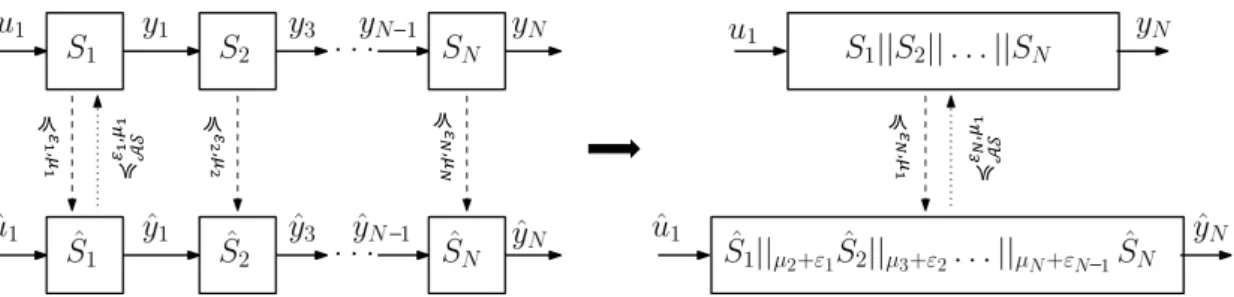
Fig. 1. Illustration of compositional abstraction of N cascade composable transition systems using notion of µ-approximate cascade composition and (ε, µ)-µ-approximate (alternating) simulation relations as formalized in Theorems 3.3 and 3.4 .
Theorem 3.4. Consider cascade composable pseudometric transition systems S1, S2 and (µ2+ ε1)-approximate cas-cade composable pseudometric systems ˆS1, ˆS2. If ˆS14ε1,µ1
AS S1 with some relation R1 and S2 4ε2,µ2 S2ˆ with some
relation R2 then the relation R ⊆ X1× X2× ˆX1× ˆX2 defined by:
R = {(x1, x2, ˆx1, ˆx2) ∈ X1× X2× ˆX1× ˆX2| (x1, ˆx1) ∈ R1 and (x2, ˆx2) ∈ R2} (3)
is an (ε2, µ1)-approximate alternating simulation relation from ˆS1||µ2+ε1S2ˆ to S1||S2, i.e. ˆS1||µ2+ε1S2ˆ 4
ε2,µ1
AS S1||S2. Proof. R1is an approximate alternating simulation rela-tion and R2is an approximate simulation relation. Hence, the first condition of Definition 2.4 follows immediately. Let (x1, x2, ˆx1, ˆx2) ∈ R. We have dY(H(x1, x2), ˆH(ˆx1, ˆx2)) = dY2(H(x2), ˆH(ˆx2)) ≤ ε2 where the equality comes from
the definition of the output maps for cascade and ap-proximate cascade compositions and the inequality comes from the second condition of Definition 2.3. Consider (x1, x2, ˆx1, ˆx2) ∈ R and any ˆu1 ∈ ˆUa(ˆx1, ˆx2). From (3) we have (x1, ˆx1) ∈ R1 and for any ˆu1 ∈ ˆU1a(ˆx1) by using condition (iii) of Definition 2.4, we can pick u1 ∈ Ua
1(x1) with dU1(u1, ˆu1) ≤ µ1 such that for all x
0
1 ∈ ∆1(x1, u1) there exists ˆx01 ∈ ˆ∆1(ˆx1, ˆu1) satisfying (x01, ˆx01) ∈ R1. Now, consider (x01, x02) ∈ ∆12(x1, x2, u1). From (3), we have (x2, ˆx2) ∈ R2 and from Definition 3.1 we have u2 = H1(x1) ∈ Ua
2(x2). Consider x02 ∈ ∆2(x2, u2), then using the third condition of Definition 2.3 for the relation R2 there exists ˆu2 ∈ ˆUa
2(ˆx2) with dU2(u2, ˆu2) ≤ µ2 and
there exists ˆx0
2 ∈ ˆ∆2(ˆx2, ˆu2) satisfying (x02, ˆx02) ∈ R2. Moreover, the condition dU2(u2, ˆu2) ≤ µ2 implies that dU2(ˆu2, ˆH1(ˆx1)) ≤ dU2(ˆu2, u2) + dU2(u2, ˆH1(ˆx1)) ≤ µ2+
ε1, hence H1(ˆˆ x1) ∈ R−1µ2+ε1(ˆu2). Thus condition (iii)
in Definition 2.4 holds and one gets ˆS1||µ2+ε1S2ˆ 4
ε2,µ1
AS S1||S2. 2
In next corollaries, we provide generalization of the results in Theorems 3.3 and 3.4 for cascade composition of N transition systems. The results are direct consequences of Theorems 3.3 and 3.4 and thus stated without proofs. An illustration of these results is given in Figure 1.
Corollary 3.5. Let S1, . . . , SN, ˆS1, . . . , ˆSN be a collections of 2N pseudometric transition systems satisfying the fol-lowing assumptions:
(i) for i ∈ {1, . . . , N }, Si4εi,µiSi;ˆ
(ii) for i ∈ {2, . . . , N }, Si−1 and Si are cascade com-posable and ˆSi−1and ˆSi are (µi+ εi−1)-approximate cascade composable.
Then we have
S1||S2|| . . . ||SN 4εN,µ1 Sˆ1||µ2+ε1Sˆ2||µ3+ε2. . . ||µN+εN −1SˆN.
Corollary 3.6. Let S1, . . . , SN, ˆS1, . . . , ˆSN be a collections of 2N pseudometric transition systems satisfying the fol-lowing assumptions:
(i) ˆS14ε1,µ1
AS S1;
(ii) for i ∈ {2, . . . , N }, Si4εi,µi Si;ˆ
(iii) for i ∈ {2, . . . , N }, Si−1 and Si are cascade com-posable and ˆSi−1and ˆSi are (µi+ εi−1)-approximate cascade composable. Then we have ˆ S1||µ2+ε1S2||µˆ 3+ε2. . . ||µN+εN −1SNˆ 4 εN,µ1 AS S1||S2|| . . . ||SN. 4. COMPOSITIONAL CONTROLLER SYNTHESIS
In this section, we provide compositional synthesis ap-proach for synthesizing controllers enforcing some speci-fication Yspec⊆ Y on the output of S1||S2.
Consider system S = (X, X0, U, ∆, Y, H) and a memo-ryless controller C : X → 2U such that for all x ∈ X, C(x) ⊆ Ua(x). Let dom(C) be the domain of controller defined by dom(C) = {x ∈ X | C(x) 6= ∅} ⊆ X. We define a controlled transition system by a tuple SC = (XC, XC0, UC, ∆C, YC, HC), where XC = X ∩ dom(C), XC0 = X0∩ dom(C), UC = U , YC = Y , HC = H, and transition x0C∈ ∆C(xC, uC) if and only if x0C∈ ∆(xC, uC) and uC ∈ C(xC).
Given a specification Yspec⊆ Y on the output set of S, we say that C is a controller for S enforcing the specification Yspec if YC ⊆ Yspec where YC is the set of all output behaviors of the controlled transition system SC. The next theorem shows the main result of this section.
Theorem 4.1. Let S1 and S2 be two pseudometric tran-sition systems which are µ-approximate cascade compos-able. Let C2 be a controller for S2 enforcing some specifi-cation Yspec on its output Y2. Then S1 is µ-approximate cascade composable with S2C2. Moreover, let C1 be a
controller for S1||µS2C2 enforcing specification Yspecon its output Y2and let C be a controller for S1||µS2defined by:
C(x1, x2) = C1(x1, x2), if ∃u2∈ C2(x2) with H1(x1) ∈ R−1µ (u2); ∅, otherwise. (4)
Then (S1||µS2)C = (S1||µS2C2)C1, and controller C en-forces Yspec on the output of S1||µS2.
Proof. Since S1 is µ-approximate cascade composable with S2 and the transition systems S2 and S2C2 have the same input sets U2C2 = U2, S1 is µ-approximate cascade
composable with S2C2.
Let (S1||µS2)C = (X12C, X12C0, U12C, ∆12C, Y12C, H12C) and (S1||µS2C2)C1 = (X12C1C2, X12C1C20, U12C1C2, ∆12C1C2,
Y12C1C2, H12C1C2). In order to prove that transition
sys-tems (S1||µS2C2)C1 and (S1||µS2)C are equal we have to
prove corresponding elements of two tuples are equal. We have:
• Let us prove that X12C = X12C1C2.
We have X12C = dom(C) = dom(C1) ∩ {(x1, x2) | ∃u2 ∈ C2(x2), H1(x1) ∈ R−1
µ (u2)} and dom(C1) ⊆ Ua 12(x1, x2C2) ⊆ {(x1, x2) | ∃u2 ∈ C2(x2), H1(x1) ∈ R−1 µ (u2)}. Hence, X12C = dom(C1) = X12C1C2; • X12C0= X12C1C20; • U12C = U1= U12C1C2; • H12C = H12C1C2; • Y12C = Y12C1C2; • (x0
1, x02) ∈ ∆12C(x1, x2, u1) if and only if x01 ∈ ∆1(x1, u1), x02 ∈ ∆1(x1, u2), u1 ∈ C1(x1, x2), R−1
µ (u2) ∩ H1(x1) 6= ∅ and u2 ∈ C2(x2); which is equivalent to (x01, x02) ∈ ∆12C1C2(x1, x2, u1).
Hence, transition systems (S1||µS2C2)C1 and (S1||µS2)C
are equal and implies that controller C enforces Yspec on the output of S1||µS2. 2
If we have abstraction ˆS corresponding to S satisfying ˆ
S 4ε,µAS S with (ε, µ)-approximate alternating simulation relation R, one can easily synthesize controller ˆC for ˆS enforcing Yspecusing various synthesis techniques and this controller can then be refined to a controller C for the original system (see Tabuada (2009)).
Next we provide similar result as in Theorem 4.1 for compositional controller synthesis for cascade composition of N transition systems.
Corollary 4.2. Let S1, S2, . . . , SN be a collection of N pseudometric transition systems satisfying the following assumptions:
(i) for all i ∈ {2, . . . , N }, Si−1 and Si are (µi)-approximate cascade composable;
(ii) CN is a controller for SN enforcing some specification Yspecon its output YN and for all i ∈ {1, . . . , N − 1}, Ci is a controller for
Si||µi+1(. . . (SN −2||µN −1(SN −1||µNSCN)CN −1)CN −2) . . .)Ci+1
enforcing specification Yspec on the output YN. Then the controller C defined by: ( u1∈ C(x1, x2, . . . , xN) if and only if u1 ∈ C1(x1, x2, . . . , xN) and for all i ∈ {2, . . . , N }, ui ∈ Ci(xi, . . . , xN) and Hi−1(xi−1) ⊆ R−1
µi(ui)), satisfies
(S1||µ2S2||µ3. . . ||µNSN)C=
(S1||µ2(. . . (SN −2||µN −1(SN −1||µNSCN)CN −1)CN −2) . . .)C1
and controller C enforces Yspecon the output of (S1||µ2S2||µ3. . . ||µNSN)C.
Proof. The proof is similar to the one of Theorem 4.1 and is omitted here. 2
5. AN EXAMPLE
To show the efficacy of our results, we consider a safety controller synthesis problem of a cascade composition of the following discrete-time control systems:
Σ1: x1(k + 1) = 0.2x1(k) + υ(k), Σ2: x2(k + 1) = 1.5x22(k) + x1(k).
Although the above example is rather small to show the effectiveness of compositionality, it is chosen just for the sake of illustrating the computational advantages of our proposed compositional scheme in comparison with the monolithic one (cf. Table 1). Let S1 and S2 be the tran-sition systems corresponding to Σ1 and Σ2, respectively. To demonstrate the effectiveness of the proposed results, we consider three cases: (i) conventional monolithic ab-straction and monolithic controller synthesis (MAMC), (ii) compositional abstraction and monolithic controller synthesis (CAMC), and (iii) compositional abstraction and compositional controller synthesis (CACC). For con-ventional monolithic abstraction and controller synthesis, we used partition based abstraction satisfying alternating simulation relation as discussed in (Reissig et al. (2017) and Meyer et al. (2015)). The safety controller synthesis is also done directly on the monolithic abstraction.
For constructing compositional abstractions, we construct an ε-approximate bisimilar abstraction of S1 called ˆS1 using state-space discretization-free abstraction techniques as discussed in (Girard (2014); Zamani et al. (2017)) and construct abstraction ˆS2of S2by partitioning the state set. For constructing ˆS1 with precisions ε1= 0.0016 and µ1= 0, we consider U = {0, 0.2, 0.4, 0.6, 0.8}, length of input sequence N = 4, and source state xs= 0.5 (For description and computation of these parameters see (Girard (2014) and Zamani et al. (2017))). For computation of ˆS2, we consider x2(k) ∈ [0, 1] with state quantization parameter η = 0.01 and input of S2which is x1(k) ∈ [0, 1] with input quantization parameter µ = 0.01. Hence, the precisions are given by ε2 = µ2 =
√
2µ . Using these abstractions and results in Theorem 3.4, we have ˆS1||µ2+ε1S2ˆ 4
ε2,µ1
AS S1||S2. Having compositional abstraction, one can easily synthe-size safety controller monolithically for ˆS1||µ2+ε1S2ˆ and
the safe set W = [0, 1] using maximal fixed point algorithm (Tabuada (2009)) and then refine the controller for S1||S2. For compositional controller synthesis, we first construct a safety controller ˆC2 for ˆS2 . Second, we compute safety controller ˆC1 for ˆS1||µ2+ε1SˆCˆ2 and correspondingly
com-pute ˆC as shown in (4) which is a safety controller for ˆ
S1||µ2+ε1S2. Having ˆˆ C, one can easily refine it to the
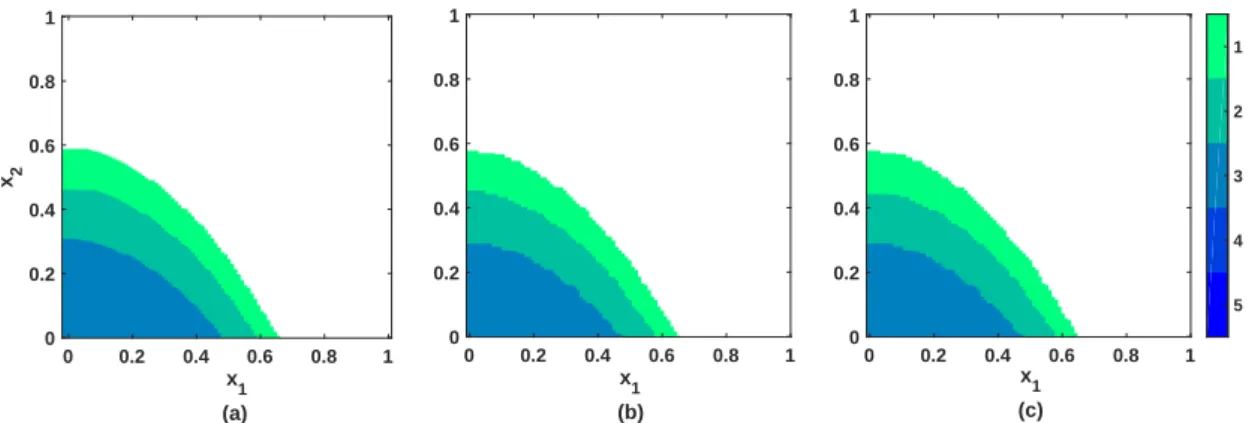
origi-nal interconnected system as discussed in Section 4. Figure 2 shows computed controllers for all three cases. Table 1 gives the computation time for generating the symbolic models and synthesizing the controllers and the size of resulting controllers in terms of number of transitions for all three cases. One can observe that the computation time for CACC is reduced significantly by around 70% as compared to MAMC whereas the size of the controller is reduced only by 3.93%. The numerical implementation
0 0.2 0.4 0.6 0.8 1 x1 (a) 0 0.2 0.4 0.6 0.8 1 x2 0 0.2 0.4 0.6 0.8 1 x 1 (b) 0 0.2 0.4 0.6 0.8 1 0 0.2 0.4 0.6 0.8 1 x1 (c) 0 0.2 0.4 0.6 0.8 1 5 4 3 2 1
Fig. 2. Controller using (a) MAMC, (b) CAMC and (c) CACC. Colorbar shows the number of control inputs available.
Table 1. Comparison between different ab-straction and controller synthesis schemes con-sidering that all abstractions achieve the same
precision
MAMC CAMC CACC
Computation time
(sec) 432.6 375.49 132.41
Size of the controller
(Number of transitions) 33568 32336 32249
of the example has been done using Matlab on an iMAC with CPU 3.5 GHz Intel Core i7.
6. CONCLUSION
In this paper, we have proposed a compositional synthesis methodology for discrete-time cascade interconnected sys-tems. The introduced notion of approximate cascade com-position allows to compose different types of abstractions. Moreover we provided compositional results based on ap-proximate (alternating) simulation relations, and showed how this results can been used for the compositional con-troller synthesis. A numerical example is given to show the effectiveness of our approach where we used different abstractions for discrete-time cascade interconnected sys-tems. In future work, we extend ideas of the paper to more general interconnections of systems.
REFERENCES
Bloem, R., Jobstmann, B., Piterman, N., Pnueli, A., and Sa’ar, Y. (2012). Synthesis of reactive (1) designs. Journal of Computer and System Sciences, 78(3), 911– 938.
Cassandras, C.G. and Lafortune, S. (2009). Introduction to discrete event systems. Springer Science & Business Media.
Dallal, E. and Tabuada, P. (2015). On compositional symbolic controller synthesis inspired by small-gain the-orems. In 2015 54th IEEE Conference on Decision and Control (CDC), 6133–6138.
Girard, A. (2014). Approximately bisimilar abstractions of incrementally stable finite or infinite dimensional systems. In 53rd IEEE Conference on Decision and Control, 824–829.
Girard, A. and Pappas, G.J. (2007). Approximation metrics for discrete and continuous systems. IEEE Transactions on Automatic Control, 52(5), 782–798.
Hussien, O., Ames, A., and Tabuada, P. (2017). Abstract-ing partially feedback linearizable systems composition-ally. IEEE Control Systems Letters, 1(2), 227–232. Julius, A.A., D’Innocenzo, A., Di Benedetto, M.D., and
Pappas, G.J. (2009). Approximate equivalence and synchronization of metric transition systems. Systems & Control Letters, 58(2), 94–101.
Kim, E.S., Arcak, M., and Seshia, S.A. (2017). A small gain theorem for parametric assume-guarantee con-tracts. In Proceedings of the 20th International Con-ference on Hybrid Systems: Computation and Control, HSCC ’17, 207–216. ACM, New York, NY, USA. Mallik, K., Schmuck, A.K., Soudjani, S., and Majumdar,
R. (2016). Compositional abstraction-based controller synthesis for continuous-time systems. arXiv preprint arXiv:1612.08515.
Meyer, P.J., Girard, A., and Witrant, E. (2015). Safety control with performance guarantees of cooperative systems using compositional abstractions. IFAC-PapersOnLine, 48(27), 317–322.
Pola, G., Pepe, P., and Di Benedetto, M. (2016). Symbolic models for networks of control systems. IEEE Transac-tions on Automatic Control, 61(11), 3663–3668. Reissig, G. (2011). Computing abstractions of nonlinear
systems. IEEE Transactions on Automatic Control, 56(11), 2583–2598.
Reissig, G., Weber, A., and Rungger, M. (2017). Feed-back refinement relations for the synthesis of symbolic controllers. IEEE Transactions on Automatic Control, 62(4), 1781–1796.
Tabuada, P. (2009). Verification and control of hybrid systems: a symbolic approach. Springer Science & Business Media.
Tazaki, Y. and Imura, J.i. (2009). Discrete-state abstrac-tions of nonlinear systems using multi-resolution quan-tizer. In International Workshop on Hybrid Systems: Computation and Control, 351–365. Springer.
Zamani, M., Pola, G., Mazo, M., and Tabuada, P. (2012). Symbolic models for nonlinear control systems without stability assumptions. IEEE Transactions on Automatic Control, 57(7), 1804–1809.
Zamani, M., Tkachev, I., and Abate, A. (2017). Towards scalable synthesis of stochastic control systems. Discrete Event Dynamic Systems, 27(2), 341–369.