HAL Id: hal-00299214
https://hal.archives-ouvertes.fr/hal-00299214
Submitted on 3 Nov 2004
HAL is a multi-disciplinary open access
archive for the deposit and dissemination of
sci-entific research documents, whether they are
pub-lished or not. The documents may come from
teaching and research institutions in France or
abroad, or from public or private research centers.
L’archive ouverte pluridisciplinaire HAL, est
destinée au dépôt et à la diffusion de documents
scientifiques de niveau recherche, publiés ou non,
émanant des établissements d’enseignement et de
recherche français ou étrangers, des laboratoires
publics ou privés.
Information entropy analysis of seismicity of
Umbria-Marche region (Central Italy)
L. Telesca, V. Lapenna, M. Lovallo
To cite this version:
L. Telesca, V. Lapenna, M. Lovallo. Information entropy analysis of seismicity of Umbria-Marche
region (Central Italy). Natural Hazards and Earth System Science, Copernicus Publications on behalf
of the European Geosciences Union, 2004, 4 (5/6), pp.691-695. �hal-00299214�
Natural Hazards and Earth System Sciences (2004) 4: 691–695 SRef-ID: 1684-9981/nhess/2004-4-691
© European Geosciences Union 2004
Natural Hazards
and Earth
System Sciences
Information entropy analysis of seismicity of Umbria-Marche region
(Central Italy)
L. Telesca, V. Lapenna, and M. Lovallo
Institute of Methodologies for Environmental Analysis, National Research Council, Tito, Italy
Received: 12 July 2004 – Revised: 26 October 2004 – Accepted: 1 November 2004 – Published: 3 November 2004 Part of Special Issue “Precursory phenomena, seismic hazard evaluation and seismo-tectonic electromagnetic effects”
Abstract. We investigated by means of nonlinear tools the temporal distribution of 1983–2003 seismicity of the Umbria-Marche region, Central Italy, that was struck by a strong event (M=5.8) on 26 September 1997. Information entropy analysis has been performed over the full and the aftershock-depleted catalogue. We analysed the series of the interevent times between successive earthquakes and the se-ries of their magnitudes. The time evolution of this measure shows a clear anomalous behaviour in correspondence with the stronger event, more evident in the full catalogue than in the aftershock-depleted one.
1 Introduction
Time series data, representing the measurement of some vari-ables of interest, have been studied in order to extract in-formation on the dynamics of underlying geophysical pro-cesses. Nonlinear time series tools have been extensively used to reveal the presence of underlying chaotic dynamics, whether the variables arise from a low dimensional attrac-tor, whether this attractor has fractal dimension which can be inferred from time series data, etc. (Azad et al., 2002). In particular, seismicity data are well suited to be studied by means of several methodologies, in order to furnish a better understanding of tectonic processes. Seismicity in a more general sense is probably evidence of a variety of complex causes. Long term behaviour of seismicity appears random but it reflects integral characteristics of the lithosphere dy-namics and encompasses all the complexities of faulting (Li and Nyland, 1994). Several features of the lithosphere allow for a nonlinear description of seismicity data: i) interaction of the processes of different physical origin, and of different spatial and temporal scales; ii) hierarchical block or possi-bly fractal structures; iii) self-similarity in space, time and energy. The lithosphere of the Earth can be viewed as a
hi-Correspondence to: L. Telesca
erachy of volumes, from tectonic plates to grains of rock. Their relative motion against the forces of friction and cohe-sion is realized to a large extent through earthquakes. The motion is controlled by a wide variety of independent pro-cesses, concentrated in the thin boundary zones between the volumes. A boundary zone has a similar hierarchical struc-ture, consisting of volumes, separated by boundary zones, etc. Altogether, these processes transform the lithosphere into a large nonlinear system, featuring instability and de-terministic chaos (Keilis-Borok, 1990). The presence of a large amount of different nonlinear mechanisms important for the seismotectonic process suggests the applicability of the genral approach of nonlinear science to complex dissipa-tive systems as shown by earthquake sequences.
In this paper we analyzed the earthquake sequence from 1983 to 2003 in the Umbria-Marche region, central Italy, by means of information entropy to qualify and quantify dynam-ical patterns.
2 Tectonic settings
The Umbria-Marche region, central Italy, has been subjected to a great scientific interest, after the strong 26 September 1997 seismic event (MS=5.9) that struck the area, and many
studies have been performed regarding its geodynamical fea-tures (Boncio and Lavecchia, 2000; Calamita et al., 2000; Vittori et al., 2000), active tectonics (Galadini et al., 1999; Cinti et al., 2000; Morelli et al., 2000), spatio-temporal seis-mic distribution (Ripepe et al., 2000; Di Giovambattista and Tyupkin, 2000; Deschamps et al., 2000; Cattaneo et al., 2000), induced geophysical effects (Quattrocchi et al., 2000; Esposito et al., 2000).
The central Apennines are made up of several tectonic units put straight since the Oligocene as a results of con-vergence and collision between the continental margins of the Corsica-Sardinia block and the Adriatic block (Cello et al., 1995). The main compressive phase started in the Tor-tonian and the lack of Pliocene-Pleistocene marine deposits
692 L. Telesca et al.: Information entropy analysis of seismicity of Umbria-Marche region 14 7.00 8.00 9.00 10.00 11.00 12.00 13.00 14.00 15.00 16.00 17.00 18.00 36.00 37.00 38.00 39.00 40.00 41.00 42.00 43.00 44.00 45.00 46.00 47.00 Fig. 1
Fig. 1. Map of the Umbria-Marche region (central Italy). The cross
indicates the stronger event (M=5.8) in the area.
prove that after the Miocene the area was definitively up-lifted. The compressive structures were dissected by normal faults during the Quaternary, and, according to the most re-cent studies (Calamita et al., 1994; Lavecchia et al., 1994), these are related to the crustal thinning processes occurring in the Tyrrhenian Tuscan area. The Quaternary normal faults led to the formation of intramountain basins, and the seismic-ity of the area is mainly related to the activseismic-ity of these faults. The Umbria-Marche region is part of the east-verging Neo-gene thrust and fold belt of Central Italy (Bally et al., 1988; Patacca et al., 1992; Calamita et al., 1994). Middle-late Qua-ternary faults and intermontane tectonic depressions, over-printed onto the thrust structure, are the preferential loci of strong to moderate earthquakes, as shown by historical and instrumental data and geological evidence (Cello et al., 1997; Vittori et al., 1997; Vittori et al., 2000).
The Umbria-Marche region is characterized by a well-documented historical and instrumental seismicity, mainly confined within the upper part of the crust (<16 km) (Lavec-chia et al., 1994). West of the Tiber Basin, the seismic ac-tivity is the lowest. It increases remarkably within the Apen-nine area, where small to moderate (4<M<6) earthquakes are frequent, while largest earthquakes (6<M<7) have long
recurrence-intervals (Boncio and Lavecchia, 2000). Four
highly damaging earthquakes (1279 Camerino, 1328 Nor-cia, 1703 Norcia and 1751 Gualdo Tadino) have occurred in the last centuries within the Citt`a di Castello-Gubbio-Gualdo Tadino-Norcia seismic band. In the same area the largest in-strumental earthquakes of the last twenty years (M5.9 1979 Norcia, M5.2 1984 Gubbio, M5.9 1997 Colfiorito) are lo-cated (Boncio and Lavecchia, 2000).
The analysed earthquake data were extracted by the National Institute of Geophysics and Volcanology
instru-mental catalogue (INGV), available on the internet site at http://www.ingv.it, and cover the period 1983—2003. Fig-ure 1 shows the epicenter distribution of the earthquakes, analysed in this paper.
3 Data analysis
We analyzed the full and the aftershock-depleted catalogues. We depleted the catalogue by means of the method of Reasenberg (1985), which is physically based and consid-ers each earthquake capable to generate an alteration of the surrounding stress field that may trigger a further seismic event, which nucleates in its surroundings a modified stress field. The areal and time extent for which the event can trig-ger a following event is called interaction zone of the earth-quake, whose length scale is proportional to the source di-mension, and the temporal scale is determined with a prob-abilistic model based on Omori’s law. Thus, we applied the Reasenberg’s algorithm to remove aftershocks from the Umbria-Marche catalogue.
Figure 1 shows the area investigated and the spatial dis-tribution of the epicenters of the earthquakes extracted by the instrumental catalogue of the Institute of Geophysics and Volcanology (INGV). We firstly performed the analysis of Gutenberg-Richter (1944) to obtain the minimum magnitude from which the catalogue could be considered complete: the full catalogue is complete for events with magnitude M≥2.4 (N=5988).
The aim of the present paper is the analysis of the time dy-namics of Umbria-Marche seismicity by means of informa-tion entropy measure, applied on both interevent and magni-tude time series.
The information entropy H is given by the well-known equation of Shannon (Kolmogorov, 1965):
H = −
n
X
k=1
Pklog (Pk), (1)
where Pk is the probability of the state k, and it reaches its
maximum value if all states are equiprobable, that is when
Pk=1/n, for k=1, 2, · · ·, n; in this case, we have no
indi-cation whatsoever to assume that one state is more probable than another state. The information entropy H expresses our uncertainty or ignorance about the system’s state. It is clear that H =0, if and only if the probability of a certain state is 1 (and of all other states 0), Pk=1 for some k and Ph=0 for
h6=k. In that case we have maximal certainty or complete information about what state the system is in. Uncertainty also relates to the concept of predictability. When some-thing is completely predictable, it is completely certain, and it contains very little, if any, information. Entropy refers to the degree of randomness, lack of organization, or disorder in a situation. Therefore, the information entropy furnishes the information about (i) the deviation from the equiproba-ble state, characterized by a uniform distribution, and (ii) the degree of “order” of a system.
L. Telesca et al.: Information entropy analysis of seismicity of Umbria-Marche region 693 15 100 101 102 103 1E-4 1E-3 0.01 0.1 PTi Ti full depleted (a) 2.0 2.5 3.0 3.5 4.0 4.5 5.0 5.5 6.0 1E-4 1E-3 0.01 0.1 PM i Mi full depleted (b) Fig. 2
Fig. 2. Histograms of the interevent times (a) and magnitudes (b).
To calculate this quantity we need to compute the his-togram, which is an approximation of the probability density function. Depending on the time structure of the variable, continuous (as the interevent times) or discrete (as the mag-nitudes), we will use different, but equivalent, definition of histogram. Let us consider the statistical sample by {si}Ni=1,
where N is the length of the sample. If si is a continuous
variable: (i) we consider a finite interval (a, b) such that
a ≤min
i {si
}and b ≥ max
i {si
}; (ii) we divide the interval (a, b) into n nonintersecting subintervals of equal length L=(b-a)/n; (iii) then the probability Pkof the subinterval (xk, xk+1)
is given by
Pk(x) =
# {si ∈ [xk, xk+1) : x ∈ [xk, xk+1), }
N , (2)
where the symbol # indicates the number of elements in the set.
If si is a discrete variable, we deal with a process with n
possible discrete outcomes, and the probability associated to the specified outcome siis simply
Pi = # {si} N . (3) 16 0 0 1x10⁸ 2x10⁸ 3x10⁸ 4x10⁸ 5x10⁸ 6x10⁸ 7x10⁸ -0.5 0.0 0.5 1.0 1.5 2.0 HT t (s) Full Depleted 5.8 M agni tu de (a) 0 0 1x10⁸ 2x10⁸ 3x10⁸ 4x10⁸ 5x10⁸ 6x10⁸ 7x10⁸ 1.0 HM t (s) Full Depleted 5.8 M agni tude (b) Fig. 3
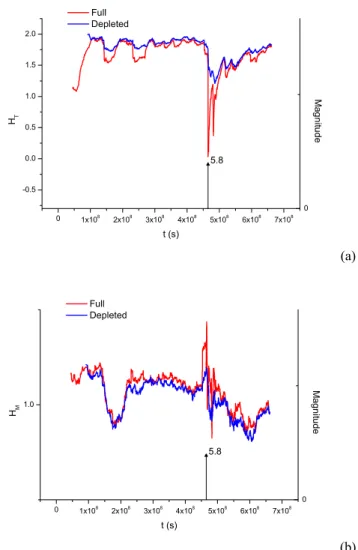
Fig. 3. Time variation of the information entropy for the interevent
intervals (HT)and the magnitudes (HM). The vertical arrow
in-dicates the occurrence time of the principal mainshock of the se-quence.
We calculated the information entropy for the interevent times using Eq. (2) and that for the magnitudes using Eq. (3). Regarding the interevent time series, we chose the parameter
L=1 h, and the histograms of the full and depleted series are shown in Fig. 2a. We obtained HT=1.5266 in the full case
and HT=2.1284 in the depleted case. We see that the
infor-mation entropy in the depleted case is slightly larger than that obtained in the full case, because the deletion of the after-shocks, which introduce short interevent times, has made the catalogue more uniform than the full catalogue. Figure 2b shows the probability distribution of the magnitudes in the full and aftershock-depleted case. The estimated value of the information entropy for the magnitudes is HM=0.9877
in the full case and HM=0.8955 in the depleted case. The
values are very close to each other, because the deletion of the aftershocks has not changed dramatically the magnitude distribution.
We analyze now the time variation of the information en-tropies HT and HM calculated using the full as well as the
694 L. Telesca et al.: Information entropy analysis of seismicity of Umbria-Marche region aftershock-depleted catalog. Figure 3 shows the results. It is
clear the strong change of both parameters, especially in the full catalog, concomitantly with the occurrence of the largest
shock of magnitude 5.8 on 26 September 1997. The HT
sharply decreases to 0 and ∼1.2 in the full and aftershock-depleted case respectively. Although the decreasing behavior is visible in both sequences, it is more evident in the full se-ries. The tendency of HT of the full sequence downward zero
indicates a loss of information, due to the increased proba-bility of estimation of the interevent intervals after the main-schock. In opposition, the behaviour of HM, which increases
during the occurrence of the aftershocks, indicating that the magnitudes are less predictable and tend to be uniformly dis-tributed.
4 Conclusions
In the present study we performed a nonlinear analysis of the 1983–2003 Umbria-Marche region (central Italy) seismicity. The information entropy analysis performed over the full as well as the aftershock-depleted catalogs has revealed the following features: i) the Umbria-Marche seismic process, described by the interevent interval and magnitude time series, is characterized by nonlinear dynamics, quantified by the information entropy of the interevent intervals HT
and magnitudes HM; ii) these two parameters are able to
quantify the degree of randomness or the degree of pre-dictability of the interevent time or magnitude of a sequence of earthquakes; (iii) the time variation of both paramaters has revealed opposite behaviors, but anomalous change in correspondence with the largest shock in the sequence is evident in both quantities; (iv) HT (t ) has suggested that
the predictability of interevent times of the aftershocks increases, because of the large frequency of small interevent intervals; while HM (t ) has revealed that the predictability
of the magnitudes decreases.
Edited by: M. Contadakis
Reviewed by: F. Vallianatos and another referee
References
Azad, R. K., Rao, J. S., and Ramaswamy, R.: Information-entropic analysis of chaotic time series: determination of time-delays and dynamical coupling, Chaos Solitons & Fractals, 14, 633–641, 2002.
Bally, A. W., Burbi, L., Cooper, C., and Ghelardoni, R.: Balanced sections and seismic reflection profiles across the Central Apen-nines, Mem. Soc. Geol. It., 35, 257–310, 1988.
Boncio, P. and Lavecchia, G.: A structural model for active exten-sion in Central Italy, J. Geodynamics, 29, 233–244, 2000. Calamita, F., Coltorti, M., Piccinini, D., Pierantoni, P. P., Pizzi, A.,
Ripepe, M., Scisciani, V., and Turco, E.: Quaternary faults and seismicity in the Umbria-Marchean Apennines (central Italy): evidences from the 1997 Colfiorito earthquake, J. Geodynamics, 29, 245–264, 2000.
Calamita, F., Cello, G., Deiana, G., and Paltrinieri, W.: Structural styles, chronology-rates of deformation and time space relation-ships in the Umbria-Marche thrust system (Central Apennines, Italy), Tectonics, 13, 873–881, 1004.
Cattaneo, M., Augliera, P., De Luca, G., Gorini, A., Govoni, A., Marcucci, S., Michelini, A., Monachesi, G., Spallarossa, D., Tro-jani, L., and XGUMS: The 1997 Umbria-Marche (Italy) earth-quake sequence: analysis of the data recorded by the local and temporary networks, J. Seismology, 4, 401–414, 2000.
Cello, G., Mazzoli, S., Tondi, E., and Turco, E.: Active tectonics in the Central Apennines and possible implications for seismic hazard analysis in peninsular Italy, Tectonophysics, 272, 43–68, 1997.
Cello, G., Turco, E., and Zuppetta, A.: Cinematica del settore cen-trale del Mediterraneo ed implicazioni sulla struttura dell’arco calabro. In Bonardi G., De Vivo, B., Gasparini, P., and Vallario, A. (eds), Cinquant’anni di attivit`a didattica del Prof. F. Ippolito, Napoli, Liguori Editore, 293, 1995.
Cinti, F. R., Cucci, L., Marra, F., and Montone, P.: The 1997 Umbria-Marche earthquakes (Italy): relation between the sur-face tectonic breaks and the area of deformation, J. Seismology, 4, 333–343, 2000.
Deschamps, A., Courboulex, F., Gaffet, S., Lomax, A., Virieux, J., Amato, A., Azzara, A., Castello, B., Chiarabba, C., Cimini, G. B., Cocco, M., Di Bona, M., Margheriti, L., Mele, F., Sel-vaggi, G., Chiaraluce, L., Piccinini, D., and Ripepe, M.: Spatio-temporal distribution of seismic activity during the Umbria-Marche crisis, 1997, J. Seismology, 4, 377–386, 2000.
Di Giovambattista, R. and Tyupkin, Y. S.: Spatial and temporal dis-tribution of seismicity before the Umbria-Marche 26 September 1997 earthquakes, J. Seismology, 4, 589–598, 2000.
Esposito, E., Porfido, S., Simonelli, A. L., Mastrolorenzo, G., and Iaccarino, G.: Landslides and other surface effects induced by the 1997 Umbria-Marche seismic sequence, Eng. Geology, 58, 353–376, 2000.
Galadini, F., Galli, P., Leschiutta, I., Monachesi, G., and Stucchi, M.: Active tectonics and seismicity in the area of the 1997 earth-quake sequence in central Italy: A short review, J. Seismology, 3, 167–175, 1999.
Gutenberg, B. and Richter, C. F.: Frequency of earthquakes in Cal-ifornia, Bull. Seism. Soc. Am., 34, 185–188, 1944.
Keilis-Borok, V. I.: The lithosphere of the Earth as a nonlinear sys-tem with implications for earthquake prediction, Rev. Geophys., 28, 19–34, 1990.
Kolmogorov, A. N.: Three approaches to the quantitative definition of information, Problems Inform. Transmission, 1, 1–7, 1965. Lavecchia, G., Brozzetti, F., Barchi, M., Menichetti, M., and Keller,
J. V. A.: Seismotectoning zoning in east-central Italy deduced from an analysis from the Neogene to present deformations and related stress fields, Geol. Soc. Am. Bull., 106, 1107–1120, 1994.
Li, Q. and Nyland, E.: Is the dynamics of the litosphere chaotic?, in Nonlinear Dynamics and Predictability of Geophysical Phenom-ena, edited by Newman, W. I., Gabrielov, A., and Turcotte, D. L., Geophysical Monograph 83, IUGG 18, 37–41, 1994. Morelli, A., Ekstr¨om, G., and Olivieri, M.: Source properties of
the 1997-98 Central Italy earthquake sequence from inversion of long-period and broad-band seismograms, J. Seismology, 4, 365–375, 2000.
Patacca, E., Sartori, R., and Scandone, P.: Tyrrhenian basin and Apennine arcs: kinematics relations since late Tortonian times, Mem. Soc. Geol. It, 3, 1–8, 1992.
L. Telesca et al.: Information entropy analysis of seismicity of Umbria-Marche region 695
Quattrocchi, F., Pik, R., Pizzino, L., Guerra, M., Scarlato, P., An-gelone, M., Barbieri, M., Conti, A., Marty, B., Sacchi, E., Zuppi, G. M., and Lombardi, S.: Geochemical changes at the Bagni di Triponzo thermal spring during the Umbria-Marche 1997–1998 seismic sequence, J. Seismology, 4, 567–587, 2000.
Ripepe, M., Piccinini, D., and Chiaraluce, L.: Foreshock sequence of the 26 September 1997 Umbria-Marche earthquakes, J. Seis-mology, 4, 387–399, 2000.
Reasenberg, P.: Second-order moment of central California seis-micity, 1969–1982, J. Geophys. Res., 90, 5479–5495, 1985.
Vittori, E., Maschio, L., Ferreli, L., Michetti, A. M., and Serva, L.: Carta e base di dati delle faglie capaci per l’Italia centro-meridionale: presentazione e stato di avanzamento del progetto ITHACA, Il Quaternario, 10, 2, 305–321, 1997.
Vittori, E., Deiana, G., Esposito, E., Ferreli, L., Marchegiani, L., Mastrolorenzo, G., Michetti, A. M., Porfido, S., Serva, L., Si-monelli, A.L., and Tondi, E.: Ground effects and surface faulting in the September-October 1997 Umbria-Marche (Central Italy) seismic sequence, J. Geodynamics, 29, 535–564, 2000.