HAL Id: tel-01293395
https://tel.archives-ouvertes.fr/tel-01293395
Submitted on 24 Mar 2016HAL is a multi-disciplinary open access
archive for the deposit and dissemination of sci-entific research documents, whether they are pub-lished or not. The documents may come from teaching and research institutions in France or abroad, or from public or private research centers.
L’archive ouverte pluridisciplinaire HAL, est destinée au dépôt et à la diffusion de documents scientifiques de niveau recherche, publiés ou non, émanant des établissements d’enseignement et de recherche français ou étrangers, des laboratoires publics ou privés.
Model based system engineering for safety of railway
critical systems
Pengfei Sun
To cite this version:
Pengfei Sun. Model based system engineering for safety of railway critical systems. Automatic. Ecole Centrale de Lille, 2015. English. �NNT : 2015ECLI0018�. �tel-01293395�
No d’ordre : 275
École Centrale de Lille
THÈSE
présentée en vue d’obtenir le grade de
DOCTEUR
en
Spécialité : Automatique Génie Informatique, Traitement du Signal et Images
par
Pengfei SUN
DOCTORAT DELIVRE PAR L’ÉCOLE CENTRALE DE LILLE
Titre de la thèse :
Ingénierie de modèle pour la sécurité des systèmes critiques ferroviaires
Model based system engineering for safety of railway critical systems
Soutenue le 24 juillet 2015 devant le jury d’examen :
Président CR-HDR, Mohamed GHAZEL IFSTTAR, Lille
Rapporteur HDR, Hélène WAESELYNCK LAAS-CNRS, Toulouse
Rapporteur Pr, Hassane ALLA UJF, Grenoble
Membre Pr, Xiaoyun FENG SWJTU, Chengdu
Membre Pr, Jinling ZHU SWJTU, Chengdu
Directeur de thèse DR, Simon COLLART-DUTILLEUL IFSTTAR, Lille
Co-directeur de thèse CR, Philippe BON IFSTTAR, Lille Thèse préparée dans le Laboratoire d’Évaluation des Systèmes de Transports
Automatisés et de leur Sécurité
IFSTTAR, COSYS/ESTAS, Villeneuve d’Ascq École Doctorale SPI 072 (EC Lille) PRES Université Lille Nord de France
Je tiens à remercier tous ceux qui m’ont soutenu et assisté pendant ces années de thèse
À mes parents adorés
À mes professeurs
Et à mes chèr(e)s ami(e)s
Abstract v
Model based system engineering for safety of railway critical systems Abstract
Development and application of formal languages are a long-standing challenge within the computer sci-ence domain. One particular challenge is the acceptance of industry. Although many successful stories have demonstrated the applicability of formal methods to industrial practice, their use within industry is still lim-ited. This thesis presents some model-based methodologies for modelling and verification of the French rail-way interlocking systems (RIS), which aims to use formal methods to effectively ensure railrail-way traffic safety.
This thesis mainly addresses two issues. The first one is the modellization of interlocking system by coloured Petri nets (CPNs). Next, a generic and compact modelling framework is introduced, in which the interlocking rules are modelled in a hierarchical structure while the railway layout is modelled in a geographi-cal perspective. Then, a modelling pattern is presented. It is a parameterized model which respects the French national rules. It is a general reusable solution that can be applied in different stations. Then, an event-based concept is brought into the modelling process of low level part of RIS to have better description of internal interactions of low level relay-based interlocking logic.
The second issue is the transformation of coloured Petri nets intoB machines, which can assist designers
on the way from analysis to implementation. A mechanism describing the multi-sets and their behaviours in
B machines is introduced to allow the following systematic translations. Firstly, a detailed mapping
method-ology from non-hierarchical CPNs to abstractB machine notations is presented. Then the hierarchy and the
transition priority of CPNs are successively integrated into the mapping process, in order to enrich the adapt-ability of the transformation. This transformation is compatible with various types of colour sets and the
transformedB machines can be automatically proved by Atelier B.
All these works at different levels contribute towards a global safe analysis framework.
Keywords: railway interlocking system, discrete event systems, CPN, modelling methodology Ingénierie de modèle pour la sécurité des systèmes critiques ferroviaires
Résumé
Le développement et l’application des langages formels sont un défi à long terme pour la science informa-tique. Un enjeu particulier est l’acceptation par l’industrie. Malgré des succès industriels avérés, la dissémina-tion des méthodes formelles dans la pratique industrielle ferroviaire est encore limitée. Cette thèse présente une approche pour la modélisation et la vérification des postes d’aiguillage français, qui utilise les méthodes formelles pour assurer efficacement la sécurité ferroviaire.
Cette thèse se concentre sur deux questions. La première est la modélisation du système d’enclenchement par les réseaux de Petri colorés (RdPC). Un cadre de modélisation générique et compact est introduit, dans le-quel les règles d’enclenchement sont modélisées dans une structure hiérarchique, tandis que les installations sont modélisées dans une perspective géographique. Ensuite, un patron de modèle est présenté. C’est un mo-dèle paramétré qui intègre les règles nationales françaises. C’est une solution générale et réutilisable qui peut être appliquée pour différentes gares. Puis, un concept basé sur l’événement est présenté dans le processus de modélisation des parties basses des postes d’aiguillage. Ce dernier fournit une meilleure description des interactions internes de la logique d’enclenchement à relais.
La deuxième question est la transformation des RdPCs en machines B, qui va aider les concepteurs sur la route de l’analyse à application. Des mécanismes décrivant les multi-ensembles et leurs comportements dans
les machinesB sont introduits. Il permettent la transformation systématique. Tout d’abord, une méthodologie
détaillée, s’appuyant sur une table de correspondance, du RdPCs non-hiérarchiques vers les notationsB est
présentée. Ensuite, la hiérarchie et la priorité des transitions du RdPC sont successivement intégrées dans le processus de mapping, afin d’enrichir les possibilités de types de modèles en entrées de la transformation. Cette transformation est compatible avec différents types d’ensemble de couleurs, et la structure des machines
B produites par la transformation permet la preuve automatique intégrale par l’Atelier B.
L’ensemble de ces travaux , chacun à leur niveau, contribuent à renforcer l’efficacité d’un cadre global d’analyse sécuritaire.
Mots clés : système d’enclenchement ferroviaire, systèmes à événements discrets, RdPC, méthode de modélisation
IFSTTAR, COSYS/ESTAS
Remerciements
Ces travaux ont été réalisés au sein de l’unité de recherche « Évaluation des Systèmes de Transports Automatisés et de leur Sécurité » dans le département « Composants et Sys-tèmes » de l’« Institut Français des Sciences et Technologies des Transports, de l’Aménagement et des Réseaux » (IFSTTAR/COSYS-ESTAS) à Villeneuve d’Ascq, de novembre 2012 à juillet 2015. Je suis extrêmement reconnaissant à China Scholarship Council (CSC) qui m’a financé ce travail.
En premier lieu, je souhaite remercier M. Simon Collart-Dutilleul, directeur de recherche à ESTAS. En tant que directeur de thèse, il m’a accueilli au sein de son équipe et m’a orienté, aidé et conseillé. Je suis également reconnaissant de ses qualités pédagogiques et scien-tifiques, sa franchise et sa sympathie. J’ai beaucoup appris à ses côtés, et je le remercie pour la confiance dont il a su faire preuve à mon égard, notamment pour les recherches sur la méthode B. De plus, Il m’a également beaucoup aidé pour mes démarches person-nelles pendant mon séjour en France. Pour toutes ses raisons, je lui adresse mes sincères remerciements.
Je souhaite aussi remercier vivement mon co-encadrant de thèse, M. Philipe BON, chargé de recherche à ESTAS, pour sa gentillesse et son soutien. Mes recherches sur la transforma-tion de la méthode B sont basées sur sa thèse. Il m’a donné des conseils avisés et son écoute a été importante pour la bonne réussite de cette thèse. Son énergie et sa confiance ont été des éléments moteurs pour moi. J’ai pris un grand plaisir à travailler avec lui.
Je voudrais ensuite exprimer mes remerciements à mon ancien professeur Xiaoyun FENG, qui fut le premier à me faire découvrir le monde des chemins de fer, qui a soutenu mon étude de master avec des suggestions utiles, m’a impliqués dans ses projets de recherche et m’a aidé à saisir cette opportunité d’étudier en France. J’ai beaucoup appris de son attitude optimiste sur la vie et l’attitude rigoureuse lors de ses recherches.
Je voudrais également remercier les rapporteurs de cette thèse Mme. Hélène WAESE-LYNCK, habilitation à diriger des recherches au LAAS-CNRS de Toulouse, et M. Hassane ALLA, Professeur à l’Université Joseph Fourier, chercheur au laboratoire GIPSA-Lab de Grenoble, pour le temps passé et leurs remarques pertinentes. Je remercie aussi tous les
viii Remerciements autres membres du jury pour avoir bien voulu participer à cette soutenance : M. Mohamed GHAZEL, directeur de recherche à ESTAS, et M. Jinling ZHU, professeur de l’Université Jiaotong du Sud-ouest en Chine.
Je remercie, pour la gentillesse et la convivialité dont ils ont fait preuve, toutes les per-sonnes avec qui j’ai partagé mes études et notamment ces années de thèse au centre IFST-TAR de Villeneuve d’Ascq et qui ont rendu mon séjour très agréable. Je tiens à remercier particulièrement tous les doctorants et post-doctorants de l’IFSTTAR de Villeneuve d’Ascq : Liuliu, Baisi, Cyril, Antoine, Ciliang ainsi que l’équipe d’ESTAS : Sonia, Julie, Grégory, El-Miloudi, Nathalie, Valérie, pour leur soutien et toute l’aide qu’ils m’ont apporté lors de ma thèse. Je tiens à remercier particulièrement Rahma, qui m’a toujours gentiment donné les explications détaillées avec patience lorsque j’ai commencé à apprendre le langage formel B, ansi que ma camarade Liuliu, à qui je souhaite de finaliser le plus rapidement possible et dans les meilleures conditions ses travaux de thèse. Je lui souhaite une bonne continuation tout au long du chemin qu’elle chosira d’emprunter.
Toute ma gratitude va également à Mlle. Hélène CATSIAPIS, mon professeur de français à l’École Centrale de Lille, qui m’a montré la beauté de la langue et de la culture françaises. Elle a organisé des voyages intéressants et inoubliables qui ont inspiré mon intérêt pour la culture française et ouvert l’appétit pour l’histoire, l’art, la cuisine, et le vin. Tout cela a fortement contribué à mon bien être en France.
Dans ces moments importants, je pense tout particulièrement à ma famille. Tout ça n’aurait jamais été possible sans le soutien inconditionnel de mes parents qui ont toujours cru en moi. Merci pour avoir fait de moi ce que je suis à présent. Je les remercie pour leur soutien durant mon séjour à Lille et d’avoir accepter mon absence pendant trois ans. Je voudrais ensuite remercier ma compagne Huixin HAN dont l’amour et la présence en France m’ont permis de conclure ce voyage avec des sourires et des souvenirs colorés. Sa présence indéfectible auprès de moi dans les bons comme dans les mauvais jour m’a permis de garder un moral stable.
Enfin, merci à toutes les personnes, qui m’ont toujours soutenu et encouragé au cours de cette thèse, que je n’ai malheureusement pas citées ici mais qui se reconnaîtront à travers ces quelques lignes.
Scientific Acronyms
AMN
abstract machine notation. 7, 8, 102, 105, 110, 113–115, 142, 150, 155, 157
B
B method. 6, 7, 15, 16, 18, 19, 22, 23, 26, 27, 101–105, 109, 110, 112–121, 123, 125,
126, 129–131, 134–137, 145, 146, 149, 150, 153–155 CPN
coloured Petri net. 6–8, 19, 21, 24–26, 52, 57, 58, 61, 63–65, 68–70, 73, 74, 76, 80, 85–87, 97–99, 101, 102, 109, 110, 112, 114, 115, 117–119, 121, 123, 125, 127, 129, 130, 134–137, 141–143, 145, 146, 149, 150, 153–157, 187–190, 192
CtlPN
controlled Petri net. 87 DSL
domain specific language. 20, 21, 25, 26 Event-B
Event-B. 15, 22
FM
formal method. 7, 11, 15–24, 27 GRAFCET
GRAphe Fonctionnel de Commande Étape/Transition. 7, 53–57, 160 HCPN
hierarchical coloured Petri net. 5, 7, 8, 51, 57, 58, 61, 63, 67, 68, 76, 85, 102, 129–131, 137, 150, 155, 156, 187, 190–192 MDE model-driven engineering. 1, 17, 18, 25, 26 ML Meta language. 57 ix
x Scientific Acronyms PN Petri net. 5–7, 18, 21, 24–27, 52, 53, 55–58, 63, 64, 67, 73, 77, 87, 92, 101, 102, 109, 110, 146, 153, 154, 192 RdP réseau de Petri. 160, 161, 163, 167 RdPC
réseau de Petri coloré. 159–167 RdPCH
réseau de Petri coloré hiérarchie. 162, 165, 167 RE requirements engineering. 1 RG reachability graph. 60 SCS safety-critical system. 3, 4, 6, 7, 11, 13, 14, 16–18, 27 SE systems engineering. 7, 12, 13 SSG
state space graph. 60, 62, 65 TL
transformation language. 25, 26 V&V
Railway Terms
ATC
automatic train control. 19 ATO
automatic train operation. 19, 22 ATP
automatic train protection. 19, 30 CAg
point control relay (french: le relais deCommande des Aiguilles). 45
CIt
route control relay (french: le relais deCommande de l’Itinéraire). 45
EIt
entrance signal relay of interlocked route (french: le relais d’Enclenchement d’Itinéraire du signal d’entrée). 45
ERTMS
European Rail Traffic Management System. 2–5, 51, 52, 159 ETCS
European Train Control System. 19, 20, 25, 68 KAg
point checking relay (french: leContrôle impératif des Aiguilles). 45
MA
movement authority. 60–62 PRCI
relay-based computer-controlled control (french:Poste d’aiguillage à Relais à Commande
Informatique). 45, 52, 160, 166 PRG
relay-based geographic cable signalling control (french: Poste d’aiguillage tout Relais
à câblageGéographique). 45
xii Railway Terms PRS
relay-based flexible signalling control (french: Poste d’aiguillage tout Relais à transit
Souple). 45 RIS
railway interlocking system. 3–5, 7, 19–21, 23, 25, 42–44, 51, 52, 66–68, 73, 76, 77, 80, 83, 86, 92–95, 98, 153, 154
RIt
route repeater relay (French: le relaisRépétiteur d’Itinéraire). 45
RRV
track circuit relay (french: Répétiteur du Relais de Voie). 45
SEF
systèmes d’enclenchement ferroviaires. 159–162, 166 SIL
safety integrity level. 15, 19, 23, 33, 44, 45 TER
regional express transport (french: Transport Express Régional). 63
TGV
high-speed train (French: Train à Grande Vitesse). 63
TMS
train management system. 19 Tr.I
odd transit relay (french: le relais deTransit Impair). 45
Tr.P
even transit relay (french: le relais deTransit Pair). 45
UIC
International Union of Railways (french:Union Internationale des Chemins de fer). 3,
Table of contents
Abstract v
Remerciements vii
Scientific Acronyms ix
Railway Terms xi
Table of contents xiii
List of Tables xvii
List of Figures xix
List of Listings xxi
List of Publications xxiii
General introduction 1
I Preliminary
9
1 Background 11
1.1 Modelling of complex system . . . 11
1.2 Safety-critical system . . . 13
1.3 Formal methods . . . 15
1.4 Model-driven engineering . . . 17
1.5 Literature review . . . 18
1.5.1 Formal method for safety-critical system in railway industry . . . . 18
1.5.2 TheB method in railway . . . . 22
1.5.3 Petri net in railway . . . 24
1.5.4 Model transformation of model-driven engineering . . . 25
1.6 Conclusion . . . 26
2 Some principles of railway safety 29 2.1 Railway safety . . . 29
2.1.1 Concept of safety . . . 30
2.1.2 Safety management of French railway system . . . 32 xiii
xiv Table of contents
2.1.3 Problematic of computer-controlled system . . . 33
2.2 Railway context . . . 34
2.3 The railway system . . . 36
2.3.1 Human actors . . . 36
2.3.2 Signalling procedures . . . 38
2.3.3 Installations . . . 39
2.4 The risk from signalling system . . . 42
2.5 Railway interlocking system . . . 42
2.5.1 Overview . . . 42
2.5.2 The general architecture of the French signal centre . . . 44
2.5.3 The operating phases of a signal centre . . . 45
II Methodology Construction
49
3 Formal modelization for railway interlocking system via hierarchical coloured Petri net 51 3.1 Introduction . . . 513.2 Preliminaries of coloured Petri net . . . 52
3.2.1 Background . . . 53
3.2.2 GRAFCET and Petri net . . . 53
3.2.3 Coloured Petri net . . . 57
3.2.4 Graphic notation and modelling ability of coloured Petri net . . . . 58
3.3 Initial coloured Petri net specification of railway interlocking system . . . . 66
3.4 A geographical approach of railway interlocking system . . . 68
3.4.1 Signalling operation specification . . . 68
3.4.2 Geographical railroad layout specification . . . 72
3.5 A pattern of railway interlocking modelling . . . 76
3.5.1 Generalisation concept . . . 76
3.5.2 Example of generalized model . . . 80
3.6 An event-based approach for relay-based logic . . . 83
3.6.1 Background of relay-based logic . . . 83
3.6.2 Event-driven concept . . . 87
3.6.3 System validation of event-based model . . . 92
3.7 Conclusions . . . 98
4 Model transformation: from coloured Petri net to B language 101 4.1 Introduction . . . 101
4.2 Preliminaries of theB method . . . . 102
4.2.1 TheB language . . . . 104
4.3 From non-hierarchical coloured Petri net toB machine . . . . 109
4.3.1 Framework of non-hierarchical translation . . . 110
4.3.2 Multi-set concept . . . 112
4.3.3 Colour sets and coloured Petri net declarations . . . 114
4.3.4 Transformation equivalence . . . 117
4.3.5 Demonstration for mapping non-hierarchical coloured Petri net . . 121
4.4 Extending transformation using hierarchical concept . . . 128
4.4.1 Hierarchy concept . . . 129
Table of contents xv
4.4.3 Transformation equivalence . . . 135
4.4.4 Demonstration for mapping hierarchical coloured Petri net . . . 137
4.5 Extending transformation using prioritized transitions . . . 141
4.5.1 Priority management . . . 141
4.5.2 Framework of model transformation . . . 143
4.5.3 Mapping coloured Petri net with prioritized transitions . . . 145
4.5.4 Transformation equivalence . . . 148
4.6 Conclusion . . . 150
III Conclusions
151
Conclusions and Perspectives 153 Conclusions . . . 153Perspectives . . . 156
Résumé étendu en français 159 Motivation de la recherche . . . 159
Contexte de la recherche . . . 160
Modélisation formelle pour les systèmes d’enclenchement ferroviaires via les réseaux de Petri colorés . . . 161
Transformation de modèles réseau de Petri coloré en machineB . . . . 163
Conclusions . . . 166
Perspectives . . . 167
Bibliography 169
List of Tables
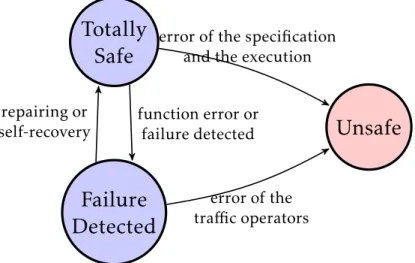
2.1 Safety restrictions of railway system . . . 42
2.2 Dangerous events of railway system . . . 43
2.3 Function phases of establishing a safe route . . . 46
3.1 Structure comparison between GRAFCET and Petri net . . . 56
3.2 Scenario-related elements in general structure . . . 79
3.3 Conditions and equations of “DA” movement . . . 81
3.4 Initial configuration of the model . . . 81
3.5 Result of route “3/15” simulation . . . 83
3.6 Type of logical variables ant its properties . . . 92
3.7 State space calculation result . . . 96
4.1 Set-theoretical notations ofB language . . . . 105
4.2 The basic sets . . . 107
4.3 Operators of complex sets . . . 107
4.4 Comparison of mathematical and ASCII notations . . . 108
4.5 A subset of generalized substitutions . . . 108
4.6 Comparison of basic data types . . . 114
4.7 Mapping ofList data type . . . . 115
4.8 Component status for dining_philosophers . . . 125
4.9 Component status for SimpleProtocol . . . 129
4.10 Comparison of composition clauses . . . 129
4.11 Component status for hierarchical protocol . . . 141
4.12 Component status for the correspondingB machine . . . . 148
1 Une version simplifiée du cadre modèle de transformation . . . 164
List of Figures
1.1 Research domains of safety-critical system . . . 14
2.1 Railway system state . . . 29
2.2 Impact of reliability of the overall safety of a signalling system . . . 31
2.3 The overall safety of a computer-controlled signalling system . . . 34
2.4 The global vision of railway system . . . 37
2.5 The effect of the automatic devices in system safety . . . 37
2.6 Components of track segments . . . 39
2.7 Components of turnout . . . 40
2.8 Basic point arrangements . . . 40
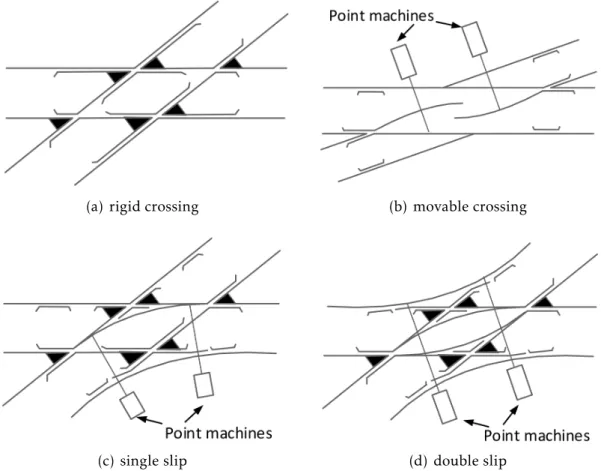
2.9 Components of crossings . . . 41
2.10 An example of railway interlocking system . . . 44
2.11 The general architecture of a signal centre . . . 45
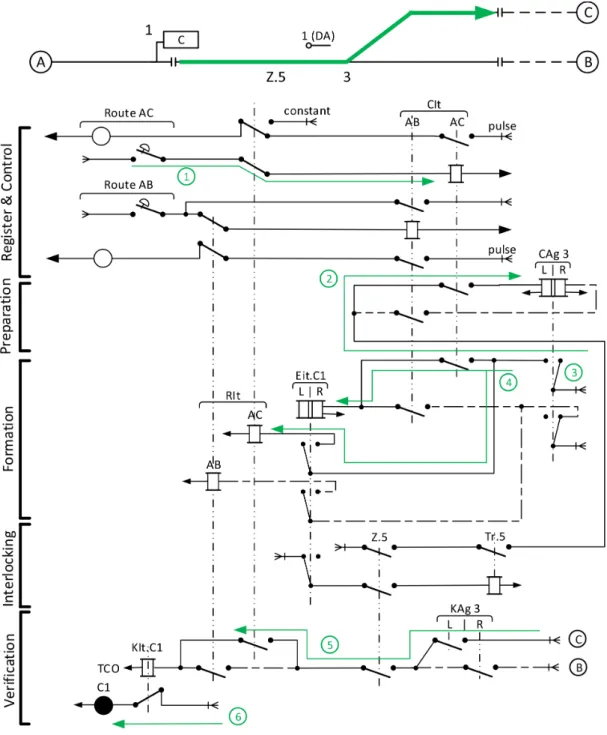
2.12 An example of PRS type railway interlocking system . . . 47
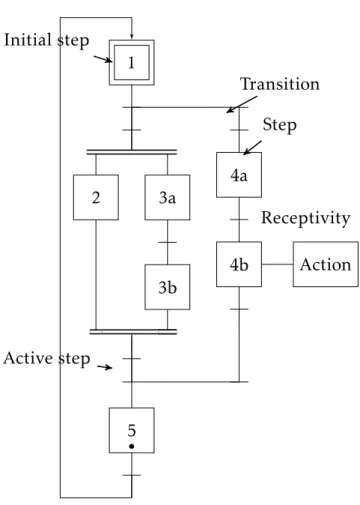
3.1 Basic concepts of the GRAFCET . . . 54
3.2 Corresponding Petri net model . . . 56
3.3 A circular railway network . . . 58
3.4 A non-hierarchical coloured Petri net example . . . 59
3.5 State space graph of the non-hierarchical coloured Petri net example . . . . 60
3.6 A circular railway network with a signal centre . . . 61
3.7 The hierarchical coloured Petri net model of the circular railway with a signal centre . . . 62
3.8 State space graph of the hierarchical coloured Petri net example . . . 63
3.9 A circular railway network with a signal centre and train priorities . . . 64
3.10 Prioritized hierarchical coloured Petri net model of circular railway . . . . 64
3.11 State space graph of the prioritized hierarchical coloured Petri net model . 66 3.12 Specification framework of railway interlocking system . . . 67
3.13 Basic specification framework of railway interlocking system . . . 68
3.14 Hierarchical model structure of signalling operation . . . 69
3.15 Example of mapping signalling operations (1) . . . 70
3.16 Example of mapping signalling operations (2) . . . 71
3.17 A Petri net representation of track segments . . . 73
3.18 A Petri net representation of point component . . . 74
3.19 A Petri net representation of signal light . . . 74
3.20 A Petri net representation of “DA” mode . . . 75
3.21 Case study of a station layout . . . 76
3.22 The Petri net model of route layout . . . 77
3.23 Generalized representation of track segments . . . 78 xix
xx List of Figures
3.24 Generalized representation including points . . . 78
3.25 Generalized representation including signal lights . . . 78
3.26 Generalized Petri net model of “DA” route pattern . . . 82
3.27 An example of PRCI type system of a single point . . . 84
3.28 Modelling problem I: synchronous firing . . . 86
3.29 Modelling problem II: firing conditions . . . 87
3.30 An example of controlled Petri net . . . 88
3.31 Event-driven coloured Petri net model of Fig. 3.28 . . . 89
3.32 Simplification rules of system space state . . . 90
3.33 Event-driven coloured Petri net model of Fig. 3.29 . . . 91
3.34 Modelling structure and simulation environment . . . 93
3.35 coloured Petri net model of signalling operations . . . 93
3.36 coloured Petri net model of point control . . . 94
3.37 coloured Petri net model of signal light control . . . 95
3.38 coloured Petri net model of test layer . . . 96
3.39 Part of the state space tree . . . 97
4.1 Software development with methodB . . . . 103
4.2 General structure ofB machine (left) and refinement (right) . . . . 106
4.3 The framework of aB machine transformed from coloured Petri net . . . . 111
4.4 Toy example of multi-set demonstration . . . 113
4.5 Example of mapping coloured Petri net function intoB operation . . . . 117
4.6 Coloured Petri net of an elevator . . . 117
4.7 State space comparison between the transformation . . . 122
4.8 Dining philosophers problem . . . 123
4.9 Coloured Petri net of simple protocol . . . 125
4.10 Demo of transition transformation . . . 127
4.11 Comparison of hierarchy structure between coloured Petri nets and B ma-chines . . . 130
4.12 The framework of aB machine transformed from hierarchical coloured Petri net . . . 133
4.13 Root net of the hierarchical protocol model . . . 138
4.14 Sub-nets of the hierarchical protocol model . . . 138
4.15 An example of prioritized operation . . . 142
4.16 The template of operation “Chg_Priority” . . . 143
4.17 The framework of aB machine transformed from prioritized Petri net . . . 144
4.18 A simple coloured Petri net model with prioritized transitions . . . 145
4.19 The state-space discussion of example in Fig. 4.18 . . . 146
4.20 The state-space ofB machine “Prioritized_Transitions” . . . . 150
1 Une approche géographique de la modélisation de SEF . . . 162
2 Exemple de représentation généralisée . . . 163
3 Règles de simplification de l’état de l’espace du système . . . 164
List of Listings
4.1 Specification of multi-set and their operations . . . 113
4.2 Corresponding system state of Fig. 4.6 . . . 118
4.3 Corresponding colour set of Fig. 4.6 . . . 119
4.4 Corresponding definitions part of Fig. 4.6 . . . 120
4.5 Corresponding operations part of Fig. 4.6 . . . 120
4.6 B-machine for dining philosophers . . . . 123 4.7 B-machine declarative part of simple protocol . . . . 126
4.8 Part of operations of simple protocol . . . 127
4.9 B-machine for Root net . . . . 138 4.10 B-machine for Sender net . . . . 140 4.11 B-machine for the prioritized coloured Petri net model . . . . 146
1 Spécifications de multi-ensemble et de leurs opérations . . . 164
List of Publications
Following are the list of publications that produced during the course of my PhD research.
Journals (Published or Submitted)
1. Pengfei Sun, Philippe Bon and Simon Collart-Dutilleul, “A Joint Development of
Coloured Petri nets and B Method in Critical System”. In:Journal of Universal
Com-puter Science. (Submitted)
2. Pengfei Sun, Simon Collart-Dutilleul and Philippe Bon, “Formal validation of
inter-locking systems under national railway signalling”. In:European Transport Research
Review. (Submitted)
Conferences (Published or Submitted)
1. Pengfei Sun, Simon Collart-Dutilleul and Philippe Bon, “Model transformation from
coloured Petri nets with prioritized transitions to B machines”. In:IESM 2015,
Inter-national conference on Industrial Engineering and Systems Management, Seville, Spain,
October, 2015. (Accepted)
2. Pengfei Sun, Simon Collart-Dutilleul and Philippe Bon, “A Model Pattern of Railway
Interlocking System by Petri Nets”. In:MT-ITS 2015, Models and Technologies for
Intel-ligent Transportation Systems, Budapest, Hungary, June, 2015.
3. Pengfei Sun, Simon Collart-Dutilleul and Philippe Bon, “Formal modelling
method-ology of French railway interlocking system via HCPN”, In:COMPRAIL 2014,
Inter-national conference on Railway Engineering Design and Optimization, Rome, Italy, June,
2014.
4. Shaobo Song,Pengfei Sun, Qingyuan Wang, “Optimization Of The Layout Of Neutral
Sections Based On A Differential Evolution Algorithm”, In:COMPRAIL 2014,
Interna-tional conference on Railway Engineering Design and Optimization, Rome, Italy, June,
2014.
5. Pengfei Sun, Simon Collart-Dutilleul and Philippe Bon, “Formal modelling
methodol-ogy of French railway interlocking system via Hierarchical coloured Petri net”. In:TRA
2014, Transport Research Arena, Paris, France, April, 2014. (poster)
6. Philippe Bon, Simon Collart-Dutilleul andPengfei Sun, “Study of implementation of
ERTMS with respect to french national rules using a B centred methodology”. In:IESM
2013, International conference on Industrial Engineering and Systems Management, Rabat,
Morocco, October, 2013.
xxiv List of Publications
7. Huixin Han, Pengfei Sun and Jie Wu, “Research on Optimizing Scheme of Neutral
Section based on Genetic Algorithm”. In:CCC 2013, China Control Conference,
P3327-3333, Xi’an, China, July, 2013.
8. Jianwei Qu,Pengfei Sun, Qingyuan Wang and Xiaoyun Feng, “Optimization for
High-speed Train Operation Considering Driving Strategies and Timetable”. In:CCC 2013,
General introduction
Preamble
This doctoral dissertation presents a synthesis of research work, which was carried out as
a fruit of my Ph.D. work (2012-2015) in the ESTAS1 laboratory of the COSYS2 department
in the IFSTTAR3 (Lille) research institute, under the supervision of Prof. Simon
COLLART-DUTILLEUL and Philipe BON. This work was made possible through the co-financing of
CSC4 and ANR5. In fact, my Ph.D. work took place in the PERFECT6 national level project.
Moreover, this project is also supported by the French i-Trans7 cluster that is financed by
Université Lille Nord de France, RFF8, SNCF9, Alstom.
With the research background of Prof. Simon COLLART-DUTILLEUL in railway safety requirements engineering (RE) and the previous work of Philipe BON in model-driven engi-neering (MDE), the research presented in this thesis contributes to the model based system engineering for safety of railway critical systems. The intention of this research is to provide some new approaches to effectively ensure railway traffic safety.
Motivation
Single European Railway Area
The organisation of railway traffic, the governance of railway principles and standards use to be a national matter. The signalisations and systems have been validated at the national level where each country has its own “language” for railway and its own requirements for man-aging trains on its network. With the development of the railway electrification, trains are
1Évaluation des Systèmes de Transports Automatisés et de leur Sécurité (Evaluation of Automated
Trans-port Systems and Their Safety Laboratory )
2COmposants et SYStèmes (Composants and Systems )
3Institut Français des Sciences et Technologies des Transports, de l’aménagement et des Réseaux (French
Institute of Science and Technology for Transport, Spatial Planning, Development and Networks )
4China Scholarship Council
5Agence Nationale de la Recherche (French National Research Agency )
6Performing Enhanced Rail Formal Engineering Constraints Traceability
7Pôle de compétitivité i-Trans
8Réseau Ferré de France (French Rail Network )
9Société Nationale des Chemins de fer Français (French National Railway Company )
2 General introduction increasingly dependent on train control system. So far, there are over 20 kinds of signalling and speed control systems throughout the European Union. Every system is autonomous and non-interoperable with the others, so that each train used by a national railway com-pany has to be equipped with at least one on-board system but sometimes more, just to be able to run safely within that one country. Meanwhile, the trains run in several countries have to carry all the on-board systems of these countries, which requests additional integra-tion effort for engineering, increases the total costs for border-crossing traffic, and reduces the performance of rail transport. For example, the “Thalys”, a high-speed railway between Paris, Brussels, Cologne and Amsterdam, is equipped with 7 different types of train con-trol systems, which causes considerable costs. All these constrains restrain competition and impede the integration of the railway transport at a European level vis-a-vis road and air transport, which have benefited from the absence of such barriers.
With the frequent economic and cultural exchanges among the European Union, there is a growing demand for international rail traffic. Also, the high speed railways have the quality to shorten the travel time for international journeys. To put an end to such a seg-mentation situation, and to promote the European rail market for passengers and freight, a packet of solutions has been launched by the European Union to remove the technical barriers that were created historically by the development of the national railways. This innovation relates to the technical and operational harmonisation, called the interoperabil-ity fo the high speed network and the conventional network. Meanwhile, the European signalling system ERTMS (European Rail Traffic Management System) has been the subject of a merger of several research projects, in order to create a new generation of signalling and speed control systems. The main objective of these projects is to have a common, har-monised, and standardised management of rail traffic and signalling in Europe in order to have a seamless network at the European level. ERTMS functions are located partly on the ground and partly on board, in this way, the communications between the ground and trains are standardised. This brand new standard is easier to apply in the new lines, where way-side signalling cost is kept to a minimum, but all the vehicle fleets that operate on these lines must be equipped with the ERTMS on-board system. However, for existing lines, there is an alternative “Mixed operation” solution. This is a strategy where the wayside signalling is equipped with both ERTMS and conventional systems. Normally, the conventional one is the legacy line used during the upgrade program. The main reasons for applying such a mixed solution are: financial and organisational constraints make it impossible to install ERTMS in the whole network in a short time. In addition, not every train has to go across the border line, and ERTMS-equipped trains sometimes have to run on the conventional lines. Most national companies prefer to gradually deploy the ERTMS in order to replace the conventional systems with a unified European system.
Every conventional signalling system is the result of historical evolution, which was boosted by progressively technological development and lessons of accidents. Generally,
General introduction 3 its safety is ensured by engineering experiences, rather than by systematic methodology and their evaluations. So far, there has not been a lot of engineering experience of ERTMS, which means it is impossible to evaluate the new system in the traditional way. Meanwhile, the management of railway signalling in ERTMS is based on local rules pertaining to each country and not on global ones, which makes it difficult to evaluate the combined system in terms of safety. In order to ensure the safety of ERTMS deployment, any implementations before being put into use should have detailed verification and validation (V&V), especially the compatibility of ERTMS and conventional signalling standards. This V&V is related to a set of rules, technical and operational conditions which ensure that the essential safety requirements are met. So some new methodologies which are more systematic and formal need to be adopted. Thus, the strong motivation of my research aims at contributing to the validation and implementation of ERTMS.
Railway interlocking system
Normally, locomotives and the rolling stock weigh tons, and are hundreds of meters long, in the distributed environment, under multiple control. These facts mean the trains are always at risk of collision. Because they are running on fixed track, trains are not capable of steering away from another conflicting train as road vehicle do to avoid collision. Another reason is the train needs a quiet long distance for to fully stop, even further than the driver’s sight distance. So, in the case of obstacles on railway track, the train cannot stop in time to avoid collision. To avoid collision and other conflicts there is a mechanism called railway interlocking system (RIS), which is a highly safe and environmentally critical system. Its malfunctioning could cause death or serious injury to people, large scale environmental damage or considerable economical loss. For example, the “Zoufftgen train collision”[BEA-TT and AET 2009], which occurred in October 2006, is an RIS accident that was related
to human failure. This accident caused 6 death, 2 serious injuries and 14 minor injuries. The organization of the accident response needed around 100 militias, 150 firefighters, 50 emergency vehicles and 7 vehicle extrication units.
Thanks to the usage of computers in safety-critical systems (SCSs), which has increased the concerns about the safety in railways, and successively reduced the number of accidents
between 2006 and 2013 (data source from UIC10 Safety Database Report 2014 [UIC-ETF
2014]). However many of these concerns have been focused on the software component of the computer based complex systems. Normally, the software itself can non cause an accident, but it becomes safety critical when it is used to control potentially dangerous sys-tems. Formal methods, which are based on mathematical foundation, can be applied for modelling such systems giving an increased confidence. According to the European
com-10UIC (International Union of Railways french: Union Internationale des Chemins de fer) is an
4 General introduction mittee of Electro technical standardization [EN 50128 2011], the use of formal methods in the development of safety-critical and computer-controlled systems for railway applications is recommended.
Based on the above discussion, it was realized that the specification and analysis of rail-way RIS is an important part of the deployment of ERTMS. Moreover, the critical and com-plicated nature of railway safety properties obliged us to adopt the formal method for the RIS more rapidly. Thus, my main research approach and case studies are based on the RIS, using formal methods.
Problematic
This thesis is in the domain of safety requirement engineering in railways and more specif-ically around the usage of formal methods to assess and validate certain SCSs. It also dis-cusses the approach of specification and modelling of complex systems. Undoubtedly, the increasing complexity of automated systems that are applied in the railway industry intro-duces in an increasing difficulty in assessing their structural and behavioural properties. We are interested in a large part of the design process, from the formalisation of requirements to integration, validation and verification.
Our research objects can be characterised as following:
• A privileged application domain: the safe and efficient operation of railway transport networks under certain signal standards.
• Scientific and technical foundation: Models and formal methods, taking into account the model transformations.
• A methodological context: the development of methods and tools for assisting the design of complex systems.
The aim of the ERTMS is to create an interoperable railway system within Europe in or-der to increase its own competitiveness. However, as a signalling system, its most important responsibility is to maintain transportation safety. During the implementation of ERTMS, evaluation of the global consistency is needed. Evaluation verifies the consistency between the conventional system and the ERTMS-equipped system, with regard to safety. This issue is crucial and yet it has scarcely been covered by scientific literature. In fact, the difficulty of this problem is the lack of formal representations of both system, which could enable the validation of different aspects through test scenarios.
In order to maintain high-level safety with deterministic scope, a project, called “PER-FECT”, was launched to develop the safety specification and verification of French rail-way interlocking systems in the context of national rules and the influence of implement-ing ERTMS laws on the original systems [Bon, Dutilleul, and Sun 2013;
Collart-General introduction 5 Dutilleul et al. 2014; Sun, Collart-Dutilleul, and Bon 2014]. My Ph.D. project is the low-level part and the fundamental phase of the project. It focuses on the formal validation approach of the French railway RIS based on the computer-controlled relay-based system. The study aims to provide a methodology for a comprehensive assessment of the consis-tency of the following two aspects: the operating rules of local signalling systems and the additional safety requirements (ERTMS).
With this method, we are able to follow the safety analysis: The safety assessment of new systems, the analysis of given scenarios, the evaluation of safety requirements of system up-dates. After this method is recognized by railway experts, we will develop the method in an automatic methodological tool easily applied in practice. Then, we will provide a method-ology for translations between the exclusive model train and classical Petri net model. This will allow us the opportunity to apply our research results in actual practice.
Contribution
As discussed above, the overall aim in this thesis is to show and explore the hypothesis that the formal languages can improve the quality with system design and verification in railway industry. The primary result of this thesis is a systematic design methodology for modelling and safety verification of the French railway interlocking system (RIS). It provides a theoretical framework, including system specification and safety requirement verification by model checking and theorem proving.
The work that has been performed in this thesis can be split into two main results: Formal modelization of railway interlocking system: The first result of the thesis is to provide a modelling framework allowing one to specify a RIS, formulated as hierarchical coloured Petri net (HCPN) models, for simulating and verification of their behaviours. In this framework, the Petri net’s “place-transition” structures delineate the construction of the fixed installations and the signalling rules of interlocking control. The dynamic behaviours, such as signal commands and train movements, are represented by firing transitions and tokens.
On the practical side, each station or yard along a railway line has its own interlocking system, which respects the same national standard but has a different facility formation. In order to effectively accomplish the validation tasks and reduce the error probability, we in-troduce a modelling pattern based on the framework for different railway layouts. This pat-tern is a parametrized model that respects the French national rules (in this thesis, we means the signalling rules of relay-based computer-controlled systems). It is a general reusable so-lution to this kind of problem and can be used in many different given contexts.
The low-level part of the RIS — the relay-based logic, has a nature of concurrency. It is a mechanism that does not exist in the Petri net language. To solve this problem, we introduce
6 General introduction an event-based mechanism to simulate a relative concurrency, in order to be able to describe the internal interaction between each relay. Comparing to the original system, this mecha-nism brings “internal” states which will enlarge the system state space. To compensate for this deficiency, we apply a reduction policy, both before and after the state space calculation, to obtain a new compact graph with the same reliability for analysis.
Model transformation from coloured Petri net to B machines: Since the formalism of Petri nets has the advantage of communicating and their models could be validated by some engineering experts, it is still a long distance from the final implementation. The second result of this thesis is to bridge the gap between the specifications and the implementations.
As the B method offers a formal software development, this thesis introduces a systematic
process of mapping coloured Petri nets (CPNs) formalism intoB language formalism. The
transformed B machines will be the input of the B development process and could be
au-tomatically refined into the implementable codes. Moreover, considering the limitations of model checking, sometimes we want to apply a theorem-proving for the purpose of
verifica-tion. As the B proved models are considered “safe” in French industry, the transformation
from Petri net toB machine is needed by any means necessary.
In this transformation framework, we improved the mechanism of multi-set behaviours based on the work [Bon and Dutilleul 2013], so that the transformed machines can be au-tomatically proved by Atelier B tool. Besides, we propose some mapping rules for different colour sets, in favour of raising the compatibility.
In order to enrich the adaptability of the transformation, the concept of hierarchy is integrated into the mapping process. A multi-system that is modelled in a hierarchical
way can be translated into a set of abstract B machines. The hierarchy is expressed by the
composition relations of the machines and the accessible operations. Then, the concept of prioritized transition is introduced into the transformation. It is achieved by giving each operation a priority and adding an operation to the machine for priority management. It maintains the same priority mechanism of as in Petri nets.
All these above works aims to contribute towards a global safe analysis framework.
Outline
This thesis is divided into 3 parts (6 chapters in total). The brief description of each chapter is as followed:
Part I
Chapter 1. Background: This chapter aims to present and locate the scientific background of this thesis. It provides an overview of the related fields which are based on the formal solution of modelling complex safety-critical systems. The first part of this chapter gives
General introduction 7 a general introduction on concept and development of four disciplines, including systems engineering, safety-critical system, formal languages. In the rest of this chapter, some previ-ous research and applications about formal method for safety-critical system in the railway domain are reviewed.
Chapter 2. Some Principles of railway safety: This chapter describes and formalises some major safety properties and the control logic of railway signalling system. For this purpose, an analysis has been performed step by step, which is organized around the safety nature of the signalling based railway system. Firstly, a particular concept of safety has been ex-plained. Based on that, the background of safety management in France is introduced, and the problematic of the computer-controlled system is discussed. Next, the context and the characteristics of the railway are stated. Then, the composition structure of the railway system is stated. Major components, such as human actors, signalling procedures and in-stallations are introduced. Further, the common risk form signalling system is summarized. Finally, the French railway interlocking system is introduced, including the general archi-tecture and different operating phases of a signal centre.
Part II
Chapter 3. Formal modelization for railway interlocking system via hierarchical coloured
Petri net: This chapter deals with modelling and analysis of the railway interlocking system.
The proposed cases are studied and described by using HCPN. Initially, this chapter starts with the background of Petri nets, and presents a discussion on the GRAFCET and Petri nets, in order to state the reason for choosing Petri nets as formal tools. The graphic notations used in this thesis and the modelling ability of CPN are carried out with a series of demon-strations Then, the structure and the modelling framework of RIS are discussed. After that, an intuitive modelling approach is performed, which formally specifies the constructions of the railway network and the signalling procedures of the interlocking logic. Then, con-sidering each station complies with same interlocking logic rules but with various railway layouts, a general solution is proposed by introducing a modelling pattern, which could be easily adapted to different stations. Finally, the analysis of the low-level system of RIS is stated. An event-based concept is introduced to better describe the internal interactions of relay-based logic.
Chapter 4. Model transformation: from coloured Petri net to B language: This chapter introduces the modelling transformation approach. First, it reviews the basics and the
out-standing features of theB theory, including some notations, concepts and the mathematical
syntax ofB language. After, a systematic transformation framework is introduced, which is
from non-hierarchical CPNs to abstract machine notations. In this framework, it improves the multi-set mechanism and its related specifications from [Bon and Dutilleul 2013], so
that the transformed B machines can be automatically proved by Atelier B without using
8 General introduction and present a new transformation from HCPNs to AMNs based on the previous one. A “multi-system” approach is be studied, and the hierarchical structures are presented by
adding accessible pre-defined functions in those high-level B machines. Finally, the
pri-oritized transition of CPN is considered, which could increase the capacity of describing the event-based systems. In new transformation, a global priority indicator is added, each operation is assigned with a priority pre-condition, a priority management mechanism is created.
Part III
Conclusions: Finally, we draw the thesis to a close by summarising all our proposed methodologies. We give concluding remarks on applying the methodology and comment on future areas of interest towards extending the methodology.
Part I
Chapter
1
Background
The aim of this chapter is to present and to locate the scientific background of my research. The subject is the modelling of complex systems considering safety-critical scope via formal languages. First, system engineering is presented as the basic concept of complex systems, then, we introduced a general solution of complex system modelling. Second, the defini-tion and categories of safety-critical system are presented, along with the introducdefini-tion of industry standards and a little analysis of its research domains. Third, the background of formal methods is described and a short discussion about its industry applications. Finally, a literature review is given on scientifically and technologically related topics.
1.1 Modelling of complex system
System modelling is an activity and its aim is to make a particular part or feature of the world easier to understand. It is essential for understanding, simulation and analysis of systems, and it provides a basic prototype for the design process. There are already a lot of techniques to represent a system in a mathematical form. Still, a model is an approxi-mation in a simple format. It has to give an abstraction of reality according to some given established purpose.
But, when a system is getting more complicated, it typically consists of “a number of
elements having diverse, variable behaviours that interact to produce the behaviour of the whole”
[Bar-Yam 2003]. This kind of systems can be referred to as a complex system. Its elements operate according to Its own rules or schedules and are not all entrained by an overall timer. The notion of complexity presents analytical difficulties coming from their behaviours, size
and natural properties. However, “Complexity (ignoring the definitional debates) is subjective
because there are many different ways of viewing the parts, describing interactions, and different ways of measuring complexity” [Berryman and Campbell 2010]. Thus, a complex system
cannot be reduced to a single model. Traditional engineering disciplines seem not so well fitted for such systems.
12 CHAPTER 1. Background The object of our study is focused on the railway context. The railway systems are large-scale systems typically consisting of many concurrently operating and interacting human and non-human elements. These elements can produce a result or provide a service or set of services. In order to analyse this system, we propose to use the technique of systems engineering.
First, let us look at what is meant by systems engineering, and then consider how com-plex system approaches are settled by systems engineering as a field of research. Roughly
speaking, “systems engineering is the engineering of complex systems” [Kossiakoff et al. 2011,
p. 3]. The more rigorous forms are illustrated as the following representative definitions from the Federal Aviation Administration (FAA) and the International Council on Systems Engineering (INCOSE).
“Systems Engineering is a discipline that concentrates on the design and application of the whole (system) as distinct from the parts. It involves looking at a problem in its entirety, taking into account all the facets and all the variables and relating the social to the technical aspects.” [FAA 2014, p. 303]
“Systems engineering is an interdisciplinary approach and means to enable the re-alization of successful systems. It focuses on defining customer needs and required functionality early in the development cycle, documenting requirements, and then proceeding with design synthesis and system validation while considering the com-plete problem: operations, cost and schedule, performance, training and support, test, manufacturing, and disposal. SE considers both the business and the technical needs of all customers with the goal of providing a quality product that meets the user needs.”
[INCOSE 2012, p. 3]
Some keywords can be figured out from the two definitions: interdisciplinary, iterative
andwholeness. It is apparent that such kinds of system description from systems engineering
have many similar characteristics as the nature of complex systems. In other words, “systems
engineering is the engineering of complex systems” [Abbott 2006, p. 1].
The technique of modelling is one of the basic tools of systems engineering, especially in the circumstances that explicit facts and quantitative information are not readily available. In such situations, a complex system can non be established as a single model. Thus, a model of a typical complex system could be constructed in term of constituent parts. Each constituent part explains only a part of the knowledge of the target system and masks other information. It is only a “sub-system” representation of a “super-system” in its environment of use. This formation may be called “system of system (SoS)”. The purpose of this formation is to define a relatively concise and easily understandable system framework, which can serve as a point of reference for discussing the process of developing a new system and the role of systems engineering through the process.
1.2. Safety-critical system 13 By their nature, complex systems have a hierarchical structure in their constitution, which integrates a number of major interacting elements. These elements are generally called subsystem. Each subsystem is composed of more simple functional entities, and so on down to primitive elements. The definition and the division of architectural system Lev-els are confined to the generic system and its subsystem. We will discuss it later in this thesis based on a typical railway system.
After all, systems engineering is a large interdisciplinary field of engineering, and we are only interested in the modelling and analysis tools of the systems engineering. To be more precise, our target field is Safety Engineering, which aims to help non-specialist engineers in designing complex systems to minimize the probability of safety-critical failures.
1.2 Safety-critical system
“Today, we live in a world in which our safety is more and more dependent on software-intensive systems” [Larrucea, Combelles, and Favaro 2013]. This is the case for the aeronautic,
auto-motive, medical, nuclear, and railway sectors, as well as many more. The shareholders of such systems are always seeking more economical way to deal with the enormous increase in size and complexity, while necessarily regarding the need to ensure system safety. Con-sequently, in the engineering domain, the safety of a system is always one of the important goals and core needs. Effort was spent on how to manage risk, eliminate or reduce it to give acceptable levels of safety.
An informal description of safety could be “Nothing bad happens”. There is an ideal
definition–“Freedom from accidents or losses” [Leveson 1995]. But it is so ideal that no system
can be perfectly safe in an absolute sense. In order to be able to integrate the safety analysis into a brand new system, designers focus more on removing hazards than accident analysis,
so there comes the modern concept of safety: “System will not endanger human life or the
environment” [Storey 1996].
Safety-critical system (SCS), or so called life-critical system is a system which controls (or as part of the control) hazardous or safety-critical hardware or software. If such a system fails that could result in at least one of the following outcomes [NASA 2004; Wikipedia 2003]:
• Death or serious injury to people
• Loss or severe damage to equipment/property • Environmental harm
Although we may find some other similar definitions of life-critical systems, sometimes an intuitive criteria will give us a better description. Both formal definition and intuitive
description describe the SCS from the failure consequences. “If the failure of a system could
14 CHAPTER 1. Background
Figure 1.1 – Research domains1 of safety-critical system
The common SCSs can be categorised into several domains as showed in Fig. 1.1. This
figure is the analysis result of CiteSpace2 [Chen 2006; Chen, Hu, et al. 2012]. The original
data is 4,048 paper entries under the topic SCS from the Web of Science (WoS). Although our data source is not exhaustive, and only contains English publications from the WoS database, its analysis can still be used as a reference. There are 45 nodes (some are too small to observe), which represent different research categories. The size of the node depends on the number of papers and the cited index.
In Fig. 1.1, it is clear that there is a large amount of research that has been done on general computer science and general engineering. However, when it comes to domain-based fields, such as telecommunication and transportation, the number of studies significantly reduce. This figure may indicate that the basic theory and methodology of SCS applications in the general areas are mature, while the major difficulty to be applied to typical domains is lacking in industry knowledge. In other words, the development of domain-based SCS has great application prospects.
Some widely accepted industry standards can be found in these domains above, such as IEC 61508 [IEC 61508 2010], EN 50128 [EN 50128 2011], DO178B [DO 178B 2010]. By regulating or restricting the development processes, via verification and validation, these standards are intended to reduce the number of risks introduced by the process (e.g. using rigorous specifications), and to increase the number of risks revealed by the process (e.g.
2CiteSpace is a freely available Java application for visualizing and analysing trends and patterns in
1.3. Formal methods 15 applying rigorous verifications) in order that such risks can subsequently be removed.
Standards prescribe the degree of rigour required in development and assurance, ac-cording to the criticality of system application. The degree of rigour is typically expressed in terms of safety integrity levels (SILs), which is to determine the acceptable failure rate of the system. For example, in EN 50128 the requirement for SIL 4 is defined as: for
continu-ously operated system, the equivalent failure probability rate range is 10−10/h ∼ 10−9/h (≈ 1
failure/114150 years).
Besides the degrees, the standards also define the recommended techniques and pro-cesses for the development process and system assurance. For example, the guidance EN 50128 states that “Informal” requirements and design specification are considered accept-able for the lower integrity levels, i.e. SIL 1 and SIL 2. “Semi-formal” techniques are admis-sible for SIL 3, and “Formal (Mathematical)” specification techniques are expected for the highest level of integrity, i.e. SIL 4.
Although there are many standards and techniques to ensure safety, we still have to accept some of the failure, considering the limitation of cost, time and other resources. It is also a wisdom in system risk management — “fallacious expectation of 0 risk”. There is no system that can be absolutely safe, and no system can guarantee zero risk.
1.3 Formal methods
In computer science, especially software engineering and hardware engineering, “formal
methods have existed at least as long as the term ‘software engineering’ itself” [Gruner et al.
2013]. “formal methods are mathematically based techniques and tools for the synthesis (i.e.
development) and analysis of software systems” [Haxthausen 2010]. For example, as a tool, the
method should include a specification language. Then such a language has a formal syntax,
a formal semantics and a formal proof system. “The techniques of a formal method help to
construct a specification, and/or analyse a specification, and/or transform (refine) one (or more) specification(s) into a program” [Bjørner and Havelund 2014]. In an engineering context,
using formal methods (FMs) means applying the design of technology based on scientific insight, and to assess its properties using some dedicated technology for the analyse phase.
After more than 40 years of research, now we have a wide range of FMs that are applied in different areas [Bjørner and Havelund 2014; Haxthausen 2010; You, Li, and Xia 2012]. The foremost ones can be classified as follows, according to their expression abilities.
Model-oriented specification languages that distinctly define states and operations
defi-nitely, such as VDM3 [Bjørner 1978], Z4 [Woodcock and Davies 1999], B method [Abrial
1996] and Event-B [Abrial 2010]. Their main focus is on the development of specifications.
3VDM: Vienna Development Method.
16 CHAPTER 1. Background
Property-oriented specification languages, such as CASL5[Bidoit and Mosses 2004], Maude [Clavel et al. 2007], and CafeOBJ [Diaconescu and Futatsugi 1998].
Analysis methods that use analysis techniques, such as Model-Checking, for example
SMV6[Clarke Jr, Grumberg, and Peled 1999], SPIN7[Holzmann 2003].
Logic based methods that explore system by chosen logic, such as ITL8 [Umamageswaran,
Pandey, and Wilsey 1999], DC9 [Zhou and Hansen 2004] and RTTL10[Ostroff 1989].
Graphical methods that are in a graphic notation, such as Petri nets [Petri 1966],
State-charts and MSC11[ITU-T 2011]. They are easy to understand and use for some lay people.
Related formal notations that are a set of languages called “process algebras”, such as
CSP12[Hoare 1985; Schneider, Treharne, and Wehrheim 2012] and CCS13[Milner 1980].
Despite all these methods, and publications, right now there are still few FMs that have become a success. In our context, success means being widely accepted by industry or in-tegrated into production processes. However, from the safety needs of industry, the FMs are worthwhile. Moreover, they will probably be indispensable in the professional pursuit of the development of SCSs. Therefore, the situation where FMs are not used, while fitted scientific methods are available, indicates the immaturity of the adaptation of this FM to the industrial.
Generally, there are two main technical obstacles of the practice of FMs. First, there is still not enough research and teaching of FMs, which restrict FMs within a scientific level. This leads to a lack of belief that FMs are worthwhile for the industry. The second difficulty is the supporting tools of FM are not sufficient for large scale use in the industry context. It is
the fact that “industry will not use an FM unless it is standardized and ‘supported’ by extensive
tools” [Bjørner and Havelund 2014]. These two obstacles can be considered as “maturity
of engineering” nature. It may take years for the science of FM to precede industry-scale engineering.
Fortunately, in the French rail transport area, the FM has reached a level of maturity.
For example, theB method has been used successfully to verify the most relevant parts of
a metro system in Paris [Behm, Benoit, et al. 1999]. The related industry keeps an open mind on FMs, and they are willing to use them. This will definitely accelerate the process of engineering maturity of FMs. Therefore, my research is to devote an effort to this process, concerning the application of FMs for SCSs in the Railway industry.
5CASL: Common Algebraic Specification Language.
6SMV: Symbolic model verification
7SPIN: Simple Promela Interpreter
8ITL: Interval Time Logic
9DC: Duration Calculus
10RTTL: Real-time temporal Logic
11MSC: Message Sequence Charts
12CSP: Communicating Sequential Processes.
1.4. Model-driven engineering 17
1.4 Model-driven engineering
To increase the formal methods productivity, one obvious approach is to increase the level of automation all along the development process. This is one of the important features of
MDE[Santiago et al. 2012; Schmidt 2006], which refers to the systematic use of models as
the primary engineering artefacts [Seidewitz 2003] in a formal and precise way [Lukman
and Mernik 2008]. MDE can be applied to software, system, and data engineering. “The
term MDE is typically used to describe software development approaches in which abstract mod-els of software systems are created and systematically transformed to concrete implementations”
[France and Rumpe 2007]. It offers an environment which ensures the systematic and disci-plined use of methods (including FMs) throughout the development process of the system, especially the software systems.
Douglas C Schmidt summarized that the promising approach to address system com-plexity is to develop FM technologies that combine the following[Schmidt 2006]:
• Domain-specific modelling languages which formalize the application structure, behaviour,
and requirements within particular domains. Such languages are described using meta-models, which define the relationships among concepts in a domain and pre-cisely specify the key semantics and constraints associated with these domain con-cepts.
• Transformation engines and generators that analyse certain aspects of models and then
synthesize various types of artefacts. Such automated transformation processes are of-ten referred to as “correct-by-construction,” as opposed to conventional hand-crafted “construct-by-correction” processes that are tedious and error prone.
As we have discussed in the previous Section 1.3, the significant factor behind the obsta-cles of applying FMs to industry is the conceptual gap between scientific technology and the implementation domain. To bridge the gap, an extensive hand-crafting of implementations is required, which will make the development of SCSsdifficult and costly, and may lead to
ac-cidental complexities. “MDE is primarily concerned with bridging the gap between problem and
software implementation domains” [Ahmad 2013] through using technologies that support
systematic transformation of formal abstractions to final implementations. The difficulties of bridging the gap can be addressed through the concept we have discussed in Section 1.1, which describes the complex system in a hierarchical way with multiple levels of abstraction and from a variety of perspectives, then with automated support for processing and analysis the models, finally to automatically transform into implementation results.
A brief conclusion, in the MDE-aided system development, “models are the primary
arte-facts of development and developers rely on computer-based technologies to transform models to running systems” [France 2010]. Our envisioned solution is to put FM into MDE