People’s Democratic Republic of Algeria
Ministry of Higher Education and Scientific Research
Mentouri University Constantine
Faculty of Letters and Languages
Department of English
The Effects of Socio-cultural Factors on Learning Foreign Languages.
Case study; English second year students, Mentouri University,
Constantine
Dissertation submitted in partial fulfilment of the requirements for the degree of “Master” in Applied Language Studies.
Board of Examiners
President: Pr. Ahmed MOUMEN Unive rsity of Constantine Supervisor: Dr. Riad BELOUAHEM Unive rsity of Constantine
Presented by Supe rvised by
LIST OF TABLES
Table 1: Number of years of studying English Table 2: Students‟ level in English
Table 3: Father‟s educational background Table 4: Mothers educational background Table 5: Father‟s occupation
Table 6: Mother‟s occupation
Table 7: Students‟ interests in the company of people who like English
Table 8: Students‟ reasons for liking the company of people who are interested in English Table 9: Students‟ reasons for not liking the company of people who are interested in English Table 10: Languages students read through
Table 11: People who know at least one fore ign language in the students‟ families Table 12: Languages often used in the students‟ homes
Table 13: Topics discussed by students with their parents
Table 14: Things that disturb the students while doing their homework Table 15: Parents‟ reaction towards their children failure
Table 16: The classroom crowdedness
Table 17: Students‟ reactions towards problems in learning
Table 18: Students‟ reasons for not asking teachers about difficult items Table 19: the classrooms atmosphere
GENERAL INTRODUCTION
1- Aims of the study
The aim of this study is to investigate how some socio- cultural factors can influence the leaning of English as a foreign language in Algeria. To make the study manageable, we choose second year English students of Mentouri University who live in urban areas. This study is an attempt to see whether living in an urban city is an advantage for those students when learning English or not. In other words, being a member of this particular social group might affect the student‟s achievement in foreign languages, specifically, in English. This can be done through investigating the effects of the family, the economic status of parents and surroundings on the achievement of the students.
2- Statement of the problem
Learning foreign languages, especially English can be influenced or determined by many factors. The social factors, for example, are said to have great effectiveness on learning English which is a foreign language in Algeria. Hence, being brought up in a society where most of people are supposed to have some knowledge about foreign languages, and where all of them are aware of the importance of learning a foreign language might be of a great influence on students‟ attainment in English. In addition, a lot of means are available today for students that may help them achieve success. To check whether this is true or not, the following questions arise:
1- Is there any relationship between living in an urban area and achieving good results in English? 2-Do the family, the surroundings, and the economic status of the family influence learning English as a foreign language in Algeria?
3- Hypothesis
Departing from the belief that socio- cultural factors are influential on students' success in English, we hypothesize that living in urban areas has a positive effect on learning English among second year students of English at Mentouri University
4- Means of Research
The methodological procedure followed in conducting this research is a formal questionnaire handled to second year students of English who live in urban cities, for the purpose of knowing to what extent being part of this specific social group can affect their English attainment
5-Structure of the Study
The present research contains two main chapters: the first chapter presents an overview of the different factors that influence foreign language learning. It deals also with the socio - linguistic theory of Brazil Bernstein, who was interested mainly in the study of the relationship between education and the learner‟s social class. The second chapter, which is the practical part, includes the analysis of the data collected from the sample with a discussion сеntеring around the student‟s questionnaire results.
CHAPTER ONE
FACTORS INFLUENCING FOREIGN LANGUAGE LEARNING
1.1 Introduction
This chapter will introduce the different factors influencing the process of foreign language learning. It deals also with the socio linguistic theory of Bernstein who was interested in studying the relationship of education and the learner‟s social class. Hence,
the
success of second language acquisition varies along a number of dimensions. Many factors seem to play a role in deciding the success or otherwise of learning a second/foreign language. The socio-cultural factors play a crucial role in determining the individual‟s views towards many issues, especially those related to education and foreign language learning. For this reason, many studies have dealt with the relationship of education and environment, and the effects of socio-cultural variables such as the family and the surroundings on the learner‟s academic achievement. For instance, a person who lives in a culturally and materially poor environment might develop negative attitudes towards learning in general, and foreign languages in particular. On the other hand , a person who lives in an environment where the necessary facilities are provided for him, is more likely to have positive attitudes towards foreign language learning, and thus he will be a successful learner.
1.2 Age Factors
Age has a great influence on the learning of languages for many reasons. First, during childhood there is a period known as “the critical period“when the human brain is most ready to receive input and to learn language. If the person does not acquire language during this period, he will find it almost impossible to do so later on. Brown (2007:57) defined the critical period as “a
biologically determined period of life when language can be acquired more easily and beyond which time language is increasingly difficult to acquire “.
The case of Genie, the girl who was socially and emotionally deprived, but could acquire language at the age of thirteen, has shown that even if the critical period passes, it is possible to acquire language. The second age factor is human cognition. It is easier for adults to learn a foreign language since they can profit from the background knowledge and strategies which they learned from their first language, and that may help them to learn the foreign language. Children, on the other hand, are generally not aware that they are acquiring a language and thus, will learn automatically without having any social attitudes or values about one language or another.
Another age factor influencing learning foreign languages is that children are not really afraid of making mistakes: they are more spontaneous than adults who are, most of the time, afraid of making errors or being laughed at.
To sum up, we can say that children have more advantages while learning foreign languages than adults. Yet, this does not mean that adults cannot overcome all the difficulties and obstacles in order to acquire a foreign language.
1.3 Psychological Factors
During the process of foreign language learning, many factors seem to intervene. The
psychological ones such as motivation and personality seem to have a great impact on foreign language learners
.
1.3.1 Personality Factors
Learners have different personalities, and this might affect t heir learning achievement either positively or negatively. According to Odlin (1989: 131) “personality factors may also account for
the varying degrees of success that individuals have in approximating pronunciation patterns in the target language”
1.3.1.1 Self –Esteem
Self-esteem or self confidence is to believe in your own capabilities to successfully perform a given activity. Learning foreign languages is among the many activities that needs a degree of self confidence.
There is a positive correlation between self confidence and foreign language learning. That is to say, the more self-confident the student is, the more successful he will be, and if he believes that he is capable of doing a given task, he will make the needed efforts to achieve success. However, if the learner feels that he cannot do something, he will not make the least effort to do it. In simple terms, as Brown puts it “it is essential for learners to believe in themselves in order to succeed at a set of tasks “(2007:156).
1.3.1.2 Risk Taking
Risk taking is an important characteristic of successful learners. Foreign language learners should be willing and able to use the information or knowledge they have. They are supposed to ask questions and participate in the class despite the fact that they might commit mistakes. Brown (2007) for instance relates risk-taking to self esteem in the sense that students with high self confidence are not afraid of being laughed at or appearing foolish when they make errors. Low risk takers, however, are usually attracted by easy tasks. Khaldi (2002:43) connected risk taking with the learner‟s society. She proposed that “some societies do not give importance to long term objectives, the world around them is guided and everything is controlled by Gods “. She wants to say that
students can be affected by some values and beliefs of their surrounding environment. Those students believe that they are unable to succeed in learning a foreign language and so, they do not try to take risks. Such students are usually not active in class and fear the remarks or comments of their classmates and teachers. Successful foreign language learners are usually those who like discussing controversial topics, like religion and politics, in which the student is supposed to express and defend his views concerning different issues, and this enables him to communicate more, and thus take more risks.
1.3.1.3 Anxiety
Another personality factor that may have an effect on foreign language learners is “anxiety “, which is somehow difficult to define. Spielberger defined it as “the subjective feeling of tension, apprehension, nervousness, and worry associated with an arousal of the automatic nervous system “cited by Brown (2007:161).
There is a distinction between two types of anxiety: “trait anxiety “and “state anxiety “. Trait anxiety is a permanent state of anxiousness, and it is unstable. Students having this type of anxiety, feel that they are unable to behave in a normal way because they do not have enough linguistic tools which help them to communicate freely.
State anxiety, on the other side, is related to a particular event or situation and it is more likely to appear in foreign language classes, where the student is controlled by the teacher who, for the student, does not tolerate mistakes.
Anxiety can have a negative effect on foreign language learners. Researchers made another distinction between “debilitative “and “facilitative” anxiety, or what Oxford called “harmful “and “helpful” anxiety (Brown: 2007).
Facilitative anxiety is the tension that pushes the person to fulfill a given task and so, this type of anxiety helps the learner to do better. For example, the feeling of nervousness before giving a public speech is a sign of just enough tension to do the job. However, debilitative or harmful anxiety is the one which prevents the student from communicating freely, to the point that he all the time feels not relaxed and this may affect his achievement negatively.
Anxiety may be a source of competitiveness in the classroom, where students feel that they are in competition with one another, and this motivates them to work harder and express themselves. But, this is not the case all the time, because the fear of peers‟ and teachers‟ reactions may cause a threat for the learner and so, he prefers keeping silent to avoid any negative comment. Hence, it is important to signal that the teacher should establish a relaxing atmosphere inside the classroom in order to minimize, as much as possible, students‟ anxiety and make the m feel at ease even when they make mistakes.
Moreover, some students may come with particular beliefs from the societies they live in, such as the idea that foreign language learning is a difficult task since a new and different culture will be introduced. All these factors might increase the learner‟s tensions and worries and so, will make the learning harder for him.
1.3.1.4 Empathy
Empathy as Brown (2007:165) puts it is usually described as “the projection of one‟s own personality of others in order to understand them better”. In other words Empathy is defined as the ability to put yourself in the place of another one and understand what he feels. In order to communicate, and to achieve a successful communication you should not misunderstand others a nd vice versa. This is in fact the relation between empathy and foreign language learning, because once the learner has the power to be native- like in speech and in writing, he will be able to
communicate effectively with others. Yet, this is not easy to achieve because learners often discover that they are not appropriately understood.
So, empathy is the ability to adapt to different social situations. Communication requires a degree of empathy, since it breaks down when false presuppositions or assumptions are made about the other person‟s state. In oral communication, it is easy to achieve empathetic communication because there is immediate feedback from the hearer. That is to say, if the hearer misunderstands something, he can ask the speaker to make it clear for him. In written communication, however, the writer should transmit his ideas very clearly and put himself in the place of the reader. For the reason that he cannot benefit of immediate feed back, and this makes empathy a very important characteristic of successful language learners who are able to draw a line between their own identity and what the situation demands.
1.3.1.5 Extroversion and Introversion
Extroversion and introversion are also crucial personality factors that might influence learning foreign languages. An extrovert is said to be an outgoing, adventuresome, talkative and sociable person. Conversely, an introvert is the person thought of as quiet and serious. It is not clear whether extroversion or introversion affect the process of foreign language learning. The learning of a foreign language requires too much talking, interacting, participating and practicing from the side of the learner without being afraid or shy. This drives us to the assumption that an extrovert person is more likely to learn better than the introvert one. In the classroom, teachers like talkative, outgoing students, who participate freely in class discussions, whereas introverts are usually thought of as not bright as extroverts. Van.et al. (1984: 122) said that “learning a second language is more effective when the language is practiced and, in so far as shy students may be less likely to practise it, they will attain less proficiency”
However, such a view is somehow misleading, and it has been proved that there is no positive correlation between successful foreign language learning and extroversion. For example Brown (2007) suggested that in some cultures, it is improper to speak inside the classroom. Hence, teachers should pay attention to those cultural norms in their assessment of students‟ participation, because introversion may be just a sign of respect and modesty in a given culture such as the “Chinese” one. Besides, extroverts might have a good immediate recall, but a poor one after a long time. Int roverts, on the other side, are more likely to have higher academic achievement, since they have more patience and focus than extroverts.
Nevertheless, extroversion can be a more influential factor on foreign language learning than introversion, since it helps students to develop their general oral communicative competence, which is very important while acquiring languages. But this does not mean that introverts cannot be good language learners.
1.3.2 Motivation
Students may show variation in the extent to which they learn a foreign language, although they have the same degree of opportunity and exposure to language. Some learners develop their skills quickly and thoroughly while others fail to do so. The explana tion of why a language is learned successfully or unsuccessfully may lie in the individual‟s motivation to learn it. Thus, motivation is a very important variable in foreign language learning, and a great number of studies were carried out on its role and effects on the learning of foreign languages.
Brown (2007:168) observed that “ the most frequently used catch all term for explaining the success or failure of virtually any complex task, motivation is a star player in the cast of characters assigned to second language learning scenarios around the world “ Motivation is generally regarded as an inner drive, emotion or desire that pushes one to perform a particular action.
Maslow (1962) sees that there are needs behind any human activity. Maslow made a classification of needs. He assumes the existence of a hierarchy of human needs, starting from the basic physiological needs to higher psychological ones. These needs are classified according to the individual‟s age, because at birth, the needs for food and warmth are of primary importance, whereas, as the child grows up, higher needs appear such as, the need for self- identification with a social group, and the need for self- esteem. The implication of Maslow‟s classification of needs is that, a person cannot feel the need to learn a foreign language if he, for instance, feels hungry or cold.
According to Littlewood (1984:55) “inside any community there is a wide variation between individuals“. He suggested that more successful foreign language learners are children of middle- class families which may be more oriented than working- class families towards contact outside their own community. So, for Littlewood, children of middle class are more motivated than those of working-class families.
Hence, motivation is a very important element in foreign language learning, and most language teachers and writers agree on that. If learners are highly motivated, they can achieve good results, even if other factors in the learning process are not available. But, if the le arners‟ motivational levels are low, it will be difficult for them to learn the foreign language successfully. Motivation is also influenced by some social and cultural values that the person learns at home, at school, with peers and in the surrounding environment he lives in. For instance, we find in some families that people encourage or prefer learning scientific subjects, rather than learning foreign languages.
1.3.2.1 Instrumental and Integrative Motivation
There is a distinction between two basic types of motivation, instrumental and integrative. Students who are instrumentally motivated are those who aim at acquiring language as a means for attaining instrumental goals such as, reading technical material, translation, furthering a career, finding a job and so on. Students who are integratively motivated are those who wish to integrate themselves into the culture of the foreign language community. They are more willing to resemble the foreign people and understand their culture.
Gardner et-al said that integrative motivation “reflects a high level of drive on the part of the individual to acquire the language of a valued second language community in order to facilitate communication with that group” cited by Mezhoud (1997:40). So, integrative motiva tion is said to be more effective in foreign language learning than the instrumental one, because learners having this type of motivation generally seize every opportunity to learn and work; they participate more frequently in class and give correct answers. Thus, they are more successful than others. But, such a claim was challenged, because in some societies instrumental motivation is more influential. In those societies, the learning of foreign languages might be indispensible for a university course or a prestigious occupation. So, instrumental motivation is more likely to lead to high attainment.
Lukmani, for instance, found that among Marath- speaking Indian students learning English, those with instrumental orientations scored higher in tests of English proficiency (Brown, 2007).
Each type of motivation can be more or less influential depending on the society in which the learning process takes place. For instance, in a society where the learning of foreign languages is favoured, learners are more advantageous to develop an integrative motivation. Also, in a society where challenging difficulties and achievement, having long term objectives are highly valued, learners will be more motivated despite the difficulties they might encounter. In addition to t his, learners may give reasons for learning a foreign language which overlap the two orientations. For
example, the achievement of a group of primary school pupils, learning French as a foreign language, was due to both types of motivation. Pupils‟ success was due to both: a desire to make good results in French as a school subject (instrumental motivation), and by an interest in the French culture and people (integrative motivation).
1.3.2.2 Intrinsic and Extrinsic Motivation
There are learning behaviours which occur in the absence of apparent external stimuli. Intrinsic motivation is thus, related to long-term success because it is guided by an inner interest in the task itself.
On the other hand, extrinsic motivation is related to short-term success because it is directed by external stimuli such as: money, parental approval, threat and punishment.
For some researchers, intrinsic motivation is superior to extrinsic motivation. Bruner in Brown (2006), for example, claimed that one of the effective ways to help children and adults think and learn is to free them from the control of rewards and punishments. Extrinsic motivation is considered as a weak behaviour because of its addictive nature, in other words, once the learner is attracted by immediate praise or prize, his dependency on those rewards increases.
Intrinsic and extrinsic motivation may intervene in language learning classrooms. Students may participate in class to get good marks, to make parents happy or to have prestigious position (extrinsic motivation), or they may do so because they enjoy the learning task itself (intrinsic motivation).
1.4 Socio- Cultural Factors:
Language is an aspect of culture, and culture is an aspect of language. That is to say, language and culture are related. For Gonzalez (2004:58) “the more an individual is familiar with the culture
of the host country, the easier it will be to communicate; and these factors in turn will promote integrative motivation and more rapid L2 learning “. To obtain a clear picture of the close relationship between language and culture, we need first to know the real meaning of culture.
Yule (2006) defines culture as a social knowledge that members of the same social group acquire unconsciously. Brown (2007:188) considered it as “the glue that binds a group of people together”, he sees that each group of people perceives reality according to their cultural system. This means that what may seem in a particular culture right, may appear inappropriate in another one. Thus, misunderstandings are likely to appear among people of different cultures.
Byram (1989) believes that language is a tool to express speakers‟ knowledge and perception of the real world. Since language is a part of culture, a person who is attempting to learn a foreign language should be familiar with its culture, because to speak a language means to enter a new culture and it is through language that one is considered as a member of a community. Mchay (2000) points out that by teaching language, one is inevitably teaching culture.
Language should meet cultural needs of the community in that, words and structures used should reflect what is culturally significant and meaningful in that society. Gonzalez (2004) gave the example of international graduate students who are trained to use English only in formal contexts such as the classroom. For Gonzalez, these students do not know how to be culturally appropriate, she illustrated this by the fact that her students were used to call her “Dr. Virginia “which does not reflect the adequate pragmatic use of social conventions within the American culture.
Because there is a correlation between language and culture, a great deal of studies discussed the relationship of education and socio-cultural variables such as: the socio economic sta tus of the family, parents‟ education, and neighbourhood and so on. For Raven and Bruner (1980), there is a significant relationship between home and school because both of them have an effect on the
learner‟s school achievement. Griffith and Dale (1965) carried out a study in which they found that the home background of the learner consists of many factors such as: parents‟ education, home facilities and family size, and there is a correlation between these variables and the learner‟s academic achievement. They demonstrated for instance that the more members are in the family, the more likelihood to deteriorate at school.
Carroll, cited by Gonzalez (2004) suggested that the parents‟ attitudes are influential on the learner‟s achievement. He claimed that the more parents use the foreign language at home, the higher their children‟s achievement will be. So, one reason why students succeed while learning a foreign language is that they have home environments that motivate them to learn. In France, studies revealed that successful learners were those whose parents reached a high school level and tend to visit their children‟s school constantly
School achievement is also related to neighbourhood factors like birth and mortality rate, population density and the provision of play areas. So, learners might have higher educational attainment when they are provided by all the necessary materials and facilities.
Fasold (quoted by Lakehal-Ayat, 1997) when interviewing two boys, found that the disadvantaged boy narrated a Western movie by using a restricted code, whereas, the privileged boy narrated his story using an elaborated code. Fasold observed that the elaborated code story was much easier to follow than the restricted one. Thus, school success can also be affected b y the environment in which the person was socialized. For instance, a person who is from early childhood exposed to difficulties and bad life conditions (such as, low ranking jobs, low income, lack of education on the part of the parents, large families…) is more likely to fail at school.
Hymes (1962:298) stated that “for children to become participating members of their society they must learn not only the correct structure of their language but how to use the structure appropriately to communicate“.This implies that knowing words or structures is not enough to
communicate. What people should really know is how to use those structures correctly, and so, people from different cultures sequence their interactions differently. In order to illustrate this point, let us take the example of Asian students who tend to participate less in class not only due to their low level at English, but due to some cultural values and beliefs about the educational process. For instance, Asian students consider silence as a sign of respect. Yet, this might be unhelpful for them while learning foreign languages where learners are supposed to be active and practise the language as much as possible in order to succeed in the learning process.
To sum up, while learning a foreign language, a learner will inevitably find differences between his native culture and the one related to the foreign language. In order to solve this problem, learners are supposed to be provided by an appropriate amount of cultural information, because it can help them better understand the foreign language and establish proper attitudes towards it. Although the learning process is affected by many factors, socio- cultural ones are said to have a significant impact more than other factors.
1.5 The socio- linguistic theory of Bernstein
Bernstein is a sociologist of education who tried to investigate the causes of educational failure of children from disadvantaged social classes. He maintains that:
We shall make the hypothesis that the learning processes of the different forms of spoken language cause, reinforce and generalize different types of class relation…The forms of language,
which depend not on individual characteristics but on cultural characteristics, determine the possibility or, on the contrary the impossibility to acquire competence- both intellectual and social
whose possession conditions school success (quoted by Lakehal Ayat, 1997:8).
Bernstein was interested in studying the socialization processes in general and the family in particular. He distinguished two kinds of English codes: elaborated and restricted. According to
him, there are also two social classes: the middle and the working classes. The behaviour of the middle- class child is guided towards certain values, which are different from those of the working –class child, who lives in a less organized world where long-term objectives are not encouraged.
Bernstein has focused mainly on the difference in life styles of both working and middle class groups, and since the individual‟s perception of the world, the values and attitudes he develops are acquired from his daily interaction with the members of the family. This latter is said to be the first social institution where the child acquires his language.
Bernstein was concerned also with speech and the influence of context upon it. While studying speech, we are inevitably studying the rules that control its use. That is, there are some speech variants which are used in a given context and not in another, and such rules are determined by the cultural system of each society.
As mentioned earlier, there are two speech codes: a restricted and an elaborated code. The first is defined as a simple language, which often relies on simple sentences, while the other is richer, much more complex, and a less predictable type of language. The characteristics of the restricted code as quoted by Lakehal Ayat (1997) are:
1. Short, grammatically simple, often unfinished sentences, a poor syntactic construction with a verbal from stressing the active mood.
2. Simple and repetitive use of conjunctions (so, then, and, because). 3. Frequent use of short commands and questions.
4. Rigid and limited use of adjectives and adverbs.
5. Infrequent use of impersonal pronouns as subjects (one, it).
6. Statements formulated as implicit questions which set up a sympathetic circularity.
7. A statement of fact is often used as both a reason and a conclusion, or more accurately, the reason and the conclusion are confounded to produce a categorical statement; e.g. “Do as I tell you “.
8. Individual selection from a group of idiomatic phrases will frequently be found. 9. Symbolism is of a low order of generality.
10. The individual qualification is implicit in the sentence structure, therefore it is a language of implicit meaning.
The characteristics of the elaborated code are:
1. Accurate grammatical order and syntax regulate what is said.
2. Logical modifications and stress are mediated through grammatically complex sentence constructions especially through the use of a range of conjunctions and relative clauses. 3. Frequent use of prepositions which indicate temporal and spatial contiguity
4. Frequent use of impersonal pronouns (it, one).
5. A discriminative selection from a range of adjectives and adverbs
6. Individual qualification is verbally mediated through the structure and relationships between sentences, that is, it is explicit.
7. Expressive symbolism conditioned by this linguistic from distributes affectual support rather than logical meaning to what is said.
8. A language use points to the possibilities inherent in a complex conceptual hierarchy for the organizing of the experience.
People choose either the restricted or the elaborated code according to the social class to which they belong that is why social class is an important factor in the process of socialization
For Bernstein, the elaborated code is very important for school success. In his earlier works, he indicated that children from working classes were likely to be limited to the restricted code, while middle class children would also have the elaborated one. But later, Bernstein modified this by considering that the restricted code is particularistic with reference to its meanings, but universalistic with respect to its model because only some people have access to it. After that, a slight difference appeared in the link between codes and social classes. All members of the society use the restricted code, but only some will use the elaborated one.
Then, Bernstein‟s interest turned to the socialization process within the family. For example, in a positional family, communication is oriented towards the status rather than the person. Thus,
the child seems to be always responding to patterns of obligations. However, in a person centred family, importance is given to individuals.
At school, learners who come from person-centred families tend to answer the classroom demands positively because they have been socialized into contexts where high levels of abstraction are provided.
Recently, studies about failure to learn foreign languages have included the investigation not only of socialization at the family level, but also at school. Some researchers have widened the scope of their studies to investigate the role of the classroom, the teacher, and the syllabus itself in the learning task.
1.6 Conclusion
Success and failure in foreign language learning depend on many factors such as, age, personality and environment. This latter plays an important role in the person‟s life in general and education in particular. Hence, if a learner is socialized in a society where notions like education and discovering other cultures are encouraged, he is likely to develop positive attitudes towards foreign language learning, and thus, he will be motivated to be a successful learner. Moreover, many sociologists, mainly Bernstein, related school success to the learner‟s social class. Learners from working- class families are more likely to be les successful than those of middle- class ones. This is because learners from working – class families are brought up in large families, whose members have low educational level, low incomes and bad living conditions. However, people from middle- class families live in better life conditions. So, teachers should not consider only the learning task as such, they also should take into account the social and cultural factors surrounding the learner‟s whole life.
CHAPTER TWO
THE ANAYSIS OF THE STUDENTS’ QUESTIONNAIRE
2.1 Introduction
The aim of this questionnaire is to investigate the effects of some socio- cultural factors on students of English living in Constantine. It also attempts to investigate students‟ views about learning foreign languages in general and English in particular. The questionnaire will, therefore, help us to know how good or bad those students will be in relation to their social and cultural environment.
2.2 The sample
Among students of English, a group of twenty three second year students at Mentouri University, who live in urban cities, were selected. The first reason that has influenced the decision for selecting such a category of students is to know if living in an urban area where a lot of facilities are available such as libraries, cyber-spaces and so on, these facilities will contribute to the students‟ success in learning the language.
The second reason is that those students are mature enough to make an evaluation about their level of achievement in English, and give their opinion about learning this language.
Because of time constraints, we chose only a small group among second year English students, and before dealing with the questionnaire, it is essential to note that a certain number of students have partly answered it.
2.3 Description of the questionnaire
This questionnaire aims at getting some information about students of English who live in urban areas; their viewpoints about the English language, their parents‟ educational background and occupation, their interests, as well as their home and neighbourhood environment. The questionnaire contains seventeen questions requiring answers with yes/no, or picking up the appropriate answer from a set of options, or open questions asking the students to justify their choice.
The questionnaire is divided into five main sections. The first section aims at obtaining some information about the students, how long they have been studying English (Q1), their level in English (Q2), their parents‟ educational background (Q3) and (Q4), as well as their occupations (Q5) and (Q6).
In the second section, students are asked whether they like the company of people who are interested in learning English or not (Q7) and to justify their answers.
In the third section, students are asked to specify the language they usually read through (Q8). In (Q9) they are asked to say whether in their family there are people who k now at least one foreign language. In the following question (Q10) they are asked about the languages they often use at home. Then, they are required to specify the topics they often discuss with their parents in (Q11). In (Q12) students are asked whether they are disturbed by something while doing their homework.
In section four, students are asked to specify their parents‟ reaction in case of failure (Q13) In the last section, they are asked to identify whether the classroom they study in is over- crowded, semi-crowded or not crowded (Q14), then they are invited to say whether they ask their teacher whenever they come across a difficult item (Q15), and to specify the reason if they answer negatively (Q16). In the last question (Q17), students are asked about the atmosphere of the classroom they study in.
2.4 Analysis of the Questionnaire
Question 01: How long have you been studying English?
YEARS Nb of students %
7 16 69,56 %
8 5 21,73%
10 2 8,69%
Total 23 100%
Table 01: Number of years of studying English
Students have studied English at least for seven years, two years at the middle school, three years at the high school and two other years at university. That is why 69, 56% of them stated that they have been studying English for seven yea rs. 21, 73% have been learning it for eight years, which means that they might be repetitive. Only 8, 69% have studied English for ten years, which indicates that those students have started learning this language at the primary school level and this might be an advantage for them, since they have made more profit from English courses which in turn may help them in their studies at University.
Question 02: Is your English: good, average or bad?
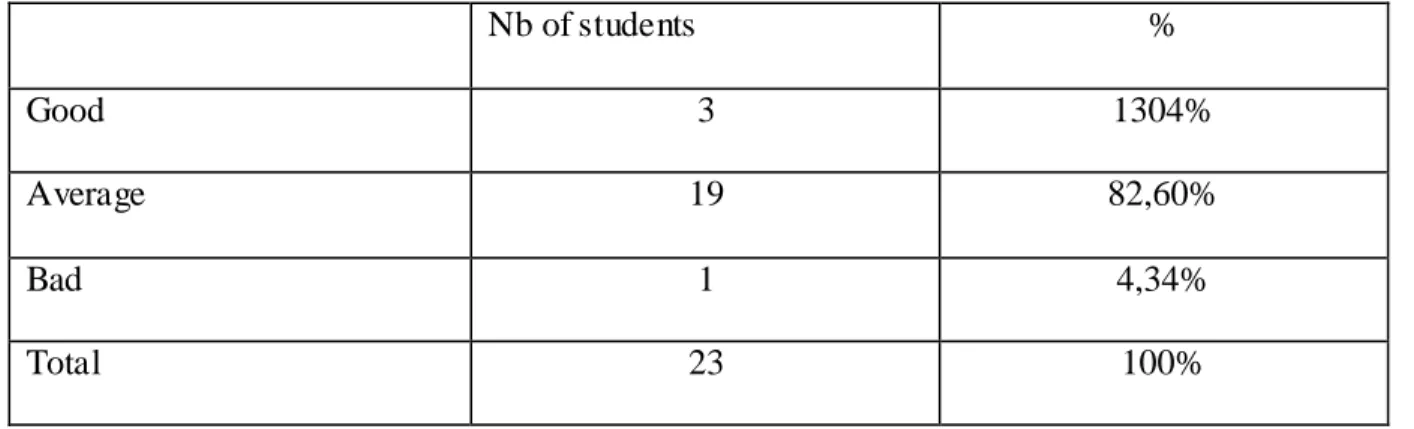
Nb of students %
Good 3 1304%
Average 19 82,60%
Bad 1 4,34%
Total 23 100%
The majority of students claimed that they have an average English with 82, 60% of the population, whereas 13, 04% said that they are good, and only 4, 34% of them claimed that they are bad at English. These results reveal that students seem more interested and motivated in learning English, since only a small number of them have a bad level. The students‟ evaluation of their English might be based on the marks they obtained in the exams, as well as their teachers‟ remarks and assessment throughout the academic year.
Question 03: What is your father’s educational background: University?
Secondary? Primary? None?
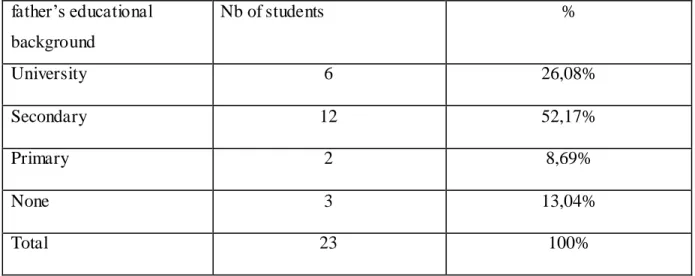
father‟s educational background Nb of students % University 6 26,08% Secondary 12 52,17% Primary 2 8,69% None 3 13,04% Total 23 100%
Table 03: Fathe r’s educational background
As the above table indicates, only 13, 04% of fathers have no educational degree, which is a quite normal result, since our study is concerned only with students who live in urban areas, and usually people who live in such places have the advantage of being educated and attending at least the primary school, unlike people from rural areas where life conditions are hard because of the lack of schools and transport, low incomes… and so on. All these factors may prevent those people from attending schools. The great majority of students‟ fathers have a secondary level with a rate of
52,17%. This implies that in urban areas, people have the opportunity to be educated, and thus educated fathers can help their children in their studies or at least encourage them to be successful learners. The rest of fathers have a primary degree, 8, 69% or a University one with a rate of 26, 08% which is an interesting percentage.
Question 04: What is your mother’s educational background?
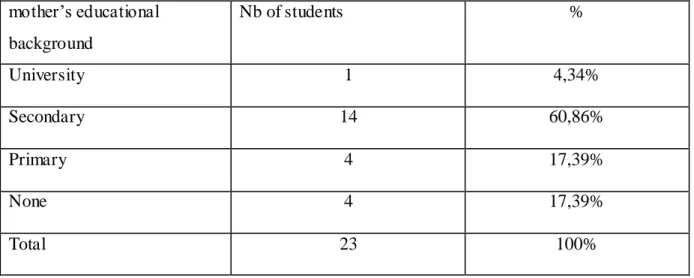
mother‟s educational background Nb of students % University 1 4,34% Secondary 14 60,86% Primary 4 17,39% None 4 17,39% Total 23 100%
Table 04: Mother’s educational background
Students‟ mothers who have a secondary degree represent 60, 86% of the population, that is, the great majority of them attended schools. This can be beneficial for their children, because generally mothers are more influential on their children than father s, since they spend more time with them. Thus, the role of mothers would be of a great importance in s haping their children‟s views and attitudes, as well as their educational attainment by helping them while doing their homework or guiding them in their educational career. Only 4, 34% of mothers have attended the university, 17, 39% of them had a primary degree, and the same number of mothers were illiterate.
Question 05: What is your father’s occupation?
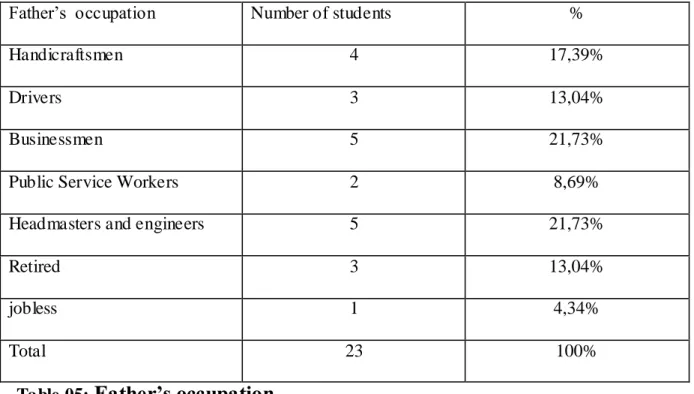
Father‟s occupation Number of students %
Handicraftsmen 4 17,39%
Drivers 3 13,04%
Businessmen 5 21,73%
Public Service Workers 2 8,69%
Headmasters and engineers 5 21,73%
Retired 3 13,04%
jobless 1 4,34%
Total 23 100%
Table 05: Father’s occupation
Students gave a wide range of occupations. 17,39% of fathers are handicraftsmen, 13,04 % work as car drivers, 21,73% as businessmen, 8,69% work in public services, 13,04% are retired, 4,34 are jobless and 21,73% of them are headmasters and engineers. Businessmen, headmasters, and engineers recorded the highest rate, whereas jobless fathers scored a very low one. This means that the families living in urban areas are in a good economic status, because the majority of fathers work in business, engineering and administration. So, students living in such conditions are supposed to learn better, since they can be provided with all what they need in order to succeed in their learning task.
Question 06: What is your mother’s occupation?
Mother‟s occupation Nb of students %
Housewife 21 19,30%
Teacher or Nurse 2 8,69%
Total 23 100%
Table 06: Mother’s occupation
According to the results we obtained the majority of the students‟ mothers attended schools and universities, but 91, 30% of those mothers are housewives, and only 8, 69% work as teachers or nurse. These results are not very surprising in a community like Algeria where almost all women are housewives; doing house-works and taking care of their children, without having the right to work outside even those with a high university degree. Yet, this idea has changed and women are playing an active role in the society. Hence, being a successful mother means bringing up efficiently children. But, we cannot ignore the role of fathers or consider it less important than the mothers‟ role since the responsibility of bringing up children is shared by both of them.
Question 07: Do you like the company of people who are interested in learning
English? Justify your answer
Nb of students %
Yes 19 82,60%
No 4 17,39%
Total 23 100%
Students who liked the company of people interested in English represent 82, 60% of the population, 17, 39% of them claimed the opposite. This indicates that the majority of students know that it is helpful for them to be in a direct contact with people who are interested in their field in order to provide them with more information, as well as helping them to practise their English. But still, some students do not like to stay with people who are interested in learning English.
Students who answered positively suggested the following reasons :
Reasons Nb of students %
I like the English language and like learning new items that help me in my studies
11 57,89%
I like their company because we share the same interests
5 26,31%
No reason 3 15,78%
Total 19 100%
Table 08: Students’ reasons for liking the company of people who are
interested in English
More than half of students 57, 89% stated that they like the company of people interested in English because they like this language and they want to learn new vocabulary which may help them in their studies. 26, 31% of the students liked their company because they share the same interests whereas 15, 18% did not justify their answers.
Reasons Nb of students % I prefer to talk to people from other fields 1 25% I think that people who are concerned with
English like to show off
3 75%
Total 4 100%
Table 09: Students’ reasons for not liking the company of people who are
interested in English
25% did not like the company of people interested in English because they prefer to talk to people from other fields. The rest of students thought that people who are concerned with English like showing off. Although this is a wrong idea, many people in our society believe in it. They think that the person who uses English in his daily interactions is doing so only to show that he masters this language even if this person wants simply to practise his English. This way of thinking might have a negative impact on the student‟s attainment in English, because learning a foreign language requires a lot of practice from the part of the learner in order to improve his fluency.
Question 08: In which language do you often read English, Arabic, French,
Others?
Nb of students % English 12 52,17% Arabic 8 34,75% French 3 13,04% Others 0 0% Total 23 100%As the above table shows, 52, 17% of the total respondents read in English, 34, 78% in Arabic and only 13, 04% read in French. The majority of students declared that they read in English. They may do so in order to improve their English attainment, and this in fact is a very useful way for them to succeed in their learning process. However, only a small number of students said that they read in Arabic, which is their mother tongue. French is the least chosen option compared to English and Arabic despite the fact that it is given more importance than English in the Algerian society.
Question 09: Is there in your family people who know at least one foreign
language?
Nb of students %
Yes 20 86,95%
No 3 13,04%
Total 23 100%
Table 11: People who know at least one foreign language in the students’
families
As table 11 shows, 86,95 % of the students answered “ yes “, while only 13,04% answered “ no “, which indicates that the majority of them live in families whose members are familiar with, at least, one foreign language. This may give the students an overview about the nature of foreign languages, furthermore, it can influence their proficiency positively for two main reasons: the first is that the notion of learning a foreign language is encouraged, and the second reason is that the student can benefit from more practice by virtue of using the foreign language in daily speech. But, we should note, here, that this is not easily achieved in our community because people who use a foreign language to communicate are usually seen as strangers.
Question 10: What are the languages you often use at home: standard Arabic?
Dialectal Arabic? English? French? Others?
Languages Nb of students % Standard Arabic 2 8,69% Dialectal Arabic 19 82,6% English 0 0 French 2 8,69% Others 0 0% Total 23 100%
Table 12: Languages often used in students’ homes.
Unfortunately, no student uses the English language at home, 82,60% of them communicate in dialectal Arabic, 8,69% use the standard Arabic and the same number of students use French. This means that the students are not exposed to English at home, and thus, they cannot profit fro more practice of this language. That is to say, they practise it only in the classroom, which is not sufficient for them to master the foreign language adequately. Hence, in urban areas, even though people have access to more than one language, they seem to communicate only in their mother tongue, and this is one of the negative impacts of the environment on the student‟s attainment in foreign languages in general and English in particular.
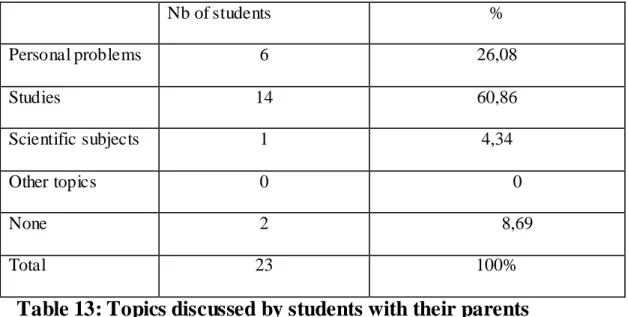
Question 11: What kind of topics do you often discuss with your parents:
personal problems? Your studies? Scientific subjects? None?
Nb of students % Personal problems 6 26,08 Studies 14 60,86 Scientific subjects 1 4,34 Other topics 0 0 None 2 8,69 Total 23 100%
Table 13: Topics discussed by students with their parents
The majority of students, 60, 86% speak with their parents about their studies, where as a minority 8, 69% do not communicate with them at all. 26, 08% of students speak with their parents about their personal problems and the rest 4, 34% of them discuss with them scientific subjects. The role of parents is very crucial in shaping their children‟s attitudes and ways of thinking. That is why communication between them is very important. So, a person who is from early childhood close to his parents and exchanges with them his views about different topics is likely to develop a strong personality, and this in turn will make him more self-confident which is an influential factor in the process of foreign language learning as it was mentioned in the previous chapter. Hence, parents should be aware of the great role they play in their children‟s whole lives.
Question 12: While doing your homework are you disturbed by: the presence of
other members such as children? The presence of the T.V set? Bad material
conditions? Others? None?
Nb of students %
The presence of other members
10 43,47%
The presence of T.V set 7 30,43%
Bad material conditions 3 13,04%
Other 0 0%
None 3 13,04%
Total 23 100%
Table 14: Things that disturb the students while doing their homework.
As table 14 reveals, nearly half of the students, 43,47% are disturbed by the presence of other members such as children when doing their homework, 30,43% are disturbed by the T.V .set and 13,04% suffer from bad material conditions such as the absence of home library. All those factors can influence the student‟s attainment negatively, because living in an uncomfortable, demotivating environment limits the person‟s concentration while learning and thus, makes him at a disadvantage of successful learning. Only 13, 04% of students stated that they are not disturbed while doing their homework, which means that only a minority of students live in comfortable homes.
Question 13: In case of failure, do your parents: -Discuss the reasons with you?
Ignore about it? Other reactions?
Parents‟ reaction Nb of students %
Discuss the reasons 22 95,62%
Ignore about it 1 4,34%
Other reaction 0 0%
Total 23 100%
Table 15: The reaction of parents towards their children’s failure.
Almost all the students, 95,62% of them declared that in case they fail, their parents discuss the reasons with them, and this in fact is the best reaction towards such a situation, that is to say, parents are supposed to find the reasons behind failure in order to help their children to avoid failing again. However, if they behave inappropriately with their children, by punishing them for instance, they would contribute in decreasing their level of attainment rather than increasing it. Parents who do not give any importance to their children‟s failure represent only 4, 34% of the whole population investigated.
Question 14: Is the classroom you study in:
Ove r- crowde d? Semi-crowde d? Not crowde d? Nb of students % Over- crowded 11 47,82% Semi-crowded 11 47,82% Not crowded 1 4,34% Total 23 100%The classroom atmosphere is very influential on the student‟s attainment. For instance, in an overcrowded classroom the teacher finds it difficult, if not impossible, to control the entire classroom and to find the difficulties and problems each student encounters while learning. This might affect the students‟ outcome negatively. Among the twenty three students investigated, 47,82% of them said that they study in an over – crowded classroom, and the same number of students stated that the classroom they study in is semi- crowded, while only 4, 34 % study in a classroom which is not crowded .
Question 15: Do you ask your teacher whenever you come across a difficult
item?
Nb of students %
Yes 11 47.82
No 12 52.17
Total 23 100%
Table 17: Student’s reactions towards problems in learning
Learning foreign languages requires from the part of learner to be active, and ask questions as much as he can because the student who asks a lot of questions is said to be more motivated than the one who keeps silent all the time. The fact that the student does not ask his teacher whenever he comes across a difficult item may be due to some psychological factors like shyness, lack of self- esteem, anxiety, fear from taking risks and so on. 47, 82% of the students said that they do ask the teacher when they face difficulties in learning, whereas the great majority, 52, 17% of the students do not do so.
Those who answered negatively (Q15) were asked to justify their answers in the following question (Q 16)
Question 16: If no, is it because: - You cannot express yourself in public? You
fear for your teacher’s reaction? You fear for being laughed at? You do not
care? Other reasons?
Reason Nb of students %
You cannot express yourself in public 5 41,66 You fear for your teacher‟s reaction 4 33,33
You fear for being laughed at 1 8,33
You do not care 2 16,66
Other reasons 0 0
Total. 12 100%
Table 18: Students’ reasons for not asking teachers about difficult items
Among the population investigated, 41, 66 %, said that they do not ask questions for the reason that they cannot express themselves appropriately in public. This can be explained by the fact that English is a new language for them, and they are not ver y much familiar with its vocabulary and grammar. That is why they cannot transmit their ideas and thoughts even if they want to do so. This problem is mainly due to some socio- cultural factors such as, lack of exposure to the English language at home and lack of practice outside the classroom.
Question 17: Is the atmosphere of the classroom you study in: Friendly? Boring?
Neutral?
The classroom „s atmosphere Nb of students %
Friendly 11 47,82
Boring 9 39,13
Neutral 3 13,04
Total 23 100%
Table 19: The classroom’s atmosphere
Foreign language learners should feel at ease in the classroom in order to succeed in their learning task, and it is the role of the teacher to make them feel so. Thus, a teacher who does not create a friendly atmosphere in his classroom, will be preventing the learners from giving their viewpoints, answering questions or even asking him about difficult items they encounter. So, teachers should be very careful while dealing with the learners .47, 82% of the students claimed that the atmosphere of the classroom they study in is friendly and 39, 13% saw it boring while 13, 04% consider it neutral.
2.5 Conclusion
The analysis of the results revealed that the majority of students have an average level in English. Most of them come from educated families and live in a good economic status. Further, students show great of interests towards people interested in learning English as a foreign language, for the sake of interacting and exchanging ideas. Furthermore, the ana lysis revealed that the students are familiar with more than one language at home. Moreover, they can discuss different
issues with their parents, and give their viewpoints. This helps them to be active members in class. As the classroom plays an important role in language learning, students complained about the bad conditions of classrooms (big number of students, lack of material equipments...etc). Henceforth, the learning/teaching process cannot be efficiently done. Still, students claimed that the classroom atmosphere is friendly, and such kind of atmosphere is very helpful for them in order to communicate freely and more fluently.
GENERAL CONCLUSON
The main concern of this study is to shed light on the effects of some socio-cultural factors on learning English as a foreign language in some urban areas. It also attempts to see to what extent the environment in which the learner is socialised can influence his attainment in English.
The home, the surroundings, and the classroom have considerable effects upon the learner‟s achievement. For instance, being brought up in a family whose members are educated is an effective factor influencing the learners. Educated parents can provide their children with a good atmosphere at home, since they already have been to school and know what the learning task demands. The economic status of the family is an important variable for successful foreign language learning. A learner who is provided with the necessary facilities can learn easier than those who live in bad life conditions.
The effect of peers s also an important factor, because if the student is in constant contact with people who master a foreign language, he can practise more and gain more information about the language being learned.
The classroom is another influencing factor on the process of foreign language learning. In overcrowded classrooms, for instance, both the teacher and the learner find many difficulties. That is why teachers are supposed to create a friendly atmosphere inside the classroom, in order to minimize the learners‟ worries and tensions, and to make the learning easier for them.
Finally, we hope that further studies will be carried on the impact the socio-cultural factors upon learning foreign languages in general and English in particular in order to provide teachers and learners with good comfortable conditions and facilitates the language acquisition.
APPENDIX
This questionnaire is a tool which helps us to collect data about our research. I will be so
thankful if you agree to answer the questions it contains in order to give your thoughts and ideas about learning English as a foreign language and the factors influencing it. Your cooperation is very important and very helpful in the investigation of the topic
Note: please put (∕) in the box which expresses your answer or write in the space provided. Thank you in advance.
Q 1: How long have you been studying English?
……….. Q2: Is your English:
Good Average Bad
Q3: What is your father‟s educational background? University
Secondary Primary None
Q4: What is your mother‟s educational background? University
Secondary Primary None
Q5: What is your father‟s occupation? ... Q6: What is your mother‟s occupation? ...
Q7: Do you like the company of people who are interested in learning English? Yes
No
Justify your answer
... Q8: In which language do you often read?
Arabic English French
Others (please specify) ...
Q9: Is there in your family people who know at least one foreign language? Yes
No
Q1O: What are the languages you often use at home? Standard Arabic
Dialectal Arabic English
French
Others (please specify) ...
Q11: What kind of topics do you often discuss with your parents? Personal problems
Your studies Scientific subjects
Other subjects (please specify) ... None
Q12: While doing your homework are you disturbed by: The presence of other members such as children
The presence of TV set Bad material conditions Others (please specify) ... None
Q13: In case of failure do your parents: Discuss the reasons with you
Ignore about it
Others (please specify) ...
Q14: Is the classroom you study in: Overcrowded
Semi-crowded Not crowded
Q15: Do you ask your teacher whenever you come across a difficult item? Yes
No
Q16: If no is it because:
You cannot express yourself in public You fear for the teachers‟ reaction You fear for being laughed at Others (please specify)
Q17: Is the atmosphere of the classroom you study in: Friendly
Boring Neutral
Bibliography
1. Brown, H. D. (2007). Principles of Language Learning and Teaching. New York: Longman.
2. Byram, M. (1989). Cultural Studies in Foreign Language Education. Clevedon, Avon: Multilingual Matters.
3. Dale, R.R, Griffiths, S. (1965). “The Influence of the Home.” In Craft, M (Ed.) Family, Class and Education. Longman: A Reader. pp. 13_17.
4. Ells, V.T.T, Bomguerts, G.Extra, Vanoe, C, A.M. J.V.Dieton (1984). Applied Linguistics and the Learning and Teaching of Foreign Languages. London: Edward Arnold.
5. Gonzalez, V. (2004). Second Language Learning: Cultural Adaptation Processes in International Graduate Students in US Universities. U.S.A: University Press of America.
6. Hymes, D. (1962).In Catherine, E.S, Charles,AF. (Eds.) Talking to Children. Cambridge: Cambridge University Press.
7. Khaldi, H. (2002). The Impacts of Socioـ Cultural Factors on Learning English as a Foreign Language in Algeria. University of Constantine: Unpublished.
8. Lakhal ayat,K.(1997).Correlation Between the Performance in English and the Sociocultural Background. The Case of the First Year Students of English.University of Constantine: Unpublished.
9. Littlewood, w. (2002). Foreign and Second Language Learning. Cambridge: Cambridge University Press
10. Maslow, A. H. (1962). Towards a Psychology of Being. New Jersey: Princeton.
11. Mckay, S. L. (2000). Teaching English as an International Language: Implications for Cultural Materials in the Classroom.Cambridge: CUP.
12. Mezhoud,S. (1998).The Effect of Motivation and Perception of a Communicative Need on Learning to Communicate. The Case of Third Literary Stream Secondary School Level Pupils. University of Constantine:Unpublished.
13. Odlin, T. (1989). Language Transfer: Cross Linguistic Influence in Language Learning. Cambridge: CUP.
14. Ravan, and Brumer (1980), in: Davies.A(ed) (1982) Language and Learning in Home School. London: Heinman Educational Books.