HAL Id: tel-01754656
https://hal.inria.fr/tel-01754656v2
Submitted on 3 Jan 2017HAL is a multi-disciplinary open access
archive for the deposit and dissemination of sci-entific research documents, whether they are pub-lished or not. The documents may come from teaching and research institutions in France or abroad, or from public or private research centers.
L’archive ouverte pluridisciplinaire HAL, est destinée au dépôt et à la diffusion de documents scientifiques de niveau recherche, publiés ou non, émanant des établissements d’enseignement et de recherche français ou étrangers, des laboratoires publics ou privés.
Process Using Formal Concept Analysis
My Thao Tang
To cite this version:
My Thao Tang. An Interactive and Iterative Knowledge Extraction Process Using Formal Concept Analysis . Computer science. Université de Lorraine, 2016. English. �NNT : 2016LORR0060�. �tel-01754656v2�
Un syst`
eme interactif et it´
eratif
extraction de connaissances exploitant
l’analyse formelle de concepts
TH`
ESE
pr´esent´ee et soutenue publiquement le 2016 pour l’obtention du
Doctorat de l’Universit´
e de Lorraine
(sp´ecialit´e informatique) par
My Thao TANG
Composition du jury
Rapporteurs : Henri SOLDANO Maitre de conf´erence, HdR, Universit´e Paris-Nord Anne VILNAT Professeur, Universit´e Paris Sud
Examinateurs : Amedeo NAPOLI Directeur de recherche, CNRS, Nancy Jean-Marie PIERREL Professeur, Universit´e de Lorraine
Nathalie PERNELLE Maitre de conf´erence, Universit´e de Paris Sud Directeurs de thèse : Yannick TOUSSAINT Charg´e de Recherche, HdR, INRIA Nancy
Chapter 1
Introduction 1
1.1 Context and Motivation . . . 1
1.2 Approaches and Contributions of the Thesis . . . 3
1.3 Thesis Organization . . . 4
Chapter 2 Knowledge Extraction and Semantic Annotation of Texts 2.1 Introduction . . . 7
2.2 Knowledge Extraction . . . 8
2.2.1 Knowledge Extraction Process . . . 8
2.2.2 Knowledge Extraction from Texts . . . 10
2.2.3 Ontology . . . 12
2.2.4 Related Work on Interactive Extracting Knowledge from Texts . . . 15
2.3 Semantic Annotation . . . 18
2.3.1 What is Semantic Annotation? . . . 18
2.3.2 Semantic Annotation Techniques . . . 20
2.3.3 Encoding Semantic Annotations . . . 22
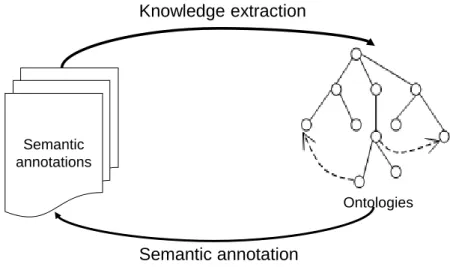
2.3.4 Knowledge Extraction and Semantic Annotation . . . 24
2.3.5 Choice of Data Mining Method . . . 25
2.4 Formal Concept Analysis . . . 26
2.4.1 Basic Concepts of Lattice Theory . . . 26
2.4.2 Formal Concept Analysis . . . 26
2.4.3 Algorithms for Lattice Construction . . . 29
2.4.4 Knowledge Extraction and Semantic Annotation with FCA . . . 29
2.5 Related Work on Expert Interaction for Bridging Knowledge Gap . . . 31
Chapter 3
KESAM: A Tool for Knowledge Extraction and Semantic Annotation Manage-ment
3.1 Introduction . . . 35
3.2 The KESAM Methodology . . . 36
3.2.1 The KESAM’s Features . . . 36
3.2.2 The KESAM Process . . . 38
3.3 Semantic Annotations for Formalizing the Source of Knowledge, Building Lattices and Providing the Traceability . . . 41
3.3.1 Semantic Annotations for Formalizing the Source of Knowledge . . . 41
3.3.2 Building Lattices and Providing the Traceability with Semantic Annotations 44 3.4 Expert Interaction for Evaluation and Refinement . . . 46
3.4.1 Formulating the Changes . . . 47
3.4.2 Implementing the Changes . . . 50
3.4.3 Evolution of the Context and Annotations . . . 53
3.5 The KESAM Implementation and Case Study . . . 54
3.5.1 The KESAM User Interface and Usage Scenario . . . 54
3.5.2 Case Study . . . 55
3.6 Conclusion . . . 57
Chapter 4 Formal Knowledge Structures and “Real-World” 4.1 Introduction . . . 61
4.2 Preliminaries . . . 63
4.2.1 Attribute Implication . . . 63
4.2.2 Constrained Concept Lattices w.r.t. Attribute Dependencies . . . 65
4.2.3 Projections . . . 68
4.3 Projections for Generating Constrained Lattices . . . 69
4.3.1 Discussion about Constrained Lattices . . . 69
4.3.2 Projections for Constrained Lattices w.r.t. Dependencies between At-tribute Sets . . . 70
4.3.3 Projections for Constrained Lattices w.r.t. Sets of Dependencies . . . 79
4.3.4 The Framework for Generating Constrained Lattices . . . 83
5.1 Summary . . . 89 5.2 Perspectives . . . 90
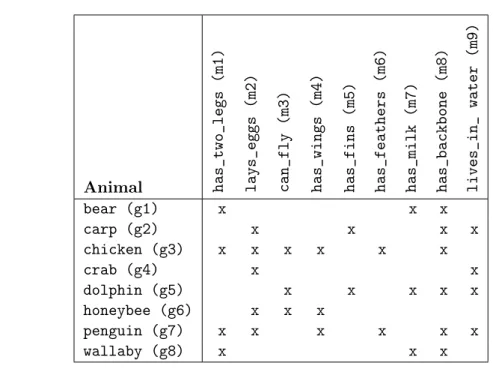
2.1 The binary context of animals. . . 27
3.1 KESAM and the other methodologies with their features. . . 39
3.2 Binary context K. . . 46
3.3 Changes in a formal context. . . 48
3.4 Basic changes in a lattice. . . 49
3.5 Changes in semantic annotations. . . 49
3.6 Strategies for removing concept C6. . . 51
3.7 The updated context K. . . 54
3.8 Dataset 1 and dataset 2. . . 55
3.9 The experimental results on dataset 1 and dataset 2. . . 56
3.10 An example of tracing back to texts . . . 56
2.1 The KDD process. Figure adapted from [Napoli, 2005]. . . 9
2.2 Knowledge extraction from texts. Figure adapted from [Cimiano, 2006]. . . 10
2.3 Example of a meaning triangle. Figure taken from [Sowa, 2000]. . . 11
2.4 Ontology learning layer cake. Figure taken from [Cimiano, 2006]. . . 13
2.5 Example of a concept hierarchy of animals. . . 16
2.6 Example of semantic annotation. Figure taken from [Kiryakov et al., 2003]. . . . 19
2.7 Example of encoding semantic annotations. . . 23
2.8 Knowledge extraction and semantic annotation loop. . . 25
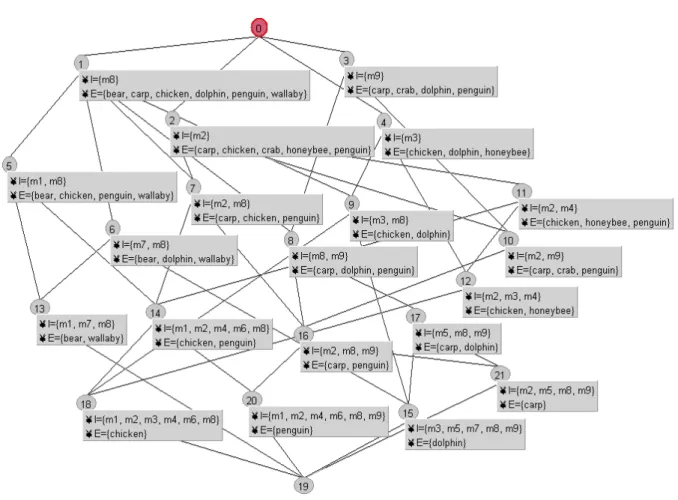
2.9 The lattice L built from the formal context in Table 2.1. . . 28
3.1 An example of the traceability between the knowledge model and source of knowl-edge in the text . . . 37
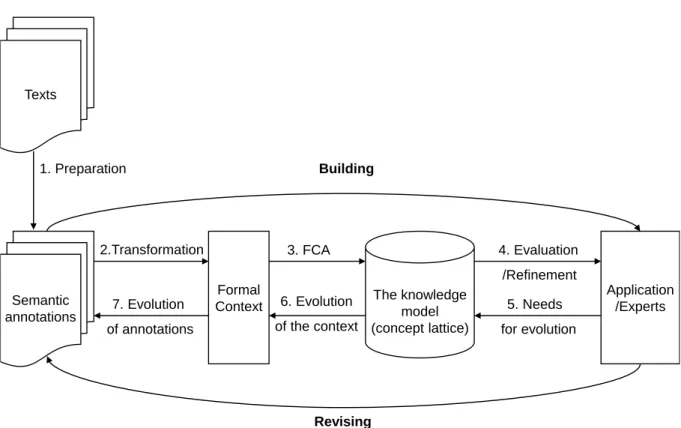
3.2 The KESAM Process . . . 40
3.3 An abstract extracted from PubMed (pmid 10961798). . . 42
3.4 Entities and relationships extracted by SemRep for the given text in Figure 3.3. 43 3.5 An example of RDF representation in KESAM. . . 44
3.6 An example of building a lattice from semantic annotations of texts. . . 45
3.7 The lattice L. . . 47
3.8 A example of the traceability in the KESAM system . . . 48
3.9 The initial lattice and the resulting lattice after removing attribute OCCURS_IN_woman from concept C6 (strategy S1). . . 59
3.10 The updated lattice L. . . 60
3.11 A screenshot of the KESAM system . . . 60
4.1 An example of animal classification. . . 63
4.2 The concept lattice built from the formal context given in Table 4.1. . . 66
4.3 The lattice constrained by m4 ≺ m3. . . 67
4.4 Mapping function between a lattice and the lattice constrained by attribute de-pendencies. . . 70
4.5 Three possible categories of extents in lattice L when ψ(x0) = x0∩ y0. . . 72
4.6 The lattice constrained by m4 ≺ m3 and the trace of changes. . . 74
4.7 The lattice constrained by m3 ≺ m4 and the trace of changes. . . 75
4.8 The lattice constrained by {m1, m2} ≺ {m3}. . . 77
4.9 Three possible parts of extents in lattice L when ψ(X0) = X0∩ Y0. . . 79
4.10 The lattice constrained by {m1, m2} ≺ {m3} and the trace of changes. . . 80
4.11 The lattice constrained by {m3, m8} ≺ {m4} and the trace of changes. . . 84
4.13 The final constrained lattice and the trace of changes. . . 85 4.14 The final constrained lattice and the trace of changes. . . 85 4.15 The final constrained lattice and the trace of changes. . . 86
Introduction
Contents
1.1 Context and Motivation . . . 1 1.2 Approaches and Contributions of the Thesis . . . 3 1.3 Thesis Organization . . . 4
1.1
Context and Motivation
Semantic annotation and knowledge extraction for building ontologies are two key processes of knowledge-based information systems. Anyone would agree that these two processes are at least dual, i.e. they should be and could be intimately related or, at most, one two-side but a unique process. However, because of the complexity of the process, it is almost always treated as two separated tasks. This thesis unifies these two processes into one and relies on Formal Concept Analysis [Ganter and Wille, 1999]. In what follows, we introduce semantic annotation and knowledge extraction, then the problems that motivate the work in the thesis.
On the one side, semantic annotation is a helpful solution to enhance information retrieval and improve interoperability [Uren et al., 2006, Bontcheva and Cunningham, 2011, Liao et al., 2015]. Information retrieval is enhanced by the ability of performing searches, which exploit the ontology to make inferences about the data. For example, a search engine can answer for a query of “city” with a text containing “Paris” thanks to a semantic annotation linking “Paris” in that text to an object of concept “city” in an ontology. Interoperability is improved by the ability of understanding by both humans and machines. With semantic annotations, documents can be processed in an intelligent way and efficiently exploited by machines for automation purpose. An annotation is the content represented in a formal language and attached to the document [Euzenat, 2002]. From a technological perspective, semantic annotation is about identifying in text all mentions of concepts from the ontology (i.e. concepts (or classes), objects (or instances), attributes (or properties), and relations) [Bontcheva and Cunningham, 2011]. In an ontology, a concept can be atomic or defined by some definitions. For example, a concept “car” can be defined by “a road vehicle, typically with four wheels, powered by an internal-combustion engine and able to carry a small number of people” 1 One problem with semantic
annotation is to manage of getting annotations that are mentions of defined concepts. The first generation of semantic annotation tools was mainly technological and terminological, focusing
1
on terms and named entity recognition by mapping terms or named entities found in texts to existing instances of concepts in an ontology. These techniques may be not able to identify these defined concepts in texts and then there is a need to take into account defined concepts in semantic annotation. Another problem with semantic annotation is, if an ontology changes, then all or some of the semantic annotations need to be updated to reflex the knowledge updates [Bontcheva and Cunningham, 2011]. These updates are time-consuming and expensive. Semantic annotations need to be co-evolved with ontologies.
On the other side, ontology is the heart of knowledge-based information systems to clarify the knowledge structure of a domain and enable knowledge sharing [Chandrasekaran et al., 1999]. Ontology is defined as “a formal, explicit specification of a shared conceptualization” [Gruber, 1993, Studer et al., 1998]. Conceptualization means an abstract model of some aspects of the world, taking the form of a definition of important concepts and relationships. Formal means that the conceptualization should be expressed in a (formal) machine readable format. Explicit means that the ontology concepts are explicitly defined. Shared means that the conceptualization should capture the consensual knowledge, that is, it is not private to some individuals, but accepted by a group or community. Knowledge extraction for building an ontology from texts is a complex [Cimiano, 2006, Aussenac-Gilles et al., 2008, Szulman et al., 2010], time-consuming and costly task. It involves such steps as collecting resources, preprocessing and processing these resources to switch progressively from the linguistic level (words, terms. . . ) to the conceptual level. Domain experts guide this iterative process by favoring the emergence of certain words, concepts, or by introducing nuggets of knowledge which are missing. Most of the works splits building ontology from text in several subtasks leading to a loss of traceability between the source of knowledge, i.e. the texts, and the ontology. When experts are asked to evaluate the knowledge model or the ontology needs to be maintained or upgraded, experts may need to look back to the texts to understand why the concepts are built. Can we manage to know which linguistic expressions in the texts are used to build a concept? Ontology provides the domain vocabulary used for semantic annotations and semantic annotations can help here to provide the traceability between the knowledge model and the resource, i.e. all mentions of concepts in the texts. Moreover, ontology or the conceptualization needs to be frequently updated to adapt to new knowledge resources, including semantic annotations, new user needs. . . [Zablith et al., 2013] as semantic annotations need to be updated to reflex the new knowledge. Ontologies and semantic annotations need to be co-evolved. Therefore, it is necessary to develop methodologies for unifying semantic annotation and knowledge extraction in one single process to benefit both semantic annotation and knowledge extraction. Semantic annotations are used to keep the traceability between the knowledge model and its linguistic expression in the texts and the knowledge model is used as the input for improving semantic annotations; any changes in semantic annotations reflexes in the knowledge model and vice versa.
The first objective of this thesis is to propose an interactive and iterative process for knowl-edge extraction, in which we focus on keeping the co-evolution and the traceability between the knowledge model and the source of knowledge in texts, i.e. semantic annotations. The traceabil-ity here means the abiltraceabil-ity of getting semantic annotations that are used to build concepts in the knowledge model including atomic and defined concepts. With this traceability, domain experts can get explanations why the concepts are built and therefore, it makes easier the evaluation or maintenance of the knowledge model. To achieve these goals, we choose Formal Concept Anal-ysis [Ganter and Wille, 1999] as the data mining method for building the knowledge model, i.e. the concept hierarchy. Formal Concept Analysis (FCA) is a formal method of classification which has proved very efficient as a bottom-up conceptualization method for building ontologies from texts [Fennouh et al., 2014, Poelmans et al., 2013, Jia et al., 2009, Bendaoud et al., 2008c,
Ben-daoud et al., 2008a,Cimiano et al., 2005,Obitko et al., 2004]. In order to overcome the problem of the knowledge acquisition bottleneck, different methods have been proposed for automatically building a concept hierarchy from texts. These methods can be grouped into two groups: the similarity-based methods and the set-theoretical-based methods [Cimiano et al., 2005]. FCA, a method based on order theory, perfectly fit our goals. FCA discovers concepts and order them hierarchically at the same time. It provides a good traceability in a comparison with divisive and agglomerative clusterings [Cimiano et al., 2004b,Cimiano et al., 2005]. Moreover, we would like a way to take into account both atomic and defined concepts, not only concepts with names and nothing inside; FCA provides intensional and extensional descriptions for concepts, therefore providing better understanding to users [Cimiano et al., 2004b,Cimiano et al., 2005] and allowing us to take into account both atomic and defined concepts.
The second objective that we would like to achieve in the thesis is to assist human and machine in refining the knowledge model based on the concept lattice resulting from FCA, and semantic annotations. Knowledge extraction is an iterative and interactive process involving several steps. In this process, interaction is usually described as evaluation, where domain experts are invited to interpret and validate the patterns extracted by data mining algorithms. However, any formal method has weaknesses when modeling a cognitive process which is not governed by clear and precise rules. Domain experts may understand the domain in a different way than what is represented in data, and often there exists a gap between the knowledge model based on a concept lattice and the knowledge model of a domain expert. For example, in the domain of animals, an expert may expect that the rule “mammal implies do not lay eggs” holds, while this may not be the case if the platypus is among the objects in the formal context. Domain experts may not be happy with the knowledge model provided by the concept lattice and thus, would like to make it to be more in accordance with their own knowledge or applications’ need. There are several reasons that can lead to the gap between the knowledge model based on a concept lattice and the knowledge model of a domain expert: (1) the fact that FCA builds formal concepts from object descriptions (bottom-up approach) makes it prone to unwanted concept creation if there is noise, errors or exceptions in the data; (2) formal concepts may represent unwanted levels of granularity. (3) the knowledge model based on the concept lattice is not in accordance with expert knowledge; (4) experts wish the concept lattice to be more in accordance with their needs, i.e. the tasks or applications that will use the knowledge model. Thus, experts should be able to correct or to refine the knowledge model based on the concept lattice. In a return, machine should be able to take into account the expert actions to improve the knowledge model and semantic annotations. An approach should be proposed to support the formal method, i.e. FCA, can live together with expert interaction.
1.2
Approaches and Contributions of the Thesis
To meet the problems presented above, we propose in this thesis a methodology using Formal Concept Analysis for knowledge extraction and semantic annotation management (KESAM).
The first contribution of this thesis is to build an interactive and iterative process for knowl-edge extraction from texts based on Formal Concept Analysis [Ganter and Wille, 1999] that is able to keep the co-evolution and the traceability between the knowledge model and semantic annotations of texts. In our approach, knowledge extraction and semantic annotation are unified into one single process to benefit both knowledge extraction and semantic annotation. Formal Concept Analysis [Ganter and Wille, 1999] is the core of the KESAM process for building the knowledge model based on the concept lattice and ensuring the link between semantic
annota-tions and each knowledge units in the knowledge model. In order to get the concept lattice as close as possible to domain experts’ requirements, the KESAM process enables expert interac-tion by introducing the sets of changes in the formal context, the concept lattice and semantic annotations. Domain experts can evaluate and make changes in the formal context, the concept lattice or semantic annotations until they reach an agreement between the knowledge model and their own knowledge or requirements. Along with a change, the consequences of that change in the lattice is reported to domain experts so that domain experts can decide if that change should be applied. The incremental lattice building approach is used for implementing the changes and managing the consequences of the changes in the lattice. The KESAM process then is in charge of keeping the formal context, the concept lattice and semantic annotations up to date with the changes. In such an interactive and iterative process, the system is able to keep the consistency between the knowledge model and semantic annotations, and converges towards a knowledge model close to the requirements of domain experts. Thanks to the link between the knowledge model and semantic annotations, the traceability between the knowledge model and semantic annotations can be enabled; semantic annotations and the knowledge model can co-evolve. Moreover, FCA allows to build definitions of concepts with a sets of objects and sets of attributes and therefore, this makes possible the annotation of both atomic and defined concepts. Our second contribution is a formal method for bridging the possible gap between the knowl-edge model based on a concept lattice and the knowlknowl-edge model of a domain expert. In order to get the concept lattice as close as possible to the experts’ requirements for building a knowledge base, domain experts are invited to provide their knowledge as a set of attribute dependen-cies [Belohlavek and Sklenar, 2005] or constraints which is “aligned” with the set of implications provided by the concept lattice, leading to modifications in the original concept lattice. The method can be generalized for generating lattices guided by constraints based on attribute de-pendencies. This method also allows the experts to keep a trace of the changes occurring in the original lattice and the revised version, and to assess how concepts in practice are related to concepts automatically issued from data. We are able to build the constrained lattices and provide the trace of changes by using extensional projections [Ganter and Kuznetsov, 2001,Per-nelle et al., 2002] over lattices. From an original lattice, two different projections produce two different constrained lattices, and thus, the gap between the knowledge model based on a concept lattice and the knowledge model of a domain expert is filled with projections without changing the original data.
The third contribution of the thesis consists of the system implementation, the experiments and the evaluation. The proposed approaches have been implemented in the KESAM system. We experimented the approaches for building knowledge bases about rare diseases. The approaches are independent of application domains and can be applied in any field. Another experiment for building knowledge bases about animals is also presented in the thesis. The results of the experiments show the capabilities of the approaches.
1.3
Thesis Organization
The thesis is organized into five chapters as follows. The first chapter presents a general in-troduction. The second chapter introduces some basic concepts, terminologies, the state of the art related to the problems of this thesis and sets the context of the thesis. The two following chapters detail the contributions of the thesis. The final chapter draws a conclusion and some perspectives.
Chapter 2: Knowledge Extraction and Semantic Annotation of Texts. First, this chapter provides the background knowledge on knowledge extraction, semantic annotation, and the problems that we aim to solve in this thesis. Then, the theoretical foundations of Formal Concept Analysis that used through the thesis are introduced. Next, we survey the related work on knowledge extraction and semantic annotation with FCA, especially analyze their advantages and disadvantages related to our proposal. Finally, we conclude all elements help us to achieve our objectives.
Chapter 3: KESAM: A Tool for Knowledge Extraction and Semantic Annotation Management. In this chapter, we present our methodology and the system named KESAM for Knowledge Extraction and Semantic Annotation Management. The KESAM system is used for building a knowledge model from semantic annotated texts. The novelty of the KESAM system is that, it provides the traceability between the knowledge model and semantic annotations including both atomic and defined concepts and keeps the co-evolution between the knowledge model and semantic annotations. Formal Concept Analysis is placed at the center of the system to build the knowledge model based on the concept lattice iteratively and ensure the link between the knowledge model and semantic annotations. Thanks to this link, both the knowledge model and semantic annotations can be efficiently updated. In addition, by classifying concepts according to their attributes using FCA, the link can be preserved for both atomic and defined concept annotation. At the end of the chapter, we present the implementation of the KESAM system and a case study on medical domain. The approach was applied to build knowledge bases about rare diseases with sets of abstracts from PubMed2. The results of applying the approach for
building and refining the classification of diseases are presented and analyzed in details.
Chapter 4: Formal Knowledge Structures and “Real-World”. In this chapter, we present our formal method for bridging the possible gap between the knowledge model based on a concept lattice and the knowledge model of a domain expert. In this work, in order to bridge the gap above, we “align” a set of attribute dependencies with the set of implications provided by the concept lattice, leading to modifications in the original lattice. The method extends the definition of dependencies between single attributes introduced in [Belohlavek and Sklenar, 2005] to the case of dependencies between attribute sets, and allows domain experts to have more possibilities for expressing constraints. We then define the extensional projection for constraining the concept lattice w.r.t. sets of dependencies between attribute sets and providing the trace of changes occurring in the original lattice and the revised version. The order of projections for generating a constrained lattice w.r.t. a set of dependencies is examined in detail.
Chapter 5: Conclusion and Future Work. This chapter concludes our work and dis-cusses about possible perspectives for the study.
2
Knowledge Extraction and Semantic
Annotation of Texts
Contents
2.1 Introduction . . . 7
2.2 Knowledge Extraction . . . 8
2.2.1 Knowledge Extraction Process . . . 8
2.2.2 Knowledge Extraction from Texts . . . 10
2.2.3 Ontology . . . 12
2.2.4 Related Work on Interactive Extracting Knowledge from Texts . . . 15
2.3 Semantic Annotation . . . 18
2.3.1 What is Semantic Annotation? . . . 18
2.3.2 Semantic Annotation Techniques . . . 20
2.3.3 Encoding Semantic Annotations . . . 22
2.3.4 Knowledge Extraction and Semantic Annotation . . . 24
2.3.5 Choice of Data Mining Method . . . 25
2.4 Formal Concept Analysis . . . 26
2.4.1 Basic Concepts of Lattice Theory . . . 26
2.4.2 Formal Concept Analysis . . . 26
2.4.3 Algorithms for Lattice Construction . . . 29
2.4.4 Knowledge Extraction and Semantic Annotation with FCA . . . 29
2.5 Related Work on Expert Interaction for Bridging Knowledge Gap . 31 2.6 Summary . . . 32
2.1
Introduction
This chapter is to provide the readers the background knowledge, the context and the rationale behind our work. In this chapter, we first present the fundamentals of knowledge extraction and semantic annotation of texts that supply for better understanding our work. Then, we introduce the theoretical foundations of Formal Concept Analysis (FCA), the classification method that we choose for our knowledge extraction process. Next, we present a survey of the work on knowledge extraction and semantic annotation with FCA related to our work, their strategies, as well as
their advantages and disadvantages to support our research. Finally, we conclude all elements help us to achieve the objectives of the thesis.
2.2
Knowledge Extraction
In this section, we first present the knowledge extraction process from databases. Then, the adaptation of the knowledge extraction process from databases to textual resources is described, followed by a discussion on the challenges of this process. Next, we review some basic concepts, terminologies and characteristics of an ontology that support to build an interactive and iterative process for knowledge extraction from texts. After that, we discuss about the classification methods for building the ontology backbone and choose the classification method for our process. Finally, we review the related work on interactive knowledge extraction from texts.
2.2.1 Knowledge Extraction Process
The knowledge discovery in databases (KDD) process in general was defined by Fayyad et al. [Fayyad et al., 1996] and then detailed in several books [Brachman and Anand, 1996, Dunham, 2002] as a process of transforming low-level data into a more compact, abstract, and useful form. The KDD process aims at extracting knowledge units that are non trivial, potentially useful, significant, and reusable, and can be seen as a process of turning data into information and then knowledge [Napoli, 2005]. This process is interactive and iterative, and guided by experts of the data domain in order to extract knowledge units on the base of their requirements or their own knowledge [Napoli, 2005]. It is iterative because it can run several times in order to obtain the requirements of the domain experts.
The KDD process is performed within a KDD system that consists of the following elements: • the databases,
• the data mining methods,
• the interfaces for interactions with the system.
The KDD process consists of four main stages: (1) first, the data sources are selected and collected, (2) then, the collected data are prepared, (3) next, data mining methods are applied to the prepared data to extract interesting information units, and (4) finally, the extracted information units are evaluated by domain experts for becoming knowledge units. The knowledge units extracted by the KDD system are then used to build a model of the domain and stored in a knowledge base, a domain ontology to be reused for problem solving needs in application domains. The model of the domain will be regarded as the knowledge model of an ontology. More precisely, the main steps of the KDD process (see Figure 2.1) are:
• Data selection: In this step, the working data sets are selected and collected.
• Data preparation: This step consists of cleaning the collected data and then transforming them into a suitable format for the selected data mining method.
• Data mining This step deals with extracting information units (discovered patterns) from the prepared data.
• Interpretation/Evaluation: In this step, the extracted information units are interpreted and evaluated by domain experts for becoming knowledge units.
Data Selected data Data selection Data preparation Prepared data Data mining Discovered patterns Knowledge units Interpretation/Evaluation
Figure 2.1: The KDD process. Figure adapted from [Napoli, 2005].
First, in the data selection step, according to the objectives of the process, the domain, such as biology, chemistry, or medicine. . . , and the resources are determined to collect the data. The data can be collected from many various resources such as databases, files, texts. . .
Next, in the data preparation step, the collected data are cleaned by removing noise, incon-sistencies. . . , and then, the data are combined into a common source and transformed into a suitable format for the selected data mining methods.
After the data preparation step, in the data mining step, data mining methods are applied to extract information units of the prepared data. The data mining methods for KDD systems can be either symbolic or numerical [Napoli, 2005]. Symbolic methods include classification based on decision trees, lattice-based classification, frequent itemsets search, association rule extraction, classification based on rough sets [Pawlak, 1992], instance-based learning, explanation-based learning [Mitchell, 1997,Michalski et al., 1998]. . . Numerical methods include statistics and data analysis, hidden Markov models, neural networks [Ghahramani, 2002]. . . The choice of the data mining method depends on the purpose of a KDD system such as classification, categorization, data summarization, or data model creation. . . Among symbolic data mining methods, lattice-based classification [Barbut and Monjardet, 1970, Guénoche and Mechelen, 1993, Ganter and Wille, 1999] is an efficient method that can be used for extracting concepts from data and organizing them within a concept hierarchy. In this thesis, we choose the lattice-based classifi-cation method, Formal Concept Analysis (FCA) [Ganter and Wille, 1999], as the data mining method for our knowledge extraction process. In the next chapter, we will show the process of transforming rough data into knowledge units using FCA.
After the data mining step, the extracted information is represented to domain experts for interpretation and evaluation through visualization techniques for becoming knowledge units. Domain experts play an important role in the knowledge extraction process. They have to de-cide what is considered knowledge according to their requirements or their own knowledge. This task is very difficult to achieve due to several reasons such as: (1) the information units ex-tracted by data mining methods are not always easy to understand for domain experts; (2) some
……… ……… ……… ………. Writing Knowledge extraction
Figure 2.2: Knowledge extraction from texts. Figure adapted from [Cimiano, 2006].
background knowledge is often assumed or expressed implicitly in the data, especially in textual resources; (3) the data collections are never big enough to provide all the knowledge; (4) the extracted information units are not in accordance with experts’ knowledge or their requirements for the tasks or applications. Particularly, often there exists gap between a knowledge model resulting from a bottom-up approach and a model that domain experts expect because humans often follow top-down approaches when building knowledge bases. For example, in a knowledge model resulting from a bottom-up approach, a chicken and a penguin can be grouped together into a concept because these objects share a common attribute has wings, this extracted infor-mation may not be in accordance with expert knowledge because the attribute has wings is not meaningful enough for them to characterize the objects chicken and penguin. Thus, the knowl-edge extraction system should be able to support domain experts in interpreting, analyzing, and refining the information units resulting from the data mining methods.
In this thesis, we focus on the formalization of expert knowledge as well as the discovery of knowledge units from textual resources. In the next sub-section, we discuss about the challenges of the knowledge extraction process from texts as it has some particular characteristics.
2.2.2 Knowledge Extraction from Texts
In case the KDD process is performed on textual resources, it is called knowledge extraction from texts. A system for knowledge extraction from texts consists of the three main following elements: the first element is the text datasets, the second element is the data mining methods, and the third element is the interfaces for interpretation and evaluation by domain experts. In 2001, Maedche and Staab [Maedche and Staab, 2001] described learning ontology from texts as an acquisition process of a domain model from textual data. In 2006, Cimiano [Cimiano, 2006] considered the construction of an ontology from texts as a reverse engineering process. According to Cimiano [Cimiano, 2006], the authors of a certain text or document have a domain model in mind when they are writing it. The process of knowledge extraction from texts thus can be
Figure 2.3: Example of a meaning triangle. Figure taken from [Sowa, 2000].
considered as a reverse engineering process, in which we should try our best to reconstruct the authors’ model (see Figure 2.2).
Knowledge extraction from texts is complex and challenging. As Cimiano [Cimiano, 2006] claimed, the reverse engineering process only can partially reconstruct the authors’ model because there is a difference between what is in the authors’ mind and what they describe in texts. Moreover, it often requires some background knowledge to understand texts properly because background domain knowledge is often assumed or mentioned implicitly in the texts [Brewster et al., 2003]. Figure 2.3 shows an example of a meaning triangle in dealing with the meaning of texts [Sowa, 2000]. In this example, there is an object, a cat named Yojo, on the left corner. On the right corner, there is a symbol that represents her name, Yojo. And, on the top corner, there is a concept that relates the symbol to its object, i.e. the model in mind of an author. When some authors want to talk about the cat Yojo (the object), they may use the symbol Yojo to describe it in texts. To reconstruct the authors’ model, the knowledge extraction system or the readers should understand that the symbol Yojo in the texts is mentioning about the cat Yojo; this information is not mentioned explicitly in the texts. The role of domain experts in the process of knowledge extraction from texts is thus more important, and their task in this process is more difficult to achieve because the information units extracted automatically need to be interpreted, validated and refined for becoming knowledge units before they can be used for problem solving needs in applications.
This thesis is dedicated to domain experts for extracting knowledge from texts. We aim at building an iterative and interactive knowledge extraction process, where domain experts are assisted in interpreting, evaluating, and refining the knowledge model. Knowledge extraction from texts is a complex, time-consuming and costly task. Splitting knowledge extraction from texts into several tasks could lead to lose the traceability between the knowledge model and the source of knowledge in texts The traceability here means, for each knowledge unit in the knowledge model, i.e. a concept, experts can trace back to the source of knowledge in texts to understand why a concept is introduced in the knowledge model. For example, from a concept containing the objects chicken and penguin and the attribute has wings in the knowledge
model, experts can trace back to texts to see where we get the information, a chicken has wings and a penguin has wings. Losing the traceability between the knowledge model and the source of knowledge in texts might cause difficulties for domain experts in the interpretation, evaluation, and refinement of the knowledge model [Cimiano and Völker, 2005, Aussenac-Gilles et al., 2008,Szulman et al., 2010]. Our first objective in this thesis is to provide domain experts the traceability between the knowledge model and the source of knowledge in texts to support domain experts in interpretation, evaluation, and refinement of the knowledge model. By tracing back to the source of knowledge in texts, experts can have some explanations why concepts in the knowledge model are built and therefore, it makes easier the interpretation, evaluation, and refinement of the knowledge model.
Our second objective in this thesis is to assist domain experts in refining the knowledge model produced automatically by the data mining method, i.e. Formal Concept Analysis, so that domain experts can get the knowledge model as close as possible to their requirements through an interactive process. Refining the knowledge model means, domain experts can make changes in the knowledge model, add some background knowledge to the source of knowledge or add constraints to get a better knowledge model with respect to the experts’ requirements. For example, if experts don’t want a concept that groups a chicken and a penguin together, they can ask for removing this concept from the knowledge model to get the knowledge model to be more in accordance with their requirements. An example of adding background knowledge is, with the texts using only the name Yojo for mentioning about the cat Yojo, experts can add “Yojo is a cat” to the source of knowledge to get the knowledge model more comprehensive. An example of adding constraints is, an expert may expect that the rule “mammal implies do not lay eggs” holds, while this may not be the case if the platypus is among the objects in the context. The system then should take into account the requirements from domain experts in the knowledge model and the source of knowledge. Moreover, modifications in the knowledge model may lead to update in the source of knowledge, and conversely [Maedche and Staab, 2001,Bontcheva and Cunningham, 2011]. These updates are expensive and time consuming. Our objective here is twofold, besides the objective of assisting domain experts in refining the knowledge model, we also aim at keeping the co-evolution of the knowledge model and the source of knowledge, i.e. any changes in the knowledge model reflexes in the source of knowledge, and vice versa.
In what follows, we review some basic concepts and characteristics of ontologies that support to build our knowledge extraction process.
2.2.3 Ontology
Computational ontologies are a means to formally model the structure of a knowledge-based system and enable knowledge sharing. As we have seen in section 2.2.1, the knowledge units extracted from the knowledge extraction system are then stored in an ontology to be reused for problem solving needs. In computer science, ontology was firstly defined as “an explicit speci-fication of a conceptualization” by Gruber [Gruber, 1993]. In this definition, conceptualization means an abstract model of important concepts in a domain of discourse and relationships be-tween those concepts, and explicit means that the conceptualization is explicitly defined. Later, in 1997, Borst [Borst, 1997] defined an ontology as a “formal specification of a shared conceptu-alization”. This definition requires the conceptualization must be expressed in a (formal) format that computers can read, such as Description Logic (DL) [Baader et al., 2003], Web Ontology Language (OWL)3, etc., and captures sharing knowledge that is not only accepted by an
indi-3
Figure 2.4: Ontology learning layer cake. Figure taken from [Cimiano, 2006].
vidual, but also a group or a community. In 1998, these two definitions [Gruber, 1993, Borst, 1997] were merged into one as “an ontology is a formal, explicit specification of a shared concep-tualization” by Studer et al. [Studer et al., 1998]. In 2009, Guarino et al. [Guarino et al., 2009] revisited, discussed in details the definition from Studer et al. [Studer et al., 1998] and claimed that ontologies need to fulfill the communication between human and machine.
Concepts(or classes) are the main elements of an ontology. For example, a concept of animals represents all animals. Specific animals such as chicken and penguin are objects ( or instances, or entities) of this concept. The backbone of an ontology consists of a generalization/specification hierarchy of concepts [Guarino et al., 2009].
Ontology learning from texts is about identifying terms, concepts, relations, and optionally axioms from texts to construct ontologies. The output of ontology learning from texts is described as the layers in an ontology learning layer cake [Buitelaar et al., 2005,Cimiano, 2006] (see Figure 2.4). The tasks of ontology learning from texts corresponding to the layers of the ontology learning layer cake are [Cimiano, 2006]:
• acquisition of the relevant terminology,
• identification of synonym terms/linguistic variants, • formation of concepts,
• hierarchical organization of the concepts (concept hierarchy),
• learning relation, attributes or properties, together with the appropriate domain and range, • hierarchical organization of the relation (relation hierarchy),
• definition of arbitrary axioms.
These tasks can be grouped together and performed at the same time.
There are two kinds of ontologies: lightweight ontologies [Davies, 2010] and heavyweight ontologies [Furst and Trichet, 2006]. A lightweight ontology is simply based on a hierarchy of concepts and a hierarchy of relations, uses very little or does not use axioms while a heavyweight ontology uses axioms for specification. Lightweight ontologies are the most common kind of ontologies and sufficient for many kinds of applications [Wong et al., 2012]. Wong et al. claimed that ontology learning from texts, in fact, is to create lightweight ontologies [Wong et al., 2012]. In this thesis, we limit ourselves to create lightweight ontologies. In this context, we focus on building the ontology backbone, i.e. the concept hierarchy. We call it the knowledge model of an ontology.
In the following, we introduce the definition of terms based on [Cimiano, 2006], and the definitions of concepts and concept hierarchies for the process of knowledge extraction from texts that we aim to build.
Definition 2.1 (Term). Terms are linguistic realizations of concepts in a corpus. Terms are either single words or multi-word compounds with a very specific, possible technical meaning in a given context or domain.
In order to provide the traceability between the knowledge model and source of knowledge in texts, we provide domain experts with terms of concepts when experts trace back from concepts in the knowledge model to the source of knowledge in texts.
We distinguish two types of concepts in an ontology: atomic concepts (or primitive concepts) and defined concepts [Baader et al., 2003]. Atomic concepts are simply denoted by names such as Person, Chair. . . They have to be considered as atoms of an ontology and are used for building more complex definitions. The other concepts, i.e. defined concepts, are built by using definition statements. A definition statement consists of a set of necessary and sufficient conditions for an individual being an object of a concept. For example, a concept Mammal can be defined by a set of attributes, being warm blooded and having four legs, then every object of Mammal is warm blooded and has four legs. Reciprocally, every individual having attributes being warm blooded and having four legs is recognized as an object of the concept Mammal.
Regarding the objective of providing the traceability between the knowledge model and the source of knowledge in texts, we would like to take into account all the concepts in the knowledge model, both atomic and defined concepts. Therefore, we would like to build concepts with definitions. We use the definition of concepts based on [Buitelaar et al., 2005, Cimiano, 2006] that is suitable to our objective as below.
Definition 2.2 (Concept). A concept is a triple < =, Σ, T >, where = is the intension of the concept, Σ its extension, i.e. a set of objects (or instances, or entities), and T its terms in a corpus.
There is no explicit definition of an intension. An intension of a concept can be a natural language description of the intuitive meaning of a concept or a set of attributes [Cimiano, 2006]. In the line with the theory of Formal Concept Analysis, we consider an intension of a concept is a set of attributes. For example, an intension of concept Mammal can be a set of attributes {being warm blooded, having four legs}.
The backbone of an ontology, the concept hierarchy structures concepts according to the attributes associated with them. The hierarchical structure is defined in such a way that more
specific concepts inherit the attributes of the more general ones. In data analysis, a hierarchy was defined by Diday [Diday, 1982] as a tree which has no multiple inheritances. In the area of knowledge extraction and FCA, a hierarchy is no longer considered as a tree, but a partial order given by the relation of subsumption [Ganter and Wille, 1999]. The definition of hierarchies from Ganter and Wille [Ganter and Wille, 1999] allows a concept to have more than one super-concept or sub-concept, which is closer to the real-life concept organization. This definition has been used by several researchers [Stumme and Maedche, 2001, Bozsak et al., 2002, Wille, 2002, Buitelaar et al., 2005, Cimiano and Völker, 2005, Cimiano, 2006, Bendaoud et al., 2008a, Jia et al., 2009]. We use in this thesis the definition of concept hierarchies based on [Cimiano, 2006] that fits the definition from Ganter and Wille [Ganter and Wille, 1999].
Definition 2.3 (Concept Hierarchy). A concept hierarchy of an ontology is a structure
(H, root, ≤H) consisting of (i) a set H of concept identifiers C, (ii) a designated root element
representing the top element of the (iii) partial order ≤H on H ∪ {root} such that ∀C ∈ H :
C ≤ root.
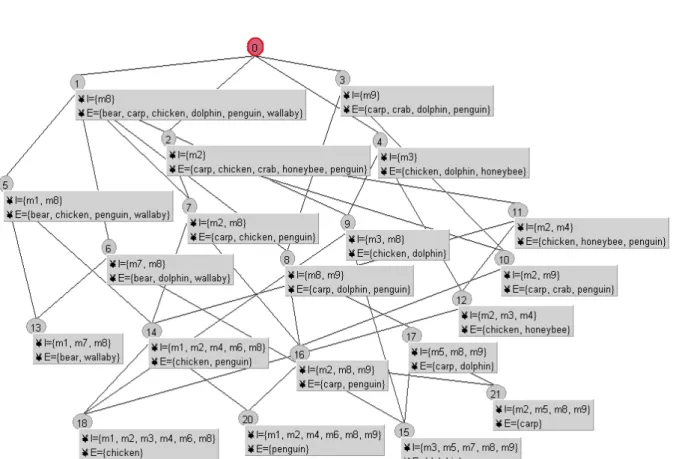
An example of a concept hierarchy of animals is depicted in Figure 2.5. In this example, the attributes are m1: has_two_legs, m2: lays_eggs, m3: can_fly, m4: has_wings, m5: has_fins, m6: has_feathers, m7: has_milk, m8: has_backbone, and m9: lives_in_water. The concept hierarchy contains a root, C0, and a set of concepts, C1, C2, C3... In this concept hierarchy,
the set of concepts is organized into a partial order, in which more specific concepts inherit the attributes of the more general ones. For example, concept C5 is more specific than concept
C1 and inherits attribute m8: has_backbone of concept C1; concept C4 has two sub-concepts,
concepts C9 and C12; concept C9 has two super-concepts, concepts C2 and C4.
After presenting the background concepts and techniques, now, we move on to investigate the work that supports domain experts for extracting knowledge from texts, particularly in keeping the traceability and the co-evolution between the knowledge model and the source of knowledge in texts.
2.2.4 Related Work on Interactive Extracting Knowledge from Texts
Regarding the topic of supporting domain experts in extracting knowledge from texts, several researchers [Cimiano and Völker, 2005,Aussenac-Gilles et al., 2008,Szulman et al., 2010,Tissaoui et al., 2011] have been interested in keeping the traceability and the co-evolution of the knowledge model and the source of knowledge in texts.
Text2Onto, one of the pioneer frameworks for ontology learning from texts, was presented by Cimiano et al. [Cimiano and Völker, 2005, Maedche and Staab, 2001, Maedche and Staab, 2000a, Maedche and Staab, 2000b]. One of the advantages of Text2Onto is, it provides the traceability between the knowledge model and the source of knowledge in texts to help domain experts in understanding why concepts are introduced in the ontology. In order to keep the traceability, Text2Onto links objects in the ontology and terms in texts by storing a pointer for each object in the ontology to terms in texts. Another advantage of Text2Onto is, thanks to the link of objects in the ontology and terms in texts, Text2Onto is able to avoid processing the whole corpus from scratch each time it changes, only updating the corresponding parts of the ontology, i.e. the source of knowledge and the ontology co-evolve. However, Text2Onto only works with atomic concepts since in Text2Onto, concepts have no formal definitions, objects are only linked with terms.
Terminae [Aussenac-Gilles et al., 2008], a platform for ontology engineering from texts, sup-ported domain experts in evaluating and adding knowledge. Similar to Text2Onto, Terminae
provides domain experts with the traceability between the ontology and the source of knowledge in texts. When domain experts build or maintain the knowledge model of the ontology, they could get terms for explaining why concepts are introduced in the ontology. In Terminae, the traceability is achieved through the links that connect terms in texts and concepts in the ontology. Several terms in texts could link to a concept in the ontology and domain experts could define or edit terms of concepts through a terminological form, then come back to modify the knowledge model. The advantage of Terminae is, concepts in the ontology are able to link to more than one terms in texts and have definitions from domain experts. However, the disadvantage of Terminae is, Terminae only works with atomic concepts since in Terminae, concepts have no formal definitions, they are defined by terms found in texts or natural lan-guage definitions that added by domain experts. Moreover, in Terminae, the knowledge model of the ontology and the source of knowledge do not co-evolve, domain experts have to do the task of modifying the knowledge model after they edit or add some knowledge to the source of knowledge. Then, there is a need for taking into account both atomic and defined concepts, and keeping the co-evolution of the source of knowledge and the knowledge model of the ontology to complete Terminae.
In the line of keeping the traceability between the knowledge model and the source of knowl-edge in texts with Text2Onto and Terminae, Dafoe, a platform for building ontologies from texts, was introduced by Szulman et al. [Szulman et al., 2010]. Szulman et al. [Szulman et al., 2010] claimed that textual data cannot be mapped directly into an ontology, such as in Text2Onto and Terminae. Dafoe uses a data model for transforming texts into ontologies which is composed of four layers: corpora layer for the original texts, terminological layer for the terms extracted from the texts, termino-conceptual layer for the relations of terms and con-cepts, and ontology layer for the ontology. The advantage of Dafoe is, by adding intermediate layers for formalizing the source of knowledge in texts, it allows concepts in an ontology can be independent of linguistic information in texts. Through this work, we can see that formalizing the source of knowledge in texts is also important for the process of knowledge extraction from texts. For our purpose, we can apply formalizing the source of knowledge in texts to bridge the possible gap between a knowledge model resulting from a bottom-up approach and a knowledge model from a domain expert that we have seen in section 2.2.1. Then, the source of knowledge can be modified to get a better knowledge model with respect to domain experts’ requirements without touching the original texts.
Another work, EvOnto, was introduced by Tissaoui et al. [Tissaoui et al., 2011]. In EvOnto, semantic annotations are used to formalize the source of knowledge in texts. Semantic annota-tions are used to connect terms in texts and objects of concepts in an ontology. The advantage of EvOnto is, it manages to adapt the ontology when documents are added or withdrawn, and to keep the semantic annotations up-to-date when the ontology changes. In this system, do-main experts can make changes in the ontology. However, the disadvantage of this system is, the experts cannot make changes in the source of knowledge, i.e. semantic annotations, or add background knowledge. In addition, EvOnto only works with atomic concepts since semantic annotations in this system only connect terms and objects of concepts in the ontology.
As we can see from the works above, it is important to keep the traceability and the co-evolution between the knowledge model and the source of knowledge in texts to help domain experts in the interpretation, evaluation, and refinement of the knowledge model. In addition, formalizing the source of knowledge, and taking into account both atomic and defined concepts are important as well. However, none of these works supports both the co-evolution of the knowledge model and the source of knowledge, and take into account both atomic and defined concepts. This thesis targets all these problems, using semantic annotations for formalizing the
source of knowledge and keeping the traceability between the knowledge model and the source of knowledge in texts. To take into account both atomic and defined concepts, we choose Formal Concept Analysis to be our classification method for discovering concepts with definitions of set of objects and sets of attributes and building the concept hierarchy in our knowledge extraction process. Moreover, Formal Concept Analysis is used as the key in the process to ensure the link between each knowledge units in the knowledge model and semantic annotations for keeping the traceability and the co-evolution between the knowledge model and semantic annotations.
In the following, we review the basic concepts of semantic annotations of texts, the techniques for encoding semantic annotations and linking them to texts that support us in formalizing the source of knowledge in texts and keeping the traceability between the source of knowledge and the knowledge model in our knowledge extraction process.
2.3
Semantic Annotation
2.3.1 What is Semantic Annotation?
Annotation
Annotation (or tagging)is about attaching metadata (comments, explanations, descriptions. . . ) to some pieces of data (texts, images. . . ) in order to provide additional information about the corresponding annotated pieces of data4.
For our purpose, we use semantic annotation of texts. Semantic Annotation of Texts
In 2002, in the context of semantic web, an annotation was defined by Euzenat [Euzenat, 2002] as “the content represented in a formal language and attached to the document”. In 2003, Kiryakove et al. [Kiryakov et al., 2003] considered “semantic annotation is about assigning to the entities in the text links to their semantic descriptions. This sort of metadata provides both class and instance information about the entities”. In 2006, in order to distinguish semantic annotation from the other annotations, Oren et al. [Oren et al., 2006] classified annotations into there types of annotations: informal annotations, which are not machine-readable; formal annotations, which are formally defined, i.e. machine-readable, but do not use ontological terms ; and ontological annotations, which are formally defined and use only ontological terms. Concerning the essential of ontologies, according to Uren et al. [Uren et al., 2006], “semantic annotation formally identifies concepts and relations between concepts of an ontology in documents, and is intended primarily for use by machines”. In 2008, Lin [Lin, 2008] considered semantic annotation as “an approach to link ontologies to the original information sources”. In 2009, Talantikite et al. [Talantikite et al., 2009] described semantic annotation as “an annotation assigns to an entity, which is in the text, a link to its semantic description. A semantic annotation is referent to an ontology”. More recently, Bontcheva and Cunningham [Bontcheva and Cunningham, 2011] defined semantic annotation as a process of “annotating in texts all mentions of concepts from the ontology (i.e. classes, instances, properties, and relations) through metadata referring to theirs URIs in the ontology”.
Figure 2.3 shows an example of semantic annotation of texts in the KIM Semantic Annotation platform5 taken from [Kiryakov et al., 2003]. In this example, the string “XYZ” in the text is
4
http://www.w3.org/Amaya/User/doc/Annotations.html
5
Figure 2.6: Example of semantic annotation. Figure taken from [Kiryakov et al., 2003].
linked to the object XYZ of the concept Company and the string “Bulgaria” in the text is linked to the object Bulgria of the concept Country of the ontology.
The definitions of semantic annotation from different researchers above show two things in common: semantic annotations are formally defined (machine-readable) and link ontologies to texts, which fulfill our needs of formalizing the source of knowledge in texts, and keeping the traceability between the source of knowledge and the knowledge model in the knowledge extraction process. Moreover, semantic annotation is suitable with our objective of building lightweight ontologies as Kiryakov et al. [Kiryakov et al., 2003] claimed, lightweight ontologies are more suitable for semantic annotation than heavyweight ontologies since they are sufficient for simple definitions, and allow more efficient and scalable management of the knowledge. From this perspective, in this thesis, we use the definition of a semantic annotation process as below. Definition 2.4 (Semantic Annotation Process). The semantic annotation process is a process of mapping terms in texts with concepts in the ontologies or concept hierarchies. The result of this mapping is formally defined metadata.
Semantic annotation can be performed manually, automatically, or semi-automatically [Reeve and Han, 2005,Bontcheva and Cunningham, 2011]. For manual semantic annotation, humans do the task annotating texts using ontologies. Examples of manual semantic annotation tools are OntoMat-Annotizer of CREAM semantic annotation framework [Handschuh and Staab, 2002], Semantic Word [Tallis, 2003], Zemanta6, etc. Manual semantic annotation suffers from several
limitations. It is considered very expensive to carry out [Cimiano et al., 2004a]. Human an-notators may provide unreliable annotations due to several reasons such as the anan-notators are unfamiliar with the domain or the ontology schema are too complex [Bayerl et al., 2003]. Changes in ontologies can lead to semantic annotation maintenance issues [Dingli et al., 2003,Bontcheva
6
and Cunningham, 2011]. The annotating task can be an overwhelming task for humans because of the volume of texts [Kosala and Blockeel, 2000]. Finally, manual semantic annotation leads to a knowledge acquisition bottleneck [Maedche and Staab, 2001]. To overcome those limita-tions, automatic and semi-automatic semantic annotation have been proposed. Semi-automatic semantic annotation relies on humans at some point in the annotation process. For example, automatic semantic annotation systems create some annotations and then, human annotators post-edit and correct these annotations.
A (semi-)automatic semantic annotation system is composed of the following elements: • the ontologies (or concept hierarchies) of the domain of discourse,
• the semantic annotation techniques that link terms in texts to concepts in the ontologies, • the encoding of semantic annotations, i.e. the metadata.
We review in the following sub-sections the current semantic annotation techniques and the methods for encoding semantic annotations, and then we discuss the relation between knowledge extraction and semantic annotation.
2.3.2 Semantic Annotation Techniques
Named entity recognition (or information extraction approach) is the most common approach for (semi-)automatic semantic annotation [Bontcheva and Cunningham, 2011]. In named entity recognition, an entity refers to a real-world object such as “Francois Hollande, born 12 August 1954, a French politician, the current President of France, as well as Co-prince of Andorra, since 2012”7. A name (or mention) of an entity is a lexical expression referring to that entity in a text.
For example, the entity above can be mentioned in a text by names such as “Francois Hollande” or “President Hollande”. Same types of entities are grouped into concepts such as person, country, or organization, etc.
In named entity recognition approach, the main tasks are [Bontcheva and Cunningham, 2011]: • Named entity recognition: This task consists of identifying the names of named entities in
texts and assigning concepts to them [Grishman and Sundheim, 1996].
• Co-reference resolution: This task deals with deciding if two terms in texts refer to the same entity by using the contextual information from texts and the knowledge from ontology. • Relation extraction: This task deals with identifying relation between entities in texts. The techniques for identifying named entities in texts are generally classified into two groups [Sarawagi, 2008,Bontcheva and Cunningham, 2011]:
• Rule-based systems (or pattern-based systems [Reeve and Han, 2005]), • Machine-learning systems.
Rule-based systems are based on lexicons and handcrafted rules and/or an existing list of reference entity names for identifying named entities. In these systems, named entities are identified by matching texts with the rules and/or simply doing a search through the list of
7
entity names. The rules are designed by language engineers. An example of such rules can be “[person], [office] of [organization]” for determining which person holds what office in what organization8. This rule can be used to recognize named entities of people, offices, organizations
from texts such as “Vuk Draskovic, leader of the Serbian Renewal Movement”. Some well-known rule-based systems for named entity recognition include FASTUS [Appelt et al., 1995], LaSIE [Gaizauskas et al., 1995] and LaSIE II [Humphreys et al., 1998], etc. FASTUS uses handcrafted regular expression rules to identify entity names; LaSIE and LaSIE II use lists of reference entity names and grammar rules. The advantages of rule-based systems are, they are efficient for domains where there is a certain formalism in the construction of terminology and do not require training data. The disadvantages of these systems are, they require expertise in the knowledge about language and domain, which are expensive to create [Sarawagi, 2008,Bontcheva and Cunningham, 2011]. Moreover, it is difficult to build a list of entity names that covers all the vocabularies of a domain of discourse. Therefore, they are expensive to maintain and not transferable across domains. Consequently, researchers have shifted the focus towards machine-learning based approaches since they are introduced.
In a comparison with rules-based systems, the advantage of machine-learning systems is, they automatically identify named entities. However, they require at least some annotated training data. Depend on the training data, the approaches of machine-learning systems can be further divided into three sub-groups: supervised, semi-supervised (or weakly supervised) and unsupervisedmethods [Nadeau and Sekine, 2007].
In supervised learning methods, the training data is an annotated training corpus, and the systems use the training data as the input of an extraction model to recognize similar objects in the new data as a way to automatically induce rule-based systems. Supervised learning meth-ods for named entity recognition include using Support Vector Machines (SVM) ( [Isozaki and Kazawa, 2002, Ekbal and Bandyopadhyay, 2010]), Hidden Markov Models ( [Zhou and J.Su, 2004, Ponomareva et al., 2007]), Conditional Random Fields (CRF) ( [Kazama and Torisawa, 2007, Arnold et al., 2008]), Decision Trees ( [Finkel and Manning, 2009]), etc. The main dis-advantages of supervised learning methods are, they require a large annotated training corpus and heavily depend on the training data, which has to be created manually. In semi-supervised learning methods, the training data are both of annotated training corpus and unannotated training corpus with a small set of examples to reduce system’s dependence on the training data. The system firstly is trained with an initial set of examples to annotate the unannotated train-ing corpus. The resulttrain-ing annotations are then used to augment the initial annotated traintrain-ing corpus. The process repeats for several iterations to refine the semantic annotations of the docu-ments. The disadvantage of these methods is, errors in the annotations can be propagated when the annotations are used for training the other. In unsupervised learning methods, the data is unannotated. Unsupervised learning methods use clustering techniques ( [Cimiano and Völker, 2005]) to group similar objects together. The disadvantages of machine-learning systems are, it can be noisy and may require re-annotation if semantic annotation requirements change after the training data has been annotated.
Typical semantic annotation platforms include AeroDAML [Kogut and Holmes, 2001], KIM [Popov et al., 2004], MnM [Vargas-Vera et al., 2002], S-CREAM [Handschuh and Staab, 2002], etc. AeroDAML [Kogut and Holmes, 2001] is an semantic annotation tool using rule-based technique to automatically generate annotations from web pages. KIM [Popov et al., 2004] is a semantic annotation platform based on the GATE framework using rule-based technique (JAPE)
8
https://web.stanford.edu/class/cs124/lec/Information_Extraction_and_Named_Entity_ Recognition.pdf
for named entity recognition. MnM [Vargas-Vera et al., 2002] is a semantic annotation tool based on supervised learning technique that supports semi-automatic annotation. MnM provides users an environment to manually annotate texts, then the system learn from the set of annotated texts to recognizes new objects. Similar to MnM, S-CREAM (Semiautomatic CREAtion of Metadata) [Handschuh and Staab, 2002] automatically annotate texts by learning from a set of annotated training texts which is provided by users.
To summarize, the choice of semantic annotation technique, rules-based systems, machine-learning systems or hybrid approaches, depends on if there are language engineers available or training data, the complexity of domain and the size of the ontology [Bontcheva and Cunningham, 2011]. Current semantic annotation techniques can be noisy and may require re-annotation if the semantic annotations’ requirements change. Besides, by identifying the names of named entities in texts and assigning concepts in an ontology, current semantic annotation techniques only work with atomic concepts, they do not care about defined concepts with formal definitions. For example, the current semantic annotation techniques may fail in recognizing objects of a concept Mammaldefined by a set of attributes, being warm blooded and having four legs.
2.3.3 Encoding Semantic Annotations
Resource Description Format (RDF)9 is a common format for encoding semantic annotation
and sufficient for basic purposes of lightweight ontologies [Kiryakov et al., 2003]. There are three common approaches to encode semantic annotations in texts [Bontcheva and Cunningham, 2011]: • Adding metadata directly to the texts’ context (inline markup), with URIs pointing to the
ontology.
• Adding metadata to the start/end of the texts.
• Storing metadata and texts in separate files and/or loaded within a semantic repository, metadata pointing to the texts.
In a comparison between the three approaches, the first approach make the retrieval faster when a system needs to retrieve where a concept or object is mentioned. In the first approach, metadata and texts are not independent and the system should have the authorization to modify the texts. The second approach encodes the fact that certain concepts or objects are mentioned in a particular text, but it is not able to retrieve where these concepts or objects occur in the text. The second approach requires data storage smaller than the first approach because it annotates only one of the mentions. In this approach, the system should have the authorization to modify the texts as well. In the third approach, metadata is independent of the texts. The choice of approach for encoding semantic annotations depends on if it is feasible to modify the text content.
Figure 2.7 shows an example of encoding semantic annotations. The first part of the figure shows a text, an abstract with ID 10071657 taken from PubMed10. The second part of the
figure shows the encoding semantic annotations of the text in the first part that produced by SemRep [Rindflesch and Fiszman, 2003]. In this system, the texts and the metadata are stored separately.
Another example of semantic annotation applications is semantic wikis. Semantic wikis are an extension to be integrated in a wiki system that enable users to annotate wiki pages with
9
http://www.w3.org/RDF/
10
Figure 2.7: Example of encoding semantic annotations.
semantic annotations. In semantic wikis, authors annotate an object represented by a wiki page with categories, datatypes, and relations, i.e. an object can be linked to other objects through relations. A category allows a user to classify pages and categories can be organized into a hierarchy. Based on the semantic annotations, wiki contents can be browsed, queried and reused in novel ways [Krötzsch et al., 2007]. In some semantic wikis such as Semantic MediaWiki (SMW) [Krötzsch et al., 2007], semantic annotations are integrated directly in the wiki texts. In some other semantic wikis such as IkeWiki [Schaffert, 2006], semantic annotations about wiki pages are stored outside the content of the pages. IkeWiki requires the load of an existing ontology.
Because the structure of semantic wikis is quite specific, in this thesis, we use semantic anno-tations of unstructured texts, not semantic annoanno-tations of semantic wikis. We focus on helping domain experts in building and refining the knowledge model and the source of knowledge in texts, i.e. semantic annotations. Thus, we choose the third approach for encoding semantic an-notations, storing semantic annotations and texts separately since we do not modify the original texts, we only modify the source of knowledge, i.e. semantic annotations.
![Figure 2.1: The KDD process. Figure adapted from [Napoli, 2005].](https://thumb-eu.123doks.com/thumbv2/123doknet/14673022.741964/20.892.286.659.139.487/figure-kdd-process-figure-adapted-napoli.webp)
![Figure 2.2: Knowledge extraction from texts. Figure adapted from [Cimiano, 2006].](https://thumb-eu.123doks.com/thumbv2/123doknet/14673022.741964/21.892.148.713.140.496/figure-knowledge-extraction-texts-figure-adapted-cimiano.webp)
![Figure 2.3: Example of a meaning triangle. Figure taken from [Sowa, 2000].](https://thumb-eu.123doks.com/thumbv2/123doknet/14673022.741964/22.892.169.702.134.475/figure-example-meaning-triangle-figure-taken-from-sowa.webp)
![Figure 2.6: Example of semantic annotation. Figure taken from [Kiryakov et al., 2003].](https://thumb-eu.123doks.com/thumbv2/123doknet/14673022.741964/30.892.249.689.154.514/figure-example-semantic-annotation-figure-taken-kiryakov-et.webp)