Publisher’s version / Version de l'éditeur:
Vous avez des questions? Nous pouvons vous aider. Pour communiquer directement avec un auteur, consultez la
première page de la revue dans laquelle son article a été publié afin de trouver ses coordonnées. Si vous n’arrivez pas à les repérer, communiquez avec nous à [email protected].
Questions? Contact the NRC Publications Archive team at
[email protected]. If you wish to email the authors directly, please see the first page of the publication for their contact information.
https://publications-cnrc.canada.ca/fra/droits
L’accès à ce site Web et l’utilisation de son contenu sont assujettis aux conditions présentées dans le site LISEZ CES CONDITIONS ATTENTIVEMENT AVANT D’UTILISER CE SITE WEB.
Internal Report (National Research Council of Canada. Division of Building
Research), 1964-08-01
READ THESE TERMS AND CONDITIONS CAREFULLY BEFORE USING THIS WEBSITE. https://nrc-publications.canada.ca/eng/copyright
NRC Publications Archive Record / Notice des Archives des publications du CNRC :
https://nrc-publications.canada.ca/eng/view/object/?id=28401d55-610d-4837-b996-47eee15e7cc2 https://publications-cnrc.canada.ca/fra/voir/objet/?id=28401d55-610d-4837-b996-47eee15e7cc2
NRC Publications Archive
Archives des publications du CNRC
For the publisher’s version, please access the DOI link below./ Pour consulter la version de l’éditeur, utilisez le lien DOI ci-dessous.
https://doi.org/10.4224/20337869
Access and use of this website and the material on it are subject to the Terms and Conditions set forth at
Effect of silicone treatment on properties of bricks
NATIONAL RESEARCH COUNCIL CANADA
DIVISION O F BUILDING RESEARCH
E F F E C T O F SILICONE TREATMENT ON P R O P E R T I E S O F BRICKS
by J . I . Davison I n t e r n a l R e p o r t No. 30 3 of t h e Division of Building R e s e a r c h Ottawa August 1964
PREFACE
The introduction of silicones f o r u s e in building h a s led t o many c l a i m s and many questions. T h e s e a r e usually difficult t o
r e s o l v e , mainly because they inevitably involve the science of water in building m a t e r i a l s and building constructions.
One such u s e , i n plant t r e a t m e n t of b r i c k s , h a s been explored through the appreciation of a number of simple t e s t s , the r e s u l t s of which a r e now r e p o r t e d and d i s c u s s e d .
The work was c a r r i e d out a t the Atlantic Regional Station of the Division. The author, a c h e m i s t , is a r e s e a r c h officer engaged in studies of m a s o n r y m a t e r i a l s and constructions in the Atlantic provinces.
Ottawa
August 1964
N. B. Hutcheon, A s s i s t a n t D i r e c t o r .
E F F E C T O F SILICONE TREATMENT ON PROPERTIES OF BRICKS by
J . I. Davison
Introduction of siliconed c l a y b r i c k s in the Atlantic a r e a in the s p r i n g of 1963 prompted s o m e i n q u i r i e s f r o m a r c h i t e c t s concerning the effect of the silicone t r e a t m e n t on the a b s o r p t i o n p r o p e r t i e s of b r i c k s . Specifically, t h e r e w e r e s e v e r a l i n q u i r i e s r e g a r d i n g the effect on the
5 - h r boiling absorption values-. Substantial reductions in initial r a t e of a b s o r p t i o n (I. R. A. ), s a t u r a t i o n coefficient, and tendency toward
e f f l o r e s c e n c e have been r e p o r t e d (1). Information on 24-hr s u b m e r s i o n and 5-hr boiling a b s o r p t i o n s i s lacking however. A study w a s t h e r e f o r e undertaken t o a c q u i r e s o m e information in t h i s a r e a and t o become m o r e f a m i l i a r with the effect of the silicone t r e a t m e n t g e n e r a l l y . The r e s u l t s a r e r e p o r t e d i n t h i s r e p o r t .
An initial attempt t o a s s e s s t h e effect of t h e silicone t r e a t m e n t consisted of a s e r i e s of a b s o r p t i o n t e s t s on two l o t s e a c h containing 100 extruded clay b r i c k s . The b r i c k s i n one lot had been siliconed a t the plant; t h o s e in the o t h e r lot w e r e not siliconed. It was considered that t h e p r o p e r t i e s of the u n t r e a t e d b r i c k s w e r e s i m i l a r t o t h o s e of the
siliconed b r i c k s before t r e a t m e n t , but t h e r e w a s no evidence t o s u b - s t a n t i a t e t h i s . A c o m p a r i s o n of the p r o p e r t i e s of the two l o t s w a s , t h e r e f o r e , m e a n i n g l e s s .
A second a p p r o a c h included d e t e r m i n a t i o n of a b s o r p t i o n
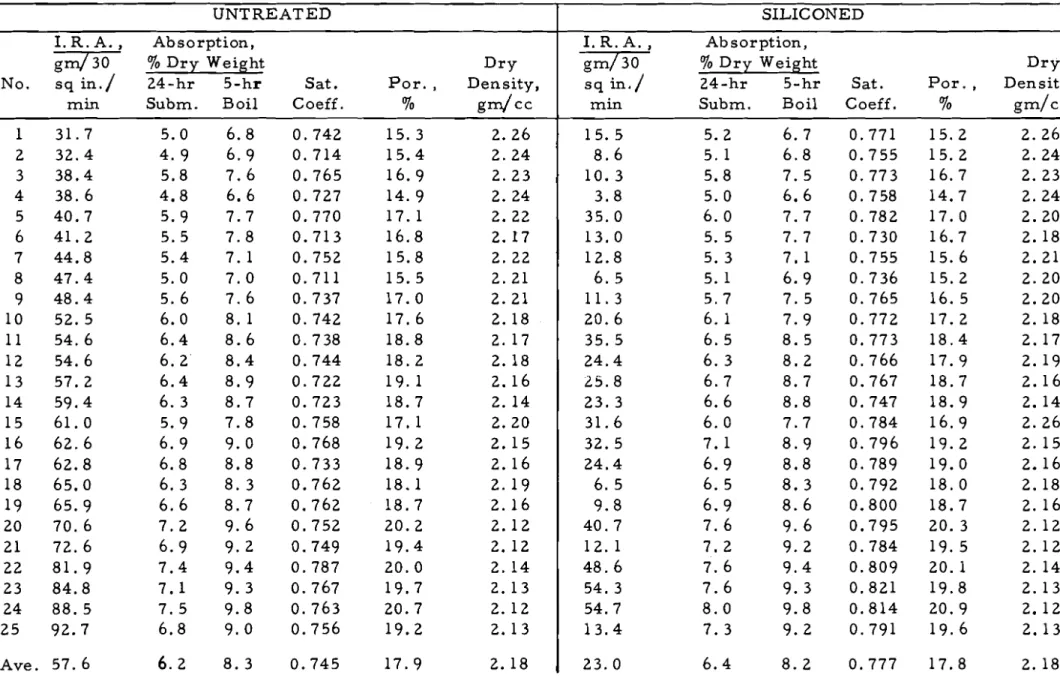
p r o p e r t i e s f o r 25 extruded (low suction) and 25 d r y - p r e s s (high suction) b r i c k s , s e l e c t e d in s u c h a m a n n e r a s t o be r e p r e s e n t a t i v e of the o v e r - a l l r a n g e i n p r o p e r t i e s f o r e a c h v a r i e t y . The b r i c k s w e r e then t a k e n t o the L a n t z plant of L. E . Shaw Ltd. where they r e c e i v e d a "silicone" t r e a t m e n t which consisted of spraying the b r i c k s on five s i d e s with a n aqueous solution r e p o r t e d t o contain 1/10 of 1 p e r cent sodium siliconate. The b r i c k s w e r e r e t u r n e d t o the l a b o r a t o r y and the p r o p e r t i e s again d e t e r m i n e d . A c o m p a r i s o n of r e s u l t s obtained b e f o r e and a f t e r t h e
silicone t r e a t m e n t i s given in T a b l e s I and
II.
It should b e noted t h a t the t r e a t m e n t f o r the extruded b r i c k a s d e s c r i b e d above was developed by the s u p p l i e r . The r e s u l t s obtained with the d r y - p r e s s b r i c k t h e r e f o r e a r e not n e c e s s a r i l y the optimum that might be achieved with a t r e a t m e n t designed specifically f o r it.DISCUSSION
The information in T a b l e s I and
II
i n d i c a t e s t h a t i n i t i a l r a t e of a b s o r p t i o n w a s the only p r o p e r t y of e i t h e r b r i c k significantly affectedby siliconing. The a v e r a g e value f o r t h e e x t r u d e d b r i c k was reduced f r o m 1 6 . 4 t o 5 . 9 gm/30 s q i n . / m i n and f r o m 57.6 t o 23.0 gm/30 s q i n . / m i n f o r t h e d r y - p r e s s b r i c k . T h e I. R . A . of the u n t r e a t e d extruded b r i c k w a s i n the r a n g e of 1 2 . 1 t o 2 5 . 4 gm/30 s q i n . / m i n ; t h i s was r e d u c e d t o 3 . 1 t o 1 2 . 1 gm/30 s q i n . / m i n by t h e t r e a t m e n t . S i m i l a r l y the 31. 7 t o 9 2 . 7 gm/30 s q i n . / m i n r a n g e f o r t h e d r y - p r e s s b r i c k w a s reduced t o 3 . 8 t o 54. 7 gm/ 30 s q i n . / m i n . The p a t t e r n of reduction w a s not a s c o n s i s t e n t f o r t h e high-suction d r y - p r e s s b r i c k s a s f o r the extruded u n i t s . In view of the wide r a n g e of o r i g i n a l values f o r the d r y - p r e s s u n i t s , t h e g r e a t e r v a r i a t i o n i n final v a l u e s w a s not unexpected.
C o m p a r i s o n of t h e o t h e r a b s o r p t i o n p r o p e r t i e s of t h e u n i t s indicated no significant changes a f t e r siliconing
.
Any changes w e r es m a l l and within t h e m a r g i n of e r r o r . T h e r e w a s no reduction in s a t u r a t i o n coefficients f o r e i t h e r b r i c k .
E f f l o r e s c e n c e T e s t
One of t h e m a j o r r e a s o n s f o r siliconing the low-suction e x t r u d e d b r i c k s w a s t o c u r b i t s tendency toward e f f l o r e s c e n c e . In o r d e r t o check t h e effect on e f f l o r e s c e n c e , siliconed and c o n t r o l s p e c i m e n s (2 e a c h ) of both extruded and d r y - p r e s s b r i c k w e r e s e t on end t o a depth of 1 in. in a 10 p e r cent solution of sodium sulphate. After s e v e r a l d a y s t h e b r i c k s w e r e r e m o v e d f r o m the solution, allowed t o d r y , and t h e e f f l o r e s c e n c e w a s a s s e s s e d by v i s u a l o b s e r v a t i o n . S p e c i m e n s w e r e photographed and a r e shown in F i g u r e s 1 and 2.
T h e r e w a s no t r u e e f f l o r e s c e n c e with the extruded b r i c k . S a l t s , however, did c r y s t a l l i z e on t h e b r i c k a s w a t e r , which wicked up t h e
s i d e s , e v a p o r a t e d leaving the s a l t behind. The amount of the deposit a p p e a r s t o be p r o p o r t i o n a l t o t h e I. R. A. of the b r i c k . Thus the silicone t r e a t m e n t w a s helpful in lowering the suction of the b r i c k ( F i g u r e 1 ) .
T h e r e was heavy e f f l o r e s c e n c e Jn all f o u r d r y - p r e s s s p e c i m e n s . On the c o n t r o l s a m p l e s i t a p p e a r e d overnight but w a s s l o w e r in a p p e a r i n g on t h e siliconed b r i c k s . At the end of t h e t e s t , a c l e a r a r e a r e m a i n e d on one of t h e t r e a t e d b r i c k s , and t h e accumulation of s a l t s w a s not a s g r e a t a s on t h e c o n t r o l u n i t s ( F i g u r e 2).
F r e e z e - T h a w Cycling T e s t s
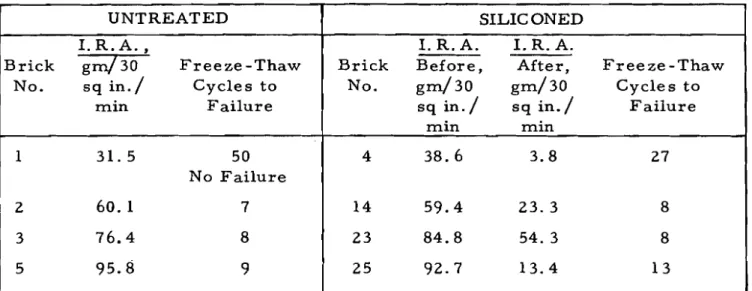
The d r y - p r e s s b r i c k s have c o n s i s t e n t l y failed (2) during r e l a t i v e l y e a r l y s t a g e s of l a b o r a t o r y f r e e z e - t h a w cycling t e s t s . T o check the
effect of siliconing on d u r a b i l i t y , four u n t r e a t e d and four t r e a t e d d r y - p r e s s b r i c k s w e r e subjected t o f r e e z e - t h a w cycling. The b r i c k s w e r e s e l e c t e d in s u c h a m a n n e r t h a t the o r i g i n a l s u c t i o n s of the t r e a t e d b r i c k s w e r e c o m p a r a b l e with t h o s e of t h e c o n t r o l s p e c i m e n s . T h i s m a y be
b r i c k s survived t o f a i l u r e . T h e r e i s no evidence of improved d u r a b i l i t y r e s u l t i n g f r o m the t r e a t m e n t . T h r e e of the c o n t r o l and two siliconed b r i c k s failed a f t e r 7 to 9 c y c l e s . The t h i r d siliconed s p e c i m e n , reduced in I. R. A. f r o m 92.7 to 1 3 . 4
gm/
30 s q in./min, survived 1 3 c y c l e s . The f o u r t h s p e c i m e n , reduced in I . R. A. f r o m 38.6
t o 3.8 g m / 3 0 s q i n . / m i n , failed a f t e r 27 c y c l e s . Contradicting t h i s indication of i n c r e a s e d d u r a b i l i t y in the siliconed units i s the p e r f o r m a n c e of the r e m a i n i n g c o n t r o l b r i c k , I . R. A. 31. 5 g m / 3 0 s q i n . / m i n , which s u c c e s s f u l l y survived 50 c y c l e s .T h e r e h a s n e v e r been any breakdown in t h e extruded b r i c k s during f r e e z e - t h a w cycling; it was, t h e r e f o r e , not considered n e c e s s a r y t o
include t h e m in t h i s phase of the study.
Leakage T e s t s on Individual B r i c k s
P r e v i o u s s t u d i e s which included leakage t e s t s on individual u n i t s r e v e a l e d w a t e r penetration of the d r y - p r e s s b r i c k in m e a s u r a b l e amounts ( 2 ) . Accordingly, the effect of the silicone t r e a t m e n t w a s checked by leakage t e s t s on two c o n t r o l and two siliconed b r i c k s . Leakage t o t a l s r e c o r d e d during the 24-hr t e s t period a r e shown in Table IV.
Again s a m p l e s w e r e s e l e c t e d s o t h a t the I. R. A. values of control units w e r e c o m p a r a b l e t o the o r i g i n a l s u c t i o n s of the siliconed b r i c k s . R e s u l t s do not indicate any i m p r o v e m e n t in r e s i s t a n c e t o w a t e r penetration a s a r e s u l t of the silicone t r e a t m e n t .
Extruded b r i c k s w e r e not subjected t o t h e t e s t s i n c e t h e r e h a s n e v e r been any evidence of leakage through t h e s e u n i t s .
S m a l l - P a n e l T e s t s
An extension of the study included leakage and b o n d - s t r e n g t h t e s t s on s m a l l p a n e l s in o r d e r t o a s s e s s the effect of the silicone t r e a t m e n t on the bond between b r i c k s and m o r t a r .
Eight panels w e r e a s s e m b l e d with the extruded b r i c k and f o u r with the d r y - p r e s s units. P e r t i n e n t information concerning panel a s s e m b l y i s contained in Table V and r e s u l t s of leakage and bond-strength t e s t s in Table VI.
R e s u l t s of leakage t e s t s indicate t h a t panels of siliconed u n i t s , both extruded and d r y - p r e s s , w e r e m o r e r e s i s t a n t t o penetration than p a n e l s of c o n t r o l u n i t s .
( a ) Extruded B r i c k s
P a n e l s A21 and A22, containing siliconed units and a ' m o r t a r
1
t i g h t e s t . T h e r e w a s no leakage n o r any indication of m o i s t u r e penetration, and t h e panels only a b s o r b e d 192 g m of w a t e r during t h e t e s t .
Bond-strength values w e r e slightly l o w e r f o r panels of siliconed units than f o r those containing untreated b r i c k s
- - but t h e extent of bond,
judged by v i s u a l observation, was slightly b e t t e r f o r panels of siliconed units.(b) D r y - P r e s s B r i c k s
R e s u l t s a r e m o r e s t r i k i n g f o r the d r y - p r e s s b r i c k panels. Leakage t o t a l s w e r e reduced f r o m a n a v e r a g e of 2400 m l f o r panels of c o n t r o l
b r i c k s t o 790 m l f o r P a n e l A14 and 1166 m l f o r P a n e l A14D (both containing siliconed units). P a n e l A1 3 was broken p r i o r t o t e s t and its r e p l a c e m e n t A14D contained units having higher I. R. A. values than t h o s e in A14. T h u s the r e s u l t s a r e l i s t e d s e p a r a t e l y , instead of being a v e r a g e d , a s f o r o t h e r s e t s of panels.
Average bond-strength values f o r panels of t r e a t e d b r i c k s w e r e slightly higher t h a n t h o s e f o r panels of c o n t r o l b r i c k s .
R e s u l t s f r o m such a limited n u m b e r of panels a r e not sufficient t o justify rigid conclusions, but t h e i r g e n e r a l a g r e e m e n t with information in t h e l i t e r a t u r e i s c o n s i d e r e d sufficient c a u s e t o include t h e m i n t h i s r e p o r t . A silicone t r e a t m e n t c a n r e d u c e I. R.A. values s o t h a t they will be below the d e s i r a b l e l e v e l of 20 g ~ 3 0 s q in. / m i n and thus provide optimum conditions f o r m a x i m u m bond between units and m o r t a r . T h e r e i s , however, a danger that too much silicone m a y reduce suction t o such low l e v e l s that bond s t r e n g t h i s a d v e r s e l y affected.
CONCLUSIONS
(1) A silicone t r e a t m e n t , consisting of s p r a y i n g units with an. aqueous solution, r e p o r t e d t o contain 1/10 of 1 p e r c e n t sodium s i l i c o n a t e , applied t o extruded and d r y - p r e s s b r i c k s , r e s u l t e d in significant r e d u c t i o n s in i n i t i a l r a t e s of absorption f o r both t y p e s of b r i c k .
(2) T h e r e w a s no significant change in t h e o t h e r a b s o r p t i o n p r o p e r t i e s of t h e units a s a r e s u l t of t h e t r e a t m e n t .
(3) L a b o r a t o r y f r e e z e - t h a w cycling of c o n t r o l and siliconed d r y - p r e s s b r i c k s failed t o indicate any i m p r o v e m e n t in t h e d u r a b i l i t y of t r e a t e d u n i t s . (4) Only m i n o r r e s t r i c t i o n i n the tendency toward e f f l o r e s c e n c e w a s
indicated f r o m t e s t s i n which c o n t r o l and t r e a t e d u n i t s w e r e i m m e r s e d t o a depth of 1 in. in a sodium sulphate solution. The improvement was a t t r i b u t e d t o reduced suction of the t r e a t e d b r i c k s .
(5) Limited t e s t s on s m a l l panels containing t r e a t e d and control units and m a s o n r y m o r t a r mix, indicated i n c r e a s e d r e s i s t a n c e to water
penetration in panels of siliconed b r i c k s
-
-
both extruded and d r y - p r e s s . Bond-
strength values w e r e slightly lower for panels of siliconed extruded b r i c k s than f o r panels of control b r i c k s . Higher values, however, were obtained f o r silicone d d r y - p r e s s b r i c k panels than in the corresponding duplicate control-brick panels. Extent of bond, a n important p r o p e r t y in determining r e s i s t a n c e t o r a i n penetration, was considered s u p e r i o r in panels of siliconed b r i c k s of both types.REFERENCES
(1) Carlson, B. C.
,
and William D. Betts. How plant applied silicones affect wall s t r e n g t h s . B r i c k and Clay Record, Vol. 135, No. 1, 1959, p.49-51, 68.(2) Davis.on, J. I. Effect of silicone t r e a t m e n t on s m a l l panels a s s e m b l e d with high suction d r y - p r e s s b r i c k s . National Re s e a r c h Council, Division of Building R e s e a r c h , Internal Report No. 241, F e b r u a r y 1962.
TABLE I
COMPARISON O F PROPERTIES O F B U F F EXTRUDED
S T I F F -MUD BRICK BEFORG AND A F T E R SILICONE TREATMENT
UNTREATED
I
SILIC ONEDI. R. A.
,
Absorption,gm/30
% D r y w e i g h t D r yNo. s q in./ 24-hr 5 - h r Sat. P o r . , Density, min Subm. Boil Coeff.
70
g d c cI. R. A . , Absorption,
70
D r y Weight D r ys q i n . / 24-hr 5-hr Sat. P o r .
,
Density, min Subm. Boil Coeff.70
g m / c cTABLE
II
COMPARISON O F P R O P E R T I E S O F RED
DRY - P R E S S BRICK B E F O R E AND A F T E R SILICONE TREATMENT
UNTREATED
1
SILIC ONEDI. R . A.
,
A b s o r p t i o n ,70
D r y Weight D r y No. s q i n . / 2 4 - h r 5 - h r S a t . P o r .,
Density, I. R. A. A b s o r p t i o n ,gm/3oP
70
D r y Weight D r y s q i n . / 24-hr 5 - h r Sat. P o r.
,
Density, min Subm. Boil Coeff.70
g m / c cI
A n Subm. Boil Coeff.70
g m / c c1 3 1 . 7 2 3 2 . 4 3 3 8 . 4 4 3 8 . 6 5 4 0 . 7 6 4 1 . 2 7 4 4 . 8 8 4 7 . 4 9 4 8 . 4 10 5 2 . 5 11 5 4 . 6 12 5 4 . 6 1 3 5 7 . 2 14 5 9 . 4 15 6 1 . 0 1 6 6 2 . 6 17 6 2 . 8 18 65.0 19 6 5 . 9 20 7 0 . 6 21 7 2 . 6 22 8 1 . 9 23 8 4 . 8 24 8 8 . 5 25 9 2 . 7 Ave. 5 7 . 6
TABLE Ill
RESULTS O F FREEZE-THAW CYCLING UNTREATED AND SILICONED BRICKS
TABLE IV
RESULTS O F LEAKAGE TESTS ON DRY-PRESS BRICKS UNTREATED I. R.A. B r i c k
gm/30
F r e e z e - T h a w No. s q i n . / C y c l e s t o m i n F a i l u r e .. 1 31. 5 5 0 No F a i l u r e 2 60.1 7 3 76.4 8 5 95.8 9 T Y P E Leakage REMARKS s q i n . / m i n m l U n t r e a t e d 5 5 . 1 103 Leakage o c c u r r e d in 1/2 h r W a t e r pickup 154.8 g m Untreated 69. 5 286 Leakage o c c u r r e d i n 1/2 h r Water pickup 1 6 4 . 3 g m :K Siliconed 5 2 . 5 +B 20.6 120 L e a k a g e o c c u r r e d i n 1/2 h r Water pickup 1 4 5 . 6 g m :;c Siliconed 7 0 . 6-+
4 0 . 7 296 Leakage o c c u r r e d in 1/2 h r W a t e r pickup 161. 3 g m S I L K ONED I. R. A. I. R. A. B r i c k B e f o r e , After, F r e e z e - T h a w No. gm/30 gm/30 C y c l e s t o s q in./
s q in./
F a i l u r e m i n m i n 4 38.6 3.8 27 1 4 5 9 . 4 23. 3 8 23 84.8 54. 3 8 25 9 2 . 7 1 3 . 4 1 3 :; < I. R. A. r e d u c e d f r o m 5 2 . 5+
2 0 . 6 g m by silicone t r e a t m e n t and f r o m 7 0 . 6 - 40.7 I t II 11W
-
O f;;Z T E
M O M9"
W OG
-
W V ) o *Z
E
.Y
Es3
2s
h k rd Q, d $'2
1
\d
E
M rn5
--
Qg,
b E_cT A B L E
VI
RESULTS O F LEAKAGE AND BOND STRENGTH TESTS ON SMALL PANELS LEAKAGE RESULTS
P a n e l T o t a l W a t e r
N u m b e r L e a k a g e , A b s o r b e d R e m a r k s ml by P a n e l ,
e m
BOND STRENGTH RESULTS A v e r a g e Value R e m a r k s p s i A5, A6 4 , 0 9 9 1 , 1 7 8 L e a k a g e o c c u r r e d 20
-
30 2. 3 m i n a f t e r s t a r t of t e s t and continued s t e a d y t o end.A l l , A12 6 1 , 0 8 0 Slight leakage f o r A1 1. 1 2 . 8 None f o r A12.
A15, A16 Nil 7 17 Much t i g h t e r p a n e l s
-
slight 4 . 8 l e a k a g e f o r A1 5 not m e a s u r a b l e .A21, A22 Nil 192 No indication of m o i s t u r e 8 . 0 penetration. A7, A8 2 , 4 0 0 7 36 L e a k a g e o c c u r r e d 15 m i n 20. 3 a f t e r s t a r t of t e s t
- -
t h r o u g h u n i t s and joints. 790 692 L e a k a g e o c c u r r e d 30 min 20.7 a f t e r s t a r t of t e s t - - t h r o u g h u n i t s and joints. A14D 1 , 1 6 6 765 L e a k a g e r e c o r d e d 36 m i n 23. 3 a f t e r s t a r t of t e s t- -
t h r o u g h u n i t s and joints.
Only f o u r v a l u e s obtained f o r eight joints. P o o r extent of bond.A v e r a g e of 6 v a l u e s
-
-
two low v a l u e s in A1 1 . Good extent of bond in s o m e joints. A v e r a g e includes 8 v a l u e s.
Not good extent.E x t e n t of bond fair f o r all 8 joints.
Only 1 value A8. Good extent of bond f o r A7 and 1 joint A8.
Good extent of bond f o r 3 joints.
Good extent of bond i n all 4 joints.
FIGURE 1
Efflorescence on buff extruded b r i c k s after i m m e r s i o n to
a
depth of1 in. in a 1 8 per cent ssBution s f N a SO Bricks on ieft silicone 4'
t r e a t e d , bricks on right untreated. %lgures in second r o w on bricks
FIGURE 2
E f f l o r e s c e n c e on r e d d r y - p r e s s b r i c k s after immersis~a t o a d e p t h of
1 in. in a 1 0 p e r cent solution of N a $8 B r i c k s on left untreated