HAL Id: hal-02980045
https://hal.archives-ouvertes.fr/hal-02980045
Submitted on 27 Oct 2020HAL is a multi-disciplinary open access archive for the deposit and dissemination of sci-entific research documents, whether they are pub-lished or not. The documents may come from teaching and research institutions in France or abroad, or from public or private research centers.
L’archive ouverte pluridisciplinaire HAL, est destinée au dépôt et à la diffusion de documents scientifiques de niveau recherche, publiés ou non, émanant des établissements d’enseignement et de recherche français ou étrangers, des laboratoires publics ou privés.
Anthracology in the tropics. How wood charcoals help
us to better understand today ecosystems
Stéphanie Bodin, Julie Morin-Rivat, Laurent Bremond, Rita Scheel-Ybert,
Christophe Tardy, Christophe Vaschalde
To cite this version:
Stéphanie Bodin, Julie Morin-Rivat, Laurent Bremond, Rita Scheel-Ybert, Christophe Tardy, et al.. Anthracology in the tropics. How wood charcoals help us to better understand today ecosystems. Methods in Historical Ecology. Insights from Amazonia, 2020. �hal-02980045�
Anthracology in the tropics. How wood charcoals help us to better understand today ecosystems.
Stéphanie BODIN, Julie MORIN-RIVAT, Laurent BREMOND, Rita SCHEEL-YBERT, Christophe TARDY and Christophe VASCHALDE.
Anthracology is literally the study of wood charcoals. More precisely, it is dedicated to the identification and interpretation of wood charcoal macro-remains. This term should be preferred to ‘charcoal analysis’, which also includes the quantification of sedimentary (micro)charcoals used for the reconstruction of past fire regimes. Anthracologists do not seek to reconstruct fire events, but rather, in archaeological contexts, vegetation and/or wood use by past societies.
Charcoals are the remnants of incomplete combustion of lignified plant material (wood) that has burnt under anoxic conditions. This charring process preserves most of the wood’s anatomical structures, including vessels, parenchyma and fibres. Charcoals display various patterns, the combination of which is characteristic of genera and species, thus allowing us to ascribe a particular piece of wood charcoal to a particular taxon.
When charcoals are uncovered from natural soils, i.e. out of archaeological contexts, their study is called pedoanthracology, and charcoals are mainly used to reconstruct vegetation changes and treeline dynamics (e.g. Touflan et al. 2010).
Wood charcoal is ubiquitous and, as such, represents one of the most common archaeobotanical remains (Asouti & Austin 2005). The identification of fragments found in archaeological sites provides much information on the gathering and selection of wood and on its uses. As such, they reflect the species burnt to achieve different purposes, e.g. domestic, agricultural, funerary, building, etc. Their long-term accumulation in the soils of archaeological sites gives a fairly good picture of the surrounding vegetation at the time, particularly in temperate zones (Chabal et al. 1999). In addition, the chronology of the studied sites can be inferred from the radiometric dating of charcoal pieces. When charcoal dating covers a long time span, the taxa recovered in assemblages allow us to reconstruct vegetation changes, which can be natural or due to woodland management.
A few case studies
Anthracology has undergone great developments in temperate countries, especially since the work of Vernet (1973) and of subsequent generations of researchers trained in Montpellier, France. Since then, anthracology has increasingly proven its reliability in reconstructing past landscapes and vegetation use (e.g. Asouti & Austin 2005). Anthracological studies are now being applied to various environments, including in the tropics. In tropical Central Africa, charcoals have been used to detect natural fires and to reconstruct vegetation changes (e.g. Hubau et al. 2013), or to confirm the existence of cultivated slash-and-burn fields related to villages (Morin-Rivat et al. 2016). In tropical South America – and particularly in Brazil – anthracological studies have been increasingly developed since the 1990s. They have been used to infer climate-related vegetation changes (Scheel-Ybert et al. 2003) and to investigate wood gathering and selection for ritual or domestic purposes (Beauclair et
al. 2009; Scheel-Ybert et al. 2014). The discipline is also being developed in Oceania. It has, for
instance, highlighted forest management in pre-colonial Kanak sites in New Caledonia (Dotte-Sarout 2017) or firewood use by late Holocene Aboriginal people in Australia (King & Dotte-Sarout 2019). However, to date, charcoals from tropical Asia remain poorly studied.
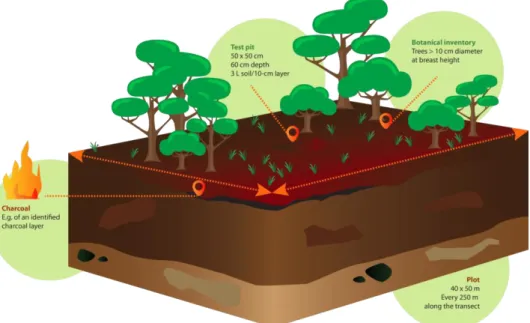
There is no standard sampling protocol for tropical areas, let alone tropical rainforests. Despite the obvious interest of working on archaeological sites already identified and excavated (presence of black soils or shards of pottery, as well as living useful plants), tropical anthracologists often have to look elsewhere, as such sites are still rare. They must therefore explore potentially interesting sites in a pedoanthracological way. The sampling mainly depends on logistical and contextual constraints: topography, vegetation and soil types, which define field accessibility and the difficulty of digging. The size of the sampling plot and the sampling method are determined by the aim of the study and by soil type (Feiss et al. 2017). While sampling along transects across ecotones is suitable for assessing treeline dynamics, a 1-hectare plot is more reliable for a palaeoenvironmental reconstruction (as for forest inventories). Prospecting can be done by digging small test pits, as illustrated in Figure 10.1, to assess the distribution and amount of charcoal pieces. The distribution of pits on the study area may be systematic or guided by previous observations or analyses, such as geomagnetic surveys. The latter are very helpful for detecting soil horizons that have been fire-heated and thus to reveal charcoal-rich deposits (Hounslow & Chepstow-Lusty 2002, Chapters 5). Pits provide a local record of the burnt vegetation and may lead to a species-poor charcoal assemblage, even in tropical rainforests. As their digging takes a lot of energy and time, it is not feasible to multiply them on a given site. Auger sampling is a good alternative to increase the species richness or the number of fragments in charcoal-poor deposits and to cover larger sampling areas (Feiss et al. 2017).
Water-sieving the soil samples allows us to reveal charcoal fragments. Identification is possible with charcoal pieces ≥0.5 mm, although a minimum size of 4 mm is more suitable to observe enough diagnostic anatomical features (Chabal et al. 1999), especially in tropical areas (Scheel-Ybert 2001). Nevertheless, 2- or 3-mm mesh sieves can be used if charcoal is not abundant in the deposits or if larger fragments are rare. After sieving, charcoal fragments are air-dried, away from direct sunlight to prevent them from bursting.
The validity of any interpretation of the assemblage strongly depends on the number of charcoal fragments identified. Building a saturation curve during sample analysis is recommended by ranking taxa according to their corresponding number of charcoals (Chabal et al. 1999). Depending on the taxonomic diversity and spatial extent of the sample, this saturation curve reaches a plateau more or less quickly beyond a certain number of charcoal fragments per sample (Badal Garcia 1992). The latter value is a good compromise which ensures that the sampling is sufficiently representative while limiting the time and effort required for analyses. In temperate areas, this figure is about 300 charcoal fragments per sampling level (Chabal et al. 1999), whereas in tropical areas Scheel-Ybert (2002) showed that about 200 to 300 fragments are sufficient.
Figure 1 Example of a sampling design using test pits (after Morin-Rivat et al. 2016). Source: © J. Morin-Rivat).
Identification
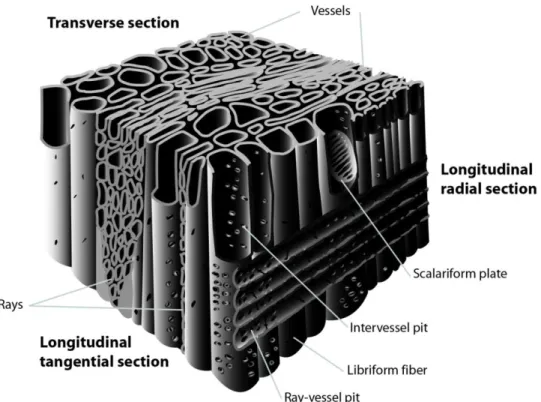
Preparation of wood charcoal for identification simply consists of breaking charcoal pieces by hand, following the three anatomical sections of the wood: transverse (which provides up to 70% of the anatomical information), longitudinal tangential and longitudinal radial (Figure 10.2).
Description of the anatomical features is then made under a reflected-light microscope using dark and bright fields. Ideally, chemical treatments should be avoided to prevent any problem with 14C dating and because they can dissolve silica bodies, which can be a diagnostic feature. Identification of charcoal fragments is carried out by using atlases and guidebooks (e.g. Détienne & Jacquet 1983, Scheel-Ybert & Gonçalves 2017), computer-aided identification tools (e.g. Bodin et al. 2019), online databases on wood anatomy (Wheeler 2011) or charcoal reference collections (Scheel-Ybert 2016). In most cases, the charring process has little impact on wood anatomy, leaving the main features recognisable and/or measurable during observation. Radial cracks (e.g. Théry-Parisot & Henry 2012) and vitrification (McParland et al. 2010) are the main structural modifications that may occur during charring. If these deformations are not too important (few cracks and incomplete vitrification), charcoals can still be identified.
Of the numerous tropical tree species, many share similar wood anatomy. Most of the time, the identification of tropical charcoal is restricted to the family level only, as many families are anatomically homogeneous (e.g. Sapotaceae), but groups or types can sometimes be distinguished (e.g. within the large family Leguminosae). Identification at the genus level is possible when the family is anatomically heterogeneous or when it includes a single (tree) genus (e.g. Goupiaceae, Huaceae, Dichapetalaceae, Irvingiaceae). Recent studies have focused on means to facilitate identification in species-rich areas. In Africa, Hubau et al. (2013) elaborated on a protocol to help identify and discriminate charcoal types from the Mayombe forest. Höhn and Neumann (2018) also stressed the importance of naming charcoal types for interpretation.
Figure 2 Charcoal fragment observed according to the three anatomical sections: transverse, longitudinal tangential and longitudinal radial. Source: © J. Morin-Rivat.
Charcoals as chronological markers
Wood charcoal is commonly used as a chronological marker because it can be dated by the radiocarbon method. Nevertheless, the fragments to be dated should be chosen with care. To avoid taking into account the age of the old wood itself (Gavin 2001, Morin-Rivat et al. 2016), charcoals must come from twigs or from the most external growth rings of larger fragments. Indeed, the 14C age obtained from a charcoal does not correspond to the date of burning, but to the date on which the wood was formed from atmospheric carbon. Thus, if the dating comes from an inner growth ring, it may be several decades, or even centuries, older than the most external growth ring. This can be avoided in temperate woods, where the growth-rings are easily remarkable, but it is more difficult with tropical woods where they are less visible (Tarelkin et al. 2016).
Conclusion
Anthracology has proved its reliability in helping us understand how today’s ecosystems have become what they are. It is complementary to other bioindicators used for palaeoenvironmental reconstruction, such as pollen and phytoliths (e.g. Robin et al. 2012) or to isotopic analyses (Scheel-Ybert et al. 2003). Anthracology only gives an image of burnt vegetation, but it often allows a more precise local-scale reconstruction of past woody landscapes than other proxies, which is particularly valuable in species-rich areas such as the tropics. In Amazonia, hundreds of hectares of terra preta are enriched with charcoal (Glaser & Birk 2012). There is no doubt that in-depth anthracological studies of these anthropogenic soils will bring insight into their formation and on the societies that produced them.
Acknowledgments
JMR was funded by the Macpès Teaching and Research Forest (Canada), the MITACS Acceleration programme (No. IT12145, Canada) and WWF-Canada (No. G-0719-905-00-D). SB and LB benefited
form an ‘Investissement d’Avenir’ grant managed by the Agence Nationale de la Recherche (Labex CEBA ANR-10-LABX-25-01). We are grateful to the whole technical team of the Nouragues Station for the warm welcome.
References
Asouti, E. & P. Austin. 2005. Reconstructing woodland vegetation and its exploitation by past societies, based on the analysis and interpretation of archaeological wood charcoal macro-remains. Environ. Archaeol. 10: 1–18.
Badal Garcia, E. 1992. L’anthracologie préhistorique: à propos de certains problèmes méthodologiques. Bull. Société Bot. Fr. Actual. Bot. 139: 167–189.
Beauclair, M., R. Scheel-Ybert, G.F. Bianchini & A. Buarque. 2009. Fire and ritual: bark hearths in South-American Tupiguarani mortuary rites. J. Archaeol. Sci. 36: 1409–1415.
Bodin, S.C., R. Scheel-Ybert, J. Beauchêne, J.-F. Molino & L. Bremond. 2019. CharKey: An electronic identification key for wood charcoals of French Guiana. IAWA J. 17.
Chabal, L., L. Fabre, J.F. Terral & I. Théry-Parisot. 1999. L’anthracologie. La botanique 43–104. Détienne, P. & P. Jacquet. 1983. Atlas d’identification des bois de l’Amazonie et des régions voisines.
Centre Technique Forestier Tropical, Nogent-Sur-Marne.
Dotte-Sarout, E. 2017. Evidence of forest management and arboriculture from wood charcoal data: an anthracological case study from two New Caledonia Kanak pre-colonial sites. Veg. Hist. Archaeobotany 26: 195–211.
Feiss, T., H. Horen, B. Brasseur, J. Lenoir, J. Buridant & G. Decocq. 2017. Optimal sampling design and minimal effort for soil charcoal analyses considering the soil type and forest history. Veg. Hist. Archaeobotany 26: 627–637.
Gavin, D.G. 2001. Estimation of inbuilt age in radiocarbon ages of soil charcoal for fire history studies. Radiocarbon 43: 27–44.
Glaser, B. & J.J. Birk. 2012. State of the scientific knowledge on properties and genesis of
Anthropogenic Dark Earths in Central Amazonia (terra preta de Índio). Geochim. Cosmochim. Acta, Environmental Records of Anthropogenic Impacts 82: 39–51.
Höhn, A. & K. Neumann. 2018. Charcoal identification in a species-rich environment: The example of Dibamba, Cameroon. IAWA J. 39: 87–113.
Hounslow, M.W. & A. Chepstow-Lusty. 2002. Magnetic properties of charcoal rich deposits associated with a Roman bath-house, Butrint (Southern Albania). Phys. Chem. Earth Parts ABC 27: 1333–1341.
Hubau, W., J. Van den Bulcke, P. Kitin, F. Mees, G. Baert, D. Verschuren, L. Nsenga, J. Van Acker & H. Beeckman. 2013. Ancient charcoal as a natural archive for paleofire regime and vegetation change in the Mayumbe, Democratic Republic of the Congo. Quat. Res. 80: 326–340. Hubau, W., J. Van den Bulcke, P. Kitin, F. Mees, J. Van Acker & H. Beeckman. 2013. Charcoal
identification in species-rich biomes: A protocol for Central Africa optimised for the Mayumbe forest. Rev. Palaeobot. Palynol. 171: 164–178.
King, F. & E. Dotte-Sarout. 2019. Wood charcoal analysis in tropical rainforest: a pilot study identifying firewood used at toxic nut processing sites in northeast Queensland, Australia. Veg. Hist. Archaeobotany 1–23.
McParland, L.C., M.E. Collinson, A.C. Scott, G. Campbell & R. Veal. 2010. Is vitrification in charcoal a result of high temperature burning of wood? J. Archaeol. Sci. 37: 2679–2687.
Morin-Rivat, J., A. Biwolé, A.-P. Gorel, J. Vleminckx, J.-F. Gillet, N. Bourland, O.J. Hardy, A.L. Smith, K. Daïnou, L. Dedry, H. Beeckman & J.-L. Doucet. 2016. High spatial resolution of late-Holocene human activities in the moist forests of central Africa using soil charcoal and charred
botanical remains. The Holocene 26: 1954–1967.
Robin, V., B.-H. Rickert, M.-J. Nadeau & O. Nelle. 2012. Assessing Holocene vegetation and fire history by a multiproxy approach: the case of Stodthagen Forest (Northern Germany). The Holocene 22: 337–346.
Scheel-Ybert, R. 2001. Man and vegetation in southeastern Brazil during the late Holocene. J. Archaeol. Sci. 28: 471–480.
Scheel-Ybert, R. 2002. Evaluation of sample reliability in extant and fossil assemblages. Bar Int. Ser. 1063: 9–16.
Scheel-Ybert, R. 2016. Charcoal collections of the world. IAWA J. 37: 489–505.
Scheel-Ybert, R., M. Beauclair & A. Buarque. 2014. The forest people: landscape and firewood use in the Araruama region, southeastern Brazil, during the late Holocene. Veg. Hist.
Archaeobotany 23: 97–111.
Scheel-Ybert, R. & T.A.P. Gonçalves. 2017. Primeiro Atlas Antracológico de Espécies Brasileiras/First Anthracological Atlas of Brazilian Species. Museu Nacional, Rio de Janeiro.
Scheel-Ybert, R., S.E.M. Gouveia, L.C.R. Pessenda, R. Aravena, L.M. Coutinho & R. Boulet. 2003. Holocene palaeoenvironmental evolution in the São Paulo State (Brazil), based on anthracology and soil δ13C analysis. The Holocene 13: 73–81.
Tarelkin, Y., C. Delvaux, M. De Ridder, T. El Berkani, C. De Cannière & H. Beeckman. 2016. Growth-ring distinctness and boundary anatomy variability in tropical trees. IAWA J. 37: 275–S7. Théry-Parisot, I. & A. Henry. 2012. Seasoned or green? Radial cracks analysis as a method for
identifying the use of green wood as fuel in archaeological charcoal. J. Archaeol. Sci. 39: 381– 388.
Touflan, P., B. Talon & K. Walsh. 2010. Soil charcoal analysis: a reliable tool for spatially precise studies of past forest dynamics: a case study in the French southern Alps. The Holocene 20: 45–52.
Vernet, J.L. 1973. Etude sur l’histoire de la végétation du sud-est de la France au Quaternaire, d’après les charbons de bois principalement. Université des sciences et techniques du Languedoc, Laboratoire de paléobotanique, Montpellier, France