HAL Id: hal-03123491
https://hal.archives-ouvertes.fr/hal-03123491
Submitted on 28 Jan 2021
HAL is a multi-disciplinary open access
archive for the deposit and dissemination of
sci-entific research documents, whether they are
pub-lished or not. The documents may come from
teaching and research institutions in France or
abroad, or from public or private research centers.
L’archive ouverte pluridisciplinaire HAL, est
destinée au dépôt et à la diffusion de documents
scientifiques de niveau recherche, publiés ou non,
émanant des établissements d’enseignement et de
recherche français ou étrangers, des laboratoires
publics ou privés.
A New Memory Layout for Self-Rebalancing Trees
Paul Iannetta
To cite this version:
Paul Iannetta. A New Memory Layout for Self-Rebalancing Trees. CGO’21, Feb 2021, Séoul, South
Korea. �hal-03123491�
A New Memory Layout for Self-Rebalancing Trees
Paul Iannetta
∗Univ Lyon 1 UCBL CNRS, ENS de Lyon, Inria, LIP, F-69342, LYON Cedex 07, France
Abstract
In this paper, we show that trees implemented as a collection of pointers suffer from a lack of parallelism opportunities. We propose an alternative implementation based on arrays. Both implementations appear to be equivalently efficient time-wise. However, this new layout exposes new parallelism opportunities which can be then exploited by an optimizing compiler.
ACM Reference Format:
Paul Iannetta. 2021. A New Memory Layout for Self-Rebalancing Trees. In Proceedings of xxxxxx (CGO’21). ACM, New York, NY, USA, 3 pages.
1
Introduction
Trees are pervasive in systems which need to be frequently queried such as databases. They can take the from of T-Trees [11] (a kind of balanced tree built on AVL trees [1, 9]) or B-Trees [9]. Improving the processing of trees is a necessary endeavor. A first step in this direction has been made by Blelloch et al. [2, 12, 13] who investigated the benefits of bulk operations to increase parallelism. However, we claim that there is still room for optimizations in other directions, such as cache locality. Here, we show that traditional imple-mentations which store trees as collection of pointers can be enhanced by using an array with a layout designed to improve data locality and performance. This new memory layout induces deep changes to the underlying mechanisms (see Section 3). Our goal is that the underlying changes in complexity gets amortized by better data locality and com-piler optimizations. In particular, not only we exhibit better opportunities for vectorization, but also we plan to reuse the ideas behind the polyhedral-model [5, 6, 8] (a framework which aims at increasing the code locality of affine loops by rescheduling their instructions using various methods such as tiling and pipelining). As far as we know, the polyhedral model has never been used to address programs using com-plex data structures relying on pointers such as trees, apart
∗This work was partially funded by the French National Agency of Research
in the CODAS Project (ANR-17-CE23-0004-01) CGO’21, date, place
2021.
from the work of Feautrier and Cohen [3, 4, 7] which uses algebraic languages to describe the iteration space over trees. Our approach does not extend directly the polyhedral model to tree-like data structures. Rather, it fits trees into arrays and see to what extent the operations like insertion, find or deletion can be written so as to fall within the reach of the polyhedral model or how ideas behind the polyhedral model can be reused in this context. Here we focus our pre-sentation on the insertion operation and its parallelization opportunities. Bulk operations is left for future work.
2
Breadth-first arrays
There are two natural categories of tree traversals: breadth-first and depth-breadth-first traversals. Both induce an ordering on the nodes which can be used to store the elements in an array. On one hand, the numbering based on the depth-first traversal provides no cheap way to recompute the structure of the tree which is needed to perform insertions, deletions and searches. On the other hand, the numbering induced by the breadth-first traversal can easily store the structure of the tree by keeping holes for unused nodes. This way, the num-bering induces layers where the 𝑖thlayer is 2𝑖
-wide.
3
Rotations on breadth-first arrays
Traditionally, a tree-rotation is a cheap operation which: 1. moves around two pointers and 2. updates the informa-tion about the heights and the balance ratio of the nodes. However, when trees are internally represented as arrays, rotations become much more expensive because, now, part of the array has to be actually moved from one memory loca-tion to another. Hence, the cost of a rotaloca-tion in the worst case becomes O (𝑛). This section describes each operation (left and right rotation, but also left-right and right-left rotations) as a sequence of low-level operations on breadth-first array, namely shifts and pulls as well as their performance against a traditional implementation.
3.1 Low-level operations on breadth-first arrays
As presented in Section 2, breadth-first arrays provide a convenient index scheme which allows to view the array as a collection of layers.
CGO’21, date, place Paul Iannetta 𝑥 T1 𝑥 T1 right shift T1 left shift T1
(a) Left and Right Shifts
𝑥 𝑧 . 𝑦 T1 T2 T3 T4 (b) Pull-down Left 𝑥 T1 T2 pull up T1 T1 (c) Pull-up
Figure 1. Low-level operations
𝑥 𝑦 T 4 𝑧 T 3 T1 T2
(a) Needs a L-rotation
𝑥 T1 𝑦 T2 𝑧 T3 T4 (b) Needs a R-rotation 𝑥 T1 𝑦 𝑧 T 4 T2 T3 (c) Needs a LR-rotation 𝑥 𝑦 T 4 T1 𝑧 T2 T3 (d) Needs a RL-rotation
Figure 2. Unbalanced trees Left and right shifts (Figure 1a). A shift moves a subtree
at a certain depth to the left or to the right. The tree is moved such that it is still on the same depth.
Pull up (Figure 1c). A pull up takes a subtree and graft it in place of its father.
Left and right pulls down (Figure 1b). A pull down takes a subtree and graft it at the place of its right (in the case of a right pull down) or left (in the case of a left pull down) children.
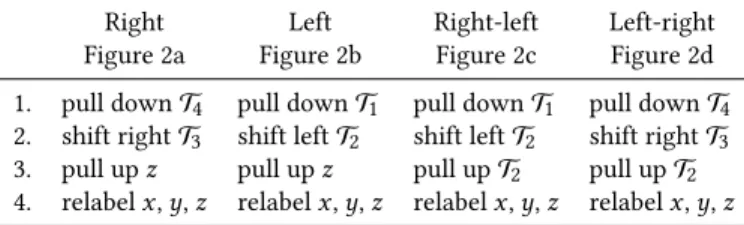
Those low-level operations can be used to implement the rotation by following the steps in the following table.
Right Left Right-left Left-right Figure 2a Figure 2b Figure 2c Figure 2d 1. pull down T4 pull down T1 pull down T1 pull down T4
2. shift right T3 shift left T2 shift left T2 shift right T3
3. pull up 𝑧 pull up 𝑧 pull up T2 pull up T2
4. relabel 𝑥, 𝑦, 𝑧 relabel 𝑥, 𝑦, 𝑧 relabel 𝑥, 𝑦, 𝑧 relabel 𝑥, 𝑦, 𝑧
3.2 Performance analysis
The following table presents the results of the insertion of sizerandom elements into an breadth-first-array-based AVL tree. Each experiment has been conducted 10 times and the table presents the average. The machine is an Intel®Core™ i5-5300U CPU @ 2.30GHz with 3072KB of cache.
Both (unoptimized) implementations have similar running times. The number of cache-misses with avl-tree (tree based implementation) is not constant despite what the measure nots tend to show in the table, avl-bf (array based implemen-tation) cache-misses increase steadily as the density (d) (the number of occupied nodes divided by the total number of
avl-tree avl-bf size d (%) t (ms) misses (%) t (ms) misses (%)
64 55 1.8 45 1.7 41 512 33 1.9 48 1.8 43 65536 13 31.2 17 47.7 36 524288 17 517.1 46 648.1 60 1048576 13 1192.3 47 1509.4 63 2097152 06 3027.4 47 3779.8 63
cells including holes) decrease. However, avl-bf can be com-pacted to mitigate this problem. The compression process transform a sparse array into an array representing the dens-est binary search tree with the same elements, this can be done because there exists an equivalent, in this case avl tree, which is close to a prefect binary search tree. This process cost is O (𝑛) and can be performed each time the density reach a fixed threshold. The best value for this threshold is still unknown.
4
Parallelization opportunities
The implementation of the low-level operations can be opti-mized by applying standard loop transformations. The imple-mentation of the shift operation is a parallel for, which means that it can be distributed over many cores easily. Pulls opera-tions can also be optimized through the use of pipelining and tiling. More details about the internals of the optimization can be found in our research report [10].
5
Conclusion
We proposed a new memory layout for rotation-based bal-anced binary search trees and we have showed that despite the change in complexity of the underlying mechanisms, the
A New Memory Layout for Self-Rebalancing Trees CGO’21, date, place
naive implementation of both strategies have similar run-ning times and there are strategies to parallelize and further optimize the array-based implementation.
References
[1] G. M. Adel’son-Vel’skii and E. M. Landis. 1962. An algorithm for organization of information. Dokladi Akademia Nauk SSSR 146, 2 (April 1962), 263–266.
[2] Guy E. Blelloch, Daniel Ferizovic, and Yihan Sun. 2016. Just Join for Parallel Ordered Sets. In Proceedings of the 28th ACM Symposium on Parallelism in Algorithms and Architectures (Pacific Grove, California, USA) (SPAA ’16). Association for Computing Machinery, New York, NY, USA, 253–264. https://doi.org/10.1145/2935764.2935768 [3] Albert Cohen. 1999. Analyse de flot de données pour programmes
récursifs à l’aide de langages algébriques. Technique et Science Infor-matiques (1999).
[4] Albert Cohen. 1999. Program Analysis and Transformation: From
the Polytope Model to Formal Languages. Theses. Université de
Versailles-Saint Quentin en Yvelines. https://tel.archives-ouvertes.fr/ tel-00550829
[5] Paul Feautrier. 1992. Some Efficient Solutions to the Affine Scheduling Problem, I, One-dimensional Time. International Journal of Parallel Programming 21, 5 (October 1992), 313–348.
[6] Paul Feautrier. 1992. Some Efficient Solutions to the Affine Scheduling Problem, II, Multi-dimensional Time. International Journal of Parallel Programming 21, 6 (December 1992), 389–420.
[7] Paul Feautrier. 1998. A parallelization framework for recursive tree programs. In Euro-Par’98 Parallel Processing, David Pritchard and Jeff Reeve (Eds.). Springer Berlin Heidelberg, Berlin, Heidelberg, 470–479. [8] Paul Feautrier. 2011. Encyclopedia of Parallel Computing. Springer,
Chapter Polyhedron Model, 1581–1592.
[9] Gaston H. Gonnet and Ricardo Baeza-Yates. 1991. Handbook of Algo-rithms and Data Structures in Pascal and C (2nd ed.). Addison-Wesley Pub (Sd).
[10] Paul Iannetta, Laure Gonnord, and Lionel Morel. 2020. On optimizing scalar self-rebalancing trees.
[11] Tobin J. Lehman and Michael J. Carey. 1986. A Study of Index Structures for Main Memory Database Management Systems. In Proceedings of the 12th International Conference on Very Large Data Bases (VLDB ’86). Morgan Kaufmann Publishers Inc., San Francisco, CA, USA, 294–303. [12] Yihan Sun and Guy Blelloch. 2019. Implementing Parallel and
Con-current Tree Structures. In Proceedings of the 24th Symposium on Prin-ciples and Practice of Parallel Programming (Washington, District of Columbia) (PPoPP ’19). Association for Computing Machinery, New York, NY, USA, 447–450. https://doi.org/10.1145/3293883.3302576 [13] Yihan Sun, Daniel Ferizovic, and Guy E. Belloch. 2018. PAM: Parallel
Augmented Maps. SIGPLAN Not. 53, 1 (February 2018), 290–304. https: //doi.org/10.1145/3200691.3178509