BASIC RESEARCH, APPLIED RESEARCH, AND INNOVATION IN THE SEMICONDUCTOR AND PHARMACEUTICAL INDUSTRIES
by
KWANGHUI LIM
B.Eng. (Electrical), National University of Singapore
Submitted to the Alfred P. Sloan School of Management In Partial Fulfillment of the Requirements for the Degree of
DOCTOR OF PHILOSOPHY at the
MASSACHUSETTS INSTITUTE OF TECHNOLOGY August 2000
© 2000 Kwanghui Lim. All Rights Reserved.
The author hereby grants to MIT permission to reproduce and to distribute publicly paper and electronic copies of this thesis document in whole or in part.
Signature of Author _______________________________________________________ MIT Sloan School of Management
August 2000 Certified by _____________________________________________________________ Scott Stern Assistant Professor Thesis Supervisor Accepted by _____________________________________________________________ Birger Wernerfelt Chairman, Ph.D. Program, Sloan School of Management
BASIC RESEARCH, APPLIED RESEARCH AND INNOVATION IN THE SEMICONDUCTOR AND PHARMACEUTICAL INDUSTRIES
by
KWANGHUI LIM
Submitted to the Alfred P. Sloan School of Management On August 25, 2000
in Partial Fulfillment of the Requirements for the Degree of DOCTOR OF PHILOSOPHY
ABSTRACT
This thesis comprises three essays on the relationships among basic research, applied research, and innovation. Earlier research emphasized that absorbing external knowledge requires effort and investment (Cohen and Levinthal, 1989; 1990). This thesis explores various mechanisms through which absorptive capacity is developed, including a firm's R&D, its connectedness to the external scientific community, the provision of a science-oriented research environment, and investment in basic research. The chief contribution of this dissertation is to document the many ways in which firms develop absorptive capacity, and how absorptive capacity varies across industry, stage of technology development, and scientific area.
The first essay explores how firms develop different kinds of absorptive capacity. A firm’s absorptive capacity depends upon internal R&D and its connectedness to
universities, other firms and R&D consortia. R&D is effective for absorbing disciplinary knowledge; alternative mechanisms are useful for domain-specific knowledge. A
science-oriented research environment is not necessary, as long as the firm remains connected through other means. To illustrate, I trace knowledge spillovers of copper interconnect technology for semiconductors.
The second essay exa mines the concentration of basic and applied research relative to innovation. In the semiconductor industry, basic research is surprisingly concentrated relative to innovation. Since spillovers are prevalent in this industry, I conclude that many semiconductor firms capture spillovers without performing much basic research. In the pharmaceutical industry, basic research and innovation have similar concentrations. In both industries, applied research is not concentrated relative to innovation.
The third essay examines researchers at five firms. Given two researchers with the same number of publications at IBM, AT&T, or Intel, the one who publishes a higher fraction of her papers in basic research journals is less likely to patent. These researchers face a tradeoff between participating in basic and applied research (Allen, 1977). The opposite holds at Merck and DuPont, where researchers who publish a higher fraction of papers in basic scientific journals obtain more patents. Thus, basic research has a
positive impact on pharmaceutical patents (Gambardella, 1992; Cockburn and
Henderson, 1998). Within Dupont and Merck, patenting is most closely associated with publications in basic chemistry, and with pharmaceutical R&D.
Thesis Committee: Scott Stern (Chair) Assistant Professor
Alfred P. Sloan School of Management, MIT Rebecca Henderson
Eastman Kodak LFM Professor of Management Alfred P. Sloan School of Management, MIT Eric von Hippel
Professor, Management of Innovation
TABLE OF CONTENTS
LIST OF FIGURES...9
LIST OF TABLES ...11
ACKNOWLEDGEMENTS...13
CHAPTER 1:INTRODUCTION...15
1.1 OVERVIEW AND MOTIVATION... 15
1.2 RESEARCH QUESTIONS AND FINDINGS... 17
1.3 CONTRIBUTIONS TO THE LITERATURE... 22
CHAPTER 2:THE MANY FACES OF ABSORPTIVE CAPACITY: SPILLOVERS OF COPPER INTERCONNECT TECHNOLOGY FOR SEMICONDUCTOR CHIPS ...27
2.1 INTRODUCTION... 27
2.2 THE DETERMINANTS OF ABSORPTIVE CAPACITY... 31
2.3 METHODOLOGY... 35
2.3.1 Research Setting...35
2.3.2 Research Method and Data...37
2.3.3 Copper Interconnect Technology and the Skills Upon Which it Depends ...39
2.4 THE COPPER PUZZLE... 44
2.4.1 Firms Depended On External Knowledge, Primarily from IBM ...46
2.4.2 Prior R&D is Insufficient to Account for Absorptive Capacity ...53
2.4.3 Absorptive Capacity Depends upon Connectedness ...60
2.4.3.1 Spillovers before 1997 ... 60
2.4.3.2 Knowledge Spillovers after 1997 ... 68
2.5 DISCUSSION... 75
2.5.1 Other Factors that Affected Adoption ...76
2.5.2 Why did IBM innovate and why did the Firm Publish? ...78
2.5.3 IBM’s Dependence on Disciplinary Spillovers...80
2.6 CONCLUSIONS... 81
APPENDIX 2-A: CONSTRUCTION OF DATA SET... 84
CHAPTER 3:THE CONCENTRATION OF BASIC AND APPLIED RESEARCH IN THE SEMICONDUCTOR AND PHARMACEUTICAL INDUSTRIES: IMPLICATIONS FOR THEORIES OF KNOWLEDGE SPILLOVERS ...89
3.1 INTRODUCTION... 89
3.2 THE ECONOMICS OF SCIENTIFIC RESEARCH AND INNOVATION... 92
3.3 EMPIRICAL METHODOLOGY... 94
3.3.1 Concentration Indices ...97
3.3.2 Measuring Basic Research, Applied Research and Innovation ... 100
3.4 DATA...101
3.4.1 Sample Construction ... 101
3.4.2 Data on Patenting Activity ... 102
3.4.3 Data on Scientific Publications... 104
3.4.4 Data on Co-authorship with Academic Researchers ... 106
3.5 RESULTS...108 3.5.1 Main Results ... 109 3.5.2 Robustness Tests... 117 3.5.3 Limitations ... 118 3.6 DISCUSSION...119 3.6.1 An Analytical Framework ... 120
3.6.2 Semiconductors versus Pharmaceuticals... 123
3.6.3 Changes In the Concentration of Basic Research Over Time ... 124
3.7 CONCLUSION...127
APPENDIX 3-A: LIST OF FIRMS IN THE SAMPLE...128
APPENDIX 3-B: ROBUSTNESS OF THE RESULTS TO JOURNAL CLASSIFICATION SCHEMES...129
CHAPTER 4:PUBLISHIN G AND PATENTING: RESEARCHER-LEVEL EVIDENCE FROM FIVE COMPANIES ... 135
4.1 INTRODUCTION...135
4.2 THE RELATIONSHIP BETWEEN PUBLICATIONS AND PATENTS...139
4.3 METHODOLOGY...143
4.4 DATA...147
4.4.1 Identifying the Inventors and Authors of each Firm ... 148
4.4.2 Matching the Abbreviated Names of Authors and Inventors... 149
4.4.3 The Results of the Algorithms to Identify and Match Authors and Inventors... 151
4.5 RESULTS AND DISCUSSION...152
4.5.1 Descriptive Statistics ... 152
4.5.2 Regression Results ... 154
4.5.3 Firm Effects and Scientific Disciplines ... 158
4.5.4 Limitations and Sources of Bias ... 162
APPENDIX 4-A: ALGORITHM FOR MATCHING AUTHORS AND INVENTORS...165
BIBLIOGRAPHY... 169
ECONOMICS AND MANAGEMENT...169
LIST OF FIGURES
FIGURE 2-1: SEMICONDUCTOR CHIP WITH COPPER INTERCONNECTS... 29
FIGURE 2-2: ABSORPTIVE CAPACITY AS A FUNCTION OF CONNECTEDNESS... 33
FIGURE 2-3: COPPER DAMASCENE VERSUS ETCH PROCESS... 40
FIGURE 2-4: NUMBER OF U.S. PATENTS RELATED TO COPPER INTERCONNECT PER YEAR... 54
FIGURE 2-5: NUMBER OF ARTICLES PER YEAR ON COPPER INTERCONNECTS... 54
FIGURE 2-6: NUMBER OF COPPER PATENTS VERSUS NUMBER OF COPPER PUBLICATIONS... 59
FIGURE 3-1: SEMICONDUCTOR FIRMS- NUMBER OF RELEVANT PATENTS VERSUS NUMBER OF BASIC RESEARCH ARTICLES (1985-1997)...111
FIGURE 3-2: PHARMACEUTICAL FIRMS- NUMBER OF RELEVANT PATENTS VERSUS NUMBER OF BASIC RESEARCH ARTICLES (1985-1997)...111
FIGURE 3-3: SEMICONDUCTOR FIRMS- C4 INDEX OF BASIC RESEARCH, APPLIED RESEARCH AND INNOVATION...112
FIGURE 3-4: PHARMACEUTICAL FIRMS- C4 INDEX OF BASIC RESEARCH, APPLIED RESEARCH AND INNOVATION...112
FIGURE 3-5: SEMICONDUCTOR FIRMS- HERFINDAHL INDEX OF BASIC RESEARCH, APPLIED RESEARCH AND INNOVATION...113
FIGURE 3-6: PHARMACEUTICAL FIRMS- HERFINDAHL INDEX OF BASIC RESEARCH, APPLIED RESEARCH AND INNOVATION...113
FIGURE 3-7: SEMICONDUCTOR FIRMS- HERFINDAHL INDEX OF ARTICLES CO-AUTHORED WITH ACADEMIC RESEARCHERS...114
FIGURE 3-8: PHARMACEUTICAL FIRMS- HERFINDAHL INDEX OF ARTICLES CO-AUTHORED WITH ACADEMIC RESEARCHERS...114
FIGURE 3-9: SEMICONDUCTOR FIRMS- GAMMA FOR BASIC RESEARCH AND APPLIED RESEARCH RELATIVE TO INNOVATION...115
FIGURE 3-10: PHARMACEUTICAL FIRMS- GAMMA FOR BASIC RESEARCH AND APPLIED RESEARCH RELATIVE TO INNOVATION...115
FIGURE 3-11: HYPOTHESIZED RELATIONSHIP BETWEEN A FIRM’S BASIC RESEARCH AND ITS ABSORPTION OF EXTERNAL RESEARCH...121
FIGURE 3-12: TOP SEMICONDUCTOR FIRMS- NUMBER OF ARTICLES IN JOURNALS WITH JCRBAS=1 ...125
FIGURE 3-13: TOP PHARMACEUTICAL FIRMS- NUMBER OF ARTICLES IN JOURNALS WITH JCRBAS=1...125
FIGURE 3-14: SEMICONDUCTOR FIRMS- GAMMA OF NUMBER OF BASIC RESEARCH ARTICLES RELATIVE TO INNOVATION...133
FIGURE 3-15: PHARMACEUTICAL FIRMS- GAMMA OF NUMBER OF BASIC RESEARCH ARTICLES RELATIVE TO INNOVATION...133
LIST OF TABLES
TABLE 1-1: SUMMARY OF THE THREE ESSAYS... 18
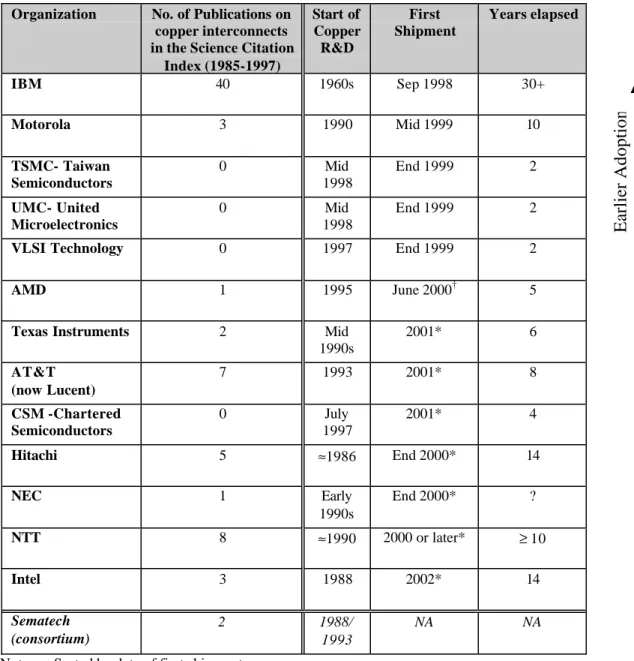
TABLE 2-1: PRIOR R&D RELEVANT TO COPPER INTERCONNECTS VERSUS YEAR OF FIRST SHIPMENT... 45
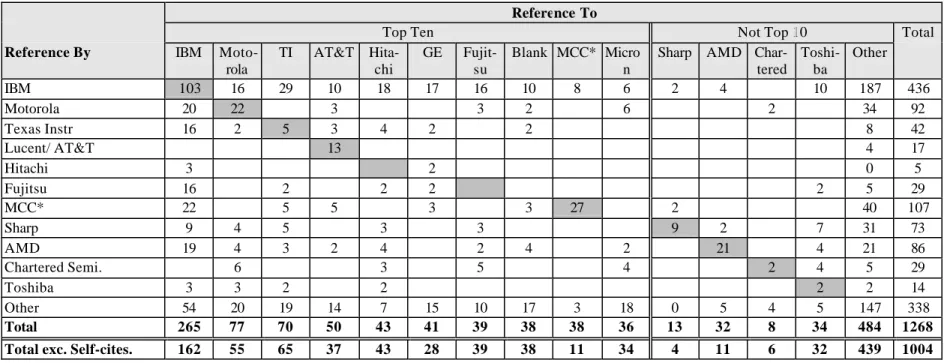
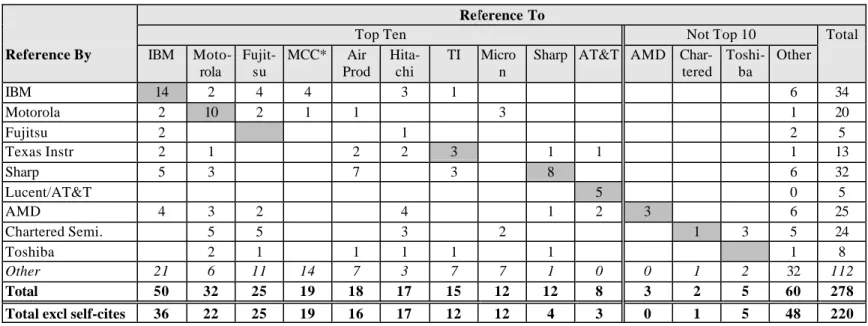
TABLE 2-2: NUMBER OF CITATIONS BY COPPER INTERCONNECT PATENTS TO ALL OTHER PATENTS... 49
TABLE 2-3: NUMBER OF CITATIONS BY COPPER INTERCONNECT PATENTS TO COPPER PATENTS... 50
TABLE 2-4: CITATIONS BY U.S. PATENTS ON COPPER INTERCONNECTS TO SCIENTIFIC ARTICLES. ... 52
TABLE 2-5: NUMBER OF PUBLICATIONS ON COPPER INTERCONNECTS PER YEAR BY COMPANIES... 55
TABLE 2-6: NUMBER OF PATENTS ON COPPER INTERCONNECT PER YEAR... 56
TABLE 2-7: NUMBER OF PUBLICATIONS ON COPPER INTERCONNECTS PER YEAR BY THE TOP 10 UNIVERSITIES AND GOVERNMENT LABORATORIES... 61
TABLE 2-8: PATENTS MOST HIGHLY CITED BY COPPER INTERCONNECT PATENTS (1960-1999)... 67
TABLE 2-9: COPPER ALLIANCES, JOINT VENTURES, AND ACQUISITIONS AMONG SEMICONDUCTOR FIRMS... 69
TABLE 2-10: COPPER ALLIANCES, JOINT VENTURES, AND ACQUISITIONS INVOLVING SUPPLIERS... 70
TABLE 3-1: APPLICATIONS OF THE E-G MODEL... 98
TABLE 3-2: US PATENT CLASSES RELEVANT TO EACH INDUSTRY...103
TABLE 3-3: CLASSIFICATION OF JOURNAL CATEGORIES INTO “BASIC” AND “APPLIED” ...105
TABLE 3-4: SUMMARY STATISTICS (ALL FIRMS, 1985-1997)...107
TABLE 3-5: DESCRIPTIVE STATISTICS...108
TABLE 3-6: OLS (DEPENDENT VARIABLE IS THE NUMBER OF PATENTS PER FIRM PER YEAR) ...109
TABLE 3-7: OLS WITH FIRM FIXED EFFECTS (DEPENDENT VARIABLE IS NUMBER OF PATENTS PER FIRM PER YEAR)...109
TABLE 3-8: HYPOTHETICAL SCENARIOS: GAMMA RELATIVE TO THE NUMBER OF RELEVANT PATENTS (1985-1997)...116
TABLE 3-9: DESCRIPTIVE STATISTICS OF JOURNAL-LEVEL VARIABLES (ALL JOURNALS IN THE SCI, 1985-1997)...129
TABLE 3-10: CORRELATION FOR VARIOUS MEASURES OF BASIC RESEARCH (ALL JOURNALS IN THE SCI, 1985-1997)...132
TABLE 4-1: SUMMARY STATISTICS FOR EACH COMPANY...148
TABLE 4-2: INVENTORS AND AUTHORS IDENTIFIED AND MATCHED IN EACH FIRM...151
TABLE 4-3: VARIABLES USED IN THE REGRESSIONS...153
TABLE 4-4: PAIRWISE CORRELATION COEFFICIENTS...154
TABLE 4-5: OLS WITH NUMBER OF PATENTS AWARDED TO A RESEARCHER AS THE DEPENDENT VARIABLE ...155
TABLE 4-6: OLS OF PATENTS PER RESEARCHER BY FIRM AND SCIENTIFIC AREA (ROBUST STANDARD ERRORS) ...158
TABLE 4-7: OLS FOR RESEARCHERS WHO RECEIVED PATENTS IN U.S. PATENT CLASSES 424 AND 514 (DRUGS, BIO-AFFECTING AND BODY TREATING COMPOSITIONS). ...161
ACKNOWLEDGEMENTS
The most difficult change a doctoral candidate must undergo is the mystical transformation from student to a scholar. For this, I am most grateful to Scott Stern, Rebecca Henderson, and Eric von Hippel. They have been more than just my thesis advisors. These past five years, they have been an active part of my intellectual
metamorphosis, helping me at each stage to hone the skills needed to journey onward and guiding me through the difficult choices I had to make.
Scott’s passion for research and for seeking the truth has inspired in me a desire to do good, enduring work. One of the many important lessons I have learned from Scott is to be unconstrained when approaching research questions and to choose the best
approach possible, rather than worrying about perceived obstacles. Rebecca has taught me the importance of a fine sense of balance and to focus on ”architectural” issues, for it is how things are combined that really matters, not any individual part. And Eric has been a source of great wisdom, teaching me to see the world for what it truly is and to learn from it rather than simply imposing my own view upon that world.
My colleagues and friends at MIT have also been critical to my transformation. The many sleepless nights I spent with my dear friend Jeff Furman studying for exams and our endless discussions covering every esoteric topic has no doubt left its mark. My officemates (Annabelle Gawer, Lin Xu, and Gao Xudong) brought light and color into what would otherwise have become a windowless prison. Pierre Azoulay never hesitated to spend time with me to offer constructive criticism on my work. I also benefited
greatly from the rich discussions with David Hsu and Ajay Agrawal, who share similar research passions. Scott Rockart, Maw Der Foo, Pek Hooi Soh, Sonali Shah, Susumu Ogawa, Sandy Rothenberg, and the rest of the BPS doctoral students offered me the comforting intellectual and emotional support of a close-knit group. My friends at MIT have indeed been my “family away from home” these past years.
I would like also to express my deep appreciation to the people who offered comments on the three papers that eventually became this dissertation, including: Glenn Ellison, Lori Rosenkopf, Sam Kortum, Iain Cockburn, Ashish Arora, Dan Levinthal, Fiona Murray, Rakesh Khurana, John de Figueiredo, Richard Nelson, Peter Murmann, Peter Lane, Jaeyong Song, Hank Chesbrough, Gary Pisano, Mike Lennox, Jorgen Pederson, Jordan Siegel, Nicole de Horatius, Lee Fleming and Brent Goldfarb. I also received helpful feedback from the participants in the CCC Doctoral Consortium (1998, 1999), Academy of Management (2000), NBER Productivity Lunches, MIT Innovation Seminar, and SIM Doctoral Lunch, as well as two anonymous referees at Research Policy.
A special word of thanks goes out to my industry contacts whose help made this research possible (although they remain unnamed to protect their identities). They were instrumental in my creation of the case study on copper interconnects, my fieldwork in Silicon Valley, and the numerous telephone interviews I conducted. Charles Weber, Ken van Bree, and Kevin Christiansen were very helpful in setting up some of these contacts. I also thank Diana Hicks of CHI Research for sharing with me valuable data on journal characteristics. The MIT reference librarians (Margaret Lippert and Margo Miller) generously offered access to the Science Citation Index; Jim Testa and Michelle Cooley from ISI helped me with its finer points. My research would not have been possible without the generous financial support of the National University of Singapore.
Scott Cooper spent many hours editing my thesis, transforming my awkward statements into elegant prose.
My deep gratitude extends to my parents and siblings for their love and
encouragement, despite our being scattered in five locations across the globe. Finally, I thank my dear wife, Seto Wai Ling, for everything she has put up with these past five years and for her many sacrifices. Her love has made my dreams a reality. The thesis you now read is wrought as much from her blood and tears as from mine.
Chapter 1: Introduction
This chapter introduces the dissertation, summarizes the key findings and
contributions, and provides an organizing framework for the three chapters that follow.
1.1 Overview and Motivation
This thesis consists of three essays on the relationship between basic research, applied research, and innovation. I define basic research as research that seeks a fundamental understanding of a problem; applied research is that which seeks useful or practical results.1 These definitions are similar to those used Bush (1945), Stokes (1997) and by the Organization for Economic Cooperation and Development (OECD).
Research activities within firms, including both applied and basic research, are crucial sources of innovation. However, as Nelson (1959) and Arrow (1962) pointed out, the main output of R&D activities is knowledge, a durable public good. Once a firm has created knowledge, other firms can easily exploit that knowledge without compensating the innovator. Thus, knowledge flows are spillovers. Innovating firms cannot capture the marginal value of the knowledge they produce, and therefore are likely to underinvest in R&D relative to what is socially desired. This problem should be worse for basic research than applied research, for which the expected benefits are highly intangible to a firm.
Nelson and Arrows’ seminal papers have spawned a huge literature on knowledge spillovers. Empirical research in this field is exceedingly difficult to perform because knowledge spillovers are, by nature, difficult to observe. The available evidence suggests
1
Other authors have defined “basicness” along other dimensions, including originality, autonomy, peer evaluation of published results, length of time between discovery and use, motivation of researcher, institutional affiliation of researcher, and source of research funding (see Stokes, 1997, chap. 1, for a review).
that (a) spillovers have a positive impact on economic growth2; (b) spillovers increase the productivity of firms (Mansfield 1991; Jaffe 1986); (c) spillovers are geographically localized (Jaffe, Trajtenberg and Henderson 1993); and (d) the level of appropriability varies greatly across industries (Levin et. al. 1987). Scholars continue to explore many issues, including how spillovers affect the incentives to innovate, whether governments should fund R&D, and whether research consortia resolve these externalities.
Several researchers have questioned whether knowledge spillovers occur as easily as portrayed by Nelson and Arrow (Rosenberg, 1990; Cohen and Levinthal 1989, 1990). Cohen and Levinthal argue that especially when learning is difficult, firms may need to make internal investments in order to absorb external knowledge. While recognizing that many alternative mechanisms are available, they assign a primary role to internal R&D investments. A firm’s prior relevant R&D helps to build “absorptive capacity,”which they describe as the “ability to recognize the value of external information, assimilate that information, and then apply it to commercial ends.”3 The need for absorptive capacity arises because knowledge is tacit and highly embedded within organizational routines (Cohen and Levinthal, 1990, pp. 135).
The notion of absorptive capacity is an influential one and has stimulated much research. But because spillovers are hard to observe, the relationship between R&D and absorptive capacity is often assumed rather than explored. A consequence of this
difficulty is that little theoretical development has occurred beyond the seminal paper of Cohen and Levinthal. How important are alternative mechanisms of building absorptive capacity vis-à-vis R&D? When is internal R&D most effective for building absorptive capacity, and when are alternative mechanisms more effective? Are there different kinds of absorptive capacity, depending on the kinds of mechanisms used?
2
See Griliches (1992) for an excellent survey.
3
A parallel stream of research on absorptive capacity has existed since the 1960s on the international transfer of technology, but deals with countries rather than firms (see Baranson 1970).
Another issue with the literature on absorptive capacity is that much of the empirical evidence supporting the theory comes from the pharmaceutical and
biotechnology industries (Gambardella, 1992; Henderson and Cockburn, 1996; Zucker and Darby, 1995). It would be interesting to learn whether these results are equally applicable in other settings.
Absorptive capacity is sometimes associated with the idea that firms should pursue science-oriented research environments that offer autonomy to researchers (Gambardella, 1992) and promote scientists based on their publications and scientific reputations
(Cockburn and Henderson, 1998). These studies suggest that science-oriented research environments allow researchers within the firm to remain connected to top scientists in various scientific disciplines, giving them better access to information and thereby boosting their productivity. The relationship between “connectedness” and spillovers is further explored in this dissertation.
1.2 Research Questions and Findings
The central question of this thesis is: how does the ability to assimilate and exploit scientific and technical knowledge developed outside the firm depend on investments in internal research, formal connections with the external scientific community, or some combination of these factors. The three essays in this dissertation revolve around this question. Each essay constitutes a separate chapter in this thesis. Table 1-1 provides a summary of the research questions, unit of analysis, and key results of each essay.
The first essay, presented in Chapter 2, explores how absorptive capacity depends upon a firm’s prior R&D and its connectedness to sources of external technical
knowledge (Figure 2-2). Firms have many options available for developing
connectedness, and consequently, for building absorptive capacity. These include: (1) performing R&D; (2) funding research at universities, maintaining relationships with faculty, and hiring graduate students; (3) forming alliances with companies that possess a
Table 1-1: Summary of the Three Essays
Chapter 2 Chapter 3 Chapter 4
Research Questions
§ How do firms develop absorptive capacity? § What accounts for the
rapid adoption of copper interconnect technology (which was developed by IBM) by other
semiconductor firms?
§ Is basic research more concentrated than innovation? § What about applied
research relative to innovation?
§ What is the relationship between the publications and patents produced by industrial scientists?
Research Setting
The semiconductor industry. Two industries with high spillovers: pharmaceuticals and semiconductors.
Five innovative companies: DuPont, Merck, IBM, AT&T, Intel.
Unit of Analysis
An innovation. A firm. A researcher.
Research Design
A quantitative and qualitative analysis of knowledge spillovers relating to copper interconnect technology.
An analysis of patents and publications by firms in the semiconductor and pharmaceutical industries.
An econometric analysis of patents and publications by scientists at five companies.
Key Findings
§ Firms used many ways to build absorptive capacity. § Apart from R&D, firms
depended upon their connectedness to external sources of technical knowledge, including Sematech, universities, equipment suppliers, and other firms that possessed copper technology.
§ In the semiconductor industry, basic research is surprisingly more concentrated than is innovation.
§ In the pharmaceutical industry, basic research is not more concentrated is innovation.
§ Applied research was not concentrated relative to innovation in either industry.
§ Scientists at IBM, AT&T, and Intel who published a higher fraction of their articles in basic scientific journals obtained fewer patents
§ The opposite result holds for scientists at Merck and DuPont. This is mainly driven by a relationship between basic chemistry research and pharmaceutical patents. Contribu-tions § Absorptive capacity is a function of connectedness as well as R&D. § Different kinds of knowledge are absorbed depending upon whether firms invest in R&D or alternative means to build absorptive capacity. § A science-oriented
research environment may not be necessary for building absorptive capacity.
§ The results suggest that semiconductor companies are able to capture spillovers without performing much basic research.
§ The relationship between basic research and patents is stronger in the
pharmaceutical industry than for semiconductors.
There is a suggestive relationship between basic research and patents at the level of the individual, not just at the level of the firm: § The relationship is
negative outside the pharmaceutical industry. § Within pharmaceutical
firms, the relationship is positive, but mainly because of basic chemistry.
given technology; and (4) obtaining membership in research consortia. The alternative methods for building absorptive capacity are at least as important as internal R&D.
I illustrate this framework using a detailed case study of copper interconnect technology, providing an “inside-the-black-box” view of how knowledge spillovers occur.4 IBM created this important technology over a three-decade period, relying on internal knowledge and secrecy. Other firms invested much less than IBM in copper interconnect R&D, but were able to adopt the technology very quickly by relying on spillovers from IBM and from Sematech-funded universities. Several firms that had performed little R&D were able to adopt the technology faster than were others that had invested more in prior R&D. I show that the rapid adopters enhanced their absorptive capacity by leveraging their connectedness to Sematech, universities, and other firms that had access to copper technology.
While previous authors recognized the relationship between absorptive capacity and connectedness (Powell et al., 1996; Cockburn and Henderson, 1998), my case study clarifies this relationship and the following implications. First, there are different types of absorptive capacity. IBM’s approach of investing heavily in internal R&D was useful for capturing discipline-level knowledge. However, other firms that didn’t perform as much R&D were more concerned about acquiring domain-specific knowledge, which they absorbed through their relationships with universities and other firms. The mechanisms used for acquiring external knowledge shifted over time, as firms became more concerned about acquiring domain-specific rather than disciplinary knowledge.
Second, the case study shows that a science-oriented research environment may be helpful for keeping up with outside knowledge, but is not essential. IBM in particular was able to keep up with all the external developments in the field although the company was highly secretive about its own research. Third, the multiplicity of approaches
4
The illustrative nature of this case study is similar in intent to Nelson’s (1962) study on the development of the transistor and Rosenberg’s (1963) analysis of the machine tools industry.
available to firms for building absorptive capacity implies that knowledge spillovers are difficult to contain. Unless many firms choose R&D as their means for building
absorptive capacity, it is unlikely that the underinvestment problem recognized by Arrow and Nelson would be overcome.
The second essay (Chapter 3) examines the relationship between research and innovation in the pharmaceutical and semiconductor industries. It poses whether basic research is more highly concentrated than innovation, and whether applied research is more concentrated than innovation. These industries exhibit high levels of knowledge spillovers (Levin and Reiss, 1988; Mowery, 1983; Appleyard, 1996; Cockburn and Henderson, 1998). To the extent that internal research is a prerequisite for absorptive capacity, we should expect basic research to be clustered within the same firms that produce a large number of innovations.
I find that, in the semiconductor industry, basic research is highly concentrated within IBM and AT&T, while innovation is dispersed across many firms. Firms other than IBM and AT&T produce a surprisingly large number of innovations relative to their basic research. Though several explanations are possible, one potential interpretation is that most semiconductor firms are able to capture spillovers even though they perform little basic research.5 In the pharmaceutical industry, basic research is not appreciably more concentrated than innovation; pharmaceutical firms that produce more basic research are also more innovative.
In contrast to basic research, applied research is not more concentrated than innovation in either industry. I reconcile this fact with the results for basic research by speculating that at least in the semiconductor industry, absorptive capacity “scales up” with applied research, but exhibits a threshold effect with respect to basic research. This
5
An alternative explanation is that the other firms are not capturing spillovers, but more productive at translating R&D into innovation. This is unlikely because there is a widespread practice among these companies of co-authoring papers with universities and public-sector laboratories.
threshold represents a “membership fee”, beyond which a firm is able to remain connected to external scientific networks.
Overall, this second essay suggests that basic research is less closely connected to innovation in the semiconductor industry than it is in the pharmaceutical industry. This theme is further explored in my next essay.
The third essay (Chapter 4) examines publishing and patenting by researchers at five R&D-intensive firms (DuPont, Merck, IBM, Intel, and AT&T). A new technique is used to match the inventors of patents to the authors of publications. The essay exploits this technique to test various hypotheses, with the individual as the unit of analysis. The results show that researchers at IBM, AT&T, and Intel who published a higher fraction of their papers in basic research journals were less likely to obtain patents. This supports the hypothesis that researchers face a tradeoff between pursuing a scientific career (publishing in basic scientific journals) and contributing directly to the firm (producing more patents).
The opposite relationship holds for Merck and DuPont, where scientists who published a higher fraction of papers in basic scientific journals obtained more patents. This is consistent with previous research suggesting a positive productivity impact among pharmaceutical firms of participating in basic research (Gambardella, 1992; Cockburn and Henderson, 1998; Zucker and Darby, 1995). My results show that the effect occurs at the level of the individual researcher, not just of the firm as a whole.
Interestingly, the results for Merck and DuPont are driven largely by publications in the field of basic chemistry. Even at these pharmaceutical firms, the relationship between basic research and patents is weaker in other scientific fields (including biology). As well, basic research is more closely associated with patents among scientists who work on pharmaceutical R&D than on other areas within these firms. Together, these results imply that even within a firm, the relationship between basic
research and patenting depends upon the scientific field being investigated and the area of application.
Apart from the results on basic research, the analysis also shows that patents across the five firms are positively related to the total number of publications by a researcher (indicating differential individual ability or balanced incentives within firms). However, patents are negatively related to the fraction of articles co-authored by a researcher with academic and public-sector scientists. The latter result is surprising given the importance of connectedness. A likely interpretation is that researchers who co-author with
academics and public-sector researchers play the role of gatekeepers, increasing the productivity of other researchers within the firm but not necessarily adding to the number of patents they themselves obtain.
1.3 Contributions to the Literature
This dissertation presents a framework for understanding and clarifying the relationship between absorptive capacity, R&D and connectedness. Although previous research has acknowledged the multi-faceted nature of absorptive capacity, this thesis unpacks its constituent elements, compares alternative drivers of absorptive capacity, and explores when each of these drivers is important relative to the others.
It is tempting to claim this leads directly to a set of managerial prescriptions, but to do so would be to pretend to have a simple fix for a highly complex problem. Rather, the greater benefit is from the change in perspective that results from this understanding. Recognizing the multi-faceted character of absorptive capacity changes R&D from a simple “make versus buy” investment to a more complex series of choices. These include the kinds of absorptive capacity a firm wants to develop, its options available for acquiring knowledge, and the relationships it plans to develop with other organizations. Instead of suggesting to all firms seeking to build absorptive capacity that they invest in internal R&D (particularly basic research), we should recommend that they choose from
a broad range of choices— depending on the strategic options and other contingencies they face.
Nonetheless, there is one public policy implication that seems reasonable to draw at this stage: outside drug discovery and at least in the semiconductor industry, there is a need to address the underinvestment problem, particularly for basic research. The nature and scope of such interventions are beyond the purview of this thesis, and much work is needed to identify which interventions (if any) are appropriate.
Another important contribution of this dissertation is that it documents several robust empirical regularities. Chapter 3 shows that, by almost any measure, basic research is much more concentrated than is innovation in the semiconductor industry, while this is not the case in the pharmaceutical industry. Chapter 4 shows that given two scientists who publish the same number of articles, the one who publishes a larger fraction of them in basic scientific journals produces fewer patents, unless she is at a pharmaceutical firm (in which case a strong positive effect exists if she publishes in basic chemistry journals).
Regardless of whether one agrees with my interpretations, these empirical regularities exist and must be accounted for. Why is basic research so much more concentrated in the semiconductor industry than in pharmaceuticals? What accounts for the differences between the two industries? In each industry, why are some firms investing so much in basic research and others so little? What accounts for the patterns of publishing and patenting by industrial researchers?
This dissertation also makes several methodological contributions. Chapter 2 presents a novel application of the Ellison-Glaeser Index for measuring relative concentration. The E-G Index allows us to measure the degree of “surprise” when comparing two variables (in this case, basic research and innovation). The simple fact that basic research is concentrated in the semiconductor industry is uninteresting, but we
learn something new by coupling this fact with the realization that innovation is widespread. The E-G Index provides a formal model for making such comparisons, controlling for several competing explanations.
Another methodological contribution is the development of several new bibliometric indices. In Chapter 2, I introduce the variables HiAcad, HiSCI, and
JCRBas, which, respectively, identify journals that are highly academic, highly cited,
and oriented towards basic research. These variables may be useful in other studies, particularly for understanding the kinds of research being performed by different
organizations. Each of these variables captures a different facet of scientific research, as evidenced by the low correlation across measures (see Appendix 3-B). While several issues are associated with the use of bibliometric measures (Martin and Irvine, 1983; Collins and Wyatt, 1988), they can be reduced by combining these variables with other qualitative and quantitative measures, and by seeking empirical results that are robust to a variety of measures.
A methodological theme that runs through all three essays is the conscious attempt to combine data on patents and publications. While there have been many studies on patents, and a huge stream of literature exists on publications, there have been relatively few studies that combine both data sources. This is unfortunate, because such data (although imperfect) give us a glimpse into the R&D activities within firms, for which it is maddeningly difficult to obtain consistent and comparable R&D data. Patents and publications can inform our analysis as long as we do not rely on them exclusively, but rather supplement them with qualitative evidence or other data. I believe this dissertation breaks new ground in the extent to which it combines such data alongside rich qualitative analysis, particularly for the case study on copper interconnects. A related contribution is the development of a technique for matching names of individuals in the U.S. Patent database to those in the Science Citation Index (SCI). As discussed in Chapter 4, deficiencies in both databases makes this a difficult challenge. The method employed partly overcomes some of these limitations, and may have other applications.
A final contribution of this dissertation is that it raises new questions to be
answered. Why are some firms more connected than others? How do the different types of absorptive capacity relate to firm capabilities and performance? Do the strong links between basic chemistry and patents exist anywhere outside drug discovery, or for any other scientific discipline? I hope these questions and others will lead to interesting future research, so that we gain a better understanding of how to manage technological innovation.
Chapter 2:
The Many Faces of Absorptive Capacity: Spillovers of Copper
Interconnect Technology for Semiconductor Chips
In this chapter, I unpack the mechanisms for acquiring absorptive capacity and explore when each mechanism is important relative to the others. There are many ways for a firm to build absorptive capacity, which depends on internal R&D and the firm’s connectedness to external sources of technical knowledge. A firm’s investments in R&D versus the alternative mechanisms are closely tied to the kinds of knowledge to be
acquired and its relationships with other organizations. I illustrate the implications of this framework with a case study on copper interconnect technology for semiconductors.
2.1 Introduction
Knowledge spillovers are important to the productivity of firms (Jaffe, 1986; Mansfield, 1991) and to economic growth (Griliches, 1992; Romer, 1990). Cohen and Levinthal (1990) proposed a firm must make internal investments — particularly in R&D — to improve its ability to absorb knowledge spillovers. This notion of “absorptive capacity” is an important theoretical contribution that has gained considerable influence (see Section 2.2). It raises many interesting questions that remain unanswered. When is internal R&D important for absorptive capacity, and when are alternative mechanisms more effective? Are there different kinds of absorptive capacity?
In this chapter, I explore the mechanisms used by firms to build absorptive capacity, and when each alternative is important relative to the others. A firm’s absorptive capacity primarily depends upon its internal R&D and the firm’s connectedness to external sources of relevant technical knowledge. The firm can enhance its connectedness by: (1) performing R&D; (2) funding research at universities, maintaining relationships with faculty, and hiring graduate students; (3) forming alliances
with companies that possess relevant technology; and (4) obtaining membership in research consortia.
The link between connectedness and absorptive capacity was noted by Cohen and Levinthal (1990) and explored by other authors (e.g. Powell, et al. 1996; Cockburn and Henderson, 1998). This chapter clarifies the relationship between absorptive capacity, R&D and connectedness, and explores the following implications. First, there are many ways to build absorptive capacity, with the alternatives being at least as important as internal R&D. Second, different types of absorptive capacity arise depending on whether firms invest in internal R&D or the alternatives. Third, a science-oriented research environment, as advocated by Gambardella (1992), may be useful but not necessary for absorption. I discuss these implications in Section 2.2.
The importance of connectedness to absorptive capacity is usefully illustrated by a case study on copper interconnect technology.6 In the context of semiconductor
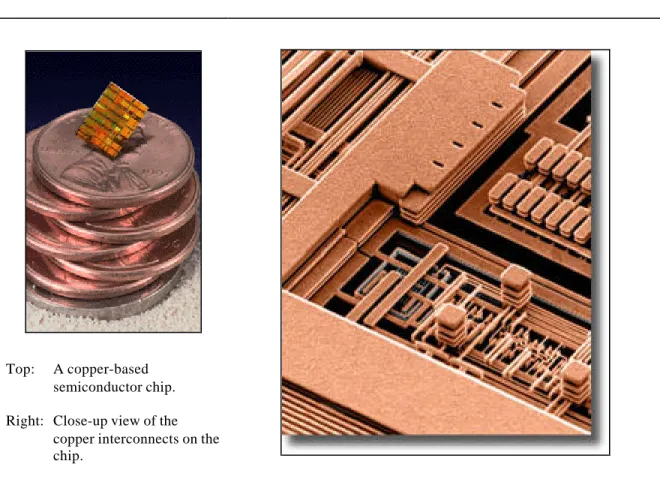
integrated circuits, interconnects refer to the conductors through which electricity flows between various circuit elements (see Figure 2-1). The use of copper instead of
aluminum for making on-chip interconnects is a recent innovation of great importance. Certain features of copper technology make it very attractive for this study (see Section 2.3.1). The most important is that its adoption relies upon a new and clearly defined set of skills. This makes it feasible to identify the prior relevant R&D performed by each firm and to track the spillovers of ideas across organizations.
Copper interconnect technology was developed by IBM over a 30-year period, but has been adopted with great rapidity by other companies. The IBM story is itself of great interest and is reported elsewhere.7 The focus in this chapter is on how other firms absorbed spillovers from IBM and other external sources of knowledge.
Figure 2-1: Semiconductor Chip with Copper Interconnects.
Top: A copper-based semiconductor chip.
Right: Close-up view of the copper interconnects on the chip.
Source: IBM Corporation, Research Division, Almaden Research Center. Reproduced with permission.
The semiconductor industry is one in which prior relevant experience should be paramount because it depends upon complex, embedded knowledge. Surprisingly, several firms were successful at capturing spillovers from IBM and universities even though they did not perform much of the early research. Furthermore, several firms were quicker to ship products based on copper technology than other firms that had made greater investments in relevant R&D. Both patterns are explained by the connectedness of the faster adopters to universities, Sematech, and to other firms that had worked on copper technology. The better-connected firms gained useful information and an advantage in recruiting people with copper-related expertise from those sources.
7
This chapter makes several contributions to the literature on innovation. Firstly, it presents a framework that clarifies the relationship between internal research,
connectedness and absorptive capacity. There are many ways for building absorptive capacity. Therefore, knowledge spillovers are difficult to contain, just as Nelson (1959) and Arrow (1962) had recognized.
Secondly, this chapter presents a novel methodology for identifying prior relevant R&D performed by each firm: it exploits the dependence of copper technology on new technical skills identify prior experience that should have helped firms to absorb external knowledge.
Thirdly, this chapter integrates the quantitative analysis of patents and publications with detailed qualitative fieldwork to overcome the limitations of each approach if used on its own.8
The remainder of this chapter is organized as follows. The next section critically analyzes the literature on knowledge spillovers. Section 2.3 presents the methodology and research setting. Section 2.4 describes the development of copper technology by IBM and the surprising speed with which other firms adopted it (including those that had invested little in prior R&D). It then shows that the connectedness of firms to external technical knowledge strongly affected the speed with which they adopted copper technology. Section 2.5 discusses alternative factors that influenced adoption and how they affect the results. It also discusses why IBM pursued copper R&D and published research on the technology despite the spillovers. Section 2.6 draws conclusions.
Magazine (1997), and an EETimes special feature (1998). These are listed in the bibliography.
8
For other studies on spillovers that combine qualitative and quantitative approaches, see Verspagen (1999) and Kim (1997). Kim (1997) relates how Samsung built absorptive capacity by being closely connected with Micron Technologies and by setting up an R&D outpost in Silicon Valley to hire U.S. engineers, including Korean-Americans with Ph.D. degrees from top U.S. universities.
2.2 The Determinants of Absorptive Capacity
In two seminal articles, Nelson (1959) and Arrow (1962) characterized knowledge as having the features of a durable public good. The knowledge produced through the R&D of an innovator is easily “borrowed” by another party to increase the latter’s productivity, without compensating the former. The innovator cannot appropriate the marginal value of the knowledge it produces and therefore under-invests in its
production, relative to the social optimum.9 Griliches (1992) makes an important
distinction between ideas that are expropriated, and inputs that are purchased below their actual costs. Borrowed ideas are “true” spillovers and a source of productivity growth, while under-priced inputs constitute a measurement problem.
Departing from the view that knowledge spillovers are easily acquired, Cohen & Levinthal (1989, 1990) proposed that knowledge spillovers come at a cost to the
recipient. Firms must invest resources in order to absorb knowledge spillovers. Cohen and Levinthal note that this investment may take many forms, and that many mechanisms exist for building absorptive capacity (including connectedness). However, the form of investment that they primarily emphasize is prior related R&D. According to Cohen and Levinthal (1990, pp. 135) this relationship between R&D and absorptive capacity arises because knowledge is (1) hard to codify or tacit (Polanyi, 1958) and (2) embedded in the routines of the organization (Nelson and Winter, 1992). From this perspective, R&D has two “faces”: it increases a firm’s productivity and its absorptive capacity.
This theory is broadly consistent with empirical data. Jaffe (1986, pp. 993) found that the interaction between a firm’s R&D expenditure and spillovers is strongly
correlated with the firm’s performance. Similar evidence is offered by Gambardella (1992), Henderson and Cockburn (1996), Arora and Gambardella (1992), Lane and Lubatkin (1998), and Zucker and Darby (1995). However, these studies are hindered by the difficulty of separating the two faces of R&D. It remains unclear whether R&D made
9
Nevertheless, Spence (1984) argues that the negative impact of spillovers on appropriability is partially offset if those spillovers reduce ex-post costs for the industry as a whole.
some firms more successful because they were better at capturing spillovers or because their R&D was more productive.10
Cohen and Levinthal made an important theoretical contribution by uncovering the relationship between R&D and absorptive capacity. This raises many interesting
questions that remain unanswered. When is R&D important for building absorptive capacity, and when are the other mechanisms important? Do different kinds of
absorptive capacity exist? Can a firm increase its absorptive capacity by hiring people whose heads contain valuable tacit knowledge?
Adopting a social network perspective may help resolve some of these questions. This shifts the focus of attention to the relationships surrounding the firm (Wasserman and Faust, p. 4). From this perspective, the crucial factor is the firm’s connectedness to external sources of public and private knowledge (Cockburn and Henderson 1998; Powell, Koput, and Smith-Doerr 1996).
The emphasis on connectedness may seem subtle, but it has important implications. Chiefly, it disentangles the role of R&D and connectedness as distinct, but related,
phenomena. Performing R&D may increase a firm’s ability to recognize technological opportunities, and to attract and retain employees connected to the external scientific community (Cockburn and Henderson, 1998; Pavitt, 1991). However, a firm that does not perform R&D is not excluded from building absorptive capacity if alternatives are feasible. Such alternatives include funding research at universities, co-authoring with academics, joining R&D consortia, and forming alliances with other companies with access to technology. These activities permit a firm to remain in close connection with important external sources of technical knowledge, and provide it with opportunities to hire individuals who possess valuable tacit knowledge.
10
Also, much empirical work has concentrated on the pharmaceutical and biotechnology industries, and it is uncertain how well the results apply in other areas.
I propose that these alternative ways for building absorptive capacity are at least as effective as internal R&D. Along with R&D, they constitute the “many faces” of
absorptive capacity. This framework for understanding absorptive capacity is shown in Figure 2-2.
Figure 2-2: Absorptive Capacity as a Function of Connectedness
A second implication of connectedness is that there may be different kinds of absorptive capacity, depending on whether a firm obtains it through R&D or alternative means.11 Internal R&D may be useful for absorbing disciplinary scientific knowledge. However, a firm without deep internal R&D could leverage its connections with universities and other companies to hire individuals who possess domain-specific
Absorptive Capacity CONNECTEDNESS A firm’s connectedness to external sources of knowledge provides: § Early access to information § Ability to hire individuals with relevant skills from these sources
Internal R&D
Relationships with Universities § Fund research at universities § Co-author with academics
and public sector scientists
§ Hire external scientific board members
Membership at R&D Consortia
Alliances with other
companies possessing relevant knowledge
knowledge. In section 2.5.3, I elaborate on how IBM used internal R&D to absorb disciplinary spillovers, while other companies leveraged their relationships to acquire domain-specific knowledge from universities and other firms. Over time, as an
increasing amount of relevant knowledge became accessible and codified, the dominant mode for building absorptive capacity shifted from internal R&D to relationships with universities, and eventually to strategic alliances with competitors and equipment suppliers that already possessed knowledge on copper interconnect technology.
A third implication of connectedness is that an “open” scientific environment, while useful, is not essential. Gambardella (1992) noted that successful pharmaceutical firms are like academic departments, offering their scientists autonomy to choose research projects and publish their work. This openness is viewed as a way to gain access to the inner circle of scientific communities. But a science-oriented research environment could also be a means of rewarding researchers in lieu of better
compensation (Stern, 1999). To increase appropriability, a firm could decide to implement a less open scientific environment and reward its researchers through better salaries and promotions. Yet, it could still remain connected to the scientific community by funding research at universities and paying top researchers to join its scientific
advisory board. In section 2.4, I describe how IBM kept up with external research while maintaining the secrecy of its own copper R&D project.
A re-examination of the empirical literature highlights the importance of
connectedness. According to Cockburn and Henderson (1998), pharmaceutical firms that co-authored research articles with public-sector scientists had better performance.
Zucker and Darby (1995) showed that biotechnology firms that collaborated with star scientists at universities (or employed them) were faster adopters. Liebeskind et al. (1996) reported that scientists at two biotechnology firms improved the integration of external knowledge by collaborating with outside researchers. In the remainder of this
11
Hansen (1999) explores a related theme, that the nature of relationships required for knowledge transfer depends on whether knowledge is tacit or explicit.
chapter, I present a case study of copper interconnect technology to illustrate how the absorptive capacity of various firms depended upon their prior R&D investments and their connectedness to external sources of technical knowledge.
2.3 Methodology
I conducted an in-depth case study to trace knowledge spillovers of an important semiconductor technology: copper interconnects. The case study approach was chosen over a large-scale research design because it provides an important advantage: the ability to trace specific ideas that were “borrowed” by other firms. Spillovers are by nature difficult to observe, so large-scale studies often have to infer that spillovers actually occurred.12 By tracing the flow of ideas, I offer an “inside-the-black-box” view of spillovers instead of assuming that they occurred.
This section is organized as follows: Section 2.3.1 describes the choice of this setting; Section 2.3.2 describes the quantitative and qualitative methodology used for the case study; and Section 2.3.3 introduces copper technology and the skills upon which it relies.
2.3.1 Research Setting
The semiconductor industry is a major pillar of other high-technology industries and shipped $144 billion worth of products in 1999.13 Spillovers are pervasive in this industry (Tilton, 1971; Mowery, 1983; Appleyard, 1996).14
12
Some methods include: (1) citation analysis without corroborating fieldwork; (2) counting the number of articles co-authored with outside researchers; (3) interacting a firm’s R&D with the sum of all other R&D in a regression; and (4) assuming technological closeness implies greater spillovers.
13
Source: Semiconductor Industry Association.
14
According to Mowery (1983), these spillovers occur among industrial laboratories, universities, and the military. Appleyard found that public sources of knowledge are important in the semiconductor industry.
The semiconductor industry is an excellent setting for studying absorptive capacity. Producing semiconductor chips requires highly technical knowledge covering a broad range of disciplines, including physics, chemistry, and materials science. Much of this knowledge is tacit and deeply embedded in organizational processes. Designing and manufacturing a semiconductor chip involves a great deal of judgement that is difficult to codify. The manufacturing process itself is horrendously complex and requires almost perfect coordination among hundreds of intricate and interrelated steps, each subject to variability from human operators and minor details in the manner and sequence in which it is performed. In short, the semiconductor industry depends upon complex, embedded knowledge. These are the conditions under which we should expect prior relevant R&D to enhance absorptive capacity (Cohen and Levinthal, 1990).
One of the most significant recent innovations in the semiconductor industry is the development of copper interconnects to replace aluminum. IBM was largely responsible for creating this technology, devoting three decades of research and millions of dollars. In September 1997, IBM announced the availability of copper technology to great fanfare (Zuckerman, 1997).15
Copper technology will have a large economic impact. IBM’s stock price jumped 5% on the day of the announcement and an additional 6% when it went into production a year later.16 As the semiconductor industry moves to smaller devices, the use of copper will become pervasive. By some estimates, this will occur as early as 2002.17
Several features of copper interconnect technology make it suitable for this study. The most important is that it depends upon a different set of skills and competencies than do traditional aluminum interconnects (see Section 2.3.3). These skills are distinct and
15
This news made it to the front page of The New York Times and other newspapers. By comparison, the invention of the transistor was announced on page 46 of that newspaper (Riordan and Hoddeson, p. 8).
16
A 5% increase in IBM’s stock price in 1997 corresponded to an increase in market capitalization of around $5 billion (source: analysis of CRSP data).
17
The “SEMI Copper Critical Survey 1999” reports that two-thirds of semiconductor companies will have copper-based chip in full production volume by 2001-2002.
fairly well defined, making it feasible to account for the “relevant prior experience” of each firm. Had copper technology been simply an extension of aluminum, tracking the vast amounts of prior research would have been a formidable task.18 Another useful feature of copper interconnect technology is that the spillovers are recent. Thus, the trail of evidence was still fresh when I began this research project at the time of IBM’s
announcement.19 In addition, the spillovers occurred from relatively few sources, making them possible to track.
2.3.2 Research Method and Data
This case study combines both qualitative and quantitative approaches. This helps to overcome the limitation of each (Yin, 1994).
Quantitative Analysis
The quantitative analysis is based on a dataset of patents and publications relevant to copper interconnect technology (see Appendix 2-A). Data on publications were obtained from the Science Citation Index (SCI) and data on patents from the U.S. Patent Office. The dataset contains 413 relevant articles (1985-1997) and 216 U.S. Patents (1976-1999). The definition of a “relevant” set is necessary because copper has many other uses within and outside the semiconductor industry. Relevant patents and publications were chosen based upon the relevant skills identified in Section 2.3.3.
I approximated each firm’s level of prior relevant R&D using the number of patents and publications it produced. This data is subject to bias, as not all research results are published or patented (some firms may choose to keep them secret). Also, papers may not meet the standards for publication and patent applications may be rejected. Another issue is that the coverage of the Science Citation Index, while excellent, is incomplete: it
18
In addition, the citation analysis would have been much more difficult because of the massive number of publications and patents on aluminum interconnects throughout its 30-year history.
19
For example, I was able to attend an IBM technical presentation at which that firm finally lifted the shroud of secrecy covering its development efforts.
covers all major scientific journals, but excludes several related engineering journals and neglects conferences. However, the SCI is the best available source, because other bibliographical databases contain only the address of the first author.
I traced knowledge flows using patent-to-patent and patent-to-science citations. The dataset contains all cited patents awarded after 1960, as well as all the scientific publications cited by the copper patents of four leading companies.
Citation analysis has long been used to measure knowledge spillovers across organizations (e.g., Jaffe, Trajtenberg, and Henderson, 1993; Martin and Irvin, 1983; Narin and Rozek, 1988; Verspagen, 1999). Patent-to-patent citations indicate spillovers of technological knowledge, while patent-to-science citations indicate spillovers from scientific fields (Narin, et al., 1997; Verspagen, 1999).20 Unfortunately, not all the citations in a patent are placed there by the inventor(s). An unspecified number are introduced by patent examiners, who have a duty to check the originality of the invention and its limits (Collins and Wyatt, 1988, p. 66). Thus, one cannot determine conclusively from patent citations alone whether the initial inventors actually relied upon the
knowledge cited.21 An additional problem with patent-to-patent citations is that few universities obtained patents on copper interconnects even after the Bayh-Dohl Act (1980) made it legal for them to do so. Thus, patent-to-patent citations are not a good measure of spillovers of copper interconnect technology from academia to firms.
In order to overcome these limitations and to provide additional insights, I performed extensive qualitative fieldwork.
Qualitative Analysis
The qualitative analysis includes semi-structured interviews with about two dozen scientists, R&D managers, and academics involved directly in developing copper
20 Patent-to-patent citations indicate the flow of technology because the cited patent must contain useful
technology.22 Each interview lasted 45-60 minutes and included in-depth information about (1) the internal development efforts of each firm; (2) technological options explored; (3) sources of internal and external knowledge; (4) appropriability; and (5) adoption of the technology. I visited several of the companies and attended technical conferences to gain a better understanding of the technology and access to industry sources. I also analyzed more than 200 related articles from technical journals, newspapers, and trade journals.
2.3.3 Copper Interconnect Technology and the Skills Upon Which it Depends23
Copper is the preferred material for conducting electricity because of its low
resistance. It is ubiquitous in electrical wiring and printed circuit boards. But for the past thirty years, aluminum has been used instead of copper for the interconnections within semiconductor integrated circuits. Over time, aluminum interconnects have evolved so that today’s interconnects are actually made from aluminum alloys, usually Al-Cu. The process involves depositing a blanket layer of the metal onto a silicon wafer, after which
21
Further issues regarding the use of patent citations are discussed in Narin, et al. 1997.
22
Prior to 1990, there were 102 unique researchers who published articles on copper interconnects; between 1990 and 1999, the number was 978. Most of the interviewees were involved early on, and played a key role in the development of copper interconnect technology.
23
Liu (1996) provides an excellent introduction to interconnect technology. For copper interconnects, see Park (1998), Gutmann (1999), and Liu et al. (1999). The material in this sub-section draws upon these sources and other technical publications.
Figure 2-3: Copper Damascene versus Etch Process
Aluminum Interconnects with Tungsten Plugs Copper Damascene Copper Dual Damascene (See Note 1)
Step A1: Deposit interlayer dielectric (ILD) and etch location of tungsten plugs, or “vias”
Step B1: Deposit interlayer dielectric (ILD) and etch location of copper vias
Step C1: Deposit ILD and etch away the location of interconnects
Step A2: Deposit barrier layer and Tungsten Step B2: Deposit barrier and seed layers Step C2: Use lithography to define via patterns and etch away vias
Step A3: Remove unwanted Tungsten to form “plug” Step B3: Electroplate copper and polish top surface Step C3: Remove photoresist, deposit seed and barrier layers
Step A4: Deposit Aluminum (or Al-Cu) Step B4: Deposit ILD and etch location of interconnects
Step C4: Deposit copper and polish
Step A5: Use lithography to define the areas of Aluminum interconnects
Step B5: Deposit barrier layer and seed layer
Step A6:Etch away unwanted Aluminum using RIE Step B6: Electroplate copper and polish top surface
Step A7:Deposit Interlayer Dielectric
Note 1: There are three main variants of dual damascene. For further details, see Liu et al., (1999), Park (1998), and Gutmann (1999). Note 2: These steps are repeated for each layer of metallization.
the desired pattern of interconnections is defined using photolithography (see Figure 2-3, steps A4-A5). This leaves the unwanted portions unprotected. The surface is then placed inside a chamber containing a reactive gas (plasma), which “eats away” the unwanted portions, leaving the desired interconnects (steps A5-A6). An insulating layer known as an interlevel dielectric (ILD) is then deposited (step A7). These steps are repeated to form multiple levels of interconnects stacked atop each other.24 Connections between the layers are made by etching holes (known as “vias”) into the interlayer dielectric and filling them up with Tungsten “plugs” (Figure 2-3, steps A1-A3).
Unfortunately, copper is very difficult to etch using plasma gases, so it is difficult to apply the traditional aluminum process. Worse, research by IBM in the 1960s showed that copper easily diffuses into silicon, thereby contaminating the very transistors it is meant to connect. To overcome these problems, all commercially available copper interconnect processes to date employ a method developed by IBM known as the damascene process.25 This process cleverly eliminates the need to etch away the metal by reversing the sequence of steps used in the traditional process (see Figure 2-3, steps B4-B6 versus A4-A7). Specifically, the dielectric is deposited first, rather than the metal. The desired interconnect pattern is then etched into the dielectric (step B1). Next, a thin barrier layer is deposited to protect the silicon from being contaminated by the copper (step B2). This is followed by a seed layer of copper, which acts as an “electrode” for an electroplating process that is used to deposit the actual copper layer (step B3). The surface is then polished flat. In a single damascene process, these steps are done once for the interconnect and once for the via. In the dual damascene process, both are combined (steps C1-C4).
IBM introduced the damascene process in the early 1980s.26 Aluminum
interconnects were used in this initial attempt. Formidable technical obstacles had to be
24
Today’s chips generally contain four to six levels of metal interconnects, depending on the application.
25
The Damascene process is named after an ancient swordmaking technique used in Damascus for combining two metals.
overcome before the damascene process could be implemented using copper instead of aluminum. First, unlike with aluminum, the propensity of copper to contaminate silicon requires that a barrier layer be placed between the two materials. The risk of
contamination also has organizational implications: it requires careful handling on a production line so as not to contaminate the equipment being used and other wafers being processed. Organizational processes and the production flow must be modified to
accommodate copper. Some companies consider the risk of copper contamination so great that they build entirely new fabrication plants for copper.27
The second, and perhaps most difficult, technical challenge is how to deposit a uniform layer of copper into the interconnect structures. These structures are deep and narrow, especially the vias that connect different layers.28 For a long time, researchers struggled to identify a way to deposit copper into the vias without forming air bubbles and imperfections inside the copper. They explored four options: chemical vapor deposition (CVD), physical vapor deposition (PVD), electroless deposition, and
electroplating.29 All commercially available copper processes employ PVD to deposit the barrier and seed layers and use electroplating to deposit the interconnect itself. In
contrast, the traditional aluminum process relies exclusively on PVD to deposit the aluminum (see Liu, 1996, p. 379). Although electroplating had been used on printed circuit board, it is an entirely new approach for on-chip interconnects.30 In fact, the use of electroplating was highly counterintuitive at first, as it requires the delicate silicon
27
For example, AMD built a new factory in Dresden, Germany to produce copper-based Athlon microprocessors. The identical part is being manufactured at the company’s existing plant in Texas, but aluminum interconnects are being used instead; AMD is not planning to make these factories copper-capable. (source: Tom’s Hardware Guide, http://www.tomshardware.com, June 2000).
28
This problem does not arise with the traditional aluminum process because the interconnects and vias are laid down first and then blanketed by the dielectric. In the damascene process, the dielectric is laid down first, and then the vias and interconnect structures are etched into the dielectric.
29
CVD involves suspending copper in a chemical vapor, which then produces a coating of copper on the semiconductor wafer. PVD involves bombarding the target surface with copper atoms that gradually form a layer. Electroplating involves immersing a surface into an electrolytic solution and running an electric current through two electrodes (one of which is the desired pattern on the surface), thereby accumulating copper on one electrode. Electroless deposition is similar to electroplating, but depends on a chemical reaction rather than requiring electrodes. See Liu (1996) for further details.