Binary Actuation of Solar Mirrors
by
Teresa M. Gomez
Submitted to the Department of Mechanical Engineering in partial fulfillment of the requirements for the degree of
Bachelor of Science in Engineering as recommended by the Department of Mechanical
at the
Massachusetts Institute of Technology June 2011 Engineering
ARCHIVES
MASSACHUSETTS INSTITUTE OF TECHiOLOCGYOCT
2
0 2011
LIBRARIES
C0 2011 Massachusetts Institute of Technology
All rights reserved
Signature of Author ...
Department of Mecha 1l Engineering May 5, 2011
C ertified b y ... .. .. .. .. .. ... ... . . . ... .... .. . . . .. . .
Stev"ubowsky Professor of Mechanical Engineering Thesis Supervisor
Accepted by ... ... ...
Johni H. Lienhard V Collins Profess chanical Engineering Chairman, Undergraduate Thesis Committee
Binary Actuation of Solar Mirrors by
Teresa M. Gomez
Submitted to the Department of Mechanical Engineering on May 5, 2011 in Partial Fulfillment of the Requirements
for the Degree of Bachelor of Science in Engineering as Recommended by the Department of Mechanical Engineering
Abstract
This thesis explores the use of binary actuators to adjust the shape of an array of mirrors. To explore this concept, an experimental system was refurbished and
recalibrated. This experimental system was used to explore the range of possible configurations that could be reached by a simple binary actuated system.
System models are required for accurate control of these binary actuated structures. This thesis develops and tests the accuracy of two different modeling
approaches, linear and iterative. The linear model assumes that each actuator contributes a constant value to the angle of the center mirror, and that this value is not dependent on the other actuator positions. The actuator contributions are summed to find the angle of the center mirror. These contributions are found two ways: by taking a relevant single
data point for each actuator, and by using a least squares fitting of a large subset of data. The iterative model assumes that each actuator adds some constant value, similar to the previous model, and that it also adds some portion of the current angle. A multiplication
and shift are therefore found for each actuator, and these multiplications and shifts successively applied, starting with the initial angles, to find the final angular position. While the linear model with measured values for the actuator contributions predicted the data poorly, the linear model with the least squares fitted values performed much better. The iterative model initially produced large errors, but these errors were found to be readily correctable and once removed, the iterative model predicted the data better than the linear model.
Thesis Supervisor: Steven Dubowsky Title: Professor of Mechanical Engineering
Acknowledgments
Above all else, I would like to thank Amy Bilton for her constant help throughout this project. Her patience and experience have been invaluable. I would also like to thank Francesco Mazzini for sharing equipment and lending a hand even as he finished and prepared to defend his doctoral thesis. Congratulations and best of luck.
I am also extremely grateful to my thesis supervisor, Professor Steven Dubowsky, for the opportunity to work in the Field and Space Robotics Laboratory. I have had a great experience and learned from every minute of it.
TABLE OF CONTENTS
A bstract ... 3
A cknow ledgm ents ... 5
Table of C ontents ... 7 F ig u re s . . . 9 T ables ... 10 1. Introduction ... 11 1.1 Background ... 11 1.2 Previous W ork ... 12 1.3 Problem Statement ... 15 1.4 Thesis Organization ... 16 2. Experimental Setup ... ... 16 2.1 Hardware Description ... 16
2.1.1 Base Plate Description ... 18
2.1.2 Actuator and Supporting Structure Description ... 18
2.1.3 Measurement System ... 19
2.2 Software Description ... 20
2.2.1 Experimental Software ... 20
2.2.2 Post Processing ... 20
2.2.2.1 Lens Distortion Correction ... 20
2.2.2.2 Reflected Ray Coordinate Calculation ... 23
2.2.2.3 Calculation of Angles ... 23 3. Experimental Results ... 25 3.1 Experiment Description ... 25 3.2 M odel Descriptions ... 26 3.3 Linear M odel ... 26 3.3.1 M odel D escription ... 26 3.3.2 Parameter Identification ... 27 3.3.2.1 Measured Values ... 27
3.3.2.2 Least Squares M ethod ... 27
3.4 Iterative M odel ... 29
3.5 Model Results ... ... . .33
3.5.1 Linear Model: M easured Values ... ... 33
3.5.2 Linear Model: Least Squares Method ... 34
3.5.3 Iterative M odel ... 36
4. Summary and Conclusions ... ... 40
4.1 Conclusions ... 40
4.2 Suggestions for Future Work ... 41
R eferences ... 42
A ppendix A ... ... 43
A.1 Linear Model ... . .43
A. 1.1 Measured Values ... 43
A.1.2 Least Squares Method ... 43
A.2 Iterative Model ... 44
A.2.1 Remaining Actuator Plots ... 44
Figures
Figure 1.1: Mirror structure (modified from [1]) with cross-section of hexagon ... 12
Figure 1.2: Experimental setup by Lee and Bilton [I] ... 13
Figure 1.3: Experimentally determined rotational workspace of center mirror with identical and random elastic element stiffness [1] ... 14
Figure 1.4: Error in center mirror angle calculation using superposition [1] ... 15
Figure 2.1: Experimental structure ... 17
Figure 2.2: B ase plate ... 18
Figure 2.3: Strut and actuator ... 19
Figure 2.4: Raw and corrected image of laser point ... 21
Figure 2.5: Original, reprojected, and corrected pictures for one calibration image .. .. 22
Figure 2.6: Distortion determined by calibration procedure ... 22
Figure 2.7: Diagram of 0, and 0y ... 24
Figure 3.1: Complete data set ... 25
Figure 3.2: Shift in data when actuator is on versus off ... 29
Figure 3.3: O, with and without actuator ... 30
Figure 3.4: 0, with and without actuator ... 31
Figure 3.5: Prediction results for linear model with measured values ... 33
Figure 3.6: Percent error for linear model with measured values ... 34
Figure 3.7: Prediction results for linear model with least squares values ... 35
Figure 3.8: Percent error for linear model with least squares values ... 35
Figure 3.9: Prediction results for iterative model ... 36
Figure 3.10: Iterative model percent error ... 37
Figure 3.11: Iterative model predictions versus experimental values of ... 38
Figure 3.12: Iterative model predictions versus experimental values of 0,O. .. . . ... 38
Figure 3.13: Prediction results for corrected iterative model ... 39
Figure 3.14: Percent error for corrected iterative model ... 40
Figure A. 1: 6 for the remaining actuators ... 44
Tables
Table 2.1: System parameters ... 17
Table A. 1: Measured values for a, and ay, in degrees ... 43
Table A.2: Least squares values for a, and aYi in degrees ... 43
Table A.3: Iterative model parameters ... 45
Chapter 1: Introduction
1.1 Background
The performance of solar concentrator systems depends on precisely shaped mirrors. However, several factors make it difficult to maintain the surface shape required for optimal performance, decreasing the effectiveness and increasing the cost of robust solar concentrators. Manufacturing high precision surfaces is both difficult and
expensive. These surfaces are then subjected to thermal gradients, wind, and other disturbances that cause warping and degradation of performance [1, 2]. This project explores the use of binary actuators to adjust mirror shape in response to such
disturbances, thus easing the manufacturing requirements and creating a more robust and effective system.
Though continuous actuators have been used to control surfaces [3-6], these actuators have poor reliability and are needed in large quantities with feedback sensors. Binary actuators are simpler and less expensive than continuous actuators, and offer the additional advantage of being energy efficient and lightweight. For this project, several binary actuators and elastic elements are used to control the mirror structure shown in Figure 1.1. By deploying the actuators appropriately, the shape can be adjusted with high precision through elastic averaging effects.
.7... ~ ( .... .<0
Figure 1.1: Mirror structure (modified from [1]) with cross-section of hexagon
1.2 Previous Work
In 2010, the work of Seung J. Lee investigated the use of binary actuators coupled with elastic elements to correct structural deformations. [7] Additional work published with Amy M. B ilton [1 ] further investigated this concept with the experiments described
below.
The surface depicted in Figure 1. 1 was built to demonstrate the workspace range of a binary actuated solar concentrator system. These mirrors were incorporated into the
experimental system shown in Figure 1.2 and used to experimentally measure the
rotational workspace of the center mirror. A honeycomb structure supports the nineteen
Figure 1.2: Experimental setup by Lee and Bilton [1]
Since the system uses thirteen vertical binary actuators to control the mirrors, there are 213, or 8192, possible mirror configurations. Though clustered around only nineteen distinct configurations when the compliant struts have identical stiffness, this set of solutions was distributed more evenly by randomizing the elastic element stiffness within a certain range. The dramatic improvement that was achieved can be seen in Figure 1.3. The measurements were taken with a vision-based system that reflected a laser beam off the center mirror onto a focal plane, captured images of the reflected ray with a CCD camera, and processed the images to determine the position of the reflected
Figure 1.3: Experimentally determined rotational workspace of center mirror with
identical (left) and random (right) elastic element stiffness [1]
The results were compared to the solutions calculated using the principle of superposition. The errors in the superposition solution were found to be larger than expected, which was attributed to the non-uniformity of the honeycomb structure supporting the mirrors, inaccuracies of the measurement system, and the fact that the actuators were not true binary actuators with consistent displacements due to force requirements. The percentage error increased exponentially as actuator displacement increased, as the graph in Figure 1.4 depicts. This trend was also seen in the previously calculated analysis of one and two dimensional systems; error was acceptably small for small displacements but grew exponentially with actuator stroke length.
24
2 4 r
Figure 14: Error in center mirror angle calculation using superposition [1
1.3 Problem Statement
The objective of this thesis is to further explore the capabilities of binary actuated mirror structures. The main focus is to develop experimentally validated models to
describe the performance of the structures that can be used for control purposes. Since the experimental system has been heavily used, it must first be refurbished. In addition, software tools must be rewritten for post-processing the acquired images.
The models developed in this thesis predict the angular position of the center mirror given the actuator configuration. Two different methods are used to model and predict the system. The first model is linear and assumes that each actuator contributes the angular position of the center mirror independently of the actuator configuration; each
actuator always contributes the same amount. The second model is iterative. The contribution of each actuator is dependent on the current angular position, and this dependence is modeled so that the effect of deploying each actuator is known. Starting with the initial angular position, the effect of each actuator in the configuration is
successively applied to simulate deploying the relevant actuators one by one.
Both of these models are developed and tested with data obtained by shining a laser onto the center of the mirror structure and calculating the deflection of the laser. As the actuators deploy in every possible configuration, the deflection of the laser is used to determine the corresponding angular positions. The data values are then split between calculating model parameters and testing predictions, and the models are corrected to be as accurate as possible.
1.4 Thesis Organization
This thesis is organized in four chapters. The first chapter provides the context and motivation for this research and includes the background, previous work, and problem statement. The second chapter describes the experimental setup used, including hardware, software, and data processing. Chapter 3 presents the results and models obtained, and the fourth chapter summarizes the work and suggests future experiments.
Chapter 2: Experimental Setup
2.1 Hardware Description
Figure 2.1 depicts the experimental system. An array of mirrors is mounted on a base plate, described in Section 2.1.1, which was newly constructed for this thesis. Several actuators and supporting struts attach the base plate to a larger supporting structure. A laser shines onto the center mirror through a small hole in the top panel of
this structure, and a camera is positioned to photograph the reflected laser point on the underside of the top panel.
Figure 2.1: Experimental structure
Table 2.1: System parameters
Number of actuators 11
Stroke length 5 mm
Laser to mirror distance 1.354 m Elastic element stiffness 2000 N/m
(maximum)
Base plate diameter 480 mm Base plate thickness 16 mm
Distance between camera 800 mm and top panel
2.1.1 Base Plate Description
The base plate shown in Figure 2.2 is cut to the size of the mirror array and consists of a thick honeycomb core with solid plastic top and bottom layers. The top and bottom layers of the plastic were scored with a rotary tool around the hexagons. The plastic was removed from the space between hexagons, exposing the honeycomb core between the hexagons, and a mirror was mounted on each hexagon. Large holes were
drilled at the locations of the struts and actuators, and tightly fitting short pegs with threaded holes were inserted. The actuators and struts were screwed into these holes and then the base of the structure shown in Figure 2.1.
Figure 2.2: Base plate
2.1.2 Actuator and Supporting Structure Description
Eleven actuators are used in this experiment. These are programmed to extend 5 mm, and are interspersed with supporting struts. Both the actuators and supporting struts have elastic elements attached to each end, and these elastic elements screw into the base
plate or supporting structure. The stiffness of these elastic elements was randomized by punching variously sized holes through the elastic material.
The supporting structure consists of a metal frame with top and bottom panels. The metal bottom panel has threaded holes to securely attach the struts and actuators. A
camera is mounted halfway up the frame, and the top panel has a small hole in the center to allow a laser mounted on top of this panel to shine down onto the mirror array.
Elastic element
Extendable
Threaded end
Figure 2.3: Strut (left) and actuator (right)
2.1.3 Measurement System
A red laser is directed through the hole in the top panel and onto the center mirror, which reflects the red laser point onto the top panel at a point determined by the angular deflection of the center mirror. The camera, mounted halfway up the frame of the supporting structure, is pointed upward with entire top panel in view, and records a picture for every actuator configuration. The location of the laser point in these pictures is used to determine the angular deflection of the center mirror, which is the quantity of
interest during data analysis.
2.2
Software Description
2.2.1 Experimental Software
During the experiment, the actuators are deployed to create every possible
configuration. The Matlab script governing the actuators counts from zero to the possible number of configurations (two raised to the number of actuators) minus one, and converts each number to a binary number with the length equal to the number of actuators. This binary count is used to determine the series of configurations; the first digit governs the first actuator, and so on. If the digit is one, the actuator is deployed, and if the digit is zero, the actuator is not.
As each configuration is activated, the camera takes a 320 by 240 pixel, 96 dpi picture of the top panel and reflected laser point. Before these pictures are used to
determine the angular deflection of the center mirror, however, some image processing is necessary for the most accurate results.
2.2.2 Post Processing
2.2.2.1 Lens Distortion Correction
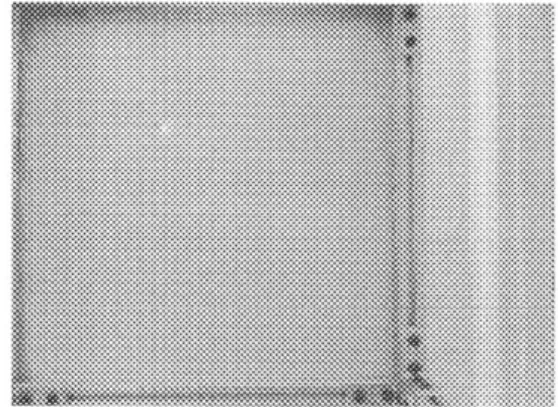
Images of the reflected laser point are first corrected for camera lens distortion. As seen in the left picture of Figure 2.4, there is a severe fishbowl effect that distorts the location of the laser point. This is removed with great success using the Camera
Calibration Toolbox for MatlabO' by Jean-Yves Bouguet
(vision. caltech.edu/bouguetj/calibdoc), as demonstrated by the right picture of Figure 2.4. ... .... . ... ... ... ... ...... .. ... ...... ... ... ...... . ... a .. ... ... ... ... I ... ......... . ... .... . ... ... ... ... g ......... gi . ... ... ... ... . . ... .. .... .. ... . . . . ... . . .... . ... ---... .. .. ... . ... .. .. .. .. ... ... il% .. I . . . .... . .... I .... . ... . ... K§§ ... ... . . ... .. ... . .... ...... .. .. .... .... .. ... ... ... .... ....
Figure 2.4: Raw image (left) and corrected image (right) of laser point
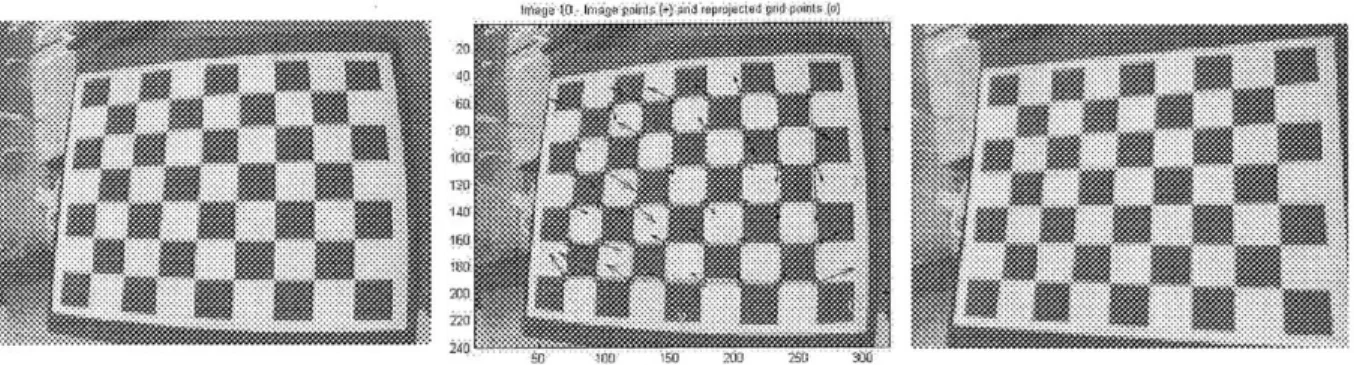
The Camera Calibration Toolbox for Matlab'l ) requires several calibration pictures of a grid of known size, and uses a comer-finding algorithm with assistance from the user to determine the lens distortion. After a few iterations, the corners and local distortion are reprojected onto the image with great accuracy, at which point any image can be
Irir ft it ICI- 11, Qe :pa'-- (I! wi rmprajeId ttnd poin . (0)
Figure 2.5: Original, reprojected, and corrected pictures for one calibration image
These parameters were computed using twenty calibration pictures similar the one shown in Figure 2.5. All contain the same image of a grid with 29 mm black and white squares, but shot from multiple heights and angles. Figure 2.6 displays the parameters that were ultimately found along with a graphical representation.
it Liccr~ ert cn
-i
eL-ermr = ?,. 9 i84. 4.48
FocalLengt = !3.-K 5,: 3-D 1- 5 Tf Cl)E i5
Figure 2.6: Distortion determined by calibration procedure
-- ---... . ... ... ... ... ... ... . ... ... ... ... .... ... ---.. . ... ... .... .... ....... ... .... .. ... ...
.
.. . ... .. ... .... ... ... .... ....... . ..... . .... ... ....... .. .. .... ... ... .... .. ... ... . .... .. .... .... .. W.....
...
. ....
...
2.2.2.2. Reflected Ray Coordinate Calculation
After correcting the images, a Matlab script calculates the coordinates of the reflected laser point by averaging the location of the "bright" pixels. A "bright" pixel is defined as one that falls within a certain range of brightness for the red, blue, and green frames, where the ranges are different for each color and the pixel must satisfy all three. The edges of the image and a circular area encompassing the center hole, through which the laser shines, are excluded since these regions have false bright spots.
This results in the origin of the coordinate system being located in the top left corner of the image. However, the center hole of the top panel must be the origin of the coordinate system in order to simplify angle calculations. The location of the center hole
is constant in each picture, since the camera never moves, and is therefore found manually. These coordinates are then used to shift the coordinates of the laser point so that the center hole is the origin of the coordinate frame.
Measurements of the structure's dimensions are compared with their size in the image to obtain a pixel-to-distance conversion ratio. This allows the hole-centered
coordinates to be converted to physically measurable units, which is necessary to include the height from the top panel to the center mirror in calculations. This dimension is needed to calculate the angular position of the center mirror.
2.2.2.3 Calculation ofAngles
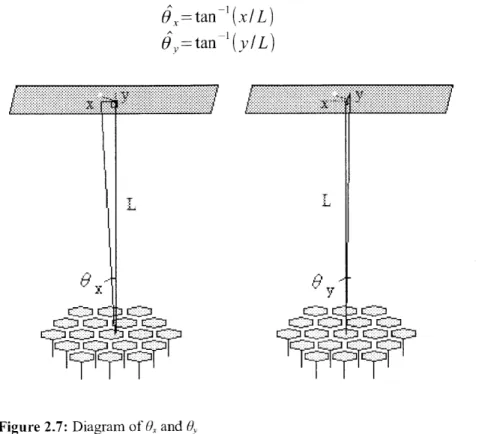
The center mirror has two degrees of freedom. These will be described as 0, and as shown in Figure 2.7. The x or y component of the laser point coordinates and the
distance from the center hole to the mirror (L)
the calculated values of 6 or 0, are defined as
O =tan O =tan
form two legs of a right triangle, so that
follows.
'(xIL)
[2.1] (y/L)
LL
Figure 2.7: Diagram of 92 and 9.
These calculations therefore result in two angles for every actuator configuration, after correcting the images of the top panel for lens distortion and extracting the
coordinates of the reflected laser point relative to the center hole. These angles are the data that will be examined from this point forward.
Chapter 3: Experimental Results
3.1 Experiment Description
The eleven actuators allowed 2", or 2048, unique actuator configurations. A
picture was taken of the reflected laser point for each one and the corresponding angular configurations were calculated as previously described. Each actuator had a stroke length of 5 mm and an elastic element on each end. These elastic elements had random stiffness as described in Section 2.1.2 and contributed varying amounts to the length of the
actuator.
Figure 3.1 shows every set of angles obtained. Since the effect of each actuator on the final angles is desired, this plot will be broken down by actuator and angle to
determine what relationships exist and whether they are able to predict the angles of the center mirror given only the actuator configuration.
Angle datai 7 di -5 -4 -3 -21 Theta x (degrees F 1 e + " + 4*~ i$ + 4* + +* 4. .4, +W A** -3 +6 +4 - 2 -Th~~~ta dg~9 +
3.2 Model Descriptions
An accurate system model would allow the final angles to be calculated from only the actuator configuration, allowing useful predictions and facilitating analysis of the system and its workspace. Two different models are formed and tested against the
experimental data. The first is a linear model that sums the contributions of each actuator, which are assumed to not vary. These contributions are found by two different methods and the results compared. The second model is iterative; each actuator is assumed to add a fraction of the current angle in addition to a constant contribution. The effect of each actuator in the configuration is successively applied, starting with the initial angles, to find the angular position.
3.3 Linear Model
3.3.1 Model Description
For the linear model, each actuator is assumed to always contribute the same amount to the final angle. The angles can therefore be calculated as:
6=Au
-u[3.1]
Ox a., a 2 --- a.. u2
0
Y.1=[z
a ay2
---Y/1I
where n represents the number of actuators and u is a vector of zeros and ones indicating which actuators are deployed. If the first entry is a one, the first actuator is deployed, and
so on. The coefficient aw1 is the contribution of actuator i to 6k, and aj is the contribution
to 0y. By multiplying the actuator and coefficient matrices, the contributions to each angle by the deployed actuators are summed.
3.3.2
Parameter Identification
Two different methods were used to identify the system coefficient matrix for the linear model. These methods, described below, include directly measuring the individual actuator contributions and least squares fitting of a large data set.
3.3.2.1 Measured Values
It is assumed that if each actuator always contributes the same amount to the final angle, then the values for each actuator should be the change in angle obtained when only that actuator is deployed. The coefficients ax, and a, are therefore the experimental 6, and
0, values obtained when only actuator i is deployed.
3.3.2.2 Least squares method
In an alternative method for determining the system matrix shown in Equation 3.1, a least squares method is used to find optimal values for ax, and a,1. While the
underlying assumption remains that each actuator contributes to the angles independently of the configuration, obtaining the best fitting a, and aYj values allows some flexibility. When using least squares, these parameters are chosen to smooth out whatever deviations exist in each actuator's contributions to the angles.
A subset of the measurements are used to determine the least squares fitting. Equation 3.1 can be extended to represent the in measurements used for the fitting, obtaining Equation 3.2
[o,
020,='A
uI U2 -.. U, [3.2]where A is the system matrix, O6 represents the ith experimental angular data, and u, represents the ith input vector of zeros and ones.
The ordinary least squares solution to 0= Au is found using Matlab so that A minimizes the sum of squared errors (0 -Au)'(0 - Au). The number of data points used in
the least square fitting, in, is approximately half of the total data taken. The coefficients found using the least squares fitting are shown in Appendix A. The effectiveness of this method is evaluated by comparing the predicted results to the experimental data below.
3.3.2.3 Treatment of Initial Angles
For the linear model, the initial angles were subtracted from the angular data before determining the system matrix. Therefore, the ax, and ay measured values are actually the 0, and 0, values obtained when only actuator i is deployed minus the initial angles, and the angular matrix 0 used to calculate the least squares fitting consists of the experimentally found angles minus the initial angles. The initial angles are added to the linear model predictions before comparing them to the experimental data.
3.4 Iterative Model
While processing the data, a the effect of each actuator was analyzed by plotting all of the data with the actuator on and all the data with the actuator off as shown in Figure 3.2. During this analysis, a consistent shift in the angular data is revealed. Such a consistent shift indicates that given any starting angles, the angles after deploying the actuator could be predicted with reasonable accuracy.
Actuator 1 With Actuator 1 6 -Vithnut Actuator 1 4 X 4.L - -5 4 -~4-. + + 4 4* -6 -6 -4 -3 210 Theta x (degrees)
Figure 3.2: Shift in data when actuator is on versus off
This consistent shift motivates the iterative model described here. In this model, the angular effect of each actuator that is deployed is successively applied to determine the Final mirror angle. It is assumed that there is a one-to-one relationship between the
angle before the actuator is turned on (0'-) and afterward (0) as shown:
For this approach, the function that defines the relationship between the angles must be determined. Figure 3.3 plots the x-angle with and without an actuator, and Figure 3.4 plots the y-angle. The plots reveal a clearly linear relationship between the angles obtained when the actuator is deployed and the angles obtained when the actuator is not. When similar plots are made for the other actuators, it becomes clear that each actuator has a linear trend. The remainder of the actuator trend plots are shown in Appendix A. Though some actuators have a cleaner relationship than others, the trend is very good after the first few actuators.
-~ I I I I t 1 -.S -S -4. -4 -3S -3 -2 5 -2 -15 -1
1*
1 2 3 4 6 7
Figure 3.4: 0, with and without actuator
A least squares linear fit for each plot is obtained from 1000 randomly chosen data values and incorporated into the iterative model. The fit obtained for each line consists of a slope and intercept, referred to as a multiplication and shift from now on.
In this iterative model, each actuator configuration is simulated by first applying the multiplication and shift for the first actuator in that configuration to the initial angle, then successively applying the multiplication and shift for the next actuator to the preceding result until the entire configuration is simulated. Equation 3.4 shows the mathematical representation of this method where Oxo and Oo represent the initial angles and mi and bi represent the multiplication and shift for actuator i. Every line incorporates another actuator into the angle calculation.
8, = m,0+bI 1 =m2(ml0,a+bl)+b2 M3( m2(m160o+bI)+b 2)+b3 [3.4] = m i (... (M2 (m, x+ b,) + b,)..)+b, Similarly, $ =mn(...(m2(m1Oab 1)+b...)+b1 [3.5]
It is worth noting that while Equations 3.4 and 3.5 seem to imply that all actuators are included, only those that are deployed in the configuration are part of these equations. The parameters mi and bi are absent from the calculations or set to 1 and 0, respectively, when actuator i is not deployed.
Additionally, while mi and bi are used in both Equations 3.4 and 3.5 for clarity, these parameters differ for 0, and 0y. Each actuator therefore has four fit parameters associated with it, most accurately represented as m, b, n., and by. The experimentally determined parameters are shown in Appendix A. Approximately half of the data values are used to find this fit. The rest are set aside so that predictions calculated using this method can be compared to the experimental results.
3.5
Model Results
3.5.1 Linear Model: Measured Values
Predicted angles using the linear model with the coefficients determined using measured values are plotted against the experimental results in Figure 3.5. As can be seen in this plot and Figure 3.6, which shows the percent error for 6, and OY, the
predictions are very poor. Therefore, this model will only be explored with A calculated by the least squares method.
Figure 3.5:
Linear model predicted data
Experimental *Predicted
- -B -4 2 0 2
Theta x (degrees)
Prediction results for linear model with measured values
The error is defined as
Ew =0
-where 0 is the predicted angular data and 0 is the experimental data.
Liw adc 4r p. P1dcra--i ciiaa
P+cent -rror in T
Figure 3.6: Percent error for linear model with measured values
3.5.2 Linear Model: Least Squares Method
A randomly selected portion of the data was used to determine the coefficients for the linear model using a least squares fit. The remainder of the data and the linear model
predicted values are shown in Figure 3.7. The predicted values are slightly skewed from the experimental data along one direction, potentially indicating a problem with an individual actuator.
Linear model predicted data Experirnental Predicted + + 4. + .. 4 4 + 4 J~ K.' ~ 4 -:AN ~ -5 ~ -4 ~ ~ -3 - . Tht x(eges
Figure 3.7: Prediction results for linear model with least squares values
Figure 3.8 plots the percent error in 0, and O,, revealing errors commonly up to
40% for 0, and 20% for 6Y, with some error values much greater.
Unear madel predt ed data
-nO 40 e&r -20 x
Percent e.ni in Theta xc
20 40 6
Figure 3.8: Percent error for linear model with least squares values
4 4
~44 4 44 4
3.5.3 Iterative Model
Figure 3.9 shows the experimental data values that were not used to calculate the iterative model and the corresponding predicted values. Significant errors appear, but these appear to be readily correctable since the error is mostly a shift.
Iterative model predicted data
E,
p:~
e
,*:ent
+ 7.~.~ + +4 +, .+ + 4 +. +- . 4V 6 -5 -4 3 -2 Theta x (degrees)Figure 3.9: Prediction results for iterative model
hf "It tvq rma-dY~~~ce ~
45 411-44
-10 -0 -80 -70 0 -50 -40 30 -20 - 0.
Percent ert in The-a x
Figure 3.10: Iterative model percent error
Figure 3.10 displays the percent error in both 0, and 0Y. The percent error is up to 60% for 0, and 30% for 0,, with many errors much larger. To adjust the model and reduce this error, Figures 3.11 and 3.12 plot the predicted and experimental a, and 6, values against each other. As Figure 3.9 suggests, the error is largely predictable.
S:
~, 4,
*+
-4 -3 5 -3
Figure 3.11: Iterative model
Theta x iegrees)
Prrdicteid dv pa
predictions versus experimental values of 0.
Thesa y (degrees
0 I 2 3 4 S
PredJcted 'datl
Figure 3.12: Iterative model predictions versus experimental values of 0,
These relationships are roughly linear. Figures 3.11 and 3.12 are recreated with the data values initially used to calculate the model parameters, and the linear fit for these
plots is then calculated with Matlab. The slope and intercept of these linear fits, M., Bx,
M, and B,, indicate that the error is essentially a pure shift for each angle since the
multiplicative coefficients M, and especially M, are close to 1. These will still be used as they do allow a slight improvement to the model, particularly when predicting 0,. All fit values can be viewed in Appendix A.
The predictions are then multiplied and shifted by these values, and replotted against the experimental values in Figure 3.13.
Itera~tive mordel prerdicted da~ta
* Experimental P rediicted A W, +4,.4 ~.4.- ~ . ~ 44 +: + 44 + + -5 4,5 4 -3.5 -3 -25 Theta x (degrees) -2 -1.5 -1 -0.5
Figure 3.13: Prediction results for corrected iterative model
The agreement is much better, and the percentage error plotted in Figure 3.13 confirms that the error is greatly reduced. Percent error is now mostly under 25% for 6 and 10% for O6, with some errors still much larger.
20
440
20
-10 -24 0 20 4 60 80 100
Percen en in Tha x
Figure 3.14: Percent error for corrected iterative model
Chapter 4: Summary and Conclusions
4.1 Conclusions
This project uses binary actuators to adjust the shape of a mirror structure. It explores the contribution of each actuator to the angular position of the center mirror, with the goal of modeling the angular position given the actuator configuration. The angles are calculated using the location of a laser point reflected off the center mirror for all possible actuator configurations, and these values are used to make, test, and correct models for the angular position.
Two models were explored: a linear model that assumes each actuator's
applies a multiplication and shift for each actuator. The iterative model had significant errors, but these were largely corrected by finding a linear fit between the predicted and experimental data, then applying that multiplication and shift to each angle. The corrected iterative model proved to be more accurate than the linear model, though least squares values for the actuator contributions greatly improved the latter.
The higher error values in both models could be attributed to faulty actuators, non-uniform actuator stroke length, irregularities in the base plate, and tilt in the laser, among other factors.
4.2 Suggestions for Future Work
Both models could likely be improved by eliminating the initial angle and using a shorter actuator displacement. In addition, constructing the base plate core from a more
uniform material might reduce the errors and allow accurate models to be calculated from basic material properties. Stiffer elastic elements could make the contribution from each
actuator more predictable, though this may have other undesirable effects on the system such as clumping the possible angles or reducing the actuator stroke length that could damage the base plate.
It is therefore suggested that future work use shorter displacements and reduce the initial angle, and that the softest elastic elements are replaced with stiffer ones to make the actuator contribution more predictable.
References
1. Lee, S. J., Bilton, A. M., and Dubowsky, S., 2010, "On the Kinematics of Solar Mirrors Using Massively Parallel Binary Actuation." ASME DETC2010-28875. 2. Coventry, J. S., 2005, "Performance of a Concentrating Photovoltaic/Thermal
Solar Collector," Solar Energy, 78, pp. 211-222.
3. Gardner, J. P. et al, 2006, "The James Webb Space Telescope." Space Science Reviews, 123(4), pp. 485-606.
4. Burge, J. H., Baiocchi, D., Cuerden, B., 2001, "Ultralight Active Mirror Technology at the University of Arizona." Optomechanical Engineering 2000, Proc. Of SPIE, 4198.
5. Irschik, H., 2002, "A Review on Static and Dynamic Shape Control of Structures
by Piezoelectric Actuation." Engineering Structures, 24, pp. 5-11.
6. Crawley, E. F., 1994, "Intelligent Structures for Aerospace: A Technology Overview and Assessment." AIAA Journal, 32(8), pp. 1689-1699.
7. Lee, S.J., 2010, "Planar Feasibility Study for Primary Mirror Control of Large
Imaging Space Systems Using Binary Actuators." M.S. Thesis, Massachusetts Institute of Technology, Cambridge, MA.
Appendix A
A.1 Linear model
A.1.1 Measured Values
Table A.1: Measured values for axI and a, in degrees
Actuator a, a,. 1 -1.8587 1.9531 2 -0.7131 1.3896 3 -0.9608 0.2224 4 -1.6684 0.2792 5 -1.7691 0.7427 6 -1.1144 1.3583 7 0.0851 1.5530 8 -0.3104 0.0196 9 -0.5560 0.1815 10 -0.2468 0.1834 11 0.0473 0.2495
A.1.2 Least Squares Method
Table A.2: Least squares values for ax, and avi in degrees
Actuator 1 2 3 4 5 6 7 8 9 10 11 aX/ -0.7134 0.3444 0.0253 -0.9734 -1.2263 -0.9463 0.1243 -0.2361 -0.7146 -0.4971 -0.2716 a,y/ 1.5732 1.0317 -0.2883 -0.2251 0.4375 1.2122 1.3792 0.0238 0.3312 0.5704 0.6586
A.2 Iterative Model
A.2.1 Remaining actuator plots
'C
PS
St
Figure A.1: O, for the remaining actuators
Ae
Figure A.2: 0, for the remaining actuators
44
A.2.2 Iterative model parameters
Table A.3: Iterative model parameters Note that in is dimensionless
Actuator 1 2 3 4 5 6 7 8 9 10 11 0.9972 0.7573 0.9185 0.9823 0.9574 0.9773 0.9798 0.9994 1.0032 0.9945 0.9875 b, -0.3647 0.0195 0.1681 -0.6467 -0.9705 -0.5985_ 0.4311 0.1696 -0.3279 -0.1869 0.0840
and b has units of degrees
0.9457 0.9877 0.9864 0.9687 0.9867 0.9721 0.9403 0.9923 1.0062 1.0046 1.0020 b, 1.4263 0.7143 -0.5498 -0.4028 0.1739 0.9751 1.2540 -0.2882 -0.0015 0.2847 0.3338
Table A.4: Iterative model corrective parameters
M, and My are dimensionless, B, and B, have units of degrees
M, B, M, B,
![Figure 1.1: Mirror structure (modified from [1]) with cross-section of hexagon](https://thumb-eu.123doks.com/thumbv2/123doknet/14159421.473034/12.918.302.629.124.345/figure-mirror-structure-modified-cross-section-hexagon.webp)
![Figure 1.2: Experimental setup by Lee and Bilton [1]](https://thumb-eu.123doks.com/thumbv2/123doknet/14159421.473034/13.918.322.550.129.425/figure-experimental-setup-lee-bilton.webp)
![Figure 1.3: Experimentally determined rotational workspace of center mirror with identical (left) and random (right) elastic element stiffness [1]](https://thumb-eu.123doks.com/thumbv2/123doknet/14159421.473034/14.918.224.749.129.334/figure-experimentally-determined-rotational-workspace-identical-elastic-stiffness.webp)