Automating the United States Payment System by
SHIH-YU WANG
Submitted to the Department of Electrical Engineering and Computer Science in Partial Fulfillment of the Requirements for the Degrees of
Bachelor of Science in Electrical Engineering and Computer Science and Master of Engineering in Electrical Engineering and Computer Science
at the Massachusetts Institute of Technology
May
20th, 1999( Copyright 1999 Shih-Yu Wang. All rights reserved
The author hereby grants to M.I.T. permission to reproduce and distribute publicly paper and electronic copies of this thesis
and to grant others the right to do so.
Author
Department oWElec)ical En neering and Computer Science
/
May 2 0th, 1999 Certified by SDr. AmarGupta 7Syperyo Accepted by C Mithur C. SmithChairman, Department Committee on Graduate Theses
MASSACHUSETTS INSTITUTE OF TECHNOLOGY
JUL 1 5
1999
Table of Contents
Abstract 5
Acknowledgements 7
Chapter 1. Payment System in the US 9
Chapter 2. Traditional Payment Method: Check 21
2.1. Check Usage 21 2.2. Popularity of Checks 22 2.3. Drawbacks of Checks 26 2.3.1. Check Fraud 26 2.3.2. Destroyed Checks 27 2.3.3. High Cost 27
2.4. Check Clearing Process 32
2.5. Major Providers 39
2.6 Future of Checks Collection Market 41
Chapter 3. Improvement Methods 43
3.1. Types of Improvement 43
3.2. Technology available 46
3.2.1. MICR 47
3.2.2. High Speed Sorter 48
3.2.3. Imaging Technology 50
3.3. Electronic Check Presentment 53
3.3.1 The use of ECP 53
3.3.2 To truncate or not to truncate? 54
3.3.3 Benefits of ECP 57
3.3.4 Drawbacks ECP 59
3.3.5 Providers of ECP 60
3.4. Point Of Sales Truncation (POS) 65
3.4.1 Use of POS truncation 65
3.4.2. Benefits of POS Truncation 67
3.4.3. Drawbacks of POS Truncation 68
3.4.4. Providers 69
Chapter 4. Alternative Payment System 71
4.1. Automated Clearing House 71
4.1.1. The use of ACH 71
4.1.2. Benefits of ACH 74
4.1.3. Drawbacks of ACH 76
4.1.4. Costs of ACH 77
4.1.3. Provider of ACH 79
4.2. Credit and Debit Card 85
4.2.1. The use of Credit and Debit Cards 85
4.2.2. Benefits of Credit and Debit Cards 88
4.2.3. Drawbacks of Credit and Debit Cards 88
4.2.4. Providers of Credit and Debit Cards 89
4.3. Smart Cards 91
4.3.1. The Use of Smart Cards 91
4.3.2 Benefits of Smart Cards 92
4.3.3 Drawbacks of Smart Cards 93
4.3.4 Provider of Smart Cards 93
4.3.5. Future of Smart Cards 95
4.4 Home Banking 97
4.4.1. The use of Home Banking 97
4.4.2. Benefits of Home Banking 101
4.4.3. Drawbacks of Home Banking 102
4.4.4. Provider of Home Banking 103
4.4.5. Future of Home Banking 109
4.5 Future of Electronic Payments 111
Chapter 5. Comparison Study: International Comparative 113
5.1. Developed Countries Case Study: G10 113
5.2. Developing Country Case Study: Thailand 118
Chapter 6. The Future 129
Proposed Solution 131
6.1. Example 131
6.2 Technology 134
6.3 Benefits 140
6.4 Technology Providers 144
6.4.1. Optical Character Recognition Providers 144
6.4.2. Evaluation 151
6.4.3. System Integrators 155
6.4.4. Evaluation 160
6.4.5. On-Line Payment Alternative NetCheque 161
6.5 Service Provider: Cheqvision 162
6.6. Conclusion 167
Appendix 169
List of Tables and Figures 169
Automating the United States Payment System by
Shih-Yu Wang Submitted to the
Department of Electrical Engineering and Computer Science May 19th, 1999
In Partial Fulfillment of the Requirements for the Degree of
Bachelor of Science in Electrical Engineering and Computer Science and Master of Engineering in Electrical Engineering and Computer Science
Abstract
Despite the advent of technology, the United States continues to write 66 billion checks each year while other G10 nations have successfully migrated to electronic payment. Although
electronic alternatives promise future savings, the payment system is an evolutionary process, not a revolutionary process. Thus, a considerable cost savings can still be realized by improving the current check clearing process.
This work discusses the evolution of the payment system, examines the costs, benefits, and the reasons behind check's enduring popularity. Electronic payment alternatives such as automated clearinghouses, credit/debit/smart cards, and home banking are scrutinized for their benefits and feasibility. Check collection improvement methods such as electronic check presentment and check truncation are also studied. One particular system offers end-to-end process efficiency improvement by combining technologies developed at MIT. This system proposes to capture check images using a high performance digital camera, recognize the courtesy amount using patented technology, and transfer the check images with the relevant account information for
settlement with a proprietary secure transfer protocol. The cost savings are realized through reduction of encoding operators, elimination of paper check transportation, reduction of fraud, shortened settlement cycle, and improved customer service. This system shows significant promise as the banking solution of tomorrow, and has received a favorable response from both the Federal Reserve Bank and the private sector service providers.
Thesis Supervisor: Amar Gupta
Title: Co-Director, Productivity from Information Technology (PROFIT) Initiative, MIT School of Management.
Acknowledgement
My Parents,
Thank you for your love and unwavering support of me throughout my life
My Sister,
For providing me with a multitude of non-thesis related problems to distract me.
My Friends,
Thank you for the five wonderful years, I could not have made it without you.
My Thesis Crew,
You know who you are. Thank you for providing comic relief and motivation during the final hours.
Dr. Amar Gupta,
Thank you for agreeing to supervise me and putting up with my constant harassment.
Bob,
Thank you for burritos, diskettes, proof reading, and your patience.
Chapter 1. The Payment System
Every large and vibrant economy requires a reliable payment system to handle the staggering number of monetary transactions. The payment system is the lifeblood of the economy. But for many years the operation of payment systems was not considered to be a subject for active central bank interest or concern: it was relegated to be back-office activity. However, this attitude has been changing for the last two decades largely due to the following reasons:
a. The increase in volume/value of transactions: There has been a tremendous increase in the turnover of the payment systems, both in terms of the numbers of transactions made, and more importantly in terms of the value of those transactions. This
phenomenon is attributed to the rapid growth in financial market activity around the world, and the payments generated by such activity. As a result, the existing payment system, unprepared for such a boom, scrambles to cope with the incredible volume of transactions. However, as the financial market activities continue to soar, an
improvement or a revamp of the payment system becomes imperative.
b. Technological advances: The last two decades witnessed an incredible technological advance in all disciplines, including the payment system. As a result, financial
institutions and consumers both have the ability and the resource to move funds much faster through the system, at a lower cost. Payment system improvement is no longer a vision, but a reality that can take place given sufficient interest.
c. Globalization of businesses: As more businesses reach across national and geographical borders, more financial transactions are flowing across countries. Companies need to pay bills to a supplier in France, pay the salary of the director expatriating in China, and manage the company cash flow globally. The company that has the capability to streamline its payment mechanism is able to trim costs and thus achieve competitive advantage. However, this can only be realized if countries actively search for a solution for cross-nation payments and invest in the
infrastructure to make that possible. In order to promote global competition and stimulate national economy, both the government and the private sector need to work together and find the solution to improve cross-border payment system.
The following table illustrates the magnitude of payment system flows in the G10 economies. Looking at the US data, annual payment system turnover is seventy-three times greater than annual GDP; this means it takes roughly three working days for the US payment systems to process a value equal to the country's annual GDP. The figure is impressive.
Annual Turnover in Ratio of Payment Number of days to Payment Systems System Turnover to Turnover annual
($000 billion) GDP GDP Belgium 10.9 47.5 5 % Canada 11.6 20.7 12 France 58.3 43.9 5 /2 Germany 129.1 63 4 Italy 20.4 29.9 12 % Japan 463.4 100.9 2/2 Netherlands 12.4 37.5 6 3/4 Sweden 6.4 32.6 7 % Switzerland 24.5 93.9 2 % UK 42.9 41.9 6 US 506.5 73.7 3 %
Table 1. PAYMENT FLOWS AND GDP IN G10 COUNTRIES Source: Bank of International Settlement. "Survey of G10 Countries" 1994.
In the United States, hundreds of millions of payments with an aggregate value of about $1.7 trillion are made every day. There are two major types of payments: cash and non-cash paper instruments. Cash accounts for less than one percent of the value of
payments, a tiny fraction of the enormous market.
Non-cash payment instruments are instructions that are authorized by the party making the payment to pay a specific sum to a receiver. Non-cash payments are divided into two categories: wholesale or large dollar transaction made primarily by banks, businesses, and governments; and retail or smaller dollar payments made by individuals, businesses and other participants in the economy.
Growing use of electronic payment alternatives such as credit and debit cards have slowed the increase in check volume, but so far has not reversed it. On-line home banking is still in its infancy stage and accounts for a tiny fraction of payments. Moreover, the customer's bill paying instruction from a home computer often simply results in the bank cutting a check to pay the customer's bill, because many payees are not equipped to receive funds electronically. Hence, while the volume of checks is likely to plateau and eventually decline as electronic payments become increasingly convenient and familiar, checks are likely to remain a significant part of the payment system for some years to come.
1.1. History of United States Payment System Currency
Prior to the Civil War, the most important manner of payment was currency. The dollar value of currency in the hands of the public exceeded the value of deposits, and the dollar value of currency payments exceeded the value of payments by check.
Currency consisted of coins minted by the federal government, U.S. notes, and national banknotes. Notes issued by state-chartered banks were eliminated by the Federal legislation in the 1860s.
A. Coins
The coins were the first official government currency. The U.S. coins have changed many times, since adopting the dollar as the standard monetary unit by the "Mint Act" of 17921. The first dollar coin was the silver dollars, which was issued from 1794 to 1935. However, as the price of silver and gold increases, the dollar coin was reincarnated as the
silverless Eisenhower dollar in 1971. It was later replaced by the silverless Susan B. Anthony coin, honoring the famed women's suffrage advocate in 1979. A new dollar coin depicting Sacajawea, the Native American woman whose presence was essential to the success of the Lewis and Clark expedition, will replace the Susan B. Anthony coins when the supply is depleted in the spring of 2000.
Other coin denominations in use today are the 25-cent, 10-cent, five-cent, and one-cent pieces, familiarly known as the quarter, dime, nickel, and penny. However, as the price of copper rises, it was costing more than a penny to produce a penny. In 1981 Congress authorized a change in the penny's composition, abandoning the ninty-five percent copper and five percent zinc alloy used for decades. The one-cent piece is now copper-plated zinc- ninety-seven-point-five percent zinc and two-point-five percent copper. The old and new pennies look virtually identical, but the new coin is about nineteen percent lighter2
e Composition
The U.S. Mint, which makes all U.S. coins, was established by Congress in 1792 and became an operating bureau of the Treasury Department in 1873. The US Mint buys the metal strips for various coins from commercial providers, except for pennies. The strips for nickels are an alloy of seventy-five percent copper and twenty-five percent nickel. Dimes, quarters, dollars are produced from three layers of metal fused together, the outer
3 layers are the same alloy used for nickels, and the core is copper.
B. U.S. Notes.
During Civil War, the Government was desperate for money to finance the war, so it passed the Act of July 17, 1861, permitting the Treasury Department to print and circulate paper money. The first paper money issued by the Government were Demand
2 Federal Reserve Bank of Atlanta. Fundamental Facts of US Money.
Notes commonly referred to as "greenbacks." In 1862, Congress replaced the Demand Notes with United States Notes, also called Legal Tender Notes.
Prior to the founding of the Federal Reserve System, banks issued private bank notes for circulation. During times of financial panic, some banks and clearinghouses refused to clear checks drawn on certain banks. The refusal lead to a suspension of the payment
system and further aggravated the financial crisis. To avoid similar disaster and to ensure the robustness of the financial system, Congress established the Federal Reserve System in 1913 to provide elastic currency and monitor the retail payment system. Today, Federal Reserve notes account for more than 99% of the total dollar amount of paper money circulating in the United States. The other small part of currency in circulation consists of U.S. notes or legal tender notes still circulating but no longer issued.
The Federal Reserve System issues Federal Reserve notes through its 12 Federal Reserve Districts. Each district issues currency according to the need in its district, and the note issued has the corresponding number and letter that are unique to each district.
Federal Reserve notes are printed and issued in denominations of $1, $2, $5, $10, $20,
. Production
The Bureau of Engraving and Printing, a division of the U.S. Treasury Department, is responsible for the production of all currency for the Federal Reserve System, to replace damaged or worn notes, or to support economic growth.
U.S. currency is printed by the engraved intaglio steel plate method, a complicated procedure that gives notes an embossed feel and other distinctive features difficult to counterfeit. Each of the features on the note is made from a steel die. Rolls made from these dies are put together into a master die of the complete note. The master die is then used in the first of a series of operations leading to the making of press plates from which the notes are printed.
0 Security Features:
Because United States currency is widely accepted and trusted, it is often counterfeited. In fact, the US Secret Service was created in 1865 to curtail counterfeiting4.
The first security measure is taken during the production phase. Each feature of the note
- the portrait, vignette, ornaments, lettering, script, and scrollwork- is the work of a separate, specially trained engraver. A geometric lathe is used to produce the intricate lacy design and borders.
The currency paper is a mixed cotton and linen rag paper. It has a distinctive, pliable feel and has embedded tiny red and blue fibers. The Bureau of Engraving and Printing
specially manufactures the printing ink according to a secret formula to help prevent counterfeiting.
With the advance of technology such as scanners, cameras, copier, printers, and
computers, security measures of the notes had to upgrade accordingly. This prompted the redesign of notes that first appeared in 1996 with the $100 note.
The new design for the $100 note, as shown below, has an impressive list of counterfeit prevention features. Fine-Une Portrait Printing Patterns Serial Numbers
A A10652494 A WatermarRaemr
Federal Reserve Indicators Um AA 10652:494 A Securiy 2 -Color-Thread Shifting -3 X I Ink Microprinting
Figure 1. The New US $20 Note
" Portrait: The new portrait is larger and incorporates more detail. It is also slightly
off-center to reduce wear (when people fold the note in half) on the portrait and provides more room for the watermark on its right.
" Watermark: The watermark is created during the papermaking process and it is visible on both sides of the note when held up to the light. It depicts the same historical figure as the portrait.
* Security thread: One of the new security features is the security thread. It is a
polymer strip, embedded in the note at a unique location for each denomination. The thread contains Microprinting with letters "USA", the denomination of the bill, and a flag in the case of the $50 and $20 notes. It is visible when held up to a bright light and the thread glows a distinctive color for each denomination under ultraviolet light.
" Microprinting: Microprinting appears at different locations depending on the
denomination of the note. It can only be read under a microscope and is blurry when photocopied.
* Fine-Line Printing Patterns: This refers to the pattern that appears on both sides of the note, in the background of the portrait and the buildings. This type of fine-line
printing is difficult to reproduce on scanning equipment or replicated by other printing methods.
C. Checks and Drafts.
As the economy boomed and the value of transactions increased, consumers started to use bank drafts and checks to settle large value obligations. Bank customers created checks payable to those with whom they wished to settle obligations. The bank that accepted a check for collection would then seek payment from the bank on which the check was drawn. However, a majority of inter-regional financial obligations are settled using bank drafts that the consumer can purchase from his or her local bank. The bank draft is usually drawn upon a major national depositary institution and is cleared through clearinghouses in the financial centers. When the draft is cleared, the bank on which it was drawn would debit the account of the bank that sold the draft.
Around the end of the 191h Century, personal checks began to slowly replace drafts to settle inter-regional payments5. As the volume of checks increased, the clearing system scrambled to keep up with the workload. Local checks were cleared through local clearinghouses or by presenting the checks to the paying banks. However, out of state checks were far more complex, especially when taken into consideration the exchange charge. The banking law required the banks to pay on par for checks presented directly, but they could pay less than the face amount if the checks arrived by mail or other indirect means. The exchange charge was introduced to cover the expense that the paying bank incurred when transporting coin or banknote to the collecting banks. To avoid the exchange charges, many collecting banks came together and formed a system of correspondent clearing where checks were routed through the member banks until the
check arrived at the same region as the paying bank and the checks were presented in person.
The advance in technology and continuing increase of check volume introduced new machinary and equipment designed to facilitate the check clearing process. For the past two decades, economists have been predicting a check-less, paper-less society. In fact, it was thought by the end of 1990s checks will be obsolete. However, it was not so. Check continued to enjoy a good health and great popularity with the United States citizens.
Chapter 2. Traditional Payment Method: Checks
2. 1. Check Usage
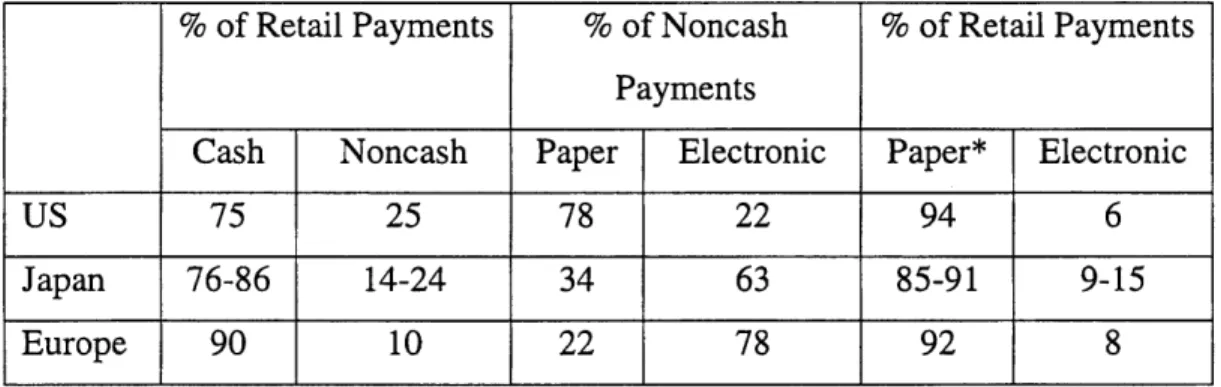
Compared with other developed countries, the US relies very heavily on paper-based transactions. In Europe and Japan, the paper instrument used is mostly cash, whereas in the US, it is more likely to be a paper check. At seventy-five percent of all non-cash transactions6, checks are used much more widely in the US than in any other industrial economy. This reliance on paper-based retail payment method is astounding in this electronic age when information can travel in seconds at minimal costs.
% of Retail Payments % of Noncash % of Retail Payments Payments
Cash Noncash Paper Electronic Paper* Electronic
US 75 25 78 22 94 6
Japan 76-86 14-24 34 63 85-91 9-15
Europe 90 10 22 78 92 8
Table 2. Payment Methods of G10 countries
Source: US Treasury, Bank of International Settlements, correspondence with central banks and others.
*Include transactions paid by cash, checks, and paper-based giro.
In 1996, Americans wrote sixty-four billion checks worth about seventy-five trillion dollars7. Over the last ten years, the number of checks written in the US grew at an average annual rate of approximately three percent. Average American households write
6 Federal Reserve System. January 1998.
eight to ten checks per week while small businesses write about sixty per week8. Large
corporations write over six thousand checks per week. Despite the effort to replace checks by electronic payments in the last several decades, the growth in check volume merely slowed to two percent annually over the last five years9. That is a growth of 1.3 billion checks every year.
2. 2. Popularity of Checks
So why has the American retail payment system been so resistant to change? This issue should be examined from both perspectives in the payment system: end users and the financial service institutions:
A. Consumers continue to write checks due to the following reasons
e Familiarity
When it comes to the matter of money, people are especially conservative and fear the unknown. The tangibility of paper is somewhat of a security blanket for users because you can touch it, see it, and put it away in a shoebox. Furthermore, many people are not comfortable with smart cards and electronics because they do not understand them.
* Convenience:
Checks are easy to write, widely accepted, and the legal status as proof of payment is established. Checks can be used to pay both remote transactions, such as invoices, and point of sale transactions.
* Price Sensitivity:
Checking accounts are lucrative business for banks. Depository institutions tried to make checking accounts more attractive to customers by eliminating a per check fee. As a result, checks appear cheap to the users.
* Network Effect
The success of a payment system depends on a large number of willing users. Similar to the telephone system, the benefit of the system increases with the number of users. Checks have been in circulation for over fifty years, and it is accepted by virtually every institution. Consumers are unwilling to switch to a new electronic system that have not been widely adopted by businesses, and merchants are reluctant to invest in the new system unless they are sure that the consumers will accept and use it.
0 Float
Float is money in the banking system that is counted twice during the delay in the check settlement process.
Businesses and individuals deposit millions of checks at banks every day. When a bank receives a check for deposit, it credits the depositor's account immediately and later collects the funds from the paying bank. Rather than sort all the checks and send each one back to the bank it was drawn upon for settlement, depository institutions transfer many
of their checks to Federal Reserve Banks or other intermediaries for collection. In turn, The Federal Reserve Banks pay the depositing banks for the total amount of the checks, then collect the funds from the banks on which the checks are drawn. A Federal Reserve Bank gives credit for most checks on the same or the next business day, and within two
days for almost all others. However, the bank on which the check is drawn does not pay the Reserve Bank until the check is presented to it. During the delay in processing, both the collecting and the paying bank list the funds on their books thus double counting the money and creating a float.
Any delay element in the check-clearing process can cause float. For example, due to reduced processing hours over the weekend, the backlog of checks causes the float on Tuesdays to be the highest. Holdover float also increases in December and January, when check volume increases for the holiday season. Transportation floats, occuring during the transportation of checks, is caused by weather, mechanical failures or air traffic. Winter weather generally causes transportation float to be highest in December and Januaryl.
A consumer benefits from float because as the check writer, he or she continues to collect interest on his or her money until the check is cleared. This means the longer the delay, the higher the benefit.
B. Banks continue to support check writing for the following reason
0 Network Affect:
Banks do not want to invest in a new electronic system unless they are sure their customers will accept and use it. Moreover, an effective new payment system is only useful if other deposit institutions also deploy it. The cost of being the pioneer in a highly network dependent venture is too high for most banks to handle and the full
benefits of the new system can only be realized when the majority of the industry also implements the changes.
0 Familiarity
Similar to its consumers, the financial industry is highly risk averse and suspicious of new technology. They feel they have already dealt with check processing for the past 50
years, so all the problems are either solved or at least known. With the electronic system, it represents the unknown, and thus is perceived to be risky.
0 Cost
More than anything else, banks are concerned with profit. They have already invested millions of dollars in the check clearing infrastructure and equipment. Scraping all of that and investing more money in an unproven system is an unappetizing thought for banks. Furthermore, an incremental approach to install a new system requires investing in a new system and maintaining the existing check process in parallel, which is far too expensive for most banks' tastes.
0 Float
As described above, not only individual consumer benefits from float, so do banks. The daily million-dollar check transactions translate into huge value of floats, generating lucrative profits for the banks.
ii
2. 3. Drawbacks of Checks 2.3.1 Check Fraud
Losses due to check fraud are huge-and growing. According to the Federal Reserve's study of check fraud, the estimated value of check fraud losses at commercial banks, credit unions and savings associations in 1995 was four hundred and eighty-seven million dollars. This number increased to one billion dollars of attempted fraud" and five
hundred and twelve million dollars actual loss in 1997. The same study also showed that check fraud losses are increasing at the rate of nineteen percent per year.
There were 529,000 cases of check fraud and about fifty-seven percent of all banks incurred some form of check fraud losses every year'.
Types of fraud include account closed and kiting, counterfeit, forgery, bankruptcy, and refer-to-member. The most common type of check fraud in 1997 was forgery, which include forged maker's signature and forged endorsement. More than half of the fraud
13 cases and four dollars out of every ten dollars in fraud losses are attributed to forgery Checks written against consumer accounts were the most common source of check fraud, with community banks and mid-size banks more adversely affected than larger banks. At small banks, three out of four fraud cases and two dollars out of every three dollars in
" American Bankers Association. 1998.
12 Board of Governors of the Federal Reserve System. 1995.
fraud losses were from consumer accounts. At large banks, consumer accounts accounted for about six in ten fraud cases and half of the fraud losses".
Regulation CC, created to enhance the check clearing system, has an unintentional benefit for the criminals. This regulation stipulates that banks are no longer allowed to hold checks for 10 days. As a result, criminals can forge a check, open a new account, and deposit the fraudulent check at a local bank. The account will be credited
immediately and the money will be available for withdrawal the very next day. The bandits will be long gone before the physical check even arrives at the alleged paying bank.
2.3.2 Destroyed Checks
In the normal course of check collection, occasionally checks are lost or destroyed. In November of 1991 a plane crashed containing a significant volume of checks. Without
some backup system such as photographing or photocopying the physical checks prior to relocation, destroyed checks present a big problem to the banking community.
2.3.3 High Cost
According to Jake Guynn, the President and CEO of Federal Reserve Bank of Atlanta, the existing payments system consumes one to two percent of Gross Domestic Product, a number four times that of other industrial nations15. In 1997, one hundred and eighty-one
billion dollars was spent processing checks16
15 Guynn, Jake. October 28, 1996.
I.
The current paper based check-collection system is resource-intensive with little promise of future cost savings. This system relies on operators, mechanical processing
equipment, buildings and a huge transportation network of cars, trucks, and planes. The processing of checks involves receiving and preparing deposits for processing, sorting checks and inputting accounting data, reconciling the accounting data, and packaging and dispatching the checks for presentment to paying banks. If some processing problems occur during the process, additional human intervention is required. Personnel costs account for about half of all direct and support costs involved in processing commercial checks at the Federal Reserve, while transportation expenditures account for about ten percent. 17
The actual cost breakdown of check clearing is very difficult to obtain. But it is
reasonable to assume the cost has two major components, a fixed cost such as building, equipment, and salaries of operators, and a variable cost such as handling of checks. The fixed costs are amortized over the volume of checks handled, and the variable costs are the marginal costs associated with each check processed. Federal Reserve Banks, as the largest third-party check-processing providers, are a good indicator for the industry standards.
Under the Monetary Control Act of 1980 (MCA), the Federal Reserve is required to set its payment service fees to recover all direct and indirect costs in the long-run18. in
addition, the Federal Reserve Banks are required to recover imputed costs, which are the
17 Rivlin, Alice M. September 16, 1997.
cost of capital and taxes, to correctly reflect the true costs and profits of a private-sector service provider.
e Transportation Cost:
Each Federal Reserve has its own local transportation network to present checks to local paying banks. This transportation consists of private-sector ground couriers,
supplemented in many cases by private-sector air couriers. The nonlocal checks are shipped between the forty-five Federal Reserve regional offices by a transportation network. Inter-district Transportation system, ITS, is a privately owned network managed by the Federal Reserve'9. ITS is a ground and air courier network made up of
private-sector firms who are awarded the contract based upon a competitive bidding process. The network is divided into five geographic regions with the following five hub cities: Atlanta, Chicago, Cleveland, Dallas, and Philadelphia. Checks are flown into the regional hub cities then sorted at the hub cities according to their final destinations. Those shipments destined for Federal Reserve offices in the same region are flown and delivered to those offices. The shipments for other regional offices are flown to the corresponding hub city serving those regions for eventual delivery to their final destinations. Approximately fifty aircraft make about two hundred flights nightly in addition to innumerable ground courier pickups and deliveries. This system costs thirty-six million dollars in 1996
19 Rivlin, Alice M. September 16, 1997. Appendix II.
0 Labor Cost
Check clearing is a very labor intensive process. Each check is handled on average by eight to twelve operators during the collection cycle. Those operators handle deposit slips, sort and bundle checks, read and input the relevant check information, verify and re-conciliate the account information, and finally send the physical check (or image of the checks) back to the check writer. At the small and mid-size banks, there are on average two salaried employees and five hourly workers responsible for check clearing. At larger institutions, the encoding staff can be made up of forty salaried employees and seventy hourly operators. The average wage rate ranges. from $6.75 to $10.672, so the labor
expense for the hourly operators alone costs about eight million dollars. At the larger banks, about forty-five percent of check processing costs is for salaries. Furthermore, the
high turnover rates necessitate training for new operators, which is also a costly expense.
9 Other Costs Equipment Costs:
As check clearing becomes more automated, the number and the type of machines required increases. At the same time, as the technology becomes more sophisticated, the price raises accordingly. Banks anticipating spending approximately three times as much on imaging equipment than on other types of equipment (e.g., sorter/reader, proof/encoding). Larger financial institutions planned on spending an average of
22 four-point-one million dollars for imaging equipment in 1997
21 American Bankers Association. 1996. Survey on Check Processing. 22 American Bankers Association. 1996. Survey on Check Processing
Service fees:
Most financial institutions, except regional banks, pay the Federal Reserve Bank for the clearing and net settlement service. The average monthly charges per bank range
from $14,000 for mid-sized banks to $700,000 for super-regional banks.
Regional banks use the correspondent network to clear the checks. The average monthly charge per bank for such service range from $12,000 in the mid-sized banks to $700,000 at money centers23, very comparable to the fees paid to the Federal
Reserve.
2.3.4. Cost Associated with Checks
Although checks seem so cheap and easy to use to consumers, in the macroeconomic perspective, checks are extremely inefficient method of payment due to the high processing costs.
In a study by Wells, the estimated social cost of a check transaction is $2.78 to $3 .0924. Social cost refers to the extent of influence one single action has on the rest of the society. In the case of check, the paper check must be produced, the bill must be mailed to the consumer, the consumer must write the check, put the check inside a stamped envelop with the invoice, and sent it through the US Post Office system. The postal service must handle this envelope multiple times before it arrives at the destination. At which point, operators will handle the check, reconcile against the consumer's account, and deposit the check. Once the check is deposited with a bank, it must be processed
several times before the final settlement. As one can see, this process incurs a significant cost at the expanse of rest of the society, while the check writer feels none of this cost.
From the banking industry's perspective, the cost associated with checks can best be estimated using the Federal Reserve Fee schedules which combine fixed and variable fees
and is set locally by Federal Reserve offices. The "cash letter" fee, associated with the fixed cost, is intended to recover costs that do not vary with the number of item
deposited, while per item fees are intended to recover at least the margin all cost of processing an additional check (variable cost). Prices for various products are related to deposit deadlines, the amount of processing the Reserve Banks must perform before the checks are packaged for delivery, and the distance the checks must be transported to paying banks. In 1996, the Reserve Banks charged an average of $0.023 to collect a local check and $0.045 to collect a non-local check5. Over the last ten years, the Federal Reserve has recovered 100.7 percent of the costs of its priced services, including imputed costs and profits. Moreover, the Federal Reserve's revenue has exceed its actual costs of providing priced services by approximately $1 billion, which is turn to the Treasury for the benefit of the US citizens.
2.4 Check Clearing Process
Payment processing encompasses the systems and procedures that are used to
authenticate a payment instruction and to facilitate the transfer of funds from the bank
23 American Bankers Association. 1996. Survey on Check Processing.
24 Wells, K.E. 1996.
account of the person making a payment (payer) to the bank account of the receiver (payee).
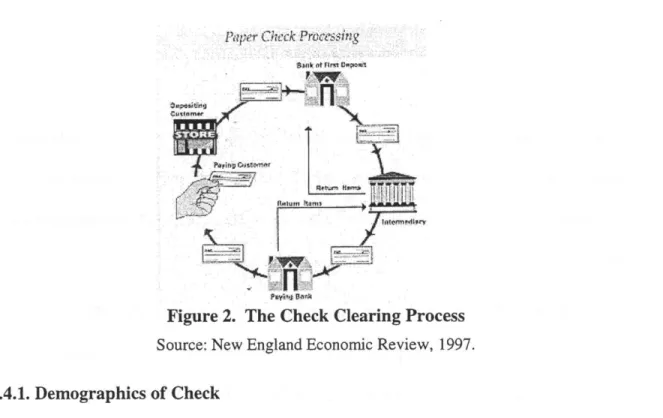
Currently, the process of clearing and settling checks is based almost entirely on physical presentment of the paper check to the paying bank, which then usually mails the canceled checks to its depositors with their monthly bank statements.
Each day at closing, bank sorts the inter-Bank checks it has received into separate piles corresponding to the subsequent collection process. The direct presentment checks are packaged for delivery via a prearranged air or ground transportation network.
Clearinghouse checks are bundled and delivered by messengers to the other members of the clearinghouse at a designated time each day. The remaining checks destined for intermediaries such as correspondent banks and Federal Reserve Banks for collection are deposited at the local branch of the appropriate institutions.
* Federal Reserve Banks: Checks deposited at the local branch of Federal Reserve Banks are sorted into the local paying banks and the nonlocal Federal Reserve Bank offices. Nonlocal checks are shipped to other Federal Reserve Bank offices around the country via the Federal Reserve's Interdistrict Transportation System (ITS), which is a network composed of private air and ground couriers that operate under contracts with the Federal Reserve to ship checks. After all the checks have been arrived at the proper Federal Reserve Branch and sorted, the Federal Reserve Bank office makes checks available for pickup or arranges to have them sent to the paying bank via a private courier.
* Correspondent Banks: Checks processed by correspondent banks are cleared in either one of the two ways: the checks can be sorted according to the individual paying banks, then presented directly to paying banks or at a clearinghouse. Checks can also be collected using additional intermediary. In this case, checks are sorted based on the requirements of the other intermediary. Correspondent banks arrange with private couriers to deliver checks to paying banks for presentment or to other intermediaries for collection.
Paper Chck Processing
Figure 2. The Check Clearing Process Source: New England Economic Review, 1997.
2.4.1. Demographics of Check & On-Us Checks
On - Us checks are checks written by the customer of a bank to another customer of the same bank. Upon presentation of the check, the bank can clear it within the bank's internal system. Approximately thirty to thirty-five percent of all checks are on-us checks and cleared in-house.
0 Inter-Bank Checks
The remaining checks are inter-bank, which are checks presented at a bank different then the paying bank. About forty -two to forty-five billion checks have to be transported and presented to the paying bank to obtain payment every year 26. There are many
methods of collection for inter-bank checks:
* Direct Presentment
Also known as bilateral correspondent arrangement, if the bank receives sufficiently large volumes of checks drawn on an individual paying bank, the two banks can establish a bilateral relationship, whereby each bank holds an account with the other. The collecting bank will ship the checks directly the paying bank. In 1996, about one-seventh of the inter-Bank checks were presented directly2 7. Each bank uses its own private air and
ground transportation couriers to present the checks
0 Clearing Houses
Payment system with multilateral net settlement usually operate through a clearing house, a central location through which the payment instructions pass and which is responsible for calculating the multilateral net positions of the member banks and passing them on to the central bank for posting to the members' settlement account.
Clearing houses may be owned and operated by the Federal Reserve or by the
commercial bank, or by a combination of the two. They may be designed to handle either paper or electronic/automated payment instructions. With electronic payments, the clearinghouse may process them in batches, or in real-time as each instruction arrives.
Clearing houses may be organized to serve the whole country, or on a regional basis within the country. The regional organizations are particularly useful in the countries with poor communications and transport infrastructure, or countries with large
geographical distribution.
There are over one hundred and fifty local and regional check clearinghouses and one national clearinghouse in the US. Participating banks typically establish operating rules
for the clearinghouse and agree to exchange checks with each other at a specified time at a designated location. In 1996, about one-fourth of inter-bank checks were exchanged at clearinghouses2
Central Bank
A
Paing. Bank A Clearing House Receiving Bank B
Figure 3. Role of the Clearing House Source: Bank of England
Third-Party Service Provider
26 Federal Reserve System. January 1998. 27 Federal Reserve System. January 1998.
Over sixty percent of all inter-bank checks are collected using intermediaries such as correspondent banks and Federal Reserve Banks. The earliest correspondent clearing network was the Suffolk System. The Suffolk Banking System, which operated during
1825 and 58 was a net-clearing system for commercial banknote organized and operated by Suffolk Bank of Boston. Suffolk required the banks for which it cleared notes to hold deposit balances with the Suffolk Bank2 9. Prior to the founding of Federal Reserve
System in 1914, interregional collection of checks and bank drafts was carried out mainly through correspondent bank networks. An out-of-town check deposited at a bank in one city might be sent to one or more correspondents of the receiving bank before being presented to the bank upon which the check was drawn. This system was widely deemed unsatisfactory because the time and expense of interregional clearing often seemed excessively high.
One of the important motives for establishing the Federal Reserve System was to
improve the efficiency of interregional payments. Toward this end, the Federal Reserve System also serves as an intermediary in check collection, serving primarily small banks in remote regions. In 1996, the Federal Reserve Banks collected about one-third of all
30
inter-Bank checks, and correspondent collected about a one-fourth of them
Banks determines how to collect the checks based on its processing capabilities, the price charged by various intermediaries, and the amount of time it takes the intermediary to provide access to funds collected from check deposits.
Check collection Volume (billions of Market Share (%) channel checks) Clearing house 10-11 23-24 Direct Presentment 6 14 Correspondent Banks 10-11 24-25 Bankers' Banks <1 1 Third-party Service <1 1 Provider
Federal Reserve Banks 16 35-37
Total 42-45 100
Table 3. Check Collection Market Source: Federal Reserve Bank. 2.4.2. Encoding/Proofing
Most banks maintained only a single center for check processing-related data/computer processing. Community and mid-sized banks typically have one capture site and one proof/encoding site, while larger institutions average two sites for each of these functions.
At small and mid-sized banks, about ninety percent of all encoding/proofing were performed at a central location with an average monthly volume of 99,000 checks3I. Regional and super-regional banks have encoding sites at several locations, and process on average thirteen million checks a month.
Power encoding, which are technologically enhanced encoding techniques such as image capture and image processing, is more likely to be employed by larger banks.
30 Rivlin, Alice. September 16, 1997.
Encoding/Proofing is a labor-intensive process. Banks employ a mix of full and part time personnel to staff the encoding operations. The number of staff ranges from two at small community banks to one hundred and twenty at the super-regionals. At the smaller banks, approximately half of the staff is full-time salaried, and the other half is paid on a permanent hourly basis with benefits. Proofing and encoding are extremely tedious and fatiguing tasks, as a result, there is significant and costly operator turnover rate. At larger banks, there are more part -time hourly workers, and the turnover rates range from thirty-two percent to forty-one percent, compared to twenty-one percent at the community banks32
2.5. Major Players
* Federal Reserve Bank
As mentioned before, one of the founding reasons for the Federal Reserve System was to improve the efficiency of payment system. To this end, the Federal Reserve System acts both as the regulatory authority, as well as an active provider of check clearing services.
Each Federal Reserve Bank offers a wide range of payment services to banks and other depository institutions in the inter-Bank market. These services include cash services, net settlement services, wholesale payment services, such as Fedwire funds and book-entry securities transfers, and retail services, such as check collection and the Automated Clearing House. In addition, the Federal Reserve serves as the fiscal agent and provides a range of payment services to the Treasury Department.
The check collection services offered by the Federal Reserve consists of the
processing and transportation of checks from those depository institutions wishing to collect funds associated with checks deposited by their customers. The Reserve Banks process and sort checks deposited by these "collecting banks" and transport them to "paying banks" (the depository institutions on which the checks are drawn) to initiate presentment. The Reserve Banks are capable of receiving from and presenting to all depository institutions throughout the United States. The Reserve Banks also handle checks that are dishonored by the paying bank for various reason, also known as return items, and provide a range of service to paying banks, such as early notification of checks that will be presented for payment later in the day. In 1996, the Federal Reserve accounted for about one-third of the estimated forty-five billion inter-Bank checks collected in the United States3.
* New York Clearing House (NYCH)
The New York Clearing House Association is the nation's first and largest bank clearing house. Established in 1853, its role was to establish order from confusion, to simplify the chaotic exchange and settlement process among the banks of New York City. Prior to the founding of the Federal Reserve, the New York Clearing House was also responsible for stabilizing currency fluctuation and the monetary system through recurring times of financial panic. With fifty-two member banks and twelve hundred users, daily average transaction of one-point-five billion dollars34, New York Clearing House is by far the largest clearinghouse in the United States. New York Clearing House leverages its prominence in the industry to push for technological
improvements such as the Clearing House Inter-Bank Payments System (CHIPS), introduced in 1970, an on-line, real-time payment system that transfers funds and settles transactions. Other technological innovative services include:
" New York Automated Clearing House (NYACH), an electronic funds transfer for small-dollar payments.
* Clearing House Electronic Check Clearing System (CHECCS), a system for electronic check presentment. It was established to reduce risk and improve the efficiency of check clearing, by speeding up the transfer of check information. * Private ACH Exchange (PAX) for nationwide ACH exchanges, to reduce risk and
costs for banks.
* Funds Availability Notification System (FANS), a shared regional database for fraud reduction.
2. 6. Looking forward: The changing landscape
The on going of consolidation in the banking industry has several significant impacts on the payment processing market. First, the consolidations can lead to the creation of nation-wide banking organizations. This means more organizations will need to develop the capabilities to process inter-regional " On-Us" checks. The absorption of medium size banks by large corporations will reduce the number of regional players, leaving community banks with fewer choices of check service providers in the future.
Furthermore, the decreasing need for inter-regional inter-bank check clearing will lead to the withdrawal of active correspondent banks, a scenario that has been reported in some local markets. Smaller depository institutions have also expressed concerns about the
continuity of check collection services provided by commercial providers, since these providers can choose to withdraw services at any time when facing decline in demand and revenue. These recent changes have lead many financial institutions, large and small, to re-examine their payment processing capabilities.
Chapter 3. Improvement Methods
3.1. Types of Improvements A. Reduce Process Time
The check settlement process is very time consuming. The process starts with the operators manually sorting, reading, and encoding each check at the site of deposit, transporting the checks from one point to another, to subsequent handling, inspection, and verification of each check. This lengthy process is inefficient and costly. There are several areas of possible improvement.
Sorting Time
At the back office, a high-speed high-volume reader/sorter can be employed to sort and handle checks. These machines will read the MICR encoded information on the check regarding paying bank, bank branch, and account number, then sort them into
corresponding piles for the next stage of settlement. The machines are faster than human operators, and free the operators from the tedious tasks of sorting and packaging.
Encoding Time
* Automatic Reading/Encoding: Bank employs a software algorithm that will read the courtesy amount and encode it in MICR at the bottom of the check along with the rest of the information. This will eliminate human operator encoding;
" MICR encoding at the teller station: When the customer presents the check to the teller for deposit, the teller keys in the amount on the check to credit the customer's account and prints the receipt for the customer. A peripheral device can
simultaneously take in the information and print the amount in MICR at the bottom of the check.
Transportation Time
Clearly, the most time consuming lag of the settlement process is the physical movement of the checks. Certainly, a well-organized and dedicated air and ground transportation team can reduce the time, but no matter how fast the plane flies or the truck drives, it is still limited by the constraints of physical capabilities. If the physical movement of the check can be eliminated, the process can speed up considerably. Settlement of the checks is really dependent on the relevant information captured on the paper, so the necessary information is the name of the paying bank, the branch of the paying bank, the payee's account number, and the amount on the check. The physical item of the check is
important only in the authentication process, where the signature of the check writer can be used to check for fraud. With the advent of technology, we are now capable of transmitting and receiving data electronically within a matter of nanoseconds,
irrespective of physical location and geographical boundaries. This change shows the greatest promise to drastically reduce the time of check settlement.
B. Decrease Cost
The check clearing process is extremely costly. It is estimated that banks with high customer check usage spend over fifty percent of the operation budget on the check clearing and support system35. This cost consists of operators' salaries and
compensations, machine purchase and maintenance, retaining private transportation crew or contracting out to private couriers, and fees to clearing houses or the Federal Reserve.
" Machine Sort: Using machines to sort and handle checks can greatly reduce the
number of operators, thus reduce the costs of salaries and benefits.
* Transportation: if the physical presentment of the checks can be eliminated, then there will be no need for the transportation network, crew, and private couriers, which will provide even more significant cost saving.
* Furthermore, the electronic settlement also reduces the need for operators in the downstream of the settlement process. More specifically, there will be no need for the operators at the clearinghouse or the paying bank to handle the checks, which will provide further cost reduction.
* Finally, if all banks have the capability to transfer check-clearing information multilaterally with each other, then there will be no need for clearinghouses or the Federal Reserve's payment services. The elimination of intermediaries will save the banks monthly and per-check service fees, and allow the Federal Reserve to concentrate on the task of monitoring the monetary policies of the country.
C. Increase Accuracy
Check reading and encoding is an extremely tedious and tiring job. Continuously reading the sometimes illegible script and keying in the amount for an extended amount of time can result in mistakes, especially under the time pressure as most banks have a tight window of settlement time. Misread checks are costly if not caught earlier on during the settling process, because they must be returned from the paying bank to the bank of deposit. To safeguard against costly mistakes, banks
sometimes have a second operator who proofreads all the inputs. Redundancy in system increases reliability, but at the same time also increases the cost. A possibility would be to build in this redundancy in the form of a feed back system in the
automatic reading algorithm mentioned above. This will not only eliminate the need for the proofreader but also protect the banks from costly mistakes.
3.2. Technology Available 3.2.1. MICR
Invented through a joint program of Stanford University and Bank of America, Magnetic Ink Character Recognition, commonly known as MICR, is the banking industry standard for machine processing checks.
This technology relies upon the interpretation of a unique magnetic waveform given off by characters printed with ink containing iron oxide. The character set adopted consists of four special symbols and ten digits. The characters are specially shaped to allow a single, wide, magnetic head (similar to those found in tape recorders) to pass over the character
and generate a unique electrical pattern for each character.
After MICR imprinted checks are received at the bank, they are first put onto a track and pass through a magnetic field. The magnetic ink of each character retains this magnetic charge, allowing the read head to determine the character type. This is similar to data
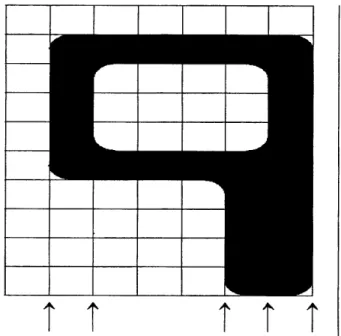
stored on a floppy disk, although less permanently. The reading is done based largely on character widths. The magnetic reading head generates a signal any time the amount of magnetic material under the head varies by a significant amount. Each character is contained in a one-eighth inch square box and is broken into imaginary cells as shown
below. Each character must be contained within these cells and must be printed with considerable precision to ensure that the reading equipment will read the information
36
correctly
Figure 4. MICR Symbol of Character "Nine" Source: MICR News and Information
3.2.2. High Speed Sorter
The two earliest mechanical sorters are A-Matic and Top Tap Key Sort. The Sort-A-Matic provided 100 metal or leather dividers numbered 00 through 99, each check to be sorted would then be placed into a corresponding divider based upon the first two numbers of the account. This process was then repeated for the next two digits of the account number, etc. and when completed the checks would be sorted.
Checks using Top Tabs Sort had small holes punched in the tabs to indicate the one's, ten's, and hundred's, etc. digits. By placing a long metal "key" through the holes in the
tabs, all the checks with a corresponding 100's, 200's, 300's, etc. could be pulled. Then this would be repeated for the 10's, 20's, etc., until all the checks were sorted. At the time, there was even a marketing controversy concerning whether the holes should be round or square. The square hole was the ultimate victor.
Both methods were effective but slow. The "punch card" style checks were developed to provide faster mechanic sorting. Although these were much improved, they were too costly to produce and unsuitable for the mass market because of the cost of punching the holes and the problem of damaged or obscured holes leading to a mis-sorting of the checks.
Fortunately, with the invention of MICR encoding came the MICR reader/sorters. They were faster and more equipped to handle the sixty-six billion checks written by
Americans each year. Currently there are two types of Reader/Sorters, Slot reader and Matrix Reader. The slot reader uses a wide magnetic read head as mentioned above. When the Slot reader encounters stray magnetic ink, dropouts in printing, or a badly formed character, it rejects the document. Furthermore, if the ink does not have enough magnetic material, the document will be rejected. This is an important fraud prevention feature to ensure fraudulent checks with an insufficient level of MICR content are ferreted out.
A rejected document must have a "repair strip" attached to it. It takes time to attach the strip and hand type the complete MICR line. The improperly MICR encoded checks are rejected by the reader/sorter and are sent back to the bank that presented the item. The
cost of re process can go as high as $2.75 per check3 7. The Federal Reserve Bank passes
the cost of processing reject items back to the bank that presented the reject item.
Matrix readers are much more expensive, cost in the million-dollar range, but are much better than a Slot reader. It reads the MICR character by breaking each character into a matrix of cells, as the figure shown on the previous page. This technology has sufficiently
advanced so that it can reliably read a 0 character with half of the 0 missing.
MICR readers/sorters are costly investments, and with the large volume of the checks that passed through banks each year, often a single reader/sorter per processing site is
insufficient. For small banks and financial institutions, it simply is not feasible to make such a large investment. As a peripheral to its payment services, the Federal Reserve also provides check sorting for smaller institutions. Responding to the need for clearing an increasing volume of inter-regional checks, the Federal Reserve recently unveiled a new program named Nationwide City Sort to promote the consistency and improve the check collection nationally. This new program will allow institutions to deposit with their local Federal Reserve office items drawn on institutions in any of the other 47 Federal Reserve cities, using a single cash letter. Financial institutions that perform in-house sorting will be able to reduce to a single reader-sorter pocket for all non-local Federal Reserve city items. Furthermore, they save on cash letter fees, since checks going to as many as 47 other Fed cities can be deposited in one cash letter.
All Federal Reserve offices offer Nationwide City Sort for a cash letter fee of $4.00, and a tiered per-item fee of $0.022 for low-cost destinations, and $0.032 for high-cost
38
destination
3.2.3. Check Imaging
There has been a heightened interest in the use of check imaging in the clearing process. Check imaging is the process of capturing the picture of a check electronically and
storing that image on a computer. The images can be captured using either a scanner or a camera. The digitized image of the check contains all the relevant information needed for item storage, research and retrieval, printing in response to customer requests, and check image statements. Images can be sent to financial institutions on a tape or CD-ROM, or transmitted to a PC or fax machine. Once the image of the check has been captured, no further handling of the paper check is necessary.
The most common application of imaging technology is the creation of image statements. Instead of returning physical checks, financial institutions can send monthly account statements along with copies of check images to their customers. Furthermore, there is commercial software for image statements available that allows for flexibility in the production and delivery of account statements. For example, the software typically allows account holders to choose the format of their own check image pages, the number of checks per page, fronts only or front and bank of checks, and to order checks by clearing date or by check number. This flexibility has the potential to increase customer satisfaction.