Automated Recycling Separation Enabled
by Soft Robotic Material Classification
The MIT Faculty has made this article openly available.
Please share
how this access benefits you. Your story matters.
Citation
Chin, Lillian et al. "Automated Recycling Separation Enabled by Soft
Robotic Material Classification." IEEE International Conference on
Soft Robotics, April 2019, Seoul, South Korea, Institute of Electrical
and Electronics Engineers, May 2019 © 2019 IEEE
As Published
http://dx.doi.org/10.1109/robosoft.2019.8722747
Publisher
Institute of Electrical and Electronics Engineers (IEEE)
Version
Author's final manuscript
Citable link
https://hdl.handle.net/1721.1/124001
Terms of Use
Creative Commons Attribution-Noncommercial-Share Alike
Automated Recycling Separation Enabled by Soft Robotic Material
Classification
Lillian Chin
1, Jeffrey Lipton
1,4, Michelle C. Yuen
2,3, Rebecca Kramer-Bottiglio
2, and Daniela Rus
1Abstract— Single-stream recycling is currently an extremely labor intensive process due to the need for manual object sorting. Soft robotics offers a natural solution as compliant robots require less computation to plan paths and grasp objects in a cluttered environment. However, most soft robots are not robust enough to handle the many sharp objects present in a recycling facility. In this work, we present a soft sensorized robotic gripper which is fully electrically driven and can detect the difference between paper, metal and plastic. By combining handed shearing auxetics with high deformation capacitive pressure and strain sensors, we present a new puncture resistant soft robotic gripper. Our materials classifier has 85% accuracy with a stationary gripper and 63% accuracy in a simulated recycling pipeline. This classifier works over a variety of objects, including those that would fool a purely vision-based system.
I. INTRODUCTION
Soft robotics has the potential to transform recycling through automated object sorting. Although environmental and sustainability concerns have made it crucial to scale up recycling operations, object sorting remains a critical bottleneck for recycling scalability. Failure to properly sort materials for recycling leads to waste; in the United States, 25% of all recycled materials are so contaminated they must be sent to landfills [1]. Single-stream recycling, while more convenient for the consumer, has a higher rate of contamination than presorted dual-stream recycling [2].
Although some recycling centers have automated sorting systems, such as eddy currents and magnets for metals [3], and visual inspection for plastics [4, 5], most facilities still employ large amounts of manual labor to grasp and sort objects that escape automation. This can lead to unsafe working conditions, especially in facilities where normal waste is mixed with recyclables.
Relying on a purely optical object sorting process also introduces inaccuracy since material type is not a visual property, but a tactile one. As a greater push is made for increased sustainability, durable versions of previously disposable items are increasingly more common and visually indistinguishable from the disposable versions. Metallic-looking plasticware or a reusable plastic coffee cup could
1 Computer Science and Artificial Intelligence Lab, Massachusetts
In-stitute of Technology, Cambridge, MA, USA. email: {ltchin,
jlipton, rus}@csail.mit.edu
2 School of Engineering and Applied Science, Yale University,
New Haven, CT, USA. email: {michelle.yuen,
rebecca.kramer}@yale.edu
3School of Mechanical Engineering, Purdue University, West Lafayette,
IN, USA.
4Mechanical Engineering Department, University of Washington, Seattle,
WA, USA.
Fig. 1. Demonstration of the soft robotic gripper holding a spiky pincushion, demonstrating its resistance to puncture and lacerations. Each finger of the soft robotic gripper is made of a pair of handed shearing auxetic cylinders and high-deformation capacitive pressure and strain sensors. The gripper can grasp objects and detect their base material without fear of sharp objects.
be difficult to distinguish purely from an image but straight-forward to detect when grasped. Thus, a robot which can grasp a wide variety of items and tactilely classify them as metal, plastic or paper would improve the purity of recycled materials, remove dangerous working conditions for people, and create a more sustainable economy.
Soft robotic grippers are a natural solution for automated recycling. In a recycling facility, it would be difficult to calculate a plan for a traditional rigid gripper to grasp the the distorted and damaged objects running past on a conveyor belt. However, with a complaint gripper that conforms to an object’s surface, the computational requirements to grasp an object are significantly reduced. Rather than scan an object, calculate directions and forces and precisely execute a plan, a soft gripper allows imprecise hardware and simple software to pick up a wide range of objects [6, 7].
Although traditional fluidic-driven soft grippers may be able to handle the variety and complexity of objects in a recycling center, their susceptibility to puncture makes them not robust enough for a recycling line. Given the many potentially sharp and jagged objects in a waste stream, a single scrape could damage the gripper and force the line to be stopped. Even without mechanical damage, repeated actuation can still lead to pressure-driven tearing and burst-ing of the internal walls [8]. Although self-healburst-ing fluidic actuators are being investigated, these methods either require significant time to heal or require specific geometries to
allow for fiber reinforcement [8, 9]. An electrically driven, non-inflated soft robotic gripper would avoid puncture issues entirely and be more appropriate for operation in harsh environments.
To address this need, we present a soft tactile-sensing gripper that is puncture resistant, capable of operating in dangerous environments, and can sort objects by material (Fig. 1). This gripper is built with handed shearing auextic (HSA) actuators and soft capacitive silicone pressure and strain sensors [10, 11]. This gripper has been demonstrated to accurately sense object size and stiffness [12], which we then extend to create a material-based classifier to sort objects as paper, plastic or metal. We characterize this classification algorithm and demonstrate its viability on a mock recycling setup, correctly classifying 27 objects with 85% accuracy with a stationary gripper and 63% accuracy on the recycling setup.
In this paper, we (1) demonstrate the functionality and puncture resistance of an electrically driven soft robotic gripper with integrated soft haptic feedback, (2) develop an algorithm to classify paper, plastic and metal objects based on sensed object stiffness and size, (3) use this algorithm with the gripper to sort through typical recycling objects, including pathological cases for a purely visual detector.
II. BACKGROUND
Single-stream recycling results in a considerable increase in adoption and set-outs for recycling over multi-stream recycling, but results in higher contamination rates of non-recyclable items [2, 13]. This forces recycling centers (mate-rial reclamation facilities or MRFs) to efficiently sort single-stream recycling. All MRFs require manual labor in the sorting process, whether to pre-screen the waste stream for a fully automated MRF or as the primary sorting force in a waste stream mixed with conventional trash.
Given a single waste stream, most MRFs use high mag-netic fields and eddy currents to separate out metals and near-infrared light with an air ejection system to sort specific plastics from one another. However, these processes will fail as soon as an object not within the expected dataset is fed through, such as metal-embedded plastics [14]. This forces human workers to serve as pick-and-place filters for a nominally fully-automated process . Research on recycling automation does not address this issue, instead focusing on separating increasingly similar materials from each other, such as paper grade and particle separation [15, 16].
While research specifically into robotic systems for recy-cling automation has been limited, research into soft robotic grippers with tactile sensing has been extensive in the last few years. Embedding strain and pressure sensors within soft grippers has become quite popular, relying on variations in resistance or capacitance to determine contact forces and length changes. These approaches range from off-the-shelf sensors to experimental materials such as liquid metal, conductive elastomers or fluidic ionic conductors [6, 17, 18]. Other soft sensors convert the tactile sensing problem into a vision problem, whether through optical waveguides or
by looking at the deformation of known patterns under controlled lighting [19–21]. Although all of these sensoriza-tion techniques have relied on puncture-susceptible fluidic actuation which is inappropriate for a recycling context, they provide an excellent guide for the design of our gripper.
III. SYSTEM DESIGN A. Actuators and Sensors
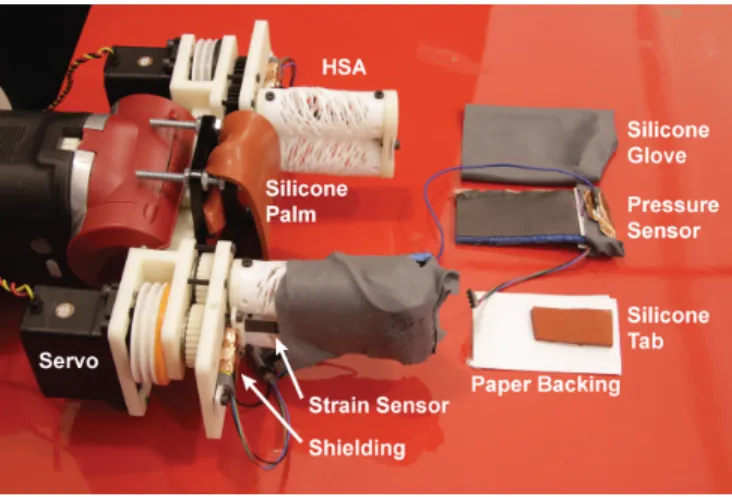
In order to have a soft robotic gripper that was resilient against puncture, we used handed shearing auxetics (HSAs) as the actuator basis (Fig. 2). Through their internal geomet-ric structure, HSAs tightly couple twisting with extension so that linear actuation can be achieved with a conventional motor [10]. Since HSA actuators are not fluidically driven and do not require a continuous surface to function, they are significantly faster, more efficient and more resistant to puncture than traditional fluidic actuators [11]. By pairing two HSAs with opposite handedness together and rotating them against each other, the pair will extend and contract as a single unit. If an internal constraint layer is placed within the pattern, out-of-plane bending can also be achieved.
Each finger in our gripper is made of a pair of HSA constrained cylinders, laser cut out of 60 mm long, 25.6 mm diameter PTFE tubes with a 1.58 mm wall thickness on a rotary engraver (PLS6.150D, Universal Laser Systems). The internal pattern was similar to the one used in [11], but with six base units around the circumference instead, giving a smaller bend radius and a more compliant gripper.
To match the resilience of the HSA actuators, we sen-sorized the gripper by adding high-deformation capacitive silicone strain and pressure sensors [22, 23]. By layering conductive silicone with dielectric foam or non-conductive silicones, a capacitor sensitive to mechanical deformations is created. As these sensors get stretched or pressed, the capacitance will change as the distance and area between the conductive layers changes. Since the sensors are primarily
Fig. 2. Overview of the soft robotic gripper. We remove the glove on the top finger to reveal the internal layers on the table. Each finger is made of a pair of handed shearing auxetics (HSAs) with contrasting chiralities. On the back of the fingers is a strain sensor, while the inside of the fingers has a pressure sensor. Silicone pads and gloves help increase contact, while a paper backing provides a surface for the pressure sensor to push against.
made of silicone and foam, they can match the high defor-mation of the HSAs without affecting the overall gripper’s performance. The sensors are also resilient to puncture; as long as the capacitive stack-up is maintained, a hole in a sensor will simply change the measured capacitance but not prevent the sensor as a whole from working.
The pressure sensors were a three-layer capacitive stack-up constructed with two conductive layers made from a silicone / expanded graphite composite and an internal dielectric foam layer made from silicone and sacrificial sugar pellets (Sug-lets, Colorcon). The strain sensors were a five-layer stack-up, adding an extra two layers of ground shielding and using a silicone elastomer for the dielectric layer (DragonSkin 10 Slow, Smooth-On). To measure the capacitance (and by proxy, the deformation), each sensor was attached to a signal conditioning board which charges the capacitor for a set time and reports how long discharge to a fixed voltage takes. B. Sensorized Gripper Integration
Mechanically integrating the actuators and sensors to form a gripper is a non-trivial task. Since the HSA-backbone of the gripper’s fingers are two counter-rotating Teflon surfaces, sensors cannot be placed directly on the actuators, leading to tricky integration concerns. The strain sensor was bolted along the outer curve of the fingers to the bottom and top finger caps, while the pressure sensor was mounted solely to the top finger cap along the finger’s inner curve. Both sensors were encased inside a silicone glove to reduce noise from the environment. The entire gripper was mounted to a Rethink Robotics Baxter robot via 3D-printed adapters. A silicone palm was placed in between the two fingers to help provide a third point of contact.
Although a similar soft gripper design was used in [11, 12], significant improvements were made in order to improve the sensitivity and resolution of readings for material classifi-cation, primarily for the pressure sensor. Previous designs relied on simply letting a neoprene foam liner or soft pressure sensor rest directly on the HSA actuators within the glove. This caused excessive noise due to close proximity to the servos and a lack of a stiff surface for the pressure sensors to press against.
To solve these problems, we needed to change the way the sensorized foam interacted with the HSA. Behind the foam, we placed a thin piece of paper with a silicone tab. These additions created a consistent backing for the sensors with a slight bulge at the tip, ensuring sufficient contact between the sensor and item being gripped. We further strengthened this contact by adding a slight opening to the silicone glove at the sensor bulge. This ensured that the sensor could consistently read the capacitance changes that came from contact with objects.
To address noise concerns from the increase in pressure sensor exposure, we shielded the sensor readout electronics with extra insulation and a grounding copper tape layer. This allowed us to use a more permissive filter on the sensor and increase the resolution of the sensor’s operating region. We also mounted the control electronics directly to the arm itself,
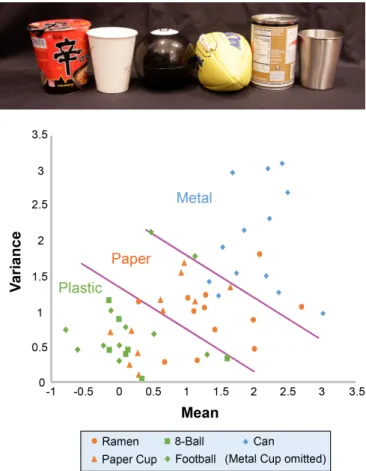
Fig. 3. Training objects used and a scatterplot of the two salient features over ten grasping tests for each object. The x-axis is the average of the two finger’s pressure readings, divided by the estimated object diameter. The y-axis is the difference of the two fingers’ pressure readings, divided by the estimated object diameter. These two features provided sufficient difference that the plane could be divided up into three regions corresponding to metal, paper and plastic. The datapoints for the metal cup were very large in both mean and variance, and were omitted in order to view detail.
creating a more self-contained package to reduce power rail interference.
C. Material Classifier
In order to extend our object size and stiffness measure-ments from [12] to apply to material properties, we would have to perform a more rigorous classification of compliance. Rather than simply perform a simple regression to map measured sensor values to compliance ratings, we use sensors in both fingers to create a more complex feature set that is more robust to variations between objects. We use traditional human-defined feature selection and linear discrimination to sort objects by material type.
For our classifier, we first calibrate the gripper’s sensors by going through an open / close sequence with no object in grasp. This gives us a baseline strain and pressure sensor reading that we can normalize against. Then, we estimate the size of the object. This size estimation is a simple linear regression determined by a set of training objects from [12]. This gives us a mapping between the fingers’ strain sensor readings to the size of the object.
pressure sensors. We then take the average and difference between the two sensor readings to give us a “mean” and “variance” features. We expect this “mean” and “variance” to vary between soft and stiff objects as softer objects have more give and will have more variance between the fingers as they push against each other, but a lower force required to hold the object. We also normalize these features against object size. As object size increases, we expect a larger area of deformation on the pressure sensor, resulting in a larger capacitive difference. We want to divide out this effect to ensure that different sized objects can be compared.
IV. EVALUATION A. Classifier Characterization
Using the “mean” and “variance” feature set outlined above, we take six objects, two of each material type, to calibrate our classifier (Fig. 3). We grasp each of the characterize objects ten times and plot the measured mean and variance on to a two-dimensional feature space, allowing us to hand-derive linear discriminating functions for material classification. Since there is some ambiguity around the boundaries of our discriminating functions, we verify our classifier is accurate by grasping assorted unseen objects with a stationary gripper (Fig. 5A and B).
Among the 14 objects used for testing, we found that our classifier correctly identified 85% of the objects. The objects that our classifier had difficulty with were for paper-covered metal tins. For both of these objects, our classifier returned ”paper”, suggesting that the coating may have provided enough insulation for our gripper to not properly identify the objects.
Although we explored other classification techniques such as k-nearest neighbors and support vector machines, the manual feature selection gave the best classification results. More specifically, for a stationary gripper, we achieved 85% accuracy with manual feature selection vs. 23% accuracy with nearest neighbors. This big difference in accuracy is probably due to the low number of datapoints from the characteristic object set and sensor information.
B. Recycling Task
To demonstrate the full capabilities of our gripper, we use the gripper in a simulation of a MRF recycling line. The goal of this demonstration is to take objects off of a conveyor belt and place them in the correct bin using a Baxter robot equipped with our gripper (Fig. 4). The conveyor belt moves objects towards Baxter’s workspace, stopping when the object crosses an IR break beam, which also signals to Baxter that the object is ready to grasp. Baxter will then grasp the object and classify the object as described in the classifier (Algo. 1).
A picture of all objects tested with can be seen in Fig. 5C. Over three tests, we averaged 63% accuracy in identifying the materials of our thirteen test objects, averaging one pick every six seconds. We correctly identified all metal objects, the paper cup and the plastic Starbucks cup across all three trials and had the most difficulty with paper objects. This is
Algorithm 1: Sorting Algorithm
Calibrate hand by recording sensor values upon open and close;
while True do
Items move along conveyor belt; if IR breakbeam is broken then
Conveyor stops;
Baxter moves to break beam location and grasps object;
Read strain / pressure sensors and normalize them based on calibrated open / close; Use linear regression on strain sensor values to
estimate size;
Calculate average and difference between pressure sensor readings, dividing by size; Sort via classifier to determine material type; Place object into appropriate bin;
end end
Fig. 4. Overview of the overall recycling test setup. Items come down the conveyor belt line until one hits the infrared break-beam, signaling the robot to grasp the object and sort it appropriately.
probably due to the close intermingling of paper and plastic objects from our characteristic objects’ feature space. The lower accuracy rate in the recycling task compared to the stationary task is probably due to sensors shifting as the recycled object is moved. This would cause our calibration to be off from what we expected, leading to more inaccurate predictions over time. The presence of the conveyor belt’s motor and large metallic body may also cause inaccurate readings as these may be a source of electromagnetic inter-ference.
C. Puncture Resistance
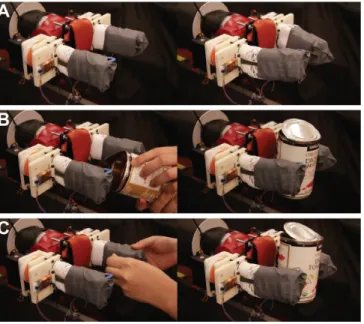
To test puncture resistance, major and minor puncture damage was performed on both a traditional silicone-based fluidic actuator and our gripper (Fig. 6). Minor damage was modeled by scraping the side of a freshly opened metal can against the finger’s internal curve, while major damage was
Fig. 5. Objects used to evaluate the classifier. (A) and (B) were used to test a stationary gripper, while (C) were objects used in the full recycling setup. The objects in (A) were successfully classified while the objects in (B) were unsuccessfully classified.
modeled by taking a 1 mm diameter pin and puncturing the gripper across the finger’s internal curve. Key functional areas for both grippers were prioritized for major damage (i.e. the internal bladder for the pneumatic gripper, sensor and struts for the HSA gripper), as for both grippers, there is a large amount of bulk material that will cause little effect when punctured. After each puncture/scrape, grippers were then qualitatively evaluated to see if they could still grasp as expected and if sensor data was as expected.
For both the fluidic actuator and our gripper, minor damage did not cause noticeable effects on the grippers. Even upon multiple (20) lacerations, only minor weakening occurred for both grippers and they were both able to grasp normally. For our gripper, only the silicone glove was affected, causing no impact to the sensor or HSA actuators. The gripper was thus still able to identify the can as metal. For major damage, the fluidic actuator failed after a single puncture. For the HSA gripper, even after 20 punctures, the most damage that occurred was to the outside silicone glove. The stiffness of the PTFE made it difficult to puncture through the struts of the HSAs, while the sensor was just perforated with minimal effect.
V. CONCLUSIONS AND FUTURE WORK We have shown a soft robotic gripper that can be used to sort recyclables. To accomplish this, we built a gripper that is puncture resistant with on-board tactile sensing. By integrating the electrically driven and robust HSA actuators with proprioceptive strain and pressure sensors, we were able to satisfy these design requirements and create a classifier that could identify metal, plastic and paper objects.
Fig. 6. Qualitative evaluation of gripper performance under (A) normal conditions, (B) minor damage due to incidental lacerations, and (C) major damage for our soft gripper due to intentional puncture with a pin. Gripper functionality is unaffected in all cases, even after repeated damage.
In order to make this system robust enough for deployment to MRFs or other recycling facilities, further work is needed to strengthen the classifier and the system overall. To improve classifier accuracy, incorporating more sensors, especially along the contact surface, could provide more information to use more advanced classification algorithms. In particular, greater contact resolution would allow the classifier to get a better understanding of the overall geometry of the object beyond just the size. On a system level, this gripper system will need to be incorporated with vision-based technologies to improve accuracy and allow picking in cluttered envi-ronments. Integration with vision would also allow future systems to have a wider range of detectable objects, including glass and non-recyclable materials.
Despite the preliminary nature of our work, this soft robotic gripper offers great potential for improving recy-cling efficiency. Although the classifier is not perfect in performance, any improvement to upstream sorting can have significant quality improvements downstream. Furthermore, given the compact nature of our system, it may be possible to deploy it further upstream than MRFs, allowing large commercial and residential buildings to presort their personal single stream waste and reduce contamination rates. Either way, it is clear that soft robotics can help improve recycling and build a more sustainable economy.
ACKNOWLEDGMENTS
This work was completed with support from Amazon, JD, the Toyota Research Institute (TRI), and the National Science Foundation, grant #1830901. LC was supported under the National Science Foundation Graduate Research Fellowship grant #1122374, the Paul & Daisy Soros Fellowship for New Americans, and the Fannie and John Hertz Foundation. MCY
was supported by the Laura Winkelman Davidson Fellowship from Purdue University and a NASA STTR Phase II contract (80NSSC17C0030). This article solely reflects the opinions and conclusions of its authors and not that of its sponsors. The authors would like to thank Shuguang Li for help with figure design.
REFERENCES
[1] L. Albeck-Ripka, “Your recycling gets recycled, right? maybe, or maybe not,” New York Times, May 2018. [Online]. Avail-able: https://www.nytimes.com/2018/05/29/climate/recycling-landfills-plastic-papers.html
[2] C. Morawski, “Single stream uncovered,” Resource Recycling, pp. 21– 25, 2010.
[3] E. J. Sommer Jr and G. R. Kenny, “Electromagnetic eddy current materials separator apparatus and method,” Jan. 17 1978, uS Patent 4,069,145.
[4] D. Cowling and P. N. Randall, “Apparatus for, and method of, classifying objects in a waste stream,” Nov. 11 2008, uS Patent 7,449,655.
[5] E. J. Sommer Jr, M. A. Kittel, and R. A. Quarles, “Automated glass and plastic refuse sorter,” Sept. 17 1996, uS Patent 5,555,984. [6] J. Shintake, V. Cacucciolo, D. Floreano, and H. Shea, “Soft robotic
grippers,” Advanced Materials, p. 1707035, 2018.
[7] D. Rus and M. T. Tolley, “Design, fabrication and control of soft robots,” Nature, vol. 521, no. 7553, p. 467, 2015.
[8] R. F. Shepherd, A. A. Stokes, R. M. D. Nunes, and G. M. Whitesides, “Soft Machines That are Resistant to Puncture and That Self Seal,” Advanced Materials, vol. 25, no. 46, pp. 6709–6713, Dec. 2013. [9] T. J. Wallin, J. H. Pikul, S. Bodkhe, B. N. Peele, B. C. M. Murray,
D. Therriault, B. W. McEnerney, R. P. Dillon, E. P. Giannelis, and R. F. Shepherd, “Click chemistry stereolithography for soft robots that self-heal,” Journal of Materials Chemistry B, vol. 5, no. 31, pp. 6249– 6255, 2017.
[10] J. I. Lipton, R. MacCurdy, Z. Manchester, L. Chin, D. Cellucci, and D. Rus, “Handedness in shearing auxetics creates rigid and compliant structures,” Science, vol. 360, no. 6389, pp. 632–635, 2018. [11] L. Chin, J. Lipton, R. MacCurdy, J. Romanishin, C. Sharma, and
D. Rus, “Compliant electric actuators based on handed shearing auxetics,” in 2018 IEEE International Conference on Soft Robotics (RoboSoft). IEEE, 2018, pp. 100–107.
[12] L. Chin, M. C. Yuen, J. Lipton, L. H. Trueba, R. Kramer-Bottiglio, and D. Rus, “A simple electric soft robotic gripper with high-deformation haptic feedback,” International Conference on Robotics and Automation (In Press). IEEE, 2019.
[13] D. J. Tonjes, O. Aphale, L. Clark, and K. L. Thyberg, “Conversion from dual stream to single stream recycling results in nuanced effects on revenues and waste stream amounts and composition,” Resources, Conservation and Recycling, vol. 138, pp. 151–159, Nov. 2018. [14] B. K. Reck and T. E. Graedel, “Challenges in metal recycling,”
Science, vol. 337, no. 6095, pp. 690–695, 2012.
[15] S. Faibish, H. Bacakoglu, and A. A. Goldenberg, “An eye-hand system for automated paper recycling,” in Robotics and Automation, 1997. Proceedings., 1997 IEEE International Conference on, vol. 1. IEEE, 1997, pp. 9–14.
[16] F. Pfaff, G. Kurz, C. Pieper, G. Maier, B. Noack, H. Kruggel-Emden, R. Gruna, U. D. Hanebeck, S. Wirtz, V. Scherer, et al., “Improving multitarget tracking using orientation estimates for sorting bulk materials,” in Multisensor Fusion and Integration for Intelligent Systems (MFI), 2017 IEEE International Conference on. IEEE, 2017, pp. 553–558.
[17] R. L. Truby, M. Wehner, A. K. Grosskopf, D. M. Vogt, S. G. Uzel, R. J. Wood, and J. A. Lewis, “Soft somatosensitive actuators via embedded 3d printing,” Advanced Materials, vol. 30, no. 15, p. 1706383, 2018. [18] B. S. Homberg, R. K. Katzschmann, M. R. Dogar, and D. Rus, “Haptic identification of objects using a modular soft robotic gripper,” in Intelligent Robots and Systems (IROS), 2015 IEEE/RSJ International Conference On. IEEE, 2015, pp. 1698–1705.
[19] C. Chorley, C. Melhuish, T. Pipe, and J. Rossiter, “Development of a tactile sensor based on biologically inspired edge encoding,” in Advanced Robotics, 2009. ICAR 2009. International Conference on. IEEE, 2009, pp. 1–6.
[20] E. Donlon, S. Dong, M. Liu, J. Li, E. Adelson, and A. Rodriguez, “Gelslim: A high-resolution, compact, robust, and calibrated tactile-sensing finger,” arXiv preprint arXiv:1803.00628, 2018.
[21] H. Zhao, K. OBrien, S. Li, and R. F. Shepherd, “Optoelectronically innervated soft prosthetic hand via stretchable optical waveguides,” Science Robotics, vol. 1, no. 1, p. eaai7529, 2016.
[22] E. L. White, M. C. Yuen, J. C. Case, and R. K. Kramer, “Low-Cost, Facile, and Scalable Manufacturing of Capacitive Sensors for Soft Systems,” Advanced Materials Technologies, vol. 2, no. 9, p. 1700072, Sept. 2017.
[23] M. C. S. Yuen, T. R. Lear, H. Tonoyan, M. Telleria, and R. Kramer-Bottiglio, “Toward Closed-Loop Control of Pneumatic Grippers Dur-ing Pack-and-Deploy Operations,” IEEE Robotics and Automation Letters, vol. 3, no. 3, pp. 1402–1409, July 2018.