HAL Id: hal-00521969
https://hal.archives-ouvertes.fr/hal-00521969
Submitted on 29 Sep 2010
HAL is a multi-disciplinary open access
archive for the deposit and dissemination of sci-entific research documents, whether they are pub-lished or not. The documents may come from teaching and research institutions in France or abroad, or from public or private research centers.
L’archive ouverte pluridisciplinaire HAL, est destinée au dépôt et à la diffusion de documents scientifiques de niveau recherche, publiés ou non, émanant des établissements d’enseignement et de recherche français ou étrangers, des laboratoires publics ou privés.
PROCESS AS AN INTERFACE BETWEEN
EXCHANGE MARKETING AND RECIPROCITY
Eric Sabourin
To cite this version:
Eric Sabourin. AGRI-FOOD QUALIFICATION & CERTIFICATION PROCESS AS AN INTER-FACE BETWEEN EXCHANGE MARKETING AND RECIPROCITY. ISDA 2010, Jun 2010, Mont-pellier, France. 11 p. �hal-00521969�
A
GRI
-
FOOD QUALIFICATION
&
CERTIFICATION PROCESS
AS AN INTERFACE BETWEEN EXCHANGE MARKETING
AND RECIPROCITY
Eric SABOURIN
* UR Arena, 73 Rue J F Breton Cirad
Montpellier 5
Abstract — This paper mobilizes the theory of reciprocity to analyze family farm product qualification process
effects in Brazil. All qualification processes that guarantee the origin, the specificity, the quality process or the standards of a product, may contribute to reduce the effects of competition and speculation, which are distinctive of the capitalist exchange. My hypothesis is that a qualification process can contribute to establish a binary symmetrical relation of reciprocity between producer and buyer. It can also contribute to generate a sharing structure (of quality) among the group of producers. However, apart from this group of qualified producers and also for the marketing of other products which are not quality, it is the rules of the capitalistic exchange market that apply. So, qualification and certification could also induce exclusion. That is why; one has to resort to some kind of interface: that of the certification mechanism, which makes it possible to reintroduce a dimension of reciprocity into the capitalist exchange market system. The paper presents, in the case of Brazil, various initiatives of setting up such co-certification, group certification or participative certification systems.
Key words: Agri-food qualification, certification systems, reciprocity, marketing exchange, Brazil
Les processus de qualification et certification des produits agricoles comme
interface entre échange marchand et réciprocité
Résumé — Ce texte mobilise la théorie de la réciprocité en anthropologie économique pour analyser les
processus de qualification des produits de l’agriculture familiale au Brésil. Tout processus de qualification qui garantit l’origine, la spécificité, la qualité d’un produit peut réduire les effets de concurrence et de spéculation spécifiques à l’échange capitaliste. Je fais l’hypothèse que les processus de qualification peuvent contribuer à établir une relation de réciprocité symétrique entre producteur et consommateur. Ils peuvent également concourir à engendrer une structure de partage (de la qualité) au sein d’un groupe de producteurs. Mais, les mécanismes de qualification et certification peuvent également introduire l’exclusion, car en dehors du groupe et des produits certifiés ce sont les lois de l’échange qui régulent le marché. C’est pourquoi on a besoin d’une forme d’interface ou d’articulation entre production et marché. L’interface offerte par les mécanismes de certification de la qualification permet de réintroduire la dimension de la réciprocité économique dans le système du marché d’échange capitaliste. Ce texte repose sur la comparaison de trois systèmes de certification de produits agro-écologiques au Brésil : la certification externe de groupes, la certification participative et la co-certification.
INTRODUCTION
This paper mobilizes the theory of reciprocity in economic anthropology to analyze family farm product qualification process effects in Brazil. All qualification processes guaranteeing the origin, the specificity, the quality process or the standards of a product, may reduce the effects of competition and speculation, which are distinctive of the capitalist exchange. The hypothesis is that a qualification process can contribute to establish a symmetrical relation of reciprocity between producer and buyer. It can also contribute to generate a sharing structure (of quality) among the group of producers. When the producer's name is at stake, reciprocity relationships generate values of trust, reputation, honor and accountability. These ethical values guarantee the legitimacy and the authority of the certification process of quality and origin standards. In fact, it thus creates a territoriality of reciprocity around a specific product.However, apart from this group of qualified producers and also for the marketing of other products which are not quality-labeled, it is the rules of the capitalistic exchange market that apply. Qualification and certification could also induce exclusion. That is why, in this type of process, there has to be some sort of interface between production and the market. The quality certification mechanism reintroduces a dimension of reciprocity (the domestic unit, the peasant community, the co-operative) into the capitalist exchange market system.
For this, the certification process should not be, by its cost or its modalities a factor of social or economic exclusion. It does not exclude producer’s access to qualification for financial reasons or exclude consumers through its effects increasing the product.
This work is based on a comparative study of several experiences of quality certification for family farming agro-ecological products Brazil, around three different mechanisms: External Audit Certification (EAC), Network Participative Certification (NPC) and mutual co-certification.
There are three main chapters: 1) The theoretical frame and context; 2) Case studies and results; 3) Discussion, lessons and perspectives.
COMMERCIALIZATION AND THEORY OF RECIPROCITY
Selling farm products is not just a matter of capitalistic exchange. Although it is now the norm for many of the small and family farms of Brazil (Conterato, 2004 ; Ploeg, 2008), one still sees socially controlled markets which also abide by the rules of reciprocity and redistribution to use the different economic services as defined by Polanyi (1957). In Brazil, as a result of direct relations between producers and consumers, local trade fairs and weekly markets generate social ties calling upon sociability and reciprocity.
What is meant by reciprocity here is the dynamic of service reproduction, which leads to the development of social ties, as identified by Mauss (1924).
Temple (2003) defined reciprocity as the repeating of an action or a service in such a way that people may recognize one another and feels they belong to a community.
From an anthropological angle, the theory of reciprocity corresponds therefore to a reflective action occurring between individuals, or an inter-subjective relation and not merely the swapping of goods and objects like in the case of an exchange. Two elements of the theory of reciprocity are particularly mobilized for this study:
1. Reciprocity principle is more than a mere gift/counter-gift relationship between peers or symmetrical social groups. The reductionism of this definition, which prevailed for a long time
and still prevails sometimes in anthropology, leads to confusing the notions of symmetric exchange and reciprocity. This error persists so long as reciprocity is interpreted following the binary logic of exchange. Exchange is merely a swapping of objects. With Temple and Chabal (1995) the theory of ternary logic (Lupasco) allows for the appearance of a third party in the relationship of reciprocity. This third party can be interpreted as the being of the
relationship or the very structure of inter-subjectivity, which is irreducible for the exchange of goods or services since it does away with the social tie or debt. Economically speaking, reciprocity therefore, is not only an economic category that differs from the capitalist exchange as identified by Polanyi (1957), but an economic principle in contrast and even antagonistic with exchange.
2. The reciprocity relationships can be analyzed in structural terms, and declined according
to a few elementary structures (Temple 1998).
In their symmetrical form, these structured relationships of reciprocity give birth to ethical values: a symmetrical bilateral structure produces a feeling of friendship and the symmetrical distribution structure of goods within a group gives rise to justice.
This is clearly the most complex point in the theory of reciprocity as put forward by Temple and Chabal (1995). It is also the most difficult to validate, since it involves not only the production of materialistic goods but also that of feelings and human values. It is, however, a key point that paves the way for analyses and alternative proposals in the field of human economy.
When it comes to marketing farm products, peasants or their organizations have set up several types of interfaces allowing for a coexistence and connection between reciprocity and exchange practices. The first interface is direct selling which involves the meeting of a producer and a consumer. In this case, there is of course an exchange relationship, but the direct contact between the producer and the buyer triggers a binary relationship of reciprocity. Here we have a one-to-one relationship that leads to emotional values such as friendship, mutual recognition or to ethical values of loyalty and respect.
This is also true for the short food-chains socially managed by producers’ associations or consumer co-operatives1. One could also call to mind the case of the peasant markets and “peasant’s baskets” in France that are managed by associations including both farmers and consumers.
All these direct contact situations give rise to human relations, conversations and explanations about products, work, techniques, tricks, etc.. They also give rise to feelings and values of friendship, loyalty and trust between producers and consumers.
When a direct relationship is not possible, one possible alternative is to call upon the qualified and interpersonal intermediation of a broker. The broker can establish a ternary relationship of reciprocity through co-knowledge, a network effect and information as to the quality of the product and the producer. A structure of this type produces trust, accountability and reputation (of both the producer and the broker), which in turn produce prestige.
Mechanisms used for product qualification can also enable an articulation between reciprocity and marketing exchange. Product qualification policy or instrument (quality-label or appellation) reduces the effects of competition and speculation following the logic of the capitalistic exchange and helps in the building of territories of reciprocity.
When the name of a producer, his locality or social or professional group is at stake, one is indeed confronted with reciprocity relationships which give rise to values in connection with reputation, honor and accountability. These values trigger the production of quality and a commercial cycle for these so-called “qualified” products.
It is therefore these ethical values that guarantee the legitimacy and authority of the certification process establishing the standards of quality and origin. Capitalist businesses have, for that matter, identified the importance of these values (reputation, trust, social accountability) and converted them into marketing objects via the privatization of standard quality control services. Above all, however, and especially in the case of farm food products,
1
the real economic sanction comes from the consumer himself. Moreover, the guarantee of quality (organic for example) is often inherent to the production itself. There is absolutely no reason a priori why any farmer who has engaged in the process of converting to agro-ecological farming methods, be it for ethical reasons (produce healthy products, land preservation) or materialistic reasons (added value), should attempt to fraud or decide to go back to the way he was farming before.
The key to the interface is a matter of trust between the consumer and the producer, between producers themselves, or between producers and middlemen.
It is this question as to the credibility of a product’s quality that has to be validated and go through a checking process known as certification.
My hypothesis is that the certification mechanism itself is no neutral technological datum. On the contrary, it is a social construction based, before any other consideration, much more on human trust than on the fact that the product is in compliance with production processes or technological standards.
These facts have already been identified by the Conventions economy (Dupuy, 1989; Eymard Duvernay, 1995; Valeschini, 1995) and confirmed by the presence of participative certification procedures based more on the validation of social compliance than on technological compliance.
These approaches, however, do not push the logic of producing social and ethical values right through. Indeed, it would be logical, in the case of farm and health food products, if it led to co-certification or to putting an end to the external marketing certification process.
In Brazil, various co-certification and participative certification systems have been set up between producers or between producers and consumers (Medaets & Medeiros, 2004). These alternatives are due to the development of local agro-ecological markets and to the effects of reputation. The second part of this paper is a comparative analysis of three certification systems (External Audit Certification-EAC, Network Participative Certification – NPC and co-certification) in which the advantages and limitations of centripetal and decentralized certification are highlighted.
THREE CASE STUDIES IN BRAZIL
In the three cases, we are talking about family farmers producing and marketing their own agro-ecological production. In Amazonia (Mato Grosso State), the system is a co-operative of agro-ecological products aimed for the export and domestic market. In the South (Santa Catarina State), the aim is for the produce to be marketed through the standard marketing channels of the capitalistic exchange (supermarkets, specialty stores), or even exported. In the Nordeste, the produce is marketed via direct selling on local markets in several towns in the state of Paraiba.
Group certification by way of external audit (Cooperagrepa MT & Ecocert)
The Cooperagrepa organic farmers’ co-operative (300 member families) at Terra Nova do Norte (Mato Grosso State), has been producing guarana, Brazilian nuts, brown sugar, coffee and honey since 2003. The certification process at this co-operative is carried out by the private firm Ecocert Brazil (Whyte, 2002). The group contract has been signed for 50 farms by Ecocert who requires at least 30 farmers for this modality.
Ecocert performs the external audit on the basis of samples taken from the farms (10 on average each year). Internal inspections are completed by an agronomist from Cooperagrepa who is responsible for all recordings and documents for each farm between two visits of the Ecocert inspectors.
The costs of the external audit are too high for the smaller members of Cooperagrepa. The co-operative is receiving funds from SEBRAE (Brazilian Support for Small Businesses Unit)
for 5 years. The entire cost of the audit is covered by the funds received from SEBRAE for the first three years, and 50% for the other two years. In 2009, the cost of the audits will amount to 700 reais (R$) per farm (350R$ charged to the producer). The money is deposited by SEBRAE and the farmer prior to the Ecocert’s visit and the certificate is supplied following payment. The larger the group, the lower the individual cost. The cost of an individual Ecocert certification system is 1,000R$/year. Checking that the farm is in compliance is largely a technical process. The group of producers goes through a transition period during which it must perform the required recordings in relation the requirements established by the production model. At the end of this period, the certification organization checks that the group is in compliance, a procedure which involves inspecting all the farms within the group and performing laboratory tests on a series of randomly collected samples.
The decision or not to award certification is not taken by the individuals who carried out the inspections, but by other members of the certification organization. Thus, in accordance with ISO specifications, there is a separation between the inspection itself and the certification process. All recordings are retained by the certification organization. Technicians are sent out to check up on the farms and specially trained for inspection procedures. Recruitment of these inspectors is subject to a number of criteria that reduce the possibility of there being any other type of relationship between the inspector and the person being inspected.
ECOVIDA agro-ecological network
ECOVIDA Agroecologia network was founded in 1998 in the state of Santa Catarina to promote agro-ecology, convey information between its members, create legitimate methods for the production of credibility and provide a guarantee of techniques used by its members” (ECOVIDA, 2002). The network covers the states of Santa Catarina, Paraná, Rio Grande do Sul and São Paulo and includes over 120 organizations and collective farmer systems (formal and informal groups, associations and producer and consumer co-operatives) and 23 support entities directly affecting approximately 1,500 families.
Several international standards, such as IFOAM/IOAS grower groups (Ifoam, 2009), the EEC Rule nº 2.092/91 or the MAPA nº 6 standard of the Brazilian Ministry of Agriculture dating from 2002 pave the way for certification among organized groups of producers (Brazil, Mapa, 2002). These standards help in establishing group profiles and the conditions of their certification, the idea being to increase the opportunities for access to this service in so far as the mechanism considerably reduces certification costs.
The ECOVIDA network has adopted Network Participative Certification (NPC) in several of these groups.
According to Trujilo Ferrari (1983), “compliance” represents the “alteration or change in the behavior and beliefs of an individual or a group, in a direction established by a larger group”. Any alteration involves a process of positive, negative and neutral sanctions. Thus, in the case of NPC, a serious investment is required on behalf of the individuals involved in the system if they want to attain “social compliance”. Evaluation of social compliance differs from technological compliance in three ways: it is carried out on the basis of the outcome of meetings and committees where systemic observation and the pooling of information are devoid of a technological profile; the compliance requirements refer to social conditions and the implementing social factors thereof but do not refer to production techniques. Certification is granted (or not) by technicians who have trained in agro-ecology and not by experts who have been trained to carry out inspection/audits.
The ethical committee’s “visits” constitute the second quality control check. Technicians, farmers and sometimes consumers who pay these visits to the production units come from an external environment. The third quality control check is carried out after completion of peers’ reviewing within the frame of the core of the network or group. It is at this point in the process that the certification decisions are made.
Agro-ecological markets in the Paraiba
In the state of Paraiba in the Nordeste of Brazil, markets selling agro-ecological products2 of Lagoa Seca, Massaranduba & Campina Grande, fit into the strategy of the Polo Sindical of Borborema (PSB a regional peasant trade union federation), which is to increase the autonomy of family farms in relation to conventional channels over which they have no control. The target consumer has a low income and the prices on these markets are no different from the prices of the same standard products on the other markets of the region. The prices are also lower than the same conventional products in the supermarkets.
The PSB initiative has led a group of farmers to come together via the founding of an association and adopt product control guaranteeing both quality and origin.
Farmers from the agro-ecological groups are commissioned to pay regular visits to each producer and check his culture processes, technical patterns and the nature of inputs used. Each farmer may find himself switching from evaluating to being evaluated. The risk of fraud is negligible since the main goal for all concerned is to patronize customers, and this means not cheating on the quality of the products on sale.
This system of mutual (or reciprocal) certification has the great advantage of being free of charge, not increasing production costs and not engaging farmers with certification firms. In the co-certification process, quality control becomes an inherent part of the production structure so long as it finds itself repositioned in a system of reciprocity.
These markets work well thanks to the involvement of a few families who ensure that the rules are being respected. The other participants, who are ideologically less involved, are simply opportunistic about the system. Their interest in agro-ecology is essentially related to the emergence of consumer demand and access to a marketing channel that pays more for their work than selling wholesale. Agro-ecological markets are not simply due to the changing of farming techniques or public organization incentives. The reason of their success lies in their qualified and established (and therefore collective and institutionalized) response to consumer demand for quality products devoid of pesticides.
DISCUSSION, LESSONS AND PERSPECTIVES
Comparative analysis of the three experiences
Analysis of the three certification systems presented focuses on practices, the type of relationships they correspond to, results and the nature of mobilized or engendered values. Each of the studied systems can be treated as a logic as well as a specific language.
EAC is based on a high and (perhaps excessively) stringent registration level and external inspections. The aim of these external inspections is to reduce the risk of opportunism, by centralizing the certification decision which is taken on the basis of the inspection documentation forms supplied by the certifier.
It has been pointed out by the EEC (2002) that these EAC certification modalities do not distinguish between big agro-industrial businesses and small family or peasant type farms. Thus, the fact that inspection standards and the amount of effort to conform are the same for all, regardless of the size of the enterprise, often leads to operations that are unnecessary
2
Family farmers direct selling markets of agro-ecological products (type of basically organic ecological farming with no chemical inputs).
and unsuitable for the small farmers. This criticism also applies to the sampling criteria, tests and analyses, recording procedures of inputs and sales, etc…. These procedures, which have all been “globalized” as a result of ISO specifications and guides, are not in keeping with the specificities of local, rural environments or the potential of local co-operative relationships and reciprocity in terms of developing credibility. Moreover, these certification systems, which are undertaken by a private enterprise, increase costs and limit access to certification for small, family and peasant farms. Lastly, and amongst other things, because of the financial requirements and the amount of documents that has to be supplied, the privately managed certification system is not very efficient at qualifying family farms. This matter, however, cannot be ignored since in Brazil agro-ecological and organic food product markets must comply with a procedure that involves being granted certification for the production of organic foods (Brazil, Mapa 2002).
NPC and mutual co-certification are based on “social compliance” to a mutual objective of a quality culture system and transformation/packaging process of the product and both formal and informal agreements made to reach this objective. The decentralized (or participative) certification decision gives rise to an exclusion mechanism when it is established that the agreements that were made within the group have not been respected; consumers (a minima one consultation) are also enlisted in the certification decision.
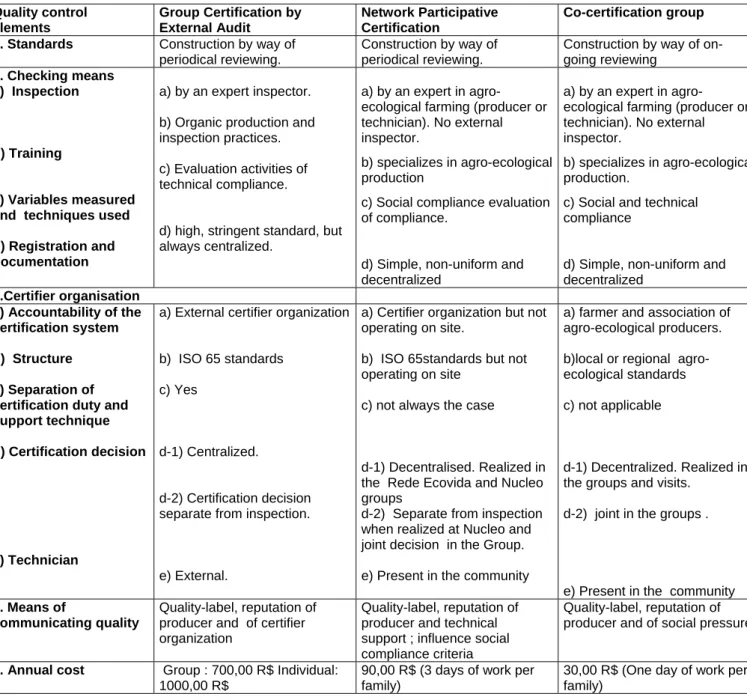
Group Certifications aims at a degree of excellence as regards inspections and recommendations in connection with standards for the export market. The decision depends on a collection of data and documents revealing the traceability of the inspected product. The social compliance system advocated by NPC is dependent on visits and reviewing undertaken by peers. These two distinctive operations vary according to a number of criteria or objectives that are less numerous and stringent than enforced in the case of certification by an external audit (table 1).
For the EAC Ecocert type, the evaluation (inspection) is carried out be an inspector and a centralized certification decision is taken by a council held within the certifier organization. The Associação de Certificação Participativa of the Ecovida network does this job thanks to the evaluations and ethical advice given by the local Groups (called nucleos). In the case of Paraiba, it is the agro-ecological producers’ association that ensures standards are met, via meetings and technical visits to the farms. The role of consumer pressure and mutual knowledge have a considerable impact in the Paraiba region and sometimes also within the Ecovida network. In both cases, the certification decision is decentralized and taken by actors who are involved in the production process. There is no separation between the roles of inspection and certification. In the case of the nucleos, on the contrary, the two roles are separated.
In the case of NPC, there is no external inspector, but the visits are ensured by farmers and technicians who have been trained in agro-ecology and are qualified to check compliance to the standards as specified by the Ecovida network (table 1)
The fact that the documentation required by NPC is less complicated than that of EAC doesn’t necessarily mean that the quality of the inspection should be questioned. Moreover, the decentralized and participative nature of NPC ensures the producers’ competence, not only in terms of their knowledge of standards and quality control, but also in terms of the management and accounting of their operations (Medaets & Medeiros, 2004)
In the NPC system, meetings gathering the Groups’ families, the intensity of the mutual exchange of information, the establishing of reputation among peers and the exclusion of all those who do not abide by the signed agreements are all factors contributing in the construction of a “social compliance”. This social compliance is the fruit of a social pressure that finds its source within the group. It is motivated by shared values and shared social and materialistic interests. In the case of the markets of Paraiba, where the documentation
required for auto-certification process is even simpler, one may argue the intensity of oral exchanges.
These exchanges are a source of mutual information and social pressure, factors that contribute in the construction of the producer and product’s reputation.
Table 1 Comparing of quality control modalities
Quality control elements Group Certification by External Audit Network Participative Certification Co-certification group1. Standards Construction by way of periodical reviewing.
Construction by way of periodical reviewing.
Construction by way of on-going reviewing
2. Checking means a) Inspection
b) Training
c) Variables measured and techniques used
d) Registration and documentation
a) by an expert inspector. b) Organic production and inspection practices. c) Evaluation activities of technical compliance.
d) high, stringent standard, but always centralized.
a) by an expert in agro-ecological farming (producer or technician). No external inspector.
b) specializes in agro-ecological production
c) Social compliance evaluation of compliance.
d) Simple, non-uniform and decentralized
a) by an expert in agro-ecological farming (producer or technician). No external inspector.
b) specializes in agro-ecological production.
c) Social and technical compliance
d) Simple, non-uniform and decentralized 3.Certifier organisation a) Accountability of the certification system b) Structure c) Separation of certification duty and support technique
d) Certification decision
e) Technician
a) External certifier organization
b) ISO 65 standards c) Yes
d-1) Centralized.
d-2) Certification decision separate from inspection.
e) External.
a) Certifier organization but not operating on site.
b) ISO 65standards but not operating on site
c) not always the case
d-1) Decentralised. Realized in the Rede Ecovida and Nucleo groups
d-2) Separate from inspection when realized at Nucleo and joint decision in the Group. e) Present in the community
a) farmer and association of agro-ecological producers. b)local or regional agro-ecological standards c) not applicable
d-1) Decentralized. Realized in the groups and visits.
d-2) joint in the groups .
e) Present in the community
4. Means of
communicating quality
Quality-label, reputation of producer and of certifier organization
Quality-label, reputation of producer and technical support ; influence social compliance criteria
Quality-label, reputation of producer and of social pressure
5. Annual cost Group : 700,00 R$ Individual: 1000,00 R$
90,00 R$ (3 days of work per family)
30,00 R$ (One day of work per family)
As regards the inspection mechanisms, the main expectation of a certification system is by and large that it should lead to reducing the asymmetry of information and fraud and/or opportunism. The three systems all fulfill this goal with no significant differences in terms of results, but with a big difference in terms of costs and processes (table 1).
Lessons and perspectives
Qualification policies (quality-label or appellation) restrict the effects of competition and speculation in the capitalistic exchange. It can be noted that this interface can be managed
and regulated by a community of producers. This is the case with the mutual and gratuitous auto-certification process of agro-ecological markets in the Paraiba region, which is carried out according to a principle of reciprocity. A system of this type not only avoids extra costs which add to the price of the product, but helps in maintaining the producer’s competence and autonomy. Indeed, the producer’s credibility as regards the quality of his products is based on other elements such as mutual knowledge, direct physical relationships between producers and consumers and, of course, reputation, which supplement and validate the auto-certification or centrifugal qualification process.
An external firm can be commissioned to undertake the qualification process but firms of this type are run according to a contractual and commercial logic. This solution considerably increases production costs and places the farmers in the position of being dependent and subordinate, and even lacking the competence to validate and control the quality of their own products. On the other hand, as the external certifier firms are recognized by the rules of international trade, they may be demanded when the producers are targeting the export market.
For this reason, Brazilian farmers have adopted the intermediate NPC system, which maintains the autonomy and the development of farmers’ skills, at a low added cost whilst ensuring external and international recognition.
In fact, the NPC system works as an interface between the logics of reciprocity and exchange on two counts. Firstly, it creates a link between domestic production and market exchange by protecting the qualified production from the effects of competition. Furthermore, the guarantee and control of product quality in the NPC system is based on reciprocity and mutual aid between peers. However, this virtually gratuitous certification mechanism (3 days of work/family/year) defies the capitalistic mercantile logic but at the same time it enables producers to enter into dialogue with it, especially concerning international standards required for the export market. In this sense, NPC is a hybrid certification mechanism suitable for systems that combine the logics of exchange and reciprocity.
The theory of reciprocity allows interpreting the social meaning and the economic logic constructed by human communities during the course of history, behind services which, sometimes imperceptibly, have been have been categorized as capitalist exchanges.
Capitalism, however, is not particularly concerned about ethical values or a more equitable project for the entire humanity.
However, all the possibilities of qualification systems for rural products have not still been explored. The case of mutual co-certification by the Association of agro-ecological producers of the Agreste and Paraiba, shows that a centripetal qualification validation is feasible. Centripetal qualification (or qualification from within) and the personalized quality-label constitute one of the keys for an endogenous or auto-centered rural development that satisfies first and above all the needs of local communities.
CONCLUSIONS
This paper proposes an original questioning of social equity in terms of innovation for agro-ecological products qualification and certification processes. It proposes an alternative with participative certification mechanisms which are quite cheaper and sustainable than EAC. In terms of global reflexion on innovation, it remembers us not to forget social and economical innovation. We are not condemned to depend on technological innovations, always absorbed and transformed in some more costs for consumers by capitalism.
The capitalist exchange market sets the homogeneity of firms’ standardized certification standards against heterogeneity, varied procedures or Network Participative Certification registration modalities. According to the logic of the capitalist market, these variations could lead to reducing the credibility of the NPC system. However, when it comes to the point, it is more the case of certification resulting from external audit, for which it cannot be claimed it
translates the diversity of production systems and conditions, the diverse realities of different countries, terroirs and producers, and particularly social and cultural realities.
This is one of the assets of certification by social compliance. It should not, however, become a complete substitute to technical compliance. This is why the producer’s opinion as peers, and that of the consumers as judges, is absolutely essential.
Notions of reputation, trust and knowledge sharing are at the heart of the qualification process of products, especially agro-food products (Ostrom, 1998; 2003). Social pressure has been recognized for its efficiency in the process of guaranteeing quality credibility. Such values and relationships are typical elements of reciprocity structures.
In Brazil, several authors have put forward the idea of developing the debate about social compliance as an efficient alternative mechanism in terms of quality control in the frame of family peasant farming.
At least, what has changed in the way of dealing with this issue over the past 15 years? In fact, the participative and group qualification and certification initiatives emerged in developing countries, where the theoretical analysis in terms of reciprocity or solidarity and plural economy is more diversified and active than in the North.
The debate, which is still timid in Brazil, will pave the way for applying the theory of reciprocity and the notion of system interface.
The example of the agro-ecological markets in the Paraiba region and of the Ecovida groups shows that a personalized and centripetal qualification, via the process of co-certification by peers, is equally efficient and considerably more economical than certification through private external firms. Indeed, consumer interest and their ability to acquire information and enter in more symmetrical relationships of reciprocity with producers is still the basis to the principle of product qualification.
This approach opens new perspectives for research and action: on the one hand, around learning and values in the context of relations of reciprocity and, secondly, on how to control the interface between practices of exchange and reciprocity.
REFERENCES
BRASIL. MINISTÉRIO DA AGRICULTURA, PECUÁRIA E ABASTECIMENTO. 2002. Instrução Normativa nº 06, de 2002
CEE. 2002. Analysis of the Possibility of an European Action Plan for Organic Food and Farming. Commission Staff Working Paper, mimeo, 34 p. 2002.
CONTERATO M. A. 2004 A mercantilização da agricultura familiar do Alto Uruguai/RS: um
estudo de caso no município de Três Palmeiras. Porto Alegre, UFRGS/PGDR, Master.
DUPUY J.P. 1989. Convention et Common Knowledge. Revue Économique 40(2), pp 361-400
EYMARD-DUVERNAY F. 1995. La Négociation de la Qualité, in VALCESHINI & NICOLAS.
Agro-alimentaire: une économie de la qualité. Paris,Inra Editions, pp199.
FAO- ORGANISATION DES NATIONS UNIES POUR L’ALIMENTATION ET L’AGRICULTURE 2003, Normes environnementales et sociales, certification et
labellisation des cultures commerciales, Rome, FAO ed., 119p.
IFOAM Organic Standards and Certification
http://www.ifoam.org/about_ifoam/standards/ics.html Access on 2/02/2009
MAUSS M. [1924] 1950. "Essai sur le Don", in: Sociologie et Anthropologie, Paris, PUF, réédition 1989
MEDAETS J P ; MEDEIROS J. X. 2004, A Ação coletiva no controle da qualidade da produção orgânica familiar: Análise comparativa entre a certificação por auditoria externa e a certificação participativa em rede, in XLII Congresso da SOBER, 2004
PLOEG J.D. Van der 2008, The New peasantries: struggles for autonomy and sustainability
in an era of Empire and Globalization. London, Sterling, Earthscan, 356p.
OSTROM E. 1998. A behavioural approach to the rational-choice theory of collective action,
American Political Science Review 92, pp:1-22.
OSTROM E. 2003.Toward a Behavioral Theory Linking Trust, Reciprocity and Reputation in OSTROM & WALKER (ed.) Trust and Reciprocity: Interdisciplinary Lessons for
Experimental Research, New York, Russell Sage Foundation, pp 19-78.
POLANYI K ; ARENSBERG C. 1957. Trade and Market in the Early empires. Economics in
History and Theory. New York, Free Press, 283p.
REDE ECOVIDA DE AGROECOLOGIA, 2002. A Legalização da Agricultura Orgânica e da
Certificação de Produtos Orgânicos no Brasil: o posicionamento da Rede Ecovida de Agroecologia. Florianópolis, Mimeo, p. 4,
TEMPLE D. 1998. Les structures élémentaires de la réciprocité Revue du MAUSS n°12, (2) : pp 234-242,
TEMPLE D. 2003 Teoría de la Reciprocidad. La Paz, Bolivia: PADEP/ GTZ, 3 tomos, 832p..
TEMPLE, D ; CHABAL, M. 1995 La réciprocité ou la naissance des valeurs humaine, Paris, l’Harmattan, 263p.
TRUJILO FERRARI, A. 1983 Fundamentos de sociologia. São Paulo, MacGraw-Hill do Brasil
VALCESCHINI, E., NICOLAS, F 1995. La dynamique économique de la qualité agro-alimentaire. in: VALCESCHINI, E., NICOLAS, F. Agro-alimentaire: une économie de la
qualité. Paris: Inra éditions.
WHYTE, C. 2002. Produits de Qualité, Territoires et développement durable, le cas de l’Agreco-SC In: Les systèmes agroalimentaires localisés: produits, entreprises et
dynamiques locales. Colloque International sur les Systèmes Agroalimentaires Localisés