EUROPEAN ORGANIZATION FOR NUCLEAR RESEARCH (CERN)
CERN-PH-EP-2012-128 LHCb-PAPER-2012-012 28 October 2012
Observation of excited Λ
0
b
baryons
The LHCb collaboration†
Abstract
Using pp collision data corresponding to 1.0 fb−1 integrated luminosity collected by the LHCb detector, two narrow states are observed in the Λ0bπ+π− spectrum with masses 5911.97 ± 0.12(stat) ± 0.02(syst) ± 0.66(Λ0b mass) MeV/c2 and 5919.77 ± 0.08(stat)±0.02(syst)±0.66(Λ0b mass) MeV/c2. The significances of the observations are 5.2 and 10.2 standard deviations, respectively. These states are interpreted as the orbitally excited Λ0b baryons, Λ∗0b (5912) and Λ∗0b (5920).
To be submitted to Phys. Rev. Lett.
†Authors are listed on the following pages.
The LHCb collaboration
R. Aaij38, C. Abellan Beteta33,n, A. Adametz11, B. Adeva34, M. Adinolfi43, C. Adrover6, A. Affolder49, Z. Ajaltouni5, J. Albrecht35, F. Alessio35, M. Alexander48, S. Ali38,
G. Alkhazov27, P. Alvarez Cartelle34, A.A. Alves Jr22, S. Amato2, Y. Amhis36, J. Anderson37, R.B. Appleby51, O. Aquines Gutierrez10, F. Archilli18,35, A. Artamonov32, M. Artuso53,35, E. Aslanides6, G. Auriemma22,m, S. Bachmann11, J.J. Back45, V. Balagura28,35, W. Baldini16, R.J. Barlow51, C. Barschel35, S. Barsuk7, W. Barter44, A. Bates48, C. Bauer10, Th. Bauer38, A. Bay36, J. Beddow48, I. Bediaga1, S. Belogurov28, K. Belous32, I. Belyaev28, E. Ben-Haim8, M. Benayoun8, G. Bencivenni18, S. Benson47, J. Benton43, R. Bernet37, M.-O. Bettler17, M. van Beuzekom38, A. Bien11, S. Bifani12, T. Bird51, A. Bizzeti17,h, P.M. Bjørnstad51, T. Blake35, F. Blanc36, C. Blanks50, J. Blouw11, S. Blusk53, A. Bobrov31, V. Bocci22, A. Bondar31, N. Bondar27, W. Bonivento15, S. Borghi48,51, A. Borgia53, T.J.V. Bowcock49, C. Bozzi16, T. Brambach9, J. van den Brand39, J. Bressieux36, D. Brett51, M. Britsch10, T. Britton53, N.H. Brook43, H. Brown49, A. B¨uchler-Germann37, I. Burducea26, A. Bursche37, J. Buytaert35, S. Cadeddu15, O. Callot7, M. Calvi20,j, M. Calvo Gomez33,n, A. Camboni33, P. Campana18,35, A. Carbone14, G. Carboni21,k, R. Cardinale19,i,35, A. Cardini15, L. Carson50, K. Carvalho Akiba2, G. Casse49, M. Cattaneo35, Ch. Cauet9, M. Charles52, Ph. Charpentier35, P. Chen3,36, N. Chiapolini37, M. Chrzaszcz 23, K. Ciba35, X. Cid Vidal34, G. Ciezarek50, P.E.L. Clarke47, M. Clemencic35, H.V. Cliff44, J. Closier35, C. Coca26, V. Coco38, J. Cogan6, E. Cogneras5, P. Collins35, A. Comerma-Montells33, A. Contu52, A. Cook43, M. Coombes43, G. Corti35, B. Couturier35, G.A. Cowan36, D. Craik45, R. Currie47, C. D’Ambrosio35, P. David8, P.N.Y. David38, I. De Bonis4, K. De Bruyn38, S. De Capua21,k, M. De Cian37, J.M. De Miranda1, L. De Paula2, P. De Simone18, D. Decamp4, M. Deckenhoff9,
H. Degaudenzi36,35, L. Del Buono8, C. Deplano15, D. Derkach14,35, O. Deschamps5, F. Dettori39, J. Dickens44, H. Dijkstra35, P. Diniz Batista1, F. Domingo Bonal33,n,
S. Donleavy49, F. Dordei11, A. Dosil Su´arez34, D. Dossett45, A. Dovbnya40, F. Dupertuis36, R. Dzhelyadin32, A. Dziurda23, A. Dzyuba27, S. Easo46, U. Egede50, V. Egorychev28, S. Eidelman31, D. van Eijk38, F. Eisele11, S. Eisenhardt47, R. Ekelhof9, L. Eklund48,
I. El Rifai5, Ch. Elsasser37, D. Elsby42, D. Esperante Pereira34, A. Falabella16,e,14, C. F¨arber11, G. Fardell47, C. Farinelli38, S. Farry12, V. Fave36, V. Fernandez Albor34, M. Ferro-Luzzi35, S. Filippov30, C. Fitzpatrick47, M. Fontana10, F. Fontanelli19,i, R. Forty35, O. Francisco2, M. Frank35, C. Frei35, M. Frosini17,f, S. Furcas20, A. Gallas Torreira34, D. Galli14,c, M. Gandelman2, P. Gandini52, Y. Gao3, J-C. Garnier35, J. Garofoli53, J. Garra Tico44, L. Garrido33, D. Gascon33, C. Gaspar35, R. Gauld52, N. Gauvin36, M. Gersabeck35, T. Gershon45,35, Ph. Ghez4, V. Gibson44, V.V. Gligorov35, C. G¨obel54, D. Golubkov28, A. Golutvin50,28,35, A. Gomes2, H. Gordon52, M. Grabalosa G´andara33, R. Graciani Diaz33, L.A. Granado Cardoso35, E. Graug´es33, G. Graziani17, A. Grecu26, E. Greening52,
S. Gregson44, O. Gr¨unberg55, B. Gui53, E. Gushchin30, Yu. Guz32, T. Gys35, C. Hadjivasiliou53, G. Haefeli36, C. Haen35, S.C. Haines44, T. Hampson43, S. Hansmann-Menzemer11,
N. Harnew52, S.T. Harnew43, J. Harrison51, P.F. Harrison45, T. Hartmann55, J. He7, V. Heijne38, K. Hennessy49, P. Henrard5, J.A. Hernando Morata34, E. van Herwijnen35,
E. Hicks49, M. Hoballah5, P. Hopchev4, W. Hulsbergen38, P. Hunt52, T. Huse49, R.S. Huston12, D. Hutchcroft49, D. Hynds48, V. Iakovenko41, P. Ilten12, J. Imong43, R. Jacobsson35,
A. Jaeger11, M. Jahjah Hussein5, E. Jans38, F. Jansen38, P. Jaton36, B. Jean-Marie7, F. Jing3, M. John52, D. Johnson52, C.R. Jones44, B. Jost35, M. Kaballo9, S. Kandybei40, M. Karacson35,
T.M. Karbach9, J. Keaveney12, I.R. Kenyon42, U. Kerzel35, T. Ketel39, A. Keune36, B. Khanji6, Y.M. Kim47, M. Knecht36, O. Kochebina7, I. Komarov29, R.F. Koopman39, P. Koppenburg38, M. Korolev29, A. Kozlinskiy38, L. Kravchuk30, K. Kreplin11, M. Kreps45, G. Krocker11, P. Krokovny31, F. Kruse9, K. Kruzelecki35, M. Kucharczyk20,23,35,j,
V. Kudryavtsev31, T. Kvaratskheliya28,35, V.N. La Thi36, D. Lacarrere35, G. Lafferty51, A. Lai15, D. Lambert47, R.W. Lambert39, E. Lanciotti35, G. Lanfranchi18, C. Langenbruch35, T. Latham45, C. Lazzeroni42, R. Le Gac6, J. van Leerdam38, J.-P. Lees4, R. Lef`evre5,
A. Leflat29,35, J. Lefran¸cois7, O. Leroy6, T. Lesiak23, L. Li3, Y. Li3, L. Li Gioi5, M. Lieng9, M. Liles49, R. Lindner35, C. Linn11, B. Liu3, G. Liu35, J. von Loeben20, J.H. Lopes2,
E. Lopez Asamar33, N. Lopez-March36, H. Lu3, J. Luisier36, A. Mac Raighne48, F. Machefert7, I.V. Machikhiliyan4,28, F. Maciuc10, O. Maev27,35, J. Magnin1, S. Malde52,
R.M.D. Mamunur35, G. Manca15,d, G. Mancinelli6, N. Mangiafave44, U. Marconi14, R. M¨arki36, J. Marks11, G. Martellotti22, A. Martens8, L. Martin52, A. Mart´ın S´anchez7, M. Martinelli38, D. Martinez Santos35, A. Massafferri1, Z. Mathe12, C. Matteuzzi20, M. Matveev27,
E. Maurice6, B. Maynard53, A. Mazurov16,30,35, J. McCarthy42, G. McGregor51, R. McNulty12, M. Meissner11, M. Merk38, J. Merkel9, D.A. Milanes13, M.-N. Minard4, J. Molina Rodriguez54, S. Monteil5, D. Moran12, P. Morawski23, R. Mountain53, I. Mous38, F. Muheim47, K. M¨uller37, R. Muresan26, B. Muryn24, B. Muster36, J. Mylroie-Smith49, P. Naik43, T. Nakada36,
R. Nandakumar46, I. Nasteva1, M. Needham47, N. Neufeld35, A.D. Nguyen36,
C. Nguyen-Mau36,o, M. Nicol7, V. Niess5, N. Nikitin29, T. Nikodem11, A. Nomerotski52,35, A. Novoselov32, A. Oblakowska-Mucha24, V. Obraztsov32, S. Oggero38, S. Ogilvy48,
O. Okhrimenko41, R. Oldeman15,d,35, M. Orlandea26, J.M. Otalora Goicochea2, P. Owen50, B.K. Pal53, J. Palacios37, A. Palano13,b, M. Palutan18, J. Panman35, A. Papanestis46, M. Pappagallo48, C. Parkes51, C.J. Parkinson50, G. Passaleva17, G.D. Patel49, M. Patel50, G.N. Patrick46, C. Patrignani19,i, C. Pavel-Nicorescu26, A. Pazos Alvarez34, A. Pellegrino38, G. Penso22,l, M. Pepe Altarelli35, S. Perazzini14,c, D.L. Perego20,j, E. Perez Trigo34,
A. P´erez-Calero Yzquierdo33, P. Perret5, M. Perrin-Terrin6, G. Pessina20, A. Petrolini19,i, A. Phan53, E. Picatoste Olloqui33, B. Pie Valls33, B. Pietrzyk4, T. Pilaˇr45, D. Pinci22, R. Plackett48, S. Playfer47, M. Plo Casasus34, F. Polci8, G. Polok23, A. Poluektov45,31, E. Polycarpo2, D. Popov10, B. Popovici26, C. Potterat33, A. Powell52, J. Prisciandaro36, V. Pugatch41, A. Puig Navarro33, W. Qian53, J.H. Rademacker43, B. Rakotomiaramanana36, M.S. Rangel2, I. Raniuk40, G. Raven39, S. Redford52, M.M. Reid45, A.C. dos Reis1,
S. Ricciardi46, A. Richards50, K. Rinnert49, D.A. Roa Romero5, P. Robbe7, E. Rodrigues48,51, F. Rodrigues2, P. Rodriguez Perez34, G.J. Rogers44, S. Roiser35, V. Romanovsky32,
M. Rosello33,n, J. Rouvinet36, T. Ruf35, H. Ruiz33, G. Sabatino21,k, J.J. Saborido Silva34, N. Sagidova27, P. Sail48, B. Saitta15,d, C. Salzmann37, B. Sanmartin Sedes34, M. Sannino19,i, R. Santacesaria22, C. Santamarina Rios34, R. Santinelli35, E. Santovetti21,k, M. Sapunov6, A. Sarti18,l, C. Satriano22,m, A. Satta21, M. Savrie16,e, D. Savrina28, P. Schaack50,
M. Schiller39, H. Schindler35, S. Schleich9, M. Schlupp9, M. Schmelling10, B. Schmidt35, O. Schneider36, A. Schopper35, M.-H. Schune7, R. Schwemmer35, B. Sciascia18, A. Sciubba18,l, M. Seco34, A. Semennikov28, K. Senderowska24, I. Sepp50, N. Serra37, J. Serrano6, P. Seyfert11, M. Shapkin32, I. Shapoval40,35, P. Shatalov28, Y. Shcheglov27, T. Shears49, L. Shekhtman31, O. Shevchenko40, V. Shevchenko28, A. Shires50, R. Silva Coutinho45, T. Skwarnicki53, N.A. Smith49, E. Smith52,46, M. Smith51, K. Sobczak5, F.J.P. Soler48, A. Solomin43, F. Soomro18,35, D. Souza43, B. Souza De Paula2, B. Spaan9, A. Sparkes47, P. Spradlin48, F. Stagni35, S. Stahl11, O. Steinkamp37, S. Stoica26, S. Stone53,35, B. Storaci38, M. Straticiuc26,
U. Straumann37, V.K. Subbiah35, S. Swientek9, M. Szczekowski25, P. Szczypka36,
T. Szumlak24, S. T’Jampens4, M. Teklishyn7, E. Teodorescu26, F. Teubert35, C. Thomas52, E. Thomas35, J. van Tilburg11, V. Tisserand4, M. Tobin37, S. Tolk39, S. Topp-Joergensen52, N. Torr52, E. Tournefier4,50, S. Tourneur36, M.T. Tran36, A. Tsaregorodtsev6, N. Tuning38, M. Ubeda Garcia35, A. Ukleja25, U. Uwer11, V. Vagnoni14, G. Valenti14, R. Vazquez Gomez33, P. Vazquez Regueiro34, S. Vecchi16, J.J. Velthuis43, M. Veltri17,g, M. Vesterinen35, B. Viaud7, I. Videau7, D. Vieira2, X. Vilasis-Cardona33,n, J. Visniakov34, A. Vollhardt37, D. Volyanskyy10, D. Voong43, A. Vorobyev27, V. Vorobyev31, C. Voß55, H. Voss10, R. Waldi55, R. Wallace12, S. Wandernoth11, J. Wang53, D.R. Ward44, N.K. Watson42, A.D. Webber51, D. Websdale50, M. Whitehead45, J. Wicht35, D. Wiedner11, L. Wiggers38, G. Wilkinson52, M.P. Williams45,46, M. Williams50, F.F. Wilson46, J. Wishahi9, M. Witek23, W. Witzeling35, S.A. Wotton44, S. Wright44, S. Wu3, K. Wyllie35, Y. Xie47, F. Xing52, Z. Xing53, Z. Yang3, R. Young47, X. Yuan3, O. Yushchenko32, M. Zangoli14, M. Zavertyaev10,a, F. Zhang3, L. Zhang53, W.C. Zhang12, Y. Zhang3, A. Zhelezov11, L. Zhong3, A. Zvyagin35.
1Centro Brasileiro de Pesquisas F´ısicas (CBPF), Rio de Janeiro, Brazil 2Universidade Federal do Rio de Janeiro (UFRJ), Rio de Janeiro, Brazil 3Center for High Energy Physics, Tsinghua University, Beijing, China 4LAPP, Universit´e de Savoie, CNRS/IN2P3, Annecy-Le-Vieux, France
5Clermont Universit´e, Universit´e Blaise Pascal, CNRS/IN2P3, LPC, Clermont-Ferrand, France 6CPPM, Aix-Marseille Universit´e, CNRS/IN2P3, Marseille, France
7LAL, Universit´e Paris-Sud, CNRS/IN2P3, Orsay, France
8LPNHE, Universit´e Pierre et Marie Curie, Universit´e Paris Diderot, CNRS/IN2P3, Paris, France 9Fakult¨at Physik, Technische Universit¨at Dortmund, Dortmund, Germany
10Max-Planck-Institut f¨ur Kernphysik (MPIK), Heidelberg, Germany
11Physikalisches Institut, Ruprecht-Karls-Universit¨at Heidelberg, Heidelberg, Germany 12School of Physics, University College Dublin, Dublin, Ireland
13Sezione INFN di Bari, Bari, Italy 14Sezione INFN di Bologna, Bologna, Italy 15Sezione INFN di Cagliari, Cagliari, Italy 16Sezione INFN di Ferrara, Ferrara, Italy 17Sezione INFN di Firenze, Firenze, Italy
18Laboratori Nazionali dell’INFN di Frascati, Frascati, Italy 19Sezione INFN di Genova, Genova, Italy
20Sezione INFN di Milano Bicocca, Milano, Italy 21Sezione INFN di Roma Tor Vergata, Roma, Italy 22Sezione INFN di Roma La Sapienza, Roma, Italy
23Henryk Niewodniczanski Institute of Nuclear Physics Polish Academy of Sciences, Krak´ow, Poland 24AGH University of Science and Technology, Krak´ow, Poland
25Soltan Institute for Nuclear Studies, Warsaw, Poland
26Horia Hulubei National Institute of Physics and Nuclear Engineering, Bucharest-Magurele, Romania 27Petersburg Nuclear Physics Institute (PNPI), Gatchina, Russia
28Institute of Theoretical and Experimental Physics (ITEP), Moscow, Russia
29Institute of Nuclear Physics, Moscow State University (SINP MSU), Moscow, Russia
30Institute for Nuclear Research of the Russian Academy of Sciences (INR RAN), Moscow, Russia 31Budker Institute of Nuclear Physics (SB RAS) and Novosibirsk State University, Novosibirsk, Russia 32Institute for High Energy Physics (IHEP), Protvino, Russia
33Universitat de Barcelona, Barcelona, Spain
34Universidad de Santiago de Compostela, Santiago de Compostela, Spain 35European Organization for Nuclear Research (CERN), Geneva, Switzerland
36Ecole Polytechnique F´ed´erale de Lausanne (EPFL), Lausanne, Switzerland 37Physik-Institut, Universit¨at Z¨urich, Z¨urich, Switzerland
38Nikhef National Institute for Subatomic Physics, Amsterdam, The Netherlands
39Nikhef National Institute for Subatomic Physics and VU University Amsterdam, Amsterdam, The
Netherlands
40NSC Kharkiv Institute of Physics and Technology (NSC KIPT), Kharkiv, Ukraine
41Institute for Nuclear Research of the National Academy of Sciences (KINR), Kyiv, Ukraine 42University of Birmingham, Birmingham, United Kingdom
43H.H. Wills Physics Laboratory, University of Bristol, Bristol, United Kingdom 44Cavendish Laboratory, University of Cambridge, Cambridge, United Kingdom 45Department of Physics, University of Warwick, Coventry, United Kingdom 46STFC Rutherford Appleton Laboratory, Didcot, United Kingdom
47School of Physics and Astronomy, University of Edinburgh, Edinburgh, United Kingdom 48School of Physics and Astronomy, University of Glasgow, Glasgow, United Kingdom 49Oliver Lodge Laboratory, University of Liverpool, Liverpool, United Kingdom 50Imperial College London, London, United Kingdom
51School of Physics and Astronomy, University of Manchester, Manchester, United Kingdom 52Department of Physics, University of Oxford, Oxford, United Kingdom
53Syracuse University, Syracuse, NY, United States
54Pontif´ıcia Universidade Cat´olica do Rio de Janeiro (PUC-Rio), Rio de Janeiro, Brazil, associated to2 55Institut f¨ur Physik, Universit¨at Rostock, Rostock, Germany, associated to11
aP.N. Lebedev Physical Institute, Russian Academy of Science (LPI RAS), Moscow, Russia bUniversit`a di Bari, Bari, Italy
cUniversit`a di Bologna, Bologna, Italy dUniversit`a di Cagliari, Cagliari, Italy eUniversit`a di Ferrara, Ferrara, Italy fUniversit`a di Firenze, Firenze, Italy gUniversit`a di Urbino, Urbino, Italy
hUniversit`a di Modena e Reggio Emilia, Modena, Italy iUniversit`a di Genova, Genova, Italy
jUniversit`a di Milano Bicocca, Milano, Italy kUniversit`a di Roma Tor Vergata, Roma, Italy lUniversit`a di Roma La Sapienza, Roma, Italy mUniversit`a della Basilicata, Potenza, Italy
nLIFAELS, La Salle, Universitat Ramon Llull, Barcelona, Spain oHanoi University of Science, Hanoi, Viet Nam
The system of baryons containing a b quark (beauty baryons) remains largely
unex-1
plored, despite recent progress made at the experiments at the Tevatron. In addition to
2
the ground state, Λ0
b, the Ξ −
b baryon with the quark content bsd has been observed by
3
the D0 [1] and CDF [2] collaborations, followed by the observation of the doubly-strange
4
Ωb− baryon (bss) [3, 4]. The last ground state of beauty-strange content, Ξ0
b (bsu), has
5
been observed by CDF [5]. Recently, the CMS collaboration has found the corresponding
6
excited state, most likely Ξb∗0 with JP = 3/2+ [6]. Beauty baryons with two light quarks
7
(bqq, where q = u, d), other than the Λ0
b, have been studied so far by CDF only. Of the
8
triplets Σb±,0 with spin J = 1/2 and Σb∗±,0 with J = 3/2 predicted by theory, only the
9
charged states Σb(∗)± have so far been observed via their decay to Λ0bπ± final states [7, 8].
10
None of the quantum numbers of beauty baryons have been measured.
11
The quark model predicts the existence of two orbitally excited Λ0
b states, Λ ∗0 b , with
12
the quantum numbers JP = 1/2− and 3/2−, respectively, that should decay to Λ0bπ+π− or
13
Λ0
bγ. These states have not previously been established experimentally. The properties of
14
excited Λ0
b baryons are discussed in Refs. [9–15]. Most predictions give masses above the
15
Λ0bπ+π− threshold, but below the Σbπ threshold. Observation of Λ∗0b states and
measure-16
ment of their quantum numbers would provide a further confirmation of the validity of
17
the quark model, and the precise measurement of their masses would test the applicability
18
of various theoretical models used to describe the interaction of heavy quarks.
19
This Letter reports the first observation of the Λ∗0b states decaying into Λ0 bπ+π
−, and
20
the measurement of their masses and upper limits on their natural widths. The data
21
set of 1.0 fb−1 collected in pp collisions at the LHC collider at the center-of-mass energy
22
√
s = 7 TeV in 2011 is used for the analysis.
23
The LHCb detector [16] is a single-arm forward spectrometer covering the
pseudo-24
rapidity range 2 < η < 5, designed for the study of particles containing b or c quarks.
25
The detector includes a high precision tracking system consisting of a silicon-strip vertex
26
detector surrounding the pp interaction region, a large-area silicon-strip detector located
27
upstream of a dipole magnet with a bending power of about 4 Tm, and three stations
28
of silicon-strip detectors and straw drift tubes placed downstream. The combined
track-29
ing system has a momentum resolution ∆p/p that varies from 0.4% at 5 GeV/c to 0.6%
30
at 100 GeV/c, and an impact parameter (IP) resolution of 20 µm for tracks with high
31
transverse momentum. Charged hadrons are identified using two ring-imaging Cherenkov
32
(RICH) detectors. Photon, electron and hadron candidates are identified by a
calorime-33
ter system consisting of scintillating-pad and preshower detectors, an electromagnetic
34
calorimeter and a hadronic calorimeter. Muons are identified by a muon system
com-35
posed of alternating layers of iron and multiwire proportional chambers.
36
The online event selection (trigger) consists of a hardware stage, based on information
37
from the calorimeter and muon systems, followed by a software stage which applies full
38
event reconstruction. The software trigger used in this analysis requires a two-, three- or
39
four-track secondary vertex with a high sum of the momenta transverse to the beam axis,
40
pT, of the tracks, and significant displacement from the primary interaction vertex (PV).
41
In addition, the secondary vertex should have at least one track with pT > 1.7 GeV/c, IP
42
χ2 with respect to any PV greater than 16 (where the IP χ2 is defined as the difference
of the PV fit χ2 with and without the track included), and a track fit χ2/ndf < 2 where
44
ndf is the number of degrees of freedom in the fit. A multivariate algorithm is used for
45
the identification of the secondary vertices [17].
46
The Λ0b candidates are reconstructed in the Λ0b→ Λ+
cπ−, Λ+c → pK−π+ decay chain
47
(addition of charge-conjugate states is implied throughout this Letter). The selection of
48
Λ0
b candidates is performed in two stages. First, a loose preselection of events containing
49
beauty hadron candidates decaying to charm hadron candidates is performed. It requires
50
that the tracks forming the candidate, as well as the beauty and charm vertices, have
51
good quality and are well separated from any PV, and the invariant masses of the beauty
52
and charm candidates are consistent with the masses of the corresponding particles.
53
The final selection requires that all the tracks forming the Λ0
b candidate have an IP
54
χ2 with respect to any PV greater than 9, and the IP χ2 of the Λ0
b candidate to the
55
best PV (PV having the minimum IP χ2 for the Λ0b candidate) is less than 16. Particle
56
identification (PID) information from the RICH detectors is used to identify kaons and
57
protons in the final state in the form of differences of logarithms of likelihoods between the
58
proton and pion (DLLpπ) and kaon and pion (DLLKπ) hypotheses. No PID requirements
59
are applied to the pions from Λ0
b → Λ+cπ
− decays to increase the Λ0
b yield: a significant
60
fraction of these pions have momenta above 100 GeV/c where the PID performance is
61
reduced. Finally, a kinematic fit is used which constrains the decay products of the Λ0b
62
and Λ+
c baryons to originate from common vertices, the Λ0b to originate from the PV and
63
the invariant mass of the Λ+
c candidate to be equal to the established Λ+c mass [18].
64
A momentum scale correction is applied to all invariant mass spectra in this analysis
65
to improve the mass measurement using the procedure similar to [19]. The momentum
66
scale has been calibrated using J/ψ → µ+µ− decays, and its accuracy has been quantified
67
with other two-body resonance decays (Υ (1S) → µ+µ−, KS0 → π
+π−, φ → K+K−).
68
Signal and background distributions are studied using simulation. Proton-proton
colli-69
sions are generated using Pythia 6.4 [20] with a specific LHCb configuration [21]. Decays
70
of hadronic particles are described by EvtGen [22] in which final state radiation is
gen-71
erated using Photos [23]. The interaction of the generated particles with the detector
72
and its response are implemented using the Geant4 toolkit [24] as described in Ref. [25].
73
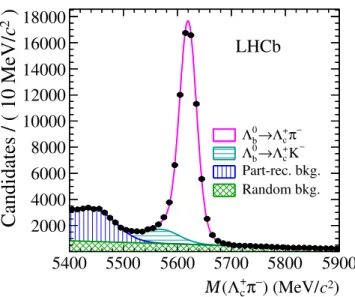
The distribution of the Λ+cπ− invariant mass after the kinematic fit is shown in Fig. 1,
74
where a requirement of good quality of the kinematic fit is applied. In addition to the Λ0
b→
75
Λ+ cπ
−signal contribution, the spectrum contains backgrounds from random combinations
76
of tracks (random background), from partially-reconstructed decays where one or more
77
particles are not reconstructed, and from Λ0
b→ Λ+cK
− decays with the kaon reconstructed
78
under the pion mass hypothesis. A fit of the spectrum yields 70 540 ± 330 signal events,
79
and the signal-to-background ratio in a ±25 MeV/c2 interval around the nominal Λ0b mass
80
is S/B = 11. The fit to the Λ+ cπ
− spectrum is only used to estimate the Λ0
b yield and the
81
Λ0
b → Λ+cK
− contribution, and is not used in the subsequent analysis.
82
The Λ0b candidates obtained with the above selection are combined with two tracks
un-83
der the pion mass hypothesis (referred to as slow pions from now on) to search for excited
84
Λ0
b states. The tracks are required to have transverse momentum pT > 150 MeV/c, and no
85
PID requirements are applied. A kinematic fit is applied that, in addition to all constraints
) 2 c ) (MeV/ − π + c Λ ( M 5400 5500 5600 5700 5800 5900
)
2c
Candidates / ( 10 MeV/
2000 4000 6000 8000 10000 12000 14000 16000 18000 LHCb − π + c Λ → 0 b Λ − K + c Λ → 0 b Λ Part-rec. bkg. Random bkg.Figure 1: Invariant mass spectrum of Λ+cπ− combinations. The points with error bars are the data, and the fitted Λ0b → Λ+
cπ− signal and three background components (Λ0b → Λ+cK−, partially-reconstructed and random background) are shown with different fill styles.
described above for Λ0
b candidates, constrains the two slow pion tracks to originate from
87
the PV and the invariant mass of the Λ0b candidate to a fixed value of 5619.37 MeV/c2,
88
which is a combination of the world average [18] and the LHCb measurement [26]. The
89
uncertainty on the combined Λ0
b mass obtained in this way, 0.69 MeV/c2, is treated as a
90
systematic effect. Combinations with a good quality of kinematic fit, χ2/ndf < 3.3, are
91
retained. From the simulation study, this requirement is optimal for the observation of a
92
narrow state near the kinematic threshold with signal-to-background ratio around one.
93
The fit of the Λ+cπ− mass spectrum (Fig. 1) indicates the presence of the background
94
from Λ0
b → Λ+cK
− decays at a rate around 12%, relative to the Λ0
b → Λ+cπ
− signal.
95
Alternatively, its rate can be estimated from the ratio of B+ → D0K+ and B+ → D0π+
96
decays that equals to 8% [18]. Due to the Λ0b mass constraint in the kinematic fit, the
97
Λ0 bπ+π
− invariant mass distribution for this mode is biased by less than 0.1 MeV/c2 if
98
reconstructed under the Λ+ cπ
− mass hypothesis, and has a resolution only a factor of two
99
worse than that with the Λ+cπ− signal. After the kinematic fit quality requirement, the
100
fraction of Λ0 bπ+π
− with Λ0
b→ Λ+cK
− decays compared to those with the Λ+ cπ
−is reduced
101
to 8%. This mode is thus not treated separately, and its effect is taken into account as a
102
part of the systematic uncertainty due to the signal shape.
103
Combinations of Λ0
b candidates with both opposite-sign and same-sign slow pions are
104
selected in data. The latter are used to constrain the background shape coming from
105
random combinations of Λ0b baryon and two tracks. The assumption that the shape of the
106
background in Λ0 bπ+π
− and Λ0 bπ
±π± modes is the same is validated with simulation. The
107
Λ0 bπ+π
− and Λ0 bπ
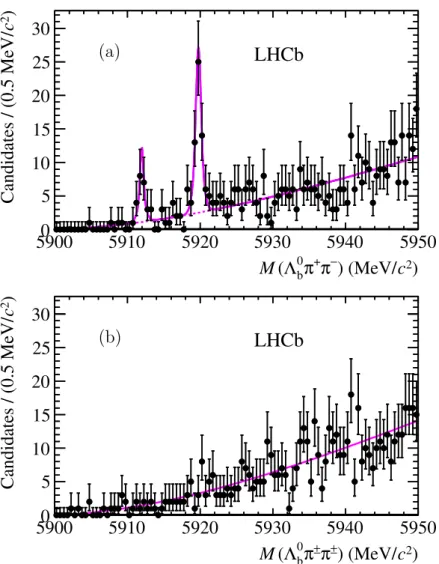
±π± invariant mass spectra are shown in Fig. 2; two narrow structures
108
with masses around 5912 and 5920 MeV/c2 are evident in the Λ0bπ+π− spectrum. They
are interpreted as the orbitally excited Λ0b states, and are denoted hereafter as Λ∗0b (5912)
110
and Λ∗0b (5920).
111
A combined unbinned fit of the Λ0 bπ+π
− and Λ0 bπ
±π± samples is performed to
ex-112
tract the masses and event yields of the two states. The background is described with a
113
quadratic polynomial function with common parameters for both samples except for an
114
overall normalization. The probability density function (PDF) for each of the Λ∗0b (5912)
115
and Λ∗0b (5920) signals is a sum of two Gaussian PDFs with the same mean. The
rela-116
tive normalization of the two Gaussian PDFs are fixed to the values obtained from the
117
simulation of states with masses 5912 and 5920 MeV/c2 and zero natural widths, while
118
the mean value and overall normalization for each signal are left free in the fit. The core
119
resolution (width of the narrower Gaussian PDF) obtained from simulation is 0.19 and
120
0.27 MeV/c2 for Λ∗0
b (5912) and Λ ∗0
b (5920), respectively. Study of several high-statistics
121
samples (Λ0b→ Λ+
cπ−, ψ(2S) → J/ψ π+π−, D∗+ → D0π+) shows that the invariant mass
122
resolution in data is typically worse by 20% than in the simulation. Thus the nominal data
123
fit uses the widths of Gaussian PDFs from the simulation multiplied by 1.2. The data
124
fit yields 17.6 ± 4.8 events with mass MΛ∗0
b (5912) = 5911.97 ± 0.12 MeV/c
2 and 52.5 ± 8.1
125
events with mass MΛ∗0
b (5920) = 5919.77 ± 0.08 MeV/c
2.
126
Limits on natural widths Γ of the two states are obtained by performing an alternative
127
fit where the signal PDFs are convolved with relativistic Breit-Wigner distributions. The
128
dependence of Breit-Wigner width Γ on the Λ0 bπ+π
− invariant mass M is taken into
129 account as ΓΛ∗0 b (M ) = ΓΛ ∗0 b × (q/q0) 2 × (M
Λ∗0b /M ). Here MΛ∗0b is the mass of the Λ∗0b
130
state, and q(0) is the kinematic energy for the decay of the state with mass M(Λ∗0b ): q(0) =
131 M(Λ∗0 b ) − MΛ 0 b − 2Mπ, where MΛ 0
b and Mπ are the masses of Λ
0
b and π+, respectively.
132
Scans of Breit-Wigner widths ΓΛ∗0
b (5912) and ΓΛ ∗0
b (5920) are performed with all the other
133
parameters free to vary in the fit. The upper limits are obtained without applying the
134
mass resolution scaling factor of 1.2 as in the nominal fit to account for the uncertainty
135
of this quantity: this gives a more conservative value for the upper limit. The 90%
136
(95%) confidence level (CL) upper limit on Γ, which corresponds to 1.28 (1.64) standard
137
deviations, is obtained as the value of Γ where the negative logarithm of the likelihood
138
is 1.282/2 = 0.82 (1.642/2 = 1.34) greater than at its minimum. The 90% (95%) CL
139
upper limit is ΓΛ∗0
b (5912) < 0.66 MeV (0.83 MeV) for the Λ
∗0
b (5912) state, and ΓΛ∗0b (5920) <
140
0.63 MeV (0.75 MeV) for the Λ∗0b (5920) state.
141
The invariant mass of the two pions, M (π+π−), in the Λ∗0
b (5920) → Λ0bπ+π
− decay
142
is shown in Fig. 3. The background is subtracted using the sWeights procedure [27].
143
The weights are calculated from the fit to Λ0 bπ+π
− invariant mass distribution, which is
144
practically uncorrelated with M (π+π−). The M (π+π−) distribution is consistent with
145
the result of phase-space decay simulation, with χ2/ndf = 1.6 for ndf = 9. No peaking
146
structures are evident.
147
Systematic uncertainties on the mass measurement are shown in Table 1. The
148
dominant uncertainty in the absolute Λ∗0b mass measurement comes from the
uncer-149 tainty on the Λ0 b mass δMΛ0 b = 0.69 MeV/c 2; it is propagated to the Λ∗0 b mass un-150 certainty as δMΛ∗0 b = δMΛ0b × (MΛ0b/MΛ ∗0 b ) ' 0.66 MeV/c
2. This uncertainty mostly
) 2 c ) (MeV/ − π + π 0 b Λ ( M 5900 5910 5920 5930 5940 5950 ) 2c Candidates / (0.5 MeV/ 0 5 10 15 20 25 30
LHCb
(a) ) 2 c ) (MeV/ ± π ± π b 0 Λ ( M 5900 5910 5920 5930 5940 5950 ) 2c Candidates / (0.5 MeV/ 0 5 10 15 20 25 30LHCb
(b)Figure 2: Invariant mass spectrum of (a) Λ0bπ+π− and (b) Λ0bπ±π± combinations. The points with error bars are the data, the solid line is the fit result, the dashed line is the background contribution.
cancels in the mass difference ∆MΛ∗0
b = MΛ
∗0
b − MΛ
0
b, where the residual uncertainty is 152
δ∆MΛ∗0
b = δMΛ0b × (∆MΛ0b/MΛ ∗0
b ). The uncertainty of the signal parameterization is es-153
timated by using the simulated signal parametrization without applying the resolution
154
scaling factor, by using the natural width for both states when left free in the fit, and by
155
conservatively including the Λ0
b→ Λ+cK
− contribution with the rate 12% parameterized
156
from simulation. The uncertainty due to the background parameterization is estimated
157
by:
158
• using an alternative fit model for background description,
159
• using the fit without the Λ0 bπ
±π± constraint,
160
• using the fit with the background obtained from the simulation,
)
2c
) (MeV/
−π
+π
(
M
280 290 300)
2c
Candidates / (2.5 MeV/
0 2 4 6 8 10 12 14 16 LHCbFigure 3: Invariant mass of the two pions from Λ∗0b (5920) → Λ0bπ+π− decay. The points with the error bars are background-subtracted data, the solid histogram is the result of phase-space decay simulation.
Table 1: Systematic uncertainties on the mass difference ∆MΛ∗0
b between Λ
∗0
b and Λ 0 b.
Source of Systematic bias, MeV/c2 uncertainty ∆MΛ∗0 b (5912) ∆MΛ ∗0 b (5920) Λ0 b mass 0.034 0.035 Signal PDF 0.021 0.011 Background PDF 0.002 0.002 Momentum scale 0.008 0.013 Total 0.041 0.039
• fitting in the reduced invariant mass range 5910–5930 MeV/c2,
162
and taking the largest difference from the nominal fit result as systematic uncertainty.
163
The effect of the momentum scale correction is evaluated by varying the scale coefficient
164
by its relative uncertainty 5 × 10⁻⁴ in simulated signal samples.
165
The significance of the observation of the two states is evaluated with simulated
166
pseudo-experiments. A large number of background-only invariant mass distributions
167
are simulated with parameters equal to the fit result, and each distribution is fitted with
168
models that include background only, as well as background and signal. The mean mass
169
value of the signal PDF is not constrained in the fit to account for a trial factor in the
170
range 5900–5950 MeV/c2. The significance is calculated as the fraction of samples where
the difference of the logarithms of fit likelihoods ∆ log L with and without the signal
172
is larger than in data. The fraction is obtained by an exponential extrapolation of the
173
∆ log L distribution [28] that allows a limited number of pseudo-experiments to be used
174
for a signal with high significance. The significance is then expressed in terms of the
175
number of standard deviations (σ). The significance of the Λ∗0b (5912) state obtained in
176
this way is 5.4σ for the ∆ log L obtained from the nominal fit. To account for systematic
177
effects, the minimum ∆ log L among all systematic variations is taken; in that case the
178
significance reduces to 5.2σ. Similarly, the statistical significance of the Λ∗0b (5920) state
179
is 11.7σ, and the significance including systematic uncertainties is 10.2σ.
180
The fit biases and the validity of the statistical uncertainties are checked with
pseudo-181
experiments where the PDF contains both signal and background components. The fit
182
does not introduce any noticeable bias on the measurement of the masses. The mass
183
uncertainty for Λ∗0b (5920) state is estimated correctly within 1% precision; however, the
184
mass uncertainty for the Λ∗0b (5912) is underestimated by 4%. This factor is taken into
185
account in the final result.
186
In summary, we report the observation of two narrow states in the Λ0bπ+π− mass
187
spectrum, Λ∗0b (5912) and Λ∗0b (5920), with masses
188 MΛ∗0 b (5912) = 5911.97 ± 0.12 ± 0.02 ± 0.66 MeV/c 2, MΛ∗0 b (5920) = 5919.77 ± 0.08 ± 0.02 ± 0.66 MeV/c 2,
where the first uncertainty is statistical, the second is systematic, and the third is the
189
uncertainty due to knowledge of the Λ0
b mass. The values of the mass differences with
190
respect to the Λ0b mass, where most of the last uncertainty cancels, and the remaining
191
part is included in the systematic uncertainty, are
192
∆MΛ∗0
b (5912) = 292.60 ± 0.12(stat) ± 0.04(syst) MeV/c
2
, ∆MΛ∗0
b (5920) = 300.40 ± 0.08(stat) ± 0.04(syst) MeV/c
2.
The signal yield for the Λ∗0b (5912) state is 17.6 ± 4.8 events, and the significance of
193
the signal (including systematic uncertainty and trial factor in the mass range 5900–
194
5950 MeV/c2) is 5.2 standard deviations. For the Λ∗0
b (5920) state, the yield is 52.5 ± 8.1
195
events and the significance is 10.2 standard deviations. The limits on the natural widths of
196
these states are ΓΛ∗0
b (5912) < 0.66 MeV (< 0.83 MeV) and ΓΛ ∗0
b (5920) < 0.63 MeV (< 0.75) 197
at the 90% (95%) CL.
198
The masses of Λ∗0b states obtained in our analysis are 30–40 MeV/c2 higher than in
199
the prediction using the constituent quark model [12], and 20–30 MeV/c2 lower than the
200
predictions based on the relativistic quark model [11], modeling the color hyperfine
inter-201
action [14] and an approach based on the heavy quark effective theory [15]. Calculation
202
involving a combined heavy quark and large number of colors expansion [9, 10] gives a
203
value roughly in agreement, although only the spin-averaged prediction is available. The
204
earlier prediction based on the relativized quark potential model [13] matches well the
205
absolute mass values for both states, but the Λ0b mass prediction using this model is
206
35 MeV/c2 lower than the measured value.
We express our gratitude to our colleagues in the CERN accelerator departments for
208
the excellent performance of the LHC. We thank the technical and administrative staff at
209
CERN and at the LHCb institutes, and acknowledge support from the National Agencies:
210
CAPES, CNPq, FAPERJ and FINEP (Brazil); CERN; NSFC (China); CNRS/IN2P3
211
(France); BMBF, DFG, HGF and MPG (Germany); SFI (Ireland); INFN (Italy); FOM
212
and NWO (The Netherlands); SCSR (Poland); ANCS (Romania); MinES of Russia and
213
Rosatom (Russia); MICINN, XuntaGal and GENCAT (Spain); SNSF and SER
(Switzer-214
land); NAS Ukraine (Ukraine); STFC (United Kingdom); NSF (USA). We also
acknowl-215
edge the support received from the ERC under FP7 and the Region Auvergne.
216
References
217
[1] D0 collaboration, V. Abazov et al., Direct observation of the strange b baryon Ξ−b ,
218
Phys. Rev. Lett. 99 (2007) 052001, arXiv:0706.1690.
219
[2] CDF collaboration, T. Aaltonen et al., Observation and mass measurement of the
220
baryon Ξ−b , Phys. Rev. Lett. 99 (2007) 052002, arXiv:0707.0589.
221
[3] D0 collaboration, V. Abazov et al., Observation of the doubly strange b baryon Ω−b ,
222
Phys. Rev. Lett. 101 (2008) 232002, arXiv:0808.4142.
223
[4] CDF collaboration, T. Aaltonen et al., Observation of the Ω−b baryon and
measure-224
ment of the properties of the Ξ−b and Ω−b baryons, Phys. Rev. D80 (2009) 072003,
225
arXiv:0905.3123.
226
[5] CDF collaboration, T. Aaltonen et al., Observation of the Ξ0
b baryon, Phys. Rev.
227
Lett. 107 (2011) 102001, arXiv:1107.4015.
228
[6] CMS Collaboration, S. Chatrchyan et al., Observation of an excited Ξb baryon,
229
arXiv:1204.5955.
230
[7] CDF collaboration, T. Aaltonen et al., First observation of heavy baryons Σb and Σ∗b,
231
Phys. Rev. Lett. 99 (2007) 202001, arXiv:0706.3868.
232
[8] CDF collaboration, T. Aaltonen et al., Measurement of the masses and widths of the
233
bottom baryons Σ±b and Σ∗±b , arXiv:1112.2808.
234
[9] Z. Aziza Baccouche, C.-K. Chow, T. D. Cohen, and B. A. Gelman, Excited heavy
235
baryons and their symmetries. 3. Phenomenology, Nucl. Phys. A696 (2001) 638,
236
arXiv:hep-ph/0105148.
237
[10] Z. Aziza Baccouche, C.-K. Chow, T. D. Cohen, and B. A. Gelman, Model-independent
238
predictions for low energy isoscalar heavy baryon observables in the combined heavy
239
quark and large Ncexpansion, Phys. Lett. B514 (2001) 346, arXiv:hep-ph/0106096.
[11] D. Ebert, R. Faustov, and V. Galkin, Masses of excited heavy baryons in the
rela-241
tivistic quark model, Phys. Lett. B659 (2008) 612, arXiv:0705.2957.
242
[12] H. Garcilazo, J. Vijande, and A. Valcarce, Faddeev study of heavy baryon
spec-243
troscopy, J. Phys. G34 (2007) 961, arXiv:hep-ph/0703257.
244
[13] S. Capstick and N. Isgur, Baryons in a relativized quark model with chromodynamics,
245
Phys. Rev. D34 (1986) 2809.
246
[14] M. Karliner, B. Keren-Zur, H. J. Lipkin, and J. L. Rosner, The quark model and b
247
baryons, Annals Phys. 324 (2009) 2, arXiv:0804.1575.
248
[15] W. Roberts and M. Pervin, Heavy baryons in a quark model, Int. J. Mod. Phys. A23
249
(2008) 2817, arXiv:0711.2492.
250
[16] LHCb collaboration, A. A. Alves Jr. et al., The LHCb detector at the LHC, JINST
251
3 (2008) S08005.
252
[17] V. Gligorov, C. Thomas, and M. Williams, The HLT inclusive B triggers,
LHCb-253
PUB-2011-016.
254
[18] Particle Data Group, K. Nakamura et al., Review of particle physics, J. Phys. G37
255
(2010) 075021.
256
[19] LHCb Collaboration, R. Aaij et al., Measurement of b-hadron masses, Phys. Lett.
257
B708 (2012) 241, arXiv:1112.4896.
258
[20] T. Sj¨ostrand, S. Mrenna, and P. Skands, PYTHIA 6.4 Physics and manual, JHEP
259
05 (2006) 026, arXiv:hep-ph/0603175.
260
[21] I. Belyaev et al., Handling of the generation of primary events in Gauss, the LHCb
261
simulation framework, Nuclear Science Symposium Conference Record (NSS/MIC)
262
IEEE (2010) 1155.
263
[22] D. J. Lange, The EvtGen particle decay simulation package, Nucl. Instrum. Meth.
264
A462 (2001) 152.
265
[23] P. Golonka and Z. Was, PHOTOS Monte Carlo: a precision tool for QED corrections
266
in Z and W decays, Eur. Phys. J. C45 (2006) 97, arXiv:hep-ph/0506026.
267
[24] GEANT4 collaboration, J. Allison et al., Geant4 developments and applications,
268
IEEE Trans. Nucl. Sci. 53 (2006) 270; GEANT4 collaboration, S. Agostinelli et al.,
269
GEANT4: A simulation toolkit, Nucl. Instrum. Meth. A506 (2003) 250.
270
[25] M. Clemencic et al., The LHCb Simulation Application, Gauss: Design, Evolution
271
and Experience, J. of Phys: Conf. Ser. 331 (2011) 032023.
[26] LHCb collaboration, R. Aaij et al., Measurement of b-hadron masses, Phys. Lett.
273
B708 (2012) 241, arXiv:1112.4896.
274
[27] M. Pivk and F. L. Diberder, sPlot: A statistical tool to unfold data distributions,
275
Nucl. Instrum. Meth. A555 (2005) 356, arXiv:physics/0402083.
276
[28] E. Gross and O. Vitells, Trial factors for the look elsewhere effect in high energy
277
physics, Eur. Phys. J. C70 (2010) 525, arXiv:1005.1891.