
HAL Id: hal-01161824
https://hal.inria.fr/hal-01161824
Submitted on 9 Jun 2015
HAL is a multi-disciplinary open access
archive for the deposit and dissemination of
sci-entific research documents, whether they are
pub-lished or not. The documents may come from
teaching and research institutions in France or
abroad, or from public or private research centers.
L’archive ouverte pluridisciplinaire HAL, est
destinée au dépôt et à la diffusion de documents
scientifiques de niveau recherche, publiés ou non,
émanant des établissements d’enseignement et de
recherche français ou étrangers, des laboratoires
publics ou privés.
New hierarchical joint classification method of
SAR-optical multiresolution remote sensing data
Ihsen Hedhli, Gabriele Moser, Sebastiano B. Serpico, Josiane Zerubia
To cite this version:
Ihsen Hedhli, Gabriele Moser, Sebastiano B. Serpico, Josiane Zerubia. New hierarchical joint
classifi-cation method of SAR-optical multiresolution remote sensing data. IEEE European Signal Processing
Conference, Aug 2015, Nice, France. �hal-01161824�
NEW HIERARCHICAL JOINT CLASSIFICATION METHOD OF
SAR-OPTICAL MULTIRESOLUTION REMOTE SENSING DATA
Ihsen HEDHLI
a,b, Gabriele MOSER
b, Sebastiano. B. SERPICO
band Josiane ZERUBIA
aa
INRIA, AYIN team, France, [email protected]
b
DITEN, Department of Electrical, Electronic, and Telecommunications Engineering
and Naval Architecture – University of Genoa, Italy, [email protected]
ABSTRACT
In this paper, we develop a novel classification approach for multiresolution, multisensor (optical and synthetic aperture radar), and/or multiband images. Accurate and time-efficient classification methods are particularly im-portant tools to support rapid and reliable assessment of the ground changes. Given the huge amount and variety of data available currently from last-generation satellite mis-sions, the main difficulty is to develop a classifier that can take benefit of multiband, multiresolution, and multisen-sor input imagery. The proposed method addresses the problem of multisensor fusion of SAR with optical data for classification purposes, and allows input data collected at multiple resolutions and additional multiscale features derived through wavelets to be fused.
Index Terms— Multisensor, multiresolution remote
sensing images, supervised classification, hierarchical Markov random fields.
1. INTRODUCTION
Nowadays, a wide variety of remote sensing images is available. Therefore, it becomes more and more important to be able to analyze compound data sets consisting of different types of images acquired by different sensors, as they allow a spatially distributed and temporally repetitive view of the monitored area at the desired spatial scales. In particular, the opportunity of joint availability of synthetic aperture radar (SAR) and optical images offers high reso-lution (HR), all-weather, day/night, short revisit time data, polarimetric, and, multifrequency acquisition capabilities. Similarly, the strong differences in terms of wavelength range (microwave vs. visible and near infrared), sensitivi-ty to cloud cover and sun illumination (strong for optical imagery vs. almost negligible for SAR), and noise-like properties (speckle in SAR vs. generally low noise vari-ance in current HR optical sensors) make the joint use of HR optical and SAR imagery especially interesting for many applications to environmental monitoring and risk management. Within this framework, there is a definite need for classification methods that automatically corre-late different sets of images taken on the same area from
different sensors and at different resolutions. Two com-mon ways are usually accepted to deal with multisensor data: (i) the combination of classifiers and (ii) the classifi-cation of preliminary fused images either explicitly or implicitly. Option (i) leads to an improved global classifi-cation by employing basic rules such as majority voting [1], or more specific methods, such as those relying on neural networks [2] or the Dempster-Shafer theory [1]. The second strategy (ii) banks on the direct fusion of the input images. In this case, the classification is obtained by applying, to the fused images, some widely used classifi-cation algorithms such as, for instance, methods based on Markov random fields (MRFs) [3, 4]. Due to their gener-ally non-causal nature, these models lead to iterative in-ference algorithms that are computationally demanding (e.g., optimization via simulated annealing) [5]. One way to circumvent this problem is to resort to a Markov model on a quadtree [6] where in-scale causality permits non-iterative inference with acceptable computational time, and offers the well-known advantages of standard hierar-chical techniques that improve robustness and ability to deal with multiresolution data. Under this contextual as-sumption, multisensor fusion may be based on explicit statistical modeling by finding a joint probability distribu-tion given the class-condidistribu-tional marginal probability den-sity functions (PDFs) related to each sensor. The joint statistics can be designed by resorting to meta-Gaussian distributions as shown in [7], by using more sophisticat-ed multivariate statistics such as multivariate copulas [8], or by applying non-parametric density estimators [20]. However, employing heterogeneous data (SAR-optical in our case) makes the task of finding an appropriate multi-variate statistical model complex, time demanding, and possibly prone to overfitting.
In the proposed method, the computation of joint statistics is avoided, and a novel approach, based on multiple quad-trees in cascade, to multisensor and multiresolution fusion is described. For each sensor, the input image is associat-ed with a separate quadtree structure on the basis of its resolutions. The proposed approach formalizes a super-vised Bayesian classifier within this multiple quadtree topology that combines a class-conditional statistical model for pixel-wise information and a hierarchical MRF for multisensor and multiresolution contextual
infor-mation.
This paper is organized as follows: In Section 2, we focus on the proposed hierarchical model. Section 3 explains the methodological choices that come with the modeling of the class-conditional statistics. Results of the use of this new multisensor hierarchical model are presented in Sec-tion 4. Finally, we conclude and present some future work in Section 5.
2. HIERARCHICAL MULTISENSOR MODEL
The objective of this study is to develop a novel method for SAR-optical and multiresolution classification based on a hierarchical Markovian model. This hierarchical structure should be highly parallel in order to handle the heterogeneity of data acquired by different sensors with different physical properties and should provide a topolo-gy that simplifies the interactions between different imag-es in the compound data set. In this context, the pyramid structure [9] is a type of signal representation in which images are organized according to their resolutions. Among others, quadtrees [6] have been proposed as at-tractive candidates for modeling the scale-to-scale interac-tions in the aforementioned pyramid structure. The choice of a quadtree allows taking benefit from its good analyti-cal properties [10] (e.g., causality) and to apply non-iterative classification algorithms such as the marginal posterior mode (MPM) [6]. The aim is to maximize recur-sively the posterior marginal at each site 𝑠, which associ-ates the most probable class label xs given the entire input
multisource information y : 𝑥̂𝑠= 𝑎𝑟𝑔 𝑚𝑎𝑥𝑥
𝑠 𝑝(𝑥𝑠|𝑦) (1)
An especially novel element of the proposed approach is the use of multiple quadtrees in cascade (see Fig. 1), each associated with the set of images given by one specific sensor. This approach aims at exploiting the multiscale information that is typically associated with either SAR or optical HR imagery.
Fig. 1. Multisensor hierarchical structure
It is worth noting that the proposed hierarchical structure implies a constraint among the resolutions of the images at the various levels of the pyramid. In fact, the choice of quadtree topology imposes a factor of 2 between the spa-tial resolutions of the images in two successive levels. This implies that missing levels can occur in the pyramid structure if the input images do not fill all levels of the quadtree by themselves. In the proposed method, these “empty” levels are filled in through a wavelet decomposi-tion of the images associated with the finer levels [11]. Quadtree structure allows, in a very natural way, the use of an explicit statistical modeling through a hierarchical Markov random field formulation using a series of ran-dom fields at varying scales, resolutions, and sensors, on the basis of the transitions defined on the quadtrees as shown in Fig. 1.
Accordingly, a novel formulation of MPM is proposed through multiple quadtrees in cascade. Specifically, the posterior marginal 𝑝(𝑥𝑠 |𝑦) of the label of each site in
the quadtree related to the optical sensor is expressed as a function not only of the posterior marginal of the parent node 𝑝(𝑥𝑠− |𝑦) in the same quadtree but also of the
pos-terior marginal 𝑝(𝑥𝑠= |𝑦) of the parent node in the
quad-tree associated with SAR images as shown in (2), with the aim to characterize the SAR-optical correlations associat-ed, at different scales, with distinct images in the input multisource data i.e. :
𝒑(𝒙𝒔 |𝒚) = ∑ 𝑝(𝑥𝑠 , 𝑥𝑠−, 𝑥𝑠=| 𝑦𝑑(𝑠)) ∑ 𝑝𝑥𝑠 (𝑥𝑠 , 𝑥𝑠−, 𝑥𝑠=| 𝑦𝑑(𝑠)). 𝒑(𝒙𝒔 −| 𝒚) 𝒑(𝒙𝒔=|𝒚) 𝑥 𝑠 −, 𝑥𝑠 = , (2)
where bold denotes the marginal posteriors of interest to 𝑀𝑃𝑀. (2) involves two conditional independence as-sumptions: (i) the label 𝑥𝑠 depends only on the data of the
site and their descendants; and (ii) the label at parent 𝑠−
is independent of the label at parent 𝑠= at the previous
date, when conditioned to the data 𝑦 (details can be found in [13]).
This formulation allows calculating recursively the poste-rior marginal 𝑝 (𝑥𝑠 |𝑦) at each site 𝑠 while the
probabil-ities 𝑝(𝑥𝑠 , 𝑥𝑠−, 𝑥𝑠=| 𝑦𝑑(𝑠)) are made available. Thus,
the computation of these joint probabilities boils down to the determination of the other probabilities involved in (3): 𝑝(𝑥𝑠 , 𝑥𝑠−, 𝑥𝑠=| 𝑦𝑑(𝑠)) = 𝑝(𝑥𝑠 | 𝑥𝑠−, 𝑥𝑠=) . 𝑝(𝑥𝑠− | 𝑥𝑠= ). 𝑝(𝑥𝑠= ) 𝑝(𝑥𝑠 ) . 𝑝(𝑥𝑠 | 𝑦𝑑(𝑠)), (3)
where the factor 𝑝(𝑥𝑠 | 𝑥𝑠−, 𝑥𝑠=) corresponds to the
child-parent transition probability; 𝑝(𝑥𝑠 ) is the prior
probability; 𝑝(𝑥𝑠−| 𝑥𝑠=) is the transition probability
between sensors at the same scale and 𝑝(𝑥𝑠 | 𝑦𝑑(𝑠)) is
the partial posterior marginal probability.
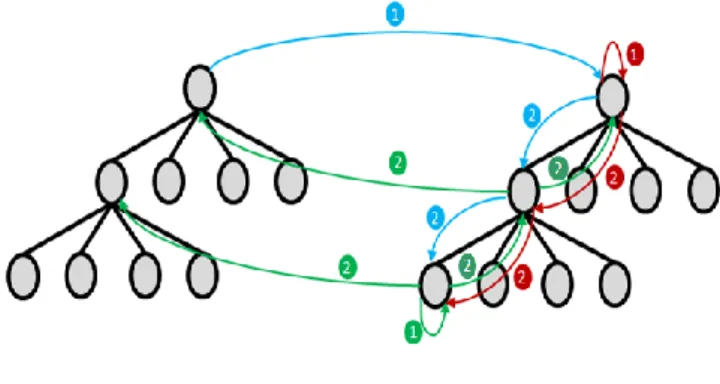
To compute these probabilities, we take benefit from the hierarchical structure defined above and we use two recur-sive passes on the quadtree, referred to as “bottom-up” and “top-down” passes (see Fig. 2.).
2.1. Top-down pass: Prior probabilities estimation
A preliminary classification is done at the first quadtree composed by SAR images using the classical MPM using a single quadtree, where the segmentation is obtained recursively over scales (details can be found in [6]). Then we use the resulting classification map to estimate the prior in the root 𝑅 of the second quadtree composed by optical images (blue arrow labeled with the number 1 in Fig. 2.). To estimate the prior in the root given the result-ing classification map, we use a spatial Markovian model which takes into account the contextual information given by SAR images, and therefore, leads to better prior esti-mation for the optical images by adding spatial infor-mation in the classification process. Thus, employing the Hammersley-Clifford theorem [3], we can define a local prior for each site 𝑠 as a Potts model as shown in (4).
𝑝(𝑥𝑠 |𝑥𝑠′ , 𝑠′~𝑠) ∝ 𝑒𝑥𝑝 (−𝛽 ∑ 𝛿(𝑥𝑠 , 𝑥𝑠′) 𝑠 ~ 𝑠′
) , (4) where 𝛿(. ) is the Kronecker symbol, 𝑠 ~ 𝑠′ denotes that 𝑠 and 𝑠′ are neighbors with respect to a given neighborhood system, and 𝛽 is a smoothness parameter [3].
Then, a top-down pass (blue arrow labeled with the num-ber 2 in Fig. 2.) is performed for each finer level, and the prior-probability distribution is derived as a function of the prior-probability distribution calculated at the parent level and of the transition probabilities from the parent to the current level, i.e.:
𝑝(𝑥𝑠 ) = ∑ 𝑝(𝑥𝑠 | 𝑥𝑠−). 𝑝(𝑥𝑠−) 𝑥 𝑠 −
, (5)
to favor an identical parent-child labeling and to model the statistical interactions between consecutive levels of the quadtree. We model the transition probability in the form introduced by Bouman et al. [12], i.e. (𝑛 = 0, 1 ⋯ 𝑅 – 1) 𝑝(𝑥𝑠 | 𝑥𝑠− ) = { 𝜃 𝑥𝑠= 𝑥𝑠− 1 − 𝜃 𝑀 − 1 𝑥𝑠≠ 𝑥𝑠− , (6)
2.2. Bottom-up pass: joint probabilities estimation
A bottom-up pass recursion is performed to estimate the joint probabilities 𝑝(𝑥𝑠 , 𝑥𝑠−, 𝑥𝑠=| 𝑦𝑑(𝑠)) starting from
the leaves of the quadtree corresponding to the optical sensor and proceeding until the root is reached based on the factorization in (3). In addition to the prior that is calculated in the previous top-down pass, there are two kinds of transition probabilities that are needed to com-pute the factorization in (3). The first one is the transition probability between sensors at the same scale 𝑝(𝑥𝑠−| 𝑥𝑠=), and the second is the child-parent
transition probability 𝑝(𝑥𝑠 | 𝑥𝑠−, 𝑥𝑠=). Details on the
calculations of these probabilities are shown in [13]. The bottom-up pass also involves the estimation of the partial posterior marginals 𝑝(𝑥𝑠 | 𝑦𝑑(𝑠)) where 𝑦𝑑(𝑠)
denotes the collection of the observations including 𝑠 and
all its descendants. Concerning the former probabilities, Laferté et al. [6] proved that:
𝑝(𝑥𝑠 |𝑦𝑑(𝑠)) ∝ 𝑝(𝑦𝑠| 𝑥𝑠). 𝑝(𝑥𝑠 ). ∏ ∑ [ 𝑝(𝑥𝑠̃ |𝑦𝑑(𝑠̃)) 𝑝(𝑥𝑠̃) . 𝑝(𝑥𝑠̃ |𝑥𝑠)] 𝑥𝑠̃ 𝑠̃∈𝑠+ (6) 𝑝(𝑥𝑠 |𝑦𝑠) ∝ 𝑝(𝑦𝑠| 𝑥𝑠). 𝑝(𝑥𝑠 ), (7)
Thus, the bottom-up pass is a recursion that estimates 𝑝(𝑥𝑠 | 𝑦𝑑(𝑠)) starting from the leaves of the quadtree
where the partial posterior marginals are computed via (7) (green arrow labeled with the number 1 in Fig. 2) and then, proceeding until the root which is reached using (6) (green arrow labeled with the number 2 in Fig. 2). (6) involves the pixelwise class-conditional PDFs 𝑝(𝑦𝑠| 𝑥𝑠) of the image data at each node of each quadtree
(see next section).
2.3. Top-down pass: posterior probabilities and opti-mization
The algorithms described in Sections 2.1 and 2.2 provide all needed probabilities to compute 𝑝(𝑥𝑠 , 𝑥𝑠−, 𝑥𝑠=| 𝑦𝑑(𝑠)) at each level of the quadtree
(green arrow labeled with the number 2 in Fig. 2). After initializing the posterior at the root (red arrow labeled with the number 1 in Fig. 2) where 𝑝(𝑥𝑟 | 𝑦𝑑(𝑟)) =
𝑝(𝑥𝑟 | 𝑦), one could easily compute, recursively in a
top-down pass (red arrow labeled with the number 2 in Fig. 2), the posterior 𝑝(𝑥𝑠 | 𝑦) at each pixel s for all tree
levels using (2). Then, the maximization of 𝑝(𝑥𝑠 | 𝑦) is
done by employing a modified Metropolis dynamics (MMD) algorithm, which exhibits good properties with respect to both computational cost (which is relatively low) and accuracy of the results [15].
Fig. 2. Recursive passes on the Quadtrees
3. PIXELWISE CLASS-CONDITIONAL PDFS
Given a training set for each input data, for each class m, scale n and sensor, we model the corresponding class-conditional marginal PDF 𝑝(𝑦𝑠|𝑥𝑠= 𝑚) using finite
𝑝(𝑦𝑠|𝑥𝑠= 𝑚) = ∑ 𝜋𝑖𝑛 𝐹𝑖𝑛(𝑦𝑠|𝜃𝑖𝑛), 𝐾𝑛
𝑖=1
(8) where 𝜋𝑖𝑛 are the mixing proportions, 𝜃𝑖𝑛 is the set of the
parameters of the ith PDF mixture component of the 𝑚𝑡ℎ
class at the 𝑛𝑡ℎ scale level 𝐹 𝑖𝑛.
The mixture modeling is performed depending on the different types of remote sensing imagery used in this study. Indeed, when the input data at the 𝑛𝑡ℎ scale level is
an optical image, class-conditional marginal PDF 𝑝(𝑦𝑠|𝑥𝑠= 𝑚) related to each class 𝑚 can be modeled by a
Gaussian mixture model [16] with a set of parameters associated with the corresponding mean and variance. On the opposite, SAR acquisitions are known to be affected by speckle [17]. For this reason, we use appropriate SAR-specific models for such images, such as the generalized gamma distribution [18]. The parameters of the mixture model for both SAR and optical images are estimated through the stochastic expectation maximization (SEM) algorithm [19], which is an iterative stochastic parameter estimation algorithm developed for problems character-ized by data incompleteness and approaching, under suit-able assumptions, maximum likelihood estimates. For each scale, SEM is applied to the training samples of each class to estimate the related parameters.
4. RESULTS
Experiments are discussed regarding two datasets collect-ed over Port-au-Prince (Haiti) including: (i) single-polarization single-look CSK (© ASI; Fig. 3. (a)) with HH polarization, stripmap acquisition modality, with 2.5-m pixel spacing; and (ii) a coregistered GeoEye RGB acqui-sition (© GeoEye; Fig. 3. (b)). Multiscale features are extracted through 2D discrete wavelet transform. Five land cover classes have been considered: urban (red), water (blue), vegetation (green), soil (yellow) and con-tainers (purple).
We compare the proposed method with the classification results obtained using the following techniques:
1) Separate hierarchical classifications of the images provides by the two sensors (Fig. 3(d) for optical and Fig. 3(e) for SAR). In this case, the classification is obtained recursively over the scales where the use of quadtree structure in MPM schema yields “blockly” segmentations (details can be found in [6]).
2) The multisensor single-scale approach in [7] (see Fig. 3(g)), in which the likelihood term is constructed by merging generalized gamma (for SAR) and Gaussian (for optical) marginals into a meta-Gaussian distribu-tion. The classification is obtained by the maximum likelihood rule.
3) The multi-sensor multiscale method proposed in [8], in which a model for the multivariate joint class-conditional statistics of the co-registered input images at each resolution is designed by resorting to multi-variate copulas. The estimated joint probability densi-ty function is plugged into a hierarchical Markovian model based on a quadtree structure (see Fig. 3(f)). A preliminary visual analysis of the resulting classifica-tion maps suggests that the proposed hierarchical method
leads to accurate results, especially as compared to sepa-rate hierarchical classifications of the images provided by the two sensors (see Figs. 3(e) (d)). Indeed, experimental results obtained by using only SAR data accurately detect roads and containers, while the results generated by using only optical data better discriminate classes that are spa-tially homogenous. The proposed method effectively takes benefit from both SAR and optical imagery, and allows generating a classification result that visually well dis-criminates all classes in the considered HR data set. It is especially interesting to notice that the detection of the “containers” class, which is generally very overlapping with other urban or built-up classes in the feature space, improves significantly compared to the method in [8], in which the classification map is over smoothed (see high-lighted region in fig. 3(f)). Compared to the previous multisensor classification method in [7] (see fig. 3 (g) and Tab. 1), which is based on transformations of the input features to a common jointly Gaussian domain, the pro-posed algorithm provides a spatially more regular classifi-cation result, thanks to contextual MRF modeling and wavelet feature extraction. There is an improvement using the proposed method compared to the hierarchical multi-sensor method in [8] (see fig. 3 (f) and Tab. 1) in terms of accuracy and computation time. For this method, the main source of misclassification is the container area, where asphalt is erroneously classified as vegetation. Moreover, with the proposed method, we avoid the computation of joint PDFs, while copulas are used in [7] and meta-Gaussian distributions are used in [8]. This choice results in reducing the computation time (see Tab.1).
5. CONCLUSION
In the proposed method, multisensor and multiresolution fusion is based on explicit statistical modeling. It com-bines a marginal statistical model of the considered input optical and SAR images, through hierarchical Markov random field modeling based on quadtrees in cascade, leading to a statistical supervised classification approach. We have developed a novel multisource MPM-based hierarchical Markov random field model that takes into account both SAR and optical information and leads to improved robustness of the classifier. When applied to a several challenging high-resolution data sets associated with urban and semi-urban test sites, the proposed method gives high overall classification accuracy with a small computation time (a few minutes). A further advantage of the proposed classifier is that it can be generalized to the use of different satellites and/or acquisitions dates by extending the multiple quadtree structure suitably. This research work will be done in the near future.
REFERENCES
[1] L. Xu, A. Krzyzak, and C. Y. Suen, “Methods of combining multiple classifiers and their applications to handwriting recognition,”, IEEE Trans. Syst., Man, Cybern., vol. 22, no. 3, pp. 418–435, 1992.
[2] J. A. Benediktsson, P. H. Swain, and O. K. Ersoy, “Neural network approaches versus statistical methods in
classifica-tion of multisource remote sensing data,” IEEE Trans.
Ge-osci. Remote Sens., vol. 28, no. 4, pp. 540–552, 1990.
[3] S. Z. Li, Markov random field modeling in image analysis
3rd edition, Springer, 2009.
[4] G. Winkler, Image Analysis, Random Fields and Markov
chain Monte Carlo Methods 2nd edition, Springer, 2003. [5] Z. Kato and J. Zerubia. Markov Random Fields in Image
Segmentation. Boston: NOW publishers, 2012.
[6] J.M. Laferté, P. Perez and F. Heitz. "Discrete Markov mod-eling and inference on the quad-tree." IEEE Trans. Image
Processing, pp. 390–404, 2000.
[7] B. Storvik and G. Storvik and R. Fjortoft, “On the combina-tion of multisensor data using meta-Gaussian distribucombina-tions,”
IEEE Trans. Geosci. Remote Sens., vol. 47, no. 7, pp.
2372–2379, 2009.
[8] A.Voisin, V. Krylov, G. Moser, J. Zerubia and S. B. Ser-pico. “Supervised Classification of sensor and Multi-resolution Remote Sensing Images with a Hierarchical Copula-based Approach.” IEEE Trans. on Geoscience and
Remote Sensing, pp. 3346-3358, 2014.
[9] J. M. Jolion, A. Rosenfeld. A Pyramid Framework for Early
Vision: Multiresolutional Computer Vision. Norwell, MA,
USA: Kluwer Academic Publishers, 2004.
[10] M. Basseville, A. Benveniste and A. S. Willsky. "Mul-tiscale autoregressive processes, Part I: Schur-Levinson parametrization." IEEE Trans. on Signal Processing, vol. 40. no. 8, pp. 1915-1934, 1992.
[11] M. Crouse, R. Nowak and R. Baraniuk. "Wavelet-based statistical signal processing using hidden Markov models."
IEEE Trans. Signal Processing, vol. 46, pp. 886–902, 1998.
[12] C. Bouman, M. Shapiro, “A multiscale image model for Bayesian image segmentation.” IEEE Trans. on Image
Pro-cessing, vol. 3, pp 162-177, 1994.
[13] I. Hedhli, G. Moser, J. Zerubia, S. B. Serpico. “New cas-cade model for hierarchical joint classification of multitem-poral, multiresolution and multisensor remote sensing da-ta”, IEEE International Conference on Image Processing, France, 2014.
[14] J. Besag, “Spatial interaction and the statistical analysis of lattice systems (with discussion),”J. R. Statist. Soc. B, vol. 36, pp. 192–326, 1974.
[15] Z. Kato, M. Berthod and J. Zerubia. “A hierarchical Mar-kov random field model and multitemperature.” Graphical
models and image processing, pp. 18–37, 1996.
[16] J. A. Richards, Remote Sensing Digital Analysis, Springer, 2013
[17] H.-C. Li, W. Hong, Y.-R. Wu, and P.-Z. Fan, “On the empirical-statistical modeling of SAR images with general-ized gamma distribution,” IEEE J. Sel. Top. Signal Process, vol. 5, no. 3, pp. 386–397, 2011.
[18] C. Oliver and S. Quegan, Understanding Synthetic Aperture
Radar images. SciTech Publishing, 2004.
[19] G. Celeux, D. Chauveau and J. Diebolt. "Stochastic ver-sions of the EM algorithm: an experimental study in the mixture case." Journal of Statistical Computation and
Sim-ulation, vol. 55, no. 4, 287–314, 1996.
[20] K. Fukunaga, Introduction to statistical pattern
recogni-tion, 2nd edirecogni-tion, Academic Press, New York, 1990.
(a) (b)
(c) (d)
(e) (f)
(g) (h)
Fig. 3. (a) SAR image (© ASI), (b) one channel from the optical
image (© GeoEye), (c) the available ground truth, (d) hierar-chical MRF-based classification obtained from the optical im-age, using method in [6], (e) hierarchical MRF-based classifica-tion obtained for the SAR image, using method in [6], (f) result of the multisensor and multiresolution method in [8], (g) result of the multisensor method in [7], (h) hierarchical MRF-based classification obtained by the proposed cascade method.
Water urban vegetation soil containers overall Computation time
The proposed method 100% 78,12% 89,46% 98,78% 47,12% 82,69% 254s
The method proposed in [7] 99,95% 97,32% 90,81% 96,22% 37,25% 79,44% 298s
The method proposed in [8] 100% 75.24% 87,16% 98,89% 49,31% 82,12% 668s
Table 1. Classification accuracies for the Port-au-Prince dataset
![Fig. 3. (a) SAR image (© ASI), (b) one channel from the optical image (© GeoEye), (c) the available ground truth, (d) hierar-chical MRF-based classification obtained from the optical im-age, using method in [6], (e) hierarchical MRF-ba](https://thumb-eu.123doks.com/thumbv2/123doknet/13429730.408721/6.892.471.798.113.867/channel-optical-geoeye-available-classification-obtained-optical-hierarchical.webp)
