
HAL Id: hal-02968727
https://hal.archives-ouvertes.fr/hal-02968727
Submitted on 7 Dec 2020
HAL is a multi-disciplinary open access
archive for the deposit and dissemination of sci-entific research documents, whether they are pub-lished or not. The documents may come from teaching and research institutions in France or abroad, or from public or private research centers.
L’archive ouverte pluridisciplinaire HAL, est destinée au dépôt et à la diffusion de documents scientifiques de niveau recherche, publiés ou non, émanant des établissements d’enseignement et de recherche français ou étrangers, des laboratoires publics ou privés.
ventilation
Eirik Vinje Galaasen, Ulysses Ninnemann, Augustin Kessler, Nil Irvalı, Yair
Rosenthal, Jerry Tjiputra, Nathaëlle Bouttes, Didier Roche, Helga (kikki) F.
Kleiven, David Hodell
To cite this version:
Eirik Vinje Galaasen, Ulysses Ninnemann, Augustin Kessler, Nil Irvalı, Yair Rosenthal, et al.. Inter-glacial instability of North Atlantic Deep Water ventilation. Science, American Association for the Advancement of Science, 2020, 367 (6485), pp.1485-1489. �10.1126/science.aay6381�. �hal-02968727�
1
Title: Interglacial instability of North Atlantic Deep Water ventilation
1
Authors: Eirik Vinje Galaasen1*, Ulysses S. Ninnemann1, Augustin Kessler2,Nil Irvalı1, Yair
2
Rosenthal3, Jerry Tjiputra2, Nathaëlle Bouttes4, Didier M. Roche4,5, Helga (Kikki) F. Kleiven1,
3
David A. Hodell6
4
Affiliations:
5
1Department of Earth Science and Bjerknes Centre for Climate Research, University of Bergen,
6
Bergen, Norway.
7
2NORCE Norwegian Research Centre, Bjerknes Centre for Climate Research, Bergen,
8
Norway.
9
3Institute of Marine and Coastal Sciences and Department of Earth and Planetary Sciences,
10
Rutgers University, New Brunswick, NJ, USA.
11
4Laboratoire des Sciences du Climat et de l’Environnement, LSCE/IPSL, CEA-CNRS-UVSQ,
12
Université Paris-Saclay, Gif-sur-Yvette, France.
13
5Vrije Universiteit Amsterdam, Faculty of Science, Cluster Earth and Climate, Amsterdam,
14
The Netherlands.
15
6Godwin Laboratory for Paleoclimate Research, Department of Earth Sciences, University of
16
Cambridge, Cambridge, UK.
17
*Correspondence to: [email protected]
18 19
Abstract: Disrupting North Atlantic Deep Water (NADW) ventilation is a key concern in
20
climate projections. We use (sub-)centennially resolved bottom water δ13C records spanning
21
the interglacials of the last 0.5 million years to assess the frequency and climatic backgrounds
22
capable of triggering large NADW reductions. Episodes of reduced NADW in the deep
23
Atlantic, similar in magnitude to glacial events, have been relatively common and occasionally
24
long-lasting features of interglacials. Critically, NADW reductions were triggered across the
25
range of recent interglacial climate backgrounds, demonstrating that catastrophic freshwater
26
outburst floods were not a prerequisite for large perturbations. Our results argue that large
27
NADW disruptions are more easily achieved than previously appreciated and occurred in past
28
climate conditions similar to those we may soon face.
2
One Sentence Summary: Large and frequent changes in ocean ventilation during recent warm
30
periods question its modern stability.
31
Main Text: Atlantic meridional overturning circulation (AMOC) and North Atlantic Deep
32
Water (NADW) ventilation represents a low probability, high impact tipping point (1) in the
33
climate system with implications for the distribution and sequestration of anthropogenic CO2
34
and heat, and for Atlantic-wide patterns of climate and sea level (2-4). While the consequences
35
of any changes are clearly severe, the probability for instabilities in the rate or pathways of
36
NADW ventilation remains highly uncertain. Simple and complex models both suggest large
37
changes are possible, but also that a strong overturning like that found in the modern ocean
38
may be more difficult to disrupt than an overall weaker circulation (4-6). Likewise, most
39
models simulate moderate to no reduction in AMOC in response to future source region
40
buoyancy increases (1) but may be biased towards stability (7) and struggle to reproduce the
41
rich spectrum of variability revealed by a decade of observations (8, 9). Testing these physical
42
and conceptual models, and more generally the stability of NADW ventilation in warm
43
climates, requires empirical constraints from beyond the current state of circulation.
44
Given a background climate similar to today, the modern mode of deep Atlantic
45
ventilation with strong NADW influence (Fig. 1) appears stable on long multi-millennial
46
timescales. Proxy reconstructions indicate that modern NADW ventilation pathways persisted
47
with little multi-millennial variability in recent interglacial periods (10-14). By contrast,
48
pronounced AMOC variability has occurred on timescales of a decade or less in observations
49
(8, 9) suggesting strong mean overturning is comprised of significant variance. However, little
50
is known about NADW variability on the intermediary timescales, leaving the variability
51
within a long-term ‘vigorous’ mean ventilation state poorly defined. There are few proxy
3
reconstructions depicting higher-frequency variability and those available are largely confined
53
to the last two interglacials, the Holocene and Marine Isotope Stage (MIS) 5e. During these
54
periods, the largest changes in deep Atlantic ventilation involving reductions of NADW
55
influence occurred on relatively short centennial timescales and were focused around intervals
56
with wasting of continental ice sheet remnants from the preceding glaciation (10, 12, 15). This
57
includes the century-long NADW reduction at 8.2 thousand years (ky) before present (B.P.)
58
following the freshwater outburst flood from glacial Lake Agassiz (12). Absence of similarly
59
large changes in the last ~eight ky of the Holocene (e.g., 12) has supported the notion of
60
vigorous and stable ventilation as generally representative of interglacial boundary conditions.
61
Beyond the last two interglacials, little is known about centennial-scale variability in
62
NADW, despite its relevance for delimiting the natural variability of ocean ventilation and the
63
frequency of large NADW reductions under different background climates. The most recent
64
interglacials MIS 5e, 7e, 9e, and 11c are particularly relevant, as these periods had similar
65
climate boundary conditions to the current MIS 1 in addition to episodes of high-latitude
66
warming, Greenland Ice Sheet (GrIS) retreat, and sea level rise relative to the modern (16-18).
67
This offers an opportunity to test the robustness of NADW ventilation under source region
68
conditions similar to those projected for the future (1). Here we reconstruct northwest Atlantic
69
bottom water δ13C to trace NADW influence (Fig. 1) over MIS 7e, 9e, and 11c and provide a
70
detailed perspective on NADW ventilation instability during recent interglacials.
71
Our epibenthic foraminifera Cibicidoides wuellerstorfi (sensu stricto) δ13C record (19)
72
from International Ocean Drilling Program (IODP) Site U1305 (57°29’N, 48°32’W; 3459 m
73
water depth) at the Eirik Drift is situated to monitor lower NADW entering the deep Atlantic
74
(Fig. 1). Due to the potential for uncertainty in δ13C reconstructions (e.g., 20), we only consider
4
changes in the running mean of three samples (averaging five data points; see (19)) and signals
76
outside the standard error of data within this window to reflect bottom water δ13C variability,
77
which, given negligible influence from organic carbon fluxes (21), provides a proxy for past
78
changes in the ventilation and distribution of water masses (e.g., 20, 22). The Eirik Drift
79
bottom water δ13C record indicates large changes in deep Atlantic carbon chemistry during the
80
interglacial δ18O plateaus of MIS 7e, 9e, and 11c (Fig. 2). Each interglacial contained abrupt
81
changes in bottom water δ13C as large (≤1.0‰) as those of the bordering glacial terminations
82
and inceptions (Fig. 2), and similar to those occurring after freshwater outburst floods such as
83
the ~8.2 ky B.P. event (12) and during MIS 5e (10). Absolute values range from near modern
84
NADW levels (≥0.8‰; Fig. 1) to those typical of the glacial deep Atlantic (13, 14, 23, 24).
85
While similar in magnitude, the frequency, timing, and duration of these changes differ among
86
individual interglacial periods. Low bottom water δ13C values persist for a millennium or more
87
during late MIS 7e (~233.5-243.5 ky; on our age model, 19) and mid- to late MIS 9e
(~323.0-88
326.0 ky), whereas large (~0.5‰) multi-centennial variability punctuated MIS 11c
89
superimposed on multi-millennial trends.
90
Low bottom water δ13C values at Site U1305 likely reflect reduced NADW influence
91
and changes in deep Atlantic ventilation patterns. Reduced (high-δ13C) NADW influence and
92
incursions of (low-δ13C) Southern source water (SSW) explain many features of the observed
93
variability, including the: 1) spatial consistency of intermittently low δ13C observed at different
94
deep sites (Site U1304 and U1305; Fig. 3); 2) abruptness of the δ13C changes as the
NADW-95
SSW water mass boundary shifted across the core sites; 3) shift of Site U1305 δ13C towards the
96
millennially averaged values found near the northern or the southern source regions (Fig. 3);
5
and 4) association of high (low) C. wuellerstorfi δ13C with high (low) C. wuellerstorfi B/Ca in
98
selected Eirik Drift samples (Fig. S6) (19).
99
We further use a transient interglacial (115-125 ky) simulation (19) with the
isotope-100
enabled intermediate complexity iLOVECLIM Earth system model (25) to assess potential
101
links between variability in deep Atlantic δ13C, NADW distribution, and AMOC. Simulated
102
centennial-scale episodes of NADW shoaling and SSW expansion produce δ13C reductions in
103
the deep Atlantic that strongly match the magnitude, rate and duration of the variability
104
observed in our (Fig. 4) and other reconstructions (e.g., 10, 12-14) consistent with the inference
105
that the δ13C variability reflect changes in NADW distribution. These large deep Atlantic δ13C
106
changes, which are similar in magnitude to glacial millennial-scale changes (e.g., 23, 24), were
107
achieved without a total collapse of but with a significant (~16 to ~8 Sv) decrease in AMOC
108
strength and accompanied by cooling in the subpolar North Atlantic (Fig. 4).
109
Our results call for reconsideration of the long-held notion of warm-climate stability in
110
deep Atlantic carbon chemistry and ventilation. This view of stability likely remains true for
111
the (multi-)millennial mean state, as previously depicted by lower-resolution records lacking
112
the fidelity to resolve the shorter timescale that is characteristic of NADW reductions (Fig. 3).
113
High-resolution records are naturally biased towards the youngest strata and the current
114
interglacial, the Holocene. Yet, when contextualized against the late Pleistocene interglacials,
115
the Holocene stands out as having had the most stable lower NADW ventilation of the last half
116
million years (Fig. 3), which was only strongly curtailed at ~8.2 ky B.P. (12). Bottom water
117
δ13C and NADW reductions similar to that at ~8.2 ky B.P. were prevalent features of prior
118
interglacials, occasionally even lasting millennia (Fig. 3). Ventilation patterns changed
119
repeatedly from one similar to the modern (Fig. 1) to one with reduced NADW and incursions
6
of SSW in the deep North Atlantic (~3.4 km), similar to that illustrated by our model
121
simulation (Fig. 4).
122
The short duration of interglacial NADW reductions may indicate a change in the
123
intrinsic ocean dynamics operating under different background climate states. The interglacial
124
deep Atlantic is clearly better ventilated than the glacial on long equilibrium timescales (11, 13,
125
14, 23, 24). However, the magnitude of ventilation pattern changes that are possible appears
126
similar in (de-)glacial (e.g., 11, 24, 26) and interglacial periods when variability in lower
127
NADW is considered at shorter timescales (Fig. 3). The centennial-scale duration and transient
128
nature of most interglacial NADW reductions (Fig. 3; Fig. 4) suggests the modern ventilation
129
pattern tends to recover quickly when perturbed, and is similar to the AMOC recovery
130
timescale seen in many numerical models forced with buoyancy increases (e.g., 4). With this in
131
mind, the longer-lasting NADW reductions in MIS 7e (~233.5-234.5 ky), 9e (~323-326 ky),
132
and late 11c (~401-408 ky) either required more sustained forcing or suggests that the recovery
133
timescale following perturbations is not fixed. Most interglacial NADW reductions were still
134
short-lived compared to those associated with glacial (Dansgaard-Oeschger) variability (e.g.,
135
24), suggesting either that NADW ventilation behaved differently or the persistence of any
136
forcing changed, depending on the climate state. One possible explanation for this timescale
137
difference is the extensive glacial expansion of high-latitude sea ice, which could promote a
138
baseline increase in SSW ventilation (27) and prolong the duration of northern ventilation
139
anomalies (28). A lack of strong sea ice responses could also explain the potentially muted
140
climate variability in interglacial compared to glacial climates (10, 13, 14, 29), despite the
141
presence of NADW variability. More high-resolution climate records spanning past
142
interglacials are however needed to conclusively evaluate the impacts of warm-climate NADW
7
reductions, and delineate its role relative feedbacks such as sea ice responses in driving
144
interglacial climate variability.
145
Model simulations suggest future warming and freshwater addition from an intensified
146
hydrological cycle and ice sheet melting could all increase source region buoyancy and curtail
147
convective NADW renewal (1, 4). The common occurrence of NADW reductions in past
148
interglacials (Fig. 3) clearly demonstrates the potential for large changes in deep Atlantic
149
ventilation and allows us to explore the triggers for perturbations. NADW reductions during
150
the last two interglacial periods were confined mainly to the early warm interglacial phases,
151
concurrent with high northern hemisphere summer insolation and known freshwater outburst
152
floods accompanying the final retreat of residual glacial ice sheets (Fig. 3) (10, 12, 30, 31).
153
While stratigraphically belonging to interglacial periods, to the extent that these anomalies are
154
related to wasting vestiges of glaciation, they are likely best viewed mechanistically as the final
155
episodes of deglaciation. By contrast, NADW reductions in MIS 7e, 9e, and 11c occurred in
156
the mid and late interglacial phases under low summer insolation (Fig. 3) and after any likely
157
deglacial freshwater influences. This implies that NADW reductions can occur without the
158
excess buoyancy input provided by wasting residual glacial ice sheets, or the influence of large
159
continental ice sheets on atmospheric circulation. Ice sheet activity may still have played a role
160
in regulating the stability of NADW ventilation during some periods. NADW reductions in
161
MIS 7e, 9e, and 11c often coincided with, or were preceded by, input of ice-rafted debris (IRD)
162
at Site U1305 (Fig. 3), indicating supply of icebergs and freshwater proximal to the NADW
163
source region. Furthermore, the prolonged NADW reduction of MIS 9e was associated with
164
elevated southern GrIS sediment discharge and MIS 1 stability with low GrIS activity (32),
165
while particularly strong GrIS retreat in MIS 11c (16, 18) occurred alongside persistent NADW
8
variability (Fig. 3). These observations are consistent with ice sheet activity and freshwater
167
addition intermittently influencing the formation or downstream density of lower NADW.
168
However, variability in NADW ventilation, IRD input, and GrIS discharge also occurred
169
independently of each other (Fig. 3), implicating additional controls on NADW ventilation and
170
supporting models suggesting convective instability is possible with relatively small buoyancy
171
input if delivered to the convection regions (e.g., 6).
172
Our results suggest we should consider rapid and large changes in NADW ventilation
173
not only as a possibility (10, 12, 30) but even as an intrinsic feature of centennial-scale
174
variability in warm climate states. This has implications for constraining the potential for and
175
cause of change in the modern Atlantic. First, it supports concerns that disregarding large
176
variability in simulations may have biased future AMOC projections towards stability (7). The
177
possibility of large natural variability on decadal (8, 9) to centennial timescales (Fig. 3) also
178
complicates attribution of variability in the deep Atlantic, but the characteristics of this
179
variability may be used to differentiate between natural and anthropogenic change in the
180
coming century. While past changes were predominantly multi-centennial, there are also
181
climate and ocean conditions that can drive longer NADW reductions, as evidenced for
182
example by the ~3000 years-long anomaly in mid-MIS 9e (Fig. 3). Specifically what these
183
conditions were remains unclear, but the triggers for NADW instability have clearly operated
184
across the range of recent interglacial climate conditions. Recognizing this requires moving
185
beyond the notion of vigorous and stable deep Atlantic ventilation as representative of warm
186
climate states (e.g., 1, 5, 11), and towards conceptual and numerical models that can account
187
for pronounced variability across various timescales and climate states.
188 189
9 References and Notes:
190
1. IPCC, in Climate Change 2013: The Physical Science Basis. Contribution of Working
191
Group I to the Fifth Assessment Report of the Intergovernmental Panel on Climate
192
Change, T. F. Stocker et al., Eds., Summary for Policymakers (Cambridge Univ. Press,
193
Cambridge, United Kingdom and New York, NY, USA, 2013).
194
2. M. W. Buckley, J. Marshall, Observations, inferences, and mechanisms of the Atlantic
195
Meridional Overturning Circulation: A review. Reviews of Geophysics 54, 5-63 (2016).
196
3. C. L. Sabine et al., The oceanic sink for anthropogenic CO2. Science 305, 367-371
197
(2004).
198
4. T. F. Stocker, A. Schmittner, Influence of CO2 emission rates on the stability of the
199
thermohaline circulation. Nature 388, 862-865 (1997).
200
5. H. Stommel, Thermohaline convection with two stable regimes of flow. Tellus 13,
224-201
230 (1961).
202
6. T. F. Stocker, D. G. Wright, Rapid transitions of the ocean's deep circulation induced
203
by changes in surface water fluxes. Nature 351, 729-732 (1991).
204
7. M. Hofmann, S. Rahmstorf, On the stability of the Atlantic meridional overturning
205
circulation. Proc. Natl. Acad. Sci. U.S.A. 106, 20584-20589 (2009).
206
8. M. Srokosz, H. Bryden, Observing the Atlantic Meridional Overturning Circulation
207
yields a decade of inevitable surprises. Science 348, 1255575 (2015).
208
9. M. Lozier et al., A sea change in our view of overturning in the subpolar North
209
Atlantic. Science 363, 516-521 (2019).
210
10. E. V. Galaasen et al., Rapid Reductions in North Atlantic Deep Water During the Peak
211
of the Last Interglacial Period. Science 343, 1129-1132 (2014).
10
11. J. F. Adkins, E. A. Boyle, L. Keigwin, E. Cortijo, Variability of the North Atlantic
213
thermohaline circulation during the last interglacial period. Nature 390, 154-156
214
(1997).
215
12. H. K. F. Kleiven et al., Reduced North Atlantic Deep Water coeval with the glacial
216
Lake Agassiz freshwater outburst. Science 319, 60-64 (2008).
217
13. J. F. McManus, D. W. Oppo, J. L. Cullen, A 0.5-million-year record of millennial-scale
218
climate variability in the North Atlantic. Science 283, 971-975 (1999).
219
14. D. W. Oppo, J. F. McManus, J. L. Cullen, Abrupt climate events 500,000 to 340,000
220
years ago: Evidence from subpolar North Atlantic sediments. Science 279, 1335-1338
221
(1998).
222
15. D. A. Hodell et al., Surface and deep-water hydrography on Gardar Drift (Iceland
223
Basin) during the last interglacial period. Earth Planet. Sci. Lett. 288, 10-19 (2009).
224
16. A. de Vernal, C. Hillaire-Marcel, Natural variability of Greenland climate, vegetation,
225
and ice volume during the past million years. Science 320, 1622-1625 (2008).
226
17. A. Berger et al., Interglacials of the last 800,000 years. Reviews of Geophysics 54,
162-227
219 (2016).
228
18. A. V. Reyes et al., South Greenland ice-sheet collapse during Marine Isotope Stage 11.
229
Nature 510, 525-528 (2014).
230
19. See the supplementary materials.
231
20. A. Schmittner et al., Calibration of the carbon isotope composition (δ13C) of benthic
232
foraminifera. Paleoceanography 32, 512-530 (2017).
11
21. B. Corliss, X. Sun, C. Brown, W. Showers, Influence of seasonal primary productivity
234
on δ13C of North Atlantic deep-sea benthic foraminifera. Deep Sea Research Part I:
235
Oceanographic Research Papers 53, 740-746 (2006).
236
22. M. Eide, A. Olsen, U. S. Ninnemann, T. Johannessen, A global ocean climatology of
237
preindustrial and modern ocean δ13C. Global Biogeochem. Cycles 31, 515-534 (2017).
238
23. L. E. Lisiecki, M. E. Raymo, W. B. Curry, Atlantic overturning responses to Late
239
Pleistocene climate forcings. Nature 456, 85-88 (2008).
240
24. L. Henry et al., North Atlantic ocean circulation and abrupt climate change during the
241
last glaciation. Science 353, 470-474 (2016).
242
25. N. Bouttes, D. Roche, V. Mariotti, L. Bopp, Including an ocean carbon cycle model
243
into iLOVECLIM (v1. 0). Geoscientific Model Development 8, 1563-1576 (2015).
244
26. J. F. McManus, R. Francois, J. M. Gherardi, L. D. Keigwin, S. Brown-Leger, Collapse
245
and rapid resumption of Atlantic meridional circulation linked to deglacial climate
246
changes. Nature 428, 834-837 (2004).
247
27. R. Ferrari et al., Antarctic sea ice control on ocean circulation in present and glacial
248
climates. Proc. Natl. Acad. Sci. U.S.A. 111, 8753-8758 (2014).
249
28. G. Vettoretti, W. R. Peltier, Fast Physics and Slow Physics in the Nonlinear
250
Dansgaard–Oeschger Relaxation Oscillation. J. Clim. 31, 3423-3449 (2018).
251
29. B. Martrat et al., Four climate cycles of recurring deep and surface water
252
destabilizations on the Iberian margin. Science 317, 502-507 (2007).
253
30. C. R. W. Ellison, M. R. Chapman, I. R. Hall, Surface and deep ocean interactions
254
during the cold climate event 8200 years ago. Science 312, 1929-1932 (2006).
12
31. J. A. L. Nicholl et al., A Laurentide outburst flooding event during the last interglacial
256
period. Nat. Geosci. 5, 901-904 (2012).
257
32. R. G. Hatfield et al., Interglacial responses of the southern Greenland ice sheet over the
258
last 430,000 years determined using particle-size specific magnetic and isotopic tracers.
259
Earth Planet. Sci. Lett. 454, 225-236 (2016).
260
33. M. E. Raymo et al., Stability of North Atlantic water masses in face of pronounced
261
climate variability during the Pleistocene. Paleoceanography 19, PA2008 (2004).
262
34. L. E. Lisiecki, M. E. Raymo, A Pliocene‐Pleistocene stack of 57 globally distributed
263
benthic δ18O records. Paleoceanography 20, PA1003 (2005).
264
35. J. Laskar et al., A long-term numerical solution for the insolation quantities of the
265
Earth. Astronomy and Astrophysics 428, 261-285 (2004).
266
36. E. J. Colville et al., Sr-Nd-Pb isotope evidence for ice-sheet presence on southern
267
Greenland during the last interglacial. Science 333, 620-623 (2011).
268
37. L. E. Lisiecki, A simple mixing explanation for late Pleistocene changes in the
Pacific-269
South Atlantic benthic δ13C gradient. Clim. Past 6, 305-314 (2010).
270
38. C. Xuan, J. E. T. Channell, D. A. Hodell, Quaternary magnetic and oxygen isotope
271
stratigraphy in diatom-rich sediments of the southern Gardar Drift (IODP Site U1304,
272
North Atlantic). Quat. Sci. Rev. 142, 74-89 (2016).
273
39. C. Hillaire-Marcel, A. de Vernal, J. McKay, Foraminifer isotope study of the
274
Pleistocene Labrador Sea, northwest North Atlantic (IODP Sites 1302/03 and 1305),
275
with emphasis on paleoceanographical differences between its “inner” and “outer”
276
basins. Mar. Geol. 279, 188-198 (2011).
13
40. D. A. Hodell, J. H. Curtis, Oxygen and carbon isotopes of detrital carbonate in North
278
Atlantic Heinrich Events. Mar. Geol. 256, 30-35 (2008).
279
41. Y. Rosenthal, M. P. Field, R. M. Sherrell, Precise determination of element/calcium
280
ratios in calcareous samples using sector field inductively coupled plasma mass
281
spectrometry. Anal. Chem. 71, 3248-3253 (1999).
282
42. N. Irvalı et al., A low climate threshold for south Greenland Ice Sheet demise during
283
the Late Pleistocene. Proc. Natl. Acad. Sci. U.S.A. 117, 190-195 (2020).
284
43. H. Goosse et al., Description of the Earth system model of intermediate complexity
285
LOVECLIM version 1.2. Geoscientific Model Development 3, 603-633 (2010).
286
44. F. J. Millero, Thermodynamics of the carbon dioxide system in the oceans. Geochimica
287
et Cosmochimica Acta 59, 661-677 (1995).
288
45. S. Barker et al., Icebergs not the trigger for North Atlantic cold events. Nature 520, 333
289
(2015).
290
46. L. C. Skinner, N. J. Shackleton, Deconstructing Terminations I and II: revisiting the
291
glacioeustatic paradigm based on deep-water temperature estimates. Quat. Sci. Rev. 25,
292
3312-3321 (2006).
293
47. H. F. Evans et al., Paleointensity-assisted chronostratigraphy of detrital layers on the
294
Eirik Drift (North Atlantic) since marine isotope stage 11. Geochem. Geophys. Geosyst
295
8, (2007).
296
48. C. Hillaire-Marcel, A. Vernal, G. Bilodeau, G. Wu, Isotope stratigraphy, sedimentation
297
rates, deep circulation, and carbonate events in the Labrador Sea during the last ~200
298
ka. Canadian Journal of Earth Sciences 31, 63-89 (1994).
14
49. J. S. Stoner, J. E. Channell, C. Hillaire‐Marcel, The magnetic signature of rapidly
300
deposited detrital layers from the deep Labrador Sea: Relationship to North Atlantic
301
Heinrich layers. Paleoceanography 11, 309-325 (1996).
302
50. A. E. Carlson, J. S. Stoner, J. P. Donnelly, C. Hillaire-Marcel, Response of the southern
303
Greenland Ice Sheet during the last two deglaciations. Geology 36, 359-362 (2008).
304
51. J. Yu, H. Elderfield, Benthic foraminiferal B/Ca ratios reflect deep water carbonate
305
saturation state. Earth Planet. Sci. Lett. 258, 73-86 (2007).
306
52. J. Yu, H. Elderfield, A. M. Piotrowski, Seawater carbonate ion-δ13C systematics and
307
application to glacial–interglacial North Atlantic ocean circulation. Earth Planet. Sci.
308
Lett. 271, 209-220 (2008).
309
53. T. Fronval, E. Jansen, H. Haflidason, H. P. Sejrup, Variability in surface and deep
310
water conditions in the nordic seas during the last interglacial period. Quat. Sci. Rev.
311
17, 963-985 (1998).
312
54. J. E. T. Channell et al., Expedition 303 Summary. Proceeding of the Integrated Ocean
313
Drilling Program (Integrated Ocean Drilling Program Management International Inc.,
314
2006), vol. 303/306. doi:10.2204/iodp.proc.303306.101.2006
315
55. N. Irvalı et al., Rapid switches in subpolar North Atlantic hydrography and climate
316
during the Last Interglacial (MIS 5e). Paleoceanography 27, PA2207 (2012).
317
56. C. Laj, X. Morin, the Shipboard Scientific Party, MD132-P.I.C.A.S.S.O/IMAGES XI
318
cruise report, Les rapports de campagne à la mer, No. OCE/2004/02 (Plouzané, France,
319
2004).
320
57. K. E. Kohfeld, R. G. Fairbanks, S. L. Smith, I. D. Walsh, Neogloboquadrina
321
pachyderma (sinistral coiling) as paleoceanographic tracers in polar oceans: Evidence
15
from Northeast Water Polynya plankton tows, sediment traps, and surface sediments.
323
Paleoceanography 11, 679-699 (1996).
324 325
Acknowledgments: We thank the scientific party and crew of R/V JOIDES Resolution IODP
326
Expedition 303, the curatorial staff at the IODP Bremen core repository for core sampling
327
assistance, and Douglas Richmond for assistance with processing MIS 9e samples. Funding:
328
Funded by grants from the Research Council of Norway (RCN) through the project
329
THRESHOLDS (RCN grant 254964) and data generation at FARLAB (RCN grant 245907).
330
Author contributions: U.S.N. and E.V.G. designed the project and all co-authors helped
331
conceptualize the study; E.V.G. processed the sediment samples and conducted the benthic and
332
planktic foraminifera stable isotope analyses; N.I. conducted the IRD analyses; A.K., J.T.,
333
N.B., and D.M.R. designed and performed the iLOVECLIM simulation; Y.R. performed the
334
B/Ca analyses; E.V.G. led the writing effort and coordinated input from all co-authors.
335
Competing interests: None declared. Data and materials availability: The data are available
336
in the Supplementary Materials.
337 338
Supplementary Materials:
339
Materials and Methods
340 Supplementary text 341 Figures S1-S7 342 References (39-57) 343
16
344
Fig. 1. Core locations. IODP Site U1305 (57°29’N, 48°32’W; 3459 m), MD03-2664
345
(57°26′N, 48°36′W; 3442 m), MD03-2665 (57°26’N, 48°36’W; 3440 m), and IODP Site
346
U1304 (53°03′N, 33°32′W; 3082 m) projected on a western Atlantic north-south section of
347
preindustrial δ13C (δ13CPI) (22) plotted using Ocean Data View. Core sites depicted in the data
348
composites of Fig. 3C are included (light and dark purple circles). Inset, plotted using
349
GeoMapApp, shows the key subpolar core sites including MD99-2227 (58°21’N, 48°37’W;
350
3460 m) and the main spreading pathways of Nordic Seas-sourced deep water contributing to
351
lower NADW (red).
352 353 354
17
355
Fig. 2. IODP Site U1305 MIS 7e, 9e, and 11c C. wuellerstorfi stable isotope and ice-rafting
356
records. A) Benthic δ18O from IODP Site U1305 (thin blue line, sample average of replicate
357
measurements; bold dark blue, 3-point running mean; shading, the standard error of the 3-point
358
window), age model tuning target ODP Site 983 (60°23’N, 23°38’W; 1983 m) (black; dashed
359
lines denote prolonged gaps) (33), and LR04 for reference (gray) (34); B) Site U1305 C.
360
wuellerstorfi δ13C (black, sample average; red, 3-point running mean; shading, standard error
361
of 3-point window) with dashed vertical lines denoting approximate levels of NADW
362
influence; C) position of age model tie points (triangles) and Site U1305 ice-rafted debris
363
(IRD; % of >150 µm entities; black and gray) (19). All records are on the LR04 timescale (19).
364
The sample spacing gives the benthic stable isotope records a nominal time resolution of 70
365
years during the interglacial benthic δ18O plateaus (shaded yellow). Insets show examples of
366
the C. wuellerstorfi δ13C variability (coloring as in B, individual data as dots). VPDB, Vienna
367
Pee Dee Belemnite standard.
368 369
18
370
Fig. 3. Variability in NADW ventilation during interglacials MIS 1-11c. Focused on the
371
interglacial δ18O plateaus: A) 65°N insolation at June 21st (orange) (35); B) core MD99-2227
372
records of GrIS sediment discharge showing silt sourced from Precambrian Greenland terranes
373
(green, % of total silt) (32) and from different Greenland provenances (% of sediment: colored,
374
see text inset) (18, 32, 36); C) bottom water δ13C reconstructions from mid-depth North (light
375
purple) (23) and deep South Atlantic composites (dark purple) (37) (see Fig. 1 for locations),
376
and from the deep Eirik Drift (MIS 1: 12; MIS 5e: 10; MIS 7e, 9e, and 11c: this study)
377
(coloring as in Fig. 2) with arrows denoting freshwater outburst floods as determined in (10,
378
12); and D) Eirik Drift ice-rafted debris (IRD) records (MIS 5e: 10; MIS 7e, 9e, and 11c: 19).
379
Glacial-interglacial records of: E) C. wuellerstorfi δ13C from the Eirik Drift (as in C; gray line,
380
sample average; red line, 3-point mean) and IODP Site U1304 (black and yellow, sample
381
average) (15, 38) (note difference in resolution, U1305: ~70 years; U1304: ~300 years); F)
382
Benthic foraminifera δ18O from the Eirik Drift and Site U1304 (colored, see inset; references as
383
for δ13C), and LR04 (gray) (34). All records are plotted on the LR04 timescale (19).
19
385
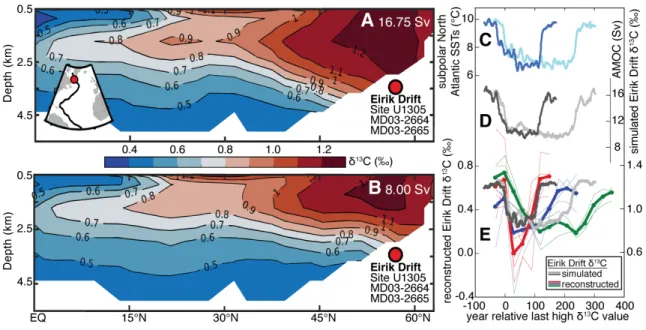
Fig. 4. Modeled and reconstructed deep Atlantic δ13C changes. (Left) The iLOVECLIM
386
simulated δ13C distribution and Eirik Drift core location (red circle) along a north-south
387
transect (inset) averaged for years with: A) strong, modern-like AMOC (>2σ; 16.75±0.70 Sv
388
mean; n=460 model years) and NADW distribution; and B) weaker AMOC (<2σ; 8.00±0.42
389
Sv mean; n=63 model years) and shoaled NADW (see (19) for details). (Right) Across two
390
simulated NADW shoaling events (ten-year mean values): C) subpolar North Atlantic mean
391
sea surface temperature (SST; light and dark blue); D) AMOC stream function at 27°N (light
392
and dark gray); and E) Eirik Drift bottom water δ13C changes (light and dark gray; magnitude
393
similar for different preformed δ13C values, see (19)) compared to the reconstructions by
394
aligning at the last high δ13C values. To illustrate common features that account for interglacial
395
differences in preformed δ13C values, the reconstructed events are shown as the average (bold
396
lines) of multiple events (thin lines) at 30-year steps (obtained by linear interpolation) binned
397
according to durations of ≤100 (red; n=5), 101-200 (blue; n=4), and 201-300 years (green;
398
n=3).
399
20
401 402 403
Supplementary Materials for
404 405
Interglacial instability of North Atlantic Deep Water ventilation
406 407
Eirik Vinje Galaasen, Ulysses S. Ninnemann, Augustin Kessler, Nil Irvalı, Yair Rosenthal,
408
Jerry Tjiputra, Nathaëlle Bouttes, Didier M. Roche, Helga (Kikki) F. Kleiven, David A.
409
Hodell.
410 411
Correspondence to: [email protected]
412 413 414
This PDF file includes:
415 416
Materials and Methods
417 Supplementary Text 418 Figs. S1 to S7 419 References 39-57 420 421
Other Supplementary Materials for this manuscript include the following:
422 423 Data S1 [Eirik-Drift_MIS-7e-9e-11c.xlxs] 424 425 426 427 428 429 430
21 Materials and Methods
431
Sample processing and C. wuellerstorfi stable isotopes
432
The International Ocean Drilling Program (IODP) Site U1305 intervals spanning
433
Marine Isotope Stage (MIS) 7e, 9e, and 11c were identified from the stable isotope stratigraphy
434
of Hillaire-Marcel et al. (39) and continuously subsampled at 2-cm spacing at the IODP
435
Bremen Core Repository by the curatorial staff. Bulk sediment samples were kept in deionized
436
water on a shaker for 12 hours for disaggregation before being wet sieved using a 63 µm mesh
437
sieve to separate the fine (<63 µm) and coarse fraction material (>63 µm). Following wet
438
sieving, samples were dried at 50°C.
439
Epibenthic foraminifera Cibicidoides wuellerstorfi (sensu stricto) shells (Fig. S1) were
440
selectively picked from the >150 µm sediment fraction for stable isotope analyses. The stable
441
isotope analyses were performed at the Facility for advanced isotopic research and monitoring
442
of weather, climate and biogeochemical cycling (FARLAB), Department of Earth Science,
443
University of Bergen, Norway, on a Finnigan MAT 253 mass spectrometer coupled to an
444
automated Kiel IV preparation line kept at constant 70°C. Measurements were performed on
445
one to three individual C. wuellerstorfi shells, depending on availability and size, and
446
duplicated per sample when possible (~64% of the samples analyzed). Fig. S2 shows the C.
447
wuellerstorfi stable isotope results from Site U1305 including all individual data points. We
448
used Carrera Marble (CM12) as a working standard measured parallel to the foraminifera
449
samples, and all values are reported relative Vienna Pee Dee Belemnite (VPDB) calibrated
450
using National Bureau of Standards (NBS) standard NBS 19 and NBS 18. The long-term
451
reproducibility (1σ) of in-house standards over the analysis period was ≤0.08‰ and ≤0.04‰
452
for δ18O and δ13C, respectively. The standard cleaning step for foraminiferal stable isotope
453
analyses, involving methanol and ultrasonication, was avoided to retain mass and increase the
454
number of measurements possible, as C. wuellerstorfi shells were generally few and small in
455
size, often providing a total weight at the lower limit possible for analysis (~10-15 µg). Instead
456
of performing the standard cleaning step, C. wuellerstorfi tests were visually cleaned using a
457
brush and deionized water (‘brush-cleaned’) to remove any foreign material on or within them
458
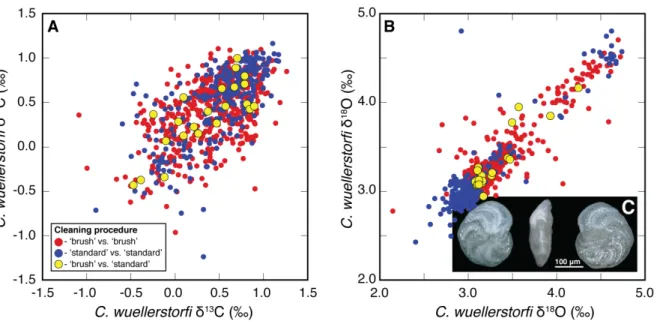
prior to stable isotope analyses. To test the impact of omitting the standard cleaning step, we
459
measured surplus shells from samples (n=22) containing sufficient mass that were cleaned
460
following standard protocols (‘standard-cleaned’) for removing fine-grained material: adding
461
methanol to reaction vials containing the shells and keeping them in an ultrasonic bath for 10
462
seconds before extracting the methanol. The δ18O and δ13C values of the ‘standard-cleaned’ C.
463
wuellerstorfi tests are very similar to the sample average of the ‘brush-cleaned’ tests (Fig. S1).
464
Further, the intra-sample reproducibility of the ‘brush-cleaned’ Site U1305 C. wuellerstorfi
465
δ18O and δ13C data is similar to a large data set of exclusively ‘standard-cleaned’ C.
466
wuellerstorfi shells from the same region (the MIS 5e section of MD03-2664; location shown
467
in Fig. 1) (Fig. S1). This indicates that the visual ‘brush-cleaning’ and ‘standard-cleaning’ steps
468
performed similarly well with no discernible difference in the stable isotope values or in the
469
intra-sample variability. Nonetheless, performing the standard cleaning step for foraminiferal
470
stable isotope analyses is highly recommended when possible. Indeed, in certain regions and
471
time intervals, a cleaning procedure more stringent than the standard one is likely required to
472
accurately determine foraminiferal stable isotope values (40).
473 474
C. wuellerstorfi B/Ca
22
We measured B/Ca ratios in C. wuellerstorfi tests from intervals in MD03-2664 (MIS
476
5e) and Site U1305 (MIS 7e, 9e, and 11c). To obtain sufficient mass for B/Ca analyses
(~250-477
300 µg), and due to scarcity of C. wuellerstorfi tests in these sediments, it was often necessary
478
to combine tests from up to a maximum of six adjacent samples (or 12 cm of core) that we
479
restricted according to consistent C. wuellerstorfi δ13C values. Following the selective picking,
480
the C. wuellerstorfi tests were opened using clean glass slides and transferred into acid-leached
481
vials. The C. wuellerstorfi tests were subsequently cleaned for contaminating phases, including
482
clay removal, reductive and oxidative steps, a weak acid leach, and dissolution in dilute HNO3.
483
The B/Ca analyses were performed using the method outlined in Rosenthal et al. (41) on a
484
Finnigan MAT Element XR Sector Field Inductively Coupled Plasma Mass Spectrometer
485
(ICP-MS) at the ICP-MS laboratory at the Institute of Marine and Coastal Sciences, Rutgers,
486
The State University of New Jersey, USA.
487 488
Site U1305 N. pachyderma (s) δ13C records
489
N. pachyderma (s) tests were selectively picked from the 150-212 µm sediment fraction
490
at continuous 4-cm spacing across MIS 7e, 9e, and 11c (with notable gaps only in MIS 9e due
491
to scarcity of N. pachyderma (s) tests). Prior to the stable isotope analyses, the tests were
492
cleaned by adding methanol to the sample kept in reaction vials and ultrasonicating them for
493
ten seconds before removing the supernatant. The stable isotope analyses were performed at
494
FARLAB, University of Bergen, Norway, as outlined for benthic foraminifera C. wuellerstorfi
495
above, and with identical standard reproducibility. Measurements on N. pachyderma (s) were
496
replicated whenever possible (~92% of the samples), and each individual measurement was
497
performed on 6-10 individual N. pachyderma (s) tests.
498 499
Ice-rafted debris
500
The ice-rafted debris (IRD) counts were performed on the same Site U1305 samples as
501
the benthic foraminiferal stable isotope measurements, but at lower sampling density. IRD
502
counts were performed at 32-cm spacing for MIS 7e and 11c, and 16-cm spacing for MIS 9e
503
(42). Following the sample processing steps outlined above, material in the >150 µm fraction
504
were split, IRD grains visually identified, and IRD calculated as the percent of ≥300 counted
505
entities.
506 507
Hole U1305C MIS 11c mcd fine-tuning
508
Sediment physical properties (e.g., magnetic susceptibility) indicated cm-scale offsets
509
between Hole U1305C and the original (Hole A & B) splice over ~74.5-78.5 mcd (Fig. S3A),
510
corresponding to most of MIS 11c. We fine-tuned the mcd scale for the Hole U1305C MIS 11c
511
interval using magnetic susceptibility, shifting it between -3 cm and -19 cm to align the
512
physical property records (Fig. S3B), and include both the original and corrected core depth
513
scales in the MIS 11c data table.
514 515
iLOVECLIM model simulation
516
We used the iLOVECLIM Earth system model of intermediate complexity to simulate
517
and assess potential relationships between NADW distribution, northwest Atlantic bottom
518
water δ13C, and AMOC. The iLOVECLIM model is an isotope-enabled development branch of
519
LOVECLIM version 1.2 (43) and includes an ocean component (CLIO) with 20 vertical layers
520
and 3° by 3° horizontal resolution as well as land and ocean carbon cycle modules (25). We
23
performed a transient simulation for 125-115 ky (corresponding to MIS 5e) using annually
522
interpolated greenhouse gas and orbital forcings following the third phase of the Paleoclimate
523
Modelling Intercomparison Project (PMIP; https://pmip3.lsce.ipsl.fr/), initialized from a
quasi-524
equilibrium spin up of 5000 years forced with constant 125 ky boundary conditions. We
525
performed two quasi-equilibrium spin-ups prior to the 125-115 ky simulation, each integrated
526
for 5000 years. The first is based on preindustrial conditions and the second on 125 ky
527
boundary conditions. The preindustrial simulation was used to validate and confirm that
528
iLOVECLIM reproduces the spatial distribution of preindustrial ocean δ13C (22), and the 125
529
ky spin-up to initialize the 125-115 transient simulation. To test the sensitivity of the simulated
530
deep Atlantic δ13C variability to changes in surface biological processes and preformed δ13C
531
values, we ran to additional 125-115 ky transient simulations using similar initial conditions as
532
above but starting at 125 ky with either: 1) atmospheric δ13C fixed at value decreased by
533
~0.6‰ (at -7.1‰); or 2) with 50% decreased primary productivity in the modeled convection
534
regions off southern Greenland and in the Nordic Seas. We expand on the model results in the
535
discussion section of the supplement below.
536
The modeled inorganic carbon cycle is represented by dissolved inorganic carbon
537
(DIC) and alkalinity (ALK), while the organic carbon cycle includes phytoplankton,
538
zooplankton, dissolved organic carbon (DOC), slow dissolved organic carbon (DOCs),
539
particulate organic carbon (POC), and CaCO3. The phytoplankton is partially remineralized as
540
it sinks through the water column, while all the POC and CaCO3 is remineralized at depth. The
541
remineralization profile follows an exponential law, adjusted to have less remineralization in
542
the upper layers and more at depth. Carbon fractionation during photosynthesis fixes 12C in the
543
organic matter, which is added back by the remineralization process at depth. At the air-sea
544
interface, the carbon flux is computed from the CO2 partial pressure difference between the
545
atmosphere and ocean at a constant gas exchange coefficient of 0.06 mol m-2 yr-1, where sea
546
surface pCO2 is a function of temperature, salinity, DIC, and ALK following Millero (44). The
547
modeled δ13C distribution is thus affected by air-sea gas exchange and organic matter
548
production/remineralization, and transported by the advection-diffusion scheme of the model.
549
Unlike 12C, the atmospheric 13C is prognostically simulated in response to land and ocean
550 processes. 551 552 Supplementary Text 553
Site U1305 age model
554
The age models for the MIS 7e, 9e, and 11c intervals of Site U1305 were constructed
555
by correlating our benthic δ18O record to and adopting the age model constructed for ODP Site
556
983 (33, 45) (Fig. 2, Fig. S4). Using Site 983 benthic δ18O as a tuning target has advantages
557
over other reference records. First, Site U1305 shares well-defined structures in benthic δ18O
558
with Site 983 (Fig. 2; Fig. S4) allowing relatively robust correlation. Further, high-resolution
559
IRD records are available from both sites and allow us to validate the benthic δ18O-correlation
560
near deglacial intervals where Site U1305 benthic δ18O data were often lacking due to C.
561
wuellerstorfi absence (Fig. 2). Tie points were defined based on major benthic δ18O transitions
562
and linearly interpolated between to obtain ages for all core depths (Fig. S4). The Site U1305
563
and MD03-2664 IRD records were also used to guide the determination of tie points at the start
564
of the interglacial δ18O plateaus, as deglacial IRD increases are observed to coincide with
565
transient decreases in benthic δ18O values before MIS 5e (10) and MIS 7e, 9e, and 11c in this
24
region (Fig. 2; Fig. S4). Given their transient nature and co-occurrence with deglacial IRD,
567
these deglacial benthic δ18O reductions may reflect contamination from low-δ18O detrital
568
carbonate commonly deposited during Heinrich-events (40). Consequently, deglacial samples
569
with low C. wuellerstorfi δ18O and high IRD were disregarded when we constructed our age
570
model and we defined the first interglacial benthic δ18O value, and start of the interglacial
571
plateaus, as the first continuously low δ18O value occurring after large deglacial IRD increases.
572
Corroborating this approach, the Site U1305/MD03-2664 and Site 983 deglacial IRD peaks
573
align using this additional constraint for the benthic δ18O tuning (Fig. S4) but would otherwise
574
be offset by a few thousand years.
575
Age uncertainties involved with benthic δ18O-based age models can be considerable.
576
For example, age differences between major δ18O transitions can reach up to a few thousand
577
years between different ocean basins (46). The absolute age uncertainty provided by the Site
578
U1305-Site 983 correlation is likely less than millennial, given i) the relative proximity of
579
these core sites, ii) the similarity of the benthic δ18O records—indicating a shared δ18O
580
evolution, and iii) the alignment of deglacial IRD peaks (Fig. 2; Fig. S4). Despite a relatively
581
robust correlation, the original age model still carries considerable uncertainty in absolute ages.
582
For example, adopting a different age model constructed for Site 983 by Barker et al. (45) (e.g.,
583
EDC3 and AICC2012), would shift absolute ages up to a few thousand years.
584
In addition to absolute age uncertainties, relative (sample-to-sample) age uncertainties
585
likely also exist for the Eirik Drift (Site U1305 and MD03-2664) records. Correlation of
586
benthic δ18O records is achieved using a limited number of tie points. This is especially true for
587
interglacial δ18O plateaus, here defined by two (MIS 5e, 7e, and 9e) or three (MIS 11c) tie
588
points (Fig. 2, Fig. S4). These tie points were linearly interpolated between, assuming constant
589
sedimentation rates. However, interglacial sedimentation rates can vary on a range of
590
timescales in this area (39, 47-49). For example, radiocarbon-dated sections indicate that
591
sedimentation rates were higher in the early compared to the late phase of the current
592
interglacial at multiple Eirik Drift locations (e.g., 12, 48). If this temporal sedimentation pattern
593
persisted in the older interglacial periods, our age models based on the conservative approach
594
of linear interpolation may over- and underestimate the durations of early and late interglacial
595
intervals, respectively.
596 597
Site U1304, MD03-2664, MD03-2665, and MD99-2227 age models
598
To place all proxy records on a common age scale, we revised the age models for all
599
core intervals containing data we compare to the IODP Site U1305 records. We tuned the MIS
600
5e interval of MD03-2664 and the MIS 5e, 7e, 9e, and 11c intervals of IODP Site U1304 to the
601
same ODP Site 983 reference record (Fig. S4), applying identical tie points and linearly
602
interpolating between as outlined above. The MIS 1 and last deglacial intervals of Site U1304
603
and MD03-2665 were left on their original age models as presented in Xuan et al. (38) and
604
Kleiven et al. (12), respectively.
605
To compare our records to the MD99-2227 southern Greenland sediment discharge
606
reconstructions (18, 32, 36), we transferred our benthic δ18O-based age models for MIS 5e
607
(MD03-2664), 7e, 9e, and 11c (Site U1305) to MD99-2227 by correlating magnetic
608
susceptibility between this core and MD03-2664 (MIS 5e) and Site U1305 (MIS 7e, 9e, and
609
11c) (Fig. S5). The strong similarity of the magnetic susceptibility records indicate that these
610
core sites shared sedimentation histories, providing robust relative age control to comparisons
611
of the Site U1305/MD03-2664 and MD99-2227 records. The alignment of glacial and
25
interglacials values in epibenthic foraminifera C. wuellerstorfi δ18O from MD03-2664/Site
613
U1305 and planktic foraminifera N. pachyderma (s) δ18O from MD99-2227 on the obtained
614
age models supports the magnetic susceptibility correlation (Fig. S5). Carlson et al.’s (50) age
615
model was used for the MIS 1 and last deglacial intervals of MD99-2227.
616 617
C. wuellerstorfi B/Ca and N. pachyderma (s) δ13C
618
To test the fidelity of Eirik Drift C. wuellerstorfi δ13C as recorder of bottom water
619
carbon chemistry and water mass tracer, we use epibenthic foraminifera C. wuellerstorfi B/Ca,
620
a proxy for bottom water carbonate ion saturation (Δ[CO32-]) and independent metric of the
621
influence of high-[CO32-] NADW versus low-[CO32-] SSW (e.g., 51, 52). The Eirik Drift C.
622
wuellerstorfi B/Ca data span a range of 185-215 µmol/mol with distinct changes within each of
623
MIS 5e, 7e, 9e, and 11c (Fig. S6). Using Yu & Elderfield’s (51) B/Ca to Δ[CO32-] relationship
624
for C. wuellerstorfi, the B/Ca data indicates intra-interglacial changes in bottom water [CO32-]
625
by 25-30 µmol/kg, similar to that expected from shifting between NADW and SSW influence
626
(e.g., 52). The concurrent and coupled changes in C. wuellerstorfi δ13C by up to ~0.8‰ within
627
the same sample pool (Fig. S6) is similarly consistent with shifts between NADW and SSW
628
influence. Indeed, the paired change in Eirik Drift C. wuellerstorfi B/Ca and δ13C we observe is
629
similar to that recorded in the last glacial to Holocene sections of two North Atlantic cores
630
from similar water depths (Fig. S6) that was previously interpreted to reflect the
well-631
established deglacial shift from SSW to NADW influence in the deep North Atlantic (52). We
632
suggest that the Eirik Drift C. wuellerstorfi B/Ca record supports the interpretation of the C.
633
wuellerstorfi δ13C variability as reflecting changes in NADW versus SSW influence.
634
An alternative explanation for co-variability in trace element ratios and δ13C is
635
contamination by secondary CaCO3 precipitation and presence of authigenic overgrowths.
636
However, several lines of evidence argue against a role for contamination by secondary CaCO3
637
precipitation. The C. wuellerstorfi δ13C record suggest no discernible influence by its own
638
merit, showing for example i) absolute values within the range of values observed in the
639
modern ocean or relevant reconstructions (e.g., 22, 23; Fig. 3) and ii) a consistency in the
640
signal and a lack of extremely large fluctuations that would require the mass and isotope value
641
of any contamination to have adjusted itself to balance changes in the mass and isotope value
642
of the foraminifera tests. Further, secondary CaCO3 precipitation should, if present, influence
643
all foraminifera tests in a given core depth to some degree similarly. That is, if secondary
644
CaCO3 precipitation drove relatively large changes in C. wuellerstorfi δ13C and B/Ca, planktic
645
foraminifera δ13C should also show low δ13C values in addition to some degree of
co-646
variability. The Eirik Drift N. pachyderma (s) δ13C records from MIS 5e, 7e, 9e, and 11c do not
647
show values as low as the C. wuellerstorfi δ13C records and there is no significant relationship
648
between N. pachyderma (s) and C. wuellerstorfi δ13C (Fig. S6). In sum, we suggest secondary
649
CaCO3 precipitation is either unimportant or entirely absent and consider it as an unlikely
650
explanation for the co-variability in C. wuellerstorfi B/Ca and δ13C. Changes in the influence
651
of NADW versus SSW could conversely explain these observations.
652 653
iLOVECLIM model simulation results
654
We identified persistent centennial-scale variability in δ13C and the distribution of
655
NADW in our 125-115 ky transient simulation occurring over a ~6 ky long interval in-between
656
intervals of relative stability during the initial 2-3 and final 1-2 ky. A subsequent study will
657
outline and discuss the results of the model simulation in detail (Kessler et al., in prep.). Here,
26
we use the simulation to help the interpretation of the reconstructed bottom water δ13C
659
variability by assessing how centennial-scale changes in NADW distribution can impact deep
660
Atlantic δ13C. We focus on the simulated episodes of NADW shoaling and recovery to assess
661
the possible rate, duration, and magnitude of water mass distribution and associated bottom
662
water δ13C changes and compare these to the reconstructed δ13C variability. In the simulation,
663
episodes of NADW shoaling were abruptly initiated, lasted some centuries, and were
664
associated with decreases in AMOC strength and North Atlantic bottom water δ13C (Fig. 4).
665
The simulated episodes of NADW shoaling/deepening produced distinct North Atlantic
666
bottom water δ13C variability as (low-δ13C) Southern source water (SSW) expanded/contracted
667
in concert with (high-δ13C) NADW contracting/expanding (Fig. 4). In the northwest Atlantic
668
region corresponding to the location of Eirik Drift core sites U1305, 2664, and
MD03-669
2665, shoaling of NADW and incursions of SSW manifested as ~0.4‰ decreases in bottom
670
water δ13C achieved over a few decades, events that ended equally abrupt as NADW deepened
671
some centuries (~100-500 years) later (Fig. 4). To illustrate these NADW and δ13C distribution
672
changes, Fig. 4A and Fig. 4B displays the North Atlantic mean δ13C distribution below 500 m
673
water depth for all simulated years with anomalously strong AMOC (>2σ; n=460 model years;
674
mean AMOC strength: 16.75±0.70 Sv) and anomalously weak AMOC (<2σ; n=63 model
675
years; mean AMOC strength: 8.00±0.42 Sv), respectively. We further selected two simulated
676
intervals of NADW shoaling and recovering to compare to the reconstructed bottom water δ13C
677
variability (Fig. 4B), differing from other simulated shoaling episodes only in duration. The
678
magnitude of any bottom water δ13C variability driven by such changes in the relative
679
influence of northern versus southern source water could depend strongly on the preformed
680
δ13C of, and the gradient between, competing water masses. While iLOVECLIM captures the
681
preindustrial preformed δ13C of northern and southern source waters relatively well (e.g.,
682
compare Fig. 1 to Fig. 4A), proxy records suggest considerable changes in preformed water
683
mass δ13C occurred between and even within past interglacial periods. For example, the
684
preformed δ13C of northern source water may have been higher in the Holocene than the late
685
Pleistocene interglacials (see data composites, purple lines, in Fig. 3), while it likely increased
686
across MIS 5e (Fig. 3) consistent with planktic and epibenthic foraminifera δ13C records from
687
the Nordic Seas (e.g., 53). This model-data difference should be noted when comparing and
688
contrasting the simulated and reconstructed time series. For the proxy reconstructions, we took
689
this into account by averaging multiple events in order to illustrate common features
690
independent of specific interglacials and preformed δ13C values (Fig. 4). Still, the similarity of
691
the modeled and reconstructed bottom water δ13C changes could result from the simulation
692
having a specific set of preformed δ13C values in NADW and SSW. To assess how different
693
background states and preformed δ13C in NADW and SSW could impact the magnitude and
694
character of the simulated bottom water δ13C variability, we reran the simulation twice with 1)
695
atmospheric δ13C lowered by ~0.6‰ and 2) 50% decreased primary productivity in the
696
simulated deep water formation regions off southern Greenland and in the Nordic Seas. Both
697
experiments shift the absolute values of the simulated Eirik Drift bottom water δ13C time series
698
but in both cases the relative magnitudes and character of the variability is only negligibly
699
impacted (Fig. S7). The simulation with perturbed primary productivity, resulting in limited
700
change in deep Atlantic δ13C, supports previous studies suggesting that organic carbon fluxes
701
have little influence on the δ13C of C. wuellerstorfi (e.g., 21). Thus, the character of the Eirik
702
Drift bottom water δ13C variability driven by shifts in the distribution of water masses appears
703
to be relatively stable in face of different preformed δ13C values and background biological



![[PDF] Cours UML diagramme d’état enjeux et pratique | Cours informatique](data:image/gif;base64,R0lGODlhAQABAIAAAP///wAAACH5BAEAAAAALAAAAAABAAEAAAICRAEAOw==)