
HAL Id: cea-01649981
https://hal-cea.archives-ouvertes.fr/cea-01649981
Submitted on 28 Nov 2017HAL is a multi-disciplinary open access archive for the deposit and dissemination of sci-entific research documents, whether they are pub-lished or not. The documents may come from teaching and research institutions in France or abroad, or from public or private research centers.
L’archive ouverte pluridisciplinaire HAL, est destinée au dépôt et à la diffusion de documents scientifiques de niveau recherche, publiés ou non, émanant des établissements d’enseignement et de recherche français ou étrangers, des laboratoires publics ou privés.
staircase of magnetised plasmas. Nuclear Fusion, IOP Publishing, 2017, 57, pp.066026. �10.1088/1741-4326/aa6873�. �cea-01649981�
This content has been downloaded from IOPscience. Please scroll down to see the full text.
Download details:
IP Address: 132.169.10.52
This content was downloaded on 26/04/2017 at 12:52 Please note that terms and conditions apply.
The E × B staircase of magnetised plasmas
View the table of contents for this issue, or go to the journal homepage for more 2017 Nucl. Fusion 57 066026
(http://iopscience.iop.org/0029-5515/57/6/066026)
We show that out-of-equilibrium magnetically confined near-marginal plasmas tend to naturally evolve towards a globally-organised critical state of spatially segregated microbarriers for transport and sectors of strong avalanche-like transport. We call this global pattern of avalanching sectors interspersed with narrow confining microbarriers the E×B staircase [1]. The present paper is concerned with discussing the factors that control this spatial segregation, the dynamics of this global organisation as well as its incidence on confinement.
The regime of near-marginality [2] is not merely academi-cally-appealing for its rich dynamics and manifestations of self-organisation. It is as well a likely operating regime for current and future magnetic confinement devices. Non-burning iter plasmas for instance, characterised by a large ratio of plasma volume over external heating are likely to reside close to marginal stability.
Relaxation through emission of fronts or avalanches [3–8] and turbulence regulation through zonal flow formation [9, 10] are natural trends of near-marginal drift-wave turbulence. One of the merits of E×B staircase patterning is certainly to pro-vide, whilst segregating regions where avalanching is domi-nant from regions where zonal flow concentrates (forming the staircase microbarriers) a natural and dynamic means for both antagonistic trends to simultaneously exist.
Salient features of the E×B staircase are represented in figures 1 and 2 and summarised below:
(i) Ubiquitous signatures of staircase formation are mean profile corrugations, reflecting the propensity of an
initially homogeneous near-marginal profile in a bath of drift-wave (or Rossby wave) turbulence to develop inhomogeneities that will tend to self-sharpen and endure. Self-sharpening relies upon positive feedback and may occur e.g. through negative viscosity-like argu-ments [11–14], clustering instability [15–17] or electric field curvature [18]. Which mechanism is operative in what region of parameter space is still unclear and will be focused on elsewhere. The mean pressure profile
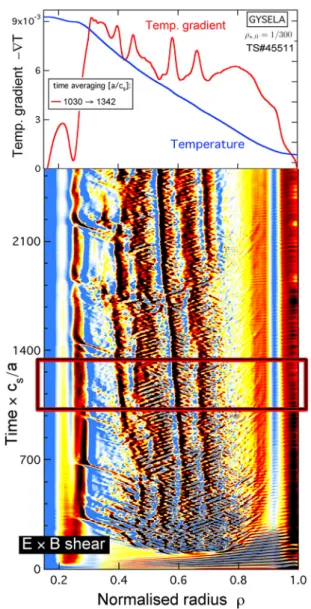
corrugations lead to strong localised temperature gradients (the ‘risers’ in figure 1). The name staircase comes from the step-like idealised resulting pressure profile with, statistically, quasi-constant mesoscale step spacing ∆. Corrugations are shown in figure 2 on the mean ion temper ature gradient ∇T temporally-averaged over 0.53 ms between 1030a c/ s and 1343a c/ s. The step size ∆ is discussed below, item (v);
(ii) Co-located with the mean profile corrugations are zonal mean flows (section 2.2) or vorticity jumps that define lasting (from a few collision times to [at least] fractions of the energy confinement time) ‘valleys’ in configu-ration-time space of hindered transport. These zonal mean flows, of typical radial extent δflow∼ 10ρs act as a set of weak or permeable transport barriers [19–21] that regulate the turbulent heat flux (section 2.3). They are thus also referred to as ‘microbarriers’ throughout the paper and are visible in figure 2 as coherent flux-1 CEA, IRFM, F-13108 St. Paul-lez-Durance cedex, France
2 Department of Applied Physics, Ghent University, 9000 Gent, Belgium E-mail: [email protected]
Received 15 December 2016, revised 14 March 2017 Accepted for publication 22 March 2017
Published 26 April 2017
Abstract
We show that a class of near-marginal and low-collisional magnetised plasmas naturally evolve into a globally organised state dubbed the ‘E×B staircase’. A key signature of this self-organised state is the containment of avalanche activity, detrimental for confinement, by a series of microbarriers for transport, the staircase steps, beneficial for confinement. Conditions for existence of the E×B staircase, impact on transport and confinement and robustness in parameter space are discussed.
Keywords: turbulence, self-organisation, magnetised plasma (Some figures may appear in colour only in the online journal)
G. Dif-Pradalier et al
The E×B staircase of magnetised plasmas
Printed in the UK 066026 NUFUAU © 2017 CEA NF 10.1088/1741-4326/aa6873
Paper
6 1741-4326surface averaged E×B shear γE B× = ∂r r( / )E rBr . The flux-surface averaged poloidal ⟨ ⟩v vr θ and toroidal ⟨v vrϕ⟩ Reynolds stresses, the parallel momentum flux M∥ and the poloidal vθ and toroidal flows vϕ similarly display long-lived structuring close to the mean profile corruga-tions. Regarding poloidal rotation, the turbulence-borne temperature corrugations at the staircase steps
neoclas-sically drive [22] localised poloidal rotation ∝ ∇T there, an example of synergistic interplay between collisions and turbulence [23];
(iii) The E×B staircase is a near-marginal pattern that progressively weakens and disappears with increasing distance to instability threshold (section 1.1);
(iv) The E×B staircase is a weakly collisional pattern, as expected from the fact that its microbarriers are zonal mean flows, hence sensitive to collisional damping [24] (section 1.2);
(v) Avalanches, in low to moderately heat-driven plasmas are ubiquitous. They play an important role for stair-case dynamics given the near-marginal character of the latter. Avalanching is the dominant transport mechanism in-between the staircase shear layers (the ‘treads’ in figure 1), see item (vi) below. Avalanches, importantly, are statistically contained by the staircase
steps (section 2.4.1) and rarely propagate across suc-cessive staircase shear layers and over a significant fraction of the plasma volume. The size distribution of avalanches therefore closely follows the size distribu-tion of ∆ (the ‘tread width’ or ‘step size’). The most probable step size ∆ ∼ 40stat ρs is mesoscale (section 2.4.2), implying a favourable mesoscale (and not a macro-scale) most probable scale length for avalanches. Interestingly, despite strongly non-Gaussian statistics the staircase mesoscale ∆stat reintroduces a favourable
gyro-Bohm like scaling for heat confinement (section 2.4); (vi) Due to the avalanche activity, mixing in the ‘treads’
is strong. Profiles there are stiff and transport is
non-local and non-diffusive, best described by a Lévy or a Lorentzian transport kernel of width ∆ [1]. In the regions of the ‘risers’, heat transport is dominantly neoclassical [20], emphasising the fact that these regions are microbarriers for transport. ∆ ∼ 40stat ρs is
a natural ‘nonlocal’ scale for the system, in addition to the ‘local’ autocorrelation microscale of the turbulence c∼ −5 8ρs. These two micro- and mesoscales, shown in figure 3 echo the two-scale turbulence correlation length [25] recently measured in Asdex-Upgrade. The measured mesoscale is a possible experimental charac-terisation of avalanche-staircase interplay;
(vii) The flux-gradient relation is often multivalued and
non-monotonic near marginal stability, in contrast to oft-reported results in Ion Temperature Gradient turbulence [26]. In particular local values of the fluxes may not bijectively relate to local values of the gradients as dif-ferent gradient drives may be associated to the same flux (multivalued) and larger gradient drives may be associ-ated to lower fluxes (non-monotonic). Observation of coherent structures, as discussed here for the E×B staircase is often indication of a breakdown of the local
Figure 1. The E×B staircase, schematic view.
Figure 2. Three general features of the plasma staircase are
visible here: (i) the mean profile corrugations here displayed on the temperature gradient, (ii) the strong, long-lived and coherent shear flows defining ‘valleys’ of hindered transport—the mean radial E×B shear profile is shown in figure 11 (left) and (iii) the radial transport dominated by avalanche-like events in-between the staircase steps.
flux-gradient paradigm. This point is evoked in sec-tion 2.3 and will be further discussed elsewhere; (viii) The whole staircase pattern dynamically evolves and
meanders, river-like over intermediate to long (col-lisional to confinement) timescales as the staircase steps show propensity to remain at constant ambient gradient drive (section 3.2);
(ix) Where staircase steps (risers) nucleate does not rely upon special values of low-order safety factor q rationals, yet synergistic reinforcement of shear layers, as they meander, in proximity of a low-order q rational is sometimes observed (section 3.1). Passing electron dynamics may also modify turbulence organisation near low-order q rationals [27]. This is left for future work. The results in this paper highlight robust properties of the E×B staircase and their impact on transport in L-mode-like plasmas. The discussion is based upon tens of gyrokinetic calculations representative of varying plasma parameters in drift-wave ion temperature gradient (ITG) turbulence with Boltzmann electrons, using the gysela code [28, 29]. Different main ion species are considered: Hydrogen, Deuterium or Helium, different collision-alities ν = 0 and ν ∈ 0.005, 10 ,0 [ ], different plasma sizes ρ ∈− 128, 512
,01 [ ]
, different gradient drives R L/ T∈[2, 12] or η =L Ln/ T∈[ ]1, 6, different heating mechanisms: thermal baths, gradient-driven and flux-driven and different boundary conditions. The subscript 0 stands for initial evaluation at mid-radius.
The main caveat of the present study lies in the assump-tion of a Boltzmann electron response which may impact turbulence organisation, especially in the vicinity of rational
q surfaces [27]. Realistic flux-driven computations including both kinetic ion and electron responses are required to assess the generic character of staircase organisation, especially as ion and electron channels may interplay [21]. Such compu-tations are unfortunately beyond reach of today’s capabili-ties. A confidence-building step in the direction discussed throughout the paper comes from the robust observation of such patterns in varieties of experimental plasma conditions [20, 21].
1. Staircases in parameter space: near-marginal and low-collisional
Whilst exploring plasma parameters, distance to instability threshold (distance to marginality) and collisionality stand out as key for E×B staircase organisation.
1.1. A near-marginal pattern
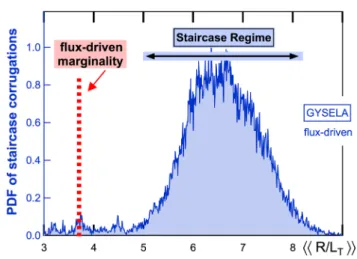
Temperature profile corrugations are ubiquitous staircase sig-natures. It is possible to systematically track in time the loca-tion rstep of these corrugations. These locations are themselves function of the thermodynamic gradients: rstep(L LT, n). Figure 4 represents the PDF of staircase corrugations as a function of 〈〈 / 〉〉R LT , i.e. the probability density of observing staircase microbarriers as a function of ambient gradient drive. This
‘ambient drive’ 〈〈∇T T/ 〉〉≡ ∇〈〈 〉〉/〈〈 〉〉T T is the temperature gradient length at the location of the corrugation, should this corrugation not exist [20]. Practically, it is computed from the time-averaged and radially-smooth temperature profile 〈〈 〉〉T — hereafter referred to as ‘background’, or ‘ambient’ state— with corrugations removed, i.e. smoothly interpolated at the location of corrugations from the temperature profile on both sides of the corrugation3.
The data in figure 4 is based on the flux-driven data of figure 2 during 6500 cs/a, with cs=( / )Te,0mi1 2/ the sound speed evaluated at mid-radius, Te the electron temperature and
mi the ion mass. In this dataset, 〈〈 / 〉〉R LT varies with time and radius between 〈〈 / 〉〉R LT =3 close to the source region ρ ∼ 0.3 and 〈〈 / 〉〉 =R LT 9 near to the edge ρ ∼ 0.85. Regardless of the precise choice for the selected computation, main features in figure 4 are robust.
Clearly, staircase organisation exists in a precise range of gradient drives, here: 〈〈 / 〉〉 [ ]R LT ∈ 5, 8. Let us call ‘marginality’
Figure 3. Autocorrelation of the electrostatic potential. Two slopes
are found: the local autocorrelation length c∼ 6ρs is microscale, the mesoscale is indicative of avalanches and therefore noted ∆
(see section 2.4.1). Figure 4.flux-driven normalised gradient drive Where the E×B staircase exists as a function of the R L T
〈〈 / 〉〉. Marginality for these parameters is indicated.
3 Anticipating results below, in gradient-driven computations (see appendix A for definitions) as no corrugations may develop, by definition 〈〈 / 〉〉R LT
coincides with the time-averaged R/LT. In the flux-driven case 〈〈 / 〉〉R LT is
very close to the time-averaged gradient-driven R/LT everywhere except in
the vicinity of profile corrugations (staircase steps), as shown in figure 15(a), bottom panel.
(or ‘criticality’) the normalised gradient at which the turbu-lent heat flux becomes greater than the neoclassical heat flux. The turbulence-dominated regime starts at marginality. E×B staircase onset is a near-marginal phenom enon, residing in the low-heating limit [20, 30] of flux-driven forcing. Some turbulence activity is indeed necessary to fuel the positive feedback between zonal mean flows and mean profile cor-rugation (sections 1.2.1 and 2.2) and allow for the staircase onset. Starting at flux-driven marginality 〈〈 /R LTF-D〉〉≈3.8 and increasing the gradient drive, a narrow region 〈〈 / 〉〉 [R LT ∈ 3.8, 5] of intermittent turbulence activity is thus first found before entering the ‘staircase regime’ 〈〈 / 〉〉 [ ]R LT ∈ 5, 8. In that region 〈〈 / 〉〉 [R LT ∈ 3.8, 5] avalanches carry a non-vanishing turbulent heat flux, even at vanishing collisionality [31]. The system is strongly intermittent, mean flows are rapidly destroyed and turbulence is regulated by fluctuating zonal disturbance flows (see appendix A for definitions). When entering the stair-case regime, the flux-gradient relation is modified and heat transport is now controlled by the staircase shear layers, as
illustrated in figure 15. Farther from marginality (here above 〈〈 / 〉〉 ⩾R LT 8), free energy is large, staircase organisation is progressively destroyed and flux- and gradient-driven trans-port are expected to become more similar. Staircase organisa-tion thus appears as a natural tendency for the near-marginal turbulent system.
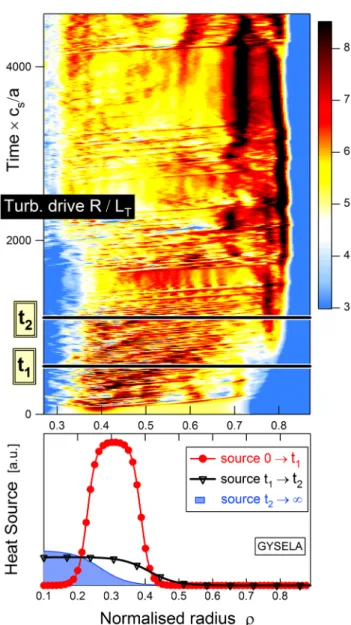
To further illustrate this near-marginal character, the fol-lowing numerical experiment is run, summarised in figure 5. Collisionality is moderate: ν = 0.1 (see next section 1.2) and kept constant across the radius so that collisional damping of zonal flows is weak and comparable between core and edge. The safety factor is parabolic and monotonically increasing between q = 1.16 at the centre and 2.4 at ρ = 0.9. A strong transient initial heat source centred around ρ = 0.3 (bottom figure) is incrementally decreased in amplitude and shifted radially at times t1=553a c/s and t2=1111a c/ s. The idea is to investigate in a test case with homogeneous zonal flow damping the dynamics of turbulence organisation as the temper ature profile reorganises.
In the initial stage t∈[0,t1], driven by the strong source, the temperature gradient transiently increases far above mar-ginality 〈〈 / 〉〉R LT ∼ −9 10 in the central region ρ =0.3−0.5 resulting in a strong avalanching activity clearly visible in figure 5 until a little after t2. Even though at time t1 the source is reduced, the system unsurprisingly responds with a time delay to the strong initial drive. Unsurprisingly also, the dominant mechanism through which the plasma disposes of its large free energy content is through the emission of heat
avalanches, i.e. through intermittent mean profile relaxations. Through avalanching the system becomes stiff: this mech-anism is faster and more efficient than relying upon diffusion to mitigate developing strong gradients.
Whilst the supercritical core region intermittently responds to the strong energy injection, the edge region between ρ =0.7−0.8 is close to criticality with gradient drives
R LT
〈〈 / 〉〉 in the range between 3 to 6 [the linear instability threshold is around 4.5]. Given these conditions the first stair-case step is observed to nucleate around time t=830a c/ s and close to ρ = 0.8, a location uncorrelated to a low-order q rational (section 3.1). As the source decreases the temperature gradient reorganises, relaxing outside-in towards criticality. Following the relaxing temperature gradient (section 3.2), the staircase also builds up outside-in as larger regions of the plasma become near-critical.
The intermittent character of the system (generic even though especially visible in the early stages of this experi-ment and close to the source region) is not deeply modi-fied by the emergence of the staircase pattern. Intermittency remains through avalanche emission a key manifestation of the system, see e.g. [7, 32–34]. The onset of the staircase pat-tern however does mitigate the radial extent of the propagating heat avalanches [1], allowing for better heat confinement as the pattern builds up. This point is specifically discussed in sections 2.3 and 2.4 and differently illustrates the somewhat counter-intuitive idea present in figure 15 that a system (flux-driven) described by strongly non-Gaussian statistics may have better confinement properties than a related system (gradient-driven) that is statistically closer to Gaussianity.
Figure 5. A numerical experiment to illustrate the importance of
proximity to marginality for staircase onset and development and the importance of avalanching for relaxation.
The essential difference residing in the microbarrier pat-terning, constitutive of the staircase.
1.2. A low-collisionality pattern
Zonal flows are linearly damped through collisions alone [24]. Steps of an E×B staircase constitute an organised pattern of zonal mean flows (see also section 2.2). An upper bound on collisionality (on the strength of collisional dissipation) is expected for this pattern to exist. Scans in collisionality, in varying plasma conditions are now discussed.
1.2.1. Commonly observed at low collisionality. In the low-collisional banana regime [35] (normalised ion–ion col-lisionality ν ⩽1), extensive scans in collisionality in the range ν ∈ 0.001, 0.5 [ ] have consistently shown a weak or negligible impact of this parameter on staircase organisation. An example is shown in figure 6 where two computations are compared, differing through a tenfold increase in collisional-ity. In realistic cases collisionality significantly varies across the radius, following density n, temperature T, safety factor
q and aspect ratio ε−1=R r/ variations as typically shown in figure 9 (inset): ν ν ν π π = qR = Λ v n e m v , with 4 3 log 4 T ii ii T 0 3 2 4 0 2 2 3 ( ) / ε ε (1) the ion–ion collision frequency, vT=( / )T m1 2/ the thermal velocity, R the major radius, ε0 the permittivity of free space and logΛ ≈17 the Coulomb logarithm [36, 37]. In the com-putations of figure 6, in contrast with the rest of the paper, collisionality is artificially set constant across the radius to precisely test the impact of collisional dissipation on the flow and profile organisation, disentangled from its profile variations.
Fluctuations of the temperature gradient are shown during respectively one collision time (ν = 0.5 ) and 0.6 collision time (ν = 0.05 ). As expected, the magnitude of shear at the staircase steps is slightly larger at weaker collisionality; cor-rugations are also slightly more marked. The overall influence however of ν on staircase organisation is weak in the low-collisional banana regime.
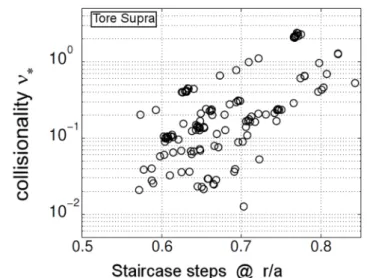
Experimentally, core plasma main ions are typically in banana regime. Staircase signatures are common there, as shown from the Tore Supra data in figure 7, processed for staircase identification as detailed in [20, 21]. About 200 experimental staircase signatures are shown. Interestingly, such signatures disappear at the banana-plateau transition (around ν ≈ 1 ) and none has been observed so far in the pla-teau regime, ν ⩾3–4, an indication confirmed by computa-tions (see following section) that collisionality starts playing an important role at the banana-plateau transition (hence will play a role closer to the plasma edge region) through effective damping of the staircase microbarriers.
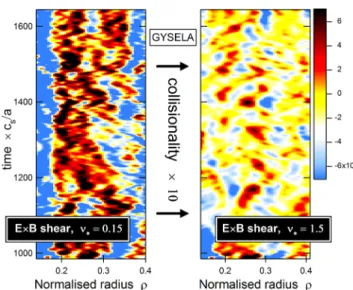
1.2.2. Disappearance at higher (plateau) collisionality. Ubiquitous in the low-collisional banana regime, staircase organisation progressively disappears in the range ν ∈ 1, 5 [ ] at the banana-plateau transition. Identification of staircase-like structures in plateau collisional regimes is hardly possible due to the increased collisional dissipation and hence short zonal mean flow lifetime. Figure 8 shows the behaviour of a step layer whilst crossing the banana-plateau transition. The low-collisional banana regime computation (left panel, ν = 0.15 at ρ = 0.3) exhibits the typical staircase pattern discussed above. We show here the detail of one of its shear layers around ρ = 0.25, with complex merger and division dynamics. The right panel shows an otherwise identical com-putation, except for a tenfold increase in collisionality (pla-teau regime, ν = 1.5 at ρ = 0.3). The time interval for which data is displayed and the colourbars are identical. As expected, both mean and disturbance E×B shear are weaker in the pla-teau regime. Interestingly, fluctuations in temperature remain mostly unchanged in magnitude by the tenfold increase in col-lisionality but as the shear pattern is collisionnally damped mean corrugations are weaker, emphasising the positive
feedback that mean shear provides on profile corrugation. The progressive weakening of staircase organisation as col-lisionality increases also translates into better confinement at
Figure 6. Staircase organisation is weakly affected by collisionality
ν in the banana regime (weak zonal flow damping). Collisionality here is constant across radius.
Figure 7. Experimental observation of staircase corrugations
as a function of collisionality and radial location in Tore Supra. Staircases have only been observed so far in the low-collisional banana regime, supporting calculation predictions (see figure 8).
low collisionality, as shown in figure 9 for the same dataset. Less collisional plasmas lead to stronger E×B staircase pat-terning. In the setup of figures 8 and 9 a tenfold decrease in collisionality leads to at least a 10% increase in central temper-ature (flux-equilibrium is not yet reached for the low ν case: the temperature profile is still slowly building). The observed discrepancy in profiles between the two computations (banana versus plateau) overlaps with the region of staircase activity, i.e. from ρ = 0 to around ρ = 0.6, the outermost radial location of the low-collisional E×B staircase step. Staircase onset with its successive microtransport barriers is thus directly respon-sible for confinement improvement at low collisionality.
1.3. Partial summary and outlook
The beneficial (see following sections) E×B staircase patterning is primarily a core phenomenon because of the conjunction of both low collisional dissipation and proximity to marginal stability. However depending on the plasma parameters, E×B staircase organisation may appear and develop anywhere within the plasma if the con-ditions are right, as e.g. illustrated in figure 5. Also, as a
near-marginal and low-collisional feature of magnetised plasma turbulence staircase organisation may be espe-cially relevant for the confinement of current and next-generation large (near-marginal) and hot (collisionless) fusion devices.
2. Staircase organisation matters
Previous sections have emphasised why global staircase organisation may be relevant to large machines and hot core plasma conditions. We now detail how such organisation, result of a balanced interplay between extended avalanches
and localised microbarriers, impacts quantities relevant for confinement:
• the organised pattern of microbarriers impacts heat transport;
• the positive feedback between mean E×B flow and mean profiles modifies the spatial distribution of shear and its temporal coherence in computations;
• strength and steadiness of the staircase organisation (of its microbarriers) provides a favourable gyro-Bohm-like scaling for confinement; unsteadiness and weakening of this organisation (of the microbarriers) a route to gyro-Bohm breaking.
To illustrate these points we compare with the same tool two modeling frameworks. ‘Flux-driven’ is first run as ref-erence and is the usual running mode of gysela. Then ‘gradient-driven’ computations are compared to this reference case; they only differ from the flux-driven framework through a constrained exploration of phase-space, the background (or ‘ambient’ in the sense defined on page 3) plasma param-eters are the same. In particular the flux-driven approach sets no constraints upon large-scale avalanche-type front propaga-tion and allows for consistent feedback between flows, shear and mean profiles. Staircase organisation clearly depends on the latter, possibly on both. Details and further discussion can be found in appendices A and B.
2.1. Staircase hindered in gradient-driven forcing
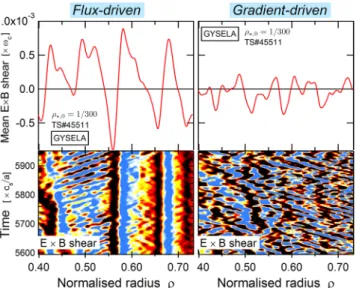
Space and time characteristics of the self-organised tur-bulent state is compared in figures 10 and 11 for flux- and gradient-driven regimes with identical plasma parameters, in the banana collisional regime (ν = 0.2 at ρ = 0.5). The flux-driven computation is first run up to flux equilibrium. Based
Figure 8. Impact of collisional dissipation on the E×B staircase. The pattern exists in the low-collisional banana (ν = 0.15 ) limit of
magnetised plasma turbulence and starts disappearing at the plateau transition (ν = 1.5 ).
Figure 9. Temperature and collisionality profiles of figure 8
in banana and plateau regimes for the otherwise same plasma parameters. Confinement degrades and the central temperature drops by about 10% as the staircase pattern starts disappearing at higher collisionality.
on the end state at 17.4 ms, the computation is then restarted in gradient-driven mode, details of the procedure are given in appendix A.
The staircase pattern visible in figure 11 that has built up and endures in the flux-driven computation is rapidly (in less than a millisecond) damped away and ultimately lost in the gradient-driven approach. The time interval and colourbars for which data is displayed in figure 11 are identical. The temperature corrugations and strong inhomogeneities in mean shear and poloidal flow, characteristic of the staircase pattern give way in the gradient-driven framework to a more homoge-neous turbulence, with fluctuations more isotropic, flow and shear patterns more random in time and evenly distributed poloidally.
The fact that front propagation is also visible in the gra-dient-driven framework emphasises its generic character as
a means of transport. Yet major differences exist with the flux-driven avalanching behaviour: (i) fronts occur because mean profiles depart from equilibrium; the back-reaction however on the mean profiles that allows for nonlinear transport feedback is discarded in the gradient-driven con-text due to the restoring force with strength γK in equa-tion (A.2). This restoring force contributes to (ii) damping the fronts as they propagate through de-synchronisation of the profile fluctuations (the restoring force acts with a short time delay against the fluctuating dynamics). This randomness of the restoring force in both space and time (iii) implies a similar randomness for the fronts, in time as well as in size and in direction and extent of propagation. Section 2.4 further highlights a possible consequence of avalanches for transport.
2.2. Staircase: a signature of modified zonal flow character-istics
An important point for transport prediction is related to ×
E B shear. The total amount of shear that is actually gener-ated is of course an important quantity but as well its spatial distribution and temporal coherence: the more concentrated and the longer-lived, potentially the more effective. We now show, comparing flux- and gradient-driven frameworks how the interplay of turbulence fluctuations and mean profiles has non-trivial consequences on the space–time distribution of zonal flow shear. This has an impact on heat transport which the following section 2.3 details.
Zonal flows (ZF) are the axisymmetric component of ×
E B flows [10]. They can be decomposed into mean and disturbance. ‘Mean’ is defined as the low frequency, slow-evolving component of the zonal flows through sliding time averages of 0.3 ms or longer (0.3 ms corresponds to 1 collision time at ρ = 0.5). An unambiguous designation is as ‘zonal mean flows’ and ‘zonal mean flow shear’, often abbreviated to ‘mean flow’ (MF) and ‘mean shear’. The disturbance part (‘zonal disturbance flows’ and ‘zonal disturbance shear’) is simply defined as the remaining part of the zonal flows with
Figure 10. Comparing zonal disturbance (black) and zonal mean shear (red) averaged radially from ρ = 0.4 to 0.8 in flux- and
gradient-driven frameworks. Mean is defined through sliding time averages of 0.3 ms. For each case the steady-state zonal shear magnitude (disturbance plus mean, thick blue) is indicated (time averaged between 12 and 16 ms (left); between 17.9 and 18.5 ms (right)).
Corresponding levels of turbulence (δΦ2 1 2) / are shown in figure 26. The average gradient-driven zonal shear magnitude (resp. turbulence
intensity) is 40% (resp. 15–20%) larger than its corresponding flux-driven counterpart.
Figure 11. The mean E×B shear, averaged over 0.3 ms (1
collision time at ρ = 0.5) is shown in both flux- and gradient-driven computations that display comparable turbulence intensities (see figure 26). No perennial structures genuinely endure in the gradient-driven approach, mean components are vanishing and the staircase pattern is lost.
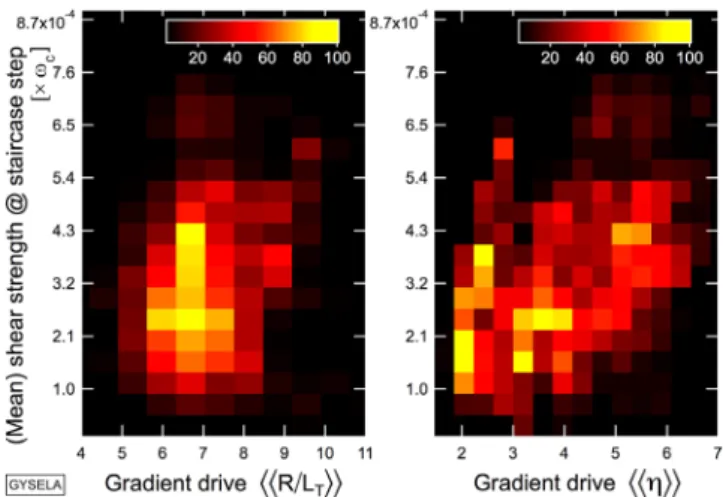
Figure 12. Strength σstep of staircase shear layers as a function of
gradient drive (distance to marginality). dynamic evolution on shorter time scales than 0.3 ms. It is
abbreviated to ‘disturbance flows’ and ‘disturbance shear’. Importantly, this definition holds without restriction to
small-amplitude disturbances. With a longer time averaging of 0.6 ms, the coherence of mean shear is further reduced in the gradient-driven calculation whilst it remains essentially unchanged in the flux-driven case—figure 15 for instance, bottom panel, still shows staircase organisation after ∼3 ms of temporal averaging despite its meandering behaviour illus-trated in section 3.2.
2.2.1. Prominence of zonal mean flows. Figure 11 displays the radial profile of mean shear in both flux- and gradient-driven frameworks whilst figure 10 shows the time evolution of radially-averaged absolute mean shear ⟨ ⟨| γE B× ⟩ ⟩τ|r (solid red) and disturbance (dotted black), with ⟨ ⟩⋅τ denoting the 0.3 ms sliding time average and ⟨ ⟩⋅r the radial averaging from ρ = 0.4 to 0.8. The zonal shear magnitude (solid blue, sum of mean and disturbance) is indicated in steady-state, respec-tively averaged between 12 and 16 ms and between 17.9 and 18.5 ms. From both figures, several features stand out:
Gradient-driven: The fluctuating, randomly varying disturbance shear is the dominant contribution to zonal shear in the gradient-driven approach. The disturbance shear is homogeneously distributed spatially. As expected from the restoring force in equation (A.2), beyond a few col lision times the gradient-driven mean shear is damped and spatially homogenised. Gradient-driven zonal shear is thus spatially homogeneous (all radial locations are equivalent) beyond a few collision times;
Flux-driven: In contrast, the dominant contribution to zonal shear in the flux-driven approach is as coherent mean shear. For the staircase pattern to form and mean shear to endure, positive feedback between flow and gradient is required. Being uncorrelated at its inception to low-order q rationals (section 3.1) mean flow localisation is spatially equiprobable. Mean profile corrugation pro-vides the seed for mean flow localisation through spatial symmetry breaking. The mean flow then locks-in the cor-rugation through reduction of transport. Positive feedback between the zonal mean flow and the mean plasma gradient allows for strong spatial localisation of staircase microbar-riers. There, locally, zonal shear is 2 to 8 times larger than in the gradient-driven case. In a staircasing flux-driven regime the dominant contribution to zonal shear thus comes from narrow regions of concentrated zonal mean shear. In-between staircase steps zonal shear is small, randomly fluctuating and dominantly carried by the disturbance part; Confinement efficiency: The total magnitude of
zonal shear (mean plus disturbance) generated in the gradient-driven framework is ∼40% larger than in the reference flux-driven case. This may result from the 15–20% larger gradient-driven turbulence intensity, see figure A3 (hence stronger zonal flow drive). However, as next section 2.3 highlights, stronger zonal flow magnitude
does not translate into better confinement in the
gradient-driven case. The opposite is observed, suggesting that the rapidly varying zonal disturbance flows are less effective than zonal mean flows in regulating transport. An efficient confinement is thus best achieved for a given level of zonal flow activity through a staircase (mean flow dominated) type of organisation.
2.2.2. Microbarrier strength and permability. Further impor-tant points regarding zonal shear organisation are how microbarriers are modified with varying gradient drive (with distance to marginality) and with varying machine size ρ . To this end, as is done in figure 4, we track in time the location of the staircase steps rstep and compute there the zonal mean shear strength σstep:
∫
σ δ γ = ′ | ′ | δ δ τ − + × r ,t dr r t, r r E B step step 2 2 flow step flow step flow ( ) 〈 〉 ( ) / / (2) with δflow∼ 10ρs, as shown in [20, 21]. The integration interval in equation (2) corresponds to the radial width of the staircase microbarriers so physically σstep is a proxy for microbarrier strength, i.e. for how impermeable microbarriers are to radial transport or how effective they are as barriers for transport.Since rstep(L LT, n) is a function of the temperature and density gradients σstep can be displayed as a function of the ambient (see definition above, section 1.1) gradient drive 〈〈 / 〉〉R LT , or to incorporate the effect of a varying density gradient as a function of 〈〈 〉〉 〈〈 / 〉〉η = L Ln T . This is shown in figure 12. Binning is applied, the colourscale represents how often a given binned σstep value is found (the most encountered value is normalised to 100). Interestingly, zonal mean shear strength increases with increasing gradient drive, but stability of the microbarriers decreases with increasing gradient drive. In other words, increasing gradient drive generates increas-ingly strong microbarriers but with decreasing probability to endure, again emphasising the near-marginal character of staircase organisation.
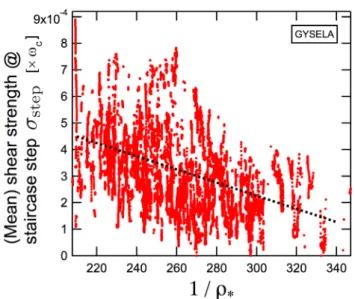
Similarly, figure 13 displays σstep as a function of ρ−1 and predicts an unfavourable scaling of staircase microbarrier
barrier weakening and beneficial increase in the number of staircase steps. This topic is further discussed in section 2.4.
2.3. Impact on profile stiffness and heat fluxes
Let us call local flux-gradient relation the often postulated instantaneous bijection that may exist between the local values of fluxes (of particle, heat, momentum) and the local values of the gradients (∇Ti, ∇Te, ∇n). In this framework, above a critical threshold:
1
( )h a given normalised gradient will drive a unique time-averaged level of flux,
2
( )h a non-vanishing level of flux is in unique correspondence with a single linear combination of normalised gradients— the flux-gradient relation is then called ‘single-valued’ and 3
( )h there is no time delay between modification of a normal-ised gradient and response of the corresponding flux(es). Known issues may lead to the breakdown of this repre-sentation: (i) additional control parameters may enter the flux-gradient relation—e.g. zonal flow strength, sketched in figure 14 may introduce a nonlinear dependence on the gradi-ents, induce a transport bifurcation [39, 40] or play a different role for transport depending on distance to marginal stability as illustrated through the observation of staircase organisa-tion, (ii) nonlocal features appear—e.g. the local value of a flux depends on the state of the system in distant regions of space, or on its past history or (iii) a time delay appears in the response of a flux to a modification of the gradients—a weak form of temporal nonlocality.
The local flux-gradient relation is based on Fourier’s or Fick’s laws for transport and is a common rationale for drift-wave turbulence, usually verified in gradient-driven modeling as e.g. explicit in [26]. From it stems the notion of stiffness which quantifies the (local) rate of change of a (local) flux with respect to the difference between its (local) driving nor-malised gradient and the (local) instability threshold [41].
Even within validity of the local flux-gradient relation, structure formation and especially the onset of zonal flows is known to significantly impact stiffness [42]. Staircase pat-terning is a signature of modified shear-gradient interplay. It is thus certainly natural to expect in its presence a modified flux-gradient relation as well. A precise discussion of these matters is left for future work. We focus here on an interme-diate problem and show that despite similar ambient gradient drives, predicted heat fluxes are significantly different in a
gradient-driven framework with no staircase organisation and in a flux-driven framework with staircase organisation.
In a flux-driven framework, the power P∝ rQ flowing through successive flux surfaces is approximately constant at flux equilibrium, Q being the total heat flux, sum of a turbu-lent flux (associated to the E×B drift) and of a curvature flux (associated to the curvature and grad-B drifts). Though their sum is monotonically constrained at equilibrium, flux-driven turbulent and curvature fluxes may vary somewhat indepen-dently. In a flux-driven context the total equilibrium heat flux is constrained by the (constant or slowly-varying) source. It is an essential difference with gradient-driven frameworks in which fluxes are not a priori bounded and respond to the time-radius adaptive force equation (A.2) that maintains ambient mean profiles—see figure A2 and appendix A for details. It is thus of special relevance to investigate flux responses in these two frameworks, especially close to marginal stability where transport is often reported to be stiff, i.e. where small varia-tions in gradient drive may be responsible for large excursions of fluxes.
To this end we compare in figure 15 predictions for the turbulent heat fluxes at the same successive radial locations in both flux- and gradient-driven frameworks. The ambient gra-dient drives are comparable in both cases and near- marginal. Staircase organisation is absent in gradient-drive and vis-ible in the flux-driven case through its shear layers (steps 1 to 3) marked as R/LT corrugations. The corresponding
gra-dient-driven R/LT profile with no staircase is non corrugated.
Turbulence characteristics are quasi-steady—figure 15 displays results averaged over 2.95 ms (1033c as/ ).
• Location [0] is a region of low linear drive, prior to entering the staircase region located between ρ = 0.4 and 0.8. The average flux-driven (black square) and gradient-driven (blue circle) heat fluxes are small and comparable, yet with a marked intermittent character and a large statistical variability for the flux-driven turbulent heat
Figure 13. Strength (impermeability) σstep of staircase shear layers
as a function of machine size ρ −1. The least-squares regression is
flux, even at weak gradient drive R L/ T≈5. This is unlike common representation of near-marginal ITG transport [26] and will be discussed elsewhere;
• Locations [1], [2] and [3] are respectively after 1, 2 and 3 successive staircase steps. As more of the staircase bar-riers are crossed computed heat fluxes start to significantly differ despite comparable ambient gradient drives. Both radial heat flux profiles are radially smooth, as expected. Where the gradient-driven flux monotonically increases with increasing gradient drive R/LT, the flux-driven flux
does not and radially organises so as to satisfy the flux-equilibrium condition P≈ constant.
Several conclusions can be drawn:
(i) the gradient-driven framework appears to be overly stiff: predicted flux levels are too large in gradient-driven mod-eling, especially near marginal stability;
(ii) strong stiffness endangers predictive reliability in a model as large variations in predicted fluxes can be obtained from modest or even possibly indistinguishable differences in ambient mean profiles (within statistical fluctuations or experimental error bars). Reliability of gradient-driven
predictions near marginal stability is thus questioned. The flux-driven framework is less stiff and appears less sensitive to details of the ambient mean profiles;
(iii) these observations may have implications for the so-called ‘transport shortfall’ problem [43, 44]. Strong stiffness indeed impedes nonlocal turbulence propaga-tion and especially turbulence spreading [45], a possibly important ingredient to the shortfall problem [46]; (iv) the fact that large though highly intermittent flux-driven
fluxes are observed at low temperature gradient drives (location [0]) where both the gradient-driven flux and its statistical variations remain small tends to indicate clear sensitivity of the flux-gradient relation to temporal coarse-graining, despite the fact that the present results are flux-surface averaged and thus already strongly spatially coarse-grained. This result echoes results in [47, 48].
The local flux-gradient relation is violated (becomes multivalued) in a flux-driven framework at short to intermediate (collisional) time scales, hence questioning hypothesis ( )h2 above;
(v) our understanding of near-marginal stiffness is clearly ques-tioned and echoes the recent observation of an increased nonlinear upshift of the temperature gradient length threshold, attributed to E×B staircase onset [30]. These questions point towards the role of staircase organisation and generally of structure formation near marginal stability in the possible breakdown of the local flux-gradient para-digm, as sketched in figure 14. As such they may be seen as a generalisation of earlier heuristic models where e.g. the heat diffusivity χ = − ∇Q/ T is itself a nonlinear function of either zonal flow shear [13] or of ∇T itself.
Figure 15. Turbulent heat fluxes before [0] and after [1], [2] and [3]
staircase steps in the flux-driven approach, compared to turbulent heat fluxes at the same locations in the gradient-driven case, figure (a). Same data, shown as the ratio of gradient-driven to flux-driven predictions for the heat flux as a function of ambient gradient drive, figure (b). The increasing discrepancy with 〈〈 / 〉〉R LT between both predictions illustrates issues with gradient-driven predictions of near-marginal transport and stiffness.
Figure 14. Example of breakdown of local flux-gradient relation:
as the system evolves (red arrows) the flux-gradient landscape is modified by a third control parameter (here zonal flow strength) from single-valued to multi-valued and back to single-valued at large normalised gradient drive.
appears desirable to restore simplicity in describing transport and encompassing the reality of structure formation (zonal flow, staircase, etc) near marginal stability. This question is left for future work.
2.4. Possible routes to confinement improvement... or to gyro-Bohm breaking
Previous sections have established staircase step layers as efficient microbarriers for transport. We now characterise transport in-between these microbarriers and investigate its possible consequences for global confinement.
2.4.1. The staircase steps contain the avalanche activity.
In-between staircase steps the transport of heat or momentum dominantly occurs through avalanche-type processes. Ava-lanches lead to strongly non-Gaussian statistics with a marked Lévy-type non-local, non-diffusive character [1]. In the absence
of regulating mechanisms for avalanches a departure from favourable gyro-Bohm confinement scaling is thus expected.
The E×B staircase organisation is especially relevant because its microbarriers are efficient avalanche regulators. This was noted in [1], figure 2 and is further shown in figure 16.
To illustrate this point, we isolate a 100a c/ s time window during which the staircase organisation is steady. There we compute the Lagrangian space-time autocorrelation A of the turbulent heat flux in two distinct regions of the plasma chosen such that (i) both regions are bounded by steady staircase microbarriers and (ii) the radial width ∆ between these microbarriers is significantly different in both cases. Each of the two regions is a different ‘tread’ of the staircase as defined in figure 1; their width ∆ is practically measured as the distance between the bounding temperature corruga-tions. The first region shown in figure 16(a) has a width of
ρ
∆ = 58 s, the second region in figure 16(b) a large width of ρ
∆ = 153 s.
Individually, avalanches are hard to systematically track. Statistically, the radial extent of space-time autocorrelation measures the coherence of radial heat transport. The full width at half maximum of A (black contours) is thus an estimate for the avalanche size in both cases (a) and (b). Interestingly, the full width at half maximum of A closely tracks, in both
significantly different cases (a) and (b) the local step size of the staircase. This leads to the following conclusions:
• the staircase step size ∆ (easy to measure) is a good proxy for the radial extent of avalanches;
• avalanche activity is a route to gyro-Bohm breaking: in two distinct regions of the plasma and at the same time, the turbulent heat flux has at least three different radial
scalings: two mesoscale ones associated to staircase organisation ∼50ρs and ∼150ρs, in addition to the robust local c∼ 6ρs scale (see figure 3);
• regardless of the step size (the ‘tread width’), avalanche transport fills-in the ‘treads’. Without staircase microbar-riers avalanches would thus propagate unhindered across larger portions of the unstable plasma domain. As a consequence, stable staircase microbarriers are efficient
regulators for the radial propagation of avalanches. 2.4.2. Statistics of staircase step sizes. The relative strength of beneficial microbarriers and detrimental avalanches evolves dynamically, as both interplay: avalanches are domi-nantly emitted on both sides of temperature corrugations whilst larger avalanches cause microbarriers to meander (see section 3.2) or be destroyed. Determining which of the two dominates in what region of parameter space may open new routes to access and possibly control:
• improved confinement: favoured in the case of strong, steady and closely packed microbarriers. An interesting perspective being that these microbarriers may coalesce [14, 21] into larger scale macrobarrier(s). Whether obser-vations in [51] are a manifestation of such phenomena is yet unclear;
Figure 16. Autocorrelation of the turbulent heat flux in two
separate radial regions of the plasma, at the same time, during /
a c
100 s: case (a) in-between two staircase steps distant of ∆ = 58ρs and case (b) distant of ∆ = 153ρs (shown as white interval). In both cases the full width at half maximum (black contour), a measure of the radial coherence of heat transport, tracks well the local staircase step width.
Figure 17. Staircase microbarrier spacing ∆ normalised to the local ion Larmor radius as a function (a) and (b) of gradient drive (distance to marginality) and of (c) plasma size ρ −1. The statistics of step sizes ∆ is shown in (d ). The most probable microbarrier spacing is
ρ
∆ =stat 40±2 s. ∆ however can be large, displaying statistics of heavy-tailed distributions: a Fréchet distribution approximates it well, which is symptomatic of extreme value statistics.
• degraded confinement: favoured in the case of weak or vanishing microbarriers or when avalanching dominates across a large portion of the plasma.
To investigate the relative strength of microbarriers and ava-lanches, microbarrier shear strength equation (2) (as a measure of microbarrier permeability [21]) is a useful quanti ty—see section 2.2. From the above section 2.4.1 however, statistics of the step size of the staircase ∆ is possibly a more robust observable of microbarrier permeability. Avalanches indeed do not cross staircase microbarriers without perturbing them and possibly destroying them, either way leaving a footprint on ∆. ∆ is thus a measure of the least favourable radial trans-port scale length in the system: larger values are indicative of degraded confinement and its systematic computation con-veys information on the actual transport processes.
Gyro-Bohm scaling through successive staircase steps. As in figure 12, since rstep(L LT, n) is a function of temperature and density gradients, ∆ can be displayed as a function of ambi-ent gradiambi-ent drive as well as of ρ . Its statistics are shown in figure 17. The colourscale in subplots (a) and (b) represent how often a given binned ∆ value is found (the most encountered value is normalised to 100) as a function of ambient drive. Sub-plot (c) displays its behaviour with respect to ρ . The larger ∆ values correspond to temporary destruction of staircase steps, often prior to their reconstruction elsewhere. As compared to our earlier results [1, 20], the present dataset is larger, encom-passing steady-state weakly driven plasmas (mostly using thermal bath boundary conditions) as well as more strongly driven (hence less quiescent) plasmas. The rich dynamics of the staircase pattern is now also embedded in the dataset, hence a large distribution of step sizes visible in subplot (d) and a slightly larger most probable step size ∆ =stat 40±2ρs (the uncertainty reflects a 95% confidence interval). The most probable staircase step spacing also appears quite independent of the ambient drive—subplots (a) and (b).
Interestingly, despite statistical variability, the ∆stat scale is approximately constant throughout the scanned ρ values.
This fact is strongly suggestive of a gyro-Bohm scaling for
the heat transport, reintroduced in the system despite
ava-lanching, via the mesoscale and ρ independent ∆ ∼ 40stat ρs scaling of the staircase step layers. In this regime of param-eters (near-marginal, low-collisional), heat transport tends to a gyro-Bohm scaling owing to the successive staircase steps. We note also that the physics of why a gyro-Bohm scaling may here be found, statistically, is significantly different from dif-fusive/random walk arguments of turbulent transport scaling with the local microscale c∼ 6ρs (see figure 3).
Extreme deviations, physical interpretation. A well defined scale ∆stat is observed with yet significant deviations from it. The distribution of step sizes in figure 17(d) is characteristic of fat-tailed distributions and is well described by a Fréchet distribution, a special case of Weibull (or generalized extreme value) distributions with lower bound:
⎛ ⎝⎜ ⎞ ⎠⎟ τ σ τ κ µ σ ∆ = 1+κe−τ with = 1+ ∆ − −1κ ( ) / F (3) with respectively a scale parameter σ = 10, a location µ = 44 and a shape κ = 0.6. As also shown in figure 17(d ) a log-normal distribution, obtained through the multiplica-tive product of many independent random posimultiplica-tive variables decays too fast and inaccurately describes the right tail of steps sizes. Fréchet PDF tails naturally emerge from the prod-ucts of a finite number of random correlated variables and is often used as a phenomenological description of relaxation in disordered systems [52].
The observation of Fréchet statistics illustrates interesting aspects of the physics of staircase organisation. Fréchet (or Weibull) statistics naturally arise in the description of wear and tear of a system that is said to fail when either wear and tear accumulates beyond an acceptable level or if a fatal shock occurs. If the occurrences of fatal shocks can be modeled by a Poisson process whose rate function is state-dependent and if a random process governs the system state, then wear and tear statistics are often well described by Weibull distributions.
Comparable statistics would certainly be observed if avalanches were to be understood not only as responsible for traumatic disruptions of individual staircase steps but also as active participants in the onset of individual shear
layers. In the latter interpretation, both the life-time and the birth-rate [17] of staircase shear layers is influenced by avalanches and similar Fréchet statistics for ∆ would cer-tainly be expected. Either way, the observation of a Fréchet distribution equation (3) would then stand for a signature of avalanches in the global organisation of near-marginal plasma turbulence.
Lastly, it could be argued that a power law description could also fit the data in figure 17(d) rather than a stretched exponential [53]. A power law would characterise an absence of characteristic size for staircase step spacing. Clearly self-similarity at all scales is not observed but self-self-similarity could be argued beyond ∆ ∼ 40stat ρs as it is known that when accounting for finite size effects in a dataset a power law often crosses over to an exponential decay, hence leading to the cur-vature in the log-log plot observed in figure 17(d). However, with the Fréchet interpretation above, there is little need to invoke finite size effects to explain the fact that ∆ statistics deviates from a power law.
What does it suggest for transport scaling? Both observations above suggest a route as to how a system described by strongly
non-Gaussian statistics may display favourable gyro-Bohm
like transport provided, as the system increases in size, that enough staircase microbarriers are formed. In addition to microscale regulation via shear suppression [54–56], trans-port can thus be directly regulated at mesoscales via modu-lation of front propagation at the scale of the staircase step
width.
Figure 13 predicts an unfavourable scaling of staircase microbarrier strength with decreasing ρ . Recent experimental findings (see figure 3 in [21]) tend to display a comparable trend. No such behaviour is visible in figure 17(c). Further understanding the statistics of ∆ with decreasing ρ is cer-tainly a matter of importance to understand the ρ scaling of heat transport. Improved confinement may reside in accessing regimes with faster decaying tails for the ∆ (avalanche) dis-tribution, provided the staircase structure survives. An unfa-vourable behaviour of the tail of the avalanche distribution on the other hand may provide a natural route to gyro-Bohm breaking.
sised both experimentally and in early modeling attempts [57,
58]. ITBs have been analysed to nucleate next to low-order rational q surfaces, especially at negative or vanishing magn-etic shear. Linearly indeed, turbulent modes tend to resonate on distinct q = m/n surfaces, their local growth rates being influenced both by the value of q and of its gradient. Two argu-ments are usually invoked for internal transport barrier onset: (i) low wavenumber turbulence tends to generate a localised
×
E B shear flow in the vicinity of low-order rational q sur-faces or (ii) low wavenumber resonant sursur-faces tend to rarefy in reversed shear plasmas in the vicinity of vanishing magnetic shear, favouring the onset of E×B shear flows and the trig-gering of a barrier.
We test both ideas, asking:
• may staircase microbarriers form under similar influence of low-order q rationals?
• may the dynamic evolution of staircase steps lead to the formation of macroscopic ITBs, and if so is it in connec-tion with the shape of the q profile?
To this end different situations are tested where the safety factor profile is varied: either parabolic and mono-tonically increasing—different cases are shown in figures 18
through 21—or reversed as also shown in figure 21, the loca-tion of vanishing magnetic shear corresponding to the low-order q = 3/2 rational. Anticipating on the results, the answer so far to both questions above is negative, yet might be worth considering anew with future inclusion of passing electron dynamics [27].
As previously shown [20, 21], neither the birth location of the staircase steps, nor their statistical localisation during nonlinear evolution seems to display clear correlations with low-order safety factor q rationals, in either monotonic or reversed q profiles. This is shown for the monotonic case in figures 18 and 19, with the possible exception of the q = 2 rational surface. Figure 20 records how often in the tem-poral window t∈[500, 3900] /a cs staircase microbarriers are found in the vicinity of given q values. From it, q = 2 could be defined as a ‘sticky’ location: staircase steps are not borne at this location but seem either attracted or prone to lingering in its vicinity. However, it is never the same staircase step but rather successive steps that linger near to q = 2 nor does this behaviour lead to the formation of a macroscopic ITB. This behaviour may be reminiscent of some experimental observations—e.g. shown next to the
q = 5/2 surface (labelled S0) in figure 3 of [20]—where measured wells in the radial correlation of turbulent fluc-tuations (interpreted as staircase microbarriers) are espe-cially marked only when they coincide with a low-order q rational.
No other low-order rational in figure 20 however seems to dis-play a similar behaviour than q = 2: the lifetime of temper ature corrugations (i.e. microbarrier localisation) with respect to q locations is roughly evenly distributed. Possible synergies might thus exist between low-order q rationals and staircase microbar-riers during their dynamic evolution but they seem rather weak. This observation may alert to the dubiety of quasilinear frame-works to correctly address staircase onset and dynamics.
A monotonically increasing q profile is now compared to a reversed q profile in figure 21, other parameters kept identical. At mid radius ρ = 0.5 the two profiles cross the
q = 3/2 surface. This surface plays no noticeable role in the monotonically increasing q case. In the reversed shear case the central staircase step only, close to the minimum
q = 3/2 location appears to be weakly drawn to this loca-tion. Furthermore, a limited steepening of the temperature gradient around the q reversal location is observed, visible
through lower R/LT values before ρ = 0.5 and larger ones
afterwards. Both effects however are modest: (i) the stair-case step does not rigorously locate at the minimum q loca-tion and even remains in the positive magnetic shear region during the computed evo lution and (ii) the negative or van-ishing magnetic shear does not lead to the formation of a macroscopic ITB either through an increased flow-gradient feedback or through coalescence of staircase microbarriers. Main conclusions are:
• the birth of staircase microbarriers is not correlated to low-order q rationals;
• correlation between staircase microbarriers and q rationals remains modest during nonlinear evolution despite observation of weak synergies;
• these synergies have not been observed to lead to stair-case microbarrier coalescence or macroscopic ITB onset, even at low or reversed magnetic shear.
3.2. ...in time: staircase dynamics and meandering
The E×B staircase undergoes dynamic evolution (i) on the short timescale of avalanche emission as propagating
Figure 18. Same data as in figure 2 where the fixed locations of
low-order q=1, 3 2, 2, 5 2 / / and 3 rationals are superimposed on top of the E×B shear, marking the staircase steps. No clear connection between low-order q rationals and staircase microbarriers can be inferred.
Figure 19. Gradient drive from figure 18 averaged between 2100
and 2892a c/s.
Figure 20. Statistics from figure 18 of the time staircase microbarriers (tracked as temperature corrugations) have spent in the vicinity of given q values, between t = 500 and 3900a c/s.
avalanches interact with its microbarriers. This point has been evoked in the previous section and is emphasised through observation in figure 17(d) of Fréchet (Weibull) statistics for the staircase step size. Staircase steps may then drift radially or be destroyed by rare and large-scale avalanches impinging on them but usually reform in their wake, possibly at dif-ferent radial locations. This short timescale for local staircase dynamics depends on distance to marginality (figure 4): close as well as far above marginality, the staircase pattern is less robust and easily perturbed by front dynamics.
Corrugations also evolve (ii) on the longer timescale of mean profile (and hence gradient drive) evolution as it adapts to the heat source. Corrugations display a slow radial motion that roughly tracks the ambient gradient drive 〈〈 / 〉〉R LT evo-lution (see definition above, section 1.1). The radial loca-tions of the staircase shear layers seem to remain at constant 〈〈 / 〉〉R LT values. This propensity of corrugations to remain at constant ambient gradient drive [20, 21] is referred to as ‘meandering’. Corrugations may endure from milliseconds to tens of milliseconds (the current upper limit of large-scale flux-driven computations). Their meandering timescale how-ever is usually shorter, as illustrated in figure 22. The gradient is computed through sliding profile averages of ∼312a c/ s that roughly correspond to ∼0.89 ms starting at time 1030a c/s. For visualisation purposes, a negative offset of 0.002 is applied to each time-slice. Clearly the staircase pattern exists throughout the time slice displayed here yet a global averaging between 1030 and 2892a c/s would effectively smear it out.
Experimentally, staircase steps are tracked as local minima of the coherence length profile ⟨Lcoh F⟩ of density fluctua-tions, the procedure as described in [20, 21]. The meandering of the ⟨Lcoh F⟩ wells is uneasy to characterise and seems to occur on long time scales. An example is shown in figure 23. Displacement of the ⟨Lcoh F⟩ profile, not detectable during a single acquisition (6 ms) becomes more visible when com-paring successive acquisitions separated by 5 to 10 s. The
present data cannot allow to unambiguously determine whether the similarity of the coherence length waveforms measured during the successive acquisitions in figure 23 results from a single very long-lived staircase or rather from staircase pat-terns that have repeatedly disappeared and reformed. The dis-parity of time scales observed in experiments and simulations is yet a challenge to explain.
Figure 21. Same data as in figure 5, averaged between 4000 and
/ a c
4610 s. Two situations are compared: all other parameters being equal, the safety factor profile is either parabolic or reversed. A weak response of the central staircase step to the reversed magnetic shear is observed.
Figure 22. How the meandering of the E×B staircase leads to
its seeming disappearance when time integration is large. Radial coarse-graining leads to the same result. This sets constrains on experimental time and space resolution in order to resolve the staircase structure. For clarity, the curves at different times have been vertically offset from each other.
Figure 23. Experimental coherence length profiles ⟨Lcoh F⟩ of density fluctuations at times t1 through t4.
![Figure 15. Turbulent heat fluxes before [0] and after [1], [2] and [3]](https://thumb-eu.123doks.com/thumbv2/123doknet/12958539.376562/12.892.466.822.90.705/figure-turbulent-heat-fluxes.webp)

