Individual and Combined Releases of Muscidifurax raptor and
M. raptorellus (Hymenoptera: Pteromalidae) as a Biological Control
Tactic Targeting House Flies in Dairy Calf Facilities
PHILLIP E. KAUFMAN,1COLLEEN STRONG,2J. KEITH WALDRON,3ANDDONALD A. RUTZ2
J. Med. Entomol. 49(5): 1059Ð1066 (2012); DOI: http://dx.doi.org/10.1603/ME11181
ABSTRACT The impact of commercially reared house ßy parasitoids released into nine dairy calf coverall facilities were evaluated over 3 yr. Individual and equally mixed ratios of the pteromalid parasitoids Muscidifurax raptor Girault and Saunders and M. raptorellus Kogan and Legner were released at a rate of 500 parasitoids per calf per week for 8 wk. Prerelease, release, and postrelease parasitism was monitored using nearly 100,000 sentinel house ßy, Musca domestica L., pupae during the 3 yr study. In general, very few adult parasitoids were recovered during the prerelease period and on the no-release farms during any period. However, considerable numbers of M. raptor and M. raptorelluswere recovered from sentinel pupae on respective release farms. As expected, the greatest successful parasitism occurred during release periods, with a drop during postrelease periods. High successful parasitism and uneclosed pupae on M. raptorellus release farms suggests that this parasitoid was aggressive in attacking hosts with progeny production at approximately four wasps per pupa. Solitary releases of M. raptor provided sentinel mortality between 31 and 38%, whereas sentinel mortality on M. raptorellus-release farms was double, at 59 Ð 80%. Using mixed releases of the two species, overall ßy mortality was slightly lower than that observed on M. raptorellus-only farms. This study documents the advantage of releasing M. raptorellus rather than M. raptor on New York dairy calf facilities, as supported by higher parasitism rates and lower costs (35Ð75%) for purchase of these gregarious wasps, as 75Ð 80% fewer parasitized pupae are needed to achieve similar adult parasitoid levels.
KEY WORDS Musca domestica, Pteromalidae, biological control, dairy, sentinel pupae
House ßies, Musca domestica L. (Diptera: Muscidae), are important dairy cattle pests across the United States (Miller 1993). House ßies harbor disease-caus-ing pathogens and are annoydisease-caus-ing to animals and farm workers (Greenberg 1971, Butler et al. 2010). Move-ment by house ßies to nonfarm areas continues to be a challenge in increasingly urbanized agricultural ar-eas (Miller 1993). This behavior creates legal chal-lenges and extremely poor community relations (Ole-jnik 2001).
Previous research has documented that calf areas are the greatest source of ßy breeding on dairy farms (Meyer and Shultz 1990). Observed differences that likely lead to successful house ßy development in calf areas include; calves that are too small to crush de-veloping ßy larvae, accumulating ßy developmental media that includes manure and spilled grain mixing with spilled water and urine, farm management
prac-tices that use straw bedding over wood chips in calf areas, and a 6 Ð 8 wk period between animal introduc-tion and bedding removal (Schmidtmann 1988, 1991; Rutz et al. 1994).
Large, plastic covered, half-hoop structures, resem-bling greenhouses are now being used for holding large numbers of calves, replacing the use of individual calf hutches on dairy farms. The beneÞts of these buildings are numerous and include easier animal han-dling, healthier calves, and easier cleanup; however, there also exists the potential for the development of large numbers of ßy pests. Farmers can spend thou-sands of dollars attempting to control ßies in these facilities, usually with insecticides. However, chemical control is limited as house ßy populations across the United States have been shown to be resistant to many of the currently registered materials (Scott et al. 1989; Keiding 1999; Kaufman et al. 2001c, 2010; Kaufman and Rutz 2002; Butler et al. 2007).
In the past, biological control of ßies on dairy farms relied on either naturally occurring predators and parasitoids or inundative releases of commercially reared parasitoids such as Muscidifurax raptor Girault and Saunders or Spalangia cameroni Perkins. How-ever, a recent addition to the catalog of commercially
1Corresponding author: Entomology and Nematology
Depart-ment, University of Florida, 970 Natural Area Drive, Gainesville, FL 32611 (e-mail: pkaufman@uß.edu).
2Department of Entomology, Comstock Hall, Cornell University,
Ithaca, NY 14853.
3New York State IPM Program, Cornell University, 630 West North
Street, Geneva, NY 14456.
available parasitoids, and one that has largely been understudied on dairies, is Muscidifurax raptorellus Kogan and Legner (Petersen and Currey 1996). This parasitoid has the advantage of producing multiple offspring, which can become established more rapidly and may cost producers less to purchase because of reduced production costs. The primary reason for this is that M. raptorellus is a gregarious species, producing more than four offspring per parasitized pupa (Geden and Hogsette 2006). Therefore, if activity is similar, not as many parasitized pupae are needed for farm releases when compared with releases of solitary spe-cies, such as the commonly released species M. raptor. Studies in poultry facilities and cattle feedlots have documented the beneÞts and challenges of M. rap-torellusreleases (Petersen and Cawthra 1995; Tobin and Pitts 1999; Floate et al. 2000; Kaufman et al. 2001a,b), but little research has been published on the effectiveness of M. raptorellus on dairies (Meyer et al. 1990).
Calf coveralls are fairly new to New York and until the time of this study, we had not had the opportunity to critically evaluate the effectiveness of our dairy ßy integrated pest management (IPM) program recom-mendations under these conditions (Rutz et al. 1994). Preliminary studies examining the release of M. raptor during 2000 and 2001 in several calf coveralls docu-mented the dynamics of parasitoids in these facilities (Rutz et al. 2001, 2002). Our results showed that when M. raptorwas released, it became the predominant species. However, after an unintentional M. raptorel-lusrelease, this species established itself at a low, but stable population, suggesting its potential as a biolog-ical control agent in these systems (Rutz et al. 2004). As a result, in this study we evaluated sustained para-sitoid releases of M. raptor, M. raptorellus, and a com-bination of the two species in these dairy calf facilities to determine the most appropriate parasitoid release strategy for dairy producers.
Materials and Methods
This study was conducted in nine New York dairy calf holding facilities, commonly called coveralls, in Tompkins, Cayuga, Cortland, and Onondaga counties in 2003, 2006, and 2007. Calf coveralls were plastic covered, half-hoop structures of similar design having calves penned individually or in small groups on op-posite sides of the greenhouse with a central alley used for farmer and animal access. During the study, the doors at each end of the greenhouse were open and the sides were rolled up to allow for increased ven-tilation.
In each year of the study, nine dairy farms were used. Farms that served as no-release farms did not have a history of parasitoid releases. Farms that re-ceived M. raptorellus in 2003, only rere-ceived M. rap-torellus-releases in subsequent years. Farms that received M. raptor releases in 2003 became mixed-species release farms in subsequent years. In 2003, the study was conducted from 10 June to 02 September (13 wk). Three farms served as M. raptor release farms,
three as M. raptorellus release farms and three farms served as no release controls. In 2006, the study was conducted from 06 June to 29 August (13 wk). Two farms served as no-release controls; three as M. rap-torellusrelease farms and four as M. raptor⫹ M. rap-torellus(MR/MRS) release farms. The 2007 study be-gan on 12 June and concluded on 4 September (13 wk) with a range of 20 Ð 85 calves among the farms. Three of these farms again served as no release controls, three as M. raptorellus release farms, and three as MR/MRS release farms. Calf numbers during the pre-release weeks ranged from an average of 16 Ð 85 among the farms.
Parasitoids were purchased from a commercial in-sectary (IPM Laboratories, Locke, NY). Current pest management recommendations are based on releasing parasitoid numbers in relation to animal numbers (Rutz et al. 1994). Additionally, because of differing farm sizes and calf numbers on farms, during all 3 yr of the study each release farm received⬇500 parasi-toids per calf per week. The release rate for an indi-vidual farm was determined by averaging the numbers of calves on the farm during the two prerelease visits and adjusting the numbers of parasitized pupae placed on a farm according to treatment. On MR/MRS farms, parasitoid releases were adjusted such that 50% of the estimated parasitoids released were of each species. Release levels (number of parasitized pupae placed at a farm on a given week) were corrected using infor-mation on estimated percent emergence provided by IPM Laboratories to achieve a more precise parasitoid release rate. The actual number of parasitized pupae placed at each farm was adjusted weekly based on the weekly parasitism rates of the to-be-released parasit-ized pupae, such that a consistent release level of an estimated 500 emergent wasps per calf was maintained between farms, weeks, and years.
Released parasitoids were distributed by Cornell University personnel by shaking the parasitized pupae from a container just inside the calf pen along the length of the active calf areas. Sub-samples of these parasitoid releases were held and checked for emer-gence and parasitoid purity levels. For all years, par-asitism was monitored for 2 wk preparasitoid release, followed by 8 wk of parasitoid releases and 3 wk of postrelease parasitism observations.
House ßy pupae used as sentinels were obtained from the Cornell University laboratory colony that had been reared for 25 yr under laboratory conditions (26⬚C, 45Ð55% RH, and a photoperiod of 16:8 L:D h). Larvae were reared on a diet of a 2:3:15:8 ratio of calf protein supplement, wood chips, bran, and tap water, respectively, while adults were maintained on water, nonfat dry milk, and sucrose.
Parasitism rates on farms were monitored weekly using the sentinel pupal bag method of Rutz and Axtell (1980). Sentinel bags (10 bags per facility; 8⫻ 8 cm, mesh density 5.5 squares/cm), each containing 30 live (1Ð2 d old) house ßy pupae, were placed weekly between 2 and 4 cm under the surface of bedding, under and around the calf water, and feed buckets, an area of high potential for ßy breeding activity. Each
sentinel bag was enclosed in a 10⫻ 12 cm metal mesh cage, constructed from honey bee queen excluders, to prevent pupae from being crushed by the calves. Ex-cluders were chained to the front of the calf pen to reduce weekly loss. After a 7-d exposure, pupae were returned to the laboratory, removed from bags and placed into 33 ml plastic cups and uneclosed ßies were allowed to emerge. Uneclosed pupae were then indi-vidually gelatin capped (size 00, Pyramid, Prescott, AZ) and held for parasitoid emergence. Stable ßy sentinel pupae were placed in the same manner at all farms in 2006 and 2007, but because of inconsistent host quality challenges these data were not analyzed. After a 60-d holding period, the total number of uneclosed pupae, of successfully parasitized pupae, and of emerged parasitoids were recorded. Parasitoids were sexed and identiÞed to species. Percentage of uneclosed pupae (UP) and percent of pupae produc-ing a parasitoid were calculated. The percentage of ßy pupae successfully parasitized was calculated by di-viding the number of pupae with emergence holes by the total number of pupae retrieved. Residual mor-tality was characterized as mormor-tality attributed to parasitoid stinging, host feeding and superparasitim of the host but where progeny were not produced (Mann et al. 1990, Petersen and Cawthra 1995), in addition to unknown mortality causes such as patho-gens or the environment. Percent residual mortality was determined by subtracting percent successful par-asitism (SP) from the corrected percent uneclosed pupae. Each week, 100 house ßy pupae from the same cohort used in sentinel bags were held at ambient laboratory temperatures to assess pupal health. These lab-held controls served as the basis for the control mortality calculation. Successful parasitism and un-eclosed pupae were corrected for control mortality (Abbott 1925) and percentages were arc-sine trans-formed for statistical analysis.
Data from the 10 sentinel bags for each treatment on each farm and exposure period were pooled, regard-less of analysis. Because the parasitoid release regimes differed between 2003 and the years 2006 and 2007, the 2003 data were analyzed individually, while the 2006 and 2007 data were analyzed as a group. The percent-age uneclosed pupae, successfully parasitized, and re-sidual mortality variables for the individual species releases were analyzed using a linear analysis of vari-ance (ANOVA) model, PROC GLM (SAS Institute 2004) to detect differences between the release pe-riods (pre-, post-, and release) within individual para-sitoid release regimes and between parapara-sitoid release regimes within release periods. Where appropriate for each analysis, factors included study year, farm, re-lease period, and parasitoid rere-lease regime. The vari-able farm was nested within release period or the parasitoid release regime and the error term for the nested effect was used to determine the F- and P values. When appropriate, a TukeyÕs mean separation was conducted.
Pest and animal management actions taken by pro-ducers were documented (i.e., improper disposal of water, etc.) to allow for a better explanation of adult
ßy population variation among farms. Insecticide ap-plications were used rarely on release farms and when used only nonanimal areas were to be treated. The use of insecticides on all farms was recorded. Parasitoid releases were not allowed on no-release farms.
Results
Overall, producers did a good job of managing mois-ture in these facilities. Calf bedding was removed, along with the calf when it was⬇6 wks old. Facility designs allowed for moisture to pass through the bed-ding into a gravel or sand bed allowing additional drying. Management of adult ßies on many farms con-sisted of sticky tapes and traps, large ventilation fans (also for cooling) and use of lime applied to bedding areas. Several producers used insecticide baits in stag-ing areas, jug traps, and in barn aisles. The only use of a residual insecticide occurred in early August 2007 when the 1% permethrin-containing pour-on product Durasect was applied to calves on one M. raptorellus-release farm. A dip in parasitism was not observed after these two instances.
One of the three planned no-release farms mistak-enly released a mix of M. raptor and M. raptorellus on 12 June 2006. As a result, this farm was changed from a no release farm to a MR/MRS release farm and data were not included in the affected prerelease analysis. As such, there were two no-release farms and four MR/MRS release farms in 2006. Parasitoid release tar-gets of 500 parasitoids per calf were based on previous-weeks calf counts. Using this approach was found to be fairly accurate with calf numbers changing slightly from week-to-week and this process is representative of what a producer would use to estimate purchases from a commercial insectary.
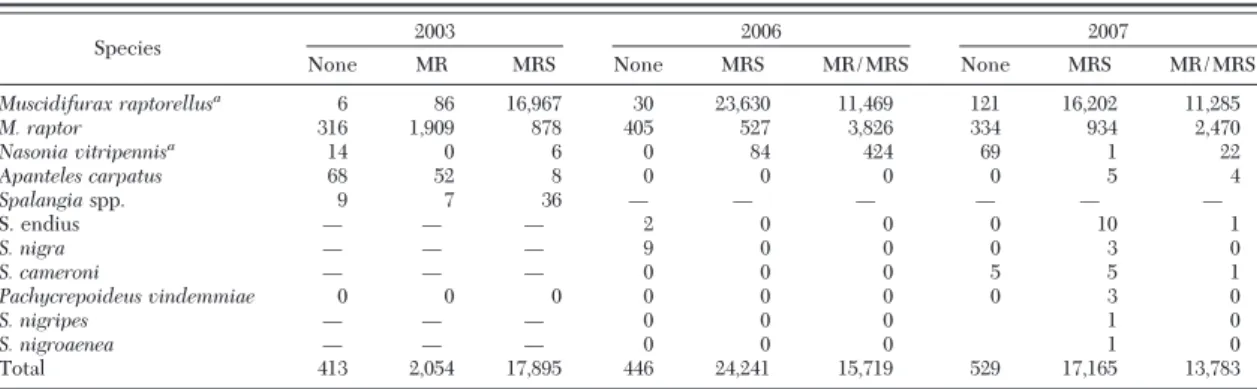
The number of sentinel pupae placed each year on the nine farms used in this study included⬇5,200 in the prerelease period, 20,500 in the release period and 7,600 in the postrelease period. The number of M. raptorellusprogeny per SP pupa recovered during the release period averaged between 4.0 and 4.5. These values ranged from 3.3 to 3.9 in the postrelease period. A summation of parasitoid species recovered from house ßy pupae are presented (Table 1), and includes many nonreleased, indigenous species. The predom-inant species recovered on no-release farms was the indigenous M. raptor. The brachonid Apanteles carpa-tus(Say) was most frequently recovered during the Þrst year of the project. Although stable ßy sentinel pupae data were not analyzed because of quality con-trol issues, several indigenous species were recovered from these sentinels and included small numbers of A. carpatus(2), Nasonia vitripennis Walker (15), Pachy-crepoides vindemmiaeRondani (11), Spalangia droso-philaeAshmead (5), and one S. endius Walker.
In 2003 during the release period, a total of 241 parasitoids were recovered from the three no-release farms, 1,509 parasitoids were recovered on farms where M. raptor was released and 13,160 parasitoids were recovered on farms where M. raptorellus was released. As expected, in 2003 the majority (87%) of
SP on M. raptorellus-release farms during the release period was attributed to this parasitoid. This value dropped to 60% during the postrelease period.
During the 2006 release period, 252 parasitoids were recovered from the two no-release farms, 19,754 para-sitoids were recovered from the three M. raptorellus-release farms and 12,385 parasitoids were recovered from the four MR/MRS-release farms. On M. raptorel-lus-release farms, 90 and 87% of SP-associated pupae were attributed to this parasitoid during the release and postrelease periods, respectively. On MR/MRS-release farms, 53 and 42% of SP-associated pupae were attributed to M. raptorellus during the release and postrelease periods, respectively.
In 2007, 395 parasitoids were recovered during the release period from the three no-release farms, 14,478 from M. raptorellus-release farms and 6,407 from MR/
MRS-release farms. Successful parasitism values on M. raptorellus- and MR/MRS-release farms attributed to M. raptorelluswere similar to that observed in 2006 (84 and 64% and 55 and 44%) during the release and postrelease periods, respectively.
During the 2003 release period, signiÞcantly greater successful parasitism and uneclosed pupae levels (F2,6⫽ 22.51; P ⫽ 0.002) were observed on M.
rap-torellus-release farms as compared with M. raptor-release farms (Table 2). On the M. raptorellus-raptor-release farms, over 50% of sentinel pupae produced parasi-toids, while these wasps killed nearly 65% of sentinel pupae. During the 2003 postrelease period, a similar trend was observed, however, no difference in SP or UP was observed between the farms (Table 2).
Successful parasitism was signiÞcantly greater (F2,6⫽ 9.55; P ⫽ 0.014) in 2003 in the release period
Table 1. House fly progeny production after parasitism incidents under three release regimes in New York dairy calf facilities
Species 2003 2006 2007
None MR MRS None MRS MR/MRS None MRS MR/MRS
Muscidifurax raptorellusa 6 86 16,967 30 23,630 11,469 121 16,202 11,285 M. raptor 316 1,909 878 405 527 3,826 334 934 2,470 Nasonia vitripennisa 14 0 6 0 84 424 69 1 22 Apanteles carpatus 68 52 8 0 0 0 0 5 4 Spalangiaspp. 9 7 36 Ñ Ñ Ñ Ñ Ñ Ñ S. endius Ñ Ñ Ñ 2 0 0 0 10 1 S. nigra Ñ Ñ Ñ 9 0 0 0 3 0 S. cameroni Ñ Ñ Ñ 0 0 0 5 5 1 Pachycrepoideus vindemmiae 0 0 0 0 0 0 0 3 0 S. nigripes Ñ Ñ Ñ 0 0 0 1 0 S. nigroaenea Ñ Ñ Ñ 0 0 0 1 0 Total 413 2,054 17,895 446 24,241 15,719 529 17,165 13,783
MR⫽ M. raptor; MRS ⫽ M. raptorellus; MR/MRS ⫽ 50% of each species contribution. Parasitoids released at 500 emerging parasitoids per calf per week. Study consisted of 2 wk prerelease, 8 wk release, and 3 wk postrelease periods. Three farms per release type, except in 2006 when two no release and four MR/MRS release farms were used.
aM. raptorellusis a gregarious species that produced 3.3Ð 4.5 progeny per parasitized pupae. N. vitripennis is also gregarious, but progeny
per pupa was not tracked.
Table 2. 2003 successful parasitism, parasitoid-induced mortality, and killed sentinel house fly pupae (UP) exposed on dairy cattle farms where two Muscidifurax species were released
Parasitism
measure Release type
Mean (SE) percentage
ANOVA
Prerelease Release Postrelease
SP None 0.0 (0.00)b 2.5 (0.71)Cab 10.0 (2.40)a F2,6⫽ 89.62, P ⬍ 0.001
M. raptor 0.0 (0.00) 21.8 (1.90)B 17.0 (2.83) NS M. raptorellus 0.0 (0.00)c 50.8 (2.21)Aa 39.8 (3.42)b F2,6⫽ 9.55, P ⫽ 0.014 ANOVA NS F2,6⫽ 24.05, P ⬍ 0.002 NS RM None 8.3 (1.95) 7.2 (0.83)B 8.5 (1.90) NS M. raptor 7.3 (1.64) 16.0 (1.21)A 13.9 (1.84) NS M. raptorellus 11.8 (3.25) 13.8 (0.82)A 18.7 (1.75) NS ANOVA NS F2,6⫽ 7.43, P ⫽ 0.024 NS UP None 8.3 (1.95) 9.6 (1.15)C 18.5 (3.14) NS
M. raptor 7.3 (1.64)b 37.8 (2.33)Ba 30.9 (3.86)a F2,6⫽ 5.52, P ⫽ 0.044 M. raptorellus 11.8 (3.25) 64.6 (2.49)A 58.6 (4.20) NS
ANOVA NS F2,6⫽ 22.51, P ⫽ 0.002 NS
NS, not signiÞcant. Within a row, means followed by the same lowercase letter are not signiÞcantly different (␣ ⫽ 0.05, TukeyÕs honestly signiÞcant difference test).
Within a column and parasitism measure, means followed by the same capital letter are not signiÞcantly different (␣ ⫽ 0.05, TukeyÕs honestly signiÞcant difference test).
SP, successful parasitism and included sentinel pupae from which adult parasitoids were produced; UP, uneclosed pupae were sentinel pupae that did not produce an adult house ßy; RM, residual mortality were pupae that neither produced an adult ßy nor an adult parasitoid and was calculated as RM⫽ UP-SP.
(51%), as compared with the postrelease period (40%) on M. raptorellus-release farms (Table 2). SigniÞcantly more uneclosed pupae (F2,6⫽ 5.52, P ⬍ 0.044) were
observed on M. raptor farms during the release and postrelease periods (38 and 31%), as compared with the prerelease period (7%).
Within each release type evaluation of 2006/2007 data, signiÞcantly more sentinel pupae were success-fully parasitized and had a higher total parasitism (UP) on M. raptorellus-release farms during the release pe-riod than the postrelease and the prerelease pepe-riods (Table 3). Successful parasitism was 56% during the release period but dropped to 41% during the postre-lease period (F2,6 ⫽ 11.45; P ⫽ 0.009). Uneclosed
pupae levels fell from 80% during the release period to 64% during the postrelease period (F2,6⫽ 10.21; P ⫽
0.012). Residual mortality was highest during the re-lease and postrere-lease periods under both parasitoid release regimes (F2,6⫽ 5.64; P ⫽ 0.004).
Within release period, signiÞcantly more sentinel pupae were successfully parasitized (F2,6⫽ 14.92; P ⫽
0.002) on M. raptorellus-release farms (56%), than on MR/MRS-release farms (52%) (Table 3). Similarly, signiÞcantly more total parasitism occurred on M. rap-torellus-release farms, where 80% of sentinel pupae were killed, than on the combination- or the no-release farms (F2,6⫽ 13.74; P ⫽ 0.003). During the
postrelease period, over 60% of sentinel pupae were killed, with between 35 and 41% producing viable offspring on the parasitoid-release farms.
Discussion
This study documents the Þrst use of M. raptorellus releases in dairy facilities for house ßy management wherein M. raptorellus was speciÞcally targeted and subsequently recovered in large numbers. Previous
studies in dairy (Meyer et al. 1990), in poultry (Tobin and Pitts 1999; Kaufman et al. 2001a,b; Geden and Hogsette 2006) and in cattle feedlots (Floate et al. 2000), have reported differing dispersal patterns and parasitism rates for this species. Meyer et al. (1990) released irregular numbers of M. raptorellus, as re-ported by their insectary, as a shifting value in a mul-tiple parasitoid release on one dairy farm. During their study on a single California dairy they were unsuc-cessful in recovering M. raptorellus. Their limited data and irregular study design makes comparisons to the current study difÞcult.
Tobin and Pitts (1999) reported little dispersal from release sites by M. raptorellus, while Kaufman et al. (2001b) reported ⬍7% M. raptorellus parasitism in poultry facilities. In contrast, Kaufman et al. (2001a) demonstrated ⬇50% successful parasitism, 88% of which was attributed to M. raptorellus. The poultry facility in the Kaufman et al. (2001a) study was a much smaller facility, about twice the size of the coverall facilities used in the current study, perhaps negating the dispersal effects and subsequent lowered parasit-ism rates observed by Tobin and Pitts (1999) and Kaufman et al. (2001b). Furthermore, Floate et al. (2000) and Petersen and Cawthra (1995) demon-strated dispersal from release sites in open-air cattle feedlots. Although the calf coveralls are enclosed, most have open sides and ends, making them more similar to the feedlots, than the completely enclosed poultry manure pits described previously. Geden and Hogsette (2006) documented that in paired releases with S. cameroni in poultry facilities, S. cameroni suc-cessfully parasitized more sentinel pupae than did M. raptorellus,even though M. raptorellus was released at a rate of 2.5-fold that of S. cameroni.
Debate over the appropriate parasitoid sampling techniques continues and was discussed in Kaufman et Table 3. 2006 and 2007 successful parasitism, parasitoid-induced mortality and killed sentinel house fly pupae (UP) exposed on dairy cattle farms where two Muscidifurax species were released
Parasitism
measure Release type
Mean (SE) percentage
ANOVA
Prerelease Release Postrelease
SP None 1.8 (1.05) 3.8 (0.72)C 6.7 (1.52) NS
M. raptorellus 2.6 (1.13)c 56.1 (1.39)Aa 40.8 (2.56)b F2,6⫽ 11.45, P ⬍ 0.009 M raptor⫹ M. raptorellus 0.5 (0.54) 51.6 (1.36)B 35.4 (2.17) NS
ANOVA NS F2,6⫽ 14.92, P ⫽ 0.002 NS
RM None 14.2 (2.46) 10.8 (1.16)B 22.6 (2.60) NS
M. raptorellus 8.5 (1.13)b 24.0 (0.93)Aa 23.1 (1.45)a F2,6⫽ 5.64, P ⫽ 0.042 M raptor⫹ M. raptorellus 6.1 (0.98)b 22.5 (0.82)Aa 26.2 (1.66)a F2,6⫽ 8.51, P ⫽ 0.008
ANOVA NS F2,6⫽ 7.70, P ⬍ 0.014 NS
UP None 15.9 (2.72) 14.6 (1.41)C 29.3 (3.04) NS
M. raptorellus 11.2 (1.62)c 80.1 (1.37)Aa 63.9 (2.99)b F2,6⫽ 10.21, P ⫽ 0.012 M raptor⫹ M. raptorellus 6.6 (1.26) 74.1 (1.42)B 61.6 (2.67) NS
ANOVA NS F2,6⫽ 13.74, P ⫽ 0.003 NS
NS, not signiÞcant. Within a row, means followed by the same lowercase letter are not signiÞcantly different (␣ ⫽ 0.05, TukeyÕs honestly signiÞcant difference test).
Within a column and parasitism measure, means followed by the same capital letter are not signiÞcantly different (␣ ⫽ 0.05, TukeyÕs honestly signiÞcant difference test).
SP, successful parasitism and included sentinel pupae from which adult parasitoids were produced; UP, uneclosed pupae were sentinel pupae that did not produce an adult house ßy; RM, residual mortality were pupae that neither produced an adult ßy nor an adult parasitoid and was calculated as RM⫽ UP-SP.
al. (2001a). A holistic approach would include the use of Þeld-collected ßy pupae over various ages, perhaps in combination with pupal traps and sentinel pupae, however, this would be a time consuming process and impractical for most situations. Additionally, the use of Þeld-collected pupae can often lead to inconsistent numbers of recovered pupae. Kaufman et al. (2001a) documented that M. raptorellus and N. vitripennis did not selectively attack either laboratory reared or Þeld produced house ßy pupae. Given the limited depth of the substrate in the sampled calf facilities with their 6 Ð 8 wk cleanout schedules and the low numbers of Spalangiacollected (Table 1), the development of a large Spalangia community was unlikely to be present. As the current study objective was to document the impact of Muscidifurax releases on dairy farms, these species were the focus of a sampling program. Pe-tersen and Cawthra (1995) and Tobin and Pitts (1999) suggest that the sentinel method employed herein provides an accurate representation of parasitoid ac-tivity for Þrst-generation releases of M. raptorellus.
An effort was made to include stable ßy sentinel pupae in 2006 and 2007, however, these data were not included in this analysis. It is important to note that stable ßy adults were abundant in these facilities, and larval habitats are appropriate for their development within the calf coveralls. The two Muscidifurax species released on these farms are known to attack (Petersen and Cawthra 1995) and even prefer stable ßy pupae (Lysyk 2004), perhaps diluting the overall impact of biological control in these facilities as observed only through sentinel house ßy sampling.
Kaufman et al. (2002) examined combined (equal) releases of M. raptor and M. raptorellus in three com-mercial caged-layer poultry facilities. In these poultry-facilities, SP stabilized near 60% in the postrelease period, with the authors attributing this to progeny recycling. They also scattered parasitized pupae in an effort to overcome the poor dispersal effects reported in previously mentioned literature. In two of the three facilities they studied, M. raptorellus was responsible for 34 Ð58% of successful parasitization, while M. raptor was recovered from only 3Ð11% of parasitized pupae. Only in the low house ßy larval density facility did M. raptorparasitism rise appreciably (31%), but this was far lower than M. raptorellus (59%).
In the current study, postrelease SP was much lower (⬇40%) than the 60% observed in the high-density house ßy poultry facilities, but considerably higher than the low-density poultry facility (⬇12%). This may be attributed to differences in poultry and dairy calf coverall management systems, with continual weekly disruption of the calf pens (a pen is cleaned about every 6 wk), leading to disruption of parasitoid cycling and introduction of new favorable ßy devel-opment habitats.
Although much of the discrepancy in numbers of recovered adult parasitoids can be attributed to par-asitism rates, parasitoid biology also plays an important role. Muscidifurax raptorellus is a gregarious parasitoid producing as few as 2.7 to as many as 8.6 progeny per parasitized pupa, while M. raptor is solitary (Lysyk
2001, 2004). In this study, progeny production from parasitized sentinel pupae was⬇4 M. raptorellus per pupa. At higher host densities, M. raptorellus has been shown in laboratory studies to distribute its egg allo-cation among more pupae (Petersen and Currey 1996, Lysyk 2004), suggesting that in this study, proportional host density was lower in the release period as com-pared with the postrelease period. However, both SP and UP were higher on M. raptorellus-release farms, suggesting that M. raptorellus was aggressive in attack-ing hosts.
Given the demonstrated signiÞcantly greater para-sitism levels of individual M. raptorellus releases over individual and paired-releases with M. raptor, the cur-rent study documents the superiority of individual M. raptorellusreleases over the previously recommended release of M. raptor (Rutz et al. 1994). When M. raptor was paired with M. raptorellus, the resultant decrease by 50% of M. raptorellus individuals in releases de-creased the percentage of pupae killed by a few per-centage points. That synergism between the Muscidi-furax species was not observed in paired-releases suggests that the two species may not be complemen-tary to each other. However, two additional outcomes are possible; either M. raptorellus efÞcacy could be maintained with fewer parasitoids released per farm, or that these two species were additive. Further re-search is needed to distinguish between these possi-bilities, as a lower M. raptorellus release rate would further reduce producer costs for including parasitoid releases into their IPM programs. The impact of these releases on indigenous parasitoids is unclear, as few individuals were captured, even on no-release farms, and their presentation was scattered across release types and years.
The drop in successful parasitism and uneclosed pupae from the release to the postrelease period could be because of several factors, including the inability to maintain a sustained postrelease parasitoid population or that previously parasitized pupae were subse-quently killed by multiparasitizing M. raptor, a known aggressive species (Wylie 1971, 1972) or a combina-tion of both. Drops in successful parasitism should be expected when releases cease, and this was evident across all treatments in this study. Given that 75% fewer M. raptorellus parasitized pupae were released (based on an average of four adult parasitoids per released pupa) than that currently recommended for a M. raptor-alone strategy and that ßy abundance on open-air dairies is seasonal, producers may see little beneÞt from using more costly multi-species releases. Releases of M. raptorellus-alone resulted in between 65 and 80% mortality of sentinel pupae, nearly twice that observed with M. raptor alone and equivalent to the mixed-release rate for what may be a 35Ð75% lower cost because of less expensive parasitoid releases. Tak-ing current pricTak-ing and packagTak-ing options where sin-gle species purchases can be requested but are no longer standard, a producer that manages 100 calves over the 12 wk ßy season in New York releasing 500 parasitoids per calf per week would expect to spend approximately $1,130.00 for a solitary species, such as
M. raptor.However, many insectaries routinely sell mixtures of gregarious and solitary species in 33:66 or 50:50 ratios, respectively. In such a case, the cost would be approximately $720.00 and $450.00 for the 12 wk release period. The selection of a M. raptorellus-only purchase, could cost as little as $280.00 for the 12 wk period, a 75% decrease from a M. raptor-only release. Such reduced costs could well encourage more pro-ducers to use parasitoids as part of their IPM program.
Acknowledgments
The authors thank C. Bialowas, E. Kingsley, J. Tomlinson, G. Howser, L. Wood, C. Carter, M. Geden, and R. Davis for their assistance with data collection. We thank C. Geden for parasitoid identiÞcation assistance and C. Glenister for pro-viding assistance with parasitoid emergence data. We also thank the cooperating dairy farmers for the use of their facilities. Funding was provided by the New York State IPM program projects C200076 and C200185.
References Cited
Abbott, W. S. 1925. A method of computing the
effective-ness of an insecticide. J. Econ. Entomol. 18: 265Ð267.
Butler, J. F., A. Garcia-Maruniak, F. Meek, and J. E. Maru-niak. 2010. Wild Florida house ßies (Musca domestica)
as carriers of pathogenic bacteria. Fla. Entomol. 93: 218 Ð 233.
Butler, S. M., A. C. Gerry, and B. A. Mullens. 2007. House
ßy (Diptera: Muscidae) activity near baits containing (Z)-9-tricosene and efÞcacy of commercial toxic ßy baits on a Southern California dairy. J. Econ. Entomol. 100: 1489 Ð1495.
Floate, K., P. Coghlin, and G.A.P. Gibson. 2000. Dispersal of
the Þlth ßy parasitoid Muscidifurax raptorellus (Hyme-noptera: Pteromalidae) following mass releases in cattle conÞnements. Biol. Control 18: 172Ð178.
Geden, C. J., and J. A. Hogsette. 2006. Suppression of house
ßies (Diptera: Muscidae) in Florida poultry houses by sustained releases of Muscidifurax raptorellus and Spal-angia cameroni(Hymenoptera: Pteromalidae). Environ. Entomol. 35: 75Ð 82.
Greenberg, B. 1971. Flies and disease vol. I, ecology,
clas-siÞcation, and biotic association. Princeton University Press, Princeton, NJ.
Kaufman, P. E., S. J. Long, and D. A. Rutz. 2001a. Impact of
exposure length and pupal source on Muscidifurax rap-torellus and Nasonia vitripennis (Hymenoptera: Ptero-malidae) parasitism in a New York poultry facility. J. Econ. Entomol. 94: 998 Ð1003.
Kaufman, P. E., S. J. Long, D. A. Rutz, and J. K. Waldron. 2001b. Parasitism rates of Muscidifurax raptorellus and
Nasonia vitripennis(Hymenoptera: Pteromalidae) after individual and paired releases in New York poultry fa-cilities. J. Econ. Entomol. 94: 593Ð598.
Kaufman, P. E., J. G. Scott, and D. A. Rutz. 2001c.
Moni-toring insecticide resistance in house ßies from New York dairies. Pest Manag. Sci. 57: 514 Ð521.
Kaufman, P. E., and D. A. Rutz. 2002. Susceptibility of house
ßies (Diptera: Muscidae) exposed to Þve commercial insecticides on painted plywood. Pest Manag. Sci. 58: 174 Ð178.
Kaufman, P. E., M. Burgess, D. A. Rutz, and C. Glenister. 2002. Population dynamics of manure inhabiting
arthro-pods under an integrated pest management (IPM)
pro-gram in New York poultry facilities: 3 case studies. J. Appl. Poultry Res. 11: 90 Ð103.
Kaufman, P. E., S. Nunez, R. S. Mann, C. J. Geden, and M. E. Scharf. 2010. Nicotinoid and pyrethroid insecticide
re-sistance in houseßies (Diptera: Muscidae) collected from Florida dairies. Pest Manag. Sci. 66: 290 Ð294.
Keiding, J. 1999. Review of the global status and recent
development of insecticide resistance in Þeld populations of the houseßy, Musca domestica (Diptera: Muscidae). Bull. Entomol. Res. 89: S7ÐS67.
Lysyk, T. J. 2001. Relationships between temperature and
life history parameters of Muscidifurax raptorellus (Hy-menoptera: Pteromalidae). Environ. Entomol. 30: 982Ð 992.
Lysyk, T. J. 2004. Host mortality and progeny production by
solitary and gregarious parasitoids (Hymenoptera: Pte-romalidae) attacking Musca domestica and Stomoxys cal-citrans(Diptera: Muscidae) at varying host densities. Environ. Entomol. 33: 328 Ð339.
Mann, J. A., R. E. Stinner, and R. C. Axtell. 1990. Parasitism
of house ßy (Musca domestica) pupae by four species of Pteromalidae (Hymenoptera): effects of host-parasitoid densities and host distribution. Med. Vet. Entomol. 4: 235Ð243.
Meyer, J. A., and T. A. Shultz. 1990. Stable ßy and house ßy
breeding sites on dairies. Calif. Agric. 44: 28 Ð29.
Meyer, J. A., B. A. Mullens, T. L. Cyr, and C. Stokes. 1990.
Commercial and naturally occurring ßy parasitoids (Hy-menoptera: Pteromalidae) as biological control agents of stable ßies and house ßies (Diptera: Muscidae) on Cal-ifornia dairies. J. Econ. Entomol. 83: 799 Ð 806.
Miller, R. W. 1993. The inßuence of dairy operations on the
urban ßy problem, pp. 25Ð33. In G. D. Thomas and S. R. Skoda (eds.), Rural Flies in the Urban Environment? Agricultural Research Division IANR: University of Ne-braska-Lincoln, Research Bull. no. 317.
Olejnik, B. 2001. Buckeye hit with $19 million judgment.
Poultry Times October 1.
Petersen, J. J., and J. K. Cawthra. 1995. Release of a
gregar-ious Muscidifurax species (Hymenoptera: Pteromalidae) for the control of Þlth ßies associated with conÞned beef cattle. Biol. Control 5: 279 Ð284.
Petersen, J. J., and D. M. Currey. 1996. Reproduction and
development of Muscidifurax raptorellus (Hymenoptera Pteromalidae) a parasite of Þlth ßies. J. Agric. Entomol. 13: 99 Ð107.
Rutz, D. A., and R. C. Axtell. 1980. House ßy parasites
(Hy-menoptera: Pteromalidae) associated with poultry ma-nure in North Carolina. Environ. Entomol. 9: 175Ð180.
Rutz, D. A., C. J. Geden, and C. W. Pitts. 1994. Pest
man-agement recommendations for dairy cattle. Cornell and Penn State Cooperative Extension Publication. Penn State, University Park, PA.
Rutz, D. A., P. E. Kaufman, and J. K. Waldron. 2001. An
integrated approach to managing ßy pests in dairy calf greenhouses, pp. 80 Ð91. 2000 NYS Livestock and Field Crops Project Report Relating to IPM. New York State IPM. Publ. no. 320.
Rutz, D. A., P. E. Kaufman, and J. K. Waldron. 2002. An
integrated approach to managing ßy pests in dairy calf greenhouses, pp. 83Ð94. 2001 NYS Livestock and Field Crops Project Reports Relating to IPM. New York State IPM. Publ. no. 321.
Rutz, D. A., P. E. Kaufman, and J. K. Waldron. 2004.
Eval-uation of two parasitoids in dairy calf greenhouses, pp. 43Ð 49. 2003 NYS Livestock and Field Crops Project Re-ports Relating to IPM. New York State IPM. Publ. no. 324.
Schmidtmann, E. T. 1988. Exploitation of bedding in
dairy outdoor calf hutches by immature house and stable ßies (Diptera: Muscidae). J. Med. Entomol. 25: 484 Ð 488.
Schmidtmann, E. T. 1991. Suppressing immature house and
stable ßies in outdoor calf hutches with sand, gravel and sawdust bedding. J. Dairy Sci. 74: 3956 Ð3960.
Scott, J. G., R. T. Roush, and D. A. Rutz. 1989. Insecticide
resistance of house ßies from New York dairies (Diptera: Muscidae). J. Agric. Entomol. 6: 53Ð 64.
Tobin, P. C., and C. W. Pitts. 1999. Dispersal of
Muscidi-furax raptorellus Kogan and Legner (Hymenoptera:
Pteromalidae) in a high-rise poultry facility. Biol. Con-trol 16: 68 Ð72.
Wylie, H. G. 1971. Observations on intraspeciÞc larval
com-petition in three hymenopterous parasites of ßy puparia. Can. Entomol. 103: 137Ð142.
Wylie, H. G. 1972. Larval competition among three
hyme-nopterous parasite species on multiparasitized houseßy (Diptera: Muscidae) pupae. Can. Entomol. 104: 1181Ð 1190.