1
Concept Note
Sales & Operations Plan
Dr. Alexander Rothkopf, Chelsey Graham, & Dr. Jarrod Goentzel September, 30, 2020
2 Overview
The United States Agency for International Development’s (USAID’s) Bureau for Humanitarian Assistance (BHA) delivers food and non-food items overseas to people in need of humanitarian assistance. The Humanitarian Supply Chain Lab (HSCL) at Massachusetts Institute of Technology has developed models and performance metrics to assess and improve BHA’s non-food item humanitarian response capacity as part of the Optimization-based Evaluation of USAID BHA’s Global Logistics Capacity project. These metrics enable decision-makers to characterize the sufficiency of global and regional capacity against a portfolio of disaster scenarios in an effort to delineate strategies to improve performance.
The project is currently planned from May 2019 until September 2020 in two phases. In Phase I (completed), the project team conducted preliminary analyses to develop a deeper understanding of BHA’s non-food item operations and collected necessary information to conduct the modelling. In Phase II (ongoing) the project team developed an optimization tool to and tested its capabilities to inform inventory and budgeting decision.
In an effort to determine effective implementation of the model for BHA, the team determined that a process structure that promotes coordinated, cross-functional planning should be developed. From this standpoint, Sales, Operations, and Planning (S&OP) decision models were applied to identify a process that methodically incorporates the model outputs in a way that can improve BHA’s non-food item response network. The team also determined through the model development that the percentage of the total affected population served has a large impact on the model’s inventory allocation recommendations. Therefore, the needs assessment and internal BHA response decisions (scale) are an important input regardless of the model’s ability to predict future disasters (scope). Disaster scope refers to the type and location of the disaster, while scale refers to percentage of the total affected population that BHA seeks to serve during a disaster response. Scale may vary by region, depending on the size of other organizations that are present.
This document first reviews the general S&OP process that was originally developed for for-profit sector companies. The team then maps the for-profit S&OP application to a planning process that accommodates BHA’s organizational structure and needs. Finally, the team highlights how the model and the performance metrics can be included in the S&OP process and show a path for implementation at BHA.
3 Sales, Operations and Planning Process
“Sales and Operations Planning (S&OP) is a set of business processes and technologies that enable an enterprise to respond effectively to demand and supply variability”.1 APICS2 formally defines S&OP as a process that “brings together all the plans for the business (sales, marketing, development, manufacturing, sourcing, and financial) into one integrated set of plans”. S&OP can be described as a means for internal coordination in which a cross-functional team reaches consensus on sales forecasts, capacity and/or production plans.3 This decision-making process seeks to answer questions, such as those below, that will improve overall inventory management and health within an organization.
1) Is there an adequate supply chain for the growing needs of the organization in the near future and in the 12-month future requirements?
2) What lessons were learned by the misses in demand forecasting in the past month? 3) What was the root cause of the operations misses this month?
S&OP benefits include (but are not limited to) higher customer satisfaction; lower and more balanced inventory; shorter lead times; more stable production rates; more cooperation across the entire operation; better forecasting; more efficient decision making; and a greater focus on the long-term horizon.
Traditional S&OP Process
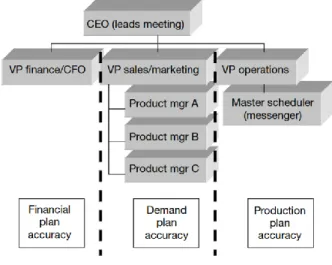
&OP processes within companies aim to bring Finance, Sales and Operations plans together so that each can inform the other. These three departments naturally have incentives that tend to oppose the other. For example, a Sales manager seeks to grow sales – usually at the detriment of optimal inventory levels – by placing large amounts of inventory across a network of stores. While an Operations manager may be held accountable for improving inventory turns and appropriately allocating warehouse space. Finance departments often times create their budgets in silos, using broad strokes for each department, without truly understanding the line item detail that it takes to create a department level budget from the
1Muzumdar and Fontanella, 2006 2Pittman and Atwater, 2016
3 Lapide, 2004
4
bottoms-up. Hence the need for Sales and Operations Planning in an effort to bridge these gaps and align the departments so that congruent planning can take place.
Current BHA Disaster Response Process
When a disaster occurs, the disaster response process involves a Needs Assessment on a country-by-country basis to discern the type and location of aid BHA will supply to support the affected population. BHA Supply Chain then transfers inventory from its commodity stockpile to the affected country / region, according to requirements given by the disaster response teams and availability of inventory at any of its four warehouses across the globe. Prior to items being released, a donation agreement is signed between the recipient partner responsible for distribution of the items and USAID. This agreement usually states that the recipient partner may keep additional items not used during the disaster for future events. Post disaster, BHA Supply Chain places orders to restock its inventory to bring it back up to pre-disaster response levels. Orders have significant lead times during which further requests from other disasters may have to be satisfied.
Figure 3 below depicts the existing response process by which demand is determined and downstream inventory management processes take place within BHA for non-food items.
Figure 4: BHA non-food disaster planning process
1. Needs Assessment DART (Field)
2. Determine supply and lead times Supply Chain (Field, D.C.)
3. Determine inventory allocation Supply Chain (Field, D.C.)
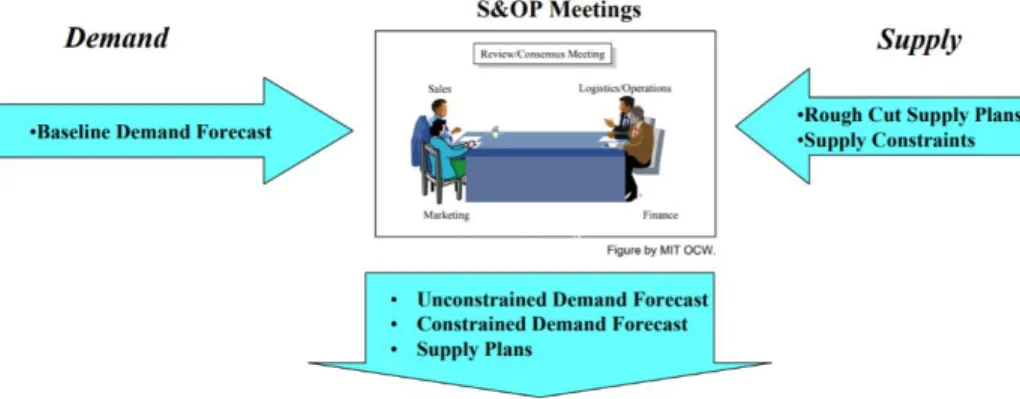
Figure 3: S&OP Roles and Responsibilities Figure 2: S&OP process
5
Other than limited efforts to do disaster response planning prior to an emergency (i.e. hurricanes in the Caribbean), BHA does not currently have a planning process that takes place pre-disaster. This is in part due to the nature of the types of disasters that BHA typically responds to with non-food items, as well as the simple fact that predicting and planning for disasters yet to occur is difficult and lacks accuracy.
Proposed BHA S&OP Process
Top business units that are typically part of the S&OP processes include Demand Planning and Procurement, Supply Management, and Operations. While roles and responsibilities within BHA may not directly translate to the traditional sense of the S&OP process, it can provide a structured approach to coordinate and align all relevant stakeholders of BHA. This section translates a traditional business S&OP to the humanitarian context that attempts to alleviate the planning challenges presented by the sheer nature of disaster response.
Figure 5: Three-step S&OP procedure
1. Identifying Demand. In this step, the Country Office (CO) and Regional teams assess potential hazard level threats and the vulnerability of the population in order to determine expected demand over a longer time horizon and prior to the occurrence of a disaster. The teams involved in this stage as the equivalent to Sales and/or Finance in industry.
Factors considered: • Locations
• Type (Natural vs. Conflict) - any need for ‘special items’ e.g. unbranded for conflict? • Total Affected Population
• BHA population planning figure
• Sectors (WASH, Shelter) - Technical Advisers provide input
2. Demand and Supply Planning. In this step, the BHA Supply Chain team analyzes current supply levels across BHA and external organizations. This is then paired against the anticipated demand that is generated in the first step in order to understand potential supply gaps. This provides the Supply Chain team with the information required to effectively manage inventory and place orders in a timely manner. The BHA Supply Chain team will also produce a commodity level forecast based on historical data. This forecast serves as a “top-down” forecast as opposed to the country-level, “bottom-up”
6
forecast that is generated in step one. Marrying these two forecasts through discussion – step three – results in well-rounded demand and supply plans that can be reconciled with existing budget allocations. At the end of this step, demand and operational plans, which include order frequency, inventory allocation, and distribution details by region will be developed. In doing so, BHA Supply Chain ultimately plays a role in both ‘Sales’ and ‘Operations’ in the traditional sense of the S&OP process. Factors considered: • Locations • Type • BHA Caseload • Items sent • Forecast items • Missing opportunities
• Existing resources from Gov/Com/Hum sectors in the region 3. Converge, align and agree on
plans. This is the crucial stage of the S&OP process that seeks to breakdown silos between teams and the stages of the planning process. Often times, demand is determined using inputs that the Supply Chain teams might not be aware of,
such as monitoring and evaluation reports or Partner requests. It is critical that forecasting takes new data points such as these into consideration in order to improve accuracy and match supply with demand growth (Figure 5). This final step should take the Operating Year Budget into consideration, as plans will need to be reconciled with budgets. The financial plan should provide both Program and Logistics teams the guidance needed to determine the disaster scale (percentage of demand served) that the organization should consider during the finalization of demand plans and inventory allocation. The S&OP process provides a discrete mechanism that establishes clear guidelines and an avenue for such collaborative discussions.
Data-driven Decision Tools
7
In an effort to fully harness the data that BHA has at its disposal, MIT has developed technology and analytical tools to bolster the proposed demand, supply, and distribution plans that are generated through the S&OP process. More specifically, the model can be directly linked to both step one and step two in the proposed S&OP process by assisting with disaster prediction (forecasting) and inventory allocation optimization (demand and supply planning). The model seeks to improve these steps by providing BHA with the unbiased tools necessary to optimize their inventory network based on existing inventory levels and desired scope, scale, and budgetary criteria, which will be established and/or discussed during the S&OP process. The model will help BHA Supply Chain with demand planning by identifying target inventory levels that provide the lowest cost given a set of constraints, and will help tie planning to operations and execution. The tool will also assist with forecasting and the quantification of the disaster “scaling” mechanism and the impact of both on inventory allocation.
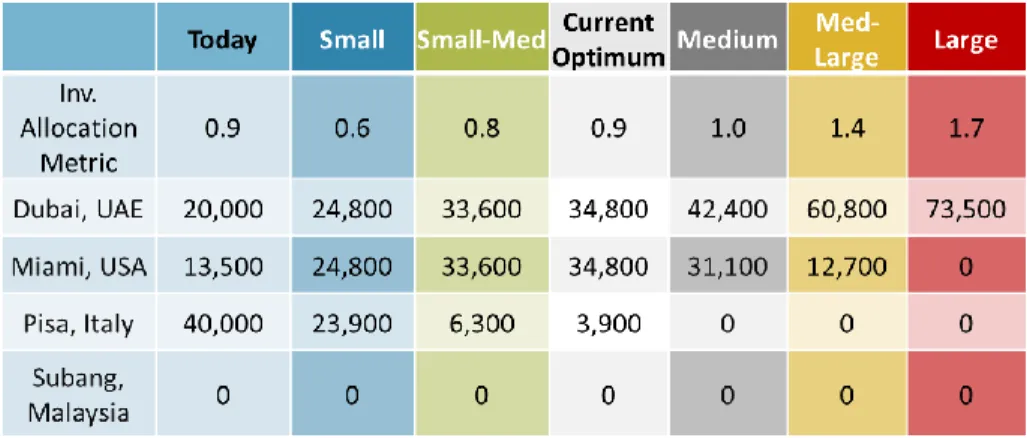
Ultimately, the model can help facilitate discussion between various teams across BHA at the global, regional, and country-level. Historical data (such as total population served by BHA) can be analyzed through the model by generating risk portfolio scenarios and highlighting the inventory requirements associated with each (Figure 6). The more features (i.e. additional warehouses, modes, predicted TAP) added to the model in the future, the more intuition can be built by managers to aid with decision-making.
Figure 7: Optimal Inventory Allocation – All
Implementation Considerations
In traditional S&OP process implementation, planning review cycles typically occur monthly. BHA may benefit from incorporating the S&OP process (and thereby the MIT model) at a number of different points throughout the year. The team recommends that BHA begin with a 6-month review cycle, and determine the need for additional reviews once the process has been fully adopted. Other review considerations
8
include the restocking process, which provides BHA with the perfect opportunity to incorporate the regional inventory allocation outputs of the model. It is at this stage that the model can contribute to the inventory and capacity balancing act (Figure 1) that the S&OP process seeks to fulfill.
Additional review periods may also provide BHA with a chance to ensure that the supply chain is setup to respond quickly and efficiently to disasters and that inventory is optimized across the network. These review periods could align with ordering cycles or simply serve as guide posts throughout the year as plans are updated with real-time disaster data.
• Quarterly Review: Model updates may include new disaster data or inputs. These types of updates could consider additional disaster data (non-BHA response), additional warehouse locations, and / or additional mode considerations.
• Ad hoc review: Business decisions may generate network change, such as changes to “scale”, target fill rates, and / or changes to BHA’s inventory profile.
• Metric review: Business decisions may generate budgetary changes that would impact model constraints or the optimization objective function.