HAL Id: hal-01745959
https://hal.archives-ouvertes.fr/hal-01745959
Submitted on 9 Apr 2018HAL is a multi-disciplinary open access
archive for the deposit and dissemination of sci-entific research documents, whether they are pub-lished or not. The documents may come from teaching and research institutions in France or abroad, or from public or private research centers.
L’archive ouverte pluridisciplinaire HAL, est destinée au dépôt et à la diffusion de documents scientifiques de niveau recherche, publiés ou non, émanant des établissements d’enseignement et de recherche français ou étrangers, des laboratoires publics ou privés.
Building 2D quasicrystals from 5-fold symmetric
corannulene molecules
Nataliya Kalashnyk, Julian Ledieu, Émilie Gaudry, Can Cui, An-Pang Tsai,
Vincent Fournée
To cite this version:
Nataliya Kalashnyk, Julian Ledieu, Émilie Gaudry, Can Cui, An-Pang Tsai, et al.. Building 2D quasicrystals from 5-fold symmetric corannulene molecules. Nano Research, Springer, 2018, 11 (4), pp.2129-2138. �10.1007/s12274-017-1830-x�. �hal-01745959�
Graphical Table of Content
A 2-dimensional quasicrystal has been grown from 5-fold symmetric corannulene
molecules. It successfully uses the templatng efect of the icosahedral Ag-In-Yb substrate
through a ratonal selecton of molecular moiety leading to preferental adsorpton of the
C
20H
10molecules with its convex side down at fve-fold symmetric sites, thus enforcing
Building 2D quasicrystals from 5-fold symmetric corannulene molecules
N. Kalashnyk,a J. Ledieu,a É. Gaudry,a C. Cui,b A.-P. Tsai,c and V. Fournée*a
a. Insttut Jean Lamour (IJL,, UMR 1198 CNR t – Université de Lorraine, Nancy, France. Email : [email protected]
b. Department of Physics, Zhejiang tci-Tech University, Hangzhou 310018, China c. Insttute of Multdisciplinary R esearch for Advanced Materials (IMR AM,, Tohoku University,
tendai, Japan
Abstract
The formaton of long-range ordered aperiodic molecular flms on quasicrystalline substrates provides a new challenge as well as an opportunity for further surface functonalizaton. A main approach to realize this aim is smart selecton of molecular building blocks, which is based on symmetry matching between the underlying quasicrystal and individual molecules. From our previous study, the geometrical registry between C60 molecules and several 5-fold and 10-fold surfaces played a key role in the growth of
quasiperiodic organic layers. However, the similar atempt to form quasiperiodic C60 network on
i-Ag-In-Yb substrate has been unsuccessful, and instead resulted in disordered molecular flm. Here we report on the growth of 5-fold symmetric corannulene C20H10 molecules on the 5-fold surface of the i-Ag-In-Yb
quasicrystal. A low-energy electron difracton (LEED, and scanning tunneling microscopy (tTM, study evidenced long-range quasiperiodic order and 5-fold rotatonal symmetry in the self-assembled corannulene flm. Decagonal molecular rings are recurrent local features resultng from the decoraton of specifc adsorpton sites with local pentagonal symmetry, by corannulenes adsorbed with their bowl-opening pointng away from the surface. They are identfed as both (Ag,In,-containing rhombic triacontahedral (R TH, cluster centers and pentagonal Yb motfs, all of which cannot be occupied simultaneously due to steric hinderance. It is proposed that symmetry matching between the molecule and specifc substrate sites is the essental driving force for this organizaton. Compared to C60
depositon on the same substrate, the alteraton of molecular rim by introducing CH substtuents seems to increase the molecule mobility on the potental energy surface and facilitate trapping at these specifc sites. This fnding suggests that a ratonal selecton of molecular moiety enables templated self-assembly of molecules leading to an ordered aperiodic corannulene layer.
Keywords
Introducton
The discovery of quasicrystals (QCs, bestowed with forbidden symmetries such as 5-, 10- and 12-fold has been a key trigger for reconsideraton of crystallography concepts as well as the whole feld of condensed mater.1 A signifcant interest into fundamental aspects of quasiperiodicity in mathematcs,
physics, and chemistry has followed, as well as intensive search for potental applicatons of QCs in the form of coatngs or composites as alternatve materials with new combinatorial propertes not found in conventonal alloys.2 Quasiperiodic structures have been discovered in a large number of intermetallics
(>100,3,4 but also in sof-mater systems5,6 and in thin oxide layers on metal surfaces1.
The possibility to grow molecular flms with quasiperiodic structure is atractve, as molecules can be functonalized, enabling the study of the interplay between aperiodic order and a variety of physico-chemical propertes. R ecent advances in supramolecular chemistry provide a number of approaches that can lead to the formaton of complex molecular paterns on metal surfaces. It includes the use of metal-directed self-assembly of linear organic linkers with four-fold, fve-fold and six-fold vertces, which were found to form semiregular Archimedean periodic tling as well as quasiperiodic square-triangle random-tling exhibitng twelve-fold symmetry.8-10 telf-assembly of hydrogen-bonded molecules into pentameric
building blocks which arrange into non-periodic domains of limited coherence length exhibitng ten-fold rotatonal symmetry was also reported.11 Another approach is to use molecular building blocks
exhibitng non-crystallographic rotatonal symmetry. This is the case of bowl-shaped corannulene (C20H10, with C5v symmetry.12 The tessellaton of the surface plane using corannulene molecules or its
derivatves was investgated on Cu(111, and Cu(110, surfaces.13-15 They form a large variety of 2D
close-packed complex ordered supramolecular networks with long range periodicity but no quasiperiodic one. Here symmetry mismatch at the molecule-substrate interface is accommodated by a tlt of corannulene board with one of its hexagonal ring or C-C bond oriented parallel to the Cu(111, or Cu(110, surfaces, respectvely. However, such adsorpton conformaton of molecules does not prevent the fabricaton of 3D structures via corannulene bowl-in-bowl stacking at multlayer growth regime,16 and can even lead to
the formaton of quadruple anionic buckybowl flms when doped with alkali metals.11
Another approach is to form quasiperiodic organic flms templated on pristne QC substrates. tuch substrate-mediated quasiperiodic molecular ordering was realized by adsorpton of linear pentacenes consistng of fve linearly-fused benzene rings deposited on the 5-fold surface of the i-Ag-In-Yb QC.18 No
long-range order was apparent in the flm structure at frst sight. However, by extractng the positon and orientaton of individual molecules from tTM images and calculatng the corresponding fast-Fourier transforms and autocorrelaton functons, the quasiperiodic distributon of the molecules was made apparent on a local scale and possible adsorpton sites were determined. Long-range quasiperiodic order could be achieved successfully in fullerene thin flms grown on various Al-based QC surfaces.19 This
was demonstrated by depositon of C60 on four diferent Al-based quasicrystalline substrates held within
a specifc temperature window. Here, the quasiperiodic order was mediated by preferred adsorpton at 5-fold symmetric sites of the surface latce, suggestng that the C60 molecules adsorb with a C
pentagonal face down to maximize molecule-substrate interactons. This hypothesis could not be clearly evidenced experimentally but was supported by density functonal theory (DFT, calculatons of adsorpton energies for various molecular confguratons. tubsequent work devoted to C60 thin flms
grown on the 5-fold surface of the i-Ag-In-Yb QC revealed the non-universal character of this approach.20
No preferred adsorpton sites could be evidenced experimentally in this system, resultng in a disordered molecular layer for all possible depositon temperatures. Most likely, a variety of adsorpton confguratons and sites may present similar adsorpton energies in this system, which could not be discriminated through high depositon temperature. As it can be readily apparent from the foregoing literature descripton, the controlled growth of long-range quasiperiodic organic networks is stll a challenge that cannot be addressed properly without adequate substrate and molecular building block selecton aiming at the optmum interplay between adsorbate-substrate and intermolecular interactons.
In the current work, we present the frst comparatve study of adsorpton of structurally related but stereochemically diferent C60 and C20H10 molecules on the 5-fold surface of the icosahedral i-Ag-In-Yb
quasicrystal. It is found that the C60 adsorpton did not yield any ordered molecular flms on that surface
as evidenced from LEED and tTM studies. In contrast, the templatng efect was successfully exploited in corannulene self-assembly. Analysis of tTM images and associated autocorrelaton patern clearly demonstrates that corannulenes adsorb with its convex side down preferentally at fve-fold symmetric sites, thus enforcing long-range quasiperiodic order in the flm. Therefore, the molecule-surface interactons had to play a major role in generatng principally diferent paterns with related C20H10 and
C60 molecules, i.e. either quasiperiodic or disordered networks, respectvely. This fnding suggests that a
ratonal selecton of molecular moiety enables templated self-assembly of molecules leading to an ordered aperiodic corannulene layer.
Experimental
All experimental data were recorded in a commercial ultra-high vacuum (UHV, system equipped with standard facilites for sample preparaton, LEED, variable-temperature tTM and X-ray photoelectron spectroscopy (XPt, techniques.
The studied single grain i-Ag-In-Yb quasicrystalline sample was grown by the Bridgman method at the Insttute of Multdisciplinary R esearch for Advanced Materials (IMR AM-Japan,21. It has a compositon of
Ag42In42Yb16 (in at.%,. A sample was extracted to present a surface oriented perpendicular to one of its
fve-fold axis identfed by Laue backscatering. Prior to loading into the UHV chamber (base pressure 10−10 mbar,, the surface was polished using diamond paste down to 0.25 µm. Aferwards the surface of
i-Ag-In-Yb quasicrystal was cleaned by several sputering (Ar+, 2 keV, 20 min, and annealing ( 690 K, 90 min, cycles under UHV conditons. The substrate temperature was controlled by a pyrometer with an emissivity set to 0.35. The later treatment led to a terrace and step surface morphology where terraces
have been identfed as a subset of dense Yb-rich planes of the bulk structure intersectng R TH building blocks in their equatorial planes.
The molecular flms were grown reproducibly on the i-Ag-In-Yb surface held either at room (300 K, or at moderate (420−520 K, temperatures by depositon of corannulene (white powder, >91%, TCI, from a Ta crucible resistvely heated to 359−361 K. Prior to the sublimaton experiment, the molecular powder was thoroughly degassed, while the cleanliness as well as the compositon of the i-Ag-In-Yb surface was checked with XPt. Monitoring of the C 1s core level spectrum by XPt has also been used to confrm that the corannulene molecules do not undergo modifcaton and fragmentaton upon adsorpton on hot intermetallic surface. The overall quality of molecular layers was investgated by LEED and tTM mainly operatng at room temperature (R T, 300 K,. The tTM experimental data were also acquired at low temperature (LT, 60 K,.
Results and Discussion
Atomic structure of the fvefold i-Ag-In-Yb substrate
A characteristc LEED patern of the pristne surface is shown in Fig. 1(a,. It consists of rings of ten difracton spots whose diameters present τ–scaling relatonships, where τ 1.618 is the golden mean. Moreover, each ring comprises two inequivalent sets of 5 difracton spots indicatng fve-fold rotatonal symmetry, consistent with previous reports by tharma et al.21 Large scale tTM images show a
stepped-terrace surface morphology with essentally two basic step heights t=0.28 nm and L=0.85 nm. Other larger step heights observed are linear combinaton of these two basic steps. R epresentatve tTM images of the surface structure are shown in Fig. 2 with unprecedented resoluton. The tTM contrast is strongly bias dependent.
Fig. 1 LEED paterns (primary beam energy equal to 14 eV, of the pristne icosahedral Ag-In-Yb quasicrystalline surface (a, and of the thin organic flm deposited at 423 K (b,. Both paterns show a
similar quasiperiodic distributon spots located on rings presentng -scaling relatonships (see yellow pentagons,. Note that the difracton spots appear more intense afer molecular depositon.
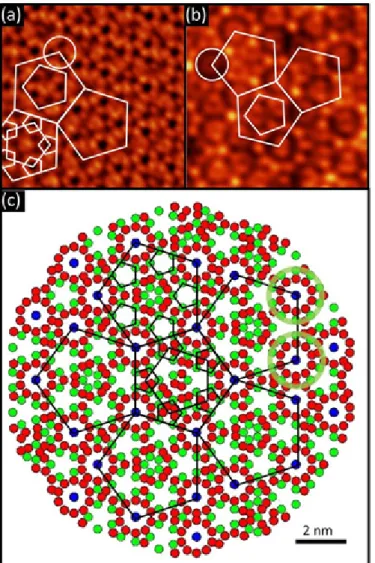
At positve bias (i.e. probing the unoccupied electronic states of the surface, Fig. 2a,, the structure can be described by decagonal rings of diameter 1.9 +/- 0.1 nm located at the node of a Penrose P1 tling made of pentagons, boats and rhombus. The edge length of the P1 tling is 2.5 +/- 0.1 nm. The internal decoraton of the pentagonal tle consists of pentagonal motfs pointng either up or down, the smallest ones having an edge length of 0.51 +/-0.05 nm and being centered by a dark spot. These small pentagons decorate the vertces of 2-scaled pentagon (edge-length equal to 1.54 nm, and pointng in
the opposite directon, etc… The central part of the P1 pentagonal tles is not uniform and varies from tle to tle.
At negatve bias (i.e. probing the occupied electronic states of the surface, Fig. 2b,, larger decagonal rings appear at the node of the P1 tling. They have a diameter equal to the edge length of the P1 tling. A triangular like motf is located inside these rings. The decoraton of the pentagonal tles vary from tle to tle, but fve bright spots usually decorate the vertces of a pentagon with edge length equal 1.54 nm and pointng in the opposite directon compared to the P1 pentagonal tle. These bright spots belong to fve diferent decagonal rings. Consistently with the previous interpretaton by tharma et al.,21 all these
motfs observed by tTM can be well explained by planes interceptng R TH cluster centres derived from the model of the isostructural i-Cd-Yb phase proposed by Takakura et al.22 (Fig. 2c,. At positve bias,
mainly the Yb atoms are imaged. The smallest pentagonal motfs with a dark centre correspond to Yb pentagons with edge length 0.51 nm. The decagonal rings with diameter 1.9 nm are made of ten Yb atoms surrounding the Ag/In rings decoratng the node of the P1 tling (highlighted by green circles in Fig. 2c,. These Yb atoms belong to diferent R TH cluster units. At negatve bias, the motfs inside the rings at the node of the P1 tling should correspond to the Ag/In decagonal rings (red rings surrounding R TH cluster centers in Fig. 2c,. The fact that they appear with a distorted form may be due to a non-uniform distributon of Ag and In atoms on the icosidodecahedral shells of the R TH units.
Fig. 2 (a,b, Atomic structure of the fve-fold i-Ag-In-Yb surface imaged by tTM at positve and negatve bias. (a, 10x10 nm2, V
B = +1.8 V; (b, 10x10 nm2, VB = -0.5 V. The most frequent local motfs are
highlighted in white. The largest pentagonal tles are P1 tles with edge length equal to 2.54 nm. (Note that images (a, and (b, do not correspond to the exact same locaton on the terrace,. (c, Atomic structure of a representatve bulk plane interceptng R TH cluster centers from the i-Cd-Yb model by Takakura et al.22 Green dots represent Yb atoms, red dots represent Cd(Ag/In, atoms, blue dots
represent R TH cluster centers. The P1 tling connects R TH cluster centers. tmaller pentagonal motfs formed by the Yb sublatce are also shown in black.
Structure of fullerene flms grown on the quasicrystalline surface
A frst atempt to self-assemble fullerene molecules (C60, Fig. t1a, on the i-Ag-In-Yb substrate held at
room temperature revealed the formaton of a non-periodic disordered thin organic flm as evidenced by the vanishing of the LEED patern. This is consistent with previous report by Nugent et al.20 showing a
random distributon of C60 on this surface observed in tTM images. Adsorpton followed a hit and stck
model, probably due a strong bonding of the C60 on the quasicrystalline surface resultng in kinetc
hindrance. In additon, the molecules appeared with diferent heights in tTM suggestng a variety of adsorpton confguraton on this surface. These are compelling evidences that no preferental adsorpton sites can be selected for fullerenes on i-Ag-In-Yb surface.
timilar disordered C60 layers are formed at R T on Al-based quasicrystals.23,24 However ordered aperiodic
flms can be obtained by using the hot substrate depositon method, within a specifc temperature window (between 623 and 613 K,.19 Hot substrate depositon is required to ease molecular difusion
allowing the full potental energy surface to be explored. As mentoned earlier, this procedure facilitates molecular trapping at sites presentng the lowest adsorpton energies. These sites are quasiperiodically distributed, resultng in a quasiperiodic molecular flm. The same approach was atempted for C60
deposited on i-Ag-In-Yb but was unsuccessful - even at the highest temperature compatble with the maximum substrate annealing temperature. The reason might be that the adsorpton energy diferences between various possible adsorpton confguratons/sites are smaller for C60 on Ag-In-Yb compared to
Al-based quasicrystal, making it impossible to discriminate specifc adsorpton confguraton/sites populated according to a Boltzmann distributon.
Structure of corannulene flms grown on the quasicrystalline surface
In the following, we select corannulene C20H10 as an alternatve to C60. Corannulene (Fig. t1b, is a
non-planar polycyclic aromatc hydrocarbon molecule with C5v symmetry.12 It consists of a C pentagonal ring
surrounded by fve benzene rings and it has a bowl-like stereo structure. It can be viewed as a fragment of buckminsterfullerene and is frequently termed buckybowl. It is expected that the reduced symmetry of corannulene compared to C60 and the presence of hydrogen at its rim might modify the
adsorbate-substrate potental energy surface as well as the adsorbate mobility. The aim is to enhance the trapping probability of molecules at fve-fold symmetric quasilatce sites and induce quasiperiodicity in the flm. The corannulene molecules were deposited on the quasicrystalline substrate held at various temperatures between 300 and 520 K, i.e. a moderate temperature range compared to C60. The global
structure was probed by LEED. A representatve difracton patern of the saturated monolayer is shown in Fig. 1b. It displays a quasiperiodic distributon of sharp spots similar to that of the clean substrate. In this case, the flm was grown with the substrate held at 423 K and annealed for 5 min at this temperature afer the depositon. The spots looks more intense afer depositon compared to the clean substrate and more difracton spots are visible. tuch LEED patern demonstrates that the molecular flm adopts a long range quasiperiodic order. The patern looks slightly more 10-fold than 5-fold compared to that of the clean surface at 14 eV beam energy. However, for some other electron beam energies, the decagonal rings of spots appear as two sets of fve spots with diferent intensites. It suggests that the molecular flm has 5-fold rotatonal symmetry like the substrate. A non-centrosymmetric LEED patern may also indicate that the substrate stll contribute in part to the difracted intensity. A difracton patern with similar characteristc is obtained already afer room temperature depositon. In this case the background is higher indicatng a more defectve structure. The fact that the corannulene flm is already ordered at R T difers from previous report on the growth of C60 flms on several quasicrystalline
surfaces. As stated earlier, a thermal treatment is required to facilitate the molecular difusion and trapping at the most energetcally favoured adsorpton sites. According to the current LEED study, corannulene deposited on i-Ag-In-Yb substrate kept at R T might conceivably possess sufcient surface mobility to form quasiperiodic supramolecular structure even without subsequent surface annealing.
On the local-scale the supramolecular structures formed on atomically clean quasiperiodic surface were studied by tTM as a functon of coverage. Typical tTM images of organic layers grown on the fvefold i-Ag-In-Yb substrate kept at 413 K are shown in Figs. t2a and 3a for submonolayer coverage and almost complete monolayer respectvely. The coverages are defned as the fracton of the surface covered by the molecules estmated from tTM image analysis. They reveal the presence of single round-shaped protrusions of 0.9−1.0 nm in diameter and their agglomerates into diferent motfs that are equally dispersed across the terraces (see clusters, lines and arcs in Fig. t2,. The dimension of isolated molecules corresponds well to the size of the free corannulene, while a weak depression clearly distnguished in its center implies that the molecular bowl opening points outwards from the surface as discussed elsewhere (see reference 13,. In other words, the corannulene adsorbs with its convex side (e.g., fve-member carbon ring, facing towards the intermetallic substrate beneath. A subsequent careful inspecton of organic layer has also enabled to detect the formaton of molecular rings composed of ten corannulenes (see Fig. 3c,. Thus, these bowl-shaped molecules can locally assemble into 10-fold symmetric motf on 5-fold i-Ag-In-Yb surface as indicated by green arrows in Fig. 3c. It may also explain the more 10-fold appearance of the organic flm in the LEED patern shown in Fig. 1b. tuch corannulene ring with radius of 2.12 nm can be alternatvely viewed as two 36°-rotated pentagons with edge length of 2.5 nm (see Fig. t2c,. The later value is in excellent agreement with the edge dimension of pentagonal tle connectng R TH cluster centers of the pristne icosahedral quasicrystalline substrate below (Fig. 2c,. The nearest-neighbour distance in the molecular ring is measured at 1.3 0.1 nm, and is identcal to the smallest molecules separaton found in the flm. This value is signifcantly higher than those of 1 0.1 nm measured in close-packed corannulene structures formed on Cu(111, experiments.15
Fig. 3 (a, tTM image of the almost complete corannulene monolayer (0.85 ML, grown on the fvefold i-Ag-In-Yb surface maintained at 413K and (b, its corresponding FFT patern. The aperiodic nature of the organic layer is confrmed by rings of ten spots having diameters presentng τ-scaling relatonships (see infated yellow pentagonal motfs,. (c, Close up tTM image of a molecular ring composed of 10 corannulenes and corresponding (d, tentatve model illustratng the preferental corannulene adsorpton on Yb- and (Ag,In,-based sites highlighted by alternatng small pentagons and circles, respectvely. Ten green arrows in (c, indicate the 10-fold symmetry of corannulene motf.
These observatons lead to the conclusion that corannulenes should indeed be in registry with the underlying i-Ag-In-Yb surface and exhibit stronger adsorbate-substrate interactons at several anchoring sites as will be discussed later. Finally, it is possible to distnguish from one to three corannulenes trapped in the pore of the molecular ring illustrated in Figs. 3c. The presence of complete corannulene rings on the surface is actually limited. Most of the tme, the rings are incomplete and instead one observes more frequently intersectng arcs, wavy lines and rarely small pentagonal motfs (see Fig. t2,. Moreover, the rims of some molecules are homogeneously visualized which might indicate non-planar adsorpton geometry of their pentagonal carbon rings with respect to the surface.
The long-range quasiperiodic order is obvious in calculated FFT of tTM images of the molecular flm. As can be seen in Fig. 3b, the FFT reveals sharp spots distributed on a number of 10-fold symmetric rings with diferent radii exhibitng -scaling relatonships. These characteristcs correspond well to the
reciprocal latce (difracton spots arrangements in Fig. 1b, of the organic flm deduced from the LEED patern, and confrm its quasiperiodic nature.
The quasiperiodic distributon of the adsorbed molecules on i-Ag-In-Yb surface can be equally ascertained from the autocorrelaton of tTM images of the flm structure. In the ACF, the 2D brightness map refects the endpoints of vectors joining neighbourhood molecules. It enhances periodic or quasiperiodic features present in the raw image. As can be seen in Fig. 4, the ACF shows long-range correlaton between the molecules on a length scale that is at least as large as the image size, typically on the order of 50 nm. The bright protrusions are arranged along high density lines oriented according to fve possible directons indicated by blue arrows, each rotated by 36° from each other. The parallel lines oriented along one of these partcular directons are unequally spaced. Furthermore, they appear either at short s 1.6 0.1 nm or long l 2.5 0.1 nm distances apart, with l/s τ, and their spacing sequence follows a Fibonacci series (···lsllslsllsll···,. From the line profle along white lines in Fig. 4, the distances between the main bright protrusions also follow a Fibonacci sequence with the same s and l building blocks. Consequently, the maxima of the ACF defne the nodes of an Ammann pentagrid, which is the dual of the Penrose tling.25 A patch of a quasiperiodic P1 tling with an edge length equal to 2.5
nm has been superimposed on the autocorrelaton map. It is observed that the brightest dots of the map are located on the node of this tling, indicatng that molecules are preferentally adsorbed on such patern.
Additonal intensity is found decoratng the P1 tles, forming an irregular pentagon with side of about 0.9 0.1 nm built of dimer protrusions and delineated by small yellow contour in Fig. 4. tuch motfs in the ACF suggest a non-uniform distributon of additonal corannulene inside the P1 tles.
Fig. 4 Autocorrelaton patern from the tTM image shown in Fig. 3a of the corannulene layer grown on i-Ag-In-Yb substrate. The bright protrusions are aligned along quasiperiodically spaced lines defning a pentagrid, with s 1.6 0.1 nm and l=.s 2.5 0.1 nm. The brightest dots are located at the nodes of a quasiperiodic P1 tling with edge length equal to 2.5 nm. A patch of this tling is superimposed on the ACF patern (white lines,. A pentagonal P1 is highlighted in blue, with its irregular decoraton in yellow.
Tentative model based on experimental results
To determine a tentatve model of corannulene self-assembly on i-Ag-In-Yb surface, all structural informaton deduced from real and reciprocal space has to be combined. First, the LEED paterns of the substrate and flm show similar spatal distributon of spots, indicatng that the flm structure is pseudomorphic with that of the substrate, meaning that the molecules must be preferentally adsorbed on a specifc subset of quasilatce sites. The tTM imaging of individual molecules indicates that they are usually adsorbed with their bowl opening pointng up, therefore contactng the surface plane with its pentagonal carbon ring. In some cases, an inhomogeneous contrast is observed at the rim of some molecules suggestng that their C5 symmetry axis may be slightly tlted with respect to the surface
normal. The most conspicuous features in tTM images are the decagonal rings of corannulenes which can be described as two 36°-rotated pentagons with edge length of 2.5 nm as depicted in Fig. 5a. From the analysis of the autocorrelaton of tTM images, it was found that the molecules preferentally adsorb on a patern reproducing the P1 tling with edge length 2.5 nm (the ubiquitous pentagonal tle is depicted in Fig. 5b,. From perfect correlaton of this pentagonal tling with the P1 tling connectng R TH cluster centers of the underlying QC substrate, a preferental adsorpton of corannulene at R TH sites can reasonably be inferred (see black circles in Fig. 3d,. These adsorpton sites have local fve-fold symmetry. According to the work by Nozawa et al.26, they are decorated mainly by In atoms. The surface
planes interceptng R TH cluster centers contain other fve-fold symmetric sites made of Yb pentagons with edge length of 0.51 nm as shown in Fig. 2c and 3d. Two such Yb pentagons are located symmetrically from the mid-edge positons between two R TH cluster centers. The molecular decoraton of both Yb pentagons and R TH sites – as shown by alternatng black pentagons and circles in Fig. 3d respectvely – perfectly reproduces the decagonal rings observed experimentally. In this case the nearest-neighbor (NN, distance would correspond to separaton of corannulenes located at R TH cluster center and Yb pentagon, matching the intermolecular distance measured at 1.3 nm (see Fig. 3d,. In turn, the consideraton of Yb pentagons as alternatve adsorpton site for the molecules in additon to R TH cluster centers can also explain the presence of a large amount of incomplete or even slightly distorted molecular rings in acquired tTM images (see Fig. t2d,. Indeed, the distance between the centers of two adjacent Yb pentagons located symmetrically from the mid-edge positons between two R TH cluster centers is 0.84 nm. Therefore these two sites cannot be occupied simultaneously due to steric hindrance between the molecules.
Additonal Yb pentagonal sites are also found inside the P1 tles, which can lead to additonal corannulenes trapped inside the decagonal ring (a maximum of 3 or 4 can be antcipated based on steric hindrance, consistent with observatons,. This hypothesis is also supported by autocorrelaton data featuring irregular pentagons embedded in P1 tles as indicated by small yellow contour in Figs. 4 and
5b. Additonal infated motfs in the autocorrelaton functon as the one shown in Fig. 5c can also be found in the proposed model (Fig. 5d,. Therefore the most salient observatons can be reproduced by assuming preferred adsorpton of corannulenes at fve-fold symmetric sites. This subset of sites consists of both R TH cluster centres located at the node of a P1 tling and Yb pentagonal motfs decoratng the P1 tles. Decoratng these sites with molecules while respectng steric hindrance rules allow to reproduce the main structural features observed in real space as well the corresponding FFT.
Fig. 5 Tentatve model of corannulene self-assembly on i-Ag-In-Yb substrate (d, based on the most prominent features of both tTM image (a, and its autocorrelaton paterns (b,c,.
Conclusions
In summary, we have presented the frst comparatve study of adsorpton of structurally related but stereochemically diferent C60 and C20H10 molecules on the 5-fold surface of the icosahedral i-Ag-In-Yb
quasicrystal. Both molecules have similar lateral dimensions and have the same pentagonal carbon ring surrounded by fve phenyls. However, while C60 molecules have 2-, 3- and 5-fold rotatonal symmetries,
C20H10 only have C5v symmetry. Therefore both organic moietes can match the underlying surface
symmetry, but the C60 have more degrees of freedom regarding its adsorpton geometry on such
complex substrate compared to C20H10. As a result, it is found that the C60 adsorpton on 5-fold symmetry
i-Ag-In-Yb surface did not yield any ordered molecular flms as evidenced from LEED and tTM studies. In
contrast, the templatng efect was successfully exploited in corannulene self-assembly, even at moderate depositon temperatures. Analysis of tTM images and associated autocorrelaton patern clearly demonstrates that corannulenes adsorb with its convex side down preferentally at fve-fold symmetric sites (R TH cluster centers and Yb pentagons,, thus enforcing long-range quasiperiodic order in the flm. tince corannulene can be viewed as a fragment of C60 with only C5v symmetry, it can be
symmetry matching. As the NN distance of 1.3 nm on i-Ag-In-Yb substrate is rather large, it suggests sufciently weak intermolecular interacton in the organic flm. Therefore, the molecule-surface interactons had to play a major role in generatng principally diferent paterns with related C20H10 and
C60 molecules, i.e. either quasiperiodic or disordered networks, respectvely. The role of the symmetry
matching should be investgated further, possibly through density functonal calculatons of the molecular adsorpton energies for example.
Finally, there are many bowl-shaped corannulene derivatves with C5 rotatonal axis with various
functonalites.12 They represent a class of molecules which can potentally self-assemble into
quasiperiodic paterns on quasicrystalline templates using the same mechanism used in the present work with corannulene. Also the saturated quasiperiodic monolayer could potentally be extended in the third dimension, by further piling of corannulenes with a bowl-in-bowl geometry. This has already been demonstrated for periodic molecular patern and could be extended to form the equivalent of a decagonal molecular quasicrystal.
Acknowledgements
This work was supported by the Lorraine R egion and the European C-MAC consortum.
Notes and references
1 thechtman, D.; Blech, I.; Gratas, D.; Cahn, J. W. Metallic phase with long-range orientatonal order and no translatonal symmetry. Phys. Rev. Let., 1984, 53, 1951-1953.
2 Dubois, J.M. Propertes and applicatons of quasicrystals and complex metallic alloys. Chem. Soc.
Rev., 2012, 41, 6160-6111.
3 Janot, C. Quasicrystals: A Primer; Oxford University Press, 2012.
4 tteurer, W.; Deloudi, t. Crystallography of Quasicrystals: Concepts, Methods and Structures; tpringer teries in Materials tcience, 2009.
5 Zeng, X.; Ungar, G.; Liu, Y.; Percec, V.; Dulcey, A.E.; Hobbs, J.K. Nature, 2004, 428, 151-160. 6 Talapin, D.V.; thevchenko, E.V.; Bordnarchuk, M.I.; Ye, X.; Chen, J.; Murray, C.B. Quasicrystalline
order in self-assembled binary nanopartcle superlatces. Nature, 2009, 461, 964-961.
1 Förster, t.; Meinel, K.; Hammer, R .; Trautmann, M.; Widdra, W. Quasicrystalline structure formaton in a classical crystalline thin-flm system. Nature, 2013, 502, 215-218.
8 Ecija, D.; Urgel, J.I.; Papageorgiou, A.C.; Joshi, t.; Auwärter, W.; teitsonen, A.P.; Klyatskaya, t.; R uben, M.; Fischer, t.; Vijayaraghavan, t.; R eichter, J.; Barth, J.V. Five-vertex Archimedean surface tessellaton by lanthanide-directed molecular self-assembly. Proc. Natl. Acad. Sci., 2013,
9 Urgel, J.I.; Ecija, D.; Auwärter, W.; Papageorgiou, A.C.; teitsonen, A.P.; Vijayaraghavan, t.; Joshi, t.; Fischer, t.; R eichter, J.; Barth, J.V. Five-vertex lanthanide coordinaton on surfaces: a route to sophistcated nanoarchitectures and tessellatons. J. Phys. Chem. C, 2014, 118, 12908-12915. 10 Urgel, J.I.; Ecija, D.; Lyu, G.; Palma, C.-A.; Auwärter, W.; Lin, N.; Barth, J.V. Quasicrystallinity
expressed in two-dimensional coordinaton networks. Nature Chem., 2016, 8, 651-662.
11 Wasio, N. A.; Quardokus, R . C.; Forrest, R . P.; Lent, C. t.; Corcelli, t. A.; Christe, J. A.; Henderson, K. W.; Kandel, t. A. telf-assembly of hydrogen-bonded two-dimensional quasicrystals. Nature, 2014, 507, 86-89.
12 Li, X.; Kang, F.; Inagaki, M. Buckybowls: corannulene and its derivatves. Small, 2016, 12, 3206-3223.
13 Parschau, M.; Fasel, R .; Ernst, K.-H.; Gröning, O.; Brandenberger, L.; tchillinger, R .; Greber, T.; teitsonen, A.P.; Wu, Y.-T.; tiegel, J.t. Buckybowls on metal surfaces: symmetry mismatch and enantomorphism of corannulene on Cu(110,. Angew. Chem. Int. Ed., 2007, 46, 8258-8261. 14 Bauert, T.; Merz, L.; Bandera, D.; Parschau, M.; tiegel, J. t.; Ernst K.-H. Building 2D Crystals from
5-Fold-tymmetric Molecules. J. Am. Chem. Soc., 2009, 131, 3460-3461.
15 Guillermet, O. ; Niemi, E. ; Nagarajan, t. ; Bouju, X. ; Martrou, D. ; Gourdon, A. ; Gauthier, t. telf-assembly of fvefold-symmetric molecules on a threefold-symmetric surface. Angew. Chem. Int.
Ed., 2009, 48, 1910-1913.
16 Bauert, T.; Baldridge, K. K.; tiegel, J. t.; Ernst K.-H. turface-assisted bowl-in-bowl stacking of nonplanar aromatc hydrocarbons. Chem. Commun., 2011, 47, 1995-1991.
11 Bauert, T.; Zoppi, L.; Koller, G.; tiegel, J. t.; Baldridge K. K.; Ernst, K.-H. Quadruple anionic buckybowls by solid-state chemistry of corannulene and cesium. J. Am. Chem. Soc., 2013, 135, 12851-12860.
18 tmerdon, J. A.; Young, K. M.; Lowe, M.; Hars, t. t.; Yadav, T. P.; Hesp, D.; Dhanak, V. R .; Tsai, A. P.; tharma H. R .; McGrath, R . Templated quasicrystalline molecular ordering. Nano Let., 2014,
14, 1184-1189.
19 Fournée, V.; Gaudry, É.; Ledieu, J.; de Weerd, M.-C.; Wu D.; Lograsso T. telf-Organized Molecular Films with Long-R ange Quasiperiodic Order. ACS Nano, 2014, 8, 3646-3653.
20 Nugent, P. J.; tmerdon, J. A.; McGrath, R .; thimoda, M.; Cui, C.; Tsai, A. P.; tharma H. R . ttep-terrace morphology and reactvity to C60 of the fve-fold icosahedral Ag–In–Yb quasicrystal.
Philos. Mag., 2011, 91, 2862-2869.
21 tharma, H. R .; thimoda, M.; tagisaka, K.; Takakura, H.; tmerdon, J. A.; Nugent, P. J.; McGrath, R .; Fujita, D.; Ohhashi t.; Tsai, A. P. ttructure of the fvefold surface of the Ag-In-Yb icosahedral quasicrystal. Phys. Rev. B., 2009, 80, 121401 (R ,.
22 Takakura, H. ; Gomez, C. P. ; Yamamoto, A. ; de Boissieu M. ; Tsai, A. P. Atomic structure of the binary icosahedral Yb–Cd quasicrystal. Nature Mater., 2007, 6, 58-63.
23 Ledieu, J.; Muryn, C. A.; Thornton, G.; Diehl, R . D.; Lograsso, T. A.; Delaney D. W.; McGrath, R . C60
adsorpton on the quasicrystalline surface of Al10Pd21Mn9. Surf. Sci., 2001, 472, 89-96.
24 Cox, E. J.; Ledieu, J.; Dhanak, V. R .; Barret, t. D.; Jenks, C. J.; Fisher I.; McGrath R . An tTM and tXPt study of the interacton of C60 with the ten-fold surface of the Al12Ni11Co11 quasicrystal. Surf.
Sci., 2004, 566, 1200-1205.
25 tocolar J.E.t.; tteinhardt, P.J. Quasicrystals. II. Unit-cell confguratons. Phys. Reb. B., 1986, 34, 611-641.
26 Nozawa K.; Ishii, Y. Theoretcal studies on clean and adsorbed surfaces of Ag-In-Yb. Philos. Mag., 2011, 91, 2913-2919.
21 C. Cui and A. P. Tsai, Growth of large single-grain quasicrystals in the Ag–In–Yb system by Bridgman method. J. of Crystal Growth, 2009, 312, 131-135.