HAL Id: hal-02344462
https://hal.archives-ouvertes.fr/hal-02344462
Submitted on 4 Nov 2019
HAL is a multi-disciplinary open access
archive for the deposit and dissemination of
sci-entific research documents, whether they are
pub-lished or not. The documents may come from
teaching and research institutions in France or
abroad, or from public or private research centers.
L’archive ouverte pluridisciplinaire HAL, est
destinée au dépôt et à la diffusion de documents
scientifiques de niveau recherche, publiés ou non,
émanant des établissements d’enseignement et de
recherche français ou étrangers, des laboratoires
publics ou privés.
Nutrient regulation in ants (Hymenoptera: Formicidae):
a review
Enikö Csata, Audrey Dussutour
To cite this version:
Enikö Csata, Audrey Dussutour. Nutrient regulation in ants (Hymenoptera: Formicidae): a
re-view. Myrmecological News, The Austrian Society of Entomofaunistics (ÖGEF), 2019, 29, pp.111-124.
�10.25849/myrmecol.news_029:111�. �hal-02344462�
Myrmecological News
Myrmecol. News 29: 111-124 doi: 10.25849/myrmecol.news_029:111 21 August 2019 Review Article
ISSN 1997-3500 myrmecologicalnews.org
Introduction
Ants, as all living organisms, face basic nutritional chal-lenges. They must find the correct amounts and balance of nutrients to satisfy their needs in terms of growth, maintenance of body functions and reproduction (Simpson & Raubenheimer 2012). Foods offer complex mixtures of nutrients, each nutrient having its own functional impli-cation for the animal. For instance, the two main life his-tory traits reproduction and lifespan often have different nutritional optima. In many insects, high-carbohydrate diets increase lifespan but reduce breeding performances, whereas high-protein diets dramatically reduce lifespan, but favour reproduction (Simpson & Raubenheimer 2012).
To regulate its nutrition, an organism, such as an ant, needs to (i) determine the nutritional quality of available food sources; (ii) assess its current nutritional state in re-lation to its desired state using circulating metabolites and hormones; (iii) and integrate its nutritional requirements with food source availability to produce optimal
behav-ioural and physiological responses (Lenard & Berthoud 2008, Simpson & Raubenheimer 2012). However, ants face an additional challenge: food collection is undertaken only by the foragers, which represent approximately ten to twenty percent of the colony (Hölldobler & Wilson 1990). Thus, foragers need to collect food that meets their own nutritional requirements, but also fulfill the needs of other members of the colony such as inner-nest workers, reproductives and larvae.
The main aim of this review is to illustrate how we can use an integrative framework to deepen our understanding of ant nutrition. First, we will give a brief overview of ant nutritional ecology and ant foraging behaviour. Second, we will present the geometric framework as an integrative approach, that takes into account the interaction between food attributes and ant behaviour. Third, we will describe how this approach enables us to understand ant foraging strategies and their impact on colony performance. Fourth, we will discuss how this framework may be used to
un-Nutrient regulation in ants (Hymeno ptera: Formicidae): a review
Enikő Csata & Audrey Dussutour
AbstractAs for all living organisms, the nutritional needs of ants change over time in response to varying environmental conditions and demands for growth, health, and reproduction. Solitary individuals regulate their nutritional intake to maintain an appropriate balance of nutrients by selectively choosing the quality and quantity of food that meet their nutritional requirements. For social organisms, such as ants, food collection for the entire colony relies on a few individuals whose nutritional requirements may be very different from those of other members of their colony. Recent studies have used an integrative framework, the “geometric framework”, to better understand how living organisms regulate macronutrient intake to defend a specific nutrient “intake target”. In this review, we first reveal how the geometric framework has been used to deepen our understanding of ant communal nutrition. Second, we describe how this framework might be used to also understand the nutritional strategies used by ants facing infection challenges. Lastly, we conclude with a brief discussion of the promising techniques that could be used in the future to improve our understanding of communal nutrition in ants.
Key words: Ants, nutrition, geometric framework, food intake, parasite, review. Received 6 March 2019; revision received 1 July 2019; accepted 6 July 2019 Subject Editor: Heike Feldhaar
Enikő Csata (contact author), Hungarian Department of Biology and Ecology, Babeş‑Bolyai University, Clinicilor 5‑7, 400006, Cluj‑Napoca, Romania; Centre de Recherches sur la Cognition Animale (CRCA), Centre de Biologie Intégrative (CBI), Université de Toulouse, CNRS, UPS, 31062, Toulouse, France. E‑mail: [email protected] Audrey Dussutour, Centre de Recherches sur la Cognition Animale (CRCA), Centre de Biologie Intégrative (CBI), Université de Toulouse, CNRS, UPS, 31062, Toulouse, France.
derstand foraging strategies used by ants facing not only nutritional but infection challenges. Lastly, we will pres-ent promising techniques that can be used in the future to improve our understanding of communal nutrition in ants.
Ant nutritional ecology
Two recent papers have extensively reviewed ant nutri-tional ecology. The first one concentrated on nutrinutri-tional niche plasticity and its influences on ant communities (Feldhaar 2014). The second one focused on how re-sources affect ant nutritional ecology, describing ants trophic position, ants natural food sources and ants di-gestive physiology (Blüthgen & Feldhaar 2009). Hence, ant nutritional ecology will only be discussed briefly in this review.
Ants have extremely diversified lifestyles, ecological characteristics, social organisations and habitat require-ments. They are present in all kinds of terrestrial envi-ronment, even when those seem inhospitable. They are often classified as ecosystem engineers, since they shape in large part the structure and diversity of their habitats (Folgarait 1998). Most ants are considered to be omni-vores (Hunter 2009) utilizing a large variety of nutritional
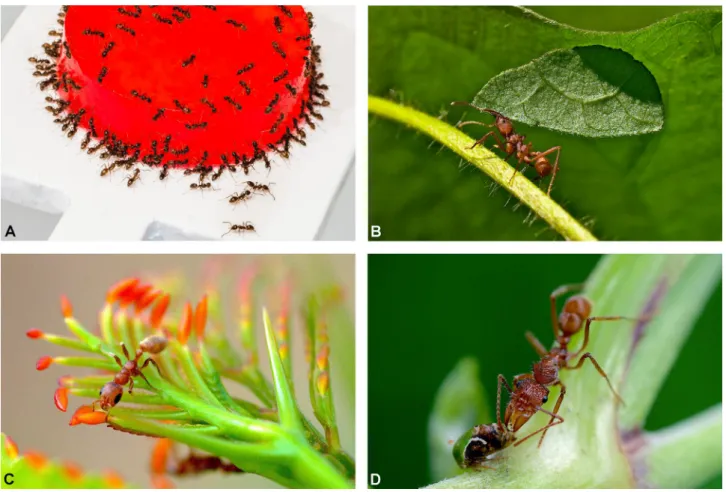
resources and feeding on more than one trophic level. Yet, a few ant species are specialized on specific food, some being herbivores (direct consumers of plant resources) or indirect herbivores (collectors of hemi pteran honeydew) predators, pollenivores, nectarivores, fungivores or grani-vores (Fig. 1, Fig. 2; Beattie 1985, Hölldobler & Wilson 1990). Numerous field studies have shown, using stable isotopes, that within ant communities, species forage in different nutritional niches, for example, formicines forage on lower trophic levels in comparison to myrmicines or po-nerines (Blüthgen & al. 2003, Davidson & al. 2003, Fie-dler & al. 2007, O’Grady & al. 2010). Yet, ant nutritional niches can vary depending on environmental conditions. For instance, studies have shown that in the presence of a superior competitor, some ant species are excluded from their favourite food to feed on less preferred ones (Blüthgen & Fiedler 2004a, b). Likewise, ants cease to feed on certain food depending on food availability (Kay 2004, Petry & al. 2012). For example, Formica podzolica foragers supplemented with carbohydrates stop collecting honeydew and floral nectar (Petry & al. 2012). Both in the field and in the lab, when studying ant nutritional ecology and in particular food selection, researchers have focused their attention on forager behaviour.
Fig. 1: Ants feeding on different food source (A) The argentine ants Linepithema humile feeding on artificial food, (B) Atta ceph‑ alotes medium worker carrying a leaf fragment back to the nest to feed their symbiotic fungus, (C) Pseudomyrmex ferruginea collecting Beltian bodies, (D) Ectatomma tuberculatum collecting honeydew from a membracid adult. (Photograph A by David Villa, B - D by Jean Paul Lachaud).
Foraging behaviour
Ant foraging activity is influenced by 1) the distribution of food resources in time and space, 2) the quality of the food, and 3) the competition level, and 4) the risk of predation or parasitization. The behaviour of a forager mostly depends on the activities of other foragers and the nutritional state of the colony as a whole (Traniello 1989). Both experimental and theoretical works investi-gating foraging strategies in ants have emphasized the importance of social information as a mechanism for selecting the highest quality food source in the environ-ment (reviewed in Jeanson & al. 2012). For instance, in many species of ants, when a forager finds a food source, it lays an odour trail (pheromone trail) on its way back to the nest to recruit its nestmates to its discovery. Re-cruited ants use the trail to reach the food source and re-inforce it on their return journey (Hölldobler & Wilson 2009).
Numerous lab studies have shown that once a forager encounters a food source the decision to lay a trail depends on various parameters: 1) food quality: Linepithema hu‑
mile (see Arganda & al. 2014), Lasius niger (see Portha & al. 2002, Dussutour & Simpson 2012), Solenopsis invicta (see Cassil & Tschinkel 1999), Solenopsis geminata
(see Hangartner 1969), Lasius niger (see Beckers & al. 1992), Monomorium and Tapinoma (see Szlep & Jacobi 1967), Tetramorium impurum (see Verhaeghe & Deneu-bourg 1983), Tetramorium caespitum (see Collignon & Detrain 2009), Myrmica sabuleti (see De Biseau & al. 1991), Monomorium pharaonis (see Sumpter & Beekman 2003), Rhytidoponera sp. (see Dussutour & Nicolis 2013), Linepithema humile (see Reid & al. 2012); 2) food quantity: Lasius niger (see Mailleux & al. 2003); 3) food handling time: Pheidole pallidula (see Detrain & Deneubourg 1997); 4) level of colony starvation: Lasius
niger (see Mailleux & al. 2006); and 5) foraging risk: Lasius pallitartis (see Nonacs 1990). Overall, depending
on the species, foragers recruit more intensively 1) to carbohydrate than to protein (Lasius niger, see Portha & al. 2002); 2) to highly concentrated foods than to diluted ones (Monomorium pharaonis, see Sumpter & Beekman 2003); 3) when they are starved than when they are sati-ated (Lasius niger, see Mailleux & al. 2006); 4) for big prey items than for small ones (Pheidole pallidula, see Detrain & Deneubourg 1997); and 5) for safe location than for risky ones (Nonacs 1990). The modulation of this trail laying behaviour often leads to the selection of the best food option, when two food sources varying in charac-teristics are offered (Franks 1985, see review Traniello
Fig. 2: Ants feeding on different food source (A) Ectatomma ruidum workers carrying a prey back to their nest, (B) Pseudomyrmex gracilis worker carrying a female parasitoid wasp, (C) Odontomachus hastatus carrying a Lucilia sericata larva, (D) Messor barbarus transporting a seed back to the nest. (Photographs A, B by Jean Paul Lachaud, C, D by Iago Sanmartín-Villar).
1989, Detrain & al. 1999, Hölldobler & Wilson 2009, Jeanson & al. 2012).
Studies investigating collective decisions in a forag-ing context have brought significant understandforag-ing of ant nutrition. Yet, even though all naturally available food items encountered by ants in the field contained multiple nutrients, most studies used carbohydrates as a food source or often investigate the effects of protein and carbohydrate in isolation from one another (Portha & al. 2002, 2004). In addition, these studies were often conducted on a short-term basis i.e., the experiments never exceeded few hours (Jeanson & al. 2012), while both the nutritional state and the nutritional optima of the colony might change in time according to seasons (Cook & al. 2011), colony growth (Dussutour & Simpson 2008), and colony composition (Dussutour & Simpson 2009). Thus, understanding how ants maintain nutrient supply at both a collective and an individual level in response to changes in the nutritional composition of available foods and colony characteristics would provide an important extension to models of collective foraging behaviour. Such important questions about ant nutrition can only be answered using an integrative approach.
An integrative approach: geometric framework
In a seminal paper, Raubenheimer & Simpson (1993) presented for the first time an integrative approach, named geometric framework (GF) to model animal nutrition that takes into account the regulation of different nutrients simultaneously. The GF is a state-space modelling ap-proach that presents how an animal solves the problem of balancing nutrient demands in an ever-changing en-vironment (Raubenheimer & Simpson 1993, Simpson & al. 2003, Simpson & Raubenheimer 2005). The GF uses a nutrient space which is a geometric space built of multiple axes, where each axis represents a particular nutrient. The
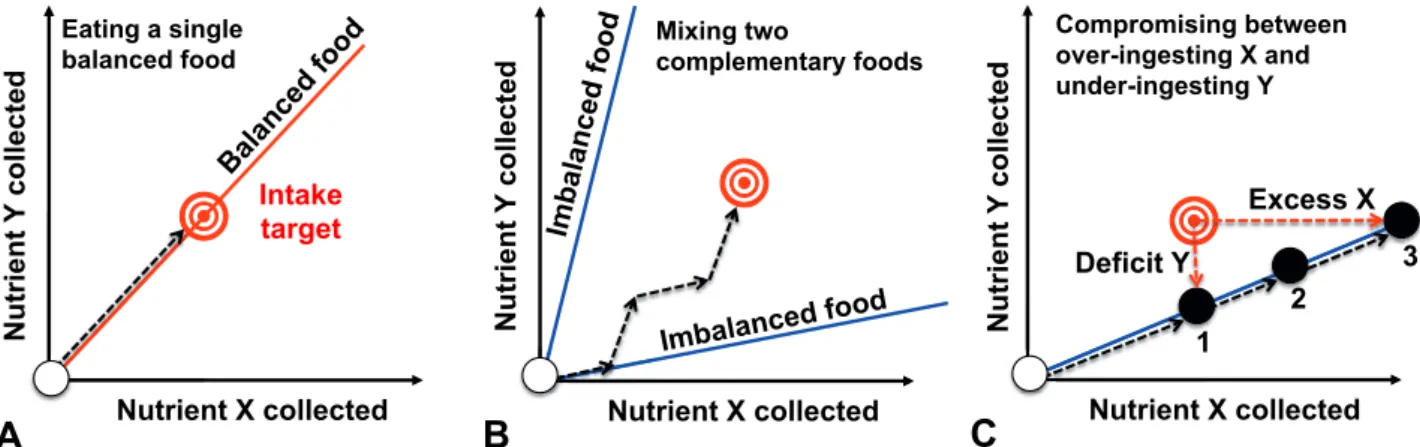
nutritional state of the animal is represented as a point in this nutrient space, which moves over time with nutrient intake, metabolism, growth, reproduction and excretion (Fig. 3). The amount of nutrients that an animal needs to ingest to maximize its fitness is represented as a point in the nutrient space, called the intake target (Simpson & Raubenheimer 2012).
Foods are modelled in this nutrient space as vectors with a slope indicating the balance of nutrients they con-tain (nutritional rails). By eating, the animal changes its nutritional state along the vector of the chosen food rail. A nutritionally balanced food enables the animal to reach its intake target (Fig. 3A), whereas an imbalanced diet forces the individual into a compromise between over-ingesting some nutrients while under-ingesting others. If two or more foods are available and encompass the intake target, they are called complementary, as the animal can achieve its intake target by eating from both foods (Fig. 3B, Fig. 3C) (Simpson & Raubenheimer 2012).
The GF has enabled to understand some of the most fundamental principles of animal nutrient regulation strategies and how they vary across a wide range of taxa, ecological contexts and feeding guilds (see review Simp-son & Raubenheimer 2012). This framework was first developed to study insects, especially grasshoppers, lo-custs and caterpillars (Zanotto & al. 1997, Behmer & al. 2001, Lee & al. 2002, Behmer & al. 2005, Lee & al. 2006, Behmer 2009, Deans & al. 2015, Tessnow & al. 2017). In the last decades, the GF has been applied successfully to various species, including slime molds (Dussutour & al. 2010), social insects (ants: Dussutour & Simpson 2008, Dussutour & Simpson 2009, Cook & al. 2010, Shik & al. 2016; bees: Altaye & al. 2010, Paoli & al. 2014, Vaudo & al. 2016a, 2016b), fish (Ruohonen & al. 2007), rats (Simpson & Raubenheimer 1997), mice (Sorensen & al. 2008, Solon-Biet & al. 2014, 2016), birds (Kohler & al.
Fig. 3: Nutritional geometry (A) The ant individual can reach its intake target, IT (red target), by eating a balanced diet (the food contains the same X:Y ratio as the IT). (B) The ant individual can reach its IT by eating two imbalanced but complementary foods. (C) The ant individual is confined to an imbalanced food and has three options: 1) under-eat the food to regulate nutrient X and suffer a lack of Y, 2) make a compromise by reaching the closest distance to the IT, or 3) over-eat the food to regulate nutrient Y and ingest an excess of nutrient X. The white dot represents the ant individual’s nutritional state and the nutritional rails (lines) represent the X:Y ratio of the diet. (Adapted from Simpson & Raubenheimer 2012).
2012), domestic mammals (Hewson-Hughes & al. 2011), and humans (Simpson & al. 2003, Simpson & Rauben-heimer 2005, 2012, RaubenRauben-heimer & Simpson 2016). A major advantage of this framework is that it can be used for generating new empirically testable predictions about what animals should eat, how much and when.
However, until recently, most researchers have viewed the world of nutrition from the perspective of individual animals. As a result, we have an extensive knowledge about nutritional regulation in solitary insects (Simpson & al. 1988, Zanotto & al. 1997, Behmer & al. 2001, Lee & al. 2002, Behmer & al. 2005, Lee & al. 2006, see review Behmer 2009, Simpson & Raubenheimer 2012). Solitary insects require about 30 nutrients to fuel life processes, like amino acids, sugars, fatty acids, vitamins, sterols, salts, and the nutrient amount, and balance required are species specific (see review Behmer 2009). Moreover, solitary insects possess separate appetites for particular nutrients and are able to compensate for changes in food composition. They are also capable of selecting among nutritionally complementary foods to achieve a nutritional “intake target”.
In social insects, regulation of nutrient intake is far more complex than in solitary ones. First, in social in-sects, such as ants, only a small proportion of individuals forage while their congeners remain in the nest. Thus, the foragers need to relate their own nutritional needs to the ones of the colony. Second, ant individuals within the colony might differ in their nutritional needs (Sorensen & al. 1985, Dussutour & Simpson 2009, see review by Feldhaar 2014).
Different nutritional requirements within a colony Different nutritional requirements across mem bers of the colony: Ants within the colony have their
own nutritional needs, which might vary depending on their growth stage, their age and / or their role in the col-ony (Sorensen & al. 1985, Dussutour & Simpson 2009, Cook & al. 2010, see review by Feldhaar 2014). Adults such as foragers and nurses mostly need carbohydrates as a source of energy (Wilson & Eisner 1957, Markin 1970), whereas larvae and reproductive adults rely also heavily on proteins for growth and egg production respectively (Markin 1970, Howard & Tschinkel 1981, Sorensen & Vinson 1981, Cassill & Tschinkel 1999, Hölldobler & Wilson 2009). These differences in nutritional needs are reflected by the proportion of nitrogen (N) in the dry body mass, which increases from the stage of larvae through pupae to adult workers (Kay & al. 2006). These differential needs within a colony are evident in honeybees, another social insect, where larval bees feed on different diet to adults. Adults primarily feed on nectar, which is rich in carbohydrate while larvae feed almost exclusively on pol-len, a protein rich food (see review by Brodschneider & Crailsheim 2010).
Therefore, the colony as a whole, needs to adjust its nutritional regulatory strategies to satisfy the nutritional needs of all the individuals. As foragers are the only
work-ers that venture outside the nest to collect food, if they would respond only to their own nutritional needs, they would collect only carbohydrates for fuelling their activity, since they are already fully-grown while the brood, queen, nurse ants and other inner-nest workers would soon starve to death. However, it was shown that the number of work-ers and the presence of larvae influences the mobilization of foragers and increases the total amount of food collected by workers in Pheidole megacephala, Ochetellus glaber,
Lasius niger and the amount of protein in Rhytidoponera
sp. (Cornelius & Grace 1997, Portha & al. 2002, 2004, Dussutour & Simpson 2008, 2009), demonstrating that foragers respond to colony demography and the presence of larvae. A key question, therefore is how foragers main-tain the supply of an appropriate balance of nutrients for the colony as a whole?
The question was answered by Dussutour & Simpson (2009) using the GF, where they showed that, when offered a choice between two imbalanced but complementary foods, green headed ants (Rhytidoponera sp.) are able to meet the nutritional requirements of all the members of the colony to optimize its growth and its survival. They demonstrated that (i) colonies with larvae maintain a higher nutrient intake than colonies without larvae; (ii) proteins comprise a higher proportion of the macronu-trients collected when larvae are present in the nest; and (iii) foragers maintain nutrient intake constantly across a range of nutrient dilutions only when larvae are present within the colony. Hence, the presence of larvae changes the nutritional requirements (i.e., intake target) of the colony, but also contributes to the effectiveness of nutri-tional regulation.
How do foragers “know” that they need to collect more food and especially more proteins when larvae are present in the nest? In ants, nutrition is a decentralized homeo-static process where the food is exchanged from individual to individual in a chain-of-demand in which recipients solicit food from donors (Cassill & Tschinkel 1999). In the colony, the chain of demand starts with larvae emit-ting signs of hunger to nurses. Then, inner nest workers transfer this information to foragers, which leave the nest to collect food (Sorensen & al. 1981, 1985, Cassill & Tschinkel 1999).
To explain how green-headed ants adjust food collec-tion depending on colony composicollec-tion, we suggest the following scenario that could be extended to other species: A forager collects a piece of high-protein / low-carbohy-drate food and returns to the nest. An inner nest worker takes this piece of food and feeds it to the larvae. Having had its food piece taken, the forager heads back outside to collect some more. If, in contrast, a forager goes back to the nest with a piece of low-protein / high-carbohy-drate food piece and has difficulty off-loading its load because inner nest workers are carbohydrate replete and larvae refuse to consume it, then the forager would be less likely to return to the same food source (Greenwald & al. 2018). Hence, fewer foragers would be recruited to a low-protein / high-carbohydrate food source than to
a high-protein / high-carbohydrate diet. Following this scenario, foragers responding to cues from their conge-ners would be able to answer colony needs by making intricate adjustments to their foraging behaviour acting both as a collective mouth and gut. Similar scenario has been demonstrated in bees, where foragers adjust their recruitment behaviour to their unloading time i.e., foragers stop foraging if they experienced long waiting time before unloading their nectar (Seeley 1989).
Different nutritional requirements across part ners: Some ant species, like fungus-growing ants rear
other organisms such as basidiomycete fungi that turn nutrients into digestible food for the colony. The intake target of these ants seldom matches the one of their “part-ner” and therefore face an additional nutritional challenge. For instance, the leaf-cutting ants Mycocepurus smithii farm a fungal cultivar as their primary nutrient source. This fungus grows on fresh plant material (grass or leaves) carried to the nests by the foragers. Using the GF approach, Shik & al. (2016, 2018) showed that the intake target of these leaf-cutting ants is different from the one of the fungal cultivar. The authors designed 36 experimentally defined artificial media varying in total amounts and rel-ative amounts of protein and carbohydrates to grow the cultivar. They demonstrated that the fungal cultivar grows differently according to the protein to carbohydrate ratio of the diet. They revealed that the growth of edible somatic tissues is maximised on high-carbohydrate / low-protein diet, while this diet suppresses the production of repro-ductive tissues. Interestingly, ants offered a choice be-tween two complementary artificial diets, collect protein and carbohydrates in amount and ratio that maximize growth of fungal somatic tissues but inhibit independent reproduction of the fungal cultivar (Shik & al. 2016). How do the ants know what to collect? As for larvae, there is a feedback mechanism that operates in leaf-cutting ant colonies, with the fungus signaling its condition to the ants using chemical cues (reviewed in Green & Kooij 2018). However, the exact chemical compounds involved in this signalling are not known yet.
Nutritional requirements depend on species ecology: Several studies have now applied the GF to study
ant nutrition and show that the intake target of a species depends on its ecology and trophic niche. For instance, predatory ants favoured more protein biased diets whereas ants feeding on plant-based resources prefer carbohy-drate biased diets (Rhytidoponera sp: see Dussutour & Simpson 2009, Solenopsis invicta: see Cook & al. 2010,
Iridomyrmex suchieri: see Christensen & al. 2010, Ny‑ landeria sp. nr. pubens: see Cook & al. 2012, Lasius niger: see Dussutour & Simpson 2012, Mycocepurus smithii: see Shik & al. 2016). These studies suggest that one of the tenets of ecological theory is that coexisting species use different resources, a process that could have driven niche differentiation and local development of biodiversity as observed in grasshoppers (Behmer & Joern 2008).
Newly arrived ants in novel habitats such as invasive ants consume food items that can be different from foods
usually encountered in their native habitats. Invaders are believed to be more flexible and able to collect a wide range of foods while exploiting different habitats. Indeed, argen-tine ants, which have successfully invaded all conargen-tinents apart from Antarctica, have a larger trophic niche and a larger tolerance to diet imbalance (Arganda & al. 2017) than co-occurring native species such as Lasius niger (see Dussutour & Simpson 2012). Machovsky-Capuska & al. (2016) proposed that invasive species might be able to combine highly disparate food sources in their macro-nutrient composition to reach their intake target and as a result might be more tolerant to nutrient imbalance. The GF might be an appropriate tool to test this hypothesis and to investigate how diet breadth and diet plasticity interact to favour invaders.
Solving nutritional challenges
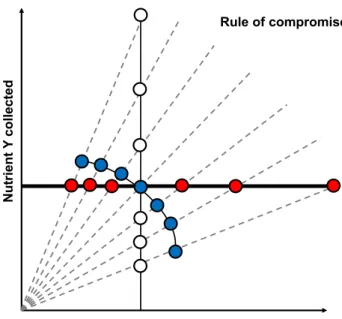
Having different nutritional requirements to meet is not the single challenge that an ant colony is facing. Nutrient availability is another issue that the colony needs to tackle on a regular basis. Sometimes, ants have neither access to a balanced food nor to nutritionally complementary but only to imbalanced food sources. For instance, if ants are confined to a high-protein / low-carbohydrate diet, they can either decide to eat a small quantity of food to satisfy their requirement in protein but in doing so they will suffer a carbohydrate shortage. Alternatively, they can eat large quantity of food to satisfy their carbohydrate requirements but in doing so they will overeat protein. Lastly, they can feed to some point intermediate between these extremes (Fig. 4). In GF models, the strategy adopted is known as a rule of compromise, because it represents the compromise between over-eating some nutrient and under-eating others.
A comprehensive description of the rule of compro-mise followed by ant colonies has been investigated in some species: Lasius niger (see Dussutour & Simpson 2012), Ectatomma ruidum (see Cook & Behmer 2010),
Iridomyrmex mayri (see Pohl & al. 2016), Iridomyrmex suchieri (see Christensen & al. 2010), Linepithema hu‑ mile (see Arganda & al. 2017), Odontomachus hastatus (see Bazazi & al. 2016), Rhytidoponera metallica (see Dussutour & Simpson 2008), Solenopsis invicta (see Sorensen & al. 1985, Cook & al. 2010, Wilder & Eubanks 2010). In these species, when ant colonies are confined to a diet containing a fixed ratio of protein to carbohydrate for a long period of time (from days to weeks), individuals adjust both their recruitment and food consumption to the diet composition. On a high-protein / low-carbohy-drate diet, ants collect more food and recruit in larger numbers than colonies given a low-protein / high-car-bohydrate diet. This suggests that ants are prioritizing carbohydrates and maintain the supply of carbohydrates to the colony at a target level (Fig. 4). This compensatory feeding to gain carbohydrates, results in overconsumption of protein. Yet, such regulation was not observed on ex-tremely unbalanced diets (Dussutour & Simpson 2012, Cook & al. 2010).
Dussutour & Simpson (2009) and Cook & al. (2010) showed that ants are able to restore a certain degree of nutritional balance by retaining carbohydrates and getting rid of proteins post-ingestively. For instance, green headed ants confined to high-protein / low-carbohydrate diet chew the food to extract the limiting carbohydrates and reject the excess protein as pellets. When larvae are present within the nest, green headed ants are more effective at getting rid of excess protein than when they are absent. Thus, not only do larvae offer nutritional feedbacks that improve nutrient regulation, they also enhance nutrient extraction (Dussutour & Simpson 2009). Larvae are not the only ones that can help the workers solving nutritional challenges. Intracellular bacteria from the genus Bloch‑
mannia provide the hosts with the resources required for
successful development (Russell & al. 2017). Feldhaar & al. (2007) showed that endosymbiotic Blochmannia
floridanus nutritionally upgrade the diet of the ants (Cam‑ ponotus floridanus) to provide essential amino acids and enhance its competitive ability toward other ant species lacking such an endosymbiont.
Cost of nutritional regulation
In most living organisms, a determinant of the relationship between diet and longevity is the balance of protein to carbohydrate and social insects are no exception (Simpson
& Raubenheimer 2012). In all species tested so far, ants die sooner on high-protein / low-carbohydrate diets than on low-protein / high-carbohydrate diets (Lasius niger, see Dussutour & Simpson 2012; Linepithema humile, see Arganda & al. 2017; Odontomachus hastatus, see Bazazi & al. 2016; Rhytidoponera metallica, see Dus-sutour & Simpson 2008; Solenopsis invicta, see Cook & al. 2010). Hence; eating excess of proteins to reach a carbohydrate target comes at a cost. Interestingly, in green headed ants the presence of larvae helped offset the costs of over ingesting proteins (Dussutour & Simpson 2009) highlighting their importance as the “digestive caste” of the colony (Markin 1970, Sorensen & al. 1983, Cassill & Tschinkel 1999, Erthal & al. 2007).
Unlike larvae, most adult workers are restricted to take up solid food particles, due to their proventriculus (Cassill & al. 2005), thus the larger food fragments are usually given to the larvae (Sorensen & al. 1983, Cassill & al. 2005). Moreover, ants produce only very small amounts of proteases in comparison to larvae (Ricks & Vinson 1972, Abbott 1978, Petralia & al. 1980, Sorensen & al. 1983, Whitworth & al. 1998). Therefore, Dussutour & Simpson (2009) suggested that green headed ants over-come some of the deleterious effects of excess protein by transferring the food directly to the larvae which in turn digest and redistribute it as liquid pre-processed food to the workers.
However, it remains unclear how high-protein / low-car-bohydrate diets shorten lifespan in ants. Arganda & al. (2017) started to answer this question in a recent study. They showed that high-protein diets shorten lifespan in Argentine ants Linepithema humile, because the final products of the protein digestion i.e., the amino acids are harmful, especially: methionine, serine, threonine and phenylalanine. They showed that these amino acids shortened lifespan even more than crude proteins. The hypothesis is that an excess in amino acids increases potentially toxic nitrogen waste products (Wright 1995) and over-stimulates nutrient-sensing pathways that regu-late lifespan such as the TOR pathway, a genetic pathway functionally conserved throughout evolution (Pankaj & Brian 2004, Simpson & Raubenheimer 2009).
Nevertheless, if an excess of protein decreases indi-viduals’ lifespan, it can increase the reproduction and the growth of the colony. For instance, when Camponotus
floridanus colonies are fed with a surplus protein the egg
production by queens increases (Nonacs 1991). Some studies have also shown that colonies supplemented with protein produced more sexuals (male and / or female), more larvae and larger individuals (Backus & Herbers 1992, Aron & al. 2001). A recent study (Bernadou & al. 2018) unveiled that reproductive division of labour is also influenced by food quality. Genetically identical individ-uals that experience poor nutritional conditions are less likely to become reproductive than well-fed clonemates (Platythyrea punctata).
Nutritional imbalance does not solely influence sur-vival and reproduction, but can also elicit distinct activity
Nu tri en tY co llected Rule of compromise Nutrient X collected
Fig. 4: Rule of compromise. When an animal is confined to one of six imbalanced diets (black line), it has three options : 1) satisfy its requirement of Y no matter the lack or the excess of X it will suffer (red dots – non interaction rule) 2) satisfy its requirement of X no matter the lack or the excess of Y it will suffer (white dots – non-interaction rule) 3) suffer both an excess of Y (X) and a lack of X (Y) but not as large as the extreme (blue dots: closest distance rule). The chosen strategy, also called the rule of compromise, usually reflect the cost of over-ingesting Y (X) and under-ingesting X (Y). (Adapted from Simpson & Raubenheimer 2012).
rates and behavioural responses, such as aggressiveness, in numerous ant species. For example, when fed with a high-carbohydrate diet, the metabolic rates of ants accel-erate, and they display behaviours that further enhance their abilities to secure resources (Linepithema humile, see Holway 1999; Ectatomma ruidum, see Kay & al. 2012; Neotropical litter ant community, see Kaspari & al. 2012; Linepithema humile, see Shik & Silverman 2013). Alternatively, carbohydrate scarcity limits both aggression and activity and tune-down foraging activity rates (Lasius
niger, see Dussutour & al. 2016; Linepithema humile, see
Grover & al. 2007).
Beyond proteins and carbohydrates
Until now, all experiments that used the GF to understand ant nutrition have focused their investigations on macro-nutrients – protein and carbohydrates. As the literature shows in other animals such as locusts, caterpillars, mice, etc. (Simpson & Raubenheimer 2012), these two macro-nutrients can explain a large proportion of the variation in the behavioural, physiological and performance responses. These two macronutrients are, however, clearly not the only functionally important nutritional components of foods.
In ants, beyond protein and carbohydrates, little is known about other dietary requirements. Lipids, the third macronutrient, are essential for larvae growth, egg pro-duction and ovary development (Blüthgen & Feldhaar 2009) but their regulation and their interactions with protein and carbohydrate have yet to be studied. Lipids are abundant in prey (Hughes & al. 1994), in seeds (Brew & al. 1989), and are also important components of extrafloral nectar and honeydew (Forrest & Knights 1972, Beattie 1985). Lipids are very attractive in some species of ants as illustrated by their extensive use in baits design (see review Stanley 2004). Lipids are also attractive in natural food sources, for instance myrmecochorous seeds and some tropical plants offer lipid-rich food rewards (elaiosome and food bodies respectively) which are very attractive to foragers (Blüthgen & Feldhaar 2009). In a field study, Pizo & Oliveira (2001) showed that recruitment rate and ant attendance (23 ant species, Atlantic forest of South-east Brazil) were higher for lipid-rich diaspores than for lipid-poor ones. Lipids are also essential to colony growth and survival, for instance sterols are required as hormone precursors and as a component of cell membranes and cannot be synthesized by insects and, thus need to be obtained from food consumption or symbionts (Herbert & al. 1980, Hagen & al. 1984, Behmer & al. 1999, Nation 2002). Gammans & al. (2005) showed that providing the ant Myrmica ruginodis with four essential fatty acids and four essential sterols through the addition of elaiosomes (Ulex) in the diet increases larvae production and larvae weight.
Vitamins and minerals are also essential to health and also play a critical role in animal nutritional strat-egies. For instance, sodium is vital for the physiological functioning of all animals including ants (homeostasis,
muscle activity, and nervous system function) (Frausto da Silva & Williams 2001), but is often rare in the en-vironment (Kaspari & al. 2008, 2009). Numerous field studies showed that ants are able to track sodium avail-ability in the environment (Kaspari & al. 2008: 17 ant communities, Chavarria Pizarro & al. 2012: leafcutter ants Atta cephalotes, Hernández & al. 2012: Camponotus
mirabilis, Vieira & Vasconcelos 2015: neotropical ants).
It has also been shown that ants recruit more workers on diets offering folic acid, B12, inositol and biotin (Ricks & Vinson 1970: imported fire ants Solenopsis saevissima
richteri and Solenopsis saevissima saevissima, Poisson -nier & al. 2014: black garden ants Lasius niger). Moreover, Poissonnier & al. (2014) showed that vitamins deficiency, as macronutrient deficiency, affects health, performance, and behaviour in ants.
A future avenue: influence of nutrition in parasitehost relationship
Besides longevity and reproduction, food intake can also affect animal health. In most animals, infections have adverse effects on nutritional status whereas nutrient deficiency impairs resistance to infection. For instance, Ayres & Schneider (2009) showed that reduced food intake in flies (Drosophila melanogaster) limits their ability to fight a Listeria monocytogenes infection and as
a consequence increases their mortality rate. In addition,
the quantity and quality of food resources influence the abundance and development of parasites (Vale & al. 2013, Hall & al. 2009), and directly shape virulent effects of parasitic infections (Tseng 2006). Parasites, pathogens are fundamental actors in ant nutrition and they are often forgotten when studying nutritional regulatory strategies. Parasites may modify the intake target of the ants to satisfy their nutritional needs, ultimately influencing the foraging decisions of the colony and the level of infection. Alterna-tively, ants may modify their nutritional state to enhance their ability to fight the infection.
So far, studies in invertebrates have focused on how nu-trient deprivation or starvation influences immune func-tions or parasite resistance (Moret & Schmid-Hempel 2000, Triggs & Knell 2012). In caterpillars, resistance to parasites depends on the relative amounts of protein and carbohydrate (Lee & al. 2006, Povey & al. 2009). When caterpillars are allowed to self-select their diet, virus challenged insects temporarily increase the relative pro-tein content of their diet to better fight the viral infection (Povey & al. 2013). This result suggests a form of macro-nutrient self-medication in bacteria or virus-challenged caterpillars (Lee & al. 2006, Povey & al. 2009, 2013).
Can parasite infection influence macronutrient balancing in ants? In social insects, the effect of
par-asites and macronutrient intake are often studied at the level of the individual (Moret & Schmid-Hempel 2000, Triggs & Knell 2012), while responses at the colony level, are usually neglected. Ant societies are attractive targets to parasites and pathogens (bacteria, fungi, mites, fluke worms, nematodes, beetles, butterflies) as they provide
them with a rich hunting ground and a promising nutri-ent source (Lachaud & al. 1998, Schmid-Hempel 1998, Csősz & Majoros 2009, Espadaler & Santamaria 2012, Csata & al. 2013, Witek & al. 2014, Tragust & al. 2016, Csata & al. 2017a, b, Araújo & al. 2018, de Bekker & al. 2018).
Ants have evolved a variety of adaptations to fight par-asites, including behavioral, biochemical and immunolog-ical responses (external: antimicrobial secretions) to both reduce virulence and transmission of entomopathogen agents (Nunn & Altizer 2006, Tragust & al. 2013, Csata & al. 2014, Tragust 2016). In addition to individual strat-egies, ants have evolved a collective defence also known as “social immunity”, that is, individuals living in groups or societies cooperate to fight against the transmission of parasites and pathogens (Cremer & al. 2007). The means to socially fight parasites are various and range from so-cial exclusion to application of antimicrobial secretions to congeners (review Cremer & al. 2007).
Using the GF approach, Kay & al. (2014) investigated for the first time how diet macronutrient composition affects immunity of ants at both an individual and collec-tive level. They challenged the ants Ectatomma ruidum with a pathogenic fungus (Metarhizium anisopliae) and showed that workers reared in groups survived longer, when fed a high-carbohydrate diet than workers confined to a high-protein diet. Interestingly, this effect of macro-nutrient composition was not observed on workers reared alone (Fig. 5). Interestingly though, they showed that when larvae were removed from the colony, the beneficial effect of a high-carbohydrate diet disappears suggesting that larvae improve worker immunity as they improve nutritional regulation (Dussutour & Simpson 2009). Further researches are needed to clarify how macronutri-ent composition affects social immunity. Kay & al. (2014) suggest that carbohydrate exploitation by social insects may provide an evolutionary advantage. In another study, Konrad & al. (2015) showed that the negative impact of the fungus Laboulbenia formicarum on the survival of the host ant Lasius neglectus is enhanced under nutritional stress (starvation).
An intriguing question is whether infection with parasites / pathogens can induce a change in diet selec-tion to fight the infecselec-tion (self-medicaselec-tion) or to sustain parasites / pathogens growth (manipulation)? Self-med-ication is considered to be prophylactic if both infected and uninfected individuals consume harmful substances that promote parasites resistance, but therapeutic if the harmful substance is consumed only after an infection (Abbott 2014). Bos & al. (2015) revealed that infected ants (Formica fusca) readily consume reactive oxygen, an harmful substance that promotes fungal resistance and survival, after being exposed to a fungal pathogen (Beauveria bassiana), while uninfected ants avoid it. This result could well be considered as the first evidence for self-medication in ants.
Whether foragers adjust their nutrient intake to the infection states of their nestmates is virtually unexplored
and should be investigated in the future. To study how parasites / pathogens, affect ant nutrition using the GF approach we need to follow a 3-steps plan. In a first step, we have to define independently the intake target of the parasite, the uninfected host and then the infected host. This requires to be able to rear the parasites separately from their host. In a second step, we must study how infected and uninfected hosts perform when confined to diets offering varying amount of protein and carbohydrate. By doing so, we shall identify a diet that promotes infection or lessens infection. In a third step, we need to offer both, infected colonies and uninfected ones a choice between various diets to decipher if parasites are manipulating the host foraging strategies to promote their own growth or if the host is fighting the parasite to survive (Fig. 5).
Conclusions
What does the future hold for the study of nutrient regula-tion in ants? In ants, the nutriregula-tional decisions of a forager not only depend on its own nutritional needs but also critically on the nutritional requirements of its congeners. As food is shared through multiple interactions between ants, tracking food distribution is challenging. Until now, authors have used stable isotopes (Feldhaar & al. 2010) or radiolabeled nutritive solutions (Buffin & al. 2012) to track food flow within colonies. Mass spectroscopy and RNA sequencing has also been used to identify the molecules present in the ant crop and quantify what is shared via trophallaxis (LeBoeuf & al. 2016). However,
Nu tri en tY co llected Food 1 IT Infected "self medication" IT Uninfected Nutrient X collected IT Parasite IT Infected "parasite manipulation"
Fig. 5: Hypothetic intake regulation strategies in a colony of ants infected by a parasite. We first determine the intake tar-get of the uninfected host and the parasite. Then an infected host is offered two foods, offering varying amount of protein and carbohydrate. Foods 1 and 2 are imbalanced but comple-mentary (fall on opposite sides of both the intake target, IT, of the parasite and the IT of the uninfected host). The infected individual can either choose to eat more from Food 1 to reach an intake that maximize resistance to the parasite (self-medi-cation) or eat more from Food 2 and satisfies the requirement of the parasites (manipulation).
while these techniques bring us a large range of insights into ant nutritional ecology, they lack temporal and / or spatial resolution. Fortunately, a new technological ad-vance is now available to complement these approaches (Greenwald & al. 2015, 2018). Greenwald & al. (2015) combining individual tracking using QR codes and food labelling using fluorescent dye were able to successfully track carbohydrate distribution within an ant colony. This new method has a high spatial and temporal resolu-tion allowing a precise quantificaresolu-tion of ant trophallactic networks and food dissemination dynamic. The next step would be to combine this approach with the GF and track multiple nutrients simultaneously to see how they interact with each other and how they are shared, distributed and stored among individuals within the nest. This will help us better understand communal nutrition in ants.
The geometric framework (GF) approach has greatly advanced our understanding of ant nutrition. In the fu-ture, it would be interesting to expand the researches to three or more nutrient dimensions to better understand ant foraging behaviour. Fortunately, the GF offers ways to deal with such dimensionality which will enable a better understanding of how nutritional interactions shape the behaviour of the colony. Until now, studies have been re-stricted to a few species and are mainly conducted under laboratory conditions. It is now necessary to characterize the nutritional niche of a broader range of species, from generalist to specialist, from invasive to native ant spe-cies. The GF offers ways to study networks of interactions within and among ant communities and might help us to predict how these communities will respond to changing environmental conditions.
Acknowledgements
The authors are grateful for helpful feedback from review-ers. We thank Subject Editor Heike Feldhaar for providing constructive comments on the manuscript. We thank Jean Paul Lachaud, Iago Sanmartín-Villar, and David Villa for providing photographs. E.Cs. was supported by the Fyssen Foundation Grant and A.D was supported by the CNRS.
References
Abbott, A. 1978: Nutrient dynamics of ants. In: Brian, M.V. (Ed.): Production ecology of ants and termites. – Cambridge University Press, Cambridge, UK, pp. 233-244.
Abbott, J. 2014: Self-medication in insects: current evidence and future perspectives. – Ecological Entomology 39: 273-280. Altaye, S.Z., Pirk, C.W., Crewe, R.M. & Nicolson, S.W. 2010:
Convergence of carbohydrate-biased intake targets in caged worker honeybees fed different protein sources. – Journal of Experimental Biology 213: 3311-3318.
Arajúo, J.P., Evans, H.C., Kepler, R. & Hughes, D.P. 2018: Zombie-ant fungi across continents: 15 new species and new combinations within Ophiocordyceps. I. Myrmecophilous hirsutelloid species. – Studies in Mycology 90: 119-160. Arganda, S., Bouchebti, S., Bazazi, S., Le Hesran, S., Puga,
C., Latil, G., Simpson, S.J. & Dussutour, A. 2017: Parsing the life-shortening effects of dietary protein: effects of individual amino acids. – Proceedings of the Royal Society B-Biological Sciences 284: art. 20162052.
Arganda, S., Nicolis, S.C., Perochain, A., Péchabadens, C., Latil, G. & Dussutour, A. 2014: Collective choice in ants: the role of protein and carbohydrates ratios. – Journal of Insect Physiology 69: 19-26.
Aron, S., Keller, L. & Passera, L. 2001: Role of resource availability on sex, caste and reproductive allocation ratios in the Argentine ant Linepithema humile. – Journal of Animal Ecology 70: 831-839.
Ayres, J.S. & Schneider, D.S. 2009: The role of anorexia in resistance and tolerance to infections in Drosophila. – Public Library of Science Biology 7: art. e1000150.
Backus, V.L. & Herbers, J.M. 1992: Sexual allocation in forest ants: Food limitation does not explain observed patterns. – Behavioral Ecology and Sociobiology 30: 425-429.
Bazazi, S., Arganda, S., Moreau, M., Jeanson, R. & Dus-sutour, A. 2016: Responses to nutritional challenges in ant colonies. – Animal Behaviour 111: 235-249.
Beattie, A.J. 1985: The evolutionary ecology of ant-plant mutualisms. – Cambridge University Press, Cambridge, UK, 120 pp.
Beckers, R., Deneubourg, J.L. & Goss, S. 1992: Trails and U-turns in the selection of a path by the ant Lasius niger. – Journal of Theoretical Biology 159: 397-415.
Behmer, S.T. 2009: Insect herbivore nutrient regulation. – Annual Review of Entomology 54: 165-187.
Behmer, S.T., Belt, C.E. & Shapiro, M.S. 2005: Variable rewards and discrimination ability in an insect herbivore: What and how does a hungry locust learn? – Journal of Experimental Biology 208: 3463-3473.
Behmer, S.T., Elias, D.O. & Grebenok, R.J. 1999: Phytosterol metabolism and absorption in the generalist grasshopper, Schistocerca americana (Ortho ptera: Acrididae). – Archives of Insect Biochemistry and Physiology 42: 13-25.
Behmer, S.T. & Joern, A. 2008: Coexisting generalist herbivores occupy unique nutritional feeding niches. – Proceedings of the National Academy of Sciences of the United States of America 105: 1977-1982.
Behmer, S.T., Raubenheimer, D. & Simpson, S.J. 2001: Fre-quency-dependent food selection in locusts: a geometric analysis of the role of nutrient balancing. – Animal Behaviour 61: 995-1005.
Bernadou, A., Schrader, L., Pable, J., Hoffacker, E., Meuse-mann, K. & Heinze, J. 2018: Stress and early experience underlie dominance status and division of labour in a clonal insect. – Proceedings of the Royal Society B-Biological Sciences 285: art. 20181468.
Blüthgen, N. & Feldhaar, H. 2009 [2010]: Food and shelter: how resources influence ant ecology. In: Lach, L., Parr, C.L. & Abbott, K.L. (Eds.): Ant ecology. – Oxford University Press, Oxford, UK, pp. 115-136.
Blüthgen, N. & Fiedler, K. 2004a: Preferences for sugars and amino acids and their conditionality in a diverse nectar-feed-ing ant community. – Journal of Animal Ecology 73: 155-166. Blüthgen, N. & Fiedler, K. 2004b: Competition for composi-tion: lessons from nectar-feeding ant communities. – Ecology 85: 1479-1485.
Blüthgen, N., Gebauer, G. & Fiedler, K. 2003: Disentangling a rainforest food web using stable isotopes: dietary diversity in a species-rich ant community. – Oecologia 137: 426-435. Bos, N., Sundström, L., Fuchs, S. & Freitak, D. 2015: Ants
medicate to fight disease. – Evolution 69: 2979-2984. Brew, C.R., O’Dowd, D.J. & Rae, I.D. 1989: Seed dispersal
by ants: behaviour-releasing compounds in elaiosomes. – Oecologia 80: 490-497.
Brodschneider, R. & Crailsheim, K. 2010: Nutrition and health in honey bees. – Apidologie 41: 278-294.
Buffin, A., Goldman, S. & Deneubourg, J.L. 2012: Collective regulatory stock management and spatiotemporal dynamics of the food flow in ants. – The FASEB Journal 26: 2725-2733. Cassill, D.L., Butler, J., Vinson, S.B. & Wheeler, D.E. 2005:
Cooperation during prey digestion between workers and larvae in the ant, Pheidole spadonia. – Insectes Sociaux 52: 339-343. Cassill, D.L. & Tschinkel, W.R. 1999: Regulation of diet in
the fire ant, Solenopsis invicta. – Journal of Insect Behavior 12: 307-328.
Chavarria Pizarro, L., Mccreery, H.F., Lawson, S.P., Win-ston, M.E. & O’Donnell, S. 2012: Sodium-specific foraging by leafcutter ant workers (Atta cephalotes, Hymeno ptera: Formicidae). – Ecological Entomology 37: 435-438. Christensen, K.L., Gallacher, A.P., Martin, L., Tong, D.
& Elgar, M.A. 2010: Nutrient compensatory foraging in a free-living social insect. – Naturwissenschaften 97: 941-944. Collignon, B. & Detrain, C. 2009: Distributed leadership and
adaptive decision-making in the ant Tetramorium caespitum. – Proceedings of the Royal Society B-Biological Sciences 277: 1267-1273.
Cook, S.C. & Behmer, S.T. 2010: Macronutrient regulation in the tropical terrestrial ant Ectatomma ruidum (Formicidae): a field study in Costa Rica. – Biotropica 42: 135-139. Cook, S.C., Eubanks, M.D., Gold, R.E. & Behmer, S.T. 2010:
Colony-level macronutrient regulation in ants: mechanisms, hoarding and associated costs. – Animal Behaviour 79: 429-437.
Cook, S.C., Eubanks, M.D., Gold, R.E. & Behmer, S.T. 2011: Seasonality directs contrasting food collection behavior and nutrient regulation strategies in ants. – Public Library of Science One 6: art. e25407.
Cook, S.C., Wynalda, R.A., Gold, R.E. & Behmer, S.T. 2012: Macronutrient regulation in the Rasberry crazy ant (Nylan‑ deria sp. nr. pubens). – Insectes Sociaux 59: 93-100. Cornelius, M.L. & Grace, J.K. 1997: Influence of brood on the
nutritional preferences of the tropical ant species, Pheidole megacephala (F.) and Ochetellus glaber (Mayr). – Journal of Entomological Science 32: 421-429.
Cremer, S., Armitage, S.A.O. & Schmid-Hempel, P. 2007: Social immunity. – Current Biology 17: R693-R702. Csata, E., Bernadou, A., Rákosy-Tican, E., Heinze, J. &
Markó, B. 2017a: The effects of fungal infection and phys-iological condition on the locomotory behaviour of the ant Myrmica scabrinodis. – Journal of Insect Physiology 98: 167-172.
Csata, E., Czekes, Zs., Erős, K., Német, E., Hughes, M., Csősz, S. & Markó, B. 2013: Comprehensive survey of Romanian myrmecoparasitic fungi: new species, biology and distribu-tion. – North-Western Journal of Zoology 9: 23-29. Csata, E., Erős, K. & Markó, B. 2014: Effects of the
ectopar-asitic fungus Rickia wasmannii on its ant host Myrmica scabrinodis: changes in host mortality and behavior. – In-sectes Sociaux 61: 247-252.
Csata, E., Timus, N., Witek, M., Casacci, L.P., Lucas, C., Bagneres, A.G., Sztencel-Jablonka, A., Barbero, A., Bonelli, S., Rákosy, L. & Markó, B. 2017b: Lock-picks: fungal infection facilitates the intrusion of strangers into ant colonies. – Scientific Reports 7: art. 46323.
Csősz, S. & Majoros, G. 2009: Ontogenetic origin of mermith-ogenic Myrmica phenotypes (Hymeno ptera: Formicidae). – Insectes Sociaux 56: 70-76.
Davidson, D.W., Cook, S.C., Snelling, R.R. & Chua, T.H. 2003: Explaining the abundance of ants in lowland tropical rainforest canopies. – Science 300: 969-972.
Deans, C.A., Sword, G.A. & Behmer, S.T. 2015: Revisiting macronutrient regulation in the polyphagous herbivore Helicoverpa zea (Lepido ptera: Noctuidae): new insights via nutritional geometry. – Journal of Insect Physiology 81: 21-27.
De Bekker, C., Will, I., Das, B. & Adams, R.M.M. 2018: The ants (Hymeno ptera: Formicidae) and their parasites: effects of parasitic manipulations and host responses on ant behavioral ecology. – Myrmecological News 28: 1-24.
De Biseau, J.C., Deneubourg, J.L. & Pasteels, J.M. 1991: Col-lective flexibility during mass recruitment in the ant Myrmica sabuleti (Hymeno ptera: Formicidae). – Psyche 98: 323-336. Detrain, C. & Deneubourg, J.L. 1997: Scavenging by Pheidole
pallidula: a key for understanding decision-making systems in ants. – Animal Behaviour 53: 537-547.
Detrain, C., Deneubourg, J.L. & Pasteels, J.M. 1999: De-cision-making in foraging by social insects. In: Detrain, C., Deneubourg, J.L. & Pasteels, J.M. (Eds.): Information processing in social insects. – Birkhäuser, Basel, pp. 331-354. Dussutour, A., Latty, T., Beekman, M. & Simpson, S.J. 2010:
Amoeboid organism solves complex nutritional challenges. – Proceedings of the National Academy of Sciences of the United States of America 107: 4607-4611.
Dussutour, A. & Nicolis, S.C. 2013: Flexibility in collective decision-making by ant colonies: Tracking food across space and time. – Chaos, Solitons & Fractals 50: 32-38.
Dussutour, A., Poissonnier, L.A., Buhl, J. & Simpson, S.J. 2016: Resistance to nutritional stress in ants: When being fat is advantageous. – Journal of Experimental Biology 219: 824-833.
Dussutour, A. & Simpson, S.J. 2008: Carbohydrate regulation in relation to colony growth in ants. – Journal of Experimental Biology 211: 2224-2232.
Dussutour, A. & Simpson, S.J. 2009: Communal nutrition in ants. – Current Biology 19: 740-744.
Dussutour, A. & Simpson, S.J. 2012: Ant workers die young and colonies collapse when fed a high-protein diet. – Proceedings of the Royal Society B-Biological Sciences 279: 2402-2408. Erthal, Jr.M., Silva, C.P. & Samuels, R.I. 2007: Digestive
enzymes in larvae of the leaf cutting ant, Acromyrmex sub‑ terraneus (Hymeno ptera: Formicidae: Attini). – Journal of Insect Physiology 53: 1101-1111.
Espadaler, X. & Santamaria, S. 2012: Ecto- and endopara-sitic fungi on ants from the Holartic Region. – Psyche 2012: art. 168478.
Feldhaar, H. 2014: Ant nutritional ecology: linking the nu-tritional niche plasticity on individual and colony-level to community ecology. – Current Opinion in Insect Science 5: 25-30.
Feldhaar, H., Gebauer, G. & Blüthgen, N. 2010: Stable isotopes: past and future in exposing secrets of ant nutrition (Hymeno ptera: Formicidae). – Myrmecological News 13: 3-13. Feldhaar, H., Straka, J., Krischke, M., Berthold, K., Stoll,
S., Mueller, M.J. & Gross, R. 2007: Nutritional upgrading for omnivorous carpenter ants by the endosymbiont Bloch-mannia. – BioMed Central Biology 5: art. 48.
Fiedler, K., Kuhlmann, F., Schlick-Steiner, B.C., Steiner, F.M. & Gebauer, G. 2007: Stable N-isotope signatures of central European ants – assessing positions in a trophic gradient. – Insectes Sociaux 54: 393-402.
Folgarait, P.J. 1998: Ant biodiversity and its relationship to ecosystem functioning: a review. – Biodiversity & Conser-vation 7: 1221-1244.
Forrest, J.M.S. & Knights, B.A. 1972: Presence of phytosterols in the food of the aphid, Myzus persicae. – Journal of Insect Physiology 18: 723-728.
Franks, N.R. 1985: Reproduction, foraging efficiency, and worker polymorphism in army ants. In: Hölldobler, B. & Lindauer, M. (Eds.): Experimental behavioral ecology and sociobiology: in memoriam Karl von Frisch, 1886-1982. – Sinauer Associates, Sunderland, MA, pp. 91-107.
Frausto Da Silva, J.J.R. & Williams, R.J.P. 2001: The bio-logical chemistry of the elements: the inorganic chemistry of life. – Oxford University Press, Oxford, UK, 600 pp. Gammans, N., Bullock, J.M. & Schönrogge, K. 2005: Ant
benefits in a seed dispersal mutualism. – Oecologia 146: 43-49. Green, P.W.C. & Kooij, P.W. 2018: The role of chemical sig-nalling in maintenance of the fungus garden by leaf-cutting ants. – Chemoecology 28: 101-107.
Greenwald, E.E., Baltiansky, L. & Feinerman, O. 2018: Individual crop loads provide local control for collective food intake in ant colonies. – eLife 7: art. e31730.
Greenwald, E.E., Segre, E. & Feinerman, O. 2015: Ant trophallactic networks: simultaneous measurement of inter-action patterns and food dissemination. – Scientific Reports 5: art. 12496.
Grover, C.D., Kay, A.D., Monson, J.A., Marsh, T.C. & Holway, D.A. 2007: Linking nutrition and behavioural dominance: carbohydrate scarcity limits aggression and activity in Ar-gentine ants. – Proceedings of the Royal Society B-Biological Sciences 274: 2951-2957.
Hagen, K.S., Dadd, R.H. & Reese, J.C. 1984: The food insects. In: Huffaker, C.B. (Ed.): Ecological entomology. – Wiley and Sons, New York, NY, pp. 79-112.
Hall, S.R., Knight, C.J., Becker C.R., Duffy, M.A., Tessier, A.J. & Cáceres, C.E. 2009: Quality matters: resource quality for hosts and the timing of epidemics. – Ecology Letters 12: 118-128.
Hangartner, W. 1969: Structure and variability of the individ-ual odor trail in Solenopsis geminata Fabricius (Hymeno-ptera: Formicidae). – Journal of Comparative Physiology A: Neuroethology, Sensory, Neural, and Behavioral Physiology 62: 111-120.
Herbert, E.W., Svoboda, J.A., Thompson, M.J. & Shimanuki, H. 1980: Sterol utilization in honey bees fed a synthetic diet: Effects on brood rearing. – Journal of Insect Physiology 26: 287-289.
Hernández, L.A., Todd, E.V., Miller, G.A. & Frederickson, M.E. 2012: Salt intake in Amazonian ants: too much of a good thing? – Insectes Sociaux 59: 425-432.
Hewson-Hughes, A.K., Hewson-Hughes, V.L., Miller, A.T., Hall, S.R., Simpson, S.J. & Raubenheimer, D. 2011: Geo-metric analysis of macronutrient selection in the adult do-mestic cat, Felis catus. – Journal of Experimental Biology 214: 1039-1051.
Holway, D.A. 1999: Competitive mechanisms underlying the displacement of native ants by the invasive Argentine ant. – Ecology 80: 238-251.
Howard, D.F. & Tschinkel, W.R. 1981: The flow of food in colonies of the fire ant, Solenopsis invicta: a multifactorial study. – Physiological Entomology 6: 297-306.
Hölldobler, B. & Wilson, E.O. 1990: The ants. – Harvard University Press, Cambridge, MA, 732 pp.
Hölldobler, B. & Wilson, E.O. 2009: The superorganism: the beauty, elegance, and strangeness of insect societies. – WW Norton & Company, New York, NY, XXI + 522 pp.
Hughes, L., Westoby, M.T. & Jurado, E. 1994: Convergence of elaiosomes and insect prey: evidence from ant foraging behaviour and fatty acid composition. – Functional Ecology 8: 358-365.
Hunter, M.D. 2009: Trophic promiscuity, intraguild predation and the problem of omnivores. – Agricultural and Forest Entomology 11: 125-131.
Jeanson, R., Dussutour, A. & Fourcassié, V. 2012: Key factors for the emergence of collective decision in invertebrates. – Frontiers in Neuroscience 6: art. 121.
Kaspari, M., Donoso, D., Lucas, J.A., Zumbusch, T. & Kay, A.D. 2012: Using nutritional ecology to predict community structure: a field test in Neotropical ants. – Ecosphere 3: 1-15. Kaspari, M., Yanoviak, S.P. & Dudley, R. 2008: On the bi-ogeography of salt limitation: a study of ant communities. – Proceedings of the National Academy of Sciences of the United States of America 105: 17848-17851.
Kaspari, M., Yanoviak, S.P., Dudley, R., Yuan, M. & Clay, N.A. 2009: Sodium shortage as a constraint on the carbon cycle in an inland tropical rainforest. – Proceedings of the National Academy of Sciences of the United States of America 106: 19405-19409.
Kay, A.D. 2004: The relative availabilities of complementary resources affect the feeding preferences of ant colonies. – Behavioral Ecology 15: 63-70.
Kay, A.D., Brunning, A.J., van Alst, A., Abrahamson, T.T., Hughes, W.O.H. & Kaspari, M. 2014: A carbohydrate-rich diet increases social immunity in ants. – Proceedings of the Royal Society B-Biological Sciences 281: art. 20132374. Kay, A.D., Rostampour, S. & Sterner, R.W. 2006: Ant stoichi-ometry: elemental homeostasis in stage-structured colonies. – Functional Ecology 20: 1037-1044.
Kay, A.D., Shik, J.Z., Van Alst, A., Miller, K.A. & Kaspari, M. 2012: Diet composition does not affect ant colony tempo. – Functional Ecology 26: 317-323.
Kohler, A., Raubenheimer, D. & Nicholson, S.W. 2012: Reg-ulation of nutrient intake in nectar-feeding birds: insights from the geometric framework. – Journal of Comparative Physiology B 182: 603-611.
Konrad, M., Grasse, A.V., Tragust, S. & Cremer, S. 2015: Anti-pathogen protection versus survival costs mediated by an ectosymbiont in an ant host. – Proceedings of the Royal Society B-Biological Sciences 282: art. 20141976.
Lachaud, J.P., Pérez-Lachaud, G. & Heraty, J.M. 1998: Parasites associated with the ponerine ant Ectatomma tu‑ berculatum (Hymeno ptera: Formicidae): first host record for the genus Dilocantha (Hymeno ptera: Eucharitidae). – The Florida Entomologist 81: 570-574.
LeBoeuf, A.C., Waridel, P., Brent, C.S., Goncalves, A.N., Menin, L., Ortiz, D., Riba-Grognuz, O., Koto, A., Soares, Z.G., Privman, E., Miska, E.A., Benton, R. & Keller, L. 2016: Oral transfer of chemical cues, growth proteins and hormones in social insects. – eLife 5: art. e20375.
Lee, K.P., Behmer, S.T., Simpson, S.J. & Raubenheimer, D. 2002: A geometric analysis of nutrient regulation in the generalist caterpillar Spodo ptera littoralis (Boisduval). – Journal of Insect Physiology 48: 655-665.
Lee, K.P., Cory, J.S., Wilson, K., Raubenheimer, D. & Simp-son, S.J. 2006: Flexible diet choice offsets protein costs of pathogen resistance in a caterpillar. – Proceedings of the Royal Society B-Biological Sciences 273: 823-829.
Lenard, N.R. & Berthoud, H.R. 2008: Central and peripheral regulation of food intake and physical activity: pathways and genes. – Obesity 16: S11-S22.
Machovsky-Capuska, G.E., Senior, A.M., Simpson, S.J. & Raubenheimer, D. 2016: The multidimensional nutritional niche. – Trends in Ecology & Evolution 31: 355-365. Mailleux, A.C., Deneubourg, J.L. & Detrain, C. 2003:
Regu-lation of ants’ foraging to resource productivity. – Proceedings of the Royal Society B-Biological Sciences 270: 1609-1616. Mailleux, A.C., Detrain, C. & Deneubourg, J.L. 2006:
Starva-tion drives a threshold triggering communicaStarva-tion. – Journal of Experimental Biology 209: 4224-4229.
Markin, G.P. 1970: Food distribution within laboratory col-onies of the Argentine ant, Tridomyrmex humilis (Mayr). – Insectes Sociaux 17: 127-157.
Moret, Y. & Schmid-Hempel, P. 2000: Survival for immunity: the price of immune system activation for bumblebee work-ers. – Science 290: 1166-1168.
Nation, J.L. 2002: Insect physiology and biochemistry. – CRC, Boca Raton, FL, 75 pp.
Nonacs, P. 1990: Death in the distance: mortality risk as infor-mation for foraging ants. – Behaviour 112: 23-35.
Nonacs, P. 1991: Less growth with more food: how insect-prey availability changes colony demographics in the ant, Cam‑ ponotus floridanus. – Journal of Insect Physiology 37: 891-898.
Nunn, C.L. & Altizer, S. 2006: Infectious diseases in primates: behavior, ecology and evolution. – Oxford University Press, Oxford, UK, XII + 384 pp.
O’Grady, A., Schmidt, O. & Breen, J. 2010: Trophic relationships of grassland ants based on stable isotopes. – Pedobiologia 53: 221-225.
Pankaj, K. & Brian, Z. 2004: TOR pathway: linking nutrient senseing to lifespan. – Science of Aging Knowledge Envi-ronment 36: art. PE34.
Paoli, P.P., Donley, D., Stabler, D., Saseendranath, A., Nicolson, S.W., Simpson, S.J. & Wright, G.A. 2014: Nutri-tional balance of essential amino acids and carbohydrates of the adult worker honeybee depends on age. – Amino Acids 46: 1449-1458.
Petralia, R.S., Sorensen, A.A. & Vinson, S.B. 1980: The labial gland system of larvae of the imported fire ant, Solenopsis invicta Buren. – Cell and Tissue Research 206: 145-156. Petry, W.K., Perry, K.I. & Mooney, K.A. 2012: Influence of
macronutrient imbalance on native ant foraging and inter-specific interactions in the field. – Ecological Entomology 37: 175-183.
Pizo, M.A. & Oliveira, P.S. 2001: Size and lipid content of non myrmecochorous diaspores: effects on the interaction with litter-foraging ants in the Atlantic rain forest of Brazil. – Plant Ecology 157: 37-52.
Pohl, S., Frederickson, M.E., Elgar, M.A. & Pierce, N.E. 2016: Colony diet influences ant worker foraging and attend-ance of myrmecophilous lycaenid caterpillars. – Frontiers in Ecology and Evolution 4: art. 114.
Poissonnier, L.A., Simpson, S.J. & Dussutour, A. 2014: Ob-servations of the “egg white injury” in ants. – Public Library of Science One 9: art. e112801.
Portha, S., Deneubourg, J.L. & Detrain, C. 2002: Self-organ-ized asymmetries in ant foraging: a functional response to food type and colony needs. – Behavioral Ecology 13: 776-781. Portha, S., Deneubourg, J.L. & Detrain, C. 2004: How food
type and brood influence foraging decisions of Lasius niger scouts. – Animal Behaviour 68: 115-122.
Povey, S., Cotter, S.C., Simpson, S.J., Lee, K.P. & Wilson, K. 2009: Can the protein costs of bacterial resistance be offset by altered feeding behaviour? – Journal of Animal Ecology 78: 437-446.
Povey, S., Cotter, S.C., Simpson, S.J. & Wilson, K. 2013: Dy-namics of macronutrient self-medication and illness-induced anorexia in virally infected insects. – Journal of Animal Ecology 83: 245-255.
Raubenheimer, D. & Simpson, S.J. 1993: The geometry of compensatory feeding in the locust. – Animal Behaviour 45: 953-964.
Raubenheimer, D. & Simpson, S.J. 2016: Nutritional ecology and human health. – Annual Review of Nutrition 36: 603-626. Reid, C.R., Latty, T. & Beekman, M. 2012: Making a trail:
informed Argentine ants lead colony to the best food by U-turning coupled with enhanced pheromone laying. – An-imal Behaviour 84: 1579-1587.
Ricks, B.L. & Vinson, S.B. 1970: Feeding acceptability of cer-tain insects and various water-soluble compounds to two varieties of the imported fire ant. – Journal of Economic Entomology 63: 145-148.
Ricks, B.L. & Vinson, S.B. 1972: Digestive enzymes of the imported fire ant, Solenopsis richteri (Hymeno ptera: Formici-dae). – Entomologia Experimentalis et Applicata 15: 329-334. Ruohonen, K., Simpson, S.J. & Raubenheimer, D. 2007: A new
approach to diet optimisation: a re-analysis using European whitefish (Coregonus lavaretus). – Aquaculture 267: 147-156. Russell, J.A., Sanders, J.G. & Moreau, C.S. 2017: Hotspots for
symbiosis: function, evolution, and specificity of ant-microbe associations from trunk to tips of the ant phylogeny (Hymeno-ptera: Formicidae). – Myrmecological News 24: 43-69. Schmid-Hempel, P. 1998: Parasites in social insects. – Princeton
University Press, Princeton, NJ, 149 pp.
Seeley, T.D. 1989: Social foraging in honey bees: how nectar foragers assess their colony’s nutritional status. – Behavioral Ecology and Sociobiology 24: 181-199.
Shik, J.Z., Gomez, E.B., Kooij, P.W., Santos, J.C., Wcislo, W.T. & Boomsma, J.J. 2016: Nutrition mediates the expression of cultivar-farmer conflict in a fungus-growing ant. – Pro-ceedings of the National Academy of Sciences of the United States of America 113: 10121-10126.
Shik, J.Z., Rytter, W., Arnan, X. & Michelsen, A. 2018: Disentangling nutritional pathways linking leafcutter ants and their co-evolved fungal symbionts using stable isotopes. – Ecology 99: 1999-2009.
Shik, J.Z. & Silverman, J. 2013: Towards a nutritional ecology of invasive establishment: aphid mutualists provide better fuel for incipient Argentine ant colonies than insect prey. – Biological Invasions 15: 829-836.
Simpson, S.J., Batley, R. & Raubenheimer, D. 2003: Geometric analysis of macronutrient intake in humans: the power of protein? – Appetite 41: 123-140.
Simpson, S.J. & Raubenheimer, D. 1997: Geometric analysis of macronutrient selection in the rat. – Appetite 28: 201-213. Simpson, S.J. & Raubenheimer, D. 2005: Obesity: the protein
leverage hypothesis. – Obesity Reviews 6: 133-142. Simpson, S.J. & Raubenheimer, D. 2009: Macronutrient balance
and lifespan. – Aging (Albany, NY) 1: 875-880.
Simpson, S.J. & Raubenheimer, D. 2012: The nature of nu-trition: a unifying framework from animal adaptation to human obesity. – Princeton University Press, Princeton, NJ, USA, 256 pp.
Simpson, S.J., Simmonds, M.S.J. & Blaney, W.M. 1988: A comparison of dietary selection behavior in larval Locusta migratoria and Spodo ptera littoralis. – Physiological En-tomology 13: 225-238.