Cloud Computing and its Implications for Organizational Design and Performance
By RCHMS
MASSACHUSETTS IN57TTE
Ali Farahani Rad OF TECHNOLOGY
B.Sc. Electrical Engineering - Electronics
MAY 3
02013
University of Tehran, 2007MBA
LIBR RI
University of Tehran, 2010
SUBMITTED TO THE MIT SLOAN SCHOOL OF MANAGEMENT
IN PARTIAL FULFILLMENT OF THE REQUIREMENTS FOR THE
DEGREE OF
MASTER OF SCIENCE IN MANAGEMENT STUDIES
AT THE
MASSACHUSETTS INSTITUTE OF TECHNOLOGY
JUNE 2013
C 2013 Ali Farahani Rad. All Rights Reserved.
The author hereby grants to MIT permission to reproduce and to distribute publicly paper and electronic copies of this thesis document in
whole or in part in any medium now known or hereafter created.
Signature of Author:
/MIT
Sloan School of Management May 10, 2013
Certified By:
Robert Gibbons Sloan Distinguished Professor of Management Professor of Applied Economics Thesis Supervisor
Accepted By:
Michael A. Cusumano SMR Distinguished Professor of Management Program Director, M.S. in Management Studies Program MIT Sloan School of Management
Cloud Computing and its Implications for Organizational Design and Performance
By
Ali Farahani Rad
Submitted to the MIT Sloan School of Management on May 10, 2013 in partial fulfillment of the requirements for the degree of Master of
Science in Management Studies
ABSTRACT
Cloud computing has been at the center of attention for a while now. This attention is directed towards different aspects of this concept which concern different stakeholders from IT companies to cloud adopters to simple users of cloud services. Cloud computing is affecting the IT industry in terms of operations, product and service development, and strategy. It also affects the organizations that adopt cloud computing. Any new technology or new means of conducting business processes could have a potential effect on organizational structure as well as performance.
The purpose of this thesis is to investigate the implications of adopting cloud computing for organizational design and performance. It focuses on how a lowering in the costs associated with IT might influence the organizational design and in particular the decision making structure of organizations. Past research conducted on the effects of the costs associated with IT on organizational structure have been used to explain the implications of adopting cloud computing.
Thesis Supervisor: Robert Gibbons
Ac know ledgement
This thesis has been more than anything an attempt for me to further educate myself It only comprises a small fraction of what I have learned and experienced during my time at MIT, but is nonetheless what I am leaving behind as my legacy as a student at this incredible institution.
Many people have helped me in different stages of developing this thesis, but I wish to thank two of them in particular. First, my advisor Professor Robert Gibbons from whom I have learned both inside and outside of the classroom. This thesis would not have existed without his guidance and insight. Next, Professor Thomas Malone who has been generous with his time and support, and whose research has been instrumental to this thesis.
Finally, I need to thank my parents and brother who supported me from far away throughout my time at MIT Sloan, my friends and classmates who never hesitated to help, and finally Chanh Phan and Julia Sargeaunt. I especially want to thank Anna Nesterova for her patience and support.
Table of Contents
1 In tro d u c tio n ... 4
2 D escription of Cloud Com puting ... 5
3 M odeling Cloud Com puting: Cost of IT; Fixed vs. V ariable... 9
4 Organizational Design and Performance with Cloud Computing ... 11
4.1 Cost of Com m unication ... 11
4.2 Cost of access to inform ation... 20
4.3 Cost of Com putation ... 23
4.4 Com pare and Com bine... 25
5 C o n c lu sio n ... 3 3 6 Bibliography ... 35
1
Introduction
"Cloud computing heralds an evolution of business that is no less influential than e-business" (Gartner, 2008). Evolution or not, cloud computing has definitely changed some things in the IT industry; there has been a growing demand for cloud services with which cloud providers have
had to keep up.
There seems to be a powerful trend of adopting cloud computing in the market with providers expanding their services and capabilities and users benefiting from cloud services that reduce their costs. (Everest Group, 2012)
This trend has brought changes and induced a shift in the IT industry and will probably continue to do so. Offering softwares online as a type of cloud computing service has become an industry changing phenomenon that will affect software companies in many ways. Their business model, internal business processes, research and development, marketing, etc. will be influenced by this change. The market, on the other hand, will go through serious changes in how it perceives these software companies in particular and IT in general. (Dubey & Wagle, 2007)
Cloud computing goes well beyond just offering softwares on the internet; it includes a wide range of IT services. Therefore, adopting cloud computing probably has some consequences for the organizations that use one or more of its service models. These implications are probably some of the reasons behind the growing demand for cloud computing services that ultimately drives the ongoing changes in the IT industry.
It might be that many cloud adopters were motivated to use cloud services due to cost saving effects of adopting cloud computing as opposed to having internal IT capabilities, but the consequences and implications of cloud computing go well beyond a mere cost reduction in the
IT division. Cloud computing can improve decision making in organizations by either providing information to the decision process faster and more efficiently, or enriching the information that is provided to the process through providing access to different and numerous sources of information. By improving information gathering through lowering the cost of locating information or accessing richer and broader information, cloud computing can make local decision making more effective and enhance collaboration in organizations. In other words, adopting cloud computing can potentially affect how and at what cost information is communicated in the organization between different agents, how and to what extent information is accessed by different decision makers in order to empower them to make more effective decisions, and how information is processed to support decision making. (Gibbons, 2012)
Cloud computing is, at least in some sense, a new phenomenon and its longer term effects on organizations might require more time to be observed, nonetheless, adopting cloud computing has certain consequences that have implications for the organization. A noticeable result of adopting cloud computing is how it will affect the cost of IT. A change in the cost of IT and its components can potentially induce changes in organizational structure and affect performance. In this thesis, the focus will be on these effects and consequences.
2 Description of Cloud Computing
The National Institute of Standards and Technology of the U.S. Department of Commerce describes cloud computing as:
"Cloud computing is a model for enabling ubiquitous, convenient, on-demand network access to a shared pool of configurable computing resources (e.g., networks, servers, storage, applications, and services) that can be rapidly provisioned and released with minimal management effort or service provider interaction. This cloud model is composed of five essential characteristics, three service models, and four deployment models". (Mell & Grance, 2011)
These characteristics are on-demand self-service which means that customers can provision their use of the cloud service on their own; broad network access that basically means the cloud services are accessible over the internet using mobile phones, computers and workstation;
resource pooling through which the provider pools its capabilities and resources that may or may
not be in the same place to serve customers; rapid elasticity which is the ability to scale capabilities up or down to match demand as a result of which customers can enjoy the on-demand self-service; and measured service which enables the optimization of resource usage. The three service models are Software as a Service (Saas) which enables customers to use applications and software on a cloud infrastructure through either a web browser or a light interface on their devices without the need to manage, control, or maintain any infrastructure;
Platform as a Service (PaaS) which enables the consumer to create its own applications on the
cloud infrastructure using the tools and capabilities provided by the provider without the need to maintain, control, or manage any infrastructure but with control over the created application; and
Infrastructure as a Service (IaaS) that is basically the notion of outsourcing the entire or part of
the IT infrastructure of an organization to a cloud provider and provisioning processing, storage, network, and other capabilities without the need to manage, control, or maintain the cloud infrastructure. The four deployment models are private cloud which means that the cloud
infrastructure is used by a single organization and can be managed and owned by the organization itself, a cloud provider, or both parties and can be local or remote; community cloud in which the cloud infrastructure is used exclusively by a group of organizations and managed or owned either by one or more of them, a cloud provider, or a combination; public cloud that is the cloud infrastructure owned and managed by a cloud provider and available to the public; and
hybrid cloud in which the cloud infrastructure is made up of two or more independent cloud
infrastructures that are compatible through shared protocols and standards. (Mell & Grance,
2011) (CloudStory, 2012)
This is only one definition of cloud computing and its characteristics. Other cloud service models such as Communication as a Service (CaaS) and Network as a Service (NaaS) can also be added to that list. Communication as a service is "a category of cloud services where the capability provided to the cloud service user is to use real-time communication and collaboration services" where "communication and collaboration services include voice over IP, instant messaging, and video conferencing, for different user devices". Network as a service (NaaS) is "A category of cloud services where the capability provided to the cloud service user is to use transport connectivity services and/or inter-cloud network connectivity services. Naas services include flexible and external VPN, bandwidth on demand, etc." (ITU-T, 2012)
The cloud computing concept comes in different forms, provides various options, and enables through a range of capabilities. Therefore, cloud computing has different meanings and usages for different organizations based on their needs, size, capabilities, resources, and perhaps industry.
Some argue that cloud computing is not a new concept, but has been around for some time and is the continuation of other models such as utility computing and grid computing. It is sometimes even looked at as being the internet itself. Others call is an "emerging phenomenon". (Gartner,
2008) (Knorr & Gruman, n.d.)
For early cloud providers such as Amazon, the initial idea started with deploying the cloud model internally to better utilize their IT capacity in order to increase efficiency since most of their capacity was left unused most of the time. It was only after that when they started offering cloud services to external customers. (Anon., 2010)
Cloud computing may not be a fundamentally new concept or form of IT, but it is definitely a new means of delivering IT services that has already started to change the IT industry and how IT services are perceived. What is apparent is that cloud computing gives consumers in general, and businesses in particular, a variety of configurations and options that were not accessible before. Cloud computing gives organizations agility in terms of addressing their IT needs as a result of cloud services' on-demand availability, high scalability, and practically no need for investment in internal IT infrastructure. Cloud services make managing IT easier and more economic while giving the consumer the ability to customize the services that it receives based on its needs.
In fact, most companies that adopt a cloud initiative consider agility the most important factor in their decision before the lowering in the infrastructure investments. (Elias & Mirchandani, n.d.)
As a result of its characteristics, cloud computing as a new means or platform of delivering IT services has started to change the IT industry. Organizations that adopt cloud computing in any way are also affected by its consequences. The lowering in the cost of IT infrastructure and
services enables organizations to increase their IT and computing capabilities which affects organizational structure, agility, and performance.
3 Modeling Cloud Computing: Cost of IT; Fixed vs. Variable
Like almost everything else, there are costs associated with IT. Cost of IT can be divided into
fixed and variable costs. Fixed cost of IT (F) is the cost that an organization incurs to gain access
to IT capabilities such as network, storage, and processing power. Variable cost of IT (C) is the marginal cost of using the IT capabilities that the organization has acquired by paying the fixed cost. Therefore, the Total Cost of IT can be modeled as below:
TC of IT = F + C * IT
Where F is the fixed cost of IT, C is the variable cost of IT. IT itself refers to the IT capabilities of the organization.
Before cloud computing, any organization interested in IT capabilities needed to invest a fixed cost in IT infrastructure whether network, storage, or processing power, and also pay for access to other IT services from providers such as applications and software. The bigger a company's IT infrastructure and capabilities, or in other words IT needs, the bigger the fixed cost that the organization would had to incur. This fixed cost would have been considerable and therefore, not all organizations could afford it or would consider it necessary.
Cloud computing can significantly reduce the fixed cost of IT as it can reduce the need for IT infrastructure to a great extent by outsourcing the IT capabilities to cloud providers whom enjoy economies of scale and high levels of utility.
A significant reduction in F, empowers companies that could not have afforded IT services and
infrastructure otherwise, due to high costs, to have access to all sorts of IT capabilities which provide them with for example the networks and computing power that they didn't have access to before. This change will affect how these organizations operate and perform as they can be more agile, efficient, and effective in their decision making. Computing power brought by adopting the cloud gives these companies the ability to better process their data and increase their productivity and improve performance.
Even companies that could afford IT capabilities before the cloud, can now enjoy not just the same capabilities, but a wider variety of them at a lower cost and with more flexibility and agility. The following picture is a simplified illustration that shows how cloud computing has lowered the total cost of IT by bringing down both the fixed and variable costs. Before cloud computing acquiring IT infrastructure required the fixed cost of F and incurring the marginal cost of C to use the infrastructure. However cloud computing significantly reduces the cost of access to IT services to F' while lowering the marginal cost of using IT to C'.
C >C F 0 Q F1 IT Capabilities
But the marginal cost of IT is also important to how an organization operates, its decision making structure, and performance. There are at least three types of marginal costs associated with IT that can be investigated to assess the other possible implications of adopting cloud computing for organizations. These three costs are cost of communication, cost of access to information, and cost of computing.
4 Organizational Design and Performance with Cloud Computing
The lowering in the total cost of IT as a result of a lower fixed cost due to the adoption of cloud computing makes it easier and more affordable for organizations to access IT capabilities. But as it was mentioned above, cloud computing also reduces the variable of cost of IT. This reduction in the variable cost can potentially affect how things are done in the organization. Most noticeably, it could change the decision making structure of the organization, which in turn, influences performance.
However, there are different types of the variable cost of IT and their impacts on organization structure are not the same. What follows is a discussion of three different costs of IT.
4.1k
One of the elements that can affect how things are done in an organization and in particular how decisions are made, is how much it costs to communicate. The lower the cost of communication, the easier and more affordable it becomes for an organization to increase its information processing and coordination capacity. (Galbraith, 1973)
Galbraith talks about two organization design strategies to increase the information processing capacity of the hierarchy in an organization; to invest in vertical information systems which essentially means information technologies, and to create lateral relationships that cut across the hierarchy to bring the decision making process down to a level at the organization where the information exists. Lower cost of communication enables these strategies, especially the second one, since it translates into a lower cost of employing systems and technologies that can increase the capacity of the organization to communicate information between different agents within the organization across lines of authority. (Galbraith, 1973)
Thomas Malone has offered an explanation for the evolution of organizational design in terms of the degree of centralization or decentralization in decision making, based the changes in the cost of communication. In order to explain why the effect of the change in the cost of communication has not been the same in different organizations, he has argued that as the cost of communication falls, organizations first move from a decentralized disconnected form in which each agent or decision maker forms his decisions based on his local information and independent of other agents and the information they possess, to a centralized connected form in which a centralized decision maker bases his decisions for the organization on local and remote information communicated to him from other agents. This shift happens because it is now cheaper to communicate information. A fall in the cost of communication enables communication between different agents that was too costly before. However, since there is still cost associated with communication at this point, it would be more cost efficient for the organization to have a central decision maker who makes decisions based on local and remote information acquired from other agents within the system, hence, the centralized connected decision structure. If the cost of communication continues to fall, the organization will again move toward a decentralized state
namely the decentralized connected state as agents have access to local information generated at other points of the system. In the first decentralized state, decision makers have only access to their local information but no access to the remote information that other agents in the system or organization possess. At this new low cost, it becomes economically possible for each agent to communicate with all other agents in the system or organization if necessary to acquire the required information to make decisions. (Wyner & Malone, 1996) (Malone, 1997) (Malone, 2004)
The decentralized connected decision structure pushes decision making down in the organization structure to the level at which the actual problem that requires a decision exists. In other words, due to the decrease in the cost of communication the organization would now afford to have the employee with the most exposure to a problem and the expertise to deal with it and gather the necessary information from other parts of the organization to make the right decision. In this format, all agents in the system can potentially communicate with one another. This empowerment has consequences such as increased motivation and productivity. (Malone, 1997)
A depiction of the different decision structures according to Malone can be seen below in which "0" are places where actions are taken and information is generated, and "X" is the centralized
O) C) C0 (7, O). 0 C0 C) C)
Independent
dec
is
io17-makers
("C'owboy's"
0decision-mak?
(
"Co
1ander's
Connected
dewii wa liC:e
NGC
is
ion-amkers
("C
ber-coiwboys
")
Figure 2: Three simple alternatives for decision making structure, Source: (Wyner & Malone,
Even though Malone introduces a single cost which is the cost of communication, he actually assumes points of cost passed which the decrease in the cost of communication will bring the overall cost of communication down to a level that makes it economically reasonable for the organization to move from one form of decision structure to another. A graphic illustration of this concept is as followed:
0'
0f 1*
Connected
CentralizedDec entralized
("om andners")
("Cyber-cowbovs)
e.g.. senior
Imanager
ofnational retail chain sets prices) (e.g 2 wer of
Interet shoopin
Serl.-ce use;-' global
marketing titabase to Set prices) t'C Direction of movement enabled by information technology Independent Decentralized C'Cowboy;'"
(e .. owner of isolated local store &et-;. pri ces
C.Gst
!c:omtmicatng reQmote
infortin
Figure 3: Desirable decision making structure for different kinds of decisions. Source: (Wyner & Malone, 1996)
Cloud computing can significantly lower the cost of communication by reducing or eliminating any need for investment in IT infrastructure and at the same time providing the organization with the infrastructure, applications, and tools of cheaper communication. Agents that are facing problems in the lower ranks of the organization, assuming they possess the right expertise, can receive information from other parts of the organization and make more effective decisions. The change in the cost of communication brought by cloud computing can promote decentralization in the organization and create a more agile and effective decision structure while keeping costs
low, thus, improving the performance of the organization.
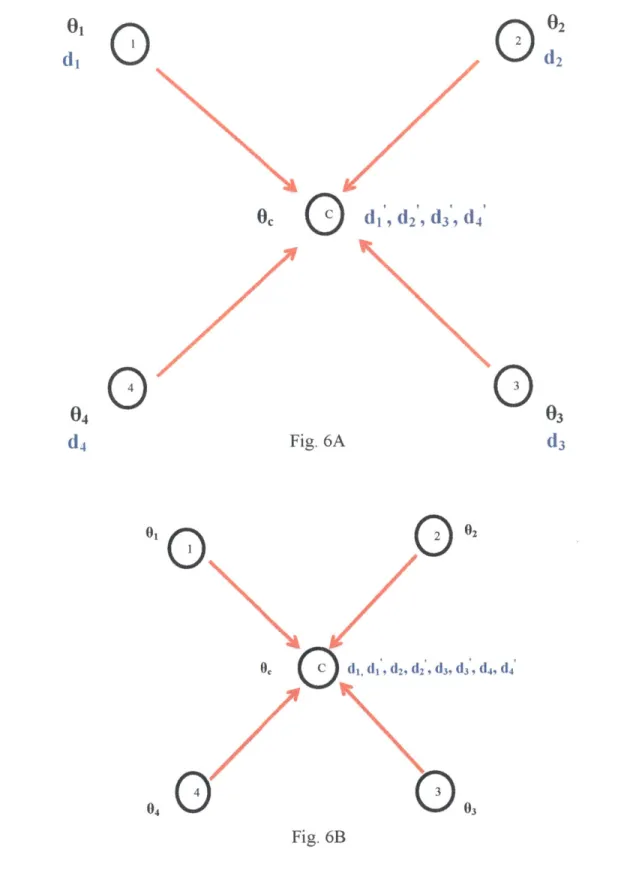
The models shown above do not illustrate the local information that exists at each point of the system, nor the decisions that have to be made in order to address the problems that each agent faces. To better understand the dynamic of the decision structure in organizations the following modeling framework has been proposed:
0, represent the local information where it is generated-information that is remote for other points in the system.
di and di' represent the set of decisions that need to be taken for each point in the system (i), to
address the problem that exists at that point. Making decision set di, di' optimally, requires the information 0i but may also require knowledge of other decisions made at other points of the system which in turn depend on local information of those points.
The arrowed lines represent communication and the direction in which information flows from one point in the system to another.
The first model represents the decentralized disconnected decision making where there is no communication between decision makers and they each only have access to their locally generated information. This model can be seen in the picture below:
di, d
01 d4, d4 04 02 d2, d20
0
00
03 d3, d3Figure 4: Decentralized disconnected decision structure
The second model represents the decentralized connected decision-making structure in which all agents have access to the local information generated elsewhere in the system where a problem exists and for which a decision has to be made. The lines of communication show the flow of information to and from each actor.
02 d2, d2
d4, d4 04
di, di'
01
Fig 5: Decentralized connected decision structure
Another possible structure in one in which one centralized actor (C) exists that has the ability to makes decisions for the problems that exist at other points of the system based on both local and remote information. Of course the entire decision sets do not have to be made by the central agent but rather a portion of the decision (di) can be made centrally and the rest (di) locally. Figure 6 (A) shows such an instance in which the central player only makes a portion of the decisions and Figure 6 (B) the instance in which the entire decision structure is centralized. This decision structure can be viewed below:
0
0
03 d010 d, 04 d4
0
00
0
od 0c 0d
,ld2', d3',
d4'0
03 d3 Fig. 6A 01 Q 04 oz d2, d2, d , d3, d4, d4 03 Fig. 6BFig 6: Decision structure with a central agent. A) a portion of decisions are made centrally. B) decision making is completely centralized
The flow of information is only from other actors to the centralized decision maker.
Models described in the previous section do not distinguish between communication and access to information. In fact what is called communication in the previous section can be interpreted as including access to information as well and not just communication. In a working paper Bloom and his colleagues argue that it is problematic to aggregate information and communication into information communication technologies (ICT) since better information access and better communication have different effects on decision-making structure in organizations. (Bloom, et al., 2011)
It seems that what was explained by previously as a shift from a decentralized state to centralized one, and again to decentralized state as a result of a continuous decrease in communication costs can be explained using two different cost parameters, those of communication and access to information.
A fall in the cost of communication will push the point of decision-making up in the hierarchy
since it would be cheaper for a central agent with more experience to gather relevant knowledge or information from employees down the hierarchy that face a problem and then make effective decisions based on that knowledge. This means less empowerment for employees down in the hierarchy and more centralization in the decision-making structure. On the other hand, as the cost of access to information or information acquisition falls as a result of things like shared databases and systems like ERP, decision-making becomes decentralized since employees lower in the hierarchy will have access to information that enables them to make more effective
decisions regarding the problems they face without the need to refer them up in the hierarchy. (Bloom, et al., 2011)
The choice of decentralization, assuming these two costs, becomes a trade-off between the cost of communication and the cost of access to information (Bloom, et al., 2011), as opposed to a single aggregated cost of communication that explains moving from centralization to decentralization and not the other way around as a result of the decrease on the single communication cost axis. Nonetheless, these two frameworks seem to be explaining the same facts.
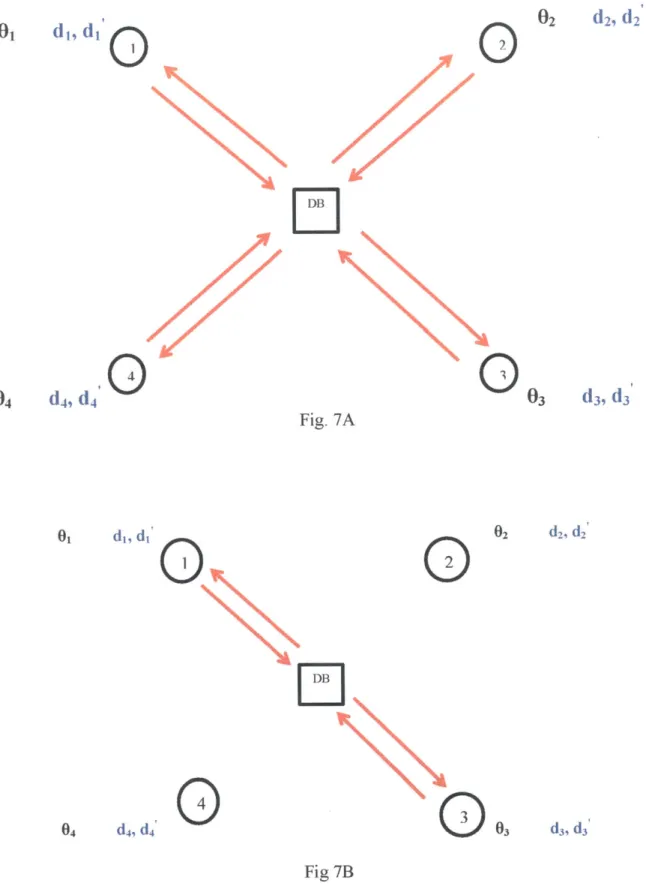
It is possible not to have a central decision maker which makes the decision set for all points in the system, but instead have a shared source of information such as an organization wide database (DB) that gathers information from around the organization. Having this shared database reduces the cost of information even further since agents only need to communicate with the database and not every other agent in the system to acquire information. This configuration is shown in Figure 7 (A). However this doesn't mean that all points in the system must be communicating with the database. Figure 7(B) shows a case in which agents 2 and 4 have no communication with the database and use purely local information that is not generated through communicating with the database to make decentralized decisions.
01
d
1,d
1 04 d4 , d4 0 2 d2, d2 Fig. 7AQ
01 di, d' 4 0 04d
4,
d4' 003 Fig 7BFig 7: Decision structure in the presence of a database. A) All agents are communicating with the database. B) Only 2 agents communicate with the database
02 d2, d2
d3, d3 0
003
dOf course, there lies no decision-making power or control in this central shared information
resource.
Communication and access to information are not the only needs of an organization. Most organizations need to do some sort of a processing, crunching, or analysis on their data to create the necessary information needed for decision making and the continuation of their operations. Computing and processing power is required for organizations to process their data and information in order to make effective decisions.
Some of the decision tasks in organizations are of a routine nature and can be addressed by devising standard processes and procedures. In many case, however, exceptions occur and problems arise that cannot be addressed by existing decision procedures. The information generated where the problem exists needs to be processed in order to create what is needed to make an effective decision. This information sometimes needs to be communicated to higher levels in the hierarchy to be processed and used for decision making in a more centralized manner. All of this necessitates a processing and computing capacity that would prevent the hierarchy from becoming overwhelmed by information it can't process. Therefore, investing in information systems in order to increase an organization's capacity to process information is a design strategy to improve the organization's decision making capabilities. (Galbraith, 1974)
Therefore, organizations need computing and processing power which costs money. Even though computing has kept up with Moor's law in terms of faster speeds and lower cost of computer processing, developing processing and computing capabilities can still costs a lot of money.
Cloud computing lowers the cost of computing even further for organizations as they do not need to invest in creating or expanding their processing capabilities, and also because cloud providers can achieve higher levels of utilization and therefore lower overheads. This will improve the performance of organizations that either had no processing capability before using the cloud because they couldn't afford it, or their processing capabilities were not very cost effective. Lower cost of computing as a result of adopting cloud computing means higher levels of performance, more effectiveness in decision making, and more agility not just in managing IT, but also in managing the entire organization since information is developed faster and more accurately which in turn improves decision making.
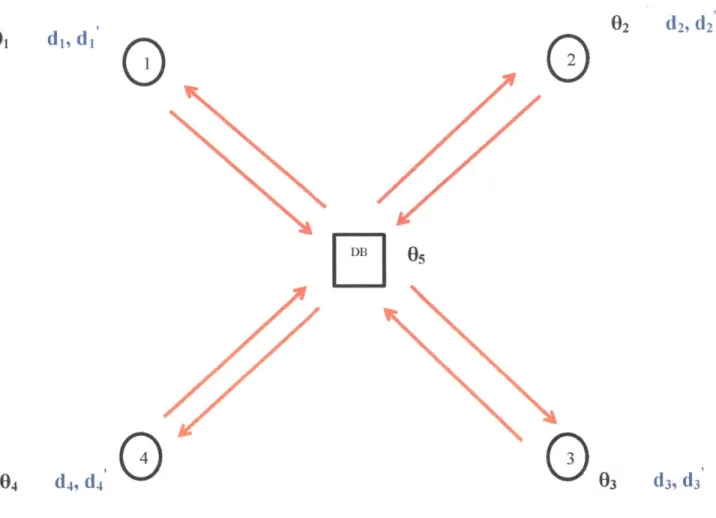
An enterprise wide planning platform (such as ERP) that gathers information and data from around the organizations and processes them to generate new information that empowers agents at different points of the organization with the necessary expertise to make the effective decision is an example of a capability that lowers the cost of computing for the organization and enables effective and efficient decision making through cheaper access to information. Below is a model that shows the decision structure with the presence of such data base that generates 05 with
02 d2, d2
01
di,
di
04 d4, d4 003 da, d3
Fig 8: Decision structure in the presence of an organization wide information processing platform
4.4 ( ompare amd ( (mbine
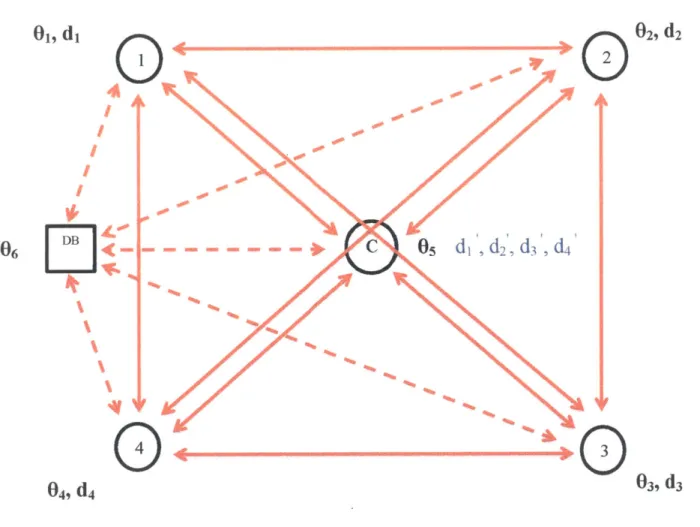
The models discussed above are rather simplified. In the real world, enabled by IT, there are more channels of communicating information available to organizational players than ever before. Decision-making doesn't have to be either centralized or decentralized; connected decision-making can be a mixture of centralized and decentralized with pure centralized and pure decentralized at the two extremes of a spectrum. Information and communication technologies can enable communication between any two actors in the system with only the internet as
infrastructure. Information can flow in both directions between agents, and the decisions made at each point can vary from complete control and autonomy in decision-making, to partial control, to no decision power at all. When there is no decision made at one point of the system, the centralized decision maker (C) would have complete control over the decisions made for that point. A depiction of this structure can be seen below:
A
I00-I -0
44
04, d
4Fig 9: Decision making structure enabled by cloud computing
02,
d
2If both agent 1 and the central decision maker (C) are responsible for making a decision for the
problem that exists at point 1, then the decision (di,di') will be based on 01 and 65. Both 01 and 05 can be pure local information or enriched through acquiring information from the rest of the system depending on the combination and distribution of decision making between agent 1 and the central decision maker.
It should be noted that the arrows only show the flow of information, 0, between agents and does not include the transmission of decision from the central agent to other agents.
Even though the decrease in the cost of communication and decrease in the cost of access to information seem to have opposite effects on the organizational structure, this doesn't suggest that both these effects cannot exist at the same time. It may be right that, when assuming a single cost of communication to represent the effects of IT, a change in just the cost of communication could lead the organization from decentralization to centralization and back to decentralization (Wyner & Malone, 1996), but such transitions are even more likely and possible on different levels at the same time if the cost of IT is disaggregated and one allows changes in both cost of
communicating and, for example, cost of access to information as two different costs with distinct effects (Bloom, et al., 2011).
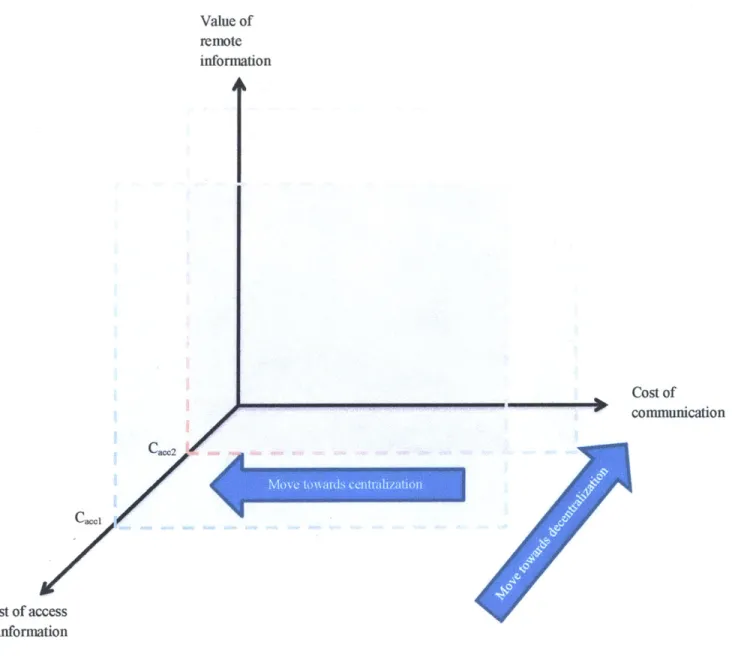
Therefore, considering only the cost of communication and cost of access to information, we can imagine a three dimensional coordinate system (Fig 10) in which the x and y axes are the cost of communication and the cost of access to information and the z axis is the value of remote information. At any given cost of access to information (Cacci), a lowering in the cost of communication will push the decision structure towards more centralization. On the other hand,
at a constant cost of communication, a decrease in the cost of access to information will shift the decision making structure towards more decentralization.
Value of remote infonnation Cost of communication Cacc2 C.1 Cost of access to information
Fig 10: A model to capture the effects of both costs of communication and access to information on decision structure
A lowering in the cost of access to information can take the organization structure to a new plane
in which tasks that can be done better by agents faced with the problem are decided for in a more decentralized manner due to a lower cost of access to information. Moving on that same plane towards a lower cost of communication will move the decision structure towards more centralization in tasks that are better decided for by agents higher in the hierarchy. This is matches the explanation given by Bloom and his colleagues (Bloom, et al., 2011).
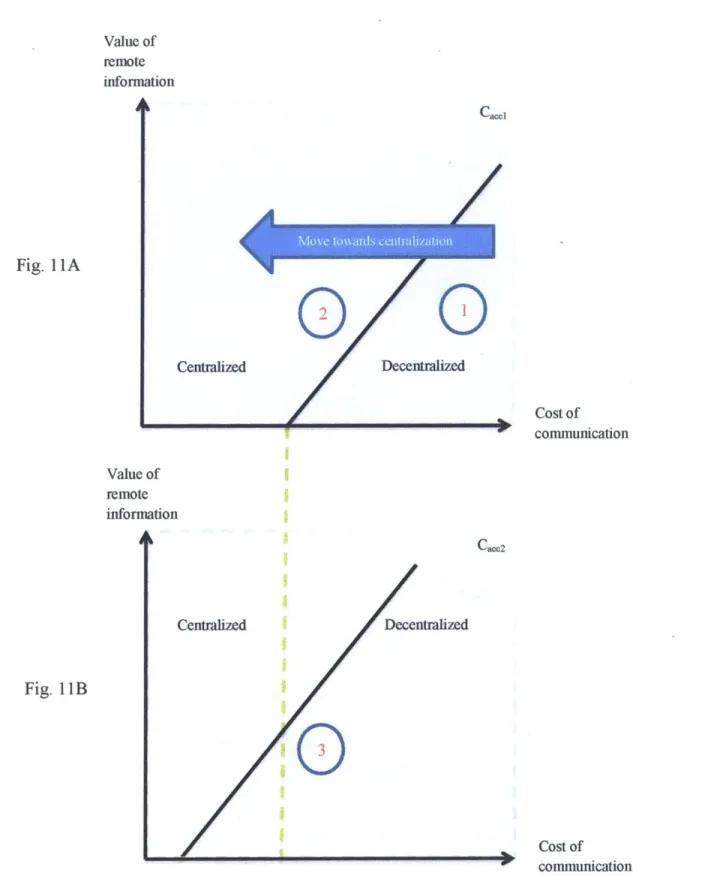
This dynamic can be shown in a different way in Fig. 11. Assuming a fixed cost of access to information (Cacc1) the effects of a lowering in the cost of communication can be shown in the coordination system below (Fig. 11a) with only two axes. As the cost of communication falls, the decision structure moves towards more centralization. However, if the cost of access to information is a lower fixed amount (Cacc2), the situation will be as described in Fig. 1 lb where due to a lower cost of access to information the system is in a more decentralized state to begin with. Therefore, moving towards centralization requires a higher decrease in the cost of communication. The dynamic nature of the effects of the different costs associated with IT can be seen in the following figures.
Deceni 0 lalized Cost of communication C.,c2 Decentralized
0
Cost of communicationFig. 11: the effects of the lowering in the cost of communication on decision structure. A) fixed cost of access to information Cacci. B) cost of access to information Cacc2 where Caccl< Cacci
Value of remote information
A
Fig. 11A A Cacci Centralized Value of remote information Centralized Fig. 1IBI%
These two dimensions show how the same phenomenon that was explained by a single cost of communication as an aggregated form of different costs associated with IT (Wyner & Malone,
1996) can be explained by two cost elements of communication and access to information
(Bloom, et al., 2011). With the aggregated single cost, it was showed that as a result of a lowering in that cost, organizations moved from a decentralized state to a more centralized state and then again to a decentralized stare as the cost fell even more (Wyner & Malone, 1996). In Figure 12, it is shown that how the two different costs of communication and access to information have different effects on the decision system, but still explain what was observed before. Cost of access to infonnation HIl L A ~
0
0
0
I L Cost of connunication I HAs shown in Figure 12, starting at state 1, a lowering in the cost of communication takes the organization towards centralization. Subsequently, a decrease in the cost of access to information pushes the structure towards decentralization.
Cloud computing can affect both the cost of communication and the cost of access to information. It can give the organization the infrastructure, tools, and applications necessary for more effective and efficient communication at lower costs. The simplest of these infrastructures are internal networks created on the could infrastructure and applications like email and messengers. Using such means, certain decisions that can be better made by people higher in the hierarchy, due to better expertise and perspective, can be shifted up since those higher people now have the necessary means of communication to provide them with the relevant information and knowledge needed to make those specific decisions. At the same time, cloud computing can provide organizations with cheaper access to infrastructure and applications that help diffuse knowledge and increase access to information, so that people lower in the hierarchy who are facing certain problems can easily access the information generated elsewhere in the organization to make effective decisions in order to address the problem without the need to refer it to people upper in the hierarchy. These types of problems are probably local by nature and do not require a wide perspective of the organization and therefore, if fed with the necessary information, can be handled in a decentralized way by the very people that face them. Examples of such infrastructure are shared databases that lower the cost of communication and ERP systems that lower the cost of access to information.
So, in fact what is modeled in figure 9 shows how cloud computing can help optimize the
decision making structure by reducing the cost of communication and the cost of access to information by allowing the decisions that can be more effectively made centrally to be made
that way by communicating remote knowledge and information from different agents to the central decision maker, and the decisions that can be more effectively and efficiently made in a decentralized and local manner to be made at the points where the problem exists by reducing the cost of accessing information so local agents can acquire the necessary information that allows them to make effective decisions. At the same time, these communication capabilities make the coordination between different decisions made at different parts of the organization possible, thus, improving the performance of the organization even further.
As a result, adopting cloud computing can affect the organizational structure in terms of decision making and in doing so optimize the decision structure so that decisions can be made where more value can be created. This optimization brings agility and flexibility to decision making in the organization as decisions can be easily passed up or down in the hierarchy based on need and circumstances, which in turn will improve the performance of the organization.
5 Conclusion
Changes in different costs associated with IT have different effects on organizational design and performance, and in particular on the decision making structure of organizations. It has been observed as these costs decrease, organizations initially start moving from a decentralized disconnected state to a centralized connected structure where a central agent or decision maker takes decisions for problems at different points of the system based on remote information communicated to him from those points. A lowering in the cost of communication is responsible for that as it becomes affordable to communicate information to a central agent who has the knowledge and expertise to make decisions for the problems at hand. A further reduction in the
cost of IT, represented by the cost of access to information, makes it possible for agents at different points of the organization to acquire information - that was otherwise too expensive to access - and therefore become capable of making decisions on their own. This means a shift from a centralized structure to a decentralized structure where decision making in dispersed.
Cloud computing can lower the cost of IT, both fixed and variable, in a dramatic way. Thus not only giving organizations cheaper, faster, and more effective access to information and computing power that can considerably improve the performance of the organizations, but also affect the organizational design and in particular the decision making structure of companies.
Changes in the costs of communication and access to information do not have to take place in sequence, but can rather happen simultaneously enabling those decisions that can be make more effectively centralized to be made by a central player through communicating remote information, and those decisions that can be made more effectively and efficiently decentralized to be made by the people that are facing the problem by giving them access to information. This implies that cloud computing can improve organizational performance through making companies more flexible, cost efficient, and effective.
In short, cloud computing not as a completely new technology or phenomenon, but as a new means of delivering IT, has serious implications for organizational design and performance many of which will surely be studied and perhaps quantified in future studies.
6 Bibliography
Anon., 2010. Amazon's Early efforts at Cloud Computing? Partly Accidental. [Online] Available at: http://itknowledgeexchange.techtarget.com/cloud-computing/amazons-early-efforts-at-cloud-computing-partly-accidental/
[Accessed March 2013].
Bloom, N., Garicano, L., Sadun, R. & Van Reenen, J., 2011. The Distinct Effects of Information
Technology and Communication Technology on Firm Organization. s. .: s.n.
CloudStory, 2012. Top 10 Reasons Why Startups Should Consider Cloud [Online] Available at: http://cloudstorv.in/2012/07/top-i 0-reasons-why-startups-should-consider-cloud/
[Accessed February 2013].
Dubey, A. & Wagle, D., 2007. Delivering Software as a Service, s.l.: The McKinsey Quarterly. Elias, H. D. & Mirchandani, S., n.d. Capitalizing on Cloud: Preparing People and Processes for
IT's Organizational Challenges, s.l.: EMC Corporation.
Everest Group, 2012. Enterprise Cloud Quarterly Review, Q1 2012, s.l.: s.n.
Galbraith, J., 1973. Designing Complex Organizations. s.. :Addison-Wesley Publishing Company.
Galbraith, J. R., 1974. Organization Design: An Information Processing View. Interfaces, 4(3),
pp. 28-36.
Gartner, 2008. Cloud Computing Confusion Leads to Opportunity, s.l.: Gartner.
Gartner, 2008. Gartner. [Online]
Available at: http://www.gartner.com/newsroom/id/707508
[Accessed March 2013].
Gibbons, R., 2012. Coase Meets the Cloud: How and When Can Outsourcing IT Improve
Organizational Performance?. s.l.:s.n.
ITU-T, 2012. Focus Group on Cloud Computing Technical Report, Part 1: Introduction to the Cloud Ecosysterm: Definitions, Taxonomies, Use Cases and High-level Requirements,
s.l.: International Telecommunication Union.
Knorr, E. & Gruman, G., n.d. What Cloud Computing Really Means. [Online] Available at: http://www.infoworld.com/d/cloud-computing/what-cloud-computing-really-means-031
Malone, T. W., 1997. Is Empowerment Just a Fad? Control, Decision Making, and IT. Sloan
Management Review.
Malone, T. W., 2004. The Future of Work: How the New Order of Business Will Shape Your
Organization, Your Management Style, and Your Life. s.l.:Harvard Business School
Press.
Mell, P. & Grance, T., 2011. The NIST Definition of Cloud Computing, s.l.: National Institute of Standards and Technology.
Wyner, G. M. & Malone, T. W., 1996. Cowboys or Commanders: Does Information Technology
Lead to Decentralization?. s.l., Proceedings of the International Conference on