HAL Id: inria-00587184
https://hal.inria.fr/inria-00587184
Submitted on 19 Apr 2011
HAL is a multi-disciplinary open access
archive for the deposit and dissemination of
sci-entific research documents, whether they are
pub-lished or not. The documents may come from
teaching and research institutions in France or
L’archive ouverte pluridisciplinaire HAL, est
destinée au dépôt et à la diffusion de documents
scientifiques de niveau recherche, publiés ou non,
émanant des établissements d’enseignement et de
recherche français ou étrangers, des laboratoires
CiberMouse design: a case study for SAIA model reuse
Julien Deantoni, Jean-Philippe Babau
To cite this version:
Julien Deantoni, Jean-Philippe Babau. CiberMouse design: a case study for SAIA model reuse. 2005.
�inria-00587184�
CiberMouse design: a case study for SAIA model reuse
Julien DeAntoni, Jean-Philippe Babau
CITI laboratory – INSA-Lyon
20, avenue Albert Einstein, 69621 Villeurbanne cedex
julien.deantoni ; [email protected]
Abstract
In the context of last year RTSS robotic competition, SAIA models and their implementation have been pro-posed. The goal was the development of an exploration robot. This year, the paper proposes the reuse one of these models for the ciberMouse design. The realized modifications are presented and an emphasis is made on benefits and limits of SAIA model reuse.
1
Introduction
CiberMouse is the second robotic competition holds in conjunction with the Real Time System Symposium (RTSS) conference. Its goal is the development of an efficient real time software for an exploration robot. The development is based on a simulator of the real robot platform.
Last year, the competition was the maRTian project. The goal of the maRTian robot was to go from one spot to another one with a minimum knowl-edge about its environment. CiberMouse presents sim-ilarities with the maRTian project, the robot must go from one spot to another one (the beacon) and come back to the starting spot. The difference is that the beacon position to reach is not a priori known. More-over, the services offered by the simulators this year and last year are almost different.
Based on SAIA (Sensors Actuators Independent Ar-chitecture) [2], models and implementation have been realized for the maRTian project [1]. SAIA is an archi-tecture for the development of real time software inde-pendently of a specific platform sensors and actuators (or simulator). It proposes a first model independent of the platform services. Then it is linked thanks to a complex connector to the platform services. [1] is a showcase of SAIA and highlight the benefits of a such approach during the deployment on the real platform. The development of ciberMouse is also SAIA based.
Moreover, because similarities exist between ciber-Mouse and maRTian, the question adressed here is the one of the reuse: is it possible to reuse maRTian models and implementations for the ciberMouse design ? This way, it allows evaluating SAIA approach for reuse.
The goal of this paper is to present how the first model and its implementation, realized in the scope of the maRTian competition, can be reuse for the ciber-Mouse design. The first section quickly presents SAIA and the choice done for the maRTian models. The sec-ond section explains how the last year model has been reused. Then, we evaluate the reuse, its benefits and its limits.
2
SAIA and the maRTian models
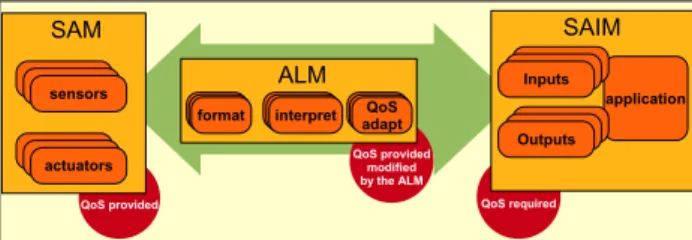
SAIA is based on three models (see figure 1). The first one (called SAIM: Sensors Actuators Indepen-dent Model) express the behaviors of the application without any suspicion about the sensors and actua-tors or simulator services. The application is based on high abstraction level Inputs and Outputs. The second model (called SAM: Sensors Actuators Model) represents the sensors and actuators drivers services or the corresponding simulator services. Then the third model (called ALM) is the specification of the com-plex link between the first and the second model. The ALM is composed of two kinds of adaptation element. The Input adaptation elements are in charge of the
Inputs construction from sensors (simulator) data and
event. The Ouput adaptation elements are in charge of the Outputs realization thanks to actuators (simulator) command. Each adaptation element is composed of three basic components: Format is a translation com-ponent. Its role is only to change the representation of an information. Interpret produces one or more
Input from one or more Sensor information for Input
adaptation element and produces one or more
Actua-tors information from one or more Output for Output
explic-itly changing the QoS characteristics of a flow (constant delay, periodic arrival law, ...).
Figure 1. SAIA models
In maRTian as well as ciberMouse, the SAM are given by the simulators interfaces. They are almost different so that no reuse is possible at this level. How-ever, mission goals encapsulated in the SAIM presents similarities. Then we propose to reuse the maRTian SAIM and so, it is the only detailled model. To realize the maRTian SAIM model,eight Inputs (in which four consigns) and three Outputs have been defined:
Inputs
• start (event consign)
• robot state (categorical consign) {normal
-crashed - near a danger}
• goal position (categorical consign) X:[Xmin ;
Xmax] and Y:[Ymin ; Ymax]
• urgent stop (event consign)
• last obstacles (continous data) [-π ; π]
• world view (categorical data) for each point in the
space: {nothing - hole - mountain - unknow }
• actual position (continuous data) X:[Xmin ;
Xmax] and Y:[Ymin ; Ymax]
• actual orientation (continous data) [-π ; π] Outputs
• run (categorical command) { normal prudent
-scared}
• turn of X (continous command) [-π ; π] • stop (boolean command)
The application that uses these Inputs and the
Out-puts realizes a path finder with obstacles avoidance.
This model and its implementation have been validated on the simulator by adding delay and changing arrival laws of the Input update and Output performing. It results in a SAIM model whose arrival law and delay for correct behaviors are known. The goal is now to see how this model and its implementation can be reused.
3
the maRTian models for ciberMouse
To realize its mission, the main functionality of maRTian is a path finder. It is obvious that ciber-Mouse needs to use a path finder at least to go back to its initial position but it also needs other features such as: looking for the beacon, moving to the beacon and giving mission state information to the simulator (by using leds). Enforcing reuse, the new models has to in-corporate these features, which are not in the maRTian project, with a minus change on the validated SAIM model and its implementation. Since the SAM is pro-vided and can not be modified, the changes will appear in the ALM model, i.e. in the way to link the SAM and the SAIM.
We are first going to detail the changes that appear in the SAIM before to detail the others major modifi-cations, realized in the ALM.
3.1 SAIM modifications
The maRTian SAIM has been modified; more ex-actly it has been extended. The first extension is re-lated to the mission state information. By looking the
Inputs and Outputs of the maRTian SAIM, we founded
that no Input or Output can be used to drive the mis-sion state information for the simulator. So, we add an Output called mission info which informs about the mission state. Three different mission states are of importance in ciberMouse: the robot is on the beacon, the robot returns to its initial position and the robot has finished.
The second extension concerns the way to drive the mission info Output. It consists in the add of two items in the robot state Input consign: on target and on end.
It is the only changes done on the maRTian SAIM, The functionnality realized by this model is always a path finder. The next section presents how to integrate the other features needed by ciberMouse in the system.
3.2 ALM modifications
There are two things the ALM must do. First, it must use the SAM services to create the SAIM Inputs and to perform the SAIM Outputs. Secondly, the ALM must ’drive’ the SAIM in order to realize the features which are not related to the path finder. Each of these two ALM objectives are presented through:
• the way to provided the robot actual position
• the way to produce the goal position to fulfill
all the ciberMouse mission features.
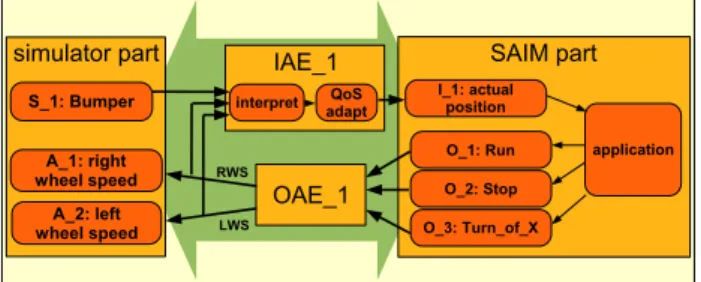
The absolute robot position (actual position) is mandatory for the application correctness. To provide it, an open loop is realized (see figure 2). First, the
Figure 2. Actual position computation
moving Outputs (O 1 O 2 and O 3) are translated by OAE 1 into two low level commands LWS and RWS (Left/Right Wheel Speed) for A 1 and A 2 in the sim-ulator. LWS and RWS are also send to IAE 1 by OAE 1. Effectively IAE 1 is in charge of production of the actual position Input. With LWS, RWS and a representation of the motors dynamic (provided in the ciberMouse specification), a computation of the robot position is possible. So, LWS and RWS are handled in IAE 1 by an Interpret component. This compo-nent contains the motors dynamic and must aggregate consequently LWS and RWS to evaluate the robot po-sition. The environment is represented by the simu-lator; and so its evolution is discrete. The computa-tion is then realized for each simulator cycle to have a maximum accuracy. Then, because the update of the actual position is not usefull at each cycle, a QoS adapt component acts as a filter and update the
Input only when needed (once on three in our case). If
the overhead introduced by the position computation is too big, it is possible to compute it less often; but to avoid a too big drift, all the low level motors command must be taken into account.
To finish, we have to consider the physical con-straints. The robot can not move forward if there is a wall or an other robot in front of him. The bumper reflects this information and so the bumper sensor S 1 is also linked IAE 1. When the bumper is ’on’, the position does not change.
Contradictly to the maRTian project, the first spot to reach is not known and depends on the mis-sion state. It significates that the absolute position goal position can not be known at the begining of the execution. There are three mission states:
• the research of the beacon,
• the move to reach the beacon, • the return phase.
For each mission state correspond a kind of goal position. The ’goal position Input adapta-tion‘ element takes charge to their computation. More precisely, for each mission state, there is a different be-havior:
• inititally, it must set the goal position thanks to
a map exploration policy to have a chance to see the beacon at least one time;
• when the beacon have been seen, it must set the
goal position to catch up with the beacon;
• then, it must set the goal position to the initial
position when the robot is in the return phase. To fulfill these requirements, the ’goal position
Input adaptation element‘ must be linked to: the
beacon Sensor, and the ’Inputs adaptation element‘ in charge of: actual position, actual orientation, and robot state. However, depending on the mission state, the elements which are linked to the adaptation element are necessary or not.
Despite that the ALM has been almost totally mod-ified, the SAIM has been reused with a minimum of modifications. The next section discusses this reuse and its impacts on the system.
4
Reuse analysis
A first work we have done (not presented here) was to deploy the maRTian SAIM with the exact maRTian behaviors on the ciberMouse platform (SAM). This ex-perience has demonstrated the ability to reuse a SAIM on different platform. In this case the modifications have occured only in the ALM.
Then, the goal was to reuse the maRTian SAIM in a different context; in term of platform as well as dif-ferent use cases (following the ciberMouse rules). To achieve that, a SAIM modification was mandatory: the add of the Output user infos and the way to drive it. Even if the maRTian project had no require-ments for that, it was suprising to consider an em-bedded system without any way to communicate its state to the environment. To avoid future modifica-tion and improve the SAIM reusability, the user infos
Output is modified in such way that it notifies all
kinds of mission state, not only the one of importance in ciberMouse. For instance, it contains these mis-sion states: wait start, look for beacon, avoid obstacle,
path finder to X Y, and so on. After these modifica-tion in the SAIM, it is always possible to use it for the maRTian project. The SAIM modifications can then be seen as a improvement of the first maRTian SAIM. It significates that the job skills are better encapsulated after some reuse of the same model and so provide a more generic ”exploration robot” SAIM.
The management of the goal position Input out-lines that the ALM is more complex than in the maR-Tian project. It is due to the encapsulation of some mission feaures into the ALM rather than into the SAIM. To avoid a too complex ALM, two solutions have to be considered. The first one consists in slicing the application in such way that the different function-nalities and the life cycle are all isolated in different modules. This way, a functionnality can easily being add. However, this solution is outside of SAIA scope.
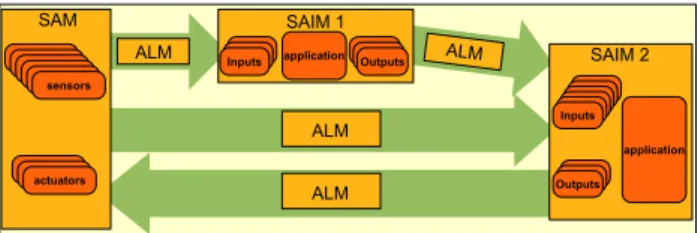
The other solution consists in realizing a sequence of different SAIM (see figure 3). In this case, a SAIM uses Inputs produced from Sensors to produce
Out-puts (as the previously presented SAIM). Then, a
sec-ond SAIM considers the Outputs of the first SAIM as
Sensors. Consequently it uses them to produce new Inputs and so, new Outputs. This solution is
specifi-cally adapted when the adaptation behaviors realized by the first SAIM needs to be reused.
Figure 3. An instance of a SAIM sequence
All that precedes is driven by a strong will to re-use the maRTian model. Without this will, the ciberMouse models would be driven only by the ciberMouse speci-fication and so would be different. For instance, there are three kinds of goal position, each representing a different knowledge depending on the mission state. These three different knowledges would have been dis-sociated into two Inputs for this hypothetical SAIM:
• goal position: which would be the calculated
po-sition relatively to the robot popo-sition
• initial position: the absolute position to return to.
Following the SAIA paradigm, the position to reach when looking for the beacon is not an Input because it is not calculated from an environment knowledge but rather from an exploration policy. This exploration strategy would be encapsulated in the SAIM.
Then, the resulting ciberMouse specific SAIM is not only a path finder. It also contains an exploration strat-egy and a more complex life cycle. Because more func-tionnalities are encapsulated in the SAIM, it results in a more simple ALM. When a platfrom change oc-curs, the ALM is widely impacted. So more simple the ALM is, easier the platform change is. Contradictly, more simple the SAIM is, easier it is to use it for an-other specification. It outlines that the way to reuse a model depends on the future purpose of the re-used model.
From a QoS point of view, the QoS can be expressed in different ways. For instance, the QoS delay is not the same for the goal position to reach when the beacon has not been seen and for the goal position when the robot comes back. With SAIA it can not be expressed for a same Input. It significates that the reuse is possi-ble and accelerates the development but it also limits the QoS expressivity.
5
Conclusion
This paper outlines the reuse opportunity when using SAIA models. It focus on the reuse of the SAIM model. The introduction of high level Inputs and Outputs creates a well specified interface between the application and the platform and thus, facilitates the platform change. The behaviors expected by the application newly developped (ciberMouse) differs in some point from the original application (maRTian). The additionnal features are encapsulated in the ALM which becomes more complex. By realizing a sequence of SAIM, the reuse seems to be better and the ALM more simple. It could be interesting to focus on this alternative in the offing. On a longer view, it could be interesting to study how the QoS specification can be linked to an application life cycle
References
[1] Julien DeAntoni and Jean-Philippe Babau. SAIA: Sensors/Actuators Independent Ar-chitecture - a showcase through martian task specification. Proceedings of the ERTSI 2005 - Embedded Real Time Systems Im-plementation Workshop, pages 43–50, 2005. http://www.cs.york.ac.uk/ftpdir/reports/YCS-2005-397.pdf.
[2] Julien DeAntoni and Jean-Philippe Babau. Model driven engineering method for SAIA architec-ture design. Ing´enierie Dirig´ee par les mod`eles (IDM’06), 2006.