ANALYTICAL CHALLENGE
Solution to spectroscopy blog challenge
E. Pretsch&R. ZenobiPublished online: 2 December 2008 # Springer-Verlag 2008
The winners of the spectroscopy blog challenge (published in issue 392/1) are:
Lothar Hennig, University of Leipzig, Leipzig, Germany and
Jean-Michel Robert, Université du Sud—Toulon–Var, La Garde, France
The award entitles the winners to select a Springer-Verlag book from our catalogue up to a value of€ 75.
Our congratulations!
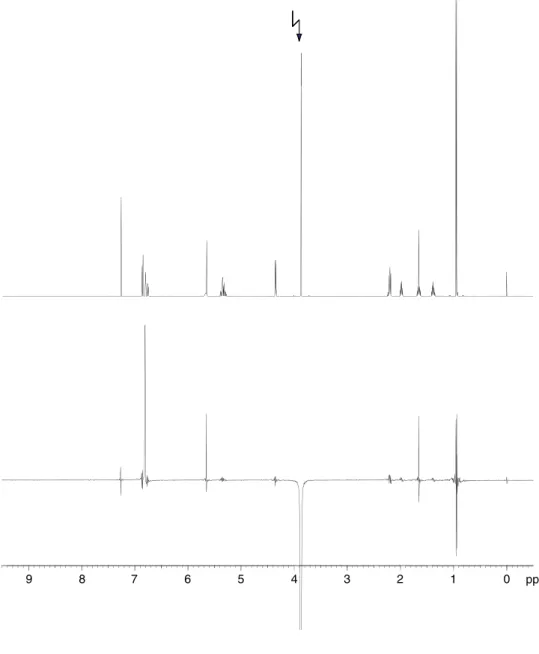
The substance described in the spectroscopy blog challenge had to be determined almost completely with the spectroscopic information provided by the authors. The participants were invited to share their ideas and solve the puzzle jointly, in blog discussions at http:// blogs.springer.com/abc. An additional spectrum was pro-vided by the authors towards the end of the blog discussions, a nuclear Overhauser effect difference spec-trum (Fig.1). Solution Capsaicin 8-Methyl-N-vanillyl-trans-6-nonenamide (CH3)2CHCH=CH(CH2)4CONHCH2C6H3 -4-(OH)-3-(OCH3) C18H27NO3
Casaicin is a lipophilic colorless, odorless crystalline compound. It is an alkaloid found in plants belonging to the genus Capsicum, e.g., chili peppers. Because the chemical properties and solubility of capsaicin are virtually the same as those of the accompanying capsaicinoids, the “natural capsaicin” was considered for a long time as an individual substance. It was not until 1958 that Kosuge et al. separated the natural substance into capsaicin and dihydrocapsaicin [1]. Capsaicin is a strong irritant to mammals, producing a sensation of burning in any tissue with which it comes into contact. Interestingly, birds, most aquatic organisms, and a number of insects are unaffected by capsaicin. The secretion of capsaicin is an adaptation to protect the fruit from consumption by mammals, while the bright colors attract birds that will spread the seeds [2]: Chili pepper seeds consumed by birds pass through the digestive tract unharmed, whereas those consumed by mammals do not germinate at all [3]. The fruits of red pepper have been used from ancient times as spices and medical drugs. The use of capsaicin in medicine is mostly based on its anesthetic and anti-inflammatory properties, but it is also known to stimulate appetite, improve digestion, and has recently also been tested for the prevention of pain, e.g., in postsurgery Anal Bioanal Chem (2009) 393:407–408
DOI 10.1007/s00216-008-2519-5
The online version of the original spectroscopy blog challenge can be found at http://dx.doi.org/10.1007/s00216-008-2267-6. E. Pretsch ETH Zürich, 8092 Zurich, Switzerland e-mail: [email protected] R. Zenobi (*) ETH Zürich, 8093 Zurich, Switzerland e-mail: [email protected]
application. Owing to the hypersensitizing and pain-relieving properties of capsaicin, its use in equestrian sports, for example, is considered illegal doping. At the 2008 Summer Olympics, four horses tested positive for capsaicin use and subsequently were disqualified from the team show jumping competition [4].
References
1. Legin GY (1996) Pharm Chem J 30(1):60–68 2.http://en.wikipedia.org/wiki/Capsicum 3.http://en.wikipedia.org/wiki/Capsaicin 4.http://news.bbc.co.uk/sport1/hi/olympics/equestrian/7574220.stm 9 8 7 6 5 4 3 2 1 0 ppm Fig. 1 1 H nuclear Overhauser effect difference spectrum: 500 MHz, recorded in CHCl3