ORIGINAL ARTICLE
Is bovine dentine an appropriate substitute in abrasion studies?
Florian J. Wegehaupt&Raffaella Widmer&Thomas Attin
Received: 21 August 2008 / Accepted: 5 May 2009 / Published online: 19 May 2009
# Springer-Verlag 2009
Abstract The study aimed to compare the wear behaviour of human and bovine dentine due to toothbrushing with different relative dentin abrasivity (RDA) toothpastes. Forty human and 40 bovine dentine samples were prepared from bovine lower incisors or human premolars roots, and baseline surface profiles were recorded. The samples were distributed to four groups (each groupn=10 human and 10 bovine samples) and brushed with fluoridated experimental toothpastes with different RDAs (group A: RDA 10, B: RDA 20, C: RDA 50, and D: RDA 100). Toothbrushing was performed in an automatic brushing machine with a brushing frequency of 60 strokes per minute and a brushing force of 2.5 N. After 2, 5, 10, and 25 min of toothbrushing, new surface profiles were recorded, and the dentine wear was calculated with a customised computer programme. The dentine wear of human and bovine dentine within the four groups was compared with unpaired t tests. No statistically significant difference was recorded for the dentine wear of human and bovine samples within the different groups.
Keywords Human . Bovine . Dentine wear . Toothbrushing . RDA
Introduction
Over the last decades, people have become older and have a rising number of teeth still in use in higher age. With
higher age, the percentage of gingival recessions with an exposure of root dentine to the oral environment increases [13]. This exposed root dentine can be abraded during daily toothbrushing.
On the other hand, especially in younger age groups, a rising number of dental erosions are reported [18]. Erosive lesions are accompanied by softening the surface layer of dental hard tissues like enamel and dentine. The wear of this softened tooth substrates increases when it is tooth-brushed [2].
Dentine wear due to toothbrushing is connected with different factors. Beside individual factors like brushing habits [4], brushing frequency, the position of the teeth in the arch [25], and pressure applied during toothbrushing [32], different material-linked factors like bristle stiffness [10,23] and dentifrices abrasivity [3,5,6,15] are reported. Studies testing the abrasion of dentine due to tooth-brushing are using either human [3,19,20] or bovine [2,7, 22, 31] dentine. There are two main reasons for using bovine dentine instead of human dentine when testing the dentine wear due to toothbrushing: firstly, the size of the bovine lower incisors allows preparation of more than one sample from one tooth so that a control sample can be gained from the same tooth as the sample intended for treatment. Secondly, it is easier to obtain a sufficient number of sound bovine teeth in comparison with human teeth [24]. Moreover, the bovine teeth often originate from cattle/cows coming from the same region with similar environmental factors. Additionally, bovine teeth do not suffer from caries and do not have a history of fluoridation measures. Thus, bovine teeth used in experiments are less dissimilar to each other than teeth gained from different human subjects.
Studies evaluating the possibility to substitute human dentine by bovine dentine are raw [8,14,26–30]. Some of
F. J. Wegehaupt (*)
:
R. Widmer:
T. AttinClinic for Preventive Dentistry, Periodontology and Cariology, University of Zürich,
Plattenstrasse 11, 8032 Zürich, Switzerland
those studies were focused on the demineralization of the dentine [29], while others compared the mechanical properties of the human and bovine dentine [8, 26–28]. Nearly all of these studies used coronal dentine, as they intended to evaluate how far bovine dentine could be used to substitute human dentine in erosions or bonding/ adhesions tests [26, 27, 30]. There is only one study comparing the dentine wear due to toothbrushing of human and bovine cervical root dentine [14]. In this study, only a single kind of toothpaste with standardised relative dentin abrasivity (RDA) was used.
It is not known how far the toothbrushing wear of human and bovine teeth is differently influenced by toothbrushing with dentifrices of different RDA.
Thus, the aim of the present study was to compare the tooth wear of human and bovine dentine due to tooth-brushing with different RDA toothpastes. The hypothesis was that there is difference in the dentine wear of human and bovine teeth when brushed with the same RDA toothpaste because of their different origin.
Materials and methods
In the study, 80 dentine samples were prepared from 20 human premolars that were extracted due to orthodontic reasons and from 20 freshly extracted cattle’s (age under 36 months) lower incisors. The teeth were sectioned at the cementum-enamel junction with a water-cooled diamond disc. The pulp tissue was removed from the roots with endodontic files.
From the distal and mesial surface of each root, one sample was gained with a trephine mill. The inner diameter of the drill amounted to 4 mm. The dentine cylinders were embedded in acrylic resin (Palavit G, Kulzer, Wehrheim, Germany) in metal moulds with an inner diameter of 6 mm. The dentine surface was ground with abrasive paper (800, 1,000, 1,200, 2,400, and 4,000 grit; waterproof silicon carbide paper, Struers, Erkrath, Germany). By this grinding step, the cementum was removed, which was additionally controlled by light microscopy. On the dentine surface, two parallel indents were applied with a scalpel with a distance of 2 mm between the indents. The dentine area next to the
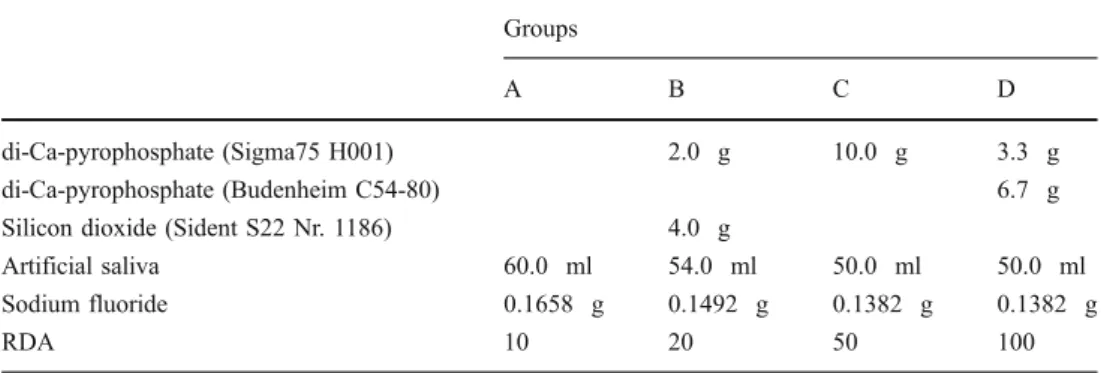
indents was covered with tape (Tesa, Beiersdorf, Hamburg, Germany) leaving a central window of 2 mm wide. From each sample, three baseline profiles were recorded with a stylus profilometer (Form Talysurf, Rank Taylor Hobson Limited, ELYT Messtechnik, Dübendorf, Switzerland) with the dentine area later covered with tape used as reference area. The samples were randomly allocated to four groups (A–D) of ten human and ten bovine samples each. Toothbrush abrasion was performed with experimental toothpaste slurries, containing fluoride, in an automatic brushing machine [14,15]. The machine was adjusted to a constant brushing frequency of 60 strokes per minute and a constant brushing force of 2.5 N. A medium bristle stiffness toothbrush was used (ParoM43, Esro AG, Thalwil, Zürich, Switzerland). In Table1, the composition of the toothpaste slurries and their use in the different groups are given. The RDA of the dentifrices was measured previously in the preliminary test, following the method described by Barbakow et al. [3]. The artificial saliva was prepared according to the formulation given by Klimek et al. [21]. In each toothpaste, the fluoride content amounted to 1,250 ppm. During toothbrush abrasion, the samples were covered with 20 ml toothpaste slurry.
After 2, 5, 10, and 25 min of brushing (120, 300, 600, and 1,500 brushing strokes), new surface profiles of the samples were recorded and compared with the baseline profiles of the respective samples to calculate the tooth wear. After each recording, the reference areas were recovered with tape. The comparison of the different profiles was conducted by a custom-made software. For exact reposition, the samples were fixed in a special jig. To evaluate the reproducibility of the measuring procedure, the coefficient of variation (CV) was determined. The CV of the measurement procedure was 1.36%.
Before starting the experiments, a preliminary study was done, and power analysis was performed. Relevant difference between the two different materials was assumed as 1µm and the estimated standard deviation, 0.7µm. Theα-level was set at 5%. For a power of 90%, ten samples were needed.
For data collection, the mean dentine wear of human and bovine dentine was calculated after 2, 5, 10, and 25 min toothbrushing in the different groups. Statistical analysis
Groups
A B C D
di-Ca-pyrophosphate (Sigma75 H001) 2.0 g 10.0 g 3.3 g di-Ca-pyrophosphate (Budenheim C54-80) 6.7 g Silicon dioxide (Sident S22 Nr. 1186) 4.0 g
Artificial saliva 60.0 ml 54.0 ml 50.0 ml 50.0 ml Sodium fluoride 0.1658 g 0.1492 g 0.1382 g 0.1382 g
RDA 10 20 50 100
Table 1 Formulation of the toothpaste slurries for the different treatment groups
was performed using ANOVA followed by Bonferroni/ Dunn post hoc tests. The human and bovine dentine wear in the different groups was compared by unpairedt tests at the four time points of measurement. The level of significance was set atp<0.05.
Results
The mean dentine wear due to toothbrushing with different RDA toothpastes of human and bovine samples for the different time points of measurement are given in Table2. Also, the p values of the comparison between human and bovine dentine are presented.
In Fig.1, the wear of human and bovine dentine due to abrasion with different RDA toothpastes against brushing time is given.
All comparisons of human and bovine samples showed no statistically significant differences in the dentine wear due to toothbrushing.
Only in group B (RDA 20) at the time point of 10 min, a slightly significant difference in the dentine wear of human and bovine dentine could be detected (p=0.0485).
Discussion
In this work, contact profilometry was used to measure the dentine wear due to toothbrushing. The standard method to measure the abrasivity of toothpastes was established in 1958 by Grabenstetter et al. [11]. For this method, the dentine has to be subjected to radioactive radiation to convert the 31P of hydroxyapatite to radioactive 32P. The dentine abraded by toothbrushing is calculated by comparing the
concentration of radioactive32P in the toothpaste slurry after brushing with a commercial available radioactive 32P standard powder [16, 17]. As this procedure is very laborious, the measurement of dentine abrasion due to toothbrushing was performed with a stylus profilometer in this study. Stylus profilometry has been used in numerous studies to specify the dental hard tissue lost due to toothbrushing [1,9,12,22]. It was not intended to compare the dentine wear of this study with the dentine wear previously measured with the radioactive32P method.
The hypothesis of this study that human and bovine dentine might be abraded non-uniformly with different RDA toothpastes under the here used in vitro conditions was proved as being wrong. From the 16 comparisons, 15 showed no statistically significant difference in the wear of
Group (RDA) Time point of measurement Human Bovine Human vs bovine A (10) 2 min 0.904 (0.402) 1.025 (0.453) 0.5336 5 min 1.089 (0.385) 1.071 (0.391) 0.9177 10 min 1.078 (0.380) 1.092 (0.286) 0.9294 25 min 1.214 (0.513) 1.198 (0.233) 0.9294 B (20) 2 min 0.845 (0.414) 1.236 (0.693) 0.1425 5 min 1.112 (0.385) 1.418 (0.515) 0.1489 10 min 1.224 (0.400) 1.697 (0.583) 0.0485a 25 min 1.673 (0.509) 2.017 (0.697) 0.2233 C (50) 2 min 1.191 (0.759) 1.380 (0.789) 0.5920 5 min 1.751 (0.700) 2.277 (1.386) 0.2978 10 min 2.425 (0.789) 2.980 (1.395) 0.2887 25 min 4.363 (1.267) 5.758 (1.758) 0.0568 D (100) 2 min 1.492 (0.539) 1.723 (0.949) 0.5127 5 min 2.822 (1.142) 2.742 (1.155) 0.8787 10 min 4.415 (1.5353) 4.436 (1.617) 0.9767 25 min 10.056 (2.425) 10.011 (3.402) 0.9733 Table 2 Mean dentine wear
(micrometre) in the different groups at the different time points of measurement (± standard deviation)
In the last row, thep values of the unpairedt tests between human and bovine dentine wear are given a Statistically significant differences 0 2 4 6 8 10 12 2 5 10 25 brushing time B RDA 10 H RDA 10 B RDA 20 H RDA 20 B RDA 50 H RDA 50 B RDA 100 H RDA 100
Fig. 1 Wear of human and bovine dentine due to toothbrushing with different RDA toothpastes against brushing time
human and bovine dentine. The finding that for one comparison of human and bovine dentine the wear was statistically, significantly different has no clinical and practical importance. Because of this finding, it might be assumed that there is no difference in the dentine wear of human and bovine dentine.
The finding of this study is in accordance to the finding of Imfeld [14]. In that study, only one toothpaste with a standardised RDA was used. No significant difference in the amount of abraded dentine for human and bovine samples was detected after 25 min brushing time. Also, a further study [30] did not find difference in the dentine lost due to toothbrushing, when the dentine wear of deciduous and permanent human teeth and cattle’s and calves teeth were compared. However, only one toothpaste with one RDA was used in that study, too.
During the whole testing, a broad range of mechanical attack is performed. It starts with very mild conditions (RDA 10, brushing for 2 min) and ends with relatively severe conditions (RDA 100, brushing for 25 min). For the very mild and relative severe conditions, a quite uniform wear of human and bovine dentine over the whole brushing time could be observed. When brushing with medium abrasive conditions (RDA 20 and RDA 50), it might be speculated that the wear behaviour of human and bovine dentine is less uniform, as different physical properties of human and bovine dentine become more relevant. Esser et al. compared the physical and chemical properties of human and bovine dentine and found these properties being similar for human and bovine dentine [8]. Even if speculating that longer brushing times (over 25 min) might reveal that the wear of human and bovine dentine is not uniform, it should be taken in consideration that 25 min of toothbrushing is the standard brushing time when testing RDA [14] and is not reached in most of the studies testing dentine abrasion [9,12,22].
The results of the present study suggest that bovine dentine can be used to substitute human dentine in studies investigating the abrasion of dentine due to toothbrushing with different RDA toothpastes and that the RDA value does not have an impact on the wear behaviour of human dentine compared with bovine dentine.
Conflict of interest The authors declare that they have no conflict of interest.
References
1. Attin T (2006) Methods for assessment of dental erosion. Monogr Oral Sci 20:152–172
2. Attin T, Buchalla W, Putz B (2001) In vitro evaluation of different remineralization periods in improving the resistance of previously
eroded bovine dentine against tooth-brushing abrasion. Arch Oral Biol 46:871–874
3. Barbakow F, Imfeld T, Lutz F, Stookey G, Schemehorn B (1989) Dentin abrasion (RDA), enamel abrasion (REA) and polishing scores of dentifrices sold in Switzerland. Schweiz Monatsschr Zahnmed 99:408–413
4. Bergstrom J, Lavstedt S (1979) An epidemiologic approach to toothbrushing and dental abrasion. Community Dent Oral Epidemiol 7:57–64
5. Bjorn H, Lindhe J (1966) Abrasion of dentine by toothbrush and dentifrice. A methodological study. Odontol Revy 17:17–27 6. Bjorn H, Lindhe J, Grondahl HG (1966) The abrasion of dentine
by commercial dentifrices. Odontol Revy 17:109–120
7. De Menezes M, Turssi CP, Hara AT, Messias DC, Serra MC (2004) Abrasion of eroded root dentine brushed with different toothpastes. Clin Oral Investig 8:151–155
8. Esser M, Tinschert J, Marx R (1998) Materialkennwerte der Zahnhartsubstanz des Rindes im Vergleich zur humanen Zahnhartsubstanz. Dtsch Zahnarztl Z 53:713–717
9. Ganss C, Schlueter N, Hardt M, von Hinckeldey J, Klimek J (2007) Effects of toothbrushing on eroded dentine. Eur J Oral Sci 115:390–396
10. Gilson CM, Charbeneau GT, Hill HC (1969) A comparison of physical properties of several soft toothbrushes. J Mich State Dent Assoc 51:347–361
11. Grabenstetter RJ, Broge RW, Jackson FL, Radike AW (1958) The measurement of the abrasion of human teeth by dentifrice abrasives: a test utilizing radioactive teeth. J Dent Res 37:1060–1068
12. Hooper S, West NX, Pickles MJ, Joiner A, Newcombe RG, Addy M (2003) Investigation of erosion and abrasion on enamel and dentine: a model in situ using toothpastes of different abrasivity. J Clin Periodontol 30:802–808
13. Hugoson A, Sjodin B, Norderyd O (2008) Trends over 30 years, 1973–2003, in the prevalence and severity of periodontal disease. J Clin Periodontol 35:405–414
14. Imfeld T (2001) Comparison of the mechanical effects of a toothbrush and standard abrasive on human and bovine dentine in vitro. J Clin Dent 12:92–96
15. Imfeld T (2002) In vitro evaluation of the mechanical effects of sensitive toothpastes of the Swiss market. Schweiz Monatsschr Zahnmed 112:104–108
16. Imfeld T, Sener B (1998) Relative effects of powered toothbrushes on dentin and gingiva. J Dent Res 77:717
17. Imfeld T, Sener B (1998) Relative dentin abrasion (RDA) by electric toothbrushes. J Dent Res 77:1236
18. Jaeggi T, Lussi A (2006) Prevalence, incidence and distribution of erosion. Monogr Oral Sci 20:44–65
19. Joiner A, Collins LZ, Cox TF, Pickles MJ, Weader E, Liscombe C, Holt JS (2005) The measurement of enamel and dentine abrasion by tooth whitening products using an in situ model. Int Dent J 55:194–196
20. Joiner A, Schwarz A, Philpotts CJ, Cox TF, Huber K, Hannig M (2008) The protective nature of pellicle towards toothpaste abrasion on enamel and dentine. J Dent 36:360–368
21. Klimek J, Hellwig E, Ahrens G (1982) Effect of plaque on fluoride stability in the enamel after amine fluoride application in the artificial mouth. Dtsch Zahnarztl Z 37:836–840
22. Magalhaes AC, Rios D, Moino AL, Wiegand A, Attin T, Buzalaf MA (2008) Effect of different concentrations of fluoride in dentifrices on dentin erosion subjected or not to abrasion in situ/ ex vivo. Caries Res 42:112–116
23. Manly RS, Brudevold F (1957) A comparison of physical properties of several soft toothbrushes. J Am Dent Assoc 55:779–780 24. Oesterle LJ, Shellhart WC, Belanger GK (1998) The use of
bovine enamel in bonding studies. Am J Orthod Dentofac Orthop 114:514–519
25. Sangnes G, Gjermo P (1976) Prevalence of oral soft and hard tissue lesions related to mechanical toothcleansing procedures. Community Dent Oral Epidemiol 4:77–83
26. Schilke R, Bauss O, Lisson JA, Schuckar M, Geurtsen W (1999) Bovine dentin as a substitute for human dentin in shear bond strength measurements. Am J Dent 12:92–96
27. Schilke R, Lisson JA, Bauss O, Geurtsen W (2000) Comparison of the number and diameter of dentinal tubules in human and bovine dentine by scanning electron microscopic investigation. Arch Oral Biol 45:355–361
28. Schmalz G, Hiller KA, Nunez LJ, Stoll J, Weis K (2001) Permeability characteristics of bovine and human dentin under different pretreatment conditions. J Endod 27:23–30
29. Titley KC, Childers S, Kulkarni G (2006) An in vitro comparison of short and long term bond strengths of polyacid modified composite resins to primary human and bovine enamel and dentine. Eur Arch Paediatr Dent 7:246–252
30. Wegehaupt F, Gries D, Wiegand A, Attin T (2008) Is bovine dentine an appropriate substitute for human dentine in erosion/ abrasion tests? J Oral Rehabil 35:390–394
31. Wiegand A, Lemmrich F, Attin T (2006) Influence of rotating-oscillating, sonic and ultrasonic action of power toothbrushes on abrasion of sound and eroded dentine. J Periodontal Res 41:221–227 32. Wiegand A, Kowing L, Attin T (2007) Impact of brushing force on abrasion of acid-softened and sound enamel. Arch Oral Biol 52:1043–1047