HAL Id: hal-00090840
https://hal.archives-ouvertes.fr/hal-00090840
Submitted on 4 Mar 2007HAL is a multi-disciplinary open access
archive for the deposit and dissemination of sci-entific research documents, whether they are pub-lished or not. The documents may come from teaching and research institutions in France or abroad, or from public or private research centers.
L’archive ouverte pluridisciplinaire HAL, est destinée au dépôt et à la diffusion de documents scientifiques de niveau recherche, publiés ou non, émanant des établissements d’enseignement et de recherche français ou étrangers, des laboratoires publics ou privés.
Wing dimorphism in aphids.
Christian Braendle, Gregory Davis, Jennifer Brisson, David Stern
To cite this version:
Christian Braendle, Gregory Davis, Jennifer Brisson, David Stern. Wing dimorphism in aphids.. Heredity, Nature Publishing Group, 2006, 97, pp.192-199. �10.1038/sj.hdy.6800863�. �hal-00090840�
Wing dimorphism in aphids
Christian Braendle1, Gregory K. Davis2, Jennifer Brisson2, David L. Stern2
1 Institut Jacques Monod, CNRS, Universités Paris 6 and 7, Tour 43, 2 place Jussieu, 75251 Paris cedex 05, France
2 Department of Ecology & Evolutionary Biology, Princeton University, Princeton, NJ 08544, USA
Correspondence: C. Braendle, Institut Jacques Monod, CNRS, Universités Paris 6 and 7, Tour 43, 2 place Jussieu, 75251 Paris cedex 05, France. E-mail: [email protected]
Abstract
Many species of insects display dispersing and non-dispersing morphs. Among these, aphids are one of the best examples of taxa that have evolved specialized morphs for dispersal versus reproduction. The dispersing morphs typically produce a full set of wings as well as a sensory and reproductive physiology that is adapted to flight and
reproducing in a new location. In contrast, the non-dispersing morphs are wingless and show adaptations to maximize fecundity.
In this review we provide an overview of the major features of the aphid wing dimorphism. We first provide a description of the wing dimorphism and an overview of its phylogenetic distribution. Second, we review what is known about the mechanisms underlying the wing dimorphism. Finally, we discuss evolutionary aspects of the dimorphism.
We distinguish between environmentally induced dimorphism, which is called polyphenism, and genetically determined dimorphism, which is called polymorphism. In addition, natural populations display genetic variation for the environmental induction of winged morphs. This is, in effect, genetic polymorphism for a polyphenism.
Aphid biology
Aphids are small, soft-bodied insects of the order Hemiptera that feed on the fluid in plant phloem. Aphids exhibit complex life cycles. Approximately 10% of species alternate between a primary (usually woody) host plant and a secondary (herbaceous) host plant. Non host-alternating species are usually monophagous or feed on a range of related host plants (BLACKMAN and EASTOP 1994). Aphids display a high reproductive
rate due to three peculiarities of their reproductive biology. First, during the spring and summer months, female aphids reproduce parthenogenetically, obviating the need for males. Second, during these parthenogenetic generations, the embryos initiate
development immediately after the budding of the oocyte from the germarium and are born as fully developed first-instar nymphs (i.e. they are viviparous). Finally, the oldest embryos also contain embryos, so that adult parthenogenetic aphids carry not only their daughters but also some of their granddaughters within them. During the fall, declining daily photoperiod and temperature induce the development of sexual females and males. These sexual aphids mate and females produce yolk-rich eggs that undergo diapause to survive the winter (i.e. they are oviparous).
Differences between winged and wingless aphid morphs
The winged and wingless phenotypes in aphids differ in a range of morphological, physiological, life history and behavioural features. Besides having wings and functional flight muscles, the fully winged morph exhibits heavier sclerotization of head and thorax, more fully developed compound eyes, ocelli, longer antennae, more rhinaria, and
sometimes larger siphunculi and cauda (KALMUS 1945; KAWADA 1987; KRING 1977;
MIYAZAKI 1987). Most of these differences reflect the different life styles of the two
phenotypes, as the winged morphs are equipped with an elaborate sensory system for flight and host plant location. Consistent with this theme, winged forms are also more resistant to starvation (HAZELL et al. 2005; TSUJI and KAWADA 1987b).
The morphological differences between winged and wingless phenotypes usually correlate with differences in life history. In general, the winged phenotype differs from the wingless phenotype by showing longer nymphal development, longer
prolonged longevity (CAMPBELL and MACKAUER 1977; MACKAY and WELLINGTON
1975; NODA 1960; TSUJI and KAWADA 1987b; TSUMUKI et al. 1990). In addition, in
response to shortened photoperiod, winged females tend to produce mainly sexual females whereas wingless females produce both sexual females and males (MACKAY et
al. 1983; NUNES and HARDIE 1996).
Phylogenetic distribution of wing dimorphisms
Phylogenetic evidence indicates that the wingless form in aphids has been secondarily derived, as in most other insects. Within the Aphididae – comprising more than 95% of all 4400 extant aphid species – there is extensive variation in the occurrence of winged and wingless morphs at different stages of the life cycle. Many species of the more primitive taxa, such as the Calaphidinae, produce only winged parthenogenetic females (HEIE 1982; HILLE RIS LAMBERS 1947; HILLE RIS LAMBERS 1966). In some of
these species, however, some winged females may differ in their flight capability or colonies may display variation in wing length (DIXON 1972; HEIE 1982; HEIKINHEIMO
1987; HILLE RIS LAMBERS and VAN DEN BOSCH 1964; HILLE RIS LAMBERS 1966). In
Drepanosiphum dixoni, for example, all parthenogenetic females develop wings, yet
some individuals lack indirect flight muscles and are therefore not capable of flight (DIXON 1972). In other calaphidine species (e.g. Symydobius oblongus) the
short-winged females do not fly (HEIKINHEIMO 1987). Most species of the Aphididae, however,
produce fully winged and completely wingless parthenogenetic females.
The diverse dispersal strategies of aphids appear to have evolved in association with two dominant ecological factors: host plant alternation and type of host plant. In host-alternating species, the morphs migrating between the primary and secondary hosts are always winged, whereas both winged and wingless females frequently occur during the parthenogenetic generations on the summer host for both host-alternating and non host-alternating species (BLACKMAN and EASTOP 1994). Certain host plant
characteristics, such as host plant persistence, may also correlate with the propensity to produce predominantly winged or wingless parthenogenetic females. Ephemeral host plants, including annual herbaceous hosts, can be exploited only temporarily and dispersal to new or more persistent hosts must take place at some point during the life cycle. Consistent with this idea, species feeding on large or perennial host plants exhibit a lower incidence of winged morph production (GROETERS 1989). An exception are
tree-dwelling aphid species, which often produce exclusively winged females compared to species feeding on herbaceous plants, possibly because flight allows aphids to find a suitable feeding location in architecturally complex trees (WALOFF 1983).
In most species the sexual females are wingless, with some exceptions in more primitive taxa. Sexual males of Eriosomatinae, Anoeciinae, Hormaphidinae and some Lachninae are wingless. In most other taxa males are winged; for example, the males of all host-alternating aphidines are invariably winged (BLACKMAN and EASTOP 1994;
BLACKMAN and EASTOP 2000). In about 10% of European species, however, both winged
that have been examined in detail, this dimorphism is apparently caused by a genetic polymorphism (HILLE RIS LAMBERS 1966; MÜLLER 1969; SMITH and MACKAY 1989).
Mechanisms
Environmental cues
The environmental conditions affecting the production of winged versus wingless morphs have been studied intensively (HILLE RIS LAMBERS 1966; KUNKEL and KLOFT
1974; LEES 1966; MITTLER and SUTHERLAND 1969; MÜLLER et al. 2001). Here we
briefly summarize the conditions known to cue production of the winged morph, focusing on parthenogenetic females.
Density (tactile stimulation)
Density-dependent regulation of alternative dispersal phenotypes is common in aphids and other insects. Increased aphid density triggers wing formation in many species and in some species a small increase in density is sufficient (BONNEMAISON 1951;
JOHNSON 1965; LEES 1967; SHAW 1970a; SUTHERLAND 1969a; SUTHERLAND 1969b).
The proximate mechanism mediating these environmental conditions appears to be increased tactile stimulation among aphids (JOHNSON 1965). However, it is possible that
chemical cues play an additional minor role (KUNERT and WEISSER 2005). While the
location of the tactile receptors is not known, in some species perception is mediated mainly by the antennae (JOHNSON 1965; LEES 1967; SUTHERLAND 1969a).
Host plant quality (nutrition)
For a given aphid clone, variation in winged morph production correlates with variation in host plant species (VERESCHAGINA and SHAPOSHNIKOV 1998) and with
changes in host plant quality or host plant age (SUTHERLAND 1969b). However, a review
by Müller et al. (MÜLLER et al. 2001) showed that more than half of 38 examined studies
in twelve different aphid species did not confirm the hypothesis that poor nutrition is responsible for an increase in winged morph production. In many of the earlier studies, the reported host plant effect on winged morph production was likely due to the effect of the host plant on the number of physical contacts between aphids (MÜLLER et al. 2001).
Nevertheless, in some species there does appear to be evidence that a decrease in plant quality alone can trigger wing induction in some species (MÜLLER et al. 2001).
Interspecific interactions
Interactions among different aphid species that aggregate on the same host plant can lead to an increased production of winged individuals (LAMB and MACKAY 1987),
but this is likely to reflect a density-dependent response. In contrast, the mere presence of particular natural enemies may elicit an increase in winged morph production in the pea aphid, Acyrthosiphon pisum (DIXON and AGARWALA 1999; KUNERT and WEISSER 2003;
SLOGGETT and WEISSER 2002; WEISSER et al. 1999). (Parasitization may also directly
affect wing development, see below). The induction of wing development seems to result from increased tactile stimulation triggered by either predator avoidance behavior or from
the release of aphid alarm pheromone (KUNERT et al. 2005). The presence of ants (which
provide some protection for aphids against predators) seems to inhibit the production of winged individuals (EL-ZIADY and KENNEDY 1956; KLEINJAN and MITTLER 1975).
Aphid or plant pathogens (e.g. fungi, viruses) and the facultative endosymbionts may also affect wing induction (LEONARDO and MONDOR 2006; MÜLLER et al. 2001).
Abiotic factors
Several other factors, in particular temperature, may influence wing production either directly or indirectly via the host plant (JOHNSON and BIRKS 1960; KENTEN 1955;
LIU 1994; SCHAEFERS and JUDGE 1971; WHITE 1946). Most studies have reported a
decline in winged morph production as temperature increases (MÜLLER et al. 2001).
Photoperiod may be responsible for wing induction of parthenogenetic females in clones that do not undergo sexual reproduction (LEES 1966).
Maternal effects
In addition to environmental factors, several maternal and transgenerational influences affect winged morph determination. In many species where wing
determination occurs prenatally, winged adults rarely or never produce winged offspring even when exposed to wing-inducing stimuli (LEES 1961; SUTHERLAND 1970). Similarly,
early born progeny descending from winged mothers themselves exhibit a decreased production of winged morphs (MACKAY and WELLINGTON 1977). In contrast, early born
stimuli (MACKAY and LAMB 1979; MACKAY and WELLINGTON 1977). Grand-maternal
phenotype, maternal phenotype, and age therefore all affect and modulate the response to wing-inducing environmental conditions.
Development
The development of alternative phenotypes has been examined in several aphid species using histological methods (GANASSI et al. 2005; JOHNSON and BIRKS 1960;
KITZMILLER 1951; SHULL 1938; TSUJI and KAWADA 1987a; WHITE 1946). Wing
development appears to be the default developmental pathway and the wingless phenotype develops by diversion from this developmental pathway during prenatal or postnatal development. For example, JOHNSON and BIRKS (1960) examined a large
number of fully developed embryos and first instar nymphs of Aphis craccivora and found wing anlagen in all of them, irrespective of whether or not they were destined to develop into winged adults. In this species wing anlagen first appear as hypodermal thickenings shortly before the embryonic moult (JOHNSON 1958a), which takes place
about one day before birth. The wing buds increase in size until the embryo is born. In nymphs destined to be wingless, the anlagen cease development at this stage. A similar scenario has been described in the pea aphid where all embryos, first-instar nymphs and second-instar nymphs exhibit wing buds, which subsequently degenerate in the
developing wingless morph (TSUJI and KAWADA 1987a).
Intermediates between winged and wingless phenotypes can occur, although these do not seem to be common. Such intermediates may be wingless but show some
morphological features of the winged morph or they may be winged without having flight muscles and show morphological characteristics of the wingless morph. In the case of
Aphis fabae and other species, these intermediates can be induced when wing-inducing
stimuli are removed at different time points of nymphal development (SHAW 1970b).
Furthermore, parasitoids that lay their eggs in adult aphids affect the wing development of offspring. Such offspring very frequently show an intermediate winged-wingless phenotype and wing development is inhibited in presumptive winged individuals
(CHRISTIANSEN-WENIGER and HARDIE 1998; CHRISTIANSEN-WENIGER and HARDIE 2000;
JOHNSON 1958b; JOHNSON 1959).
The role of hormones in determining the wing polyphenism
Juvenile hormone
The observation that wingless adults and nymphs are morphologically similar led early workers to suggest that high titers of juvenile hormone (JH) induce the wingless state by promoting the retention of juvenile features in adults (JOHNSON 1959; KENNEDY
and STROYAN 1959; LAMB 1956). Naturally occurring JHs, as well as crude
JH-containing extracts, JH precursors, and JH analogs, have all been tested for their ability to inhibit the induction of winged morphs when administered both prenatally to mothers and postnatally to nymphs.
These studies have yielded disparate and sometimes conflicting results (HARDIE
and LEES 1985), in part due to mistaking mere juvenilization by JH for authentic
administration, and experimental design. One clear result concerns the migratory winged morphs that produce sexual females, which in certain species (e.g., A. fabae) can be induced by short days. Both long days and natural JHs administered to 1st and early 2nd instar nymphs of these individuals cause them to develop as wingless morphs (HARDIE
1980; HARDIE 1981). This appears, however, to be a special case – unrelated to the
summer wing polyphenisms – in which JH is able to mimic the effect of long days. Indeed, the effects of both long days and JH can be cancelled out by crowding,
suggesting that something other than JH mediates the density-cued wing polyphenism (HARDIE 1980).
Attempts to correlate the activity of the organ that secretes JH, the corpus allatum, with winglessness have also yielded conflicting results. Several studies showed that 3rd and 4th instar nymphs that do not possess wing buds possess larger corpora allata, either by volume or nuclei diameter (ELLIOT 1975; WHITE 1965; WHITE 1968a; WHITE 1971).
In at least one other species, however, this correlation does not hold (LECKSTEIN 1976;
LECKSTEIN and LLEWELLYN 1975) and the working assumption that volume or nuclei
diameter are suitable proxies for either corpus allatum secretory activity or JH titer may be invalid (HARDIE and LEES 1985). Attempts to measure JH directly have detected JH
III at very low levels in Megoura viciae (HARDIE et al. 1985), but no study has
successfully correlated JH titers with the production of wingless morphs.
The failure to unequivocally induce or correlate winglessness with JH led to the proposal that the use of anti-JH compounds or experimental destruction of the corpus allatum might break the experimental impasse (HALES 1976). Cells of the corpus allatum
are selectively destroyed by the plant-derived precocenes, Precocene I (PI) and Precocene II (PII), as well as the more potent synthetic precocene, Precocene III (PIII) (OHTA and
BOWERS 1977). In sensitive species, precocene treatment thus prevents JH synthesis and
results in the precocious appearance of adult characteristics in nymphal instars (BROOKS
and MCCAFFERY 1990). Consistent with a predicted role for JH in mediating the aphid
wing polyphenism, PII applied prenatally can induce the entire suite of characteristics found in the winged morph (DELISLE et al. 1983; GAO and HARDIE 1996; HARDIE 1986;
HARDIE et al. 1996; HARDIE et al. 1995; MACKAUER et al. 1979; RUP and SOHAL 1989).
However, PIII is capable of inhibiting the production of winged morphs, at least in the pea aphid (GAO and HARDIE 1996; HARDIE et al. 1995).
These contradictory effects of precocenes on winged morph induction are probably not mediated by JH. Although PII is able to induce winged progeny in several species, the majority of studies suggest that it fails to induce precocious development, the classic JH-mediated hallmark of precocenes (DELISLE et al. 1983; HARDIE 1986; HARDIE
et al. 1996; HARDIE et al. 1995; MACKAUER et al. 1979). Consistent with this result, JH
generally fails to reverse the winged morph-inducing effects of PII (GAO and HARDIE
1996; HARDIE 1986; HARDIE et al. 1995). Moreover, although the inhibition of winged
morph production caused by PIII is accompanied by precocious development and destruction of the corpus allatum (HALES and MITTLER 1981; HARDIE 1986; HARDIE et
capable of rescuing precocious development without reversing the inhibition of winged morphs (GAO and HARDIE 1996). Together, these observations suggest that PII and PIII
exert their effects on the wing polyphenism independently of JH, and that the target mediating the effect of precocene on winged morph production remains unknown.
These results for precocenes, as well as a dearth of clear positive evidence for regulation by JH, leave the question of hormonal regulation of wing induction
unanswered. Other than one study reporting a negative result for ecdysterone (APPLEBAUM et al. 1975), no other hormonal candidates for mediating the wing
polyphenism have been investigated despite the likely requirement, for species showing prenatal induction, that the morph-determining signal must be able to cross the
haemolymph. In seeking other candidates, it is perhaps worth keeping in mind one old but telling result for both Aphis craccivora and Megoura viciae: decapitation of winged morph-producing females leads to the almost immediate and exclusive production of wingless morphs, suggesting that signals either from the brain or the corpus allatum of the mother are likely to induce winged characteristics, not suppress them as the JH model suggests (JOHNSON and BIRKS 1960; LEES 1966).
Evolution
Origin and maintenance of alternative phenotypes
In general, most discrete phenotypic variation seems to arise from continuous phenotypic variation with selection acting against the expression of intermediate phenotypes. The
expression of alternative phenotypes may underlie an actual developmental switch, so that no intermediate phenotypes can be generated. Alternatively, the observed occurrence of discrete phenotypes is due to the discrete occurrence of alternative environmental cues, yet intermediate phenotypes may be produced under certain environmental conditions (NIJHOUT 1999). For aphid wing polyphenisms, both situations may occur depending on
the species (see above).
For most organisms displaying alternative phenotypes, neither phenotype exhibits higher fitness. Rather, there is a trade-off, with the relative fitness of the different phenotypes being contingent upon environmental conditions. The evolution and maintenance of alternative phenotypes therefore requires variation in the environment. In aphids and many other wing-dimorphic insects, the winged morph usually has a lower individual fecundity than the wingless morph in the laboratory (see above). The production of these and other alternative phenotypes enables an aphid clone to flexibly specialise for different environments and functions. As aphids produce alternative phenotypes within a clonal unit, there is no genetic conflict among individuals and selection acts to produce an optimal investment in alternative phenotypes for a given clone.
An environmental induction mechanism of alternative phenotypes requires several specific conditions to be met. First, environmental conditions must influence development to generate different phenotypes. Second, the resulting phenotypes must exhibit higher than average fitness in their respective environments. The factors acting as cues may be the same as the selective agents or may be different. Because the developmental environment precedes the selective environment, an environmental cue
must at least be correlated with future selective factors. Environmental control of alternative phenotypes can therefore evolve in organisms living in spatially or temporally variable environments in which cues can be used to reliably predict the future selective environment (MORAN 1992).
Genetic variation for the wing polyphenism
Different clones of the pea aphid, Acyrthosiphon pisum (BRAENDLE et al. 2005b;
HAZELL et al. 2005; LOWE and TAYLOR 1964; MARKKULA 1963; WEISSER and
BRAENDLE 2001), and other species (BLACKMAN 1979; GROETERS 1989; KVENBERG and
JONES 1974; MACGILLIVRAY and ANDERSON 1958) display variation in the propensity to
produce winged females, even when exposed to the same environmental conditions. The causes for this genetic variation in the plastic response to environmental cues are not known. Some of this variation may be related to the host plant preferences of aphid clones (MACGILLIVRAY and ANDERSON 1958; WEISSER and BRAENDLE 2001), yet
variation is also observed in clones collected from the same host plant species (BRAENDLE et al. 2005b).
Male wing polymorphism in the pea aphid
Winged and wingless males of the pea aphid are found both in populations in the ancestral range of Europe and in introduced populations in North America (BLACKMAN
1966; MEIER 1958; MÜLLER 1962). The male polymorphism is controlled by a single
locus on the X chromosome called aphicarus (api) (BRAENDLE et al. 2005a; CAILLAUD et
al. 2002; SMITH and MACKAY 1989). In aphids, males are haploid for the X
chromosome, so one allele of api causes winged males and the other causes wingless males. Given that males are produced only for a short period of time in the autumn, a lack of available environmental cues might explain why the male polymorphism relies upon a genetic switch.
Three api genotypes segregate in natural populations: clones homozygous for the
api-winged allele that produce all winged males, clones homozygous for the api-wingless
allele that produce all wingless males and clones heterozygous for api that produce winged and wingless males in equal proportions. Although all three possible api genotypes may occur on the same host plant species, several studies suggest that male morph production may correlate with host plant range and persistence (EASTOP 1971;
MARKKULA 1963; MEIER 1958; MÜLLER 1962). The precise costs and benefits of
producing winged versus wingless males are not known. Only winged males can move long distances to find mates on distant host plants. On the other hand, wingless males develop faster into adults thus may out-compete winged males born on the same host plant. There may therefore be an advantage to producing both winged and wingless males.
Relationship between female wing polyphenism and male wing polymorphism
Since the female wing polyphenism mimics phenotypes generated by the male wing polymorphism, one question is whether the genotype-environment interaction responsible
for the polyphenism involves the same loci that control the polymorphism. We attempted to test this possibility by examining the wing-induction tendencies of the three possible
api genotypes (BRAENDLE et al. 2005b). We derived F2 clones from a cross between
parental clones homozygous for the two api alleles, which randomized alleles at loci that were not closely linked to api. In every case, clones homozygous for the api-winged allele produced few winged females. In contrast, clones heterozygous for api or
homozygous for the api-wingless allele produced comparatively large numbers of winged females. In other words, alleles of the api locus producing the male winged morph and unknown loci influencing female wing plasticity are genetically linked in opposite phase. We do not know the extent of the linkage between api and the factors contributing to variation in wing polyphenism, but in the extreme they could also represent pleiotropic effects of api. One important caveat of this work is that this linkage has been found in progeny derived from a single cross of two wild lines homozygous for the two api alleles. Without analyzing a larger sample of clones segregating for the different api alleles, we do not yet know if the genetic variation for the female polyphenism and api are in linkage disequilibrium in natural populations.
Aphid wing dimorphism illustrates how a single genome can express phenotypic alternatives. The wing polyphenism provides a clear example of adaptive phenotypic plasticity. The co-expression of a wing polymorphism in males, as seen in the pea aphid, provides a rare opportunity to address the interrelation between environmental and genetic induction of alternative phenotypes. This may also help to clarify how genetic and environmental factors interchangeably control the same developmental events, and how evolutionary transitions between polyphenisms and polymorphisms take place. From a practical point of view, the identification of genes involved in the polymorphic control of alternative phenotypes may facilitate the study of polyphenism with a similar set of alternative phenotypes.
Aphid ecology and physiology have been studied intensively during the past few decades but little is known about the genetics and development underlying the expression of alternative phenotypes. Currently, aphids are becoming an increasingly important model system because a large community has begun to develop genomic resources for the pea aphid, Acyrthosiphon pisum. These resources will provide novel opportunities for investigating the aphid wing dimorphism and many other features of aphid biology, such as aphid-plant interactions and the relationship between aphids and their endosymbiotic bacteria. The genome of the pea aphid is currently being sequenced at the Human Genome Sequencing Center at Baylor College of Medicine with funds provided by the National Human Genome Research Institute
Acknowledgements
C.B. acknowledges support from the Boehringer Ingelheim Fonds, Roche Research Foundation and the Swiss National Science Foundation. G. K. D. acknowledges support from the NIH for a NRSA post-doctoral fellowship. D.L.S. acknowledges support from the NIH (Grant GM6362201), Princeton University and the David and Lucile Packard Foundation.
Figures
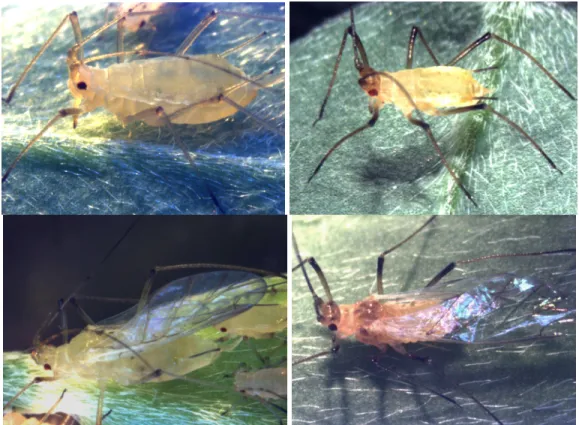
Figure 1. The female polyphenism (left) and male genetic polymorphism (right). In both cases, discrete alternative wingless (top) or winged (bottom) morphs are produced.
References
APPLEBAUM, S. W., B. RACCAH and R.LEISEROWITZ, 1975 Effect of juvenile hormone
and ß-ecdysone on wing determination in the aphid Myzus persicae. Journal of Insect Physiology 21: 1279-1281.
BLACKMAN, R. L., 1979 Stability and variation in aphid clonal lineages. Biol. J. Linnean
Soc. 11: 259-277.
BLACKMAN, R. L., and V. F. EASTOP, 1994 Aphids on the world's trees: An identification
and information guide. CAB International, Wallingford.
BLACKMAN, R. L., and V. F. EASTOP, 2000 Aphids on the world's crops: an identification
and information guide. John Wiley & Sons Ltd., Chichester.
BONNEMAISON, L., 1951 Contribution à l'étude des facteurs provoquant l'apparition des
formes ailées et sexuées chez les Aphidinae. Annls Epiphyt 2: 1-380.
BRAENDLE, C., M. C. CAILLAUD and D. L. STERN, 2005a Genetic mapping of aphicarus
-a sex-linked locus controlling -a wing polymorphism in the pe-a -aphid (Acyrthosiphon pisum). Heredity 94: 435-442.
BRAENDLE, C., I. FRIEBE, M. C. CAILLAUD and D. L. STERN, 2005b Genetic variation for
an aphid wing polyphenism is genetically linked to a naturally occurring wing polymorphism. Proc Biol Sci 272: 657-664.
BROOKS, G. T., and A. R. MCCAFFERY, 1990 The precocene antijuvenile hormones
(Allatotoxins): A case history in insect toxicology, pp. 33-43 in Chromatography
and Isolation of Insect Hormones and Pheromones, edited by A. R. MCCAFFERY
and I. D. WILSON. Plenum Press, New York.
CAILLAUD, C. M., M. BOUTIN, C. BRAENDLE and J. C. SIMON, 2002 A sex-linked locus
controls wing polymorphism in males of the pea aphid, Acyrthosiphon pisum (Harris). Heredity 89: 346-352.
CAMPBELL, A., and M. MACKAUER, 1977 Reproduction and population growth of the pea
aphid (Homoptera: Aphididae) under laboratory and field conditions. Canadian Entomologist 109: 277-284.
CARTIER, J. J., 1963 Les formes du puceron du pois dans le sud du Quebec. Canadian
Entomologist 95: 558-560.
CHRISTIANSEN-WENIGER, P., and J. HARDIE, 1998 Wing development in parasitized male
and female Sitobion fragariae. Physiological Entomology 23: 208-213.
CHRISTIANSEN-WENIGER, P., and J.HARDIE, 2000 The influence of parasitism on wing
development in male and female pea aphids. Journal of Insect Physiology 46: 861-867.
DEHN, M. V., 1963 Hemmung der Flügelbildung durch Farnesol bei der schwarzen
Bohnenlaus, Doralis fabae Scop. Naturwiss 17: 578-579.
DELISLE, J., C. CLOUTIER and J. N. MCNEIL, 1983 Precocene II-induced alate production
in isolate and crowded alate and apterous virginoparae of the aphid, Macrosiphum
euphorbiae. J Insect Physiol 29: 477-484.
DIXON, A. F. G., 1972 Fecundity of brachypterous and macropterous alatae in
Drepanosiphum dixoni (Callaphidae, Aphididae). Entomologia Experimentalis et
DIXON, A. F. G., and B. K. AGARWALA, 1999 Ladybird induced life history changes in
aphids. Proceedings of the Royal Society London-Biological Sciences 266: 1549-1553.
EASTOP, V. F., 1971 Keys for the identification of Acyrthosiphon. Bull. Brit. Mus.
(Natural History) Entomol. 26: 1-115.
EL-ZIADY, S., and J. S. KENNEDY, 1956 Beneficial effects of the common garden ant,
Lasius niger L., on the black bean aphid, Aphis fabae Scop. Proceedings of the
Royal Entomological Society London 31: 61-65.
ELLIOT, H. J., 1975 Corpus allatum and ovarian growth in a polymorphic paedogenetic
insect. Nature 257: 390-391.
GANASSI, S., G. SIGNA and L. MOLA, 2005 Development of the wing buds in Megoura
viciae: a morphological study. Bulletin of Insectology 58: 101-105.
GAO, N., and J. HARDIE, 1996 Pre- and post-natal effects of precocenes on aphid
morphogenesis and differential rescue. Archives of Insect Biochemistry and Physiology 32: 503-510.
GROETERS, F. R., 1989 Geographic and clonal variation in the milkweed-oleander aphid,
Aphis nerii (Homoptera: Aphididae), for winged morph production, life history,
and morphology in relation to host plant permanence. Evol. Ecol. 3: 327-341. HALES, D. F., 1976 Juvenile hormone and aphid polymorphism, pp. 105-115 in Phase
and Caste Determination in Insects, edited by M. LÜSCHER. Pergamon Press,
Oxford.
HALES, D. F., and T. E. MITTLER, 1981 Precocious metamorphosis of the aphid Myzus
persicae induced by the precocene analogue
6-methocy-7-ethoxy-2,2-dimethylchromene. Journal of Insect Physiology 27: 333-337.
HARDIE, J., 1980 Juvenile hormone mimics the photoperiodic apterization of the alate
gynopara of aphid, Aphis fabae. Nature 286: 602-604.
HARDIE, J., 1981 Juvenile hormone and photoperiodically controlled polymorphism in
Aphis fabae: postnatal effects on presumptive gynoparae. Journal of Insect
Physiology 27: 347-355.
HARDIE, J., 1986 Morphogenetic effects of precocenes on three aphid species. J. Insect
Physiol. 32: 813-818.
HARDIE, J., F. C. BAKER, G. C. JAMIESON, A. D. LEES and D. A. SCHOOLEY, 1985 The
identification of an aphid juvenile hormone, and its titre in relation to photoperiod. Physiol Entomol 10: 297-302.
HARDIE, J., N. GAO, T. TIMÁR, P. SEBÓK and K. HONDA, 1996 Precocene derivatives and
aphid morphogenesis. Archives of Insect Biochemistry and Physiology 32: 493-501.
HARDIE, J., K. HONDA, T. TIMÁR and L. VARJAS, 1995 Effects of 2,2-dimethylchromene
derivatives on wing determination and metamorphosis in the pea aphid,
Acyrthosiphon pisum. Archives of Insect Biochemistry and Physiology 30: 25-40.
HARDIE, J., and A. D. LEES, 1985 Endocrine control of polymorphism and polyphenism,
pp. 441-490 in Insect Physiology, Biochemistry and Pharmacology, edited by G. A. KERKUT and L. J. GILBERT. Pergamon Press, New York.
HAZELL, S. P., D. M. GWYNN, S. CECCARELLI and M. D. E. FELLOWES, 2005
Competition and dispersal in the pea aphid: clonal variation and correlations across traits. Ecological Entomology 30: 293-298.
HEIE, O. E., 1982 The Aphidoidea (Hemiptera) of Fennoscandia and Denmark. II. The
family Drepanosiphidae. Scandinavian Science Press Ltd., Klampenborg.
HEIKINHEIMO, O., 1987 Wing polymorphism in Symydobius oblongus (Von Heyden,
1837) and Myzocallis myricae (Kaltenbach, 1843), pp. 170-175 in Population
structure, genetics and taxonomy of aphids and thysanoptera, edited by J.
HOLMAN, J. PELIKAN, A. F. G. DIXON and L. WEISMANN. SPB Academic
Publishing, Smolenice.
HILLE RIS LAMBERS, D., 1947 Contributions to a monograph of the Aphididae of Europe
III. Temminckia 7: 179-319.
HILLE RIS LAMBERS, D., and R. VAN DEN BOSCH, 1964 On the genus Therioaphis Walker,
1870, with descriptions of new species (Homoptera, Aphididae). Zoologische Verhandlungen 68: 3-47.
HILLE RIS LAMBERS, L., 1966 Polymorphism in the Aphididae. Annual Review of
Entomology 11: 47-78.
JOHNSON, B., 1958a Embryonic cuticle in aphids. Australian Journal of Science 21: 146.
JOHNSON, B., 1958b Influence of parasitization on form determination in aphids. Nature
181: 205-206.
JOHNSON, B., 1959 Effect of parasitization by Aphidius platensis Bréthes on the
developmental physiology of its host Aphis craccivora Koch. Entomologia Experimentalis et Applicata 2: 82-99.
JOHNSON, B., 1965 Wing polymorphism in aphids II. Interaction between aphids.
Entomologia Experimentalis et Applicata 8: 49-64.
JOHNSON, B., and P. R. BIRKS, 1960 Studies on wing polymorphism in aphids I. The
developmental process involved in the production of the different forms. Entomologia Experimentalis et Applicata 3: 327-339.
KALMUS, H., 1945 Correlations between flight and vision, and particularly between
wings and ocelli, in insects. Proc. Roy. Entomol. Soc. London A20: 84-96. KAMBHAMPATI,S., M. MACKAUER and K. K. NAIR, 1984 Precocious metamorphosis and
wing formation in the pea aphid, Acyrthosiphon pisum, induced by precocene analogue 7-ethoxy-6methoxy-2,2-dimethylchromene. Arch. insect Biochem. Physiol 1: 147-115?
KAWADA, K., 1987 Polymorphism and morph determination, pp. 255-266 in Aphids,
Their Biology, Natural Enemies and Control, edited by A. K. MINKS and P.
HARREWIJN. Elsevier, Amsterdam.
KENNEDY, J. S., and H. L. G. STROYAN, 1959 Biology of aphids. Annual Review of
Entomology 4: 139-160.
KENTEN, J., 1955 The effect of photoperiod and temperature on reproduction in
Acyrthosiphon pisum (Harris) and on the forms produced. Bulletin of
Entomological Research 46: 599-624.
KITZMILLER, J. B., 1951 The time interval between determination and differentiation of
wings, ocelli, and wing muscles in the aphid Macrosiphum sanborni (Gillette). American Naturalist 84: 23-50.
KLEINJAN, J. E., and T. E. MITTLER, 1975 A chemical influence of ants on wing
development in aphids. Entomologia experimentalis et applicata 18: 384-388. KOHNO, M., and I. TAKAOKA, 1977 Effects of synthetic juvenile hormones through oral
KRING, J. B., 1977 Structure of the eyes of the pea aphid, Acyrthosiphon pisum. Annals
of the Entomological Society of America 70: 855-860.
KUNERT, G., S. OTTO, S. R. ROSE, J. GERSHENZON and W. W. WEISSER, 2005 Alarm
pheromone mediates production of winged dispersal morphs in aphids. Ecology Letters 8: 596-603.
KUNERT, G., and W. W. WEISSER, 2003 The interplay between density- and trait-mediate
effects in predator-prey interactions: a case study in aphid wing polymorphism. Oecologia 135: 304-312.
KUNERT, G., and W. W. WEISSER, 2005 The importance of antennae for pea aphid wing
induction in the presence of natural enemies. Bull Entomol Res 95: 125-131. KUNKEL, H., and W. KLOFT, 1974 Polymorphismus bei Blattläusen, pp. 152-201 in
Sozialpolymorphismus bei Insekten, edited by G. H. SCHMIDT. Wissenschaftliche
Verlagsgesellschaft, Stuttgart.
KVENBERG, J. E., and P. A. JONES, 1974 Comparison of alate offspring produced by two
biotypes of the greenbug. Environmental Entomology 3: 407-408.
LAMB, K. P., 1956 Physiological relations between aphids and their host plants, pp.
Cambridge University, Cambridge, England.
LAMB, R. J., and P. A. MACKAY, 1987 Acyrthosiphon kondoi influences alata production
by the pea aphid A. pisum. Entomologia Experimentalis et Applicata 45: 195-204. LECKSTEIN, P. M., 1976 The role of the corpus allatum in prenatal wing determination in
Megoura viciae. Journal of Insect Physiology 22: 1117-1121.
LECKSTEIN, P. M., and M. LLEWELLYN, 1975 Corpus allatum activity and wing
determination in Megoura viciae. Nature 258: 714-715.
LEES, A. D., 1961 Clonal polymorphism in aphids, pp. 68-79 in Insect Polymorphism,
edited by J. S. KENNEDY. Royal Entomological Society, London.
LEES, A. D., 1966 The control of polymorphism in aphids. Advances in Insect
Physiology 3: 207-277.
LEES, A. D., 1967 The production of the apterous and alate forms in the aphid Megoura
viciae Buckton, with special reference to the role of crowding. Journal of Insect
Physiology 13: 289-318.
LEES, A. D., 1977 Action of juvenile hormone mimics on the regulation of larval-adult
and alary polymorphisms in aphids. Nature 267: 46-48.
LEONARDO, T. E., and E. B. MONDOR, 2006 Symbiont modifies host life-history traits
that affect gene flow. Proceedings of the Royal Society London B in press. LIU, S.-S., 1994 Production of alatae in response to low temperature in aphids: a trait of
seasonal adaptation, pp. 245-261 in Insect Life-Cycle Polymorphism: Theory,
Evolution, and Ecological Consequences for Seasonality and Diapause Control,
edited by H. V. DANKS. Kluwer Academic Publishers, Dordrecht.
LOWE, H. J. B., and L. R. TAYLOR, 1964 Population parameters, wing production and
behaviour in red and green Acyrthosiphon pisum (Harris) (Homoptera: Aphididae). Entomologia Experimentalis et Applicata 7: 287-295.
MACGILLIVRAY, M. E., and G. B. ANDERSON, 1958 Production of apterous and alate
progeny by apterous and alate viviparae of Macrosiphum solanifolii (Ashm.) (Homoptera: Aphididae). Canadian Entomologist 90: 241-245.
MACKAUER, M., K. K. NAIR and G. C. UNNITHAN, 1979 Effect of precocene II on alate
production in the pea aphid, Acyrthosiphon pisum. Canadian Journal of Zoology 57: 856-859.
MACKAY, P. A., and R. J. LAMB, 1979 Migratory tendency in aging populations of the
pea aphid, Acyrthosiphon pisum. Oecologia 39: 301-308.
MACKAY, P. A., D. J. REELEDER and R. J. LAMB, 1983 Sexual morph production by
apterous and alate viviparous Acyrthosiphon pisum (Harris) (Homoptera: Aphididae). Canadian Journal of Zoology 61: 952-957.
MACKAY, P. A., and W. G. WELLINGTON, 1975 A comparison of the reproductive
patterns of apterous and alate virginoparous Acyrthosiphon pisum (Homoptera: Aphididae). Canadian Entomologist 107: 1161-1166.
MACKAY, P. A., and W. G. WELLINGTON, 1977 Maternal age as a source of variation in
the ability of an aphid to produce dispersing forms. Res. Popul. Ecol. 18: 195-209.
MARKKULA, M., 1963 Studies on the pea aphid, Acyrthosiphon pisum Harris (Hom.,
Aphididae), with special reference to the differences in the biology of the green and red forms. Annales Agriculturae Fenniae 2: 1-30.
MEIER, W., 1958 Beiträge zur Kenntnis der auf Papilionaceen lebenden
Acyrthosiphon-Arten (Hemipt. Aphid). Mitteilungen der Schweizerischen Entomologischen Gesellschaft 31: 291-312.
MITTLER, T. E., and O. R. W. SUTHERLAND, 1969 Dietary influences on aphid
polymorphism. Entomologia Experimentalis et Applicata 12: 703-713.
MIYAZAKI, M., 1987 Forms and morphs of aphids, pp. 163-195 in Aphids, Their Biology,
Natural Enemies and Control, edited by A. K. MINKS and P. HARREWIJN.
Elsevier, Amsterdam.
MORAN, N. A., 1992. The evolutionary maintenance of alternative phenotypes. The
American Naturalist 139: 971-89.
MÜLLER, C. B., I. S. WILLIAMS and J. HARDIE, 2001 The role of nutrition, crowding and
interspecific interactions in the development of winged aphids. Ecological Entomology 26: 330-340.
MÜLLER, F. P., 1962 Biotypen und Unterarten der "Erbsenlaus" Acyrthosiphon pisum
(Harris). Zeitschrift für Pflanzenkrankheiten und Pflanzenschutz 69: 129-136. MÜLLER, F. P., 1969 Bastardierungsversuche zur Feststellung von
Isolierungsmechanismen zwischen nahe verwandten Formen in der Gattung
Myzus Passerini (Homoptera: Aphididae). Biologisches Zentralblatt 88: 147-164.
NIJHOUT, H. F., 1999 Control mechanisms of polyphenic development. Bioscience 49: 181-92.
NODA, I., 1960 The emergence of winged viviparous female in aphid. - VI. Difference in
rate of development between the winged and unwinged forms. Japanese Journal of Applied Entomology and Zoology 10: 97-102.
NUNES, M. V., and J. HARDIE, 1996 Differential photoperiodic responses in genetically
identical winged and wingless pea aphid, Acyrthosiphon pisum, and the effect of day length on wing development. Physiological Entomology 21: 339-343. OHTA, T., and W. S. BOWERS, 1977 Synthesis of insect antijuvenile hormones. Chem
RUP, B. J., and S. K. SOHAL, 1989 Morphogenetic effects of precocene II on Lipaphis
erysimi (Homoptera, Aphididae). Acta Entomol Bohemoslov 86: 172-178.
SCHAEFERS, G. A., and F. D. JUDGE, 1971 Effects of temperature, photoperiod, and host
plant on alary polymorphism in the aphid, Chaetosiphon fragaefolii. Journal of Insect Physiology 17: 365-379.
SHAW, M. J. P., 1970a Effect of population density on alienocolae of Aphis fabae Scop. I.
The effect of crowding on the production of alatae in the laboratory. Annals of Applied Biology 65: 191-196.
SHAW, M. J. P., 1970b Effect of population density on alienocolae of Aphis fabae Scop.
III. The effect of isolation on the development of form and behaviour of alatae in a laboratory clone. Annals of Applied Biology 65: 205-212.
SHULL, A. F., 1938 Time of determination and time of differentiation of aphid wings.
American Naturalist 72: 170-179.
SLOGGETT, J. J., and W. W. WEISSER, 2002 Parasitoids induce production of the dispersal
morph of the pea aphid, Acyrthosiphon pisum. Oikos 98: 323-333.
SMITH, M. A. H., and P. A. MACKAY, 1989 Genetic variation in male alary dimorphism
in populations of pea aphid, Acyrthosiphon pisum. Entomol. Exp. Appl. 51: 125-132.
SRIVASTAVA, U. S., and N. CHHIBBER, 1980 Effect of a juvenoid on wing development
and differentiation in an aphid Aphis nerii B De F. Indian Journal of Experimental Biology 18: 814-817.
SRIVASTAVA, U. S., and A. K. JAISWAL, 1989 Precocene-II-induced effects in the aphid
Aphis craccivora Koch. Insect Science and Its Application 10: 471-475.
SUTHERLAND, O. R. W., 1969a The role of crowding in the production of winged forms
by two strains of the pea aphid, Acyrthosiphon pisum. Journal of Insect Physiology 15: 1385-1410.
SUTHERLAND, O. R. W., 1969b The role of the host plant in the production of winged
forms by two strains of the pea aphid, Acyrthosiphon pisum. Journal of Insect Physiology 15: 2179-2201.
SUTHERLAND, O. R. W., 1970 An intrinsic factor influencing the alate production by two
strains of the pea aphid, Acyrthosiphon pisum. Journal of Insect Physiology 16: 1349-1354.
TSUJI, H., and K. KAWADA, 1987a Development and degeneration of wing buds and
indirect flight muscles in the pea aphid (Acyrtosiphon pisum (Harris)). Japanese Journal of Applied Entomology and Zoology 31: 247-252.
TSUJI, H., and K. KAWADA, 1987b Effects of starvation on life span and embryo
development of four morphs of pea aphid (Acyrthosiphon pisum (Harris)). Japanese Journal of Applied Entomology and Zoology 31: 36-40.
TSUMUKI, H., H. NAGATSUKA, K. KAWADA and K. KANEHISA, 1990 Comparison of
nutrient reservation in apterous and alate pea aphids, Acyrthosiphon pisum (Harris) .1. Developmental time and sugar content. Applied Entomology and Zoology 25: 215-221.
VERESCHAGINA, A. B., and G. C. SHAPOSHNIKOV, 1998 Influence of crowding and
host-plant on development of winged and apterous aphids, pp. in Aphids in natural and
managed ecosystems, edited by J. M. NIETO NAFRIO and A. F. G. DIXON.
WALOFF, N., 1983 Absence of wing polymorphism in the arboreal, phytophagous species
of some taxa of temperate Hemiptera - A hypothesis. Ecological Entomology 8: 229-232.
WEISSER, W. W., and C. BRAENDLE, 2001 Body colour and genetic variation in winged
morph production in the pea aphid. Entomologia Experimentalis et Applicata 99: 217-223.
WEISSER, W. W., C. BRAENDLE and N. MINORETTI, 1999 Predator-induced
morphological shift in the pea aphid. Proceedings of Royal Society London B 266: 1175-1181.
WHITE, D. F., 1965 Changes in size of corpus allatum of a polymorphic insect. Nature
208: 807.
WHITE, D. F., 1968a Cabbage Aphid - Effect of Isolation on Form and on Endocrine
Activity. Science 159: 218-219.
WHITE, D. F., 1968b Post-natal treatment of the cabbage aphid with a synthetic juvenile
hormone. Journal of Insect Physiology 14: 901-912.
WHITE, D. F., 1971 Corpus allatum activity associated with development of wingbuds in
cabbage aphid embryos and larvae. Journal of Insect Physiology 17: 761-773. WHITE, D. F., and K. P. LAMB, 1968 Effect of a synthetic juvenile hormone on adult
cabbage aphids and their progeny. Journal of Insect Physiology 14: 395-402. WHITE, W. S., 1946 The environmental conditions affecting the genetic mechanism of