ARCH!
CS
AAH U,The DarkLight Experiment:
Searching for the Dark Photon
by
Dustin R. Katzin
Submitted to the Department of Physics
in partial fulfillment of the requirements for the degree of
Bachelor of Science in Physics
at the
MASSACHUSETTS INSTITUTE OF TECHNOLOGY
June 2012
@
Massachusetts Institute of Technology 2012. All rights reserved.
A .
A uthor ...
Department of Physics
May 11, 2012
A-nCertified by...
I
Jesse Thaler
Assistant Professor of Physics
Thesis Supervisor
Accepted by ...
Nergis Mavalvala
Professor, Senior Thesis Coordinator, Department of Physics
The DarkLight Experiment:
Searching for the Dark Photon
by
Dustin R. Katzin
Submitted to the Department of Physics on May 11, 2012, in partial fulfillment of the
requirements for the degree of Bachelor of Science in Physics
Abstract
We describe a setup to search for the existence of a massive gauge boson A', the "dark photon," mediating dark matter interactions with coupling strength a'. In certain models, the A' decays promptly but invisibly and might be discoverable in high luminosity collider experiments. Following a proposed setup by Wojtsekhowski et al. to use the VEPP-3 electron-positron storage ring at the Budker Institute for Nuclear Physics, we study whether an e+
+ e-
- A'+ -y signal could be seen over the quantum electrodynamic background. The proposed VEPP-3 setup is sensitive to an A' within the mass range mA = 5-20 MeV. Out of the two backgrounds, e++e- - 3-Yand e+
+
e- - e++
e-+
y, we find that the former process provides the dominantbackground for the A' signal. While positron bremsstrahlung events can be detected and suppressed in Wojtsekhowski's apparatus, the 3,y cross-section has a large cross
section in this range, "faking" an A'. We use Monte Carlo numerical integration techniques to calculate the cross sections and obtain reach plots, determining which values of mA' and a' could be discovered at 5o- confidence. This background study can be used to improve the VEPP-3 proposal, and provides a valuable comparison study with the MIT-led DarkLight proposal to search for a dark photon in the same mass range.
Thesis Supervisor: Jesse Thaler Title: Assistant Professor of Physics
Acknowledgments
I am grateful to my thesis advisor Professor Jesse Thaler for his valuable guidance,
high expectations, and strong support throughout the research process. I would also like to thank Yonatan Kahn for his feedback and advice.
Contents
1 Background and Motivation
2 Experimental Setup
2.1 Signal and Background Processes . . . . 2.2 Detector Constraints . . . .
3 Monte Carlo Techniques for Phase-Space Integration
3.1 Monte Carlo: Basic Test Cases . . . .
4 Computation of the Matrix Elements
4.1 Signal Cross Section & Kinematics . . . .
4.2 Background Cross Sections . . . . 4.3 R esults . . . .
5 Experimental Reach
6 Conclusion
A Integration of Lorentz-Invariant 3-Body Phase Space
B Calculation of the e+ + e- --+ 7 + A' Matrix Element
9 13 13 16 21 24 27 27 30 32 37 41 43 47
Chapter 1
Background and Motivation
Astrophysical measurements have revealed an anomalous matter distribution through-out the universe, which cannot be explained by the gravitational interactions of visible matter. Measurements from galactic rotational curves to cosmic microwave back-ground observation
[1]
indicate the existence of dark matter, a mysterious entity that interacts with gravity but not electromagnetism. Because gravity is the weakest known fundamental force, dark matter is difficult to test with terrestrial experiments, and precision measurements are needed to determine whether dark matter has non-gravitational interactions with ordinary matter. The eventual goal is to discern the nature of dark matter, and whether or not we can describe it within current particle paradigms, such as the neutralinos predicted by supersymmetry [2].Except for the absence of dark matter, the Standard Model, encompassing the physics of quarks, leptons, the Higgs boson, and the gauge bosons, is a successful physical theory of fundamental interactions. It has passed many experimental tests. For example, the quantum electrodynamic fine-structure constant has been measured precisely from numerous experiments, including the Lamb shift, hyperfine splitting, quantum Hall effect, and AC Josephson effect
[3].
Because of this, QED provides a tool for accurately probing the structure of elementary particles. Surprisingly, we will show in this thesis that precision tests of QED may be able to probe aspects of dark matter.force." [4, 5]. A new light force-carrying boson, called an A' boson, or dark photon, would mediate the dark force. One model consists of a g?/A'IV interaction, quantum electrodynamics with a massive photon, with coupling constant g to be determined
2
experimentally. Throughout this thesis, we refer to a' = g as the coupling constant
47r
of the theory. This interaction allows the process e+ + e- -+ /A' to occur. Recent astrophysical anomalies give tantalizing hints towards this proposal, such as a high fraction of positrons among cosmic ray particles, found by the PAMELA satellite [6]. Based on data collected between July 2006 and February 2008, these results showed a significant increase in positron fraction with energy [6]. This is inconsistent with our current knowledge of cosmic rays; an additional mechanism for positron production is necessary. Dark matter pair annihilation is the proposed conversion of a dark matter particle and an anti-dark matter particle into two dark photons, which can then decay to electron-positron pairs via A' - e+ e-. This is a candidate for the additional positron source. In addition, the Standard Model prediction for the anomalous g - 2 of the muon differs from observation by 3.6- [7]. An additional gauge boson with mass between 10-100 MeV may resolve this discrepancy.
Within the same dark force paradigm, the A' might decay invisibly, either to dark matter itself or to neutrinos [8]. Wojtsekhowski et al. proposed [9] an invisible A' search, in which the A' is produced but its decay products are not detected, using the VEPP-3 electron-positron storage ring situated at the Budker Institute for Nuclear Physics. In their proposal, a 500 MeV beam of positrons is incident on an electron target, and a segmented photometer may detect one or two outgoing photons. If only one is detected, it may have originated from the process e+ e- -- y A'. Wojtsekhowski et al. compare this signal with e+ e- --+ 2-y and positron bremsstrahlung e+ e --e+ e- y backgrounds. We will explain why the 2-y process is not a background for the A' signal process, and present a careful treatment of an e+ e --+ 3-Y background. If the e+ e- __ e+ e- y background is suppressed, then e+ e- -+ 3-y is the dominant
background.
In this thesis, we study the production of dark photons by e+ e- - -y A', and
plot [10] shows the region in the (m' , a') plane where a dark photon could be dis-covered above the QED background. A narrow resonance in the reconstructed A' invariant mass spectrum would support the existence of a dark photon which inter-acts with known particles by our proposed interaction. As we will show, even though the A' cannot be detected directly, the photon kinematics is sufficient to determine the A' mass.
By studying the VEPP-3 experiment, we can gain valuable information for an
MIT-led proposal [11] called DarkLight (for Detecting A Resonance Kinematically with eLectrons Incident on a Gaseous Hydrogen Target). The DarkLight appara-tus would be situated at Jefferson Lab (JLab), and would be included in the Free Electron Laser (FEL) in 2014-2015. Test data is being collected in 2012. The Dark-Light apparatus will collide the JLab FEL 100 MeV electron beam with a stationary hydrogen target, and search for a narrow resonance in the reconstructed e+ e- invari-ant mass spectrum [11]. This resonance would be the signature of the dark photon proposed for cosmic-ray positron production: dark-matter pair-annihilates to the A', which then decays to an electron-positron pair. Studies are ongoing as to whether DarkLight could be sensitive to an invisible A' decay, since DarkLight is not currently optimized for such a search. DarkLight, though it uses Rutherford scattering rather than e+ e- annihilation, could in principle control QED backgrounds by detecting all final-state particles. This work motivates the incorporation of invisible A' search into the DarkLight apparatus.
The remainder of this thesis is organized as follows. In Chapter 2, we discuss the experimental proposal
[9]
by Wojtsekhowski et al. In Chapter 3, we present our MonteCarlo phase-space integration technique, and give a few easily verifiable test cases. In Chapter 4, we compute the matrix elements of the signal and background processes. The signal matrix element is a straightforward calculation given in Appendix B. The background matrix elements are significantly more difficult to calculate, but we were able to obtain numerical matrix elements using MadGraph 5 [12], as discussed in Chapter 5. In Chapter 6, we present the reach of the VEPP-3 proposal and cross section histograms for each background process. We conclude in Chapter 7 by
Chapter 2
Experimental Setup
2.1
Signal and Background Processes
We perform an analysis of the experimental setup proposed by Nikolenko, Rachek, and Wojtsekhowski in [9], determining the 5- confidence potential discovery range for the existence of the A'. This setup is capable of detecting the A' in the mass range 5 - 20 MeV. The experiment proposed in [9] was designed for the VEPP-3 electron-positron storage ring at the Budker Institute for Nuclear Physics.
Wojtsekhowski et al. proposed an experimental search shown in Figure 2-1
[9]
over the dominant pair-annihilation background. The apparatus contains a segmented
photon detector between 1.50 and 4.5', which is sensitive to the signal process e+ e- _
1 A'. Wojtsekhowski's setup includes partial measures for separating the signal from the QED background. If both detectors register a photon, then the process is e+ e-
-2+ X, where X denotes zero or more additional outgoing particles, and the event is thrown out. This eliminates the large e+ e- --* 2i background, which is the dominant
QED
process. If only one detector registers, then the event may have either two or three outgoing particles. If there are two outgoing particles, the photon originated from the signal process. In addition, the setup is surrounded by a positron veto, which1
detects outgoing positrons with a failure rate [9]. If the veto detects a positron,
50
then the event is thrown out. The signal process cannot be completely separated from the background by the VEPP-3 apparatus.
I I
Figure 2-1: The interior of the setup proposed by Wojtsekhowski. The photometer
spans the angular range 1.50 to 4.5'. A positron veto is downstream of the D2 detector.
The leading order background processes are (BG1) e+ e- -y y y and
(BG2) e+ e- _y e+ e-.
Feynman diagrams for the signal and background processes are displayed in Figures 2-2, 2-3. We also give the lab frame kinematics in Figures 2-4, 2-5, and 2-6.
We must include both backgrounds in an analysis of Wojtsekhowski's setup. If just one photon is detected, it is possible that there are two other photons in the final state with a nonzero composite invariant mass, faking an A'. It is impossible to distinguish a single event of this type (BG1) from a signal event without additional photon detectors. In principle, if the setup contained an ideal positron veto, all (BG2) processes could be identified and eliminated. The positron veto at VEPP-3 suppresses
1
the (BG2) background, but does not eliminate it entirely due to the - failure rate.
50
The occurrences of a given background event are Poisson distributed with fluctu-1
ations - , where
N
is the number of events. For each event, the detector eitheraccepts it as a possible signal or throws it out. If the number of possible signals exceeds the expectation value of the Poisson distribution by more than 5a- = 5v
N,
then we say with higher than 5a- confidence that the A' exists. This information is visualized in a reach plot, showing the smallest 5co-detectable coupling constant for a9Y A' + A'
Figure 2-2: Feynman diagrams for the signal process (S) e+ e- -+ ~y A'.
Figure 2-3: Feynman diagrams for the background processes (BG1) e+ e- -+ 3'y
and (BG2) e+ e-_ e+ e- y, respectively. For clarity, we do not show the crossed diagrams.
given A' mass.
It is useful to contrast this signal and background with that of the DarkLight apparatus. DarkLight would produce A' as a product of Rutherford scattering, with signal e p -+ e p A' and dominant background for invisible A' decays e p --+ e p -y 7y.
For DarkLight, both the signal and background would have more particles in the final state than the analogous processes for Wojtsekhowski's setup, so the cross sections are necessarily smaller. For each additional final-state particle, there is an extra phase space normalization factor that decreases the total cross section. However, DarkLight would have a larger signal-to-background cross section ratio, since it could detect and identify all final-state particles, improving the signal separation. The reach of both setups should be comparable.
* ~ 43Lab
e*
e-A'
Before After
Figure 2-4: Kinematics for the signal process, e+ e -- y A', in the lab frame.
V
Before After
Figure 2-5: Kinematics for the background process e+ e- -- 3 in the lab frame.
2.2
Detector Constraints
We enumerate the particles from 1 to 5, such that particle 3 is a photon in both processes. The invariant mass of particles 4 and 5, M4 5, is nonzero, and acts as a
fictitious A'. If a real A' is observed, a signal A' cross section from the (S) process must occur above the fictitious A' background. [9] proposed that the (BG2) process alone constitutes the dominant background for the signal. We will see that this background is manageable for invariant masses in the suspected range of the A',
MAI= 5 - 20 MeV. However, since the (BG2) process is suppressed by the positron veto, the (BG1) process is much larger, providing the dominant background for the A' in its mass range. For the dominant background of the signal process over the full invariant mass range, we must overlay (BG1) and (BG2), obtaining a composite background.
Let EsLab and 03Lab denote the lab frame energy and scattering angle of one of the
photons in the final state of the scattering process. The photons are indistinguishable, so it does not matter which we choose. But we must account for multiple counting by
-0
--
e
e
e -
V
Before After
Figure 2-6: Kinematics for the background process e+ e- _, e+ e- - in the lab frame.
1
restricting to a fraction of phase space. Following [9], we restrict to photon energies
E3Lab between 50 and 400 MeV, and scattering angle 03Lab between 1.50 and 4.5', the
range of the detector, in both processes. We take the beam energy to be Ebeam = 500 MeV, and the instantaneous luminosity to be 1032 cm-2s-1 = 10' pbarn s-'. Over
6 months at 75% efficiency, the integrated luminosity is 1166.4 pbarn. For (BG1),
there is a soft photon singularity in the limit that one of the photon energies gets small. We regulate this singularity by imposing a lower bound of 1 MeV on E4Lab and
E5Lab, the other two photon energies. We also ensure that only one of the photons is
observed in the given angular range; 04Lab and 6
5Lab must both be outside this range,
so that exactly one photon impinges on the detector. For (BG2), we restrict to E3Lab
between 50 and 400 MeV, and scattering angles 63Lab, 0
4Lab between 1.5' and 4.5',
so that the photon and positron are both detected. Here the label 3 refers to the photon, 4 to the positron, and 5 to the electron.
In both background processes, we detect a photon and treat the other two out-going particles as a composite particle. The constraints we have imposed on the background mimic the constraints on the signal process, treating the background composite particle as we treat the A' in the signal. We do this because, for the signal process, the photon is the only detectable outgoing particle. Since e+ + e- -> YA' is a 2 -* 2 scattering, the A' momentum qA can be entirely reconstructed from the measured momentum q, of the photon.
In [9], the following detector resolutions are given: 5% for the energy of a
E
photon, and -o = 0.1' for the angle off of the scattering axis. For the reach plots, we will see that it suffices to compute the resolution of M45, the invariant composite mass
of two outgoing particles that are not photons, for the 2 -> 3 background processes.
We compute m45 in terms of the center-of-mass energy EcM, which is easily related to Ebeamn by a simple Lorentz transformation: see the calculation in Chapter 4 for details. There, we show that
EM = V2m(Bbeam+m), (2.1)
where m is the electron mass. For pi and P2 the incoming momenta, and pa the momentum of an outgoing photon, we have in the center-of-mass frame (with E3 now the energy of the outgoing photon in the CM frame):
= (p1 + P2 - =3) (EcM - E3) 2
--= Ec2 - 2E3EcM. (2.2)
So mn45 =VEbM
SO M5 =
- 2I
-I-E
1(#)EstabEcM,
3Lb I2mwhere - BCM = (1 -#2)-i
Usingstandard error-propagation techniques described in
[13],
we find the resolution onM4 5 to be
OVE ' - 27(1 - O)E3L abEcM
M/) Urn -abBC 0.05E3Lab
4 5 (av/B8 -(E3Lab
= 0.05
ECME3Lab7(1-3)
- 2y(1 - 13)E 3ECM
= 0.05 EcME3 (2.3)
m 4 5
In terms of EcM and m 45 alone, we have
_E2 -m2
om45 = 0.05 x CM 45 (2.4)
2Mn45
Since m45 is a function of E3, independent of 03, the angular resolution 0 does not affect the mass resolution o-r4 5. The mass resolution is plotted in Figure 2-7.
7 6 5 4-b 3 2 0 -1 0 5 10 15 20 m45[MeV]
Figure 2-7: Plot of the mass resolution o-m45 as a function of the composite invariant mass m45.
Chapter 3
Monte Carlo Techniques for
Phase-Space Integration
The differential cross section of a scattering process p1 + P2 - p3 + - -- + pn is given
by eq. (6.38) in [14]. S do- = |M42 (27r )46(4) (P + P2 - P3 --- pn) 4 /(p1 -p2) 2 - (mim2)2 n 3 -x 1(3.1) j=3 2 Vp + mj 27r3
where S is the symmetry factor due to identical particles in the final state, and M is the matrix element. We obtain the total cross sections for the signal and background processes by calculating the matrix element and then performing the phase space integration, with the lab cuts imposed by additional Heaviside theta factors included in the differential cross section.
The matrix element for the signal process was computed analytically. However, for the 2 -* 3 background processes, we computed matrix elements numerically
us-ing MadGraph 5 [12]. MadGraph, developed by the University of Illinois: Urbana-Champaign, is Fortran-based software which can numerically generate a matrix el-ement, given all of the kinematic information for a scattering event. It is typically used for processes involving Standard Model particles, such as the two background
processes. MadGraph assumes the high-energy limit, eliminating the electron mass, but we will later discuss a work-around to put this mass back in the calculation.
In general, the 2 -+ 3 phase space integrals are too difficult to do by hand, so
we evaluated them numerically by the Monte Carlo algorithm [15]. Monte Carlo integration takes as input a weight function w(xI, ... , XNI), where Nx is the number of parameters, and returns the approximate integral of w over the rectangle [ai, b1] x
- x [aNx, bN]. From the definition of the average value (w),
bI bNx Nx
all aj,\ Jl, .. xx r~j- w) 32
ai 1 Nx (1~
The Monte Carlo technique is to randomly generate events, sets of values for the xj, and evaluate w on each set to obtain a sequence of values wi, i = 1, -- -,
K,
whereK
is the number of events. Then we simply have(w = Wi, (3.3)
i=1
and by comparison,
Ib1 bNx N. Nr
--- dIi---dxNx w(1 , xNx)=F ((bj-aj)
Ewi.
(3.4)ai ajoj 1 =
To obtain reach plots, we need to integrate the differential cross section over Lorentz-invariant phase-space. We will specialize this general Monte Carlo integration pre-scription to this task. First, we give an analytic tool for unifying the phase space integration for both background processes.
In each process, all of the momenta are determined by a small set of center-of-mass parameters. For the signal process, we use the scattering angle OcM, defined as the angle 73 makes with J1 in the CM frame. For the 2 -+ 3 processes, we used a
cascaded 2 - 2 scheme, for which pi + P2 -- P3 + pQ, and then pQ -- p4 + P5. PQ is a composite state with an undetermined invariant mass, which we integrate over. We think of PI + P2 = pcM as a decaying composite rest particle. The full analysis is
contained in Appendix A, and we give the result here: = )2 d(ECM dQ2 cI +c4 +1-2c2c -2c2 -2c2 (27)(327r2) 2 (m2 p 2 -M x (C ) + (C 4+1 -2 (C -C3) -2 ( 2) -2 C3) cq)Y cq) cq cq) cq) cq) x dQ1qdQ2 3, where
Q
is theQ
cq =Ecm, cifictitious mass of the outgoing composite of particles 4 and 5, and
mni
,1 i = 1, 2,13.
The main advantage to using cascaded 2 -> 2 for the background processes is that all 2 -> 3 phase space integrals may be treated identically: just set up the integrand
as a product of 2 -- 2 phase space integrals, and use cq, 01q,
#q,
023, and
#
23 asthe five center-of-mass parameters. Note that the Jacobian between solid angles is 1, since the change-of-variables matrix is in SO(3). So we can use any two independent solid angles. It is most convenient to use the solid angles for the directions of p3 and P4.
Once the N independent center-of-mass parameters have been chosen, we ran-domly generate a table of sets of values for these parameters, and evaluate the dif-ferential cross section at each value. Each center-of-mass parameter xj is uniformly generated over an interval [aj, by], with length 1j = by - a3,
j
1,--- Nx. DenoteNX
the parameter volume by V,
fl
ij. Let do- denote these values, indexed byj=1
i 1,--- ,N, with M the total number of events. Then we define the total cross section o- and uncertainty Au by
V M - = doi), i=1 (3.6) (3.7)
J
db3 (3.5)We generate histograms of the differential cross section over any function f(xi, --- , zNx of the CM parameters over an interval
[fmin,
fmax], by partitioning this interval into bins Ik = [fk-1, fk], k 1,- - , Nbins. Here NbiS is the number of bins, and fo = fmin,fNbins =
fmax-Define dOik to be do-i if the set of center-of-mass parameters, {x}, that yielded
the differential cross section dai satisfies f(xi, -- -, zNx ) E Ik, and set d7ik to be 0
otherwise. We give dor as a histogram over the bin partition {Ik}, by setting
df dor V N (Id ) = f
(S
doik), (3.8)df
NV(fk -- _1) i=1A
df(k) =Vxdoik
-(Ik)
. (3.9) df N([fk - fk_1) = (v dWe check that if we integrate over
f,
we get back the total cross section:fmax Nbins df = d (Ik) -
(f
- f-1) mn k=1 df Nbins K Nx -~5(do-ik)(f1l j) k=1 i=1 j=1 Ar Nx = (( do-i (H 1j ) i=1 j=1 = o-. (3.10)Note that since all of the do- values are nonzero for exactly one value of k, we have
Nbins
the relation E dci = doi. k=1
3.1
Monte Carlo: Basic Test Cases
To see that the method works, we begin with the simplest possible weight function, w(O) = 1. Here, the parameter 0 is sampled uniformly from the interval [0, 27r]. Upon applying the Monte Carlo method, we find the total cross section o- = 6.283 ±
1.0 0.8 0.6 0.4 0.2-0.0 J 0 1 2 3 4 5 6 0
Figure 3-1: Histogram over f(0) = 0 for the trivial weight w(O) - 1. The blue curve
is the differential cross section d, and the pink shaded region is the uncertainty. df
(1.2
x 10-12), as expected. In Figure 3-1, we present a histogram over the function f(0) = 0, with K = 10000 events and Nbin, = 25 bins. For every histogram inthis paper, the blue curve is df, and the pink shaded region encompasses the region df
do- do- do-
do--- Adf , + We expect the uncertainty to vary with the number of
df df df dfI
events K as O(N-1). That is, for K = 10000, the uncertainty should be on the
order of 10-2. We see from the figure that this is the case, as the uncertainty is about
0.05.
We performed a similar calculation with the weight function w(0) = sin 0, with 0 sampled from [0, r]. The total cross section should give us
j
sin OdO = 2. The MonteCarlo result for
AN
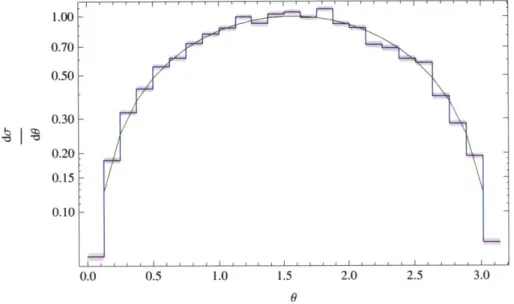
= 10000 is o- = 1.999 ± 0.966743. With Nbi, = 25, we obtainthe histogram in Figure 3-2. This histogram clearly traces out sin 0 for 0 E [0, 7r], as expected.
1.00- 0.70- 0.50- 0.30-0.20 -0.15 - 0.10-0.0 0.5 1.0 1.5 2.0 2.5 3.0 0
Figure 3-2: Histogram over f(0) = 0 for the weight w(6) = sin 0. The green curve is a plot of sin 0 for comparison.
Chapter 4
Computation of the Matrix
Elements
4.1
Signal Cross Section & Kinematics
The signal cross section is computed analytically in Appendix B. The matrix element is |M2 - e 4
[
4 I _ 4(p_ -q,)2 II IV1
2(p_- gy)(p+ -y) (+ 'qy) where I = 8[tu - m2(2s + 5t + 3u) + 3m4], II = 8[-M 2s + m2(M 2 - s) + 2m 4] IV = 8[tU - m2(2s + 5u + 3t) + 3m4], (4.2) (4.3) (4.4)given in terms of electron mass m, the A' mass M, and the Mandlestam variables s, t, u. The resulting cross section is given in Appendix B as
d o - _ 1 E y
ly
|2 dOcM 32-rFECM I +M (4.5) E2 M2 where Ey = 2Ecm (4.1)We give the kinematics here, computing the Lorentz transformation below:
The lab frame is defined by p_ = (M, 0, 0,0), p+ = (Ebeam, - E - M2, 0,0).
Ebeamn is the positron beam energy, fixed by the experimental setup: Ebeam = 500 MeV.
The transformation between the lab and CM frames is given by the as-yet undeter-mined Lorentz transformation
(m> 0 ) 7 37 EcM/2 }{(EcM/2)2 M2 (4.6) So (Em + 3 (E -CM m2) = n 4 2 CM
and # EcA + (Ecm)2 - m 2 = 0, and we obtain
We have y(Ec - CM(( )2 m2)) = M,
EcM as a function of Ebeam.
ECM
so that 7 2mn We now determine
Ebeam VEeam - M2 EcM/2 {( EcuM/2)2 - m2J ECM Ebeam = E( 2 EcM )2 - m2 Ec 2 ECM)2-m2)) = -V 2 2 EcM 2 7EcM -n, (4.8) so that Ebeam EcM E 2 =c -m 2m = 2m(Ebeam + m) = 22.6 MeV. (4.9) (4.10)
The kinematics require that M < EcM, giving an upper bound on the A' mass of M < 22.6 MeV. For completeness, we give the lab variables 4Lab, E Lab, Lab, and This gives
ELab as functions of the CM variables: '7 Lab 0 q, 0 0 /#Py 0 1 0 0 0 0 1 0 #37 E-0 EsinOcM 0 0 -7 EcosOcM -yE,(1 +#13cosOcM) E. sin 0 cM 0 yE,(0#+ cosOcM) = yE,(I1+#cosOcm), tarn1 sin cM 7 (13 + cos OcM) 7 Lab 0 qA= 0 3-y 0 1 0 0 0 0 1 0 #7- EcM - E_( 0 E., sinOCM 0 0
7 -E, cos Ocm
7[ECM - E,(1 + 1 cos OcM) -E, sin 0
CM
0
[3ECM - E(13 + cos OcM)l
(4.14) and we have
Eab
oLab
= [Ecm - E,(1 +3 cosOCM)],
tan-1 -E, sin Ocm
-[/3EcM - E,(( +cos Ocm)
(4.15) (4.16)
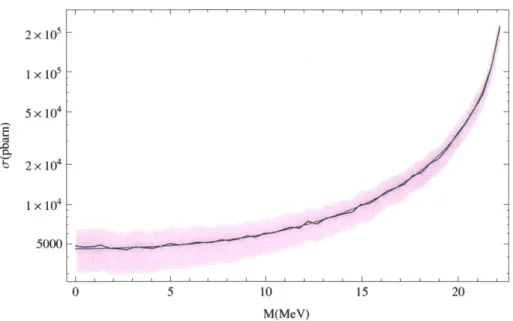
We present a Monte Carlo computation of the total unconstrained signal cross section as a function of the A' mass in Figure 4-1. Note that the total cross section o- grows as a function of the A' mass M, and the matrix element appears to become formally infinite at M = EcM, where E, = 0. This results from the infrared sin-gularity of the soft-photon limit in quantum electrodynamics
[3].
This divergence is cancelled by a loop diagram, so that the matrix element is finite at M = EcM. Then the factor of E, in the phase space causes the differential cross section to vanish, and so the total cross section also vanishes as expected. But this is unphysical: whenSo (4.11) BLab-y Similarly, (4.12) (4.13)
2x 105 I X 105 1 5 x 10⁴-2x 104 I x 10 4 5000-0 5 10 15 20 M(MeV)
Figure 4-1: Plot of the total unconstrained signal cross section a (blue curve) as a function of the A' mass M. The number of Monte Carlo events was
N
= 1000. The pink shaded area is the uncertainty. The analytically integrated cross section is givenby the green curve. Note the divergence at M = ECM = 22.6 MeV.
taking measurements of the signal process, the requirement that a photon of nonzero energy is detected regulates the singularity by itself. If we impose a cut on Ey, the cross section will reach zero at some Mmax < EcM, and we do not need to add the loop diagram. As M --+ ECM from below, the maximum photon energy in the CM
E2 -m2
frame, Ey = ECM , goes to 0 smoothly, and this factor appears in the phase
2Ecu
space. The diminishing phase space dominates the increasing matrix element, so the cross section is zero for M > Mma, and the process is kinematically disallowed.
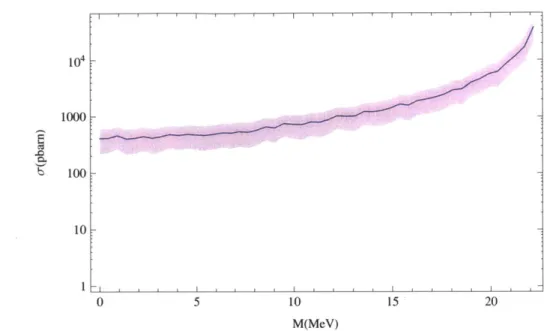
In Figure 4-2 we present a Monte Carlo computation of the constrained signal cross section as a function of the A' mass. The constraints used are the 2 --* 2 analogues
of those used for the 3-y background (see Chapter 2 and the following discussion in Section 4.2).
4.2
Background Cross Sections
For the two background processes, we use MadGraph 5 to numerically compute the matrix elements. The information flow for MadGraph 5 consists of the following:
104 1000 100 10 0 5 10 15 20 M(MeV)
Figure 4-2: Plot of the constrained signal cross section o as a function of the A' mass M, using the 2 -+ 2 analogues of the 3-y constraints. The number of Monte Carlo
events was
K
= 1000. The pink shaded area is the uncertainty.Input: First the desired process is specified. The resulting code takes a table
of four-momenta, with one full set ((Pi, P2, P3, P4, P5) for 2 --+ 3 scattering) of
four-momenta for each of K events.
Output: For each full set of four-momenta, the MadGraph code returns a pair
consisting of the set of momenta and the corresponding value of the squared and spin-summed matrix element.
This matrix element is directly inserted for
|M
2 in the differential cross section formula. The generated matrix element code is accessed via a Fortran routine, which reads in many sets of four-momenta, with a placeholder 0 after each set, and to return a file that replaces the Os by the computed matrix elements. We generate the four-momenta by randomly selecting cascaded 1 - 3 decay parameters in preparationfor the Monte Carlo technique described above; the four-momenta are completely specified by these parameters. After running the Fortran routine, we have the center-of-mass parameters and read in the corresponding differential cross sections. This is
all the information we need to compute the total cross sections and invariant-mass histograms.
We made a few specifications to optimize the performance of MadGraph. We generated momenta in MeV rather than GeV in order to improve numerical stability, reducing the uncertainty. In addition, MadGraph is designed to be run in the high-energy limit, and treats the electron as massless. We reintroduce the electron mass by a workaround, noting that the r has the same QED interactions as the electron, but
has a different mass. Instead of generating the processes e+
+
e- - 3-Y and e++
e- ->e+ +e-+, we generate T++r- -+ 37 and ++±T- -> ++T-+ 7. MadGraph creates
a directory for each process, containing the Fortran code as well as a file called the "parameter card." This file contains the numerical values of Lagrangian parameters for built-in particles. In particular, the mass of the T is specified. We modify the value of mT to match the electron mass, me = 0.511 MeV. So we have turned the -r
into an electron with its mass included in the matrix element computation.
4.3
Results
We computed histograms (Figures 4-3, 4-4) over the full kinematically allowed range
of M4 5, with constraints to regulate the energy singularity for the 3-/ process.
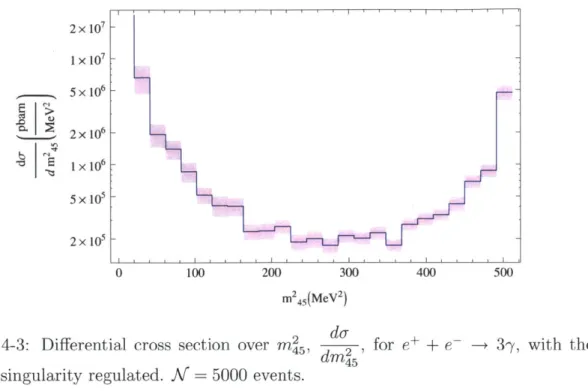
Specif-ically, we require each lab energy to be at least 1 MeV. There is still an energy singularity in the e+ e- y process, but it is automatically regulated by kinematic constraints imposed by the detector's measurement, as in the case of the signal cross section. Notice that the 37 cross section is largest for m45 < 10 MeV (Figure 4-3),
which is in the expected mass range of the A', so we say that the process e+ + e- -- 37
can fake an A'.
We imposed constraints by multiplying the differential cross section by a Heaviside
E
function for each constraint. The process e++
e- -> 3y was constrained as per theVEPP-3 setup (lab variables): 50MeV < E3 < 400MeV,
E4, E;> 1 MeV (to cut off an energy singularity),
1.50 <03 < 4.50, 04,05 V [1.50, 4.50].
2 x 10⁷ -5 x 10⁶ 2x 10⁶ 1 X 10⁶ -5 x 10⁵ 2x 10⁵ | I i I I 0 100 200 300 400 500 m245(MeV2 )
Figure 4-3: Differential cross section over m2, d , for e+ + e- 3-Y, with the 4m5'
energy singularity regulated.
K
= 5000 events.Recall that if two or more photons hit the photometer, we can throw out the event as background. The last constraint ensures that we only consider events in which exactly one photon is detected. The process e+ + e- - -y + e+ + e- was
constrained as follows: 50MeV < E3 < 400MeV,
1.50 < 63, 64 4.50.
For this process, the energy singularity is automatically cut off by the measure-ment, and there are no identical particles in the final state. Hence, we can physically separate all three final-state particles, allowing the -y to hit the detector and the charged particles to be swept away by a strong magnetic field to the sink. We give the constrained histograms and total cross sections in Figures 4-5, 4-6.
The e+ e- y process is suppressed by the positron sink. For Wojtsekhowski's 1
setup, the suppression factor is I. For an ideal detector, the denominator would
50
be infinite, and the positron bremsstrahlung process would be completely suppressed, leaving the 3-y process as the sole background. We will consider a range of suppression
factors in our reach plot.
.0 '~ E 2x 10'0 -1 x 10¹⁰ -5 x 10⁹ -2x 10⁹ -1 x -109 5 x 10⁸ 2 x 10⁸ 0 100 200 300 400 500 m245(MeV2)
Figure 4-4: Differential cross section over m 2 for e + e- - y + e+ + e-. The energy
singularity is already regulated by the measurement process. M =
1 x 10⁸ 5xi07 .0 .~ ~t 1 x 5x 1 x 5x 106 106 106 105 40000 events. 5 10 15 20 m24 5(MeV2 )
Figure 4-5: Constrained differential cross section over m45 for e+ + e -+ 3y.
K
= 10000 events.-I , , , , I , , , , I , , , I , , , , I , , , ,
7.0 x 10⁷ 5.0 x 10 7 3.0 x 10⁷ -1.5x 10⁷ 1.0 x 10⁷ 10 12 14 16 18 20 m45(MeV)
Figure 4-6: Constrained differential cross section over m25 for e+ +e -+
+ e++
e-Af = 40000 events.Chapter 5
Experimental Reach
A reach plot shows the couplings a' and the A' masses that can be tested at
50-confidence. It separates (mA', a') parameter space into two regions, one in which we can claim discovery of an A' gauge boson or exclude such an A', and one in which we
cannot. We compute numerical reach plots for the signal process e+ + e- -> -y + A'
over the two backgrounds, 3-y and e+e-
',
relating the A' mass mA to the coupling constant a'.In the lab frame, a positron beam impinges upon a stationary electron target, with luminosity L. The number of scattering events of a given process i is Ni = La-, where oi is the total cross section. In addition, we see in the appendix that the signal cross section is proportional to a'. Hence, if o-
lg
is the signal cross section evaluated at a set coupling constant a'o(= 10-), then o-, = , -lgat an arbitrary coupling0 constant a'. We summarize these results as follows:
N, =L = L - a, (5.1)
0
Nb =Lo- (5.2)
Here, ob is the background cross section, with the additional constraint that M4 5
[m'/ - o-m45, mA + 0-M 45]. That is, the invariant mass of all of the outgoing particles
except one detected photon must be within the experimental mass resolution of the A' mass. Aside from these additional constraints, we impose the exact same kinematic
constraints on both the signal and background processes, treating p4 + p5 from the
background process as we treat the A' momentum qA in the signal process.
The relation between m' and oz' comes from imposing 5a confidence in the cross section measurements, by setting the signal-to-noise ratio to be 5:
Ns 5 at
b 5 -5 (5.3)
We iterate through values of mA' in the mass range 11 - 22 MeV and compute the corresponding value of a'. The reach plot is displayed in Figures 5-1. There are two competing effects: the signal matrix element increases due to the soft singularity of QED, while the phase space prefactors in the cross section approach zero. Until
mA' gets close to Ec, the increase of
|M
2 dominates, so that the reach improves,allowing smaller couplings to be measured. Near the kinematic upper limit, the decreasing phase space is the dominant effect, and the signal cross section approaches
zero. This limiting mass is given by mA' = Ecm - E3min, with the A' emitted at rest and the -y emitted with its minimum experimentally-detectable energy under the VEPP-3 constraints. Near the limiting mass, the reach curve should increase to infinity, preventing the measurement of couplings at the limiting mass. This behavior is not captured under our numerical precision, so we introduce a vertical line by hand at the limiting mass to complete the shape of the reach.
There are additional bounds on the allowed coupling from (g - 2) of the electron and muon. The a' coupling and mA' mass could be measured in a region not already excluded by these bounds. Due to a 3.6 o discrepancy between the experimental and theoretical values of (g - 2), [7], the (g - 2),, reach is given by a band in the (mAI, a') plane. With the reach plot given in Figure 5-1, the (g - 2) boundaries are an order of magnitude higher than the reach coupling constant, except for near the
kinematic limit. For comparison, we give an alternate reach plot [16], computed using
CompHEP[17], a package for the computation of Feynman diagrams, in Figure 5-2.
Both reach plots exhibit the same improvement up to the limiting mass, followed
1 X 10⁷ -5 x 10⁻⁸ 1 x 10-S5 x 10-9 1 x 10⁻⁹ 5 x 10⁻¹⁰--I x 10-10 5 10 15 20 25 MAMCVI 1
Figure 5-1: Reach plot, with suppression factor = 1 (blue), -,(pink), and oc (gold). 50
The kinematic upper bound is given by the green vertical line. The shaded region is
the (g - 2), band. The orange and black curves are the (g - 2),, and (g - 2), exclusion
boundaries, respectively. Any points above these boundaries are forbidden.
10-6
10-8
10-9
-1~ [
0
Comparison of invisible A' searches
---- DarkLight e+e search
-90% photon detection DL invis. VEPP3 w/100% e* veto
woo so" - -a -oo moo -. 0
---
--20
40
60
mA' (MeV)
80
100
Figure 5-2: Reach plot computed using CompHEP. The gold curve labelled VEPP-3 is the reach of Wojtsekhowski's setup, with 100% suppression of the e+ e- Y background.
Chapter 6
Conclusion
In this thesis, we performed an analysis of Wojtsekhowski's VEPP-3 experimental setup for the production of an A' as a product of electron-positron annihilation. Using Monte Carlo integration, we computed total cross-sections under the VEPP-3 constraints for the signal process, e++e- -
+A',
and the two dominant backgroundprocesses, e+ + e~ -+ 3y and e+ + e- -> -y + e+ + e-. Additionally, we computed
composite invariant mass histograms for the two background processes. We found that the 3-y background is dominant, since the alternative background -y e+ e- is
par-tially suppressed by the positron detector at VEPP-3. In principle, an ideal positron detector would completely eliminate the -y e+ e- background. Finally, we generated reach plots that display the region of the (m' , a') plane for which discovery of the A' can or cannot be claimed.
This analysis is relevant to the DarkLight experiment, and motivates the imple-mentation of invisible A' search in the proposed apparatus. DarkLight uses Ruther-ford scattering of an e- beam off of a stationary proton target. The signal process for
DarkLight is currently A' -> e+ + e~, but with invisible A' search, the signal would
be e- + p - e- + p + A'. The dominant background would be e- + p - e- + p + 27y,
since we need 2 photons to get a nonzero invariant mass. The Monte Carlo methods we developed are entirely general, and may be directly applied to these processes to generate a reach plot. The DarkLight reach would be comparable to the VEPP-3 reach: VEPP-3 has fewer phase space particles in the final state, so its cross sections
o-s
are larger. This improves the a' reach for VEPP-3. But the ratio a which occurs in the reach plot is larger for DarkLight than for VEPP-3, since DarkLight could in principle detect and identify all of the final state particles, and DarkLight has a higher instantaneous luminosity. This improves the a' reach for DarkLight, and the improvement may be similar in magnitude to VEPP-3.
Appendix A
Integration of Lorentz-Invariant
3-Body Phase Space
For a 1 -+ 2 decay, the phase space integration gives
- (27)464(Ecm - pi -p 2)0(E1)0(E2) (2-r)2 (p -m 1)6(p2 - m). (27F)4 (27) 4 (A. 1) Using p m2m2 = E2 _ (p + m2), we have 6(p2 - m2 )O(E) 7 m d 1 2 : = (E - m2 + |p 2) 2 Vm 2+|p 2 P2 2 64 EM-P ,r2 + 1cm .2 P mn2 + P2 2 d3pi d 3p2 16wr2 m
+
512 m+±|
22|
x(Ecm - 2 + I12 m2 + | 2|2)6(3)(1 + -2) fIc)Q
r2 dr 'dQ' =Jdl167r2 m-r 2 ml+r 2 x6(Ecm - m +r 2 - m r2 ).I
I
Hence, Jdb 2 (A.2)=1
J1
- P2) (A.3)We make the substitution u(r) = r2
+ m
+
r2+m2, so thatdu = dr +
Vr2 +m 2 r-2+m2
We change variables in the integration:
1f
00r(b
ml m2 U )6(Ecm - u) = 112 167r2I
dQr (u Ecm) Ecm = 3 c +c2 + 1 - 2cicprovided that Ecm > m1 + M2, otherwise
I
Ci = E c Ecm - 2c - 2cJ dQ, d4b2 = 0. We have written EM Ecm'We now decompose 1 --> 3 decay into 1 -+ 2 -- 3 cascaded decay: 3-body LIPS is
given by
Jd<D3
I
( )4 4 2 4 (27)46(4)(Ecm - P1 - P2 - P3)x(E1)(E2)0(E3)(2-Fr)36(p2 - m p)6(pp -
m). (A.7)
We introduce an intermediate mass
Q,
so that Ecm -+ P1 +Q
andQ
-> P2 + P3. Weintegrate over its momentum d4pq, and over
Q
2 subject to the constraintsQ2 P2 = (Ecm - P1)2 = Em + m - 2EcmE1
< Ec, + m1 - 2Ecmmi
= (Ecm -- mi)2 (A.8)
and
Q2
= (P2 + p3)2 =m + m+2p2 - P3. (A.9) Urdr. r2 + m2r2+ 2 IdD2 (A.4) 1 16wr2 J dQ (A.5) (A.6)Moving to the center of momentum frame of P2 and P3, 2 = -P3. In this frame,
Q2
= m2 2 + m + 2EE±2E3+ 2 (A.10)With E2E3 = V/p + m2 -V/- + rmn, we see that this is minimized for 12 0, that is,
Q2 2> (M2 + m3)2. Under this integration, we make the substitution 6(4)(Ecm Pi
P2 -P3) - (27r)46(4
)(Ecm Pi p-Pq)6(4)(pq -p2 -P3) and include the factors 6(p2 _ Q2)
(pg on mass shell) and O(Eq). This second factor does not change the integral because
Ecm, Pi, P2, P3 are all timelike momenta with positive energy, so Pq must be as well. We obtain 1 2 (Ecm-mi)2 27r (M2 +M3 2 dQ2 d 4pi d4pq (2-r)6
6(4)(Ecm -pi pq)O(E1)O(Ep)
(27)4 (27) 4 x6(p2 - m )6(p2 - Q2 ) x (2w) (2P)
d
4(27r)66(4)(pq - P2 - P3)O(E2)O(E3) xo(p2 - m)(p - m) 1 f(Ecm-m 1 )2 27r (m2+m3)2 dQ2 d'b2(Ecm -> PI + pq)I
d4b2(Pq -> P2 + P3) 1f
(Ecm-mi)2 (27r)(3272 )2 (m2+m3 )2 dQ2 c + c4 + 1 - 2c2c2 - 2c2 - 2c2 +1 -2 (2 C3) (cq cq ) -2 (3)C cq x C2 4+ C ) cq ) cq ) x dG19dQ23, where cq = and c= EcmFor the case ci = c =
(A.11)
,i=1, 2,3.
Ecm
Fcm we obtain (changing variables to cq)
E 2 =(27r-)(327r2)2 (1-c)2 d(cq ) - 2c - 2cidQ1qdQ2 3. (A.12) I Id(b3 -2 ( 2 cq )
Evaluating this dimensionless integral, we obtain
2
d (4= )c (2 )2 (1 -- c4 + 4c2 In c)dQ1qdQ 23.
(47)(32e2)2
For the case C2 = C, Ci = C3 = 0, we have
(2-r) E (32w2)2 1C2 d(c2) c + 1 - 2c2 kCq} E 2
(1
c' + 4C2 In c)dQ19dQ23. (47r) -(87r) 2+
1-2 (L)2 dQqdQ23 (A.14)Since the
Q
is a fictional particle we have used to arbitrarily group two of the three masses, the result should be independent of our choice of the nonzero mass. We see that this is indeed the case.Appendix B
Calculation of the
e+
+
e
Matrix Element
To calculate the signal process, we use the standard QED Lagrangian with the addi-tional interaction -gA' y"@ and a mass term m ,A'A'. This gives
iM
Fi
(P - ± + m)+(-'g?)E*(qA) + m) (-i*O U(P).
(p_ - q,) 2 -m2 (B.1)
e-p-q,
, - qA
A' A'
Figure B-1: Tree-level diagrams for the annihilation of an electron and positron to an A' and a photon. Note the close analogy with the e+ + e- -* 2-y process from
standard quantum electrodynamics.
We sum over final spins and average over initial spins, and obtain
M2A4 I 1 :J4 2 g:9e2 Es*(q) E' q-,) E" *(qA) C" (qA)
spins s,s'
xtr (+m 2 271- -7 +I 2 27
(p_ - gy) - m (p+ - q,) - m2
-g)2m2'
fr
-g -mx4 P + -m) n " (p_ - g-y) ( ~m 2- m 2-7AP A2 (p+ - g-y) + 2- 2 -m)mO2"
Se [ 2 t r [(P + m)7-,(P -g +mT), 4 (2p- q,)-x (P+ - mn)-"(f_ - 0, + m)-y'] 1 tr[(Pi + m)7,(P - g + m)7, Ap_ - qy, x (P+ - mn)-l(f+ - 0,, - mn)-"] tr[(Pf + m)7,V(f - 0, - )7 4p- ' 9,p+' 9, + x (+-m)-y"(f_ - , + mn)-'] (B.2) 1 + ±(2p+ -(2+* y2tr[(p q-y)2tr1/ + mn)7v(f+ ~ , -T-), x (P+ - m)7y(f+ - 0, - m)'y"]. (B.3)
We have used (ii7p7,bYv)t = Vty7y~tgyou = O-yAyvu, and replaced
S*(p)E,(p)
Labeling these traces by 1, 11, 111, and IV, note that, up to cyclic ordering, III is II
with all of the factors of the trace reversed; equation (A.28) in [3] implies that II = III. The fourth trace may be dealt with by noting that an even number of m factors must be selected in each nonzero term. So we can multiply each m by -1 without changing
the result. Reversing the resulting trace, we see that IV = I(p_ <-+ p+) = I(t <-+ a).
I = tr[(_ + m)y,(f _ - , + m)-,(f+ m)7"(f_ - 0, + m)y'] = -2tr[(f _ +m)y,(f - 0, +m)(f+ + 2m)(p_ - ,+m)-y] = 4tr[(f_ - 2m)(f _ - , + m)(P+ + 2m) (f_ - , +Tm)] = 44[2(p_- f (p_ - q-,)) (p+ - (p- - q-,)) - (p- -p+) (p- - q,)2] + 8mn2_. _-q, +4m 2p- P+ + 8m2p_ -(p_ - q,) - 8m2p+- (p- - q-,) - 16m 2(p 2 -8m 2 p+- (p- - q,) - 16m4} 16[2 (p_- qP- -qy) - -P+__- - 9,)2 +4m2 +m2 - p+ - Am2P+ -(p- - ,) - _)qA 2 - 4m ]. (B.4)
We introduce Mandlestam variables:
s (P+ + p_)2 _P+ - - - m2, (B.5)
2
t = (p- - q,)2 _ p_- q, = 1I(mn2 -_) (B.6) u = (p+ - q,)2 p+ -q, = I (m2 -u), (B.7)
s + t + U = M2 +2m 2, (B.8)
where m is the electron mass and M is the A' mass. We have
1 1 p_ (p_ - q7) =m - (m2 - t) (in2 + t), (B.9) 2 2 s 212 1 p+ (p- - q,) = - 2 -- (n - U) (s + u - 3m 2). (B.10) 2 2 2