HAL Id: hal-02046747
https://hal.archives-ouvertes.fr/hal-02046747
Submitted on 25 Jan 2021
HAL is a multi-disciplinary open access
archive for the deposit and dissemination of
sci-entific research documents, whether they are
pub-lished or not. The documents may come from
teaching and research institutions in France or
abroad, or from public or private research centers.
L’archive ouverte pluridisciplinaire HAL, est
destinée au dépôt et à la diffusion de documents
scientifiques de niveau recherche, publiés ou non,
émanant des établissements d’enseignement et de
recherche français ou étrangers, des laboratoires
publics ou privés.
Polar wandering in mantle convection models
M.A. Richards, H.-P. Bunge, Y. Ricard, J.R. Baumgardner
To cite this version:
M.A. Richards, H.-P. Bunge, Y. Ricard, J.R. Baumgardner. Polar wandering in mantle convection
models. Geophysical Research Letters, American Geophysical Union, 1999, 26 (12), pp.1777-1780.
�10.1029/1999GL900331�. �hal-02046747�
GEOPHYSICAL RESEARCH LETTERS, VOL. 26, NO. 12, PAGES 1777-1780, JUNE 15, 1999
Polar wandering in mantle convection models
M.A. Richards
•, H.-P. Bunge
2, Y. Ricard
3, and J.R. Baumgardner
4
Abstract.
We calculate polar motion in models of 3-D spherical
mantle convection at Rayleigh numbers up to 10 s which
include internal heating, radial viscosity variations, and an endothermic phase change. Isoviscous models yield
rapid polar motion of order 3ø/Myr, but a factor of 30
increase in viscosity with depth reduces the rate of po-
lar motion to about 0.5ø/Myr due to stabilization of
the large-scale pattern of convection. Avalanching due to an endothermic phase change causes pulsating iner- tial interchange polar excursions of order 80-110øand of duration 20-70 Myr. A layered viscosity model with an endothermic phase change yields only one inertial inter- change event in 600 million years. These models show that the slow observed rate of post-Paleozoic true polar wander is not incompatible with higher rates inferred
for earlier times.
Introduction
Motion of the Earth's rotation axis determined from
paleomagnetic measurements is called polar wander, and apparent polar wander refers to the motion of the rotation axis with respect to continental plates. "True
polar wander" (TPW) is defined with respect to some
global reference frame, e.g., hotspots, and may repre-
sent motion of the rotation axis with respect to the
deep mantle [Jurdy, 1981]. On timescales long com-
pared to the adjustment time for the Earth's rotational
bulge (of order 1-10 Myr) the position of the rotation axis will coincide with the maximum inertia axis of the
non-rotating Earth [Gold, 1955; Goldreich and Toorare,
1969], so the position of the rotation axis will evolve on
timescales characteristic of the evolution of large-scale
(harmonic degree 2) mass heterogeneities. If the maxi-
mum and intermediate inertia axes become equal the ro- tation axis may become at least momentarily unstable,
leading to rapid polar wander [Fisher, 1974], with the
TPW rate controlled by equatorial bulge adjustment. This process is called "inertial interchange" TPW, re- flecting a possible 90øshift in the rotation axis.
Post-Paleozoic rates of TPW have been small (typi-
cally less than lø/Myr) [Gordon, 1987], but two Pale-
ozoic episodes of rapid apparent polar wander of con- tinental blocks have been described as possible TPW
•Geology &: Geophysics, Univ. of California, Berkeley
2Geological Sciences, Princeton University
a Lab. de Sciences de la Terre, ENS-Lyon, France 4Theoretical Division, Los Alamos National Laboratory
Copyright 1999 by the American Geophysical Union.
Paper number 1999GL900331. 0094-8276/99/1999GL900331 $05.00
events. Meert et al. [1993] identified Cambrian (580-550
Ma) and Devonian (415-379 Ma) intervals in which Lau-
rentia and parts of Gondawana moved as rapidly as 16
cm/yr in a paleomagnetic reference frame. Van der Voo
[1994] suggest that rapid Late Ordovician- Late Devo-
nian movement of Laurentia, Baltica, and Gondwana may represent about 75øof TPW in less than 75 Myr.
Torsvik et al. [1996] suggest a more rapid phase of TPW
during late Silurian-Early Devonian time. Kirschvink
et al. [1997] postulated an Early Cambrian inertial in-
terchange TPW event (90øshift), with apparent plate
motions as high as as 30 cm/yr. Evans [1998] suggests
that the Cambrian through Devonian TPW events rep- resent coaxial shifts of the rotation axis in response to a convection pattern associated with the Rodinia super-
continent. Kirschvink et al. [1997] speculate that ex-
traordinary rates of speciation during the Early Cam- brian resulted from environmental pressure generated by a TPW-induced global shift of the continents with respect to the poles. These inferences are controversial,
and have been challenged by Torsvik et al. [1998].
TPW has been modeled using subduction history
[Richards et al., 1996] or advection of mass anoma-
lies inferred from seismic tomography [Steinberger and
O'Connell, 1997] to infer the history of mantle het-
erogeneity during Cenozoic and Mesozoic time. Since global plate motions cannot be determined reliably for earlier times, other approaches are necessary to study longer-term rotational dynamics relevant to the Paleo-
zoic observations.
In rotational dynamics the timescale(s) for evolu-
tion of thermal mass heterogeneities in convection inter- act with the timescale for rotational bulge adjustment, which itself depends not only on the viscosity struc- ture of the mantle, but also on the strength of the mass
heterogeneities [Ricard et al., 1993]. Here we combine
3-D spherical mantle convection models with solutions for the equations for rotational dynamics in a viscous planet. The convection models are described in detail
elsewhere [Bunge et al., 1996; 1997]. The theory for
rotational dynamics is given by Ricard et al. [1993].
Convection and Polar Motion Models
Four mantle convection models [Bunge et al., 1997]
are used to study polar motion. These models have in- ternal heating, isothermal conditions at the free surface, and insulating conditions at the core-mantle boundary.
We vary the lower/upper mantle viscosity ratio (1 or
30) and the phase buoyancy
parameter (0 or -0.112)
characterizing an endothermic phase change at 670 km
depth [Christensen and Yuen, 1985]. The other physical
parameters of the models (see Table I of Bunge et al.,
1997) yield a "surface"
Rayleigh
number
of 1.1x10
s for
all the models, based on a viscosity of 2.0x10²² Pa-sec
for the upper mantle. The volume-averaged Rayleigh number is lower for models with a high viscosity lower mantle. Temperature fields and. spherical harmonic het-
1778 RICHARDS ET AL.- POLAR WANDERING AND MANTLE CONVECTION
erogeneity spectra for the four models are shown in Fig. 1. All the models are time-dependent and have been run to secular equilibrium.
The rotation axis position is computed with respect to the model reference frame, which is entirely arbi- trary. We solve the Euler equations for conservation of angular momentum subject to viscous adjustment of
the rotational bulge and dynamic compensation of in- ternal mass anomalies by deformation of the Earth's
surface and core-mantle boundary [e.g., Richards and
Hager, 1984]. The bulge adjustment time is inversely
proportional to the strength of forcing, i.e., the differ- ence between maximum and intermediate inertias, so
the character of thermal heterogeneity (i.e., the "style"
R erenee, Ra=lOexp8
e)
Power Spectrum
e)+phas, chang, (670km
+ layered viscosity
30x
.. .. .+ ph, se chan:, & layered vise,
sity
h)z•os oo 0 8 •6 2• 32. 0 0 8 16 24 32 o 8 •6 24 32. 0 8 16 2'4 32
Spherical Harmonic Degree
Figure 1. (a-d) Temperature
fields
for the convection
models
(red=hot, blue=cold). (a) Isoviscous
model
at 10
s
Rayleigh
number. (b) Isoviscous
phase
change
model. (c) Layered
viscosity
model. (d) Layered
viscosity,
phase
change
model (e-h) Harmonic
spectra
of the adjacent
convection
models
(see
Bunge
et al., 1997).
RICHARDS ET AL.' POLAR WANDERING AND MANTLE CONVECTION 1779
of convection) affects the rotational dynamics, as well
as the radial viscosity structure.
We adjust model time to Earth time by scaling the
rms surface
velocity
to that of the Earth's plates (4.7
cm/yr). The isoviscous
model discussed
below yields a
surface rms velocity of 0.22 cm/yr, so we contract the
model run time of 4800 Myr by a factor of 0.22/4.7 to
yield an Earth time of 250 Myr. Likewise, model ro- tational adjustment is appropriate for an upper mantle
viscosity
of 2.0x10²²(0.22/4.7)
= 0.9x10²¹
Pa-sec,
con-
sistent with estimates from post-glacial rebound. Results
The uniform viscosity mode] of Fig. la is character-
ized by downwe]ling plumes and a "blue" heterogene-
ity spectrum dominated by structure at high harmonic
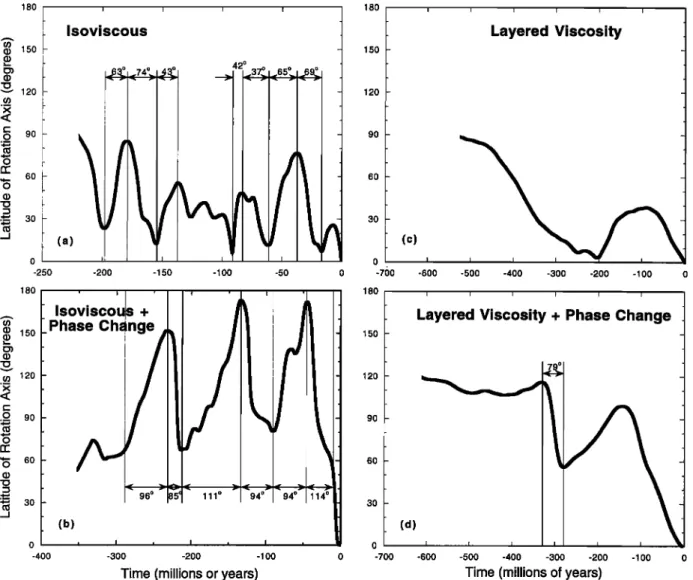
degrees (Fig. le). Fig. 2a shows the position of the
rotation axis in angular distance relative to the final pole position. Polar motion is rapid, typically of order
3ø/Myr. Fig. 2a also gives the total angular distances
of the largest TPW excursions, which appear random
and certainly not clustered about 90 ø. Thus inertial interchange TPW does not occur in this mode]. The
reason for this, and for the rapid TPW rate overall, is
that the low amplitude
degree
2 heterogeneity
pattern
is so unstable that TPW is limited by the rotational
bulge adjustment
time, which is of order 5-10 Myr.
The isoviscous model shown in Fig. lb introduces an
endothermic
phase change
at 670 km depth (Clapey-
ron slope ff =-4 Mpa/øK, phase buoyancy parameter
-0.112) strong
enough
to induce
periodic
"avalanching"
of cold downwelling material across the phase transition
[Tackley
et al., 1994], and also a somewhat
"redder"
heterogeneity spectrum (Fig. If). The rate of TPW re-
mains very high (Fig. 2b), with large, pulsating TPW
excursions whose total angular displacements (96 ø, 85 ø,
111
ø, 94 ø, 94 ø, and 114
ø) indicate inertial interchange
events of duration 20-70 Myr and recurrence interval of
50-100 Myr. However, there is no tendency of the inter-
vening pole positions to be repeated. The TPW pulses
correspond to pulses in the surface heat flux and rms
surface velocity due to phase change avalanches.
A more "Earthlike"
convection
pattern
dominated
by
long-wavelength structure and long-linear downwellings
results
from increasing
the lower mantle viscosity
by a
factor of 30 [Bunge
et al., 1996],
(Figs. lc,g). The vis-
180 , , • Isoviscous I (:]3 150 •- •' 120•- X
<
o 90 •- '- o 60 • o '5 30 I- 0 I , -250 (a) -200 -150 -1 O0 -50 180 150 120 90 60 30 0 -7o0 (c) Layered Viscosity I _ -600 -500 -400 -300 -200 -100 0 180 (:]3 150 Q) (/) 120 X .0 90 0 '"- 60 0 "'-' 30 0 -40o_Pha
_ -"
(b)96
ø
'-
"%
85
-'
111
ø 94
ø'•"
94
ø'-
-•
14•-
I
, , I , I , I , -300 -200 -100 0Time (millions or years)
80 i i i i i i
Layered Viscosity + Phase Change
5O 7 o 120 90 60 30 (d) o -700 -600 -500 -400 -300 -200 -1 O0 0 Time (millions of years)
Figure 2. Polar wandering
with time zero the end of the model
run. Vertical axis gives
the latitudinal
pole
position relative to time zero calculated in the model reference frame. Total angular distances for individual TPW
excursions
are given
for the bracketed
time intervals.
(a)-(d) correspond
to the models
of Fig. 1 (a)-(d). Model
times scaled
to Earth time by factors
of (a) 0.045, (b) 0.068, (c) 0.064, and (d) 0.070 (see
text).
1780 RICHARDS ET AL.: POLAR WANDERING AND MANTLE CONVECTION
cosity increase yields much slower rates of TPW (Fig.
2c), typically of order 0.5ø/Myr, with no inertial in-
terchange events, although the time series duration of
550 Myr is admittedly short (limited by computing re-
sources). The bulge adjustment time for this model is of
order 10-20 Myr, or only about a factor of two increase
over the isoviscous models. The lower TPW rate re-
sults from a more stable degree 2 heterogeneity pattern induced by the viscosity contrast.
The final model (Figs. ld,h) includes both layered
viscosity and a phase change, and is similar in charac- ter to the previous layered viscosity model. Avalanch- ing is largely suppressed by the viscosity increase with
depth. TPW rates (Fig. 2d) are similar to those ob-
tained for the previous layered viscosity model, with one rapid TPW excursion of 79øapproximating inertial interchange.
Discussion and Conclusions
Isoviscous models yield rapid TPW rates due to in- stability of the degree 2 heterogeneity pattern. TPW is limited by an effective bulge adjustment time of or- der 5-10 Myr. The isoviscous model with phase-change avalanching results in inertial interchange events, demon. strating that such events can occur in coupled convec-
tion/rotational dynamics models.
Layered viscosity models yield smaller TPW rates of
order 0.5ø/Myr due to greater stability of the long-
wavelength structure. One inertial interchange event occured in the layered viscosity phase-change model, suggesting a frequency of one or two events per billion years, but longer model runs are needed to better de- fine this frequency. Layered viscosity models are more "Earthlike" than the isoviscous models, but greater re- alism would require models with plates, which further
stabilize the low-degree structure [Bunge and Richards,
1996].
Rapid TPW events may have durations of order 20- 70 Myr, but pole excursions may not cluster around 90 ø , depending on the nature of convection. Approxi- mate inertial interchange TPW represents a plausible, albeit infrequent, mechanism for rapid continental mo- tions relative to the poles, and for rapid global envi- ronmental change. The low rate of TPW observed for the past 200 Myr is not incompatible with rapid TPW
events inferred for Paleozoic or Precambrian time.
Acknowledgments. We thank D. Evans, J. Kirschvink,
and T. Torsvik for helpful comments. This research was sup-
ported by NSF and IGPP-Los Alamos.
References
Bunge, H.-P., M.A. Richards, and J.R. Baumgardner, Ef-
fect of depth-dependent viscosity on the planform of mantle convection, Nature, 1379, 436-438, 1996.
Bunge, H.-P. and M.A. Richards, The origin of long-
wavelength structure in mantle convection, Geophys. Res. Lett., 23, 2987-2990, 1996.
Bunge, H.-P., M.A. Richards, and J.R. Baumgardner, A sen-
sitivity study of three-dimensional spherical mantle convec-
tion at 10 s Rayleigh number: Effects of depth-dependent
viscosity, heating mode, and an endothermic phase change,
J. Geophys. Res., 102, 11,991-12,007, 1997.
Christensen, U., and D. Yuen, Layered convection induced by phase transitions, J. Geophys. Res., 89, 4389, 1985. Evans, D.A., True polar wander, a supercontinental legacy,
Earth Planet. Sci. Lett., 157, 1-8, 1998.
Fisher, D., Some more remarks on polar wandering, J. Geo-
phys. Res., 79, 4041-4045, 1974.
Gold, T., Instability of Earth's axis of rotation, Nature, 175,
526-529, 1955.
Goldreich, P., and P. Toomre, Some remarks on polar wan- dering, J. Geophys. Res., 7J, 2555-2567, 1969.
Gordon, R.G., Polar wandering and paleomagnetism, Ann.
Rev. Earth Planet. Sci., 15, 567-593, 1987.
Jurdy, D., True polar wander, Tectonophysics, 7J, 1, 1981.
Kirschvink, J.L., R.L. Ripperdan, and D.A. Evans, Evidence
for a large-scale reorganization of Early Cambrian continen-
tal masses by inertial interchange true polar wander, Sci- ence, 277, 541-545, 1997.
Meert, J.G., R. Van der Voo, C.McA. Powell, Z.-X. Li, M.W.
McElhinny, Z. Chen, and D.T.A. Symons, A plate-tectonic
speed limit?, Nature, 363, 216-217, 1993.
Ricard, Y., G. Spada, and R. Sabadini, Polar wandering of
a dynamic Earth, J. Geophys. Res., 113, 282-298, 1993.
Richards, M.A., and B.H. Hager, Geoid anomalies in a dy-
namic Earth, J. Geophys. Res., 89, 5987-6002, 1984.
Richards, M.A., Y. Ricard, C. Lithgow-Bertelloni, G. Spada, and R. Sabadini, An explanation for Earth's long-term ro- tational stability, Science, 275, 372-375, 1996.
Steinberger, B., and R.J. O'Connell, Changes of the Earth's rotation axis owing to advection of mantle density hetero-
geneities, Nature, 387, 169-173, 1997.
Tackley, P.J., D.J. Stevenson, G.A. Glatzmaier, and G.
Schubert, Effects of multiple phase transitions in three-
dimensional spherical models of convection in Earth's man-
tle, J. Geophys. Res., 99, 15,887-15,901, 1994.
Torsvik, T.H., J.G. Meert, and M.A. Smethurst, Polar wan- der and the Cambrian, Science, 279, 9a, 1998.
Torsvik, T.H., M.A. Smethurst, J.G. Meert, R. Van der Voo,
W.S. McKerrow, M.D. Brasier, B.A. Sturt, and H.J Walder-
haug, Continental breakup and collision in the Neogrotero- zoic and Paleozoic: A tale of Baltica and Laurentia, Earth
Sci. Rev., JO, 229-258, 1998.
Van der Voo, R., True polar wander during the middle Pa- leozoic?, Earth Planet. Sci. Lett., 122, 239-243, 1994.
M. Richards, Dept. of Geology and Geophysics, Univ. of California, Berkeley, CA 94720
H.-P. Bunge, Dept. of Geology and Geophysical Sciences,
Princeton Univ., Princeton, NJ 08544
Y. Ricard, Laboratoire de Sciences de la Terre, Ecole Normale Superieure, 69364 Lyon, France
J. Baumgardner, Theoretical Divsion, Los Alamos National Laboratory, Los Alamos, NM 87545
(received November 12, 1998; revised January 25, 1999; accepted February 9, 1999.)