HAL Id: hal-00303442
https://hal.archives-ouvertes.fr/hal-00303442
Submitted on 4 Apr 2008HAL is a multi-disciplinary open access
archive for the deposit and dissemination of sci-entific research documents, whether they are pub-lished or not. The documents may come from teaching and research institutions in France or abroad, or from public or private research centers.
L’archive ouverte pluridisciplinaire HAL, est destinée au dépôt et à la diffusion de documents scientifiques de niveau recherche, publiés ou non, émanant des établissements d’enseignement et de recherche français ou étrangers, des laboratoires publics ou privés.
Molecular characterization of aerosol-derived water
soluble organic carbon using ultrahigh resolution
electrospray ionization Fourier transform ion cyclotron
resonance mass spectrometry
A. S. Wozniak, J. E. Bauer, R. L. Sleighter, R. M. Dickhut, P. G. Hatcher
To cite this version:
A. S. Wozniak, J. E. Bauer, R. L. Sleighter, R. M. Dickhut, P. G. Hatcher. Molecular characteriza-tion of aerosol-derived water soluble organic carbon using ultrahigh resolucharacteriza-tion electrospray ionizacharacteriza-tion Fourier transform ion cyclotron resonance mass spectrometry. Atmospheric Chemistry and Physics Discussions, European Geosciences Union, 2008, 8 (2), pp.6539-6569. �hal-00303442�
ACPD
8, 6539–6569, 2008 ESI FT-ICR MS characterization of aerosol WSOC A. S. Wozniak et al. Title Page Abstract Introduction Conclusions References Tables Figures ◭ ◮ ◭ ◮ Back CloseFull Screen / Esc
Printer-friendly Version Interactive Discussion
Atmos. Chem. Phys. Discuss., 8, 6539–6569, 2008 www.atmos-chem-phys-discuss.net/8/6539/2008/ © Author(s) 2008. This work is distributed under the Creative Commons Attribution 3.0 License.
Atmospheric Chemistry and Physics Discussions
Molecular characterization of
aerosol-derived water soluble organic
carbon using ultrahigh resolution
electrospray ionization Fourier transform
ion cyclotron resonance mass
spectrometry
A. S. Wozniak1, J. E. Bauer1, R. L. Sleighter2, R. M. Dickhut1, and P. G. Hatcher2
1
School of Marine Science, Virginia Institute of Marine Science, College of William and Mary, P.O. Box 1346, Gloucester Point, VA 23062, USA
2
Department of Chemistry and Biochemistry, Old Dominion University, 4541 Hampton Blvd., Norfolk, VA 23529, USA
Received: 19 February 2008 – Accepted: 4 March 2008 – Published: 4 April 2008 Correspondence to: A. S. Wozniak ([email protected])
ACPD
8, 6539–6569, 2008 ESI FT-ICR MS characterization of aerosol WSOC A. S. Wozniak et al. Title Page Abstract Introduction Conclusions References Tables Figures ◭ ◮ ◭ ◮ Back CloseFull Screen / Esc
Printer-friendly Version Interactive Discussion
Abstract
Despite the acknowledged relevance of aerosol water-soluble organic carbon (WSOC) to climate and biogeochemical cycling, characterization of aerosol WSOC has been limited. Electrospray ionization Fourier transform ion cyclotron resonance mass spec-trometry (ESI FT-ICR MS) is utilized in the present study to provide detailed
molecular-5
level characterization of the high molecular weight (HMW; m/z>223) component of
aerosol-derived WSOC collected from rural sites in Virginia and New York, USA. More than 3000 organic compounds were detected by ESI FT-ICR MS within am/z range
of 223–600 for each sample. Approximately 86% (Virginia) and 78% (New York) of these peaks were assigned molecular formulas using only carbon (C), hydrogen (H),
10
oxygen (O), nitrogen (N), and sulfur (S) as elemental constituents. H/C and O/C mo-lar ratios were plotted on van Krevelen diagrams and indicated a strong contribution of lignin-like and lipid-like compounds to the aerosol-derived WSOC samples. Dou-ble bond equivalents were calculated from the molecular formulas and used to identify black carbon (BC) compounds present in aerosol WSOC. BC compounds were found to
15
comprise only 1–4% of the identified compounds in the aerosol-derived WSOC. Several high magnitude peaks in the mass spectra of both samples corresponded to molecular formulas consistent with molecular formulas proposed in previous secondary organic aerosol (SOA) laboratory investigations indicating that SOAs are important constituents of the WSOC. Overall, ESI FT-ICR MS provides the level of molecular characterization
20
needed for detailed compositional and source information of the high molecular weight constituents of aerosol-derived WSOC.
1 Introduction
The importance of atmospheric aerosols to several areas of environmental study has been well-documented. Natural and anthropogenically-derived aerosols alter Earth’s
25
so-ACPD
8, 6539–6569, 2008 ESI FT-ICR MS characterization of aerosol WSOC A. S. Wozniak et al. Title Page Abstract Introduction Conclusions References Tables Figures ◭ ◮ ◭ ◮ Back CloseFull Screen / Esc
Printer-friendly Version Interactive Discussion
lar radiation (e.g. Ramanathan et al., 2001; Satheesh and Moorthy, 2005; Highwood and Kinnersley, 2006). Elevated concentrations of aerosols (specifically hygroscopic aerosols) due to human activities increase the number of cloud condensation nuclei (CCN) that act as seed for cloud droplets. Because of the limited amount of atmo-spheric water vapor available for cloud formation, an increase in CCN number may
5
reduce the average size of CCN such that it may limit precipitation and thereby in-crease the lifetime of clouds, thus serving as an indirect positive feedback on climate change (Toon, 2000; Ramanathan et al., 2001; Lohmann and Feichter, 2005).
In addition to the general role of aerosols in climate, fossil fuel and biomass com-bustion produce anthropogenically-derived aerosols that are known to impair
visibil-10
ity (Charlson, 1969; Jacobson et al., 2000), contribute to ecosystem-level problems via rain acidification (Likens and Bormann, 1974; Driscoll et al., 2001 and references therein) and the transport and deposition of persistent organic pollutants (Dickhut et al., 2000; Galiulin et al., 2002; Jurado et al., 2004), and cause cardiovascular and res-piratory problems in humans (Davidson et al., 2005; Highwood and Kinnersley, 2006).
15
Furthermore, atmospherically-derived materials in aerosol form are potentially impor-tant in a biogeochemical context. For example, recent studies estimate that between 30 and 90 Tg yr−1 of aerosol-derived organic carbon (OC; Koch, 2001; Bond et al., 2004) and 8 and 24 Tg yr−1 black carbon (BC; Penner et al., 1993; Bond et al., 2004) are deposited globally. These fluxes are potentially significant in the context of
car-20
bon cycling and budgets at the atmosphere-land-water interfaces, especially in areas where industrial sources are significant. Given the potential quantitative importance of aerosol OC to different terrestrial and aquatic systems, molecular-level characteriza-tion of aerosols is critical for both tracing the sources of aerosol OC and assessing its transformations before and after deposition.
25
Aerosols tend to be highly carbonaceous in nature with OC often comprising 10– 30% of total aerosol mass (e.g. Wolff et al., 1986; Jacobson et al., 2000; Tanner et al., 2004; Liu et al., 2005). In addition, as much as 20–70% of aerosol OC is water-soluble (WSOC; Krivacsy et al., 2001; Kleefeld et al., 2002; Yang et al., 2004; Decesari et al.,
ACPD
8, 6539–6569, 2008 ESI FT-ICR MS characterization of aerosol WSOC A. S. Wozniak et al. Title Page Abstract Introduction Conclusions References Tables Figures ◭ ◮ ◭ ◮ Back CloseFull Screen / Esc
Printer-friendly Version Interactive Discussion
2007). As noted above, only hygroscopic aerosols can act as CCN, making WSOC an important indirect climate agent (Saxena and Hildemann, 1996; Fuzzi et al., 2001; Satheesh and Moorthy, 2005). Aerosol WSOC is also of great potential interest in the context of OC cycling between atmosphere, land, and natural waters because it is likely to be the fraction of aerosol OC that is most rapidly transported along with surface
5
and ground waters through watersheds to lakes, rivers, and estuaries on timescales relevant to carbon biogeochemical cycling.
Despite the potential importance of aerosol WSOC, detailed molecular characteri-zation of the WSOC component of aerosols has thus far been limited. Attempts to characterize WSOC at the molecular level using gas chromatography-mass
spectrom-10
etry (GC-MS; Mayol-Bracero et al., 2002; Wang et al., 2006) and a combination of ion chromatography and high performance liquid chromatography (HPLC; Yang et al., 2004) characterized less than 10% and 20% of WSOC, respectively. Characterization of aerosol WSOC at the functional group level using HPLC (Mayol-Bracero et al., 2002), 1
H (Decesari et al., 2000) and cross-polarization-magic angle spinning13C (Duarte et
15
al., 2005; Sannigrahi et al., 2006) nuclear magnetic resonance (NMR) spectroscopy, Fourier transform infrared spectroscopy (Duarte et al., 2005), and size exclusion chro-matography (Sullivan and Weber, 2006) generally agree with the limited molecular-level investigations (Mayol-Bracero et al., 2002; Yang et al., 2004; Yu et al., 2005; Wang et al., 2006) in identifying mono- and di-carboxylic acids as well as polyconjugated acids
20
(sometimes described as humic-like substances, HULIS) as the most prevalent com-pounds in WSOC, followed by neutral comcom-pounds such as sugars.
The high concentration of acidic species in aerosol-derived WSOC likely indicates the presence of secondary organic aerosols (SOA) formed from the oxidation of natu-rally and anthropogenically emitted volatile organic carbon (VOC) precursors (Jaoui et
25
al., 2005; Kanakidou et al., 2005; Sullivan and Weber, 2006). To date, however, much of the work identifying SOA compounds has relied on experimental laboratory investi-gations (e.g. Forstner et al., 1997; Jang and Kamens, 2001; Kanakidou et al., 2005; Heaton et al., 2007), and very few SOA compounds have been identified in ambient
ACPD
8, 6539–6569, 2008 ESI FT-ICR MS characterization of aerosol WSOC A. S. Wozniak et al. Title Page Abstract Introduction Conclusions References Tables Figures ◭ ◮ ◭ ◮ Back CloseFull Screen / Esc
Printer-friendly Version Interactive Discussion
aerosol samples (Edney et al., 2003; Tolocka et al., 2004; Jaoui et al., 2005). Com-prehensive molecular characterization of WSOC derived from ambient aerosol material will therefore complement studies of SOA formation processes, atmosphere-land-water biogeochemical fluxes, and climate-related effects of WSOC.
Electrospray ionization coupled with Fourier transform ion cyclotron resonance mass
5
spectrometry (ESI FT-ICR MS) provides detailed molecular characterization of organic matter due to its extremely high resolution and mass accuracies (Marshall et al., 1998; Kujawinski et al., 2002a; Sleighter and Hatcher, 2007). ESI is a “soft” ionization tech-nique that produces minimal fragmentation of the analytes, thus allowing for detection of intact molecules (Stenson et al., 2002) and is a particularly effective technique for
10
ionizing polar, hydrophilic molecules (Gaskell, 1997; Kujawinski, 2002; Sleighter and Hatcher, 2007) similar to those found in aerosol WSOC. FT-ICR MS provides ultrahigh mass resolving powers (>300 000) and mass accuracy (<1 ppm), enabling the
identi-fication of many distinct compounds at a given nominal mass (Marshall et al., 1998; Kujawinski et al., 2002a; Sleighter and Hatcher, 2007).
15
Recently, ESI FT-ICR MS has been used to successfully characterize complex mix-tures of organic matter including fulvic and humic acids extracted from rivers (Kujawin-ski et al., 2002a; Stenson et al., 2003; Kujawin(Kujawin-ski et al., 2004), soils (Kujawin(Kujawin-ski et al., 2002a; Kramer et al., 2004; Hockaday et al., 2006), peat (Kramer et al., 2004), and de-graded wood (Kujawinski et al., 2002a; Kim et al., 2003a; Kramer et al., 2004) as well
20
as dissolved organic matter (DOM) from riverine (Kim et al., 2003a,b; Stenson et al., 2003; Kim et al., 2004) and marine waters (Koch et al., 2005; Tremblay et al., 2007), ice cores (Grannas et al., 2006), mangrove porewaters (Koch et al., 2005; Tremblay et al., 2007), and soils (Hockaday et al., 2006). Amongst the key findings in recent ESI FT-ICR MS studies has been the detection of potential BC compounds (Kim et al.,
25
2003b; Kim et al., 2004; Kramer et al., 2004; Hockaday et al., 2006). With biomass and fossil fuel combustion thought to be the dominant sources of BC, ESI FT-ICR MS analysis of aerosol WSOC may be useful for detecting the mobile, water-soluble com-ponent of BC present in aerosols. The recent studies of Grannas et al. (2006) have
ACPD
8, 6539–6569, 2008 ESI FT-ICR MS characterization of aerosol WSOC A. S. Wozniak et al. Title Page Abstract Introduction Conclusions References Tables Figures ◭ ◮ ◭ ◮ Back CloseFull Screen / Esc
Printer-friendly Version Interactive Discussion
shown that BC compounds can be identified in melt water from ice cores and rep-resent historically-deposited atmospheric precipitation in snow-accumulating regions of the world. In the present study, we demonstrate the utility of ESI FT-ICR MS for characterizing aerosol-derived WSOC and present novel information on the molecular composition of this material collected in two different watersheds of the northeastern
5
United States.
2 Experimental section
2.1 Sample collection and field methods
Two-day integrated high-volume aerosol samples (>4000 m3) were collected during 16–18 August 2006 at the Institute of Ecosystem Studies Environmental Monitoring
10
Station in Millbrook, NY (http://www.ecostudies.org/emp purp.html) and 7–9 Novem-ber 2006 at the National Atmospheric Deposition Program (NADP) site (VA98) lo-cated in Gloucester County, VA (http://nadp.sws.uiuc.edu/sites/siteinfo.asp?net=NTN\ &id=VA98) using high-volume total suspended particulate (TSP) air samplers (Model GS2310, ThermoAndersen, Smyrna, GA). Both sites are located in rural
environ-15
ments and are more than 30 km from major industrial emissions. Air was drawn through pre-ashed (3 h, 525◦C) and pre-weighed high-purity quartz microfibre filters (20.3 cm×25.4 cm, nominal pore size 0.6 µm; Whatman QM-A grade) for collection of aerosol particles. Following collection, aerosol filter samples were transferred to pre-ashed (3 h, 525◦C) aluminum foil pouches and stored in the dark in a carefully cleaned
20
air-tight polycarbonate desiccator until analysis.
2.2 Aerosol-derived WSOC C18extraction procedure
Approximately half of each aerosol filter was cut into strips using solvent-cleaned (hexane, acetone, and methanol) razor blades and placed in pre-combusted (500◦C)
ACPD
8, 6539–6569, 2008 ESI FT-ICR MS characterization of aerosol WSOC A. S. Wozniak et al. Title Page Abstract Introduction Conclusions References Tables Figures ◭ ◮ ◭ ◮ Back CloseFull Screen / Esc
Printer-friendly Version Interactive Discussion
and solvent-cleaned 1-L glass beakers. Approximately 200 mL of LC-MS grade water (Fisher Scientific) was added to the filter strips, and samples were sonicated for 30 min to extract the WSOC from the filters. The extracted organic matter was then isolated and concentrated from the WSOC filtrates using C18 solid phase extraction disks (3M, Empore) following previously established protocols (Kim et al., 2003a). The C18 disks
5
were activated using LC-MS-grade water and methanol (Fisher Scientific), and each WSOC sample was acidified to a pH of 2 with 10 M HCl before passing through the disk. The sorbed material was rinsed with LC-MS grade water before eluting it off the disk with 4–6 mL of LC-MS grade methanol. Due to the qualitative nature of these stud-ies, the recovery from the C18disk was not measured; however, previous studies have
10
shown that approximately 42–60% of freshwater dissolved organic matter is recovered by this technique (Louchouarn et al., 2000; Kim et al., 2003a).
3 Analytical methods
Because previous studies have determined that water/methanol mixtures yield higher quality mass spectra (Kujawinski et al., 2002b; Rostad and Leenheer, 2004), the C18
-15
extracts were diluted by 25% with LC-MS grade water. In order to increase the ion-ization efficiency, ammonium hydroxide was added immediately prior to ESI, raising the pH of the sample to approximately 8. Samples were continuously infused into the Apollo II ESI ion source of a Bruker Daltonics 12 Tesla Apex Qe FT-ICR MS, housed at the College of Sciences Major Instrumentation Cluster (COSMIC) at Old Dominion
Uni-20
versity (http://www.sci.odu.edu/sci/cosmic/index.shtml). Samples were introduced by a syringe pump providing an infusion rate of 120µL/h. All samples were analyzed in
neg-ative ion mode, and electrospray voltages were optimized for each sample. Previous studies have shown that the negative ion mode avoids the complications associated with the positive ion mode in which alkali metal adducts, mainly Na+, are observed
25
along with protonated ions (Brown and Rice, 2000; Rostad and Leenheer, 2004). Ions were accumulated in a quadrupole ion trap for 1.0 s before being transferred to the ICR
ACPD
8, 6539–6569, 2008 ESI FT-ICR MS characterization of aerosol WSOC A. S. Wozniak et al. Title Page Abstract Introduction Conclusions References Tables Figures ◭ ◮ ◭ ◮ Back CloseFull Screen / Esc
Printer-friendly Version Interactive Discussion
cell. Exactly 300 transients, collected with a 4 MWord time domain, were added, giving about a 30 min total run time for each sample. The summed free induction decay (FID) signal was zero-filled once and Sine-Bell apodized prior to fast Fourier transformation and magnitude calculation using the Bruker Daltonics Data Analysis software.
3.1 Mass calibration and molecular formula assignments of aerosol WSOC
5
Prior to data analysis, all samples were externally calibrated with an arginine cluster standard and internally calibrated with fatty acids naturally present within the sample (Sleighter et al., 2008). The ultrahigh resolving power of 12 T FT-ICR MS is capable of separatingm/z values to a mass accuracy of less than 1 ppm. A molecular formula
calculator developed at the National High Magnetic Field Laboratory in Tallahassee, FL
10
(Molecular Formula Calc v.1.0 ©NHMFL, 1998;http://www.magnet.fsu.edu/) generated empirical formula matches using carbon (C), hydrogen (H), oxygen (O), nitrogen (N), sulfur (S), and phosphorus (P). Onlym/z values with a signal-to-noise above 4 were
inserted into the molecular formula calculator. In the vast majority of cases, the exact mass of each assigned formula agreed with them/z value to within less than 0.5 ppm.
15
3.1.1 Data processing
Molecular formulas generated by the molecular formula calculator were pre-processed using a MatLab file (The MathWorks Inc., Natick, MA) that employed several conser-vative rules in order to eliminate compounds not likely to be observed in nature. The pre-processing file eliminated all molecular formulas in which: O/C≥1.2, H/C≥2.25,
20
H/C≤0.3, N/C≥0.5, S/C≥0.2, P/C≥0.1, (S+P)/C≥0.2, and DBE (double bond equiva-lents)<0, where DBE is calculated as follows:
DBE = (2c + 2 − h + n + p)/2 (1)
for any formula CcHhNnOoSsPp. DBE indicates the number of rings and double bonds in a molecule and is a measure of the degree of unsaturation in a given compound
25
ACPD
8, 6539–6569, 2008 ESI FT-ICR MS characterization of aerosol WSOC A. S. Wozniak et al. Title Page Abstract Introduction Conclusions References Tables Figures ◭ ◮ ◭ ◮ Back CloseFull Screen / Esc
Printer-friendly Version Interactive Discussion
In addition to these rules, the MatLab file searched for and eliminated peaks detected by the FT-ICR MS that were 1.003 mass units greater than another detected peak, un-der the assumption that the two peaks represent the same compound, with the peak at the higherm/z having a 13C in place of a 12C. Following pre-processing, molecu-lar formulas were assigned following the “formula extension” approach described by
5
Kujawinski and Behn (2006). Phosphorous is typically not a quantitatively significant component of atmospheric materials (Chen et al., 2002; Grimshaw and Dolske, 2002; Baker et al., 2006); therefore all molecular formulas containing phosphorous were elim-inated for ease of processing. Additionally, by analyzing solvent blanks, peaks below
m/z 223 were determined to be high-frequency noise and were not analyzed.
10
4 Results and discussion
4.1 Mass spectra
ESI FT-ICR mass spectra for aerosol-derived WSOC samples from both locations showed over 3000 peaks and remarkably similar patterns in peak distribution. The greatest peak magnitudes were located betweenm/z 250 and 375, and considerably
15
smaller magnitude peak clusters were centered aroundm/z 450 and 550 (Fig. 1a and
b). Peak magnitude is not necessarily indicative of a compound’s concentration in a sample due to inherent biases of C18 extractions and electrospray ionization efficien-cies (Hockaday et al., 2006). In addition, only two samples were investigated here, so further work is needed to determine whether this is a characteristic molecular weight
20
distribution of aerosol WSOC. Nonetheless, the similarity between the spectra is strik-ing given the differences in dates and locations of samplstrik-ing (August 2006, Millbrook, NY vs. November 2006, Harcum, VA). Dismal Swamp DOM (Sleighter and Hatcher, 2007) and Mount Rainier humic acid (Kujawinski et al., 2002a) also showed strongest peak magnitudes at m/z 250 to 375 in their ESI FT-ICR spectra, indicating similar
25
ACPD
8, 6539–6569, 2008 ESI FT-ICR MS characterization of aerosol WSOC A. S. Wozniak et al. Title Page Abstract Introduction Conclusions References Tables Figures ◭ ◮ ◭ ◮ Back CloseFull Screen / Esc
Printer-friendly Version Interactive Discussion
Spectral details for both samples (see insets for Fig. 1a and b) show thatm/z 330–
340 demonstrated a typical pattern of several peaks at low mass defects (mass defect is the distance a peak is displaced from the exact nominal mass) from a given odd-numbered nominal mass, and fewer, less intense peaks at even-odd-numbered nominal masses (e.g. Kujawinski, 2002; Kim et al., 2004; Sleighter and Hatcher, 2007).
Even-5
numbered nominal mass peaks are indicative of either13C isotopic peaks (observed at a mass difference of 1.003 m/z greater than its12C counterpart) or N-containing compounds with an odd number of N (Koch et al., 2005). N-containing compounds are preferentially discriminated against in C18 extraction methods because the polar nature of organic nitrogen precludes its quantitative retention on the hydrophobic C18
10
disk (Benner, 2002; Koch et al., 2005); therefore, any N-containing compounds present in the WSOC samples would likely be present at relatively smaller peak magnitudes.
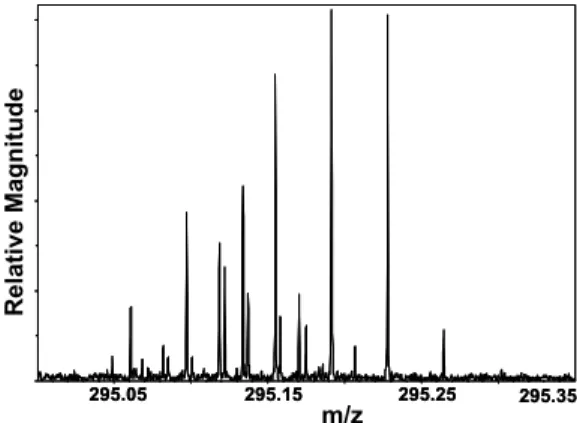
Figure 2 illustrates both the ultrahigh mass resolving power of FT-ICR MS and the heterogeneous nature of aerosol WSOC. Similar to other mixtures of natural organic matter (e.g. Kim et al., 2004; Kujawinski et al., 2004; Koch et al., 2005), aerosol WSOC
15
in this study was found to be highly complex, containing more than 3000 compounds in a single sample (Fig. 1) and 10–20 compounds at any given nominal mass (Fig. 2). Less than 0.0001 Da often separated two distinct peaks (i.e. compounds; Fig. 2). Only instrumentation with mass-resolving powers as high as FT-ICR MS can obtain the sep-aration necessary to resolve compounds at such small mass differences.
20
4.2 Formula assignments
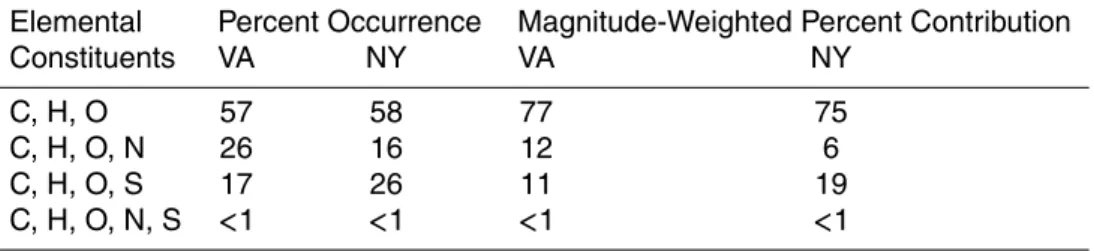
Using a formula extension approach similar to that described by Kujawinski and Behn (2006), 86% and 78% of the peaks identified in the mass spectra for the Virginia and New York aerosol WSOC samples, respectively, were assigned molecular formulas. Most of the identified compounds contained only C, H, and O (Table 1). The New York
25
aerosol WSOC had a higher percentage of compounds containing C, H, O, and S (26% versus 17%; Table 1) than the Virginia sample. In contrast, compounds containing C, H, O, and N accounted for 26% of those identified in the Virginia sample vs. only 16%
ACPD
8, 6539–6569, 2008 ESI FT-ICR MS characterization of aerosol WSOC A. S. Wozniak et al. Title Page Abstract Introduction Conclusions References Tables Figures ◭ ◮ ◭ ◮ Back CloseFull Screen / Esc
Printer-friendly Version Interactive Discussion
in the New York sample (Table 1). While ESI FT-ICR mass spectra do not provide a quantitative estimate of compound concentrations, the New York and Virginia WSOC samples were analyzed on the same instrument using the same protocols and meth-ods, and therefore the resulting spectra reflect the same inherent biases. Because of the similar sample processing, we may calculate and compare magnitude-weighted
5
percent contributions for various compound groups (e.g. C-H-O, C-H-O-N, C-H-O-S, C-H-O-N-S; Table 1). These magnitude-weighted percent contributions further support a greater contribution of S-containing compounds to New York aerosol WSOC than to Virginia WSOC, and a greater contribution of N-containing compounds to Virginia aerosol WSOC compared to that from New York.
10
4.3 Van Krevelen analysis
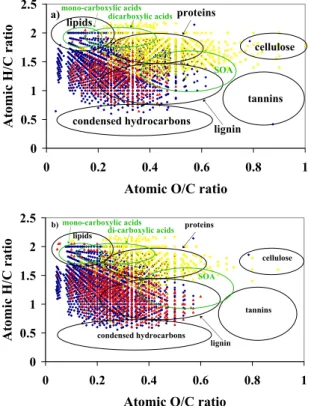
The identified molecular formulas of aerosol WSOC are represented in van Krevelen diagrams (Fig. 3a and b) which plot molar ratios (H/C vs. O/C) of compounds against each other. Also plotted are representative molar ratios for major known classes of natural and anthropogenic organic compounds (i.e. ovals in Fig. 3a and b) in order
15
to provide potential source information for the aerosol WSOC samples (see also Kim et al., 2003b; Kujawinski et al., 2004; Sleighter and Hatcher, 2007). In addition to major compound classes frequently used to apportion sources of dissolved organic matter (Kim et al., 2003b; Kujawinski et al., 2004; Sleighter and Hatcher, 2007), SOAs and mono- and di-carboxylic acids, compounds frequently associated with WSOC, are
20
included to provide additional likely sources to aerosols (Fig. 3a and b; Yang et al., 2004; Yu et al., 2005; Sullivan and Weber, 2006; Wang et al., 2006).
The majority of aerosol WSOC compounds identified by ESI FT-ICR MS in this study had molar H/C and O/C ratios similar to lipids, lignin, mono- and dicarboxylic acids, and SOAs (Fig. 3a and b). Compounds with molar ratios reflective of protein sources
25
were also abundant, however, the majority of these compounds do not contain nitro-gen, a component of every amino acid, (Fig. 3a and b) indicating that proteins are an unlikely source for these particular compounds in the present study. Few compounds
ACPD
8, 6539–6569, 2008 ESI FT-ICR MS characterization of aerosol WSOC A. S. Wozniak et al. Title Page Abstract Introduction Conclusions References Tables Figures ◭ ◮ ◭ ◮ Back CloseFull Screen / Esc
Printer-friendly Version Interactive Discussion
plotted within the regions characteristic of tannins, cellulose, and condensed hydrocar-bons (Fig. 3a and b) suggesting that these groups are also not major contributors to aerosol WSOC. Many of the compounds plotted outside any of the source signature regions and had low O/C (∼0 to 0.2) and H/C (∼1 to 1.5) indicating an unknown source. There are currently very few reports of SOA H/C and O/C molar ratios (Reinhardt et al.,
5
2007; Altieri et al., 2008), however, with further investigation the region representing SOA may prove to be more extensive and encompass those compounds not presently represented by any known sources.
The relatively broad distributions of H/C and O/C molar ratios for compounds in these samples (Fig. 3a and b) again illustrate the complex nature of aerosol WSOC,
how-10
ever, certain patterns emerge. The majority of S-containing compounds identified in both samples had H/C values greater than 1.2 and simultaneously showed high O/C ratios. Organosulfur compounds have been detected in previous aerosol WSOC stud-ies (Romero and Oehme, 2005; Gilardoni et al., 2007). Romero and Oehme (2005) further observed HSO−4 mass fragments in high molecular weight (HMW) atmospheric
15
HULIS and postulated that these anions were covalently bound by sulfonation or sulfa-tion processes. The high O/C ratios of many S-containing compounds observed in the New York and Virginia aerosol WSOC samples (Fig. 3a and b) are also consistent with covalently bound HSO−4. Elevated H/C molar ratios (>1.5) are indicative of saturated
hydrocarbons with few double bonds, and the high H/C ratios in S-containing
com-20
pounds in these samples indicate that any sulfonation or sulfation processes resulted in mostly saturated compounds. S-containing aromatic compounds that would show much lower H/C ratios are not evident in these samples. In contrast, N-containing and C-H-O compounds (Fig. 3a and b) frequently have H/C values<1 and do not typically
have O/C values >0.6, suggesting that the nitrogenous WSOC compounds in these
25
samples tended to be highly carbonaceous, condensed compounds. Previous labo-ratory studies of SOAs have also reported the formation of nitro-aromatic compounds from the photooxidation of aromatic compounds in the presence of NOx (Forstner et al., 1997; Jang and Kamens, 2001; Alfarra et al., 2006). The data presented here are
ACPD
8, 6539–6569, 2008 ESI FT-ICR MS characterization of aerosol WSOC A. S. Wozniak et al. Title Page Abstract Introduction Conclusions References Tables Figures ◭ ◮ ◭ ◮ Back CloseFull Screen / Esc
Printer-friendly Version Interactive Discussion
consistent with the presence of nitro-aromatic compounds as well.
4.4 Black carbon in aerosol-derived WSOC
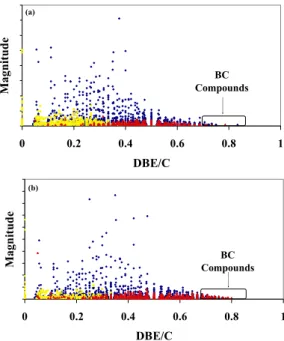
The aerosol WSOC samples from New York and Virginia contained several compounds with DBE/C values greater than 0.7, a characteristic of condensed aromatic ring struc-tures and a cut-off value proposed for the identification of BC compounds (Fig. 4;
Hock-5
aday et al., 2006). BC compounds defined in this manner made up only 4% and 1% of the identified compounds in Virginia and New York aerosol WSOC, respectively, and were present at small magnitudes relative to the majority of other compounds present (Fig. 4a, b). When peak magnitudes were accounted for as in Table 1 above, BC compounds accounted for only 1.5% (Virginia) and 0.3% (New York) of the total peak
10
magnitudes.
BC has traditionally been studied in particulate OM (e.g. Mitra et al., 2002; Gatari and Bowman, 2003; Dickens et al., 2004). However, BC may become hydrophilic in the course of its oxidation (Kamegawa et al., 2002; Park et al., 2005; Zuberi et al., 2005), and several studies of aqueous OM mixtures have identified a BC component
15
(Mannino and Harvey, 2004; Kim et al., 2004; Kramer et al., 2004; Hockaday et al., 2006). A recent FT-ICR MS study of freshwater DOM identified BC using molar H/C and O/C ratios using a similar approach to the one employed in the present study but did not report the number of peaks characterized as BC (Kim et al., 2004). A study of BC in DOM from the Delaware Bay found that 9% of bay DOC and 4–7% of coastal ocean
20
DOC was BC (Mannino and Harvey, 2004). The authors listed sediment resuspension and atmospheric transport from nearby Philadelphia, PA as likely sources of BC to the bay. We are unaware of aerosol WSOC studies that have quantified BC, but soot oxidation has been demonstrated to form WSOC compounds (Decesari et al., 2002). While the relative paucity of BC compounds identified in this study does not support
25
a strong aerosol WSOC source for BC to riverine and coastal DOC, the presence of BC compounds in WSOC from both of these rural sites suggests that areas having stronger BC sources such as urban regions may contribute greater amounts of BC to
ACPD
8, 6539–6569, 2008 ESI FT-ICR MS characterization of aerosol WSOC A. S. Wozniak et al. Title Page Abstract Introduction Conclusions References Tables Figures ◭ ◮ ◭ ◮ Back CloseFull Screen / Esc
Printer-friendly Version Interactive Discussion
riverine and coastal DOC.
Radiocarbon analysis of the New York aerosol WSOC from August 2006 showed a mean ∆14C signature of −230‰ (n=3; Wozniak et al., 2008). A simple two-source isotopic mass balance assuming one source devoid of14C (e.g. fossil fuels) and an-other source having present-day levels of14C (e.g. modern living biomass) suggests
5
that more than 20% of the New York WSOC comes from a fossil source. BC emitted as a byproduct of fossil fuel combustion represents a logical potential source of this aged WSOC. The data presented here, however, do not support a significant input of BC to aerosol WSOC, and therefore other sources of aged organic matter, both natural and anthropogenic, may be responsible for the aged WSOC (e.g. aged soil organic
10
matter, SOAs from fossil fuel precursors, etc.). In addition, several of the identified BC compounds contain N in their molecular formulas, and as discussed previously, C18 extraction does not retain organic N compounds efficiently (Benner, 2002; Koch et al., 2005). Therefore, BC-derived compounds present in the initial WSOC sample may not be quantitatively represented as well as non-N containing compounds in the
15
FT-ICR mass spectra. Alternately, DBE/C≥0.7 may be too conservative as a cut-off for a complete identification of BC compounds (Fig. 4a and b; Hockaday et al., 2006).
While BC compounds may comprise only a small portion of identified molecular for-mulas in the aerosol WSOC samples analyzed here, their identification nonetheless highlights another application of ESI FT-ICR MS. BC is generally defined as
carbona-20
ceous material thought to be composed of a highly refractory, slow-cycling pool of compounds resulting from combustion processes with relevance to climate and carbon cycling issues and can be a significant portion of aerosol carbonaceous material (e.g. Novakov et al., 2005; and references therein). In a biogeochemical context, the identifi-cation of BC in aerosol WSOC suggests that BC may become desorbed into rainwater
25
and transported through watersheds to various aquatic systems. To this point, BC has primarily been studied using one of several operational definitions that do not measure the full spectrum of BC (Masiello, 2004; Hammes et al., 2007). The use of ESI FT-ICR MS to identify BC in aerosols may therefore provide molecular level information
ACPD
8, 6539–6569, 2008 ESI FT-ICR MS characterization of aerosol WSOC A. S. Wozniak et al. Title Page Abstract Introduction Conclusions References Tables Figures ◭ ◮ ◭ ◮ Back CloseFull Screen / Esc
Printer-friendly Version Interactive Discussion
allowing for better characterization of BC in WSOC.
4.5 Potential contributions of secondary organic aerosols to aerosol-derived WSOC
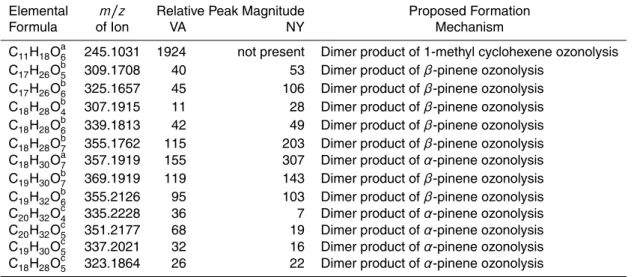
Formula assignments for many of the FT-ICR MS peaks in this study were consistent with formulas proposed in experimental laboratory investigations of SOA formation by other researchers (Table 2). While molecular structure can not be deduced from the
5
data collected in the present study, the molecular formulas are consistent with the presence of at least certain SOA compounds and illustrate how the extremely high mass resolution of FT-ICR MS may be utilized to identify dominant SOA species in field-collected aerosols, aerosol-WSOC, rainwater and other natural aqueous samples. Of the molecular formulas in Table 2, C18H28O4 was the most prevalent potential
10
SOA species in the Virginia sample, while C20H32O4 was the most prevalent poten-tial SOA species in the New York sample. Heaton et al. (2007) observed C18H28O4 as a product of β-pinene ozonolysis and suggested its formation is via reaction of a
monomer end product and a hydroperoxide intermediate ofβ-pinene ozonolysis. In
comparison, C20H32O4 (Table 2) was a product of α-pinene ozonolysis, and its
pres-15
ence was attributed to dimerization of pinonaldehyde, a known product of primary ozonolysis, via either aldol condensation or gem-diol formation (Tolocka et al., 2004).
The majority of previous experimental and field studies identifying SOA compounds focused on low molecular weight (LMW) species (m/z<200; e.g. Forstner et al., 1997;
Jang and Kamens, 2001). However, recent experimental work also argues for the
for-20
mation of HMW SOA compounds that are oligomers of precursor compounds (Gao et al., 2004; Kalberer et al., 2004; Tolocka et al., 2004; Dommen et al., 2006; Heaton et al., 2007). The abundance of HMW peaks in the mass spectra (Fig. 1a and b) and molecular formula assignments in Table 2 agree with these recent studies on the contri-bution of HMW compounds to SOA (Gao et al., 2004; Kalberer et al., 2004; Tolocka et
25
al., 2004; Dommen et al., 2006; Heaton et al., 2007). While the ESI FT-ICR MS method utilized in this study does not characterize LMW SOA products, detailed molecular characterization of HMW SOA using FT-ICR MS is possible. This approach may help
ACPD
8, 6539–6569, 2008 ESI FT-ICR MS characterization of aerosol WSOC A. S. Wozniak et al. Title Page Abstract Introduction Conclusions References Tables Figures ◭ ◮ ◭ ◮ Back CloseFull Screen / Esc
Printer-friendly Version Interactive Discussion
establish which of the many HMW SOA compounds identified in experimental labora-tory investigations are prevalent in field samples, thus helping to identify the dominant formation processes and pathways under natural environmental conditions. Laboratory studies have also employed ESI FT-ICR MS to examine the behavior ofα-pinene in the
presence of ozone to reveal that polymerization processes were important in the
for-5
mation of HMW SOA (Tolocka et al., 2004; Reinhardt et al., 2007). Tolocka et al. (2004) also found several species whose presence could not be explained by monomer poly-merization or degradation and proposed unknown complex chemical pathways for their formation. This study also reported SOA oligomers from a field sample illustrating the utility of FT-ICR MS in validating laboratory investigations (Tolocka et al., 2004). ESI
10
FT-ICR MS may alternately be used in field and laboratory investigations to detect SOA compounds that may be abundant but previously unidentified.
5 Conclusions
ESI FT-ICR MS is well-adapted to molecularly characterizing aerosol WSOC as a re-sult of its extremely high mass resolving power and ability to ionize and detect polar,
15
hydrophilic molecules such as the HULIS-type molecules in WSOC. Van Krevelen dia-grams of compounds found in aerosol WSOC may be further useful for understanding the general compositional features of WSOC compounds. Finally, ESI FT-ICR MS may be particularly well-suited to identifying BC and SOA molecular formulas, giving inves-tigators an inventory of BC and SOA compounds in aerosol WSOC that may permit
20
more detailed study of these highly complex substances for better understanding their formation and degradation pathways. Further work is required to make ESI FT-ICR MS analyses more quantitative if at all possible, but presently has been shown to be an ex-cellent qualitative tool available to the aerosol and atmospheric chemistry communities.
Acknowledgements. The lead author (A. S. Wozniak) was partially supported by a
Gradu-25
ate Fellowship from the Hudson River Foundation during the course of this study. Additional funding for this work came from the following NSF awards to JEB: DEB Ecosystems grant
ACPD
8, 6539–6569, 2008 ESI FT-ICR MS characterization of aerosol WSOC A. S. Wozniak et al. Title Page Abstract Introduction Conclusions References Tables Figures ◭ ◮ ◭ ◮ Back CloseFull Screen / Esc
Printer-friendly Version Interactive Discussion DEB-0234533, Chemical Oceanography grant OCE-0327423, and Integrated Carbon Cycle
Research Program grant EAR-0403949 to JEB. We thank J. P. Rinehimer and P. Dickhudt for writing a MATLAB script to pre-process the molecular formula data, W. Reay for field assistance in Virginia, J. Cole, H. Malcom, and V. Kelly for field assistance in New York, E. Keesee for lab-oratory assistance, and S. Hatcher for assistance at the COSMIC facility. This manuscript is
5
contribution #2917 to the Virginia Institute of Marine Science.
References
Alfarra, M. R., Paulsen, D., Gysel, M., Garforth, A. A., Dommen, J., Prevot, A. S. H., Worsnop, D. R., Baltensperger, U., and Coe, H.: A mass spectrometric study of secondary organic aerosols formed from the photooxidation of anthropogenic and biogenic precursors in a
re-10
action chamber, Atmos. Chem. and Phys., 6, 5279–5293, 2006.
Altieri, K. E., Seitzinger, S. P., Carlton, A. G., Turpin, B. J., Klein, G. C., and Marshall, A. G.: Oligomers formed through in-cloud methylglyoxal reactions: Chemical composition, proper-ties, and mechanisms investigated by ultra-high resolution FT-ICR mass spectrometry, At-mos. Environ., 42, 1476–1490, 2008.
15
Baker, A. R., Jickells, T. D., Witt, M., and Linge, K. L.: Trends in the solubility of iron, aluminum, manganese and phosphorous in aerosol collected over the Atlantic Ocean, Mar. Chem., 98, 43–58, 2006.
Benner, R.: Chemical composition and reactivity, in: Biogeochemistry of Marine Dissolved Organic Matter, edited by: Hansell, D. A. and Carlson, C. A., Academic Press, New York,
20
59–90, 2002.
Bond, T. C., Streets, D. G., Yarber, K. F., Nelson, S. M., Woo, J.-H., and Klimont, Z.: A technology-based global inventory of black and organic carbon emissions from combustion, J. Geophys. Res.-Atm., 109, D14203, doi:10.1029/2003JD003697, 2004.
Brown, T. L.and Rice, J. A.: Effect of experimental parameters on the ESI FT-ICR mass
spec-25
trum of fulvic acid, Anal. Chem., 72(2), 384–390, 2000.
Charlson, R. J.: Atmospheric visibility related to aerosol mass concentration: A review, Environ. Sci. Technol., 3, 913–918, 1969.
Chen, L.-W. A., Doddridge, B. G., Dickerson, R. R., Chow, J. C., and Henry, R. C.: Origins of fine aerosol mass in the Baltimore-Washington corridor: implications from observation,
ACPD
8, 6539–6569, 2008 ESI FT-ICR MS characterization of aerosol WSOC A. S. Wozniak et al. Title Page Abstract Introduction Conclusions References Tables Figures ◭ ◮ ◭ ◮ Back CloseFull Screen / Esc
Printer-friendly Version Interactive Discussion factor analysis, and ensemble air parcel back trajectories, Atmos. Environ., 36, 4541–4554,
2002.
Davidson, C. I., Phalen, R. F., and Solomon, P. A.: Airborne particulate matter and human health: A review, Aerosol Sci. Tech., 39, 737–749, 2005.
Decesari, S., Facchini, M. C., Fuzzi, S., and Tagliavini, E.: Characterization of water-soluble
5
organic compounds in atmospheric aerosol: A new approach, J. Geophys. Res.-Atmos., 105(D1), 1481–1489, doi:10.1029/1999JD900950, 2000.
Decesari, S., Facchini, M. C., Matta, E., Mircea, M., Fuzzi, S., Chughtai, A. R., and Smith, D. M.: Water soluble organic compounds formed by oxidation of soot, Atmos. Environ., 36, 1827–1832, 2002.
10
Decesari, S., Mircea, M., Cavalli, F., Fuzzi, S., Moretti, F., Tagliavini, E., and Facchini, M. C.: Source attribution of water-soluble organic aerosol by nuclear magnetic resonance spec-troscopy, Environ. Sci. Technol., 41, 2479–2484, 2007.
Dickens, A. F., Gelinas, Y., and Hedges, J. I.: Physical Separation of combustion and rock sources of graphitic black carbon in sediments, Mar. Chem., 92, 215–224, 2004.
15
Dickhut, R. M., Canuel, E. A., Gustafson, K. E., Liu, K., Arzayus, K. M., Walker, S. E., Edge-combe, G., Gaylor, M. O., and Macdonald, E. H.: Automotive sources of carcinogenic poly-cyclic aromatic hydrocarbons associated with particulate matter in the Chesapeake Bay re-gion, Environ. Sci. Technol., 34, 4635–4640, 2000.
Dommen, J., Metzger, A., Duplissy, J., Kalberer, M., Alfarra, M. R., Gascho, A.,
Weingart-20
ner, E., Prevot, A. S. H., Verheggen, B., and Baltensperger, U.: Laboratory observation of oligomers in the aerosol from isoprene/NOxphotooxidation, Geophys. Res. Lett., 33, L13805, doi:10.1029/2006GL026523, 2006.
Driscoll, C. T., Lawrence, G. B., Bulger, A. J., Butler, T. J., Cronan, C. S., Eagar, C., Lambert, K. F., Likens, G. E., Stoddard, J. L., and Weathers, K. C.: Acidic deposition in the
north-25
eastern United States: Sources and inputs, ecosystem effects, and management strategies, Bioscience, 51, 180–198, 2001.
Duarte, R. M. B. O., Pio, C. A., and Duarte, A. C.: Spectroscopic study of the water-soluble or-ganic matter isolated from atmospheric aerosols collected under different atmospheric con-ditions, Anal. Chim. Acta, 530, 7–14, 2005.
30
Edney, E. O., Kleindienst, T. E., Conver, T. S., McIver, C. D., Corse, E. W., and Weathers, W. S.: Polar organic oxygenates in PM2.5 at a southeastern site in the United States, Atmos. Environ., 37, 3947–3965, 2003.
ACPD
8, 6539–6569, 2008 ESI FT-ICR MS characterization of aerosol WSOC A. S. Wozniak et al. Title Page Abstract Introduction Conclusions References Tables Figures ◭ ◮ ◭ ◮ Back CloseFull Screen / Esc
Printer-friendly Version Interactive Discussion Forstner, H. J., Flagan, R. C., and Seinfeld, J. H.: Secondary organic aerosol from the
pho-tooxidation of aromatic hydrocarbons: Molecular composition, Environ. Sci. Technol., 31, 1345–1358, 1997.
Fuzzi, S., Decesari, S., Facchini, M. C., Matta, E., Mircea, M., and Tagliavini, E.: A simplified model of the water soluble organic component of atmospheric aerosols, Geophys. Res. Lett.,
5
20, 4079–4082, 2001.
Galiulin, R. V., Bashkin, V. N., and Galiulina, R. A.: Review: Behavior of persistent organic pollutants in the air-plant-soil system, Water Air Soil Poll., 137, 179–191, 2002.
Gao, S., Ng, N. L., Keywood, M., Varutbangkul, V., Bahreini, R., Nenes, A., He, J., Yoo, K. Y., Beauchamp, J. L., Hodyss, R. P., Flagan, R. C., and Seinfeld, J. H.: Particle phase acidity
10
and oligomer formation in secondary organic aerosol, Environ. Sci. Technol., 38, 6582–6589, 2004.
Gatari, M. J. and Boman, J.: Black carbon and total carbon measurements at urban and rural sites in Kenya, East Africa, Atmos. Environ., 37, 1149–1154, 2003.
Gaskell, S. J.: Electrospray: Principles and Practice, J. Mass Spectrom., 32(7), 677–688, 1997.
15
Gilardoni, S., Russell, L. M., Sorooshian, A., Flagan, R. C., Seinfeld, J. H., Bates, T. S., Quinn, P. K., Allan, J. D., Williams, B., Goldstein, A. H., Onasch, T. B., and Worsnop, D. R.: Regional variation of organic functional groups in aerosol particles on four U. S. east coast platforms during the International Consortium for Atmospheric Research on Transport and Transforma-tion 2004 campaign, J. Geophys. Res.-Atmos., 112, D10S27, doi:10.1029/2006JD007737,
20
2007.
Grannas, A. M., Hockaday, W. C., Hatcher, P. G., Thompson, L. G., and Mosley-Thompson, E.: New revelations on the nature of organic matter in ice cores, J. Geophys. Res., 111, D04304, doi:10.1029/2005JD006251, 2006.
Grimshaw, H. J. and Dolske, D. A.: Rainfall concentrations and wet atmospheric deposition
25
of phosphorous and other constituents in Florida, USA, Water Air Soil Poll., 137, 117–140, 2002.
Hammes, K., Schmidt, M. W. I., Smernik, R. J., Currie, L. A., Ball, W. P., Nguyen, T. N., Lou-chouarn, P., Houel, S., Gustafsson, O., Elmquist, M., Cornelissen, G., Skjemstad, J. O., Masiello, C. A., Song, J., Peng. P., Mitra, S., Dunn, J. C., Hatcher, P. G., Hockaday, W.
30
C., Smith, D. M., Hartkopf-Froder, C., Bohmer, A., Luer, B., Huebert, B. J., Armelung, W., Brodowski, S., Huang, L., Zhang, W., Gschwend, P. M., Flores-Cervantes, D. X., Largeau, C., Rouzaud, J.-N., Rumpel, C., Guggenberger, G., Kaiser, K., Rodionov, A., Gonzalez-Vila,
ACPD
8, 6539–6569, 2008 ESI FT-ICR MS characterization of aerosol WSOC A. S. Wozniak et al. Title Page Abstract Introduction Conclusions References Tables Figures ◭ ◮ ◭ ◮ Back CloseFull Screen / Esc
Printer-friendly Version Interactive Discussion F. J., Gonzalez-Perez, J. A., de la Rosa, J. M., Manning, D. A. C., Lopez-Capel, E., and
Ding, L.: Comparison of quantification methods to measure fire-derived (black/elemental) carbon in soils and sediments using reference materials from soil, water, sediment and the atmosphere, Global Biogeochem. Cy., 21, GB3016, doi:10.1029/2006GB002914, 2007. Heaton, K. J., Dreyfus, M. A., Wang, S., and Johnston, M. V.: Oligomers in the early stage of
5
biogenic secondary organic aerosol, Environ. Sci. Technol., 41, 6129–6136, 2007.
Highwood, E. J. and Kinnersley, R. P.: When smoke gets in our eyes: The multiple impacts of atmospheric black carbon in climate, air quality and health, Environ. Int., 32, 560–566, 2006. Hockaday, W. C., Grannas, A. M., Kim, S., and Hatcher, P. G.: Direct molecular evidence for the
degradation and mobility of black carbon in soils from the ultrahigh-resolution mass spectral
10
analysis of dissolved organic matter from a fire-impacted forest soil, Org. Geochem., 37, 501–510, 2006.
Jacobson, M. C., Hansson, H.-C., Noone, K. J., and Charlson, R. J.: Organic atmospheric aerosols: Review and state of the science, Rev. Geophys., 38(2), 267–294, 2000.
Jang, M. and Kamens, R. M.: Characterization of secondary aerosol from the photooxidation
15
of toluene in the presence of NOx and 1-propene, Environ. Sci. Technol., 35, 3626–3639, 2001.
Jaoui, M., Klendienst, T. E., Lewandowski, M., Offenberg, J. H., and Edney, E. O.: Identification and quantification of aerosol polar oxygenated compounds bearing carboxylic or hydroxyl groups. 2. Organic tracer compounds from monoterpenes, Environ. Sci. Technol., 39, 5661–
20
5673, 2005.
Jurado, E., Jaward, F. M., Lohmann, R., Jones, K. C., Simo, R., and Dachs, J.: Atmospheric dry deposition of persistent organic pollutants to the Atlantic and inferences for the global oceans, Environ. Sci. Pollut. R., 38, 5505–5513, 2004.
Kalberer, M., Paulsen, D., Sax, M., Steinbacher, M., Dommen, J., Prevot, A. S. H., Fisseha, R.,
25
Weingartner, E., Frankevich, V., Zenobi, R., and Baltensperger, U.: Identification of polymers as major components of atmospheric organic aerosols, Science, 303, 1659–1662, 2004. Kamegawa, K., Nishikubo, K., Kodama, M., Adachi, Y., and Yoshida, H.: Oxidative degradation
of carbon blacks with nitric acid II. Formation of water-soluble polynuclear aromatic com-pounds, Carbon, 40, 1447–1455, 2002.
30
Kanakidou, M., Seinfeld, J. H., Pandis, S. N., Barnes, I., Dentener, F. J., Facchini, M. C., Van Dingenen, R., Erven, B., Nenes, A., Nielsen, C. J., Swietlicki, E., Putaud, J. P., Balkanski, Y., Fuzzi, S., Horth, J., Moortgat, G. K., Winterhalter, R., Myhre, C. E. L., Tsigaridis, K., Vignati,
ACPD
8, 6539–6569, 2008 ESI FT-ICR MS characterization of aerosol WSOC A. S. Wozniak et al. Title Page Abstract Introduction Conclusions References Tables Figures ◭ ◮ ◭ ◮ Back CloseFull Screen / Esc
Printer-friendly Version Interactive Discussion E., Stephanou, E. G., and Wilson, J.: Organic aerosol and global climate modeling: a review,
Atmos. Chem. Phys., 5, 1053–1123, 2005,
http://www.atmos-chem-phys.net/5/1053/2005/.
Kim, S., Simpson, A. J., Kujawinski, E. B., Freitas, M. A., and Hatcher, P. G.: High resolution electrospray ionization mass spectrometry and 2D solution NMR for the analysis of DOM
5
extracted by C18 solid phase disk, Org. Geochem., 34(9), 1325–1335, 2003a.
Kim, S., Kramer, R. W., and Hatcher, P. G.: Graphical method for analysis of ultrahigh-resolution broadband mass spectra of natural organic matter, the van Krevelen diagram, Anal. Chem., 75(20), 5336–5344, 2003b.
Kim, S., Kaplan, L. A., Benner, R., and Hatcher, P. G.: Hydrogen-deficient molecules in natural
10
riverine water samples – evidence for the existence of black carbon in DOM, Mar. Chem., 92, 225–234, 2004.
Kleefeld, S., Hoffer, A., Krivacsy, Z., and Jennings, S. G.: Importance of organic and black car-bon in atmospheric aerosols at Mace Head, on the West Coast of Ireland (53◦19′N, 9◦54′W), Atmos. Environ., 36, 4479–4490, 2002.
15
Koch, B. P., Witt, M., Engbrodt, R., Dittmar, T., and Kattner, G.: Molecular formulae of marine and terrigenous dissolved organic matter detected by electrospray ionization Fourier trans-form ion cyclotron resonance mass spectrometry, Geochim. Cosmochim. Ac., 69, 3299– 3308, 2005.
Koch, D.: Transport and direct radiative forcing of carbonaceous and sulfate aerosols in the
20
GISS GCM, J. Geophys. Res.-Atmos., 106(D17), 20 311–20 322, 2001.
Kramer, R. W., Kujawinski, E. B., and Hatcher, P. G.: Identification of black carbon derived structures in a volcanic ash soil humic acid by Fourier transform ion cyclotron resonance mass spectrometry, Environ. Sci. Technol., 38, 3387–3395, 2004.
Krivacsy, Z., Hoffer, A., Sarvari, Zs., Temesi, D., Baltensperger, U., Nyeki, S., Weingartner,
25
E., Kleefeld, S., and Jennings, S. G.: Role of organic and black carbon in the chemical composition of atmospheric aerosol at European background sites, Atmos. Environ., 35, 6231–6244, 2001.
Kujawinski, E. B.: Electrospray ionization fourier transform ion cyclotron resonance mass spec-trometry (ESI FT-ICR MS): Characterization of complex environmental mixtures, Environ.
30
Forensics, 3, 207–216, 2002.
Kujawinski, E. B., Freitas, M. A., Zang, X., Hatcher, P. G., Green-Church, K. B., and Jones, R. B.: The application of electrospray ionization mass spectrometry (ESI MS) to the structural
ACPD
8, 6539–6569, 2008 ESI FT-ICR MS characterization of aerosol WSOC A. S. Wozniak et al. Title Page Abstract Introduction Conclusions References Tables Figures ◭ ◮ ◭ ◮ Back CloseFull Screen / Esc
Printer-friendly Version Interactive Discussion characterization of natural organic matter, Org. Geochem., 33, 171–180, 2002a.
Kujawinski, E. B., Hatcher, P. G., and Freitas, M. A.: High-resolution Fourier transform ion cyclotron resonance mass spectrometry of humic and fulvic acids: improvements and com-parisons, Anal. Chem., 74, 413–419, 2002b.
Kujawinski, E. B., del Vecchio, R., Blough, N. V., Klein, G. C., and Marshall, A. G.:
Prob-5
ing molecular-level transformations of dissolved organic matter: insights on photochemical degradation and protozoan modification of DOM from electrospray ionization Fourier trans-form ion cyclotron resonance mass spectrometry, Mar. Chem., 92, 23–37, 2004.
Kujawinski, E. B. and Behn, M. D.: Automated analysis of electrospray ionization Fourier trans-form ion cyclotron resonance mass spectra of natural organic matter, Anal. Chem., 78, 4363–
10
4373, 2006.
Likens, G. E. and Bormann, F. H.: Acid rain: A serious regional environmental problem, Sci-ence, 184, 1176–1179, 1974.
Liu, W., Wang, Y., Russell, A., and Edgerton, E. S.: Atmospheric aerosol over two urban-rural pairs in the southeastern United States: Chemical composition and possible sources, Atmos.
15
Environ., 39, 4453–4470, 2005.
Lohmann, U. and Feichter, J.: Global indirect aerosol effects: a review, Atmos. Chem. Phys., 5, 715–737, 2005,
http://www.atmos-chem-phys.net/5/715/2005/.
Louchouarn, P., Opsahl, S., and Benner, R.: Isolation and quantification of dissolved lignin from
20
natural waters using solid-phase extraction and GC/MS, Anal. Chem., 72, 2780–2787, 2000. Mannino, A. and Harvey, H. R.: Black carbon in estuarine and coastal ocean dissolved organic
matter, Limnol. Oceanogr., 49, 735–740, 2004.
Marshall, A. G., Hendrickson, C. L., and Jackson, G. S.: Fourier Transform Ion Cyclotron Res-onance Mass Spectrometry: A Primer, Mass Spectrom. Rev., 17, 1–35, 1998.
25
Masiello, C. A.: New directions in black carbon organic geochemistry, Mar. Chem., 92, 201– 213, 2004.
Mayol-Bracero, O. L., Guyon, P., Graham, B., Roberts, G., Andreae, M. O., Decesari, S., Fac-chini, M. C., Fuzzi, S., and Artaxo, P.: Water-soluble organic compounds in biomass burning aerosols over Amazonia 2. Apportionment of the chemical composition and importance of the
30
polyacidic fraction, J. Geophys. Res.-Atmos., 107(D20), 8091, doi:10.1029/2001JD000522, 2002.
ACPD
8, 6539–6569, 2008 ESI FT-ICR MS characterization of aerosol WSOC A. S. Wozniak et al. Title Page Abstract Introduction Conclusions References Tables Figures ◭ ◮ ◭ ◮ Back CloseFull Screen / Esc
Printer-friendly Version Interactive Discussion Quantitites, sources, and potential implications for the global carbon cycle, Environ. Sci.
Technol., 36, 2296–2302, 2002.
Novakov, T., Menon, S., Kirchstetter, T. W., Koch, D., and Hansen, J. E.: Aerosol organic carbon to black carbon ratios: Analysis of published data and implications for climate forcing, J. Geophys. Res.-Atmos., 110, D21205, doi:10.1029/2005JD005977, 2005.
5
Park, R. J., Jacob, D. J., Palmer, P. I., Clarke, A. D., Weber, R. J., Zondlo, M. A., Eisele, F. L., Bandy, A. R., Thornton, D. C., Sachse, G. W., and Bond, T. C.: Export efficiency of black carbon aerosol in continental outflow: Global implications, J. Geophys. Res.-Atmos., 110, D11205, doi:10.1029/2004JD005432, 2005.
Penner, J. E., Eddleman, H., and Novakov, T.: Towards the development of a global inventory
10
of black carbon emissions, Atmos. Environ., 27A, 1277–1295, 1993.
Ramanathan, V., Crutzen, P. J., Kiehl, J. T., and Rosenfeld, D.: Aerosols, climate, and the hydrological cycle, Science, 294, 2119–2124, 2001.
Reinhardt, A., Emmenegger, C., Gerrits, B., Panse, C., Dommen, J., Baltensperger, U., Zenobi, R., and Kalberer, M.: Ultrahigh mass resolution and accurate mass measurements as a
15
tool to characterize oligomers in secondary organic aerosols, Anal. Chem., 79, 4074–4082, 2007.
Romero, F. and Oehme, M.: Organosulfates – A new component of humic-like substances in atmospheric aerosols?, J. Atmos. Chem., 52, 283–294, 2005.
Rostad C. E., Leenheer J.A.: Factors that affect molecular weight distribution of Suwannee
20
river fulvic acid as determined by electrospray ionization/mass spectrometry, Anal. Chim. Acta, 523, 269–278, 2004.
Sannigrahi, P., Sullivan, A. P., Weber, R. J., and Ingall, E. D.: Characterization of water-soluble organic carbon in urban atmospheric aerosols using solid state13C NMR spectroscopy, En-viron. Sci. Technol., 40, 666–672, 2006.
25
Satheesh, S. K. and Moorthy, K. K.: Radiative effects of natural aerosols: A review, Atmos. Environ., 39, 2089–2110, 2005.
Saxena, P. and Hildemann, L. M.: Water-soluble organics in atmospheric particles: A critical review of the literature and application of thermodynamics to identify candidate compounds, J. Atmos. Chem., 24, 57–109, 1996.
30
Sleighter, R. L. and Hatcher, P. G.: The application of electrospray ionization coupled to ul-trahigh resolution mass spectrometry for the molecular characterization of natural organic matter, J. Mass Spectrom., 42, 559–574, 2007.
ACPD
8, 6539–6569, 2008 ESI FT-ICR MS characterization of aerosol WSOC A. S. Wozniak et al. Title Page Abstract Introduction Conclusions References Tables Figures ◭ ◮ ◭ ◮ Back CloseFull Screen / Esc
Printer-friendly Version Interactive Discussion Sleighter, R. L., McKee, G. A., Liu, Z., and Hatcher, P. G.: Naturally Present Fatty Acids as
Internal Calibrants for Fourier Transform Mass Spectra of Dissolved Organic Matter, Limnol. Oceanogr.-Meth., accepted for publication, 2008.
Stenson, A. C., Landing, W. M., Marshall, A. G., and Cooper, W. T.: Ionization and fragmenta-tion of humic substances in electrospray ionizafragmenta-tion Fourier transform-ion cyclotron resonance
5
mass spectrometry, Anal. Chem., 74, 4397–4409, 2002.
Stenson, A. C., Marshall, A. G., and Cooper, W. T.: Exact masses and chemical formulas of in-dividual Suwannee River fulvic acids from ultrahigh resolution electrospray ionization Fourier transform ion cyclotron resonance mass spectra, Anal. Chem., 75, 1275–1284, 2003. Sullivan, A. P. and Weber, R. J.: Chemical characterization of the ambient organic aerosol
solu-10
ble in water: 2. Isolation of acid, neutral, and basic fractions by modified size-exclusion chro-matography, J. Geophys. Res.-Atmos., 111, D05315, doi:10.1029/2005JD006486, 2006. Tanner, R. L., Parkhurst, W. J., and McNichol, A. P.: Fossil sources of ambient aerosol carbon
based on14C measurements, Aerosol Sci. Tech., 38(S1), 133–139, 2004.
Tolocka, M. P., Jang, M., Ginter, J. M., Cox, F. J., Kamens, R. M., and Johnston, M. V.:
For-15
mation of oligomers in secondary organic aerosol, Environ. Sci. Technol., 38, 1428–1434, 2004.
Toon, O. B.: How pollution suppresses rain, Science, 287, 1763–1765, 2000.
Tremblay, L. B., Dittmar, T., Marshall, A. G., Cooper, W. J., and Cooper, W. T.: Molecular characterization of dissolved organic matter in a North Brazilian mangrove porewater and
20
mangrove-fringed estuaries by ultrahigh resolution Fourier transform- ion cyclotron reso-nance mass spectrometry and excitation/emission spectroscopy, Mar. Chem., 105, 15–29, 2007.
Wang, H., Kawamura, K., and Shooter, D.: Wintertime organic aerosols in Christchurch and Auckland, New Zealand: contributions of residential wood and coal burning and petroleum
25
utilization, Environ. Sci. Technol., 40, 5257–5262, 2006.
Wolff, G. T., Kelly, N. A., Ferman, M. A., Ruthkosky, M. S., Stroup, D. P., and Korsog, P. E.: Measurements of sulfur oxides, nitrogen oxides, haze and fine particles at a rural site on the Atlantic Coast, JAPCA J. Air Waste Ma., 36, 585–591, 1986.
Wozniak, A. S., Bauer, J. E., Dickhut, R. M., Hatcher, P. G., Keesee, E. E., and Sleighter,
30
R. L.: Isotopic and molecular characterization of total and water-soluble aerosol organic matter: implications for carbon fluxes and budgets in watersheds and rivers, Ocean Sciences Meeting, Orlando, FL, 2–7 March 2008.
ACPD
8, 6539–6569, 2008 ESI FT-ICR MS characterization of aerosol WSOC A. S. Wozniak et al. Title Page Abstract Introduction Conclusions References Tables Figures ◭ ◮ ◭ ◮ Back CloseFull Screen / Esc
Printer-friendly Version Interactive Discussion Yang, H., Xu, J., Wu, W.-S., Wan, C. H., and Yu, J. Z.: Chemical characteristics of water-soluble
organic aerosols at Jeju Island collected during ACE-Asia, Environ. Chem., 1, 13–17, 2004. Yu, L. E., Shulman, M. L., Kopperud, R., and Hildemann, L. M.: Characterizations of organic
compounds collected during southeastern aerosol and visibility study: water-soluble organic species, Environ. Sci. Technol., 39, 707–715, 2005.
5
Zuberi, B., Johnson, K. S., Aleks, G. K., Molina, L. T., and Molina, M. J.: Hydrophilic properties of aged soot, Geophys. Res. Lett., 32, L01807, doi:10.1029/2004GL021496, 2005.
ACPD
8, 6539–6569, 2008 ESI FT-ICR MS characterization of aerosol WSOC A. S. Wozniak et al. Title Page Abstract Introduction Conclusions References Tables Figures ◭ ◮ ◭ ◮ Back CloseFull Screen / Esc
Printer-friendly Version Interactive Discussion Table 1. Percent occurrence of formula groups and magnitude-weighted percent contribution
of formula groups to all peaks assigned molecular formulas in the mass spectra. Formulas are grouped based on their elemental constituents.
Elemental Percent Occurrence Magnitude-Weighted Percent Contribution
Constituents VA NY VA NY
C, H, O 57 58 77 75
C, H, O, N 26 16 12 6
C, H, O, S 17 26 11 19
ACPD
8, 6539–6569, 2008 ESI FT-ICR MS characterization of aerosol WSOC A. S. Wozniak et al. Title Page Abstract Introduction Conclusions References Tables Figures ◭ ◮ ◭ ◮ Back CloseFull Screen / Esc
Printer-friendly Version Interactive Discussion Table 2. Elemental formulas of compounds consistent with proposed or identified SOA
com-pounds from selected previous studies. Relative peak magnitudes are ranked from 1 (strongest peak assigned a molecular formula in spectrum) ton (weakest peak assigned a molecular
for-mula in spectrum; for VA,n=2098; for NY, n=2261).
Elemental m/z Relative Peak Magnitude Proposed Formation
Formula of Ion VA NY Mechanism
C11H18Oa6 245.1031 1924 not present Dimer product of 1-methyl cyclohexene ozonolysis
C17H26O b
5 309.1708 40 53 Dimer product ofβ-pinene ozonolysis
C17H26O b
6 325.1657 45 106 Dimer product ofβ-pinene ozonolysis
C18H28O b
4 307.1915 11 28 Dimer product ofβ-pinene ozonolysis
C18H28O b
6 339.1813 42 49 Dimer product ofβ-pinene ozonolysis
C18H28Ob7 355.1762 115 203 Dimer product ofβ-pinene ozonolysis
C18H30O a
7 357.1919 155 307 Dimer product ofα-pinene ozonolysis
C19H30Ob7 369.1919 119 143 Dimer product ofβ-pinene ozonolysis
C19H32O b
6 355.2126 95 103 Dimer product ofβ-pinene ozonolysis
C20H32Oc4 335.2228 36 7 Dimer product ofα-pinene ozonolysis
C20H32O c
5 351.2177 68 19 Dimer product ofα-pinene ozonolysis
C19H30O c
5 337.2021 32 16 Dimer product ofα-pinene ozonolysis
C18H28Oc5 323.1864 26 22 Dimer product ofα-pinene ozonolysis
a Gao et al., 2004; b Heaton et al., 2007; c Tolocka et al., 2004.
ACPD
8, 6539–6569, 2008 ESI FT-ICR MS characterization of aerosol WSOC A. S. Wozniak et al. Title Page Abstract Introduction Conclusions References Tables Figures ◭ ◮ ◭ ◮ Back CloseFull Screen / Esc
Printer-friendly Version Interactive Discussion 225 300 400 500 600 700 331 333 335 337 339 a) 225 300 400 500 600 700 m/z R e la ti v e Ma g n itu d e 331 333 335 337 339 331 333 335 337 339 a) 225 300 400 500 600 700 331 333 335 337 339 b) 225 300 400 500 600 700 m/z R e la ti v e M a g n itu d e 331 333 335 337 339 b)
Fig. 1. ESI FT-ICR mass spectra for aerosol WSOC samples collected in (a) August 2006 in New York and (b) November 2006 in Virginia. Insets highlight them/z 330–340 region showing
ACPD
8, 6539–6569, 2008 ESI FT-ICR MS characterization of aerosol WSOC A. S. Wozniak et al. Title Page Abstract Introduction Conclusions References Tables Figures ◭ ◮ ◭ ◮ Back CloseFull Screen / Esc
Printer-friendly Version Interactive Discussion 295.05 295.15 295.25 295.35 295.05 295.15 295.25 295.35 m/z R e la ti v e Ma g n itu d e
Fig. 2. Expanded ESI FT-ICR mass spectrum region atm/z 295 for aerosol WSOC sample
ACPD
8, 6539–6569, 2008 ESI FT-ICR MS characterization of aerosol WSOC A. S. Wozniak et al. Title Page Abstract Introduction Conclusions References Tables Figures ◭ ◮ ◭ ◮ Back CloseFull Screen / Esc
Printer-friendly Version Interactive Discussion 0 0.5 1 1.5 2 2.5 0 0.2 0.4 0.6 0.8 1
Atomic O/C ratio
A tomi c H /C r ati o condensed hydrocarbons tannins lipids cellulose proteins lignin a)mono-carboxylic acidsdicarboxylic acids
SOA 0 0.5 1 1.5 2 2.5 0 0.2 0.4 0.6 0.8 1
Atomic O/C ratio
A tomi c H /C r ati o condensed hydrocarbons tannins lipids cellulose proteins lignin b) SOA mono-carboxylic acids di-carboxylic acids
Fig. 3. Van Krevelen plots for elemental formulas assigned to FT-ICR mass spectra peaks in aerosol WSOC samples from (a) New York and (b) Virginia. Blue diamonds represent com-pounds containing only C, H, and O, yellow squares represent S-containing comcom-pounds, and red triangles are N-containing compounds. Black ovals represent traditional potential source molecular classes (after Sleighter et al., 2007). The green SOA oval represents published mo-lar H/C and O/C ratios from laboratory investigations of secondary organic aerosols (Reinhardt et al., 2007; Altieri et al., 2008). O/C ratios for the green ovals representing mono- and dicar-boxylic acids were calculated for molecules containing 10–30 carbons, and the H/C ratios for these ovals assumed little branching and few double bonds.
ACPD
8, 6539–6569, 2008 ESI FT-ICR MS characterization of aerosol WSOC A. S. Wozniak et al. Title Page Abstract Introduction Conclusions References Tables Figures ◭ ◮ ◭ ◮ Back CloseFull Screen / Esc
Printer-friendly Version Interactive Discussion 0 0.2 0.4 0.6 0.8 1 DBE/C M agn it u d e BC Compounds (a) 0 0.2 0.4 0.6 0.8 1 DBE/C M agn it u d e BC Compounds (b)
Fig. 4. Peak magnitude vs. DBE/C for elemental formulas identified in aerosol WSOC samples from (a) New York and (b) Virginia. Blue diamonds represent compounds containing only C, H, and O, yellow squares represent S-containing compounds, and red triangles are N-containing compounds. For both samples, the y-axis was augmented to make lower magnitude com-pounds visible. Several high magnitude C, H, O comcom-pounds at DBE/C between 0.3 and 0.5 are not shown.