HAL Id: hal-02333586
https://hal.archives-ouvertes.fr/hal-02333586
Submitted on 17 Nov 2020
HAL is a multi-disciplinary open access
archive for the deposit and dissemination of sci-entific research documents, whether they are pub-lished or not. The documents may come from teaching and research institutions in France or abroad, or from public or private research centers.
L’archive ouverte pluridisciplinaire HAL, est destinée au dépôt et à la diffusion de documents scientifiques de niveau recherche, publiés ou non, émanant des établissements d’enseignement et de recherche français ou étrangers, des laboratoires publics ou privés.
Andrii Karpus, Oleksandr Yesypenko, Sergii Cherenok, Vyacheslav Boiko,
Olga Kalchenko, Zoia Voitenko, Oleksandr Trybrat, Rinaldo Poli, Jean-Claude
Daran, Eric Manoury, et al.
To cite this version:
Andrii Karpus, Oleksandr Yesypenko, Sergii Cherenok, Vyacheslav Boiko, Olga Kalchenko, et al.. Chiral phosphorus-containing calixarenes. Phosphorus, Sulfur, and Silicon and the Related Elements, Taylor & Francis, 2019, 194 (4-6), pp.471-475. �10.1080/10426507.2018.1539994�. �hal-02333586�
For Peer Review Only
Chiral phosphorus-containing calixarenes Journal: Phosphorus, Sulfur, and Silicon and the Related Elements Manuscript ID GPSS-2018-0225.R1Manuscript Type: Original Article Date Submitted by the
Author: 11-Oct-2018
Complete List of Authors: Karpus, Andrii; Institute of organic chemistry of Natinal Academy Sciences of Ukraine, Phosphoranes chemistry; Taras Shevchenko National University of Kyiv, Faculty of Chemistry; Laboratoire de Chimie de Coordination du CNRS, Ligands, complex architectures and catalysis Yesypenko, Oleksandr; Institute of organic chemistry of Natinal Academy Sciences of Ukraine, Phosphoranes chemistry
Cherenok, Sergiy; Institute of organic chemistry of Natinal Academy Sciences of Ukraine, Phosphoranes chemistry
Boiko, Vyacheslav; Institute of organic chemistry of Natinal Academy Sciences of Ukraine, Phosphoranes chemistry
Kalchenko, Olga; Institute of organic chemistry of Natinal Academy Sciences of Ukraine, Phosphoranes chemistry
Voitenko, Zoia; Kyyivs'kij nacional'nij universytet imeni Tarasa Shevchenka, Faculty of Chemistry
Tribrat, Oleksandr; Institute of organic chemistry of Natinal Academy Sciences of Ukraine, Phosphoranes chemistry
Poli, Rinaldo; Laboratoire de Chimie de Coordination du CNRS, Ligands, complex architectures and catalysis
Daran, Jean-Claude; Laboratoire de Chimie de Coordination du CNRS, Ligands, complex architectures and catalysis
Manoury, Eric; Laboratoire de Chimie de Coordination du CNRS, Ligands, complex architectures and catalysis
KALCHENKO, Vitaly; Institute of Organic Chemistry, National Academy of Sciences of Ukraine, Phosphoranes Chemistry
For Peer Review Only
URL: http://mc.manuscriptcentral.com/gpss Email: [email protected] 1 2 3 4 5 6 7 8 9 10 11 12 13 14 15 16 17 18 19 20 21 22 23 24 25 26 27 28 29 30 31 32 33 34 35 36 37 38 39 40 41 42 43 44 45 46 47 48 49 50 51 52 53 54 55 56 57 58 59
For Peer Review Only
Chiral phosphorus-containing calixarenes
Andrii Karpus1,2,3, Oleksandr Yesypenko1*, Sergii Cherenok1, Vyacheslav Boiko1, Olga
Kalchenko1, Zoia Voitenko2, Oleksandr Tribrat1, Rinaldo Poli3, Jean-Claude Daran3, Eric
Manoury3, Vitaly Kalchenko1
11nstitute of Organic Chemistry NAS of Ukraine, Kyiv, Ukraine, 2Taras Shevchenko National University of Kyiv, Kyiv, Ukraine 3Laboratoire de Chimie de Coordination du CNRS, Toulouse, France
Email: [email protected]
GRAPHICAL ABSTRACT
Abstract Phosphorus-containing inherently chiral calix[4]arenes as well as calix[4]arenes substituted with phosphinoferrocene chiral groups at the lower rim are described. Stereoselective synthesis, structure, and catalytic properties of the chiral calixarenes are discussed.
Keywords calixarenes, phosphonates, phosphines, chirality, stereoselective synthesis, catalysis.
INTRODUCTION
Calixarenes1,2 are cup-shaped macrocyclic compounds easily synthesized by one pot
cyclocondensation of para-substituted phenols with formaldehyde. Calixarenes are easily
amenable to chemical modification at the upper wide rim or at the lower narrow rim of the macrocycle. Due to their cup-shaped architecture calixarenes can recognize and separate similar in properties guests such as anions, cations and neutral organic molecules or biomolecules. Calixarenes modified with chiral moieties or asymmetrically substituted (inherently chiral) calixarenes discriminate of enantiomers of optically active molecules. The ability of the calixarenes to the enantiodiscrimination opens wide perspectives for their application in chiral technologies such as enantioselective sensors, shift reagents for NMR, catalysts of asymmetrical synthesis, sorbents for chromatography, nonlinear optic materials, one enantiomere drug design, etc3-6. 5 6 7 8 9 10 11 12 13 14 15 16 17 18 19 20 21 22 23 24 25 26 27 28 29 30 31 32 33 34 35 36 37 38 39 40 41 42 43 44 45 46 47 48 49 50 51 52 53 54 55
For Peer Review Only
Phosphorus, Sulfur and Silicon, 193: xxxx-yyyy, 2018 Copyright © Taylor and Francis Group, LLC ISSN: 1042-6507 print / 1563-5325 online
Received xx yyyy 2018; accepted xx yyyy 2018, International Conference on Phosphorus Chemistry 2018 Insert acknowledgements and thanks
This paper is devoted to the phosphorus-contained chiral calixarenes. There are several reasons of interest to the chiral calixarenes bearing phosphorus. First of all phosphorus has rich chemistry and opens wide perspectives in design of the chiral receptors. Phosphorus is
biologically friendly element and chiral organophosphorus compounds play important role in biochemistry and medicine. Chiral phosphines and phosphites are very popular ligands in metallocomplexing catalysis7.
RESULTS AND DISCUSSION
There are two families of the chiral phosphorus-contained calixarenes. The first one consists of the calixarenes functionalized with chiral substituents. The second family is so-called inherently chiral calixarenes.
It is well documented that calixarenes modified with phosphine or phosphite moieties are widely used as ligands of metallocomplexing catalysts for organic synthesis8. It is also known
that metallocomplexes of chiral phosphino ferrocenes catalyze of the asymmetrical reactions9.
So, it was idea to decorate the calixarene platform with a chiral phosphino pherrocene group and investigate catalytical properties of this conjugate.
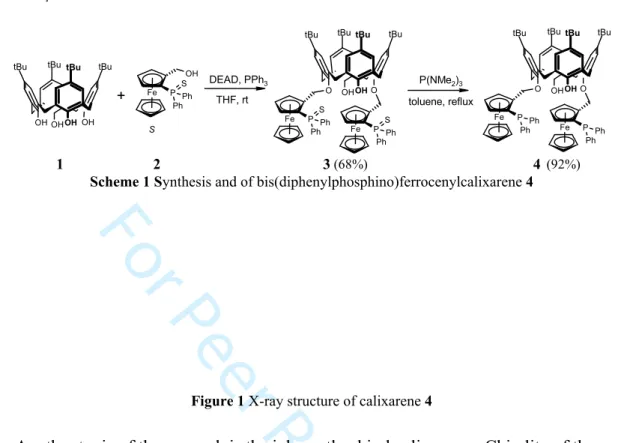
As a reagent for the calixarene modification we used S-enatiomer of
thiophosphino(methylol)ferrocene 2 possessing a planar chirality10. By the Mitsunobu reaction
the chiral thiophosphinoferrocene moieties were connected to distal oxygen atoms at the lower rim of tetrahydroxycalixarene 1 and chiral bis-(thiophosphinoferrocenyl)calixarene 3 was
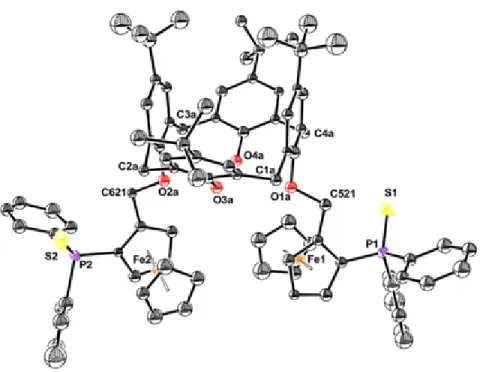
formed. After that sulfur atoms were removed from 3 by the reaction with triamidophosphite and desirable calixarene 4 with two chiral phophinopherrocenyl groups at the lower rim was obtained with high total yield (Scheme 1, Figure 1).
The bis-(phosphinoferrocenyl)calixarene ligand 4 displayed good catalytic activity and enantioselectivity in the asymmetric Tsuji-Trost reaction. In the presence of the ligand the
alkylation of 1,3-diphenylpropenyl acetate by dimethylmalonate occurs with good chemical yield and high enantiomeric excess 86%10.
URL: http://mc.manuscriptcentral.com/gpss Email: [email protected] 1 2 3 4 5 6 7 8 9 10 11 12 13 14 15 16 17 18 19 20 21 22 23 24 25 26 27 28 29 30 31 32 33 34 35 36 37 38 39 40 41 42 43 44 45 46 47 48 49 50 51 52 53 54 55 56 57 58 59
For Peer Review Only
Scheme 1 Synthesis and of bis(diphenylphosphino)ferrocenylcalixarene 4
Figure 1 X-ray structure of calixarene 4
Another topic of the research is the inherently chiral calixarenes. Chirality of the compounds is induced by asymmetric disposition of any achiral substituents at the macrocyclic scaffold. The main method for synthesis of the phosphorus-containing incherently chiral calixarenes is phosphorotropic isomerisation of the symmetrical distally phosphorylated alkoxycalixarenes 5 into chiral 1,2-regioisomeres 6a,b (Scheme 2)11.
Scheme 2 Phosphorotropic isomerization of the symmetrical calixarenes 5 into chiral 1,2-regioisomeres 6a,b It should be noted that the isomerisation is not stereoselective. Phosphorus with the same probability migrates to the both oxygen atoms and racemic mixture of two enantiomeres 6a and
6b is formed. The calixarenphosphates 6 have been converted into free acids and their
diastereomeric salts with chiral L-phenylethylamine were separated by the achiral HPLC method11. H+ OHOH O O P O OEt OEt Et O O O O H P O OEt OEt Et Li+ O O OH OH P O OEt OEt Et P O OEt OEt OHO OH O Et (enantiomeric pair, ABHH type) BuLi THF + 5 6a 6b S P OH Ph Ph Fe OH OHOH OH
tBu tButBu tBu
Fe S P O Ph Ph S P Ph Ph O OHOH Fe
tBu tButBu tBu
Fe P O Ph Ph P Ph Ph O OHOH Fe
tBu tButBu tBu
DEAD, PPh3 THF, rt P(NMe2)3 toluene, reflux S + 1 2 3(68%) 4(92%) 5 6 7 8 9 10 11 12 13 14 15 16 17 18 19 20 21 22 23 24 25 26 27 28 29 30 31 32 33 34 35 36 37 38 39 40 41 42 43 44 45 46 47 48 49 50 51 52 53 54 55
For Peer Review Only
Phosphorus, Sulfur and Silicon, 193: xxxx-yyyy, 2018 Copyright © Taylor and Francis Group, LLC ISSN: 1042-6507 print / 1563-5325 online
Received xx yyyy 2018; accepted xx yyyy 2018, International Conference on Phosphorus Chemistry 2018 Insert acknowledgements and thanks
The phosphorotropic isomerisation of the calixarene phosphate 7 bearing a chiral phenylethylamide auxiliary group in distal position is stereoselective. Phosphorus preferably migrates to one oxygen atom. Two diastereomers of the inherently chiral calixarene 8a,b were formed in this condition with diastereomeric excess of 36% (Scheme 3)12. The diastereomeres
were separated by the column chromatography on silica-gel. Each isomer was transformed into inherently chiral calixarene phosphorus acids 9 and structure of the acids was examined by NMR and X-Ray methods.
Scheme 3 Stereoselective phosphorotropic isomerization of calixarenes 7 into diastereomeres 8a,b Optically pure calixarene phosphonous acid 16 was synthesized in accordance with Scheme 413. As the building blocks we used optically pure chiral calixarene acetic acid 10 or its
methyl ester 1114. The acid 10 and ester 11 have been reduced to calixarene ethanol 12 by the
reaction with lithium aluminum hydride. Following the Appel reaction, alcohol 12 was transformed into calixarene ethylchloride 13a or bromine 13b. Chloride 13a was converted to calixarene ethylphosphonate 14 by the Arbuzov reaction with triisopropyl phosphite. However, under rigid conditions of the phosphorylation (180 °C) the phosphonate 14 due to intermolecular
trans-esterification in accordance with the Gloede’s scheme15 was transformed into
spirophosphonate 15 with high yield. The spirophosphonate 15 was hydrolyzed to cyclic phosphonous acid 16 by the reaction with sodium hydroxide. The reaction is highly
stereospecific. Exclusively one P-O bond was hydrolyzed and phosphonous acid 16 was formed in optically pure form with practically quantitative yield.
P O EtO OEt O OH OHO NH O P O EtO OEt O OH O OH NH O P O O H OH O OH OHO ONH P O O H OH O OH O OH NH O O P O OHOH O OEt OEt NH O BuLi THF, rt + * * * * 7 8a 8b 9a 9b (63%) (27%)
tBu tButBu tBu tBu tButBu tBu
tBu tBu tBu tBu
tBu tBu tBu tBu *
S
tBu tButBu tBu
1. Me3SiBr 2. MeOH Column separation 1. Me3SiBr 2. MeOH
URL: http://mc.manuscriptcentral.com/gpss Email: [email protected] 1 2 3 4 5 6 7 8 9 10 11 12 13 14 15 16 17 18 19 20 21 22 23 24 25 26 27 28 29 30 31 32 33 34 35 36 37 38 39 40 41 42 43 44 45 46 47 48 49 50 51 52 53 54 55 56 57 58 59
For Peer Review Only
The optically pure calixarene phosphonous acid 16 catalyses the asymmetrical Diels -Alder cyclisation of imines with Danishefsky diene13. Unfortunately enantiomeric excess of the
reaction is low.
Scheme 4 Synthesis of inherently chiral calixarene phosphonous acid 16
The enantiomerically pure propoxydibromocalixarene 1716 possessing reactive OH
groups at the lower rim and hydrogen or bromine atoms in para-position can be used as versatile synthon for design of phosphorylated chiral catalysts (Scheme 5)17. An attempt to exchange the
proximal bromine atoms at the upper rim on phosphine oxide groups by the Nickel catalyzed Arbuzov reaction was failed, perhaps due to a sterical reason. To activate the bromine atoms the
cone conformation was transformed into partial cone one by introduction two benzoyl groups
into the molecule. The benzoyl derivative 18 bearing two bromine atoms at the opposite sides of the macrocycle was phosphorylated by the Nickel catalyzed Abuzov reaction with formation of diphosphine dioxide 19 in the partial cone conformation with a high yield. Hydrolytical
debenzoylation of the diphosphine dioxide 19 returned the calixarene skeleton into the initial
cone conformation. Reduction of the diphosphine dioxide 20 by phenylsilane leads to
enantiomerically pure inherently chiral calixarene diphosphine 21.
In order to obtain new calixarenes phosphorylated in the upper rim, the inherently chiral dibenzoylpropoxycalixarene 22 in the partial cone conformation was synthesized.
Regioselective bromination, nitration and formylation of 22 at the para-position of unsubstituted
O OH O OH Pr OH O O R O O OH OH Pr OH O OHO Pr X O OH O OH Pr P O O O Pr P O O O O O Pr P OH O O OH LiAlH4 Et2O, 0-20OC (cS)-10R=H (cS)-11R=Me CX4, PPh3 THF, 80OC (cS)-12(98%) (cS)-13aX=Cl (85%) (cS)-13bX=Br (88%) (cS)-14 P(O-iPr)3 180OC OiPr OiPr (cR,pR)-15(80%) NaOH MeOH/H2O, 80OC (cR,pR)-16(96%)
tBu tBu tBu tBu tBu tBu tBu tBu tBu tBu tBu tBu
tBu tBu tBu tBu tBu tBu tBu tBu
tBu tBu tBu tBu 5 6 7 8 9 10 11 12 13 14 15 16 17 18 19 20 21 22 23 24 25 26 27 28 29 30 31 32 33 34 35 36 37 38 39 40 41 42 43 44 45 46 47 48 49 50 51 52 53 54 55
For Peer Review Only
Phosphorus, Sulfur and Silicon, 193: xxxx-yyyy, 2018 Copyright © Taylor and Francis Group, LLC ISSN: 1042-6507 print / 1563-5325 online
Received xx yyyy 2018; accepted xx yyyy 2018, International Conference on Phosphorus Chemistry 2018 Insert acknowledgements and thanks
phenol ring lead to corresponding bromo 23a, nitro 23b and formyl 23c derivatives suitable for further phosphorylation (Scheme 6)18.
Scheme 5 Synthesis of enantiomerically pure inherently chiral calix[4]arene diphosphine 21
Scheme 6 Synthesis of chiral building blocks 23a-c in the partial cone conformation
The benzoyl groups of calixarenes 23 were removed by hydrolysis with sodium hydroxide to form the upper rim functionalized ethoxycalixarenes 24 in the cone conformation.
Scheme 7 Synthesis of chiral building blocks 24a-c in the cone conformation
O O O OH Br Br O Ph O Ph O O O OH P P O O Ph Ph Ph Ph O O Ph Ph OHOHO OH P O Ph Ph P O Ph Ph OHOHO OH P Ph Ph P Ph Ph OH OH Br Br O OH Pri PhC(O)Cl Py, rt PhCN, 175° C Ph2P-OPr(i) cat. NiBr2 MeOH/H2O reflux, 12 h reflux, 48 h toluene PhSiH3 17 18 19 20 21 (62%) (68%) (86%) (94%) KOH Pri Pri Pri Pri OH O O O O O Pr Ph Ph OH O O O O O Pr Ph Ph NO2 OH O O O O O Pr Ph Ph Br OH O O O O O Pr Ph Ph CH=O 68% HNO3 / MeCOOH NBS 25 oC, 24 h CHCl3, acetone CH2Cl2, 0-5 oC, 1 h Cl2CHOMe 25 oC, 30 min CH2Cl2, TiCl4 22 23a 23b 23c (93%) (75%) (90%) (racemate) OH O O O O O Pr Ph Ph X OHO OHOH X Pr 60% EtOH/THF 80-85 oC, 24 h 23a-c 24a-c(85-95%) NaOH X = Br (a), NO2 (b), CHO (c)
URL: http://mc.manuscriptcentral.com/gpss Email: [email protected] 1 2 3 4 5 6 7 8 9 10 11 12 13 14 15 16 17 18 19 20 21 22 23 24 25 26 27 28 29 30 31 32 33 34 35 36 37 38 39 40 41 42 43 44 45 46 47 48 49 50 51 52 53 54 55 56 57 58 59
For Peer Review Only
Calix[4]arene modified with two chiral phosphinoferrocenyl moieties at the lower rim was synthesized by the Mitsunobu reaction of tert-butyltetrahydroxycalixarene with S-enatiomer of thiophosphino(methylol)ferrocene with a high yield. Convenient methods of synthesis of the inherently chiral calix[4]arenes asymmetrically substituted with achiral diphenylphosphino moieties at the upper rim as well as with phosphorus acid moieties at the lower rim were
developed. The chiral phosphorus-contained calix[4]arenes are promising molecular platform for design of catalysts of asymmetrical reactions or stereochemically pure bio-active compounds as well.
REFERENCES
1. Gutsche, C. Calixarenes Revisited, The Royal Society of Chemistry: Cambridge, 1998.
2. Calixarenes 2001, Eds.: Z. Asfari, V. Boehmer, J. Harowfield, J. Vicens; Kluwer Academic Publishers: Dordrecht, 2001.
3. Boiko, V.I.; Kalchenko, V.I.; Esipenko, А.А. Chiral calixarenes, Lambert Academic Publishing: Saarbrücken, 2014.
4. Wierzbicki, M.; Jedrzejewska, H.; Szumna, A. Chiral Calixarenes and Resorcinarenes. In: Calixarenes and
beyond, Neri, P.; Sessler, J.L.; Wang, M.-X., Eds.; Springer: Switzerland, 2016; pp. 13-42.
5. Guo, D.-S.; Liu, Y. Supramolecular chemistry of p-sulfonatocalix[n]arenes and its biological applications. Acc.
Chem. Res. 2014, 47, 1925−1934.
6. Maftei, C.V.; Fodor, E.; Jones, P.G.; Franz, M.H.; Davidescu, C.M.; Neda, I. Asymmetric calixarene derivatives as potential hosts in chiral recognition processes. Pure Appl. Chem. 2015, 87, 415−439.
7. Kolodiazhnyi, O.I. Recent Developments in the Asymmetric Synthesis of P-Chiral Phosphorus Compounds.
Tetrahedron-Asymmetry. 2012, 23, 1–46.
8. Sémeril, D.; Matt, D. Synthesis and catalytic relevance of P(III) and P(V)-functionalised calixarenes and resorcinarenes. Coord. Chem. Rev. 2014, 279, 58-95.
9. Gomez Arrayas, R.; Adrio, J.; Carretero, J.C. Recent applications of chiral ferrocene ligands in asymmetric catalysis. Angew. Chem. Int. Ed. 2006, 45, 7674-7715.
10. Karpus, A.; Yesypenko, O.; Boiko, V.; Poli, R.; Daran, J.-C.; Voitenko, Z.; Kalchenko, V.; Manoury, E. New Chiral Phosphinoferrocenyl Calixarenes. Eur. J. Org. Chem., 2016, 3386–3394.
11. Tairov, M.A.; Vysotsky, M.O.; Kalchenko, O.I.; Pirozhenko, V.V.; Kalchenko, V.I. Symmetrical and inherently chiral water-soluble calix[4]arenes bearing dihydroxyphosphoryl groups. J. Chem. Soc. Perkin Trans. 1, 2002, 1405-1411. 5 6 7 8 9 10 11 12 13 14 15 16 17 18 19 20 21 22 23 24 25 26 27 28 29 30 31 32 33 34 35 36 37 38 39 40 41 42 43 44 45 46 47 48 49 50 51 52 53 54 55
For Peer Review Only
Phosphorus, Sulfur and Silicon, 193: xxxx-yyyy, 2018 Copyright © Taylor and Francis Group, LLC ISSN: 1042-6507 print / 1563-5325 online
Received xx yyyy 2018; accepted xx yyyy 2018, International Conference on Phosphorus Chemistry 2018 Insert acknowledgements and thanks
12. Karpus, A.O. Chiral calix[4]arenes with phosphorus-containing groups, using in asymmetric catalysis. PhD Dissertation, Kyiv-Toulouse, 2016.
13. Karpus, A.; Yesypenko, O.; Boiko, V.; Daran, J.-C.; Voitenko, Z.; Kalchenko, V.; Manoury, E. Synthesis of an enantiomerically pure inherently chiral calix[4]arene phosphonic acid and its evaluation as an organocatalyst. J.
Org. Chem. 2018, 83, 1146-1153.
14. Karpus, A.O.; Yesypenko, O.A.; Andronov, L.P.; Boyko, V.I.; Voitenko, Z.V.; Chernega, A.N.; Kalchenko, V.I. Synthesis and stereochemical configuration of inherently chiral p-tert-butylcalix[4]arene carboxylic acids and their derivatives. J. Incl. Phenom. Macrocycl. Chem. 2013, 77, 175-181.
15. Gloede, J. Calixarene phosphates. Phosphorus, Sulfur, Silicon Relat. Elem. 1997, 127, 97−111.
16. Yakovenko, A.V.; Boyko, V.I.; Danylyuk, O.; Suwinska, K.; Lipkowski, J.; Kalchenko, V.I. Diastereoselective lower rim (1S)-camphorsulfonylation as the shortest way to the inherently chiral calix[4]arene. Org. Lett. 2007,
9, 1183–1185.
17. Matvieiev, Yu.; Solovyov, A.; Shishkinа, S.; Shishkin, O.; Katz, A.; Boiko, V.; Kalchenko V. Upper-rim calixarene phosphines consisting of multiple lower-rim OH functional groups: synthesis and characterisation.
Supramolecular Chem.. 2014, 26, 825-835.
18. Yesypenko, O.A.; Klyachina, M.A.; Dekhtyarenko, M.V.; Pirozhenko, V.V.; Shishkina, S.V.; Boyko, V.I.; Voitenko, Z.V.; Kalchenko, V.I. Design, synthesis and structure determination of new inherently chiral para-bromoalkoxycalix[4]arenes. Supramol. Chem., 2017, 29, 49-58.
URL: http://mc.manuscriptcentral.com/gpss Email: [email protected] 1 2 3 4 5 6 7 8 9 10 11 12 13 14 15 16 17 18 19 20 21 22 23 24 25 26 27 28 29 30 31 32 33 34 35 36 37 38 39 40 41 42 43 44 45 46 47 48 49 50 51 52 53 54 55 56 57 58 59
For Peer Review Only
Figure 1 X-ray structure of calixarene 4 38x29mm (300 x 300 DPI) 5 6 7 8 9 10 11 12 13 14 15 16 17 18 19 20 21 22 23 24 25 26 27 28 29 30 31 32 33 34 35 36 37 38 39 40 41 42 43 44 45 46 47 48 49 50 51 52 53 54 55
For Peer Review Only
185x65mm (72 x 72 DPI)URL: http://mc.manuscriptcentral.com/gpss Email: [email protected] 1 2 3 4 5 6 7 8 9 10 11 12 13 14 15 16 17 18 19 20 21 22 23 24 25 26 27 28 29 30 31 32 33 34 35 36 37 38 39 40 41 42 43 44 45 46 47 48 49 50 51 52 53 54 55 56 57 58 59