HAL Id: hal-00880239
https://hal.archives-ouvertes.fr/hal-00880239
Submitted on 7 Nov 2013
HAL is a multi-disciplinary open access
archive for the deposit and dissemination of
sci-entific research documents, whether they are
pub-lished or not. The documents may come from
teaching and research institutions in France or
abroad, or from public or private research centers.
L’archive ouverte pluridisciplinaire HAL, est
destinée au dépôt et à la diffusion de documents
scientifiques de niveau recherche, publiés ou non,
émanant des établissements d’enseignement et de
recherche français ou étrangers, des laboratoires
publics ou privés.
Assessing Nonlinear Properties in Breathing Signals
from Preterm Infants
Xavier Navarro, Fabienne Porée, Alain Beuchée, Guy Carrault
To cite this version:
Xavier Navarro, Fabienne Porée, Alain Beuchée, Guy Carrault. Assessing Nonlinear Properties in
Breathing Signals from Preterm Infants. International Journal of bioelectromagnetism, International
Society for Bioelectromagnetism, 2013, 15 (1), pp.102 - 108. �hal-00880239�
Assessing nonlinear properties in breathing signals
from preterm infants
Xavier Navarro
ab, Fabienne Porée
ab, Alain Beuchée
abc, Guy Carrault
abaUniversité de Rennes 1, LTSI, Rennes, France bINSERM, U1099, Rennes, France
cCHU Rennes, Pôle Médico-Chirurgical de Pédiatrie et de Génétique Clinique, Rennes, France
Correspondence: G Carrault, LTSI, Campus de Beaulieu, Université de Rennes 1, 263 avenue du Général Leclerc, CS 74205, 35042 Rennes Cedex, France. E-mail: [email protected], phone +33 2 23236767, fax +33 2 23236917 Abstract. Breathing signals from preterm infants are studied with the noise titration technique and
surrogate-data analysis using nonlinear indexes from correlation dimension and sample entropy. We verify that most analyzed breathing time-series contains nonlinear dynamics, and their strengths become more significant as maturational aspects (weight and post-conceptional age) increase. This behavior is partially followed in variability-series extracted from five-minute breathing signals. We also observe that entropy and titration based tests were more robust than correlation dimension in short and noisy signals.
Keywords: Preterm infants; Breathing; Nonlinear; Surrogate-data test; Noise titration
1. Introduction
Although it has been observed that adult human breathing shows chaotic dynamics under certain conditions, it remains still unclear whether the rhythm generated by respiratory control centers is governed by deterministic chaos [Fiamma et al., 2007]. One of the reasons contributing to this uncertainty is that experimental conditions, as the presence of noise, or an insufficient series length makes detection of chaos quite arduous. So, quantifying underlying nonlinear dynamics rather than chaos in physiological data seems more realistic and reliable.
Breathing dynamics in preterm infants have not been explored extensively. [Engoren et al., 2009] studied the complexity in the respiratory rate concluding that while some entropy measures increased significantly with age and weight, others did not. Concerning healthy term infants, the works of [Small et al., 1999; Small and Judd, 1998] confirmed the presence of nonlinearity in ventilation, proposed some modeling methods, and stated that chaos was probably present during quiet sleep by examining the correlation dimension.
This communication shows the results of analyzing short regular breathing signals from premature newborns with two different approaches: the surrogate-data test and the noise titration, still unexplored in this concern. We studied the presence of nonlinearity by means of several nonlinear indexes and its eventual relationship with maturity in preterm infants.
2. Methods
Surrogates test [Theiler et al., 1992] has been classically employed to reveal the presence of nonlinear processes, but more recently noise titration [Poon and Barahona, 2001] arose as a more robust strategy to this purpose in noisy and short time-series. In this section both methods are introduced, then we describe how nonlinear indexes are derived from surrogates.
2.1. Surrogate-data test
The surrogate-data based test consists of computing a statistic from the empirical data and the family of series (surrogates) originated by removing nonlinearity and preserving the spectrum [Theiler et al., 1992]. If the data under test is generated by a nonlinear process, the computed statistic is significantly different from the surrogate set and the null hypothesis, that a linear method characterizes the original data, can be rejected. We generated the ensemble of surrogates using the iterated Amplitude Adjusted Fourier Transform (iAAFT) method [Schreiber and Schmitz, 1996]. The statistics, chosen by their ability to evidence nonlinearity, were correlation dimension (D) and sample entropy (SpEn).
Correlation dimension is a parameter describing the characteristics of the chaotic attractor of a dynamical system, and the first step to compute it relies on reconstructing the phase space with the
appropriate lag and embedding dimension (d). D was estimated by the Gaussian Kernel Algorithm (GKA) [Yu et al., 2000] with d from 3 to 15 as was suggested by the nearest neighbor technique, and a lag equal to the first zero of the autocorrelation function.
Sample entropy is a well-known robust measure of pattern regularity in short data-series [Richman and Moorman, 2000]. Here, SpEn was computed by introducing time delays (!) between templates (m) as shown in the following equation:
SpEn(! ) = !ln Ai m(!,r) i=1 N!m
"
Bim(!,r) i=1 N!m"
(1)where N is the number of points of the series, r is the tolerance, and Aim(!,r) and Bim(!,r) are the
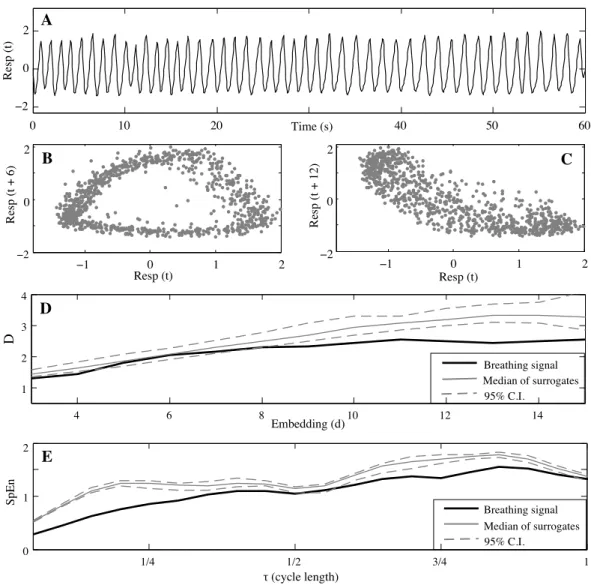
probabilities that two (m+1)-point sequences and two m-point sequences match, respectively. Computing SpEn across several time delays (see Fig. 1-D) allows to better capture nonlinear contributions than using a single sample delay (! =1) as done traditionally [Kaffashi et al., 2008].
0 10 20 40 50 60 −2 0 2 −1 0 1 2 −2 0 2 Resp (t) −1 0 1 2 −2 0 2 Resp (t) 1/4 1/2 3/4 1 0 1 2 ! (cycle length) 4 6 8 10 12 14 1 2 3 4 D Embedding (d) Time (s)
A
E
D
B
C
Median of surrogatesBreathing signal 95% C.I. Breathing signal Median of surrogates 95% C.I. Sp En Re sp (t + 1 2) Re sp (t + 6 ) Re sp (t )
Figure 1. Example of one-minute breathing signal (A). Return maps plotted from the original and time-delayed data sets: 6 points (B) and 12 points (C). Estimated D with embeddings from 3 to 15 (D). SpEn of breathing signal (E) calculated with ! from 1 to 20 points (1-cycle length).
2.2. Noise titration
Noise titration was proposed by [Poon and Barahona, 2001] to provide a robust measure of chaos intensity even in the presence of noise and with short data series. Despite noise titration was found later to have some pitfalls detecting deterministic chaos confidently, this test can still be used as an efficient
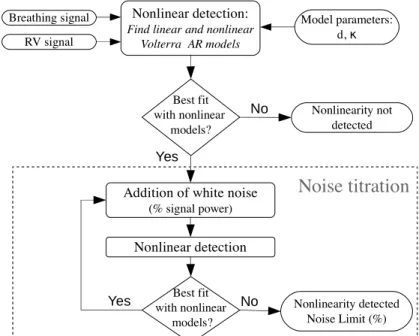
tool to detect nonlinearity in time series [Freitas et al., 2009]. Briefly, the noise titration technique (Fig. 2) begins by fitting a family of polynomial autoregressive Volterra-Wiener models, both linear and nonlinear, with different degrees of nonlinearity (d) and embedding dimension ("). If the best model, chosen according to the Akaike information theoretic criterion is nonlinear, titration can be applied. Then, white noise is added to the series increasing its standard deviation until nonlinearity is not detected. The level of noise, called noise limit (NL) denotes the relative intensity of nonlinearity, so NL = 0 can be interpreted as the neutralization of nonlinear dynamics by the background noise in the data.
!
!
Breathing signal Nonlinear detection:
Find linear and nonlinear Volterra AR models Best fit with nonlinear models? Nonlinearity not detected
Addition of white noise (% signal power) Nonlinear detection Best fit with nonlinear models? Nonlinearity detected Noise Limit (%)
Noise titration
!" #$% !" #$% RV signal Model parameters: d, !Figure 2. Illustration of the noise titration technique. 2.3. Nonlinear indexes
Nonlinear indexes were derived from the surrogate analysis of breathing signals as follows: • Estimate D0, the correlation dimension on the original signal across the range of embeddings,
and SpEn0, the sample entropy across the delays !, also on the original breathing signal. • Similarly, estimate !Ds and Sp !Ens, the medians of D and SpEn on the set of surrogates,
respectively.
• Obtain nonlinear indexes, NID = mean( !Ds- D0) and NISpEn = mean(Sp !Ens - SpEn0).
3. Results
3.1. Database and study protocol
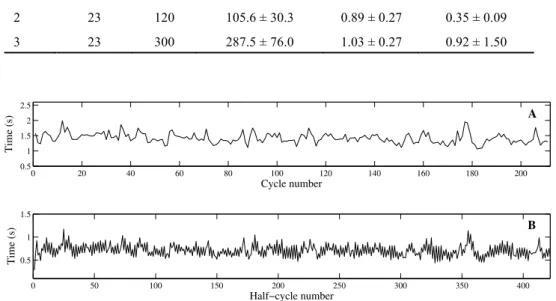
Data, collected at the neonatal intensive care unit of the University Hospital Center of Rennes (France), consisted of 1-hour electrocardiograms and respiratory signals (recorded with abdominal strain gauges) sampled at 400 Hz. We removed baseline and high frequency noise and subsampled signals to 16 Hz before performing calculations. From our database of 47 preterm infants between 27 and 35 weeks of post-conceptional age, we formed three groups of 1, 2 and 5-minute excerpts of the steadiest and least noisy breathing traces in quiet sleep. The infants could be included in several groups (with different excerpts), but only once in the same group. We chose such a short sample duration due to the limitation of finding highly regular patterns without amplitude modulations and apnea. In group 1, it was possible to select signals with a low envelope variation (the standard deviation of the magnitude of the Hilbert transform), but this feature increased in longer excerpts from second and third groups, where regularity was sparser (see Table 1). Respiratory variability (RV) signals were extracted from the 5-minute set applying a peak detector. Inhalation time (ti) was measured as the time elapsed between a valid minimum and its consecutive time, and exhalation time (te) as the time between a maximum and its consecutive minimum. Used RV signals (Fig. 3) were ttot series, containing the inter-breath times (ti to ti), and tite series containing the time between minima and maxima (half-cycle
times). Data relative to newborns was post-conceptional (PCA) and post-natal age (PNA), gender and weight. There were not significant statistical differences between them.
Table 1. Number of infants (Ni), length (L) and mean ± std of number of cycles (Nc), main frequency (Mf) and
envelope variation (EV) of groups. Mf was estimated as the maximum of the power spectral density (Burg
method, order 30). Group Ni L (s) Nc Mf (Hz) EV 1 29 60 61.2 ± 17.9 1.04 ± 0.28 0.29 ± 0.07 2 23 120 105.6 ± 30.3 0.89 ± 0.27 0.35 ± 0.09 3 23 300 287.5 ± 76.0 1.03 ± 0.27 0.92 ± 1.50 0 20 40 60 80 100 120 140 160 180 200 0.5 1 1.5 2 2.5 Cycle number Time (s) 0 50 100 150 200 250 300 350 400 0.5 1 1.5 Time (s) Half−cycle number B A
Figure 3. Examples of extracted variability signals from group 3: ttot (A) and tite (B). 3.2. Surrogate analysis
We generated an ensemble of 20 surrogates for each signal to obtain the nonlinear indexes. NID was not computed in RV series due to its lack of periodicity, which prevents a reliable phase space reconstruction.
Since randomized signals have higher chaos dimension, !Ds>D0, hence NID > 0 when nonlinearity
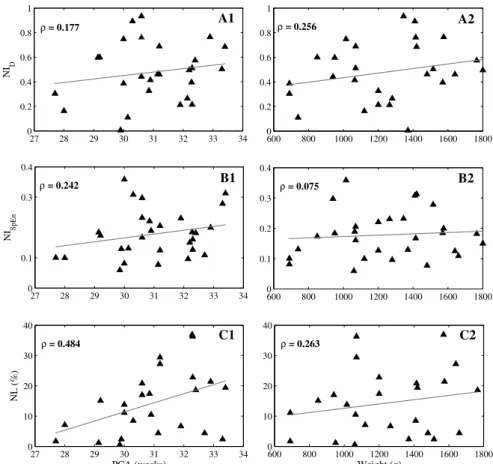
is detected. Likewise, NISpEn > 0 because surrogates exhibit higher entropy than the original signal. A linear regression of the indexes as a function of age and weight was performed to describe the relationship between maturation and nonlinearity. The Pearson's linear correlation coefficient (#) was inserted in the figures as a measure of fit. Results from PCA and weight manifested consistent trends whereas PNA (not shown) did not.
NID was computed on first and second group. A few samples failed the nonlinearity test (NID < 0) and hence not taken in account to calculate the linear regressions. As it can be observed in Fig. 4-A1, A2, NID increases slightly with PCA and weight in group 1, but not in group 2 (Fig. 5-A1, A2). This disagreement may be explained by the high sensitivity of the correlation dimension with irregularities, more present in two-minute samples.
NISpEn was obtained from all signals with r = 0.2 and m = 2. For groups 1 and 2, ! ranged from 1 to the average cycle length of each series, and for group 3, ! was fixed to 1 due to the absence of short-term correlations in RV signals. All signals passed the nonlinear test with entropy (NISpEn > 0). In temporal signals, a positive slope was also observed within PCA and weight regression lines, being the 2-minute group (Fig. 5-B1, B2) better fitted than results from group 1 (Fig. 4-B1, B2).
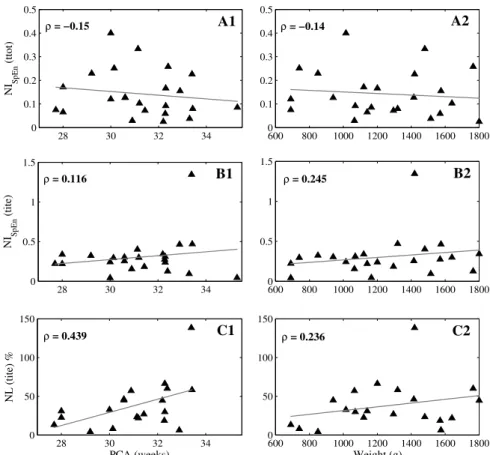
On the other hand, opposed patterns were observed in variability signals. According to the regression lines from ttot series, nonlinearity decreases with maturity (see Fig. 6-A1, A2), whereas in tite it grows (Fig. 6-B1, B2). Since SpEn could be estimated inaccurately in signals with a small number samples as ttot, and indexes from tite follows the generalized behavior, it can be stated that the latter are more reliable.
27 28 29 30 31 32 33 34 0 0.1 0.3 0.4 NI SpEn ρ = 0.242 600 800 1000 1200 1400 1600 1800 0 0.1 0.2 0.3 0.4 ρ = 0.075 27 28 29 30 31 32 33 34 0 0.2 0.4 0.6 0.8 1 NI D ρ = 0.177 600 800 1000 1200 1400 1600 1800 0 0.2 0.4 0.6 0.8 1 ρ = 0.256 27 28 29 30 31 32 33 34 0 10 20 30 40 NL (%) PCA (weeks) ρ = 0.484 600 800 1000 1200 1400 1600 1800 0 10 20 30 40 Weight (g) ρ = 0.263 B1 B2 A1 A2 C1 C2
Figure 4. Results of 1-minute breathing signal analysis. Indexes from correlation dimension (A), from sample entropy (B) and from titration (C) with regression lines.
28 30 32 34 0 10 20 30 40 NL (%) PCA (weeks) ρ = 0.712 600 800 1000 1200 1400 1600 1800 0 10 20 30 40 Weight (g) ρ = 0.473 28 30 32 34 0 0.1 0.2 0.3 0.4 NI SpEn ρ = 0.342 600 800 1000 1200 1400 1600 1800 0 0.1 0.2 0.3 0.4 ρ = 0.575 600 800 1000 1200 1400 1600 1800 0 0.2 0.4 0.6 0.8 1 1.2 ρ = −0.02 28 30 32 34 0 0.2 0.4 0.6 0.8 1 1.2 ρ = 0.063 NI D A1 A2 B1 B2 C1 C2
28 30 32 34 0 50 100 150 NL (tite) % PCA (weeks) ρ = 0.439 600 800 1000 1200 1400 1600 1800 0 50 100 150 Weight (g) ρ = 0.236 600 800 1000 1200 1400 1600 1800 0 0.5 1 1.5 ρ = 0.245 28 30 32 34 0 0.5 1 1.5 NI SpEn (tite) ρ = 0.116 28 30 32 34 0 0.1 0.2 0.3 0.4 0.5 ρ = −0.15 NI SpEn (ttot) 600 800 1000 1200 1400 1600 1800 0 0.1 0.2 0.3 0.4 0.5 ρ = −0.14 B1 C1 A1 A2 B2 C2
Figure 6. Results of 5-minute variability signal analysis. SpEn indexes applied on ttot (A) and on tite series (B). C: NL applied on tite series.
3.3. Noise titration analysis
The measure of nonlinearity given by noise titration (NL) was obtained in both temporal and variability signals. We chose the pair of modeling parameters (d, ") equal to 3 and 5 respectively following the recommendations in [Roulin et al., 2011] to avoid false detections. Ten titrations for each sample were realized to ensure as well a reliable noise limit. In time-series, nonlinearity was undetected in 4 and 5 cases for group 1 and group 2 respectively. In RV signals, ttot length was often insufficient (about 300 samples) to find nonlinear models with given parameters and results are not shown here. However, tite series were more adequate to be analyzed with noise titration. In Fig. 6-C1 and C2, it can be observed that slopes from regression lines have a similar trend to increase with age and weight than those obtained with temporal signals. The evolution of NL was very similar in all analysis. Slopes, more pronounced with PCA, are even reproduced in temporal and RV signals. Furthermore, the correlation coefficients where the closest to 1, revealing that noise titration is the most reliable measure of nonlinearity studied here. A comparison of all correlation values can be seen in Table 2.
Table 2. Correlation coefficients (!PCA/ !weight) of the different indexes. Best results in bold.
Breathing signals Variability signals
Index 1 min 2 min ttot tite
NID 0.177 / 0.256 0.063 / -0.020 - -
NISpEn 0.242 / 0.075 0.342 / 0.575 -0.15 / -0.14 0.12 / 0.25
4. Conclusions
In this work, several indexes related to nonlinearity in preterm infants breathing were analyzed. We stated that in most of the cases nonlinear dynamics are present in temporal and RV signals, and their strength became more relevant, in qualitative terms, with maturation.
From the methodological point of view, noise titration is an interesting alternative to surrogate-data tests to evaluate nonlinearity in our breathing signals. Frequently, experimental conditions in neonatology limit the quality and length of records, hence correlation dimension based methods should be applied with caution. Indexes from sample entropy and noise titration were therefore introduced due to their robustness with noisy and short data. Indeed, observing the regression lines, trends are consistent and better fitted. The noise limit can be then considered the most reliable nonlinear index when series length is sufficient to perform noise titration. Otherwise, sample entropy based index can be used, yet being aware of its inaccuracy within very short data-series.
From a clinical point of view, the presented nonlinear indexes could be a useful tool to assess and understand maturation in neonatology. Loss (or absence) of nonlinearity in the breathing signal might be associated with underdevelopment in preterm infants, but additional tests on longitudinal databases should be done to confirm this conjecture.
References
Fiamma MN, Straus C, Thibault S, Wysocki M, Baconnier P, and Similowski T. Effects of hypercapnia and hypocapnia on ventilatory variability and the chaotic dynamics of ventilatory flow in humans. American Journal of Physiology, 292(5): R1985 – R1993, 2007.
Engoren M, Courtney SE, and Habib RH. Effect of weight and age on respiratory complexity in premature neonates. Journal of
Applied Physiology, 106(3): 766 –773, 2009.
Small M, Judd K, Lowe M, and Stick S. Is breathing in infants chaotic? Dimension estimates for respiratory patterns during quiet sleep. Journal of Applied Physiology, 86(1): 359 –376, 1999.
Small M and Judd K. Comparisons of new nonlinear modeling techniques with applications to infant respiration. Physica D, 117: 283–298, 1998.
Theiler J, Eubank S, Longtin A, Galdrikian B, and Farmer JD. Testing for nonlinearity in time series: the method of surrogate data. Physica D: Nonlinear Phenomena, 58(1-4): 77–94, 1992.
Poon CS and Barahona M. Titration of chaos with added noise. Proceedings of the National Academy of Sciences, 98(13): 7107– 7112, 2001.
Schreiber T and Schmitz A. Improved surrogate data for nonlinearity tests. Physical Review Letters, 77(4):635–638, July 1996. Yu D, Small M, Harrison RG, and Diks C. Efficient implementation of the Gaussian kernel algorithm in estimating invariants and noise level from noisy time series data. Physical Review E, 61(4): 3750–3756, 2000.
Richman JS and Moorman JR. Physiological time-series analysis using approximate entropy and sample entropy. American
Journal of Physiology, 278(6): H2039–H2049, 2000.
Kaffashi F, Foglyano R, Wilson CG, and Loparo KA. The effect of time delay on approximate & sample entropy calculations.
Physica D: Nonlinear Phenomena, 237(23): 3069–3074, 2008.
Freitas US, Letellier C, and Aguirre LA. Failure in distinguishing colored noise from chaos using the noise titration technique.
Physical Review E, 79(3): 035201, 2009.
Roulin E, Freitas US, and Letellier C. Working conditions for safe detection of nonlinearity and noise titration. Physical Review