Universit´
e de Neuchˆ
atel
Facult´
e des Sciences
Institut d’Informatique
Multimodal Information Retrieval
par
Melanie Geiger n´
ee Imhof
Th`
ese
pr´
esent´
ee `
a la Facult´
e des Sciences
pour l’obtention du grade de Docteur `
es Sciences
Accept´
ee sur proposition du jury:
Prof. Jacques Savoy, Co-directeur de th`ese
Universit´
e de Neuchˆ
atel, Suisse
Prof. Martin Braschler, Co-directeur de th`ese
Zurich University of Applied Sciences, Suisse
Prof. Nicola Ferro, rapporteur
University of Padova, Italie
Prof. Peter Kropf, rapporteur
Universit´
e de Neuchˆ
atel, Suisse
Faculté des Sciences Secrétariat-décanat de Faculté Rue Emile-Argand 11 2000 Neuchâtel – Suisse Tél : + 41 (0)32 718 21 00 E-mail : [email protected]
IMPRIMATUR POUR THESE DE DOCTORAT
La Faculté des sciences de l'Université de Neuchâtel
autorise l'impression de la présente thèse soutenue par
Madame Melanie GEIGER
Titre:
“Multimodal Information Retrieval”
sur le rapport des membres du jury composé comme suit:
• Prof. Jacques Savoy, Université de Neuchâtel, Suisse
• Prof. Peter Kropf, Université de Neuchâtel, Suisse
• Prof. Martin Braschler, Zürcher Hochschule für Angewandte Wissenschaften,
Winterthur, Suisse
• Prof. Nicola Ferro, Università degli Studi di Padova, Italie
ABSTRACT
Knowledge-intensive business processes, one of the essential drivers of our economy today,
often rely on multimodal information retrieval systems that have to deal with increasingly
complex document collections and queries. The complexity mainly evolves due to a large and
diverse range of textual and non-textual modalities such as geographical coordinates, ratings
and timestamps used in the collections. However, this results in a explosion of combinations
of modalities, which makes it unfeasible to find new approaches for each individual modality
and to obtain suitable training data. Therefore, one of the major goals of this dissertation
is to develop unified models to treat modalities for document retrieval. Further, we aim to
develop methods to merge the modalities with little or no training, which is essential for the
methods to be applicable in a wide range of applications and application domains.
We base our approach on our experience with several multimodal information retrieval
applications and thus also many different modalities. In a first step we suggest a coarse
categorization of modalities into two types of modalities, which we further subdivide by their
distribution. The categorization is a first attempt to reduce the number of different models.
It helps to generalize methods to entire categories of modalities instead of being specific for a
single modality.
Since the most popular weighting schemes for textual retrieval have generalized well to many
retrieval tasks in the past, we propose to use them as a basis of the unified models for the
categories of modalities. We therefore demonstrate as a second step how the three main
components of the so-called BM25 weighting scheme (term frequency, document frequency
and document length normalization) have to be redefined to be used with several non-textual
modalities.
As a third step towards establishing clear guidance for the integration of many modalities into
an information retrieval system, we demonstrate that BM25 is a suitable weighting scheme
to merge modalities under the so-called raw-score merging hypothesis. We achieve this with
the help of a sampling-based approach, which we use as a basis to prove that BM25 satisfies
the assumptions of the raw-score merging hypothesis with respect to the average document
length and the variance of document lengths.
Using our redefinition of BM25 for several non-textual modalities together with textual
modalities, we finally build multimodal baselines and test them in evaluation campaigns as
well as in operational information retrieval systems. We show that our untrained multimodal
baselines reach a significantly better retrieval effectiveness than the textual baseline and even
achieve similar performance when comparing them to a trained linear combination of the
modality scores for some cases.
Keywords: Multimodal, Information Retrieval, Probabilistic Information Retrieval Model,
BM25 Weighting Scheme
R´
ESUM´
E
Les processus bas´
es sur le savoir, une des composantes essentielles de notre ´
economie, requiert
souvent un syst`
eme multimodal de recherche d’information. De tels syst`
emes doivent traiter
des collections de documents et des requˆ
etes de plus en plus complexes. Cette complexit´
e
sous-jacente se situe dans le grand nombre et la diversit´
e des modalit´
es textuelles ou
non-textuelles comme les coordonn´
ees g´
eographiques, les indications temporelles, ou les cotations
apparaissant dans les documents. La combinaison de toutes ces modalit´
es rend
quasi-impossible la mise au point de nouvelles approches pour chaque modalit´
e potentielle ou
d’obtenir suffisamment de donn´
ees d’apprentissage. D`
es lors, l’un des objectifs de ce travail
de th`
ese est de proposer un mod`
ele unifi´
e afin de traiter les diverses modalit´
es en recherche
d’information. De plus, nous avons d´
evelopp´
e des m´
ethodes permettant la fusion de modalit´
es
avec peu ou en l’absence de donn´
ees d’entrainement. Une telle contrainte s’av`
ere essentielle
pour des m´
ethodes pouvant s’appliquer `
a un large ´
eventail d’applications ou de domaines.
Nous avons fond´
e notre approche sur notre exp´
erience touchant de nombreux syst`
emes
multimodaux de recherche d’information. Dans un premier temps nous pr´
esentons une
approche bas´
ee sur une distinction fond´
ee sur deux types de modalit´
es que nous subdiviserons
par la suite. Ce choix correspond `
a une premi`
ere approche dont l’objectif est de r´
eduire
le nombre possible de mod`
eles. Elle permet de g´
en´
eraliser des m´
ethodes traitant plusieurs
modalit´
es au lieu d’ˆ
etre sp´
ecifiques `
a une unique modalit´
e.
Comme les sch´
emas de pond´
eration les plus populaires pour le d´
epistage d’information
textuelle se sont g´
en´
eralis´
es avec succ`
es dans de nombreuses tˆ
aches de recherche, nous les
avons adopt´
es comme fondement `
a nos mod`
eles unifi´
es traitant diverses modalit´
es. Dans un
deuxi`
eme temps, nous d´
emontrons comment les trois composantes principales du mod`
ele
BM25 (fr´
equence d’occurrence, fr´
equence documentaire et normalisation selon la longueur du
document) peuvent ˆ
etre red´
efinies pour pouvoir traiter des modalit´
es non-textuelles.
Dans un troisi`
eme temps, nous d´
efinissons des lignes directrices pour l’int´
egration de plusieurs
modalit´
es dans un syst`
eme de d´
epistage de l’information. Dans ce but, BM25 s’av`
ere un
syst`
eme de pond´
eration permettant la fusion de modalit´
es sous l’hypoth`
ese des scores bruts
(raw-score). Ce but est atteint par l’usage d’une approche bas´
ee sur l’´
echantillonnage qui est
utilis´
ee pour d´
emontrer que BM25 satisfait les hypoth`
eses de la fusion par les scores bruts (la
longueur moyenne des documents et la variance de celle-ci).
En se basant sur notre red´
efinition du mod`
ele BM25 pouvant traiter `
a la fois les modalit´
es
textuelles et non-textuelles, nous avons test´
e notre approche par rapport `
a diff´
erentes r´
ef´
erences
ainsi que lors de campagnes d’´
evaluation internationales de mˆ
eme que dans des contextes
de production. Nous avons d´
emontr´
e que notre approche sans donn´
ees d’apprentissage
retournait une performance significativement sup´
erieure `
a des syst`
emes classiques. De plus
notre mod`
ele (sans apprentissage) apporte des performances similaires `
a des syst`
emes bas´
es
sur une combinaison lin´
eaire de modalit´
es avec entraˆınement.
Mots-Cl´
es: Multimodalit´
e, Recherche d’information, Mod`
ele de recherche d’informations
probabilistes, Sch´
ema de pond´
eration BM25
ACKNOWLEDGMENTS
Firstly, I would like to express my sincere gratitude to my co-supervisor and mentor Prof.
Martin Braschler for the continuous support of my Ph.D. study, for his insights, patience, and
encouragement. His guidance helped me in all the time of research and writing of this thesis.
Prof. Jacques Savoy generously accepted to be my co-supervisor in this extraordinary
col-laborative dissertation between the University of Neuchatel and the Zurich University of
Applied Sciences. I would like to thank him for his support, advice and time to help my
understanding of the problems described in this dissertation.
Besides my supervisors, I would like to thank the rest of my thesis committee: Prof. Nicola
Ferro and Prof. Peter Kropf for accepting to examine this thesis and for their insightful
comments and questions.
This being an applied dissertation that is partly based on joined research projects of the Zurich
University of Applied Sciences and many external partners, I want to mention my colleagues
at Zurich University of Applied Sciences and my collaborators at the project partners with
whom I had the opportunity to work closely on multimodal information retrieval as well as
other data science problems.
Most importantly, none of this could have happened without my husband, who not only
motivated me to continue my study every time I was ready to quit but also provided his
unconditional love, patience and endless support.
Table of Contents
1 Introduction
1
1.1
Motivation & Objectives . . . .
1
1.2
Definitions . . . .
3
1.3
Achievements . . . .
5
1.4
Structure of this Dissertation
. . . .
6
2 Presentation of Publications
7
2.1
Multimodal Information Retrieval Test Collections . . . .
9
2.2
Experiments with Multimodal Collections
. . . .
11
2.3
Untrained Models for Multimodal Information Retrieval . . . .
13
2.4
An Application of Multimodal Information Retrieval in Industry . . . .
15
3 Conclusion
17
3.1
Summary of Contributions . . . .
17
3.2
Future Work . . . .
19
References
21
A Publications
25
A.1 Are Test Collections “Real”? Mirroring Real-World Complexity in IR Test
Collections . . . .
25
A.2 Multimodal Social Book Search . . . .
33
A.3 BM25 for Non-Textual Modalities in Social Book Search . . . .
45
A.4 A Study of Untrained Models for Multimodal Information Retrieval . . . . .
55
A.5 Overcoming the Long Tail Problem: A Case Study on CO2-Footprint
Estima-tion of Recipes using InformaEstima-tion Retrieval . . . .
85
Chapter 1
Introduction
1.1
Motivation & Objectives
Starting with the eighties at the latest, we have entered the so-called information age in
which creating, disseminating and retaining knowledge have become some of the essential
drivers of our economy [18]. Since then, many new jobs and businesses have been created
where the work no longer is limited to applying explicit knowledge repeatedly - such as
a mason when building walls. Today’s jobs in the service industry (recruiting, marketing,
sales, insurances, banks, etc.) often revolve around knowledge-intensive business processes
(KIBP’s). According to Isik et al. [10], from a broad, conceptual point of view, KIBP’s
can be defined as: “Processes that require very specific process knowledge, typically expert
involvement, that are hard to predict and vary in almost every instance of the process. They
typically depend largely on human involvement and decisions although parts of the process
could be supported by automation” (p. 3818).
From a high-level view, this dissertation describes efforts to advance the automation of the
tasks encountered in KIBP’s. In particular, we focus on the retrieval of documents in order
to gather the necessary information for such a process. This retrieval process is primarily
driven by the main business-specific aspects that describe the important information of the
processes. For example, for a recruiting business these aspects might be the clients, jobs,
companies, skills, salary ranges, period of notice, etc., while for other businesses such as
insurance companies entirely different aspects are important, e.g. insurance holders, policies,
claims, hospitals, treatment costs, etc. Notably, the processes usually include numerous
aspects that we claim all need to be treated by the retrieval system.
The information age has led to an ever-increasing amount of data produced every day
1.
In order to leverage the vast amount of information contained therein, businesses as well
as academics have been successfully employing information retrieval (IR) systems. IR is a
rather old and well-studied academic discipline in which documents
2that are relevant with
respect to an information need are obtained from a collection of documents. An IR system in
1According to the 2013 IBM Annual report [6], the world has been generating more than 2.5 billion bytes per
day in 2012. Thereof, about 80% is unstructured data in the form of images, videos, audio, social media, embedded sensors, distributed devices, etc.
2In this dissertation, we will use a wide definition of the term document. We will consider any kind of
retrievable item a document. This means that a document can potentially consist of multiple texts, images, geographical coordinates, ratings etc.
the context of KIBP’s not only has to deal with the raw processing of data, but also with
increasingly complex document collections that typically contain heterogeneous documents,
from different sources with many different types of information that are not only textual
but also non-textual such as images, locations, timestamps and ratings. Throughout this
dissertation, we use the term modalities to describe the different types of information in the
documents that can be used for retrieval. The modalities usually represent the important
aspects of the business processes. Therefore, IR systems used in the context of KIBP’s are
mostly multimodal IR systems.
In order to assist the business processes, it is crucial for a multimodal IR system to incorporate
all the business-critical aspects with respect to all the corresponding modalities. In the past
however, most IR systems did not treat the modalities individually but instead concatenated
the information into a single textual modality. Another strategy was to ignore or discard
some of the modalities. However, we claim that in a lot of KIBP’s the exclusion of (some)
modalities is not a valid option and treating them as a single modality comes with potential
loss of information and retrieval effectiveness.
From a high level perspective, filtering in database systems is an alternative to deal with
multimodal documents. For database systems, the documents are usually called records and
the modalities in the queries correspond to the filtering criteria. However, a closer look shows
that the requirements of the applications for which either database systems or multimodal
IR systems are used are quite different. Filtering in database systems selects only the records
that exactly match the specified criteria (“exact match”). In the worst case, the result set
is empty since no records fulfill all the criteria in the query. This property is useful for
applications in which exact matches are essential; e.g. the blood type in a database with
blood donors. Multimodal IR systems, however, do not exclude documents that do not match
a modality but simply reflect this in the score, which then may lead to a lower rank in the
result list (“best match”). This is particularly important for recall-oriented applications
where it is unlikely that documents will match the complete query, e.g. the search for an
expert in a collection of candidate profiles.
The goal of the research underlying this study is to develop untrained models
for multimodal IR systems with the following vision: The models should be
generalizable to build multimodal IR systems for a large range of different KIBP’s.
There should be clear guidance as to how to treat each individual modality and
how to synthesize an overall result using all modalities with little or no training.
In our effort to fulfill this vision, we have tackled several research challenges in the course of
this dissertation. Firstly, due to the large and diverse range of different modalities in KIBP’s,
we aim to treat modalities with unified models instead of finding new approaches for each new
individual modality. Secondly, we will address merging the results for individual modalities
into a single overall result. A main consideration in both these points was the use of no or
minimal training data. This seems to run counter to published trends: in 2017, Gartner
named machine learning one of the top 10 strategic technology trends [9]. At the same time
machine learning and in particular deep learning significantly increased the performance of
many tasks and has been used to merge modalities into a single ranked list [25]. However, the
numerous different modalities used in KIBP’s result in a explosion of possible combinations.
As a consequence, available academic test collections can only provide training data for a
few select situations. Moreover, the long tradition of heuristic methods in IR has shown
that the avoidance of training data is essential for the methods to be applicable in a wide
range of applications and application domains. Both by demonstrating effective approaches
to multimodal retrieval with little or no training and by reflecting on the limits with respect
to approaches that can be applied in scenarios where suitable training data is available, the
dissertation makes a major contribution to the field.
1.2
Definitions
In the following, we define some of the major terms and notations used in this dissertation.
Information Retrieval
Information retrieval is the activity of storing and searching large amounts of (unstructured)
data [23]. Typically, a user’s information need is expressed in the form of queries, while the
answer of the retrieval system is given by a (ranked) set of documents relevant to the query.
Hereby, the retrieval system calculates a retrieval score as an order-preserving estimation of
the probability of relevance of a document with respect to the information need [20]. The
retrieval scores are usually calculated by a weighting scheme using the so-called bag of words
of the documents and the queries. A bag of words is the output of a pre-processing step that
extracts features from the documents and the queries. For example with textual information,
the features extracted are usually the analyzed and normalized words
3. The most popular
weighting schemes for retrieval can all be described in terms of how they combine three main
components; the term frequency (tf ); i.e. how often a feature appears in the bag of words of a
given document, the document frequency (df ); i.e. in how many documents a feature appears
and the document length; i.e. the number of features in the bag of words of a document.
Most research efforts have been dealing with text retrieval, which is IR on textual documents.
Since 1990, content based image retrieval, which is IR on images [24], and many other related
tasks have been investigated. When moving from textual to non-textual information the
individual features in the bag of words are no longer limited to words and thus we use the
more general terminology bag of features. Similarly, the term frequency is generalized to
feature frequency.
Modality
The documents in image retrieval often not only contain images but also the textual meta-data
(e.g. image caption). Similarly, information needs might be described by queries that consist
of an image and a textual description. The two constituent parts of the documents and the
queries (the image and the textual meta-data respectively description) in image retrieval are
usually denoted as modalities [4]. In this dissertation, we broaden the term modality to any
type of information that is part of a document or a query. For example, a document or a
query could contain multiple modalities such as the number of likes, timestamps, locations
(e.g. geographical coordinates), images, prices, ratings, etc. Whenever we use the term
3Peters et al. [19] give a more extensive overview of the steps in this pre-processing such as tokenizing,
non-textual modality, we want to empathize that this modality cannot per se be treated like
natural language as known from classical text retrieval.
Multimodal Information Retrieval System
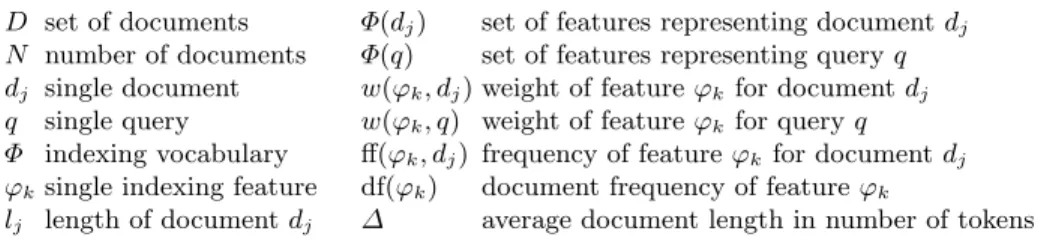
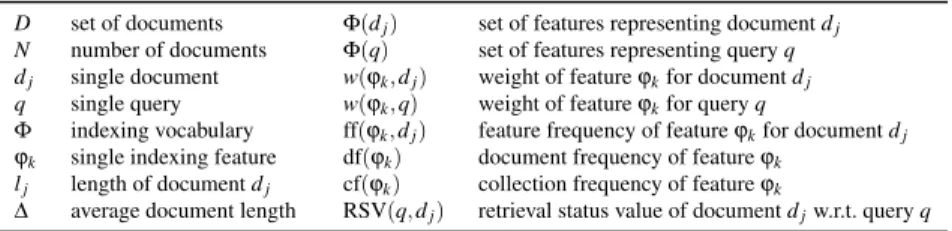
In a multimodal IR system, the documents (d
1, d
2, ..., d
D) consist of several modalities. Hereby,
d
mjis the bag of features of modality m of document d
jand D is the number of documents.
Analogously, the query q consists of several modalities and q
mis the bag of features for
modality m of query q.
For simplicity, we assume that we can estimate the contribution of relevance of each
modal-ity separately and estimate the probabilmodal-ity of relevance of a document by combining the
contributions of its modalities.
During retrieval, weighting schemes define the retrieval score (retrieval status value RSV(q
m, d
mj))
of modality m in document d
jw.r.t. modality m in query q, which is an estimation of the
contribution of modality m to the probability of relevance of the document d
jw.r.t. query q.
Hence, for each modality m the result set is a ranked list ordered by the retrieval score of
document d
jand modality m. Note that most retrieval scores depend on the modality length
l(d
mj) which is the number of features in the bag of features of modality m of document d
jand that the modality length might be different for each modality in a document. The ranked
lists of all the modalities, similarly to image and multilingual retrieval, need to be merged
into a single ranked list. Hence, a function f has to be found to compute the retrieval score
for each document based on the retrieval scores of all modalities
RSV(q, d
j) = f (RSV(q
1, d
1j), RSV(q
2, d
2j), ..., RSV(q
M, d
Mj)),
(1.1)
where M is the number of modalities. In the following, we call function f that combines the
scores of all modalities merging function
4.
Document Relevance
Generally, the term relevant documents denotes the set of documents that meets the
informa-tion need of the user. Finding a more specific definiinforma-tion of document relevance is however not
trivial and numerous definitions of relevance have been published so far. The most popular
publications about document relevance are probably the work of Cooper [5], Borlund [1] and
Mizzaro [16]. Eickhoff [7] claims that the topical overlap with the user’s information need is
the most frequently used criterion for relevance. We are however convinced that there are
numerous other aspects of relevance that have to be considered. We claim that the additional
modalities as we encounter them in multimodal IR systems help to incorporate such further
noteworthy dimensions of relevance; e.g. the recency, language or popularity.
For multimodal IR systems, we need to define how the individual modalities contribute to
the relevance of the whole document. In some cases, a modality might further specify an
information need and therefore narrows down the set of relevant documents. For example, the
timestamp, when searching for current traffic jams with a query consisting of two modalities:
a timestamp and a textual part “traffic jams”. In other cases, the modalities can broaden
the result set, since they help to further understand the broader meaning of the information
need. This often occurs if the IR system cannot accurately extract the information need from
a textual modality. For example, the textual query “popular names in Switzerland” would
possibly not return documents that only contain Zurich and not Switzerland. However, if
the query has an additional modality for the geographical region and the documents contain
locations, probably more documents that are relevant could be retrieved; in particular such
that only contain city names.
Since we defined our multimodal IR system to estimate the relevance of a document based on
a combination of the contribution of relevance of each individual modality, the definition of
the document relevance faces additional challenges. We not only need to define the relevance
of a document with respect to each modality but also how the relevance of the individual
modalities affects the relevance of the whole document. This is however not always trivial,
since the observation of a ranked list of an individual modality (e.g. timestamps) may not
give a lot of information about the overall relevance.
Test Collections
A test collection, as used in evaluation campaigns
5such as the Text REtrieval Conference
(TREC)
6and the Cross-Language Evaluation Forum (CLEF)
7, generally consists of a collection
of documents, a set of queries and the corresponding relevance assessments. As described
above, the documents and the queries in multimodal IR consist of several modalities. However,
not all the modalities have to be present in all the documents and queries. Ideally, the
test collection covers all the possible combinations of present and missing modalities in the
documents and queries. Note that this is only necessary for multimodal IR test collections
and it might lead to an increased number of required queries compared to traditional IR test
collections [8].
For the relevance assessments in multimodal IR test collections, it is crucial that they are
conducted such that they actually include the aspects of all the modalities. This is in
particular a difficult task when the relevance assessment is not performed by the original
users that have the whole context of the query. Usually, the relevance assessments are
published after the participants submitted their runs. However, once the relevance assessment
is available the test collections can also be used as training data to learn the parameters of
the retrieval models for future improvements.
1.3
Achievements
This dissertation includes the following main contributions to the development of untrained
models for multimodal IR:
1. In order to treat modalities with unified models instead of finding new approaches for
each new individual modality, we suggest a categorization of modalities. Therefore,
models only need to be developed for each category.
5Evaluation campaigns support the development, evaluation and comparison of IR methods by providing
shared test collections for multiple research groups [19].
6http://trec.nist.gov
2. We justify the use of existing weighting schemes as a basis for the unified models in
multimodal IR systems. In particular, we show how to generalize the so-called BM25
weighting scheme
8for several non-textual modalities.
3. We demonstrate that the BM25 weighting scheme is suitable for merging modalities
with little or no training. For that purpose, we analyze the underlying assumptions of
the BM25 formula with respect to the raw-score merging hypothesis
9.
4. We establish multimodal baselines that involve all the given modalities and merge the
scores generated by unified models under the raw-score merging hypothesis. We have
tested them in evaluation campaigns (CLEF Social Book Search lab
10and GeoCLEF
11)
as well as in operational IR systems and showed that for some cases they reach a
significantly better retrieval effectiveness as a baseline that only uses the textual
modality. For the collections where training data was available, we compared the
untrained multimodal baselines to trained linear combinations of the scores of the
modalities and found similar performance in the case of the Social Book Search lab.
1.4
Structure of this Dissertation
The remainder of this dissertation is structured as follows. In Chapter 2, we present the papers
published in the course of this dissertation. First, the chapter provides a high-level overview
of the publications. The remainder of the chapter is divided into individual sections for each
paper. Each of the sections describes the detailed context and gives a short summary of the
main aspects and findings of the paper, especially with respect to the goal of this dissertation
of providing clear guidance for building multimodal IR systems with little or no training.
Finally, Chapter 3 summarizes our contributions with respect to the state-of-the-art and gives
pointers to further open questions. Appendix A provides the reprints of the publications
presented in Chapter 2.
8BM25 (“Best Match 25”) was developed as part of the participation of the Okapi system in the early TREC
evaluation conferences. The first Okapi system used a simpler version of the ranking formula and was called BM1 formula (“Best Match 1”) [12]. In the subsequent participations more elaborate ideas were included and the number was used to indicate the version of the formula.
9The raw-score merging hypothesis postulates that similarity values are directly comparable if they are
produced from similar search engines and underlying collections with similar statistics [2, 14, 21, 22].
Chapter 2
Presentation of Publications
The core of this dissertation is based on the following five publications.
• Melanie Imhof
1, Martin Braschler.
Are Test Collections “Real”? Mirroring Real-World Complexity in IR Test
Collections
In Josiane Mothe, Jacques Savoy, Jaap Kamps, Karen Pinel-Sauvagnat, Gareth Jones,
Eric San Juan, Linda Cappellato, Nicola Ferro (Hg.) Experimental IR meets
Multilin-guality, Multimodality, and Interaction, Proceedings of the 6th International Conference
of the CLEF Association, CLEF’15 Toulouse, France, pages 236-232, September 8–11,
2015, Heidelberg: Springer.
• Melanie Imhof
1, Ismail Badache, Mohand Boughanem.
Multimodal Social Book Search
In Linda Capellato, Nicola Ferro, Gareth Jones, Eric San Juan (Eds.), CLEF 2015
Labs Working Notes, Toulouse, France, September 8-11, 2015, Aachen: CEUR.
• Melanie Imhof
1.
BM25 for Non-Textual Modalities in Social Book Search
In Krisztian Balog, Linda Capellato, Nicola Ferro, Craig Macdonald (Eds.), CLEF
2016 Labs Working Notes, ´
Evora, Portugal, September 5-8, 2016, Aachen: CEUR.
• Melanie Imhof
1, Martin Braschler.
A Study of Untrained Models for Multimodal Information Retrieval
In Information Retrieval Journal, 21(1):81-106, 2018
• Melanie Geiger, Martin Braschler.
Overcoming the Long Tail Problem: A Case Study on CO2-Footprint
Esti-mation of Recipes using InforEsti-mation Retrieval
In Nicoletta Calzolari (Conference chair), Khalid Choukri, Christopher Cieri, Thierry
Declerck, Sara Goggi, Koiti Hasida, Hitoshi Isahara, Bente Maegaard, Joseph Mariani,
H´
el`
ene Mazo, Asuncion Moreno, Jan Odijk, Stelios Piperidis, and Takenobu Tokunaga
Proceedings of the 11th International Conference on Language Resources and Evaluation
(LREC 2018), Miyazaki, Japan, May 7-12, 2018, Paris: European Language Resources
Association (ELRA).
These publications systematically address the challenges and necessary steps for building an
untrained model for multimodal IR. The following sections give a summary of the motivation,
methods and contributions for each of these publications, while the full articles, containing
the related work, results and discussions, can be found in Appendix A.
In Section 2.1 we argue that multimodal test collections used in evaluation campaigns do not
yet reach the complexity of operational collections in real-world applications, thus having
limited value in building multimodal IR systems. Further, we propose a categorization of
modalities, which allows the development of unified models for a category of modalities.
Section 2.2 summarizes our participations to the Social Book Search lab at CLEF and presents
a trained model using random forests and a first attempt using the weighting scheme BM25
for non-textual modalities. In Section 2.3, we discuss how to validate the suitability of
the BM25 weighting scheme for multimodal IR systems and the analysis of the underlying
assumptions of the BM25 formula with respect to merging modalities without training. We
conclude with Section 2.4 in which we describe how we used the presented methods in an
operational multimodal IR application.
2.1
Multimodal Information Retrieval Test Collections
Due to the complex notion of relevance and other factors that prohibit a well-defined result,
the objective evaluation of retrieval effectiveness has a long tradition in IR. Evaluation
campaigns enable the comparison of different retrieval systems and therefore help to increase
the retrieval effectiveness of many IR methods. As stated before, for multimodal IR the
notion of relevance of a document is a complex issue, which calls for a careful evaluation
methodology and test collections to evaluate the results. Therefore, we start this synopsis of
our work with an overview and position paper about the analysis of the state-of-the-art of
multimodal IR evaluation, more specifically about the available test collections in evaluation
campaigns such as TREC and CLEF; as well as operational applications.
The initial motivation for this dissertation dates back to 2013, when we first encountered a
multimodal IR application in a research project with an industry partner
1. In the project,
we worked on a noise canceling news feed application that collects documents from various
sources such as public search engines, social networks and news feeds in general. The queries
in this application not only consist of a textual modality of the user’s interests that the
user explicitly defines, but also of the user’s preferences with respect to recency, language,
popularity and source-quality of the documents that is implicitly defined by the user’s past
behavior. The documents consist of various modalities such as timestamps, number of likes,
number of re-tweets, the source of the documents, the language of the documents, etc. Due to
the small scope of the project, the availability of training and test data was limited. In order
to verify the developed methods in a comparable setting, we searched for similar academic
collections. However, none of the collections we found fulfilled our needs.
In the course of this thesis, we analyzed the collections in the past CLEF labs and found
that their complexity has increased over the years, mostly due to the INEX track introduced
in 2012. In this context, we assume that more modalities lead to more complexity and thus
we used the number of modalities in the documents and queries as a measure of complexity
of the task. The complexity particularly increases with the number of modalities due the
additional effort that is necessary to combine the contributions of the individual modalities
into a single overall result. Although the complexity of the CLEF labs has increased over the
years, these collections are still far less complex than what we have observed in operational
collections. From this analysis, we concluded that a collection that mirrors the complexity
of real-world IR applications should contain a large amount of modalities from different
categories of modalities, some of the modalities should be independent from each other, and
others should be inter-related.
In the paper, we further claim that the consequence of the lack of complex test collections is
that it is unclear how to incorporate upcoming new modalities into IR systems leading to
much effort. In addition, most methods have been developed for a single very specific modality
and have not been generalized to other modalities. Further, only a few very basic approaches
have been developed to combine the modalities in a meaningful way without using training.
We suggest a categorization of modalities, which should help to develop methods that can be
generalized to a whole category of modalities. In this categorization, we distinguish between
1The project was funded by the Swiss commission for technology and innovation (CTI) with the funding
ordered
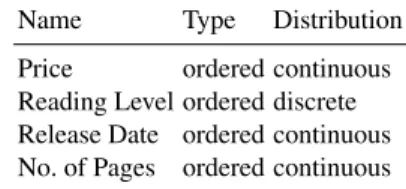
2and descriptive modalities. The values of ordered modalities such as ratings, dates
and prices have a natural order and we believe that this order is important for retrieval and
needs to be considered. The values of descriptive modalities such as terms and SIFT features
do not have an order that contains relevant information for retrieval. We are convinced that
it is easier to develop different retrieval methods for these two categories of modalities, since
each of them comes with different challenges.
2.2
Experiments with Multimodal Collections
Our participation in the “suggestion track” of the “INEX Social Book Search (SBS) lab”
at CLEF in two consecutive years gave us the opportunity to explore the multimodal test
collection of this lab. The challenge is to develop methods to retrieve books, from a collection
with 2.8 million book records, as requested by real users of the social cataloging web application
LibraryThing. For each book not only the meta-information from Amazon (description,
binding, number of pages, price, etc.) is available but also user generated information such
as the books’ ratings and reviews. A query consists of the user’s textual description for a
book recommendation as well as the user’s personal catalog. In our participation in both
years, we extracted additional implicit non-textual modalities from the personal catalogs, so
that the query was multimodal consisting of four modalities: the textual description, the user
preference w.r.t. the book length, the user preference w.r.t. the book price and an assumed
general preference of books with high ratings.
The main goal of this exploration was to see if a strong textual baseline can be significantly
improved using the additional modalities. Therefore, we tried different models to incorporate
the modalities and we checked the correlation between the different modalities, in particular
their information overlap.
Even though numerous definitions of document relevance have been proposed in the past, the
document relevance is frequently limited to a topical overlap with the user’s information need
[7]. In the context of multimodal IR, the document relevance however needs to exceed the
topicality and has to include all aspects of the modalities. We therefore carefully examined
the relevance assessment provided in the SBS lab. Since one of the goals of the suggestion
track of SBS is to go beyond topical relevance [13], they use the suggestions from real users
as a basis for the relevance assessment. Several rules are applied to extract graded relevance
values from these suggestions. Although the modalities are not explicitly considered, these
rules potentially include the additional modalities implicitly. For example, one rule assigns a
higher relevance value if the user that suggested a book has actually read it. This ensures that
rather objective criteria are considered, such as our assumption that users prefer books with
higher ratings. Further, books that have later been added to the catalog of the requesting
user are considered more relevant than others. This gives us an indicator for whether the
book matched the users’ preferences.
In the paper “Multimodal Social Book Search” we describe our first participation in the SBS
lab at CLEF 2015 for which we collaborated with Ismail Badache and Mohand Boughanem
from IRIT - Paul Sabatier University, Toulouse, France. We built a strong textual baseline and
combined it with a social document prior based on social signals proposed by our colleagues
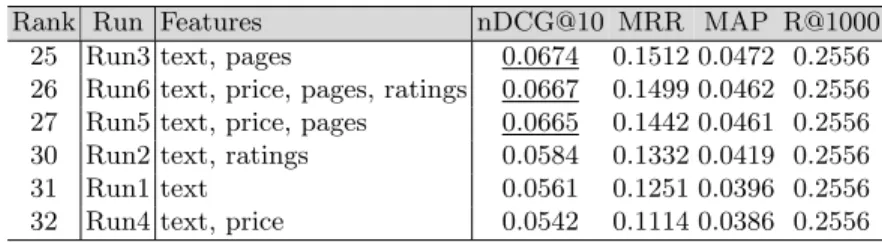
from Toulouse. Further, we used three modalities, the book’s price, the number of pages
and the book’s ratings as additional non-textual modalities. We used a random forest to
learn how to combine the scores of the individual modalities. Our main finding was that we
were able to significantly improve the retrieval effectiveness of the textual baseline using the
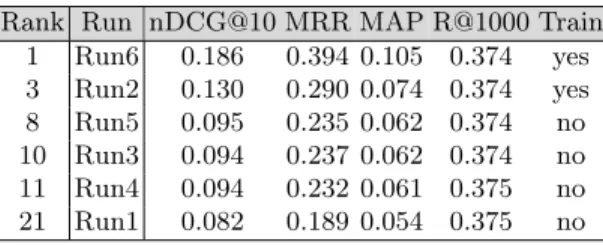
additional modalities. This approach resulted in the best-ranked run in the SBS competition
at CLEF 2015. However, the proposed method heavily relies on the availability of a test
collection and is not directly transferable to other collections and modalities.
Our second participation in the SBS lab at CLEF 2016 is described in “BM25 for Non-Textual
Modalities in Social Book Search”. We used the same three modalities, the book’s price, the
number of pages and the book’s ratings, as in 2015 but we applied a unified model based
on BM25. Based on the raw-score merging hypothesis, we suspected that using the same
weighting scheme for all modalities gives us the possibility to merge their scores without
training. However, since we did not yet understand the underpinnings of a suitable weighting
scheme to merge modalities without training, we still used a trained linear combination to
merge the scores.
Similar to most weighting schemes used in IR, BM25 is defined by its three main components,
the term frequency, the document frequency and the document length. Therefore, whenever
using BM25 with other modalities, we need to define the three components for this particular
modality or for the category of modalities. In the paper, we thus show how to redefine the
three components for the three non-textual modalities.
For the ratings, we assume that users generally prefer books with higher ratings. Accordingly,
we define the three components so that higher ratings will result in a higher BM25 score.
For the price and the number of pages of a book, we define the query based on the user
preferences, i.e. the average price respectively the average number of pages of the books a user
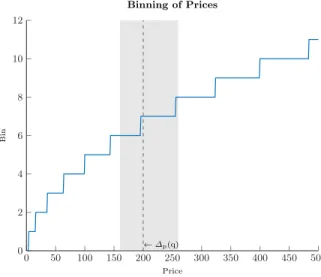
has already read. The price and the number of pages are continuous variables and therefore
exact matches of the values in the query and the values of the books are not meaningful.
Thus, we define the three components to result in a fuzzy query. This definition is only a
first attempt to handle continuous variables and is probably not generalizable to all other
modalities. Therefore, future work has to investigate generalizable models for continuous
variables using the existing weighting schemes.
In the paper, we show that the proposed approach using BM25 for non-textual modalities and
a linear combination of the scores of the modalities achieves a significantly higher retrieval
effectiveness than the textual baseline.
2.3
Untrained Models for Multimodal Information Retrieval
This work is the centerpiece of this dissertation. It is based on the lessons of the other
publications in this dissertation, in particular the following four:
1. In the context of KIBP’s, a large variety of IR applications evolved. These applications
have to deal with increasingly complex document collections and queries, primarily due
to increasing number of different modalities.
2. Due to the large variety of IR applications and lack of suitable test collections, we
argue that it is crucial to treat the modalities with unified models instead of finding
new approaches for each individual modality.
3. Even though weighting schemes have been developed for retrieval on English text, they
generalized well before to other related tasks such as multilingual retrieval, multimedia
retrieval and others; and we are therefore hopeful that they can be generalized to other
modalities.
4. Since weighting schemes can be described in terms of how they combine three main
components (term frequency, inverse document frequency and document length
normal-ization), we want to attempt to define these three main components for each category
of modalities.
As a first step to develop generalizable models, the core of this publication discusses the
underpinning of weighting schemes for textual retrieval based on the four lessons mentioned
above and shows how they can be applied or adapted methodically to non-textual modalities.
The main contribution is that we demonstrate that BM25 is a suitable weighting scheme for
non-textual modalities and to merge them without any training.
Our early efforts in developing generalizable models focused on the definition of the term
frequency and the document frequency for non-textual modalities. However, we soon realized
that the role of the document length and the document length normalization in the merging
process is unclear and thus needs further investigation. Therefore, we studied the document
length components of the most popular weighting schemes. Note that in the context of
multimodal IR system, we no longer have a single document length, but instead have a
length for each modality. We conducted several experiments to find the weighting scheme
that is most robust with respect to varying document lengths and therefore is most likely
suitable to be used in a multimodal IR system. Furthermore, we looked into alternative
weighting schemes that potentially are not dependent on document length normalization such
as passage retrieval and proximity weighting. However, we found that even these weighting
schemes rely on a document length normalization component[11], [3], [27], [15].
The modalities usually have vastly different lengths. For example in an application that
deals with newspaper articles, the textual modality could have a length of several hundred
terms while the timestamp modality usually has the length of one. The document length
normalization component only focuses on the normalization of the lengths of the documents
within a modality. Therefore, we looked into other application domains to find solutions to
avoid the document length completely and to handle the different lengths across the modalities.
We found that in multimedia retrieval, in particular image retrieval, the document length
normalization as part of the weighting scheme is circumvented by sampling a fixed number
of features for each image regardless of the image size and the number of concepts in the
image. Accordingly, we applied this idea to the features in multimodal IR systems. This
means that we sample the same number of features for each document and each modality and
then apply any weighting scheme without the necessity for a document length normalization
component. This approach, however, has issues with data-loss due to downsampling and is
not deterministic due to the random sampling. Therefore, we introduced a novel idealized
sampling approach in which we do not randomly sample the documents but simply simulate
the average resulting feature statistics. This approach solves two issues regarding merging.
First, the role of the document length normalization for the merging is no longer relevant,
since none is used. Second, we now have modalities that all have the same collection statistics
with respect to the document length and the document length variance, which is ideal for
merging under the raw-score merging hypothesis.
In the paper, we prove that applying BM25 with full document length normalization b = 1 is
identical to our ideal sampling approach. Therefore, we show that BM25 is equally suited for
merging under the raw-score merging hypothesis. Analogously, we propose a scope-aware
sampling approach that deals with the fact that some documents can be more verbose than
others. Therefore, we sample the documents to different lengths, similar to the concept
introduced by Robertson’s document length normalization in BM25. We were able to prove
that BM25 with a general document length normalization parameter b
6= 1 is equal to the
scope-aware sampling approach and therefore the raw-score merging hypothesis w.r.t. the
average document length also holds for BM25 in general. However, unlike for the fully
normalized BM25, only the average document length is the same for all modalities but not
the variance of document lengths.
Based on these findings, we implemented a multimodal baseline using BM25 with raw-score
merging for the SBS and the GeoCLEF collection. The experiments show that the approach
leads to encouraging results. Not only because the textual baseline can be significantly
improved, but also because for the SBS collection, our untrained multimodal baseline achieves
a similar performance as a trained linear combination of the modalities.
2.4
An Application of Multimodal Information Retrieval in
Indus-try
The initial motivation for the topic of this dissertation came from the ever-increasing
com-plexity in operational IR applications in industry. Therefore, we conclude this presentation
of our publications with the paper “Overcoming the Long Tail Problem: A Case Study
on CO2-Footprint Estimation of Recipes using Information Retrieval”. In this paper, we
describe the solutions for an operational multimodal IR application that we proposed and
implemented in a research project with our industry partner Eaternity AG
3. The paper was
co-authored by Martin Braschler and both authors have been involved in the project
4.
The goal of the project was to automatically calculate the CO
2-footprint of cooking recipes.
This task is an example of the fact that the field of IR has evolved substantially beyond
classical IR that has been concerned with building systems that retrieve ranked lists of
documents in response to information needs formulated as queries. In recent years, new IR
challenges have been addressed such as the attempts to synthesize more concise “answers” to
information needs. In our case, we calculate a CO
2-footprint for a recipe. We can characterize
a whole group of retrieval applications similar to this CO
2-footprint calculation. They all
require the calculation of a single numerical value from a semi-structured item that consists of
a list of textual elements. Besides the calculation of the CO
2-footprint using instructions lines
such as “100g carrots, sliced” and “1 pizza dough” in the cooking recipe, other applications
such as the calculation of the insurance value of a real estate from its facts such as “Bedrooms:
4” and “Heating: Oil-Fired Central Heating” fall into this group.
Before the project started, Eaternity calculated the CO
2-footprint of recipes by first
man-ually matching all the ingredient descriptions to a database with food products and their
corresponding CO
2-values and then calculating the estimate by the sum of the CO
2-values of
each food product multiplied with the corresponding amount. This is a very time-consuming
process and therefore an expensive approach. A logical first step to automate the calculation
is to replicate the manual process by replacing the manual matching with an IR search on the
food product database; we call this approach ingredient matching. Both the manual and the
automatic ingredient matching approaches need to deal with the difficulties that stem from
the fact that recipes are usually written in natural language and are therefore not restricted
to the fixed vocabulary in the food product database. For example, the difficulties that arise
with too specific ingredient description such as “Pinot Noir” as well as unspecific descriptions
like “fillet of fish” need to be handled. However, the largest challenge is the long tail problem
that arises since the food products used in recipes worldwide are manifold and new products
are continuously introduced to the marketplace. M¨
uller et al. [17] have shown that most of
the food products appear only in very few recipes; hence they arrange themselves according
to the so-called Zipf’s law [26], meaning that most entries relate to entities that occur very
infrequently. While this is less problematic for the manual approach where a human assessor
can decide if a new food product needs to be added to the database or if it can be matched
3The project was funded by the Swiss commission for technology and innovation (CTI) with the funding
number “16699.2 PFES-ES”.
4Other notable contributors include Auerlian Jaggi and Manuel Klarmann from Eaternity, who not only
helped us to understand the business case and the domain specific issues, but also integrated our solutions into their application.