Supplementary materials
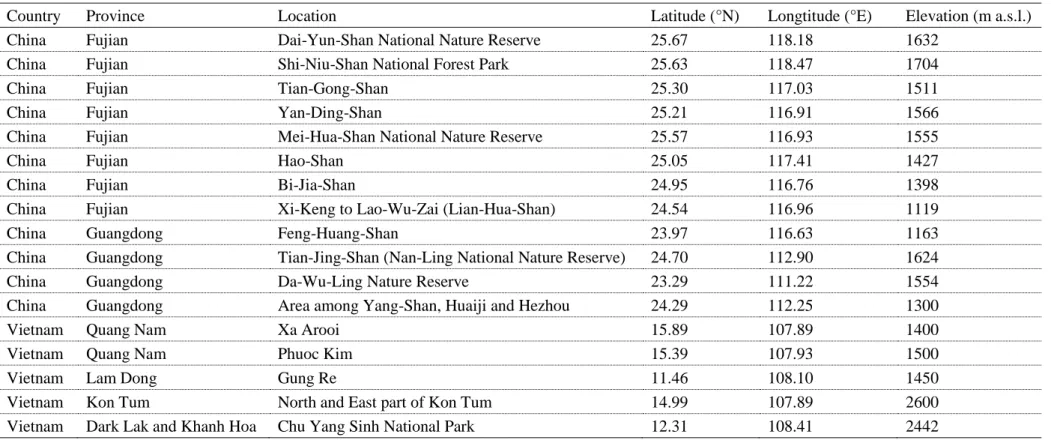
Table S1 The areas with complete suitable habitats of Quercus arbutifolia predicted by species distribution modeling.
Country Province Location Latitude (°N) Longtitude (°E) Elevation (m a.s.l.)
China Fujian Dai-Yun-Shan National Nature Reserve 25.67 118.18 1632
China Fujian Shi-Niu-Shan National Forest Park 25.63 118.47 1704
China Fujian Tian-Gong-Shan 25.30 117.03 1511
China Fujian Yan-Ding-Shan 25.21 116.91 1566
China Fujian Mei-Hua-Shan National Nature Reserve 25.57 116.93 1555
China Fujian Hao-Shan 25.05 117.41 1427
China Fujian Bi-Jia-Shan 24.95 116.76 1398
China Fujian Xi-Keng to Lao-Wu-Zai (Lian-Hua-Shan) 24.54 116.96 1119
China Guangdong Feng-Huang-Shan 23.97 116.63 1163
China Guangdong Tian-Jing-Shan (Nan-Ling National Nature Reserve) 24.70 112.90 1624
China Guangdong Da-Wu-Ling Nature Reserve 23.29 111.22 1554
China Guangdong Area among Yang-Shan, Huaiji and Hezhou 24.29 112.25 1300
Vietnam Quang Nam Xa Arooi 15.89 107.89 1400
Vietnam Quang Nam Phuoc Kim 15.39 107.93 1500
Vietnam Lam Dong Gung Re 11.46 108.10 1450
Vietnam Kon Tum North and East part of Kon Tum 14.99 107.89 2600
Figure legends
Figure S1 The 39 sites have been investigated in south China and north Vietnam: 8 red solid circle (with Quercus arbutifolia) and 31 green solid triangle (without Q. arbutifolia). The two yellow solid square in Vietnam are the sites where Q. arbutifolia was found in 1920s.
Figure S2 The habitats and threats of Quercus arbutifolia. Young individuals in the populations NL(A), DQ (B), and GY (C). Individual with a tree-like form (D). Scrubby form of Q. arbutifolia in the populations DQ (E) and GY (F). Intensive tourism development in Q. arbutifolia habitat of NL (G) and DM (H). The forest-like bamboo stands invading the lower boundaries of Q. arbutifolia stands in MH (I). The grassland and bamboo thickets invading the upper boundaries of Q. arbutifolia stands in DQ (J and L) and TG (K). White arrows show the Q. arbutifolia individuals. For abbreviations of populations see Table 1.
Figure S3 The analogue climate between the future projection climate and the current climate in the calibration dataset. Value 3 means that it is not analogue in the three GCMs, 2 - only in two GCMs, 1 - only in one GCMs, and 0 - in zero GCM. (A) under the climatic scenario RCP 4.5; (B) under the climatic scenario RCP 8.5.
Figure S4 The current area of occurrence of Quercus arbutifolia (red enclosed surface) and future (2050, simulation 1, yellow enclosed surface). For abbreviations of populations see Table 1.