READ THESE TERMS AND CONDITIONS CAREFULLY BEFORE USING THIS WEBSITE. https://nrc-publications.canada.ca/eng/copyright
Vous avez des questions? Nous pouvons vous aider. Pour communiquer directement avec un auteur, consultez la première page de la revue dans laquelle son article a été publié afin de trouver ses coordonnées. Si vous n’arrivez pas à les repérer, communiquez avec nous à [email protected].
Questions? Contact the NRC Publications Archive team at
[email protected]. If you wish to email the authors directly, please see the first page of the publication for their contact information.
Archives des publications du CNRC
This publication could be one of several versions: author’s original, accepted manuscript or the publisher’s version. / La version de cette publication peut être l’une des suivantes : la version prépublication de l’auteur, la version acceptée du manuscrit ou la version de l’éditeur.
Access and use of this website and the material on it are subject to the Terms and Conditions set forth at
Limitations of present test methods for roofing materials
Laaly, H. O.; Sereda, P. J.
https://publications-cnrc.canada.ca/fra/droits
L’accès à ce site Web et l’utilisation de son contenu sont assujettis aux conditions présentées dans le site
LISEZ CES CONDITIONS ATTENTIVEMENT AVANT D’UTILISER CE SITE WEB.
NRC Publications Record / Notice d'Archives des publications de CNRC:
https://nrc-publications.canada.ca/eng/view/object/?id=791786e6-129d-401d-abfd-545a5b0e0bcf https://publications-cnrc.canada.ca/fra/voir/objet/?id=791786e6-129d-401d-abfd-545a5b0e0bcf
H. 0.
Laalyl and
P.
J. Seredal
Limitations of Present Test
Methods for Roofing Materials
W3FERENCE: Laaly, H. 0. and Sereda, P. J., ULlmiC.tiolu d Pracnt Teat Mcthsdr for Roothy M.tCrWI," Durability of Building Mat&& and component^, ASTM STP 691,
P. J . Sereda and G. G. Litvan, Eds., American Society for Testing and Materials, 1980, pp. 755-766.
ABSTRACT: A development study of test methods and criteria for evaluating new roof- ing materials is described: prefabricated polymeric and elastomeric sheets, prefabricated modified bituminous membranes, and liquid applied membranes. Results are summa- rized for a number of materials selected as typical of the three groups in order to illustrate the problems and the limitations associated with the different tests.
KEY WORDS: roofing, waterproofing, membranes, performance, durability, rubber- ized asphalt, poly(viny1 chloride), rubber, liquid elastomers, prefabricated, asphalt, bitumen, building materials
Bituminous built-up roofing (BUR) has been widely used in North America over the past 80 years with varying success. With the inclusion of in- sulation in flat roofs, however, problems have intensified and this has generated much interest internationally.*J The failure of traditional BUR and development of a range of plastic materials, including prefabricated ones, has led to the introduction of many new membranes for use on roofs. They range in composition from slight modifications of the original asphalt, also applied in liquid form, to prefabricated sheets of plastic or membranes containing several elements. The rapid introduction of these materials and their great variety have necessitated the establishment of suitable petfor- mance criteria to ensure a minimum service life in comparison with the con- ventional BUR system.
At the request of Central Mortgage and Housing Corporation (CMHC),
'
Ass,ociate research officer and principal research officer, respectively, Division of Building Research, National Research Council of Canada, Ottawa, Ont., Canada.International Symposium of Roofs and Roofing, Society of the Chemical Industry/Agree- ment Board, Brighton, England, Vols. 1 and 2, Sept. 1974.
3~nterna~onal Symposium on Roofing Technology, National Bureau of Standards/National Roofing Contractors Association, Gaithersburg, Md., Sept. 1977.
the Division of Building Research of the National Research Council of Canada has undertaken the task of establishing methods of evaluating these new roofing materials and of assisting in the preparation of standards. This paper outlines classification and description of products, and criteria for evaluation. It also presents a summary of the results of the tests for a number of materials selected as typical of the different classes. These examples il- lustrate the problems encountered and the limitations of the tests.
If it were possible to evaluate such a wide range of materials on strictly performance-based criteria, there would be no need for group classification. Ideally, one should be able to designate all as roofing and waterproofing membranes and consider them on that basis. This has not yet been possible, however, and it has been necessary to categorize them. It has been con- sidered essential for the preparation of standards, which must be "prescrip- tive" to some degree, and based on generic class and method of application. In discussing the durability of these materials, the following classifications were used:
Group I-Prefabricated polymeric and elastomeric sheets, poly(viny1 chloride) (PVC) reinforced and unreinforced. Six flexible PVC samples were included in the evaluation.
Group 2-Prefabricated, modified, bituminous, reinforced membranes, multi-component. Thirty-six separate products were included under this category, representing a wide range of components formulated to give specific properties.
Group 3-Liquid-applied membranes (classified according to manner of application): hot-applied-These were represented by seven products that are formulations composed mainly of asphalt modified with rubber, resin or other materials, or cold-applied-This sub-group was represented by a total of 33 products, some of which were two-component systems requiring mix- ing, others, emulsions or solutions. Liquid materials are usually applied by trowel or spray.
Criteria for Durability Evaluation
In evaluating durability of roofing membranes it is necessary to specify the conditions of exposure, for example, to specify exposed or protected roofing systems. In an exposed system the membrane may experience the full range of temperature (-40 to +70°C), may receive full solar irradiation, and moisture in the form of rain, snow, and ice. In the protected roofing system the membrane is covered by a layer of suitable insulation that shields it from solar irradiation. The yearly temperature change imposed on it is also moderated to about 25°C and it is subjected predominantly to liquid water.
The expected performance of conventional roofing materials is based on an average life of about 20 to 25 years. Therefore, it is logical that perfor-
LAALY AND SEREDA ON TEST METHODS FOR ROOFING 757
mance of new roofing materials should be based on at least a similar life expectancy.
Each class of roofing membranes has very different chemical, physical, and mechanical properties. The capability of providing a water barrier is the
!
only pmperty that all classes have in mrnmon. At the present time the perfor-mance requisements of a roofing membrane cannot be defined in terms of
any single propefty such
as
tensile strength, because two materials may havevery different tensiIe strengths yet give adequate performance. However, in- dividual properties may be used to characterize a material and permit control of quality.
Evaluation of new roofing materials has been based on the following criteria.
Mechanical Capabiliry
(a) The material must withstand movements of the roof systems, wind ac- tion, penetration by sharp objects, and low temperatures. Therefore, the following properties were considered: tensile strength, elongation at break, elastic limit (recovery after stretching), low temperature flexibility, crack bridging, cone penetration resistance, and static and dynamic impact test at different temperatures.
( b ) In order to maintain the capability dkfined in ( a ) . propertities should not change greatly after prolonged aging and weathering. Any change that does occur in a particular pmperty after exposure to natural or artificial weathering conditions often gives the best indication of durability.
Resistance to Moisture
This requirement is clearly most important in evaluating the performance of roofing membranes: (a) moisture absorption (note any weight and dimen- sional change), and (b) moisture absorption (note mechanical property change, as in ( b ) under Mechanical Capability.
Resistance to Weathering
In addition to actual field experience involving recorded service perfor- mance and exposure of specimens to normal outdoor weathering, two machines were used in subjecting specimens to accelerated weathering cycles:
(a) Climate Lab-cycles of moisture and temperature: 2 cycles per day- 7 h at 100 percent relative humidity, 56OC and 5 h at 25 to 100 percent relative humidity, 11 to 56OC (see footnote 4 for details). This method of
aging is suitable for the membranes used in inverted roofing systems where solar irradiation is not involved.
( b ) Weather-Ometer-combined action of moisture-temperature-solar ir- radiation. Resultsof this test are applicable to materials that will be exposed to normal outdoor conditions.
Results
The following is a summary of data from the evaluation program chosen to illustrate the problems encountered in using the criteria and the reasoning behind the need for range of requirements rather than the lowest limit of one property which has to be considered in the development of material specifica- tions.
Tensile Properties
Tensile strength and elongation for a membrane that is to serve as a roof- ing material can be considered only in relation to a group. Thus it is not possible to set an overall minimum requirement. This merely emphasizes that no one property can be taken alone to define the expected performance of the given material. For example, two materials from two groups could be
consideted to serve adequately as membranes while each will have very dif- ferent tensile strengths,
The tensile strength and elongation of Group 1 specimens are higher than might be required of a roofing membrane, but this property is specified mainly for the purpose of determining the quality of the product and to measure the effect of aging or weathering. Tensile strength of PVC mem- branes varied with direction of manufacture (machine or cross-machine) and gave values ranging from 115 to 227 kg/cm2 and elongations from 245 to 350 percent. When tensile strength was measured after certain aging and weathering exposures it did not change significantly although elongation at break did (Table 1).
Group 2 represents a large number of products, and tensile strengths varied widely from 6.5 to 92.9 kg/cm2 in machine direction and 5.4 to 77.4 kg/cm2 in cross-machine direction. As stated earlier, a single limit cannot be placed on tensile strength because of lack of performance data, and at this time values can serve only as an indicator of quality or evidence of changes following intervals of aging.
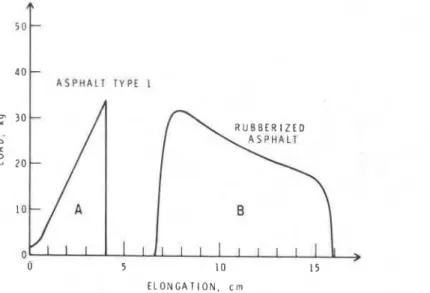
For rubberized asphalt (Group 3), tensile strength could not be deter- mined at room temperature, using conventional strip or dumb-bell specimens. Instead, the toughness test was conducted using the cup and pull- ing head procedure described in CGSB Standard for Asphalt, Rubber- ized, Hot-Applied for Roofing and Waterproofing (37-GP-50M March 1978h5 Another procedure used ASTM Method for Ductility of Bituminous
'~anadian Government Specification Board. Department of Supply and Services, Ottawa, Ont.. Canada.
TABLE 1-Mechanical properties of flexible PVC (tensile strength in kg/cm2, elongation at break, percent). Accelerated Aging at 163'
Original 170 days in Water 75 mn 300 min Natural Aging
Specimen Tensile Tensile Tensile Tensile Tensile
No. Direction Strength Elongation Strength Elongation Strength Elongation Strength Elongation Year Strength Elongation
...
... 1 MD 214 321 21 1 260 229 240 8 218 345...
...
...
...
...
CMD 196 338 184 257 176 233...
...
...
... ND...
23 1 292...
...
. . . 2 MD 227 352 216 278 222 208. - .
.
.
-
...
...
...
. . . CMD 218 340 219 295 207 212..,
...
... ND ... 233 31 1. - .
. - ....
...
...
... 3 MD 196 314 187 210 220 20 ...
...
...
...
...
...
CMD 178 340 165 234 172 10...
...
... ... 4 MD 197 308 188 . 215 213 105..-
...
...
. . . CMD 180 353 159 232 162 97.
. .-..
...
...
...
... 5 MD 154 285 ,.
, 158 218 211 12 . . ....
...
... CMD 146 245 157 39 226 16. . -
...
. . .
6 MD 117 289 112 242 125 166 5 138 282...
...
10 155 215. .
, ... 11 230 19...
... CMD 115 234 119 266 128 160 5 148 308...
...
...
...
...
...
...
,.
.
10 115 138 11 214 50No're-MD = machine direction. CMD = cross-nlaclline direction.
Materials ( D 113
-
76). Toughness (area under the curve) was determined at-25OC to show the influence of rubber on the brittleness of the asphalt (Fig. I ) .
Low-Trmperurirrr Flexibili[v-Low-temperature flexibility can best be evaluated by a tension test at low temperature, but an alternative method is often referred to in standards, a bend test over a mandrel at a given temperature. This test is particularly important if the membrane has to be applied at below zero temperature. Low-temperature flexibility at -10 and
-30°C has been considered,for the standard and heavy duty materials, respectively (see CGSB 37-GP-56M).
Again, there is no criterion that can allow a limit to be set based on perfor- mance requirements. The test might be used to indicate quality and changes resulting from certain aging or weathing exposure, but the latter is difficult because of the low sensitivity of the test.
The materials included in this program yielded a wide range of results; where some elastomeric membranes passed the bend test over a 6.35 mm (I/1-in.) mandrel at -60°C, other materials failed it over a 25.4 mm (1-.in.) mandrel at
-
10°C. Of interest is the fact that conventional BUR failed a bend test over a 25.4 mm (I-in.) mandrel at O°C. At this time there are few performance data to indicate which of the new materials will perform better in service and what common limits, if any, can be set on the low temperature flexibility of roofing materials.Crack Bridging-This property is applicable to Groups 2 and 3 (where
30 R U B B E R I Z E D n a 0
-
20 10 a 0 5 10 15 E L O N G A T I O N , crnFIG. I-Toughness rest (using ASTM D 113): resting temperature -2S°C: machine speed I cm/min: chart speed 5 cm/min.
LAALY AND SEREDA ON TEST METHODS FOR ROOFING 761
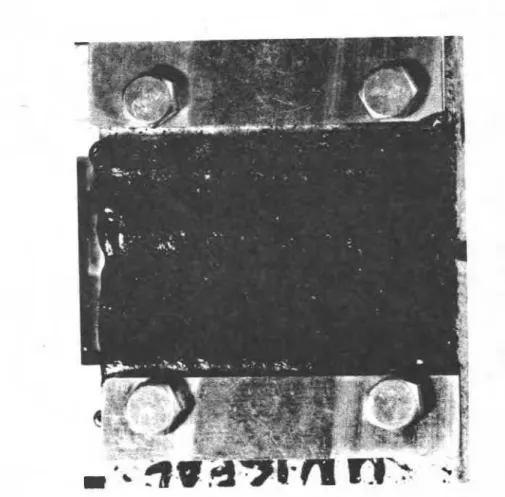
they are fully adhered to a substrate). A test was devised to observe the tendency of the material to sag or break in bridging an opening of 3.18 mm
(1/8 in.), either at room temperature or in an oven at 40°C for 24 h. The ap- parataus is shown in Fig. 2 and the test described in CGSB 37-GP-50M.
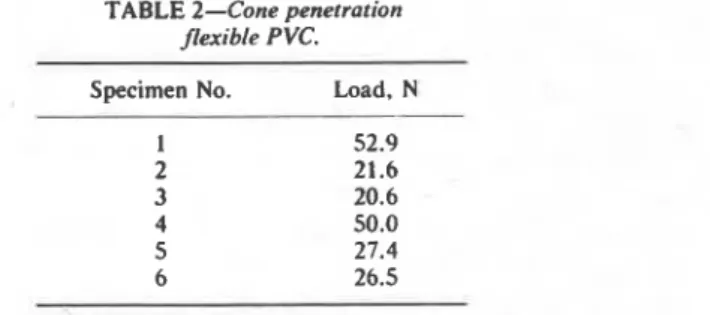
Cone Penetration-This property was measured for Groups 1 and 2 and defines limits to the thickness of the sheet that will withstand puncture such as that caused by falling objects or crushed stone grains driven into the sur- face under the weight of a man. This test is not valid for thick membranes, especially those that are self-healing such as rubberized asphalts (Table 2). Resistance to Moisture
This is the most important property of roofing materials. It is their main function to serve as a moisture barrier and in this capacity they must retain
FIG. 2-Device and concrete blocks (CGSB 37-GP-50M) covered with hot-applied rubberized asphalt ready f i r crack-bridging test.
TABLE 2-Cone penetration frexible PVC.
Specimen No. Load, N
their physical and mechanical properties after continuous or cyclic exposure to water over their entire life cycle.
Various test methods for water absorption were considered, and that selected was immersion for a week at 50°C. The increase in temperature ac- celerated absorption rate, reducing the test period. It is believed that no ab- normal effect was imposed on the materials at the chosen temperature. The amount of water absorbed and its effects were determined by measuring weight and dimensional changes.
Specimens of
PVC
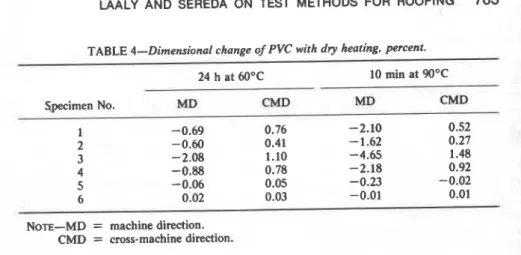
materials (Group 1) absorbed 0.6 to 3.5 percent water (Table 3), and shrank up to 1 percent in the machine direction when exposed to the absorption cycli at 5 0 " ~ , due to stress relaxation. This could be demonstrated by heating the material .dry for 24 h at 60°C or for 10 min at90°C (Table 4). This shrinkage presented a problem in evaluating the TABLE 3- Weight and length changes of PVC immersed in water (mean of3 tests).
Weight Changes A W / W o (%) Length Changes A L/L, (70) Long-term at 2S°C Accelerated at 50°C Long-term at 2S°C Accelerated at 50°C
170 days 233 days 7 days 170 days 233 days 7 days Specimen
No. MD CMD MD CMD
NOTE-MD = machine direction. CMD = cross-machine direction.
LAALY AND SEREDA ON TEST METHODS FOR ROOFING 763
TABLE 4-Dimensional change of PVC with d.y heating. percent.
24 h at 60OC 10 min at 90°C
Specimen No. MD CMD MD CMD
NOTE-MD = machine direction. CMD = cross-machine direction.
material's resistance to moisture and this test should be carried out either at room temperature or after the heat relaxation.
Group 2 materials also gave a number of anomalous results for water ab- sorption and dimensional change. There did not seem to be any consistency in the values; where one material absorbed 10.6 percent moisture and shrank 0.3 percent in machine direction, expanding 0.4 percent in cross-machine direction, another material absorbed only 0.9 percent water and expanded 1.3 percent (MD), 1.6 percent
(CMD).
Because of this, the results of these tests cannot be used alone in evaluating the materials, but must be combined with other tests such as tensile strength to identify any significant change in properties on absorption of water.However, the absorption test does identify which materials will deteriorate visibly when exposed to water, for example, which will undergo large, ir- regular expansion resulting in buckling, delamination, etc. This is iljustrated by the Group 3 materials in Table 5. It does not mean that other materials that absorb a certain amount of water with corresponding dimensional change but no visible damage will not, in time, undergo deleterious changes due to absorption. The hot-applied materials exhibited so little water absorp- tion that dimensional changes were not even measured. Conversely, most of the cold-applied materials showed large losses or gains in weight with cor- responding shrinkage or expansion.
Resistance to Weathering
Specimens of all the materials in this program were exposed to either or both of the two cyclic accelerated weathering machines:
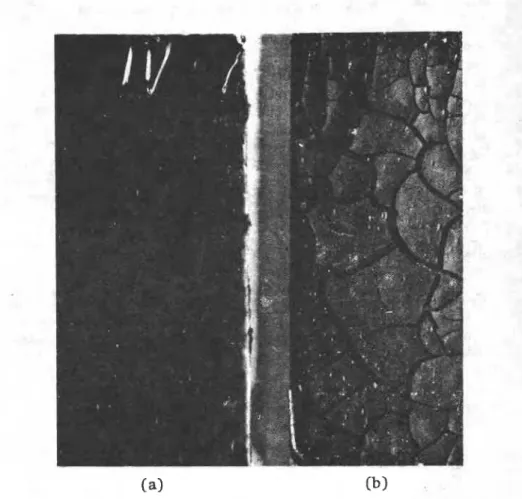
(a) Climate Lab-Exposure of over 3 months was given to all specimens and the effect ranged from virtually no change to extreme deterioration and
distortion (Fig. 3 and 4). It is believed that measurements of change in length and tensile strength may provide a quantitative indication of the effect of this
TABLE 5- Weight uttd length chunges of Group 3 immersed in nwter (nteurr c$ three tests-7 duys ur 50°C).
Weight Changes Length Changes Specimen No. A W/W,,, 7'0 A L/L,,, % -
FIG. 3-Liquid-applied, modified polyurethune membrane: (a) before exposure and
(b) ufter 110 duys' exposure in climate lab (temperalure and moisture cycling). Note swelling and deformution.
LAALY AND SEREDA ON TEST METHODS FOR ROOFING 765
FIG. 4-Rubberized asphalt: ( a ) unexposed. and ( b ) after 18 months' exposure in climate lab.
I
exposure, but these measurements have not yet been completed for all materials under investigation.
(b) Weather-Ometer-Specimens tested in this machine are being
restricted to those materials that will be exposed to normal outdoor condi- tions, including solar irradiation. Testing is in progress.
Conclusions
Preliminary results of the program have revealed that evaluation of durability of new roofing materials is a complex task.
Owing to uncoordinated performance data it is not possible at the present time to define criteria for a roofing membrane in quantitative terms ap- plicable to all of the variety of generic materials in use.
p u p s . a? even within one group, i s not justified because of wide variability and anomalous results for water absorption and dimensional change. Com- parison of combinations of properties may yield useful results when perfor-
mance data become available to provide the basis for such comparison.
Systematic evaluation of the large number of roofing materials is an in- volved, long-term study that will require combined laboratory and field work
on an international lwel before realistic evaluation of performance can be achieved. For the present, evaluation of such materials must be done on an
ad hoc basis to provide guidelines for quality control and standards to protect the consumer.
Acknowledgments
Experiments were carried out by C. C. Barrett, G. A. O'Doherty, and L. R. Dubois. The authors wish to thank them for their effort and dedication. This paper is a contribution from the Division of Building Research, Na- tional Research Council of Canada, and is published with the approval of the Director of the Division.
- - -