Publisher’s version / Version de l'éditeur:
Journal of Fire Protection Engineering, 19, 1, pp. 31-49, 2009-02-01
READ THESE TERMS AND CONDITIONS CAREFULLY BEFORE USING THIS WEBSITE.
https://nrc-publications.canada.ca/eng/copyright
Vous avez des questions? Nous pouvons vous aider. Pour communiquer directement avec un auteur, consultez la première page de la revue dans laquelle son article a été publié afin de trouver ses coordonnées. Si vous n’arrivez pas à les repérer, communiquez avec nous à [email protected].
Questions? Contact the NRC Publications Archive team at
[email protected]. If you wish to email the authors directly, please see the first page of the publication for their contact information.
NRC Publications Archive
Archives des publications du CNRC
This publication could be one of several versions: author’s original, accepted manuscript or the publisher’s version. / La version de cette publication peut être l’une des suivantes : la version prépublication de l’auteur, la version acceptée du manuscrit ou la version de l’éditeur.
For the publisher’s version, please access the DOI link below./ Pour consulter la version de l’éditeur, utilisez le lien DOI ci-dessous.
https://doi.org/10.1177/1042391508095094
Access and use of this website and the material on it are subject to the Terms and Conditions set forth at
Understanding the effectiveness of notification technologies in assisting vulnerable populations
Gwynne, S. M. V.; Boswell, D. L.; Proulx, G.
https://publications-cnrc.canada.ca/fra/droits
L’accès à ce site Web et l’utilisation de son contenu sont assujettis aux conditions présentées dans le site
LISEZ CES CONDITIONS ATTENTIVEMENT AVANT D’UTILISER CE SITE WEB.
NRC Publications Record / Notice d'Archives des publications de CNRC: https://nrc-publications.canada.ca/eng/view/object/?id=a9e46c68-7146-471f-8e9d-b2a0a51becdf https://publications-cnrc.canada.ca/fra/voir/objet/?id=a9e46c68-7146-471f-8e9d-b2a0a51becdf
http://irc.nrc-cnrc.gc.ca
U nde rst a nding t he e ffe c t ive ne ss of not ific a t ion
t e chnologie s in a ssist ing vulne ra ble populat ions
N R C C - 5 1 2 2 7
G w y n n e , S . M . V . ; B o s w e l l , D . L . ; P r o u l x , G .
F e b r u a r y 2 0 0 9
A version of this document is published in / Une version de ce document se trouve dans:
Journal of Fire Protection Engineering, 19, (1), pp. 31-49, DOI:10.1177/1042391508095094
The material in this document is covered by the provisions of the Copyright Act, by Canadian laws, policies, regulations and international agreements. Such provisions serve to identify the information source and, in specific instances, to prohibit reproduction of materials without written permission. For more information visit http://laws.justice.gc.ca/en/showtdm/cs/C-42
Les renseignements dans ce document sont protégés par la Loi sur le droit d'auteur, par les lois, les politiques et les règlements du Canada et des accords internationaux. Ces dispositions permettent d'identifier la source de l'information et, dans certains cas, d'interdire la copie de documents sans permission écrite. Pour obtenir de plus amples renseignements : http://lois.justice.gc.ca/fr/showtdm/cs/C-42
Understanding the Effectiveness of Notification Technologies in Assisting
Vulnerable Populations
S.M.V. Gwynne*, D.L. Boswell*, and G. Proulx
+ *Hughes Associates, Inc., USA+National Research Council, Canada
Hughes Associates, Inc.(Boulder Office) 3515 28th St #307 Boulder, CO 80301 USA Correspondence: [email protected] Tel: +1 303 444 0974 Abstract
Different sections of the general population were examined to establish two criteria: whether they were particularly vulnerable to death in fire incidents; and whether these vulnerabilities could be reduced through developing and/or applying specific notification technologies. This study was conducted in order to establish where there were omissions in our current
understanding and where this coincided with technological solutions of particular interest.
An approach was developed to identify vulnerabilities and prioritize them in order to focus future research. The approach adopted was able to achieve this goal. The suggested research was then conducted and allowed guidance to be developed regarding the use of different notification technologies. This article describes the development of this analytical framework and the analysis of some of the results produced.
Keywords
Pre-Evacuation Time; Notification Technology; Vulnerable Groups. Introduction
During an emergency incident it is imperative that evacuees respond in a timely fashion, and that this response is based on the information available [1-10]. Information can arrive (or be sought) from a variety of different sources that vary greatly in their reliability and accuracy. Where there is ambiguity or conflicting information, time can be spent confirming the existence of an
incident, the nature of the hazard posed and then formulating an appropriate response. In addition, this information can be misinterpreted or missed entirely. The implementation of notification technology represents an attempt to compensate and correct for these omissions. It is also vital that once the population starts to evacuate that they are aware of the egress routes available, use them efficiently, and waste as little time as possible wayfinding. Therefore, when designing an emergency procedure two basic behavioral components need to be addressed: ensuring that people are alerted of the incident sufficiently quickly and in adequate detail; and ensuring that the population responds in the most efficient manner possible.
From the research literature it appears that the most effective means of informing an individual of an incident is through the presence of well-informed, well-trained, assertive [11,12] and respected staff. The message is perceived as more credible [3]; the member of staff is able to
intervene to aid the evacuee response where necessary [4,11-12]. If sufficient numbers of staff are not present to inform the occupant population and manage the evacuation, then other means of influencing the evacuation needs to be provided. In the absence of staff, it is critical that an information vacuum be avoided. There will inevitably be situations where members of staff are unavailable, or where they need support. In these situations, notification technology is a critical tool. These systems (video, audio, tactile, etc.) are used to inform occupants of the existence of an incident and then, ideally, aid their response to ensure safe egress.
As part of a project funded by the Fire Protection Research Foundation sections of the general population were examined to establish two criteria: whether they were particularly vulnerable to dying in fire incidents; and whether these vulnerabilities could be reduced by applying existing or new notification techniques. Given that being alerted to a fire early is a key factor in surviving a fire incident, notification technologies were examined to determine whether they were effective in alerting these groups of an incident and improving their chances of survival when responding to it.
This project was primarily conducted in order to direct research activities; i.e. to establish where there were omissions in our current understanding and where these omissions coincided with technological solutions of particular interest. Therefore, the authors developed an approach to identify vulnerabilities, and prioritize them in order to focus future research. This paper describes the development of this analytical framework, followed by an analysis of some of the data
collected, and some of the conclusions drawn. Limitations of the Existing Approach
The project required the development of an approach to identify and assess a range of
vulnerabilities. It was established relatively early on in the work that these vulnerabilities might not be equally supported by the data available; i.e. that some vulnerabilities were more likely to be recorded than others. This became apparent from examining high-level statistics, the methods used to collect and store the supporting information and from examining our understanding of human behavior in fire [2,4,13-16]. It was felt that this issue may mask potentially important vulnerabilities that need to be examined and addressed. Given these limitations, it did not seem appropriate to assess vulnerabilities entirely by examining high-level trends, as was typically the case. A novel approach was needed to overcome this problem and in order to reliably assess these vulnerabilities. An analytical approach was developed. This can be broadly separated into two phases. In Phase I a framework was developed to identify vulnerabilities, assess the
effectiveness of notification technologies and identify research needs. In Phase II, research was conducted to meet these needs and this prompted, along with the existing research material available, recommendations to be made.
Phase I: The Analytical Approach
The approach required an extensive review of the available literature describing the notification process and how it fitted into the overall evacuation process. This review enabled the
identification of vulnerabilities, their nature and placed them in context with the evacuation process. This iterative process also enabled the identification of vulnerabilities from several sources. Some of these vulnerabilities would have otherwise been difficult to identify and
attribute. This was important as the nature of the vulnerability influenced the likelihood of it being recorded. These vulnerabilities included
Innate vulnerabilities –attributes of those involved and traditionally easier to identify and record; e.g. the individual was immobile, elderly, etc.
Experiential vulnerabilities –related to the level of experience, knowledge levels, and procedural awareness; e.g. whether or not an individual is sufficiently trained.
Situational vulnerabilities –related to the incident scenario; e.g. the individual was asleep or intoxicated, close to the fire, potential for assistance being provided, etc.
Vulnerabilities were defined in this manner to better understand how they may arise, persist, develop and propagate. For example, vulnerabilities need not be permanent; i.e., someone that may not otherwise be considered vulnerable may become vulnerable (e.g. intoxication, the presence of background noise, lack of familiarity and training, etc.). As an incident evolves, so these factors may or may not have influenced the behavior of those involved. These situations are particularly susceptible to being overlooked in the reporting process and are also less likely to have been prepared for by those involved; e.g. someone with a permanent and serious hearing impairment is more likely to have taken some measures to counteract this condition in
comparison with someone who is occasionally intoxicated. For instance, in an actual incident a number of factors may be present (see Figure 1). However, whether these factors are reported and whether they contributed to the final outcome is difficult to ascertain from high-level quantitative data. Even if all of the relevant factors are recorded, which is unlikely, the extent of their impact is rarely collected, assessed or stored.
Figure 1: The factors leading to vulnerabilities.
It became clear that different vulnerabilities were not equally likely to be recorded in incident statistics. This discrepancy may be due to difficulties in identifying the presence of a condition (e.g. partial hearing loss); recording practices (e.g. whether all the necessary information was sought or recorded at the scene); and also establishing whether a factor actually influenced the fatality (e.g. whether being asleep actually contributed to the fatality). Therefore, not only are there difficulties in extracting vulnerabilities during the fire investigation and through examining
the reported material, but it is also difficult to assess the extent of the actual impact of reported vulnerabilities in a particular incident.
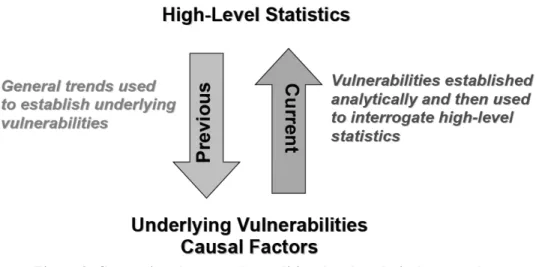
These issues could lead to certain vulnerabilities being misreported and misunderstood; it is possible that high-level statistical trends may misrepresent the importance of a particular factor, while missing others entirely. To avoid these discrepancies, a vulnerability model was developed to complement the existing statistical approach. It is contended that this model is able to identify factors that may otherwise fall through the statistical „net‟ and may help explain why certain vulnerabilities exist. This model required that vulnerabilities be identified from the bottom-up; i.e. by analyzing their constituent components, rather than employing the traditional approach of deriving trends from high-level statistics (see Figure 2). This depended on a comprehensive and detailed examination of the available literature in order to analytically derive vulnerabilities, rather than extracting them from general statistical trends.
Figure 2: Comparison between the traditional and analytical approaches.
Instead of focusing entirely on the notification process, a broad literature review of the
evacuation process was performed. This deliberately included a wide variety of subject areas in order to get an appreciation of the pre-evacuation process, the manner in which this influenced the evacuation response, and to place the potential impact of notification systems into context. It was also felt that vital information may be included in material that did not directly address notification issues. This examination increased the probability of recognizing previously overlooked vulnerabilities. This review included material addressing the following topics [17]
• Anticipated evacuation behavior and influential factors; e.g. [2,4]. • Case Studies: reports describing real fires; e.g. [7].
• Theoretical Work: where researchers attempted to explain phenomena; e.g. [2,16]. • Empirical data: where researchers engineered situations to produce data; e.g. [11,12,18]. • Notification principles: the factors specifically associated with the notification process. • Notification technology: technology available and potential impact upon evacuee response. • Incident scenarios: the types of situations that might arise and the impact of contributing factors
such as occupancy type, the resident population, and other contributory behaviors/factors.
Both qualitative and quantitative material was examined in order to provide a more reliable foundation for the analysis. This was critical given the limitations of the high-level statistics highlighted previously. It was vital that not only the existence of vulnerabilities were understood, but also why they existed and their nature. In support of this understanding, material was also
included that provided (or was based on) a narrative account of the fire incidents. In these cases, the statistical evidence examined was both supported and informed by a descriptive account. Examples of this can be found in the work of Fahy and Molis [19], and Purser and Kuipers [20]. In this work, the conclusions derived were not solely based on an overview of statistical trends, but were also influenced by a low-level analysis of quantitative data and an assessment of the contributory factors in each of the cases included in the analysis; they therefore attempted to understand the chain of events and explain why the statistics were produced as well as quantifying the results collected.
Therefore, the vulnerability model was based on detailed qualitative accounts, low-level quantitative analysis and also on the more traditional high-level quantitative statistical data. Vulnerabilities were identified in context with the incidents from which they were derived and an effort was made to understand how these vulnerabilities could have contributed to the outcome of that incident. This was achieved by understanding the nature of the vulnerability in question and then establishing how this may have constrained the performance of a population. In this manner, a set of vulnerabilities and vulnerable populations were identified.
Phase I: Establishment of Vulnerable Groups
Vulnerable groups were derived through examining the research literature and from guidance provided by the expert technical panel established as part of this project. This panel included expertise in fire safety, human behavior in fire, technical systems, data collection and the
mathematical sciences. A variety of different groups were identified including, but not limited to Individual Differences/Attributes
Children younger than 5 Children older than 5
Hearing impaired (identified /unidentified) Visual impairment (identified / unidentified) Untrained individuals
Unprimed individuals Elderly
Those asleep/awake Sleep deprived
Drug impairment (medication) Drug impairment (illegal narcotics) Alcohol impairment
Chronic Health Problems
Role (specifically whether the role has
associated responsibilities for fire safety)
Fire not considered likely/ not seen as a threat
Those subject to false alarms Physically impaired
Mentally impaired
Presence of Background Pollution (e.g. noise,
lights, distractions, etc.)
Being Alone
Engaged in an activity (i.e. attention focused
elsewhere, level of commitment)
Unfamiliar with signal/message Unfamiliar with surroundings
Fearful of responding (e.g. institutions) People in large groups
People in public spaces Non-native speaker
Those affected by security issues
These groups were then examined using the vulnerability model to establish the nature of their vulnerability and, crucially, whether this vulnerability could be counteracted through
improvements in the notification process. This examination was confined to the delivery of the signal/message and therefore excluded issues of implementation, maintenance, or connectivity that may be related to the use of a particular notification system. Although important issues, they were beyond the scope of the project.
This vulnerability model required breaking the notification process down into four stages. These four stages were derived from the review of theoretical work associated with the notification process and was particularly influenced by the work of Mileti [3]. Each of the groups identified as being vulnerable was assessed according to these four stages:
(1) Ability to receive a signal/message - the ability of the notification system to reach the target population
(2) Ability to recognize the signal/message - the ability of the signal or message to be differentiated from other sounds and signals, and be identified as an alarm
(3) Ability to identify a response – the ability of the signal/message to suggest the required response (4) Ability to perform the response – the ability of the target population to perform the response
suggested by the notification system.
This approach established which of the vulnerabilities were due to notification (stages (1,2,3) in the above list) or due to some other factor that could not be addressed by notification technology (for instance, an inability to respond at all (stage (4)); in effect, it determined which
vulnerabilities could be aided by the notification process and by specific notification technologies. This process both clarified our understanding of the vulnerabilities and later assisted in the prioritization of the vulnerabilities. These vulnerabilities identified were
categorized according to the stage of the notification process that they affected. A simple metric was produced to clarify this categorization process. This enabled the nature and the severity (no vulnerability, slight vulnerability, severe vulnerability) of the vulnerabilities to be better
understood. An example of this is shown in Table 1. This process required a simplification of the vulnerabilities in question; however, this was essential in order to gain a general appreciation of the vulnerabilities and then make comparisons between them.
Table 1: Example of categorization for two groups deemed as vulnerable [17]. (1) Receive signal/message (2) Recognize signal/ message (3) Identify Response (4) Perform Response Children younger than 5
SEVERE SEVERE SEVERE SEVERE
Hearing impaired SEVERE slight
In the example shown in Table 1, children younger than 5 years old are deemed to be vulnerable in all stages of the notification process (indicted by a “severe” rating). Therefore, a component of their vulnerability (i.e. their ability to respond to the incident, stage (4)) is beyond the direct reach of notification technology. In contrast, it was established that the hearing impaired were deemed only to have vulnerabilities related to receiving and possibly recognizing the notification message, and did not necessarily have innate vulnerabilities associated with their response. As such, technological improvements to the notification system may benefit the hearing impaired. This approach was adopted to understand the nature of the vulnerabilities and also to focus on those groups that were deemed most vulnerable, but which could benefit most from the development of new notification technologies.
The detailed review and the separation of these vulnerabilities into their four constituent parts highlighted how vulnerabilities were not necessarily static, nor independent of each other or the scenario. Instead, they were dynamic and could evolve and interact in complex ways.
Importantly, the analysis also highlighted how vulnerabilities can propagate; i.e. influence an individual and others involved in the incident. For each of the vulnerable groups, a set of factors was established highlighting the primary impact of this vulnerability upon their response (see examples in Table 2). In addition to this, the secondary impact of the vulnerability was
established; i.e. the potential impact on others. In this manner, the capacity for the vulnerability to propagate to other members of a population was examined. Not only is it difficult to get a consistent assessment of the vulnerable groups from examining high-level statistics, but the secondary impact of these vulnerabilities can also easily be overlooked. This consideration was therefore important both in terms of understanding the impact of the vulnerabilities and their prioritization, but also in identifying vulnerabilities that might be overlooked and which have an important secondary impact upon the outcome.
Table 2: The primary and secondary impact of vulnerabilities [17]. Primary Impact on Emergency
Response
Secondary Impact on Emergency Response
Children younger than 5 Depth of sleep / sleep patterns. Inability to comprehend seriousness of
situation / form appropriate response.
Responsibility of another. May require rescue, potentially placing the other
person at risk Alcohol impairment Difficult to arouse. Likely to be
cognitively impaired. Potentially mobility impaired.
Likely to delay/prevent them from rescuing someone else in their care.
Phase I: Notification Technologies
Once the vulnerabilities had been examined, the notification technologies currently available were categorized according to which of the four stages of the notification process they addressed. The extent to which they addressed these stages was also estimated from the literature review. This enabled the potential impact of the notification technologies to be better understood and some comparisons to be made. For example, a strobe system may be able to aid in the receipt of a signal; it may also help in the recognition that a fire incident is developing. It is not, however, able to help identify the required response or aid in this response. This should be compared with a member of staff who has the potential for helping in all of these four stages.
The examination of the vulnerable groups and the notification technologies was then integrated to establish which of the technologies addressed the vulnerabilities in question. A simple metric was established to represent the potential of these technologies to reduce these vulnerabilities. The levels of information provided by the technologies were termed „recognition‟ (i.e. the system alerted the population of an incident, denoted by „Rc‟ in Table 3); and „response‟ (i.e. the
system both alerted the population and had the potential for providing information on the response required, denoted by „Rp‟ in Table 3). In effect, the technologies labeled „Rc‟ had the
potential for addressing stage 2 of the notification process, while those labeled „Rp‟ had the
potential for addressing stages 2 and 3 (see Table 1). These were further categorized according to the sense targeted. The categorization focused upon the potential effects of the technology rather than the underlying technological causes. An example of this is shown in Table 3Error!
Reference source not found.. The potential impact of the notification systems is represented using a three point scale: black indicating that a significant benefit may be attained; grey indicating that some benefit may be gained; no color indicating that no benefit is likely. This
does represent a simplification, but enabled comparisons to be made between the different technologies available.
Table 3: Assessment of the potential impact of notification technologies upon vulnerable groups [17].
Audible Tactile. Visual Staff
Rc (Rc/Rp) Rp Rc Rc Rp Rp
Example Tone Directional
Sound Voice Vibrate Strobe Display Sleep Deprivation/Medication
Hearing impaired 1 3 1
Composite (Public Spaces etc.) Those asleep
Alcohol impairment
Background Pollution 2 2 2 2 2
1 Potential for this will be largely dependent upon the severity of the hearing impairment 2 This will be dependent upon the nature of the noise/pollution present.
3 Broadband nature of sound may have particular benefit to some of the hearing impaired population.
Each of the combinations (i.e. vulnerability and notification technology) was examined to determine whether there was sufficient existing data to make a judgment on the effectiveness of the technology in question [17]. This enabled the identification of omissions in the existing data-sets and helped to identify research requirements. These were then prioritized according to the potential effect of the notification system in question, and the benefit that it might have. The research conducted is discussed in the following sections.
By adopting this vulnerability model, vulnerabilities could be identified in a manner that was independent of the process used to record the data at the scene; i.e. that could take into account the body of learning in the field of human behavior in fire, rather than rely completely on high-level statistics. This allowed vulnerabilities to be highlighted that might otherwise have been overlooked. This approach could then be used in the future to complement the existing method of identifying vulnerabilities through the examination of statistical trends. It also allowed the nature of the vulnerabilities to be better understood and suggested a means of potentially addressing the vulnerability in question through the application and development of different notification technologies.
Phase II: Data Collection
Three different data collection activities were performed as part of this project (see Table 4). These were decided upon after the analysis conducted in Phase I of the project, and also after a detailed analysis was performed of the existing research available [17]. Therefore, the data collection had to represent an area of interest and an area that was not sufficiently supported by empirical data. The expert technical panel also provided significant input into the selection of these three research areas.
Table 4: Research areas examined during Phase II.
Research Area
Vulnerabilities Status Occupancy Technologies Tested Nature of Trial
Nature of Vulnerability A Intoxication Asleep Domestic T-3 (variants)
Vibrating Devices Strobe
Contrived Situational
B Hearing Impaired
Asleep Domestic T-3 (variants) Vibrating Devices Strobe Contrived Situational and Innate C Composite (Public Spaces, large groups etc.)
Awake Public Existing System implemented T-3, Voice, Strobe Staff Natural Setting All
Two projects covering research areas A and B were conducted by Bruck, Thomas and Ball [21] and Bruck and Thomas [17,22]. These projects addressed domestic occupancies where the participants were asleep and impaired, either through alcohol or through an existing hearing impairment. The work conducted by Gwynne addressed research area C, which addressed several non-domestic (i.e. public) occupancies where those involved were awake [17,23]. These three studies examined innate, experiential and situational vulnerabilities. These data-sets obtained were analyzed in order to understand the effectiveness of the notification systems and supporting procedural activities given the context of the evacuation exercise taking place. An example of the analysis prompted by the data collected by Gwynne is shown in the next section [24]. The reader is referred elsewhere for a more complete analysis [17,23,24]. Following this analysis, some general conclusions derived from this data are presented.
Phase II: Analysis of Four Data-Sets Relating to Public Occupancies
The pre-evacuation times collected from four of the sixteen evacuation exercises performed by Gwynne are now examined (see Table 5) [23, 24]. This analysis is consistent with that performed elsewhere in the project [17]. It involved the categorization of the exercises according to their background conditions, the procedures applied and the existing information levels in the
evacuating population. This allowed conclusions to be drawn on the nature of the vulnerabilities present. During the collection of this data, it was not possible to perform repeat trials at the same location [24]. The results are therefore only indicative. However, along with other supporting data-sets [23] and research [17] they are suggestive of the vulnerabilities present and the means to reduce such vulnerabilities [17,23,24].
These particular data-sets [24] are discussed as they are derived from occupancies where a population would not normally be deemed (or expect to be) vulnerable; however, vulnerabilities, as discussed previously, can certainly exist or develop. In addition, the previous analysis
established that these vulnerabilities could be addressed using notification systems as part of an overall procedural response. In this instance, the analysis focuses on the population‟s experiential vulnerabilities (e.g. were they familiar with the procedure?) and situational vulnerabilities (e.g. were there sufficient staff to provide assistance?). In effect, these are procedural issues that then produce vulnerabilities in the population. These vulnerabilities relate to stages (2) and (3) of the notification process identified in Table 1: the recognition of the notification process and the ability to identify a response. These situational and experiential vulnerabilities may be
of these innate impairments upon these results is discussed elsewhere [17,24], although they had a less significant impact than the vulnerabilities discussed here.
Table 5: The context and results from four egress exercises [17,23,24]. Data-Set Occupancy Type Procedure Info Provided by Not. System Drills performed in last 12 months False Alarms Presence of staff active in the procedure
Weather # data points
collected Average Pre-Evacuation time (sec) 1 Office Partial/
Unannounced Voice No Occasional Some Severe 72
141.3 [40-426] 2 Library/Office/
Comp. Space
Full/
Unannounced Tone Occasional Occasional Many Moderate 153
102 [5-290] 3 Office Full/
Unannounced T-3 Often Rare Sufficient Moderate 348
101.4 [19-269] 4 Office1 Full/Managed/
Unannounced Voice Often Rare Sufficient Moderate 132
74 [23-152]
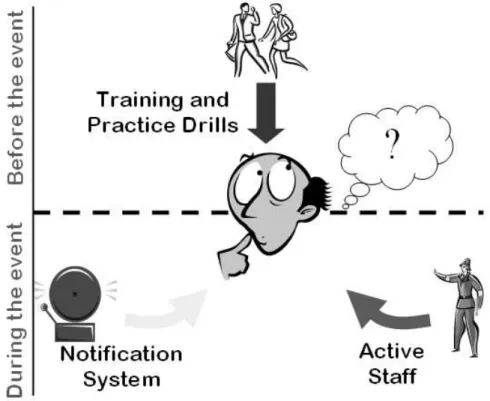
All four data-sets relate to public occupancy, office-based environments. This was deliberately engineered to reduce the number of variables. The critical difference between these evacuations was the information provided by the notification systems, the level of preparation and the responding staff. These represent the methods of informing and guiding an evacuation (see Figure 3). The populations involved in these events had different vulnerabilities, given the levels of information, preparation and guidance.
Figure 3: The three methods of informing and guiding the evacuation process.
Given the differences in the structures (e.g. the number of floors), only the pre-evacuation times are presented here; a comparison of the evacuation times produced is beyond the scope of this paper, but can be found elsewhere [17,23, 24].
0.00 5.00 10.00 15.00 20.00 25.00 30.00 35.00 40.00 45.00 0 <30 <60 <90 <120 <150 <180 <210 <240 <270 <300 <330 <360 >360 Pre-Evacuation time (class size 30 seconds)
% P o p u la ti o n Data-Set(1) Data-Set(2) Data-Set(3) Data-Set(4)
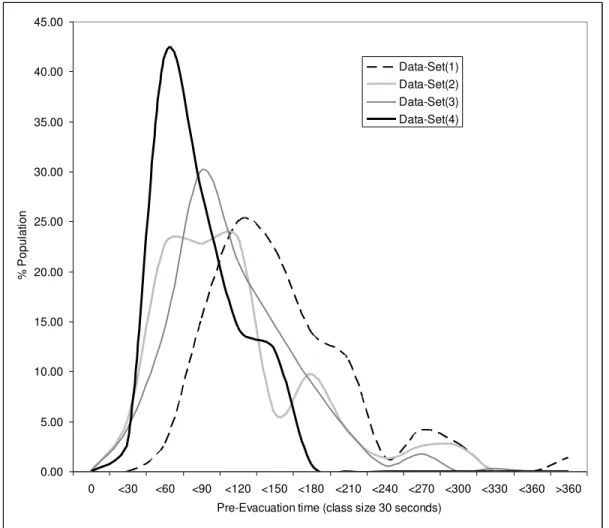
Figure 4: Pre-evacuation frequency curves produced for data-sets 1-4.
The pre-evacuation times collected from these trials are presented in Table 5, along with the key procedural and scenario factors. Trial 4 produced substantially shorter pre-evacuation times than the other three trials; the difference is statistically significant (p < 0.01). 2 The difference in the distribution of the pre-evacuation times produced can be seen more clearly in Figure 4.
It is possible to identify several factors that influenced the results produced.
In Trial 1, the lack of training was compensated for, to some degree, by the voice notification system and by the (admittedly limited) number of staff. In Trial 2, the lack of training and
provision of information by the notification system was compensated for by the numerous, active staff involved. In Trial 3, the well-trained population responded quickly to the tone, supported by staff. Their previous training meant that they understood what was required of them without information being provided by the notification system.
2
It is apparent that the procedural context of Trial 4 was different from the other trials in one critical aspect: it was the only trial where the population was engaged in frequent, unannounced drills; the population was familiar with the procedure; the population was provided with
information during the evacuation; and sufficient staff were on hand to assist in the evacuation process and inform people where necessary. Therefore, all three methods highlighted in Figure 3 were exploited. The population therefore had a base knowledge regarding their response to the alarm, which was then clearly recognizable to them. This base knowledge was then reinforced and enhanced by information provided by the notification system and by the actions of staff. This enabled many occupants to leave prior to the arrival of emergency staff (given that they were familiar with the procedure and understood the alarm), or meant that if occupants required confirmation/instruction from a member of staff, then a staff member arrived relatively quickly to confirm the incident rather than having to explain the procedure. This population was therefore less experientially vulnerable than the populations in the other trials given that they were prepared and practiced; the population was less situationally vulnerable given the notification system and the staffing in place.
The analysis of these four data-sets, along with the other twelve data-sets that were part of this component of the research (Research Area C in Table 4), enabled some general comments to be made regarding the effectiveness of notification systems in public spaces:
It is critical that information levels within the occupant population are adequate otherwise the evacuation process will not be amenable to management and the response of the evacuating population will be based on incomplete or erroneous information. The lack of existing information represents a significant vulnerability.
The presence of a well-informed, assertive, authoritative, well-trained and numerous staff is considered the benchmark notification system. It is able to influence all aspects of the notification process: message delivery, interpretation, recognition of response and enacting the response. As such, it is able to address a range of experiential, situational and innate vulnerabilities. However, these benefits are dependent on the presence,
preparation and commitment of sufficiently large number of staff who are involved in the emergency procedure.
This preceding type of staffing effort should be supported by other means of informing the population of the incident (such as a voice notification system, graphical displays, etc.), in order to provide redundancy in the system and current information on the incident.
The use of notification systems that only alerts the population of an incident (e.g. a tonal signal, a strobe, etc.) cannot inform the population of the nature of the event or the required response. A system that only alerts a population needs them to be sufficiently attuned to the signal, understand its meaning and be familiar with the response required of them (i.e. through preparation and training).
In many public spaces, it is not possible to prepare a population to respond appropriately to an alert signal alone. In such spaces (e.g. shopping malls, transport terminals, etc.), additional measures should be taken. Given this, there are clear benefits to providing the population with sufficient information to encourage their initial response and to guide their subsequent actions. The principle of providing concise, accurate and timely information during the evacuation is clearly supported. In this empirical work, the
provision of information during the event was shown to compensate (albeit imperfectly) for an absence of preparation. This, in support of active staff, addresses the experiential vulnerability identified.
The analytical approach adopted enabled the notification process to be broken down into its constituent parts. This then enabled the notification technologies to be examined to determine which aspects of the notification process they were able to assist. This approach was also applied to understanding the factors that influenced observed egress exercises (e.g. preparation and staff) and how they interacted with the notification technologies available. This allowed experiential and situational vulnerabilities to be identified (vulnerabilities that are often difficult to establish) and guidance provided on how to remedy these vulnerabilities.
Conclusion
The three key objectives of the project were to identify and understand vulnerabilities; to facilitate research on the effectiveness of notification technologies at addressing these vulnerabilities; and to provide recommendations, given the findings produced.
Ideally, a notification system should be formed from technological and human solutions. Not only will these two sources of information act to reinforce the reality of the incident, they will increase coverage and introduce much needed redundancy into the system. Notification technologies provide a means to support staff activities, but also to alert the population and ensure a level of current information regarding an incident.
Vulnerabilities exist that make sections of the population more susceptible to fire than others. However, these vulnerabilities can be innate, experiential or situational, can be sensitive to the actions of others and can also be dynamic. These points, along with limitations in the reporting and recording process, mean that not all vulnerabilities are equally likely to be recorded and identified. A method was developed to support the traditional approach of establishing vulnerabilities that was based on a broader analytical approach. This approach analyzed the vulnerabilities from the bottom-up, establishing their underlying nature. In doing so, it provided additional information on the source of vulnerabilities and allowed an assessment of the merits of different notification technologies in addressing them.
Through the development of this vulnerability model omissions in the current empirical data were identified and three data collecting activities were conducted. These looked at those with hearing impairments, the intoxicated and those in public spaces. These produced an array of data that allowed recommendations to be made relating to the effectiveness of different notification technologies in aiding vulnerabilities and the procedural activities required in support of these technologies. Valuable data was therefore generated where it was needed; an analytical approach was developed to better understand vulnerabilities; and general guidance was provided on how to fit notification solutions to the scenario in question.
Acknowledgements
We would like to acknowledge the Fire Protection Research Foundation for funding this project. We would also like to thank the members of the technical panel who kindly provided us with detailed and expert advice.
References
[1] Proulx, G. and Fahy, R.F., „„The Time Delay to Start Evacuation: Review of Five Case Studies,‟‟ In: Hasemi, Y. ed., Proceedings of the Fifth International Symposium on Fire Safety Science, International Association for Fire Safety Science, London, 1997, pp. 783–794.
[2] Sime, J., Escape Behaviour in Fire: „Panic‟ or Affiliation? PhD Thesis, Department of Psychology, University of Surrey, Guildford, Surrey, UK, 1984.
[3] Mileti, D.S., Communication of Emergency Public Warnings: A Social Science Perspective and State-of-the-Art Assessment. ORNL-6609, Federal Emergency Management Agency, Washington, DC, USA, 1990.
[4] Gwynne, S., Galea, E.R., Owen, M. and Lawrence, P.J., Escape as a Social Response. The Society of Fire Protection Engineers, Bethesda, MD, USA, 1999.
[5] Johnson, N.R., „„Panic At „The Who Concert Stampede‟: An Empirical Assessment,‟‟ Social Problems, Vol. 34, No. 4, 1997.
[6] Sime, J., Human Behaviour in Fires Summary Report. CFBAC Report No. 450, Portsmouth Polytechnic, Portsmouth, Hampshire, UK, 1992.
[7] Best, R.L., Reconstruction of a Tragedy: The Beverly Hills Supper Club Fire, Southgate, Kentucky. NFPA International, Quincy, MA, USA, 1977.
Downloaded from http://jfe.sagepub.com at Society of Fire Protection Engineering on February 4, 2009 [8] Summerland Fire Commission Report. Isle of Man Government Office, Douglas, Isle of Man, UK, 1974. [9] Sime, J., „„Escape Behaviour in Fires and Evacuations,‟‟ In: Canter, D. ed., Fires and Human Behaviour, 2nd edn, London, David Fulton, 1990, pp. 56–8.
[10] Proulx, G., „„Time Delay to Start Evacuating Upon Hearing The Fire Alarm,‟‟ Proceedings of Human Factors And Ergonomics Society 38th Annual Meeting, Santa Monica, CA USA, Human Factors and Ergonomics Society, 1994, pp. 811–815.
[11] Proulx, G. and Sime, J., „„To Prevent Panic in an Underground Emergency: Why Not Tell People The Truth?,‟‟ Fire Safety Science-3rd International Symposium. New York, Elsevier Applied Science, 1991, pp. 843–853. [12] Muir, H.C. and Cobbett, A., Influence of Cabin Crew Behavior in Emergency Evacuations At Floor Level Exits. CAA Paper 95006: Part A, (FAA No.Dot/Faa/Ar-95/52), ISBN 0 86039 6495, London, CAA/FAA, 1996. [13] Canter, D., „„Overview of Human Behaviour,‟‟ In: Canter, D. ed., Fires and Human Behaviour, 2nd edn, London, David Fulton, 1990, pp. 205–234.
[14] Fahy, R.F. and Proulx, G., „„Towards Creating a Database on Delay Times to Start Evacuation and Walking Speeds for Use in Evacuation Modeling‟‟, Proceedings of the 2nd
International Symposium on Human Behavior in Fire, Mass. Inst. of Tech., Interscience Communications, London, 2001, pp. 175–183.
[15] Bryan, J.L., Smoke as a Determinant of Human Behavior in Fire Situations. College Park, MD USA, University of Maryland, 1997.
[16] Bryan, J., „„A Selected Historical View of Human Behavior in Fire,‟‟ Fire Protection Engineering, Fall, 2002, pp. 4–16.
[17] Gwynne, S.M.V., Optimizing Fire Alarm Notification for High Risk Groups: Summary Report. Quincy, MA, USA, The Fire Protection Research Foundation, June 2007.
[18] Shields, T.J., Dunlop, K.E. and Silcock, G.W.H., Escape of Disabled People From Fire: A Measurement And Classification of Capability for Assessing Escape Risk. BRE Report 301, ISBN 1 86081 0675, London, Building Research Establishment, 1996.
[19] Fahy, R. and Molis, J.L., „„Fatalities in Home Fires Where Smoke Alarms Operated,‟‟ Human Behavior in Fire – Proceedings of the Third International Symposium. Interscience Communications, Belfast, N. Ireland, London, 2004.
[20] Purser, D. and Kuipers, M.E., „„Interactions Between Buildings: Fires and Occupant Behavior Using a Relational Database Created from Incident Investigations and Interviews,‟‟ Human Behavior in Fire – Proceedings of the Third International Symposium. Interscience Communications, Belfast, N. Ireland, London, 2004, pp. 453– 456.
[21] Bruck, D., Thomas, I. and Ball, M., Waking Effectiveness of alarms (Auditory, Visual and Tactile) for the Alcohol Impaired, Prepared for the Fire Protection Research Foundation, NFPA, Victoria University, Australia, June 2007.
[22] Bruck, D. and Thomas, I., Waking Effectiveness of Alarms (Auditory, Visual and Tactile) for Adults Who are Hard of Hearing, Prepared for the Fire Protection Research Foundation, NFPA, Victoria University, Australia, June, 2007.
[23] Gwynne, S.M.V., Optimizing Fire Alarm Notification for High Risk Groups: Notification Effectiveness for Large Groups. The Fire Protection Research Foundation, Quincy, MA, USA, June 2007.
[24] Gwynne, S.M.V. and Boswell, D.L., „„Pre-Evacuation Data Collected from a Mid-rise Evacuation Exercise,‟‟ Journal of Fire Protection Engineering, Vol. 19, 2009.

![Table 1: Example of categorization for two groups deemed as vulnerable [17].](https://thumb-eu.123doks.com/thumbv2/123doknet/14158015.472855/8.918.131.788.644.766/table-example-categorization-groups-deemed-vulnerable.webp)
![Table 2: The primary and secondary impact of vulnerabilities [17].](https://thumb-eu.123doks.com/thumbv2/123doknet/14158015.472855/9.918.131.786.359.525/table-primary-secondary-impact-vulnerabilities.webp)
![Table 3: Assessment of the potential impact of notification technologies upon vulnerable groups [17]](https://thumb-eu.123doks.com/thumbv2/123doknet/14158015.472855/10.918.97.828.177.402/table-assessment-potential-impact-notification-technologies-vulnerable-groups.webp)