by
Lyndie Ruth Williamson
B.S. Applied Physics
California Institute of Technology, 1996
SUBMITTED TO THE DEPARTMENT OF PHYSICS IN PARTIAL
FULFILLMENT OF THE REQUIREMENTS FOR THE DEGREE OF
MASTER OF SCIENCE IN THEORETICAL PHYSICS AT THE
MASSACHUSETTS INSTITUTE OF TECHNOLOGY
SEPTEMBER 1999
1999 Lyndie R. Williamson. All rights reserved.
The author hereby grants to MIT permission to reproduce and to distribute
publicly paper and electronic copies of this thesis document in whole or in
part.
Signature of Author:
Center for Theoretical Physics
Stember, 1999
Certified by: ___________
(Rober( L. Jaffe
Pro
sor
Physics
Thesis Supervisor
Accepted by:
Thom/as J. Gr
k
Professor of P
sics
Associate Department Head for Education
1 MASSACHUSETTS INSTITUTE
The Casimir Energy in a Separable Potential
by
Lyndie R. Williamson
Submitted to the Department of Physics in September 1999 in Partial Fulfillment of the Requirements for the Degree of Master of Science in
Physics
ABSTRACT
Abstract
The Casimir energy is the first-order-in-h correction to the energy of a time-independent field configuration in a quantum field theory. We study the Casimir energy in a toy model, where the classical field is replaced by a separable potential. In this model the exact answer is trivial to compute, making it a good place to examine subtleties of the problem. We construct two traditional representations of the Casimir energy, one from the Greens function, the other from the phase shifts, and apply them to this case. We show that the two representations are correct and equivalent in this model. We study the convergence of the Born approximation to the Casimir energy and relate our findings to computational issues that arise in more realistic models.
Thesis Supervisor: Robert L. Jaffe Title: Professor of Physics
Casimir energies are important in quantum field theories, where they give the first-order (in h) corrections to the energy of time-independent classi-cal field configurations. Computations of the Casimir energy involve for-mal manipulations of divergent expressions that eventually are regulated and renormalized.[2] Since they go beyond perturbation theory, Casimir energy calculations provide a potentially powerful way to study nonperturbative ef-fects. Several formally equivalent representations of the Casimir energy have been used in numerical calculations, notably (a) in terms of integrals over scattering phase shifts and bound states; (b) as an integral over the trace of a Greens function (equivalent to a functional determinant); and (c) as an infinite sum of Feynman diagrams. The aim of this paper is to study the various representations of the Casimir energy in a simple, highly con-vergent toy model, where the equivalence of different representations can be demonstrated without the complication of divergences. Our analysis does not demonstrate the equivalence of representations in realistic models, where divergences make the arguments more complex. However we do see how the different representations are related in a simple, calculable example. Also, because the model is so simple, it is possible to explore some issues of con-vergence and cancellation that are obscure in more realistic cases.
The model we study makes use of the simple dynamics of separable po-tentials in nonrelativistic quantum mechanics.[1] Our first task is to explain how such a simple model can give insight into one-loop effects in a quantum field theory. Next we review the well-known Greens function and scattering theory analysis of a separable potential. With this in hand we discuss the various representations of the Casimir energy and explore their relationship. Finally, we study convergence of the perturbative expansion and associated computational issues.
Formally, the Casimir energy is the sum of zero point energies for the modes of a quantum field, IF, in the presence of some spatially varying back-ground, 0o(x),
E = (hw[o] - hwo) (1)
where
{w[0o]}
are the eigenfrequencies in the presence of the nontrivial back-ground field 0, and{wo}
are the eigenfrequencies in the trivial background, 00 = 0. The{w[bo]}
are typically related to the eigenvalues of some simple differential operator, 'H[qo], which looks like a Schr6dinger operator for a scalar field,dx
2+ V 0 ( )
(2 )
or a Dirac operator for a spinor field. Vos (x) is a "potential" derived from the field 0. Although we have written eq. (2) for a scalar in one-dimension, the same considerations apply in three-dimensions. Typically the
{w}
areR.L. Jaffe and L.R. Williamson
not themselves the eigenvalues,
{A},
of H but rather simple functions of the them. For example, in the case that T is a scalar, w3 = A3 + M2.Our toy model is based on two alterations in this physical picture: first we assume that the
{w}
are proportional to the eigenvalues of H, as they would be in the nonrelativistic case where hw(k) = h2k2/2m (and k2 is the eigenvalue of H); and second, we replace the local potential, V(x), by anonlocal, but separable potential,
V(x, x')
=-Au(x)u(x')
(3)
where f dx u2(x) = 1. Because of our first assumption the Casimir energy can be written as
Ec =Tr(- - Ho) .(4)
As a consequence of the separability assumption, 7- can be written formally as
R = Ho - Alu)(ul
(5)
where 1u) is the state with wavefunction u(x) = (x~u). Combining eqs. (4)
and (5) we find that the Casimir energy is -'A C = -jTr{-Alu) (ul}
-'A
(6)
This is the fundamental result that makes the study of the Casimir energy in separable potential models interesting - the answer is so transparent. Our object in this paper is to show that more conventional (and more compli-cated) methods of computing the Casimir energy coincide with this simple result.
The remainder of the paper is organized as follows. In the next section we review the bound states, Greens functions and scattering amplitude for a separable potential. In Section 3 we derive expressions for the Casimir energy in terms of integrals over Greens functions or scattering phase shifts. n Section 4 we compute the Casimir energy using the methods of Section 3 for the case of a separable potential and show that the result is -!A. In Section 5 we specialize to a particular choice of u and explore the convergence of the Casimir energy calculation as a function of the strength, A, of the interaction. We conclude in Section 6.
2
Separable Potentials
In this section we review the solution of the scattering problem for a scalar particle moving in an s-wave separable potential in three dimensions. We 4
begin with the Schr6dinger equation in three dimensions with a nonlocal potential,
-
V2(F) +
d
r'V(F, r')4(F')
=r(F)
(7)
where
(FIVF')
=V(F,F')
.(8)
The resulting integral equation is in general more complicated than the local case, but for a separable potential, eq. (3), it is simpler. For simplicity we take a separable and spherically symmetric nonlocal potential,
V(FF')
=-Au(r)u(r')
(9)
for which eq. (7) reduces to
2
M V (r)
-
Au(r)
d r'u(r')?P(F') = w4(F)
.(10)
For A > 0 the potential is attractive.
A principa simplification with a spherically symmetric, separable poten-tial is the absence of any interaction in parpoten-tial waves with f > 0. This follows immediately from eq. (10) because f d3r'u(r')4(F') projects out only
the spherically symmetric part of $. All partial waves except f = 0 cancel out of the Casimir sum. We replace 0'(F) by U(r)/r and find that eq. (10) simplifies to
-U"(r)
-
4wrAru(r)
j
dr'r'u(r')U(r')
= k
2U(r) (11) where k2 = 2Mw/h 2, and where we have set h = 2M1 henceforth.
For scattering solutions, it is useful to convert eq. (11) into an integral equation for the function, U(+)(r), obeying scattering boundary conditions,
U(+)(r) = Uo(r) + 4wA
j
dr'GO+)(r, r', k)r'u(r')j
dr"r"u(r")U(+)(r")(12)
where Uo(r) is the free solution regular at the origin, Uo(r) = sin kr, and G(+)(r, r', k) is the free, s-wave Greens function with outgoing wave boundary conditions,G(+)(r, r, k)
0
= 6ikr> sinkr<
k
1Fx. ,ir sin qr' = .dq
2 k 2 - .(13)
71 _-00 (q - - c)R.L. Jaffe and L.R. Williamson
6
The properties of the Greens function guarantee that U(+)(r) satisfies the Schr6dinger equation. The asymptotic form of the scattering wave at large r,
lim U(+)(r) =±(e-ikr - e2is(k)eikr) (4
r-oo 2
and the behavior of the Greens function at large r enable us to read off the scattering amplitude in terms of U,
f(k) z
eS(k) sin 6(k)
dr r sin kru(r)
dr'
r'U(+)(r')u(r') .(15)
k
O0
To proceed we return to eq. (12), multiply by ru(r) and integrate over r. The resulting algebraic equation can be solved for fo dr ru(r)U(+)
(r),
which yieldsf(k)
upon substitution into eq. (15),4wA
Iko(k)12
f(k)
k
-X(w)
(16)
where we have defined
o(k)
j 'drru(r)Uo(r) =
Idr r sinkru(r)
X(w)
=8A
dq
q2 L.
Io(q) 12(17)
The scattering amplitude,
f(k),
has a cut along the positive k2 axis in-duced by the cut in X(w). The cut begins with a branch point at threshold,k2 = 0. The discontinuity across the cut is given by
disc
f(k)
=
21 Im
f(k)
=2i sin
26(k)
(18)
where we have used 1/(x + ic) = PV(1/x) -i6r(x)
to separate out the imaginary part when x is real. The phase shift 6(k) can be read off eq. (16) conveniently by using the parameterization, f(k) = 1/(cot 6 - i),4w
A Vfo
(k)
2/k
t an 6(k) =
2I .7Iok (19)S
1- 8Afo'dq |o(q)|2/(q2 - k2)
The Born approximation to the scattering amplitude is obtained by expand-ing the denominator in eq. (16) in a geometric series,
fBA(k) 4
o(k)
A
1 2 (20)In addition to the branch cut for real, positive
k
2,f(k)
can be singular at values of k where the denominator in eq. (16) vanishes, i.e., where X(u) = 1. Bound states appear as poles inf(k)
for k2 < 0, or more precisely, k = is.[Poles
atk
=--
iK are "virtual states".] Whenk
2< 0, X(-K2 ) becomes real,
(-2
8A
dq
q
(21)
and a bound state occurs at the value of KO _= for which
X(-K ) =
8A
dq
= 1 .(22)
Since X(-K 2) is a decreasing function of K, the criterion for existence of a bound state is that X(0) > 1, or
8A
dq
2 > 1 .(23)
S
q
2This equation defines the critical value of A at which a bound state appears for a given choice of u(r). Note that there is at most one bound state in this separable potential. This completes our review of the properties of a particle moving in a separable s-wave potential.
3
The Casimir Energy
We are interested in (a) the Greens function and (b) the phase shift expres-sions for the Casimir energy. Both representations may be derived heuristi-cally in the effective action formalism in field theory. [2] Equally well, we can start from the formal expression, eq. (1), and convert the sum over eigenen-ergies to a trace of a Greens function or an integral over phase shifts.
3.1
Greens Function Representation
The Greens function method starts from the Greens function in coordi-nate/energy representation,
G(FF',oW)
=
E
(24)
R.L. Jaffe and L.R. Williamson
where the
{q,(F)}
are the unit-normalized* energy eigenstates in coordinate space and the summation ranges over the spectrum of 'H, so(H -
w)G(F, F',
w)
=
3(F
-
F')
.
(25)
In order to relate this to the Casimir energy, consider the difference of the Greens functions evaluated at w - iE and w + 1c integrated over space,
jd3r
[AG(F,
F, w
+
ic)
- AG(F,
F, w
-
iE)]
=2wi
Z[6(w
-
wj)
-
6(w - wo
(26)
where AG is the difference between the Greens function in the background potential and the free Greens function. To obtain the Casimir energy, mul-tiply eq. (26) by w, integrate from -o to oo, and divide by 47i,
1 -c
Ec =o ' 3w r
[AG(F, F',
+ i)
-AG(F, F', w
-i)]
(27)
4xi -o
This result can be simplified further by introducing a function, F(W), defined by its derivative,
dF(w)
3=-f d r AG(, T, W)
(28)
and the condition that F(w) -+ 0 as jwj -+ oo. Then substituting into eq. (27) and integrating by parts, we find
1f
Ec =
.
cd
[F(o
-
ic)
-
F(w +
ic)]
.(29)
The surface terms at ±o0 ± ic can be shown to cancel.
Referring back to the definition of AG, we see that the discontinuity in
F along the Re L axis is associated with the eigenstates of H. Let wo be the
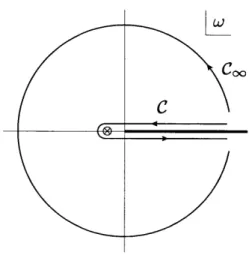
ground state of 'H. For all w < wo we can send --> 0. Then the integral of eq. (29) can be written as a contour integral over a contour C (as shown in Fig. 1) that runs in from +o0 above the Re o axis to wo and then returns to
+oo
below the Re w axis,Jc
=
.
dw F(L)
=.
dw F(w).
(30)
471
c 47r iCIn the second term we have replaced the contour C by the counterclockwise circle at infinity, Ccc, since in general the only singularities in F(w) lie on the real axis. This compact expression will be particularly useful in the separable case.
*We proceed as if the spectrum is discrete and the states are normalizable. Our result applies equally to the case (of interest) where the spectrum is continuous and the states are normalized to 6-functions.
Coo
C
Figure 1: Contours in the energy.
complex w-plane relevant to evaluating the Casimir
3.2
Phase Shift Representation
The phase shift representation for S, begins from eq. (1) divided up into bound state and continuum contributions,
-C
=
E W. +
f
dn o
bound 2continuum
states
=
-)
B3+±
d
p(w)w
(31)
where B are the binding energies, and p(w) = dn/dw is the modification of the continuum density of states due to the interaction. A simple and general argument connects p(w) to the phase shift (in our case only the s-wave contributes),
-
1 d6(w)
pO~\) =- .w
gr dy
Substituting p(w), and integrating by parts yields,
1 1
r
0o*=-} B,
dw 6(w).
3 27r
(32)
(33)
The surface term in the integration by parts -' wS() vanishes trivially at O = 0. For a general problem the surface term at infinity causes problems
R.L. Jaffe and L.R. Williamson
because generically 6(w) ~ 1/w as w -+ oc. However, in the case of a separable potential, we shall see that the phase shift vanishes rapidly as
w -+ oo, so the surface term can be ignored. So we may immediately calculate
the Casimir energy if we are given the phase shift. Eq. (30) and eq. (33) give alternative representations of the Casimir energy, which should both be equivalent to eq. (6) for the separable case.
4
Casimir Energy for the Separable Case
In this section we examine the Green's function and phase shift representa-tions of the Casimir energy for the separable case.
4.1
Greens Function Representation
To exploit eq. (27) we need an explicit expression for the trace of the Greens function for the separable potential of Section 2. We start with the Lippmann-Schwinger equation for G,
G(F,
F',w)
=G
0(F,
F', w) + A
d
3rdar
2Go(F, F
1,
w)u(r,
which may be solved by iteration,
AG(F ',
' I)
where X(w)Eq. (27)
eq. (35) the )u(r2)G(F2,F',
w)(34)
=
A
Jdar
d
3r2Go(r, F
1, w)u(F)
[1+X(w)+X(w)2+
-
u(F')Go(F
2,
F',O)
(35) was defined in eq. (17).
requires the us to set r =
F'
and integrate. If result takes a particularly simple form,we substitute from
I
d
3rAG(F,
F, w)dX
[X(w)]"
= w EM-
m
=
In (1 - X())
d~o
SC=
dw In (I - X(w))
47Zico so(36)
(37)
where we have identified the generic function F(w) of eq. (28) with - In (1
-X(w)) in the separable case. [With this identification it is easy to check that the surface terms discussed following eq. (29) do indeed vanish.] To 10
evaluate the integral we need limu In (1 - X(w)). From eq. (17) and the
normalization of u(r), it is easy to see that as w -- o,
ln
(1
-
X(w))
-X(w)
A/w
.(38)
Thus,
C
A .
-
-
.
(39)
471
C.LO
2
Confirming the value of the Casimir energy is -A/2 as we derived in Section 1 from more formal considerations.
Some comments are in order:
* The method we have presented is equivalent to the usual graphical analysis of the effective action in quantum field theory. Iiad we be-gun with a theory describing a scalar field, T, propagating in a scalar background, D, then the Casimir energy would have been given by the (infinite) sum of one-loop graphs for T with insertions of the I/D
coupling. The one-loop graphs could then be resummed into a Lipp-mann Schwinger equation for G(r, P, w). The special advantages of a separable potential are (a) that the resulting integral equation for G is solvable, and (b) that there are no ultraviolet divergences (seen as
divergences in the w -* oc limit) to complicate the calculation.
" The resummation of 1
+
X + X 2 +-.- that generated the logarithm ineq. (36) is valid for small A where the series converges. The result can then be analytically continued to large A were the re-expansion into a
(Born) series does not converge.
4.2
Phase Shift Representation
In Section 3 we also derived a simple representation, eq. (33), for the Casimir energy as a sum over binding energies and an integral over the phase shift
6(w). In this subsection we show explicitly that this representation is
equiva-lent to the Green's function representation as found, for example, in eq. (37). First, we return to the contour, C, of Fig. 1,
SC=
-
. d
ln (1 - X(w)).
(40)
The contour integral is equivalent to integrating the discontinuity in the integrand across the real axis from just below the lowest bound state wO to
00,
R.L. Jaffe and L.R. Williamson
where we have used the fact that the discontinuity in the logarithm is 2i times its imaginary part.
There are two distinct regions in the integral. For w < 0, X(w) is ex-plicitly real, and the logarithm can have an imaginary part if and only if
X(w) > 1. For w > 0, X(w) always has an imaginary part (see eq. (17)) re-lated to the scattering amplitude. We shall show that these two contributions map into the binding energy and integral over the phase shift respectively, as expected from eq. (33).
First consider w < 0. According to the analysis of Section 2, eqs. (21) and (22), etc., X(w) takes its maximum at w = 0, and decreases as w decreases. If X(0) > 1 there is a single bound state with binding energy, B -- -wo, determined by the equation X(-B) = 1. Thus if A is large enough to generate a bound state, then ln (1 - X(w)) has an imaginary part (equal to w) for
-B < w < 0. Thus
I
0dw Im
ln (1
- X(w))
=-B
.
(42)
Next consider w > 0. From the analysis of Section 2, we find
In (1
- X(w))
= ln
I- 4A
dq
2+ 4A(
.
(43)
-OO
(q2 - w)
k
From this we read off the imaginary part,
Im ln ( - X(Lu+ lc-)) =- - tan-,(
4rlok
2I(44)
1 -
4AfO dq ldo(q) 1/(q2 _O)which is just - tan 6(k) as defined in eq. (19). Substituting from eqs. (42) and (44) into eq. (41), we confirm the phase shift plus binding energy repre-sentation, eq. (33),
EC =
Bj
-dw
6(w).
(45)
2x
5
Convergence and Numerical Issues in a
Sep-arable Potential Model
A particular virtue of the separable potential model is that it is simple enough to allow us to investigate issues that are difficult to attack in more realistic 12
theories. As an example of such an issue, we consider here some computa-tional aspects of phase shift representation of the Casimir energy. Ref.
[2]
introduced a method of computing the Casimir energy in realistic quantum field theories based on the Born approximation to the phase shift. Diver-gences generated by the lowest-order Feynman diagrams are associated with the first few terms in the Born approximation to the phase shift. To remove the divergences from the numerical part of the calculation, the first few Born approximations are subtracted from the phase shift. These contributions are then added back into the calculation in the form of (divergent) Feyn-man diagrams, which are regulated and renormalized by means of available counterterms. Schematicallyc1 0o N
E= -B
2
d
(N(w) +Dn +
CT
(46)
2 2z 0n=O3 .
where 3N is the phase shift with the first N terms in the Born approximation
subtracted,
N
6(w)
=
6(w)
-
S
A6(n)(w)
(47)
n=1
Dn is the contribution to E from the nth-order Feynman diagram, and CT
denotes the renormalization counterterms. Both the
{Dn}
and the coun-terterms depend on a cutoff if the theory has ultraviolet divergences. TheBorn-subtracted phase shift however, is cutoff independent.
In realistic quantum field theory applications the Feynman diagrams,
{D4},
and the counterterms are calculated by standard, diagrammaticmeth-ods. The integral over N is done numerically. The Born approximations
{W46(n)}
have just the right behavior to cancel the large w tail of 6(w) and render the w-integral convergent. However they are a poor approximation to6(w) for small w, especially in partial waves where there are bound states.[3] Numerical studies show that at low w the function 4N(w) is much larger than
its integral fo dw N(w). The origin of this effect is obscured in those studies because the integral over the individual Born approximations,
fO dW 6( )(w),
diverge. The large w behavior of the separable potential model is very soft,enabling us to study this issue explicitly.
It is convenient to specialize further to a particular choice of the separable potential function, u(r). Following Gottfried, we choose the Yukawa function,
U(r)=.
(48)
27r r
A simple calculation gives
= a k
o2(k)
k2 2R.L. Jaffe and L.R. Williamson 14
X(k)
=A
.
(49)
2(a -
Zk)2It is convenient to use the momentum, k, rather than o = k2 as the inde-pendent variable, also to introduce scaled variables, k/a = z, A/a 2
g, and finally, it is easiest to explore the model by studying the scattering amplitude,
f(k)
-+ f(g,
z)
=1/(cot
6(g, z)
-
),
2gz
f (g,
Z) (1 + iz)2((1-iz)2
- g)
The scattering amplitude f(g, z) has two types of singularities. The dou-ble pole at z = -i is a "potential singularity" arising from the fourier
trans-form of u(r), o(k). It is on the second sheet of the complex o plane where it
does not affect the contour shifting arguments we used earlier in this paper. The other singularities are poles at
Z(V 9 -1)()
Z±
Z(V/9 +1)
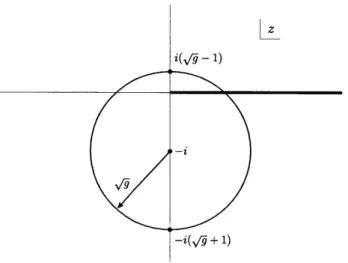
For g > 1, z+ is associated with a bound state: it lies on the positive imagi-nary axis, corresponding to the negative real axis on the first sheet of the com-plex w-plane.t The energy of the bound state is wo = -a2Z2 = -(A - a)2.
The pole at z_ is always on the second sheet and is not dynamically impor-tant. The singularities in the complex-z plane are summarized (for g > 1) in Fig. 2.
With these considerations in mind, we can write an illuminating expres-sion for the Casimir energy,
JGd
6(w)
for
A < a
24C=
-!jA
= 27r O jc (52)- 1~ - a)2 2 2 (V2 or
dw 6 (w)
for A
> a2i.e., where there is a bound state, it appears explicitly in Ec. The Born approximation is an expansion of 6(g, z) in powers of g obtained by expanding the denominator of f(g, z) (see eq. (50)) in a geometric series:
00
6 (g,
z) =g
gn6(n)(Z) .(53)n=1
tFor g < 1 the z+ pole lies on the negative imaginary axis, i.e., on the second sheet of
IZ
-i(g+ 1)
Figure 2: The Born expansion converges outside a at -i in the complex z-plane. Singularities in i(V - 1), and z- = -i(Vg+ 1) are shown.
circle of
f(g, z)
radius F centered at z = -i, z+ =
The convergence of the Born expansion is determined by the convergence of the geometric series for f(g, z), which converges provided I1 - izI > Vyrg. That is, z must lie outside the circle of radius fg centered at z =
-i.
To compute the Casimir energy by the phase shift method, we must integrate over all w > 0, corresponding to z E [0, 00].As long as g < 1 (A < a2
) the Born expansion converges for all real, positive z and can be used under the integral sign in eq. (52) to compute C,
1
00
n 0 d ngc
= -}A = - A d_ (2
27
n= 1 for A < a2
.
(54)
This is a remarkable result: both sides are power series in A, but the left hand side consists of a single term. We conclude that, for A < a2, when
there is no bound state, the entire Casimir energy is given by the first Born approximation, and that the integrals over all higher Born approximations to the phase shift vanish:
-
12A
=
27 oI
d.
6)(w),
0 = d 6(n)(w) for all n > 1 . This result may easily be verified numerically.
(55)
V9-R.L. Jaffe and L.R. Williamson 1.4 1.2
1
0.8 (1) 0.6 (30.4
(42) NN 0.2(4\
\(3)0
1.5
2
2.5
3
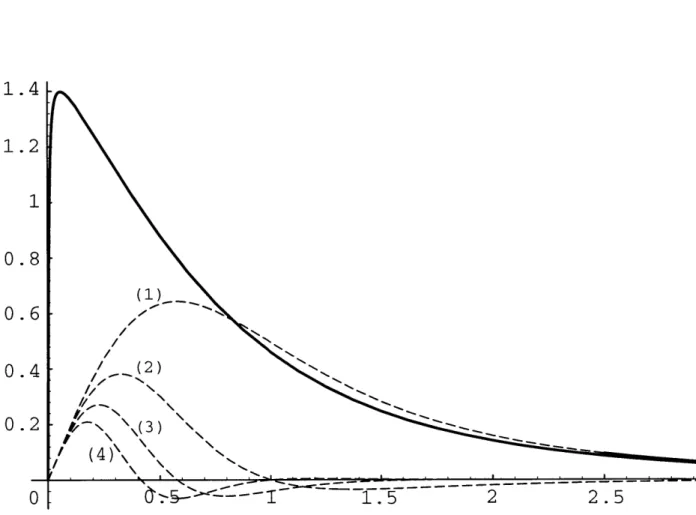
Figure 3: The phase shift for the Yukawa separable potential for g 0.99. The solid curve is the exact result, the four dashed curves give the first four
Born approximations respectively.
When g > 1 (A > a2), it is no longer possible to use the Born approxima-tion to evaluate the w-integral. A glance at the second equaapproxima-tion in eq. (52) confirms that the Born approximation cannot converge when there is a bound state: if it did, it would yield a result analytic in A, however the w-integral must generate a factor aVAX to cancel the contribution of the bound state and give Ec = -. A. To generate A, the Born expansion must not converge. Still, it is useful to subtract some number of terms in the Born expansion from the exact phase shift (VN(w) _(_ ) - 1' 1 An(n)(w)) and to rewrite Sc accordingly,
Sc
='A
= l(qc-
)2 - +-dw6(
1)(w)
- fd, N2 2 2
xi
27 2 0= j(V- _C)2 1 0 d N(w) . (56)
Here we have subtracted the first N terms in the Born approximation to con-vert 6 to 4N. When we added them back in, we used the fact that the integral of the first Born approximation gives exactly -!A, and that the integrals of all higher Born aproximations vanish. From this analysis we conclude that when there is a
bound
state, the integral of the "Born subtracted" phase shift, 6N gives an N-independent contribution to Sc,I1
jdW
N 1(v/X -a)2
(57)
27r 02
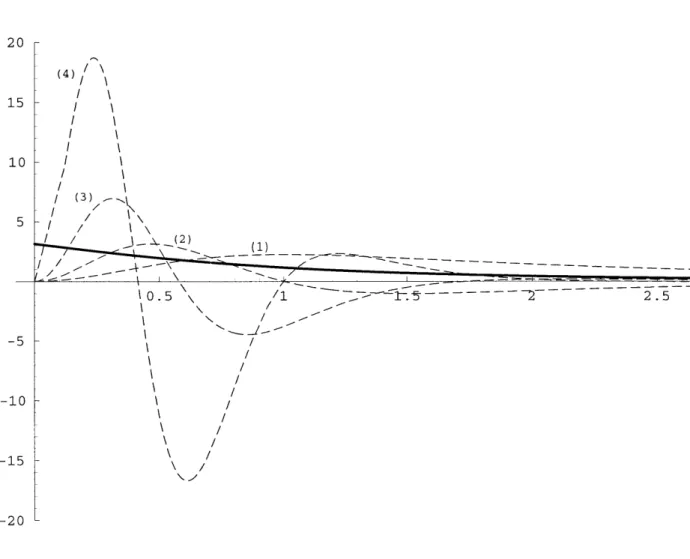
These results help to understand the effects that have been seen in nu-merical calculations in more complicated theories. In our toy model, when g is such that there is no bound state, the Casimir energy is given entirely by the first Born approximation (which, in a theory with divergences, would be computed from a Feynman graph). The nth Born approximation gives a con-tribution to 6 of order gfl, which may be large for g <~ 1, but its integrated contribution to the Casimir energy is exactly zero. In more complicated the-ories the answer is very small but not exactly zero.[3] The magnitude of the effect can be seen in Fig. 3, where we plot the exact phase shift and the first four Born approximations for g = 0.99. The first Born approximation has the same integral as the full phase shift. Each higher Born approximation integrates to zero. The situation becomes even more bizarre in when there is a bound state. The entire Casimir energy is still given by the first Born approximation! The bound state contribution is exactly canceled by the re-mainder of the phase shift integral. One can remove any number of further Born approximations from 6 - defining &N, which is significantly modified
by the subtraction of higher Born approximations - without changing the integral. The effect can be seen in Fig. 4, where we plot the exact phase shift and the first four Born approximations for g = 4.5. Once again the toy model caricatures effects seen in more complex and more realistic theories.
R.L. Jaffe and L.R. Williamson 20 1 1i (4) 5 -0 \ (3)/ 5 (2) -- / \ ---- - - - - - - - -- - --5 -10 -15 -20 0.5 ~1 / / N -/ / / \ /
Figure 4: The phase shift for the Yukawa separable potential for g = 4.5. The solid curve is the exact result, the four dashed curves give the first four Born approximations respectively.
18
6
Summary and Conclusions
Our principal purpose has been to develop a simple model to obtain insight into complicated calculations of Casimir energies in quantum field theories. We have verified in our separable potential model that several traditional representations of the Casimir energy employed in quantum field theories are equivalent. Our model is very simple. In particular, it does not display the divergences characteristic of real quantum field theories. Thus we are not surprised that results are confirmed in our model that might be spoiled by divergences in more realistic theories. Nevertheless, the model is rich enough to illustrate some of the computational difficulties that have been seen numerically in more complicated theories.
Also, we should point out that there are cases where separable potentials do arise in the treatment of more realistic theories. In particular, Bashin-sky has shown that the collective coordinate quantization in theories with solitons introduces additional, separable-potential-like terms into the small oscillations Hamiltonian whose eigenvalues determine the Casimir energy.
[4]
The ideas developed here would apply relatively directly to such cases.Acknowledgments
I would like to acknowledge the many eople who have supported me during the course of my studies at MIT. My advisor, professor Robert Jaffe, provided much academic guidance during the course of my thesis. The people I have seen every day for the past three years - my officemates - made the office a very wonderful place to be and helped me with useful discussions on physics, the finer points of Bach, and many other topics. These people are Lisa Dyson, Bo Feng, Yang-Hui He, Mario Serna, and Jun Song. No acknowledgement is honestly complete without mentioning one's parents. I thank my parents for their unconditional love and support during this sometimes difficult time period. And finally, I must acknowledge my man, Stephen Daudi Afande. Like my cousin Abdul said when you're in love, everything is better - the sky is brighter, the air is fresher, music sounds better, food tastes better, everything feels softer - life glows in a way it never has.... And certainly Stephen is the only man that has done all that for me and more.
References
[1]
See, for example, K. Gottfried, Quantum Mechanics, Volume I:Funda-mentals, (W.A. Benjamin, Reading, 1966).
[2] E. Farhi, N. Graham, P. Haagensen and R.L. Jaffe, Phys. Lett. B427,
R.L. Jaffe and L.R. Williamson 20
[3] E. Farhi, N. Graham, R.L. Jaffe, and H. Weigel, in preparation.