Bullfrog: An Extensible, Modular Toolkit for the Construction of
NuMesh Applications
by
Michael W. Connell
Submitted to the Department of
Electrical Engineering and Computer Science
in Partial Fulfillment of the Requirements for the Degree of
MASTER OF SCIENCE
in Electrical Engineering and Computer Science
at the
Massachusetts Institute of Technology
February 1996
@ 1996 Massachusetts Institute of Technology
All rights reserved
Signature of Author
Certified by
Department of Electrical Engineering and Computer Science December 19, 1995
Dr. Stephen A Ward ro
sor, E cal Engineering and Computer Science Thesis Supervisor
Accepted by
- --- essor Prederic Morgenthaler Chairm )qmmittee on Graduate Students
:;i.SACHiUSiTTS INSTi'UTE OF TECHNOLOGY
APR 1 1 1996
LIBRARIES
Bullfrog: An Extensible, Modular Toolkit for the Construction of
NuMesh Applications
by
Michael W. Connell
Submitted to the Department of Electrical Engineering and Computer Science on January 19, 1996 in partial fulfillment of the requirements for
the Degree of Master of Science
in
Electrical Engineering and Computer Science.
Abstract
The current generation of NuMesh, a communication substrate for scaleable parallel processing systems composed of arbitrary processing elements, requires an integrated development environment to enable NuMesh programmers to construct applications rapidly, flexibly, robustly, and conveniently. A design and implementation of the Bullfrog Network Description Language (Bullfrog NDL)-a very-high-level language for writing NuMesh network applications-and a Bullfrog NDL compiler is
presented, and a framework based on this design and intended as the core component of an integrated development environment is implemented and documented. The Bullfrog compiler reads functional network descriptions written in the Bullfrog NDL and outputs communication information in the form of NuMesh virtual stream specifications, along with compiler
directives (including compile-time constants calculated from the network description) for compiling the source code to be run on the network
hardware. The software written for this project supports an abstraction layer that was previously nonexistent between the physical NuMesh network topology and the NuMesh programmer, allowing for the construction of much more complex NuMesh applications than was previously practical.
Thesis Supervisor: Professor Stephen A. Ward
Acknowledgments
I'd like to take this opportunity to thank some of the people who have given help in some form or another during the long and sometimes torturous journey that has finally landed me here.
Thanks to Charlie for teaching me to drink bitter tears and laugh at the same time.
Thanks to Kimball for helping me build a robotic chicken leg late one night when he had nothing to gain by it.
Thanks, Gill Pratt, for hanging in there even when I bolted for New York.
I owe Shoe gratitude on far too many counts to go into it here. Let me just say thanks for conspiring to get me back to Boston and for helping keep the gossamer thread of sanity from snapping once I arrived.
Thank you, Steve Ward and Alan Turing, for making Computer Science a respectable field. Oh, and thanks, Steve, for the Camp Minnetonka trip and the Tomb of Horrors and all. And the thesis advisement.
Thanks to Nietzsche, Bertrand Russell, The Tick, Kurt Vonnegut, Albert Einstein, and Elvis for various and sundry kindnesses over the years.
Thanks to my family for being the best.
Thanks to Shoe's parents for having a daughter.
Thanks to Shoe's parents' daughter for agreeing to marry me and for being tremendously supportive and generally delightful. Smart, too.
Finally, a great big thank you to all of the women at the graduate office who have been so helpful and pleasant through all of this. And a special thank you to Marilyn Pierce, who has pulled me out of more than one metaphorical snake pit.
For My Mother,
Darlene
Who Has Taught Me
So Many Important Things
by Example
With All My Love
IN TR O D U C TIO N ... 6
BACKGROUND AND M OTIVATION ... ... ... 6
PROJECT O VERVIEW ... ... ... 8
THE NUMESH PROGRAMMING MODEL ... 13
N UM ESH CONCEPTS AND D EFINITIONS... 13
NUMESH PROGRAMMING IN THE DARK AGES (BEFORE BULLFROG) ... ... 17
N UM ESH PROGRAM M ING IN THEA GE OF BULLFROG... 21
BULLFROG NETWORK DESCRIPTION LANGUAGE ... 24
O VERVIEW ... 24 LANGUAGE SPECIFICATION... ... 28 Comments. ... 28 Keywords. ... 28 define-function ... 29 define-network ... 32
Application Entry Point. ... 34
Language restrictions. ... 34
Example ... 35
PA R SER ... 36
PARSER COM PONENTS ... 37
Tokens... 37
Atom ic Objects ... 39
Composite O bjects ... 43
LISP READER (LEXICAL ANALYZER) ... 45
Example ... 46 G ARBAGE COLLECTION ... 48 INTERNAL REPRESENTATION... 50 O VERVIEW ... 50 N AM ING CONVENTIONS ... 54 O BJECT D ESCRIPTIONS ... 55
BULLFROG OUTPUT GENERATION -(EXPANDER & EXTRACTOR)... . 64
N ETW ORK EXPANSION... ... 65
D ATA EXTRACTION... 66
PARAM ETER EVALUATION... ... 68
BULLFROG O UTPUT FILES... ... ... 72
Nodes.bfg ... 72
Stream s.bfg ... 73
Compiler.bfg ... 75
GRAPHICAL USER INTERFACE ... 77
C O N C LU SIO N ... 79
O THER TOOLS... 79
FUTURE BULLFROG ENHANCEM ENTS ... ... 80
W HAT'S N EXT ... ... 80
Introduction
Background and Motivation
NuMesh is a communication substrate for high-bandwidth communications among arbitrary processing elements arranged in user configurable lego-like lattices in three-space. NuMesh includes packaging and interconnect
specifications, a hardware and software specification of a communication finite state machine (CFSM) to be included on each node, and specifications for a set of internode and intranode communication protocols. The NuMesh technology is expected to yield the largest performance gains when
executing programs for which most or all of the communication patterns can be computed statically (at compile time), although more general dynamic communication patterns can be accommodated, and the issues involved in the latter are currently being studied [12].
The philosophy driving the NuMesh project is underpinned by the belief that there are significant advantages to be realized by decoupling the communication interface of a processing system from a specific architecture and from the processing elements themselves. Several advantages can be secured in this way over other designs, including modularity, robustness, cost-effectiveness, opportunity for optimization in accordance with the characteristics of a specific problem, and wide applicability. This design is in contrast to the typical backplane bus design found in most
single-processor computers today, as well as the various bus designs implemented for specific (mostly multi-processor) projects. The NuMesh technology is intended as a general-purpose communication substrate specification which can be used to construct a processing network out of whatever processing or peripheral elements are most suitable to a particular task, and is not tied to any specific architecture.
Previous generations of the hardware (and simulations of the hardware) required the NuMesh programmer to use a set of ad hoc, low-level, and disparate tools, utilities and procedures to write, compile, link, and load the program onto the NuMesh network, and node intercommunications had to be specified manually by the programmer. This worked fine in the early stages of development, where the main focus was specification of the NuMesh hardware and protocols, when the requirements of a development environment were not yet known and the sizes of the networks being dealt with were limited to a few nodes. As the hardware specifications become more stable, however, and the focus shifts to the problem of programming a sizable NuMesh network to do useful work, the complexity of the
programming task is quickly becoming unmanageable with the current tools. Some of the problems facing the NuMesh programmer at this stage are described in the following paragraphs.
The lack of an integrated development environment leads to problems of compatibility and consistency among the different tools used in the process of developing a program to be run on a network. There is no common
interface and no common set of documents explaining to a newcomer how to use the system. Also, as tools change, there is no good way of notifying everyone affected by the changes, nor is there a natural way of making sure the tools still work together since there is no specification describing
interfaces or functionality. Furthermore, there is no clear division of
responsibility among the different tools, and error checking for some stages is currently non-existent. Finally, much of the work which could be
automated is currently being done by hand; for instance, virtual stream specifications can be automatically calculated from a programmatically simple high-level network specification, but are currently being produced manually by the programmer-a tedious and error-prone process.
The lack of a mechanism for automatic specification of communication streams means, for one thing, that functional units involving more than one processor node cannot be abstracted as a single functional element and cannot, therefore, be reused-which means there is no support for controlling complexity; i.e., the programmer has had to specify every communication stream in the network, even if a previously specified
subnetwork is being used repeatedly within a larger network. As a result of this lack of an abstraction mechanism, the task of programming, debugging, and maintaining a program is prohibitively-and unnecessarily-complex.
Previous attempts at creating system software or software specifications ([4], [5], [8], [11]) have been hampered in part by the inevitably significant differences among early hardware revisions and the fact that the
specifications and requirements of such software were still under investigation by members of the NuMesh research group. The current generation NuMesh prototype represents a significant step in the evolution of the NuMesh system, especially with regard to performance and hardware support for the specified communication protocols. As the hardware
specifications stabilize, sophisticated system software is becoming increasingly well-defined and the necessity of such software is growing.
Project Overview
The work embodied in this thesis represents an attempt to lay the foundation for an integrated development environment for the NuMesh system that will eliminate the problems described above, enormously simplify the programming process, and provide a framework upon which additional tools and utilities can be built in such a way as to leverage the features of the existing components, thereby reducing redundant work and increasing the capabilities of each new component. A design is presented
for the front end of a NuMesh system compiler, and the current implementation of the core functionality described in that design is discussed. The implementation is intended to be an extensible, portable framework upon which the rest of the components described in the design (and, undoubtedly, others which have yet to be specified) can be built over time. At the present time, work is being completed on the virtual stream compiler by another member of the NuMesh research group [7], and work has been initiated on a module for the automatic calculation of an efficient mapping of high-level code modules to hardware processors based on the characteristics of each individual network application developed using the Bullfrog software. These and other modules will eventually be integrated seamlessly with the Bullfrog system to realize the goal of an integrated NuMesh development environment.
This initial design describes four interdependent but clearly definable modules that make up the core of the NuMesh application development environment. The ultimate goal is to have one integrated package that allows the NuMesh programmer to rapidly and flexibly construct network applications using a "very high level" graphical language (see [5] and [11]) similar to those being developed for other research projects ([6], [10], [13]), and which generates, links, and loads the executable and communication code onto the processor nodes in the network after calculating an efficient network configuration and code layout, so the programmer does not have to deal with intermediate files or perform steps manually which could be handled automatically.
The four modules analyzed and implemented in this work are the following: * A specification of the Bullfrog Network Description Language
* A flexible, portable, extensible, modular, and efficient internal
representation of the network with hooks to support future functionality * An output module that generates compiler directives and communication
information from the internal representation that can then be processed further by other NuMesh tools
In addition, characteristics of a graphical user interface will be discussed throughout this work where appropriate, and several of the references in the bibliography point to other works that discuss this component in much greater detail [5] [11].
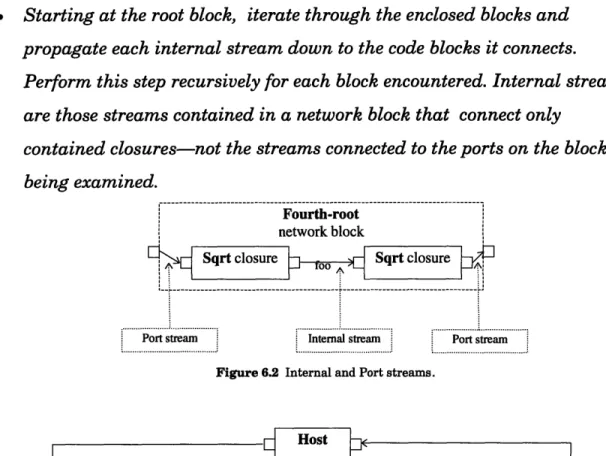
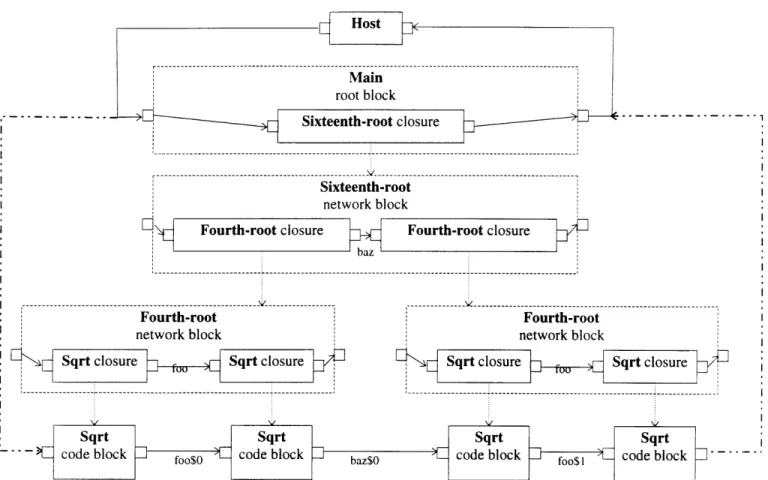
Figure 1.1 (below) depicts the system composed of these four elements and illustrates how they interconnect. Two modules are included in the diagram that have not yet been implemented: a graphical user interface and a
module that saves an internal representation to a permanent file using Bullfrog NDL syntax. These modules are connected to the existing system components using dotted lines. The file-saving module also has an arrow feeding back into the parser, indicating that the files created by it can then be read by the parser the same way a file written by a human programmer can.
cr U oa f U 0n -- C a -0, N w -II -II oI IIu I- -: ~ ;- 0 0n O 0l 0 cj cz 0 to cl "0S.- U0• a x 0* S I I 5 v -88 o v. a -Uo O u o . -, * O M Cj o 0 S, 0 U -o U 0 II U p; i!
The internal representation has been laid out in such a way as to support, in what should be a straightforward manner, the addition of a graphical user interface for manipulating the network once it has been parsed, for entering networks into a library as reusable modules, and for outputting a compact text representation of a network constructed or modified using the graphical user interface. Furthermore, related projects currently being implemented should be straightforward to integrate with this work; specifically, the virtual stream compiler currently being completed by Pat LoPresti of the NuMesh group [7], along with the normal language
compilers (for C, C++, LISP, etc.) will comprise the back end of the compiler system and should be straightforward to integrate with this package, and a module for generating a reasonable mapping of executable code to processor nodes (work currently being initiated by Greg Spurrier of the NuMesh group) can operate upon either the internal representation directly, or upon the output of the extraction module included in this work to automate another of the difficult tasks currently faced by the NuMesh programmer.
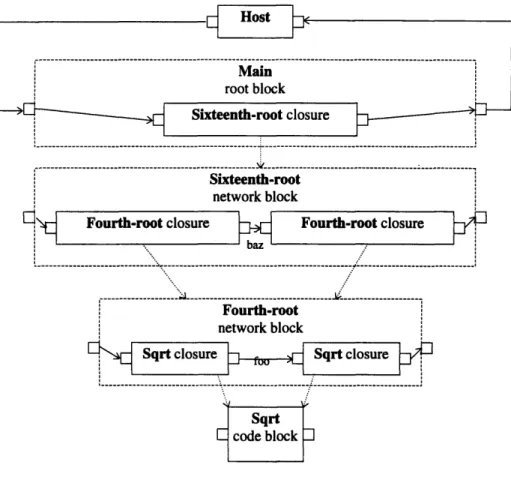
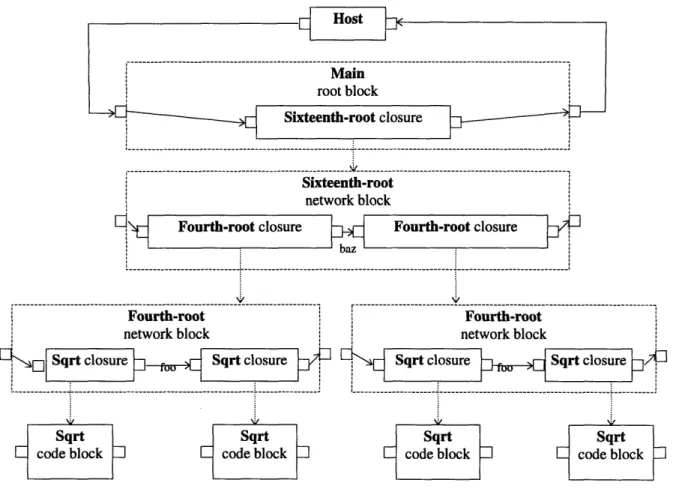
A single example, a NuMesh application that calculates the sixteenth root of its input, will be traced throughout this work to illustrate how each module in the Bullfrog system transforms its input into its output.
NOTE: In the following pages, the term "NuMesh programmer" is used to indicate a person using the Bullfrog system to construct applications for a NuMesh network. The term "Bullfrog programmer" will be used to refer to a person extending or maintaining the Bullfrog software itself-that is, the software that is implemented as part of this thesis and that serves as a development system used in the construction of NuMesh applications.
The NuMesh Programming Model
In an effort to make explicit the problems being addressed by the work embodied in this thesis, an overview of the NuMesh programming model before the advent of the Bullfrog system will now be presented, and some concepts used throughout the thesis will be defined and/or explained. Following that, the programming model supported by the Bullfrog system will be presented and contrasted to the previous model.
NuMesh Concepts and Definitions
A NuMesh network is a (possibly heterogeneous) set of processing
elements mounted on boards designed according to NuMesh specifications and connected to one another through NuMesh-compliant connectors to form a hardware network in three-space. The network may be configured in any three dimensional topology desired; ideally, a topology will be selected which is most suitable for maximizing the important performance
parameters of a particular application running on a particular network. The topology and processing element characteristics are left unspecified by the NuMesh technology. What the NuMesh specification does define are the internode and intranode communication protocols, the characteristics of the boards on which the processing elements are mounted, and the node
interconnection characteristics. In addition, a communication finite state machine (CFSM) is specified which is included on each node to process node communications [12].
The NuMesh execution model is different from the model associated with the majority of other computers. Conventional single and multiprocessor computer systenms generally run a single application at a time. Even when multiple applications are running, each application usually runs as if it
were the only one; i.e., they have little or no intentional interaction with one another. In the case of multiprocessor computers, a single application is often replicated across all processors and the data is decomposed into
modules to be processed on different nodes, and when each node's processing is complete, the results are gathered to synthesize the final output [3]. In contrast, a NuMesh network typically consists of a variety of different programs running on separate nodes simultaneously and passing data between them via virtual communication streams. For example, a single NuMesh network might be composed of hundreds or thousands of nodes, some containing digital signal processing elements, some containing RISC processors, some CISC processors, and each one of them performing a distinct operation on its data.
Simply put, a virtual stream (in the NuMesh world) is a stream of data which flows from the output of one processor to the input of another, possibly passing through any number of nodes in between its source and destination. The intermediate nodes do not operate upon the data, they merely pass it along. Ideally, the programmer specifies the endpoints of such a stream and the software will automatically calculate a reasonable path for the stream to take. Additionally, the network should be able to operate in the presence of node failures, unbalanced communication loads, and other singular conditions by re-routing the virtual streams dynamically. This highlights an important and unusual feature of the NuMesh
technology-its communication paths are not explicitly defined by the architecture [12]. Although one topology might be more efficient than another for a specific application because it allows critical communications to happen more quickly, a particular topology is not, in general, required for a particular application to run.
Low-level code is conventional assembly or machine language code that runs on a physical processor. It can be binary or mnemonic, but there is a one-to-one mapping between software instructions and the instructions actually executed on the hardware. This type of code is processor specific.
High-level code is code written in a conventional high-level programming language, such as C++, Java, LISP, or any one of the many languages in existence. One high-level primitive instruction generally compiles into several low-level instructions. This level of code supports a programming model that is easier for a human programmer to work with than is low-level code, as it helps control software complexity through support for data, function, and iteration abstraction. The code that runs on the individual NuMesh nodes is written in a high-level language. This level of code is, in
general, portable across platforms in the same architecture category, but specific to the topology or category of hardware on which it is being
executed; i.e., high-level code for a parallel processing architecture will not run on a single-processor architecture, and vice-versa (it won't take
advantage of the parallel architecture in the latter case, at any rate).
A very-high-level language (in the case of the NuMesh) is a language using entire high-level modules as its primitives, and the Bullfrog Network Description Language is such a language designed specifically for writing NuMesh applications. This language supports an additional type of abstraction-topological abstraction-that provides analogous benefits to the NuMesh programmer that a programmer of a conventional computer architecture enjoys by utilizing a high-level language, as explained in the following sections.
Figure 1.2 illustrates the relationships between low, high, and very-high level languages.
Very-high-level language (Bullfrog NDL)
Primitives: Functions or modules defined in high-level languages, wrapped in Bullfrog interfaces (via define-function).
Support for abstraction of user-defined composite functional blocks, which are then viewed by the programmer the same way a primitive function is (via define-network)
Mechanisms for connecting Bullfrog functional blocks together. Example:
(define-function (sqrt in = (input real) out = (output real) source-code = "sqrt.cc"))
( npan fi twork (fnurthkrnnt
sqrt (Bullfrog function)
Sqrt.cc (C++ file)
in = (input real)
out = (output real) Sqrt.cc Sqrt.cc
(streams (baz real)) fourth-root (C++ file) (C++ file) (sqrt in = in out = baz) (Bullfrog function)
(sqrt in = baz out = out)))
There is a one-to-many mapping between Bullfrog functional blocks and high-level code modules. When Bullfrog NDL source is compiled, the result is a set of code modules compiled from high-level source files with specific compile-time parameters and information specifying module relationships and communications.
High-level language (C, LISP, etc.) Primitives: Fundamental data types (float, int, char, etc.)
High-level constructs representing computational concepts such as abstraction, flow-control, and support for user-defined aggregate data types
Example:
for (i = 0; i < 10; i++) ...
There is a one-to-many mapping between high-level statements and low-level instructions. Set of available operations is generally specified by some standard and (ideally) portable across platforms. When source is compiled, the result is hardware-specific low-level machine code.
MOVC 0, Ox0000
SUB ...
CMPZ ...
... (many more instructions here)
Low-level language (Assembly language)
Primitives: Machine opcodes supported by the hardware and associated binary arguments Example:
LDAB OxFFFF (language statement)
+ 0101010001100111 1111111111111111
(machine instruction)
There is a one-to-one mapping between language statements and machine-executable instructions, and set of operations is hardware specific and not portable.
Figure 1.2
NuMesh Programming In the Dark Ages (Before Bullfrog)
Until now, the NuMesh programmer has had to work at a level comparable to traditional assembly language programming, but without the support for subroutines generally offered at that level. Before Bullfrog, the NuMesh programmer had to go through something resembling the following process in order to get an application up and running on a NuMesh network.
* Write, debug, and compile the set of source files containing code to be run on the network nodes (processors). These might be written in C, LISP, Assembly, or any other programming language or combination of languages.
* Specify a topology for the hardware. This had to be done before the application was actually written, because the program was dependent on it.
* Write the NuMesh application (which probably entailed drawing a block diagram on paper), using the functions created in the first step as
primitives.
* Assign functional blocks to processor nodes in the target network, and obtain or write the CFSM code to handle communications.
* Load the code onto the appropriate processors (as determined in the previous step) and load the CFSM code into CFSM memory.
* Specify each communication stream connecting nodes in the target network, and compile the communication stream information using the NuMesh stream compiler.
* Debug the target application, including high-level code source files, if necessary.
* Iterate.
Note that the programming model has no mechanisms for supporting abstraction at the level of a NuMesh application. The only functions that can be used in such an application are those defined in the high-level source files-no composition is possible, and no reuse of a particular network structure is possible. Furthermore, notice that the NuMesh programmer had to locate, configure, and figure out how to use several scattered tools and technologies (language compilers, NuMesh stream compiler, CFSM code, etc.), and he must remember to (and how to) perform each of the many steps involved. The programmer spent the bulk of his time attending to network-dependent details, such as keeping track of and specifying each stream's sources, destinations, and parameters, and then verifying their correctness, or assigning functions to nodes, rather than focusing on
constructing a functional network with the appropriate behavior. Finally, note that a NuMesh application written in this way is not portable across either networks containing the same processing elements but having non-isomorphic topologies, or across topologically non-isomorphic networks that contain different processing elements. To have the same application (viewed from a functional standpoint) run on two networks differing in any way required some amount of additional work on the part of the NuMesh programmer to port it.
Here is a simple example of a NuMesh application that calculates the
sixteenth root of a stream of numbers, using the square root function as the only NuMesh primitive.
Source file for code to run on processor nodes:
#include <math.h> void NMSqrt()
{
long int x = ReadNuMesh( );
WriteNuMesh( sqrt( x ) );
}
(compile this with appropriate switches)
NuMesh application block diagram (generated by hand by NuMesh programmer):
host
SqrtO I
SqrtI
Sqrt2 - 1 Sqrt3
Communication stream specification (generated by hand by NuMesh programmer): (stream ( src host) ( dest sqrt ) ( type double) (bandwidth 0.01) ( stream2 ( src sqrtO ) ( dest sqrtl ) ( type double) ( stream3 ( src sqrtl ) (dest sqrt2 ) ( stream4 ( src sqrt2) (dest sqrt3 ) (stream5 ( src sqrt3 ) (dest host )
As the example shows, the programmer would have had to specify five streams by hand, enforcing type consistency and program validity without the aid of any tools to reduce complexity. Even this trivial example presents many opportunities for introducing bugs. In a real-world application, there might be hundreds or thousands of primitives and/or nodes to be managed. Furthermore, in this scheme there is no way to have the computer calculate a reasonable topology or an efficient distribution of code to processor nodes, since there is no intermediate representation of the NuMesh program in this programming model from which to extract this information. Whereas an assembly language programmer of a conventional computer system is tied to a particular processor, the NuMesh programmer has had an analogous problem in being tied to a particular network topology. Similarly, whereas an assembly programmer on a single processor
architecture has to spend time on mechanistic details of how a program gets things done rather than being free to work with more simple and abstract computational elements to solve a problem (e.g., having to have an addition loop rather than being able to execute a simple multiplication operation), the NuMesh programmer has, until now, had to worry about how physical processing nodes are interconnected rather than on how to build on a set of functions to do a particular job. Bullfrog provides the means to make this transition from what amounts to NuMesh assembly programming to a
simpler, more conceptual, more flexible, and more powerful level of programming abstraction.
NuMesh Programming in the Age of Bullfrog
Using the Bullfrog language and compiler, the same program for calculating sixteenth roots would look like this:
Source file for code to run on processor nodes (essentially unchanged from previous example):
#include <math.h> void NMSqrt()
{
long int x = ReadNuMesh( 'in' ); WriteNuMesh( 'out', sqrt( x ) );
Bullfrog Network Description Code:
(define-function (sqrt in = (input real) out = (output real) language-type = C
source-code = "sqrt.c" object-code = "sqrt.o")) (define-network ( fourth-root in = (input real)
out = (output real)) ((streams (foo real))
(sqrt in = in out = foo)
(sqrt in = foo out = out)))
The second expression creates a composite function, fourth-root, that can now be used as if it were a primitive function:
fourth-root
in : in out in out out S Sqrt Sqrt
foo
(define-network (sixteenth-root in = (input real)
out = (output real))
( (streams (baz real))
( fourth-root in = in out = baz )
( fourth-root in = baz out = out )))
This last expression creates a composite function containing two copies of the fourth-root composite function (shown below). The result can now be
used in other definitions as if it were a primitive. This can be repeated ad infinitum (or at least until memory runs out).
Sixteenth-root
in i Fourth-root out in Fourth-root out out.
baz
Clearly, this approach has enormous advantages over the original, and the advantages become more profound as the networks involved become more complex. To take a simple case, if the example above were extended to calculate the 256th root, the first method would require the addition of four more nodes and four more streams--doubling its size and complexity, while the Bullfrog example would require only one new define-function
expression.
The Bullfrog system should (eventually) calculate a suitable NuMesh topology (or take one as input from the programmer), compile the final composite network down to the module level, calculate a distribution of code to network nodes, generate and execute compiler directives for the source code modules, generate stream information and compile it using the virtual stream compiler, and enforce type constraints on the NuMesh application. Moreover, the introduction of the Bullfrog Network Description Language separates the programming model presented to the NuMesh programmer from the underlying hardware on which the application is running, which frees the programmer to concentrate on the application's functionality rather than the details of how to map the code modules onto the network and how to interconnect them with virtual streams to get the correct output. The programming model has changed dramatically. No longer is the model focused on blocks and streams and their interconnections; now the model
focuses on functional units and their relationships to one another, independent of the underlying hardware.
Bullfrog Network Description Language
Overview
The Bullfrog Network Description Language was developed to be a very-high-level language for constructing NuMesh applications rapidly, flexibly, and robustly. A NuMesh application consists of a set of functional blocks that are connected by virtual streams of data and that perform some set of calculations or transformations on the data. The application runs on a hardware network composed of processing elements, wires, and
communication finite-state machines [12]. Until now, the NuMesh
programmer has only been able to do the NuMesh equivalent of assembly language programming on a conventional CISC or RISC single-processor computer. That is, the NuMesh programmer has had to work directly with and take into consideration the actual elements of the underlying hardware network when writing a NuMesh application. He has had to calculate or at least be familiar with the topology of the hardware network, calculate a distribution of low-level code to processor nodes, specify every parameter of every communication stream, enforce data type and other kinds of
constraints, and debug the NuMesh application with very little in the way of supporting tools or utilities.
The Bullfrog Network Description Language was designed with the goals of extensibility and flexibility in mind. In addition, the language was
influenced by the requirement of being easy for both a human and a computer to parse, while remaining compact and avoiding unnecessary syntactic complexity and overhead. [4] [8]. The structure of the language reflects the physical structure of the NuMesh network, but at a more abstract level-for example, there are ways to specify code blocks, to abstract functional groups and use them as a single block, and attach
allows a NuMesh programmer to work with NuMesh network elements while at the same time separating him from the underlying topological and processor-specific details. The Bullfrog Network Description Language is based upon work done by Chris Metcalf on the NuMesh Interchange Format for Text (NIFT) [8], and the work described in [4].
Extensible
The Bullfrog language is extensible in several ways on various levels. * The primitive environment used to preprocess and/or postprocess the
input file can be extended by exposing primitive operators from C and adding arbitrary user-defined operators; these would be primitive (built-in) operators from the point of view of the Bullfrog programmer.
* Mechanisms can be added to enrich the Bullfrog NDL programming environment itself. For instance, the keyword define could be added to allow a Bullfrog NDL programmer to bind symbols to expressions and then use the symbol in place of the more complex expression in other expressions. Also, the CLispClosure functionality could be exposed to the Bullfrog NDL programmer to allow him to extend the primitive environment on the fly.
* The syntax of existing expressions can be extended to include additional parameters, or new keywords can be introduced by adding functions for processing those parameters and adding an entry to a dispatch table in the Bullfrog source code.
One anticipated future addition to the language is the ability to check specified data types against an external list of valid types, which may be different among applications or even among expressions within the same application. This way, if the source file pointed to by a define-function is a C file, for instance, the data types of ports and streams can be checked against all the types which are valid in the C language. This mechanism
could be made general enough that a function or network parameter could point to the file of type information, and then new files could be introduced as needed, without further change to the Bullfrog system's source code.
Flexible
The primitives are defined as needed, by creating a Bullfrog function out of an external high-level code module. The Network Description Language merely provides a framework for interconnecting modules and enforcing generic constraints; the functionality and interface of any primitive is dependent on the high-level module being wrapped. The Bullfrog NDL simply provides mechanisms for abstracting high-level modules so that the application programming model is separate from the details of the
underlying physical network. Just as a programmer on a conventional computer gains flexibility and control over complexity through the use of a high-level language, the NuMesh programmer gains similar benefits by using a very-high-level language--the Bullfrog NDL. The language doesn't actually define the functions, and the parser and internal representation do not depend on what functions are being used. This makes it a very flexible environment to work in, because the programmer can extend the range of functionality incorporated into a NuMesh application as needed by adding functions using define-function and by adding networks using
define-network-without having to change a single line of code in the Bullfrog sources.
Ease of parsing
The Bullfrog language uses a LISP-like syntax, for several reasons. For one, it is straightforward to parse a LISP expression into tokens and lists, the latter of which generally represent meaningful constructs in the
syntax is already known to many people, especially in the research
community, where this software is expected to be used, at least initially. It is also easy to extend the set of parameters allowed within a specific
expression. A very compelling reason for using this type of syntax is that we can also take advantage of existing LISP evaluators to preprocess the input file before operating upon it, thus allowing, for instance, general mathematical expressions as parameters rather than requiring hard-coded numbers there. Furthermore, the basic
(<operator> <operandi> <operand2> ... <operandn>)
format for expressions itself allows for a great deal of flexibility, in that when a new type of operand or operator is added to the language, the parser can be left unchanged-only the semantic analyzer needs to be expanded to handle the new element, and that addition in most cases can be
accomplished simply by adding the function(s) necessary to process the construct and by adding a line or two to the appropriate dispatch table(s). Finally, complex expression evaluators, regular grammars, and other brittle constructs are not necessary because precedence is made explicit by the Bullfrog NDL programmer. Expressions in this format are not as easy for a human to work with, granted, but it becomes second nature after working with it for a while; also, the complexity of mathematical expressions used in Bullfrog NDL programs is not expected to be very great.
Language Specification
* Comments.
Comments in a Bullfrog source file begin with a semicolon (";") and end at the next newline character.
* Keywords.
The following keywords are recognized when they appear as the first symbol in a Bullfrog NDL expression.
define-function define-network
The following words and symbols are also keywords, but are only recognized as such in the context of certain subexpressions (described below). input language-type main object-code output real source-code streams +
* define-function
The Bullfrog NDL does not contain any primitive operators in the sense of pre-defined functions that execute on network nodes. Instead, the
define-function keyword allows for the introduction of specific primitive functions into the programming environment that are relevant to a
particular application. It is expected that in time a library of such functions will be written or accumulated and that mechanisms for importing
functions from and adding functions to such a library will be added to the Bullfrog NDL programming model. In other words, the basic building block in the Bullfrog NDL is the define-function expression, which specifies pointers to source, object, and/or executable versions of a function to be run on a NuMesh node, along with expressions defining the inputs and outputs for the function, types of and default values for parameters, and similar information. The define-function expression is used by the semantic analyzer to construct a corresponding CNMCodeBlock object (see Internal Representation).
The define-function expression has the following syntax:
(define-function (<function-name>
< port name> = ( input <port data type> ) ; input port specification
<port name> = ( output <port data type> ) ; output port specification
language-type = <expri> ; C, LISP, FORTRAN, etc.
source-code = <expr2> ; these may be code or a pointer to it
object-code = <expr3> ; (currently, these are expected to be path names)
; include additional parameters here with syntax described below. <parameter-name> = <exprn)) ; arbitrary function parameter
Except for the function name, none of the parameters to define-function is position dependent.
<function name> is the name of the Bullfrog NDL function being defined. The name entered in this position will be used in other Bullfrog NDL expressions to reference this construct.
The syntax
<port name> = ( { input I output ) <port data type>)
is the manner in which a data port is specified for communicating with the function being defined. The <port name> should correspond to the name specified in the actual source file, so the appropriate inputs and outputs can be matched between the Bullfrog function and the source code function it is abstracting. The <port data type> value can be any data type; the compiler uses the textual symbol to enforce type constraints, without regard for the meaning of the symbol. The compiler could easily be made to recognize certain data types, however, if that becomes necessary for additional processing or some other reason.
language-type indicates the language the source code is written in (C, C++, LISP, etc.). This information will be used to generate compiler directives from the compiler output of the Bullfrog system.
source-code specifies the path to the source code to be compiled and run on the network hardware.
object-code specifies the path to the file containing the object code to be run on network hardware.
The syntax
is how arbitrary parameters to the function are specified. It is expected that the source code will require certain compile-time constants to be defined, and this is the mechanism that will allow for that, so the <parameter-name> value will probably have to match what the source file is expecting. Other annotations could be added in this way for whatever purposes might become necessary in the future. These could be used for enforcing additional
constraints, for generating additional output, for entering debug
information, etc. Currently, the only expression recognized has the form
<parameter-name> = (real <numerical expression>)
where the <numerical expression> could be any arbitrary mathematical expression recognized by the Bullfrog compiler (currently, any LISP-like mathematical expression involving +, -, *, and / could be entered in this
position), and may include symbols as operands that are defined in an enclosing environment. Parameters of this type are evaluated only once, and evaluation is delayed until the network description is compiled and the output generated. This expression provides a default value for the
parameter, which may be overridden when a function block is instantiated (see define-network, below).
The specific key words shown in bold above are only examples of the possible types of information that can be used to annotate the code block. For instance, a full-blown compiler command could be specified instead of the language type, or a list of flags could be entered in addition to the language name, or whatever information turns out to be most useful and convenient can be entered as parameters. The keywords explicitly shown here are the ones currently recognized by the Bullfrog system and included
in the compiler output. Support would have to be added to the Bullfrog sources for any other parameters, but this should be a straightforward task, using the code for the existing parameters as a guide.
* define-network
Functional abstraction is supported in the Bullfrog NDL using the define-network keyword, which is analogous to the define-function primitive in many ways. A network definition contains a list of parameters and inputs/outputs for the composite functional block being defined, in addition to a list of instantiations of the sub-blocks contained in the network and information specifying how they are interconnected. The sub-blocks may be either primitive functions or other, previously defined networks. Each define-network expression results in the creation of a corresponding CNMNetworkBlock in the internal representation.
The network block has the following syntax:
(define-network ( <network-name>
<parameter_namei> = <expri> <parameter_name2> = <expr2>
<parameter_namen> = <exprn> )
(( streams ( <strmi_name> <attr1l> <attri2> ...) ( <strm2_name> ... )
<block_instantiationl> <block_instantiation2>
<block_instantiationN> ))
<network-name> is the name of the network being defined, and it is the only position dependent parameter.
The syntax
is the same as for define-function, above.
The ( streams ... ) expression is analogous to a LISP let construct, and
names streams internal to the network. Currently, every port in an
instantiated function must connect to exactly one stream or other port, and every internal stream must connect to exactly two ports. It is expected that this requirement will change in future versions of the Bullfrog software (when support for broadcast and multicast communications are added, for example). The syntax for the streams expression is
(streams (<stream namez> <streami data type>) ... (<stream namen> <streamn data type>) ).
The <block_instantiation> expression is an instantiation of a function or network definition and takes the form:
(<function or network name> <port_namez> = <port or internal streami> <parameter_namel> = <parameter_valuez>
<port_namem> = <port or internal streamm> <parameter_namen> = <parameter_valuen>)
where:
<portname> is the name of a port in the definition of the function or network being instantiated,
<port or internal stream> is the name of a port on the network being defined
(not the one being instantiated) or the name of an internal stream specified in the streams expression
<parameter_name> is the name of a parameter in the definition of the function or network being instantiated
(real <LISP-like mathematical expression>).
The operands used in the <parameter_value> expression may be numbers, or they may be names of parameters specified in the function or network being defined. In the latter case, when the <parameter_value> expression is evaluated, the symbol will take on the default value of the parameter if no overriding value is specified in the applicable instantiation, otherwise, the symbol will take on the overriding value of the parameter.
* Application Entry Point.
The entry point for a Bullfrog NDL application is the network with the distinguished name main.
There must be exactly one main network defined in the Bullfrog NDL application being compiled. This is the top-level network that implicitly attaches to the single host node. All inputs to main are attached implicitly to outputs on the host, and all outputs on main are implicitly attached to inputs on the host.
* Language restrictions.
A network definition can only reference previously defined networks and functions.
The '$' character should be reserved for system names, as it is currently being used to separate the two parts of an object identifier (see CNuMeshID in chapter entitled Internal Representation).
* Example
The following network description defines a network to calculate the sixteenth root of the values on an input stream from the host:
(define-function ( sqrt in = (input real)
out = (output real)
prec = (real 0.001) language-type = lisp object-code = "/projects/test.o" source-code = "/projects/test.lsp")) (define-network ( fourth-root in = (input real)
out = (output real)
prec = (real 0.002)) ((streams (foo real))
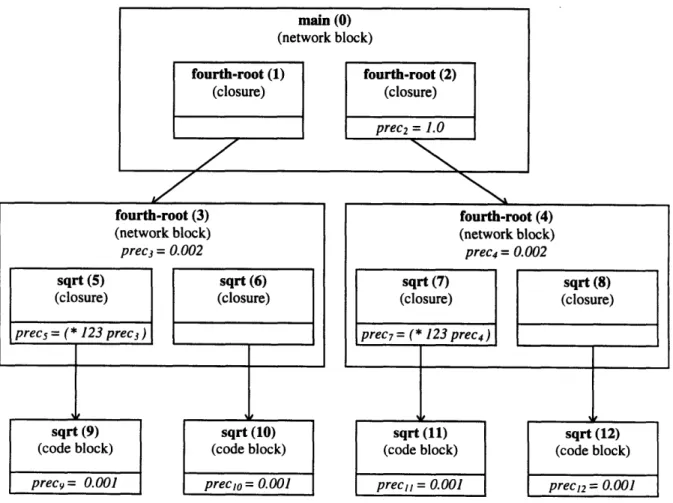
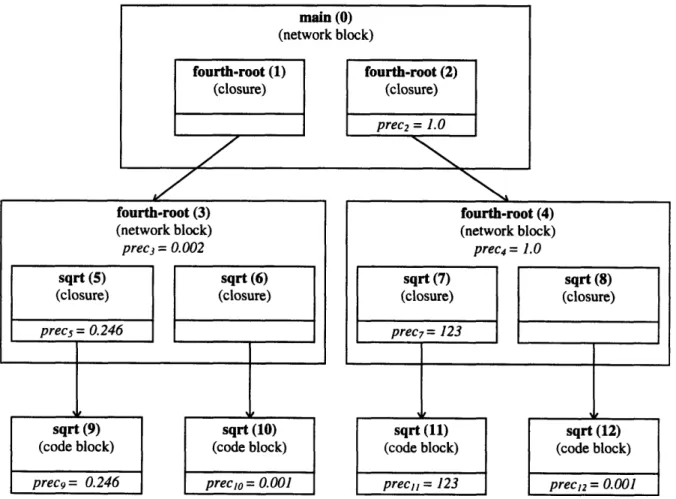
(sqrt in = in out = foo prec = (real (* 123 prec))) (sqrt in = foo out = out)))
(define-network ( main
in = (input real)
out = (output real)) ((streams (baz real))
(fourth-root in = in out = baz)
(fourth-root in = baz out = out prec = (real 1.0))))
; primitive function ; input port ; output port
; function parameter: default val = 0.001 ; sqrt source language type
; sqrt object code path ; sqrt source code path
; composite function ; input port
; output port
; function parameter: default val = 0.002 ; internal streams definition
; primitive instantiations; override sqrt ; default prec val with prec = 0.002 or whatever value is given for prec ; when fourth-root is instantiated ; top-level network
; input port ; output port
; internal streams definition
; network instantiations; override prec ; default val with constant values
Parser
The parser is based on a C++ port of Professor Ward's CLisp package. The CLisp package is a set of functions and data structures capable of reading in LISP-like expressions, parsing them into tokens, and evaluating the
resulting expressions in a LISP-like environment using an eval-apply loop similar to that also used in LISP [1] [9]. The CLisp package also includes a simple garbage collection mechanism. The package allows C programmers to incorporate some of the flexibility of LISP into their C programs.
The Bullfrog parser is a C++ version of the CLisp package called C++Lisp (or CPPLisp), with extensions and modifications. Originally created as a general-purpose parsing utility, it has been tailored somewhat to the specific needs of the Bullfrog project. Specifically, the set of expressions it can parse has been expanded to include the syntax
<parm> = <value>,
where <parm> is a parameter and <value> is a default value for <parm> (see the chapter on the Bullfrog Network Description Language). Also, the garbage collection mechanism has been replaced with a much simpler one. A more complex scheme could and should be implemented to replace what has been done for this work, as it keeps information in memory much longer than it needs to and places a couple of requirements on the Bullfrog programmer that are error-prone.
The parser converts the textual input into tokens organized in trees, with elements at the same level of nesting in the input expression located at the same depth in the tree, and tokens within the same parenthesized
subexpression (or "list", to borrow the LISP term for it) found hanging in a chain from a common node. The figure below illustrates the parsing process graphically.
(define-function (sqrt x
tol = (real 0.0(01)
source-file = "sqrt.c")
Input File Parser Parser
Output
(Bullfrog network (Converts text to tokens and organizes into trees) (Tokens are organized into
description language) trees reflecting the
structure
of the input.)
The output of this stage (trees of tokens representing expressions) can then undergo preprocessing-if mathematical expressions need to be evaluated at this point, for instance-or it can be passed to the semantic analyzer for construction of the internal network representation. This method of
parsing, combined with the structure of the network description language, provides flexibility to the Bullfrog programmer and leaves room for later modification and extension. The parser aids in the production of robust NuMesh applications by detecting and reporting syntax errors in the input.
Parser Components
The hierarchy of classes that make up the parser is shown in Figure 4.1.
* Tokens
This section describes the set of tokens and constructs into which the parser converts the input. The set of available tokens can be extended by deriving new objects from those found here, as in the case of CLispParameter.
Implementation specific information about the tokens is included below for clarity, although each could be implemented in various ways.
(define-function (sqrt x tol = (real 0.001)
CLispSymbol CLispSymbol CispSymbol CLispParm Name = "define-function" Name = "sqrt" Name ="x" Name = "tol"
Value =
F
CLispObject
Object Type = oneof( CL_INT, CL_SYMBOL, CL_STRING, ... }
The CLispObject class implements the basic functionality of the set of CPPLisp token objects, and all tokens are derived from it. It contains default implementations for functions that are available to more than one type of token, such as Eval( ) and Cons( ), and for functions that need to report an error if called on the wrong type of object, such as Apply( ). The CLispObject class also maintains bookkeeping information for the set of CLisp tokens created, and contains initialization functions used by the entire hierarchy or used for management of the entire set, such as
InitializeSpecials( ) and FreeLispObjects(). Viewed as an abstract token, this object contains only type information. CLispObject is an abstract type and an object of this type cannot be instantiated directly; only a class
derived from CLispObject and providing implementations for its abstract members can be instantiated.
* Atomic Objects
This section describes the classes implementing the atomic tokens, which are the primitive types.
CLispInteger
Object Type = CL_INT Value = <integer value>
The CLispInteger object provides an immutable token representing an integer. Its type is CL_INT, and its value is an integer that can only be set at the time of creation. It is expected that in the future an integer table will be created so that each integer token is only created once, stored in the table and shared by all constructs that use it.
CLispDouble
Object Type = CL_DOUBLE Value = <floating point value>
The CLispDouble object is an immutable token representing a floating point number. Its type is CL_DOUBLE, and its value is a floating point number that can only be set at the time of creation. It is expected that a table of floating point numbers will in the future be created similar to the one described above for CLispInteger.
CLispSymbol
Object Type = CL_SYMBOL
Name = <alphanumeric symbol name>
The CLispSymbol object is an immutable token representing an atomic alphanumeric symbol. A symbol is a non-literal string of alphanumeric characters (beginning with a non-numeric character) that generally (but not always) evaluates to something else, such as a procedure object, a number, or a subroutine. The type of a CLispSymbol is CL_SYMBOL, and its name is its alphanumeric string representation, which cannot be changed after the symbol is created. It is expected that in the future a symbol table will be created to keep track of all symbols used, that each symbol will only be created once, and that all uses of a symbol will point to the same object, as described above for CLispInteger.
CLispParameter
Object Type = CLPARM
Name = <alphanumeric symbol name>
Value = <pointer to CLispObject> l CLispObject
The CLispParameter object is a mutable derivative of CLispSymbol. It was added to support the syntax "<parm> = <default value>" in the Bullfrog
Network Description Language, which allows the Bullfrog NDL programmer to specify an overridable default value for a function
parameter. A CLispParameter's name cannot be changed after creation, but its value can. The type of a CLispParameter object is CL_PARM, its name is its alphanumeric string representation (inherited from CLispSymbol),
and its value is another CLispObject, which can be any type (although whatever type it is must correspond to the type expected by the function being defined).
CLispString Object Type = CL_STRING Name = <literal string>
The CLispString object is an immutable object encapsulating a literal string. Its type is CL_STRING and its name is the literal string which it represents. Its name cannot be changed after creation. It is expected that a string table will be added in the future, analogous to the tables described for CLispSymbol, CLispInteger, and CLispDouble so that every use of a
CLispSpecial
Object Type = CL_SPECIAL
Name = <string representation of special's token name>
The CLispSpecial class provides for a set of immutable system-defined symbols with reserved meanings. Many are used to flag error conditions. The following list enumerates the entire set of specials currently defined and explains the meaning of each one:
CLEnd Unmatched right parenthesis encountered. CL_EOF End of file token.
CL_Error General error condition encountered.
CL_Unbound Unbound object error condition encountered.
CL_Env This token is placed at the head of a list to identify the list as an environment object.
CL_True Token representing the boolean value TRUE.
CL_Nil Token representing the boolean value FALSE; also used to mark the end of a list and anywhere a terminator symbol is required.
The value of a special is a string representation of the symbol's name; CLispSpecials are unique in the sense that only one instance of each is created and they cannot be changed after creation.
The set of CLispSpecial objects should be global, as they currently are, but their constructors should probably be made private to help ensure that each is only created once (the constructor is currently public). Currently, the Bullfrog programmer must call CLispObject::InitializeSpecials() before the first use of these objects; this can probably be handled in a cleaner way automatically. Perhaps this call could be added to the CNMRootBlock constructor if the symbol table were added to the CNMRootBlock representation as described in the section below discussing garbage collection.
* Composite Objects
This section describes the classes that support organization of tokens into semantically meaningful structures.
CLispSubroutine
Object Type = CL_SUBR
Name = <subroutine name (string)>
Function = <pointer to Cfunction>
Number of Args = <number of args required by function>
The CLispSubroutine object allows the Bullfrog programmer to package a C function as a LISP procedure that can be bound in an environment and applied to a list of arguments just like a LISP closure. It is used mainly for defining primitive operators to be bound in the primitive environment. Its type is CL_SUBR. It is immutable-it cannot be modified after
construction. Its name is the name of the subroutine (mainly used for
display purposes when dumping an environment or printing out the value of a subroutine object), its function is a pointer to the underlying C function, and its number of arguments is the number of arguments required by the function, where a zero specified here means either zero arguments or a variable number of arguments are required.
CLispClosure
Object Type = CL_CLOSURE _CLispList ---
Formals = <pointer to list offormal parameters>
Body = <pointer to body of procedure (executable content)> 1Cisis Environment = <Pointer to environment in which body is evaluated>
CLispEnvironment
The CLispClosure object provides an abstraction mechanism for composing new operations out of operations already defined in an
environment. Its type is CL_CLOSURE and it is immutable. It contains a list of formal parameters that are evaluated at the time of execution in an environment passed to the closure, a body represented as a list of
contain CLispClosures) that specifies the operations the closure should carry out, and an environment in which the body should be evaluated.
CLispList
Object Type = CL LIST
Car = <pointer to CLispObject> -- CLspObject Cdr = <pointer to CLispList or CL_Nil> CLispList
The CLispList class provides the backbone out of which all token trees are constructed. It is mutable, as its Car and Cdr may be set; this may change in the future, as this kind of mutation can cause problems in some
situations. Often, two sets of functions are provided in a LISP
implementation for setting these values--one that mutates the list and another that copies it and modifies the copy-so the user can perform the appropriate operation in each case. This would be simple to add to this implementation if necessary in the future. A list can contain other lists, which is how nested expressions are represented. Every list is terminated with the null list (represented by the CL_Nil CLispSpecial object).
CLispEnvironment
Object Type = CL_ENV
Car = <pointer to CLispObject> CLispObject Cdr = <pointer to CLispList>
A CLispEnvironment is, in this implementation, a derivative of the CLispList class, though it doesn't have to be (see CNMEnvironment, under Internal Representation). It is, conceptually, a map of <key, value> pairs where the key is a CLispSymbol and the value can be any type derived from CLispObject. Environments can be chained (referred to as one
environment enclosing another), such that a binding in one environment can shadow another binding with the same key in an enclosed environment. This object is mutable.
CLispPrimEnv
The CLispPrimEnv object is a specialized CLispEnvironment. It is an implementation of the primitive environment, which is the environment enclosing all other environments and containing the basic ("primitive") operations provided by the system (such as the arithmetic operators: +, -, /, *). There can only be one instance of the CLispPrimEnv class in an
application.
LISP Reader (Lexical Analyzer)
The Lisp reader (lexical analyzer) is the module that reads in text and converts it into the appropriate tokens and organizes them into the appropriate structures.
CLispReader
The CLispReader reads text from a source file and converts the white space delimited symbols into the tokens and structures described in the previous section.
CBullfrogReader
The CBullfrogReader is very similar to the CLispReader, except it has been specialized for use in the Bullfrog system through the addition of specific support for the CLispParameter syntax
<parm> = <expr>.
* Example
Figure 4.2 illustrate the way the parser transforms its input (a Bullfrog NDL text file) into its output (a tree of CPPLisp tokens), using the same sample NuMesh application from the previous chapter that calculates the sixteenth root of its input.
o .o z . " 0 -0 o
"oe
cas
5- . 0. 0a 5-Cu 5-Cu C.-0 .. .. 0 c.1 0o 0. L, -Gt CuC.-Garbage Collection
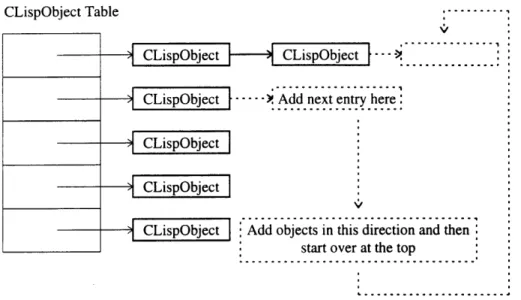
Garbage collection is currently being handled in a relatively crude manner. As CLispObjects are created, they are added to a list containing all
previously created CLispObjects. The Bullfrog programmer must be sure to call CLispObject::FreeLispObjects() before the program terminates in order to reclaim that memory. This also means that all objects derived from CLispObject must be allocated using the C++ operator new; use of
automatic (local or stack) variables will result in a memory violation when the call to FreeLispObjects() tries to delete an object that was already deleted by the system when it went out of scope. The call to
FreeLispObjects() should not be made until just before program
termination, as the CNMEnvironment objects contain CLispObject-derived objects that must remain valid until the network is compiled and the pertinent information is output to files. Figure ??? illustrates the structure of the symbol table.
This garbage collection scheme can and should be replaced in future versions of the software with a more sophisticated scheme. For instance, separate tables could be maintained for the different types of CLispObjects, and then things like a particular integer or string could be shared by all users rather than creating duplicates when one instance of such an object is already in existence, and certain tables could be deleted when the parser finishes reading the input file rather than being kept around until
termination of execution, when FreeLispObjects is called.. Also,
FreeLispObjects() could be added to the CNMRootBlock destructor, perhaps, so the programmer doesn't have to make the call explicitly (the symbol table, which is currently a global object, would have to be added to the CNMRootBlock class representation to support this behavior). The insertion of objects into the symbol table could be limited to dynamically allocated objects so that automatic objects are permitted without causing