HAL Id: hal-01788569
https://hal-amu.archives-ouvertes.fr/hal-01788569
Submitted on 9 May 2018HAL is a multi-disciplinary open access
archive for the deposit and dissemination of sci-entific research documents, whether they are pub-lished or not. The documents may come from teaching and research institutions in France or abroad, or from public or private research centers.
L’archive ouverte pluridisciplinaire HAL, est destinée au dépôt et à la diffusion de documents scientifiques de niveau recherche, publiés ou non, émanant des établissements d’enseignement et de recherche français ou étrangers, des laboratoires publics ou privés.
Large complexes: Cloning strategy, production and
purification
Eric Durand, Roland Lloubès
To cite this version:
Eric Durand, Roland Lloubès. Large complexes: Cloning strategy, production and purification. Meth-ods in Molecular Biology: Bacterial protein secretion systems, 2017, �10.1007/978-1-4939-7033-9_24�. �hal-01788569�
Chapter 24. Large complexes: Cloning strategy, production and purification
1
Running Head: Membrane protein complex purification
2
Eric Durand and Roland Lloubes
3
attention abbreviations
4
Laboratoire d'Ingénierie des Systèmes Macromoléculaires UMR7255, Institut de Microbiologie
5
de la Méditerranée, CNRS/Aix-Marseille Université, 31 chemin Joseph Aiguier, 13402 Marseille
6 cedex 20, France 7 8 E-mail: [email protected] 9 10 i. Summary 11
Membrane proteins can assemble and form complexes in the cell envelope. In Gram-negative
12
bacteria, a number of multiprotein complexes including secretion systems, efflux pumps,
13
molecular motors or pilus assembly machines comprise proteins from the inner and the outer
14
membrane. Beside the structures of isolated soluble domains, only few atomic structures of these
15
assembled molecular machines have been elucidated. To better understand the function and to
16
solve the structure of protein complexes, it is thus necessary to design dedicated production and
17
purification processes. Here, we present cloning procedures to overproduce membrane proteins
18
into E. coli cells and describe the cloning and purification strategy for the Type VI secretion
19
TssJLM membrane complex.
20
21
ii. Key words: membrane protein complexes, E. coli, T7 overexpression, protein purification.
22
23
1. Introduction
24
Protein overproduction results from cloning a gene of interest into a plasmid vector, downstream
25
of a tightly regulated promoter, and from inducing its expression after plasmid transformation
into a bacterial strain. For large protein complexes containing multiple subunits, the genes
27
encoding the different subunits can be expressed under the control of an inducible promoter
28
either from single plasmid containing a cluster of genes or from different compatible plasmids
29
harboring single or multiple genes.
30
1.1 Cloning vectors
31
Several inducible promoters have been described and are available to overexpress a gene of
32
interest. These promoters are usually cloned into vectors that also contain the gene encoding the
33
cognate regulatory protein and a transcriptional terminator to prevent non-productive
34
transcription from downstream gene (1-7). The tac and trc promoters that contain the -35 and -10
35
sequences from the trp and lacUV5 promoters, respectively, have been optimized for high
36
expression level (1). Other E. coli tightly regulated promoters such as the tetA promoter and its
37
repressor TetR, the araBAD promoter and its cognate activator AraC (3-6). In addition,
38
heterologous combinations of promoter/regulator binding sequences can be used (2). The last
39
family of inducible promoters gathers sequences that are not recognized by the E. coli RNA
40
polymerase but rather recognized by phage RNA polymerases such as the SP6, T3 and T7
41
promoters. Vectors and strains that express the T7 RNA polymerase (T7RNAp) have been
42
extensively developed. Three independent methods are used to regulate the T7 expression
43
systems. First, the expression of the chromosomally- or plasmid-encoded T7 RNAp gene can be
44
itself under the control of an inducible promoter (see Note 1). Second, the inhibition of the T7
45
RNAp basal activity can be controlled by producing the T7 lysozyme under constitutive or
46
regulated conditions (8, 9). Last, the transcription by the T7 RNAp can be repressed by the Lac
47
repressor, adding the lac operator sequence (10), the lacI gene being cloned on the expression
48
vector.
49 50
A large choice of cloning vectors with different characteristics is now available and can be
51
selected based on the toxicity, stability and folding rate of the protein or protein complex to
52
overproduce:
53
- production of proteins in the cytoplasm, the periplasm or the membrane of E. coli (using the
54
addition of synthetic N-terminal signal-sequences such as that of the OmpA and PelB proteins).
55
- compatible T7 expression vectors containing one or two T7 promoters to overproduce protein
56
complexes with up to eight subunits (see Duet Vectors from Novagen).
57
- Protein tagging sequence (6 to 10 × His, Strep-Tag II...) or fusion partner (protein G,
58
glutathione-S-transferase: GST, calmodulin-binding peptide: CBP, Maltose binding protein:
59
MBP) to increase protein solubility or to simplify the purification using affinity chromatography
60
techniques. In addition, these tag affinity sequences can be removed using specific protease
61
(most used proteases: Tobacco Etch Virus Protease: TEV, enterokinase, Thrombin, Xa Factor,
62
PreScission..). For this purpose, the corresponding protease recognition sequence is inserted
63
either downstream (for N-terminal tagging) or upstream (for C-terminal tagging) of the tag
64
sequence. After protease digestion, purified protein complex is submitted to a new purification
65
step to remove the protease, the uncleaved protein and the tag peptide (for example affinity
66
chromatography to remove the His-tag peptide and the His-tagged TEV).
67
Currently, cloning into these vectors is facilitated by PCR techniques based on gene and
68
plasmid amplifications, leading to restriction site/ligation free cloning methods. These techniques
69
have proven to be efficient to perform gene expression strategies in short delay (see section 3.1
70
and Note 2).
71
If none of the overproduction strategies are sufficient to produce and purify protein
72
complexes, in vitro alternatives such as cell-free transcription-translation systems, based on
T7RNAp and E. coli cell extracts, have been found efficient to produce milligram amounts of
74
some membrane proteins (11).
75
76
1.2 Membrane protein complex overproduction and purification
77
Membrane protein complexes have been successfully overproduced and purified based on pBAD
78
or T7 vectors. For example, the Tol proteins from the Tol cell envelope molecular motor were
79
overproduced and specifically radiolabeled with 35S-Methionine after cloning into a pT7-driven
80
vector using restriction sites (RS) and ligation techniques (RSl) (12, 13, see Note 3 and Note 4).
81
Sub-complexes from the Ton system (14-17), the PomA-PomB flagellar rotor (18), the
AcrAB-82
TolC efflux pump (19), the Type IV and Type VI secretion systems (T4SS and T6SS,
83
respectively; 20, 21) and the β-barrel assembly machinery (22) have been also successfully
84
purified using similar approaches.
85
In addition to the cloning strategy and the production to levels compatible with
86
purification, studying these multiprotein machines also requires to extract and solubilize the
87
protein complex without disrupting the contacts between the subunits. Finally, since the
88
overproduction condition may induce stoichiometry artifacts, the tagging of the minor subunit or
89
the specific tagging of different subunits should be performed to purify homogenous protein
90
complexes (see below and section 3.2).
91
Here we describe the cloning strategy as well as the production, extraction, and
92
purification of the T6SS TssJLM membrane complex (21).
93
94
2. Materials
95
2.1 Cloning of the TssJLM complex
1. Desalted oligonucleotides of up to 35 bases, 5' ends unphosphorylated
97
2. Restriction enzymes (NdeI, XhoI, DpnI)
98
3. T4 DNA ligase
99
4. Thermoblock (16°C-42°C)
100
5. E. coli DH5a competent cells
101
6. PCR thermocycler
102
7. HPLC purified Mega-primer pairs (≥ 50 bases), 5' ends unphosphorylated
103
8. vector: pRSF-Duet1
104
9. High fidelity Taq DNA polymerase (Pfu turbo, Agilent)
105
10. dNTPs, 10 mM stock solution in water
106
11. Agarose gel electrophoresis system
107
2.2 Production and purification of the TssJLM complex
108
1. IPTG stock solution: 0.1 M in water
109
2. BL21(DE3): E. coli strain B F– ompT gal dcm lon hsdSB(rB–mB–) λ(DE3 [lacI lacUV5-T7 gene
110
1 ind1 sam7 nin5]) [malB+](λS)
111
3. Lysozyme stock solution: 10 mg/mL in water
112
4. DNase stock solution: 10 mg/mL in water
113
5. TCEP (Tris(2-carboxyethyl)phosphine hydrochloride) extemporaneously added
114
6. EDTA stock solution: 0.5M in water
115
7. MgCl2 stock solution: 1 M in water
116
8. Lysis buffer: 50 mM Tris-HCl, pH 8.0, 50 mM NaCl, 1 mM EDTA
9. Solubilization buffer: 50 mM Tris-HCl, pH 8.0, 50 mM NaCl, 1 mM EDTA, 0.5% (w/v)
n-118
dodecyl-b-D-maltopyranoside (DDM), 0.75% (w/v) decyl maltose neopentyl glycol (DM-NPG),
119
0.5% (w/v) digitonin (Sigma-Aldrich)
120
10. EDTA-free protease inhibitor tablets
121
110. Affinity buffer: 50 mM Tris-HCl, pH 8.0, 50 mM NaCl, 0.05% (w/v) DM-NPG
122
12. Imidazole-HCl, pH 8.0: stock solution 4M
123 13. Incubation Shakers (16°-37°C) 124 14. Centrifugation (from 5,000 to 100,000 × g) 125 15. Glass potter 126 16. Emulsiflex-C5 (Avestin) 127
17. 5-mL StrepTrap HP and 5-ml HisTrap HP columns (GE Healthcare)
128 18. Desthiobiotin 129 130 3. Methods 131
3.1: Cloning the TssJLM membrane complex
132
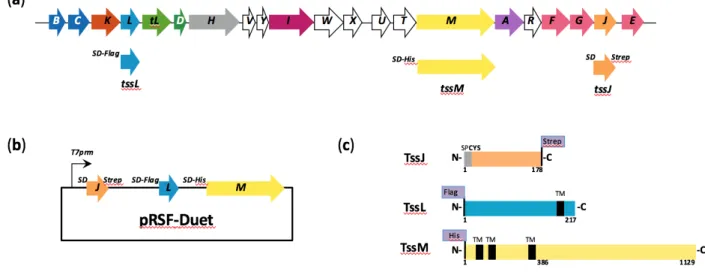
To overproduce the T6SS TssJLM membrane complex, the tssJ, tssL and tssM genes have been
133
assembled in an artificial operon with individual optimized ribosome-binding sites (see Figure
134
1). In addition, based on previous data regarding permissive positions, each subunit has been
135
tagged with a specific tag.
136
The pRSF–TssJStrep-TssLFLAG-His6TssM plasmid was constructed by both RSl (see Note
137
4) and RSl-free (see Note 2, (23)) cloning methods (Figure 1).
138
1. PCR amplify the tssJ gene (encoding the TssJ lipoprotein) using High fidelity Taq DNA
139
polymerase and primers containing the NdeI (5' primer) and the XhoI RS (3' primer) extensions.
The Strep-Tag II DNA sequence followed by a stop codon was introduced in the 3’ primer (Note
141
5). Check the correct amplification by agarose gel electrophoresis (AGE).
142
2. Digest the PCR product and the pRSF-Duet vector with NdeI and XhoI restriction enzymes
143
(sites present into the pRSF-Duet MCS2).3. Mix the digested PCR amplified fragment with
144
about 50 ng of the digested pRSF-Duet vector, both digested with NdeI and XhoI, with a molar
145
excess ratio of insert/vector of (2/1 to 5/1, inversely proportional to the DNA length of the
146
insert).
147
4. Add 1 U of T4 DNA ligase to the DNA mixture plus its specific buffer in a total volume of 15
148
µl and incubate at 16-20°C for at least 2 hours.
149
5. Transform E. coli DH5a competent cells with about 30% of the ligation mix, plate on LB agar
150
containing the appropriate antibiotic (in case of pRSF-Duet, use kanamycin 50 µg/mL) and
151
incubate overnight at 37°C.
152
6. Select positive clones containing the pRSF–TssJStrep plasmid by colony PCR screening using
153
the same primers. Extract the plasmid DNA and check the accuracy of the cloned sequence by
154
DNA sequencing.
155
7. PCR amplify the tssL gene using (i) a 5' primer containing a 5' extension (22bp) corresponding
156
to the Strep-TagII and the stop codon followed by the RBS sequence (see Note 6) and the
5'-157
FLAG-tssL extension (63bp), and (ii) a 3' primer containing the 3'-tssL gene extension (35bp)
158
including the stop codon followed by RBS, the ATG and the 5'-His6-tssM extension (14bp).
159
Check correct amplification by AGE.
160
8. PCR amplify the tssM gene using (i) the 5' primer complementary to the 3' end of tssL gene,
161
RBS, His tag and 5' sequence of tssM gene (20bp) and (ii) the 3' primer containing the 3'-tssM
gene extension (35bp) including the stop codon followed by the pRSF-Duet sequence extension
163
(35bp). Check correct amplification by AGE.
164
9. Mix the flag-tssL, his-tssM PCR products and the pRSF–TssJStrep plasmid and PCR amplify
165
with High fidelity DNA polymerase in a single reaction as described for the RSl-free technique
166
(see Note 2).
167
10. Digest the mixture with DpnI. Transform into E. coli DH5a competent cells and plate on LB
168
agar containing the appropriate antibiotic and incubate overnight at 37°C.
169
11. Select positive clones containing the pRSF–TssJStrep-FLAGTssL-6HisTssM plasmid by colony
170
PCR screening using the same primers. Extract the plasmid DNA and check the accuracy of the
171
cloned sequence by DNA sequencing.
172
173
3.2: TssJLM membrane complex, extraction and purification
174
1. Transform the expression vector (pRSF-TssJStrep-FLAGTssL-6HisTssM) into the E. coli
175
BL21(DE3) expression strain.
176
2. Grow cells at 37 °C in 8 L of lysogeny broth (LB) to an optical density at 600 nm (A600) ~ 0.7.
177
Induce the expression of the tssJLM genes with 1.0 mM IPTG for 16 h at 16 °C (see Note 7).
178
3. Pellet cells by centrifugation at 7,000 × g for 20 min. Resuspend cell pellets in 300 mL of ice-179
cold Lysis buffer supplemented with 1 mM TCEP, 100 µg/mL of DNase I, 100 µg/mL of
180
lysozyme and with one tablet of EDTA-free protease inhibitor. Add MgCl2 to the final
181
concentration of 10 mM.
182
4. Break the cell suspension with an Emulsiflex-C5 by 4 passages at 15,000 psi (100 MPa).
183
Pellet unbroken cells by centrifugation at 7,000 × g (see Note 8). 184
5. Pellet membranes by ultracentrifugation at 98,000 × g for 45 min. 185
6. Resuspend membranes in 120 mL of Solubilization buffer supplemented with 1 mM TCEP at
186
22°C and homogenize membranes mechanically with a potter (duration about 45 min) (see Note
187
9).
188
7. Clarify the membrane suspension by centrifugation at 98,000 × g for 20 min.
189
8. Load the supernatant onto a 5-mL StrepTrap HP column and then wash with Affinity buffer at
190
4 °C.
191
9. Elute the TssJLM core complex in Affinity buffer supplemented with 2.5 mM desthiobiotin
192
into a 5-mL HisTrap HP column.
193
10. Wash the HisTrap HP column in Affinity buffer supplemented with 20 mM imidazole and
194
proceed to the elution of the TssJLM core complex in the same buffer supplemented with 500
195
mM imidazole.
196
11. Pool the peak fractions and load onto a Superose 6 10/300 column equilibrated in 50 mM
197
Tris-HCl, pH 8.0, 50 mM NaCl, 0.025% (w/v) DM-NPG (see Note 10). The TssJLM complex
198
elute as a single monodisperse peak close to the void volume of the column.
199
200
4. Notes
201
1. E. coli T7RNAp expression systems result from (i) plasmid (pGP1-2) expression, the
202
T7RNAp under the control of the Lambda PL promoter is regulated by the plasmid encoded
203
temperature-sensitive C1-857 repressor (24); (ii) chromosomal expression: the T7RNAp gene is
204
under the control of the lacUV5 (25) or the ara promoter (26); (iii) besides tight control of the
205
chromosomal T7RNAp expression upon AraC control (26), infection by phages (M13 mGP1-2
206
or Lambda CE6) encoding the T7RNAp (27, 28) has proven to be efficient for the expression of
207
toxic gene products.
2. The RSl-free cloning strategy allows the insertion of a gene at a precise position on a target
209
plasmid but does not require the presence of RS. The restriction free cloning method consists in
210
two sequential PCR amplifications using only two primers. These primers (with ≥ 25 bp
211
homology extension) are designed to hybridize on the 5' and 3' ends of the gene of interest and
212
contain additional extension to hybridize on the expression vector at a selected position
213
downstream of the regulate promoter sequence. First, the gene of interest is amplified by PCR,
214
then the amplified mega-primer pairs containing the gene are annealed to the vector of interest. A
215
new amplification with High fidelity polymerase produce a linear gene-vector amplification (29).
216
The gene is thus plasmid included into a nicked and circular DNA molecule. The PCR reaction is
217
treated by DpnI RE to digest the unwanted Dam methylated plasmids templates. Competent
218
E.coli cells are further transformed with the annealed DNA complex directly. An alternative
219
method has been developed (30). It uses PCR amplified gene containing at least 15 bp extensions
220
that are homolog to each end of the linearized vector (PCR amplified or RS digested). PCR DNA
221
and vector treated with T4 polymerase, to create 5' overhangs, are annealed to form a
222
recombinant plasmid.
223
3. Addition of a T7 promoter by a RS-dependent cloning strategy. RS present in the upstream
224
sequence of the gene of interest can be used to insert a synthetic T7 promoter DNA fragment
225
which is formed by two overlapping oligonucleotides containing the T7 consensus promoter
226
sequence of 23 bases corresponding to: 5'-taatacgactcactatagggaga-3'. The T7 promoter sequence
227
is inserted upstream of the Ribosome Binding Site (RBS) of the gene of interest (it is also
228
possible to insert the T7 promoter upstream of the natural promoter sequence). For this purpose,
229
the synthetic DNA fragment contains additional 5' and 3' end extensions that are complementary
230
of the sticky ends of the RS present in the plasmid (blunt ended RS are also possible to use but
with lower ligation efficiency and random insertion). Two complementary desalted
232
oligonucleotides (ON) of about 35 bases, 5' end unphosphorylated are hybridized following heat
233
denaturation in ultrapure water and further cooling at room temperature. The annealed DNA
234
fragment is further ligated into RS digested plasmid. It is possible to favor the selection of
235
positive clones using Synthetic DNA that do not recreate the initial RS. Then, heat inactivated
236
ligation mix is digested with the RE corresponding to the RS that has been destroyed upon DNA
237
fragment ligation (Example: DNA fragment insertion into the EcoRI RS: after EcoRI digestion,
238
the overhang EcoRI: 5'-AATTC... should be filled with the synthetic sequence: 5'-AATTX....,
239
where the X nucleotide does not correspond to C nucleotide). It is noticeable that this fast
240
technique does not require plasmid sequencing. It should be used for plasmids harboring
241
resistance and regulatory genes in the opposite orientation from that of the T7 regulated gene(s)
242
(31). 243
4. The general RSl-dependent strategy is often used for cloning genes of interest into the MCS of
244
expression vectors. The genes can be either purified from RS digestion (32) or obtained from
245
PCR amplification using primers that contain additional RS extensions. Then, the PCR amplified
246
DNA is RE digested and inserted into the cognate RS of the MCS present in the vector (16).
247
5. Since lipoproteins undergo a post-translational modification at their N-termini (33), the
Strep-248
Tag II affinity tag sequence was introduced at the C-terminal of TssJ. It is important to note that
249
the positions of affinity tags (Strep, FLAG and His Tags) have been rationally chosen to
250
maintain functional proteins.
251
6. To optimize the production of the TssL and TssM protein, the endogenous RBS-ATG 5’
252
sequence in front of the genes were replaced (in the 5’ primer sequence) by the consensual
sequence “AAGGAGATATACATATG” (34) (RBS and start codon are presented, bold and
254
italic letters respectively).
255
7. Growth and induction at 37°C for 3 hours led to very low biomass and protein yield. The
256
culture was conducted at 37°C until A600 ~ 0.7-0.9 before shifting the incubator at 16°C prior to
257
induction by IPTG. The final OD after the 16H induction was around 1.4-1.6. It is important not
258
to induce around 0.4 OD since the cell would stop growing shortly after.
259
8. It is important to note that whereas many cell disrupting protocol have been tried, only lysis
260
with Emulsiflex produced a stable and homogenous sample of the TssJLM membrane core
261
complex.
262
9. This specific combination of detergents (same recipe than that used for the purification of the
263
T4SS (20)) gave the higher extraction yield of the TssJLM membrane complex. Other isolated
264
detergents (Triton-X-100, n-Octyl-β-D-Glucoside, DDM or DM-NPG) gave poor extraction
265
yields. All detergent buffers were prepared extemporally the day of the purification. Digitonin
266
tends to precipitate in high salt buffers and without other detergents. Adding DDM and
DM-267
NPG prevent digitonin precipitation.
268
10. DM-NPG was chosen because the solulilized TssJLM complex is stable and since this
269
detergent is successful for high-resolution structural biology studies giving very clear and
270
reproducible EM background after negative staining. Using low salt concentration (50 mM
271
maximum) was key to prevent aggregation of the TssJLM complex. The affinity purification
272
steps were of paramount importance to isolate a stoichiometric complex. Indeed, a far excess of
273
the TssJ lipoprotein was eliminated during the second His column.
274
275
5. References
1. Amann E, Brosius J, Ptashne M. (1983) Vectors bearing a hybrid trp-lac promoter useful for
277
regulated expression of cloned genes in Escherichia coli. Gene 25, 167-178.
278
2. Lutz R, Bujard H. (1997) Independent and tight regulation of transcriptional units in
279
Escherichia coli via the LacR/O, the TetR/O and AraC/I1-I2 regulatory elements. Nucleic Acids
280
Res 25,1203-1210.
281
3. Cagnon C, Valverde V, Masson JM. (1991) A new family of sugar-inducible expression
282
vectors for Escherichia coli. Protein Eng 4, 843-847.
283
4. Skerra A. (1994) Use of the tetracycline promoter for the tightly regulated production of a
284
murine antibody fragment in Escherichia coli. Gene 151,131-135.
285
5. Guzman LM, Belin D, Carson MJ, Beckwith J. (1995) Tight regulation, modulation, and
high-286
level expression by vectors containing the arabinose PBAD promoter. J Bacteriol 177,
4121-287
4130.
288
6. Haldimann A, Daniels LL, Wanner BL. (1998) Use of new methods for construction of tightly
289
regulated arabinose and rhamnose promoter fusions in studies of the Escherichia coli phosphate
290
regulon. J Bacteriol 180, 1277-1286.
291
7. Balzer S, Kucharova V, Megerle J, Lale R, Brautaset T, Valla S. (2013) A comparative
292
analysis of the properties of regulated promoter systems commonly used for recombinant gene
293
expression in Escherichia coli. Microb Cell Fact. 12, 26.
294
8. Studier FW. (1991) Use of bacteriophage T7 lysozyme to improve an inducible T7 expression
295
system. J Mol Biol 219, 37-44.
9. Schlegel S1, Löfblom J, Lee C, Hjelm A, Klepsch M, Strous M, Drew D, Slotboom DJ, de
297
Gier JW. (2012) Optimizing membrane protein overexpression in the Escherichia coli strain
298
Lemo21(DE3). J Mol Biol 423, 648-659.
299
10. Dubendorff JW, Studier FW. (1991) Controlling basal expression in an inducible T7
300
expression system by blocking the target T7 promoter with lac repressor. J Mol Biol 219, 45-59.
301
11. Schwarz D, Junge F, Durst F, Frölich N, Schneider B, Reckel S, Sobhanifar S, Dötsch V,
302
Bernhard F. (2007) Preparative scale expression of membrane proteins in Escherichia coli-based
303
continuous exchange cell-free systems. Nat Protoc 2, 2945-2957.
304
12. Guihard G, Boulanger P, Bénédetti H, Lloubes R, Besnard M, Letellier L. (1994) Colicin A
305
and the Tol proteins involved in its translocation are preferentially located in the contact sites
306
between the inner and outer membranes of Escherichia coli cells. J Biol Chem 269, 5874-5880.
307
13. Cascales E, Lloubes R, Sturgis JN. (2001) The TolQ-TolR proteins energize TolA and share
308
homologies with the flagellar motor proteins MotA-MotB. Mol Microbiol 42, 795-807.
309
14. Celia H, Noinaj N, Zakharov SD, Bordignon E, Botos I, Santamaria M, Barnard TJ, Cramer
310
WA, Lloubes R, Buchanan SK. (2016) Structural insight into the role of the Ton complex in
311
energy transduction. Nature 538, 60-65.
312
15. Pramanik A, Zhang F, Schwarz H, Schreiber F, Braun V. (2010) ExbB protein in the
313
cytoplasmic membrane of Escherichia coli forms a stable oligomer. Biochemistry 49, 8721-8728.
314
16. Pramanik A, Hauf W, Hoffmann J, Cernescu M, Brutschy B, Braun V. (2011) Oligomeric
315
structure of ExbB and ExbB-ExbD isolated from Escherichia coli as revealed by LILBID mass
316
spectrometry. Biochemistry 50, 8950-8956.
17. Sverzhinsky A, Fabre L, Cottreau AL, Biot-Pelletier DM, Khalil S, Bostina M, Rouiller I,
318
Coulton JW. (2014) Coordinated rearrangements between cytoplasmic and periplasmic domains
319
of the membrane protein complex ExbB-ExbD of Escherichia coli. Structure 22, 791-797.
320
18. Yonekura K, Maki-Yonekura S, Homma M. (2011) Structure of the flagellar motor protein
321
complex PomAB: implications for the torque-generating conformation. J Bacteriol 193,
3863-322
3870.
323
19. Kim JS, Jeong H, Song S, Kim HY, Lee K, Hyun J, Ha NC. (2015) Structure of the tripartite
324
multidrug efflux pump AcrAB-TolC suggests an alternative assembly mode. Mol Cells 38,
180-325
186.
326
20. Low HH, Gubellini F, Rivera-Calzada A, Braun N, Connery S, Dujeancourt A, Lu F, Redzej
327
A, Fronzes R, Orlova EV, Waksman G. (2014) Structure of a type IV secretion system. Nature
328
508, 550-553.
329
21. Durand E, Nguyen VS, Zoued A, Logger L, Péhau-Arnaudet G, Aschtgen MS, Spinelli S,
330
Desmyter A, Bardiaux B, Dujeancourt A, Roussel A, Cambillau C, Cascales E, Fronzes R.
331
(2015) Biogenesis and structure of a type VI secretion membrane core complex. Nature 523,
332
555-560.
333
22. Bakelar J, Buchanan SK, Noinaj N. (2016) The structure of the β-barrel assembly machinery
334
complex. Science 351, 180-186.
335
23. Unger T, Jacobovitch Y, Dantes A, Bernheim R, Peleg Y. (2010) Applications of the
336
Restriction Free (RF) cloning procedure for molecular manipulations and protein expression. J
337
Struct Biol 172, 34-44.
24. Tabor S, Richardson CC. (1985) A bacteriophage T7 RNA polymerase/promoter system for
339
controlled exclusive expression of specific genes. Proc Natl Acad Sci U S A. 82, 1074-1078.
340
25. Studier FW, Moffatt BA. (1986) Use of bacteriophage T7 RNA polymerase to direct
341
selective high-level expression of cloned genes. J Mol Biol 189, 113-130.
342
26. Narayanan A, Ridilla M, Yernool DA. (2011) Restrained expression, a method to
343
overproduce toxic membrane proteins by exploiting operator-repressor interactions. Protein Sci.
344
20, 51-61.
345
27. Stuchlík S, Turna J. (1998) Overexpression of the FNR protein of Escherichia coli with T7
346
expression system. Folia Microbiol (Praha) 43, 601-604.
347
28. Doherty AJ, Connolly BA, Worrall AF. (1993) Overproduction of the toxic protein, bovine
348
pancreatic DNaseI, in Escherichia coli using a tightly controlled T7-promoter-based vector.
349
Gene 136, 337-340.
350
29. van den Ent F, Löwe J. (2006) RF cloning: a restriction-free method for inserting target
351
genes into plasmids. J Biochem Biophys Methods 67, 67-74.
352
30. Jeong J, Yim H, Ryu J, Lee H, Lee J, Seen D, Kang S. (2012) One-step sequence- and
353
ligation-independent cloning as a rapid and versatile cloning method for functional genomics
354
studies. Appl Environ Microbiol 78, 5440-5443.
355
31. Bénédetti H, Lazdunski C, Lloubes R. (1991) Protein import into Escherichia coli: colicins A
356
and E1 interact with a component of their translocation system. EMBO J 10, 1989-1995.
32. Derouiche R, Bénédetti H, Lazzaroni JC, Lazdunski C, Lloubes R. (1995) Protein complex
358
within Escherichia coli inner membrane. TolA N-terminal domain interacts with TolQ and TolR
359
proteins. J Biol Chem 270, 11078-11084.
360
33. Konovalova A, Silhavy TJ. (2015) Outer membrane lipoprotein biogenesis: Lol is not the
361
end. Philos Trans R Soc Lond B Biol Sci 370, 1679.
362
34. Ringquist S, Shinedling S, Barrick D, Green L, Binkley J, Stormo GD, Gold L. (1992)
363
Translation initiation in Escherichia coli: sequences within the ribosome-binding site. Mol
364 Microbiol 6, 1219-1229. 365 366 i. Acknowledgements 367
We would like to thank M. Petiti, L. Houot, H. Célia and D. Duché for careful reading. ED and
368
RL are are funded by the Centre National de la Recherche Scientifique, the Aix-Marseille
369
Université and two grants from the Agence Nationale de la Recherche (ANR-10-JCJC-1303-03
370
and ANR-14-CE09-0023, respectively)
372
Figure 1: Cloning of the synthetic tssJLM operon encoding the T6SS membrane core
373
complex. (a) The tssL, tssM and tssJ genes were PCR amplified from the entero-aggregative
sci-374
1 T6SS operon. DNA sequences were added encoding an optimized RBS at the 5’ end of each
375
gene and sequences encoding a C-terminal Strep-II tag for TssJ and N-terminal 6×His and Flag
376
tags for TssM and TssL, respectively. (b) The tssJLM artificial operon was cloned in the pRSF-
377
Duet vector. (c) Schemes representing the protein constructs, the sub-domain boundaries and
378
some indicated characteristics (TM, transmembrane segments; SP, signal peptide; CYS, acylated
379
cysteine).
380