Publisher’s version / Version de l'éditeur:
Vous avez des questions? Nous pouvons vous aider. Pour communiquer directement avec un auteur, consultez la première page de la revue dans laquelle son article a été publié afin de trouver ses coordonnées. Si vous n’arrivez pas à les repérer, communiquez avec nous à [email protected].
Questions? Contact the NRC Publications Archive team at
[email protected]. If you wish to email the authors directly, please see the first page of the publication for their contact information.
https://publications-cnrc.canada.ca/fra/droits
L’accès à ce site Web et l’utilisation de son contenu sont assujettis aux conditions présentées dans le site
LISEZ CES CONDITIONS ATTENTIVEMENT AVANT D’UTILISER CE SITE WEB.
Internal Report (National Research Council of Canada. Institute for Research in
Construction), 1989-01-01
READ THESE TERMS AND CONDITIONS CAREFULLY BEFORE USING THIS WEBSITE.
https://nrc-publications.canada.ca/eng/copyright
NRC Publications Archive Record / Notice des Archives des publications du CNRC :
https://nrc-publications.canada.ca/eng/view/object/?id=3a8c77b9-a456-4e16-8eb7-56d80e80f46e https://publications-cnrc.canada.ca/fra/voir/objet/?id=3a8c77b9-a456-4e16-8eb7-56d80e80f46e
NRC Publications Archive
Archives des publications du CNRC
For the publisher’s version, please access the DOI link below./ Pour consulter la version de l’éditeur, utilisez le lien DOI ci-dessous.
https://doi.org/10.4224/20386641
Access and use of this website and the material on it are subject to the Terms and Conditions set forth at
Laboratory investigation of concrete sealers
Ip'C
PUB
National Research
Conseil national
1
*
1
Council Canada
de recherche* Canada
-- Institute for lnstitut de
Research in recherche en
Construction construction
Laboratory Investigation of Concrete Sealers
C.T.
Aitken and G.G. Litvan
IRC Report No. IR 574
Date of issue: January 1989
Work sponsored by:
Canadian Institute of Public Real Estate Companies Canada Mortgage and Housing Corporation
Institute for Research in Construction, National Research Council Ministry of Housing, Province of Ontario
Public Works Canada
\
MAR
4
1989
I
Volume I
\
B I B L I O T H ~ Q U E
I R C
Discussions in this Report relating to any product named must not be
construed as a testimonial, or endorsement of that product by the National
Research Counci\. As a consequence, readers are cautioned not to make
reference in an advertisement to any tests that have been made by the
National Research Council unless the advertisement has been first approved
and permission has been given in writing by the President of the National
Research Council. This is a requirement stated in Chapter 23, Article 36, of
the Combines Investigation Act.
In 1987 the Canadian lnstitute of Public Real Estate Companies, Canada
Mortgage and Housing Corporation, the lnstitute for Research in Construction,
National Research Council of Canada, the Ministry of Housing, Province of Ontario
and Public Works Canada commissioned a jointly sponsored research project aiming
to obtain information that will enable owners to formulate strategies for the repair in a
most cost effective way.
Specifically, the following objectives have been adopted for the project
contemplated to be of four to five years duration:
evaluation of the effectiveness and limitations of current repair procedures
and materials used;
identification of new technologies and materials that could be used to
advantage in garage repairs;
achievement of an improved understanding of the effect and importance of
such parameters as design type, micro- environment, type of usage, etc.;
evaluation of the merits and limitations of the various repair strategies in
terms of technical and economical aspects, and serviceability; and
provision of a basis for the evaluation of those current requirements for new
construction which are not yet proven.
Monitoring the performance of approximately 70 garages of various structural
design, type of usage and location is the major task of the project. In the knowledge
of the repair histories of these structures information will be obtained on the merits of
the various repair strategies and approaches.
In the first year of the project laboratory investigation of concrete sealers
marketed in Canada was also performed. The results of the first phase of this study
are presented here.
EXECUTIVE SUMMARY
In order to determine the effectiveness of the various types of commercially
available concrete sealers for traffic surfaces, 189 manufacturers and distributors
were contacted soliciting information. Fifty-seven products of 49 companies were
included in the test program. Altogether 12 generic groups were represented in the
sample.
All concrete sealers obtained for testing routinely had an infrared spectrum
taken of the neat material; they were also analyzed by gas chromatography/mass
spectroscopy and had their solids content determined by thermo-gravimetric analysis
as well as by evaporation. These tests serve to identify the sealers for the present
study or in future investigations.
The waterproofing qualities of the sealers were tested on eight different types
of concrete: waterlcement (WIC) ratio 0.43 and 0.55, air-entrained and plain, cured
in water and at
50%
RH.
These represent the various types of concretes
encountered in the field. In existing structures built some years ago the concrete is
mostly of high W/C ratio, non-air-entrained and air-cured while in recently built
garages the concrete is mostly of low WIC ratio, water-cured and air-entrained in
conformity with the specifications of the CSA S413 Standard on Parking Structures.
The test results can be summarized as follows:
1.
Water curing does not have significant benefit with regard to the chloride
concentration in the surface zone of uncoated concrete when exposed to
NaCl solution. Great benefits are derived, however, with regard to the
chloride concentration in the zones at greater depth.
2.
Chloride ion penetration has not been reduced by air entrainment; in fact by
creating higher porosity and permeability air-entrained concrete tends to have
approximately 30% higher water absorption in the surface zone than similar
non-air-entrained concrete.
3.
The benefits of low waterkement ratio and wet curing on the water absorption
were clearly apparent. This was true whether the concrete was coated with a
sealer or not.
4.
Great influence of the concrete substrate on the performance of sealers was
found. This shows clearly the need to take into consideration the
characteristics of the concrete when selecting a suitable sealer. This is
seldom,
if
ever, done at present.
5.
Substantial differences were found concerning the effectiveness of the
various sealers. In laboratory tests some sealers decrease the water
absorption of concrete to approximately one third of that of the uncoated
concrete, while others have little effect or even increase the water uptake by
as much as
30%.
6.
While trends in the performance among various types of sealers could be
clearly detected in the laboratory tests, being of a particular generic type does
not in itself determine the degree of effectiveness of a sealer.
7.
Only
35%
of the
57
tested sealers had measurable penetration into the
concrete; thus
65%
of the sealers tested have to be considered as coating.
8.
Water vapour transmission of mortars coated with sealers varied
En
1987, 1'Institut canadien des compagnies immobilibres
publiques, la SociCtC canadienne d'hypothkques et de logement,
1'Institut de recherche en construction, le Conseil national de
recherches du Canada, le ministkre du Logement- de l'ontario et
Travaux publics Canada mettaient sur pied un projet de recherche
conjoint visant
8
recueillir de l'information pour aider les
propribtaires de garages de stationnement
B
Ctablir les stratCgies de
reparation les plus rentables.
Voici les objectifs precis du projet, dont la durCe prCvue est de
quatre & cinq ans
:
$valuer llefficacitC et les restrictions des procCdures de
reparation et des matCriaux actuellement utilisbs;
identifier les nouvelles technologies et les nouveaux matbriaux
pouvant &re utilisCs
B
profit dans la rCparation des garages de
stationnement;
approfondir les connaissances sur les effets et l'importance de
paramktres tels que le type de conception, le micro-milieu, le type
d'usage, etc.;
Cvaluer les avantages et les restrictions des diverses strategies
de reparation en ce qui a trait
8
la durabilitC et aux aspects
techniques et 6conomiques; et
fournir une base pour lqCvaluation des exigences existantes
relatives aux constructions non Cpaouv6es.
La principale tgche du projet consiste 8 enregistrer la
performance d'environ
70 garages de stationnement situCs
B
divers
endroits et ayant des conceptions structurales et des usages
differents.
L'historique des reparations de ces structures permettra
de recueillir des donn$es sur la valeur des diverses stratCgies et
mCthodes de rCparation.
Au cours de la premi&re annCe du projet, on a 6tudi6 en
laboratoire des produits dlCtanchCitC pour bCton commercialisCs au
Canada. Les rCsultats de la premibre Ctape de ce projet sont
&SU&
A
L'INTENTION DE LA DIRECTION
Des renseignements sur ltefficacitC des divers types de produits
d'CtanchCitC sur le march6 ont CtC obtenus aupr&s de
189 fabricants
et distributeurs.
Cinquante-sept produits vendus par
49 compagnies
ont CtC inclus dans le programme d'essai. Au total, 12 groupes
gCnCriques Ctaient reprCsentCs dans llCchantillon.
Tous les produits d'CtanchCit6 pour bCton mis
B
l'essai ont fait
l'objet d'une analyse de routine visant
B
obtenir le spectre infrarouge
des produits
B
1'Ctat pur; ils ont Cgalement CtC analysCs par
chromatographie en phase gazeuse et spectroscopie de masse, et leur
teneur en solides a CtC dCterminCe par analyse thermogravimCtrique
de meme que par Cvaporation. Ces essais permettent de classer les
produits d'CtanchCitC aux fins de la prCsente Ctude et d'Ctudes
B
venir.
Les qualitCs hydrofuges des produits ont CtC CtudiCes sur huit types
de bCton ayant les caractCristiques suivantes
:
rapport eaulciment de
0.43 et 0.55,
B
air occlu ou non, cure
B
l'eau et
B
une humidit6
relative de
50
%.
Cet tchantillon reprCsente les types de bCton
utilisCs sur le terrain. Le bCton des structures construites depuis un
certain nombre d'annCes a un rapport eaulciment ClevC, n'est pas
B
air occlu et a subi une cure
B
l'air, tandis que le beton des garages de
stationnement rCcemment construits a tr&s souvent un faible rapport
eaulciment, a subi une cure
B
l'eau et est
B
air occlu, conforrnCment
aux spCcifications de la norme
CSA S413 <<Parking Structures>>. Les
rCsultats des essais peuvent &re rCsumCs comme suit
:
1.
En ce qui a trait
B
la concentration de chlorure, la cure
B
l'eau
est peu avantageuse pour la surface du beton non protCgC lorsque ce
dernier est expose
B
une solution de NaC1, mais elle procure par
contre de grands avantages pour les zones plus profondes.
2.
En ce qui a trait
B
la pCnCtration d'ions de chlorure, la presence
d'air occlu dans les bCtons non protCgCs ne procure aucun avantage
visible; en rCalitC, en ayant une plus grande porosit6 et une plus
grande permCabilit6, le beton
B
air occlu a tendance
B
absorber
environ
30
%
plus d'eau
B
la surface qu'un bCton similaire qui ne l'est
pas.
3.
Les avantages d'un faible rapport eaulciment et d'une cure en
atmosphkre humide relativement
B
l'absorption d'eau, que le d'un
beton soit protege ou non, sont nettement Cvidents.
4.
On a constat6 que le substrat influait grandement sur la
performance des produits d'CtanchCitC.
Cette dCcouverte montre
bien l'importance de choisir le produit appropri6 en fonction des
caracteristiques du beton; malheureusement on n'en tient gukre
compte encore aujourd'hui.
5 .
I1 existe des $carts importants sur le plan de I'efficacitC des
divers produits d1CtanchCitC. Les essais en laboratoire rCv6lent que
certains produits rCduisent l'absorption d'eau du bCton
B
environ un
tiers de celle d'un bCton non protCgC, tandis que d'autres ont peu
d'effet ou augmentent mzme l'absorption d'eau parfois jusqu'g 30
%.
5.
Bien que les tendances au niveau performance des divers types
de produits dlCtanchCitC peuvent 6tre facilement dCtectCes en
laboratoire, le fait d'appartenir
B
un type gCnCrique particulier ne
determine pas en soi le degrC dlefficacitC d'un produit.
7.
Seulement
35
%
des
57 produits d'CtanchCit6 mis
B
l'essai
pCnCtraient dans le bCton
B
une profondeur mesurable; 65
%
des
produits doivent donc ztre considCrCs comme des enduits.
8.
La transmission de vapeur d'eau dans les mortiers enduits de
produits d'CtanchCit6 varie considCrablement selon le produit utilisC.
Table of Contents
page
...
Executive Summary
ii
...
.
I
Introduction
1
...
1.1 General Introduction
1
...
1.2
Introduction to this work
5
II
.
Experimental
...
9
11.1 Instrumentation
...
9
...
11.2 Substrate Preparation
11
11.3 Water Absorption
...
13
...
11.4 Penetration Depth
6
11.5 Water Vapour Permeance
...
16
11.6 Solids Content
...
17
11.7 Porosimetry
...
17
Ill
.
Results and Discussion
...
18
...
111.1 Water Absorption
18
111.2 Penetration Depth
...
34
111.3 Porosimetry Studies
...
53
111.4 Water Vapour Transmission
...
58
111.5 Solid Content of Sealers
...
58
111.6 Infrared Transmittance and Absorbance
...
58
111.7 Gas Chromatography of Sealers
...
58
111.8 Viscosity of Sealers
...
58
List
of
Tables
page
Table 1
Concrete Sealers: Generic Types Evaluated
...
for their Waterproofing Ability
6
Table 2
Concrete Mix Design
...
11
Table 3
Concrete Batch Weights
...
12
Table 4
Aggregate Gradings
...
12
Table 5
Sealer Coverage Rates
...
14
Table 6
Results of CI- Penetration Into Uncoated Concrete
...
(Types 1 through 8)
1
8
Table
7
Water Absorption of Various Types of Uncoated
Concrete Specimens
...
21
Table 8
Water Absorption and Permeance of Specimens.
...
Viscosity and Penetration Depth of Sealers
25
Table 9
Water Absorption and Permeance of Specimens.
Viscosity and Penetration Depth of Sealers. Listed by
...
Generic Type
..
...
28
Table 10 Rankings of Sealers Listed According to Their
...
Generic Type
35
Table 11 Rankings of Sealers. Based on the Various
...
Tests. Listed in Order of Rank
41
Table 12 Ranks of Sealers in the Various Tests. Listed
in Order of Sample Number
...
49
Table 1-1 Sealer Information
...
App.1
Table 2-1 Data on Water Absorption of Coated Specimens
...
APP-2
Table 8-1 Penetration Depth of Sealers
...
App.8
Table 9-1 Porosimetry
...
App.9
Table 10-1 through 10-9 Weight Loss of Wet Cup
...
App
.
1
0
Table 11 -1 Solids Content of Concrete Sealers
...
App.11
Table 15-1 Viscosity of Sealers
...
App
.
1 5
List
of
Figures
page
Figure 1
Chloride Penetration of Concrete Cubes
...
20
Figure 2
Pore Size Distribution of Concrete, 0.43 w/c
...
54
Figure 3
Pore Size Distribution of Concrete, 0.55 w/c
...
55
Figure 3-1 Average Weight Gain of Coated Specimens
during Water Absorption Studies as a Function
of Time
...
APP- 3
Figure 4-1
Average Weight
Gain
as Percentage of that of
the Control Specimens
...
APP. 4
Figure 5-1 Reduction of Water Absorption
...
APP. 5
Figure 6-1 The Effect of Concrete Type on the Water
Absorption of the Sealers
... ...
APP. 6
Figure 7-1
Weight Gain of Sealers of the Same Generic Type
...
App. 7
Figure 9-1 Porosimetry
...
App. 9
Figure 10-1
I
Figure 10-9 Weight Loss of Wet Cups
...
App. 1 0
Figure 1 1-1
I
Figure 1 1-71 Thermogravimetric Analysis
...
App. 1 1
Figure 12-1
I
Figure 12-63 lnfrared Spectrograms of Sealers
(Transmittance)
...
... ...
...
App. 1
2
Figure 13-1
I
Figure 1 3-62 Infrared Spectrograms (Absorbance)
... .. ...
...
...
..
App. 1 3
Figure 14-1
I
1.
-
INTRODUCTION
I. 1
General Introduction
One of the most serious problems in the construction industry today is
the premature deterioration of parking garages, largely as a result of harsh
winters and the wide scale use of deicing salts. The signs of deterioration
currently evident in parking garages across Canada have given rise to much
concern among owners.
Most of the work done to date on deteriorated concrete has been
carried out by various highway authorities. Although an analogy may be
drawn between some types of multi-storey parking garages and highway
stretches, e.g. bridge decks, one must be careful not to take the analogy too
far. Enclosed parking garages are not subjected to the same climatic
conditions as highways, i.e. freeze-thaw damage is not evident in the former.
The high humidity and temperatures often encountered, however, can lead to
massive premature deterioration of the parking garage. Moreover, the quality
of the design and construction often leaves much to be desired in a typical
parking garage, especially when compared with highway bridge decks.
One focus of current interest in the protection of highway structures
including traffic surfaces, is the use of waterproofing materials, particularly
concrete sealers. In fact a number of highway authorities test sealer materials
as an ongoing commitment, due to the very high costs associated with
highway (particularly bridge) maintenance programs and the constant need to
find cost effective solutions.
There are, in general, two types of protective materials intended for use
on concrete surfaces, membranes and sealers. Membranes are generally
impenetrable coatings
(0.5
mm to
30
mm thick) which can be very effective at
reducing water absorption. Solid membranes are commonly used, but
solutions which cure upon drying are also available. The high cost, however,
and need for good application makes their practical use somewhat limited. In
contrast, a sealer, supplied as a solution or as a suspension in a solvent, is
usually easier to apply and cheaper. Furthermore, in contrast to membranes,
sealers neither hamper visual inspection of the concrete nor make repairs
cumbersome. Sealers tend to penetrate the surface of the concrete to some
extent, even if it is just the surface pores as in a coating. True penetrating
sealers, however, usually penetrate the surface at least
1
mm, and often 2-3
mm; the extent of penetration depends on the type of concrete, dilution and
type of solvent, and also on the temperature at which the product is applied.
There are a number of previous reports pertaining to the evaluation of
concrete sealers for use on highway structures. The first major report on this
subject was published in the United States by the Transportation Research
Board as NCHRP Report 244. It is entitled "Concrete Sealers for the
Protection of Bridge Structuresn. This was the most important and
comprehensive study to date although it focused only on the protection of the
traffic surfaces of bridges, i.e. walls, piers, etc. Three, more recent, Canadian
reports prepared by the Alberta, Ontario and Quebec Departments of
Transportation reflect the growing concern in Canada over highway
deterioration, and the constant search for cheap solutions. The Alberta report
in particular has recognized the need to evaluate sealers for use on traffic
surfaces, i.e. surfaces that are subject to abrasion, and have adjusted their
testing procedures accordingly, considering depth of penetration as indicative
of how well a sealer would perform on a traffic surface.
Since publication of the NCHRP Report 244 in 1982, there has been a
dramatic increase in the number of concrete sealers available on the market.
Although considered "the bible" by manufacturers and highway authorities
alike, report 244 is now
7
years old and does not truly reflect the current
product availability. In particular there are now many more silane-derived
sealers of various types, developed to meet the need for true penetrating
sealers as opposed to coatings (particularly important for a traffic surface).
Out of 21 products evaluated by
NCHRP 244, only one silane was
described as being a true penetrant.
It performed consistently well in all
series of tests except when applied on top of a linseed oil coating.
There are a number of different materials, both organic and inorganic,
that are used for sealing concrete surfaces. Some of the most common ones
include epoxies, acrylics, urethanes, styrene-acrylates, rubbers, oils, silicates,
silicones and the reactive silanes and siloxanes (partially hydrolysed silanes).
All of these materials, with the exception of the latter two, are (or become)
highly polymeric in nature.
They are usually obtained in an organic
solvent (with the exception of silicates), but it is interesting to note
that waterbased epoxies, acrylics and even silanes are now
available so that potential problems with toxicity can be avoided.
Epoxy resins are the condensation products of a dihydroxyphenol and a
compound containing an epoxy group
-
often epichlorohydrin. The resins will
not cure without the addition of a crosslinking agent, often a compound with
two or more amino groups, and
it
is this crosslinking process that gives rise to
a very rigid network with great strength and hardness. In addition, epoxies
also show excellent resistance to chemical attack. They are, however, usually
supplied as two-component systems which makes them difficult to apply, as
mixing instructions must be followed carefully. They tend to form glossy
coatings on the surface of concrete, although the extent of this varies with the
solids content.
Acrylics (including methacrylates, etc.) may all be considered
derivatives of acrylic acid and there are many different types. They tend to
leave a sheen or gloss on the concrete, depending on the type and solids
content of the material.
Polyurethane concrete sealers may be obtained as either one or two
component systems. The former are cured by either air oxidation or moisture,
as they dry, and are hence much easier to apply. The properties of
polyurethane vary widely, and as in the case of epoxies and acrylics, a sheen
is often obvious on the surface of the concrete. Because of the presence of
isocyanate groups in these materials proper application procedures must be
followed to avoid potential toxic effects.
Styrene-acrylate copolymers, chlorinated rubbers and oils are all used
with varying degrees of success. The latter two in particular, are subject to
oxidation and
UV
degradation, although in the case of linseed oil, this process
is said to impart its protective characteristics.
Silicones are silicon-oxygen based polymers, usually supplied in
mineral spirits. They may also be called polysiloxanes although the term
silicone generally denotes a degree of crosslinking into resins as opposed to
straight chains. They possess organic groups,usually hydrocarbon in nature,
attached to the silicon atoms, and it is this that differentiates them from their
purely inorganic equivalents, the silicates. Sodium silicates are the silicates
most often provided for use as a concrete sealer due to the relatively high
solubility in water compared to other silicates. Upon reaction with the free
lime in concrete, production of insoluble calcium salts result, helping to plug
the pores of the concrete. Dilution of the product is often required to facilitate
penetration into the concrete surface.
Finally, the newest class of concrete sealers currently being used on
traffic as well as non-traffic surfaces include the reactive alkylalkoxy silanes
and the oligo(alkylalkoxy) siloxanes. These may be represented by the
following:
-
-
R
R
R
I
R'O
-
Si 4 R '
R ' O - S i
I
4
-
i
I
-
OR'
I
OR'
I n
a . J
n
MONOMERIC
SILANE
I
R
=
Bulky alkyl group;
R' =
Alkyl group.
II
may be obtained as a result of partial hydrolysis of I. Both types of molecule
react in situ in the concrete pores, leaving the bulky alkyl (hydrocarbon) group
as a hydrophobic barrier lining the pores. The reaction is as follows for the
monomeric silane:
R'O- Si
-
OR'
+
3 H20
---->
HO
-
Si --OH
+
3R'OH
I
I
OR'
OH
The silanes subsequently condense with the elimination of water, to
give a 3-dimensional siloxane network. The advantages
~f
the monomeric
species (I) is that it penetrates the concrete easier (being smaller) and
probably reacts faster with the substrate than the oligomeric siloxane. The
oligomeric species (11) is however less volatile as a result of its higher
molecular weight although it does not penetrate the concrete surface as
easily. In conclusion, both types of molecule are sensitive to moisture and
rigorous exclusion of water is necessary to preserve the shelf life of the
material.
1.2
Introduction to
This
Work
The objective of this work was to determine the effectiveness of a
number of protective sealers specified for use on the concrete traffic surfaces
of parking garages. The study was limited to those products formulated,
manufactured or distributed in Canada and resulted in contact with 189
manufacturers/distributors.
Of this total, 49 companies recommended a total
of 89 products as suitable for use on a parking garage floor. The remaining
companies either had no suitable products or did not reply. Product suitability
for a traffic surface (i.e. slip free) was verified at the time the product (4
L)
was
requested. Within several generic groups, particularly the silanes and
siloxanes, a number of products appeared to be identical on the basis of
specification sheets provided. This was taken into consideration when the
final selection was made, and products thought to be representative of each
generic type were chosen. The study was, therefore, by no means exhaustive.
To help in the selection, provincial and state highway authorities were
approached in order to ascertain those products being used the most widely.
Moreover, a number of sealers were also obtained from local hardware stores
as being representative of those available in the retail market. The total
number of concrete sealers eventually tested was 57, this number reflecting
the current interest in penetrating sealers, particularly alkylalkoxy silanes and
oligo(alkylalkoxy) siloxanes. Of the products tested, 15 or approximately
25%,
involved reactive silane molecules of one type or another, with 13 of these
having silane (or siloxane) as the sole active ingredient. For the sake of
comparison and completeness, a number of the more traditional concrete
sealers were also evaluated. Many of these are still being widely used
whether for economic or other reasons, and are included in the list of generic
types given in Table 1. A complete list of sealers tested with their
TABLE
1
-
CONCRETE SEALERS: GENERIC TYPES EVALUATED FOR
WATERPROOFING ABILITY
1.
Acrylics
2.
Oligomeric Alkoxysiloxanes
3.
Epoxies
4.
Blends
5.
Urethanes
6.
Alkoxysilanes
7.
Silicates
/
Siliconates
8.
Polysiloxanes and Silicones
9.
Styrene-Acrylate Copolymers
10.
Chlorinated Rubbers
11.
Oils
1
2.
Siloxane/Methacryfate Synergistic
GENERIC TYPE
System
I
Number of
Products Tested
All concrete sealers obtained for testing routinely had an infrared
spectrum taken of the neat material; they were also analysed by gas
chromatography/mass-spectroscopy
and had their solids content determined
by thermogravimetric analysis as well as by more conventional methods.
Finally the viscosity of each sealer was determined at ambient temperature.
The experimental details and results obtained will be given later.
Particular attention was paid to the problems encountered in already
deteriorated parking garages. Most parking garage concrete is already highly
contaminated with chloride ions and so it seemed important to investigate how a
sealer would adhere to contaminated concrete (even with the top surface
sandblasted prior to application). Moreover, how would the presence of sodium
chloride in the surface pores affect sealer penetration? Penetration depth was
therefore deemed important, particularly for a traffice surface, and was
determined accordingly.
We further adopted the approach that a sealer's waterproofing ability is
important in reducing further deterioration of the concrete by altering the rate at
which chloride ions migrate to the steel reinforcement through the substrate. In
conclusion, the most important properties of a concrete sealer were deemed to
be the penetration depth achieved and the waterproofing ability. These were
both determined on concrete precontaminated with sodium chloride.
It has been widely recognized that the ability to transmit water vapour is
an important characteristic of a concrete sealer; but while ingress of water is
reduced, moisture transfer through the vapour phase must not be greatly
affected to make evaporation of the pore-held liquid possible. In an indoor
parking garage, the effects of freeze-thaw deterioration are normally not
important, but the presence of water is still detrimental, giving rise to spalling
effects as the water and contaminating salts reach the reinforcing steel. Thus
this study has focused on the water vapour permeability of the sealers as
being a prime concern. The method used was a "wet-cup" method [Standard
Test Method for Water Transmission of Materials, ASTM, E96-801 and will be
discussed later in the experimental section. It was felt that merely determining
the loss of water vapour with time after water-absorption tests as commonly
done [Concrete Sealers for Protection of Bridge Structures, National
Cooperative Highway Research Program Report No. 244, Transportation
Research Board, National Research Council, Washington, D.C. 19821 was
inadequate. The problem with this method is that the water content of coated
concrete varies dependent on the nature of the sealer. Therefore merely by
taking the coated substrates out of the water to evaluate water vapour
permeability, would be to assess concretes saturated to different extents. It is
clear therefore that even for uncoated concrete, a wet substrate would be
expected to lose more weight than a dry one.
Finally, the waterproofing ability and penetration depth of concrete
sealers have been assessed on eight different types of concrete in recognition
of the variety of concretes likely to be encountered in the field. Details of these
are given in the Experimental Section. The water vapour permeability studies
were performed on one type of mortar only,
a
high waterlcement (WIC) ratio
paste containing no large aggregates. This choice was made to facilitate the
passage of water vapour through the substrate such that meaningful results
could be obtained in a relatively short period of time. Finally some
porosimetry results are also reported in this study. An attempt has been made
to correlate observed penetration depths in the different concretes with
II.
-
EXPERIMENTAL
11.1
Instrumentation
Infrared spectra of the neat sealers were obtained on a Nicolet FTlR
6000 spectrometer, fitted with ATR (attenuated total reflectance). A zinc
selenide crystal (4S0 angle, 70 x 9 mm dimensions) was used with a path
length of 10 microns. 100 sample scans were used per sealer.
GC/ms (gas chromatography/mass spectroscopy) was performed on
each sample. The spectra were obtained using an HP 5890lHP 5970A
system. A run time of 50 minutes was used with an initial temperature of 60°C
and a final temperature of 250°C. Mass spectral data was obtained using a
scan threshold of 20.
Viscosities of all sealers were obtained using an LV8 viscometer
(Viscometers UK Ltd.). Those sealers having a viscosity below 20 cps
(centipoises) had their viscosities determined using a low centipoise adaptor.
Porosity measurements were obtained on a mercury porosimeter
(60,000 psi, American lnstrument Company, Silver Springs, Maryland).
TGA (Thermo-Gravimetric Analysis) was used as one method of
determining the solids content of all sealers. A Dupont Model 951
Thermogravimetric Analytical lnstrument was used together with a Dupont
Model 9900 computer. Three programs were employed, depending on the
sealer. Descriptions of the program sequences are given below:
Program
1:
Maximum temperature 1 10°C (indicated on graphs as "Drying
at 1 10 DEGw).
1. Ramp 5.00 OCImin to 80.00°C
2. Isothermal for 30.00 min
3. Ramp 5.00°C/min to 1 40.00°C
4.
Isothermal for 60.00 min.
A maximum temperature of 11 0°C was obtained using this program
sequence.
Program 2
Maximum temperature 140°C (indicated on graphs as "Drying
at 140 DEG").
1. Ramp 5.00°C/min to 80.00°C
2. lsothermal for 30.00 min
3. Ramp 5.00°C/min to 140.00°C
4.
lsothermal for 60.00 min
5. Ramp 5.00°C/min to 180.00°C
6.
lsothermal for 60.00 min.
A final temperature of 1 40°C was obtained using this program sequence.
Program
3:
Maximum temperature 180°C (indicated on graphs as "Drying
at 180 DEG").
1. Ramp 5.00°C/min to 80.00°C
2. lsothermal for 30.00 min
3. Ramp 5.00°C/min to 140.00°C
4. lsothermal for 60.00 min
5. Ramp 5.00°C/min to 230.00°C
6. lsothermal for 60.00 min
A
final temperature of 180°C was obtained using this program sequence.
The final temperatures obtained with the three programs are less than
those indicated by each program. This does not affect the final results as we
were only interested in the total residue (solids content) left at the end of the
program sequence. All sealers were initially analysed using program 1, and
only if necessary was program 2 (or program 3) employed.
11.2
Substrate Preparation
The details of the eight types of concrete used to evaluate the sealers
for waterproofing ability and penetration depth, are given in Table 2.
TABLE 2
-
CONCRETE MIX DESlGNa
CONCRETE TYPE
I
2
3
4
5
6
7
8
a
Maximum aggregate size = 19.0 mm
Minimum 28 day compressive strength:
-
35 MPa
-
0.43 W/C ratio
23 MPa
-
0.55 W/C ratio
Cement type: Normal portland cement type 10 Canada Lafarge #07-08-87
Concrete mix temperature = ambient.
b
6% air entrainment
(21% obtained by using the appropriate amount of Darex
AEA).
c
Well cured: 28 days at 20°C and 100% relative humidity.
d
Air cured: ambient laboratory air conditions for 28 days.
e
Given in mm.
f
After the addition of superplasticizer (Mightly 150 Atlas RD2 Lot #2).
W/C Ratio
Air Entrainment
Curing Conditions
Slumpe
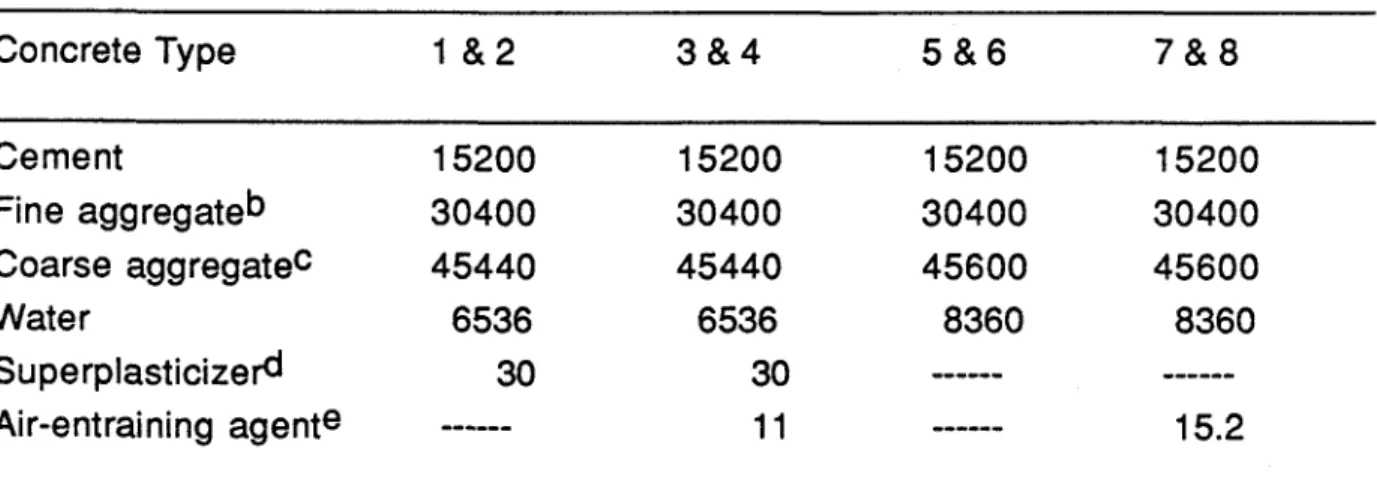
Typical concrete batch weights are given in Table 3, and aggregate
0.43
0.43 0.43
0.43 0.55
0.55
0.55
0.55
b
b
b
b
c
d
c
d
c
d
c
d
50f
50f
90f
90f
203
203
216
216
TABLE 3
-
CONCRETE BATCH WElGHTSa
Concrete Type
1 & 2
3 & 4
5 & 6
7 & 8
Cement
15200
15200
15200
15200
Fine aggregateb
30400
30400
30400
30400
Coarse aggregatec
45440
45440
45600
45600
Water
6536
6536
8360
8360
~uperplasticized
30
30
---
---
Air-entraining agente
---
11
--em--15.2
a
Given in g except where specified and prior to batching; after batching, types
1-4 (0.43 WIC ratio) have WIC = 0.44; types 5-8 (0.55 WIC ratio) have
WlC = 0.56.
b
Spratt "concrete grade" sand (washed and air-dried); moisture content = 0.2%.
c
Francon, Ottawa (CaC03); moisture content = 0.35%.
d
Mighty 150 Atlas RD2 Lot #2.
e
Darex AEA, given in mL.
TABLE 4
-
AGGREGATE GRADINGS
FINE
COARSE
SlEVEa
% PASSING
I
SlEVEa
% PASSING
a
In mm.
The concrete was cast in Plexiglass molds as cubes (1 00 mm x 100
mm x 100 mm), allowing three of each concrete type per sealer
-
two to assess
the waterproofing ability and one to assess the penetration depth. Extra
cubes were cast for controls, with a minimum of two cubes for every 20 cast;
the number of cubes set aside for use as controls varied somewhat, being
dependent on the consistency of cube quality within a given batch. After the
prescribed curing periods (given in Table 2), all cubes were soaked in a 15%
NaCl solution for one month prior to coating. Those that had been air-cured
were soaked at +4OC in an effort to retard hydration whilst permitting salt
penetration. Acid soluble chloride determinations were done at the end of the
salt soaking period on two representative cubes for each concrete type
and
also on control cubes after the water absorption tests were completed. Typical
concrete samples were also checked for chlorides prior to immersion in the
NaCl solution. Coring two holes (12.7 mm diameter) per face at the
0-6.35 mm (0-114") and 6.35-12.70 mm (114-112") levels gave enough material
for the total chlorides to be determined using a standard method, given in the
Federal Highway Administration Report No. FHW A-RD-77-85. The results
obtained will be presented later. Subsequent to the NaCl soaking period, all
cubes were rinsed and air-dried at 50% relative humidity and ambient
temperature for a period of
3
weeks, prior to a light sandblasting (sufficient to
expose the fine aggregate).
The substrate used to assess the water vapour permeability of the
sealers was a 0.55 wlc ratio mortar similar to Type 7 (Table 2; cured at 100%
RH for 1 week) with all aggregate over 6.35 mm removed (after batching). The
concrete was cast into 15.2 cm diameter cylinders from which slices 6.5 mm
thick were obtained after curing.
11.3
Water Absorption
As already indicated, two cubes of each concrete type were used to assess
the waterproofing ability of the sealers. Coverage rates used were as
recommended by the manufacturers and are given in Table 5. All sealers
were applied uniformly with a paint brush except for the penetrant (base coat) of
sealer 26127 which was dip-coated and sealers 46 and 47 which were spray
TABLE 5
-
SEALER COVERAGE RATES
SEALER
COVERAGE RATE
COVERAGE RATE
APPEARANCE
OF
FOR CONCRETE
FOR CONCRETE
SEALER ON
TYPES
1
-
4a
TYPES 5
-
8a
CONCRETE
b
ii,
iii
ii, iii
ii, iii
i
i
ii,
iii
i i
ii, iii
i i
ii,
iv
ii,
v
ii,
v, vi
i i
ii,
iii
ii,
iii
ii, iv, vii
ii, iii
ii,
vi
i
ii, vi
i
ii, iv
ii, iii
ii, vi
ii,
vi
ii, iii
ii,
iv
ii,
iv
ii,
iii
ii,
iii
vi
ii, iii
vi
ii,
iv
ii,
iii
ii, iv
ii,
vi
ii, iii
SEALER
COVERAGE RATE
COVERAGE RATE
APPEARANCE OF
FOR CONCRETE
FOR CONCRETE
SEALER ON
TYPES 1
-
4a
TYPES
5
-
8a
CONCRETE b
a
Given in m 2 / ~ .
c
b
i
No observable change
d
ii
Concrete darkened
e
iii
Slight sheen
f
iv
High gloss
v
Waxy
vi
Patchy
9
vii Water-soluble
ii, iii
ii, vi
ii, vi
i i
ii,
iii
i i
ii, iv
ii,
iii
i
ii, iii
ii,
iii
ii,
iii
i
ii, iii
ii, iii
i i
ii, vi
Diluted 1 :1 with varsol
1
st coat
2nd coat; applied 24 hours after the 1 st coat
3 coats applied:
1
st coat
-
product diluted 1 /6
2nd coat
-
product diluted 1/4
3rd coat
-
product diluted 1 /2
2 coats required with 24 hours drying time
between coats
----
---
coated at the recommended rate. These were treated differently in
response to specific requests from the manufacturers concerned. Where
possible, two different coverage rates for all sealers were chosen, depending on
the w/c ratio of the concrete. We decided that the dense 0.43 WIC ratio
concretes should have a higher coverage rate, representative of its dense pore
structure, whilst the
0.55 WIC ratio concretes should have a lower coverage rate reflecting their
expected greater absorption. The numbers were chosen to facilitate sealer
application, and usually represented the two extremes of the manufacturers'
recommended coverage ranges. After application of the sealers, the cubes were
left to dry in ambient conditions for a minimum period of 7 days prior to
immersion in tap water. Both coated cubes and uncoated controls were left in
the water for a period of 28 days with the weights determined prior to immersion,
and after 1, 2 , 3 , 4 , 7,14, 21 and 28 days. The cubes were surface dried with a
wet cloth prior to weighing.
11.4
Penetration Depth
The penetration depth of each sealer was assessed on one cube of
each concrete type. The sealers were applied in an identical manner to that
discussed previously for the water absorption tests, and the cubes were left to
dry for a minimum of 7 days. The cubes were then sliced in half and im-
mersed in water to delineate the penetration depth. Only one half was used
and three measurements on each of the four sides were taken, giving a total
of twelve readings per cube. A pair of digital calipers were used, and care
was taken not to take a reading near a large piece of surface aggregate or
pore which can affect the extent of penetration at that point. The readings
were averaged and standard deviations were obtained.
11.5
Water Vapour Permeance
The substrate used to determine the water vapour permeance of the
sealers was identical to Type 7 concrete (Table 2). All aggregate greater than
6.35 mm (114") was however removed from the wet mix. The "mortar" was
subsequently cast into cylinders (1 52.4 mm, 6" diameter) from which slices
with an average thickness of 6.5 mm were cut, after curing.
Two slices were cut for each sealer evaluated. After drying, the mortar
slices were coated with the concrete sealers on one side only, using the cov-
erage rates given in Table
5
for concrete types 5-8 (0.55
W/C
ratios concrete).
The water vapour permeance of the samples thus coated was then deter-
mined using the standard wet cup ASTM method [Standard Test Method for
Water Transmission of Materials E-96-80]; 6 mortar slices were not coated and
were left as controls. All samples were weighed every day, except at week-
ends, for a period of 16 days. The first
4
days were allowed for the samples to
come to equilibrium; the first 4 readings, therefore, were not used in the cal-
culations of permeance. All samples were kept in a constant environment at
74OC and 52% relative humidity. Permeabilities were not calculated as the
"thickness" of the sealers was not known.
11.6
Solids Content
The solids content of all sealers was determined using
TGA
(discussed
in section 11.1) and also by heating 10 g samples of each sealer for 24 hours in
an oven set at 1 10°C and weighing the residue. Some manufacturers of
volatile silanelsiloxane sealers provided additional methods for the
determination of active ingredients. Wherever possible, the "solids content" of
these materials was also determined using these other methods.
11.7
Porosimetry
Porosimetry studies were carried out on each type of concrete specified
in Table 2. Concrete cubes, (two per type) identical to those used to
determine waterproofing ability of the sealers, were prepared as already
described. A diamond coring bit (34.9 mm, 1 318" diameter) was used to core
a cylinder from the top, bottom and each of two sides of each cube. A Buehler
diamond wafering saw was then used to slice the top 2 mm of each cylinder
so
produced. Each slice produced was subsequently crushed and stored
under vacuum for at least one day to ensure complete removal of all free
water. Large pieces of aggregate were removed prior to the samples being
placed in the porosimeter. The mercury intrusipn porosimetry was carried out
in an AMINCO porosimeter.
111.
-
RESULTS AND DISCUSSION
111.1 Water Absorption
All types of concrete used in the tests were first soaked in NaCl solution
as discussed in the experimental section. The total chloride percentages thus
obtained are given in Table 6 and presented graphically in Figure
1.
These
results were initially obtained solely as a means of verifying the penetration
TABLE
6
-
RESULTS OF CI- PENETRATION INTO UNCOATED
CONCRETE (TYPES 1-8, SEE TABLE
2);
CI' GIVEN AS
%
BY
MASS OF CONCRETEa
DEPTH^
CONCRETE TYPE
%
el-
%
CI-
CBLANK
0.02
a
Results given represent average values taken from
2
cubes of each concrete
type; the blank reading represents the average value of 4 typical cubes not
soaked in NaCi.
b
Given in mm (6.35 mm =
I/@,
12.7
mm =
1/27.
c
Values obtained from control cubes used in water absorption studies after the
of NaCl into the different concrete types used in this study. Some interesting
observations may, however, be made.
1.
In the 0 to 6.35 mm surface zone uncoated specimens cured at 50% RH have
similar chloride contents to those cured at 100% RH.FF.2.
Chloride
concentrations in the 6.35-1 2.7 mm zone of the air and water cured uncoated
concrete differ significantly, with the water cured (100% RH) concrete having the
lower value, as expected in view of their lower porosity.
3.
Air entrained specimens tend to have higher chloride content particularly in the 0 to
6.35 mm zone.
4.
At greater depth (6.35-12.7 mm) there is no noticeable beneficial effect observable
concerning the chloride content of air entrained concrete, a finding in need of
further research.
5.
Data in Table 6 and Figure 1 also show how chloride content is affected by
submersion in water for one month. In the 0 to 6.35 mm zone the CI- concentration
was reduced by at least 50%. The chloride concentration remaining in the
concrete may be due to formation of insoluble chloride compound (Friedel Salt
C3A.CaC12.10 H20) or a submersion period insufficiently long for the diffusion of
all soluble chlorides.
It
is
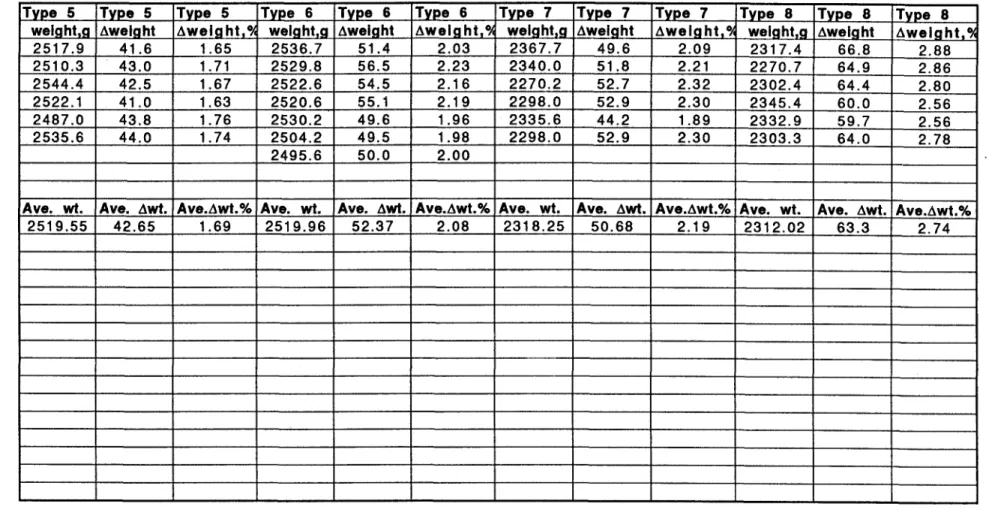
instructive to examine the water absorption data obtained with uncoated, virgin
specimens (content) fabricated from eight different types of concrete (Table 7).
These results are indicative of the water absorption of the concrete itself.
6.
The average weight gain of the four concrete types having a WIC ratio of 0.55 is
88%
higher than that of concretes having a W/C ratio of 0.43.
7.
Curing concrete of both WIC ratios on 50% RH results in 23% higher water
absorption compared to that of the wet cured mixes. The effect appears to be the
most pronounced in the case of the 0.43 WIC ratio air entrained concrete (35%).
100%
RH-
Wetcured and immersed
in NaCl Sol
' n
f o r 28d
a t 20°C
50% RH- Cured
a t
50%
RH
and
immersed i n NaCl Sol 'n
f o r 280 a t 4°C
R-
Flir entrained cubes
immersed i n NaCl
sol
'nf a r 28d
N- Non a i r entrained
cubes immersed i n
NaCl sol
'n for286
AC-
Flir entrained concrete
immersed i n NaCl sol 'n
f o r
28d
followed
by
submers
i on
i
n
tap water
f o r 28d
NC- Non-air entrained
concrete immersed
in NaCl
sol 'n f o r 28d
f o l
lowed
by
28d submersion i n
tap
water
Table 7. Water absorption of various types of uncoated concrete specimens
I I I I I I
Effect of WIC: % wt gain. of types (5+6+7+8)1 (1+2+3+4)*100
% 188.50 511 ' 1 0 0 173.95 % 612'100 202.93
Effect of curlng: % wt gain of types (2+4+6+8)1(1+3+5+7)*100 122.94 211'1 0 0 105.22 713'1 0 0 195.84 814'1 0 0 182.63 % 413'1 0 0 134.25
Effect of AE: % wt gain . of types. (3+4+7+8)1(1+2+5+6).t100
615'1 0 0 122.75 130.78 311 ' 1 0 0 1 14.78 817'1 0 0 125.20 % 412'100 146.45 '10 % 715'100 129.23 816'100 131.80
8.
Air entrained concrete mixes were found to absorb on the average 30% more water
than the similar non air entrained concrete mixes. The effect is the greatest in the
~case of the 0.43
W/C
ratio concrete cured at 50% RH.
The water absorption data are given in Appendix
2
and in an abbreviated form
in Table
8.
It is presented further in graphical form in Appendices 3 to
7.
The
list of sealers with their assigned code numbers has been given in
Appendix
1,
and it is these numbers that are used in the graphs. Appendix
3
shows the average weight gain of the coated cubes as a function of time;
Appendix 4 shows the average weight gain of the coated specimens as a
percentage of that of the control specimens, as a function of time; Appendix 5
shows the weight difference (of control and sample cubes) expressed as a
percentage of the control cubes vs time. All data for the coated cubes plotted
in these graphs represent the average of results obtained with two specimens.
All three sets of graphs show the data plotted by concrete type, i.e. all data
relevant to one concrete type is presented together for purposes of
comparison. In Appendix
6,
however, the data is presented somewhat
differently. Although this set of graphs shows the average weight gain of the
cubes as the percentage of the control cubes vs no. of days, in each figure the
water absorption of the different types of concrete coated with the same sealer
are shown. Thus it is possible to compare the effectiveness of a given sealer
on various types of concrete. In Appendix 7, data on sealers of the same
generic types are presented, i.e.: all those sealers of a given generic type are
grouped together and shown for each concrete type.
Although the amount of water absorption data obtained during the course of
this work is very extensive and specific details will not be discussed, a number
of general observations may, however, be made.
9.
There are considerable differences among the effectivenesses of sealers on
the various types of concretes.
10.
In general, sealers are more effective on low
WIC
ratio concrete than on the
high
WIC
ratio concrete. According to the data of Table 8 in 28 day exposure
concrete to 79.55O/0 in terms of the uncoated control while on the four types of
0.55 WIC ratio concretes the reduction was only to 90.75%. It has to be
remembered that the 0.55 WIC ratio concrete controls themselves absorbed
88% more than the lower WIC ratio concrete. (Comment No. 6).
11.
Sealers, in general, are more effective in reducing water absorption of wet
cured concrete than that of air dried concrete. After 28 days of exposure the
average of all water absorption tests carried out on air dried concrete was
88.5% and that of the measurements performed on wet cured concrete was
78.6% in terms of the water absorption of the pristine control specimens.
Again the controls themselves showed a
23%
difference (Comment No. 7).
12.
The above observations clearly indicate that application of a sealer is no
substitute for using good quality dense concrete.
13.
Sealers were equally effective in reducing water absorption of air entrained
and plain concrete. In terms of the water absorption of the uncoated control
specimen the water content of coated specimens was 82%.
14.
The reason that in some instances specimens absorb more water in the
presence than in the absence of a sealer is not clear.
15.
The slopes of the average weight gain vs days of submersion curves
(Appendix 3) are of interest. Generally a rapid increase in water absorption
was found in the first few days until levelling off occurred usually in less than a
week. With some sealers, however, weight gain occurs gradually and even
after 28 days no levelling off took place.
As the effectiveness of sealers varies with the type of concrete, in the evaluation
of the benefit of a sealer the concrete type has to be defined. For the purposes
of this study it seems reasonable to give prominence to Type 6 concrete
because the concrete used in the construction of most existing parking garages
had a high waterlcement ratio, and was not air entrained and water cured. In
Table 8 the water absorption results on the various concrete types are given
and it can be seen that the overall average of all sealers on Type 6 concrete
was 90.8% of that of the reference samples. Thus the advantage of applying
Table 9. Water Absorption and Permeance of Specimens, Viscosity and Penetration Depth of Sealers. 1 5 1 7 3 0 Average 88.2 94.2 85.5 8 9 . 9 94.1 93.2 88.5 9 2 . 9 97.7 99.3 96.4 9 9 . 3 100.6 101.6 95.9 1 0 0 . 7 87.3' 85.9 127.0 1 0 0 . 8 88.3 88.2 130.2 1 0 2 . 0 88.3 94.1 91.8 9 3 . 6
Table 9. Water Absorption and Perme nce of Specimens, Viscosity and Penetration Depth of Sealers.
Table 9. Water Absorption and Permeance of Specimens, Viscosity and Penetration Depth of Sealers. 1 5 1 7 3 0 Average 91.7 95.0 94.6 9 4 . 9 103.5 103.2 95.5 1 0 2 . 8 104.5 103.5 96.1 1 0 3 . 3 120.5 98.9 94.3 1 0 8 . 9 118.2 99.1 95.1 1 0 8 . 0 113.5 112.5 101.8 1 0 6 . 4 11 7.6 11 6.2 1 06.4 1 0 9 . 8 -
sealers for commonly experienced field concrete is much less than in better
quality low WIC ratio concrete. On the other hand, in new construction the
results obtained with the other appropriate concrete types should be
considered.
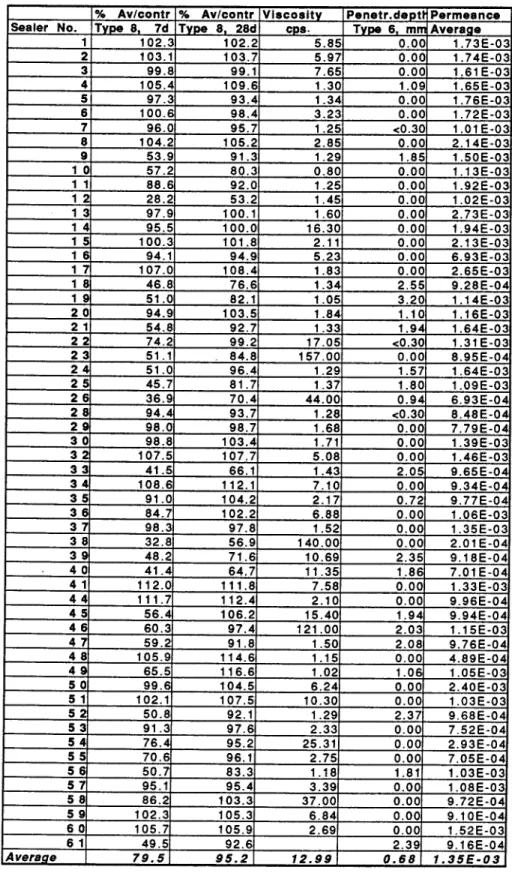
17.
In Table 9 the water absorption viscosity, penetration depth and permeance
results are listed according to the generic types of the sealers. It can be seen
that very significant differences exist among the various groups. The ranking
of the sealer in the various tests based on water absorption, viscosity,
penetration depth and permeance is given in Table 10.
18.
The overall performance of a given generic group does not mean that all
sealers belonging to the group have the same effectiveness.
19.
In Table 1 1 the sealers are listed in the ascending order of their ranking based
on the water absorption results in the 28 day exposure test performed on the
eight types of concrete. The results of the 17 day water exposure test, the
viscosity, penetration depth and permeance are also included. The same
data is also presented in Table 12 in the ascending order of sealer code
numbers.
111.2
Penetration Depth
Penetration depths of sealers determined for each sealer on each concrete
type are given in Appendix 8, Table 8-1. Many sealers did in fact show no
measurable penetration and were often observed as a coating which peeled
off when the cubes were cut. This was particularly true of the high solids
content glossy sealers. The only two generic types which showed significant
penetration for all concrete types were the alkylalkoxysilanes and the
oligomeric alkylalkoxysiloxanes; other sealers which showed a significant
degree of penetration relative to other generic types were 3 polysiloxanes,
linseed oil and the two hydrozs sealers defined as "mixtures". Thus it seems
that the only true penetrating sealers are those based on reactive
silane/siloxane molecules. Dilution does not appear to help traditional
sealers such as epoxies penetrate the concrete pores. It is further interesting
to note that further dilution of an active silane does not facilitate its passage
Table 10. Ranks of Sealers Listed According to Their Generic Type
Table 10. Ranks of Sealers Listed According to Their Generic Type