HAL Id: tel-02057960
https://tel.archives-ouvertes.fr/tel-02057960
Submitted on 5 Mar 2019HAL is a multi-disciplinary open access archive for the deposit and dissemination of sci-entific research documents, whether they are pub-lished or not. The documents may come from teaching and research institutions in France or abroad, or from public or private research centers.
L’archive ouverte pluridisciplinaire HAL, est destinée au dépôt et à la diffusion de documents scientifiques de niveau recherche, publiés ou non, émanant des établissements d’enseignement et de recherche français ou étrangers, des laboratoires publics ou privés.
Non-holonomic Mobile Dual-arm Manipulator
Yan Wei
To cite this version:
Yan Wei. Motion Planning and Tracking of a Hyper Redundant Non-holonomic Mobile Dual-arm Manipulator. Other. Ecole Centrale de Lille, 2018. English. �NNT : 2018ECLI0004�. �tel-02057960�
centrale lille
thèse
Présentée en vue d’obtenir le grade deDOCTEUR
enSpécialité: Automatique, Génie Informatique, Traitement du Signal et Image
par Yan WEI
Doctoral délivré par centrale lille
Titre de la thèse:
Planification et Suivi de Mouvement d’un
Manipulateur Mobile Non-holonome à deux
Bras
Motion Planning and Tracking of a Non-holonomic
Mobile Dual-arm Manipulator
Soutenue le 18 juin 2018 devant le jury d’examen :
Président Youcef MEZOUAR Professeur, SIGMA Clermont and Institut Pascal
Rapporteur Daniel SIDOBRE Maître de conférence HDR, Université Paul Sabatier Rapporteur Jingrui ZHANG Professeur, Beijing Institute of Technology
Membre Youcef MEZOUAR Professeur, SIGMA Clermont and Institut Pascal
Membre Pushparaj PATHAK Ass. Prof., Indian Institute of Technology Roorkee
Directeur de thèse Ahmed RAHMANI Professeur, Ecole Centrale de Lille
Thèse préparée au Centre de Recherche en Informatique Signal et Automatique de Lille CRIStAL, UMR CNRS9189 - Centrale Lille
à tous ceux qui le méritent,
à mon cher mari Ang ZHANG, à mes chers parents, à toute ma famille,
à mon directeur bien-aimé,
faut s’affermir au dedans.
Victor Hugo
Most men appear never to have considered what a house is, and are actually though needlessly poor all their lives because they think that they must have such a one as their neighbors have.
Motion Planning and Tracking of a Non-holonomic Mobile Dual-arm Manipula-tor
Abstract
This thesis focuses on motion planning and tracking of a redundant Mobile Dual-Arm Manipulator System (MDAMS) for personal assistance. Firstly, the modified Denavit-Hartenberg method is used for kinematic modeling of the designed MDAMS. In order to avoid calculating system energy and energy derivatives, Kane’s method is used for dynamic modeling. The physical stability is analyzed based on the constructed Kane’s model and a controller is proposed using the back-stepping technique. Secondly, motion planning problem including redundancy and coordination solving between the mobile platform and upper manipulator is studied. In particular, an improved MaxiMin NSGA-II algorithm is proposed to design the optimal position-orientation of mobile platform and the optimal configuration of upper manipulator simultaneously given only the initial pose and the end-effectors’ desired positions and orientations. Five objective functions are defined including two positioning accuracy criteria, the manipulability criterion and two displacement criteria in task and joint spaces respectively, to optimize the desired pose. In order to achieve the transition from the initial pose to the optimal pose, a direct-connect bidirectional RRT and gradient descent-based motion planning algorithm is proposed. Specifically, a geometric optimization method is designed to guarantee always the optimal and consistent path from the initial pose to the optimal pose. In addition, head forward movements are achieved by calculating a sequence of orientations for the mobile platform based on the planned via-positions of the mobile platform and by using the linear polynomials with parabolic blends interpolation technique, thus indicating the robot’s movement intention to increase the quality of robot-human interaction. Then, in order to solve the failure problem of offline motion planning algorithm in dynamic environment, an on-line motion planning algorithm is proposed which includes on-line sensing, collision-test, on-line motion planning and tracking processes. The movements of dynamic obstacles are estimated in real time. In addition, in order to optimize via-poses, a motion planning algorithm based on end- effectors’ points and multi-objective GA is proposed by optimizing four via-poses-based objective functions simultaneously, which are sums of joint displacements, of end effectors’ directional manipulability measures, of end-effectors’ positioning errors and of robot-obstacle collision measures. Finally, the motion tracking problem is studied given end-effectors’ movements in the task space. The task priority and leader-follower techniques are used to solve the high redundancy and to deal with the coordination between the mobile platform and upper manipulator while tracking the end-effectors’ trajectories in real time. Instead of controlling the absolute motion in the world frame, two relative motions are introduced to realize the coordination and cooperation between the mobile platform and upper manipulator. Thus, a triple-trajectory problem is formulated. Moreover, a modulated weighted least norm technique is proposed to achieve the avoidance of joint boundaries.
Keywords: mobile manipulator, kane’s method, maximin nsga-ii, redundancy solving, motion planning, trajectory tracking.
This work was carried out in “Centre de Recherche en Informatique, Signal et Automatique de Lille (CRIStAL)” at Ecole Centrale de Lille (ECLi) with the research team “Méthodes & Outils pour la Conception Intégrée de Système (MOCIS)”.
I would like to express my sincere gratitude to the people who have helped me a lot .Without their encouragement and help, I would not have reached this position and this stage of my life.
First of all, I would like to express my sincere gratitude to my PhD thesis supervisor Prof. Ahmed RAHMANI who influenced me a lot during my studies at Central Lille. He gave me the maximum freedom to search in the robot field. He taught me how to look for new areas of research, how to understand the state of the art quickly, how to write good technical papers, and how to present my ideas effectively.
Besides, I also would like to acknowledge all members of the jury: Mr. Daniel SIDOBRE, Mrs. Jingrui ZHANG, Mr. Youcef Mezouar and Mr. Pushparaj Mani Pathak, for their valuable time to review this thesis. Their invaluable comments and objective criticisms shed a light on my drawbacks and the research road in the future. Meanwhile, I want to thank Prof. Qiang ZHAN from Beihang University who helped me a lot with the research work, the thesis writing and other related discussions during his visit to France.
In addition, I would like to thank all the staff in CRIStAL-MOCIS, Mrs. Geneviève Dauphin Tanguy, Mr. Belkacem OULD BOUAMAMA, Mr. Christophe Sueur, etc. for their valuable discussions and insightful suggestions in team meetings. I also would like to thank three interns Yue CHAI, Yijing QI and Hongbo CAO who have done their research projects with me for their contribu-tion on the virtual prototype validacontribu-tion via MATMAB/SIMULINK and ADAMS co-simulation. A particular acknowledgment has to be made to the visit pro-fessors Yunhe MENG and Yongguang YU, and all my PhD colleagues Jing BAI, Youwei DONG, Xing CHU, Wei JIANG, Thanh Binh Do, Wei HU, etc. And I also want to express my great thanks to the staff at Ecole Centrale de Lille, Brigitte FONCEZ, Patrick GALLAIS and Vanessa FLEURY for their kindly help.
Pursuing a P.h.D degree requires not only technical skills but also tremendous amount of stamina and courage. I would like to thank my husband ZHANG Ang for his support and accompany throughout my life abroad. And very often he gave me some valuable suggestions on the research. I wish also to thank my parents and family for sharing their unconditional love with me and giving me the necessary amount of courage required for pursuing my goals. Besides, together with my friends, Xuemei LIU, Tian TIAN, Yihan LIU, Lijie BAI, Wenjuan GU, Siyang DENG, etc. I had a very interesting time in France.
Finally, I would like to thank China Scholarship Council (CSC) for giving me the opportunity to pursue the PhD diplomat at Centrale Lille.
Abstract vii
Acknowledgments ix
Table of Contents xi
List of Tables xv
List of Figures xvii
Glossary 1
INTRODUCTION 3
1 STATE OF THE ART AND PRELIMINARIES 11
1.1 STATE OF THE ART ON SERVICE ROBOTS . . . 11
1.1.1 Developments and Applications of Service Robots . . . . 12
1.1.2 Humanoid Robots For Personal Assistance . . . 14
1.2 LITERATURE SURVEY . . . 19
1.2.1 Robotic System Modeling . . . 20
1.2.2 Motion Planning Methods . . . 21
1.2.3 Motion Tracking and Controllers . . . 31
1.3 PRELIMINARIES . . . 38
1.3.1 Forward Kinematics Background . . . 38
1.3.2 Kane’s Method for Dynamic Modeling . . . 39
1.3.3 Kinematic Control of Non-holonomic Mobile Platform . . 41
1.3.4 Non-dominated Sorting Scheme . . . 43
1.4 Conclusions . . . 43
2 SYSTEM DESCRIPTION AND MODELING 45 2.1 INTRODUCTION . . . 45
2.2 SYSTEM MODELING FOR MDAMS . . . 46 xi
2.2.1 System Description and Kinematic Modeling . . . 46
2.2.2 Lagrangian Formulations and Control . . . 56
2.2.3 Dynamic Modeling and Control using Kane’s Method . . 66
2.3 CONCLUSIONS . . . 73
3 MOTION PLANNING IN STATIC ENVIRONMENTS 75 3.1 INTRODUCTION . . . 75
3.2 MAXIMIN-BASED NSGA-II MOTION PLANNING . . . 79
3.2.1 Improved MaxiMin NSGA-II Algorithm forPose Design . 79 3.2.2 Motion Planning in Static Environments . . . 85
3.3 SIMULATION RESULTS . . . 92
3.3.1 Task 1: Chair A . . . 92
3.3.2 Task 2: Chair D . . . 99
3.3.3 Motion Planning and Dynamic Tracking for MDAMS . . 104
3.4 CONCLUSIONS . . . 104
4 MOTION PLANNING IN DYNAMIC ENVIRONMENTS 107 4.1 INTRODUCTION . . . 107
4.2 MOTION PLANNING AMONG DYNAMIC OBSTACLES . . . . 109
4.2.1 On-line Motion Planning Algorithm . . . 110
4.2.2 Via-points and MOGA-based Motion Planning . . . 113
4.3 SIMULATION RESULTS . . . 117
4.3.1 On-line Motion Planning for Mobile Platform . . . 118
4.3.2 On-line Motion Planning for EE . . . 124
4.3.3 Motion Planning Time-consuming Statistics . . . 132
4.3.4 On-line Motion Planning for MDAMS . . . 132
4.4 CONCLUSIONS . . . 135
5 MOTION TRACKING FOR MDAMS 137 5.1 INTRODUCTION . . . 137
5.2 IK SOLVING AND JOINT LIMIT AVOIDANCE . . . 139
5.2.1 IK Solving . . . 139
5.2.2 Joint Limit Avoidance - mWLN . . . 140
5.3 DUAL-TRAJECTORY TRACKING . . . 141
5.3.1 Task Priority and Relative Motion-based IK Solving . . . 141
5.3.2 Semi-decentralized Dual-trajectory Tracking . . . 144
5.3.3 Simulation Results . . . 147
5.4 TRIPLE-TRAJECTORY TRACKING . . . 158
5.4.1 Task Priority and Motion Distribution-based IK Solving . 159 5.4.2 Semi-decentralized Triple-trajectory Tracking . . . 160
5.5 CONCLUSIONS . . . 163
CONCLUSIONS, CONTRIBUTIONS AND FUTURE WORK 167 A APPENDIX 175 A.1 Partial Velocity . . . 175
A.1.1 Partial Velocity Table Construction . . . 175
A.1.2 Vectors Zi (i = 1, ..., 75) and Ai (i = 9, ..., 75) . . . 177
A.2 Matrix D ∈ Rn×n . . . 179
A.3 Matrix B ∈ Rn×1 . . . 180
Bibliography 181
1.1 Literature survey on robotic motion planning. . . 30
2.1 MDH Parameters of MDAMS. . . 48
2.2 Main inertial properties of MDAMS. . . 49
2.3 Link length and CoM position. . . 71
3.1 The designed optimal pose θop [m, deg]. . . . 93
3.2 The designed optimal pose θop [m, deg]. . . 101
5.1 Control gains. . . 147
5.2 MDAMS joint limit. . . 156
A.1 CoM vectors of MDAMS. . . 175
A.2 Partial velocities of bodies 1-5. . . 175
A.3 Partial velocities of bodies 6-19. . . 176
A.4 Frame’s origin vectors. . . 177
1.1 Service robots in various fields. . . 12
1.2 Various types of humanoid robots. . . 15
2.1 The structure of the proposed robot MDAMS. . . 46
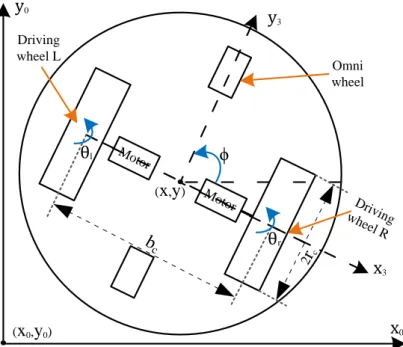
2.2 Modeling of the non-holonomic mobile platform. . . 47
2.3 Left: virtual prototype in ADAMS. Right: real robot construction. 49 2.4 MATLAB/SIMULINK and ADAMS co-simulation procedure. . . 58
2.5 Simplified model of robot MDAMS. . . 59
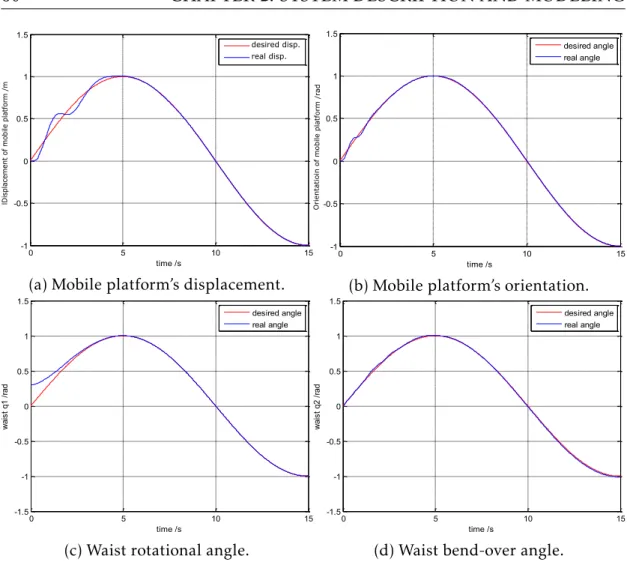
2.6 Case A: position tracking results. . . 60
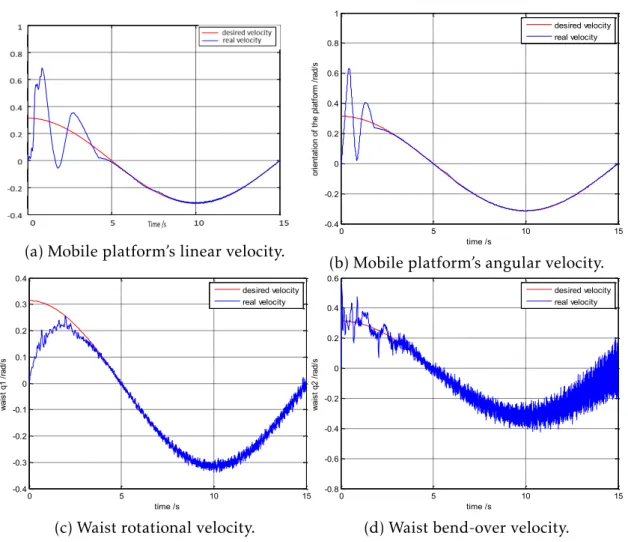
2.7 Case A: velocity tracking results. . . 61
2.8 Case B: position tracking results. . . 62
2.9 Case B: velocity tracking results. . . 63
2.10 Comparison of position tracking errors between cases A and B. . 63
2.11 Comparison of input torques between cases A and B. . . 64
2.12 Co-simulation shortcuts of virtual prototype in ADAMS. . . 65
2.13 Joint trajectory tracking results. . . 72
2.14 Input torques errors between Kane’s and E-L methods. . . 73
3.1 An example of motion planning problem for MDAMS. . . 78
3.2 Flowchart of the improved MaxiMin NSGA-II algorithm. . . 83
3.3 An example of off-line path planning. . . 86
3.4 MDAMS motion planning flow chart. . . 91
3.5 Domestic environment with one table and four chairs. . . 92
3.6 Motion planning results to manipulate chair A: Improved Max-iMin NSGA-II. . . 94
3.7 Motion planning results to manipulate chair A: combined fitness function-based MOGA. . . 95
3.8 Comparison between the improved MaxiMin NSGA-II and Max-iMin NSGA-II algorithms. . . 96
3.9 Path planning results without geometric optimization for mobile platform to approach chair A. . . 97
3.10 Path planning results with geometric optimization for mobile
platform to approach chair A. . . 98
3.11 Motion planning results to manipulate chair A. Up: improved MaxiMin NSGA-II. Down: combined fitness function-based MOGA.100 3.12 Motion planning results to manipulate chair D: Improved Max-iMin NSGA-II. . . 102
3.13 Motion planning results to manipulate chair D: combined fitness function-based MOGA. . . 103
3.14 Path planning results for mobile platform to approach chair D. . 104
3.15 Motion planning results to manipulate chair D. Up: improved MaxiMin NSGA-II. Down: combined fitness function-based MOGA.105 3.16 Dynamic simulation results: motion planning and tracking. . . . 106
4.1 Dynamic obstacle collision space estimation. . . 112
4.2 Simplified structure of MDAMS for robot-obstacle collision test. 116 4.3 First task in virtual dynamic domestic environment A. . . 118
4.4 Off-line motion planning results for mobile base. . . 119
4.5 On-line motion planning results for mobile platform (a). . . 120
4.6 On-line motion planning results for mobile platform (b). . . 121
4.7 On-line motion planning results for mobile platform (c). . . 122
4.8 On-line motion planning results for mobile platform (d). . . 123
4.9 On-line motion planning results for mobile platform (e): Phase 9. 124 4.10 Second task in environment A. . . 125
4.11 Off-line motion planning results for EE. . . 126
4.12 On-line motion planning results for EE (a). . . 127
4.13 On-line motion planning results for EE (b). . . 128
4.14 On-line motion planning results for EE (c). . . 129
4.15 On-line motion planning results for EE (d). . . 130
4.16 On-line motion planning results for EE (e). . . 131
4.17 The time-consuming statistics of motion planning Algorithm 4. 132 4.18 Virtual dynamic domestic environment B. . . 133
4.19 Via-points design for two EEs. . . 134
4.20 Via-poses design for robot MDAMS (local view). . . 135
5.1 Semi-Decentralized dual-trajectory tracking framework. . . 145
5.2 Linear trajectory tracking results. . . 149
5.3 EEs’ Attitude tracking results. . . 150
5.4 Sinusoidal trajectory tracking results. . . 150
5.5 Various tasks execution: trajectory tracking results (a). . . 151
5.6 Various tasks execution: trajectory tracking results (b). . . 152
5.8 Object manipulation results. . . 155
5.9 Linear trajectory tracking under joint limit. . . 157
5.10 Comparison between PD and Back-stepping controllers. . . 158
5.11 Triple-trajectory tracking results. . . 161
5.12 Triple-trajectory tracking errors. . . 162
5.13 Triple trajectory tracking results: 3D view. . . 163
5.14 Dual-trajectory tracking: linear trajectory to approach the object. 164 5.15 Triple-trajectory tracking results: 2D view. . . 165
ADAMS Automatic dynamic analysis of mechanical systems. 6
DoF Degree of freedom. 4
EE End-effector. 46
GA Genetic algorithm. 26
IK Inverse kinematics. 20, 75
MDAMS Mobile dual-arm manipulator system. 4, 167
MDH Modified Denavit Hartenberg. 7, 9
NSGA Non-dominated sorting genetic algorithm. 167
RBFNN Radial basis function neural network. 5, 7, 45, 167
WLN Weighted least norm. 33
Since last century, many industrial manipulator systems have been used to do some repetitive tasks with high speed and high precision. However, their task policies and control inputs are normally predefined in a structured environment. In addition, they are usually fixed robotic manipulators with limited workspaces and have no interaction with human beings.
Nowadays, more and more service robots are being introduced for personal assistance, entertainment, surgery, agriculture, military, etc. Different from tra-ditional robotic manipulators in industry, services robots are required to adapt to different environments, to interact with human beings, to make decisions independently, etc. There exist many services robots in the market, for exam-ple sweeping robots, entertainment robots, accompany robots, guidance robots, servant robots, etc. which, however, are either single-functional, or inflexible, or non-programmable, or non-interactive. Very often, they are too specialized or not intelligently autonomous, which is not practical for non-expert users. In addition, according to the world population report, aging population is increas-ing continuously and has become a global phenomenon, and the percentage of people with disabilities increases with people’s age. As a result, the demand of the personal assistive devices and health caring is rising. Thus, the study of the multi-functional, completely autonomous and sustainable service robots is still a hot research field.
In order to meet various service demands, personal assistant robots are required to have dexterous manipulability abilities. Humanoid mobile manipu-lator systems are of great interests due to their human-like elegant appearance, dexterous moving and manipulation abilities over the traditional mobile vehicles and fixed manipulator robotic systems. Therefore, we designed a hyper
dant humanoid non-holonomic mobile dual-arm manipulator system (MDAMS, see Fig. 2.1) and constructed a virtual prototype for virtual validation in ADAMS (see Fig. 2.3). The designed robot MDAMS has up to 56 degrees of freedom (DoFs) with one mobile platform, one moving body and two arm-hand sub-systems. It has a wide workspace due to the mobile platform and can execute various tasks due to the moving waist, two redundant arms and two dexterous hands. The designed humanoid is expected to be semi or fully autonomous and can imitate humans with cognitive shock-free human-like behaviors. Specifically, it is required to navigate in standard domestic environments which consist of known and unknown, static and dynamic obstacles including human beings. It should be able to provide assistance tasks like cleaning, washing, serving, sit-down and stand up helping, and to interact with other entities like human beings.
However, implementing such a complex humanoid mobile manipulator sys-tem is very challenging. The first challenge comes from the construction of kinematic and dynamic models of the high DoFs system. It requires considering the non-holonomic mobile platform, the moving waist and two arm-hand sub-systems at the same time. The second challenge comes from the task policies design and motion planning meeting human expectation. In practical applica-tions, one given task is often composed of multiple subtasks and each subtasks requires perfect motion planning. The motion planning can happen in joint space or in task space. However, due to the high redundancy, the position-orientation of mobile platform and the configuration of upper body manipulator of the designed MDAMS can be quite different for the same task which is very challenging. In fact, human beings always know where to stand and how to use their two arm-hand subsystems to accomplish tasks under multiple constraints. Therefore, the robot is expected to have similar autonomous abilities to con-duct human-like activities and complete personal assistant tasks in dynamic and complex environments. The third challenge comes from motion tracking and robot control. There are uncertainties, such as modeling uncertainties, the disturbances and uncertainties from environments and hardware systems to be dealt with for real implementation. Other problems like the coupling between mobile platform and upper body manipulator system, redundancy and
singular-ity problem, collision avoidance, on-line motion planning and control, etc. are all of great difficulty.
This thesis is a part of the collaboration between Prof. A. Rahmani (Centrale Lille) and Prof. Q. Zhan (BUAA) in the LIA 2MCSI project. The humanoid mobile manipulator can be used to complete various home services and for elderly and disabled caring. Meanwhile, multi-robot systems have potential applications in tasks which require cooperation of multiple robots. Under this background, our research team is currently focusing on investigating humanoid mobile manipulator systems and is committed to the control of a group of mobile robots to achieve greater flexibility, robustness and adaptability to accomplish tasks such as the handling of very heavy items, searching and rescuing, and large space security inspections.
PROBLEM STATEMENT
This thesis is the continuation of [1]. In [1], the author finished the applica-tions and functionalities designs of personal assistant robots, and accomplished system modeling of the designed MDAMS based on Lagrangian formulations. However, the calculations of energy and its partial derivatives become complex as the DoFs increase. Besides, the motion in task space for the robot is assumed to be known in advance. The author proposed a RRT-connect-based inverse kinematic solving algorithm using the pseudo-inverse of Jacobian but without considering the redundancy, singularity, joint limit or dual-arm cooperation problems, not to mention human-like movements. Besides, there are static ob-stacles like walls and furniture, dynamic obob-stacles like other robots and human beings, and removable obstacles like doors, chairs and small objects in standard domestic environment. The motion in task space is difficult to known for such a complex robotic system. And very often even though the motion in task space is known, it is still very difficult to design the optimal trajectory in joint space due to the high non-linear property. In addition, the author proposed an adaptive RBFNN controller to cope with the uncertainties and disturbances and achieved object grasping using dexterous hands through force control. However, the co-operative control between two arm-hand subsystems and the coupling problem
between the mobile platform and upper body manipulator system have not been studied. Moreover, the effectiveness of the proposed adaptive RBFNN controller remains to be validated.
To sum up, there is still a long way to go before constructing a long-term intelligent personal assistant robotic system for real applications. Therefore, the main objectives of this thesis are listed in the following.
• Kinematic modeling of the designed robot MDAMS.
• Virtual prototype validation via MATLAB/SIMULINK and ADAMS co-simulation of the adaptive RBF neural network controller.
• Dynamic modeling for the designed robot MDAMS using Kane’s method. • Human-like optimal position-orientation design for the mobile platform and optimal configuration design for the upper body manipulator at the same time under multiple constraints.
• Off-line motion planning of the designed robot MDAMS in static environ-ments with known obstacles.
• On-line motion planning of the designed robot MDAMS in dynamic envi-ronments with unknown obstacles including human beings.
• Decoupling and Redundancy solving for the designed robot MDAMS based on task priority notion and least norm solution.
• Trajectory tracking and control of the designed robot MDAMS with joint limit and singularity avoidance.
• Validation of the proposed motion planning and tracking strategies on the virtual prototype in ADAMS via MATLAB/SIMULINK & ADAMS co-simulation.
STRUCTURE
This thesis is organized into five Chapters. The state of the art on robotic manipulator systems and service robots especially humanoid robotic systems, and a brief introduction to the technical context are given in Chapter 1.
In Chapter 2, the kinematic model is firstly established for the designed MDAMS. The Modified Denavit Hartenberg (MDH) method is used to construct the kinematic model with only four parameters. Compact expressions of the motions of mobile platform and end-effectors are formulated with the unit quaternion being used to represent the orientations of end-effectors. Then, the Lagrangian model and the adaptive RBFNN controller are recalled. Virtual prototype validation via MATLAB/SIMULINK and ADAMS co-simulation is realized to validate the effectiveness of the adaptive RBF NN controller. In order to avoid calculating energy and partial derivatives, the dynamic equations using Kane’s method are formulated for MDAMS. The physical tip-over stability is studied based on the constructed Kane’s model. A controller is proposed and the control stability is analyzed using the back-stepping technique.
In Chapter 3, the motion planning problem for the designed MDAMS in static environments is investigated. Firstly, an improved MaxiMin-based non-dominated sorting genetic algorithm (NSGA-II) is proposed to design the optimal position-orientation of mobile platform and the optimal configuration of upper manipulator system (pose) for MDAMS at the same time. It speeds up the evolu-tionary algorithm MaxiMin NSGA-II by adding a MaxiMin sorting process. Five objective functions are defined, i.e. two reaching accuracy criteria, manipulabil-ity abilmanipulabil-ity, joint displacement in joint space and end-effectors’ displacements in task space. The proposed method searches for the optimal pose by optimizing five objective functions at the same time. In particular, a normalized combined-fitness function is defined and a post decision maker is introduced to settle the preferred solution among the candidates in the Pareto-optimal set. Then, in order to realize the collision-free transition from the initial pose to the designed optimal pose, an off-line motion planning algorithm is designed. In detail, a direct-connect BiRRT and gradient descent-based sample process is proposed which speeds up greatly the sampling phase. And a geometric optimization
method is designed which always guarantees the shortest and consistent path be-tween the initial and optimal goal poses. Besides, the hybrid linear polynomials with blends and fifth-order polynomials interpolations are used for generating the time-specified trajectory. In addition, forward movements are realized by assigning reasonable orientations to the mobile platform based on its planned positions, thus indicating robot’s movement intentions to increase the quality of human-robot interaction. Finally, several motion planning tasks are realized to validate the proposed method.
In Chapter 4, in order to solve the failure problem of the off-line algorithm, an on-line collision-free motion planning method is introduced for the designed MDAMS in dynamic environments by extending the off-line motion planning method proposed in Chapter 3. Firstly, the desired motion is designed off-line. Then, on-line sensing, collision test, on-line motion planning and control processes are enabled to cope with the motion planning problem in unknown dynamic environments. Environmental information is sensed on-line and the future movements of unknown obstacles are predicted in real time according to their historical motions. If there is a possible collision predicted, the on-line re-planning process will be activated and the desired motion will be updated immediately. In order to take the poses into account, an end-effectors’ via-points and multi-objective genetic algorithm (MOGA)-based motion planning algorithm is proposed. Four via-poses-based objective functions are defined to optimize MDAMS’s via-poses, i.e. (i) sum of joint displacements, (ii) directional manipulability bypassing each via-point, (iii) via-points’ positioning accuracy, and (iv) robot-obstacle collision evaluation. In other words, firstly, end-effectors’ via-points are designed; secondly, the proposed end-effectors’ via-points and MOGA-based algorithm is used to design the corresponding via-poses; finally, the point-to-point motion planning method is used to link the optimized via-poses. At the end of this Chapter, two virtual domestic environments are con-structed, and a number of motion planning simulations are realized to validate the effectiveness of the proposed method.
In Chapter 5, the trajectory tracking problem is investigated based on the task-priority notion, the least norm solving method and the leader-follower technique. Firstly, the task priority and least norm solving-based inverse kinematics
solv-ing technique is introduced. And the modulated weighted least-norm solution method for joint limit avoidance is presented. Secondly, a semi-decentralized control law is proposed with kinematic control for the non-holonomic mobile platform. Instead of controlling the absolute motion of two end-effectors, a rela-tive motion between two end-effectors is defined using lead-follower technique. A compact relative Jacobian is formulated in terms of the individual Jacobians of two arms using the MDH method. Besides, the tracking error matrix in terms of unit quaternion is used to represent the orientation error of end-effector. The ob-ject grasping is studied by introducing the contact matrices of two end-effectors. Thirdly, inspired by human behaviors, a new relative motion - position of the right end-effector with respect to the mobile platform of MDAMS - is defined to distribute the movements among the mobile platform and two arms. The corresponding relative Jacobian of the defined relative motion is formulated in terms of the known Jacobians applying the forward kinematics. Then, a motion distribution-based triple-trajectory tracking method is proposed. Finally, several numerical simulations are presented to validate the effectiveness of the proposed tracking methods. The comparison between the PD and back-stepping-based controllers is also presented which proves that the back-stepping-back-stepping-based controller has better performances.
Finally, conclusions, the work under consideration and some ideas ahead are given at the end of the thesis.
Chapter
1
STATE OF THE ART AND
PRELIMINARIES
This Chapter firstly gives the state of the art on service robotic systems in Section 1.1. Then, the literature survey on robotic system modeling, motion planning and tracking controllers is presented in Section 1.2. Finally, some preliminaries are given in Section 1.3.
1.1
STATE OF THE ART ON SERVICE ROBOTS
In recent decades, service robots are widely used in maintenance, repair, trans-portation, cleaning, security, rescue, custody and other work. According to the classification of International Federation of Robotics (IFR), service robots are mainly divided into two categories: professional service robots and per-sonal/domestic robots. In particular, the professional service robots include: field robots, professional cleaning robots, medical robots, logistics purposes robots, inspection and maintenance robots, construction robots, underwater robots, defense, rescue and safety applications robots and so on. The per-sonal/domestic robots mainly include assistant robots, entertainment robots, auxiliary robots for the disabled, safety and surveillance robots. With the increas-ing agincreas-ing population and percentage of people with disabilities, the demand on personal assistant devices services and health caring increases continuously.
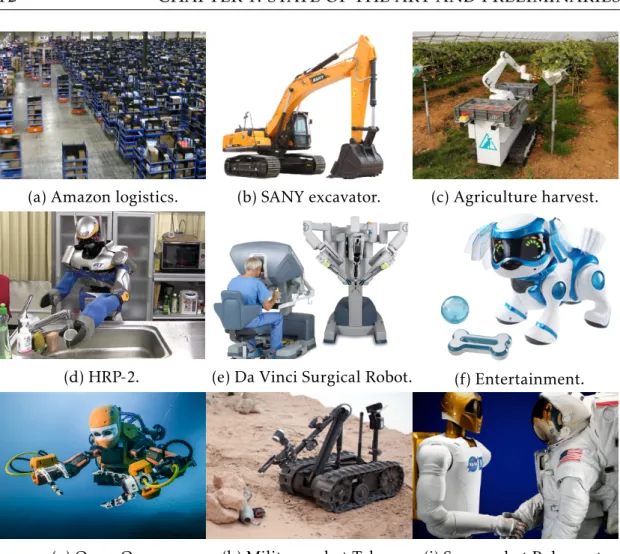
(a) Amazon logistics. (b) SANY excavator. (c) Agriculture harvest.
(d) HRP-2. (e) Da Vinci Surgical Robot. (f) Entertainment.
(g) OceanOne. (h) Military robot Talon. (i) Space robot Robonaut.
Figure 1.1 – Service robots in various fields.
1.1.1
Developments and Applications of Service Robots
Since the very first industrial robotUnimate presented in the 50s, robots have
been widely used in manufacturing [2]. Recently, more and more service robots are introduced. For example, the logistic robots, robots on building sites, harvest robots, domestic assistant robots, medical robots, entertainment toys, under-water robots, military robots, space manipulators [3–5], aerial vehicles, rescue robots [6] and so on.
Fig. 1.1 shows some services robots that are in use or under study.
Multi-mobile robots system in Fig. 1.1 (a) is used for logistics [7] byAmazon with
which can be used as a personal assistant. Intuitive Surgical designed a robot
system Da Vinci in Fig. 1.1 (e) controlled by a surgeon from a console for
prostatectomies, cardiac valve repair and gynecologic surgical procedures. The
bi-manual underwater humanoid robot OceanOne [9] in Fig. 1.1 (g) allows
human to explore the depths of the oceans with an unprecedented ability. The
tracked military robotTalon in Fig. 1.1 (h) proposed by Foster-miller is designed
to protect war fighters and first respond against explosive threats. Robonaut [4,
5] in Fig. 1.1 (i) is a humanoid robotic system designed byNASA to study how to
replace human beings to work and explore in outer space.
In fact, if we enter "service robots" inGoogle Images, a lot of service robots
can be found. For instance, servant robots in restaurant, public guidance robots,
vacuum-cleaning robotRoomba and military robots of iRobot, Turtlebot of Willow
Garage, DARwIn-OP of Robotics. There are also robotic systems like 3D printed
robots, multi-legged robotic dogs and ghost legged unmanned ground vehicles ofBoston Dynamics and so forth.
Many scientific researchers are dedicated to service robotics. Korpela [10] introduced a framework for valve turning using an aerial vehicle endowed with dual multi-degrees of freedom (DoFs) manipulators. Srinivasa [11] designed an autonomous multi-robotic system to play the role of a robotic busboy. Zhang [12] studied a dual-arm robotic system for bolt and nut mating using the 3D dynamic simulation tool ADAMS. Doumanoglou [13] introduced a dual-manipulator system to autonomously recognize and unfold articles of clothing. Bertacchini [14] designed a shopping assistant robotic system to perform social-like interac-tions. The robot communicates with the customer based on retail’s database and affects the customers’ buying decisions by recognizing their emotions. Khatib [9] presented a robotic avatar for oceanic discovery. In addition, many mechanical systems have been widely used by people experiencing mobility disability or upper limb impairment (ULI), such as the electric wheelchairs and prosthetic devices. Lee [15] introduced a robot programming method by developing a passive exoskeleton as a master device for a master-slave tele-operation system to program dual-arm industrial robots. Miyoshi [16] designed a tele-operation
dual-arm robot manipulator system for wheelchairR-SaDaCo. It can be operated
control mechanism are designed and implemented.
1.1.2
Humanoid Robots For Personal Assistance
Among various robotic manipulator systems in manufacturing and service mar-ket, the humanoid mobile manipulator systems have attracted increasing at-tention due to their human-like elegant appearance, dexterous moving and manipulation abilities. They can be classified into two categories: legged hu-manoid robot and huhu-manoid robot with a mobile platform, according to the type of their lower body. The former would mainly play its role in non-flat situations like stairs, while the latter proves its conveniences in flat situations. The humanoid mobile manipulator systems can operate in an extended space due to the mobility of their lower body. They can mimic human beings with human accepted motions due to the upper human-like arm-hand manipulator system with dexterous end-effectors like grippers or multi-fingered hands. In the past decades, many humanoid robots have been introduced (see Fig. 1.2).
The two-legged (biped) humanoid robotAMIO (2006) [17] in Fig. 1.2 (a) is
created byKAIST A.I. & Media Lab1, Korea, for personal accompany. It has one
head, two arms, two 3-fingered-hands and two legs.
The humanoid robot Atlas (2013) [18] in Fig. 1.2 (b) designed by Boston
Dynamics company2, USA, is also a biped robotic system with two arms and a torso to achieve whole-body mobile manipulation, which greatly expands its workspace.
The 130cm tall biped humanoid robotic systemASIMO (2010) in Fig. 1.2 (c)
is designed byHonda3, Japan. It has the ability to recognize moving objects,
pos-tures, gespos-tures, its surrounding environment, sounds and faces, which enables it to interact with humans. However, its manipulation abilities have not been well-developed.
The annual international robotics competitionRoboCup [19] which is founded
to promote robotics and AI research attracts many researchers each year. A group of biped humanoid robots are designed to form a soccer team and cooperate
1http://mind.kaist.ac.kr/robotics.php. 2https://www.bostondynamics.com/atlas. 3http://asimo.honda.com/.
(a) AMIO. (b) Atlas. (c) Asimo. (d) Team rUNSWift.
(e) Nao. (f) Romeo. (g) Pepper. (h) Enon.
(i) Care-o-rob 4. (j) PR2. (k) Twendy-one. (l) Readyrob.
(m) Armar. (n) Robot AR. (o) Dreamer. (p) Robovie-II.
Figure 1.2 – Various types of humanoid robots.
together to play with another robotic team (e.g. teamrUNSWift in RoboCup 2010
SoftBank Robotics (formerly Aldebaran Robotics), Japan, designed three
hu-manoid robots:NAO (2006) [20], Romeo (2012) [21] and Pepper (2014) (see Figs.
1.2 (e), (f) and (g))4. In particular,NAO is a 58cm tall biped humanoid robotic
system with 14-25-DoFs. However, it is designed for entertainment accompany, which can only offer simple assistance. The 140cm tall biped humanoid robotic
system Romeo is a research platform for assisting elderly people and people
who experience mobility disabilities. However, it is only a mechanical base for research purpose and its manipulability ability remains to be explored.
One of the challenges for designing and controlling such a biped robotic system comes from the physical instability and redundancy introduced by two legs. Thus, the humanoid robot with one mobile platform attracts people’s
attention. The 120cm tall humanoid robotic systemPepper is such a robot which
is designed for day-to-day accompany. It has one mobile platform, two arms and one communication screen, and is capable of identifying user’s emotion. However, it is only able to entertain and accompany people with embedded multimedia systems and to execute tasks with limited manipulability abilities.
The humanoid robotic systemEnon (1999-2011)5 in Fig. 1.2 (h) developed
byFujitsu Frontech Limited and Fujitsu Laboratories Ltd., Japan, has one mobile
platform, two arms and a screen. Its applications include providing guidance, transporting small objects, escorting guests and security patrolling. But it is mainly for navigation applications with very limited manipulation abilities.
In order to improve the manipulation abilities, many humanoid robots with
high DoFs upper body have been constructed. The 33-DoFs robotic systemAMI
(2001) [22] which is another robot created byA.I. & Media Lab, Korea, consists
of one mobile platform, one head, two arms and two three-fingered hands. It is designed for house cleaning, pick-place tasks, communication, etc.
The humanoidCare-O-bot 3 (2011) [23] created by Fraunhofer6, is designed
to assist people at home. It has one multi-directional mobile platform and two dexterous 7-DoFs arms. It can be used for entertainment, communication and
emergency support. Care-O-bot 4 (2015) in Fig. 1.2 (i) is a developed version
4https://www.softbankrobotics.com/emea/en/robots.
5http://www.fujitsu.com/global/about/resources/news/press-releases/. 6https://www.care-o-bot.de/en/care-o-bot-3.html.
of Care-O-bot 3 with 31-DoFs for communication, surveillance and personal
assistance like hand over. If the user needs to do some things out of home, the newer version can be commanded in distance. In addition, the new version has different modes of interaction and is more agile than the previous one.
The humanoid robotPR2 (2010) in Fig. 1.2 (j) [24] is a robotic research and
development platform designed byWillow Garage7, USA, which consists of one
omni-directional mobile platform, one 3-DoFs wrist, two 4-DoFs arms and two 1-DoF grippers. It is an open-platform which is designed to make it easy to develop and test robotics applications and technologies. For instance, Scholz [25] studied the application of PR2 for cart pushing in a typical office environment.
The human-symbiotic-robotTwendy-one (2009) [26] in Fig. 1.2 (k) designed
by Sugano Laboratory8, WASEDA University, Japan, is an accurate robot with
two 7-DoFs arms, two 13-DoFs fingered-hands and one 1-DoF trunk. It offers personal assistance like sit-up support, caretaker-transferring, refrigerator-using, tray-handling and so on.
Readybot (2008) in Fig. 1.2 (l) designed by Readybot Robot Challenge is a
research toy which would be for cleaning in the kitchen. It can move slowly and can adjust its height according to the task. It can currently perform 30-40% of daily chores.
Armar-III (2006) [27, 28] in Fig. 1.2 (m) is a 43-DoFs humanoid robot which
is designed byKarlsruhe Institute of Technology9 for domestic helping like dish
washing. It is a mobile platform with two dexterous arm-hand subsystems. Its grasping and helping abilities remain to be explored.
The 32-DoFs humanoid robotic systemAR (2008) in Fig. 1.2 (n) designed by
IRT-Tokyo University, Japan, is able to recognize the environment, to create 3D
motions, to evaluate and assess itself after having finished a task. Unfortunately, it can only do some simple household chores.
There exist also other humanoid robots likeDreamer in Fig. 1.2 (o) proposed
byUT Austin, robot Robovie-II in Fig. 1.2 (p) in supermarket, etc. Apart from
the robotic systems introduced above, many research groups around the world
7http://www.willowgarage.com/pages/pr2/overview. 8http://twendyone.com/demo_e.html.
are working on personal assistant robots.
For instance, in order to face the aging society in Japan, Jouhou System
Kougaku Lab. (JSKL)10 of Tokyo University designs many robotic platforms,
such as humanoid robots, daily life assistance systems and personal mobility systems, to forward Information and Robot Technology Research Initiative (IRT) innovations and image scenarios[29].
The French research groupLAAS11, in collaboration withVERIMAG, studies
the robust and reliable architecture of autonomous robots through by combining the BIP component-based design and the modular architecture development methods. Sidobre [30] gives a global view on human–robot interaction. Zhao and Sidobre [31] work on the motion planning problem for service manipulator robots.
German Aerospace Center (DLR) - Institute of Robotics and Mechatronics12
proposes five humanoid robotic platforms:C-Runner, David, Rollin’ Justin,
Space-Justin and TORO, for research topics of robust locomotion on two legs, mimicking
human two arms, autonomous dexterous mobile manipulation in human en-vironments, tele-manipulation, dealing with biped movement and dynamics, etc. Butterfass [32] introduced 2nd generation of multisensory hand design at DLR. Ott [33] designed a humanoid dual-arm system based on the modular
DLR-III and the DLR-Hand-II for studying dexterous two handed manipulation.
In particular, two arms and two hands are combined with a 3-DoFs movable torso and a visual system to form a complete humanoid upper body.
In addition toOceanOne, Stanford Robotics Lab also investigates the modeling
and control of humanoid robotic system to move like human beings13.Stanford
Computational Vision and Geometry Lab (CVGL) has developed a robot prototype Jackrabbot to study the autonomous movements among humans.
ChineseInstitute of Mechatronic Engineering of Tsinghua University has
de-veloped many platforms for humanoid and bionic robots research14. The biped
humanoid robotTHBIP-I is capable of accomplishing forward, backward and
10http://www.jsk.t.u-tokyo.ac.jp/research/irt/index.html. 11https://www.laas.fr/public/.
12http://www.dlr.de/rm/en/desktopdefault.aspx/tabid-11370/. 13https://cs.stanford.edu/group/manips/projects.html.
lateral movements on the flat floor without cables. It can continuously walk up and down stairs up to 75mm in 0.35m steps. Its upper body is able to serve water,
exercise tai chi, nod and shake hands. The micro biped humanoidTHBIP-II is
18 cm high and weighs 18 kg with 18-DoFs. It is capable of moving forward and backward, turning around, sidewalks, walking up and down stairs, kick-ing and shootkick-ing, wavkick-ing, graspkick-ing heavy objects, etc. Many efforts have been also done on biped running robots, bionic muscles drive biped robots, single and quadruped bionic robots, soccer robots, anti-strong external disturbance biped robots, robotic powered thigh prostheses, passive robotic dancer, bionic human-robot interactive arm band, etc.
We can see that the service robotic systems have attracted continuous atten-tion and good results have been obtained. However, only a few simple personal assistant robots, such as the vacuum cleaning robots, guidance robots and some restaurant robot servants, can be found in real commercial settings. Most robotic systems introduced for personal assistance are still in the research stage. The reason is that they still lack the autonomous ability of adapting to complex and unknown dynamic environments including human-robot interaction. Thus, the development and investigation of autonomous, multi-functional health care and personal assistant robots for busy, elderly, disabled or impaired people are still an active area. Under this background, a non-holonomic redundant Mobile Dual-Arm Manipulator System (MDAMS) is designed by our group for personal assistance. However, the introduction of a non-holonomic mobile platform and a redundant upper manipulator system increases the system modeling, motion planning and control challenge.
1.2
LITERATURE SURVEY
In this Section, a brief literature survey on system modeling, motion planning and control of robotic systems is given.
1.2.1
Robotic System Modeling
A robotic system is a mechanical system which consist of a group of rigid bodies connected by certain joints. A concise and precise mathematical model (kinematic and dynamic) is fundamental [34–36] to study a robotic system.
1.2.1.1 Kinematic Modeling
The kinematics of a robotic system describes the relationship between the motion in joint space and the resulting motion of the rigid bodies in task space that form the robotic system. Forward kinematics relate the motion from joint space to task space, while the inverse kinematics (IK) relate the motion from task space to joint space. There exist various representations of the position and orientation of a rigid body in space. In particular, many methods like Z-Y-X Euler angles, X-Y-Z fixed angles, angle axis, unit quaternions, etc., have been introduced to represent the orientation of mechanic systems [37, 38]. The advantages and disadvantages of different parameterization methods become evident as the number of DoFs of robotic systems increases. The geometric Denavit-Hartenberg-based representation is widely used in robotics with only four parameters and simplifies greatly the kinematic modeling.
1.2.1.2 Dynamic Modeling
The dynamics of a robot manipulator system describes the relationship between the resulting motion and the applied forces and torques. There exist many dy-namic modeling methods for mechanical robotic systems, such as Newton-Euler’s equations, Lagrangian formulations, Kane’s method, and so forth. Among these
methods, the most classical one is the model based onLagrangian formulations
[39, 40]. For instance, Yamamoto [39] used Lagrangian formulations to model a wheeled mobile manipulator system. Korayem [40] applied Lagrange equations to model a non-holonomic mobile manipulator which has one spatial arm and one mobile platform with two driving wheels independently driven by two actu-ators. As a result, 7-DoFs dynamic equations are formulated. Baigzadehnoe [41] used the universal approximation properties of fuzzy logic systems to estimate unknown system dynamics based on Lagrangian model. However, due to the
second order differential item in the Lagrange model, the calculation amount increases rapidly as the number of DoFs increases.
Kane’s [42] method was first introduced for modeling the astronautical sys-tems. It has attracted constant attention because of its advantages over La-grangian formulations. Kane [43] applied this method to improve formulation and solution computational efficiency of robotic system’s motion equations. Huston [44] extended Kane’s equations to multi-body mechanical systems. Pu-rushotham [45] used Kane’s method to dynamically model a manipulator arm. Ke [46] presented a detailed dynamic modeling of a manipulator that mounted on a remotely operated underwater vehicle. Isenberg [47] employed Kane’s equa-tions to dynamically model system that subjects to Pfaffian constraints (rolling without sliding).
In addition, there are other methods likeLie group-based method and Bond
graph methodology. Park [48, 49] presented two formulations of robot dynamics
based onLie Group. Compared with Lagrange formulations, it has less
calcu-lation amount, more unified form of models and definite physical meaning. Li [50] applied Lie group theory for the space manipulator system’s modeling
through forward and backward recursive process.Bond graph methodology [51]
is a graphical modeling language for modeling multi-physical systems using a unique representation. The multi-physical systems can be random combination of electrical, mechanical, magnetic, fluid, chemical and thermodynamic systems. Many works have been done using Bond graph [52, 53]. It defeats the traditional modeling methods especially in multi-physical systems.
1.2.2
Motion Planning Methods
The environments for traditional industrial manipulator systems are normally constructed to the needs of robots. And their trajectories are usually designed in advance and fixed. On the contrary, the service robots are required to work in non artificially constructed surroundings. Thus, they should be able to plan motion strategies and take their own decisions. Motion planning consists of geometric path design and time-specified trajectory generation (Definition 1.1) under multiple physical and environmental constraints.
Definition 1.1 (Path and trajectory [54]) A path is the locus of points in joint or task space. A path is a pure geometric description of motion. A trajectory is the path on which a time law is specified.
Motion planning in robotics can happen in 2-dimensional (2D) (x, y, φ)/3D (x, y, z, α, β, γ) space (mobile vehicles or free-flying robots), or for multi-DoFs
articulated robotic systems (θ1, ..., θn, fixed or mobile manipulators). Obstacle
avoidance is the major aspect of motion planning problem. In the past few decades, many motion planning methods have been introduced [55–68]. For
ex-ample, visibility graphs linking obstacles’ vertices (O(n2logn)), voronoi diagrams
with maximum clearance (O(nlogn)), cell decomposition (O(nlogn)) which pro-duce a roadmap with vertex and edges [57, 58], A* [59] and D* [60], potential fields methods [61], sampling-based methods like probabilistic roadmaps (PRM) [62] and Rapidly-exploring Random Trees (RRTs) [63, 69], heuristic method like genetic algorithms (GAs) [64] and particle swarm optimization (PSO) [65–68], etc.
1.2.2.1 Redundant Manipulators
As the number of DoFs increases, obstacle avoidance is no longer the only issue. The challenge of redundancy solving under multiple constraints occurs. Apart from the required DoFs to realize target task, the additional DoFs of redundant manipulator system can be used to achieve objectives like obstacle, joint limits and singularity avoidance, human-like movements, and so on. In addition, many systems with manipulators mounted on a mobile platform have been introduced to expand the workspace and manipulation ability. As a result, the coordination between the mobile platform and the upper mounted manipulator system becomes another challenge for motion planning.
Direct Searching Methods Sampling-based planners represented by RRTs are
the leading family of algorithms for higher dimensional motion planning. Tsai
[70] proposed aBi-direction RRTs in Configuration Time space (CT-RRTs) planner
planning framework to plan motion for a dual-arm-hand robot during a pick-and place task which requires object exchange between the hpick-ands. Vahrenkamp [28] used RRT-based algorithms to build a tree of reachable and collision-free configurations for humanoid robot ARMAR-III. Kim [72] presented an occlusion-free and collision-occlusion-free path planning algorithm for a 7DoFs manipulator with RRTs. However, the random planners are inconsistent and non-optimal, though RRT* is asymptotically optimal.
Rodriguez [73] proposed a motion planner PRM with Obstacles (PRMwO) which searches for dual-arm system’s path and determines, if necessary, the obstacles to be removed. It uses a precedence graph to look for a proper se-quence of actions and for the distribution of tasks among the robot arms (can be extended to multi-arms). Wang [67] employed the direct kinematic equa-tions in conjunction with PSO technique for trajectory planning of a redundant manipulator which is mounted on a free-floating space robot.
IK-based Motion Planning Though many good results exist, they mainly focus
on collision-free motion planning while tracking the given path in task space of end-effector. And the resulting motion of robot links in task space and other constraints are not considered. Many practical tasks impose constraints on the motion of robotic end-effectors such as carrying a cup of coffee. Therefore, IK-based motion planning methods have attracted people’s attention. Many methods have been developed to solve the IK problem. The difficulty is that the mapping from task space to joint space is non-linear for redundant robots. Hence, many motion planning methods solve the redundancy problem by introducing additional optimization objectives.
For example, the gradient-based method in [74] minimizes a defined scalar function in terms of obstacle and manipulability measure and projects it onto the Jacobian null-space. The resolved motion planning method in [75] solves multiple robotic tasks with priorities for redundant robots using pseudo-inverse Jacobian. Lewis [76] formulated an IK solving-based trajectory planning algo-rithm for two robots cooperating to perform an assembly task. It treats two robots as a single redundant system and derives two Jacobians to relate two end-effectors. Secondary goals such as collision and joint limit avoidance are
defined to be projected onto the Jacobian null-space. Mohri [77] proposed a motion planning method for two cooperative manipulators to hold a common object. Potential functions are defined to avoid collisions among robotic links and obstacles. Korayem [40] presented an advanced methodology for trajec-tory planning of wheeled mobile manipulators in obstructed environments by defining potential functions. It models the obstacles and mobile manipu-lator as ellipsoids. Berenson [78] proposed a Constrained BiDirectional RRT (CBiRRT2) motion planner for pose-constrained manipulation planning. A Task Space Regions (TSRs) representation is introduced. It is suitable for redundant robots and takes several constraints into account, including constraints for the end-effector. In addition, a formal proof for the probabilistic completeness of RRT-based algorithms is presented [79]. Cohen [24] designed a heuristic search and graph-based motion planning algorithm for dual-arm object manipulation
using robotPR2. The upper arm roll joint is chosen as the redundant DoF. Then,
it computes the collision-free paths for moving the object from a start pose to a goal pose while maintaining the initial roll and pitch of the object with two arms. Huang [65] introduced a PSO method for IK solving of a 7-DoFs robotic manipulator. Jamisola [80] introduced a method to maximize the utilization of the redundant DoFs of a given robot, within the framework of task prioritization. Tsai [81] introduced an IK-based planner which combines PSO algorithm and real coded genetic algorithm (RGA) to determine the configuration of a 7-DoFs manipulator.
It can be seen that the IK-based methods are designed to satisfy the primary tracking tasks, as well as secondary goals such as collision, obstacle and joint limit avoidance and world frame orientation constraints. However, they re-quire inverse Jacobian calculation and can only solve the optimization problems expressed by continuous objective functions.
Mobile Platform and Upper Manipulator Coordination On the other hand,
only mobile platform’s mobility or manipulator manipulability has been consid-ered in the above mentioned works. Tchon [82] designed an extended Jacobian pseudo-inverse method for mobile manipulators by introducing new output functions. Yamamoto [39] investigated coordination of mobile manipulator
systems by treating the mobile vehicle and the manipulator as two different dynamic entities. It has only one manipulator installed atop the mobile plat-form. Korayem [83] presented an efficient IK algorithm based on the two point boundary value problem (TPBVP) solution. It determines the maximum load-carrying capacity and the corresponding joint optimal path for kinematically redundant manipulators. Besides, it supposes that the path of end-effector is given and redundant (R) and nonredundant (NR) joint variables are assigned manually in advance. It uses the NR joints to achieve path tracking and the R joints to avoid obstacles. Harada [84] planned a sequence of base positions for the mobile dual-arm manipulator system which performs pick-and-place tasks. It formulates a quadratic programming (QP) problem to solve the IK problem. The robot uses selectively either right or left hand to pick up an object to minimize the base’s movement. Ren [85] designed an algorithm to optimize mobile platform’s position of a mobile manipulator to meet the requirements of local painting tasks. The globally near-optimal mobile platform’s position is selected by sorting all feasible positions according to the evaluation criteria. The manipulator maneuvers to finish the painting task independently after the mobile platform arrives at a given position.
Reasoning Methods In addition, many analytical reasoning methods have
been also presented for motion planning of robotic systems. Yahya [86] solve the motion planning problem for a planar hyper-redundant manipulator system through a geometric approach. It sets angles between the adjacent links be the same. But it is difficult to geometrically solve the planning problem for complex robots consisting of not only planar joints. Yan [87] proposed an analytical IK solving method based on the dual-arm-angle parameterization. It uses two orthogonal vectors to define two absolute reference planes and derives an absolute reference elbow attitude matrix. Lamperti [88] introduced swivel elbow angle using muscular activation. Kim [89] formulated a mathematical representation for characterizing human arm motions. It characterizes robot motion by elbow elevation angle which is determined using the position and orientation of human hands with the approximation tool-Response Surface Method (RSM).
Heuristic Methods It can be seen that many good works have been done on robotic motion planning. However, sometimes it is difficult to formulate proper objective functions, hence they are no longer competent to solve motion planning problem. In order to cope with the shortcomings of the above-mentioned direct, indirect and reasoning motion planning methods, many evolutionary meta-heuristic methods have been introduced. Genetic algorithm (GA) is one of the most used heuristic methods.
Inspired by the process of natural selection and natural genetics, Goldberg [64] firstly introduced the GA method. Different from conventional techniques, GA is blind by applying notions of gene, individuals, parent, offspring, child, population and chromosomes. It consists of bio-inspired operators such as mutation, crossover and selection. A standard GA has a genetic representation of the solution domain and a set of objective functions (or cost function) to evaluate the candidate solutions.
GA has the following attractive features: no constraints on the cost func-tion’s continuity, no need of inverse Jacobian computation, capable of optimizing (maximizing and minimizing at the same time) multiple objectives, etc. Many GA-based motion planning methods have been proposed for redundant robotic manipulator systems [90–95]. Parker and Goldberg [90] used GA to plan mo-tion for a redundant robotic manipulator system. The robot’s end-effector is leaded from an initial position to a final position by optimizing a combined fitness function. The combined fitness function is in terms of two objective functions: positioning error of end-effector and joint displacement. Zhao [91] solved the path planning problem for a mobile manipulator system based on GA. A combined fitness function is defined in terms of displacements of mobile platform and joint angles. The combined fitness function in [93] is in terms of joint displacement and end-effector’s reaching error. Bakdi [95] designed an optimal GA-PCHIP-based off-line path planning method for a mobile manip-ulator by optimizing also a combined fitness function. The combined fitness function is in terms of navigation length, path-obstacles intersection and total deviation of mobile platform. However, the reproduction processes require specific consideration of various intersection cases with the obstacles.
method seems incompetent. Therefore, hybrid optimization methods attract researchers’ attention by compensating the inconveniences and combing the advantages of various optimization methods [96–98].
Most of the above-mentioned GAs search for the solution in one direction by optimizing a combined fitness function. In order to search for the solution in multiple directions, Deb [99] introduced the non-dominated and crowding distance sorting schemes to GAs. Pires [92] replaced the crowding distance sort-ing scheme with MaxiMin sortsort-ing scheme. The main idea behind the MaxiMin sorting scheme is to select the solutions in order to decrease the large gap areas existing in the already selected population.
Many of them have been used for high DoFs systems in complex environ-ments under multiple constraints. But very few of them solve on-line motion planning problem and take human-like motion planning into account. In fact, the additional DoFs can be used to make the robot move more human-like, thus increasing the quality of human-robot interaction.
1.2.2.2 On-line Motion Planning
Autonomous navigation and manipulator abilities of service robots are increas-ingly demanding. But most of the above mentioned methods mainly focus on the motion planning in static environments. The off-line planned motion will be no longer realizable and applicable when the environments are time-varying. Therefore, many works have been done on motion planning [57, 58, 100–123] in real time for robotic systems.
Primatesta [100] presented a trajectory planning algorithm based on Informed-RRT* for mobile robot navigation in crowded environments with moving people. Instead of computing the entire path in real time, it only evaluates the validity of the current path and partially repairs the path, thus often resulting in
non-optimal paths. A RRT*-based motion planning algorithm consisting ofreconnect
and regrow processes was introduced in [101] for mobile robots in dynamic
environments. However, the RRT* method which needs to sample throughout the task space between the initial and goal positions is time-consuming for long distance planning. Another disadvantage is that the random sampling process
will generate different paths for the same task. It treats the mobile robots as a point. Meng [102] introduced a BiRRT algorithm with pruning and re-planning processes of the global sampling tree to design paths for the unmanned aerial vehicle (UAV). Choi [104] proposed a two-level obstacle avoidance algorithm by introducing a multi-phase problem for an UAV system to avoid multiple obstacles with the minimal effort. The motion planning method proposed by Greiff [105] needs to find two feasible paths around an inflated obstacle by finding the projection points around the obstacles. And the process will become complex in a crowded and dynamic environment. Mercy [106] presented an optimization-based motion planning method based on separating hyper plane theorem and spline-based technique to generate motions for the non-holonomic vehicles. Mcleod [107] used Bezier curve to connect two via-segments of gener-ated path in real time for mobile vehicles. However, for non-holonomic mobile platform there will be too many orientation changes. On the other hand, in a crowded environment, spline-based trajectory generation may cause unnecessary obstacle collision.
We can see that all the above techniques are for collision-free motion plan-ning for mobile vehicles or free-flying robots. Although some of them can be applied to robots with high DoFs, their effectiveness will decrease, and they are incompetent to solve multiple constraints problems. In order to solve this problem for robots, Lee [57] established an algorithm that provides an on-line trajectory generation for a dual-arm robotic system by introducing a virtual roadmap. Berg [58] proposed an algorithm to solve on-line motion planning for any robot type in configuration space with any dimension based on a roadmap. The roadmap is constructed for the static part of the environment, then only the dynamic part is dealt with on-line. A two-level search is performed to design the shortest path. On the local level, trajectories on single edges of the roadmap are found using a depth-first search on an implicit grid in state-time space. On the global level, these local trajectories are coordinated using an A*-search to find a global trajectory to the goal configuration. Pajak [108] proposed a motion planning method for a mobile surgery assistant. Only the knowledge of the end-effector’s path is needed, and the reference trajectory of the mobile platform is not needed. It is based on a penalty function approach and a redundancy
resolution at the acceleration level. The motion of the mobile manipulator is planned in order to maximize the manipulability measure, thus to avoid manip-ulator singularities. Akli [109] proposed a random profile approach (RPA)-based motion planning strategy for a mobile manipulator RobuTER/ULM to approach the target point by implementing the manipulability measure. Yang [110] intro-duced a configuration re-planning or adaptation method for a fixed manipulator in a dynamic environment. However, it requires Jacobian computation between the relative distance space and the joint space and it demands that the desired configuration must be known in real time.
In order to avoid dynamic obstacles during manipulation, Chen [111] de-signed an on-line joint velocity correction term to avoid obstacles by adjusting the manipulator’s joint trajectory. Xin [112] proposed a path planning algo-rithm for redundant robot arms in dynamic environments by introducing an escape velocity and projecting it onto the null space of Jacobian. An obstacle avoidance gain which depends on one minimum distance is defined to reduce computation burden in such a way to modify the IK homogeneous solution. The on-line obstacle avoidance method in [113] used the distance calculation and discrete detection for robot arms, but it is difficult to be applied to humanoid mobile manipulators due to the demand of the obstacle identification and the dependence on robot’s structural complexity.
Nguyen [114] presented a heuristic planning method for a multi-DoFs hu-manoid robot’s arm by employing the sampling-based RRT* algorithm directly in task space in hierarchical fashion. However, it only considers the end-effector and elbow as two hierarchical control points. In fact, as the number of control points increases, the hierarchical motion planning method will become much more complicated. Vannoy [115] introduced an on-line adaptive motion plan-ning algorithm by generating a population of trajectories based on the fitness evaluation for the mobile manipulators.
Very important works have been done by Trautman [116, 117]. They study the safe navigation of a mobile robot through crowds of dynamic agents with uncertain trajectories. In particular, It applies the Interacting Gaussian Processes (IGP) to estimate the behavior of a crowd with the environment being structured. There are also motion planning methods for robots in dynamic environments