Knowledge Building and Mathematics: Shifting the Responsibility for
Knowledge Advancement and Engagement
La coélaboration de connaissances et les mathématiques : faire basculer
la responsabilité pour l’avancement des connaissances vers l’apprenant
Joan Moss and Ruth BeattyAuthors
Joan Moss, Associate Professor (CSE/DPE), University of Toronto, OISE | Ontario
Institute for Studies in Education. Correspondence regarding this article can be sent to: [email protected]
Ruth Beatty, Assistant Professor, Faculty of Education, Lakehead University.
Abstract
Three classrooms of Grade 4 students from different schools and diverse
backgrounds collaborated in early algebra research to solve a series of linear and quadratic generalizing problems. Results revealed that high-‐ and low-‐achieving students were able to solve problems of recognized difficulty. We discuss Knowledge Building principles and practices that fostered deep understanding and broad participation. Students used the online Knowledge Building
environment Knowledge Forum® to conduct their work and we illustrate how
Knowledge Forum supported a Knowledge Building culture for mathematical learning and problem solving. Analyses of participation patterns and note content revealed practices consistent with Knowledge Building principles, specifically democratization of knowledge, with students at all achievement levels participating, and epistemic agency, with students providing evidence and justification for conjectures and generating multiple solutions to challenging problems.
Résumé
Trois classes de quatrième année issues de diverses écoles et ayant des bagages de connaissance diversifiés ont participé à une recherche en algèbre élémentaire pour résoudre une série de problèmes linéaires et quadratiques généralisés. Les résultats ont démontré que tous les élèves, tant les moins performants que les plus performants, ont été en mesure de résoudre des problèmes complexes. L’article fait état des principes et des pratiques de coélaboration de
connaissances qui mènent à une compréhension approfondie et à une participation élargie des élèves. Ces derniers ont utilisé l’environnement de coélaboration de connaissances en ligne Knowledge Forum® pour effectuer leur travail. Nous illustrons de quelle façon Knowledge Forum a soutenu une culture de coélaboration de connaissances dans l’apprentissage des mathématiques et
la résolution de problèmes. Des analyses des modèles de participation et des contributions écrites des élèves ont révélé des pratiques cohérentes avec les principes de coélaboration de connaissances, en particulier la démocratisation de la connaissance (participation d’élèves à tous les niveaux de rendement) et l’action épistémique (élèves prouvant et justifiant leurs hypothèses et générant des solutions multiples aux défis proposés).
Introduction
We start by presenting a written discussion among Grade 4 students engaged in Knowledge Building in mathematics. The students were from different urban settings, they had never met each other, and they were collaborating online to find solutions to a series of challenging mathematics generalization problems. This work was part of an ongoing study of early algebra. A special feature of the research was that once the mathematics problems were posted on Knowledge Forum, the database was entirely student-‐managed; there was no teacher voice in the database and no answers provided from any source external to the students. Thus, it was the students who took the
responsibility to offer conjectures, find solutions, and negotiate multiple approaches for mathematics problem solving. How was this possible? This report provides an overview of Knowledge Building pedagogy and technology that allowed students to assume high levels of agency for their knowledge work.
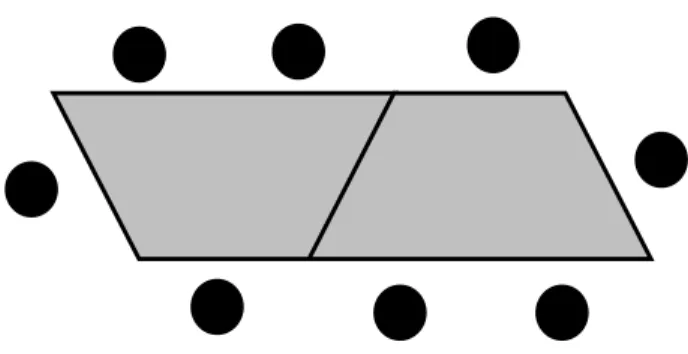
The Border Problem (see Figure 1) was one of six problems posted on Knowledge Forum. In this problem students were challenged to find the function, or “rule,”1 to predict the number of border squares for any size of grid. As the reader will see in the protocol that follows, the students present two viable and different solutions based on different visual interpretations2 -‐ an area interpretation where the total area of the grid is
calculated and the inner area is subtracted, symbolically, y=x2-‐(x-‐2)2, and a second strategy based on a perception of the border as four sides composed of x number of squares (4x), with each side “sharing a square” (-‐4), represented by f (x)= 4x-‐4. While we present formal symbolic notation to preview solutions that the students discuss, it must be noted that these young students had not had formal symbolic instruction3 but rather, in trying to communicate their mathematical ideas the students “invented” their own algebraic notation and combined this with natural language explanations, what Sfard (e.g., 1995) refers to as “syncopated” mathematical language.
1 Students used the term “rule” throughout the intervention and at no time were taught or used the term “function”.
2 Over the course of the study the students developed five different viable solutions to the Perimeter Problem.
3Students had been introduced to function tables as part of an instructional sequence that preceded the problem solving on Knowledge Forum, and were familiar with the language of input number and output number. Over the course of the lesson sequence the students adopted the use of the letter n to represent any number.
The discussion, which follows, involved students from all three classrooms, is taken verbatim from Knowledge Forum, and typifies the kinds of discourse that the students were engaged in as part of their mathematical problem solving.
The first note of this discussion (HLab4), entitled Eureka!, was posted by a student, AW. HLab Eureka! AW
for the 5x5 question you do 5x5=25 the square of 25 is 5 and you minus two from the square (5) and square that (3) then minus it (3squared=9) from your original number (25) and you have your answer! First I drew the five by five grid and there was nine in the middle to take away -‐ 3x3=9
so then I figured out a 6x6 square was 36 and I know that inside there would be a 4x4 square to take away so the difference between 6 and 4 is 2 -‐ so it was 36-‐16=20 nxn=nsquared -‐ (n-‐2)squared -‐
so minus (n-‐2)squared from nsquared
HPS1 Another rule SI
I have another rule for you and it is the output x4-‐4.In the rule it is x4 because there is 4 sides in a square. It is -‐4 because when you multiply 4 you are repeating the corners twice so you –4.
Hlab 2 rules AW
but there might be two rules because we got the same answer so i think there is more than 1 way to figure the problem out
MPS2 Both right? GA
I agree with you and disagree with you because you've got the answer but in a complicated way. I disagree with you because there's an easier way than taking the square of 25, subtracting 2 from it and square that and then subtract that from your original answer. I got the rule times 4 -‐4 because a square has 4 sides and you don't count the corners twice. I agree with you because for the first few questions you got it right.
Hlab Two Ways AW
Why can't there be two ways. There are different ways to do lots of different problems I think you can have two ways nxn=nsquared -‐(n-‐2)squared -‐ so minus (n-‐2)squared from nsquared works and x4-‐4 works
This exchange is representative of the kinds of notes that the students wrote and discussions they were engaged in. Of note, as will be elaborated in further sections of this paper, is the difficult level of mathematics that the students were engaged in: generalizing problems are known to be difficult for much older students (e.g., Amit & Neria, 2008; Becker & Rivera, 2005; English & Warren, 1998; Lee & Wheeler, 1987; Orton & Orton, 1994, 1999; Stacey, 1989; Stacey & MacGregor, 1999; Warren, 2000, 2004, 2005). Also of note, students were linked online with students in another school and veteran student knowledge builders were able to engage newcomers from a different school in Knowledge Building pedagogy and technology. Together they were able to sustain high level Knowledge Building discourse without a teacher serving as the facilitator or intervening to keep them motivated and focused. Students paid attention to and responded to one another; took on the roles of evidence-‐producers, moderators, and ratifiers; and negotiated the mathematical ideas developed – in this case, the possibility of multiple solutions for one problem, and the merits of each solution based on the elegance of the solution.
In this paper we present the context, methods and results from an experimental intervention to illuminate how Knowledge Forum, and the underlying Knowledge Building principles (Scardamalia, 2002, 2004) of democratization of knowledge and
epistemic agency supported students in adopting a Knowledge Building culture for
mathematical learning and problem solving.
Background to the Research: Early Algebra
For the last five years we have been working on a project in which we have been developing new learning contexts to support students in deep understanding of patterns and functions to introduce algebra across the grades (e.g., Beatty & Moss, 2009, 2006a, 2006b; Moss & Beatty, 2006a, 2006b; Moss, Beatty, Shillolo, & Barkin, 2008; Moss & McNab, in press). Pattern activities have become ubiquitous in reform-‐ oriented curriculum documents and mathematics textbooks as part of early algebra strands. The study of patterns, particularly those known as “generalizing problems,” offers students a vehicle for understanding the dependent relations among quantities that underlie mathematical functions (e.g., Ferrini-‐Mundy, Lappan, & Phillips, 1997; Lee, 1996; Mason, 1996; Mason, Graham, & Johnston-‐Wilder, 2005; Steen, 1988) and also provides a rich context for generalizing (Pimm, 1995). Generalization and justification are both considered essential components of algebraic activity (Blanton & Kaput, 2002; Carpenter & Franke, 2001; Carpenter, Franke, & Levi, 2003). Researchers argue that students should develop general connections early as a foundation for algebraic understanding, which has led to a wealth of studies focused on the promotion of generalizing activities (Blanton & Kaput, 2002, 2004; Carpenter & Franke, 2001;
Schliemann, Carraher, & Brizuela, 2001). Indeed, working with patterns and generalizing problems can provide a rich context for engaging students in the mathematical
reasoning processes that are central to the internationally recognized standards of the National Council of Teachers of Mathematics (2000): problem solving, reasoning and
proof, communication, connections (among mathematical topics and ideas), and use of multiple representations in generalizing and justification.
However, substantial evidence from past research suggests that understanding
functions through pattern activities is challenging for students, and that “the route from perceiving ‘patterns’ to constructing algebraic representations is rather complex and fraught with potential problems for students” (Noss, Healy, & Hoyles, 1997, p. 204; also see Kieran, 1992; Lee & Wheeler, 1987). Although the study of patterns has the
potential to develop the mathematical reasoning processes outlined by NCTM, the reality is that current instruction tends to reduce pattern lessons to superficial data driven pattern-‐spotting activities, which are grounded in arithmetic calculations
(Bednarz, Kieran & Lee, 1996). Students commit to their first conjectures of rules even in the face of invalidating data, and show little rigour or interest in supporting or justifying their conjectures (e.g., Lannin, 2005; Lee, 1996; Mason, 1996; Stacey, 1989). Our research in students’ learning of patterns has a double focus to address the findings and concerns in the literature. The first is the design of a sequence of instruction to provide students with multiple representations of functions—numeric, geometric and narrative — and promote a way of integrating these representations. This learning sequence is grounded in Case’s theory of mathematical development and central conceptual structures (see Case & Okamoto (1996) and Moss & Case (1999) for a discussion of the general theory; and Moss, Donoahue, Eisenband, Shapiro, &
Macdonald (2004) for a discussion of application of this theory to pattern learning). The second focus of our research, and the goal for this paper, is to investigate the potential of Knowledge Building pedagogy and technology to provide support for students’ developing understanding of patterns and functions. More specifically we test the possibility of young students’ engagement in theory development in the context of mathematical problem solving.
We first discuss the Knowledge Building principles that guided our analyses:
democratization of knowledge and epistemic agency. We then outline the methods used
in the study. The results will be presented in terms of frequency counts of student participation, as well as verbatim accounts and analysis of student notes to provide evidence of Knowledge Building. We conclude with exploratory conjectures about Knowledge Building and mathematics.
Knowledge Building, Knowledge Forum, and Mathematics Learning
The creation of a Knowledge Building community supported by Knowledge Forum in elementary classrooms has been shown to foster an inquiry-‐based, theory development orientation to work in various domains (McAuley, 2009; Resendes & Chuy, 2010;
Scardamalia, Bereiter, Chuy, Prinsen, Resendes, & Teplovs, 2010; Scardamalia, Bereiter, Hewitt, & Webb, 1996; Zhang, Scardamalia, Reeve, & Messina, 2009). To date the use of Knowledge Forum in mathematics education has been limited (Hurme & Jarvela, 2005; Nason & Woodruff, 2002), particularly at the elementary school level.
Two concerns have been raised about the applicability of Knowledge Forum for typical school-‐based mathematics learning. First, school-‐based mathematical problems typically lack open-‐endedness and authenticity, thus limiting the need for theory development (Nason & Woodruff, 2002). The second concern was that Knowledge Forum is a text-‐ based discourse space, and did not support symbolic math representations to aid communication.5 Our conjecture was that Knowledge Forum would provide an
authentic context for collaborative problem solving and extended mathematical
discussions while students worked on open-‐ended school-‐based generalizing problems. With respect to the text-‐based nature of Knowledge Forum, researchers suggest that verbal and written communication of mathematic ideas is essential to support
development of an understanding of structure (e.g., Pugalee, 2001) and is a necessary step in moving towards symbolic representations. Thus we were interested in
investigating how students would communicate their mathematical ideas in written discourse conducted in a text-‐based environment. Additionally Knowledge Forum supports graphical representation of ideas, a feature that facilitates work with patterns. We also investigated patterns of participation through Knowledge Forum to assess the extent to which a Knowledge Building culture in mathematics was developing similar to results reported in other domains such as science and social science (e.g., Bereiter & Scardamalia, 1989, 2003; Scardamalia, Bereiter, Hewitt, & Webb, 1996). Specifically for this study, we wanted to determine if students, given the opportunity to engage in mathematical problem solving on Knowledge Forum, would reveal evidence of core Knowledge Building principles: democratization of knowledge and epistemic agency. The scope of this paper does not allow a full discussion of the principles that underlie
Knowledge Building and Knowledge Forum6, but rather how these two serve the central
mathematical goals of the project.
Democratization of knowledge
In most mathematic classrooms, even with the best of intentions, there is an imbalance in students’ participation levels. One reason for this is that there is often a hierarchy of students’ mathematical achievement and status. The contributions from students who are perceived to be “higher” are generally accepted and acknowledged much more readily than those of weaker students whose ideas can be discounted or ignored. In addition, in most math classrooms the teacher is the expert and sole source of knowledge. In a Knowledge Building community, however, the principle of
democratization of knowledge supports the notion that all contributions are valued and can be improved. Democratization of knowledge can perhaps be achieved more readily through the absence of the teacher’s voice in the database, in the sense that students themselves then need to work harder to provide explanations and they don’t look to the teacher to provide “the answer.” As part of our analyses we looked at the participation
5 Open source developments will make it possible to incorporate symbolic math representations and expand Knowledge Forum functionality.
patterns for both high and low achieving students to determine whether all students were contributing ideas and accessing the ideas of others in meaningful ways.
Epistemic agency
The emphasis on student agency and the centrality of student ideas was a fundamental reason for incorporating Knowledge Forum in our study. Bereiter and Scardamalia (e.g., Bereiter, 2002; Scardamalia, 2002 ) use the term epistemic agency to characterize the responsibility that the group assumes for the ownership of ideas that are given a public life in Knowledge Forum. The principle of epistemic agency, therefore, underpins other Knowledge Building principles such as idea improvement and the democratization of knowledge. The students themselves take on the responsibility of contributing ideas, monitoring one another’s contributions, and asking for clarification and revisions with an eye towards moving the theorizing forward. As has been well documented, in traditional mathematics classrooms students do not see themselves in the role of initiators of mathematical ideas or theories, and even less as leaders in relation to developing mathematical discourse. The teacher and textbook are the authorities and students do not see mathematics as a subject to be created or explored. We wondered if a shift in responsibility would result in an increase in students’ engagement in the language of and disposition for mathematical discourse. We looked for evidence of epistemic agency through an analysis of the extent to which students were responding to one another’s ideas. We also looked for examples of student discussions that moved the mathematical content knowledge forward.
Methods
ParticipantsParticipants were students from three different Grade 4 classrooms (8-‐9 year olds), n=68. One of the classrooms was a University Laboratory school and the other two classrooms were in an inner city public school serving an at-‐risk population (high ESL, low SES) that has been designated as the third neediest school in the school board. Prior to the study, none of the students in these classrooms had been exposed to any kind of work with mathematical functions, nor had they had any formal instruction in symbolic representations of algebraic functions. The 22 students from the laboratory school had used Knowledge Forum as part of their science curriculum, as had half of the students from the public school, and so they were familiar with the software and
processes. Those who had not used Knowledge Forum previously had two lessons in how to use the software, and another lesson to work with an experienced peer. All students were shown how to open views, compose and contribute notes, and how to respond to other students’ contributions. None of the students had worked on Knowledge Forum for mathematical problem solving.
Procedures
designed to develop an understanding of linear functional relationships. Prior to entering into the lesson sequence, the students were told that at the end of the patterning unit they would be linked with students from a different school on
Knowledge Forum in order to work together to solve very difficult problems. The lesson sequence was comprised of activities involving numeric patterns, guess my rule games, geometric growing sequences with position cards and specially created word problems. For a detailed outline of this sequence please see Moss and Beatty (2006a; 2006b). As mentioned previously, at no time were the students taught any formal algebraic notation. After completing the instructional sequence, students from the three classrooms were linked electronically and invited to collaborate in solving six generalizing problems.
For each problem, students were asked to discern a functional relationship between two sets of data and express this as a “rule,” and to explain their reasoning. Each problem was posted on a separate Knowledge Forum “view.” There were three pairs of problems, which were matched for structural similarity and increasing difficulty. The first two problems (The Cube Sticker and the Trapezoid Table –see the Appendix for a full description of each problem) both had an underlying functional rule of y=mx+b, (where m and b were positive integers). The second two problems (The Border Problem and the Triangle Dot Problem) had an underlying function of y=mx-‐b. The final two problems (The Handshake Problem and the Pattern Kingdom) were based on the quadratic function, (x2-‐x)/2, which posed an unfamiliar challenge to the students since they had previously worked only with linear functions. The Knowledge Forum database was available to students over an eight-‐week period, and on average each student had approximately 30 to 45 minutes per week to work on-‐line. The time that the students had to work on the database varied depending on the classroom and the availability of computers, and was usually carried out during one math period a week. In this study the site for problem solving was the Knowledge Forum database with a focus on peer collaboration with students from all classrooms. Consequently, there were few whole class discussions related to student problem solving.7
Data sources
The data for the present study comes from the 247 notes that the students in the three classes posted in response to the six generalizing problems. As part of the larger study, the students from the three classrooms were assigned to a level of mathematical achievement (high, medium, or low) based on teacher rating of general mathematics performance and report cards.
For this study, each note was given a code based on the student author’s classroom (Lab = Lab School, PS1 = public school classroom 1, PS2 = public school classroom 2), and
7 We have subsequently carried out a study in which we included Knowledge Building whole class discussions as part of the intervention. See Beatty and Moss, 2009.
their achievement level (H, M or L). All notes were given a title, indicated by bold text, by the student or students who posted them. Authorship is indicated by the student’s first and last initial. Any metacognitive scaffolds8 are indicated through the use of italics. Each note was read by the researcher and one or more research assistants, and coded for type of note (i.e., original notes or notes that were in response to original notes) and for mathematical content. We analyzed notes and discussions to determine the extent to which the principles of democratization of knowledge and epistemic agency were exemplified.
Results
The intention of this paper is to present evidence of the Knowledge Building principles, in particular democratization of knowledge and epistemic agency. Thus, the results are presented in two major sections to reflect the Knowledge Building principles that are the focus of this study.9
Results – Democratization of Knowledge
There is always a question in collaborative learning situations about the usefulness of collaborative learning for students of varying abilities. This study involved a very diverse population of students in terms of ability level and so we were interested to learn about the kinds of contributions made to the database as a function of ability level.
We compared the contributions of high-‐achieving students to their lower achieving peers in terms of whether their notes were original ideas or written in response to the ideas of others. We found that 70% of notes posted by lower-‐achieving students were in response to notes of other students, compared to 54% of notes posted by higher-‐
achieving students. This finding indicates that lower-‐achieving students spent a greater proportion of their time on Knowledge Forum reading and responding to the ideas of other students than their higher-‐achieving peers.
It has been suggested that in many collaborative learning situations collaboration may benefit lower-‐achieving students only in as much as they can copy the ideas of more advanced students, and that this copying may not necessarily lead to an increased understanding (Steffe, personal communication, October 2005). When we looked specifically at the content of the notes posted by lower-‐achieving students in response to those of higher-‐achieving students, we discovered that, contrary to the concerns stated above, when lower-‐achieving students read and built onto the theories of higher-‐
8 Metacognitive scaffolds in Knowledge Forum are optional and customizable supports to encourage students to engage in high-‐level knowledge processes such as theory building while they write notes (Scardamalia 2003). The scaffolds used in this study include my theory, I need to understand, new information, a better theory, and putting our knowledge together.
9 For an analysis of frequency counts of the content of students’ notes, please see Moss and Beatty, 2006a.
achieving students, they did so by translating the ideas of others into modified
representations. This indicated that they were not just repeating the ideas of others but were incorporating these ideas into their own understanding using language, drawings, and other representations that were meaningful to them.
In the following note, a middle achieving student, SG, offers a solution to the border problem based on his understanding of the numeric operations that yield the correct output numbers (shaded squares) from the input numbers (type of square grid). His explanation of his rule includes an understanding that the rule is to predict the border, “only count the edge,” of each grid and that the corners overlap.
MPS1 Not Finished SG
Type of number of
Square grid squares shaded 3 by 3 8
4 by 4 12 5 by 5 16 6 by 6 20
The output number is equal to input number times four, minus four, My evidence is that three times four is twelve and minus four is eight. Also it says that you have to only count the edge so thats [sic] a big hint so that how I got my rule. Also you don’t put the corners with 2 squares you have to take one square away.
In response, a lower achieving student responds by outlining his own initial “goldilocks strategy” using guess-‐and-‐check. He then tried SG’s offered rule on all the grids and agrees that the rule is “a perfect fit”. Although JC may not understand the reasoning behind the rule in the same way that SG does, he does seem to grasp that SG’s solution is a rule because it works for all instances.
LLab Easy Math JC
I tried x3+3 but it was too much. When I went to x2+2 but it was too little. So I went to x4-‐4. It was right at first. Then I went to the second one. It was a perfect fit. Then I did the rest it was the rule. I agree with you SG.
JC’s note offers additional confirmation of SG’s rule, and an explanation of why other rules were not correct solutions, and so he is contributing meaningful information to the community through the Knowledge Forum database.
Lower-‐achieving students were also able to use their reinterpretations to critique the solutions of higher-‐achieving students, as illustrated in the following example. MB, a higher-‐achieving student, presents his solution to the Border Problem. SJ, a lower-‐ achieving student, outlines his strategy for solving the problem, and is able to correct a calculation mistake in MB’s note.
HPS2 My Solution MB
My theory is that 16 squares would be shaded in a 5x5 grid. 54 squares would be
shaded in a 17x17 grid. 396 squares would be shaded in a 100x100 grid. Yes there is a rule and the rule is x4-‐4. We know that there are 4 sides to a square, so whatever the grid is you times the side by 4. But the corners overlap, so that means -‐4. Our evidence is that we tried it for each grid and it matched the correct number of shaded squares.
LPS1 17x17 SJ
I agree with you because the 5x5 square is right because 5x4-‐4=16. I disagree with
you because the 17x17 answer is wrong. My evidence is that the rule is x4-‐4 so 17x4=68-‐4=64. I know this is the rule because I have a t-‐chart and it says this: 3 will be 8, 4 will be 12 and 5 will be 16. If you use this rule you will get the answer to the question.
In the preceding example, a lower-‐achieving student was able to incorporate a solution presented by a higher-‐achieving peer and then reinterpreted the solution using a different representation (t-‐chart). Whereas MB derived a solution based on the geometric structure of the problem, SJ indicates that he had constructed a table of values to support his understanding of the rule.
In this next example, a higher achieving student, NS, posted a solution to the problem based on a numeric analysis of the data given, with the conclusion that only the operations of x4-‐4 would lead to the correct output numbers. She states that her rule would apply for all the other numbers, but is unclear as to why this is true. In a revision to her original note, for which she uses the scaffold “a better theory”, NS contributed an addition to her idea that includes a more conceptual orientation to the problem
PS1H Relationships NS
My theory is that the Output # is = to the input # times 4 -‐ 4. My evidence is that
3x4=12 and -‐4 is 8 which is the output. You need to multiply the input x 4[only one side] because without multiplying you wouldn't get 12. Then when you minus another # besides 4 the output wouldn't be 8. The same rule applies for all the other numbers. Like: 100x4= 400-‐4=396 10x4=40-‐4=36 14x4=56-‐4=52 I think I still have to think a little more to explain my theory.
A better theory
You need to x 4 because you need 4 sides to make a square. Like 3x3 means 3 is the length and the other 3 is the width so one length or width x 4 = to the whole
border.
In response to NS’s note, two lower achieving students respond by providing
clarifications to NS’s note. In the first response ALe, who understands that the rule is x4-‐ 4, restates NS’s rule to make sure that she (and others reading the note) are not
confused. CW also asks for clarification based on his knowledge of multiplication facts. LabL I agree Ale
I agree with you because As long as you don’t get confused because they might think that you have to x the number when times the number by four and then minus four. What your [sic] saying here is that you don’t x the number by itself. Instead you times it by four then minus four, As long as you don’t get confused I completely agree with you.
LabL Can you be a bit more clear CW
Can you be a bit more clear because it says 3x3=8 and your [sic] saying 3x4=8. In response, NS clarified her reasoning by stating that it is the length or width of a grid that is multiplied by 4 because of the four sides of the grid.
PS1H Meaning it NS
I meant to say in my note that one length or wideth [sic] which is the same in this case. Then take the length or wideth [sic] then X by 4 because there are 4 sides.
When we looked at the activity in the database of lower-‐ and higher-‐achieving students it was encouraging that the lower-‐achieving students appeared to be utilizing the ideas posted by their higher-‐achieving peers to move their own learning forward, and were offering their own ideas or reinterpretations of ideas as participating members of the Knowledge Building community.
Results – Epistemic Agency
In Knowledge Building communities members make progress not only in improving their personal knowledge, but also in developing collective knowledge through progressive discourse (Bereiter & Scardamalia, 2003). As mentioned in the previous section, there were many instances of students making concerted efforts to move the understanding of the group forward as they read and responded to each other’s contributions and built onto the ideas of others rather than simply posting individual ideas. Also, many of the discussions revealed students’ commitment to include broader issues of mathematical understanding.
The following discussion comes from the Handshake Problem. This problem, which has been shown to be difficult for much older students (e.g., Cooper & Sakane, 1986), requires that students find the quadratic rule to determine how many handshakes there would be if everyone shook hands with everyone else in any size group. Initially many students came up with a recursive numeric pattern, as the first note exemplifies. However, in contrast to findings of other research with older students (e.g., Lannin, 2005; Steele, 2005; Steele & Johanning, 2004) a number of notes were posted by students who realized the limitations of this recursive approach, and questioned one another as to how to find the explicit functional rule. As M and J state in their note, “the thing about math is to figure out the fastest and most accurate way to do things.”
MPS1 Follow the Next Output Number TH
If there is [sic] 3 people there are 3 handshakes. If there is [sic] 4 people there are 6 handshakes. So I think that it is like 2+1=3 that is the next handshake output. So 3+3=6 that is the next handshake. My rule will be the input+output=next output. Number of people Number of handshakes
1 3 6 10
MLab M and J’s Theory MT
I was wondering could you do this rule for 149 378 people? Because the thing is in our theory you have to know the number of handshakes before the one you’re doing…but the large numbers are so big it would take forever to figure it out! The thing about math is to figure out the fastest and most accurate way to do things.
MPS2 I need to Understand VT
I need to understand if there is another way to get the answer? I want to solve how
many handshakes would 10 people do without making a T-‐chart.
HPS1 Thinking SI
My theory is that the rule is the number x the number – 1 divided by 2. I think that
it is the number x the number – 1 because a person can shake with the number of people 1 less than the person because the person cannot shake with his or herself. It is divided by 2 because 2 people make a handshake.
These notes show a disposition in these students to move mathematical reasoning forward. First of all, based on the literature, it is well known that one of the difficulties in generalizing problems lies in the propensity of students and adults to use a recursive strategy—a focus on the variation within a single set of data rather than on the
relationship between two data sets—for identifying and describing generalizations (e.g., English & Warren 1998; Lee 1996; Orton 1997; Warren, 2000, 2005). While recursive
strategies allow students to predict what comes in the next couple of positions of a series, it does not foster the ability to perceive the (structural) relationship across the two data sets to find the underlying rule. However, these students, having found a numeric pattern based on recursion, are dissatisfied with this as the sole solution. We see a push to go beyond spotting the numeric pattern, which the students see as a serious limitation because “you have to know the number of handshakes before the one you’re doing.” The students persist to find and understand both the underlying
mathematical structure of the problem and the articulation of this as a rule. In our view, while there is no straightforward way to identify epistemic agency, this kind of interest in expanding the status of the understanding that we have seen in this particular set of notes can be taken as evidence of epistemic agency.
Summary of Results
Knowledge Building principles in evidence
Throughout the database we found evidence of practice consistent with two core Knowledge Building principles: democratization of knowledge and epistemic agency. Democratization of knowledge was evidenced by participation of students at all levels. It was not only the higher-‐achieving students who were motivated and interested in solving these difficult problems; the lower-‐achieving students used the opportunity provided by Knowledge Forum to look at solutions posted by their peers, and were able to incorporate these ideas into their own solutions at a level that was meaningful for them. A particularly encouraging result of this study was the number of notes posted by lower-‐achieving students as these students rarely spoke out in class and had been silent members of the mathematics community of the classroom. As our analyses revealed, these lower-‐achieving students posted proportionally more notes in response to the ideas of other students, rather than original ideas, and were clearly engaged in
collaborative discourse. We believe that a Knowledge Building approach increased the access to ideas and the means to work with them for students identified as “low-‐
achieving.” These students were able to engage with the mathematical ideas presented, and their contributions were acknowledged by higher-‐achieving peers. Also, we believe that because students from the two participating schools had never met, that the status hierarchies with respect to mathematical prowess were leveled, so that the
contributions of all students were equally considered.
Epistemic agency was seen in students’ working together to solve these problems and to support each others’ suppositions or question one another’s incorrect solutions so that the group as a whole could achieve a level of assurance about whether the answers being offered were correct solutions for the problems. This was necessary because, as previously stated, neither the teachers nor the researchers ever commented on any of the answers offered (on or off Knowledge Forum) so the students had no external source of information as a means of checking whether the solutions posted were “right”
or “wrong.” This is a most interesting finding, as in most Knowledge Building contexts the teacher is more engaged in the online exchanges (see, for example, Brett, Forrester, & Fujita, 2009; MacKinnon & Aylward, 2009; Sun, Zhang, & Scardamalia, present issue). It is especially interesting that left to their own devices the students developed a
disposition for offering not just solutions for problems, but took the responsibility to offer evidence and justifications for their solutions with the intention of making their understanding comprehensible to everyone. In this student-‐managed database the discussions broadened to include such themes as the elegance of explicit functions, recursive numeric patterns, and the possibility of multiple solutions for problems.
Discussion
Generalizing problems are now common in textbooks in many countries to serve as a foundation for mathematical functions (Lee, 1996; Mason; 1996; Zazkis & Liljedahl, 2002) and for supporting justifications as an introduction to algebraic reasoning (Lee & Wheeler, 1987; Radford, 1999, 2003, 2006). However it has been shown that, at least given traditional instruction, students’ approach to generalizing and justifying through patterning problems is limited. When we analyzed the contributions that students made on Knowledge Forum we found a very different pattern of problem solving—a pattern especially impressive for such young students from such diverse backgrounds. Not only were they able to find multiple solutions to very challenging generalizing problems,10 but also the notes that they contributed to the database showed a commitment to providing explanations and evidence for conjectures and rules. This clarity of
communication and justification, while central to new reform efforts, eludes much older students. As our data revealed, the students’ problem solving strategies were not
limited to the simple recursive strategies that typify the reasoning for these kinds of generalizing problems; but rather, they found multiple functional rules that allowed them to make predictions for instances of the pattern in any position, indicating an ability to generalize (Mason, 1996) their rules from particular instances.
The students in these classrooms had no experience prior to this study with these kinds of problems, as indicated by low performance on pretests. In addition, interviews with students at the beginning of the study revealed that student responses to problems of this sort were limited, and involved “guess and check” or recursive reasoning. While the intervention that preceded the Knowledge Forum problem solving was designed to provide students with grounding in linear functions of the form y=mx+b, the kinds of problems that they encountered on the database were substantially more difficult. The Knowledge Forum problems included two linear problems of the form y=mx-‐b, and two problems based on quadratic functions (x2-‐x)/2, which the students had not learned. In
10 While the scope of this paper allowed for an analysis or presentation of students’ problem solving for only two of the six problems posted, these kinds of strategies typify the students’ problem solving for all six problems.
addition, these problems required the students to ascertain the independent and dependent variables, as well as the relationship between the two.
We believe that our research results, as outlined in the previous section, indicate that the students in our study were engaged in Knowledge Building. Thus we speculate that Knowledge Building as supported by Knowledge Forum played a significant role in the students’ mathematical achievements.
At the most basic level we see the attributes of the software itself as contributing to the outcomes of this study. The visual set up of the Knowledge Forum views allows students to trace their contributions and to review discussions. As students contribute and respond to one another, their notes are automatically linked, and the resulting webs provide a visually based ongoing record of the development of increasingly
sophisticated ideas. Students can see the evolving problem solving space that represents the growing complexity of discussions.
Figure 2: Border Problem View
More importantly, we believe that in this study Knowledge Forum was a tool that allowed for learning consistent with Knowledge Building principles. Knowledge Forum gives students’ ideas a space in which to reside that is accessible to everyone. The ability to record ideas, coupled with the asynchronicity of the discussion, provided students with both the software capability and the think-‐time to revisit their original solutions in