2
nd
LOGIN General Assembly
Meeting Report
2 - 4 December 2014
Kathmandu, Nepal
Local Governance Initiative and Network (LOGIN) is a multi-stakeholder knowledge exchange platform that supports greater decentralisation and strengthened local governance in South and East Asia. Spanning over 10 countries, LOGIN’s members include elected representatives, training institutions, think tanks, government departments, non-governmental organisations and inter-non-governmental organisations, among others. Working in favour of accountable, transparent and inclusive local governance, LOGIN facilitates knowledge sharing and peer-engagements on key governance issues amongst its members. Since its inception in 2013, LOGIN has been connecting and capacitating various actors and change agents who are driving reform agendas within their countries and the region.
LOGIN’s General Assembly is the highest governing body of the network. All LOGIN members are a part of the General Assembly. The General Assembly convenes once a year and during these meetings, it defines the network’s strategic direction and thematic focus for the year ahead. It reviews LOGIN’s actions and collectively develops its annual workplan and activities.
LOGIN’s 2nd General Assembly was held in Kathmandu from 2-4 December, 2014. The focus of the meeting was
to (i) Review activities undertaken in 2014; (ii) Develop ‘Theories of Change’ at the thematic and institutional level; and (iii) Set strategic priorities for 2015. Over 70 participants came together from Afghanistan, Bangladesh, Bhutan, Cambodia, India, Laos, Mongolia, Nepal, Pakistan, Myanmar and the SDC Head Office in Switzerland. This report summarises the methods and proceedings of the three-day event.
LOGIN is supported by the Swiss Agency for Development and Cooperation. © LOGIN Asia, 2014
Contents
Abbreviations iv
DAY 1 Reflecting on Change 1
1. Inaugural session 2
2. Capturing what ‘change’ means to members 2
3. Reflecting on the 2014 LOGIN experience 3
4. Change recommendations for LOGIN 7
5. Members reflect on change – Wilber Matrix 8
6. Members stand up for their idea of change 10
7. Reporting back through informal sessions 10
DAY 2 Accountability Review and Strategies for the Coming Years 13 1. Members respond to the Secretariat’s report to the General Assembly 14 2. Members brainstorm on the strategies for the next three years 17 DAY 3 Draft Twelve-Month Workplan on the Content and Institutional 23
Aspects of the Network
1. SDC’s feedback to the General Assembly 24
2. Draft twelve-month workplan on content and institutional aspects of LOGIN 25
3. Closure of the 2nd LOGIN General Assembly 30
Annexures 31
Annexure I: Programme schedule 32
Annexure II: List of participants 34
Annexure III: Secretariat’s presentation to the General Assembly 38
Abbreviations
BNEW Bhutan Network for Empowering Women
CIRDAP Centre on Integrated Rural Development for Asia and the Pacific, Bangladesh CSO Civil Society Organisation
DLGN Decentralisation and Local Governance Network HLP Horizontal Learning Programme
IDS Institute of Development Studies Sussex, U.K. LOGIN Local Governance Initiative and Network MELP Member Engagement and Learning Platform
MoFALD Ministry of Federal Administration and Local Development, Government of Nepal M&E Monitoring and Evaluation
NGO Non-Governmental Organisation OC Operational Committee
SDC Swiss Agency for Development and Cooperation SLV Structured Leaning Visit
ToR Terms of Reference
DAY 1
1.
Inaugural session
As members walked into the meeting room for the 2nd LOGIN General Assembly, they were handed flash
cards to write down – “For you, what would success of the General Assembly look like?” These cards helped collect an initial harvest of expectations from the meeting. Each card was then displayed on a wall, and served as a reference point through the three days of the event.
Members then assembled for the plenary, where they sat around tables in mixed groups. Mr. Somlal Subedi, Secretary, Ministry of Federal Administration and Local Development (MoFALD), Government of Nepal, addressed the gathering and opened the 2nd LOGIN General Assembly meeting.
2.
Capturing what ‘change’ means to members
Starting with a brainstorming exercise on various possible ideas of change, facilitators asked each network member to reflect on – “How does change happen?” Discussions brought forward several ideas:
Change takes persistence and time
Change encompasses changing mind-sets and influencing people
For change to occur there must be a conducive environment, an enabling legal framework and relevant
agents of change
For change to occur, there must be active learning within the context
For change to occur, there must be strong leadership along with political will and synergy of ideas
among different stakeholders
Change can also fundamentally mean rearrangement/reconfiguration of existing structures Change involves considering conditions for overcoming resistance
There must be a clear vision on what change looks like
Change can be incremental, for example, as a result of a reform process. Or it can be more sudden,
for instance, spurred by deep public dissatisfaction with existing systems or social unrest forcing governmental authorities to react
Change can be both internal and external All change is not necessarily good change
Access to information and increased awareness of rights can empower and cause change Change happens at various levels – systemic, institutional and personal
Knowledge is a powerful tool – as we know more, we can do more and we improve more
The inputs from this session helped build common ground among members, and also fed into the reflections and discussions for the sessions ahead.
3.
Reflecting on the 2014 LOGIN experience
Mapping changes triggered by LOGIN
For this session, members moved to the second area of the plenary meeting room. In this space, they were seated in country groups around a 20 foot LOGIN mandala1, depicting the ecosystem that LOGIN
inhabits.
The facilitators posed the following questions to the members:
“What has changed in you over the last year as a member of LOGIN?” “What is different because of your country platform and because of LOGIN?”
Members deliberated around their country tables. Discussions were captured on flash cards which were placed against each country name around the LOGIN mandala.
Members walked around the mandala to understand the key change processes underway in each member country. Representatives from each country were invited to share key highlights from their discussions.
1 The LOGIN mandala was developed based on inputs from the Envisioning Workshop (July 2014) held with members from Bhutan and Mongolia. The wheel depicts the multitude of institutions, actors, engagements and actions that shape LOGIN. The countries in East and South Asia where LOGIN has a presence are in the outermost circle. These countries have different contexts and cultures, and follow different pathways to better governance at the local level. The next circle shows the different stakeholders who are the enablers to strengthening local governance. The enablers are guided by different strategies and practices and institutional modes, but work towards a common purpose. LOGIN creates the space for these enablers to engage in a non-hierarchical and non-threatening environment to connect with peers in other countries, share knowledge and exchange experiences. The authorising environment provided in each country by constitutions, legislations and policies are represented in the third circle. The enablers derive their legitimacy and formulate their strategies and actions on the basis of these frameworks. Institutions and practices in local governance operate under the rubric of the enabling environment. These institutions and practices are strengthened by the promotion of a culture of connectedness, dialogue, knowledge sharing and learning among different actors within and across countries. They together nurture an enabling environment for better local governance. This is the sphere actively nurtured by LOGIN. The innermost circle core purpose of the engagements nurtured by LOGIN, wherein there is better governance at the local level, and where people are aware and capable of playing the role of active and engaged citizens.
Members from Bangladesh shared how attitudes and perceptions around LOGIN have changed since the beginning of the platform. Members outlined the importance of collaborative strategies and its collective influence from the community-level up.
In Nepal, members reflected on how they have experienced an increased sense of experiential sharing, including the strengthened intra-country network. There has been an increased application of ideas and the overall accountability of local governments towards communities has improved. Inclusion on gender and caste bases has also increased substantially. In these efforts, members have had the opportunity to learn from their past experiences as well as from the experiences of other members within the LOGIN platform.
Members from Pakistan identified that they required more coordination within their country group. Overall, more collective action is needed, and stakeholders need to be correctly identified to have meaningful engagements that mould change agents.
For Laos, members considered it vital to understand the progress made in each network country, as well as to gauge the holistic progress made by the network. They reflected how exchanges facilitated via LOGIN have allowed for understanding on these grounds to develop, including new insights to tackle similar challenges. The importance of discussing ideas with all stakeholders, and to look for enriching ways to learn and grow together was also discussed.
Myanmar, as a new entrant to the LOGIN platform, called on other countries to share their experiences – both personal and organisational. They expressed their desire to further explore themes within decentralisation and local governance.
For India, members highlighted how level of decentralisation is different across its states as well as the LOGIN countries. Different states and network countries have different models, which makes it necessary that these models and learnings are brought back to elected representatives.
Through exchange of experience within LOGIN, members from Cambodia not only shared how they have learned that decentralisation and local governance challenges in various countries are similar, but also that the pace at which reforms are implemented varies from country-to-country. For the future, members shared that they look forward to learning from other countries’ good practices,while examining how they could be implemented within their own country context.
Members from Bhutan reflected on how LOGIN has been successful in creating an environment to get to know each other and, in-turn, a desire for change. At the country-level, while the status of decentralisation is “not bad”, yet it is not at a level to influence policy. However, a great opportunity to initiate the same has been created within the country group.
Members from Afghanistan shared how learning and exploring the status of local governance within their country has increased. There is an unprecedented understating within the government that non-governmental organisations (NGOs) can be a part of local governance reforms. There is renewed energy through the Independent Directorate for Local Governments papers, which have received some feedback and interest from LOGIN.
Mongolia started its engagements through conversations with members to gain consensus within the group: More knowledge has been shared on theories of change; members now have a feeling that they are not alone and that it is helpful to have collective action; LOGIN is an enabling platform to create a multi-stakeholder community of practitioners on reform; members have benefitted from peer-learning and good practices; to translate thoughts into action, budgetary reforms must also take place in a way that includes communities; LOGIN has enabled members to link and complement knowledge transfer and peer-learning with their engagements with the government. Members shared how Mongolia is looking forward to conversations with other Central Asian countries to spread news about the network and the need for peer-learning.
Deliberations around each theme brought to the fore the following points:
Knowledge products hold intrinsic importance
The cross pollination of systems and reforms needs attention
There are many players within the field of decentralisation that require a coordinated effort Increased country-level coordination is required
An understanding of the ‘drivers of change’ and ‘change champions’ is critical
Civic empowerment is highly significant – where people become owners of society and true citizens Countries are always in a process of change – it is important to understand the priorities of each
country
There is great value in being connected across regions Policy reform is linked to political will
Budget planning cannot be ignored
Performance tracking Change drivers Policy influence Reform process Budget planning
Connection between key stakeholders Mapping Political will Civic empowerment Country-level coordination Knowledge products
Thematic clusters
During this session, members moved back to the main plenary area and sat around mixed group tables. Building upon the previous exercise of mapping changes triggered by LOGIN, the flash cards placed by country platforms around the LOGIN mandala were grouped along 11 common themes:
The change triad
Flash cards were then re-arranged on the vertices of a change triad, depending on whether the idea reflected an aspect of knowledge, attitude or behaviour:
Each member discussed:
“What changed in me through the LOGIN experience?” “Where did my attitude, understanding and/or practice
shift because of LOGIN?”
“What difference does it make to my work?”
Reflecting on the clustering of cards within the change triad, members shared:
LOGIN constitutes a platform for discussion and debate between various actors in a non-hierarchical
and open manner. Such a platform has no precedent in some LOGIN member countries
LOGIN symbolises the idea that process is just as important as end – processes and thematic content
have emerged and these processes themselves will undergo change
By sharing experiences and ideas, members get to engage with stakeholders who can take things
forward in the area of local governance
Change is a long journey– networking for reforms and social solutions bridge the gap between the
people and government institutions
The challenge of capacity development exists. Although frameworks exist, the ability to implement
them has yet to improve. An important question is whether and how to engage the private sector as a key part of local governance. Change must emerge from combined trust and understanding
There are many commonalities as well as unique challenges. LOGIN members should consider linking
with other countries and exchange ideas with them
There is a lot happening at the community-level, and suggestions to move forward must be demanded
by the people. National governments must acknowledge communities and the demands of the people
CHANGE
Behaviour/ Hands Knowledge/ Head Attitude/ Heart4.
Change recommendations for LOGIN
In this session, members debated challenging questions pertaining to LOGIN as a network, harnessing views on setting priorities for LOGIN and its functions:
“What do we need to do more of?” “What do we need to do less of?” “What do we need to stop doing?” “What do we need to do differently?” “What do we need to do that is new?”
Members discussed these questions around mixed group tables. Key ideas that emerged are presented in the table below:
Table 1: Change recommendations for LOGIN
Do more of… Do less of… Stop doing… Do differently… Do new…
Country platform should lead the learning agenda and accordingly take responsibility Experts (outsiders) view should be minimised Knowledge should not be created for the sake of creating knowledge
We should try and utilise virtual platforms for sharing learning
We should connect to other global networks
More governments and local
government institutions should be brought into the network
To increase greater understanding, the use of simple terminologies and words should be adopted
Events should be held at the premises of partner/member institutions The network should be further structured, and more funding partners should be brought in Ownership should be increased and platform leadership should be rotated for learning and interaction Facilitators should do more Learning should be ‘demand-driven’ as well as ‘action-driven’ Mechanisms to monitor activities and progress at the country and network level should be established
The network should learn from failures
The network should ‘network’ at the national and international level The network should
learn from tacit learning/indigenous practices
The network should aid the creation of policy, advocacy and support groups
Learning should be internalised
The private sector should be brought in The role of the
country facilitators to link members should be strengthened Success stories/good practices should be brought out Public relations should be strengthened Regional learning groups should be created Contd...
Do more of… Do less of… Stop doing… Do differently… Do new… The Member Engagement and Learning Platform (MELP) should be used more Country-level newsletters should be published. The LOGIN website should be used to further disseminate information to the public
Gender equality at every level should be established
Learning, analysis and sharing should be captured more systematically
5.
Members reflect on change – Wilber Matrix
In the afternoon of Day 1, members re-convened around the LOGIN mandala for an in-depth reflection on the idea of change. The exercise took place with members seated within their respective country groups. The concept of the Wilber Matrix (for details, refer to Annexure IV: The Wilber Matrix presentation), proposed by Ken Wilber, was introduced as a tool to facilitate understanding on change and assess efforts pursued towards materialising change. In its simplest form, the Wilber Matrix consists of four quadrants representing the intersections of individual consciousness and collective consciousness with the interior and exterior worlds, as depicted below:
Interior world Exterior world Individual
Consciousness
Multiple identities, personal mind-sets, values, emotions and feelings,
development of the self
→
Personal transformationI Intentional
Relational habits,
behaviour, interactions with environment
→
Transforming relationships It Behavioural Collective Consciousness We Cultural Collective identities and culture, collective belief system and values Shared understanding→
Transforming collective patterns of thinking and actingIts Social
Structural institutions (laws,
organisations), public policies, legal and judiciary procedures
→
Transforming structures, processes, mechanismsEach country platform was asked to identify a reform agenda and elaborate on how they would work towards bringing change, both individually and collectively. The purpose of the exercise was to examine how the interior and exterior worlds of members constrain or enable such reform efforts.
A snapshot of some of the ideas put forward are as follows:
Members from Bangladesh took the example of elected women representatives in local governance
and identified information provisioning and capacity building of women leaders to enhance their confidence and appraise them of their roles and responsibilities as an aspect of the ‘interior world.’ With these tools in hand, women leaders have spoken out for their rights and mobilised other women
as change agents, indicating their interactions with the ‘exterior world.’ The country platform also identified patriarchy/cultural restrictions on women’s mobility as an ‘interior’ challenges to women’s collective efforts. By contrast, the policy on reservation for women announced in 1997 was identified as an ‘exterior’ development that enabled further collective action by women leaders
The Mongolian members presented a different cultural dimension of collective efforts, where a notable
section of society is nomadic. The country platform identified that they are ‘strong’ in behavioural transformation and ‘very strong’ in social transformation, while ‘weak’ in cultural transformation and ’very weak’ in intentional transformation. The first two relate to the exterior world, while the last two relate to the interior world. Highlighting the features of the Mongolian society, members pointed out that common welfare and respect for elders were integral elements of transforming relationships and transforming collective patterns of thinking respectively
Members from Myanmar underlined the role played by ethnic diversity in its decentralisation and local
governance scenario, as well as efforts towards reforms and change. Democratisation and federalism, thus, have to be dealt with factoring in this diversity. The key issues in materialising change were identified as building trust amongst different ethnic groups and exploring commonalities in their local governance aspirations
The influence of power dynamics on individual and collective actions towards change was brought out
by the Cambodia country platform. There is a need to not only build a relationship of trust between the state and civil society, but also to change the ingrained attitude of individuals towards change. Collective action towards change currently remains limited in Cambodia as there is little oversight on the state or coordination between the state apparatus and the civil society
The Wilber Matrix helped members understand the complexity of the processes of change, especially with regard to the influence of cultural, social and legal environments on their efforts.
6.
Members stand up for their idea of change
For the last session on Day 1, members engaged in an intriguing game of picking and defending an idea of change that they most related to. The following ideas of change were placed on posters:
Mobilise grassroots change Lobby key decision-makers
Put funding in the hands of champions Bring like-minded people together Reform the system from the top Educate people
Members clustered around each of these posters to demonstrate their preferred idea for influencing change in their country. Each group then nominated one person to defend their choice:
The group that stressed on grassroots change referred to the failed top-down development projects to
drive home the point that only bottom-up changes were sustainable
The defenders of change from the top, meanwhile, contended that systematic change, including
grassroots change, can be spurred only from the top
Members who chose education as the means of change shared how education needs to be understood
as learning that is meaningful and relevant, and that peer-learning would be the ideal mode of education within the decentralisation and local governance scenario
Funding the efforts of decentralisation and local governance champions was selected by some
members who stressed the need to place trust in the abilities and potential of champions as change agents. “Put your money where the mouth is”, was the common slogan for this group
Bringing like-minded people together was selected by another group as the most preferred change
strategy, as they believed that without a critical mass of like-minded people no other effort would be fruitful
The group emphasising the importance of lobbying key decision-makers saw this as a crucial step
towards influencing and changing policy
Wrapping up the session, the session facilitator concluded that to bring about change/reform each factor/ idea is as relevant as the other. A ‘one size fits all’ approach should not be adopted. Each context determines the response, and in most cases, a combination of these approaches are necessary to bring about change. This re-emphasises the importance of a multi-stakeholder group such as LOGIN, with different capabilities and spheres of influence, coming together to synergise resources and bring about change.
7.
Reporting back through informal sessions
In the evening of Day 1, members split into three groups to be informed and to provide feedback on three topics:
Civic engagement in local governance LOGIN’s learning offers
LOGIN’s proposed framework for performance tracking
These informal sessions were held with the aim to collate feedback on the LOGIN learning journeys, exploring ways to take the lessons learnt forward.
Civic engagement in local governance – taking the study pack forward
In this session, members identified the relevance of civic engagement to their experiences, with an aim to take the study pack on civic engagement forward. Facilitators indicated that the study pack was an effort to bring the key lessons of the learning retreat, organised by the Institute of Development Studies Sussex (IDS) and the Decentralisation and Local Governance Network (DLGN) and attended by some LOGIN members, to the rest of the network. The contents of the study pack (concepts, entry points, power dynamics and post-conflict scenario) were outlined and members were asked to share their own stories related to the themes.
Each member shared a story and provided the following feedback:
Revisit and elaborate the theme of protests as an entry point
Explore the very creation of awareness that citizens are not subjects, as an entry point
Explore fundamental definitional issues in detail. For example, what does civil society mean (NGOs/civil
society organisations (CSOs)/the community….)?
Create a Facebook page were members can share photographs/stories on civic engagement from
their contexts. MELP does not provide a non-threatening platform for non-experts
Write case studies through member contribution and draft simple case study files in the form of
two-page briefs for quick reference
After the collation of case studies, explore the possibility of having a learning programme on the lines
of the IDS-DGLN learning retreat
Continue the learning journey on civic engagement
Prepare comparative studies of two countries. These can function as negotiation tools – a government
could be coerced into action by presenting the scenario in another country
LOGIN performance tracking – a proposed framework
This informal session started with a presentation of the proposed Monitoring and Evaluation (M&E) framework, followed by a discussions and clarifications on the scope, mechanisms and tools of the framework. The feedback received was as follows:
Draw upon members and establish a mechanism/unit/task force of members to be responsible for the
M&E process
Balance qualitative and quantitative indicators
Explore outcome mapping as a tool for measurement
Consider the need to keep the central circle of ‘active citizens’ always in mind Include gender related indicators
Base the framework on the logframe, however also look beyond
Combine the logframe and Theory of Change to inform the M&E system Include mechanisms to capture the unintended results
Have a loose and flexible M&E system
Reviewing learning offers and peer-learning activities
In this session, the learning offers and peer-learning activities offered by LOGIN were discussed to gather ideas for improvement and way forward. The following points were highlighted by members:
Learning Offer 1: Structured Learning Visit to Mongolia
Mongolia got an opportunity for a stakeholder review of its own practices Sharing by all stakeholders was enabled in the structured visit
Concept of citizen hall was showcased and found to be a useful practice to be adapted by other countries Concept of mobile office has been put in place
Learning Offer 2: Travel Workshop on Federating Local Representatives
This offer showed that it is necessary to reimagine what could be done in the process of federating
local governments
The topic was new: new concepts and practices (e.g. Gujarat) were learnt The learning offer was rich in content
The travel workshop should be repeated
Cambodia is planning a workshop to share learnings
Learning Offer 3: Distance Learning Programme on Fiscal Decentralisation
Content was appropriate for basics Experiences from other cases helped
Peer-Learning: Horizontal Learning Programme (HLP)
Intensive engagement was required
Observations and meetings with the community was important Validation of the concept for Bangladesh is vital
Internalisation and learning through exposure visit is needed Eagerness to replicate and integrate is key
Follow-up visits to exchange further learnings is required
DAY 2
Accountability Review and
1.
Members respond to the Secretariat’s report to the
General Assembly
In the first session of Day 2, the Secretariat presented its report for the year 2014 to the network members (for details, refer to Annexure III: Secretariat’s presentation to the General Assembly). Ms. Phuntshok Chhoden, Chairperson for the Bhutan Network for Empowering Women (BNEW), a LOGIN member from Bhutan, chaired this session.
Members eagerly put forward their comments, criticisms, concerns and recommendations in the discussions that followed. The Chair reminded the audience that they bear in mind their responsibilities as members while posing questions. The key issues discussed were as follows:
Legitimacy
Should LOGIN become a formal institution/legally registered entity? The Secretariat clarified that it was for the network members to decide what form of legitimacy LOGIN adopts. Many members who spoke subsequently seconded this thought. The Secretariat also indicated that the strength of peer-to-peer connections was as important for legitimacy as its registration.
Network structure
Members from Myanmar suggested that an organogram should be developed to clarify the network’s structure, including the relationship between the various parts of the network. The Secretariat responded in the affirmative, cautioning that the organogram must ultimately be developed by the members themselves. Members also reiterated the Secretariat’s point that the network has to be more member-driven than Secretariat-member-driven.
In addition to these, performance tracking of the network and strengthening in-country platforms were also identified by members as key areas needing focus. The Secretariat clarified that it is incidental that it currently works out of New Delhi, India.
Membership
Membership expansion was stressed throughout the three-day meeting. The General Assembly reminded itself that this was the moment to reflect on membership – who the network wants and from which new countries. The question whether the network should look at all Asian countries or only those countries with the Swiss Agency for Development and Cooperation (SDC) presence was also debated. Reaching out to Indonesia and the Philippines came up as a strong suggestion.
Members drew attention to the presence of other knowledge networks working on local governance in Asia and the need to connect with them. Centre on Integrated Rural Development for Asia and the Pacific (CIRDAP), Bangladesh stated that it could help LOGIN build a network that is sustainable, having the capacity to influence policy. A member proposed exploring the possibility of introducing a membership fee to address concerns regarding sustainability.
Role and constitution of the Operational Committee
The role and constitution of the Operational Committee (OC) were not clear to many members. Members were, thus, introduced to the three representatives of the OC – Director of Cooperation, SDC India; Director of Cooperation, SDC Bangladesh; and Head of Governance, SDC Laos. Also introduced were the Programme Officers of SDC South Asia Desk and SDC East Asia Desk, both based in Berne. The Director of Cooperation, SDC India, clarified that the constitution of the OC was decided at LOGIN’s Constituent Assembly and adopted in the 1st LOGIN General Assembly (2013). He stressed that the
responsibility of the OC is to maintain oversight on the functioning and finances of the LOGIN platform to ensure that the agreed goals (identified and agreed upon by the network members at the General Assembly meeting) are met. At this stage, it was also pointed out that currently the OC has SDC staff as it is the sole sponsor of the network for now, and as a donor it is accountable to its tax payers. The Director of Cooperation clarified that the OC would welcome having new members on board, provided they also bring resources to the table.
The OC highlighted the need for a mid-term review that would occur shortly. The mid-term review is expected to assess the current structure of the network as well. A strong response that resonated in members’ voices was that the OC should include network members. This was perceived as essential to making the network more member-driven.
Finances
Members sought clarification on the category ‘technical assistance’ for which 17 percent of the annual budget was spent. The Secretariat clarified that each learning activity involved the input of several technical actors possessing the specialised skills to guide learners through the activities. Additionally, several host institutions also provided their space and know-how for such activities. The cost incurred on these were placed within the category ‘technical assistance.’ Thus, this cost was spent on learning activities, but was categorised separately to ensure absolute clarity. The Secretariat requested members to reflect on whether there should be upper limits placed on this cost. In addition, the Secretariat indicated that it would work on making data available on the expenditure by country.
A suggestion placed before the Secretariat was to capture costs that members or host institutions bore by themselves while organising LOGIN’s learning activities, as a way to acknowledge their role and contribution in materialising each activity.
Learning offers and peer-learning activities
A strong suggestion that arouse during discussions was the organisation of smaller peer-to-peer learning activities involving two-to-three countries, as compared to large events. It was also suggested that members meet in grassroots settings, such as at the member institution level rather than in hotels, for meetings and conversations.
The Mongolia country platform offered its continuing support for LOGIN learning journeys and suggested hosting a learning offer on strengthening fiscal decentralisation. The Secretariat thanked the country platform and added that knowledge on local development funds did emerge consistently as a key learning demand from members who participated in the learning activities and envisioning workshops of 2014. A member opined that the current learning offers did not have substantial space for urban governance and that this aspect of local governance needed to be included in the future. The necessity of having clearly articulated goals and expected outcomes chalked out well in advance of a learning activity was also put forward as a suggestion by a member.
Influencing policy
Recognition of LOGIN activities by government leaders was flagged by members as a point that needed consideration. A member also called on peers to reflect whether they could foresee learning from LOGIN activities becoming a part of government policies. A member pointed out that good practices become out-of-date and, thus, long-lasting efforts to influence policy were required.
The Chair thanked the network members, SDC and the Secretariat and closed the session. Members subsequently jotted down their expectations from and concerns about the network under the heads captured in the table below:
Table 2: Expectations and concerns
I like
The content offered by LOGIN
LOGIN’s focus on decentralisation and local governance The growing network on governance
Learning approaches with the country platform in Bangladesh
Inclusion of elected forms of rural urban local governments and experts in the network
Face-to-face opportunities that LOGIN provides its stakeholders concerned with local government Focus on civic engagement and women’s empowerment
The open/transparent report from the Secretariat MELP and the General Assembly Daily
I need to know
What are the new knowledge learning journeys being offered in 2014? The challenges that the Secretariat has faced in the past 17 months? If country chapter reports will be included in 2015?
How country-level experience sharing events can be funded, including field studies?
How can the OC be expanded/restructured (as per the LOGIN Governance Document) in the next General
Assembly meeting (2015)?
I’m concerned
Sustaining and expanding members’ engagement
LOGIN’s internal governance (i.e. a need for a steering board/committee) with an active participation of
members
Sustainability after the four year commitment of SDC, and the network’s legitimacy Legitimacy for audit of activities to be accepted by the government
OC does not have members from within the network
Country networks should be on board if any LOGIN activities happen in those countries Funding/financial sustainability of LOGIN (not only beyond SDC, but beyond July 2017) Approach of mid-term evaluation and use of the logframe as the management tool
General Assembly is the highest governing body of the network, however the OC can overrule its decisions
I suggest
Twinning arrangement for country facilitators and in-country LOGIN platforms (e.g. Bhutan and Mongolia) Learning journey/offers from Mongolia for 2015: (a) Strengthening civic engagement in fiscal decentralisation
(b) Peer-learning visit to Mongolia for local governors/administrators, (c) HLP on local development funds
Expansion/restructuring of the OC with members. Setting-up of other advisory/working groups/committees
(with reporting lines to the General Assembly)
Support to in-country platforms: e.g. (a) Website/interactive at national level/local language, (b) LOGIN
advocacy and promotion
Involvement of Mongolia and Mekong Institute to engaging additional members from East Asia
(i.e. Cambodia, Laos, Vietnam and Myanmar)
Civic engagement…through social accountability in future Country network strengthening
The network is made open to support both cross-counties learning as well as within country
Technical support in doing analysis of lessons learned/good practices that will be documented by different
countries
Make effort to invite multiple donors for deepens and intense engagement Make discussion for legitimacy
Extend members and invite China, Japan and Republic of Korea for their valuable role and support Put effort for extension of funding bases
Organise/conduct more peer-learning in 2015
Review/revise logframe during mid-term evaluation to see how this can be adapted for the use of LOGIN
management in a flexible, yet systematic manner
Organise a travel workshop to India, similar to the learning offer provided in 2013 for elected representatives
and government officials
Provide spaces for in-country platforms to decide on their ways of working, while promoting the broader
goals of LOGIN
2.
Members brainstorm on the strategies for the next
three years
The remainder of Day 2, members brainstormed on ideas to feed into the LOGIN workplan for the coming three years. Participants were divided into two groups, one focusing on the ‘Content’ and the other on the ‘Institutional’ aspects of the platform. At the end of the Day 2, the two groups presented their ideas
before the General Assembly, following which further suggestions were proposed. The key highlights from the discussions are given below:
The Content Group envisaged five thematic areas for LOGIN for the coming years:
People’s participation in local governance
Performance management/measurement in local governance Advocacy for deepening democratic local governance Strengthening local government finance
Accountability mechanisms
The Institutional Group drew attention to the following critical areas wherein changes are proposed:
Membership – including platform composition, numbers, member roles, role of the country facilitators Governance – structure, leadership, management and accountability
Sustainability – grievances, linkages, outreach and communication
Quality assurance – evidences, funding partners relationship, value of LOGIN’s work, mechanisms
The detailed topics that came up for discussion under the five thematic areas envisaged by the Content Group are given below:
Table 3: Topics discussed by the Content Group
People’s participation in local governance
Increased public awareness of local governance
} Identify multiple actors at the local level
} Engage media for campaigns on local governance
Increased participation of women, youth and the marginalised groups
} Defined rules and procedures for women, youth and the marginalised groups } Identifying champions and documenting successes
} Engage the civil society
Capacity building for responsible local governance
} Learning from doing approach } HLP and peer-learning } E-learning
Performance management/measurement in local governance
How to ascertain minimum standards in service delivery?
} Functions } Capacity } Resources
} Transparency and accountability } Effective people’s participation
Learning Offer
} Study tools/systems for performance management in different countries
Peer-learning for systems
Structured Leaning Visit (SLV) for tools
Advocacy for deepening democratic local governance
How to deepen decentralisation and local governance:
} Political – Constitutional and legal protection of decentralisation and local governance } Administrative – division of roles and responsibilities
} Fiscal – budgetary and financial independence
Advocacy for all three
Gender and social inclusion as cross-cutting theme?
Strengthening local governance finance
Financial management capacity building of local governance
} Experience capitalisation – LOGIN and beyond (pool of resources)
Intergovernmental fiscal transfer system
} Structured learning visit – India decentralisation and local governance expert and Bhutan
Participation of local government in budget planning
} Experience capitalisation and structured learning visits – Philippines
Local resource identification and mobilisation
} Peer-learning and sharing (cross-country and in-country) – India and Bangladesh
Accountability mechanisms
Civic education (responsibility, duty, rights)
} Peer-learning (SLV + HLP)
} Developing a community of practice
Access to information
} Advocacy
} Sharing of good practices
Applying appropriate social accountability tools
} Situational analysis
} Social-cultural, political, economic ‘consciousness’ } Apply participatory tools
The Institutional Group recommended the following governance structure that LOGIN could work towards in 2015:
Ad-Hoc
Task Force
(revisit
constitution)
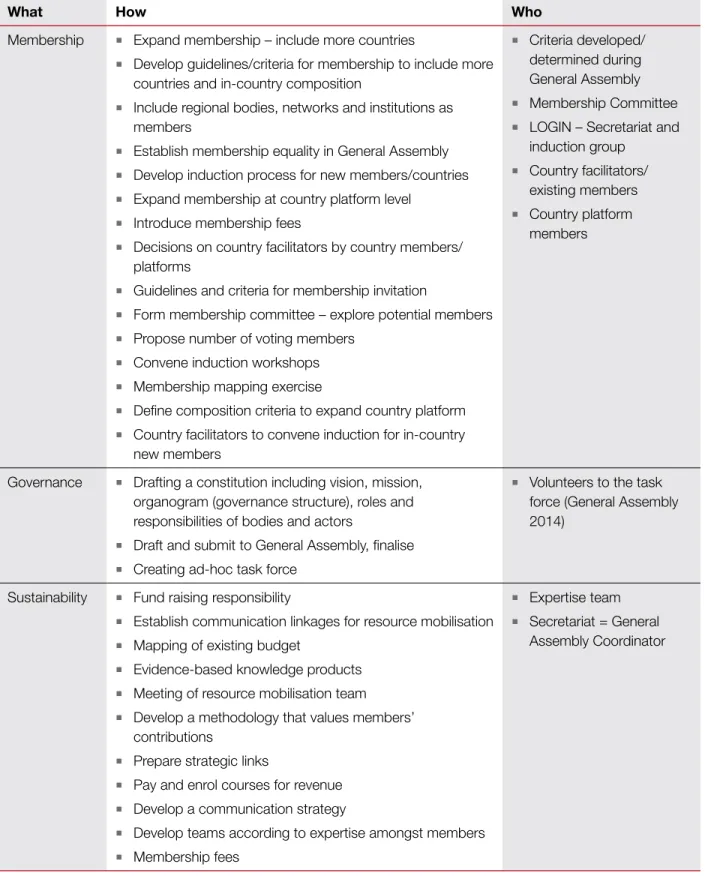
Country Platforms General Assembly Steering Committee (Funders + Country Representatives) Secretariat Thematic Group Thematic Group Contd...This group also came up with suggestions on how each of the three key themes identified – membership, governance and sustainability – should be taken forward and who within the LOGIN system should spearhead these activities. These suggestions are captured in the following table:
Table 4: Suggestions by the Institutional Group
What How Who
Membership Expand membership – include more countries
Develop guidelines/criteria for membership to include more
countries and in-country composition
Include regional bodies, networks and institutions as
members
Establish membership equality in General Assembly Develop induction process for new members/countries Expand membership at country platform level
Introduce membership fees
Decisions on country facilitators by country members/
platforms
Guidelines and criteria for membership invitation
Form membership committee – explore potential members Propose number of voting members
Convene induction workshops Membership mapping exercise
Define composition criteria to expand country platform Country facilitators to convene induction for in-country
new members
Criteria developed/
determined during General Assembly
Membership Committee LOGIN – Secretariat and
induction group
Country facilitators/
existing members
Country platform
members
Governance Drafting a constitution including vision, mission,
organogram (governance structure), roles and responsibilities of bodies and actors
Draft and submit to General Assembly, finalise Creating ad-hoc task force
Volunteers to the task
force (General Assembly 2014)
Sustainability Fund raising responsibility
Establish communication linkages for resource mobilisation Mapping of existing budget
Evidence-based knowledge products Meeting of resource mobilisation team
Develop a methodology that values members’
contributions
Prepare strategic links
Pay and enrol courses for revenue Develop a communication strategy
Develop teams according to expertise amongst members Membership fees
Expertise team Secretariat = General
DAY 3
Draft Twelve-Month Workplan
on the Content and Institutional
Aspects of the Network
1.
SDC’s feedback to the General Assembly
In the morning of Day 3, SDC colleagues presented their ideas for LOGIN’s future as well as the role of SDC. Ms. Vesna Roch, Head of Governance, SDC Laos, led the presentation and noted that the future of the network has to be worked out jointly with the LOGIN members. Different member countries are at different stages of network activities; while some countries have taken upon themselves the charge of organising meetings and activities, the others might need support from SDC country offices.
The relationship between the SDC country offices, LOGIN and its country platforms:
SDC discussed four aspects of the network – membership, seats/votes at the General Assembly, sustainability and opening up of the OC:
Regarding membership, it was highlighted that the criteria for new members needed detailed discussion, along with whether there should be a cap on membership. The LOGIN Governance Document needs to be revisited to see how representativeness and diversity can be ensured in terms of seats/votes. Sustainability of the network with regard to having new funding partners also needs consideration. A related issue is the opening up of the OC to new members. SDC is open to having new members in the OC; the criteria for membership needs to be worked out by
the network members.
SDC colleagues proposed constituting a Working Group on Governance Structure (WGGS) to chalk out the critical aspects of network structure. The Terms of Reference (ToR) of the working group would be developed in conjunction with the General Assembly. Each country would then decide whom to send to the working group. Although the easiest method of constituting the working group would be to have one member from each country, the General Assembly could decide whether they would like to have a smaller group of members who already have substantive ideas. A time frame of one year could be given to the WGGS, following which its proposals should be endorsed/rejected at General Assembly 2015.
Mr. Fabrice Fretz, Programme Officer at SDC East Asia Division, noted that he was humbled by the nature of engagement he saw in the two days of the General Assembly, which spoke of the quality of members associated with LOGIN. He added that SDC would like to go in the same direction as LOGIN as far as the network’s future is concerned.
2.
Draft twelve-month workplan on content and
institutional aspects of LOGIN
On Day 3, the General Assembly approved a draft twelve-month workplan on the content and institutional aspects of the network. The two groups – Content and Institutional aspects, presented their ideas before the entire General Assembly, following which members put forward their suggestions.
The Content Group
The Content Group proposes a workplan
The Content Group noted that it was difficult to narrow down a few thematic areas for 2015 after the rich discussions that took place on Day 2. Nevertheless, the most important learning themes were identified, along with the details of who demands, who offers and who leads each theme. In the second step, seven of these themes were selected by placing red dots on the themes that each member in the group thought were most important. These are:
Knowledge sharing on functional re-assignment Preparing women for elections
Social accountability
Capacity building through HLP
Civic engagement on local governance
Local development fund – through experience capitalisation Action research on local governance
The full list of thematic areas identified by the Content Group is given below.
Table 5: Thematic areas identified by the Content Group for 2015 (selected areas highlighted in grey)
S.No. What Who demands Who offers Who leads
1. Reassignment of functions Afghanistan,
Cambodia, Myanmar, Nepal Indonesia, Bangladesh (CIRDAP), Mongolia Mongolia and Bangladesh (CIRDAP) 2. Preparing women for politics Laos, Myanmar,
Bhutan (BNEW), Bangladesh (STEPS, Aparajita)
Mongolia, India (Joy, PRIA)
India (IC, PRIA), Bangladesh (Aparajita and CIRDAP)
3. Social accountability Bhutan, Laos,
Mongolia, Cambodia, Bangladesh, Myanmar
Nepal, Myanmar, Pakistan, Cambodia, India (PRIA)
Nepal (COMAT), India (PRIA), Bhutan (RIM) 4. Peer learning on HLP
between Nepal and Bangladesh to be continued
Nepal, Pakistan, Afghanistan, Bhutan, Laos, Mongolia, Cambodia
Bangladesh Bangladesh, CIRDAP
5. Civic engagement in local governance
India (IC), Nepal, Cambodia, Bhutan, Laos, Pakistan, Bangladesh (STEPS)
Cambodia, India (Joy, Alok), Nepal, Afghanistan, Pakistan, Mongolia
Mongolia, Nepal, India (PRIA)
6. Local Development funds (experience capitalisation)
Afghanistan,
Mongolia, Cambodia, Bangladesh
Bhutan (DLG, GNHC, RIM) and Laos (DDF)
India (IC) and Bhutan (DLG)
7. Action research on local governance
Myanmar, Afghanistan, Laos, Mongolia
Myanmar, India, Nepal India (PRIA) and Nepal (LG Associations) 8. Conference of training
institutions
India, Laos, Mongolia, Bhutan, Cambodia
Bangladesh (CIRDAP) and NIRD (India)
Bangladesh (CIRDAP) 9. How can local governments
create more financial resources?
Pakistan, Cambodia, Afghanistan
10. How can local governments manage finances they already have?
Pakistan, Afghanistan, Laos, Nepal
India India (PRIA)
11. How can local governments ensure quality in
functioning? (Procurement, finance, human resource management etc.) Pakistan, Cambodia, Laos, Nepal Mongolia Mongolia 12. How to form LG Associations?
Mongolia Pakistan Pakistan (Local
Council Association of Punjab - LCAP) 13. Service provision – one front
desk
Nepal, Afghanistan India, Cambodia (One Window Service Offices)
India (KGPA)
14. Some techniques on engaging people based on my experience
The group noted that cross-cutting issues, such as conflict scenarios, should be explored in all the themes. It emphasised that LOGIN’s online portal (MELP) should be actively used for discussion on these aspects. Further, the country platforms should also engage on these issues.
On the methodology of carrying out each theme, the group noted that it would be decided according to the demands made by the members.
Members respond to the Content Group’s workplan
The members who were not a part of the Content Group raised their concerns, and provided feedback and suggestions. A member asked who would pay for the expenses of offering and leading the learning themes. The Content Group responded that this was not decided as of yet, and should be discussed. It was pointed out that resources mean not only funds, but also intellectual resources and time provided. Concerns regarding the dissemination of the learning to the larger public and the relevance of the media were also raised. The Content Group agreed that the role of the media is significant and hoped to see more media organisations becoming a part of the country platforms.
Concern was also raised regarding the number of thematic areas identified – whether it was possible to implement them all. The group responded that the list of thematic areas identified was not carved in stone and needed to be discussed thoroughly through MELP. It was also added that the thematic areas need to be implemented keeping in account the political developments, such as elections, occurring within member countries.
The General Assembly approves the proposal
Following the feedback session, the General Assembly stood up and expressed its approval of the workplan on content.
The Institutional Group
The Institutional Group proposes a workplan
The Institutional Group presented their proposals for two critical institutional aspects of the network: (a) Strengthening governance structure and membership, and (b) Sustainability.
The Working Group on Governance Structure
To strengthen the governance structure and membership, the group suggested that SDC colleagues collect extensive suggestions from the group as well as the rest of the members in the General Assembly to develop the ToR of the WGGS. The WGGS was proposed by the SDC colleagues in the opening session of Day 3 as a suggestion to review the institutional aspects of LOGIN.
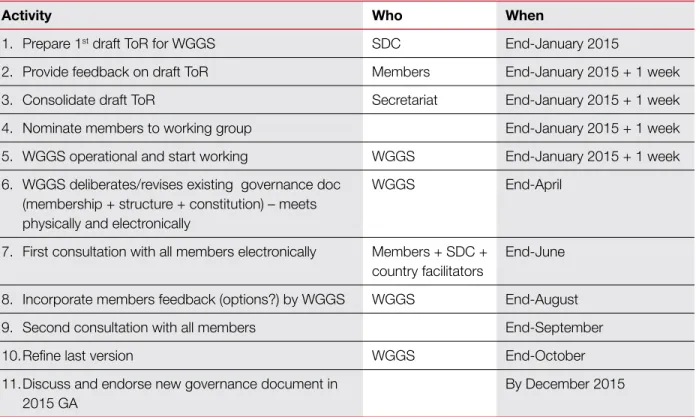
The 11 concrete stages of constituting and rolling out the WGGS, along with the details of who would perform the task and by when, were chalked out by the group as follows:
Table 6: Rolling out the WGGS
Activity Who When
1. Prepare 1st draft ToR for WGGS SDC End-January 2015
2. Provide feedback on draft ToR Members End-January 2015 + 1 week
3. Consolidate draft ToR Secretariat End-January 2015 + 1 week
4. Nominate members to working group End-January 2015 + 1 week
5. WGGS operational and start working WGGS End-January 2015 + 1 week
6. WGGS deliberates/revises existing governance doc (membership + structure + constitution) – meets physically and electronically
WGGS End-April
7. First consultation with all members electronically Members + SDC + country facilitators
End-June
8. Incorporate members feedback (options?) by WGGS WGGS End-August
9. Second consultation with all members End-September
10. Refine last version WGGS End-October
11. Discuss and endorse new governance document in 2015 GA
By December 2015
The following suggestions were put forward by the Institutional Group for the ToR:
Detail the purpose of WGGS Include in the content:
} Membership
} Governance structure } Representation } Procedures
} Rules and responsibilities
} Relations: LOGIN Asia/Country platforms } Relations with other members
The criteria for the members of WGGS should include: } Experience } Expertise in: y Institutional building/crafting y Networks y Organisational development y Governance
The WGGS shall consist of 5-7 members Gender balance be ensured
Sub-regional balance (South Asia/East Asia) be ensured Secretariat = Coordination
Sustainability
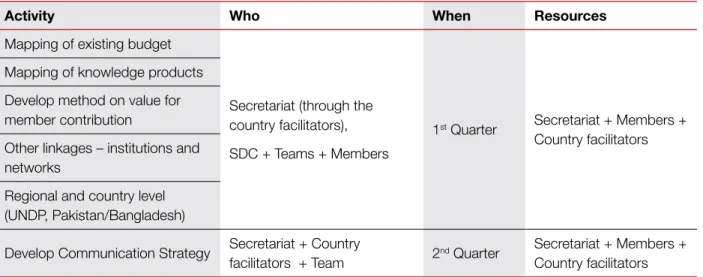
The Institutional Group also presented its proposal on the sustainability of the network, along with the details of who will perform the activity by when, as well as who would provide the resources. These are mapped below:
Table 7: Workplan on sustainability
Activity Who When Resources
Mapping of existing budget
Secretariat (through the country facilitators), SDC + Teams + Members
1st Quarter Secretariat + Members +
Country facilitators Mapping of knowledge products
Develop method on value for member contribution
Other linkages – institutions and networks
Regional and country level (UNDP, Pakistan/Bangladesh)
Develop Communication Strategy Secretariat + Country
facilitators + Team 2nd Quarter
Secretariat + Members + Country facilitators Members respond to the Institutional Group’s workplan
After the institution group presentation, members were asked to note any further suggestions they might have for the SDC to consider with regard to the composition and mandate of the WGGS:
Suggestions on the composition of the WGGS
Maintain multi-stakeholder nature in the WGGS
Ensure representation in WGGS: Decide criteria for composition of WGGS Set up separate working group on sustainability
Final composition of WGGS should be endorsed by members
Membership of WGGS: Secretariat, member country, SDC, country facilitators (all rotating) It’s good to dig more on how to select working group members
Members should be eminent persons
Suggestions on the Mandate of the WGGS
Members should inform the progress regularly Consultation should be done through MELP (online) Review the present governance structure thoroughly Come up with clear and solid criteria for membership Come up with member country criteria
Consider whether the sustainability issue should be included, i.e. membership fees and SDC’s funding
‘horizon’
Review General Assembly’s decision-making rules
If SDC allows a new donor, it is necessary to consider risks, in particular political risks Discuss registration of LOGIN as a legal entity
Roles and responsibilities of in-country platforms should be considered in the constitution Terms of Reference and reporting mechanism of country facilitators need clarity
OC needs to be regionally inclusive
Formulate a complaining mechanism about problems, i.e. a feedback mechanism Identify a mechanism for monitoring quality of learning journeys
Include sources of potential funding in the governance document Start looking for the donors for possible funding in 2015
The possible donor(s) should be invited in the General Assembly WGGS to work on strategy to increase diversification of dependence Formalise country platforms; leave the regional network as a loose entity Institute performance monitoring
Include plans for expansion (more countries)
Consider how to establish links with think-tanks, competence centres etc. Should they become
members, pay fees? What would they get out of it?
Review the location of Secretariat office in country offices
(a) Consider the link between donor, Secretariat and members, (b) Review annual plans and budgets,
(c) Look into resource mobilisation options
Sustainability: Explore cost-sharing mechanisms (for example, travel workshop-Bhutan-hosting and
expenses)
The General Assembly approves the proposal
Following the feedback session, the General Assembly stood up and expressed its approval of the workplan on the institutional aspects of the network.
3.
Closure of the 2
ndLOGIN General Assembly
Following the approval of the twelve-month workplan, members, seated in their country platforms, wrote key messages they would take back for other LOGIN members in their country who were not present at the General Assembly.
Annexure I:
Programme schedule
Background
About 70 Participants are expected from Afghanistan, Bangladesh, Bhutan, Cambodia, India, Laos, Mongolia, Nepal, Pakistan, Myanmar and SDC Head Office in Switzerland. The workshop will be held in English. As in the Constituent Assembly and first General Assembly, we will be working in groups and different settings during the workshop. The programme will be handled flexibly to accommodate expectations and give room to emerging ideas through the workshop.
Overall Purpose
Review Network progress and set Network Direction for 2015.
Objectives
Explore critical areas of Network progress
Capture learning about change triggered by LOGIN
Develop Theories of Change at the thematic and institutional level
Review current Network structure and functions, co-ownership, effectiveness and sustainability Set strategic priorities for 2015
Expected Results
Key areas of Network progress and areas required to be strengthened identified Agreement on the Theory of Change at the thematic and institutional level
Agreement on Network structure and functions, co-ownership, effectiveness and sustainability Agreement on strategic priorities for 2015
2 December 2014, Tuesday
08.30 – 09.00 Welcome and Inaugural Address
Explore critical areas of network progress: Capture learning on changes triggered by LOGIN
09.00 Introduction and working basis
Learning from the experience of Country Platforms
11.15 Break
11.45 What success looks like so far for the Network
13.00 Lunch
14.30 Concepts about change and capturing how it happens
16.00 Break
16.30 Reviews of approaches to inform and influence reform processes
17.30 End of day 1 main session
18.30 – 20.00 Parallel sessions on topics identified by Secretariat and Members
20.00 Dinner – Meet your peers
3 December 2014, Wednesday
Develop theories of change at the thematic and institutional level
09.00 Introduction and social reporting
09.30 Report to the Members
10.30 Break
11.00 Content and Institutional Strategy Review
13.00 Lunch
14.00 Content and Institutional Strategy Review continued
16.00 Break
16.30 Consensus building on Theories of Change
17.30 End of day 2 main session
19.30 Formal Dinner 4 December 2014, Thursday
Agree on strategic priorities for 2015
09.00 Introduction and Social Reporting
09.15 Finalisation of Theory of Change
09.45 Workplan preparation
10.30 Break
11.00 Workplan preparation continued
13.00 Lunch
14.30 Programme Consolidation – Network and Country level
16.00 Evaluation of Outcomes and Processes of the General Assembly
Annexure II:
List of participants
S.No. Participant Designation Organisation
Afghanistan
1. Mr. Mohammad Ismail
Qarizada
Senior Program Manager Swiss Agency for Development and
Cooperation, Afghanistan 2. Mr. Arian Mawz Sharifi LOGIN Country Facilitator
Bangladesh
3. Ms. Yasmein Sabina
Lubna
Senior Program Officer Swiss Agency for Development and
Cooperation, Bangladesh
4. Mr. Samar Roy Director Media Professionals Group
5. Mr. Badiul Alam Majumdar Country Director The Hunger Project
6. Mr. Ranjan Karmaker Executive Director Steps Towards Development
7. Mr. Akira Munakata JICA
8. Mr. Santanu Lahiri LOGIN Country Facilitator
Bhutan
9. Ms. Tashi Pem Deputy Country Director Helvetas Swiss Intercooperation
Bhutan
10. Mr. Dorji Norbu Director General Department of Local Governance
11. Mr. Wangdi Gyaltshen Senior Program Officer Department of Local Governance
12. Mr. Jit Tshering Assistant Professor Royal Institute of Management
13. Mr. Pasang Dorji Chief Planning Officer,
Local Development Division
Local Development Division, GNHC
14. Ms. Phuntshok Chhoden Coordinator Bhutan Network for Empowering
Women
15. Ms. Norbu Dema Program Manager DG+ and LOGIN
Country Facilitator
Gross National Happiness Commission
Cambodia
16. Mr. Bunchhoeuth Keng Regional Advisor CORD Asia
17. Mr. Chhonn Chuon Coordinator Working Group for Partnership in
Decentralisation Secretariat
18. Mr. Sambatphalla Chey Chief of Capacity Building Office National Committee for Democratic Development Secretariat
19. Mr. Chhor Jan Sophal Decentralisation and Governance Director
Pact Cambodia
20. Mr. Sok Sothy Deputy Director of Policy Analysis
and Development Division
National Committee for Democratic Development Secretariat
21. Mr. Michael Engquist LOGIN Country Facilitator
India
22. Mr. Joy Elamon Chief Executive Officer Intercooperation Social Development
India
S.No. Participant Designation Organisation
24. Mr. Alok Pandey Director PRIA
25. Ms. Veena Mahor Coordinator SETU Learning Lab
26. Mr. Ranjeet Nirguni Member Zila Parishad, Samastipur, Bihar, India
27. Ms. Tina Mathur LOGIN Country Facilitator
Laos
28. Ms. Nithsa Vongphanakhone
Senior Program Officer Swiss Agency for Development and
Cooperation, Laos 29. Mr. Hongthong Sirivath Land and Livelihood Program
Coordinator
Village Focus International
30. Ms. Catherine Perroud Coordinator INGO Network
31. Mr. Bounchanh Niyavong Deputy Director Department of Planning and
International Cooperation, Ministry of Home Affairs
32. Mr. Danang Thaophialuang Member Lao Civil Society Consortium
Mongolia
33. Mr. Diepak Elmer Deputy Country Director Swiss Agency for Development and
Cooperation, Mongolia
34. Ms. Perenlei Erdenejargal Executive Director Open Society Forum
35. Mr. Tur-Od Lakhagvajav Consultant
36. Mr. Battuvshin Bat-Ochir Head of Department on Civic Participation
Ulaanbaatar City 37. Mr. Dorjderem Dorj Assistant to the President’s Advisor Office of the President 38. Mr. Gerelchuluun
Yondon-Oidov
Chief of Staff Municipality of Ulaanbaatar
39. Mr. Saruul Agvaandorj Executive Director Direct Democracy Institute
Myanmar
40. Mr. Thet Win Aung National Program Officer, Health and Local Governance
Swiss Agency for Development and Cooperation, Myanmar
41. Mr. Kyaw Myint Senior Program Coordinator Paung Ku
42. Mr. Yin Nyein Program Officer Network Activities Group
43. Ms. Kyi Pyar Chit Saw Research Associate Centre for Economic and Social
Development
44. Ms. Nan Mya Thida Founder Thanlwin Power Youth for
Development and Kayin Research Institute for Social and Ecology
45. Ms. Hsu Mon Aung Program Officer Community Response Group
46. Mr. Thiha Ko Ko Program Officer, Governance Oxfam, Myanmar
Nepal
47. Mr. Jean-Francois Cuenod Director of Cooperation Swiss Agency for Development and
Cooperation, Nepal