HAL Id: inserm-00144413
https://www.hal.inserm.fr/inserm-00144413
Submitted on 22 Jan 2008HAL is a multi-disciplinary open access archive for the deposit and dissemination of sci-entific research documents, whether they are pub-lished or not. The documents may come from teaching and research institutions in France or abroad, or from public or private research centers.
L’archive ouverte pluridisciplinaire HAL, est destinée au dépôt et à la diffusion de documents scientifiques de niveau recherche, publiés ou non, émanant des établissements d’enseignement et de recherche français ou étrangers, des laboratoires publics ou privés.
Power comparison of different methods to detect genetic
effects and gene-environment interactions.
Rémi Kazma, Marie-Hélène Dizier, Michel Guilloud-Bataille, Catherine
Bonaïti-Pellié, Emmanuelle Génin
To cite this version:
Rémi Kazma, Marie-Hélène Dizier, Michel Guilloud-Bataille, Catherine Bonaïti-Pellié, Emmanuelle Génin. Power comparison of different methods to detect genetic effects and gene-environment inter-actions.. BMC Proceedings, BioMed Central, 2007, 1 Suppl 1 (Suppl 1), pp.S74. �inserm-00144413�
Power comparison of different methods to detect
genetic effects and gene-environment interactions
Rémi KAZMA1,2§, Marie-Hélène DIZIER2,1, Michel GUILLOUD-BATAILLE2,1,
Catherine BONAITI-PELLIE2,1, Emmanuelle GENIN2,1
1
Univ Paris-Sud, UMR-S 535, Villejuif, F-94817, France
2
INSERM UMR-S 535, Villejuif, F-94817, France
§ Corresponding author Email addresses: RK: [email protected] MHD: [email protected] MGB: [email protected] CBP: [email protected] EG: [email protected] Fax: (33) 1 45 59 53 31
2
Abstract
Identifying gene-environment (GxE) interactions has become a crucial issue in the past decades. Different methods have been proposed to test for GxE interactions in the framework of linkage or association testing. Their respective performances have however rarely been compared. Using GAW15 simulated data, we compare here the power of four methods: one based on affected sib-pairs that tests for linkage and interaction (the mean interaction test) and three methods that test for association and/or interaction: a case-control test, a case-only test and a log-linear approach based on case-parent trios. Results show that for the particular model of interaction between tobacco use and locus B simulated here, the mean interaction test has poor power to detect either the genetic effect or the interaction. The association studies, i.e. the log-linear-modeling approach and the case-control method, are more powerful to detect the genetic effect (power of 78% and 95% respectively) and taking into account interaction moderately increases the power (increase of 9% and 3% respectively). The case-only design exhibits a 95% power to detect gene-environment interaction but the type I error rate is increased.
Background
Gene-environment (GxE) interactions are likely to play an important role in multifactorial diseases. The detection of GxE interaction can be of major interest in epidemiological studies to help identify subgroups of the population which are at high risk of disease and at which prevention and screening programs should be targeted. The presence of interaction can conceal environmental and/or genetic effects if not considered in the analysis [1]. On the other hand, taking it into account may either enhance or reduce the power to detect genetic susceptibility factors depending on the parameters inherent to the model underlying disease susceptibility [2,3]. Towards that end, many statistical methods have been developed, in the past decades, either to directly investigate GxE interaction or to enhance detection of genetic factors by taking into account exposure status. They can be classified according to the design followed, the kind of data used and the hypothesis tested [1,4].
The purpose of our work is to compare the power of different methods to detect the effect of locus B and its interaction with history of tobacco use. We used
the simulated data (problem 3) of the 15th Genetic Analysis Workshop (GAW15) with
knowledge of the “answers” and compared four methods to test for genetic effect and/or GxE interaction. The first method referred to as the mean interaction test (MIT) method [5] tests linkage and GxE interaction among sib-pairs. It is compared to three association testing methods: a log-linear-modeling approach [6] that uses case-parent triads and a case-control design [4], both of which test for the effect of the gene and GxE interaction and finally a case-only design [7] that tests for interaction only.
Methods
One hundred replicates were studied at the disease susceptibility locus B that controls the effect of smoking on rheumatoid arthritis risk. In each replicate, 1500 affected sib-pairs were considered for the MIT, 1500 case-parent trios for the log-linear method, 1500 cases and controls for the case-control design and only the 1500 cases for the case-only test. We also studied smaller sample sizes (500 trios and 750 cases and controls) in order to compare the three association methods for the same number of genotyped individuals. Cases were obtained by considering the first
affected case in each sib-pair and controls were the first 1500 control subjects among the 2000 available for each replicate.
Since none of the SNPs close to locus B were in linkage disequilibrium with this locus, we used genotypes of all the individuals at that locus for association tests and the exact identity-by-descent (IBD) provided in the problem 3 "answers" for the linkage test. For the exposure status, we considered the lifetime smoking status and did not account for the indirectly increased risk through smoke effect on IgM. Four following methods were compared.
Mean interaction test
The MIT developed by Gauderman and Siegmund [5] is an extension of the mean sharing test [8] to account for GxE interaction. It compares the proportion of alleles shared IBD, π, (which is expected to be equal to 0.5 under the null hypothesis of no linkage) across the three groups of affected sib-pairs differing for the number of
exposed sibs (2, 1 or 0). The following regression model is used: πi = π+β(Xi-X)+εi
where π is the intercept and β the regression coefficient for the exposure, with Xi the
covariate of exposure centred on its mean X. We conducted analysis using the coding
scheme consisting of two variables (XEE and XEU) contrasting sib-pairs with 2, 1 or 0
exposed sibs. The null hypothesis of no linkage is tested by the likelihood ratio test
(LRT): Tπβ =2[ln{L(π=0.5,β=0)}- ln{L(π,β)}], which follows a 50:50 mixture
distribution of 2 and 3 degrees of freedom (df) χ2
. The alternative hypothesis corresponds to linkage with or without GxE interaction.
In its original presentation, the mean interaction test method allows accounting for GxE interaction in the search for linkage but does not test for GxE interaction. We
therefore developed a LRT for GxE interaction: Tβ=-2[ln{L(π,β=0)}-ln{L(π,β)}]. This
test follows a 2 df χ2
distribution.
Log-linear-modeling approach for case-parent triads
Proposed by Umbach and Weinberg (2000) [6], this method consists in comparing the conditional genotype distribution of exposed cases, given parental genotypes, versus that of unexposed cases. Briefly, case-parent triads are divided into 20 categories based on the parental genotypes, the genotype of the case and the
exposure status of the case. The expected number of triads can be expressed according to a log-linear model [3,6]. LRT are performed to test for (1) a gene effect ignoring
GxE interaction (which follows a 2 df χ2), (2) a gene effect accounting for GxE
interaction (which follows a 4 df χ2) and (3) a GxE interaction (which follows a 2 df
χ2
). Fit of the data with a dominant model is also tested as the true model was dominant.
Case-control design
Case-control designs have been widely used to compare risks of developing a disease according to their genotype and exposure status [4]. Odds-ratios (OR)
associated with the exposure, the genotypes and their interaction factors are estimated
and tested for significance. Three likelihood ratio tests are performed: a 2df χ2 test for
genetic effect alone, a 4df χ2
test for genetic effect accounting for GxE interaction, and 2df χ2
test ofGxE interaction. Fit of the data with a dominant model is tested
4
Case-only design
Case-only studies [4,7] test the interaction between an exposure and a
genotype among case subjects only. This type of design assesses the departure from a multiplicative scale, assuming independence between both factors. To test for the interaction, a 2 df LRT of homogeneity between the genotype distribution in exposed and unexposed cases is performed.
Powers of the different tests were estimated by determining the number of replicates among the 100 replicates that were significant at a nominal 0.05 type I error rate. Type I error rates to test for GxE interaction are estimated on the 7 loci (A, C-H) that are not supposed to interact with lifetime smoking status.
Results
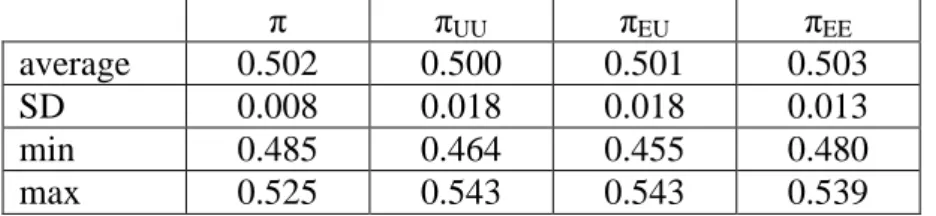
Table 1 gives the mean proportion of alleles shared IBD in the whole sample, and in each of the three sib-pair categories of exposure. Table 2 shows the power of the different tests. We found that MIT has almost no power to detect linkage even when accounting for GxE interaction. This could have been expected given the proportion of alleles shared IBD in the whole sample and in each of the 3 categories based on exposure. Indeed, these proportions are very close to the null expectation of 0.5 (Table 1).
With the log-linear model, the power to detect the gene effect is 78% and is increased to 87% when accounting for GxE interaction. There is thus a gain in power to detect the gene effect when accounting for GxE interaction under the simulated model. For the case-control design, the power to detect the gene effect is 95% and improves to 98% when accounting for interaction. As shown in Figure 1, the p-values of test accounting for GxE are smaller than those of the test not accounting for GxE for most of the replicates and similar trends (gain or loss of power) are observed between the two methods in 74% of the replicates.
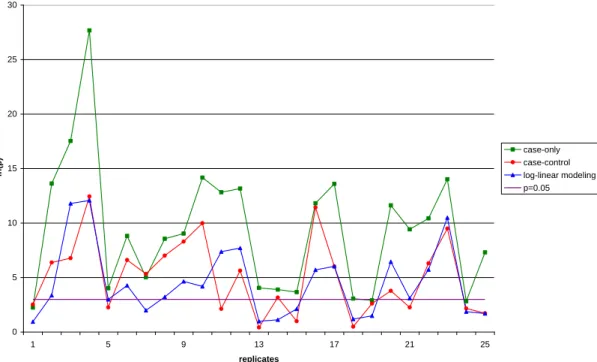
Concerning the detection of the GxE interaction, we found that the case-only design is by far the most powerful test. It reaches a 95% power where the case-control design only reaches 69%, the log-linear approach 53% and the linkage test (MIT) 12%. When constraining the number of genotyped individuals to be the same for the three association methods, the differences in power are even more increased. Figure 2 shows, for the first 25 replicates, the p-values of the GxE interaction test for the log-linear-modeling approach, the case-control and the case-only designs. We observe that it is generally in the same replicates that the different methods give the most significant results with the highest significance achieved for the case-only method.
Estimates of interaction factors presented in Table 2 do not seem to comply with a dominant model and indeed a dominant model is rejected in 60% of the
replicates with the case-control and in 46% of the replicates with the log-linear model. Average type I error rates for the interaction test over the 7 loci were
respectively 13% for the case-only design (ranging from 5% for locus H to 26% for locus C), 10% for the case-control (from 4% for locus H to 30% for locus C) and 8% (ranging from 3% for loci A and F to 23% for locus C) for the log-linear model.
Discussion
Under the GxE simulated model presented here, it is more powerful to test for association than to test for linkage. Indeed, the MIT method has extremely poor power to detect the genetic factor either with or without taking GxE interaction into
account. This could be explained by the low value of the interaction coefficient used in the simulations. Gauderman and Siegmund [5] actually showed that for an
interaction coefficient lesser than 3 (or greater than 1/3), the MIT will not be efficient. For the association-based approaches, accounting for the environmental factor increases the power to detect the genetic susceptibility factor from 78% to 87% for the log-linear method and from 95% to 98% for the case-control method. This gain in power is rather limited even though under the simulated model, the gene has an effect only in exposed subjects. This could be linked to the fact that the exposure is
relatively frequent in the population as shown by Selinger-Leneman et al. [3]. If one is interested in detecting the interaction, the case-only design is shown to be the most efficient. However, its validity depends on some assumptions, in particular, the independence between both genetic and environmental factors. Type I error rates were actually higher than expected (13% instead of 5%). It should be noted however that type I errors estimated for the two other methods were also inflated. This was essentially due to locus C that interacts with sex and might thus indirectly be associated to tobacco exposure. When locus C is excluded, type I error rates were close to expectation with the log-linear model (5%) and with the case-control (6%), but were still increased for the case-only design (10%).
Another point of concern was the model issue. In fact, the true model was dominant but dominance is rejected in the majority of the replicates but less often for the log-linear method than for the case-control. A plausible explanation for this distortion could be the fact that sib-pairs are ascertained, leading to a modification in expected parental genotype distributions. This is partially corrected for in the log-linear model by the conditioning on the parent genotypes.
All association approaches considered here do not take full advantage of the data since only one of the two sibs is used in each sib-pair. It would be interesting to extend the methods to use the whole sibship while correcting for the dependence between the sibs.
Conclusions
Although this study argues in favour of the use of the case-only design to detect a GxE interaction, it shows that if one is interested in detecting gene effect, accounting for the exposure is not necessary. This of course depends strongly on the underlying model and could probably be linked to the high exposure frequency. It will be of interest to compare again the different methods presented here over a much larger range of models.
References
1. Ottman R: Gene-environment interaction: definition and study designs.
Prev Med 1996, 25: 764-770
2. Dizier MH, Selinger-Leneman H, Genin E: Testing linkage and gene x
environment interaction: comparison of different affected sib-pair methods. Genet Epidemiol 2003, 25: 73-79
3. Selinger-Leneman H, Genin E, Norris JM, Khlat M: Does accounting for
gene-environment (GxE) interaction increase the power to detect the effect of a gene in a multifactorial disease? Genet Epidemiol 2003, 24:
6 4. Andrieu N, Goldstein AM: Epidemiologic and genetic approaches in the
study of gene-environment interaction: an overview of available methods.
Epidemiol Rev 1998, 20: 137-147
5. Gauderman WJ, Siegmund KD: Gene-environment interaction and affected
sib pair linkage analysis. Hum Hered 2001, 52: 34-46
6. Umbach DM, Weinberg CR: The use of case-parent triads to study joint
effects of genotype and exposure. Am J Hum Genet 2000, 66: 251-261
7. Khoury MJ, Flanders WD: Non-traditional epidemiologic approaches in the
analysis of gene-environment interaction: case-control studies with no controls! Am J Epidemiol 1996, 144: 207-213
8. Blackwelder W, Elston R: A comparison of sib-pair linkage tests for
disease susceptibility loci. Genet Epidemiol 1985, 2: 85-97
Tables
Table 1 - Proportion of alleles shared IBD in the sib-pairs
Average, standard deviation (SD), minimum (min) and maximum (max) values of the proportion of shared alleles between the 1500 sib-pairs over the 100 replicates are presented. π is the total proportion and πUU, πEU, πEE the proportion in sib-pairs with 0,
1 or 2 exposed sibs, respectively
π πUU πEU πEE
average 0.502 0.500 0.501 0.503
SD 0.008 0.018 0.018 0.013
min 0.485 0.464 0.455 0.480
max 0.525 0.543 0.543 0.539
Table 2 - Power and estimates of interaction coefficients of the four tests
Power in percent (%) to detect (1) the genetic effect accounting for interaction (G+I), (2) the genetic effect not accounting for interaction (G) and (3) the GxE interaction (I) were obtained over the 100 replicates. Average values of the interaction coefficients
estimates for exposure x Bb genotypes (IBb) and exposure x BB genotypes (IBB) are
represented with their empirical 95% confidence interval (CI)
G+I G I IBb IBB
mean interaction test 6 8 12 - -
log-linear-modeling (a) 87 78 53 1.33[1.03-1.71] 1.72[1.13-1.83] case-control (a) 98 95 69 1.39 [0.97-1.96] 1.88 [1.08-3.10] case-only (a) - - 95 1.39 [1.05-1.72] 1.86 [1.39-2.96] log-linear-modeling (b) 33 23 20 1.35[0.79-2.15] 1.79[0.82-3.68] case-control (c) 79 68 42 1.41 [0.85-2.09] 1.96 [0.99-3.37] (a)
Samples of 1500 families were used corresponding to 4500 (1500 triads), 3000 (1500 cases and 1500 controls) and 1500 genotyped individuals for the log-linear-modeling, the case-control and the case-only design, respectively.
(b)
Samples of 500 triads are considered corresponding to 1500 genotyped individuals.
(c)
Samples of 750 cases and 750 controls are considered here to limit the number of genotyped individuals to 1500.
Figures
Figure 1 - Difference in p-values of G+I and G tests
Difference is represented for the case-control (red plot) and the log-linear-modeling (blue plot) by ln(pG)-ln(pG+I) reported over the first 25 replicates
Figure 2 - Comparison of the p-values of the interaction tests
-ln(p) are reported for the case-only design (green plot), the case-control design (red plot) and the log-linear-modeling method (blue plot) over the first 25 replicates
0 5 10 15 20 25 30 1 5 9 13 17 21 25 replicates -ln(p) case-only case-control log-linear modeling p=0.05 -6 -4 -2 0 2 4 6 8 10 1 5 9 13 17 21 25 replicates ln(p G )-ln(p G +I ) case-control log-linear modeling