HAL Id: hal-00298124
https://hal.archives-ouvertes.fr/hal-00298124
Submitted on 22 Feb 2006HAL is a multi-disciplinary open access
archive for the deposit and dissemination of sci-entific research documents, whether they are pub-lished or not. The documents may come from teaching and research institutions in France or abroad, or from public or private research centers.
L’archive ouverte pluridisciplinaire HAL, est destinée au dépôt et à la diffusion de documents scientifiques de niveau recherche, publiés ou non, émanant des établissements d’enseignement et de recherche français ou étrangers, des laboratoires publics ou privés.
Inter-hemispheric linkages in climate change:
paleo-perspectives for future climate change
J. Shulmeister, D. T. Rodbell, M. K. Gagan, G. O. Seltzer
To cite this version:
J. Shulmeister, D. T. Rodbell, M. K. Gagan, G. O. Seltzer. Inter-hemispheric linkages in climate change: paleo-perspectives for future climate change. Climate of the Past Discussions, European Geosciences Union (EGU), 2006, 2 (1), pp.79-122. �hal-00298124�
CPD
2, 79–122, 2006 PEP overview J. Shulmeister et al. Title Page Abstract Introduction Conclusions References Tables Figures J I J I Back CloseFull Screen / Esc
Printer-friendly Version
Interactive Discussion
EGU
Clim. Past Discuss., 2, 79–122, 2006 www.clim-past-discuss.net/2/79/2006/ © Author(s) 2006. This work is licensed under a Creative Commons License.
Climate of the Past Discussions
Climate of the Past Discussions is the access reviewed discussion forum of Climate of the Past
Inter-hemispheric linkages in climate
change: paleo-perspectives for future
climate change
J. Shulmeister1, D. T. Rodbell2, M. K. Gagan3, and G. O. Seltzer4,†
1
Department of Geological Sciences, University of Canterbury, Private Bag 4800, Christchurch, New Zealand
2
Department of Geology, Union College, Schenectady, NY 12308, USA
3
Research School of Earth Sciences, The Australian National University, Canberra 2000, ACT, Australia
4
Department of Earth Sciences, Heroy Geology Lab, University of Syracuse, Syracuse NY 13244, USA
Received: 20 December 2005 – Accepted: 22 January 2006 – Published: 22 February 2006 Correspondence to: J. Shulmeister ([email protected])
CPD
2, 79–122, 2006 PEP overview J. Shulmeister et al. Title Page Abstract Introduction Conclusions References Tables Figures J I J I Back CloseFull Screen / Esc
Printer-friendly Version
Interactive Discussion
EGU
Abstract
The Pole-Equator-Pole (PEP) projects of the PANASH (Paleoclimates of the Northern and Southern Hemisphere) programme have significantly advanced our understanding of past climate change on a global basis and helped to integrate paleo-science across regions and research disciplines. PANASH science allows us to constrain predictions
5
for future climate change and to contribute to the management and mitigation of such changes. We identify three broad areas where PEP science makes key contributions.
1. The patterns of global changes: Knowing the exact timing of glacial advances
(synchronous or otherwise) during the last glaciation is critical to understanding inter-hemispheric links in climate. Work in PEPI demonstrated that the tropical Andes in
10
South America was deglaciated earlier than the Northern Hemisphere (NH) and that an extended warming began there ca. 21 000 cal years BP. The general pattern is consis-tent with Antarctica and has now been replicated from studies in Southern Hemisphere (SH) regions of the PEPII transect. That significant deglaciation of SH alpine systems and Antarctica led deglaciation of NH ice sheets may reflect either i) faster response
15
times in alpine systems and Antarctica, ii) regional moisture patterns that influenced glacier mass balance, or iii) a SH temperature forcing that led changes in the NH. This highlights the limitations of current understanding and the need for further fundamental paleoclimate research.
2. Changes in modes of operation of oscillatory climate systems: Work across all the
20
PEP transects has led to the recognition that the El Ni ˜no Southern Oscillation (ENSO) phenomenon has changed markedly through time. It now appears that ENSO operated during the last glacial termination and during the early Holocene, but that precipitation teleconnections even within the Pacific Basin were turned down, or off. In the modern ENSO phenomenon both inter-annual and seven year periodicities are present, with
25
the inter-annual signal dominant. Paleo-data demonstrate that the relative importance of the two periodicities changes through time, with longer periodicities dominant in the early Holocene.
CPD
2, 79–122, 2006 PEP overview J. Shulmeister et al. Title Page Abstract Introduction Conclusions References Tables Figures J I J I Back CloseFull Screen / Esc
Printer-friendly Version
Interactive Discussion
EGU
3. The recognition of climate modulation of oscillatory systems by abrupt climate events: We examine the relationship of ENSO to an abrupt SH climate event, the
Antarctic cold reversal (ACR), in the New Zealand region. We demonstrate that the onset of the ACR was associated with the apparent switching on of an ENSO signal in New Zealand. We infer that this related to enhanced zonal SW winds with the
amplifica-5
tion of the pressure fields allowing an existing but weak ENSO signal to manifest itself. Teleconnections of this nature would be difficult to predict for future abrupt change as boundary conditions cannot readily be specified. Paleo-data are critical to predicting the teleconnections of future abrupt changes.
1 Introduction
10
1.1 Background to the Pole-Equator-Pole projects of PANASH
The aim of all PANASH science is to understand the modes of climate and environ-mental variability. This work is problem/project focused. The ENSO climate system, for example, has been a particular focus for research. These research problems are tack-led through multi-proxy climate and environmental reconstructions and paleo-climate
15
modelling.
Within PANASH, the largest projects have been the three PEP transects. PEP I cov-ers the Americas, PEPII covcov-ers the East Asia to Australasia region, and PEPIII extends from Northern Europe to Southern Africa. Under the auspices of the PEPs hundreds of scientists have been involved in dozens of projects. The PEPs have played a major role
20
in bringing together disparate regions and research disciplines into cohesive science programmes and numerous, substantive outputs have been achieved (e.g. Markgraf, 2001; Battarbee et al., 2004; Dodson et al., 2004). Given the scale of the PEP projects, it is not feasible to attempt to summarise the whole of the science programme in a sin-gle paper. Instead this paper identifies three general areas of research where PEP
25
CPD
2, 79–122, 2006 PEP overview J. Shulmeister et al. Title Page Abstract Introduction Conclusions References Tables Figures J I J I Back CloseFull Screen / Esc
Printer-friendly Version
Interactive Discussion
EGU
systems. In order to further focus the paper we have chosen to review progress in one region, the South Pacific Basin, using a case study approach.
We highlight how the understanding derived from “paleo” work can assist in the man-agement and mitigation of future change. We focus on the need to work on high-resolution records that will allow paleoclimate science to interface with climate
mod-5
elling and management but we also emphasise the need for on-going fundamental research into past environments and climates. Despite many decades of paleoenvi-ronmental research we do not have adequate understanding of the patterns of change over huge swathes of the globe’s surface, notably Africa, the SH in general and much of the world’s oceans.
10
The three topics we have chosen to highlight are: 1) Patterns of global change, 2) Changes in the modes of oscillatory climate systems, and 3) Climatic teleconnections of abrupt climate events. The latter two topics deal with the unique power of “paleo” science to deal with longer-term changes and extreme events. The first topic, however, highlights a cautionary note about the limits of our knowledge.
15
2 Contribution 1: the pattern of global changes: case study – the Last Glacial Maximum and the timing of deglaciation in the Southern tropics and mid-latitudes
One of the longest standing debates in global climate change has been on the mech-anism of climate signal transfer from the region of climate forcing to the rest of the
20
globe. The largest climate changes of the recent geological past are the ice ages. On a glacial-interglacial timescale, the timing of glacial advances in the mid-latitude SH appears to be broadly synchronous with those of the main northern ice advances (e.g. Nelson et al., 1985). This is unexpected, as SH conditions based on orbital (Mi-lankovitch) forcing of solar insolation, should be out of phase with the Northern
Hemi-25
sphere (Mercer, 1984; Berger, 1992). The apparent synchrony requires rapid transfer of cooling from the Northern Hemisphere (NH). The main candidates for this forcing are
CPD
2, 79–122, 2006 PEP overview J. Shulmeister et al. Title Page Abstract Introduction Conclusions References Tables Figures J I J I Back CloseFull Screen / Esc
Printer-friendly Version
Interactive Discussion
EGU
changes in greenhouse gas concentration in the atmosphere (e.g. Petit et al., 1999; In-derm ¨uhle et al., 2000) and/or changes in heat transport through ocean (thermohaline) circulation (e.g. Broecker, 2000; Stocker, 2000).
The focus for much of this work has centred on the termination of the last ice-age. The primary reason for this is that the warming associated with this termination is both
5
rapid and of similar or even larger magnitude than the human-induced climate modifica-tion expected under future greenhouse-gas scenarios (Watson et al., 2001). A second reason is that numerous climate archives that span the last deglaciation are both avail-able and well dated. Over the last decade or so, it has become apparent that the timing of deglaciation in the NH (as typified by the Greenland ice core records) and the SH (as
10
exemplified by Antarctica ice core records) are not in harmony. Antarctica started to deglaciate at ∼17 000 calendar years ago whereas Greenland did not deglaciate until ∼14 700 years ago. This and the mis-timing between late glacial-interglacial transition (LGIT) cooling events, such as the SH Antarctic Cold Reversal and NH Younger Dryas, is seen as evidence for the so-called climate “see-saw”. This, in turn, appears to
sup-15
port a deep ocean overturn mechanism of global climate transmission, though it is not easy to resolve whether the North leads the South, or vice-versa (e.g. Steig and Alley, 2002).
Though the thermohaline mechanism is not universally accepted, there is little doubt that there is an interhemispheric offset in climate change. In the immediate post-LGM
20
period, a warming manifested itself in Antarctica before it showed up in Greenland. A possible implication is that deglaciation started in Antarctica and propagated to the NH. This debate, however, has proceeded without much reference to either the tropics or the mid-latitude SH. Here we present a cautionary note, wherein we summarise evi-dence for an early “LGM” and an early start to deglaciation in the tropics and southern
25
mid-latitudes. These data can be interpreted to imply that deglaciation started in the tropics and propagated firstly to low mid-latitudes before extending to Antarctica and Greenland.
CPD
2, 79–122, 2006 PEP overview J. Shulmeister et al. Title Page Abstract Introduction Conclusions References Tables Figures J I J I Back CloseFull Screen / Esc
Printer-friendly Version
Interactive Discussion
EGU
2.1 Timing of the LGM and deglaciation in the SH tropics and mid-latitudes 2.1.1 Tropical South America
Recent work (Smith et al., 2005a) has highlighted evidence for the relative unimpor-tance of the globally defined LGM in the Andes of Peru and Bolivia. There, moraines from six valleys (3 valley systems), previously attributed to LGM advances, proved to
5
be much older (Fig. 1). The moraines that date to the global LGM advance are located significantly up valley from their originally inferred LGM ice positions. In addition, a late last glaciation (OIS 3) advance, dating to between 34 000 and 28 000 years ago, was significantly bigger than the subsequent OIS 2 LGM advances in all these systems. Ice may have remained in an advanced position until about 23 000 years ago, after which
10
it retreated rapidly up valley. Therefore, it appears that the global LGM was marked by a minor re-advance during the local deglaciation of the tropical Andes.
A major strength of the recent work of Smith et al. (2005a) is the scale of the dating. Several hundred 10Be ages were determined of which 106 ages relate to late last glaciation advances. The general pattern of the ages is compelling.
15
One long-standing climate inference regarding global cooling, based on estimates of equilibrium line altitude (ELA) depression during the global LGM, is also challenged by the Smith et al. (2005a) findings. With the dramatic reduction in the revised extent of the LGM comes a new calculation of the ELA depression during the LGM (Smith et al., 2005b). ELA depressions of only 300–600 m are estimated for the western side of the
20
tropical Andes, indicating LGM cooling of only 2–4◦C. This is much closer to the tropical ocean cooling inferred for the Pacific than the changes derived from the Atlantic Basin. The Smith et al. (2005) conclusion of relatively minor ice extent during the LGM in the Peruvian Andes is consistent with several other studies from the tropical Andes. Seltzer (1994) reported basal radiocarbon dates from a moraine-dammed lake in a
25
cirque in the Cordillera Quimsa Cruz Bolivia of ∼20 000 cal yr BP. These dates require deglaciation before this time, and a maximum glacial ELA lowering of <500 m, far less than the purported global average of ∼1000 m for the LGM (Broecker and Denton,
CPD
2, 79–122, 2006 PEP overview J. Shulmeister et al. Title Page Abstract Introduction Conclusions References Tables Figures J I J I Back CloseFull Screen / Esc
Printer-friendly Version
Interactive Discussion
EGU
1989; Porter, 2001). Likewise, Mark et al. (2002) report a maximum ELA depression of 500 m for LGM paleoglaciers in the Quelccaya Ice Cap region of southern Peru. In contrast, in the Andes of northern Peru, Ecuador, and Colombia workers have reported considerably higher (up to ∼1500 m) estimates of the magnitude of ELA depression during the LGM (e.g., Clapperton, 1986; Rodbell, 1992; Mark and Helmens, 2005),
5
with universally more ELA depression on the eastern side of the Andes than on the western side. This latter was echoed in the findings of Smith et al. (2005b). These differences raise two significant questions: 1) Does the apparent northward increase in ELA depression for purported LGM paleoglaciers reflect a real paleoclimatic gradient or is it the product of poor age control in northern regions? 2) Do the apparent increases in
10
ELA depression from west to east across the Andes reflect real paleoclimatic gradients or are they the product of different glaciological conditions on the eastern side of the Andes than on the western side. These latter could include the positive feedback set up by paleoglaciers advancing into regions of increasing mean annual precipitation, or higher debris cover on glaciers on the eastern side of the Andes, which general flowed
15
down deeply incised bedrock valleys, whereas those on the western side were mostly piedmont glaciers that expanded out onto Inter-Andean plateaus at ∼4000 m a.s.l., such as the Altiplano of southern Peru and Bolivia.
2.1.2 Temperate Australasia
During the peak of the last ice age at least discontinuous glaciation extended from
20
Antarctica as far north as the Snowy Mountains in southeastern Australia (36◦450S) in the SW Pacific region. Here again a traditional view of last glacial maxima coinciding with the global LGM has required revision as new age control data have come to light. The classic glacial sequence in New Zealand comes from the Kumara-Moana area in Westland (Suggate, 1990). The LGM is defined by the Larrikins-2 advance in north
25
Westland and the M52advance in south Westland (Suggate and Almond, 2005). These date to 24 500 to 21 500 years ago. They are not, however, the largest advances during the latter part of the last ice age. Instead the Larrikins-1/M51advance between 34 000
CPD
2, 79–122, 2006 PEP overview J. Shulmeister et al. Title Page Abstract Introduction Conclusions References Tables Figures J I J I Back CloseFull Screen / Esc
Printer-friendly Version
Interactive Discussion
EGU
and 28 000 years ago extended further and is volumetrically bigger (Fig. 2). The main LGM advance on the eastern side of the Alps is poorly dated except in the Rakaia Valley in Canterbury. Here the Bayfield advances (Soons and Gullentops, 1973), which may represent two Last Glacial maxima yield a mean age of less than 23 500 years ago roughly co-eval with moraines on the west coast. Recent luminescence dating
5
(Shulmeister et al., unpublished data) of outwash deposits previously mapped as OIS 4 indicates that late OIS 3 advances (provisionally post 37 000 years ago) are also recorded (Fig. 2). These OIS 3 ice limits are significantly greater than the true LGM limits. While the timing of relationships between the eastern and western advances requires further work, one conclusion is that the LGM is not the major glacial advance
10
in the latter part of the last glaciation in New Zealand.
The New Zealand pattern is partially confirmed by discontinuous data from Australia. On the eastern highlands at Mt Kosciusko (36◦450S) Barrows et al. (2001) recognised a significant glacial advance at about 32 000 cal yr ago. A pseudo-LGM advance dating to between 24 and 22 000 cal yr ago is also noted but is significantly smaller than the
15
late MIS 3 advance. In contrast, glacial advances in Tasmania during the latter half of the last glaciation are limited to small scale cirque readvances (e.g. Barrows et al., 2002; Kiernan et al., 2004). The LGM moraines were constructed around 20 000– 17 000 years ago. They may, or may not, have reoccupied late OIS 3 positions.
A further notable feature of New Zealand paleoclimate is the apparent lack of cooling
20
at the LGM. Traditional proxies such as ELA depression (Porter, 1975) and sea-surface temperature reductions in the Tasman Sea (Barrows and Juggins, 2005) indicate cool-ing of between 3–7◦C with most reconstructions indicating 4–5◦C. These values are less than many other regions of the globe but recent efforts to quantify cooling on land have challenged even these moderate figures. Reconstructions from beetle work
25
shows maximum cooling of ∼4◦C during the LGM (Marra et al., 2004) with cooling dur-ing the parts of the LGM averagdur-ing only 1◦C from a site immediately proximal to an ad-vanced glacier (Marra et al., 2006)! Physical modelling of ice accumulation conditions also suggest that cooling of as little as 2–4◦C could trigger large-scale ice advances
CPD
2, 79–122, 2006 PEP overview J. Shulmeister et al. Title Page Abstract Introduction Conclusions References Tables Figures J I J I Back CloseFull Screen / Esc
Printer-friendly Version
Interactive Discussion
EGU
in New Zealand (Rother and Shulmeister, 2005). The distinct impression is that while small-scale readvances do occur during the LGM, the peak cooling preceeds the LGM by several thousand years, possibly in direct response to the SH insolation minimum at 35 000–30 000 years ago (Vandergoes et al., 2005). Arguments for direct NH forcing are difficult to sustain.
5
In contrast to New Zealand, temperature reconstructions for Australia suggest sig-nificant LGM cooling (ca. 9◦C) (Barrows et al., 2001). This trans-Tasman conundrum needs resolution, but we note that there are many more data for New Zealand than temperate Australia.
2.1.3 The deglaciation
10
The only comprehensively dated deglaciation sequence in New Zealand comes from Cobb Valley in the north-western South Island (Shulmeister et al., 2005). Here, seven separate ice terminal positions over a 21 km sequence of end moraines, roche mou-ton ´ees and glacially carved bed forms effectively yield a single deglaciation age of 16 400+/−2400 years from surface exposure age dating. Calibration issues mean that
15
the precise age may move by a few percent, and is most likely to be older, but the overwhelming message from this site is the stagnation and rapid disappearance of the local ice cover early in the deglaciation. A rapid and massive deglaciation, as observed in most of the major valley systems, is consistent with evidence for a substantial retreat from LGM positions without early stage deglaciation. This situation is mirrored in
Tas-20
mania and the Australian mainland, where no late last deglaciation readvances are observed, indicating early ice evacuation from these areas.
The well known Waiho Loop advance of the Franz Josef Glacier (e.g. Denton and Hendy, 1994) demonstrates that some glaciers did readvance during the deglaciation. In the case of the Waiho Loop it is unclear whether this advance is synchronous with
25
the Younger Dryas Chron (YD) or immediately preceeded it. The lack of biological evi-dence for cooling (see below) and the confinement of YD readvances to high elevation catchments suggests that precipitation, rather than temperature decline, is the primary
CPD
2, 79–122, 2006 PEP overview J. Shulmeister et al. Title Page Abstract Introduction Conclusions References Tables Figures J I J I Back CloseFull Screen / Esc
Printer-friendly Version
Interactive Discussion
EGU
forcing for this advance (e.g. Shulmeister et al., 2005).
Support for an early and fairly continuous deglaciation comes from at least two other terrestrial proxies from the New Zealand region. Williams et al. (2005) have recently presented a composite speleothem record from South Island, New Zealand covering the last 22 500 years. Stable isotope values reach a nadir at about 18 500 years and a
5
gradual shift from glacial to non-glacial conditions started at this time. Modern values were achieved by ∼15 000 years ago (Fig. 3). This record is quite noisy and suggests a greater degree of variability during the deglaciation than is evident from either the pollen or glacial records. The first biological evidence for a switch from full glacial conditions is recorded in a high resolution pollen record from Auckland in northern New Zealand
10
also ∼18 500 years (Sandiford et al., 2003). For many years, pollen records from New Zealand have generally indicated a pattern of fairly continuous climatic warming during the deglaciation with little evidence of any significant reversals (e.g. McGlone, 1995). More recently, Turney et al. (2003) and McGlone et al. (2004) presented a series of high resolution pollen records supported by intensive radiocarbon dating. For their
15
more southerly sites, they concluded that initial warming began shortly before 17 000 years ago and continued until at least 14 600 years ago without a break. Thereafter, they inferred a short-lived cool episode of 1000 years duration which they correlated to the Antarctic Cold Reversal. Sustained warming was observed during the YD.
2.1.4 Middle to low latitude South America
20
The evidence from mid-latitude South America is somewhat contradictory. On the one hand, there is clear evidence for a major advance of the glaciers in southern Chile at, or about, 28 000 cal yr BP (Lowell et al., 1995). This advance also appears to show up further north in the marine record off Chile at 33◦S (Lamy et al., 1999). In con-trast, Kaplan et al. (2004) demonstrate that multiple late glacial advances occurred at
25
Lago Buenos Aires in Patagonia. The earliest and largest of these advances occurred at 23 000±1200 years. They find no pre-23 000 year advances belonging to the last glacial cycle. One possible explanation is that this strongly eastern glacial location was
CPD
2, 79–122, 2006 PEP overview J. Shulmeister et al. Title Page Abstract Introduction Conclusions References Tables Figures J I J I Back CloseFull Screen / Esc
Printer-friendly Version
Interactive Discussion
EGU
starved of moisture when glaciers were most extended west of the Andes.
Lake sediment records from two localities in the tropical Andes indicate that initiation of deglaciation there preceeded that in the NH (Seltzer et al., 2002). Cores from Lakes Junin and Titicaca, which are among the relatively few lakes in the Andes that are located beyond the extent of LGM paleoglaciers, record glaciation in the surrounding
5
cordillera as increases in the abundance of glacial flour. These records cleary show the initial reduction in glacial flour flux beginning prior to 20 000 cal yr BP, and cessation by ∼19 000 cal yr BP. Sediment records from lakes within the LGM ice limits record a late glacial readvance that was underway by 14 000 cal yr BP, and rapid ice retreat that began ∼13 000 cal yr BP (Rodbell and Seltzer, 2000). Most paleoglaciers retreated to
10
nearly modern (∼1950 AD) limits by 12 500 cal yr BP, but some actually disappeared for several thousand years before reforming in the mid-late Holocene (Abbott et al., 2003). There has been considerable disagreement over the moraine evidence for an ice ad-vance synchronous with the YD adad-vance of the NH (reviewed in Rodbell and Seltzer, 2000). In general, there is neither the necessary age control nor the unambiguous
15
stratigraphic evidence to provide compelling evidence for a significant ice advance dur-ing the YD in the tropical Andes. The aforementioned lake sediment evidence, which is both well-dated and continuous, provides solid evidence for rapid ice retreat during the YD. The YD, however, was apparently cold in the tropical Andes as evidenced by the Huascaran Peru ice core record (Thompson et al., 1995). Thus it appears that
condi-20
tions must have become suddenly drier during this time in order to drive significant ice retreat.
2.1.5 Summary
The timing of the maximum glaciation in the latter part of the last ice age in the Andean tropics of South America preceded the LGM by 5–10 kyr. There is widespread evidence
25
of late OIS 3 advances in the tropics and mid-latitudes of the SH. These advances are bigger and more pervasive than the LGM advance, at least in the South American Andean tropics and in Australasia. A reasonable case can be made that the first step
CPD
2, 79–122, 2006 PEP overview J. Shulmeister et al. Title Page Abstract Introduction Conclusions References Tables Figures J I J I Back CloseFull Screen / Esc
Printer-friendly Version
Interactive Discussion
EGU
towards an interglacial climate occurred at about 18 500 cal yr BP in the southern mid-latitudes.
The available paleo-records suggest that the sequence of events for the last deglaciation could be re-interpreted as follows (see Fig. 3): Tropical (and mid-latitude SH) glacial maxima were achieved 5–10 000 years before the LGM. The
deglacia-5
tion in both regions effectively starts soon after 28 000 years ago but is interrupted by smaller-scale re-advances during the LGM. By about 18 500 years ago these regions have started a nearly continuous drift to deglaciation. This is 1500 years before the inferred warming of Antarctica at ∼17 000 years ago and at least 3000 years ahead of Greenland, which warmed after 15 500 years ago. In both Australasia and tropical
10
Andean South America there are glacial fluctuations around 14 000 years ago though it is unclear whether their timing coincides.
The significance of these observations is that they challenge the basic assumptions of climate change on which we base our predictions of global climate response. The records could be interpreted to demonstrate that the Andean tropics and mid-latitude
15
SH lead the polar regions. Our purpose, however, is not to directly dispute the under-standing of patterns of global change. It is to emphasise the extent of the uncertainty, given the limitations of the available paleoclimate records. It is imperative, therefore, that fundamental research into the basic patterns of long-term global change continues to be supported. There are large areas of the planet, notably Africa, the SH and large
20
sections of the oceans where our understanding of long-term climate and environmen-tal change is inadequate. We will not be successful in predicting future responses to climate modification if we can’t even specify the patterns of past changes.
CPD
2, 79–122, 2006 PEP overview J. Shulmeister et al. Title Page Abstract Introduction Conclusions References Tables Figures J I J I Back CloseFull Screen / Esc
Printer-friendly Version
Interactive Discussion
EGU
3 Contribution 2. The recognition and definition of longer-term changes in modes of operation of climate phenomena. Case study: the Holocene evo-lution of ENSO and change from long frequency to biennial oscillation ENSO dominance
The ENSO phenomenon contributes a large portion of the interannual (2–7 yr)
vari-5
ability in the modern climate system (Gagan et al., 2004). Work across all the PEP transects has led to the recognition that ENSO has changed markedly through time. In particular, a mid-Holocene shift or drift in ENSO activity by ∼5000 yr BP has been postulated from both modelling studies (e.g. Clement et al., 1999) and paleo-ENSO records (e.g. Shulmeister and Lees, 1995; Shulmeister, 1999; Rodbell et al., 1999;
10
Moy et al., 2002). A further intensification of ENSO is often invoked at around 3000 yr BP (e.g. Sandweiss et al., 2001; Woodroffe et al., 2003; Gagan et al., 2004). Under-standing ENSO variations under mid-late Holocene conditions is particularly important because global sea-level and ice cover are effectively modern, leaving potential forc-ings such as extra-tropical forcing, changes in mean temperature and the like to be
15
examined (Diaz and Markgraf, 1992).
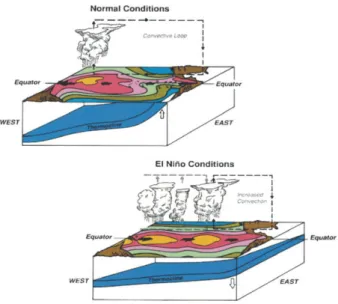
The following brief review of the ENSO phenomenon follows Cane (2005) (Fig. 4). ENSO is an ocean-atmosphere circulation pattern in the Pacific set up by 2–7 year os-cillations in the temperature contrast between the western and eastern tropical Pacific. This zonal temperature contrast is due to upwelling of cold water in the eastern
equa-20
torial Pacific, while warm surface waters in the tropical western Pacific are maintained by inflow from the equatorial regions under the prevailing easterly trade wind systems. The temperature contrast maintains the trade wind flow and provides a positive feed-back, the so-called “Bjerknes mechanism” (Cane, 2005). If the trade winds weaken, the flow collapses and ultimately reverses. The mechanism explains why the
circula-25
tion breaks down (to an El Ni ˜no) once cooling has started in the western Pacific but it does not provide the trigger for the switch to an El Ni ˜no state. This is most probably provided by wave propagation in the tropical ocean thermocline which is described as
CPD
2, 79–122, 2006 PEP overview J. Shulmeister et al. Title Page Abstract Introduction Conclusions References Tables Figures J I J I Back CloseFull Screen / Esc
Printer-friendly Version
Interactive Discussion
EGU
the delayed oscillator (Cane, 2005).
The bandwidth for modern ENSO oscillations is 2–7 years. ENSO frequency may respond to solar forcing (e.g. Nuzhdina, 2002) with longer duration ENSO cycles co-inciding with periods of stronger solar activity (Enfield and Cid, 1991). Whether or not there is a solar component to the forcing, a bi- or tri-modal ENSO can be
identi-5
fied from the analyses of instrumental records as well as predicted conceptually from modelling (Lau and Sheu, 1988). The different duration ENSOs are similar in clima-tology and oceanographic effects, but have some notable differences also. Tomita and Yasunari (1993) identified two types of ENSO; a long-frequency ENSO with a mean duration of 57 months and a biennial-oscillation ENSO with a duration of 30 months.
10
The biennial-oscillation ENSO causes a sea surface temperature (SST) anomaly for only one year in the eastern tropical Pacific but is associated with a clockwise eddy of wind-stress anomalies in the western tropical Pacific during the “mature” El Ni ˜no phase (Tomita and Yasunari, 1993). This wind stress anomaly assists in terminating the El Ni ˜no phase of the ENSO phenomenon and forms part of a teleconnection to the East
15
Asian winter monsoon. Long-frequency ENSO causes SST anomalies in the eastern equatorial Pacific for three successive years but has no wind-stress anomaly in the western tropical Pacific.
ENSO has very significant climatic impacts within the Pacific basin, and through teleconnections to other parts of the globe. Substantial progress has been made in
20
understanding the modern phenomenon, but ENSO has proved very variable in both temporal and spatial impacts, and modern ocean and atmosphere records are not long enough to decipher long-term changes in ENSO behaviour. Here we present a series of ENSO records from across the South Pacific Basin. Cumulatively these records clearly indicate that the frequency of ENSO events has increased through the course
25
of the Holocene and that the mean strength of El Ni ˜no events has also increased. The records do not, however, imply that the ENSO system has ever switched off.
CPD
2, 79–122, 2006 PEP overview J. Shulmeister et al. Title Page Abstract Introduction Conclusions References Tables Figures J I J I Back CloseFull Screen / Esc
Printer-friendly Version
Interactive Discussion
EGU
3.1 ENSO in South America
The impact of ENSO on the western margin of South America has been documented for the past several centuries (e.g., Quinn et al., 1987). During non-El Ni ˜no years in the tropical eastern Pacific, tradewind circulation dominates, SSTs are cool, and the ∼75 km wide onshore coastal belt below 3000 m a.s.l. is very dry. During El Ni ˜no
5
events tradewinds slacken, the thermocline in the eastern Pacific deepens, and rainfall increases dramatically along the coast. During strong El Ni ˜no years, rising motions occur in parts of the eastern Pacific troposphere that are normally characterized by subsidence and inversion. Under these conditions, rainfall along the coast can be extreme, driven by intraseasonal bursts of deep convection and torrential rainfall.
10
The inland extent of precipitation events is limited, and, generally, east of the crest of the Andes the climatic response to El Ni ˜no events is muted, and in some regions the response is opposite of that noted along the coastal belt. One region where the latter is especially true is on the Peruvian-Bolivian Altiplano. In this region, El Ni ˜no events are marked by a significant reduction in precipitation.
15
The best known record from the high Andes is the Laguna Pallcacocha (Ecuador) record (Rodbell et al., 1999; Moy et al., 2002). Here a 15 000-year record of clastic sediment influx to a lake marks precipitation driven run-off events in a normally semi-arid setting. Spectral analysis of colour changes in the sediments related to the influx events shows that for the last 150 years the colour banding contains significant spectral
20
variance in the 2–7 year ENSO bandwidth. The influx bands are associated with warm SST excursions off the coast of Ecuador during El Ni˜no events. Modern ENSO band variance, along with decadal to centennial scale variance, appears after about 6000 years ago.
The Laguna Pallcacocha record demonstrates a long-term drift from long period
vari-25
ability to shorter period variability (Fig. 5). During the early Holocene, all the spectral variability occurs at long time periods dissimilar to modern ENSO signals. From 6000 to about 3000 years ago the period of variability shortens and a ca. 7 yr ENSO signal
CPD
2, 79–122, 2006 PEP overview J. Shulmeister et al. Title Page Abstract Introduction Conclusions References Tables Figures J I J I Back CloseFull Screen / Esc
Printer-friendly Version
Interactive Discussion
EGU
becomes visible. In the last 3000 years the signal frequency has been increasing and 3–4 year period signals have become important. In short ENSO frequency appears to have increased through the Holocene at this site.
Over the last 6000 years, where ENSO has been visible in this record, it is not consistently strongly “on”. Instead at least three phases of enhanced ENSO events
5
centred around 5000, 3000 and 1000 years ago can be recognised. This was inferred by Moy et al. (2002) to represent a roughly 2100 year cyclicity. This repetitive pattern may be forced by insolation (solar activity).
Recently, the first nearly-continuous 20 000-year long archive of past El Ni ˜no activity has been obtained from marine sediments off the coast of Peru (Rein et al., 2005).
10
This record shows significant El Ni ˜no activity as early as 17 000 cal yr BP, strong activity during the late glacial, and a marked reduction in El Ni ˜no activity from 9–5000 years BP. The Holocene portion of this record agrees well with the aforementioned Pallcacocha record, however this is the first compelling evidence of strong El Ni ˜no frequencies during MIS 2 from the eastern tropical Pacific.
15
3.2 Coral records of ENSO in the West Pacific Warm Pool
Viewed as an oceanic system, the Western Pacific Warm Pool (WPWP) and Indonesia form the “down-drift” core region for ENSO. Under normal conditions, the surface wa-ters of the WPWP are very warm (>28◦C) and provide vast quantities of atmospheric water vapour and latent heat that drive the world’s climate. The resulting high levels
20
of convective rainfall make the surface waters of the WPWP less saline than aver-age tropical seawater. This low density warm pool water is displaced eastward during El Ni ˜no events and SSTs in the WPWP decline by about 1◦C, mainly in response to the thinning of the surface mixed layer and greater mixing with underlying, cooler wa-ter. Consequently, atmospheric convection in the WPWP region is disrupted during
25
El Ni ˜no events (Rasmusson and Carpenter, 1982) causing drought conditions in the WPWP region (Ropelewski and Halpert, 1987).
CPD
2, 79–122, 2006 PEP overview J. Shulmeister et al. Title Page Abstract Introduction Conclusions References Tables Figures J I J I Back CloseFull Screen / Esc
Printer-friendly Version
Interactive Discussion
EGU
through changes in the δ18O values in their skeletons. These changes in skeletal
δ18O reflect the combined effect of cooler SSTs and the reduction in18O-depleted rain-fall during El Ni ˜nos. Analysis of fossil corals from northern Papua New Guinea dating to 7600–5400 years years ago suggests that ENSO amplitude was reduced to 85– 40% of modern (Tudhope et al., 2001; McGregor and Gagan, 2004; Fig. 6). Records
5
from Christmas Island in the central equatorial Pacific also contain a strong ENSO signal indicating ENSO amplitudes 80–60% of modern from ∼4000 to 3300 years ago (Woodroffe and Gagan, 2000; Woodroffe et al., 2003). In contrast, large and protracted El Ni ˜no events are identified for 2500–1700 years ago (McGregor and Gagan, 2004) and remained above modern until the last 1000 years (Moy et al., 2002).
10
Analysis of individual ENSO events reveals that the precipitation response to El Ni ˜no temperature anomalies was subdued in the mid-Holocene (Gagan et al., 2004). There-fore, while ENSO strength may be reduced in the early Holocene, there is no sugges-tion from coral records for the WPWP that ENSO is eliminated. In fact, coral records documenting the early Holocene climate in Indonesia (Gagan et al., unpublished data)
15
show clear seasonal ENSO SST signals. And, in terms of temperature, mid-Holocene El Ni ˜nos on the Great Barrier Reef were similar in amplitude to recent events (Gagan et al., 2004). Unlike recent events, however, summer rainfall was only marginally reduced, producing a record with much less interannual rainfall variability.
The relative failure of the precipitation anomaly to develop in these WPWP records
20
may explain the absence of ENSO signals in Ecuador during the early Holocene. With strong convection still occurring over the WPWP, the Walker and Hadley circulations were probably still operating in their usual meridional positions, even if somewhat re-duced. Therefore, the opportunity for a strong convective cell to develop in the eastern Pacific may have been reduced. Alternatively, El Ni ˜no-driven precipitation only reaches
25
Lake Palcacocha during strong-very strong events when convection reaches ∼4000 m and the absence of El Ni ˜no signals at this site during the early Holocene may indicate the absence of such strong events.
fre-CPD
2, 79–122, 2006 PEP overview J. Shulmeister et al. Title Page Abstract Introduction Conclusions References Tables Figures J I J I Back CloseFull Screen / Esc
Printer-friendly Version
Interactive Discussion
EGU
quency. Unlike Laguna Pallcacocha, where ENSO bandwidths are effectively absent until about 6000 years ago, ENSO-like phenomena are in place at 12 000 years ago elsewhere in the tropics (Rein et al., 2005). By 10 000 years ago the spectral signal shows strong forcing at 1.5–3 year bandwidths. During the peak ENSO frequency pe-riod (about 2000 to 1000 years ago) the frequency of events becomes nearly annual
5
before dropping back to a 1.5 yr bandwidth in the last millennium. The overall frequency of events observed in coral records from the WPWP is much greater than in Ecuador, but the trend towards high frequency oscillation is similar. The difference between the records may again be that the Ecuador lake sediments only record El Ni ˜no events when they are strong enough to trigger a rainfall anomaly in western tropical South America.
10
3.3 ENSO teleconnections in the SW Pacific (New Zealand)
New Zealand is strongly affected by ENSO (Pepper et al., 2004). The climatic effects of ENSO were mapped in some detail by Gordon (1985) who demonstrated that the impacts in New Zealand vary by season and locality. Also, Mullan (1995) demon-strated that the effects were partially non-stationary and consequently impacts may
15
vary through time. Despite these riders, the strong topographic division of New Zealand makes regional precipitation signals highly sensitive to small-scale synoptic changes and these are what allow us to recognise ENSO effects. The primary ENSO impacts in New Zealand are related to the waxing and waning of surface pressure over eastern Australia in response to El Ni ˜no events. During El Ni ˜no events, anomalous high
pres-20
sure over eastern Australia causes an acceleration of the regional southwest air-flow over New Zealand. By contrast, reduced zonal flow and more frequent development of blocking highs over the country occurs during La Ninas.
In the following sections we examine the impact of ENSO on the Holocene glacial records in New Zealand and on paleoclimate records from a maar in the Auckland
25
region. These data are then compared to the recently developed regional composite speleothem record of Williams et al. (2005).
CPD
2, 79–122, 2006 PEP overview J. Shulmeister et al. Title Page Abstract Introduction Conclusions References Tables Figures J I J I Back CloseFull Screen / Esc
Printer-friendly Version
Interactive Discussion
EGU
3.3.1 Records of glacial activity and speleothems
It has been demonstrated that the strength and pattern of westerly wind flow and con-comitant precipitation and cloud cover are critical to modern glacier mass balance in New Zealand (Fitzharris et al., 1992; Tyson et al., 1997; Hooker and Fitzharris, 1999). Changes in westerly air-flow can be directly correlated with ENSO and, at least for the
5
west coast glaciers, a prima facie relationship between a westerly index and glacier fluctuation has been established. Specifically, the modern west coast glaciers respond with a 5–7 year lag to average seasonal synoptic conditions, with advances occurring after years of positive zonal (southwesterly) flow and retreats associated with years of meridional (northerly) anomalies. East coast glaciers, on the other hand, have
10
longer response times and respond to longer period (decadal) forcing. Millennial-scale changes in the westerlies will be controlled by the pole-equator temperature gradient, which is most likely driven by orbital forcing through modification of insolation season-ality (e.g. Dodson, 1998; Shulmeister, 1999; Shulmeister et al., 2004).
The long-term records from these glaciers indicate a remarkable absence of
evi-15
dence for glacial advances from 9000 to 5000 years ago. After 5000 years the glacial systems switched on. The best-studied Holocene glacial record comes from the west coast, Franz Josef Glacier, which advanced at 5000, 2500, 1500 years ago and during the Little Ice Age (Wardle, 1973). This suggests ENSO activity has stepped-up in the latter half of the Holocene.
20
Until recently, there was no long-term continuous record to compare with the intermit-tent glacial record. The compilation of a composite speleothem stable isotope record for New Zealand (Williams et al., 2005) provides one. In Fig. 7, this speleothem record is plotted against the Franz Josef glacial record, the colour spectral signal of ENSO from Laguna Pallcacocha (Moy et al., 2002) and, as an independent check, against a
25
composite speleothem record from South Africa (a SH site that is affected by, but not a core region for, ENSO impacts). The comparison supports the coherence of paleo-ENSO records for New Zealand and South America through the Holocene. In both
CPD
2, 79–122, 2006 PEP overview J. Shulmeister et al. Title Page Abstract Introduction Conclusions References Tables Figures J I J I Back CloseFull Screen / Esc
Printer-friendly Version
Interactive Discussion
EGU
Laguna Pallcacocha and New Zealand, the earliest flickering of a signal of greater vari-ability occurs about 6000 years ago and the systems swing strongly to a new (ENSO) mode after 5000 years ago. In contrast, the South African record shows very little similarity to Laguna Pallcacocha and New Zealand.
Thus far, nothing in the New Zealand record gives insight into changes in ENSO
fre-5
quency. We cannot demonstrate a Holocene change in bandwidth from New Zealand, but we can demonstrate that ENSO operated differently during the LGM and deglacia-tion. Laminated sediment records from Auckland Maar craters are the key (e.g. Hor-rocks et al., 2005). Some of these laminae are at least quasi-annual and, as they are largely organic, they are measures of primary productivity. The laminae become
thin-10
ner from the LGM to the Holocene, so they cannot be driven by either temperature or insolation (Pepper et al., 2004) (Fig. 8). Instead, nutrient limitation is the likely driver because the maar lakes are small, deep, closed basins without catchments, so fluvial activity is minimal. The only likely source of variable nutrients is via aeolian input. Both dry and wet deposition are possible but, given that the regional dominant wind (SW)
15
is also the major rain-bearing wind, the sources for both wet and dry deposition coin-cide. Therefore, we interpret these records to show variability in the southwest wind which, in the Auckland region, is strongly related to ENSO variability (Gordon, 1985). The Auckland Maar record shows strong coherence at a 2–3 year bandwidth near the LGM. There is no visible ENSO signal in the early Holocene, but during the
deglacia-20
tion there are two brief periods showing strong spectral forcing at a 7 year bandwidth (Fig. 9).
3.4 Discussion/summary: changes in the amplitude and frequency of ENSO events
ENSO switches up and down (rather than on and off) during the Holocene. Clearly, there are important changes in paleo-ENSO dynamics in the middle Holocene. To
in-25
terpret the Holocene evolution of ENSO, we lean towards the hypothesis of Haug et al. (2001) who suggested that the ITCZ was located further north during the early-middle Holocene. This may have strengthened the links between ENSO and the NH
CPD
2, 79–122, 2006 PEP overview J. Shulmeister et al. Title Page Abstract Introduction Conclusions References Tables Figures J I J I Back CloseFull Screen / Esc
Printer-friendly Version
Interactive Discussion
EGU
monsoonal systems but weakened the link between the Southern Oscillation and ITCZ rainfall patterns in the southern tropics. This would allow the oceanic ENSO tempera-ture signal to be maintained through the early Holocene, as indicated by coral records in the WPWP, in the absence of detectable rainfall anomalies in Ecuador and New Zealand. After 5000 years ago, and especially after 3000 years ago, strengthening
5
links between a southward drifting ITCZ and the Southern Oscillation established the modern rainfall anomalies.
The second half of the Holocene is clearly a period of enhanced ENSO variability, but it is not uniformly enhanced. A critical feature of the Laguna Pallcacocha and New Zealand records is that they suggest phases of enhanced ENSO activity that
10
extend for at least several hundred years, which are separated from each other by hundreds to thousands of years. The evidence from the WPWP shows that ENSO is likely to have been active at inter-annual bandwidth, if at somewhat reduced amplitude, through the entire period. The implication is that transmission of ENSO signals, even to the proximal tropical coast of western South America, requires more than the ENSO
15
oscillation itself. The available records indicate that ENSO is riding on the back of longer-term oscillations in the tropical general circulation (e.g. the Interdecadal Pacific Oscillation) driven by external forcings (e.g. solar forcing).
We conclude that the frequency patterns visible in sites connected by rainfall anomaly teleconnections may not reflect true ENSO base frequencies. While the
20
records indicate that El Ni ˜no events became stronger and more frequent through the Holocene, it is likely that they reflect the incidence of extreme events within the ENSO cycles. Nevertheless, they represent a real shift towards shorter frequency El Ni ˜nos. The pattern is important because bi- or multi-modal oscillations are discernable in the modern ENSO cycle. These modes have similar but not identical climatologies and a
25
systematic shift in the frequency means a systematic shift in climatological responses. It is important because the mode helps to indicate which teleconnections are likely to operate. This will allow us to both better predict the nature of ENSO events themselves and the long-distance climate impacts.
CPD
2, 79–122, 2006 PEP overview J. Shulmeister et al. Title Page Abstract Introduction Conclusions References Tables Figures J I J I Back CloseFull Screen / Esc
Printer-friendly Version
Interactive Discussion
EGU
We propose that the strengthened ENSO regime of the late Holocene is a function of a strong SH seasonality that enhances zonal circulations in the SH and reinforces the Southern Oscillation. This sets up the conditions for both increased ENSO amplitude and increased ENSO frequency. Therefore, it is probably not accidental that the most extreme period of ENSO activity (∼2500–1500 years ago) coincides with maximum SH
5
seasonality.
4 Contribution 3: the recognition of climate modulation of oscillatory sys-tems by abrupt climate events. Interactions between climate phenomena and abrupt climate events – the case of the Antarctic Cold Reversal
Human systems are capable of dealing with gradual environmental drift but an abrupt
10
change, even of relatively small magnitude, can cause extreme hardship and potentially system collapse. This can be observed on all time scales. For example, the Tamb-ora eruption of 1815, which created the so-called “year without a summer”, disrupted agriculture across much of the globe and caused famines in Europe and elsewhere (Strothers, 1984). The implications of a major abrupt change, such as the shut-down
15
of the global thermohaline circulation that has recently caught the popular imagination, are widespread and potentially catastrophic for human societies.
Unlike gradual climate changes, which can be modelled with Global Climate Mod-els (GCMs) using standard flux equations and modern boundary conditions, abrupt change will not (normally) fall out of climate models. The only real strategy to predict
20
future abrupt change is to examine the history of climate systems from the paleo-record, to see whether and how the system has behaved in the recent geological past. Some abrupt changes over the last 20 000 years are now becoming well recognized, in particular the late-last glaciation cooling known as the Younger Dryas, and oscilla-tory changes such as Dansgaard-Oescher events. Recognition of these events allows
25
us to estimate the direction and extent of change possible in climate systems. It also may allow us to identify the trigger, which gives us the potential for managing some
CPD
2, 79–122, 2006 PEP overview J. Shulmeister et al. Title Page Abstract Introduction Conclusions References Tables Figures J I J I Back CloseFull Screen / Esc
Printer-friendly Version
Interactive Discussion
EGU
of the changes. As the quality and density of paleo-records improves we are also be-ginning to recognise the global teleconnections linked to abrupt events and can make useful, if still unquantified statements about far-field effects of abrupt change. Here we present one example, the Antarctic Cold Reversal (ACR) where the climate link between an abrupt change in one region (coastal Antarctica) and its effect in another
5
(New Zealand) can be demonstrated.
4.1 The Antarctic Cold Reversal in the New Zealand record
In Sect. 2.3.2 we highlighted a maar lake record from the Auckland region, New Zealand, that demonstrates strong ENSO-like periodicities (Pepper et al., 2004). Within that record the transition from the last glaciation to the present interglaciation presents
10
a clear story. For most of the deglaciation, there is no evidence of strong inter-annual variability in the Auckland region. During two brief interludes, however, strong inter-annual variability at a 7 year ENSO periodicity is observed. The younger of these two events aligns well with the onset of the Antarctic Cold Reversal between 14 800 and 14 500 years ago (Jouzel et al., 1995; Blunier et al., 1997). The duration of the event
15
is much shorter than the ACR, lasting about 150 years as opposed to the 1700 years of the ACR. Nevertheless the coincidence of the timing of initiation is compelling. Fur-thermore, there is a strong ACR record from the ocean off New Zealand (Carter et al., 2003) and the ACR also shows up in terrestrial paleoecological records (e.g. Turney et al., 2003; McGlone et al., 2004).
20
The ACR manifests itself in Antarctica as a cool anomaly recorded in the oxygen isotope ratios of ice formed at ∼14 800 years ago. Simplistically, a decrease in temper-atures in the Antarctic margin would be expected to increase the speed of the zonal westerlies to the north by increasing the thermal (pressure) contrast between the polar region and the surrounding ocean. A general increase in westerly circulation at
south-25
ern mid-latitudes would be expected. This is observed from the Auckland record. The individual laminae in the maar records are interpreted as annual and reflect aeolian flux to the maar under zonal south-westerly flows. During the ACR event the laminae
CPD
2, 79–122, 2006 PEP overview J. Shulmeister et al. Title Page Abstract Introduction Conclusions References Tables Figures J I J I Back CloseFull Screen / Esc
Printer-friendly Version
Interactive Discussion
EGU
are significantly thicker than at any other time since the LGM (Fig. 8). In short the gen-eral pattern of the Auckland record is compatible with a simplistic predicted change in westerly wind strength under Antarctic cooling.
The additional factor is the apparent enhancement of an ENSO signal in the New Zealand region during this event. ENSO has been identified as an important driver
5
of Antarctic climate change on inter-annual to decadal scales (e.g. Kwok and Comiso, 2002). Under modern conditions, ENSO teleconnections exist between New Zealand and the Antarctic. Links between ENSO warm events in the South Pacific and impacts in Antarctica have been recognised, partly through the mechanism of blocking highs hindering migration of the Amundsen Sea Low (Renwick, 1998; Bertler et al., 2004).
10
The position (or absence of) of blocking systems in the South Pacific and eastern Australia, in turn, control the zonal flows over New Zealand during ENSO events (and at other times). This relationship is, however, both seasonal and non-stationary. In the Ross Sea, the regional climate shows a significant positive ENSO correlation during the last decade whereas no significant correlation is observed in the decade from 1971–
15
1980 (Bertler et al., 2004).
Since the Antarctic is not the source area for ENSO, we do not suggest that ENSO actually switches on during the ACR. Rather, we infer that circulation changes associ-ated with the ACR event amplified an existing ENSO signal in the New Zealand region. This occurred through an enhancement of zonal wind flows that magnified the signal
20
sufficiently for it to become visible through primary production in the Auckland maar. This type of study provides insight into the climatology of a teleconnection for an abrupt climate change event. The El Ni ˜no-style anomaly can be projected out of the NZ region using modern climatologies to provide a testable prediction of regional re-sponses to the ACR. These predictions can be tested by further paleoclimate studies
25
in other regions. However, it is likely that only high temporal resolution paleoclimate research will be capable of providing insights into how global climate change is trans-mitted.
CPD
2, 79–122, 2006 PEP overview J. Shulmeister et al. Title Page Abstract Introduction Conclusions References Tables Figures J I J I Back CloseFull Screen / Esc
Printer-friendly Version
Interactive Discussion
EGU
5 Conclusions: implications of PANASH work for future management
The PEP projects of PANASH have greatly extended our understanding of past climate change. The main messages from this paper are:
1. Low resolution records provide information on changing background states on which ENSO, the monsoons and other climate phenomena are superimposed.
5
This is a critical underpinning for the higher resolution studies. In addition, as we move towards higher precision, numerical, reconstructions of climate parameters we need the verification that broad reconstructions provide. Many of these low resolution records provide a higher reliability than the numerical reconstructions. The presence of tree stumps in growth position, for example, guarantees that
10
local conditions were favourable enough for trees to grow. Such high reliability indicators greatly reinforce the inferences from numerical reconstructions.
The need for ongoing basic research is highlighted by the fact that although very significant advances have been made in the understanding of past climate sys-tems, we cannot yet define the basic patterns of past climate change accurately.
15
We cannot even hope to reconstruct global impacts of climate change if we have very intermittent coverage of the globe. We note particular data deficiencies over much of the SH, the oceans and Africa. We have highlighted this predicament by demonstrating that one of the better studied periods, the transition from the Last Glaciation Maximum to the current Interglaciation can be re-interpreted in
20
the light of recent paleo-climate finds. We cannot even specify with confidence whether the post LGM warming initiates at one of the Poles or the equator. 2. There is a real need for annually resolvable paleoclimate records. This paper
has highlighted the rapid growth in our understanding of the geological history of ENSO. The studies that have provided this insight are annual in resolution, or
25
higher, because only these studies can examine the phenomenon. In fact, the increase in understanding reduces our ability to make simple statements about
CPD
2, 79–122, 2006 PEP overview J. Shulmeister et al. Title Page Abstract Introduction Conclusions References Tables Figures J I J I Back CloseFull Screen / Esc
Printer-friendly Version
Interactive Discussion
EGU
the phenomenon. The recognition that the core ENSO system probably operates continuously through the Holocene but that teleconnections through precipitation and other anomalies are non-stationary on centennial and millennial scales, is, however, significant. Major changes in climate can occur without ENSO switching on or off. The change in frequency and the possible relationship of this change
5
to insolation forcing is also important, both because it affects regional climate re-sponses and because the geological observations allow models of climate change to be tested against real data. The better we know the history of the climate sys-tems, the better our hope of predicting and subsequently managing patterns of climate change.
10
With respect to annual records, bioturbation of ocean floors is a particular prob-lem. While in earlier studies the relatively high resolution (centennial scale) from marine cores gave a comparative advantage over the available discontinuous ter-restrial records, the situation is slowly reversing. Ice core, laminated lake, dendro-and speleothem records all allow quasi-annual resolution on ldendro-and. We need
an-15
nual resolution to examine climatic phenomena, such as ENSO, which cannot be examined in centennial resolution records. There is an urgent need to identify higher resolution marine records that can actually see these signals. Other than coral proxies, only a handful of records from anoxic sites (e.g. Rein et al., 2005) can actually be used to examine these types of change.
20
3. “Rates of change” is one of the critical pieces of the jig-saw that paleoclimate studies can provide. The risk of abrupt climate change is recognised as very important and inherently difficult for future climate change management and mit-igation (Watson et al., 2001). Human systems are quite adaptable to change so long as it is gradual and predictable. The same systems may collapse under even
25
moderate change scenarios if the rate of change is too great. Paleoclimate work is the only reliable tool to evaluate how fast natural systems can change.
oscilla-CPD
2, 79–122, 2006 PEP overview J. Shulmeister et al. Title Page Abstract Introduction Conclusions References Tables Figures J I J I Back CloseFull Screen / Esc
Printer-friendly Version
Interactive Discussion
EGU
tory systems requires well-dated high resolution paleoclimatic records. Thus far paleoclimate work has allowed us to recognise that abrupt climate changes have occurred and to specify some aspects of the change in the core affected regions. Paleoclimate work needs to extend to examining the teleconnections between the abrupt phenomena and distal climates. The importance of distal responses to
5
abrupt change has been recognised for some time (e.g. Broecker, 2000) but it is only with the proliferation of quasi-annual resolution records that we can start to recognise the climatic processes involved in the teleconnections themselves. 4. Modelling work provides the global view and improves our understanding by giving
insights into the processes controlling climate change. Paleo-data provide both
10
verification for model runs and in some instances the data and ideas to generate the model scenarios. Modelling provide us with the dynamic reconstructions of past climates and the ability to examine teleconnections. It gives us the ability to turn reconstructions of local climates into a powerful tool for predicting and even managing future change.
15
PEP studies are at the cutting edge of all these areas of research.
Acknowledgements. We dedicate this paper to the memory our colleague and friend
G. O. Seltzer, long-time leader of the PEPI project and a major player in much of the science presented in this paper. J. Shulmeister acknowledges Marsden Grant UOC301 and University of Canterbury internal grant U6508 for support of glacial work and PGSF grant VIC-009 for 20
paleolimnological investigations. He thanks the Department of Geosciences, Idaho State Uni-versity and the RMAP programme RSPAS, Australian National UniUni-versity for hospitality and fa-cilities while writing this paper during a sabbatical visit. D. T. Rodbell acknowledges NSF grants EAR9418886 and ATM-9809229 for support of his work in the tropical Andes. M. K. Gagan ac-knowledges Australian Research Council grant DP0342917 for support of his work in the west 25
CPD
2, 79–122, 2006 PEP overview J. Shulmeister et al. Title Page Abstract Introduction Conclusions References Tables Figures J I J I Back CloseFull Screen / Esc
Printer-friendly Version
Interactive Discussion
EGU
References
Abbott, M. B., Wolfe, B. B., Wolfe, A. P., Seltzer, G. O., Aravena, R., Mark, B. G., Polissar, P. J., Rodbell, D. T., Rowe, H. D., and Vuille, M.: Holocene Paleohydrology and glacial history of the central Andes using multiproxy lake sediment studies, Palaeogeography, Palaeoclimatology, Palaeoecology, 194, 123–138, 2003.
5
Barrows, T. T. and Juggins, S.: Sea-surface temperatures around the Australian margin and Indian Ocean during the Last Glacial Maximum, Quat. Sci. Rev., 24, 1017–1047, 2005. Barrows, T. T., Stone, J. O., Fifield, L. K., and Cresswell, R. G.: Late Pleistocene glaciation of
the Kosciusko Massif, Snowy Mountains, Australia, Quat. Res., 55, 179–189, 2001.
Barrows, T. T., Stone, J. O., Fifield, L. K., and Cresswell, R. G.: The timing of the last glacial 10
maximum in Australia, Quat. Sci. Rev., 21, 159-173, 2002.
Battarbee, R. Gasse, F., and Stickley, C.: Past Climate Variability through Europe and Africa, Kluwer, 610 p., 2004.
Berger, A.: IGBP PAGES/World Data Center-A for Paleoclimatology Data Contribution Series #, 92–007, 1992.
15
Bertler, N. A. N., Barrett, P. J., Mayewski, P. A., Fogt, R. L., Kreutz, K. J., and Shul-meister, J.: El Ni ˜no suppresses Antarctic warming, Geophys. Res. Lett., 31, L15207, doi:10.1029/2004GL020749, 2004.
Blunier, T., Schwander, J., Stauffer, B., Stocker, T., D¨allenbach, A., Inderm¨uhle, A., Tschumi, J., Chappelaz, J., Raynaud, D., and Barnola, J.-M.: Timing of the Antarctic Cold Reversal 20
and the atmospheric CO2 increase with respect to the Younger Dryas event, Geophys. Res. Lett., 24, 2683–2686, 1997.
Broecker, W. S.: Abrupt climate change:causal constraints provided by the paleoclimate record, Earth Sci. Rev., 51, 137–154, 2000.
Broecker, W. S. and Denton, G. H.: The role of ocean-atmosphere reorganizations in glacial 25
cycles, Geochim. Cosmochim. Acta, 53, 2465–2501, 1989.
Cane, M. A.: The evolution of El Ni ˜no, past and future, Earth and Planetary Science Lett., 230, 227–240, 2005.
Carter, L., Manighetti, B., and Neil, H.: From icebergs to pongas: Antarctica’s ocean link with New Zealand, Water and Atmosphere online, 11, 30–31, 2003.
30
Clapperton, C. M.: Glacial Geomorphology, Quaternary glacial sequence and paleoclimatic in-ferences in the Ecuadoran Andes, Int. Geomorph. Proc., 1st conference, 2, 843–870, 1986.
CPD
2, 79–122, 2006 PEP overview J. Shulmeister et al. Title Page Abstract Introduction Conclusions References Tables Figures J I J I Back CloseFull Screen / Esc
Printer-friendly Version
Interactive Discussion
EGU
Clement, A. C., Seager, R., and Cane, M. A.: Orbital controls on the El Ni ˜no/Southern Oscilla-tion and the tropical climate, Paleooceanography, 14, 441–456, 1999.
Denton, G. H. and Hendy, C. H.: Younger Dryas age advance of Franz Josef Glacier in the Southern Alps of New Zealand, Science, 264, 1434–1437, 1994.
Diaz, H. F. and Markgraf, V.: El Ni ˜no, Historical and Paleoclimate aspects of the Southern 5
Oscillation, Cambridge University Press, 1992.
Dodson, J. R.: Timing and response of vegetation change to Minankovitch forcing in temperate Australia and New Zealand, Global and Planetary Change, 18, 161–174, 1998.
Dodson, J., Taylor, D., Ono, Y., and Wang, P.: Climate, Human and Natural Systems of the PEP II Transect, Quat. Int., 118–119, 1–203, 2004.
10
Enfield, D. B. and Cid, L. S.: Low-frequency changes in El Ni ˜no-Southern Oscillation, J. Climate, 4, 1137–1146, 1991.
Fitzharris, B. B., Hay, J. E., and Jones, P. D.: Behaviour of New Zealand glaciers and atmo-spheric circulation changes over the past 130 years, Holocene, 2, 97–106, 1992.
Gagan, M. K., Hendy, E. J., Haberle, S. G., and Hantoro, W. S.: Post-glacial evolution of the 15
Indo-Pacific Warm Pool and El Ni ˜no-Southern Oscillation, Quat. Int., 118–119, 127–143, 2004.
Gordon, N. D.: The Southern Oscillation: A New Zealand perspective, J. Royal Soc. New Zealand, 15, 137–155, 1985.
Grootes, P. M. and Stuiver, M.: Oxygen 18/16 variability in Greenland snow and ice with 10-3-20
to 105-year time resolution, J. Geophys. Res., 102(C12), 26 455–26 470, 1997.
Hendy, E. J., Gagan, M. K., and Lough, J. M.: Chronological control of coral records using lumi-nescent lines and evidence for non-stationary ENSO teleconnections in northeast Australia, The Holocene, 13, 187–199, 2003.
Holmgren, K., Lee-Thorp, J. A., Cooper, G. R. J., Lundblad, K., Partridge, T. C., Scott, L., 25
Sithaldeen, R., Siep Talma, A., and Tyson, P. D.: Persistent millennial-scale climatic variability over the past 25 000 years in Southern Africa, Quat. Sci. Rev., 22, 2311–2326, 2003. Hooker, B. L. and Fitzharris, B. B.: The correlation between climatic parameters and the retreat
and advance of Franz Josef Glacier, New Zealand, Global and Planetary Change, 22, 39–48, 1999.
30
Horrocks, M., Augustinus, P., Deng, Y., Shane, P., and Anderson, S.: Holocene vegetation, environment and tephra recorded from Lake Pupuke, Auckland, New Zealand, New Zealand J. Geology and Geophysics, 48, 85–94, 2005.