
VINCENT D'OYLEY,
Department of Measurement and Evaluation,
The Ontario !nstitllte for Studies in Education,
Toronto.
CANADIAN POST-SECONDARY INSTITUTIONS:
A CHALLENGE TO COUNSELLORS
as read at
The Canadian Guidance and Counselling Association Societe Canadienne D'Orientation et du Consultation
Conference on June 4, 1969 in Edmonton
The purpose of this paper is manifold. It purports to survey briefly the growth of some Canadian post-secondary institutions, mainly non-university type, glance at research findings on test fairness as adolescents see it, and highlight a few tentative conclusions on how teachers and guidance coun sellors may actually be employing test results. Its emphasis shifts to Canadian survey data on pre and post admissions' testing and its utilization in some community colleges and nursing schools. There then follows a brief men tion of national testing for college admission before concerning itself with what I consider a multi-faceted challenge facing counsellors who work with older adolescents and adults in the educational enterprise.
Canadian post-secondary institutions have grown rapidly over the last decade, from an enrolment of about 145,000 in 1960-61 to an estimated 431,000 in 1968-69 and also a projected estimate of 670,000 by 1975.
This growth in the number of our post-secondary institutions and their enrolment is not, however, confined to Canada. It has been the pattern in many other countires including the U.S. The U.S. growth curve1 for one type of post-secondary institution, the community college, as reported by the American Association of Junior Colleges, indicates an increase in their number from 678 in 1961 to 1,050 in 1969, and a population growth from approximately 750,000 to 2,000,000. In the next four years, 200 more junior colleges are expected to open with a total enrolment of approximately three and one half million. As regards the community college, the Cana dian movement is, as we are all quite aware, still at the infant stage. The present number of Canadian community colleges is presented in Table 1.
The wand of change is now being waved over post-secondary institu tions which train nurses. The signal innovation is the move to weave 'part' of the programs into the fabric of general education.2
1 See also "Community Colleges-New Frontier in Education," U.S. News & World Report, May 5, 1969, pp. 64-66.
'See "More Nursing Schools Move Within Framework . . . Education," The Canadian Nurse, May, 1969, p. 9.
TABLE I
Number of Community Colleges in Canada-By Provinces'
Province 1968-69 B.C.
xxxxxx
6 Albertaxxxxxxxxx
9 Newfoundland XX 2 P.E.!. XX':' 2* Nova Scotia XXX 3 New Brunswick XX 2 Quebec XXXXXXXXXXXXXXXXXXXXXXX 23 Ontario XXXXXXXXXXXXXXXXXXXXXXX 23 Manitoba XXX 3 Saskatchewan XX 2 TOTAL 75aMainly from "Canada College" Vol. I, No.1, April, 1969. Canadian Commis sion for the Community College, Toronto.
*The "old" Provincial Vocational Institute and the "new" Holland College. TABLE 2
Student Admission and Enrolment in Schools of Nursing within General Education Framework 1968
Total Student Education System 1968
Province Enrolment No. Admitted in General
Quebec 1,553 1,402* in 20 CEGEPS
Sask. 436 244* to Inst. of Appl. Arts & Se.
Ontario 83 37 to Ryerson Polytech. Inst.
B.C. 145 99 to B.C. Inst. of Technology
Alberta 132 119 Mt. Royal, Red Deer, St. Jean
"First admissions in 1967.
Table 2 shows the trend quite clearly. This change is maintaing its momen tum as evidenced by the fact that in Ontario, Humber CC has just organized a nurses' training program and at least four other CCs will begin to sell packaged general education programs to nursing schools during 1969-70. A similar scheme is being discussed in Prince Edward Island with Holland College.
Significantly too, there is a strong pressure across the nation to build large nursing education institutions in the place of the many small ones which mushroomed formerly.3
TEST FAIRNESS AND How TEACHERS AND COUNSELLORS USE TESTS
It might be refreshing to comment on what the current research litera ture says about the use of tests with end-of-high-school and post-secondary
3 This reference is CO schools of nursing rather than to University Nursing Schools. Of both types there were 212 in Canada in 1967: 186 schools of nursing, and 26 University Nursing Schools.
students (and I apologize for my non-Canadian sources). What are some of their attitudes to intelligence or aptitude tests for instance? John Neulinger's paper "Attitudes of American Secondary School Students Toward the Use of Intelligence Tests"4 is in some sense the classic. Of 9,000 representative grades 10 and 12 secondary U.S. students from 59 parochial and private schools, he solicited views on whether aptitude or intelligence tests could be used fairly to make these 9 decisions:
1. Decide who can go to certain colleges. 2. Put children into special classes into school.
3. Find out which children in the family should be given the most education.
4. Decide who should be hired for a job. 5. Decide who should be promoted. 6. Decide who should be allowed to vote. 7. Decide whom one should marry. 8. Select leaders in government. 9. Select leaders for large corporations.
Having measured their "general intelligence" by a Reading Compre hension Test (and utilizing the same questions on test fairness with a U.S.
sample of adults) Neulinger was able to indicate that: (I) " . . . anti-test sentiment is neither ubiquitous or consistent . . . (2) . . . inconsistency is determined by the respondent's social background and personality charac teristics,"5 and certainly by the testee's view of the particular testing con text so far as he himself is concerned.
A high percentage of the adults (75%) favoured the use of aptitude tests by 'authorities' for streaming into special classes in schoo1.6 This find ing suggests that at least in one part of this continent the majority of adults do not resent the use of tests for placement.
Although a research study of similar magnitude has not been carried out in Canada, a survey of counselling personnel in community colleges in three provinces has not uncovered any resentment on the part of the present students to the use of tests for post admissions program placement. There is even some indication that they welcome it.
What are the views of teachers and counsellors concerning the use of tests? Are they consistent in their own use and interpretation of test ma terials for guidance, counselling, and decision making? Goslin's more recent writings on "The Social Impact of Testing,"7 based on research conducted in 1965, spotlights some of the more significant findings. Extending Neu linger's data, Goslin investigated "whether counsellors, along with other school personnel . . . are cognizant of the extent to which standardized test scores influence decisions about and attitude toward pupils . . . (and) the problem of arriving at some consistent and intelligent policy regarding the dissemination of the test score information to pupils and their parents."8
• John Neulinger, "Attitudes of American Secondary School Students Toward the Use of Intelligence Tests," The Personnel and Guidance Journal, December 1968, 45, #4.
• Ibid., Pp. 340-341.
• Holding a similar view were only 42% of students from public schools, 51% from the parochial schools, and 58% from the private schools.
7 David A. Goslin, "The Social Impact of Testing." The Personnel and Guidance Journal, March 1967, 45, #7. Pp. 678-81. Groslin has since published a book based mainly on this
research-Teachers and Testing. New York: Russell Sage, 1967.
It was found that in actuality, the use of test scores varied considerably from the reported opinion or practice.
Family background, for instance, received a far greater weight on the
card sort test when counselling about college choice than it did for deciding
the streaming or placement: I.Q. scores had the least weight on a recom mendation for financial aid to college. In spite of some weaknesses in the research study (e.g., there may be considerable differences between coun sellor's behaviour in card sort situations as opposed to 'live' situations) it seems clear that there is inconsistency between teachers' and counsellors' behaviour as researched and their expressed opinions. It is clear that (in the U.S. at any rate) very many school personnel who use standardized tests do not fully comprehend the full and careful use of these instruments. Should we not ask how far this may be true of the personnel in Canadian post-secondary institutions especially since only a few schools have full fledged counselling centres operated by trained counsellors?
TESTlNG IN CCs AND NURSING SCHOOLS
How are tests utilized in these Canadian institutions? How useful do counsellors9 consider them to be? The data garnered from a Januray 1969 "Questionnaire re Standardized Testing in the CAAT"lU sent from OISE with returns from 24 of the 25 CC campuses in Ontario will suffice as an index. Eight colleges have not yet developed extensive counselling and test ing services partly because of (a) lack of qualified personnel until quite recently, and (b) doubts concerning the validity of available tests for wide range of ability and interests of their students.
Intelligence of aptitude tests are in fair use in many of the colleges as Table 3 indicates. The picture concerning achievement tests, vocational aptitude tests, interest inventories, and personality questionnaires are illus trated in Table 4.
TABLE 3
Current Extent of l.Q. Test Use in CCs in Ontario January, 1969
Name of Test No. of Courses
Cooperative Academic Ability Test &
(verbal & information) ..._. C.QT. ._. . . ._.
<4
of each D.A.T. (verbal & numerical) _Dominion Learning Capacity Tests
_. .. ._ _ ._
__
_. __ . . 12 6
Henm.on-~elson & Ohio State University Psychological
ExamInation __ ._ _ _ .__
<4
of eachOtis Quick-Scoring M.A.T. & W.A.I.S. _. __ .. __ . 4 of each Raven's Progressive Matrices & S.C.AT. __ ..__ .. _ .
<4
of eachSATOII and/or OACU results available ._. _ _ . all
In addition to supplying information about the tests currently employed the CCs replied to the column of "whether they were interested in more test use."
• Trained counsellor or substitute staff member.
10 A copy of the Questionnaire is available on request. 11 Similarly in most regards to PSAT.
TABLE 4
Current Use of Achievement, Vocational Aptitude Tests, Interest Inventories and Personality Questionnaires in CCs in Ontario January, 1969
Name of Test No. of Campuses
California Achievement Tests, Stanford . <3
Ach. Tests, Cooperative English Tests Davis Reading Test
Reading Tests: Gates-MacGinitie, Kelley-Green, S.R.A Nelson-Denny, Reading Test
D.A.T. (excluding V & N sections and IBM) Programmer Apt. Tests
Flanagan A.C.T. (battery) & General Clerical Tests Knauber Art Ab. Test, Meir Art Test, and Meehan.
, . . . . . 7 <3 of each 4 <2 each 2 each Compreh. Test
Purdue Mech. Apt. Tests and S.R.A. Compo Progr. Test Fowler-Parmenter Interest Record
. . . 1 each I each 3 Kuder P.R., (Vocational/Occupational) Minnesota V.I.I . . 7 1 Strong V.I.B
Mooney Problems Check List
TAT, The "SI Inventory"
Rotter Incomp. Sent. Blank, M.M.P.L, Edwards P.P.S Eysenck P.l., California Psych. & Motivation Analysis Test
. . . . 5 3 I each 2 each 1 each Their responsesl2 under this column are as follows:
a) concerning scholastic aptitude tests 5 of the 25 campuses replied "YES".
b) on subject achievement tests 8 of the 25 campuses replied "YES".
c) on vocational aptitudes tests 8 of the 25 campuses replied "YES".
d) on interest inventory tests 13 of the 25 campuses replied "YES".
e) on personality questionnaires 15 of the 25 campuses replied "YES".
Follow-up discussions with counsellors and their substitutes from all CCs have helped us to interpret the data. The CCs will not establish any special admissions' examinations but will instead continue the open door policy for entrants with a high school diploma (a grade 12 certificate in Ontario), or the mature minimum age of 18 or 19 years and some work experience. Because the CCs are regional institutionsla drawing their student population predominantly from their immediate geographic neighbourhoods, their program emphases are dictated predominantly by regional needs. The nature of the student population has caused the guidance officers and regis trars to avoid any reliance on marks from current large scale testing pro grams like OACU-SACUI4 or SATO.J5 Research on the latter test has
12 CCs #8 and II replied "YES" to the inquiries (a) to (e). CCs #2, 3 7, 18, and 19 replied
"Y ES" on 4 of the 5 inquiries.
1:, There is in fact dissimilar means by which these are linked with their geographic regions. The D.C. CCs are legally established under the Public Schools Act, binding them to local school boards and requiring local taxation. In Alberta, the Public College Act of a few weeks ago establishes them (old and new) under a centrally operated system, the Alberta Colleges Com· mittee, with public support. Ontario's is similar to Alberta while in some regards Quebec's is the most advanced-the CEG EPs have genuine parent-student participation in their management.
H Intended for university applicants.
I'
A SATO questionnaire of January 1968 sent to 615 Ontario secondary schools (with about 75% responding) to determine the extent of its use and how it could be made more useful to teachers and guidance counsellors provided a strong request for the continuation of the test. The request argued that CCs, schools of nursing and. other post·secondary institutions were requesting the results and would probably be relying heavily on them for any admission. It is now clear that the CCs at least don't intend to place any such reliance on either SATO or OSATjCSAT.demonstrated a much higher predictive validity for the 5-year arts and science high school student and a surprisingly low validity for the 4-year program high school student16 very many of whom enter this type of post secondary institution rather than universities.
In Prince Edward Island the one new community college-Holland College-though hardly operational as yet seems destined under its new principal Donald Glendenning to make effective use of tests for diagnostic purposes and program placement. Through the imminent employment of a testing specialist and the establishment of a Learning Resources Centre there could emerge an effective individualized instruction pattern and a de facto
guidance and counselling unit.
The CC representatives tend towards a policy wherein test (aptitude, achievement, personality and vocational) data are used-alongside other data like previous school record-by the student himself who with the help of the counsellor and other college personnel selects a program initially or works out a later placement.
In the experimentation with Canadian-made tests, OISE has collabor ated with 2 large post-secondary institutions in administering over a 2-year period the OSEATl i an English achievement test to determine its validity and relevance of its scores for the CC student. Although OSEAT has, as expected, proven significantly more difficult for this group of students18 than for the predominantly university-bound final-year high school group, along with the Nelson Denny Reading Test it has served to verify the majority of cases placed in a Writing Development Course especially struc tured for weaker language students.
English masters in these institutions examine the scores on the OSEAT sub-tests especially when weaker students are referred to them for addi tional help or revised placement. After some explorations of the use of OSEAT in this setting, it has been decided to make the test more relevant by varying the content of some of the items and also by experimenting with a re-wording of the directions; a subcommittee of 3 post-secondary institu tions and OISE staff collaborated on this adaptation in summer, 1969.
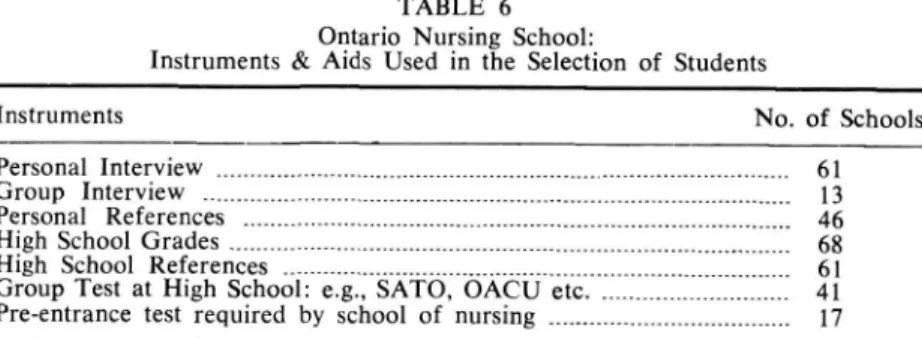
Let us now concern ourselves with the use made of tests for entrance program placement or counselling purposes in the nursing schools. The sparse data here come mainly from a provincial registered nursing associa tion's incomplete survey-"Questions Regarding Pre-Admission Testing in Schools of Nursing. "19 Table 6 reports the "Instruments and Aids Used in the Selection of Students." The two most frequently used tests were the C.Q.T. and Otis Quick-Scoring M.A.T.
The survey attempted to garner data on pre-admission testing, but some of the comments supply information on post-admission testing as well. Ad mission test administrations are shared between school staff and trained psychologists seconded from the hospitals. Increasingly (though slowly) there are nurses with measurement and guidance training engaged in test
,. See the SATO Technical Reports for 1964-65, 65-66, 66-67, 67-68.
17 Developed as I of the 4 tests in the OACU battery in 1966-67 and 67-68, it is the prototype for CELAT one of the 2 tests in the SACU battery used nationally in February, 1969.
,. Whereas for the final year high school group the scores are normally distributed, on this group the scores are possibly skewed.
,. See "More Nursing Schools Move Within Framework . , Education". The Canadian
interpretation. Although only 6 schools analyze test results in any compre hensive manner, most admit to using the scores as a segment of the student evaluation which draws heavily also on personal interview, references, and school academic achievement. Many schools feel that the standardized tests give a broader knowledge of the students aptitudes, abilities, and interest in nursing. However, after experimentation other schools have concluded that for them: (a) personality and interest test results have not correlated with behaviours and emotional stability, (b) work experience or extra-curricular activities appear to be rather more closely related to achievement in theory and clinical practice, (c) it is wiser to engage in post admissions testing20 where results seem relevant and necessary for guidance and counselling. Results of standardized testing programs from high schools are used for placement in 4 schools, diagnostically in 3, for counselling in 4, as an aid in admissions' decisions in 6.
TABLE 6 Ontario Nursing School:
Instruments & Aids Used in the Selection of Students
Instruments No. of Schools
Personal Interview 61
Group Interview . 13
Personal References 46
High School Grades 68
High School References 61
Group Test at High School: e.g., SATO, OACU etc. 41
Pre-entrance test required by school of nursing 17
Other aids mentioned were: Employment experience and/or participation in group activities, own tests, personnel appraisal, adaptability test.
Since development in Canadian university admissions' testing are al ready well known by us, I will make only brief comments on this topic. The former program of success on provincial essay-cum-objective exams in final high school year as the university admission requirement is being altered in most provinces. Earlier research (e.g., the Atkinson Studies at Toronto) had demonstrated that final high school exam grade was the best predictor of university success. Some provinces like British Columbia and Ontario have clearly de-emphasized provincial examinations, and all provinces are now working feverishly on curriculum and organizational changes designed to give more freedom to high school teachers. Ontario launched OACU, its own standardized objective testing program of 4 tests in 1966-67; the Cana dian universities admission testing corporation SACU held its first annual (February, 1969) national test administrations in aptitude and mother tongue (French and English). The Ontario program lists only 2 tests maths and physics-until June 1970. SACU plans to research the predictive validity of its two tests, will make them more widely available to Canadian institutions and undoubtedly plans to play a leading role in studying the
20 Most frequently used tests here are the Edwards Personal Preference Inventory. The House
Tree·Person, and the Brainard Occupational Preference Inventory. My colleague Dr. Josephine Flaherty is extending this investigation to include prediction of success and placement in some nursing schools over a S-year period.
effectiveness of tests for university and college admissions and placement for different regions of Canada.
Do CANADIAN POST SECONDARY INSTITUTIONS COMPRISE A CHALLENGE TO COUNSELLORS?
In replying in the affirmative, I am persuaded to identify the challenge in these ways:
I. The present program of community colleges and large nursing education schools is new, not yet five years old, and multi-dimensional with con siderable energy being poured into the cempletion of physical plants, adaptation to them, and to the organization of courses: this is the very situation in which counselling should be emphasized if we recognize that counsellors have an important role to play in curriculum development through the involvement of students and the community in policy formu lation. In this 'novel' environment, the counsellor will be the customary staff member sought by students beset by vocational, academic and per sonal problems. He will possess the competence to (I) help the student whether the difficulty is caused from within the self or from unexpected environmental pressures; and (2) help the college to recognize severe problem areas while hopefully they are still of manageable dimensions. 2. The good counsellor is invaluable to the rest of the staff for discussing the
more serious or unusual student difficulties. New institutions lack tradi tion-even a tradition of problems to expect and program for. The coun sellor should be a consultant to his teaching colleagues on many of these sorts of issues. His training in adolescent psychology and group dynamics should enable him to promote a staff dialogue on more effective methods of teaching to eradicate student weaknesses not readily recognized by staff.
3. The absence of prototype forces the post secondary counsellor to reject the mere counsellor-therapist role and opt also for the model of preven tive interaction with .student body and administration, anticipating the needs of both and reaching out to members of the college community who on their own initiative would not attend the counsellor's office. The role certainly calls for collaboration with the admissions' office in the interpretation of general policies which affect the lives of so many students. 4. The counsellor is challenged by the fact that so little is known about his student population. More than other staff he would be aware through the reading of research studies (Super, O'Hara and Tiedeman) that although progress has been made in vocational theory development, more has to be explained before we can feel assured of the rightness of the directions in which vocational education is being prodded. His flexibility when think ing of vocational education needs should be akin to Super's whose earlier view was that each occupation requires its own characteristic pattern of interest, abilities, and personality traits but with enough leeway on either side to permit some variety of occupation roles for each person and also some variety of persons to each occupational role.
Sparsity of conclusions is also evident in the work which has been done on the theory that the student's view of himself is an important factor in his vocational development and the construct of role-playing as a facilitator in the development of the vocational self-concept. Research
has investigated this view of the self concept for very few occupations mainly teaching and nursing-and their findings can hardly be general ized to the other occupations for which our institutions now train person nel.
5. Hardly anyone else is in a better position than the guidance counsellor to understand the current rate of social change of which there are many on campus evidences. Because the newer post secondary institutions recruit predominantly from some subgroups which were denied educational opportunities when the Canadian society provided a narrower range of institutions for a highly select student body, guidance counsellors need to point out that we have not yet assessed the effect of motivation and real istic goal setting in improving the learning of this group of students. 6. The counsellor's knowledge of testing and the caution with which test
results should be employed make him a key person in staff discussions and l1ecisions concerning initial and subsequent placement. This is particularly true since I assume that there is acceptance of the pattern that the coun sellor will be involved in helping the student to place himself intelligently. While interpreting test results the counsellor ought to be mindful of some of the finding of Endler (York U,) and Snyder viz: (i) in females test
anxiety seems to interfere with intellectual performance but general
anxiety has no such effect on either the male or the female, (ii) the negative relationship between achievement and anxiety is not as strong as the negative relationship between aptitude and anxiety.
7. Many Canadian researchers have tended to put considerable faith in exploring intellective, demographic and to some extent socio-economic profiles of students in some types of post-secondary institutions.21 One ongoing Toronto university doctoral thesis (research population of 1838 drawn from I CC only for the period 1967-69) is concluding that measures of intellective factors do not supply strong reasons why some students succeed and other fail.~~ We should search for answers elsewhere. Know ing this, counsellors should begin to develop other types of profiles on their students. Ed Johnson's M.A. thesis "Student and Prospective Student Perceptions of Environment in Two Alberta Colleges" penetrates an area which should be speedily researched in all parts of Canada. Johnson uses Pace and Stern's 'College and University Environmental Scale' to investi gate the students' expectations in the two Alberta CCs. His data analysis is indicating that:
at CC# I prospective students have an inaccurate perception of the college program, etc.: at CC#2 prospective students have a more accur ate perception of the college program, etc.; CC#2 is seen as a well organ ized and ordered institution so far as its 'government' is concerned; CC# I is perceived as being strong on community attitude; at both institutions, students expected a greater emphasis on scholarship than what they eventually experienced through the first year of attendance. We should read this study carefUlly to estimate the relevance of the CU ES and others
"See especially some of the writings of W. G. Fleming and Dormer Ellis at OISE over the last decade.
Z! Some variables in this study are marks on Grade 12 SATO, Nelson Denny. C.Q.T.
(N.V.I.Sc., Soc.), Dominion Learning Capacity Advanced. Success is definied as a clear pass on 4 subjects in the second semester in a Cc.
like it as test and research instrument but moreso to see how counsellors may:
i) discover our students' perception of their post-secondary institutions, communicate these new findings to high school guidance counsellors, counsel the students to recognize the college goals and quickly relate them to their own.
ii) explore the environmental influences of their institutions.
iii) try to identify the faculty's perceptions of their institutions. This approach should provide new in-put for influencing college environ ments and college curricula.
Finally, I must comment that the survey data illustrates that there is no national acceptance of the view that post-secondary institutions ought to have trained counsellors. Even in the same province there is a wide varia tion in the quality of the guidance and counselling services. We here ought to devise a strategy for prodding the authorities to institute at least minimum counselling standards for large, new and important educational institutions, and knowing the limitations of traditional type testing as the main means of
identifying aspiration subgroups in the student population, we ought instead
to turn to regional descriptive studies for which we will ingeniously devise questionnaire instruments. In at least two large provinces the groping has already begun.
SELECTED BIBLIOGRAPHY
Clifford, P. C. Testing the educational and psychological development of adolescents, ages 12-18 Review of Educational Research, 38, No. I, (Febru ary 1968), pp. 29-39.
"Community colleges across Canada." Canadian Commission for the Com munity College, Toronto. College Canada. 1, No. I, (April 1969) p. 3.
(The) Counselling Psychologist. Vocational Development Theory, I, No. I, 1969.
Countdown 1968: Canl'}dian Nursing Statistics. Canadian Nurses Association, Ottawa, 1968.
Dominion Bureau of Statistics. Advance statistics of education, 1967-68,
1968-69, Ottawa.
Survey of Higher Education Part I. Fall enrolment in universities and col/eges,
1967-68, Ottawa, (I 968).
Endler, N. S. Factors related to the prediction of academic success. Ontario Journal of Educational Research. 7, No.2, (Winter, 1964-65) pp. 147-154. Endler, N. S., and Snyder, L. S. Anxiety, aptitude and academic achievement.
Ontario Journal of Educational Research. 6, No.2, (Spring, 1964), pp. 85-9 I.
Fleming, W. G. Contributions and progress of the Atkinson study of utiliza tion of student resources. Ontario Journal of Educational Research. 6, No. 2, (April, 1954), pp. 167-171.
Pallone, N. J., & Hosinki, M. Reality-testing a vocational choice: Congruence between self, ideal and occupational percepts among student nurses. The Personnel and Guidance Journal. 4, No.3, (May, 1967), pp. 217-266. Tiedeman, D. W. Purposing through education: The further delineation of goal
and program guidance. Guidance in American Educations Backgrounds and Prospects, E. Landy & P. Perry (Eds.). Harvard Univ. Press, pp. 162-172. Watley, D. J., & Merwin. J. C. The effectiveness of variables for predicting
academic achievement for business students. Joumal of Experimental Educa tion. 33, No.2, (Winter, 1964), pp. 189-192.
Campbell, G. Re: His incomplete Ph.D. thesis on "Community Colleges in Canada," University of Calgary.
Glendenning, D. (Principal of Holland College, P.E.I.) Re: Developments in P.E.1.
Johnson, E. (Director of Counselling, Mt. Royal College, Calgary).
Sheffield, E. F. Professor, University of Toronto and Consultant on Higher Education to the P.E.!. Government.
LES INSTITUTIONS POST-SECONDAIRES DU CANADA:
UN Df:FI AUX CONSEILLERS D'ORIENTATION?
VINCENT D'OYLEY
Le texte donne un aper~u du developpement recent des institutions post-secondaires et expose comment les infirmieres re~oivent une partie de leur formation en dehors des ecoles d'infirmieres, dont les plus petites sont progressivement abandonnees.
II ressort des donnees de cetle recherche que la fa~on dont les maitres et les conseillers d'orientation utilisent les tests n correspond pas entierement
a
celie qu'ils disent utiliser. II ne semble pas exister d'oppositiona
l'usage des tests dans les colleges locaux.Le texte contient des donnees d'enquete sur l'usage de differents tests dans les colleges locaux et dans les ecoles de nursing. Un usage mieux adapte des tests dans ces institutions est souhaitable. Certaines ecoles de nursing mettent l'accent sur l'utilisation de teste donnes apres l'admission pour des fins de counselling et de placement.
L'auteur conclut que les colleges locaux et autres institutions semblables posent un defi aux conseillers d'orientation parce que:
l~es colleges nont pas de tradition en matiere d'organisation 2---on connait mal les aspirations de leurs etudiants
3---on n'a pas encore etudie
![Synthesis and biological evaluation of new dipyrrolo[3,4-a:3,4-c]carbazole-1,3,4,6-tetraones, substituted with various saturated and unsaturated side chains via palladium catalyzed cross-coupling reactions](data:image/gif;base64,R0lGODlhAQABAIAAAP///wAAACH5BAEAAAAALAAAAAABAAEAAAICRAEAOw==)